Brecht, Bertholt
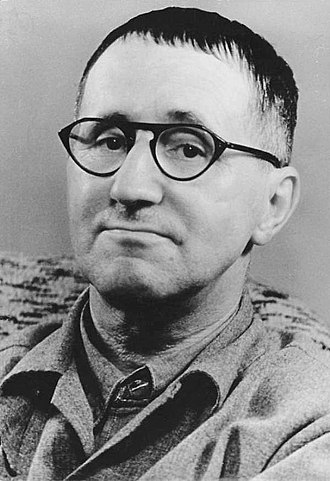
ALIAS: Eugen Bertolt Friedrich Brecht
DATE OF BIRTH: 10th February, 1898
PLACE OF BIRTH: Augsburg, Germany
DATE OF DEATH: 14th August, 1956
PLACE OF DEATH: East Berlin, East Germany
DISCIPLINE: Theater Arts
FIELD: Playwright, theater critic, editor
ASSESSMENT: Known for the “epic” theater style and numerous plays and musicals, he is an influential figure in 20th-century theater.
LANGUAGE/S: German
EDUCATION: University of Munich (never finished his degree)
ACHIEVEMENTS: Founded Berlin Ensemble with Helene Weigel, 1949; Left dozens of plays, verse, theatrical critics and fiction.
MAJOR-WORK/S: Mutter Courage und ihre Kinder (“Mother Courage and Her Children”), 1949;
Der aufhaltsame Aufstieg des Arturo Ui (“The Resistable Rise of Arturo Ui”), 1957; Der gute Mensch von Setzuan(“The Good Woman of Setzuan”), 1943; Die Dreigroschenoper (“The Threepenny Opera”), 1928
LIFE AND TIMES:
Brecht was too young to enlist for World War I, but was given a job as a plane spotter atop a watch tower, where he witnessed death and destruction. Amply affected by this experience, he didn’t volunteer for military service when he came of age.
In 1917, to avoid being drafted, he enrolled at the University of Munich as a medical student. Uninterested in the study of medicine, he spent most of his time attending theater classes and writing his first major play, Baal. In it he plagiarized his favorite poets, Francois Villon, Rimbaud* and Verlaine*.
Despite his efforts to stay out of the war, he was drafted in 1918 and given the unenviable position of an orderly in the venereal disease ward of a military hospital. His claim he was traumatized by the gruesome experience is supported by his works, many of which take an antiwar, antimilitary stance.
From the end of the war to 1924, he staged several plays, all of them closing shortly after they opened. Although some of the plays were well received, the contents - full of homoerotic and antibourgeois themes - made the theater owners uncomfortable. In addition, some critics made a sport of pointing out the many plagiarized passages – accusations Brecht never denied. Instead, he countered that he approached copyrighted works with a “laxity in matters of intellectual property.”
In 1924, theater producer Max Reinhardt offered Brecht a position in Berlin, where avant-garde literary circles of Germany congregated. The charming Brecht recruited friends who did most of his work, including the writing. But he was a talented self-promoter and businessman, often pitting one theater against the other to negotiate profitable productions, a major feat since his works were mostly unsuccessful.
Then, in 1928, he staged a musical play called The Threepenny Opera, translated and adapted from Gay’s* Beggar’s Opera (1728). Weill* composed the score and the musical was a smash hit. Even though Weill received his training from classical musicians, including Humperdinck, he used the musical as a platform to fuse modern and popular styles and to explore political themes with music.
Most of the lyrics and story were borrowed without acknowledgement, but the most famous and persistent song, ‘Mack the Knife,’ holds Brecht’s original lyrics. The bulk of the profits went to Brecht, with only a small percentage for Weill and even a smaller percentage for Elisabeth Hauptmann, the originator of the idea and translator. With the musical’s success and shrewd investments with the profits, Brecht became wealthy.
Although Brecht hounded producers, publishers and critics, getting most of his work produced and published and reviewed, his works after The Threepenny Opera were as unsuccessful as before. Between 1928 and 1930, Brecht wrote several educational pieces for actors, which were scored by Weill and Hindemith*. But Hindemith and Weill both became disenchanted with Brecht’s behavior and abandoned him shortly after.
His circle of friends, pounding out the work, also became unhappy with the lack of credit, profit and the abuse of them by the perfectionist Brecht. In addition, the publishers and collaborators were wary with the numerous broken deadlines and constant content changes.
The unfavorable situation for Brecht in Berlin was overshadowed by the increasing power of the Nazi party. Germany was becoming unsafe for Brecht’s contemporaries, many of whom were Jewish, homosexual and communist. Brecht had also studied Marx, K 2ism and was affiliated with the communist party. Finally in 1933 after the Nazis started burning leftist books, including Brecht’s publications, he left Germany and sought refuge in Scandinavia.
There, he wrote many of his most famous plays, including The Resistible Rise of Arturo Ui, an allegory about Hitler’s rise to power. When the Germans invaded Denmark and Norway in 1940, Brecht applied to enter the United States.
By 1941, he was in Hollywood, which he despised for commercializing art. But his declining funds forced him to try selling movie treatments. His efforts were unsuccessful, since the atmosphere was distinctly unfriendly towards him. Many of his fellow exiles were still resentful over his unfair business dealings with them. Unable to strike up any significant deals in Hollywood, he tried writing for American theater.
While his old collaborator Weill had become a respected Broadway composer, Brecht was unable to charm New York or Hollywood as he had Berlin. But in 1947, he convinced premier poet, W.H. Auden* to collaborate in adapting The Duchess of Malfi. Later, Auden was reported to have called Brecht “positively evil.”
That year Brecht was called to testify before the House Un-American Activities Committee, an organization which hunted communists, ruining the careers and lives of those found to be affiliated. Although a known communist, he categorically denied any involvement. In fear of retribution, Brecht fled America the next day for Zurich, never to return to the United States.
He roamed around Europe without formal citizenship until he settled in communist Berlin, where the Soviets offered him a place to stage his plays, and used him as for propaganda purposes, giving him the Stalin Peace Prize in 1955.
With his wife, Helene Weigel - an actress who starred in many of his plays - he started the Berlin Ensemble, a troupe devoted to his work. There, he fully explored “epic” theater, a style that seeks to detach the audience from the performance by making ordinary events and objects appear strange and unfamiliar.
In 1956, Brecht died of a heart attack, was given a state funeral and was buried next to Hegel 2, a German philosopher who influenced both Adolf Hitler and Karl Marx. He left a prolific body of work which has profoundly influenced 20th century theater, especially in Europe.
EXTRA CONNECTIONS:
Worked with Peter Lorre
McDonalds used Mack the Knife in an epic re-branding fail.
ONELINER: Bertholt Brecht, 20th-century German playwright
BIBLIOGRAPHY:
Andre, Chris. “Brecht, Bertolt”; http://www.anb.org/articles/16/16-01944.html; American National Biography Online Feb. 2000. Access Date: Mon Sep 29 14:35:16 PDT 2003.
EB
Dictionary of Literary Biography, Volume 56: German Fiction Writers, 1914-1945. A Bruccoli Clark Layman Book. Edited by James Hardin, University of South Carolina. The Gale Group, 1987. pp. 39-61.
Dictionary of Literary Biography, Volume 124: Twentieth-Century German Dramatists, 1919-1992. A Bruccoli Clark Layman Book. Edited by Wolfgang D. Elfe, University of South Carolina and James Hardin, University of South Carolina. The Gale Group, 1992. pp. 57-74.
Fuegi, John, Brecht and Company: Sex, Politics, and the Making of the Modern Drama, Grove Press, New York, New York. 1994.
PARENTS: Berthold Friedrich Brecht and Sofie Brezing
SPOUSE: Marianne Zoff, 1922 (divorced in 1927); Helene Weigel, 1929
SIBLINGS: 1, brother, Walter
CHILDREN: 4: Frank (with Paula Banholzer), Hanne (with Zoff), Stefan and Barbara (with Weigel)