Maxwell JC
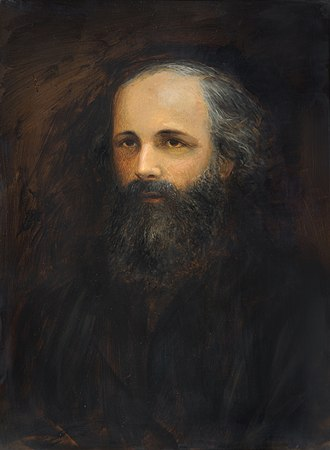
James Clerk Maxwell
Achievements: Electromagnetic theory
Born: 13 November 1831, Edinburgh, Scotland
Died: November 5, 1879; Cambridge, England. Aged 48
Field & Discipline: Science; Physics; Physicist
Education: Edinburgh Academy; University of Edinburgh; Trinity College, Cambridge
Major Work:
"On Physical Lines of Force" (1661)
"On a Dynamical Theory of the Electro-magnetic Field" (1864)
"Treatise on Electricity and Magnetism" (1873)
"On the Theory of Compound Colours" (1860)
"On the Dynamical Theory of Gases" (1867)
Life & Times:
After Edinburgh University Maxwell went on to Cambridge, where he taught the mathematician [taught] Pearson*. He was offered a fellowship at Trinity College but returned to Scotland to be near his sick father.
In 1855 he presented a paper on color-blindness ("Experiments on Colour, as perceived by the Eye, with remarks on Colour-Blindness") to the Royal Society. Together with earlier work on the same subject by Thomas Young*, Maxwell's paper started modern colorimetry.
At the end of the year his paper on "Faraday's Lines of Force" was read before the Cambridge Philosophical Society. This paper, in which he gave a mathematical explanation of [work related to] Faraday's* concept of electromagnetic lines of force, was the basis for Maxwell's later theory of electromagnetism. Maxwell used the analogy, suggested earlier by [influenced by] Kelvin*, between electric or magnetic fields and the steady flow of heat. Faraday wrote to Maxwell the following year to congratulate him on his paper.
Maxwell was appointed to the chair of natural philosophy at Aberdeen University in 1856 and over the next couple of years devoted much of his attention to the question of the stability of Saturn's rings. In his final paper on the subject, "On the Stability of the Motion of Saturn's Rings" (1859), he stated that the rings were not solid and must consist of numerous small bodies, since conformed by modern space studies). His work on Saturn's rings gave Maxwell a dazzling reputation with his contemporaries and he was awarded the Adams prize. In 1860 he became professor of physics and astronomy at King's College, London.
His greatest work was done over the next five years. He was awarded the Rumford Medal by the Royal Society for his work on color and continued to research this subject in 1861. During a lecture on his color research at the Royal Institution in May 1861, he displayed the first color photograph. He had taken a black and white photograph through three filters (green, red and blue) and then projected and superimposed the results through the same filters.
He also designed apparatus for research into the molecular theory of gases which he carried out in his attic. He concluded that the different speeds of the molecules of a gas followed a statistical distribution and were not as was previously thought all equal. His theory, published in his paper "On the Dynamical Theory of Gases" (1867) was later generalized by the German physicist [influenced] Boltzmann*.
Maxwell's most important work was his investigation into electromagnetism. He approached the subject through a model (a fluid agitated by numerous vortices) which extended the theories of Kelvin and [extended theory of] Rankine* on rotating molecules, and he also adopted Rankine's term 'molecular vortices'.
In 1861 and 1864 he produced two papers on his conclusions before he resigned from his university post in 1865 to write his treatise on the subject at the family home in Galloway.
In his treatise, he set out the laws, or equations, of electromagnetism. His theory of electromagnetism was a synthesis which unified the two forces of electricity and magnetism. It contrasted with the accepted idea of action-at-a-distance, where a force acted on an object over empty space. For Maxwell, space was not empty. It was an electromagnetic field.
The equations he provided to explain the forces in this field provided the basis for [laid ground for] Einstein's* theory of relativity. Maxwell's aim was to provide proof of Faraday's law of induction ("that a changing magnetic field gives rise to an induced electromagnetic field").
When Maxwell constructed a mechanical model to do this, he discovered that a displacement current was produced in the di-electric medium which could then produce transverse waves. When he calculated the speed of the waves, he found they were near to the speed of light which suggested that light was an electromagnetic phenomenon, or at least existed in the same medium which produced electric and magnetic phenomena. Maxwell's theory also suggested that electromagnetic waves could be generated in the laboratory. This was later proved by [theory proved by] Hertz* .
In 1871, urged on by the mathematician [supported by] Stokes* and the brilliant young academic J W Strutt (later Lord [supported by] Rayleigh*), Maxwell accepted the newly established chair of experimental physics at Cambridge. He helped to design
the Cavendish physical laboratory and under his directorship there was a revival of physical science at Cambridge.
Maxwell lectured, examined and wrote and edited scientific papers while also finding time for creative work in thermodynamics, statistical mechanics, capillarity and optics.
He died in 1879 after a short illness and was buried privately in Scotland.
Extra Connections:
He recognized [admired] Somerville’s* talents.
[admired by] Helmholtz* was one of the first to recognize his work.
His work related to that of [work related to] Kirchhoff*, [work related to] Brewster*, [work related to] Lorentz*, [work related to] Boris Golitsyn* and [work related to] Heaviside*
Because of his asocial and secretive behaviour, Cavendish often avoided publishing his work, and much of his findings were not told even to his fellow scientists. In the late nineteenth century, long after his death, James Clerk Maxwell looked through Cavendish's papers and found observations and results for which others had been given credit. Examples of what was included in Cavendish's discoveries or anticipations were Richter's law of reciprocal proportions, Ohm's law, Dalton's law of partial pressures, principles of electrical conductivity (including Coulomb's law), and Charles's Law of gases. A manuscript "Heat", tentatively dated between 1783 and 1790, describes a "mechanical theory of heat".
American mathematician Norbert Wiener published his book Cybernetics in 1948 in which he made reference to an 1868 article by the British physicist James Clerk Maxwell on governors.
Assessment: One of the greatest influences on 20th Century physics.
Oneliner: J C Maxwell, major British physicist
Language: English
Father: John Clerk
Mother: Frances Cay
Siblings: None
Spouse: Mary Dewar
Children: None
Bibliography:
- Tolstoy, Ivan, James Clerk Maxwell, A Biography, Canongate, Edinburgh, 1981.
Wiki
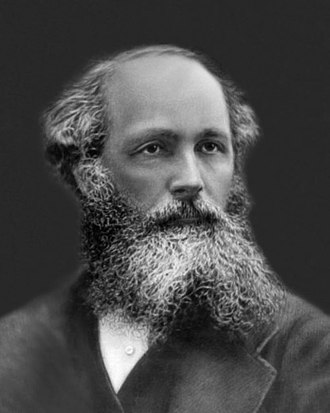
James Clerk Maxwell FRSE FRS (13 June 1831 – 5 November 1879) was a Scottish mathematician[1][2] and scientist responsible for the classical theory of electromagnetic radiation, which was the first theory to describe electricity, magnetism and light as different manifestations of the same phenomenon. Maxwell's equations for electromagnetism have been called the "second great unification in physics"[3] where the first one had been realised by Isaac Newton.
With the publication of "A Dynamical Theory of the Electromagnetic Field" in 1865, Maxwell demonstrated that electric and magnetic fields travel through space as waves moving at the speed of light. He proposed that light is an undulation in the same medium that is the cause of electric and magnetic phenomena.[4] The unification of light and electrical phenomena led to his prediction of the existence of radio waves. Maxwell is also regarded as a founder of the modern field of electrical engineering.[5]
Maxwell helped develop the Maxwell–Boltzmann distribution, a statistical means of describing aspects of the kinetic theory of gases. He is also known for presenting the first durable colour photograph in 1861 and for his foundational work on analysing the rigidity of rod-and-joint frameworks (trusses) like those in many bridges.
His discoveries helped usher in the era of modern physics, laying the foundation for such fields as special relativity and quantum mechanics. Many physicists regard Maxwell as the 19th-century scientist having the greatest influence on 20th-century physics. His contributions to the science are considered by many to be of the same magnitude as those of Isaac Newton and Albert Einstein.[6]
In the millennium poll—a survey of the 100 most prominent physicists—Maxwell was voted the third greatest physicist of all time, behind only Newton and Einstein.[7] On the centenary of Maxwell's birthday, Einstein described Maxwell's work as the "most profound and the most fruitful that physics has experienced since the time of Newton".[8] Einstein, when he visited the University of Cambridge in 1922, was told by his host that he had done great things because he stood on Newton's shoulders; Einstein replied: "No I don't. I stand on the shoulders of Maxwell."[9]
Life
Early life, 1831–1839

Clerk Maxwell's birthplace at 14 India Street in Edinburgh is now the home of the James Clerk Maxwell Foundation.
James Clerk Maxwell was born on 13 June 1831[10] at 14 India Street, Edinburgh, to John Clerk Maxwell of Middlebie, an advocate, and Frances Cay,[11][12] daughter of Robert Hodshon Cay and sister of John Cay. (His birthplace now houses a museum operated by the James Clerk Maxwell Foundation.) His father was a man of comfortable means[13] of the Clerk family of Penicuik, holders of the baronetcy of Clerk of Penicuik. His father's brother was the 6th baronet.[14] He had been born "John Clerk", adding "Maxwell" to his own after he inherited (as an infant in 1793) the Middlebie estate, a Maxwell property in Dumfriesshire.[11] James was a first cousin of both the artist Jemima Blackburn[15] (the daughter of his father's sister) and the civil engineer William Dyce Cay (the son of his mother's brother). Cay and Maxwell were close friends and Cay acted as his best man when Maxwell married.[16]
Maxwell's parents met and married when they were well into their thirties;[17] his mother was nearly 40 when he was born. They had had one earlier child, a daughter named Elizabeth, who died in infancy.[18]
When Maxwell was young his family moved to Glenlair, in Kirkcudbrightshire, which his parents had built on the estate which comprised 1,500 acres (610 ha).[19] All indications suggest that Maxwell had maintained an unquenchable curiosity from an early age.[20] By the age of three, everything that moved, shone, or made a noise drew the question: "what's the go o' that?"[21] In a passage added to a letter from his father to his sister-in-law Jane Cay in 1834, his mother described this innate sense of inquisitiveness:
He is a very happy man, and has improved much since the weather got moderate; he has great work with doors, locks, keys, etc., and "show me how it doos" is never out of his mouth. He also investigates the hidden course of streams and bell-wires, the way the water gets from the pond through the wall....[22]
Education, 1839–1847
Recognising the boy's potential, Maxwell's mother Frances took responsibility for his early education, which in the Victorian era was largely the job of the woman of the house.[23] At eight he could recite long passages of John Milton and the whole of the 119th psalm (176 verses). Indeed, his knowledge of scripture was already detailed; he could give chapter and verse for almost any quotation from the psalms. His mother was taken ill with abdominal cancer and, after an unsuccessful operation, died in December 1839 when he was eight years old.
His education was then overseen by his father and his father's sister-in-law Jane, both of whom played pivotal roles in his life.[23] His formal schooling began unsuccessfully under the guidance of a 16-year-old hired tutor. Little is known about the young man hired to instruct Maxwell, except that he treated the younger boy harshly, chiding him for being slow and wayward.[23] The tutor was dismissed in November 1841. James' father took him to Robert Davidson's demonstration of electric propulsion and magnetic force on 12 February 1842, an experience with profound implications for the boy.[24]
[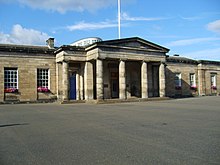
Edinburgh Academy, where Maxwell was educated
Maxwell was sent to the prestigious Edinburgh Academy.[25] He lodged during term times at the house of his aunt Isabella. During this time his passion for drawing was encouraged by his older cousin Jemima.[26] The 10-year-old Maxwell, having been raised in isolation on his father's countryside estate, did not fit in well at school.[27] The first year had been full, obliging him to join the second year with classmates a year his senior.[27] His mannerisms and Galloway accent struck the other boys as rustic. Having arrived on his first day of school wearing a pair of homemade shoes and a tunic, he earned the unkind nickname of "Daftie".[28] He never seemed to resent the epithet, bearing it without complaint for many years.[29] Social isolation at the Academy ended when he met Lewis Campbell and Peter Guthrie Tait, two boys of a similar age who were to become notable scholars later in life. They remained lifelong friends.[11]
Maxwell was fascinated by geometry at an early age, rediscovering the regular polyhedra before he received any formal instruction.[26] Despite his winning the school's scripture biography prize in his second year, his academic work remained unnoticed[26] until, at the age of 13, he won the school's mathematical medal and first prize for both English and poetry.[30]
Maxwell's interests ranged far beyond the school syllabus and he did not pay particular attention to examination performance.[30] He wrote his first scientific paper at the age of 14. In it he described a mechanical means of drawing mathematical curves with a piece of twine, and the properties of ellipses, Cartesian ovals, and related curves with more than two foci. The work, [11][31] of 1846, "On the description of oval curves and those having a plurality of foci" [32] was presented to the Royal Society of Edinburgh by James Forbes, a professor of natural philosophy at the University of Edinburgh,[11][31] because Maxwell was deemed too young to present the work himself.[33] The work was not entirely original, since René Descartes had also examined the properties of such multifocal ellipses in the 17th century, but Maxwell had simplified their construction.[33]
University of Edinburgh, 1847–1850

Old College, University of Edinburgh
Maxwell left the Academy in 1847 at age 16 and began attending classes at the University of Edinburgh.[34] He had the opportunity to attend the University of Cambridge, but decided, after his first term, to complete the full course of his undergraduate studies at Edinburgh. The academic staff of the university included some highly regarded names; his first year tutors included Sir William Hamilton, who lectured him on logic and metaphysics, Philip Kelland on mathematics, and James Forbes on natural philosophy.[11] He did not find his classes demanding,[35] and was therefore able to immerse himself in private study during free time at the university and particularly when back home at Glenlair.[36] There he would experiment with improvised chemical, electric, and magnetic apparatus; however, his chief concerns regarded the properties of polarised light.[37] He constructed shaped blocks of gelatine, subjected them to various stresses, and with a pair of polarising prisms given to him by William Nicol, viewed the coloured fringes that had developed within the jelly.[38] Through this practice he discovered photoelasticity, which is a means of determining the stress distribution within physical structures.[39]
At age 18, Maxwell contributed two papers for the Transactions of the Royal Society of Edinburgh. One of these, "On the Equilibrium of Elastic Solids", laid the foundation for an important discovery later in his life, which was the temporary double refraction produced in viscous liquids by shear stress.[40] His other paper was "Rolling Curves" and, just as with the paper "Oval Curves" that he had written at the Edinburgh Academy, he was again considered too young to stand at the rostrum to present it himself. The paper was delivered to the Royal Society by his tutor Kelland instead.[41]
University of Cambridge, 1850–1856

A young Maxwell at Trinity College, Cambridge, holding one of his colour wheels
In October 1850, already an accomplished mathematician, Maxwell left Scotland for the University of Cambridge. He initially attended Peterhouse, but before the end of his first term transferred to Trinity, where he believed it would be easier to obtain a fellowship.[42] At Trinity he was elected to the elite secret society known as the Cambridge Apostles.[43] Maxwell's intellectual understanding of his Christian faith and of science grew rapidly during his Cambridge years. He joined the "Apostles", an exclusive debating society of the intellectual elite, where through his essays he sought to work out this understanding.
Now my great plan, which was conceived of old, ... is to let nothing be wilfully left unexamined. Nothing is to be holy ground consecrated to Stationary Faith, whether positive or negative. All fallow land is to be ploughed up and a regular system of rotation followed. ... Never hide anything, be it weed or no, nor seem to wish it hidden. ... Again I assert the Right of Trespass on any plot of Holy Ground which any man has set apart. ... Now I am convinced that no one but a Christian can actually purge his land of these holy spots. ... I do not say that no Christians have enclosed places of this sort. Many have a great deal, and every one has some. But there are extensive and important tracts in the territory of the Scoffer, the Pantheist, the Quietist, Formalist, Dogmatist, Sensualist, and the rest, which are openly and solemnly Tabooed. ..."
Christianity—that is, the religion of the Bible—is the only scheme or form of belief which disavows any possessions on such a tenure. Here alone all is free. You may fly to the ends of the world and find no God but the Author of Salvation. You may search the Scriptures and not find a text to stop you in your explorations. ...
The Old Testament and the Mosaic Law and Judaism are commonly supposed to be "Tabooed" by the orthodox. Sceptics pretend to have read them and have found certain witty objections ... which too many of the orthodox unread admit, and shut up the subject as haunted. But a Candle is coming to drive out all Ghosts and Bugbears. Let us follow the light.[44]
In the summer of his third year, Maxwell spent some time at the Suffolk home of the Rev C.B. Tayler, the uncle of a classmate, G.W.H. Tayler. The love of God shown by the family impressed Maxwell, particularly after he was nursed back from ill health by the minister and his wife.[45]
On his return to Cambridge, Maxwell writes to his recent host a chatty and affectionate letter including the following testimony,[44]
... I have the capacity of being more wicked than any example that man could set me, and ... if I escape, it is only by God's grace helping me to get rid of myself, partially in science, more completely in society, —but not perfectly except by committing myself to God ...
In November 1851, Maxwell studied under William Hopkins, whose success in nurturing mathematical genius had earned him the nickname of "senior wrangler-maker".[46]
In 1854, Maxwell graduated from Trinity with a degree in mathematics. He scored second highest in the final examination, coming behind Edward Routh and earning himself the title of Second Wrangler. He was later declared equal with Routh in the more exacting ordeal of the Smith's Prize examination.[47] Immediately after earning his degree, Maxwell read his paper "On the Transformation of Surfaces by Bending" to the Cambridge Philosophical Society.[48] This is one of the few purely mathematical papers he had written, demonstrating his growing stature as a mathematician.[49] Maxwell decided to remain at Trinity after graduating and applied for a fellowship, which was a process that he could expect to take a couple of years.[50] Buoyed by his success as a research student, he would be free, apart from some tutoring and examining duties, to pursue scientific interests at his own leisure.[50]
The nature and perception of colour was one such interest which he had begun at the University of Edinburgh while he was a student of Forbes.[51] With the coloured spinning tops invented by Forbes, Maxwell was able to demonstrate that white light would result from a mixture of red, green, and blue light.[51] His paper "Experiments on Colour" laid out the principles of colour combination and was presented to the Royal Society of Edinburgh in March 1855.[52] Maxwell was this time able to deliver it himself.[52]
Maxwell was made a fellow of Trinity on 10 October 1855, sooner than was the norm,[52] and was asked to prepare lectures on hydrostatics and optics and to set examination papers.[53] The following February he was urged by Forbes to apply for the newly vacant Chair of Natural Philosophy at Marischal College, Aberdeen.[54][55] His father assisted him in the task of preparing the necessary references, but died on 2 April at Glenlair before either knew the result of Maxwell's candidacy.[55] He accepted the professorship at Aberdeen, leaving Cambridge in November 1856.[53]
Marischal College, Aberdeen, 1856–1860

Maxwell proved that the rings of Saturn were made of numerous small particles.
The 25-year-old Maxwell was a good 15 years younger than any other professor at Marischal. He engaged himself with his new responsibilities as head of a department, devising the syllabus and preparing lectures.[56] He committed himself to lecturing 15 hours a week, including a weekly pro bono lecture to the local working men's college.[56] He lived in Aberdeen with his cousin William Dyce Cay, a Scottish civil engineer, during the six months of the academic year and spent the summers at Glenlair, which he had inherited from his father.[14]

James Clerk Maxwell and his wife by Jemima Blackburn
He focused his attention on a problem that had eluded scientists for 200 years: the nature of Saturn's rings. It was unknown how they could remain stable without breaking up, drifting away or crashing into Saturn.[57] The problem took on a particular resonance at that time because St John's College, Cambridge, had chosen it as the topic for the 1857 Adams Prize.[58] Maxwell devoted two years to studying the problem, proving that a regular solid ring could not be stable, while a fluid ring would be forced by wave action to break up into blobs. Since neither was observed, he concluded that the rings must be composed of numerous small particles he called "brick-bats", each independently orbiting Saturn.[58] Maxwell was awarded the £130 Adams Prize in 1859 for his essay "On the stability of the motion of Saturn's rings";[59] he was the only entrant to have made enough headway to submit an entry.[60] His work was so detailed and convincing that when George Biddell Airy read it he commented, "It is one of the most remarkable applications of mathematics to physics that I have ever seen."[1] It was considered the final word on the issue until direct observations by the Voyager flybys of the 1980s confirmed Maxwell's prediction that the rings were composed of particles.[61] It is now understood, however, that the rings' particles are not stable at all, being pulled by gravity onto Saturn. The rings are expected to vanish entirely over the next 300 million years.[62]
In 1857 Maxwell befriended the Reverend Daniel Dewar, who was then the Principal of Marischal.[63] Through him Maxwell met Dewar's daughter, Katherine Mary Dewar. They were engaged in February 1858 and married in Aberdeen on 2 June 1858. On the marriage record, Maxwell is listed as Professor of Natural Philosophy in Marischal College, Aberdeen.[64] Katherine was seven years Maxwell's senior. Comparatively little is known of her, although it is known that she helped in his lab and worked on experiments in viscosity.[65] Maxwell's biographer and friend, Lewis Campbell, adopted an uncharacteristic reticence on the subject of Katherine, though describing their married life as "one of unexampled devotion".[66]
In 1860 Marischal College merged with the neighbouring King's College to form the University of Aberdeen. There was no room for two professors of Natural Philosophy, so Maxwell, despite his scientific reputation, found himself laid off. He was unsuccessful in applying for Forbes's recently vacated chair at Edinburgh, the post instead going to Tait. Maxwell was granted the Chair of Natural Philosophy at King's College, London, instead.[67] After recovering from a near-fatal bout of smallpox in 1860, he moved to London with his wife.[68]
King's College, London, 1860–1865

Commemoration of Maxwell's equations at King's College. One of three identical IEEE Milestone Plaques, the others being at Maxwell's birthplace in Edinburgh and the family home at Glenlair.[69]
Maxwell's time at King's was probably the most productive of his career. He was awarded the Royal Society's Rumford Medal in 1860 for his work on colour and was later elected to the Society in 1861.[70] This period of his life would see him display the world's first light-fast colour photograph, further develop his ideas on the viscosity of gases, and propose a system of defining physical quantities—now known as dimensional analysis. Maxwell would often attend lectures at the Royal Institution, where he came into regular contact with Michael Faraday. The relationship between the two men could not be described as being close, because Faraday was 40 years Maxwell's senior and showed signs of senility. They nevertheless maintained a strong respect for each other's talents.[71]

Blue plaque, 16 Palace Gardens Terrace, Kensington, Maxwell's home, 1860–1865
This time is especially noteworthy for the advances Maxwell made in the fields of electricity and magnetism. He examined the nature of both electric and magnetic fields in his two-part paper "On physical lines of force", which was published in 1861. In it he provided a conceptual model for electromagnetic induction, consisting of tiny spinning cells of magnetic flux. Two more parts were later added to and published in that same paper in early 1862. In the first additional part he discussed the nature of electrostatics and displacement current. In the second additional part, he dealt with the rotation of the plane of the polarisation of light in a magnetic field, a phenomenon that had been discovered by Faraday and is now known as the Faraday effect.[72]
Later years, 1865–1879

The gravestone at Parton Kirk (Galloway) of James Clerk Maxwell, his parents and his wife

This memorial stone to James Clerk Maxwell stands on a green in front of the church, beside the war memorial at Parton (Galloway).
In 1865 Maxwell resigned the chair at King's College, London, and returned to Glenlair with Katherine. In his paper "On governors" (1868) he mathematically described the behaviour of governors—devices that control the speed of steam engines—thereby establishing the theoretical basis of control engineering.[73] In his paper "On reciprocal figures, frames and diagrams of forces" (1870) he discussed the rigidity of various designs of lattice.[74][75] He wrote the textbook Theory of Heat (1871) and the treatise Matter and Motion (1876). Maxwell was also the first to make explicit use of dimensional analysis, in 1871.[76]
In 1871 he returned to Cambridge to become the first Cavendish Professor of Physics.[77] Maxwell was put in charge of the development of the Cavendish Laboratory, supervising every step in the progress of the building and of the purchase of the collection of apparatus.[78] One of Maxwell's last great contributions to science was the editing (with copious original notes) of the research of Henry Cavendish, from which it appeared that Cavendish researched, amongst other things, such questions as the density of the Earth and the composition of water.[79] He was elected as a member to the American Philosophical Society in 1876.....
Sandbox (Cybernetics)