Sprat, Thomas
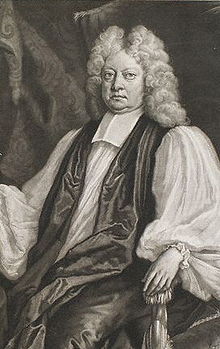
ACHIEVEMENT(S): Influential early member of Royal Society
DATE AND PLACE OF BIRTH: 1635, Beaminster, Dorset, England
DATE/PLACE OF DEATH/AGE AT DEATH: May 20, 1713, Bromley, Kent, England. Aged about 78
DISCIPLINE: Chronicler/Priest
FIELD: Science/Religion
LANGUAGE: English
PARENTS: Thomas Sprat; (First name unknown) Strode
SIBLINGS: Several, names unknown
SPOUSE: Lady Helen Wolseley
CHILDREN: George; Thomas (archdeacon of Rochester)
EDUCATION: Oxford University
MAJOR WORK: "History of the Royal Society"
LIFE AND TIMES:
As an undergraduate at Oxford around 1652, Sprat became friends with the warden of Wadham College, churchman/scientist Wilkins*, who invited him to join an influential scientific circle, which included architectWren*. Wilkins had begun to hold such meetings about seven years earlier in London, and they eventually led to the founding of the Royal Society in 1660.
In 1659, at 24, Sprat published his first work, "To the Happy Memory of the Late Lord Protector," poems in praise of Cromwell*. In 1660, he was ordained an Anglican priest, and the same year was appointed chaplain to George Villiers, second duke of Buckingham, a post he retained for at least 10 years.
In May, 1660, Charles II was restored to the throne, and Sprat, like many of his colleagues, changed loyalties and became a staunch Tory and devout royalist. He was elected to the Royal Society in 1663.
In 1667, Sprat published his most famous prose work, "History of the Royal Society*". During the Society's early years, most of the Society's members leaned toward empiricism, following Francis Bacon* or they leaned toward Puritanism and were regarded with suspicion by many. Sprat's "History," backed by the Society, was intended to explain its nature, organization, and activities, and to show that the promotion of its affairs was a national, even a patriotic, enterprise, that promised great discoveries and material benefits for the nation's future.
"History of the Royal Society" was divided into three parts. The first presented a survey of ancient, medieval and Renaissance philosophy (to show how different the new approach was). The second outlined the seven-year history of the Society. And the third attempted to refute all objections to the Society's aims and activities. In the second section (the historical section), Sprat explained the Society's origins, then detailed its nature and aspirations, its organization, membership, meetings, subject matter, method of inquiry and the benefits of its cooperative work (as opposed to Descartes'* contemplative method), its reputation abroad, and gave 14 examples of investigative papers produced by Society members between 1661 and 1664.
The first printing of Sprat's work sold out in six months, with many copies being sent to scientists and intellectuals abroad. The work continued to be highly influential until the end of the 18th century, but its historical reliability has frequently been questioned, and it is now regarded as a fascinating exercise in 17th-century public relations during an age that was often hostile to the new science.
During the second half of the 17th century, other Society members published works extolling the new science. These include Boyle*'s "Sceptical Chymist"(1661),Hooke*'s "Micrographia" (1665),Grew*'s "Anatomy of Plants" (1681),Ray's* "History of Plants" (in three volumes, 1686-1704), andNewton*'s "Principia Mathematica" (1687).
In 1669, Sprat was made a canon at Westminster Abbey, and a year later the Duke of Buckingham gave him the living of Uffington Rectory in Lincolnshire. In 1676, he was appointed chaplain to Charles II and in 1679 curate and lecturer at St. Margaret's, Westminster. The diarist Evelyn* wrote that he went to St. Paul's Cathedral "to hear that great wit, Dr. Sprat". In 1681, Sprat was made a canon at Windsor, then in 1683 dean of Westminster Abbey, and finally in 1684 Bishop of Rochester. In 1686, he took a seat on the new ecclesiastical commission of the new king, James II, and opened its proceedings at Whitehall. In 1689, he assisted at the coronation of William and Mary, along with philosopher Locke*.
ASSESSMENT: Though attaining a high position in the Anglican Church, was best known for his history of the Royal Society, which later was generally dismissed as a work of propaganda
EXTRA CONNECTIONS: None
ONELINER: Thomas Sprat, early Royal Society member
BIBLIOGRAPHY:
DNB, DSB, EB
Jones, W.H., "Thomas Sprat (1635-1713)", in Notes and Queries, 197 (5 January 1952), 10-14 and (15 March 1952), 118-123.
Britannica on attempts to improve English language. Wikpedia: Samuel Johnson opposed.