Descartes, Rene
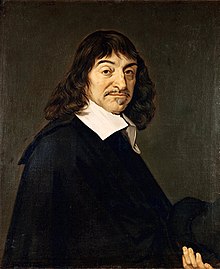
Achievements: Reductionism
Born: March 31, 1596, La Haye [now Descartes], Touraine, France
Died: February 11, 1650, Stockholm, Sweden. Aged 53
Field & Discipline: Philosophy; Mathematics; Engineering
Language: French; Mathematics; Engineering
Education: Jesuit College, La Fleche, France; University of Poitiers, France
Major Work:
"Method for Properly Guiding the Reason and Finding Truth in the Sciences."
Life & Times:
After university, Descartes went to Breda, Netherlands, as a student in mathematics and military architecture in the army of Protestant ruler, Prince [worked for] Maurice of Nassau*. He met physicist [dedicated first work to] Isaac Beeckman*, who encouraged him in science and mathematics and to whom Descartes dedicated his first scholarly work, "Compendium of Music" (written in 1618, published in 1650.) From 1619 to 1628, Descartes toured Europe, arriving first in Germany, where he joined the forces of Maximilian of Bavaria. In November, 1619, in the famous "stove-heated room" on the Danube, near Ulm, Descartes had three dreams that instructed him to set up a unified philosophical system of certainty in knowledge, modeled on mathematics and supported by a rigorous rationalism.
Influenced in part by [influenced by] da Vinci*'s work of a century before and by [influenced by] Francis Bacon*'s recent "Advancement of Learning,” which proposed a new science of observation and experiment to replace the traditional approach of [superseded] Aristotle*, Descartes worked out a new, reductionist method of deductive reasoning, applicable to all the sciences.
From 1624-27 Descartes lived in Paris, where he became close friends with [a pal of] Mersenne*, who introduced him to the French intellectual world. Near the end of the 1620s, Descartes produced his first major work, the "Rules for the Direction of the Mind,” which, though never completed and not published until 1701, set down four rules for reasoning:
1) accept nothing as true that is not self-evident;
2) reduce problems into their simplest parts (hence “reduction-ism”);
3) solve problems by going from simple to complex; and
4) recheck your reasoning.
The rules mark the first direct application of mathematical procedures to philosophical thought.
In 1629, Descartes settled in Holland, where he was free from the growing religious intolerance in France and from conscription in the Roman Catholic army. He attended university at Franeker, during which time he wrote the first draft of his "Meditations.” He moved to Amsterdam, where he spent two years, then to Leiden, where he met Dutch mathematician [met] Snell*. He was to change his address more than a dozen times in as many years. In the 1630s, Descartes took an interest in anatomy (studying [studied] Harvey*'s 1628 treatise on the circulation of blood), algebra, and optics, but he devoted most of his time to developing a comprehensive system to explain all phenomena.
The work was finished in 1633, but Descartes refused to publish it because of the [influenced by] Galileo* case in Rome. The Inquisition had condemned Galileo for supporting the Copernican view that the earth orbited the sun. Since the Copernican doctrine was central to Descartes's cosmology and physics, he decided to keep his work under wraps until such time as the church might retract its condemnation. "The World," the first part of Descartes's work, dealt with the origins and structure of the physical universe, and included sections on heat, light, fire, and the nature of heavenly bodies. The final section, now known as the "Treatise on Man," dealt with human physiology.
Throughout the rest of the 1630s Descartes worked on a treatise on science, published in 1637 as "Method for Properly Guiding the Reason and Finding Truth in the Sciences.” It was one of the first important philosophical works to be written in a language other than Latin. One section dealt with Descartes's early life, another offered a provisional moral code for the conduct of life, a third, on metaphysics, included his famous pronouncement: "Je pense, donc je suis” [I think, therefore (I can be sure) I exist"; with [shared ideas of] Alsem of Bec* Descartes was also sure of the existence of God], and another section dealt with anatomy and physiology. Throughout the work, Descartes emphasized the necessity of employing reason in the search for scientific truth. The book also included a method of representing geometric figures with algebraic equations (now known as ‘coordinate,’ or ‘analytic’ geometry) that led directly to the development of calculus by [laid ground for] Leibniz* and [laid ground for] Newton*. Descartes also introduced algebraic notation, still in use today.
In August, 1641, Descartes published his philosophical masterpiece, "Meditations on First Philosophy in Which Is Proved the Existence of God and the Immortality of the Soul." He sent the unpublished Latin manuscript to Mersenne, who circulated it among various distinguished philosophers and theologians, including Jansenist [work critiqued by] Arnauld*, [work critiqued by] Hobbes*, and [work critiqued by] Gassendi*.
In 1644, Descartes published "Principles of Philosophy," in which he tried to put the universe on a mathematical foundation and reduce everything to the study of mechanics. Together with "Discourse" and "Meditations," the work set out his fundamental doctrines. Rejecting the accumulated preconceptions of the past (using his method of methodical doubt), he aimed to reconstruct the whole of philosophy on the basis of a few self-evident intuitions such as the existence of the self in consciousness, and of elementary logical truths. From these premises, he attempted to deduce the existence of God as the absolutely perfect Being and the guarantor of the reliability of the perceptible world and of the dualism of mind and matter.
He dedicated the work to Princess Elizabeth, daughter of Elizabeth Stuart, titular queen of Bohemia, who was in exile at The Hague, and with whom Descartes maintained a long correspondence. In her letters, Elizabeth raised questions about Descartes' idea of the mind and its relation to the body, and pinpointed some major difficulties in his position. Descartes made detailed replies. Their correspondence also dealt with the relationship between reason and the passions, and Descartes' thoughts on this subject were later incorporated into his major physiological-psychological-ethic treatise, "The Passions of the Soul" (1649).
Descartes returned to France for brief visits in the 1640s and to oversee the translation into French of his "Principles,” "Meditations,” and "Objections and Replies.” In 1647, he met Gassendi, Hobbes and [met] Blaise Pascal*, and apparently suggested to Pascal the famous experiment of taking a barometer up Mount Puy-de-Dome to investigate the influence of the weight of the atmosphere.
In 1649, Descartes was invited to visit 22-year-old Queen [taught] Christina of Sweden*, with whom he had corresponded for several years. She begged him to stay in Stockholm and teach her philosophy. He spent a depressing autumn, during which he was he was asked to write the verse libretto to a ballet and a pastoral comedy, as well as compose statutes for a Swedish Academy of Arts and Sciences. In January, 1650, he began giving lessons to the Queen every morning starting (at her insistence) at 5, despite his lifelong habit of meditating in bed until 11. Within a month he contracted pneumonia, and died.
Extra Connections:
His work influenced everybody, including [influenced] Locke*; [influenced] Willis*; [influenced] Sir Dudley North*; [influenced] Galvani*; [influenced] Buffon*; [influenced] Cullen*; [influenced] Condillac*; [influenced] Franklin*; [influenced] Gall*; [influenced] Spurzheim*; [influenced] Charcot*; [influenced] TH Huxley*; [influenced] Santayana* and [influenced] La Fontaine*
His work related to that of [work related to] von Haller*, [work related to] Torricelli* and [work related to] Guericke*
[opposed by] Sprat* opposed his method
The [opposed by] Cassini’s* disagreed with his view of the Earth
A patron was [a parton was] Mazarin*
He met [met] Roberval* and [met] Komensky*
He was influenced by [influenced by] Witelo*
A good friend was [a pal of] Christiaan Huyghens*
Assessment: Generally regarded as the founder of modern philosophy, he constructed a philosophical system embracing cosmology, physics, mathematics, epistemology, psychology, and certain aspects of religion based on the reduction of all nature to mathematical law
Oneliner: Rene Descartes, philosopher who invented reductionism
Bibliography:
- Collier’s Encyclopedia.
- Dictionary of Scientific Biography.
- Encyclopedia Britannica.
- Cottingham, John, Descartes, Oxford: Basil Blackwell, 1986.
Stanford Encyclopedia of Philosophy
Father: Joachim Descartes
Mother: Jeanne
Siblings: 1 brother; 1 sister
Spouse: None
Children: Francine (natural daughter)