Garibaldi
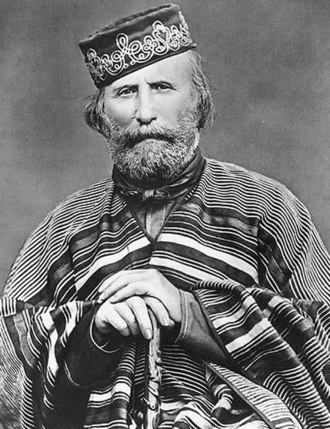
Achievements: Italian unification
Born: July 4, 1807; Nice, Italy (now France)
Died: June 2, 1882; Caprera, Italy (Aged 74)
Field & Discipline: Politics; Revolutionary
Education: Private tutors; school in Genoa
Life & Times:
In 1832, at age 25, Garibaldi was made a merchant captain and in 1833, he was ship's mate on the vessel that escorted the exiled Saint-Simonians from France to Constantinople. Listening to the talk of his captives, he learned the socialist and humanitarian philosophy of French thinker, [influenced by] Saint-Simon*.
Around the same time, he chanced to hear a speech that was a great inspiration to him. Giovanni Battista Cuneo, a member "Giovane Italia (Young Italy)", a revolutionary group formed by Italian author and patriot [influenced by] Mazzini*, called for the liberation of Italy from Austrian occupation. In 1833, Garibaldi met Mazzini and joined Giovane Italia. Since Mazzini expected the republican revolution to begin in Piedmont-Sardinia, Garibaldi enlisted in the Piedmontese Navy.
In 1834, at 27, Garibaldi took part in a revolutionary plot in Piedmont, but was forced to flee to France when the plot was uncovered by the Swiss police. He was sentenced to death in absentia.
In late 1835, he sailed to Rio de Janeiro, where Italian expatriates had formed a large colony. For the next 12 years, he lived in South America, but never ceased to engage in Italian revolutionary activity, lending at least moral support to the campaign against King Charles Albert of Piedmont.
In 1842 Garibaldi was put in command of the Uruguayan Navy in the liberation war against Juan Manuel de Rosas, the dictator of Argentina. Still in the service of Uruguay, he took command of a newly formed unit of Italian expatriates called the Italian Legion (the first "redshirts"), and from 1843 to 1848, helped defend Montevideo. After he won a small but heroic engagement at the Battle of Sant'Antonio in 1846, his fame reached around the world.
In Italy, a sword of honor, paid for by subscription, was struck for him. His exploits caught the attention of French author [publicized by] Alexandre Dumas pere*, who later did much to foster his reputation.
In 1848, Garibaldi led 80 members of his Italian Legion back to Italy to fight for the "Risorgimento" (resurrection) of Italy in the war of independence against the Austrians. Upon arrival at Nice, they learned of revolts all over Italy. Garibaldi offered to fight for Pope Pius IX, and, when his offer was refused, approached Charles Albert, the king of Piedmont-Sardinia, who also refused his offer.
Garibaldi then took his Legion to the city of Milan, where Mazzini had already arrived, and fought here against the Austrians.
Resolved to free Italy from foreign rule and spurred by his belief, shared by Mazzini, that the many Italian states could be joined into a single state, in 1848 Garibaldi accepted an invitation from the revolutionary government in Rome.
In February, 1849, Garibaldi was elected a deputy in the Roman Assembly, and two months later proposed the creation of a Roman Republic. In April, the French army tried to restore Papal authority. Garibaldi beat off one attack and then defeated a Neapolitan army at Velletri in May. However, the French persisted, and after a four-week siege, recaptured Rome on July 3.
Refusing to surrender, Garibaldi took his republican army of 4,000 men across the Apennines to the neutral territory of the Republic of San Marino, where he disbanded his men, and then returned to Piedmonte where he was arrested and deported as an undesirable, first to Tangier (where he lived for seven months) and then to the United States, where he lived in New York for a year.
In 1853, [collaborated with] Cavour*, the Prime Minister of Piedmont, agreed to let Garibaldi return to Piedmont. Garibaldi sailed first to London to meet Mazzini, but found that they now differed considerably in their political views. He then bought part of the Italian island of Caprera and made a home there.
In 1856, Garibaldi returned to England to put into operation a scheme that largely financed by individual British politicians, and orchestrated by British statesman [aided by] Gladstone* and Italian ex-revolutionary and refugee [aided by] Panizzi*. The plan was to buy a ship and release a group of Italian political prisoners on the island of Santo Stefano, west of Naples. The ship was wrecked and the project abandoned.
In 1858, Garibaldi was called to Turin by Cavour to organize a corps of volunteers in anticipation of another war against Austria. Cavour gave Garibaldi the rank of major general in the Piedmontese Army. Garibaldi named his corps the "Cacciatori delle Alpi (Alpine Hunters"), and when war broke out in April, 1851, he captured Varese and Como. In the ensuing armistice, Piedmont acquired Lombardy. Garibaldi now planned a march on Rome, but at the last moment it was called off by King Victor Emmanuel of Piedmont.
In May, 1860, Garibaldi set out on the conquest of Sicily and Naples. Although he had no official backing from Cavour and Victor Emmanuel, he had by now become a national hero, and had no trouble rounding up a force of volunteers.
Sailing from Genoa with 1,000 red-shirted young men, he reached Marsala, Sicily, in five days and in the name of Victor Emmanuel proclaimed himself dictator. Aided by the revolutionary movement in Sicily, by the end of May he had captured Palermo, the capital of Sicily.
He then crossed the Straits of Messina into mainland Italy in August, eluding the Neapolitan navy. After a lightning campaign in Calabria, he captured Naples, the largest city in Italy, and made himself "Dictator of the Two Sicilies".
Victor Emmanuel and the Sardinian army joined up with Garibaldi in October and their combined forces won a major battle on the Volturno River. He subsequently held plebiscites in Sicily and Naples and then handed the whole of southern Italy to Cavour, proclaiming Victor Emmanuel as King of a united nation.
In November, having refusing any reward, Garibaldi retired to his villa on Caprera Island. In 1861, largely due to his efforts, a new kingdom of Italy came into existence.
By now, Garibaldi considered himself a totally independent power. His prestige abroad induced [offered military command by] U.S. President Abraham Lincoln* in July, 1861, to offer him a command in the American Civil War; Garibaldi declined.
In 1862, Victor Emmanuel persuaded Garibaldi to lead a revolutionary expedition to attack Austria in the Balkans, as part of an attempt to gain Venice for Italy. He was allowed to recruit another volunteer army, and munitions were collected for him in Sicily, but Garibaldi then decided to use this army to attack the Papal States.
The Italian government did not want to jeopardize its relations with the French, who garrisoned the Papal States, and ordered the Italian army to stop Garibaldi. At the ensuing Battle of Aspromonte in Calabria in May, 1862, Garibaldi was badly wounded and taken prisoner.
When war broke out again with Austria in 1866, Garibaldi was given an almost independent command in the Tyrol, and though his force was badly mauled at Bececca, he won the war and Venice was ceded to Italy. In 1867, Garibaldi led another private expedition into the Papal States, this time secretly subsidized by the government, but French and papal troops defeated Garibaldi's volunteers at Mentana.
Garibaldi led one final campaign in 1870-71, when he assisted the French in the Franco-Prussian War. He was subsequently elected a member of the French National Assembly at Bordeaux, but resigned soon after.
He was elected a member of the Italian Parliament for Rome in 1874. During the last decade of his life, he suffered from rheumatism and war wounds, and led a virtually reclusive life on his island with his family. He published three historical novels, two in 1870 and one in 1872.
Extra Connections:
In London in 1854, met Hungarian nationalist [met] Kossuth*.
He met [met] Oliphant*,[met] Bryant*, [met] Smiles* and [met] Tennyson*
His success in Sicily allowed [collaborated with] Cannizzaro* to return there
He was supported by [a supporter was] Bradlaugh*
Assessment: A master of guerrilla warfare and a brilliant propagandist, who fought for the Italian Risorgimento and was instrumental in the unification of Italy.
Oneliner: Giuseppe Garibaldi, unifier of Italy
Bibliography:
- Encyclopedia Britannica.
- Encyclopedia of Military Biography.
- Ridley, Jasper, Garibaldi, London: Constable, 1974.
- Smith, Denis Mack, Garibaldi: Great Lives Observed, New Jersey: Prentice-Hall, 1969.
Language: Italian
Father: Domenico Garibaldi
Mother: Rosa Raimondi
Siblings: Maria Elisabetta; Angelo; Michele; Felice; Teresa
Spouse: 1) Anita Ribeiro da Silva (born Anna Maria de Jesus); 2)Giuseppina Raimondi; 3) Francesca Armosina
Children: By Anita: Menotti; Rosita; Teresita; Ricciotti. By Francesca: Clelia; Rosa; Manlio. Illegitimate children: Margerita (by Lucia Esteche); Anita (by Battistina Ravello).