Goldoni
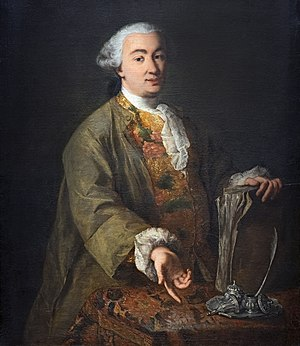
ACHIEVEMENT(S): Did much to revive the ‘Commedia dell’arte’ as an art form.
DATE/PLACE OF BIRTH: 25th February 1707, at Venice, Italy.
DATE/PLACE/AGE AT DEATH: 6th February 1793, at Paris, France. Aged 85.
DISCIPLINE: Playwright.
FIELD: Drama.
LANGUAGE: Italian and French.
PARENTS: Dr. Giulio Goldoni and Margherita Salvioni.
SIBLINGS: Gian Paolo.
SPOUSE: Nicoletta Conio, married 1735.
CHILDREN: Adopted his brother's children, Petronilla and Antonio, in 1755.
EDUCATION: Jesuit College, Perugia; Rimini School, 17?-21; Papal College, Patvia, 1723-28.
MAJOR WORK: 'La Locandiera' (performed 1753; English translation, 'The Innkeeper', 1928)
LIFE AND TIMES:
Through his father's influence, at the age of 16 he was enrolled at Ghislieri College, the Papal college of Pavia. For writing a satire on the ladies of the town, Goldoni was expelled from the college and began law studies at the University of Pavia.
In 1728, Goldoni became a clerk at the Chioggia criminal court, which he greatly enjoyed. In October 1731 he started his apprenticeship as a Venetian lawyer. It was during this period that he wrote his first play, a tragedy, entitled 'Amalasunta'. In 1733 he became under-secretary to the Venetian ambassador in Milan and in 1734, moved to Verona. There he met the Venetian Imer drama company , delighted the manager with his newly-written second play, 'Belisarius' and was commissioned to write more. In the plays that followed, Goldoni modelled his characters on the company actors. In giving them scripts to be learned by heart, however, he was beginning something new and original.
'Commedia dell'arte', the art form which had flourished in Italy for two centuries, was based on one of about 300 general synopses, within which the actors would ad lib, relying on comic violence to interest and amuse the audience. Goldoni created a new, more realistic form of Italian comedy, and audiences greeted the new style with enthusiasm.
In the summer of 1734, Goldoni and the company went back to Venice where he wrote 'The Ward' and 'The Scapegrace'. Meanwhile 'Belisarius' opened on 24th November at the San Samuele Theatre and was an immediate success. 'The Ward' and 'The Scapegrace' followed, and both were fairly successful. In December Goldoni was commissioned to adapt an existing script: 'The Patient Grissel', to be set to music by the composer Vivaldi*, and the two worked very successfully together. In 1735 Goldoni met and married Nicoletta Conio, a marriage which, despite his many infidelities, lasted happily for over 50 years.
The first of Goldoni's plays to be written out in full was his 'The Well-mannered Lady'. From then on he wrote prolifically and on demand. In 1748 Goldoni agreed to write for the Teatro Sant'Angelo company of the Venetian actor-manager Girolamo Medebac, and signed a four-year contract, dedicating himself to the stage. He now dispensed with masked characters altogether, in such new plays as 'La Pamela', a serious drama based on Samuel Richardson's* novel, and first performed in 1750.
As part of an ongoing feud with fellow playwright Chiari, Goldoni had promised patrons 16 new comedies in the 1750-1751 season. This was an enormous feat and Goldoni was forced to work day and night, somehow managing to produce some of his best work, notably 'I Pettegolezzi delle Donne' ("Women's Gossip"), a play in Venetian dialect, 'Il Bugiardo' ( 'The Liar'), written in ‘Commedia dell'arte’ style and 'Il Vero Amico' ('The True Friend'), an Italian comedy of manners.
This was a time of professional conflicts between Goldoni and his rivals. Goldoni satirised Chiari, in his play ‘I Malcontenti’ in 1755. Then Gozzi*, a poet who supported the traditional ‘Commedia dell’arte’, satirised Goldoni in a poem in 1757. He then ridiculed both playwrights in ‘L’Amore delle Tre Melarance’, ‘The Love of Three Oranges,’ in 1761. At one stage, Voltaire joined the battle of words, with a poem and a letter of support for Goldoni.
In April 1762, Goldoni left Venice for Paris to direct the Comédie Italienne. One of his most successful plays of this period was his 'Les Amours d'Arlequin et de Camille,’ fter which audiences flocked to the Comedie Italienne to see his plays. He followed this up with 'La Jalousie d'Arlequin' and 'Les Inquietudes de Camille', in 1763. Subsequently, he rewrote all of his French plays for Venetian audiences, his French 'L'Éventail', performed in Italian in 1763 became one of his finest plays: 'Il Ventaglio', performed the following year, and translated as 'The Fan' a century and a half later.
Goldoni retired from his exhausting life in 1764 and accepted a post teaching Italian to Princess Adelaide, the eldest living daughter of Louis XV, at Versailles, where he and his wife were given apartments in 1765. He soon began teaching Adelaide's three younger sisters as well and for a while, Goldoni enjoyed the high life of the court.
His last theatrical triumph, in 1770, was 'Le Bourru Bienfaisant', 'The Soft-hearted Despot', a piece which remained in the repertory of the Comedie Francaise until 1848. In the same year he visited Rousseau.*
In 1778, he saw Mesmer* (the Austrian physician who popularised hypnotism) perform in Paris, and was one of many hundreds of people who visited Voltaire*, on 17th Feb 1778, when the philosopher came to Paris from his country home at Ferney. That year Goldoni also watched the first balloon ascent by the Montgolfiers* .
In 1783, he moved from Versailles to Paris and began his celebrated and highly entertaining 'Mémoires', written in French between 1784 and 1787 and published in 1787. They were an immediate success with the French King and Queen, who ordered many copies, as did Catherine the Great of Russia. In 1792, however, after the French Revolution, Goldoni’s pension was cancelled because of his support for the monarchy and he died in poverty on 6th February 1793.
ASSESSMENT: He enhanced the well-established Italian ‘Commedia dell'arte’, replacing its masked stock figures and un-plotted content with more realistic characters and written plots.
EXTRA CONNECTIONS: Satirized Christina of Sweden’s* Academia dell’Arcadia
ONELINER: Carlo Goldoni, Italian playwright
BIBLIOGRAPHY:
Holme, Timothy, A Servant of Many Masters: The Life and Times of Carlo Goldoni, London: Jupiter Books, 1976.