Mesmer
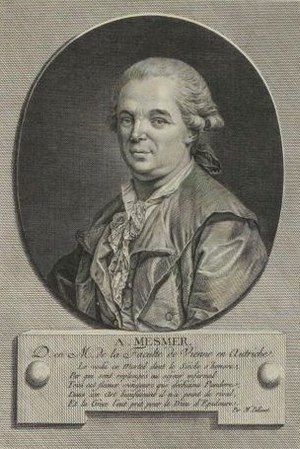
NAME: Mesmer, Franz Anton
ACHIEVEMENTS: Mesmerism
NICKNAME/ALIAS:
None
DATE AND PLACE OF BIRTH:
23 May 1734, Isnang, Swabia, (now Germany)
DATE AND PLACE OF DEATH AND AGE AT DEATH:
5 March 1815, Meersburg, Swabia, (now Germany). Aged 61
DISCIPLINE:Physician
FIELD:Hypnosis
EDUCATION:
Monastery school
University of Dillingen, Bavaria
University of Ingolstadt, Bavaria
University of Vienna
MAJOR WORK:
"Memoir sur la decouverte du magnetisme animal" (1879)
LIFE AND TIMES:
In 1759 Mesmer studied law for a year at Vienna, then switched to medicine, qualifying as a physician in 1766. In his dissertation, "On the Influence of the Planets on the Human Body", he suggested that the planets affected an invisible fluid in the human body which was also found throughout nature and which he termed the "universal fluid."
Mesmer set up his own medical practice in Vienna, at the same time continuing to expand his knowledge by attending lectures and operations, following up case histories and observing diagnostic procedures and treatment with electro-therapy in the hospitals and clinics. He was particularly interested in patients suffering from mental or nervous complaints such as lunacy, epilepsy, nightmares and depression. (In the following century, Mesmer's methods were studied by the Italian criminologist <influenced> Lombroso* who also worked in this area).
In 1768 Mesmer married a rich widow from the Austrian aristocracy. He continued with his medical practice, although he moved to a grand house where he entertained lavishly and pursued his musical interests. He played the cello, the clavichord and the glass harmonica, and once a week he held open house for musical gatherings. In 1768 he commissioned a work from <commissioned> Mozart*, the twelve-year-old child prodigy who had been brought to Vienna by his father. The work: "Bastien und Bastienne" was performed at Mesmer's house in the autumn of 1768.
In 1774 Mesmer began treating Franzl Oesterlin, a relation of his wife's who suffered from a variety of symptoms caused by her nervous condition. When he found that passing magnets over her body was helpful, he took this as proof that the magnets were affecting the gravitational pull of the planets on the universal fluid in Franzl's body. With <influenced by> Galvani* in mind, he named the process "animal magnetism" and developed the theory that it was obstacles to the flow of the universal fluid through the body which produced symptoms in the patient.
He began to treat other neurotics and found that use of magnets brought about a state of trance in the patients. The trance sometimes ended in a dramatic manner with convulsions or delirium events which Mesmer interpreted as indicating the removal of the obstacle to the flow of fluid. The patient then entered a calm state, signifying the restoration of a harmonious flow of fluid in the body. Mesmer soon found that it was not necessary to use magnets and that non-magnetic objects worked just as well. From this standpoint, he came to see himself as the source of animal magnetism with the ability to magnetize the objects he used.
He presented his theory to the Faculty of Medicine in Vienna, who advised Mesmer not to risk his reputation. Mesmer responded by sending an account of his treatment to a physician in Hamburg. He had the letter copied, and under the title "Letter to a Foreign Physician" (1755) it was widely distributed in the Germanic states and beyond. He was soon treating a large number of patients and gaining a reputation as a healer. He toured Bavaria, Switzerland and Hungary and in 1775 was made a member of the Bavarian Academy of Sciences.
Accounts of his work were published in literary, scientific and philosophic journals elsewhere in Europe. The Viennese medical establishment remained hostile and eventually, after massive publicity over the case of a young women he had cured of hysterical blindness, Mesmer was accused of fraud.
In 1778 he left Austria (and his wife) for Paris. New phenomena were eagerly greeted by fashionable society in the capital. The Swiss physiologist <work related to> Haller* had proposed the theory of muscle irritability to explain the constant stimulus needed by the body's vital organs. Mesmer was given a hearing at the Academy of Sciences but failed to win their support. The medical establishment were equally unenthusiastic.
Economic considerations now forced Mesmer to take patients and he set up a practice in the Place Vendome. He entered into a correspondence with the secretary of the Royal Medical Society, <corresponded with> Vicq d'Azyr*, and enclosed a large number of testimonials but was again rebuffed.
Mesmer then took premises in Paris at the Hotel Bullion and created a theatrical treatment centre. Heavy drapes were used to keep the large rooms quiet and dim. The elegant furnishings included a glass harmonica, and music was played to soothe the patients. Mesmer often wore a powdered wig and purple silk. He organized a form of group therapy where patients were stood around a large wooden tub filled with water containing magnetised objects. Iron rods from the tub were grasped by the patients and pressed against their bodies.
<a follower was> Lafayette* was a convert who in 1784 joined the semi-secret Mesmerist Society of Harmony. Similar societies were set up in provincial French cities. In the same year, an investigation into Mesmerism was ordered and <investigated by> Franklin*, the American minister in France, was appointed head of a committee of scientists and physicians which included <investigated by> Lavoisier*. Franklin later signed a report which found against Mesmer.
In 1785, Mesmer decided to travel. He remained out of France during the Revolution. He returned to Paris in 1798 to sue for financial reparation for property ruined during the revolution. He did not pursue either Mesmerism or politics but in 1799 he published "Memoir of F. A. Mesmer, Doctor of Medicine, Concerning His Discoveries".
In 1802 he was awarded some compensation and a life annuity which enabled him to live in modest comfort. He left Paris and spent the last thirteen years of his life mainly in Switzerland near Lake Constance.
ASSESSMENT: His use of the trance eventually led to the development and medical use of hypnotism.
EXTRA CONNECTIONS: <influenced> Breuer* and <influenced> Liebault* later used hypnosis.
<observed by> Goldoni* attended a performance.
His work was studied by <studied by> Schelling*
ONELINER: Anton Mesmer, who invented mesmerism (hypnosis)
BIBLIOGRAPHY:
Buranelli, Vincent, The Wizard from Vienna, Peter Owen, London, 1976
LANGUAGE:German
PARENTS:Father: Anton MesmerMother: Maria Ursula Michel
SIBLINGS:8@@
SPOUSE:Maria Anna von Bosch
CHILDREN:None