Richardson, Samuel
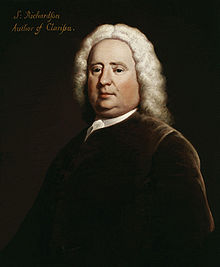
ACHIEVEMENTS: One of the first English novelists
NICKNAME/ALIAS: None.
DATE AND PLACE OF BIRTH: Baptized 19th August 1689, Mackworth, Derbyshire, England.
DATE/PLACE OF DEATH/AGE AT DEATH: 4th July 1761, London, England. Aged 72.
DISCIPLINE: Novelist.
FIELD: Literature.
LANGUAGE: English.
EDUCATION: Village school, Derbyshire.
MAJOR WORK: "Clarissa" (1747).
LIFE AND TIMES:
Richardson had been earmarked for the Church but there was no money to send him to university and so he was apprenticed, at the age of sixteen, to a printer, John Wilde. He learned his trade and was then employed at a printing press, as a compositor and proof reader. By 1721 he set up on his own as a printer and married Martha Wilde, daughter of his former master. Two years later, he printed six editions of the political opposition paper, the ‘True Briton’, on behalf of the Duke of Wharton. As an up-and-coming member of the trade, and through a connection with Arthur Onslow, who became Speaker of the House of Commons in 1728, Richardson started printing the Commons' Journals.
By the mid 1730s, he was also printer for the "Society for the Encouragement of Learning", set up by a group of aristocrats and writers , and he had begun printing two newspapers, the "Daily Journal" and, in 1738, the "Daily Gazeteer". He was also active in the Stationers' Company (the printers' guild) and held office. He became known for helping authors, including Dr Johnson* who, when he was under arrest for debt, appealed to Richardson. As he was now one of the three most prominent printers in London, he moved to a larger house in London with his second wife, Elizabeth Leake, whom he married after the death of Martha in 1730. During the 1730's, he also began renting a country house. Visitors included the actors Garrick* and Cibber*, and the artist Hogarth*.
In 1739 two booksellers approached Richardson and suggested he write a pattern book of letters for "illiterate country people". Richardson wrote letters for imaginary situations in family life, one of which was a letter from "a father to a daughter in service, on hearing of her master's attempting her virtue". He then wrote a letter from the daughter to her father. This provided the trigger for his first novel "Pamela", with a plot based on a true story he had heard about a domestic servant who had preserved her virtue and then received an offer of marriage from her would-be seducer. Richardson had actually suggested this plot to other authors, who had thought it "too humble" for them. He wrote "Pamela," in letter form, between November 1739 and January 1740, mostly at weekend gatherings at his country house. The book was published anonymously at the end of 1740 and was a huge popular success.
The novel was translated into French and Dutch, lauded as a moral example, preached about in Church, compared to the Bible, praised by the Pope, and read by fashionable society. This spurred Richardson to write a sequel. "Pamela in an Exalted Condition" was published in 1742, but this two-volume novel was not of the same standard as the original. The "Pamela" novels, although so widely read, were not admired by some critics, some of whom thought the heroine was heartless and manipulative, while others doubted the author's morality.
The novelist Fielding* mocked Richardson in his own novel "Joseph Andrews," and in 1741 published a parody, "Apology for the life of Mrs Shamela Andrews".
Richardson had written "Pamela" in the hope of producing something worthwhile for young people to read. He said he wanted to "promote the cause of religion and virtue" and so in 1744, he began writing "Clarissa." This was published in two parts in 1747 and 1748, and is possibly the longest English novel.
In 1745, the actor and critic Colly Cibber was one of the first to see the manuscript of ‘Clarissa’ and he argued strongly for a happy ending. In the finished work, Richardson approvingly allows his heroine to read Cibber's works, calling them "not ill-chosen". The novel was received with staggering enthusiasm in Britain, where Fielding was one o its strongest admirers. It also won European fame, when Balzac*, Sand*, de Musset* and Diderot* all gave favourable opinions, and its influence can be seen in Jean-Jacques Rousseau’s* novel, "Julie."
Lady Mary Wortley Montagu* read the novel and said it reduced her to tears, but that Richardson had failed to capture the manners of good society. This opinion is said to have also been held by Horace Walpole*.
Richardson’s third novel, "Sir Charles Grandison", was published in 1753 , following his intention to portray a good man, as a contrast to the rakish hero of Fielding's recent "Tom Jones". Meanwhile, Richardson's printing business had continued to flourish. He became Master of the Stationers' Company in 1754. The following he demolished his house in London and built a new printing works, and a new house for his family.
ASSESSMENT: Richardson had a great influence on the rise of the English novel and explored the psychology of contemporary young women.
EXTRA CONNECTIONS: Prevost*, French author of "Manon Lescaut," translated "Clarissa" into French.
Goldsmith* proof-read for him.
Bluestocking Mrs Elizabeth Wortley Montagu* praised “Clarissa.”
Influenced painter Sir Joshua Reynolds*
Was a friend of Elizabeth Carter*
ONELINER: Samuel Richardson, one of the first English novelists
BIBLIOGRAPHY:
Eaves, T. C. Duncan and Kimpel, Ben D., Samuel Richardson, A Biography,Clarendon Press, Oxford, 1971.
PARENTS: Father, Samuel Richardson. Mother, Elizabeth Hall.
SIBLINGS: Two brothers, William and ? Three sisters, Mary, Anne and Sara
SPOUSE: First wife Martha Wilde. Second wife, Elizabeth Leake.
CHILDREN: Five sons, one daughter (by Martha Wilde), all died in infancy.
Four daughters (by Elizabeth Leake), Mary, Martha, Anne and Sarah.
10/16 update