Revolving Door Pjt
---
-=-=
jeff am prospect
Sep 10, 2026 The Majority Report w/ Sam Seder
Live-streamed on September 9, 2026. Jeff Hauser, founder and Executive Director of the Revolving Door Project, on potential AI bailouts and the Democrats who may be too compromised to fight this.
The (Democratic) AI Lobby | Jeff Hauser | TMR
-=-=
---
reving dr
Abundists haven’t been shy about their support for high level Trump toadies.
Secretary of the Interior Doug Burgum
A billionaire software magnate with a side hustle leasing his land to oil companies, Burgum has become a favorite of the Abundance crowd. When his name was announced, Politicoreported that much of the jubilation came from Burgum’s attention to “one of the abundance agenda’s key fixations, or bogeymen: permitting reform.”
In Open Philanthropy’s announcementof their $120 million Abundance And Growth Fund (funded largely by tech titans Dustin Moskovitz and Patrick Collison), they cite Burgum’s previous calls for zoning reform and infrastructure investment as proof that abundance ideas have been “gaining traction for some time on both sides of the U.S. political spectrum.”
Matthew Yglesias, who Derek Thompson described as the “OG grandfather” of the ideas in Abundanceand is a Senior Fellow at the Niskanen Center, reassured his liberal audience that Burgum is “a totally solid pick who’ll do good things.” Yglesias also previously supported Burgum for Secretary of Housing and Urban Development.
Alec Stapp, the co-founder and co-CEO of the Institute for Progress made his support for Burgum very clear, saying “Excited to see Burgum land a cabinet role in the new administration. He’s a YIMBY abundance guy.” Aidan Mackenzie, an infrastructure fellow at the Institute for Progress, also chimed in, adding “I think it was a really good pick.”
When speaking about Trump’s intent to nominate Burgum to lead the Department of the interior, CEO of theInclusive Abundance Initiative, Derek Kaufman said “We are excited for the abundance community to resume work with the new administration on electricity transmission and permitting reform, which came so close to becoming law at the end of 2024.”
Alex Trembathof the Breakthrough Institute celebrated Burgum’s first day in the Trump administration simply, posting a quote from Burgum that reads simply: “We are entering an era of abundance”
Armand Domalewski, a self-appointed abundance influencer with an increasingly prominent voice in the abundance world, celebrated Burgum’s appointment, posting “BURGUM BROS WE ARE SO BACK.”
Thomas Hochman of the Foundation for American Innovation has been particularly thrilled with Burgum’s inclusion in the Trump administration, declaring “In Burgum we trust” and celebrating Burgum’s role in exempting companies from the Endangered Species Act and in ensuring further fossil fuel exploitation.
Secretary of Energy Chris Wright
Oil and gas magnate Chris Wright is perhaps the single most popular Trump appointee among the Abundance crowd. Politicodescribed his nomination as having brought together “unlikely friends” to support “Chris Wright’s ‘energy abundance’ future” and as being backed by “the loose coalition of analysts and writers pushing for an ‘abundance agenda.’”
Inclusive Abundance’s Derek Kaufmanhas praised Wright’s appointment as a win for abundance and helpfully pointed out that “The word ‘abundance’ appears 11 times in the confirmation hearing transcript for President Trump’s nominee to run the Department of Energy, Chris Wright. It was invoked by Senators across the political spectrum, ranging from Mike Lee (R-UT) to Bill Cassidy (R-LA) to Lisa Murkowski (R-AK) to Martin Heinrich (D-NM).”
In their $120 million abundance grant announcement, Open Philanthropycelebrated the conservative embrace of abundist ideas, citing Wright’s appointment as evidence. “On the right, President Trump has issued an executive order focused on reducing energy costs […] and Secretary of Energy Chris Wright has argued for the removal of burdensome regulations on nuclear power.”
Institute for Progress’ Aidan Mackenziealso praised Chris Wright’s nomination, saying “Both Burgum and Chris Wright seem committed to an all-of-the-above approach to energy; they’re very pro-oil and gas, but they’re also excited about forms of clean energy, especially nuclear and geothermal.”
The Breakthrough Institute’s Alex Trembatheven defended Wright’s assertion that climate change is not a crisis, saying “Chris Wright’s claim that climate change is not a “crisis” is, while not the last word on the subject, much more scientifically defensible than the claims of his environmentalist critics.” Trembath later posted “Chris Wright: smart choice.”
Thomas Hochman summed up his opinion of the appointment simply: “Wright pursuing an all-of-the-above approach to energy production… pretty ideal”
NIH Director Jay Bhattacharya
The Trump administration has utterly dismantled the National Institutes of Health and is currently proposing a 40% cut, which would devastate scientific advancement for generations. But don’t worry, abundists have full confidence in Trump’s NIH Director, Jay Bhattacharya. While he does have a medical degree, Bhattacharya has never practiced medicine nor even completed a medical residency.
Open Philanthropy was bullish on Bhattacharya in March, when they said, “There is also cross-partisan interest in improving science policy, from newly nominated NIH director Jay Bhattacharya’s calls for a focus on reproducibility and funding high impact research, to the launch of the new Technology, Innovation, and Partnerships directorate at the NSF during the Biden administration.” Tragically, the Trump administration has proved less interested in funding research than cutting it, throwing the NSF that Open Philanthropy was so excited about into complete chaos.
The Foundation for American Innovation’sChief Economist, Samuel Hammond,said Bhattacharya’s appointment was cause for optimism, posting “That said, how many people do you know going into HHS? The folks I know around Jim O’Neill, Jay Bhattacharya and Martin Makary are extremely high quality and serious about reform. Doesn’t mean I’ll agree with all their ideas, but there are some genuine reasons for optimism if you know anything at all ahout [sic] the behind the scenes.”
Institute for Progress’co-founder and co-CEO, Caleb Watney, elevated Bhattacharya’s analysis of the “increasing difficulty of funding novel research and younger scholars at the NIH,” a hobbyhorse of the abundance community, and said he was “very glad to see a larger focus on this issue.”
---
Jun 24, 2026 The Majority Report w/ Sam Seder
Live-streamed on June 17, 2026. Dylan Gyauch-Lewis, senior researcher at the Revolving Door Project, joins to talk about her piece in The American Prospect: “New Documents Detail Nine-Figure, Silicon Valley–Funded Abundance Movement.” Watch the Majority Report live Monday–Friday at 12pm EST on YouTube or http://www.Majority.fm Dylan's work: https://prospect.org/2026/06/12/new-d...Revolving Door Project: https://therevolvingdoorproject.org/To connect and organize with your local ICE rapid response team visit ICERRT.com
---
tnr
In early February, Axios reported that “Ezra Klein’s Abundance movement is getting some backup” in the form of a new group: Next American Era, headed by former Democratic Congressional Campaign Committee head, Illinois congresswoman, and longtime Washington insider Cheri Bustos. Bustos’s group, per the report, would be committed to “‘pro-growth,’ deregulatory policies.” This is hardly surprising; for the past several years Bustos has been a literal corporate lobbyist at the extremely Trump-connected outfit Mercury Partners. Mercury saw its profits more than double in 2025 as it sold access to the Trump throne room.
Over the course of the three years for which we have lobbying disclosures, Bustos branched out from lobbying overwhelmingly on behalf of agriculture firms and municipal governments to work for energy firms and software behemoths, as well. In particular, Bustos registered as a lobbyist for OpenAI and Larry Ellison’s Oracle, two of the most central companies in the bubblish AI industry that is becoming increasingly omnipresent in our politics, economy, and daily lives. The two firms were also the biggest clients in Bustos’s portfolio; Oracle’s 2025 lobbying expenditures totaled over $11 million, while OpenAI’s were just under $3 million. Bustos’s next-largest clients in 2025 were Korea Zinc and battery manufacturer Gotion, both with around $2.5 million in total lobbying.
Facially, it seems odd for someone like Bustos, fresh off a stint of AI lobbying, to launch a centrist 501c(4) and immediately align with the abundance agenda, which generally represents itself as a movement focused on housing and utility transmission permitting. In reality, it’s of a kind with a deep techno-optimist, pro-AI undercurrent that has permeated abundance thought since before Derek Thompson coined the phrase “abundance agenda” in 2022.
In the spring of 2025, Thompson and Klein’s tome, Abundance, launched to a firestorm of discourse, both praise and criticism. Nearly a year later, the blaze has lessened—Trumpian destruction of the economy and democracy tends to take the wind out of the sails of cockeyed optimists, after all—but tensions in what writers on both sides (namely, Jonathan Chait and David Sirota) have called the “Democrats’ Civil War” continue to simmer.
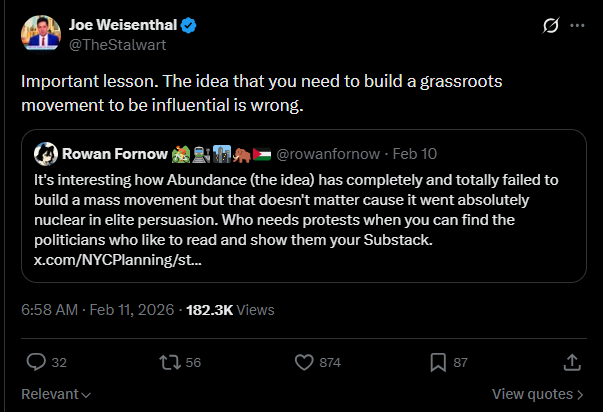
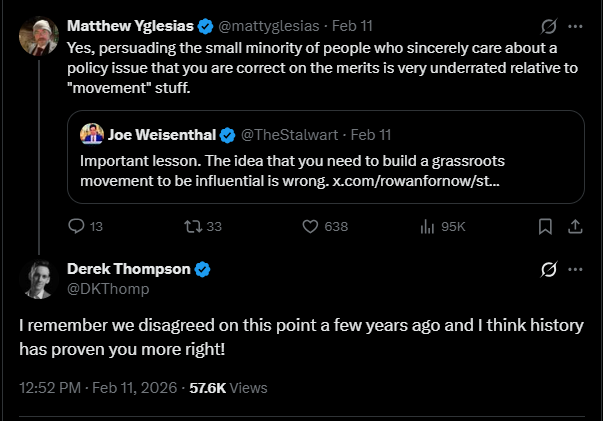
The abundance ecosystem has tried to develop a “grass-tops” movement, which parlays an elite influence campaign into building a mass constituency. Abundance world has certainly been successful at the first part; with hundreds of millions of dollars (this figure is meant literally, not figuratively) flowing into abundance organizations and Klein playing an intellectual power-broker role within Democratic politics—to the point that it raised eyebrows internally at The New York Times, according to reporting from Axios. But with sitting mayors and governors explicitly name-checking the book and its authors, abundance has thoroughly permeated the political class. It has not, however, been as successful at building a broad-base constituency. (It is perhaps difficult to focus on a gauzy future of plenty when fascist shock troops are loose on the streets, acting with impunity.)
Despite Abundance making theNew York Times bestseller list (tech tycoon Reid Hoffman sending copies to everyone he knows probably didn’t hurt), Democratic voters have been notably leery about the abundance framework. Polling has shown that the base is far more interested in tackling corporate greed than it is in municipal red tape, and Klein’s attempts to cast himself as a bipartisan mediator in the wake of the Charlie Kirk assassination have undermined his status as a leading light on the left.
At the Abundance 2025 conference, prominent abundance think tanker Alex Trembath of the Breakthrough Institute stood up to forcefully decry any allegations that the movement had been organized by elites, claiming that “abundance is not this astroturfed conspiracy. In fact, just the opposite: Abundance is emergent. Abundance is bottom-up.” He followed this declaration with the romantic sentiment that it was not donors who brought this movement together but fate, saying, “We were not herded and orchestrated: We found each other. The people and ideas in this ballroom pull on strands from multiple fields—think tanks, activists, organizers, elected officials, journalists, philanthropists, technologists, and entrepreneurs and investors.”
That is, notably, not what a bottom-up movement is. Grassroots movements are built on a foundation of organizing and mobilizing a mass membership. What Trembath actually described is very clearly a grass-tops strategy. Many people within abundance circles recognize, sometimes even celebrate, this dynamic. It was this very strategy that the Niskanen Center spelled out in its June 2024 manifesto charting how to build a so-called “abundance faction.”
The push for a bipartisan grand coalition, also laid out in Niskanen’s manifesto, has not succeeded either. The right flank of the abundance ecosystem has openly embraced some of the most vile parts of Trumpism. In the lead-up to Abundance 2025, the Manhattan Institute’s Charles Lehman, one of the speakers at the conference, called for “deportation abundance.”
Even Utah Governor Spencer Cox, who headlined alongside Klein and Thompson, and has a long-standing reputation as a (relatively) compassionate moderate who wants us all to “disagree better,” has veered toward rank partisanship and entrenching the power of an ever more authoritarian Republican Party. Cox moved to pack the Utah Supreme Court in order to gerrymander Salt Lake City, in what was an awfully aggressive approach for anyone who isn’t dead set on preserving the MAGA regime. The gerrymander would have only picked up one seat. But Cox has embraced a cosmic view of politics, where Donald Trump’s survival from an assassination attempt in 2024 was “miraculous,” spinning a borderline messianic interpretation of Trump’s candidacy and saying to Trump, “You, and only you, can be [the] kind of leader” it will take to repair the country.
Meanwhile, the Trump officials who were praised by abundance advocates as sage and reasonable, particularly Energy Secretary Chris Wright and Interior Secretary Doug Burgum, have been anything but. Wright has raised concerns that he is using his post to advance the business interests of the nuclear energy firm Oklo, where he was previously a board member, and is taking point on the American colonial takeover of the Venezuelan oil industry. Burgum is keeping busy cheerleading threats to annex Greenland, ignoring natural disasters in the actual interior, explicitly serving the oil and gas industry, and whitewashing American history by scrubbing any discussion of climate change, colonial violence toward Native Americans, and other stains on our heritage from national parks and monuments. Oh, lest we forget, he also oversaw the removal of the word “transgender” from the Stonewall monument, where his Interior Department recently abortively removed the Pride flag itself.
Curtis Yarvin, whom prominent abundance intellectual Steve Teles links to in this piece as the far-right edge of abundance, is considered central to the “new right,” which James Pogue described as “a project to overthrow the thrust of progress, at least such as liberals understand the word.” Yarvin, an antidemocracy nutball who wants to replace the republican system of government with a dictatorship or monarchy, also believes white people are innately more intelligent than other races, and has minimized slavery.
Despite this movement being studded by such miscreants and autocratic enablers, abundance is poised to exert significant influence in the near term, especially through a donor class that absolutely loves it and inside organizing like Ezra Klein’s appearance at a major Senate Democratic retreat. But if abundance liberals are to avoid missing the moment and find durable standing within center-left politics, they have to confront a glaring contradiction: their relationship to the AI industry.
AI skepticism and populist anger at data centers are surging. But abundance groups are increasingly aligning with deeply unpopular tech-titan pet projects like California Forever, an attempt by Silicon Valley bigwigs to build their own city from scratch between Sacramento and San Francisco. Housing policy group California YIMBY endorsed the plan, which led to California state Senator Christopher Cabaldon expressing confusion at a recent conference. California Forever also sponsored a recent “Festival of Progressive Abundance” in Los Angeles. The Charter Cities Institute, which advocates for the creation of autonomous cities unbound by existing legal code and envisioned as techno-optimist Meccas, sent an open letter to the Trump administration in support of Freedom Cities, alongside researchers at the American Enterprise Institute, or AEI, which is considered an abundance organization in the list maintained by Inclusive Abundance, the ecosystem’s main organizing arm.
On top of AEI, there is a host of other broadly pro-tech libertarian think tanks included in the Inclusive Abundance list, such as the (Koch-aligned) Cato Institute, the Cicero Institute (chaired by Palantir co-founder Joe Lonsdale), primary Charles Koch influence operation Americans for Prosperity, and the Federation for American Innovation. FAI alum Michael Kratsios, now the head of the White House Office of Science and Technology, has been an aggressive AI booster and was central to Texas Senator Ted Cruz’s legislation that attempted to create a mechanism to functionally exempt the AI industry from any and all federal regulation.
Don’t just take it from me that abundance sometimes is awfully close to tech-libertarians; the Cato Institute itself has said so, and it is generally expert at what libertarianism means.
Abundance has been marketed as a movement focused on solving the crisis of housing affordability, but there has always been a distinct techno-optimist bent to the movement that looks favorably on AI and Silicon Valley. In the opening utopian vignette of Abundance, Klein and Thompson identify widely distributed wealth from artificial intelligence as the internal mechanism that enables our supposedly impending sci-fi-flavored future. Klein, in particular, was quite vocal that a major driver of his side of the project was about repairing the frayed relationship between progressives and technology—both the concept itself and the tech industry centered around Silicon Valley.
The Abundance 2025 conference, judging by its schedule, had as much programming around AI as it did around housing (there was more directly focusing on energy policy than either, though energy and AI are deeply interconnected). The author of President Trump’s AI Action Plan, Dean Ball (now at FAI), was a featured speaker at the conference, as was NVIDIA’s director of infrastructure policy and multiple other champions of AI.
Moreover, much, if not most, of the funding flowing into abundance organizing is closely linked to powerful Silicon Valley figures. Following the release of Klein and Thompson’s book, Open Philanthropy (another sponsor of the abundance conferences, since rechristened Coefficient Giving), which was launched by Facebook co-founder Dustin Moskovitz, unveiled a $120 million fund focused on advancing abundance ideas. Half of the fund—$60 million—came from Stripe’s Patrick Collison. Arnold Ventures is a frequent abundance funder, which launched the Abundance Academic Network and a new abundance-flavored Vox vertical, among others. John Arnold made his fortune in energy trading and more recently joined the board of Meta specifically to serve as an energy adviser for data-center buildout. When welcoming Arnold to the board, Mark Zuckerberg said that, “as we focus on building AGI,” Arnold’s “deep experience” in “energy infrastructure will help us execute our long-term vision.”
Ever wonder why AI advocates downplay the climate implications of natural gas–fueled AI data centers? Consider Renaissance Philanthropy, an early pro-abundance foundation, which was created with money from former Google CEO Eric Schmidt. Schmidt has publicly stated that humans will never manage to control climate change, and that our best bet is to pour near-unlimited resources into developing an AI that can solve the issue for us. And Schmidt’s views are hardly niche within the realm of our would-be AI oligarchs.
In the most on-the-nose example, Abundance 2025 also had two literal trade associations that represent major tech firms among its sponsors: Chamber of Progress and the New American Industrial Alliance. The former of these is funded by literally every prominent AI firm in the game, from Marc Andreessen’s a16z to Amazon, Apple, Google, OpenAI, NVIDIA, Midjourney, and others.
None of this is an aberration: Silicon Valley has been at the forefront of developing abundance thought since its inception. Among the earliest proto-abundance treatises was an essay in The Atlantic co-authored by Patrick Collison and Tyler Cowen that called for the launch of a new science dedicated to studying how to achieve progress, which they creatively dubbed “progress studies.” In the seven years since their essay, progress studies has intermingled with other movements, such as effective altruism and rationalism, mainline Koch-style libertarianism, and supply-side progressivism, with a dash of technofascism comprising what Steve Teles has christened the “Dark Abundance” subfaction. The amalgamation of all these strands led to what we now would call the abundance movement (or ecosystem).
Cowen, in turn, runs key abundance funder Emergent Ventures, which was launched with a grant from Palantir’s Peter Thiel. Patrick Collison has marshaled part of his fortune to organize an annual retreat for abundance diehards in Sevastopol, California, where those invested in the success of the movement can gather, commiserate, and plan future efforts. Venture capitalist Marc Andreessen, whose a16z invests heavily in AI, fintech, and crypto, wrote his own call for abundance in 2023, titled “The Techno Optimist Manifesto,” with a whole chapter on “abundance.” Notably, one of Ezra Klein’s early proto-abundance columns built on another viral Andreessen essay.
Now, it should be noted that there are some in the abundance ecosystem who have been critical of AI in recent years. Thompson, while an enthusiastic fan of AI, who has been explicit about wanting to convince skeptics, has written about the technology’s downsides; fledgling abundance magazine The Argument (itself frequently techno-optimist and replete with Silicon Valley funding from Arnold, Collison, Open Philanthropy, and Emergent Ventures) has published several good articles that scrutinize the more boondogglish side of Silicon Valley’s latest obsession.
Even beyond the array of pro-AI interests lining up behind the abundance agenda, though, the AI industry and the data-center construction boom raise what should be uncomfortable questions for abundance advocates.
The movement’s central premise is that we can’t build and that we have created too many veto points that let parochial interests block important construction projects. But the data-center boom clearly shows that we can build. Or at least that mega corporations can when they put their minds to it. Granted, the sets of restrictions that apply to multifamily housing, energy transmission infrastructure, and industrial-scale data centers are all different, but frequently abundance proponents target the exact types of procedural bottlenecks that communities that don’t want data centers are using to block or delay tens of billions of dollars’ worth of them from popping up. In particular, community input meetings, air quality standards, and public interest lawsuits are frequent boogeymen of the abundance framework. But they are now the chief means by which communities are fighting back.
The data-center buildout also creates acute examples of why the types of bottlenecks that abundists decry are both absolutely necessary and, sometimes, still too weak. Examples of massive data-center projects being built against the wishes of their neighbors have become commonplace, to the point that foisting nondisclosure agreements upon elected officials over the details of the terms local government is giving to AI companies to build in their communities for economic development is becoming something of an industry standard.
Abundance tells us that we struggle to build and that procedural measures like public interest lawsuits, zoning restrictions, and community input meetings are blocking essential public goods. But then, at the same time, it has so far offered no comment on the reality that we are building plenty of data centers, often even while overcoming those democratic processes.
In Memphis, when Elon Musk’s xAI started operating without going through the permitting process—potentially illegally—we got a taste of how things work without the “bottlenecks” that figures like Thompson and Klein decry. The data center spewed toxic gas over a community that already bore significant air pollution, and did it without the public even knowing about it; more than a dozen local officials signed NDAs, which led to even some City Council members being completely in the dark about xAI’s operations in the city.
Perhaps Musk’s “Colossus” data center couldn’t have been built or would have taken much longer if it hadn’t pulled the wool over the eyes of residents and their government and had actually followed the law. But the flip side is that the progress that those costs have borne is a chatbot that, while it does sometimes fact-check kooky conspiracy claims, declared itself “MechaHitler,” provided planning assistance for a home invasion, removed clothes from people’s pictures on X without their consent, and generated thousands upon thousands of images of child pornography. Thankfully, the only cost for creating such an innovative piece of technology was an entire community being bombarded with toxic emissions that cause cancer and respiratory disease. Data-center expansion is already causing tens of billions of dollars in additional public health costs annually, disproportionately in poor, minority-majority areas like South Memphis.
Moreover this type of “behind-the-meter” energy supply is extremely common and trending up. More than three-fourths of the on-site power currently being brought online at data centers is natural gas, which, while its fumes are less toxic than coal’s, still emits large amounts of carcinogenic and toxic pollutants. Even worse, many data centers have diesel backup generators, which are far more detrimental to the health of people living nearby, particularly because of higher levels of nitrogen oxide and PM2.5 particles.
Public sentiment is also clearly turning against data centers. While polling indicates that voters are largely agnostic on data-center buildout as a hypothetical, there is a large body of evidence on the underlying elements that shows deep hostility toward the AI industry.
Politico and Public First recently found that 37 percent of respondents supported data centers to 28 percent opposed, with another 28 percent neither supporting or opposing, though with a major split along party lines; Democrats narrowly opposed, 36 percent to 33 (27 percent for neither), while Republicans had fairly strong support, 45 percent to 26 (24 percent for neither). This is similar to what NBC found in the summer of 2025, with 44 percent of respondents thinking AI would improve their family’s future versus 42 percent who thought it would make it worse. News site Heatmap found that only 44 percent of respondents supported a data center being built, even less than other types of energy infrastructure, including gas-fired power plants and nuclear reactors. There is also a substantial polling literature that shows Americans are deeply apprehensive of AI generally, although with very different views along gender lines—men tend to be positive about AI, while women are skeptical.
While apathy may be the prevailing mood nationally, with most voters having heard nothing at all about data-center construction, nearly every state or county-level case study available shows massive backlash brewing. Most tellingly, in the places where people have heard about data centers, they detest them. Virginia Democrats vocally ran against data centers last year and scored impressive wins. The 30th district, which includes data-center capital of the world Loudoun County, saw the incumbent Republican ousted by John McAuliff, who worked overtime to tie his opponent to the data centers. Similarly, 2025 saw two statewide spots on the Georgia Public Service Commission flip to Democrats over anger about data-center-fueled energy price hikes, the first statewide races the party had won in decades. State-level polling has shown antipathy in the ever-crucial swing states of Pennsylvania, Wisconsin, and Michigan.
A growing number of localities have also instituted a pause on new data-center construction, including Prince George’s County in Maryland; St. Charles, Missouri; several Atlanta-area counties; and several counties in Indiana. State-level restrictions and moratoria are being debated across the country, from New York to Georgia to California. Given all of that, it’s hardly surprising that Morning Consult has shown that support for banning data-center construction has been surging; just between October and November 2025, the policy went from down by two points to up by five. It is becoming increasingly clear that this moment calls for campaigning on AI skepticism.
Abundance proponents, however, seem determined to swim against the current of public opinion. For some, as Eric Levitz implies in Vox, it’s a matter of the muddled picture of public opinion we have. For others, though, abandoning data centers would be like surrendering their raison d’être. Particularly for the groups that emerged out of the “progress studies” movement kick-started by Collison and Cowen’s Atlantic essay, part of the point of abundance has always been to foster a sense of techno-optimism.
There is nothing inherent to abundance thought that necessitates AI boosterism. Indeed on a recent podcast, Marshall Kosloff, who emceed Abundance 2025, recalled responding to a question about what the abundance line on AI is: “We want nothing to do with that.” As Austin Ahlman of the Open Markets Institute, one of Kosloff’s guests for the episode, pointed out, such sentiment is “nowhere close to where the status quo is,” where Silicon Valley elites clearly “view this as an easy vehicle for the regulatory structures that they need to very quickly do the AI buildout without any democratic discipline or oversight.”
In fact, in its “Abundance Landscape” report, Inclusive Abundance identifies artificial intelligence as one of the five core policy areas. Notably, transit, one of the most common talking points for abundance punditry, is excluded, though IA said it would include it in its 2026 report. Even outside of AI’s own dedicated policy area, the report also includes AI as one of the “opportunities” for abundance energy policy, saying “AI industry leaders and experts agree that this technology will need a tremendous amount of energy going forward. AI and energy experts must collaborate in order to meet the need for more energy.” A similar argument was made by Trembath in an article with Josh Smith of the Abundance Institute. The Abundance Institute itself has also pushed AI very aggressively, including encouraging the White House to attempt to preempt all state-level regulation via executive order.
In a bit of profound irony, data-center construction has broken free of the choke points decried by abundance to the point that it is now bidding up land value and resulting in further constraints on the supply of housing, according to reporting from The Wall Street Journal. Now the data-center buildout, as well as being deeply unpopular and undermining the intellectual case for abundance, is directly jeopardizing what is supposed to be the movement’s central animating goal.
Elements of abundance raise important questions, particularly about how to build state capacity and the importance of government efficiency to public buy-in for ambitious governance (articulated well in this podcast by Mayor Zohran Mamdani speaking to Derek Thompson). But the framing of these questions is also saddled with an association with the excesses of ambition of Silicon Valley moguls—and their dark, antidemocratic leanings. If it’s hard to get people to say yes to an apartment building in their backyard, it’s doubly so to convince them to site a giant warehouse spewing toxic emissions and spiking their electrical bills in their backyard—especially if the best non-bubblish case for the data center is that it will increase the odds they will be unemployed.
Dylan Gyauch-Lewis is a researcher at the Revolving Door Project.
Read More:
Politics, Abundance, Ai, Data Centers, Economy, Technology, Silicon Valley, Artificial Intelligence
ref $
patrick-collison-dreams-abundance-verse conf?
---
REF
Abundance Will Meet the Energy Demands of AI - Heatmap News
Heatmap Illustration/Getty Images
American electricity consumption is growing for the first time in generations. And though low-carbon technologies such as solar and wind have scaled impressively over the past decade, many observers are concerned that all this new demand will provide “a lifeline for more fossil fuel production,” as Senator Martin Heinrich put it.
In response, a few policy entrepreneurs have proposed novel regulations known as “additionality” requirements to handle new sources of electric load. First suggested for electrolytic hydrogen, additionality standards would require that subsidized hydrogen producers source their electricity directly from newly built low-carbon power plants; in a Heatmap piece from September, Brian Deese and Lisa Hansmann proposed similar requirements for new artificial intelligence. And while AI data centers were their focus, the two argued that additionality “is a model that can be extended to address other sectors facing growing energy demand.”
There is some merit to additionality standards, particularly for commercial customers seeking to reduce their emissions profile. But we should be skeptical of writing these requirements into policy. Strict federal additionality regulations will dampen investment in new industries and electrification, reduce the efficiency of the electrical grid through the balkanization of supply and demand, and could become weapons as rotating government officials impose their views on which sources of demand or supply are eligible for the standards. The grid and the nation need a regulatory framework for energy abundance, not burdensome additionality rules.
After decades of end-use efficiency improvements, offshoring of manufacturing, and shifts toward less material-intensive economies, a confluence of emerging factors are pushing electricity demand back up again. For one, the nation is electrifying personal vehicles, home heating, and may do the same for industrial processes like steel production in the not-too-distant future, sparked by a combination of policy and commercial investment. Hydrogen, which has long been a marginal fuel, is attractingsubstantial interest. And technological innovation is leading to whole new sources of electric load — compute-hungry artificial intelligence beingthe most immediate example, but also large-scale critical minerals refining, indoor agriculture like alternative protein cultivation and aquaculture, and so on.
In recent years, clean energy has seemed to be on an unstoppable path toward dominating the power sector. Coal-fired generation has been in terminal decline in the United States as natural gas power plants and solar and wind farms have become more competitive. Flexible gas generation, likewise, is increasingly crowded out by renewables when the wind is blowing and the sun shining. These trends persisted in the context of stable electricity load. But even as deployment accelerates, low-carbon electricity supply may not be able to keep up with the surprisingly robust growth in demand. The most obvious — though not the exclusive — way for utilities and large corporates to meet that demand is often with new or existing natural gas capacity. Even a few coal plants have delayed retirement, reportedly in response to rising demand and reliability concerns.
Given the durable competitiveness of coal and especially natural gas, some form of additionality requirement might make sense for hydrogen production in particular, since hydrogen is not just a nascent form of electric load but a novel fuel in its own right. Simply installing an electrolyzer at an existing coal or natural gas plant could produce hydrogen that, from a lifecycle perspective, would result in higher carbon emissions, even if it displaces fossil fuels like gas or oil in final consumption. Even so, many experts caution that overly strict additionality standards for hydrogen at this stage are overkill, and may smother the industry in its crib.
Likewise, large corporate entities and electricity customers adopting additionality requirements for their own operations can bolster investment in so-called “clean firm” generation like nuclear, geothermal, and fossil fuels with carbon capture. In just the past month, Google announced plans to back the construction of new small nuclear reactors, and Microsoft announced plans to purchase electricity for new data centers from the shuttered Three Mile Island power plant, the plant made famous by the 1979 meltdown but which only closed down in 2019. Three Mile Island’s $100-per-megawatt-hour price tag would have been unthinkable just a few years ago but is newly attractive.
Notice the problem Microsoft is trying to solve here: a lack of abundant, reliable electricity generation. Outdated technology licensing, onerous environmental permitting processes, and other regulatory barriers are obstructing the deployment of renewables, advanced nuclear energy, new enhanced geothermal technologies, and low-carbon sources. Additionality fixes none of these issues. Of course, Deese and Hansmann propose “a dedicated fast-track approval process” for verifiably additional low-carbon generation supplying new sources of AI load. Yet this should be the central effort, not the after-the-fact add-on. The back and forth over additionality rules for the clean hydrogen tax credit is a case in point. The rules for the tax credit will (likely) be finalized by January, but lawsuits already loom over them. Expanding this contentious additionality requirement to apply to broad use cases will be even more contentious without solving the actual shortage data center companies care about. Conversations about additionality are a distraction and misplace the energies of policymakers and staff.
Substituting one regulatory thicket for another is a recipe for stasis. Instead of adding more red tape, we should be working to cut through it, fast-tracking the energy transition and fostering abundance.
With such broad requirements, what’s to stop future administrations from expanding them to cover electric vehicle charging, electric arc furnace steelmaking, alternative protein production, or any politically disfavored source of new demand? Could a second Trump Administration use additionality to punish political enemies in the tech industry? Could a Harris Administration do the same? What if a future administration maintained additionality standards for new sources of load, but required that the electricity come from fossil fuels instead of low-carbon sources?
Zero-sum regulatory contracts between sources of electricity supply and demand are not simply at risk of becoming a tool for handing out favors on a partisan basis — they already are one. Two pieces of model legislation proposed at the July meeting of the American Legislative Exchange Council, an organization of conservative state legislators that collaborate to write off-the-shelf legislative measures, would require public utility commissions to prioritize dispatchable generation and formally discourage intermittent renewable sources like solar and wind. One of the proposals suggests leaning on state attorneys general to extend the lifespans of coal plants threatened with retirement.
These proposals did not move forward this year, but it is unlikely that the motivating force behind them is exhausted. And whatever one thinks of the relative merits of intermittent versus firm generation, ALEC’s proposals demonstrate just how easily gamed regulations like additionality could be and the risks of relying on administrative discretion instead of universal, pragmatic rules.
This is not how the electric grid is supposed to work. The grid is, if not an according-to-Hoyle public good, a shared public resource, providing essential services to customers large and small. Homeowners don’t have to sign additionality contracts with suppliers when they buy an electric car or replace their gas furnace with an electric heat pump. Everyone understands that such requirements would slow the pace of electrification and investment in new industries. The same holds for corporate customers and novel sources of load.
The real problem facing the AI, hydrogen, nuclear, geothermal, and renewables industries is an inability to build. There are more than enough clean generators queueing to enter the system — 2.6 terawatts at last count, according to the Lawrence Berkeley National Laboratory. The unfortunate reality, however, is that just one in five of these projects will make it through — and those represent just 14% of the capacity waiting to connect. Still, this totals about 360 gigawatts of new energy generation over the next few years, much more than the predicted demand from AI data centers. Obstacles to technology licensing, permitting, interconnection, and transmission are the key bottlenecks here.
Would foregoing additionality requirements and loosening regulatory strictures on technology licensing and permitting increase the commercial viability of new or existing fossil fuel capacity, as Deese and Hansmann warn? Perhaps, on some margin. But for the foreseeable future, the energy projects and infrastructure most burdened by regulatory requirements will be low-carbon ones. Batteries, solar, and wind projects make up more than 80% of the queue added in 2023. Meanwhile, oil and gas benefit from categorical exclusions under the National Environmental Policy Act, while low-carbon technologies are subject to stricter standards (although three permitting bills recently passed the House, including one that waives these requirements for new geothermal projects).
Consider that 40% of projects supported by the Inflation Reduction Act are caught up in delays. That is $84 billion of economic activity just waiting for the paperwork to be figured out, according to the Financial Times. Additionality requirements are additional boxes to check that almost necessarily imply additional delays. Permitting reform makes them redundant and unnecessary for a cleaner future.
This underscores perhaps the most essential conflict between strict additionality requirements and clean energy abundance. Ensuring that every new policy and every new source of demand allows for absolutely zero additional fossil fuel consumption or emissions will prove counterproductive to global decarbonization in the long run. Natural gas is still reducing emissions on the margin in the United States. Over the past decade, in years with higher natural gas prices, coal generation has ticked up, indicating that the so-called “natural gas bridge” has not yet reached its terminus. Even aggressive decarbonization scenarios now expect a substantial role for natural gas over the coming decades. And in the long term, natural gas plants may prove wholly compatible with abundant, low-carbon electricity systems if next-generation carbon capture technologies prove scalable.
The United States is the world’s energy technology R&D and demonstration laboratory. If policies to prune marginal fossil fuel consumption here stall domestic investment and scaling of low-carbon technologies — as current permitting regulations already do, and proposed additionality requirements would do — then we will not only slow U.S. decarbonization, but also inhibit our ability to export affordable and scalable low-carbon technologies abroad.
Environmental progress’s surest path is in speeding up. For that to happen, we need processes that allow for rapid deployment of clean energy solutions. Expediting technology licensing, fast-tracking federal infrastructure permitting, and finding opportunities for quicker and more rational interconnections should be first and foremost.
The real solution lies in building a regulatory environment where energy abundance can flourish. Clearing the path for clean energy development, we can achieve a future where energy is affordable, reliable, and abundant—a future where the United States leads in both decarbonization and economic growth. It’s time to stop adding barriers and start speeding up progress.
....$
Heat Waves, Hot Rods, and Mr. Wonderful
Three climate stories that caught my eye today.
June 25, 2026

Heatmap Illustration/Getty Images, Slate
It’s been a busy few days for climate and energy news. So instead of focusing on a single story in this edition, let’s try something different and check in with a few big ones I’ve been thinking about:
Europe’s heatwave
Wednesday was the hottest day ever recorded in France, according to the country’s weather agency, Météo-France. The commune of Palluau, not so far from the country’s Atlantic coast, recorded a high of 43.8 degrees Celsius, or 110 degrees Fahrenheit.
How the Slate Truck Got So Cheap
It’s not the hand-crank windows.
June 25, 2026
Heatmap Illustration/Slate, Getty Images
Today’s top-of-the-line electric vehicles are self-driving computers on wheels built to feel as futuristic and digital as possible. They come with artificial intelligence-powered assistants, enormous touchscreen interfaces, and huge batteries.
The Slate pickup truck’s signature feature? Hand-crank windows.
Gassed Up
On alumina, CANDUs, and copper
[
June 25, 2026
Heatmap Illustration/Getty Images
*Current conditions:France just recorded its hottest day ever, with Wednesday’s temperatures soaring to just under 111 degrees Fahrenheit; nearly 50 people died drowning while seeking respite from the heat • A pair of 7.1-magnitude earthquakes struck Venezuela, collapsing buildings in Caracas • Wind has whipped the Cottonwood Fire, one of six wildfires raging in Utah, into a larger blaze now covering 60,000 acres — and it’s still at 0% containment.
THE TOP FIVE
1. One of the highest-ranking Democrats yet calls for a data center moratorium
New Jersey Representative Frank Pallone, the ranking Democrat on the House Energy and Commerce committee, joined calls for a national moratorium on data center construction ahead of Wednesday afternoon’s markup of a series of bills related to the buildout of infrastructure to support artificial intelligence software. In a statement, Pallone described the bills as a “useful first step,” but one that, “compared to the challenges the American power grid is facing,” amounts to “not nearly enough.” Rather, he backed a “national AI data center moratorium until we can find a way to ensure they don’t harm our nation’s air, water, and power bills.” Pallone’s new public position makes him one of the highest-ranking Democrats yet to back the idea, championed by the likes of Representative Alexandria Ocasio-Cortez, of halting permitting on new data centers in response to the growing blowback from voters.
---