Tech Fascism Abundance
---
---
primary 9 26 nerd reich bk, EZ, rename
this orIginally was EXRA KLEIN PRETEND LEFT ACTUALLY NEO-LIB 3RD WAY CORP DEM? BUT // MERGES W NERD REICH END TIMES FASCISM? 9 26
MERRI OK
see BROLIARCHY
LEFTY ASTRO CRYPTO COVER BY EZRA KLEIN, BUT BUILDS ON TECH BRO TRUMP CTR-REVO; AI NEEDS MASSIVE ELEC SO DEREG, COAL LUCKEY PALMER ANDURIL
THIEL A16 ANDREESSEN
KOCH INST FOR PROGRESS TYLER COWAN mercatus STAND TOGETHER AEI KEVIN ROBERTS PJT 2025 REBOOT
BURGUM CHRIS WRIGHT
BRKTHRU TREMBATH // SHILL
---
-=-=
left hook gmail 10/31/26
For over two decades, a specific faction of Silicon Valley elites—from the “PayPal Mafia” like Peter Thiel and Elon Musk to financial predators like Jeffrey Epstein—has pursued a singular, overriding ambition: the complete elimination of regulatory oversight, national borders, and public accountability. What began as a covert bid to undermine the U.S. dollar through early digital payment architectures and unregulated cryptocurrencies has evolved into an overt, predatory campaign to rewrite the terms of modern society.
This is not a story about technological innovation. It is an organized blueprint for institutional capture, engineered to dismantle the post-World War II democratic order and replace it with a new feudalism.
The Evolution of the Covert Circle
Historically, elite manipulation operated under the cover of shadow networks—cloaked within exclusive societies, think tanks, and closed-door political pacts. Today, that discretion has been completely abandoned. Empowered by wealth that rivals or exceeds the GDP of sovereign nation-states, modern tech oligarchs no longer feel the need to mask their intentions.
The unchecked concentration of capital has birthed an absolute impunity. When an individual commands more financial leverage than a nation, the fear of legal consequence vanishes. Courts, regulatory bodies, and legislative assemblies are no longer viewed as institutions of governance, but as assets to be acquired.
|
|---|
| |
By mainstreaming financial lawlessness and systematically gutting public protections, this “broligarchy” seeks to operate entirely outside the rule of law, dictating terms directly to a vulnerable public.
From Subprime Mortgages to the Crypto-AI Bubble
The financial mechanics driving today’s tech economy are dangerously reminiscent of the 2008 subprime mortgage crisis, only executed at greater speed and scale. The playbook remains identical:
- Manufacture an Overvalued Asset Class: Unregulated cryptocurrencies, dubious high-yield tokens, and hyper-inflated AI valuations are aggressively marketed as the undeniable future of finance.
- Obfuscate Real Earnings: Companies trade at absurd multiples—often hundreds of times their actual annual earnings—fueled entirely by speculative mania and speculative private offerings.
- Offload Risk to the Public: Wall Street asset managers quietly bundle these high-risk, volatile tech assets into the standard 401(k) portfolios, index funds, and pension systems of working-class families.
When market corrections inevitably occur—such as sudden multi-billion-dollar liquidations or localized bursts of speculative bubbles—the tech executives and hedge funds fail upward. Armed with the “too big to fail” precedent established during previous financial bailouts, they leave everyday workers to absorb the losses, destroying retirement security and driving working households into economic desperation.
Manufactured Desperation as a Tool of Control
Economic destabilization is not merely an unfortunate byproduct of these speculative cycles; it is a core structural component. A population trapped in continuous financial precarity—struggling against inflated living costs, vanishing retirement funds, and threatened employment—is inherently easier to govern and manipulate.
|
|---|
| |
By systematically destabilizing the economic floor beneath the middle class, the tech elite ensures that working people remain in a state of survival, unable to challenge the expanding monopolies governing energy, labor, and digital infrastructure.
The Diversion: Scapegoating and the Politics of Distraction
To prevent public scrutiny from focusing on the structural extraction of wealth, political allies and media apparatuses routinely deploy engineered distractions. Whenever financial instability looms, political discourse is deliberately weaponized against marginalized groups, immigrants, and vulnerable populations.
By fabricating existential boogeymen and stoking culture wars, the architects of economic collapse ensure that public outrage is directed downward against fellow citizens rather than upward at the corporate entities dismantling their livelihoods.
Breaking the Cycle: Accountability Over Bailouts
Ending this systemic cycle requires an absolute refusal to underwrite private financial recklessness with public funds. The path toward restoring economic sovereignty demands immediate, decisive structural reforms:
- Strict Prohibition of Tech Bailouts: Enacting legislative guardrails ensuring that speculative AI firms and unregulated crypto enterprises are forced to face standard bankruptcy proceedings without taxpayer intervention.
- Criminal Liability for Corporate Risk: Enforcing civil and criminal accountability for executives who intentionally manipulate markets, overstate earnings, or misappropriate public investment.
- Protection of Main Street Capital: Decoupling retirement funds, public pensions, and retail savings from predatory, highly leveraged tech instruments.
- Reinvestment in Public Infrastructure: Shifting legislative priority from corporate safety nets toward tangible human infrastructure—healthcare, education, wage protection, and housing stability.
Until society actively severs its dependency on hyper-capitalist exploitation and demands strict institutional accountability, the cycle of manufactured crises will continue to transfer collective wealth into the hands of an immune few. Sovereign democratic governance cannot coexist with unchecked corporate oligarchy; the choice to dismantle these predatory structures must be made before the option is permanently stripped away.
The DAM Digest is a reader-supported publication. To receive new posts and support my work, consider becoming a free or paid subscriber.
-=-=
gil
p7
Bannon was right to call them radicals. But what exactly do they believe? For decades, many described the anti-government politics of certain Silicon Valley figures as libertarian, portraying them as the eccentric beliefs of rich men who hated taxes but mostly wanted to build their companies without government interference. This framing is now dangerously obsolete.
What began as libertarian-inflected fantasy among wealthy entrepreneurs and thinkers in the twentieth century has now curdled into something even more sinister: tech fascism. The sight of tech billionaires partnering enthusiastically with authoritarian regimes, providing technologies of control and surveillance while profiting from government contracts, clarifies the reality. Rather than opposing government control, they seek to enhance it. For decades, Silicon Valley had promoted libertarian fairy tales about freedom from government power. In fact, seizing that power for itself was the true goal. Thiel himself dismissed libertarianism as useless fantasy in 2009, famously declaring, “I no longer believe that freedom and democracy are compatible.” And the precursors of fascism were always present in libertarianism, which
has deep roots in eugenics-adjacent ideas of hierarchy, supremacy, and disdain for the social contract. The term “fascist” is highly charged and, according to some, overused—most likely its incidence has skyrocketed because fascism is resurgent in the twenty-first century. But fascists excel at deflecting the accusation. “[T]he right in the United States has attempted to turn the term against itself, labeling those who oppose fascism as fascists themselves, sometimes even the ‘real’ fascists,” wrote the late David Golumbia in Cyberlibertarianism: The Right-Wing Politics of Digital Technology. The word comes from the Latin fasces, meaning a bundle of wooden rods bound together with a small axe protruding from the side. This totem, carried by bodyguards of magistrates in ancient Rome, signaled authority and the power to punish. It also symbolized the power of unity: One stick can be snapped, but a bundle cannot be easily broken. Benito Mussolini, the dictator who invented fascism and ruled Italy from 1922 to 1943, sought to bundle every institution of society under unified state authority. Italian fascism combined religion, the military, corporations, and media under state authority. Technofascism innovates on this model through technology, creating a system that seeks the “technicization of all aspects of government and society,” making technology the “driving force” of the authoritarian regime, historian Janis Mimura told The New Yorker in 2025. Tech fascism bundles powerful technologies—AI, crypto, defense tech, social media platforms, surveillance systems—toward authoritarian goals. These technologies are bound together under the control of a small, interconnected group of oligarchs who, simultaneously integrated into the highest levels of government, are creating an authoritarian
-=-=
an tc 9 26 bk rev
“A moment of reckoning has arrived for the West,” reads a recent recruitment ad for Palantir, a Silicon Valley firm that increasingly provides data-driven “intelligence” for intelligence, police and military agencies – as well as blue-chip corporations and non-profits. “On the factory floor, in the operating room, across the battlefield,” the ad intones, “we build to dominate.”
How do we make sense of this convergence between advanced technologies and unapologetic violence, between “rational” AI and a primordial view of the world that seems to revert to a language of blood and soil, friends and enemies, “us” and “them”? In op-eds, talk shows, and political analyses, a single word has risen to prominence: fascism.
As a term, “fascism” is highly provocative, but seemingly untimely. It conjures up powerful images of jackbooted throngs of followers repeating chants and salutes, visions of black-lettered and blood-red banners. Yet these images are typically associated with political orders from a century ago in interwar Europe, a dusty relic from a previous age where “evil” was identified and annihilated.
So what is fascism in the present? How can it help explain contemporary technological, social and political dynamics? Two recent books attempt to diagnose these conditions: End Times Fascism And the Fight for the Living World by writer Naomi Klein and filmmaker Astra Taylor, and The Nerd Reich: Silicon Valley Fascism and the War on Democracy by journalist Gil Durán.
End times fascism
For Klein and Taylor, what we see now is not a repetition but an evolution. Fascist ideologies have been injected into a broader apocalyptic vision.
“End times fascism is a fascism embedded in an understanding that something immense is ending, and it responds to this discomfiting truth with unabashed cruelty,” they write.
ALT RT IN EUR ACCEPTS AGW BUT SAYS THUS WE MUST BUNKER~ DARK HORDES?
In this vision, it is taken for granted that our economic, institutional and environmental systems are collapsing. Financial inequality is surging, with unaffordable houses and skyrocketing cost-of-living. Ecologies are crumbling, with earth systems hitting planetary limits. And that’s just a few of these stacked crises.
But an apocalyptic mindset, grounded in fundamentalist religion, stresses that crisis is not to be fixed, but fast tracked. Dysfunction and disorder are necessary to arrive at something more glorious, the labour pains to a great rebirth. Here, apocalyptic religion and political fascism agree: the current world is corrupt and cannot be saved; it must be burned to the ground and remade from scratch – or escaped altogether, for a greater paradise.
For its proponents, the end times are here — and only by embracing and accelerating this winner-takes-all transition will the chosen elite assure they can survive and even thrive.
Klein and Taylor follow this thread across three core sections.
Messianic Dreams traces the birth and rise of the Zionist dream, through to its present vision of genocidal reset in Gaza – where the glorious next stage of one society is built on the ashes of another. The authors explain these moves are not just about “righteous revenge” or “national security”, but have a distinct cosmological goal: to “move us all significantly closer to the prophesied end of times.”
Escape to the Cloud unpacks big tech’s fervent faith in AI superintelligence and the double-edged utopia or dystopia it would usher in. Here, claims of existential risk resulting from “the singularity” – where AI becomes sentient and human/machine norms break down – are essentially self-serving, directing investment and attention to tech development. They prop up the power of the already powerful.
(These claims of existential risk, which have been around for a long time, have been big news recently, with warnings from everyone from the UN High Commissioner for Human Rights to former AI staff and the “Godfather of AI”.)
And Prepper Nation steps through the push to bunker the United States against future threats and deport the alien others who are corrupting its purity. Here, elites ride out the apocalypse by establishing their own tech infrastructures, ethnostates, finance streams, and even their own (literal) bunkers.
For Klein and Taylor, fighting end times fascism starts with fighting its core premise that the world is doomed: a sinking ship beyond saving. They locate hope in embracing “hereness” and “staying”, rather than leaving. Their plea is to embrace our broken reality and engage in the slow, messy work of improving it – rather than abandoning it (and democracy) to a scorched earth authoritarian order.
Zohran Mamdani – the progressive mayor of New York City, who pulled off a remarkable grassroots campaign and embraces the city’s diverse foods, festivals and communities – is held up as a champion of this “here and now” mentality.
End Times Fascism is a thoughtful and engaging read that deftly weaves journalism into a cohesive premise about our current political condition.
The authors deserve particular praise for making careful distinctions between the distorted versions of Judeo–Christianity weaponised by fascist entrepreneurs – a blend of Holy war and culture war fought by the Chosen – and mainstream understandings of doctrine.
Indeed, as the book explains, it was longstanding Christian injunctions to love thy neighbour – including the migrant – that partially motivated Minnesota’s antifascist pushback to ICE deportations. Churches and faith organisations took part in protests, set up community kitchens and offered aid. Far-right fundamentalists, by contrast, cherry-pick the Bible passages they like, while ignoring core injunctions to “act justly, walk humbly, and love mercy” (Micah 6:8): to embrace the stranger, rather than expel them as Other.
Yet if the book represents the best of popular journalism, it also comes with its limitations. Klein and Taylor are resolutely focused on people, places and events, rather than attempting to unpack their ideologies in a more systemic way. The result is that end times fascism becomes linked to the actions of egotistical and powerful men, from politicians to tech titans. US President Donald Trump in particular is the common thread, appearing over and over again throughout.
So when Klein and Taylor suggest, at the end of the book, that end times fascism is not about Trump, and will continue when these men disappear, their claim runs against the book’s premise. Place powerful elites to one side, and end times fascism becomes difficult to envision. What does it look like when it moves off the front page and out of elite hands in everyday contexts?
Nerd Reich
In Nerd Reich, reporter Gil Durán, a longtime San Francisco resident, looks to Silicon Valley. He focuses on how “the world’s richest men are building a new political order.” Durán’s primary antagonist is Peter Thiel (who also appears in End Times Fascism), the billionaire co-founder of PayPal and Palantir: “a man fusing business, politics and religion into one terrifying bundle of power”.
For Durán and others, Thiel is the lynchpin for a new breed of Silicon Valley-driven fascism, whether concretely (through donations) or ideologically (through his books and speeches). Thiel has increasingly moved beyond the tech world to offer political diagnoses and future visions that find sympathetic ears in elite circles.
Where do these ideas come from? Durán suggests they can be traced back to the Sovereign Individual, a 1997 book of future predictions based on the transition to the information age, by former Times (UK) editor William Rees-Mogg and financial advisor James Dale Davidson. Strangely, Durán never really carries out a close reading of this book he regards as an ur-text. Instead, he chooses to highlight some key claims and its general reception.
Durán’s circle of rich fascists ranges from technologists to politicians. It includes well-known figures like Elon Musk, Vice President JD Vance and OpenAI CEO Sam Altman. But it also features lesser-known figures, like cryptocurrency entrepreneur Balaji Srinivasan, who wants Silicon Valley to carry out an “ultimate exit” from the US altogether, and venture capitalist Marc Andreessen, who elevates the acceleration of “techno-capital” and denigrates democracy.
Each of them, in their own way, has leveraged wealth from the finance and tech industry to grab political and social influence and push forward their vision of society and the state.
What exactly is fascist about these individuals and their ideas? For Durán, tech fascism “bundles powerful technologies” like AI, crypto and social media “towards authoritarian goals” that benefit a “small, interconnected group of oligarchs”. They wish to privatise what is public and “eliminate democracy”, he writes.
And yet the book lacks a deeper or more systemic unpacking of tech fascism. What are its core values? How do these technologies actually carry out authoritarian goals? And what might this mean beyond power games in a US bubble?
The closest we get to answers is two breezy paragraphs on page 240. They tell us tech fascism “updates this ideology for the AI age” by controlling “reality through algorithms” and launching the “next generation of killer robot drones”. And it’s all driven by a venture capital system that has “run out of unicorns and must now hunt Antichrists to meet its unquenchable thirst for acceleration”.
The strength and weakness of Nerd Reich, then, rests on its journalistic approach. Drawing on a decade of newsroom experience, Durán weaves in insider knowledge of Silicon Valley.
He provides a play-by-play of San Francisco City Council election manipulation, for instance, where a flood of Big Tech money aimed to flip local politics from progressive to conservative. And he serves it all up with visceral language — like “an image dripping in fascist cosplay” — that leaves no doubt as to how he views these men and their manoeuvrings.
The downside of this approach is that chapters fragment into dozens of “human interest” style vignettes, with only a gossamer-thin thread to connect them.
The reader wades through a whirlwind tour of names, dates and places. Garry Tan, CEO of venture capital incubator Y Combinator. Sam Bankman-Fried and his fraudulent FTX cryptocurrency exchange. Michelle Stephens and her Acts 17 organisation, which hosts events hoping to bridge technology and Christianity. Bryan Johnson, who believes he can live forever via products like his own bespoke “snake oil” elixir.
And Curtis Yarvin, the political blogger whose illiberal ideas have found traction in Washington.
In each case, we get titbits without a deeper throughline. How exactly does a long backstory on Yarvin — including his love life and use of psychedelics — shed light on his increasingly influential ideas about remaking the state as a startup? The reader must draw their own conclusions.
Technofascism and everyday people
In both these books, the lens could be described as the Big Man – the powerful politician, swaggering tech founder, or deep-pocketed venture capitalist who can leverage their immense resources to transform their visions into fascistic realities. This cast of strong antagonists lends itself to strong storytelling — concrete people who can be pointed to and called out.
But this focus on unsavoury elites leaves some key questions unanswered. Where did these fascist energies originate? How have they been updated? What are the grievances and desires at the heart of this ideology? And how are these values packaged, narrated and circulated in ways that make them compelling to everyday people?
Today, we are surrounded by platforms, models and algorithms that hold up a vision of reason and rationality. Yet politically, we see a return to myth, bigotry and barbarism. These twin forces are not a paradox but a program. Technofascism leverages advanced technology to bolster authoritarian ideals and regressive values that carve up the world along bloodlines, gender lines and borderlines.
But how do these twin forces prop each other up? What role does the “techno” in technofascism play? I see three core functions.
Technology augments, providing a practical outworking of fascist visions by operationalising difference and domination. Palantir’s data-driven deportation partnership with Immigration and Customs Enforcement (ICE) is a perfect recent example of transforming fascist ideals into a concrete program of platforms, software and servers that can be leased and run.
Secondly, technology alienates. It creates a vacuum of meaning that is filled by powerful mythologies that address grievances and reimpose order on the world. Meta-narratives like the Great Replacement Theory, suggesting non-white immigrants are replacing white populations, translate complex crises into tangible figures. Anti-immigration marches in Australia were a recent troubling example. They transformed a complex set of pressures — from rising costs of living to climate anxieties — into a powerful myth with a single scapegoat: the migrant.
Finally, technology manipulates. It creates environments that leverage desire while cultivating fascist ideologies over time. Manosphere influencers translate misogyny, insecurity and xenophobia into viral packages of content. Ex-radicals describe a pipeline effect where media played a key role in nudging them towards more right-wing stances. Eventually, they arrived at violent, dehumanising visions that can only be described as fascist.
Together, these books shed light on the fascistic energies that increasingly seem to permeate our present moment. This is not a problem for other places and times, but one that confronts us here and now.
As one scholar stressed after three decades of researching authoritarian personalities: “I study normal folks, not Nazis.” Grasping the core logic of this fascist phenomenon is the first step in combating and countering it.
Luke Munn, Research Fellow, Digital Cultures & Societies, The University of Queensland
This article is republished from The Conversation under a Creative Commons license. Read the original article.
-=-=
gmail left hook 9 11 26
if Democrats and Republicans take money from billionaires who are promoting AI and Crypto, what hope do you have that once they gain power, they will turn around and hold these destructive, racist, anti-democratic forces accountable and promote regulation?
If you do believe they will actually promote the majority instead of their benefactors, then I have a Trump diploma to sell you for $50,000.
Wonderful.
This week, Anthropic employees are warning that this technology might end humanity. We also know that Anthropic is creating a real-life version of the movie *Minority Report,* where they will stop “pre-crime” and help law enforcement go after activists and anti-AI critics.
Wonderful.
Congress is now investigating a July incident involving OpenAI in which the AI model’s “swarm” of 700 autonomous agents coordinated a hack into Hugging Face’s production infrastructure. However, according to Mother Jones today, this is mostly performative, meant to placate bipartisan anger at reckless capitalists unleashing destructive technology. Most likely, Sam Altman and his cabal of sociopaths will walk away with a slap on the wrist.
Sirota joined me to discuss how fascism will continue to flourish unless Democrats finally embrace an ideology of transformation, instead of restoration, and aggressively combat the broligarchy and super PAC money that is corrupting our world.
...
-=-=-=
-=-=
GGL 626
AI Overview
Joe Lonsdale, through the Abundance Institute and in partnership with Stand Together, champions an "Inclusive Abundance" economic framework. This movement actively pushes for regulatory reforms and technological acceleration across AI, biotech, and government administration to unlock human potential. [1, 2, 3, 4, 5]
Key Initiatives & Stances
- FDA Overhaul: Lonsdale raised millions to fund an "AI-native strike team" of software engineers and data scientists to place inside the FDA, aiming to cut red tape and accelerate clinical development. [1, 2, 3]
- Abundance Agenda: Both organizations support an innovation-driven economy, emphasizing that society can grow by solving big problems rather than operating on a zero-sum mentality. [1, 2]
- Tech Advocacy: Lonsdale regularly advocates for American competitiveness, supporting policies that foster fast and inclusive growth across technology sectors. [1, 2, 3]
Related Platforms & Perspectives
- To learn more about this philosophy, read the Inclusive Abundance Primer or explore the Stand Together Economy Issues page.
- Read Lonsdale’s original op-eds on pushing for these changes on his Joe Lonsdale Substack.
- Hear ongoing discussions about these and other technology policies directly on the American Optimist Podcast. [1, 2, 3]
===
---
reving dr
Abundists haven’t been shy about their support for high level Trump toadies.
Secretary of the Interior Doug Burgum
A billionaire software magnate with a side hustle leasing his land to oil companies, Burgum has become a favorite of the Abundance crowd. When his name was announced, Politicoreported that much of the jubilation came from Burgum’s attention to “one of the abundance agenda’s key fixations, or bogeymen: permitting reform.”
In Open Philanthropy’s announcementof their $120 million Abundance And Growth Fund (funded largely by tech titans Dustin Moskovitz and Patrick Collison), they cite Burgum’s previous calls for zoning reform and infrastructure investment as proof that abundance ideas have been “gaining traction for some time on both sides of the U.S. political spectrum.”
Matthew Yglesias, who Derek Thompson described as the “OG grandfather” of the ideas in Abundanceand is a Senior Fellow at the Niskanen Center, reassured his liberal audience that Burgum is “a totally solid pick who’ll do good things.” Yglesias also previously supported Burgum for Secretary of Housing and Urban Development.
Alec Stapp, the co-founder and co-CEO of the Institute for Progress made his support for Burgum very clear, saying “Excited to see Burgum land a cabinet role in the new administration. He’s a YIMBY abundance guy.” Aidan Mackenzie, an infrastructure fellow at the Institute for Progress, also chimed in, adding “I think it was a really good pick.”
When speaking about Trump’s intent to nominate Burgum to lead the Department of the interior, CEO of theInclusive Abundance Initiative, Derek Kaufman said “We are excited for the abundance community to resume work with the new administration on electricity transmission and permitting reform, which came so close to becoming law at the end of 2024.”
Alex Trembathof the Breakthrough Institute celebrated Burgum’s first day in the Trump administration simply, posting a quote from Burgum that reads simply: “We are entering an era of abundance”
Armand Domalewski, a self-appointed abundance influencer with an increasingly prominent voice in the abundance world, celebrated Burgum’s appointment, posting “BURGUM BROS WE ARE SO BACK.”
Thomas Hochman of the Foundation for American Innovation has been particularly thrilled with Burgum’s inclusion in the Trump administration, declaring “In Burgum we trust” and celebrating Burgum’s role in exempting companies from the Endangered Species Act and in ensuring further fossil fuel exploitation.
Secretary of Energy Chris Wright
Oil and gas magnate Chris Wright is perhaps the single most popular Trump appointee among the Abundance crowd. Politicodescribed his nomination as having brought together “unlikely friends” to support “Chris Wright’s ‘energy abundance’ future” and as being backed by “the loose coalition of analysts and writers pushing for an ‘abundance agenda.’”
Inclusive Abundance’s Derek Kaufmanhas praised Wright’s appointment as a win for abundance and helpfully pointed out that “The word ‘abundance’ appears 11 times in the confirmation hearing transcript for President Trump’s nominee to run the Department of Energy, Chris Wright. It was invoked by Senators across the political spectrum, ranging from Mike Lee (R-UT) to Bill Cassidy (R-LA) to Lisa Murkowski (R-AK) to Martin Heinrich (D-NM).”
In their $120 million abundance grant announcement, Open Philanthropycelebrated the conservative embrace of abundist ideas, citing Wright’s appointment as evidence. “On the right, President Trump has issued an executive order focused on reducing energy costs […] and Secretary of Energy Chris Wright has argued for the removal of burdensome regulations on nuclear power.”
Institute for Progress’ Aidan Mackenziealso praised Chris Wright’s nomination, saying “Both Burgum and Chris Wright seem committed to an all-of-the-above approach to energy; they’re very pro-oil and gas, but they’re also excited about forms of clean energy, especially nuclear and geothermal.”
The Breakthrough Institute’s Alex Trembatheven defended Wright’s assertion that climate change is not a crisis, saying “Chris Wright’s claim that climate change is not a “crisis” is, while not the last word on the subject, much more scientifically defensible than the claims of his environmentalist critics.” Trembath later posted “Chris Wright: smart choice.”
Thomas Hochman summed up his opinion of the appointment simply: “Wright pursuing an all-of-the-above approach to energy production… pretty ideal”
NIH Director Jay Bhattacharya
The Trump administration has utterly dismantled the National Institutes of Health and is currently proposing a 40% cut, which would devastate scientific advancement for generations. But don’t worry, abundists have full confidence in Trump’s NIH Director, Jay Bhattacharya. While he does have a medical degree, Bhattacharya has never practiced medicine nor even completed a medical residency.
Open Philanthropy was bullish on Bhattacharya in March, when they said, “There is also cross-partisan interest in improving science policy, from newly nominated NIH director Jay Bhattacharya’s calls for a focus on reproducibility and funding high impact research, to the launch of the new Technology, Innovation, and Partnerships directorate at the NSF during the Biden administration.” Tragically, the Trump administration has proved less interested in funding research than cutting it, throwing the NSF that Open Philanthropy was so excited about into complete chaos.
The Foundation for American Innovation’sChief Economist, Samuel Hammond,said Bhattacharya’s appointment was cause for optimism, posting “That said, how many people do you know going into HHS? The folks I know around Jim O’Neill, Jay Bhattacharya and Martin Makary are extremely high quality and serious about reform. Doesn’t mean I’ll agree with all their ideas, but there are some genuine reasons for optimism if you know anything at all ahout [sic] the behind the scenes.”
Institute for Progress’co-founder and co-CEO, Caleb Watney, elevated Bhattacharya’s analysis of the “increasing difficulty of funding novel research and younger scholars at the NIH,” a hobbyhorse of the abundance community, and said he was “very glad to see a larger focus on this issue.”
---
oops all bold
https://theabundantfuture.substack.com/p/how-we-make-abundance-a-lasting-movement}:
beware bs
When something becomes popular, there’s always a question of how long it’ll last. Will a new popstar be a one-hit wonder or have a full-fledged career? Some things are clearly fads, but often, it’s only obvious in retrospect whether a cultural phenomenon was actually a permanent shift.
That’s a key question facing the abundance movement right now. In the months since Ezra Klein and Derek Thompson’s Abundancewas published, abundance has gone about as viral as a new political framework can go. It’s dominated “the discourse” – every political outlet had a take on the book, Klein is being heralded (and criticized) as a Democratic powerbroker, and he and Thompson are now greeted like celebrities in places like the U.S. Capitol.
More importantly, their ideas have started to result in real change.
In Congress, the major opportunities for bipartisan achievement are basically lifted from the first few chapters of Abundance: housing and energy permitting reform, pushed in part by the new, abundance-y Build America Caucus, now one of the most active bipartisan caucuses in the House. Governors in California, Montana, Texas, and Connecticut signed major pro-housing bills last year, while those in Oregon, Massachusetts, and Pennsylvania are reforming state government. Mikie Sherrill just won in New Jersey on an abundance-coded platform. Donors are getting on board: Coefficient Giving announced a $120M abundance and growth fund, and state capacity expert Jen Pahlka announced another $120M fund. And groups like Inclusive Abundance – which advocates for abundance at the federal level – are now scaling to meet the moment.
And there’s plenty I haven’t listed here. It’s clear, abundance had a wildly successful last year. It won the Grammy for Best New Artist. But the real question is whether that success will endure throughout 2026, 2036, 2046…whether this will be a movement with lasting impacts on the way the U.S. takes on the biggest challenges of our time.
Yet there are some indications that abundance’s influence may have a ceiling. Few of the prospective 2028 presidential candidates have explicitly embraced the abundance movement, though nearly all have espoused aligned ideas. Detractors on X dampened progressives’ excitement by arguing abundance is just neoliberalism rebranded – leaving leaders like Senator Elizabeth Warren skeptical. And from Inclusive Abundance’s work on the Hill with electeds of both parties, we can report that surprisingly few politicians beyond very online moderate Democrats can say exactly what abundance is, beyond “that’s the Ezra Klein thing, right?” Or worse, “So you guys want more stuff?”
But one-hit wonders aren’t destined to stay that way. They have an opportunity: deliver a second album, or fade. Abundance is at that precipice.
So how do we build abundance into an enduring movement? There’s a long list, but here’s a start:
Win elections.
In a democracy, what candidates campaign on sets the foundation for what elected officials govern on. If abundance is seen as a pet project for out-of-touch elites and a detriment to winning over voters everywhere outside San Francisco and Brooklyn – as its haters have vehemently argued – it will be sidelined.
So we must make abundance useful for winning elections. That means message testing, inviting more political practitioners into key conversations, making the case that getting shit done is key to gaining voters’ trust, and educating candidates throughout the country (the ones who don’talready subscribe to Politico Playbook) about what abundance means for them. Of course, learning how to sell the abundance approach doesn’t require ever using the word itself.
Push the movement past pundits.
I’m a big fan of Klein, Thompson, and other abundance commentators like Jerusalem Demsas and Matthew Yglesias – they’re brilliant and popularized the concept that I’m now dedicating the vast majority of my time and energy to. But the reality is, continuing to tie this movement squarely to any single person or book is a mistake. For one thing, they may move on – recent Ezra Klein Show episodes are focused on Gaza and the alt-right. Thompson has expanded to sports gambling and cultural criticism.
It makes sense – they’re commentators and have never professed to be political movement builders. But if abundance doesn’t grow past them, it will be silenced when they’re silent on it. And even when they’re not quiet, that can hurt too – I’ve too frequently been talking to someone about housing policy only to be shut down because they didn’t like Klein’s takes on Israel or Charlie Kirk.
Articulate the vision beyond wonky policy.
Even those familiar with abundance mostly think of it as a call to speed up the construction of housing and clean energy. That’s not necessarily a bad thing in the short term: abundance is now seen as a solution to the number one word on every politico’s tongue right now, affordability.
But defining the long-term agenda around those two issues – and in particular, around boring process changes – makes this a technocratic argument devoid of vision. It risks everyone missing the broader point, that abundance is about a larger mindset shift that encourages electeds, donors, activists, and hopefully voters to become ruthlessly focused on outcomes over process, less risk-averse, and more positive-sum.
So we must do more to anchor abundance not around one or two issue areas, but around the results it offers: greater human flourishing. The boring process changes just get us there.
But while we’re at it, expand the technocratic agenda too.
Abundance is more policy lens than list, but to prove that, we need to build out the list. That may sound counterintuitive, but look at the most robust issues on the agenda: housing and energy. The abundance solutions to those issues are, for the most part, deregulatory – no wonder some circles see our movement as synonymous with deregulation!
Building out the abundance policy playbook would highlight what else a positive-sum, outcomes-oriented approach can offer, including where abundance is compatible with anti-monopoly populism. For instance, an abundance approach could mean building state capacity to fully reap the benefits of immigration, as Demsas has written; or taking on entrenched powers like the American Medical Association to make healthcare more affordable; or coming up with new ways to fund government research and development to support a more innovative economy.
Abundance offers a new way of thinking that could reshape a number of policy areas. Let’s go ahead and dream up the playbook that makes that clear, so people see abundance doesn’t represent tiny, temporary edits but a permanent shift in the way we do politics and make change.
---
What’s next
Inclusive Abundance is working to build the national abundance movement every day – we support the Build America Caucus, launched the annual conference, and help elected officials and candidates looking to roll out abundance policies. And we’re gearing up for an exciting year ahead.
We’re launching this Substack because there are clearly some open questions about this movement. This is where we’ll work through those questions in public – the strategic debates, the ideological and factional tensions, the policy fights on Capitol Hill, and the places where we think the movement needs to evolve.
You’ll get to hear from more than just me. Posts will be authored by different members of our team and eventually by a broader sphere of abundance thinkers. You’ll see message testing, smart policy analysis, and reactions to the political debates shaping (and being shaped by) the movement. New posts will be published around twice per month.
We’re incredibly excited about this Substack. Subscribe if you want to help make abundance a lasting movement.
---
Secret Truth Behind The Abundance Movement | Dylan Gyauch-Lewis | TMR
seder
---
tnr
In early February, Axios reported that “Ezra Klein’s Abundance movement is getting some backup” in the form of a new group: Next American Era, headed by former Democratic Congressional Campaign Committee head, Illinois congresswoman, and longtime Washington insider Cheri Bustos. Bustos’s group, per the report, would be committed to “‘pro-growth,’ deregulatory policies.” This is hardly surprising; for the past several years Bustos has been a literal corporate lobbyist at the extremely Trump-connected outfit Mercury Partners. Mercury saw its profits more than double in 2025 as it sold access to the Trump throne room.
Over the course of the three years for which we have lobbying disclosures, Bustos branched out from lobbying overwhelmingly on behalf of agriculture firms and municipal governments to work for energy firms and software behemoths, as well. In particular, Bustos registered as a lobbyist for OpenAI and Larry Ellison’s Oracle, two of the most central companies in the bubblish AI industry that is becoming increasingly omnipresent in our politics, economy, and daily lives. The two firms were also the biggest clients in Bustos’s portfolio; Oracle’s 2025 lobbying expenditures totaled over $11 million, while OpenAI’s were just under $3 million. Bustos’s next-largest clients in 2025 were Korea Zinc and battery manufacturer Gotion, both with around $2.5 million in total lobbying.
Facially, it seems odd for someone like Bustos, fresh off a stint of AI lobbying, to launch a centrist 501c(4) and immediately align with the abundance agenda, which generally represents itself as a movement focused on housing and utility transmission permitting. In reality, it’s of a kind with a deep techno-optimist, pro-AI undercurrent that has permeated abundance thought since before Derek Thompson coined the phrase “abundance agenda” in 2022.
In the spring of 2025, Thompson and Klein’s tome, Abundance, launched to a firestorm of discourse, both praise and criticism. Nearly a year later, the blaze has lessened—Trumpian destruction of the economy and democracy tends to take the wind out of the sails of cockeyed optimists, after all—but tensions in what writers on both sides (namely, Jonathan Chait and David Sirota) have called the “Democrats’ Civil War” continue to simmer.
The abundance ecosystem has tried to develop a “grass-tops” movement, which parlays an elite influence campaign into building a mass constituency. Abundance world has certainly been successful at the first part; with hundreds of millions of dollars (this figure is meant literally, not figuratively) flowing into abundance organizations and Klein playing an intellectual power-broker role within Democratic politics—to the point that it raised eyebrows internally at The New York Times, according to reporting from Axios. But with sitting mayors and governors explicitly name-checking the book and its authors, abundance has thoroughly permeated the political class. It has not, however, been as successful at building a broad-base constituency. (It is perhaps difficult to focus on a gauzy future of plenty when fascist shock troops are loose on the streets, acting with impunity.)
Despite Abundance making theNew York Times bestseller list (tech tycoon Reid Hoffman sending copies to everyone he knows probably didn’t hurt), Democratic voters have been notably leery about the abundance framework. Polling has shown that the base is far more interested in tackling corporate greed than it is in municipal red tape, and Klein’s attempts to cast himself as a bipartisan mediator in the wake of the Charlie Kirk assassination have undermined his status as a leading light on the left.
At the Abundance 2025 conference, prominent abundance think tanker Alex Trembath of the Breakthrough Institute stood up to forcefully decry any allegations that the movement had been organized by elites, claiming that “abundance is not this astroturfed conspiracy. In fact, just the opposite: Abundance is emergent. Abundance is bottom-up.” He followed this declaration with the romantic sentiment that it was not donors who brought this movement together but fate, saying, “We were not herded and orchestrated: We found each other. The people and ideas in this ballroom pull on strands from multiple fields—think tanks, activists, organizers, elected officials, journalists, philanthropists, technologists, and entrepreneurs and investors.”
That is, notably, not what a bottom-up movement is. Grassroots movements are built on a foundation of organizing and mobilizing a mass membership. What Trembath actually described is very clearly a grass-tops strategy. Many people within abundance circles recognize, sometimes even celebrate, this dynamic. It was this very strategy that the Niskanen Center spelled out in its June 2024 manifesto charting how to build a so-called “abundance faction.”


The push for a bipartisan grand coalition, also laid out in Niskanen’s manifesto, has not succeeded either. The right flank of the abundance ecosystem has openly embraced some of the most vile parts of Trumpism. In the lead-up to Abundance 2025, the Manhattan Institute’s Charles Lehman, one of the speakers at the conference, called for “deportation abundance.”
Even Utah Governor Spencer Cox, who headlined alongside Klein and Thompson, and has a long-standing reputation as a (relatively) compassionate moderate who wants us all to “disagree better,” has veered toward rank partisanship and entrenching the power of an ever more authoritarian Republican Party. Cox moved to pack the Utah Supreme Court in order to gerrymander Salt Lake City, in what was an awfully aggressive approach for anyone who isn’t dead set on preserving the MAGA regime. The gerrymander would have only picked up one seat. But Cox has embraced a cosmic view of politics, where Donald Trump’s survival from an assassination attempt in 2024 was “miraculous,” spinning a borderline messianic interpretation of Trump’s candidacy and saying to Trump, “You, and only you, can be [the] kind of leader” it will take to repair the country.
Meanwhile, the Trump officials who were praised by abundance advocates as sage and reasonable, particularly Energy Secretary Chris Wright and Interior Secretary Doug Burgum, have been anything but. Wright has raised concerns that he is using his post to advance the business interests of the nuclear energy firm Oklo, where he was previously a board member, and is taking point on the American colonial takeover of the Venezuelan oil industry. Burgum is keeping busy cheerleading threats to annex Greenland, ignoring natural disasters in the actual interior, explicitly serving the oil and gas industry, and whitewashing American history by scrubbing any discussion of climate change, colonial violence toward Native Americans, and other stains on our heritage from national parks and monuments. Oh, lest we forget, he also oversaw the removal of the word “transgender” from the Stonewall monument, where his Interior Department recently abortively removed the Pride flag itself.
Curtis Yarvin, whom prominent abundance intellectual Steve Teles links to in this piece as the far-right edge of abundance, is considered central to the “new right,” which James Pogue described as “a project to overthrow the thrust of progress, at least such as liberals understand the word.” Yarvin, an antidemocracy nutball who wants to replace the republican system of government with a dictatorship or monarchy, also believes white people are innately more intelligent than other races, and has minimized slavery.
Despite this movement being studded by such miscreants and autocratic enablers, abundance is poised to exert significant influence in the near term, especially through a donor class that absolutely loves it and inside organizing like Ezra Klein’s appearance at a major Senate Democratic retreat. But if abundance liberals are to avoid missing the moment and find durable standing within center-left politics, they have to confront a glaring contradiction: their relationship to the AI industry.
AI skepticism and populist anger at data centers are surging. But abundance groups are increasingly aligning with deeply unpopular tech-titan pet projects like California Forever, an attempt by Silicon Valley bigwigs to build their own city from scratch between Sacramento and San Francisco. Housing policy group California YIMBY endorsed the plan, which led to California state Senator Christopher Cabaldon expressing confusion at a recent conference. California Forever also sponsored a recent “Festival of Progressive Abundance” in Los Angeles. The Charter Cities Institute, which advocates for the creation of autonomous cities unbound by existing legal code and envisioned as techno-optimist Meccas, sent an open letter to the Trump administration in support of Freedom Cities, alongside researchers at the American Enterprise Institute, or AEI, which is considered an abundance organization in the list maintained by Inclusive Abundance, the ecosystem’s main organizing arm.
On top of AEI, there is a host of other broadly pro-tech libertarian think tanks included in the Inclusive Abundance list, such as the (Koch-aligned) Cato Institute, the Cicero Institute (chaired by Palantir co-founder Joe Lonsdale), primary Charles Koch influence operation Americans for Prosperity, and the Federation for American Innovation. FAI alum Michael Kratsios, now the head of the White House Office of Science and Technology, has been an aggressive AI booster and was central to Texas Senator Ted Cruz’s legislation that attempted to create a mechanism to functionally exempt the AI industry from any and all federal regulation.
Don’t just take it from me that abundance sometimes is awfully close to tech-libertarians; the Cato Institute itself has said so, and it is generally expert at what libertarianism means.
Abundance has been marketed as a movement focused on solving the crisis of housing affordability, but there has always been a distinct techno-optimist bent to the movement that looks favorably on AI and Silicon Valley. In the opening utopian vignette of Abundance, Klein and Thompson identify widely distributed wealth from artificial intelligence as the internal mechanism that enables our supposedly impending sci-fi-flavored future. Klein, in particular, was quite vocal that a major driver of his side of the project was about repairing the frayed relationship between progressives and technology—both the concept itself and the tech industry centered around Silicon Valley.
The Abundance 2025 conference, judging by its schedule, had as much programming around AI as it did around housing (there was more directly focusing on energy policy than either, though energy and AI are deeply interconnected). The author of President Trump’s AI Action Plan, Dean Ball (now at FAI), was a featured speaker at the conference, as was NVIDIA’s director of infrastructure policy and multiple other champions of AI.
Moreover, much, if not most, of the funding flowing into abundance organizing is closely linked to powerful Silicon Valley figures. Following the release of Klein and Thompson’s book, Open Philanthropy (another sponsor of the abundance conferences, since rechristened Coefficient Giving), which was launched by Facebook co-founder Dustin Moskovitz, unveiled a $120 million fund focused on advancing abundance ideas. Half of the fund—$60 million—came from Stripe’s Patrick Collison. Arnold Ventures is a frequent abundance funder, which launched the Abundance Academic Network and a new abundance-flavored Vox vertical, among others. John Arnold made his fortune in energy trading and more recently joined the board of Meta specifically to serve as an energy adviser for data-center buildout. When welcoming Arnold to the board, Mark Zuckerberg said that, “as we focus on building AGI,” Arnold’s “deep experience” in “energy infrastructure will help us execute our long-term vision.”
Ever wonder why AI advocates downplay the climate implications of natural gas–fueled AI data centers? Consider Renaissance Philanthropy, an early pro-abundance foundation, which was created with money from former Google CEO Eric Schmidt. Schmidt has publicly stated that humans will never manage to control climate change, and that our best bet is to pour near-unlimited resources into developing an AI that can solve the issue for us. And Schmidt’s views are hardly niche within the realm of our would-be AI oligarchs.
In the most on-the-nose example, Abundance 2025 also had two literal trade associations that represent major tech firms among its sponsors: Chamber of Progress and the New American Industrial Alliance. The former of these is funded by literally every prominent AI firm in the game, from Marc Andreessen’s a16z to Amazon, Apple, Google, OpenAI, NVIDIA, Midjourney, and others.
None of this is an aberration: Silicon Valley has been at the forefront of developing abundance thought since its inception. Among the earliest proto-abundance treatises was an essay in The Atlantic co-authored by Patrick Collison and Tyler Cowen that called for the launch of a new science dedicated to studying how to achieve progress, which they creatively dubbed “progress studies.” In the seven years since their essay, progress studies has intermingled with other movements, such as effective altruism and rationalism, mainline Koch-style libertarianism, and supply-side progressivism, with a dash of technofascism comprising what Steve Teles has christened the “Dark Abundance” subfaction. The amalgamation of all these strands led to what we now would call the abundance movement (or ecosystem).
Cowen, in turn, runs key abundance funder Emergent Ventures, which was launched with a grant from Palantir’s Peter Thiel. Patrick Collison has marshaled part of his fortune to organize an annual retreat for abundance diehards in Sevastopol, California, where those invested in the success of the movement can gather, commiserate, and plan future efforts. Venture capitalist Marc Andreessen, whose a16z invests heavily in AI, fintech, and crypto, wrote his own call for abundance in 2023, titled “The Techno Optimist Manifesto,” with a whole chapter on “abundance.” Notably, one of Ezra Klein’s early proto-abundance columns built on another viral Andreessen essay.
Now, it should be noted that there are some in the abundance ecosystem who have been critical of AI in recent years. Thompson, while an enthusiastic fan of AI, who has been explicit about wanting to convince skeptics, has written about the technology’s downsides; fledgling abundance magazine The Argument (itself frequently techno-optimist and replete with Silicon Valley funding from Arnold, Collison, Open Philanthropy, and Emergent Ventures) has published several good articles that scrutinize the more boondogglish side of Silicon Valley’s latest obsession.
Even beyond the array of pro-AI interests lining up behind the abundance agenda, though, the AI industry and the data-center construction boom raise what should be uncomfortable questions for abundance advocates.
The movement’s central premise is that we can’t build and that we have created too many veto points that let parochial interests block important construction projects. But the data-center boom clearly shows that we can build. Or at least that mega corporations can when they put their minds to it. Granted, the sets of restrictions that apply to multifamily housing, energy transmission infrastructure, and industrial-scale data centers are all different, but frequently abundance proponents target the exact types of procedural bottlenecks that communities that don’t want data centers are using to block or delay tens of billions of dollars’ worth of them from popping up. In particular, community input meetings, air quality standards, and public interest lawsuits are frequent boogeymen of the abundance framework. But they are now the chief means by which communities are fighting back.
The data-center buildout also creates acute examples of why the types of bottlenecks that abundists decry are both absolutely necessary and, sometimes, still too weak. Examples of massive data-center projects being built against the wishes of their neighbors have become commonplace, to the point that foisting nondisclosure agreements upon elected officials over the details of the terms local government is giving to AI companies to build in their communities for economic development is becoming something of an industry standard.
Abundance tells us that we struggle to build and that procedural measures like public interest lawsuits, zoning restrictions, and community input meetings are blocking essential public goods. But then, at the same time, it has so far offered no comment on the reality that we are building plenty of data centers, often even while overcoming those democratic processes.
In Memphis, when Elon Musk’s xAI started operating without going through the permitting process—potentially illegally—we got a taste of how things work without the “bottlenecks” that figures like Thompson and Klein decry. The data center spewed toxic gas over a community that already bore significant air pollution, and did it without the public even knowing about it; more than a dozen local officials signed NDAs, which led to even some City Council members being completely in the dark about xAI’s operations in the city.
Perhaps Musk’s “Colossus” data center couldn’t have been built or would have taken much longer if it hadn’t pulled the wool over the eyes of residents and their government and had actually followed the law. But the flip side is that the progress that those costs have borne is a chatbot that, while it does sometimes fact-check kooky conspiracy claims, declared itself “MechaHitler,” provided planning assistance for a home invasion, removed clothes from people’s pictures on X without their consent, and generated thousands upon thousands of images of child pornography. Thankfully, the only cost for creating such an innovative piece of technology was an entire community being bombarded with toxic emissions that cause cancer and respiratory disease. Data-center expansion is already causing tens of billions of dollars in additional public health costs annually, disproportionately in poor, minority-majority areas like South Memphis.
Moreover this type of “behind-the-meter” energy supply is extremely common and trending up. More than three-fourths of the on-site power currently being brought online at data centers is natural gas, which, while its fumes are less toxic than coal’s, still emits large amounts of carcinogenic and toxic pollutants. Even worse, many data centers have diesel backup generators, which are far more detrimental to the health of people living nearby, particularly because of higher levels of nitrogen oxide and PM2.5 particles.
Public sentiment is also clearly turning against data centers. While polling indicates that voters are largely agnostic on data-center buildout as a hypothetical, there is a large body of evidence on the underlying elements that shows deep hostility toward the AI industry.
Politico and Public First recently found that 37 percent of respondents supported data centers to 28 percent opposed, with another 28 percent neither supporting or opposing, though with a major split along party lines; Democrats narrowly opposed, 36 percent to 33 (27 percent for neither), while Republicans had fairly strong support, 45 percent to 26 (24 percent for neither). This is similar to what NBC found in the summer of 2025, with 44 percent of respondents thinking AI would improve their family’s future versus 42 percent who thought it would make it worse. News site Heatmap found that only 44 percent of respondents supported a data center being built, even less than other types of energy infrastructure, including gas-fired power plants and nuclear reactors. There is also a substantial polling literature that shows Americans are deeply apprehensive of AI generally, although with very different views along gender lines—men tend to be positive about AI, while women are skeptical.
While apathy may be the prevailing mood nationally, with most voters having heard nothing at all about data-center construction, nearly every state or county-level case study available shows massive backlash brewing. Most tellingly, in the places where people have heard about data centers, they detest them. Virginia Democrats vocally ran against data centers last year and scored impressive wins. The 30th district, which includes data-center capital of the world Loudoun County, saw the incumbent Republican ousted by John McAuliff, who worked overtime to tie his opponent to the data centers. Similarly, 2025 saw two statewide spots on the Georgia Public Service Commission flip to Democrats over anger about data-center-fueled energy price hikes, the first statewide races the party had won in decades. State-level polling has shown antipathy in the ever-crucial swing states of Pennsylvania, Wisconsin, and Michigan.
A growing number of localities have also instituted a pause on new data-center construction, including Prince George’s County in Maryland; St. Charles, Missouri; several Atlanta-area counties; and several counties in Indiana. State-level restrictions and moratoria are being debated across the country, from New York to Georgia to California. Given all of that, it’s hardly surprising that Morning Consult has shown that support for banning data-center construction has been surging; just between October and November 2025, the policy went from down by two points to up by five. It is becoming increasingly clear that this moment calls for campaigning on AI skepticism.
Abundance proponents, however, seem determined to swim against the current of public opinion. For some, as Eric Levitz implies in Vox, it’s a matter of the muddled picture of public opinion we have. For others, though, abandoning data centers would be like surrendering their raison d’être. Particularly for the groups that emerged out of the “progress studies” movement kick-started by Collison and Cowen’s Atlantic essay, part of the point of abundance has always been to foster a sense of techno-optimism.
There is nothing inherent to abundance thought that necessitates AI boosterism. Indeed on a recent podcast, Marshall Kosloff, who emceed Abundance 2025, recalled responding to a question about what the abundance line on AI is: “We want nothing to do with that.” As Austin Ahlman of the Open Markets Institute, one of Kosloff’s guests for the episode, pointed out, such sentiment is “nowhere close to where the status quo is,” where Silicon Valley elites clearly “view this as an easy vehicle for the regulatory structures that they need to very quickly do the AI buildout without any democratic discipline or oversight.”
In fact, in its “Abundance Landscape” report, Inclusive Abundance identifies artificial intelligence as one of the five core policy areas. Notably, transit, one of the most common talking points for abundance punditry, is excluded, though IA said it would include it in its 2026 report. Even outside of AI’s own dedicated policy area, the report also includes AI as one of the “opportunities” for abundance energy policy, saying “AI industry leaders and experts agree that this technology will need a tremendous amount of energy going forward. AI and energy experts must collaborate in order to meet the need for more energy.” A similar argument was made by Trembath in an article with Josh Smith of the Abundance Institute. The Abundance Institute itself has also pushed AI very aggressively, including encouraging the White House to attempt to preempt all state-level regulation via executive order.
In a bit of profound irony, data-center construction has broken free of the choke points decried by abundance to the point that it is now bidding up land value and resulting in further constraints on the supply of housing, according to reporting from The Wall Street Journal. Now the data-center buildout, as well as being deeply unpopular and undermining the intellectual case for abundance, is directly jeopardizing what is supposed to be the movement’s central animating goal.
Elements of abundance raise important questions, particularly about how to build state capacity and the importance of government efficiency to public buy-in for ambitious governance (articulated well in this podcast by Mayor Zohran Mamdani speaking to Derek Thompson). But the framing of these questions is also saddled with an association with the excesses of ambition of Silicon Valley moguls—and their dark, antidemocratic leanings. If it’s hard to get people to say yes to an apartment building in their backyard, it’s doubly so to convince them to site a giant warehouse spewing toxic emissions and spiking their electrical bills in their backyard—especially if the best non-bubblish case for the data center is that it will increase the odds they will be unemployed.
Dylan Gyauch-Lewis is a researcher at the Revolving Door Project.
Read More:
Politics, Abundance, Ai, Data Centers, Economy, Technology, Silicon Valley, Artificial Intelligence
---
---
How Vox’s new Silicon Valley-funded ‘Abundance’ vertical aligns with Silicon Valley’s political priorities
John Arnold and other AI boosters have plenty of reasons to “streamline” energy capacity—some less noble than others.
byAdam JohnsonDecember 17, 2025
ref 5
:{:{earlier this month, Vox announced a new vertical dedicated to “growth” that’s funded entirely by the Arnold Foundation, the influence arm of billionaire former Enron energy trader and founder of energy commodity hedge fund Centaurus Energy John Arnold. Arnold has long-donated to center-liberal causes, some seemingly benign (investigative journalism) and others that are, to say the least, controversial (spy planes in poor majority-Black cities, for example). Arnold’s latest ideological—and economic—agenda is to promote so-called Abundance, a vague political movement currently fashionable among wealthy liberals that’s a constellation of conferences, think tanks, political action group, billionaire donors, and best-selling books by *New York Times* and *Atlantic* authors. }:
Their primary ethos is “growth” through deregulation of industry. Some of the proposals are sensible (obviously not all regulations make sense and regulations can, and often are, manipulated by other capital actors). But this seed of a decent, if entirely banal, idea has predictably morphed into an all-encompassing politics of deregulation and anti-Left populism that dovetails with the political needs of Silicon Valley, and the ultrawealthy in general.}:
Aside from the broader ideological aims it’s worth noting that, in a direct and urgent way, the primary focus on “growth” through rapid and broad deregulation aligns neatly with the most direct and urgent needs of Silicon Valley billionaires—including Arnold, and the company whose board of directors he joined in February 2024, Meta (formerly Facebook). Arnold has discussed publicly how he was brought onto Meta’s board specifically to handle the energy crisis facing AI companies, Bloomberg’s David Rubenstein in August of last year:
“I think [Meta was] looking for somebody who had some energy expertise. The amount of infrastructure that’s required to run the data centers for AI is immense, and the industry is under a real challenge. It is putting tremendous challenges upon the utility industry and the electric industry, in general. But the tech platform companies that are involved in AI are really struggling with this, I think, and my background in public policy is an asset to them.”
Translation: companies that have dumped trillions of dollars betting on LLMs understand that their energy demands are far outstripping capacity, and over the next years and decades getting ahead of these demands will be central to their need for infinite growth. Enter: “Abundance” as an ideological and public policy catch-all for these needs.
Vox’s Case for Growthvertical—while also focusing on related topics like housing and transportation projects—very much prioritizes energy and the building up of energy capacity, name checking it three times in their launch announcement. In Case for Growth’s subsequent articles, the role this supposed “cheap, clean energy” would play in allowing us to scale up AI is simply taken for granted, often spoken about in mystical and providential terms. In his article, “Breaking free of zero-sum thinking will make America a wealthier country,” Vox Senior Editorial Director Bryan Walsh made somewhat fantastical claims about “clean energy’s” immediate impact on “growing the pie.” While railing against the supposed myopia of “zero sum” leftists, Walsh insisted that
If you’re convinced the pie is fixed, you’ll resist immigration, block new housing, and treat technological progress as a threat rather than a source of abundance — even when those are exactly the changes that would create more opportunity for everyone.
In a genuinely stagnant, low-growth world, this might be rational. But we are on the cusp of technologies — from AI to cheap clean energy— that could dramatically increase the size of the pie.
This is a fairly lofty assertion. What is its source substantiating this assertion? Walsh links to another Case for Growtharticle entitled “The long, fun list of things we could do with unlimited clean energy” which reads like a press release for Silicon Valley. It never, needless to say, establishes the premise that we are “on the cusp” of “cheap clean energy” with any journalistic rigor. Progress is certainly being made in renewables, but even this has other environmental trade-offs and will certainly not, any time soon, usher in a post-scarcity future. This glossy puffery is not serious reporting on a complex and politically fraught topic. It’s Silicon Valley boosterism posing as policy reporting.
In addition to more overt advocacy for Arnold and Meta’s political interests around energy and AI, Case for Growth has thus far produced more abstract ideological defenses of neoliberalism that align with Arnold’s broader worldview, such as:
- (The aforementioned) Breaking free of zero-sum thinking will make America a wealthier country
The final example is, indeed, fairly on-the-nose ideological propaganda making the traditional neoliberal argument that what’s most important is “growing the pie.” The substance of the articles vary but in general they lament an alleged rise of “populism,” attack the supposedly overly regulatory and zero-sum “Left” and the political forces against “growth”—a rather vague political goal that we are led to believe is, per se, unobjectionable.
Case for Growth is also running outright puffery for the AI industry more broadly. Their podcast, Explain It to Me, published an episode on “How AI could create ‘a world without work’” where they painted a rosy picture of a post-scarcity society where AI does most of our labor. “AI abundance,” host Jonquilyn Hill tells listeners, “essentially carries the notion that we could all be so much wealthier than we can even imagine today.”
In his article defending the AI industry from its doubters, “We’re running out of good ideas. AI might be how we find new ones,” Walsh insists—after box-checking worries around slop—that we should focus on the “pro-social uses of AI that could actually help address major problems.”
“If I wanted to change people’s minds about AI, to give them the good news that this technology would bring,” Walsh says, volunteering to promote the AI industry, “I would start with what it could do for the foundation of human prosperity: scientific research.”
The day before Vox announced their Case for Growth vertical, with an ostensible focus on promoting AI-oriented growth and “cheaper and cleaner energy,” the $1.6 trillion company Arnold is on the board of directors of, Meta, kicked off their PR campaign to frame their AI investments as environmentally sustainable. “Meta is seeing an increase in emissions related to AI and looking towards an array of clean energy and low-carbon solutions to manage AI’s needs and related emissions,” a Dec. 1 press release read.
Arnold, who was a special guest speaker for the top oil and gas industry lobbying group American Exploration & Production Council (AXPC) last year, promotes other neoliberal PR efforts. In 2024 he donated $175,000 to the Progressive Policy Institute (PPI), an ostensibly liberal think tank funded by Big Oil, Big Tobacco, Amazon and Walmart, that I profiled in 2023. PPI operates the @CNLiberalism Twitter account (formerly @Ne0liberal) that attempts to make neoliberalism fun, cool, and novel while promoting bog-standard free market and anti-regulatory dogma for zoomers. Arnold has also lavished money on Bari Weiss’ “anti-woke” university, the free market think tank Niskanen Center, the rightwing American Enterprise Institute, and a similar Abundance publication launched earlier this year called The Argument.
This rah-rah posture for wealthy Americans is not new for Vox; it’s baked into their DNA as a media company co-founded by arch free-marketers Ezra Klein and Matt Yglesias over 10 years ago. And they have long run sycophantic write-ups for billionaires—Bill Gates, MacKenzie Scott, Dustin Moskovitz, Sam Bankman-Fried(who funded Vox until he didn’t) and, of course, John Arnold. But this latest project is murky with its conflicts of interest, and ought to be more transparent about where Arnold’s and Meta’s financial interests come into direct contact with Vox’s deregulatory ideological output and seemingly benign-sounding “case for growth.” It’s not enough to disclose the funding source (which they, to their credit, do at the end of every article). They need to disclose what direct interests John Arnold and Meta have in promoting “streamlined” regulation and scaling up the electrical grid. It’s not solely about “smart policy” or “lowering costs” for the average person, but very much about promoting an urgent political priority for the industry and person funding the vertical.
---
niskasen teles
Varieties of Abundance - Niskanen Center
the nomination of Zohran Mamdani for mayor of New York suddenly has people talking about “Left Abundance.” Where earlier this year it looked as though the movement to create a more effective, problem-solving state and unlock the supply of crucial goods might end up fitting best with political moderation, it suddenly seems to have an avatar cut from a different cloth, arguing that we need to clear away roadblocks obstructing housing and…publicly owned supermarkets. Mamdani’s election raises the question of whether abundance will actually become a project of “Red Plenty,” one in which we deregulate the public sector in the name of more effective central planning and state provision.
Not so fast. Supporters of “Dark Abundance” are arguing that an abundant future can only come from the right, because progress will require, as Manhattan Institute President Reihan Salam argues, “stand(ing) behind profit-seeking real-estate developers” and others driving progress by making a buck, while the left and its institutions are the main obstacle to progress. Meanwhile, centrists are advancing a synthesis of abundance and cultural moderation within the Democratic Party, arguing that both the left and right are too committed to populist, zero-sum politics to drive the housing expansion, energy overhaul, and other changes the country needs.
It would not be hard to conclude that the emergence of these various flavors of abundance betrays the inherent squishiness and incoherence of the concept. And it is true that abundance is not a systematic ideology attached to a specific political coalition, as are conservatism or democratic socialism. But that doesn’t mean that it is ideological vaporware. As someone who has been working on many of these ideas for a decade or more, I think it is time to nail down just what sort of idea abundance is.
Abundance stirs confusion in part because, unlike contemporary conservatism and progressivism, it is not an idea that emerged to justify a specific party-political, coalitional, material, or cultural project. Given that abundance has been embraced by post-colonial socialists, techno-futurist capitalists, and Democratic centrists, it is best conceptualized as an alternative dimension that cuts across existing ideologies without entirely superseding them, defined by a new set of problems and tools for addressing them.
Abundance is fundamentally “syncretic,” spreading by attaching itself to a variety of different cultural practices and political projects, rather than by preserving its doctrinal purity. It will not wipe out everything in its path, but insinuate its way into a variety of seemingly incompatible projects and values. The Catholic church, for example, has been impressively syncretic over time, incorporating various languages and cultural practices, and remaining “Catholic” even as it spans the range from liberation theology to Opus Dei. We will know that abundance has succeeded when there is a proliferation of “abundances,” different governing projects attached to previously existing ideologies, interests, and parties.
We can already see inklings of Abundance Syncretism, as the idea merges with a variety of other ideological currents. Some have already formed as well-organized projects, while in other cases, this is a preview of coming attractions. Some are movements that combine political action with ideology, like democratic socialism, while others are more specifically ideological and philosophical. But each of the varieties of abundance that I sketch out below will, I predict, become more defined as abundance becomes a larger part of our political discourse in the next few years. In the process, they will increasingly structure political identities that cut across our inherited ideological lines.
What Abundance(s) have in common
How can Abundance be one thing, but also many? At its base, Abundance is best understood as having one central aspiration that requires tackling two interlocking challenges. The aspiration is to escape from a political economy defined by artificial scarcity, to create a world in which we solve problems primarily by unlocking supply. This vision is not inherently hostile to redistribution—my version certainly is not, and in fact, I think a strong system of social insurance is essential to an abundant future. But what makes it Abundance is an obsession with reducing zero-sum conflicts by creating more—more energy, more housing, more high-quality schools, more scientific discovery, more world-leading firms, and more, cheaper healthcare. Abundance seeks to create a surplus rather than divvy up a shrinking pie.
How do you get that bigger pie? All varieties of Abundance believe the path goes through two chief obstacles. The first is the problem of asymmetric power between concentrated incumbent interests and diffuse challengers. Yesterday’s winners, whether they are homeownersseeking to block new housing or doctors using licensing to prevent competition, have a strong incentive to organize to obstruct new entrants by gaming the rules to their advantage. When enough of these interests have captured the laws that govern the economy, the consequence is the seeming paradox of slowing growth and increasing inequality.
Abundance advocates seek to intervene in this toxic cycle of economic decline by changing the rules to favor market entrants over incumbents, to empower builders, whether public or private, over blockers. They also try to create new forms of participation that mobilize those who would benefit from a societal surplus. In doing so, they take inspiration from the YIMBY movement, which cracked what seemed like an impossible collective action problem by organizing those in favor of new housing over the NIMBY interests that social scientists were certain would always dominate politics.
The second challenge Abundance advocates agree on is helping the government regain its ability to manage complex tasks competently and decisively. This problem of diminished “state capacity” is both a cause and an effect of the power asymmetries identified above. Government tends to be captured by concentrated interests that weaken its ability to act in the public interest, and a feckless government encourages the accumulation of such interests. Critically, capture can occur from the outside as well as the inside: Bureaucrats can act as a concentrated interest obstructing the common weal. Abundance thus views government from the point of view of the consumers of its services, rather than through the interests of its producers. It is not anti-statist, but it draws its emotional energy from the various ways government fails to deliver for precisely those citizens who most need high-quality public services, and who most benefit from an economy that is constantly delivering more innovation and opportunity.
State capacity may mean more civil servants with higher status and pay. It might mean fewer, complemented more effectively by technology and increased authority. But it always means a state that has developed the routines, reputations, and organizational culture that allow it to do complex things, to coordinate challenging tasks quickly and effectively. All versions of abundance recognize the need to “deregulate government,” by giving agencies the discretion to use expert judgment rather than trying to control them through procedural constraints.
The counterintuitive insight that unites Abundants is that to achieve big goals, bureaucracy requires fewer procedural constraints. An effective state requires a certain level of bureaucratic autonomy, which is the space that state actors have to create capacities and organizational culture, and perpetuate them over time to generate performance-based authority. Rather than constraining states through a morass of procedure, abundance advocates typically seek to authorize it through the regular, predictable achievement of results. Rather than being captured by government’s own labor force, state capacity requires an ability to create a high level of esprit de corps and a ruthless focus on effectiveness. This model still leaves bureaucracy vulnerable to capture by internal or external forces—but a needlessly procedural approach virtually guarantees it.
To a greater or lesser degree, all forms of abundance aspire to attenuating zero-sum conflict by fighting rent-seeking and building state capacity, creating a state that responds creatively and effectively to broad public goals rather than concentrated interests. But that leaves an enormous scope for conflict, as the idea becomes syncretic with other pre-existing ideologies and conceptions of what society hopes to get more of.
The categories below do not always track specific individuals or organizations, especially some whose ideas substantially predated the rise of contemporary Abundance. For example, there is no question that a thinker like Michael Lind belongs in the abundance conversation. But his influence appears in very disparate parts of the spectrum—both in Red Plenty (through his advocacy for public enterprise and emphasis on the role of labor) and in Dark Abundance (in his focus on the need to deconstruct the nonprofit sector and his skepticism of climate regulation). The Breakthrough Institute’s “Ecomodernism”is unquestionably part of Abundance, but it appears through its influence at almost every place along the Abundance spectrum, from Cascadian industrial policy advocates to Dark Abundance supporters of energy super-abundance.
These categories are ideal types, created mostly as an exercise in imagining what the varieties of abundance will be in the future, rather than as a faithful description of which ideologies have already emerged. While I have more sympathy with some of these categories than others, my aspiration here is to describe each in the most compelling and coherent way possible, letting the reader decide for herself which is most attractive.
Red plenty

The Democrats’ nomination of Zohran Mamdani, and his centering of cost-of-living issues, has rapidly changed the conversation around Abundance. We should not be surprised, however, that Abundance has appeal on the Left. The DSA wing of the Democratic Party is certainly not motivated by unlocking dynamic capitalist markets. But they do want to accomplish a lot in and through the public sector, and when they try, they too find that the inherited structures of government stand in their way. Housing, which Mamdani made his signature issue, has always attracted a strong left contingent to the movement because of the regressive class and racial consequences of zoning. But the appeal to the far left of Abundance goes well beyond getting the rent down.
Consider, for example, the two signature issues for American democratic socialists: Medicare for All (single-payer health care) and tuition-free higher education. Both are effectively demand-side policies, designed to intervene in high-cost sectors by socializing payment. But unless the cost curve of both sectors is sharply bent downward, they will be too expensive to swallow into the public sector. Even worse, if we did try to socialize them, the sudden surge of demand would cause costs to rise sharply, putting government in a subsidy-inflation cycle. Socialism doesn’t eliminate the problems of rampant cost inflation in these areas. If anything, it makes them more pressing, because taxes alone will not rescue the state’s balance sheet.
A similar story could be told about public investment. Many on the Left are nostalgic for the New Deal’s grand projects of major public works that drove economic development. Saikat Chakrabati, who is running for Nancy Pelosi’s seat against YIMBY-hero State Senator Scott Weiner, has celebrated France’s postwar planning state, with its centrally directed building of nuclear power, high-speed rail, and housing. But Abundance advocates have demonstrated convincingly that this is precisely the kind of public enterprise that is nearly impossible to pull off, given the legal and regulatory constraints and the lack of sophisticated state capacity that characterizes the post-1970s governments. To put it bluntly, the Tennessee Valley Authority couldn’t have been built under NEPA requirements, and neither will those of latter-day New Dealers.
The distinctive feature of Red Plenty is its synthesis of ambitious public investment and strong support for organized labor. But rather than merely giving unions their favored topping on the everything bagel through project labor requirements, Red Plenty proposes to generate union jobs through aggressive support for public investment whose path is cleared by a strong, organized constituency to counter NIMBYism. Pushing for building scores of nuclear power plantswith union labor, for instance, is a characteristic Red Plenty move. Another would be to provide guaranteed public demand for union-built modular housing, even if it replaces existing union jobs in construction trades.
Red Plenty may find a surprising role for AI as the solution for at least some of the coordination and information problems that market economists identified with earlier versions of Left economics. “Fully Automated Luxury Communism,” in one author’s phrase, requires replacing the coordinating role of prices with some other way to manage the huge informational challenges of a planned economy. AI holds out the hope that technology can substitute both for markets and “public input” as a way to discover what citizens want—and how to connect that to what the state can provide.
Red Plenty is Abundance for those who dream of state-led economic development aimed at publicly determined goals. Mamdani’s NYC mayorship, if it comes to pass, could be the tip of the spear of Left Abundance.
Cascadian Abundance

One step in from the far left in the Abundance spectrum is what I am calling “Cascadian Abundance,” after the region where it is likely to have the greatest appeal. This version of Abundance combines deep environmental commitments, especially around the need for rapid decarbonization, a commitment to urbanism, and a faith in technological solutions to environmental problems. The connection to Abundance is strongest in its critique of NIMBYism and the legacy procedural approaches to environmentalism. Cascadian Abundants reject these positions because they sense great urgency to build out all the things they associate with the energy transition—solar, wind, nuclear, electricity transmission, public transit, and dense urban housing.
Cascadian Abundants believe that large parts of the built environment need to be entirely reconstructed at a breakneck pace. They do not believe it is feasible or desirable to reverse human impacts on the climate by reducing energy use, as de-growthers do. They are not pastoralists or ruralists. Their philosophy is fundamentally urban and techno-futurist; they imagine the planet being healed by the expansion of urban living in highly dense, transit-rich, completely electrified neighborhoods connected to zero-carbon energy sources.
More than any of the abundance variations other than possibly Dark Abundance, Cascadian Abundance has an acute sense of urgency. While all forms of abundance share a scorn for NIMBYism, it is particularly acute for Cascadians who believe that the United States (and the world) has very little time left to make a radical energy transition. This leads them to be uncompromising YIMBYson housing, and anti-procedural centralizers where building linear infrastructure is concerned. It also explains Cascadian Abundance’s focus on green industrial policy, both at the national and global levels. Unlike many abundance advocates further to their right, however, Cascadian Abundants want to keep carbon-based energy in the ground, less by pure obstructionism and more by making clean energy so cheap that it outcompetes the alternatives. Their techno-optimism also manifests in a distinctive focus on causes like artificialproteins or vertical farming. As with green energy, Cascadian Abundance proposes to use industrial policy to make such enterprises competitive with what it takes to be unsustainable forms of industrial activity.
Like Red Plenty and Liberal Abundance, Cascadian Abundance is optimized politically for places with little or no interparty competition and is grounded in the cultural instincts of deeply left and green cities like Seattle and Portland on issues it takes to be outside the core Abundance package. Unlike Red Plenty, however, it is not fundamentally socialist in its economics. In fact, it is enthusiastic about supporting the green entrepreneurial ecosystem of firms, envisioning a network of public-private partnerships rather than a fundamentally centralized bureaucracy driving the green transition.
Liberal Abundance

Klein and Thompson’s Abundance has been taken by some readers to be a statement of Abundance Orthodoxy, whereas I take it to reflect a very particular place on the Abundance spectrum. It is rooted in a response to the particular pathologies of contemporary California, but also the romance and aspiration of the state’s past. It is obsessed with the seeming paradox of one-party Democratic governance leading to comprehensive policy failure and the critique of government that comes out of it. It is center-left, but comfortable with a mixed economy that combines markets with an ambitious, problem-solving government.
Liberal Abundance is, as the name suggests, fundamentally liberal, rather than left. Because it is broadly liberal, it comfortably combines egalitarian ambitions with insights from liberal traditions further to its right, especially libertarianism. While it supports public goods and social insurance, it is much more influenced by mainstream market economics and public-choice critiques of government than Red Plenty and Cascadian Abundance. Liberal abundance is generally optimistic about the ability of well-governed markets to solve problems like housing scarcity. And while it accepts the power of libertarian analyses of government failure, it rejects their despair of a state that does better. It aspires to fundamentally reform government structures and create new forms of collective action to overcome NIMBYism.
While YIMBYism is a common denominator of all species of Abundance, the movement is the fundamental experience that grounds Liberal Abundance. The YIMBY movement was born in the Bay Area, and it continues to be the strongest organizational manifestation of Liberal Abundance. As UC-Davis law professor Chris Elmendorf has argued, the YIMBY movement began with a recognition of the collective action problem in urban housing. But while many of the libertarians who influenced Liberal Abundance gloomily argue that capture by concentrated interests is inevitable in democratic politics, YIMBYism shows that highly organized, public-spirited liberals in blue cities and states can defeat coalitions of NIMBYs, particularly if they can move decisions to more centralized venues.
Unlike versions of abundance to its right, Liberal Abundance is fairly relaxed about the role of culture in abundance and state capacity. It sees the toppings on everything bagelism as minoritarian, procedural, and bureaucratic extravagances to be disciplined rather than symptoms of an irredeemably corrupt cultural liberalism. Liberal Abundance thinks that liberal institutions of expertise, science, and professionalism are fundamental motors of progress, but are suffering diseases of old age (literally in the case of science) and need reformist energy. Released from regulatory and other shackles, these institutions could regain public trust and recapture their role as engines of economic and cultural growth.
Far from rejecting the left’s emphasis on social justice, Liberal Abundance frequently draws on such concepts to put constraints on building housing in the context of historical segregation and frame YIMBYism as a contribution to racial equity. Liberal abundance is also distinctively cosmopolitan in its vision of the link between abundance and the economy’s capacityto absorb higher immigration levels, which it understands as the ultimate non-zero-sum public policy.
Liberal Abundance sees the problems of California, and by extension the country, not as a function of liberalism, which it takes to be a perfectly fine moral foundation for policy, but of minoritarianism. It holds that the capture of the Democratic Party and the institutions of government by narrow interests is an abscess and not an appendage in the broader philosophy of liberalism. It is enamored with the idea of building state capacity—most vividly in the ideas of the Californian Jen Pahlka—because it is frustrated by how the state’s ambitious progressive goals are fumbled by its creaky government. It charges that a mulish state, accustomed to following the interests of its producers, negates liberalism’s higher ambitions. Liberal Abundance wants government to do big, ambitious things (just as the varieties to its left do) but thinks that this is a project of restoration through idealistic reform, rather than revolution.
Moderate-Abundance synthesis

At what I consider roughly the center-point of the Abundance spectrum, but generally within the Democratic Party umbrella, is the synthesis of Abundance with political moderation. More than most of the other Abundance ideologies here, the Moderate-Abundance Synthesis (MAS) is an attempt to graft Abundance thought onto an explicitly political, partisan project. The goal is to contribute a substantive, ambitious governing vision to a moderate Democratic persuasion that often tends toward incrementalism or electioneering through posturing rather than policy. On the other hand, MAS critiques the Abundances to its left by arguing that sustained victories for unlocking supply will only come by aligning with cultural moderation, especially around issues of social order. Only then, MAS contends, can a coalition be built broad enough to keep the right out of power nationally and the left out of power locally. It argues that while many Abundance victories may be gained by technocratic, “Secret Congress” style politics, larger victories require defeating “the groups” in the Democratic Party, both to deliver on Abundance policy goals and to avoid thermostatic electoral backlash.
MAS is primarily a political rather than a policy vision. It is aggressively YIMBY on housing policy, but because it is attuned to expanding the Democratic coalition, it is less hostile than some Abundants are to sprawl and more focused on homes for families. It is generally supportive of industrial policy to encourage energy super-abundance but skeptical about the politics (and feasibility) of crash efforts to transition to zero-carbon energy. It is very comfortable with the conceptual apparatus of contemporary “neoliberal” economics and less concerned than many on the left about corporate power. It is much more enthusiastic than the Abundances to its left about criticizing the power of government-producer groups and liberal NGOs, who it believes are the organizational foundations of proceduralism. It sees initiatives like environmentaljustice as driven by Democratic coalitional politics that prioritize extending the constituency of NIMBYism over meeting communities’ actual needs, as Abundance would.
The politics of MAS are much more explicitly partisan than single-issue. The most distinctive example of MAS at the urban level is GrowSF, which seeks to build political power through a fusion of traditional Abundance priorities like housing and transportation with “moderate” priorities like crime prevention, back-to-basics education and school choice, and a more assertive policy toward the homeless in public spaces. The failures of urban Democrats are becoming harder to deny, but the nationalization of politics means that Republicans can’t take advantage of them. Abundance, state capacity, and moderation provide a genuinely ambitious governing agenda for Democrats in blue places, and a coalition of wealthy donors and moderate voters makes them electorally potent. In the single-party Democratic politics of big cities, MAS has a fairly obvious lane to pitch itself as the alternative to the governance of the party’s left.
In national politics, MAS confronts a harder challenge: rallying the existing moderate Democrats around its banner. Those Democrats mostly hold or seek office in politically competitive places, or have ambitions to do so. They have typically been quite timid where policy is concerned, differentiating themselves from the rest of their party by having less policy ambition, supporting relatively incremental proposals, and opposing their party’s left more based on vibes than comprehensive governing strategies.. These moderates have traditionally been individualists, trying to win in hard places by standing out as geographically idiosyncratic and pragmatic. The problem with this strategy is that the nationalization of politics has made geographic idiosyncracy harder to pull off. But moderates find themselves ill-equipped to compete with the left for intellectual control of the party’s message, and unable to build the power to control the personnel of Democratic administrations.
MAS seeks to solve these problems by effectively nationalizing moderation to make it simultaneously more aggressive on cultural issues (like crime and border security) and more committed to the governing project of Abundance. It seeks to address the spoiled identity of the Democratic brand by creating an MAS “sub-brand” that those running in politically competitive places can proudly associate themselves with. And it tries to solve the problem of how the party governs by creating cadres of MAS affiliates to staff Democratic administrations. MAS supporters think that the path to Abundance is unavoidably through hard-edged battles for power, both at the urban and national levels. They hope to stiffen the spine of Democratic donors and office-seekers to realize that cultural moderation and Abundance are two great tastes that taste great together.
Abundance dynamism

Possibly the oldest variant of Abundance, Dynamism is fundamentally syncretic with libertarianism. Much of Abundance thought on the center-to-left end of the spectrum is motivated by the things it seeks to build—housing, public transit, clean energy—and is focused on removing obstacles to building them. Abundance dynamism, by contrast, is fundamentally Hayekian, and is interested in spurring mostly decentralized, privately managed, and financed innovation. Abundance Dynamists are distinguished from more traditional libertarians by their emphasis on learning and progress rather than individual rights, and their more pragmatic, politically opportunistic approach to what will unlock them.
Virginia Postrel could make a good case to be called the originator of the concept of Abundance, because her concept of “dynamism” suggested a dimension of political economy that cut across left and right with a focus on embracing technology as a force in enhancing human flourishing. While libertarian-oriented dynamists are much more enthusiastic than statist dynamists about relying on prices (including the information embedded in profits) as guides for investment, growth, and innovation, Postrel recognized the latter as somewhat mistaken friends of human progress, rather than enemies.
When Abundance Dynamism thinks about what has slowed the “natural progress of opulence,” it sees regulation as the primary cause. FDA caution slows down drug development. Rules on noise have killed transcontinental supersonic flight. The accumulation of regulation in the wake of Three Mile Island halted progress on nuclear power. Even where Abundance Dynamism grants that the state must be a key funder, it sees the growth of proceduralism as leading to the bureaucratization of science and the dominance of large, increasingly sluggish universities over new, creative places for science to flourish. As a result, Abundance Dynamists generally prefer creating as many spaces for “permissionlessinnovation” as possible, arguing that this mode would work for economic growth in the physical world just as it has for digital technology.
So far, so libertarian. What makes Abundance Dynamism syncretic with Abundance is its marriage of an emphasis on progress with an interest in state capacity—what Tyler Cowen has called “state capacity libertarianism.” Abundance Dynamism is more attentive than many versions of libertarianism to the affinity between strong, competent, effective, well-resourced state structures and dynamic markets. While, like other libertarians, it wants the scope of state action to be much more constricted than left Abundants do, it is strongly opposed to starving the state itself of resources and authority. It finds models in Singapore and Denmark, countries with high-status, autonomous, and low-corruption bureaucracies, rather than abstract minarchist utopias. Abundance Dynamists are alsomore ambitious than many to their left about AI’s potential to boost the productivity of public servants, and more willing to imagine a future with a much smaller civil service, albeit with higher salaries and status.
Abundance Dynamists also tend to be “market urbanists,” highly attentive to the importance of cities as drivers of agglomeration economies. Sam Bowman, for instance, has argued that the productivity of cities—especially mega-cities like London—is extremely high, and that high housing costs are a price signal of demand that policymakers should heed, rather than fight against. Abundance requires clearing space for the highest productivity cities to expand by making it easier and cheaper to build housing and accompanying infrastructure, leading new firms to form around that demand-driven density.
Abundance Dynamists recognize that government has an important role in establishing a legal context for innovation and supporting basic science, and even a role in creating public infrastructure that supports the extension of markets and the reduction of transaction costs. But they worry—as few to their left do—that redistribution is in tension with the investment functions of the state. They are therefore more open to constitutional constraints on state action to act as a shield against the capture of government by distributive coalitions. But Abundance Dynamists are so impressed by the long-term benefits of economic growth that they are more open to policies like Universal Basic Income that increase the political buy-in for pro-market reform, and serve as an alternative to growth-destroying distortions of markets.
While Abundance Dynamists appreciate decentralized innovation and public-choice critiques of government more than their left counterparts, they see them as partners in a project of progress, rather than enemies. They recognize the role that left-liberalism has played in breaking down identitarian constraints on free markets and see a free culture as a natural partner to an open economy. This allies them to Abundants who want to reform liberal institutions, and makes them somewhat more skeptical of those to their right who want to use the state to destroy their autonomy (even as they bemoan the capture of these institutions by the left).
Dark Abundance

Near the end of the abundance spectrum—but perhaps not all the way to its right—is “Dark Abundance.” Dark Abundance occupies a place on the Abundance spectrum that is syncretic with the more tech-adjacent parts of the Trump coalition. It is less libertarian, more culturally conservative and institutionally critical, and more security-minded—both foreign and domestic—than most of the rest of the abundance spectrum. Dark Abundance sees itself as the tip of the intellectual spear of the contemporary conservative project, weaving the National Conservative and projects into a new synthesis that combines a cultural-conservative-inspired assault on left institutions with a futuristic, Silicon Valley-inspired “Founder Mode.” More Milei than Orban, Dark Abundance seeks to wield national power to disrupt deep-seated institutions in American life to spur economic growth and revive American hegemony.
Central to the Dark Abundance project is its impatience (in which it resembles Cascadian Abundance) and its much greater taste for (creative) destruction. The first factor driving Dark Abundance’s impatience is its belief that the United States is at risk of falling far behind China both economically and militarily, and the time for it to make up that growing gap is very short. America’s industrial base, especially its ability to innovate in developing new weapons systems and energy, has declined precipitously. The imperative of recovering it makes Dark Abundance adherents much more open to industrial policy than Abundance Dynamists.
To rapidly rearm the country and rebuild civilian and military defense bases, the government needs to change root and branch. The spirit, if not the reality, of DOGE, and the practices of rising defense tech firms like Palantir, SpaceX, and Anduril, are the inspiration for what Dark Abundance thinks it can do with the state. Rather than the slow boring of hard boards, it envisions moving fast and breaking stuff —creative destruction in the public sector. That is not because Dark Abundance is fundamentally libertarian. Rather, it wants to use the state to perform critical, time-sensitive tasks, and it thinks there is no way to repurpose or retrain the our existing government to do them.
Unlike some of those even further to its right, Dark Abundance is democratic, but in a mode that might be called democratic centralism. Dark Abundance adherents contrast their patriotic, disruptive innovation with the decadence and regressive character of modern liberalism as it operates through government, nonprofits, and universities. Dark Abundance wants to use democratic majorities to deconstruct rather than reform the modern liberal state’s intermediary institutions, which it diagnoses as bloated, pathological and fundamentally broken. It sees those institutions not as embodiments of expertise and knowledge production, but as power centers for a liberalism that has become an instrument of woke groupthink. In its place, it hopes to create new institutions to create knowledge and develop practices entirely separate from existing institutions—think of the University of Austin rather than the more mainstream conservative-inspired UT School of Civic Leadership. In a world in which, in Alana Newhouse’s gripping formulation, “Everything is Broken,” it makes more sense to start over than reform from within.
Dark Abundance is also distinguished by what it wants an abundance of. While it shares the YIMBYness that all abundants have in common, it is less excited by urban, infill housing and much more excited by the prospect of large, family-size houses that could facilitate much higher rates of fertility. It is very relaxed about the prospect of climate change, and interested in alternatives to fossil fuels mainly for their contribution to the goal of energy super-abundance, which it sees as central to powering transformational AI and other economic breakthroughs. In fact, Dark Abundance puts much greater emphasis than other schools on the centrality of AI preeminence as a tool of foreign policy, which provides the security motivation for its focus on technological accelerationism achieved primarily by private capital. While it wants to improve the speed and lower the cost of building things through the public sector, the things it wants to build include much more effective prisons and systems for policing immigration policy.
Dark Abundance is not entirely comfortable with the overall drift of the American right, and in particular the Trump administration, which it views as somewhat clownish and lacking a coherent governing project. It shares with Abundance Dynamism a deep attachment to open trade, less because of a respect for the price system and more as a conscious element of industrial strategy. As Samuel Hammond has argued, protectionism will make American firms soft and uncompetitive by cutting them off from the discipline of foreign capital and the need to meet the standards of globally leading firms. The industrial policy Dark Abundance envisions aims to drive progress through new firm formation rather than (as Nationalist Conservatives aspire to) creating an entente cordiale between labor and capital.
Advocates of Dark Abundance believe deeply in technologically-driven progress, both as an engine for human flourishing and as the tip of the spear of American global supremacy. But Dark Abundance believes that getting to that future at the speed the United States and its allies need to, will require grappling fundamentally with the failure of liberal institutions. It is not hard to imagine that the degree of this belief in the need for wholesale institutional replacement could be what makes it hard for those in the Dark Abundance world to continue collaborating with others on the Abundance spectrum.
Frontiers of Abundance syncretism
As Rob Saldin and I have argued, the closest analogue to Abundance is the Progressive movement of the early 20th century. Like Abundance, Progressivism covered a very wide range of ideological terrain. Herbert Hoover was a Progressive, but so was Jane Addams. Some Progressives supported breaking up monopolies, while others advocated regulating them in the public interest. Progressives were organized into factions within the Democratic and Republican parties, but they also built institutions and professions that transcended the parties, helping them work together to transform American government.
Continued diversity rather than convergence, facilitated by a combination of shared and separate institutions, is the most likely future of Abundance. Where the purpose of institution-making is primarily intellectual, shared institutions make the most sense. For example, a number of student Abundance chapters are popping up in universities and professional schools across the country. It makes sense that these should be very broad-tent organizations, since they are designed to bring in young people whose political identities are still in flux, and for whom vigorous argument and discussion make more sense than being presented a party line. More broadly, Abundance benefits from being open-minded, problem-solving, and empirical in a time when many public-spirited people are looking for an alternative to rigid, narrowly partisan teams. Abundance should be a place where people like that can find a political home. It’s likely to flourish in places like professions, where the idea can provide an umbrella for institutional reform, and where differences between species of Abundance may be less important than what they have in common.
That said, these various forms of Abundance are likely to persist because there are deep philosophical, factional, and partisan differences between them. Abundance advocates disagree deeply on how much to prioritize decarbonization and whether existing governmental and civil society institutions can be reformed, versus needing to be replaced wholesale. They disagree about the role of markets and prices, and how much to emphasize building public infrastructure versus private enterprise. I suspect that we will see considerable conflict in the near future between those keen to encourage further technological innovation in the digital space (AI and crypto in particular) and those who think that the future is in hard tech (and that getting there will require actively repressing even existing digital technologies in areas like online gambling, social media, and pornography).
The varieties of Abundance described earlier may not exhaust those that we will see in future years. National Conservatism has some significant differences with those on the Abundance spectrum, especially around its tepid response to YIMBYism, and much greater enthusiasm for immigration restriction. But National Conservatism is also unquestionably productivist and excited to use an engaged state to open up new technological frontiers. It’s unromantic about protecting small business, and its pro-natalism opens it to the argument for liberalizing the housing market to create more living space for larger families. The line between Dark Abundance and National Conservatism, for example, is real—especially on trade and labor—but the overlaps on industrial policy to counter China and the desire to comprehensively replace liberal institutions are also quite large.
Something similar might be said about those in the “progressive antitrust” or “post-neoliberal” camp. There has been a lot of fire coming from these groups, leading to equally feisty counter-attacks. But there have also been many olive branches from the less online parts of liberal populism, and these have even included hiring key Abundance advocates. Messaging and coalitional politics aside, supporters of Abundance and critics of corporate power both agree that an absence of effective economic competition is at the root of constricted supply and increased inequality. Many parts of the Abundance spectrum could benefit from the less technocratic, more moralistic spirit of liberal populism, even as we disagree on how central traditional antitrust remedies are likely to be in the portfolio of pro-growth policies.
Political conflict is also on the horizon. 2026 will witness a straight-up fight between Liberal Abundance (Scott Weiner) and Red Plenty (Saikat Chakrabati) in the Democratic Party primary to replace Nancy Pelosi in Congress. Advocates of a Moderate-Abundance Synthesis are already actively organizing within the Democratic Party, preparing for races where they may face the heirs of Mamdani, as well as standard-issue interest-group Democrats. Dark and Dynamist Abundance will be part of the argument over the future of a post-Trump Republican party, but also a challenge to more liberal variants of Abundance in wooing the minds of Silicon Valley.
Balancing projects of cooperation and mutual learning, and those of competition and conflict, will require considerable arts of political and intellectual skill. But I am convinced that the basic ideas that all Abundance advocates share are powerful and will only be stronger for the scope of conflict and intellectual openness the movement continues to include.
---
proto a16
The Techno-Optimist Manifesto | Andreessen Horowitz
---
---
SMALL WWW FUNDER --> DUMBER
260M$ YR TO TAKE OVER DEMS

Jun 24, 2026 The Majority Report w/ Sam Seder
Live-streamed on June 17, 2026. Dylan Gyauch-Lewis, senior researcher at the Revolving Door Project, joins to talk about her piece in The American Prospect: “New Documents Detail Nine-Figure, Silicon Valley–Funded Abundance Movement.” Watch the Majority Report live Monday–Friday at 12pm EST on YouTube or http://www.Majority.fm
Dylan's work: https://prospect.org/2026/06/12/new-d...Revolving Door Project: https://therevolvingdoorproject.org/To connect and organize with your local ICE rapid response team visit ICERRT.com
---
abundance network
### It Could Happen Here Weekly 199
September 12, 2025 • 193 mins
All of this week's episodes of It Could Happen Here put together in one large file.
- It Was Never About Crime feat. Prop
- Abundance, Or How To Sell Tech Fascism To Liberals
You can now listen to all Cool Zone Media shows, 100% ad-free through the Cooler Zone Media subscription, available exclusively on Apple Podcasts. So, open your Apple Podcasts app, search for “Cooler Zone Media” and subscribe today!
http://apple.co/coolerzone
Sources/Links:
Abundance, Or How To Sell Tech Fascism To Liberals
https://thebaffler.com/latest/whats-the-matter-with-abundance-harris?ref=newintermag.com}:
https://newintermag.com/abundance-big-techs-bid-for-the-democratic-party/#fn16}:
https://archive.vn/zgPJ8}:}:
https://therevolvingdoorproject.org/wp-content/uploads/2025/09/Abundance-Ecosystem-Report-Final.pdf}:
https://www.semafor.com/article/08/17/2025/with-the-argument-the-left-gets-a-new-publication
http://www.thinktankwatch.com/2022/01/washingtons-newest-think-tank-institute.html
https://www.vcinfodocs.com/venture-capital-extremism
https://therevolvingdoorproject.org/who-is-behind-the-growing-abundance-movement/
https://www.vcinfodocs.com/the-tech-fascist-axis
https://www.abundancedc.org/speakers
https://www.vcinfodocs.com/the-tech-fascist-axis
https://archive.vn/GKRmw#selection-377.0-377.19
https://www.theargumentmag.com/about
---
rev dr data viz
Revolving Door Project | Who is Behind the Growing Abundance Movement? | Revolving Door Project
Revolving Door Project Releases Report on Abundance Ecosystem Ahead of 2025 Abundance Conference
Ahead of the 2025 Abundance Conference taking place in Washington, the Revolving Door Project announced the release of a report on the abundance ecosystem and its known funders. The report aims to shed light on the growing abundance agenda, and expand on the Revolving Door Project’s groundbreaking reporting in The American Prospect last November. The report can be viewed here.
With the popularity of abundance surging in the wake of Ezra Klein and Derek Thompson’s publication of Abundance in March, more think tanks, advocacy organizations, and philanthropies have openly embraced the mantra. This includes groups that are traditionally left of center, and those with strong conservative bona fides. This report aims to help the media and the public understand those involved with the ill-defined abundance movement, and how these groups and individuals are tied together.
“Much of the American public associates abundance with the ideas put forth by Ezra Klein and Derek Thompson in the book of the same name. While they are certainly part of the picture, the incomplete policy ideas championed in the airplane book are only a glimpse of the entire abundance universe. Last November, we documented how abundance was already gaining popularity among the political elite who fund think tanks and advocacy organizations. But since the publication of Abundance,the popularity of the movement has exploded, as every wealthy individual or group with an interest in deregulation has jumped on the opportunity to tie their stale political agenda into the hot new ideology.” said Revolving Door Project Executive Director Jeff Hauser.
Revolving Door Project Senior Researcher Henry Burke followed up: “When questioned, some ostensibly center-left abundance proponents may attempt to distance themselves from those they find distasteful in the movement. Yet the conference taking place today makes it clear that the vast majority of abundance supporters are comfortable sharing a political movement and a stage with groups funded by big tech figures, oil barons, and committed Trump supporters. As abundance gains popularity with policymakers, these are the figures that aim to fill in the blanks left by Klein and Thompson.”
To access the report, click here. Below is an interactive diagram of the key figures in the abundance movement, and how they’re interconnected.
abundance movement is increasingly influential in American politics on both sides of the aisle. The groups and individuals behind the movement were first discussed by my colleague Dylan Gyauch-Lewis in The American Prospect in November of 2024, but the publication of Abundance by Ezra Klein and Derek Thompson in March 2025 has helped the movement gain mainstream recognition in the months since.
This diagram is a visual display of the research compiled in The Revolving Door Project's report on the abundance ecosystem. More information about how this information was compiled can be found in the report.
How to use this tool: Hover over a person or institution to see how they are connected to others in the abundance ecosystem, or click and drag a circle to spread out the visualization. Click a circle to learn more about that specific individual or group. Once you've clicked a circle, you can push the "focus" button underneath the zoom toolbar in the top right to hone in on the relevant connections. Pick a category at the top to isolate abundance supporters by type (e.g., media figures, benefactors, academics, funders, and more).
---
*This article first appeared in our (no longer weekly) Hackwatch newsletter on media accountability. Subscribe here to get it delivered straight to your inbox every week, and check out our Hackwatch website.
---
Howdy folks and welcome back to Hackwatch! It’s been too long; I’ve had a bit of a rollercoaster ride with recovering from cancer (I wrote a bit about it in this piece if you’re interested) and this administration has been keeping us pretty busy. For those of you who don’t know, we’ve been maintaining a number of trackers on everything from aviation mishaps to the way the administration has been undermining federal data to fumbled disaster response efforts resulting in tragic consequences. You can see our full portfolio of trackers here.
Unfortunately, we still won’t be able to go back to running these Hackwatch columns at regular intervals, but hopefully you won’t have to go without our keen, cutting, quippy coverage of the commentariat for months on end again! Anywho, let’s talk about the middle-of-the-road political sensation that’s sweeping the nation: abundance.
Today is the start of the flagship Abundance 2025 conference, the second annual gathering devoted to building a political faction centered on permitting reform, reducing barriers to building, and greenwashing Joe Manchin’s legacy!
[Ed. note: If you want a musical accompaniment while you read, I’d recommend “The Wrong Direction” by Passenger, “Crossroads” by Tracy Chapman, “I Won’t Back Down” by Tom Petty, “Waking Up The Giants” by Grizfolk, or “Only a Pawn in their Game” by Bob Dylan]
For those of you joining us blessed enough to not follow politics closely or tuning in from under a rock, the abundance movement is a cross-partisan initiative that ostensibly emphasizes identifying and clearing bottlenecks in the building process to clear the path for material abundance. Towards this end, abundists frequently advocate for relaxing regulatory requirements, though many of its Democratic-aligned champions bristle at accusations of being “deregulatory.”
We’ve been critiquing this approach for years now, since before it had crystallized into the “abundance agenda.” In the last few months we’ve written a lot about the movement’s ideas and policies and why we think it’s a losing political paradigm. In particular, last week my colleagues Hannah, Kenny, and Henry wrote a report jointly with our friends at the Open Markets Institute tackling a number of the biggest problems with the abundance narrative. And this morning, Henry has followed that up with another new report on the people and groups comprising the abundance ecosystem.
Check out Henry’s report The Abundance Ecosystem here!
The trouble with talking about the abundance movement is that it’s quite hard to pin down what exactly it is. There’s Paul Williams who basically says that abundance is just an amalgamation of local YIMBY movements, which leads to the counterintuitive position (made at roughly the 1 hour 52 minute mark) that people like Ezra Klein and Derek Thompson aren’t really part of the movement, despite being the most prominent public representatives of the faction’s brand. Amusingly, when I was searching for where Williams said that, Google’s AI told me “No, Paul Williams is not in the abundance movement, but Ezra Klein and Derek Thompson are two of its most prominent proponents.” (For what it’s worth, I truly wish that we lived in a world where we had an abundance movement that matches what people like Williams and Ned Resnikoff mean, rather than a bundling of YIMBYism with clearing a path for AI data centers—which is explicitly cited as an objective by the Inclusive Abundance Initiative—and abetting fossil fuel expansion. Oh well.)

A degree of this ambiguity is deliberate, as the movement’s main organizing arm Inclusive Abundance acknowledged that:
“Thus far, the ecosystem has intentionally taken a big-tent approach by maintaining a broad appeal. That said, as momentum moves towards policy action, some in the ecosystem have called for more clearly defining policy priorities, which has the potential to surface policy disagreements among the organizations in the space.”
That abundance is a big tent doesn’t quite do the canopy’s capaciousness justice. The movement includes groups like Greater Greater Washington, which explicitly centers “racial, economic, and environmental justice,” which seems directly opposed to the thesis of “everything bagel liberalism.” But it also includes groups like Stand Together, a philanthropic organization funded by Charles Koch (and run by the head of the Charles Koch Foundation) which funds the Alliance Defending Freedom, an anti-LGBTQ hate group that, among other things, has sought to keep laws criminalizing sodomy on the books and in 2015 argued to the European Court of Human Rights that transgender people should face mandatory sterilization. You’ve got Americans for Prosperity, the primary Koch political arm that has waged an intense campaign to block climate action, alongside the Federation of American Scientists.
There becomes a point where expansiveness begets incoherence. As a political faction, I think abundance is past that point. Our dear friend Matt has also said this explicitly:
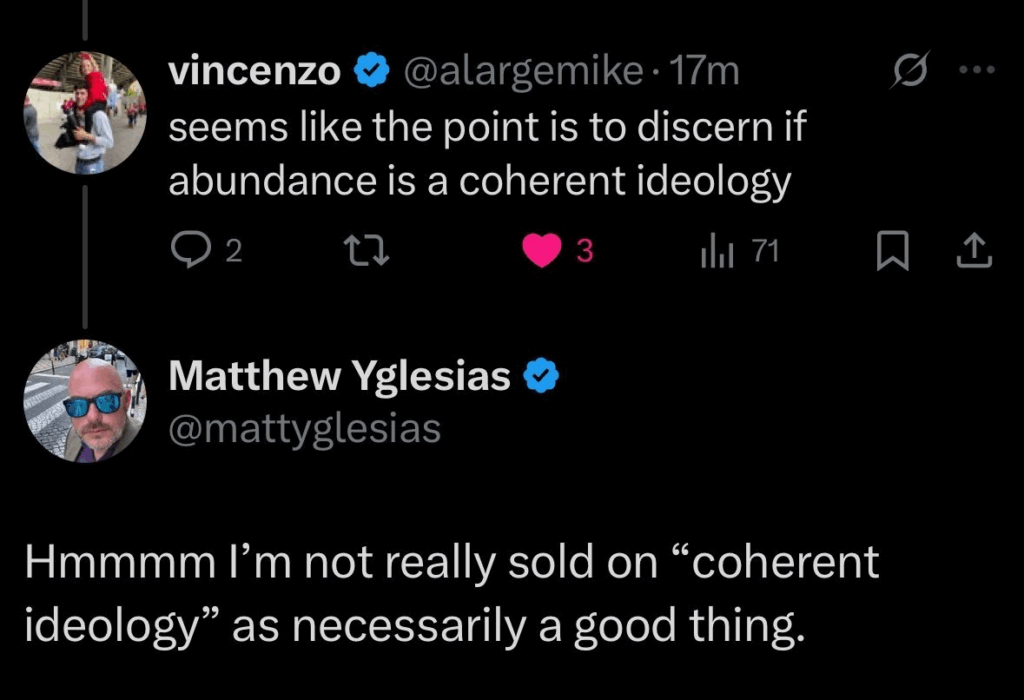
When people talk about “abundance,” they mean a lot of different things. For nearly a century before Derek Thompson coined the term “abundance agenda,” the word was used to describe a political economic paradigm that emphasized equitable distribution over increasing growth and production, pretty much diametrically in opposition to the modern abundance movement. I wrote about the abundance faction of 1935 that toyed with founding a party to FDR’s left for The New Republic. It’s a good word that socialists and social justice folks had been using for a long time (and probably would like to have it back). There’s even a forthcoming communist degrowth treatise called Radical Abundance.
But in the very contemporary, last few months sense, people broadly mean some subset of three things when they say “abundance.” There’s the book Abundanceby Ezra Klein and Derek Thompson, there’s abundance as an umbrella policy category encompassing how to invigorate the physical economy, and there’s the political abundance faction.
There are a ton of book reviews, ranging from near infatuation to even-handed to negative fusilades. I maintain that my colleague Hannah’s early review for The American Prospect is criminally underrated in that department. It usefully contrasts the book with Marc Dunkelman’s Why Nothing Works, which makes an extremely similar case but with some more nuance and historical context. If you want a quick guide to criticism of Klein and Thompson’s book, we have a compilation on this page.
Sometimes Abundance is called an airport book, and other times it’s “a once-in-a-generation, paradigm-shifting call to renew a politics of plenty.” I honestly expected it to be better; I liked Klein’s previous book Why We’re Polarized a lot more and I often enjoy Thompson’s articles.
It is, though, frequently wrong and/or incomplete. It discusses housing without mentioning the collapse of a housing bubble in the Great Recession. It laments that we can’t build another transcontinental railroad without discussing any of the historical tragedy around that construction, which I wrote about here. And the book takes issue with a Los Angeles air filter regulation that is actually extraordinarily reasonable and not cost-intensive, which I wrote about here. It also leans heavily on a questionable understanding of the New Left, including an unusual reading of Rachel Carson’s Silent Spring and arguing that Ralph Nader’s litigation to compel the government to actually enforce the law is actually the ur-example of making the government less able to act decisively. My paradigm, alas, remains unshifted.
The part of abundance that’s most compelling (in my humble opinion) is its role as an umbrella category for an array of supply-side policies. (And no, I do not consider climate denialist “all of the above” energy policies within that category; we already have an abundance of pollution.) There’s a lot of good work being done on housing policy by a variety of YIMBY groups. There are a number of organizations like the Volcker Alliance and Partnership for Public Service that do great work to develop a corps of dedicated civil servants, and there are a number of very good policy shops that I’m a big fan of, including the Washington Center for Equitable Growth. At the same time, you also have conservative culture warrior organizations like the Manhattan Institute and the Cato Institute and a literal landlord lobbying group in the National Multifamily Housing Council who pitch their policy preferences as abundance agenda items.
And then there’s abundance as a political program. My biggest problem with abundance is that it is specifically envisioned as means to disempower progressives, organized labor, and environmentalists. To be clear, that’s not me drawing spurious conclusions. Here’s some statements that say it quite explicitly:
- Niskanen: “On the left, conflicts exist wherever progressives pursue their goals through NIMBY-like mechanisms, such as with historic preservation, public employee unions, and organized interests claiming the mantle of environmental justice.”
- Derek Thompson, on the Lex Fridman podcast: “On the Democratic side, there is a fight and it’s happening right now and our book is trying to win a certain intra-left coalitional fight about defining the future of liberalism in the Democratic Party. So, I’m not of the left. I’m certainly not of the far left. I have center left politics and maybe even a center left personality style if we can even call it that, but I do not begrudge the left for fighting because there’s a fight to be had.”
- Jonathan Chait: “[P]rogressives are not wrong to see the abundance agenda as a broader attack on their movement. Their theory of American politics depends on empowering the very groups the abundance agenda identifies as the architects of failure and barriers to progress.”
- Josh Barro: “Sometimes the conflict between abundance and the labor movement gets downplayed. If you look up “unions” in the index to Ezra Klein and Derek Thompson’s Abundance, it takes you to their discussion on pages 126-7 of how the use of union labor did not prevent Pennsylvania Gov. Josh Shapiro from using regulatory relief to speed the reconstruction of a destroyed interstate underpass. It does not take you to their discussion on page 104 of how local construction trade unions in San Francisco have sought to block the use of cost-saving modular construction in affordable housing projects.”
As I’ve written, it isn’t universal, but there is a major undercurrent of anti-labor sentiment in the abundance movement. As my colleagues and their OMI co-authors discuss at some length in their report on the abundance policy agenda, environmentalists are perhaps an even greater scapegoat.
It’s worth noting that this faction is seeking to disempower organized labor and environmentalists arm-in-arm with:
- Charles Koch’s personal political machine, Americans for Prosperity
- Multiple organizations with contributors to Project 2025 like the American Enterprise Institute, the Reason Foundation, the Foundation for American Innovation, and the Mercatus Center
- Oren Cass, a speaker at Abundance 2025 who was also a contributor to Project 2025 and who just yesterday wrote in The New York Times about how the Trump administration’s destructive first 8 months set the stage for an economy that, as the article’s image claims emblazoned on a hard hat, “Make[s] America Build Again”
- The Future of Life Institute, which once sent a letter of intent for a $100,000 grant to a Swedish Neo-Nazi publication hmn
As Henry details in the report released this morning, all of those groups are either included in Inclusive Abundance’s “Abundance Landscape” or are participating at today’s abundance conference.
At a time when the most fundamental question confronting the Democratic Party, and everyone in the center-left coalition more broadly, is how to stand up to Trumpism, it seems like a particularly bad moment to decide that the Kochs make better allies than the AFL-CIO. And abundance very much is the pitch from establishment Democrats right now.
The champions of abundance liberalism are also hell-bent on bringing tech moguls, many of whom have become openly fascistic (e.g. Musk, Marc Andreesen), back into the fold even while advocating to discard entire constituencies including labor, environmentalists, and racial justice advocates, along with immigrants and queer people. At WelcomeFest, a centrist confab that was very abundance-pilled, there were talks about why Democrats needed to stop talking about Kilmar Abrego Garcia and why it was a bad idea to contest Florida’s “Don’t Say Gay” bill.
As Substacker and labor organizer JoeWrote explained, this myopia is downstream of the top-down vision of politics that has become a defining feature of Democrats, and is part of why the party is so distrusted even by its base. As Joe wrote:
“While most parties try to build support by turning their constituents’ wishes into policy, the Democrats take the opposite approach. The political objective is determined by wealthy party and media insiders, who then try to convince their constituents that the elite-decreed platform is in their best interest. This was best illustrated in the concluding chapter of Abundance, which outlined a top-down political theory: the policies are decided by the donor class, and the job of Democrat-aligned media and politicians is to sell those policies to American voters.”
And:
“As Abundance articulated, the Democratic establishment believes think tanks and donors should determine the party’s direction, not voters. Those forces are ideologically committed to Israel, neoliberalism, and the existing social order, so they see their primary goal as stopping anti-Zionists, socialists, and progressives from having a seat at the table.”
This frame, I think, helps to explicate why centrist liberals would proactively seek to weaken organized labor with the help of well-monied benefactors from the oil, crypto, and tech industries. As a factional movement, abundance is being wielded to preserve the type of top-down anti-democratic politics that has led us to this juncture.
Want more? Check out some of the pieces that we have published or contributed research or thoughts to in the last week:
Who is Behind the Growing Abundance Movement?
Trump’s Homicidal Hurricane Policy
In Trump’s D.C., the Swamp Runneth Over
Battle Over Independence Arrives at Fed’s `Doorstep’
Detailed Report Exposes Serious Threat of the Neoliberal, Trump-Lite ‘Abundance’ Agenda
Goon School Begins Bright and Early
The “Mini-Trump” Attacking Lisa Cook Had Paperwork Problems of His Own
Polymarket Authorized for U.S. Return Just Days After Donald Trump Jr. Joins as Adviser
*Clarification: A previous version of this Hackwatch said that the Future of Life Institute “granted $100,000 to Swedish Neo-Nazis,” based on reporting that a grant in that amount had been approved. FLI has denied that funds were disbursed and has disputed the reporting that the grant was approved, though they have acknowledged sending a letter of intent to the pro-Nazi publication Nya Dagbladet. The wording has been updated to clarify the stage in the grant process reached.
---
Friday, January 21, 2022
Billionaires Play Big Role in Funding of New Think Tank Institute for Progress (IFP)
Get ready to learn another think think tank acronym: IFP. It stands for Institute for Progress, a new Washington, DC-based think tank that has been launched by Caleb Watney and Alec Stapp.
Its mission is to "accelerate scientific, technological, and industrial progress while safeguarding humanity's future." The founders say they will spend most of their initial attention on three key areas: 1) Metascience, 2) Immigration, and 3) Biosecurity.
Mr. Watney, the Co-CEO, was the director for innovation policy at the think tank Progressive Policy Institute (PPI). Before that, he worked as a technology policy fellow at the R Street Institute and as a graduate research fellow at the Mercatus Center.
Mr. Stapp, the other Co-CEO, was the director of technology policy at PPI, a research fellow at the International Center for Law and Economics, a technology policy fellow at the Niskanen Center, and a graduate research fellow at the Mercatus Center.
Scholars at the think tank include senior biosecurity fellow Nikki Teran, who previously worked with the Committee on International Security and Arms Control at the National Academy of Science, the Council on Strategic Risks, and the Open Philanthropy Project. Another scholar is senior immigration fellow Jeremy Neufeld, who previously worked at the Niskanen Center.
There are currently three external board members: Tamara Winter, who formerly worked at the Charter Cities Institute and the Mercacuts Center; Dan Correa, a former Obama Administration official who was CEO of the Federation of American Scientists (FAS) and worked at Stanford's Freeman Spogli Institute as well as the Information Technology and Innovation Foundation (ITIF); and Zachary Graves, a visiting fellow at George Mason University's Antonin Scalia Law School who formerly worked at the Cato Institute and R Street Institute.
IFP, whose new website can be found here, only accepts funding from individuals and foundations. It is currently funded with the support of Open Philanthropy, Emergent Ventures, Patrick Collison, John Collison, and Sam Bankman-Fried.
Facebook co-founder Dustin Muskowitz and wife Cari Tuna are the main funders of Open Philanthropy, an entity which supports numerous think tanks. George Mason University's Mercatus Center houses Emergent Ventures, a fellowship and grant program which was launched with a $1 million grant from the Thiel Foundation. That foundation was created and funded by billionaire Peter Thiel, co-founder of PayPal and early investor in Facebook.
Patrick Collison and his brother John Collison are Irish billionaires who co-founded online payment processor Stripe. Sam Bankman-Fried, another billionaire, is the founder and CEO of FTX, a cryptocurrency exchange.
The IFP founders note that Tyler Cowen, head of the Mercatus Center, played a big role in their thinking.
IFP joins a crowded field of policy shops in Washington, which has more than 400 think tanks large and small.
---
rev dr ref
Comment on Request for Information on the Development of an Artificial Intelligence Action Plan
March 2025
, Josh T. Smith
Introduction
We appreciate the opportunity to comment on the NSF and NITRD NCO’s request for information (RFI) on the Development of an Artificial Intelligence Action Plan. We applaud the Office of Science and Technology Policy’s (OSTP) desire to identify policy actions necessary to enhance America’s AI dominance.
The Abundance Institute is a mission-driven nonprofit organization focused on creating the cultural and policy environment necessary for emerging technologies to grow, thrive, and reach their full potential. We strongly support Executive Order 14179’s establishment as the policy of the United States “to sustain and enhance America’s global AI dominance in order to promote human flourishing, economic competitiveness, and national security.”
AI is set to improve productivity, strengthen our national security, and “secure a brighter future for all Americans.” However, several threats could undermine those benefits. Well-intentioned state legislatures scramble to fill perceived regulatory gaps with hundreds of new hurdles for innovators. Meanwhile, wrapped in red tape, U.S. companies struggle to build the necessary domestic infrastructure, including energy infrastructure, to train and deploy powerful AI technology. If we stumble or slow, China is poised to take the lead.
The U.S. must meet these threats with muscular executive action. A robust AI Action Plan focused on removing barriers is a first important step.
As such, we are pleased to offer the following concrete ideas for the AI Action Plan. Our recommendations are grouped into direct AI-related actions and those that facilitate the energy infrastructure necessary to continue AI innovation in the U.S.
Key AI Policy Recommendations
Stem the Flow of Conflicting State Laws
Problem:State legislatures are actively considering more than 700 AI bills as of the end of February 2025 and will probably top 1000 by the end of state sessions. Colorado has passed a ‘comprehensive’ AI regulation that no one knows how to implement. Many other states, including some led by Republicans, are considering similar legislation. This patchwork of conflicting overregulation is a significant threat to the Trump administration’s goal of preserving and strengthening U.S. AI dominance.
Actions:
Anti-Patchwork Executive Order: Issue an executive order declaring that it is the position of the federal government that there be a unified regulatory regime for AI in the U.S., and that regime will be light touch, permissionless, and innovator-led. The executive order should:
- Establish a use-based approach to AI regulation, recognizing that AI models are general-purpose software that pose no inherent consumer risks until applied to specific purposes.
- Direct agencies, including the Departments of Commerce, Agriculture, Education, Energy, Transportation, and Health and Human Services to offer guidance on when state-level AI regulations would exclude a state from eligibility to receive funds from federal spending programs, including CHIPS Act and BEAD.
- Direct relevant agencies to prioritize federal permitting and other regulatory processes for projects in states with AI-friendly regulatory environments, as determined by the Administration.
- Declare federal contractors offering AI products and services exempt from state AI regulation that would hinder contract performance.
- Direct the Federal Trade Commission’s Competition Advocacy Program to offer comments to state legislatures on proposed AI regulation that highlight the likely effects of such laws on competition.
Advance Pro-Innovation Federal Law: Propose and advocate for Congressional legislation that preempts restrictive state regulations or explicitly prohibits certain forms of state-level AI legislation. For example,
- Anegative liability law could limit liability of developers of general-purpose AI models for damages created by third parties using the model.
- A safe harbor law could establish a set of light-touch practices that, if performed, would exempt developers of general-purpose AI models from other state and federal regulatory requirements.
- A right to compute law could establish that any government actions that restrict the ability to privately own or make use of computational resources for lawful purposes must be limited to those demonstrably necessary and narrowly tailored to fulfill a compelling government interest.
Dormant Commerce Clause Case: Direct the Attorney General to prepare a brief and litigation strategy to support a private dormant commerce clause case. Publicize the Administration’s intent to support such cases against any state legislation that threatens to undermine U.S. AI leadership.
Empower the Executive to Direct AI Policy
Problem:As a general-purpose technology, AI touches every industry and sector. This means that nearly every government agency has a jurisdictional hook to regulate AI. These disparate regulatory efforts must be clearly constrained, channeled, and coordinated by the White House to preserve and improve the U.S. innovation environment.
Actions:
Executive Order on AI Regulatory Planning and Review. In the model of EO 12866, adopt an Executive Order governing federal AI regulation. The EO should:
- Reassert that (consistent with EO 12866) the Vice President is the Executive Branch lead on AI policy.
- Direct the Office of Information and Regulatory Affair (OIRA) to develop a benefit-cost rubric to ensure that any AI regulation is justified, proportionate, and does not stifle progress while addressing any real risks. The rubric should include the following factors:
- Economic and Innovation Impact. What are the expected productivity gains, compliance costs, and effects on market competition and investment incentives?
- Risk Management and Safety. Does regulation significantly reduce empirical and significant risks? What beneficial AI applications might be delayed, deterred, or prevented? Does this rule account for varying risk profiles in different AI applications (e.g., healthcare vs. entertainment)?
- National Security and Geopolitical Positioning. Will this regulation make the U.S. a leader or laggard in global AI development? Will it make U.S. technology the choice of countries and companies around the globe? How will the regulation affect supply chain robustness?
- Regulatory Simplicity and Feasibility.Does the rule use regulatorily flexible approaches for iterative innovation, sandboxing, and adaptive governance, or will it be quickly obsolete by new developments? Is the rule straightforward, or does it create regulatory uncertainty? Can this regulation be enforced efficiently without excessive bureaucracy? Are there non-regulatory approaches (e.g., industry standards, liability frameworks) that achieve similar or better outcomes?
- Require all proposed federal AI regulation to be reviewed by OIRA and the Vice President’s office.
- Refocus Chief AI Officers established under the Biden Administration on how to deploy and use AI to further their agencies’ missions.
- Require agency heads to identify in writing their plans for how they will streamline and accelerate U.S. AI development in the next 90 days.
Federal Interagency Regulatory Sandbox.Establish a federal interagency AI sandbox to accelerate AI innovation in federally regulated industries. The sandbox should have five components:
- Coordinate agency action. Identify participating agencies and develop clear processes, including standardized regulatory mitigation agreements for sandbox participants.
- Admit and monitor participants. Govern the participation of parties in the sandbox, including by setting and enforcing the criteria for participation, establishing the processes for entering and leaving the sandbox, and monitoring participation.
- Maintain shared resources.Maintain key resources for agency and private participants, including a repository of template agreements. Access to certain federal data sets could also be conditional on sandbox participation (see “Unleash the Potential of Unstructured Federal Data for AI Training,” below).
- Catalyze regulatory mitigation. Match participants with involved agencies. Coordinate and support the development of time-limited regulatory mitigation agreements between participants and federal regulators. Serve as a pro-innovation advocate to the agencies as participants develop such agreements.
- Recommend legal changes. Based on knowledge built through sandbox work, offer recommendations to agencies and to Congress on regulatory or legislative changes needed to streamline development or fill gaps in legal protections.
Rename and Restructure AISI. Consistent with the growth and innovation emphasis of this administration, the AI Safety Institute should be renamed the AI Standards Institute, depoliticized, and integrated back into NIST’s general structure. Important standard-setting institutions are undermined if they are positioned to make controversial policy decisions better suited to elected officials.
Reorienting the federal bureaucracy toward accelerating U.S. AI innovation requires strong leadership from the White House. A muscular EO, decisively implemented by OIRA, sets the right tone across government. And a vibrant sandbox will help federal agencies and innovators alike to learn more about how to collaborate to advance American AI leadership.
Unleash the Potential of Unstructured Federal Data for AI Training
Problem:The U.S. federal government holds vast troves of economic, demographic, scientific, historical, and other data that it has assembled or funded. While some of this data is publicly available, much remains inaccessible or stored in formats that hinder usability.
A significant portion of this inaccessible data is unstructured—text, images, audio, and other formats that lack a predefined model. Many of these datasets have few legal constraints and pose no privacy or security risks, yet they remain underutilized. Unlocking this data could greatly enhance AI training, benefiting both general AI models and specialized applications such as scientific research.
Further complicating access, multiple federal initiatives—such as the National AI Research Resource (NAIRR), the Standard Application Process (SAP), and the National Secure Data Service (NSDS)—address data access challenges but focus primarily on structured, high-quality statistical data, which is costly to curate. Meanwhile, unstructured data remains largely overlooked.
Action:The federal government should identify and make available unstructured datasets from federal programs. To achieve this:
- Survey Federal Data Holdings.Direct the Office of Management and Budget (OMB), through the Federal Chief Data Officers Council, to conduct a government-wide inventory of unstructured data. This survey should assess data types, volume, and accessibility to prioritize high-value datasets for release.
- Redirect the NAIRR to Unstructured Data. Task NAIRR with creating an AI training repository specifically for federally sourced, unstructured data. Agencies should be directed to contribute datasets to this repository.
- Mandate Open Research Access. Require all government-funded research—including clinical studies—to be published openly, with associated publications and data submitted to the new repository.
- Ensure Automated Access. Prohibit federal websites from blocking data collection by automated tools (‘bots’), allowing researchers to retrieve publicly available information more efficiently.
- Digitize National Archives.Launch a large-scale initiative to digitize historical records and create a publicly accessible National Archives repository.
Many of these efforts could be implemented through public-private partnerships to promote data use while minimizing costs to taxpayers.
Ensure AI Liability Frameworks Promote Innovation
Problem:AI model developers create general-purpose tools, but they generally do not control how those tools are fine-tuned, deployed, or applied by the model deployers who build user applications. Yet some regulatory proposals and litigation efforts seek to impose liability on AI model developers. Trial lawyers and plaintiffs currently have strong financial incentives to sue model developers. Imposing broad liability on model developers would have severe consequences, including:
- Overcautious AI Development.Model creators cannot predict every possible use by third parties, forcing them to adopt excessive restrictions that would limit the functionality of or access to the most effective AI tools.
- Self-Censorship.Heightened litigation risk triggers one specific form of overcaution: unnecessarily constraining the range of topics and viewpoints that AI models and AI systems will engage with or reflect.
- Anticompetitive Effects.Litigation burdens would disproportionately harm smaller or open-source AI model developers, entrenching the dominance of large technology firms that can afford litigation or compliance costs.
Legislators already recognize that harms are a result of AI deployment choices. New York’s anti-deepfake law targets those who create and distribute harmful AI-generated content, not the developers of image-generation models. This approach should guide federal AI policy. A liability framework that properly focuses on bad actors—rather than on tool-builders—better ensures accountability without stifling innovation.
Action:The executive branch should take immediate steps to influence the development of AI liability regimes that focus on deployers rather than model developers. The administration should:
- Distinguish AI Liability Roles:Direct enforcement agencies such as the FTC and DOJ to distinguish between AI developers and deployers in enforcement actions and policy guidance.
- Advocacy Efforts:Direct the DOJ to pursue intervening in relevant cases to support the development of liability law that focuses on the most proximate cause of harm. Oppose liability and compliance frameworks that impose undue burdens on foundational AI research and building of general-purpose tools.
- Codify Deployers’ Responsibility Where Appropriate:Direct sector-specific agencies (e.g., FDA for AI-powered medical devices, NHTSA for AI-driven vehicles) to clarify that their jurisdiction is limited to industry-specific applications, with the goal of not subjecting developers of general-purpose tools to overlapping agency jurisdiction.
Key Energy Policy Recommendations
Direct FERC to Speed Interconnection Processes Within the Regional Transmission Operators that they Oversee
Problem: It takes too long to plug new generators into the grid. The Federal Energy Regulatory Commission (FERC) oversees the operations of major grid operators except for Texas. Over the last few years, it has become clear that the Texas grid builds much faster than other grids. From 2021 to 2023, the Electricity Reliability Council of Texas (ERCOT) added 25 GW, compared to the next highest, PJM in the eastern U.S., at 15 GW. That is, Texas added about 70% more, almost double what other grids added.
Texas can build fast and power new growth for two interrelated reasons. First, Texas has no capacity market, which requires extensive research, complicated modeling, and often expensive upgrades before new generation capacity can be added to the grid. Texas operates an energy-only system and relies on a “connect and manage” approach to grid operation. Generators know that they can be curtailed by the grid operators to maintain the safe operation of the system.
The second reason is that Texas operates more efficiently than other grid operators. An energy-only resource in the PJM regional transmission organization system takes just as long to add to the grid as a networked resource eligible for additional capacity payments. Because of this, generators largely ignore the energy-only option.
A swelling body of academic research suggests that the existing operations of capacity markets and interconnection need reform to enable faster building and market-driven responses to rising electricity costs or rising capacity costs.
Action:Direct the Federal Energy Regulatory Commission to speed interconnection processes within the regional transmission operators they oversee. Set a goal that new generation and new loads should be approved and connected to the grid within one year.
Specifically, direct FERC to host a technical conference and begin a related rulemaking on capacity markets and large load interconnection processes that clarifies and accounts for: (1) the economic foundations of capacity markets and simplifies the conflicting processes between regional transmission operators, (2) load flexibility from on-site energy assets that includes co-location, (3) the ability to move load from sites where the grid is stressed, (4) the possibility of energy parks that incorporate multiple energy assets, and (5) the emergence of new energy technologies like batteries. The goal is to enable innovation and replace bloated planning with market-driven investments that encourage efficiency, adaptation, and innovation.
Embrace “Build, Baby Build”: Enable All Energy Sources Via Permitting Reform
Problem: Permitting reviews are out of control. Two out of three reviews take longer than the two-year timeline required by statute. Final Environmental Impact Statements issued in 2024 took a median of 2.2 years and an average of 3.8 years. In addition to consuming years of time, these reviews are thousands of pages long.
Action:Work with agencies managing federal land to speed permitting and interconnection of energy infrastructure of all kinds and to open opportunities for mining and energy development of all kinds on federal lands.
In concrete terms, OSTP can work with agencies as they rewrite their NEPA-implementing regulations in response to Executive Order 14154 and CEQ’s subsequent rescission of its regulations. Under the NEPA statute and CEQ guidance, agencies have significant authority to improve their implementation of NEPA. The President should require agencies implementing NEPA to:
- Consider only the direct, significant, and reasonably foreseeable environmental effects. Speculative, indirect, and cumulative impacts must not be considered.
- Enforce prompt NEPA review timelines.
- Improve coordination between agencies when multiple agencies are involved, by 1) designating a single lead agency for each NEPA review, responsible for issuing a single, consolidated Record of Decision; 2) requiring concurrent agency reviews and prohibit sequential reviews; and 3) eliminating duplicative permitting requirements among agencies unless explicitly required by law.
- Immediately adopt new categorical exclusions to exempt:
- Routine infrastructure maintenance and upgrades,
- Grid expansion and modernization projects,
- Domestic energy extraction and production activities,
- Nuclear plant modifications and upgrades that do not significantly alter environmental impact,
- Nuclear plant uprates and capacity expansions,
- License renewals and life extensions for existing plants,
- Deployment of next-generation reactors on pre-approved sites, and
- Co-locating SMRs on existing energy infrastructure sites.
- Unify exemptions by directing agencies to adopt all existing categorical exclusions at other agencies so that the same categorical exclusions are available to project sponsors regardless of the agency overseeing the permitting process.
- Prioritize permitting for projects designated by the National Energy Council as critical for energy dominance. These include:
- Nuclear energy projects, including SMRs and advanced reactors,
- Domestic oil, natural gas, and hydrogen infrastructure,
- Liquefied Natural Gas (LNG) terminals,
- Electrical transmission lines,
- Mining and mineral extraction for critical energy materials, and
- Energy production from any fuel source.
- Enable the use of federal lands for energy development and production of all kinds.
Direct the NRC to Replace Linear No-threshold Modeling
Problem: The U.S. builds nuclear power generation at a glacial pace. The Connecticut Yankee nuclear plant, which began operating on January 1, 1968, took five years and $1 billion (in today’s dollars) to permit and build. In contrast, Vogtle’s nuclear reactor in Georgia took 14 years and over $30 billion to fully come online in 2024. Poor regulation is the problem—particularly the “As Low as Reasonably Achievable” (ALARA) standard and the linear no-threshold (LNT) model. These lack well-defined limits, ignore radiation dosage and timing, and force excessive mitigation efforts. These rules have stifled nuclear expansion since the mid-to-late 1980s, creating skyrocketing costs and halting additional capacity. ALARA prevents cost reductions because regulators could interpret cost savings and profitability to imply that additional radiation emission reduction efforts could have been done.
Action:Direct the Nuclear Regulatory Commission (NRC) to replace linear no-threshold modeling with standards that account for dosage and timing. Specifically, the NRC must:
- Clarify ALARA guidelines to establish reasonable, cost-conscious thresholds rather than open-ended requirements.
- Replace the LNT model with a more risk-informed framework that considers dosage and timing for radiation exposure.
- Refine and streamline the NRC’s rules created under the direction of the 2019 Nuclear Energy Innovation and Modernization Act (NEIMA). NEIMA required the NRC to establish new licensing processes for nuclear reactors and advanced reactors, but its proposals have been unwieldy and failed to create the NEIMA authors’ envisioned and intended surge of small modular reactor (SMR) companies or deployment of SMRs or advanced reactors.
Supercharge Small Modular Nuclear in the US by Settling the Lawsuit Against the NRC Brought by Utah, Texas, and Last Energy
Problem: The Nuclear Regulatory Commission (NRC) is overstepping its authority by asserting licensing jurisdiction over the construction and operation of all nuclear reactors, regardless of how small and safe they are. The Atomic Energy Act of 1954 explicitly excludes small and safe reactors from the statutory definition of Utilization Facility, and therefore, the NRC lacks legal authority to license or restrict construction and operation of those reactors. Licensing authority for these classes of reactors properly belongs to the states.
States and commercial nuclear startups have now sued the NRC to overturn this aspect of NRC’s Utilization Facility Rule, opening the door for rapid deployment of test reactors, microreactors, and small modular reactors. If this lawsuit is successful, America could experience a nuclear, energy, and economic renaissance. Nuclear costs would plummet as repeatable and manufacturable commercial reactors are deployed and rapid iteration of test reactors proceeds.
Action:The Trump Administration should welcome the Texas v. NRC case on the Utilization Facility Rule and direct the DOJ to settle the case immediately in favor of the plaintiff’s claims. This will usher in a new age of nuclear energy abundance. Among the many other benefits, there would be ample energy to power data centers needed for AI supremacy.
Conclusion
Thank you for considering the above recommendations. Maintaining the U.S. lead in AI development and deployment is a critical priority, and there is much that the President and his administration can do to clear the path for American innovators and entrepreneurs. We look forward to supporting such efforts.
Key AI Resources
---
PROTO? CONTEXT INTERCEPT SAM BIDDLE NOV 2024
tech-industry-trump-military-contracts
Donald Trump pitched himself to voters as a supposed anti-interventionist candidate of peace. But when he reenters the White House in January, at his side will be a phalanx of pro-military Silicon Valley investors, inventors, and executives eager to build the most sophisticated weapons the world has ever known.
During his last term, the U.S. tech sector tiptoed skittishly around Trump; longtime right-winger Peter Thiel stood as an outlier in his full-throated support of MAGA politics as other investors and executives largely winced and smiled politely. Back then, Silicon Valley still offered the public peaceful mission statements of improving the human condition, connecting people, and organizing information. Technology was supposed to help, never harm. No more: People like Thiel, Palmer Luckey, Trae Stephens, and Marc Andreessen make up a new vanguard of powerful tech figures who have unapologetically merged right-wing politics with a determination to furnish a MAGA-dominated United States with a constant flow of newer, better arms and surveillance tools.
Trump’s election marks an epochal victory not just for the right, but also for a growing conservative counterrevolution in American tech.
These men (as they tend to be) hold much in common beyond their support of Republican candidates: They share the belief that China represents an existential threat to the United States (an increasingly bipartisan belief, to be sure) and must be dominated technologically and militarily at all costs. They are united in their aversion, if not open hostility, to arguments that the pace of invention must be balanced against any moral consideration beyond winning. And they all stand to profit greatly from this new tech-driven arms race.
Trump’s election marks an epochal victory not just for the right, but also for a growing conservative counterrevolution in American tech that has successfully rebranded military contracting as the proud national duty of the American engineer, not a taboo to be dodged and hidden. Meta’s recent announcement that its Llama large language model can now be used by defense customers means that Apple is the last of the “Big Five” American tech firms — Amazon, Apple, Google, Microsoft, and Meta — not engaged in military or intelligence contracting.
Elon Musk has drawn the lion’s share of media scrutiny (and Trump world credit) for throwing his fortune and digital influence behind the campaign. Over the years, the world’s richest man has become an enormously successful defense contractor via SpaceX, which has reaped billions selling access to rockets that the Pentagon hopes will someday rapidly ferry troops into battle. SpaceX’s Starlink satellite internet has also become an indispensable American military tool, and the company is working on a constellation of bespoke spy satellites for U.S. intelligence agency use.
But Musk is just one part of a broader wave of militarists who will have Trump’s ear on policy matters.
After election day, Musk replied to a celebratory tweet from Palmer Luckey, a founder of Anduril, a $14 billion startup that got its start selling migrant-detecting surveillance towers for the southern border and now manufactures a growing line of lethal drones and missiles. “Very important to open DoD/Intel to entrepreneurial companies like yours,” Musk wrote. Anduril’s rise is inseparable from Trumpism: Luckey founded the firm in 2017 after he was fired by Meta for contributing to a pro-Trump organization. He has been outspoken in his support for Trump as both candidate and president, fundraising for him in both 2020 and 2024.
Big Tech historically worked hard to be viewed by the public as inhabiting the center-left, if not being apolitical altogether. But even that is changing. While Luckey was fired for merely supporting Trump’s first campaign, his former boss (and former liberal) Mark Zuckerberg publicly characterized Trump surviving the June assassination attempt as “bad ass” and quickly congratulated the president-elect on a “decisive victory.” Zuckerberg added that he is “looking forward to working with you and your administration.”
:{To some extent, none of this is new: Silicon Valley’s origin is one of militarism. The American computer and software economy was nurtured from birth by the explosive growth and endless money of the Cold War arms race and its insatiable appetite for private sector R&D. :{And despite the popular trope of liberal Google executives, the tech industry has always harbored a strong anti-labor, pro-business instinct that dovetails neatly with conservative politics}:.
It would also be a mistake to think that Silicon Valley was ever truly in lockstep with progressive values. A 2014 political ad by Americans for a Conservative Direction, a defunct effort by Facebook to court the Republican Party, that “it’s wrong to have millions of people living in America illegally” and urged lawmakers to “secure our borders so this never happens again.” The notion of the Democrat-friendly wing of Big Tech as dovish is equally wrong: Former Google chair and longtime liberal donor Eric Schmidt is a leading China hawk and defense tech investor. Similarly, the Democratic Party itself hasn’t meaningfully distanced itself from militarism in recent history. The current wave of startups designing smaller, cheaper military drones follows the Obama administration’s eager mass adoption of the technology, and firms like Anduril and Palantir have thrived under Joe Biden.}:
What has changed is which views the tech industry is now comfortable expressing out loud.
:{:{A year after Luckey’s ouster from the virtual reality subsidiary he founded, Google became embroiled in what grew into an industry-wide upheaval over military contracting. After it was reported that the company sought to win Project Maven, a lucrative drone-targeting contract, employees who had come to the internet titan to work on consumer products like Search, Maps, and Gmail found themselves disturbed by the thought of contributing to a system that could kill people. Waves of protests pushed Google to abandon the Pentagon with its tail between its legs.}:
Even Fei-Fei Li, then Google Cloud’s chief artificial intelligence and machine learning scientist, described the contract as a source of shame in internal emails obtained by the New York Times. “Weaponized AI is probably one of the most sensitized topics of AI — if not THE most. This is red meat to the media to find all ways to damage Google,” she wrote. “I don’t know what would happen if the media starts picking up a theme that Google is secretly building AI weapons or AI technologies to enable weapons for the Defense industry.”}:
It’s an exchange that reads deeply quaint today. The notion that the country’s talented engineers should build weapons is becoming fully mainstreamed. “Societies have always needed a warrior class that is enthused and excited about enacting violence on others in pursuit of good aims,” Luckey explained in an on-campus talk about his company’s contributions to the Ukrainian war effort with Pepperdine University President Jim Gash. “You need people like me who are sick in that way and who don’t lose any sleep making tools of violence in order to preserve freedom.”
This “warrior class” mentality traces its genealogy to Peter Thiel, whose disciples, like Luckey, spread the gospel of a conservative-led arms race against China. “Everything that we’re doing, what the [Department of Defense] is doing, is preparing for a conflict with a great power like China in the Pacific,” Luckey told Bloomberg TV in a 2023 interview. At the Reagan National Defense Forum in 2019, Thiel, a lifelong techno-libertarian and Trump’s first major backer in tech, rejected the “ethical framing” of the question of whether to build weapons.” When it’s a choice between the U.S. and China, it is always the ethical decision to work with the U.S. government,” he said. Though Sinophobia is increasingly standard across party affiliations, it’s particularly frothing in the venture-backed warrior class. In 2019, Thiel claimed that Google had been “infiltrated by Chinese intelligence” and two years later suggested that bitcoin is “a Chinese financial weapon against the U.S.”
Related
Tech Billionaires Love Trump Now — Because He’s One of Them](https://theintercept.com/2024/08/07/silicon-valley-tech-billionaires-president-trump/)
Thiel often embodies the self-contradiction of Trumpist foreign policy, decrying the use of taxpayer money on “faraway wars” while boosting companies that design weapons for exactly that. Like Trump, Thiel is a vocal opponent of Bush- and Obama-era adventurism in the Middle East as a source of nothing but regional chaos — though Thiel has remained silent on Trump’s large expansion of the Obama administration’s drone program and his assassination of Iranian Maj. Gen. Qassim Suleimani. In July, asked about the Israeli use of AI in the ongoing slaughter in Gaza, Thiel responded, “I defer to Israel.”
Thiel’s gravitational pull is felt across the whole of tech’s realignment toward militarism. Vice President-elect JD Vance worked at Mithril, another of Thiel’s investment firms, and used $15 million from his former boss to fund the 2022 Senate win that secured his national political bona fides. Vance would later go on to invest in Anduril. Founders Fund, Thiel’s main venture capital firm, has seeded the tech sector with influential figures friendly to both Trumpism and the Pentagon. Before, an investor or CEO who publicly embraced right-wing ideology and products designed to kill risked becoming an industry pariah. Today, he can be a CNBC guest.
An earlier adopter of MAGA, Thiel was also investing in and creating military- and intelligence-oriented companies before it was cool. He co-founded Palantir, which got its start helping facilitate spy agency and deportation raids by Immigration and Customs Enforcement. Now part of the S&P 500, the company helps target military strikes for Ukraine and in January sealed a “strategic partnership for battle tech” with the Israeli Ministry of Defense, according to a press release.
Before, a tech investor or CEO who publicly embraced right-wing ideology and products designed to kill risked becoming an industry pariah. Today, he can be a CNBC guest.
The ripple effect of Palantir’s success has helped popularize defense tech and solidify its union with the American right. Thiel’s Palantir co-founder Joe Lonsdale, also an Anduril investor, is reportedly helping Trump staff his new administration. Former Palantir employee and Anduril executive chair Trae Stephens joined the Trump transition team in 2016 and has suggested he would serve a second administration. As a member of the U.S.–China Economic and Security Review Commission, Thiel ally Jacob Helberg has been instrumental in whipping up anti-China fervor on Capitol Hill, helping push legislation to ban TikTok, and arguing for military adoption of AI technologies like those sold by his employer, Palantir, which markets itself as a bulwark against Chinese aggression. Although Palantir CEO Alex Karp is a self-described Democrat who said he planned to vote against Trump, he has derided progressivism as a “thin pagan religion” of wokeness, suggested pro-Palestine college protesters leave for North Korea, and continually advocating for an American arms buildup.
“Trump has surrounded himself with ‘techno-optimists’ — people who believe technology is the answer to every problem,” Brianna Rosen, a strategy and policy fellow at the University of Oxford and alumnus of the Obama National Security Council, told The Intercept. “Key members of his inner circle — leading tech executives — describe themselves in this way. The risk of techno-optimism in the military domain is that it focuses on how technology saves lives, rather than the real risks associated with military AI, such as the accelerated pace of targeting.”
The worldview of this corner of the tech industry is loud, if not always consistent. Foreign entanglements are bad, but the United States must be on perpetual war-footing against China. China itself is dangerous in part because it’s rapidly weaponizing AI, a current that threatens global stability, so the United States should do the very same, even harder, absent regulatory meddling.
Stephens’s 2022 admonition that “the business of war is the business of deterrence” argues that “peaceful outcomes are only achievable if we maintain our technological advantage in weapons systems” — an argument that overlooks the fact that the U.S. military’s overwhelming technological superiority failed to keep it out of Korea, Vietnam, Iraq, or Afghanistan. In a recent interview with Wired, Stephens both criticized the revolving door between the federal government and Anduril competitors like Boeing while also stating that “it’s important that people come out of private industry to work on civil service projects, and I hope at some point I’ll have the opportunity to go back in and serve the government and American people.”
William Fitzgerald, the founder of The Worker Agency, a communications and advocacy firm that has helped tech workers organize against military contracts, said this square is easily circled by right-wing tech hawks, whose pitch is centered on the glacial incompetence of the Department of Defense and blue-chip contractors like Lockheed and Raytheon. “Peter Thiel’s whole thing is to privatize the state,” Fitzgerald explained. Despite all of the rhetoric about avoiding foreign entanglements, a high-tech arms race is conducive to different kinds of wars, not fewer of them. “This alignment fits this narrative that we can do cheaper wars,” he said. “We won’t lose the men over there because we’ll have these drones.”
In this view, the opposition of Thiel and his ilk isn’t so much to forever wars, then, but rather whose hardware is being purchased forever.
The new conservative tech establishment seems in full agreement about the need for an era of techno-militarism. Marc Andreessen and Ben Horowitz, the namesakes of one of Silicon Valley’s most storied and successful venture capital firms, poured millions into Trump’s reelection and have pushed hard to reorient the American tech sector toward fighting wars. In a “Techno-Optimist Manifesto” published last October, Andreessen wrote of defense contracting as a moral imperative. “We believe America and her allies should be strong and not weak. We believe national strength of liberal democracies flows from economic strength (financial power), cultural strength (soft power), and military strength (hard power). Economic, cultural, and military strength flow from technological strength.” The firm knows full well what it’s evoking through a naked embrace of strength as society’s greatest virtue: Listed among the “Patron Saints of Techno-Optimism” is Filippo Tommaso Marinetti, co-author of the 1919 Fascist Manifesto.
The venture capitalists’ document offers a clear rebuttal of employees’ moral qualms that pushed Google to ditch Project Maven. The manifesto dismisses basic notions of “ethics,” “safety,” and “social responsibility” as a “demoralization campaign” of “zombie ideas, many derived from Communism” pushed by “the enemy.” This is rhetoric that matches a brand Trump has worked to cultivate: aspirationally hypermasculine, unapologetically jingoistic, and horrified by an America whose potential to dominate the planet is imperiled by meddling foreigners and scolding woke co-workers.
“There’s a lot more volatility in the world, [and] there is more of a revolt against what some would deem ‘woke culture,’” said Michael Dempsey, managing partner at the New York-based venture capital firm Compound. “It’s just more in the zeitgeist now that companies shouldn’t be so heavily influenced by personal politics. Obviously that is the tech industry talking out of both sides of their mouth because we saw in this past election a bunch of people get very political and make donations from their firms.”
“It’s just more in the zeitgeist now that companies shouldn’t be so heavily influenced by personal politics. Obviously that is the tech industry talking out of both sides of their mouth.”
Despite skewing young (by national security standards), many in this rightward, pro-military orbit are cultural and religious traditionalists infused with the libertarian preferences of the Zynternet, a wildly popular online content scene that’s melded apolitical internet bro culture and a general aversion to anything considered vaguely “woke.” A recent Vanity Fair profile of the El Segundo tech scene, a hotbed of the burgeoning “military Zyndustrial complex” commonly known as “the Gundo,” described the city as “California’s freedom-loving, Bible-thumping hub of hard tech.” It paints a vivid scene of young engineers who eschewed the progressive dystopia of San Francisco they read about on Twitter and instead flocked to build “nuclear reactors and military weaponry designed to fight China” beneath “an American flag the size of a dumpster” and “a life-size poster of Jesus Christ smiling benevolently onto a bench press below.”
The American right’s hold over online culture in the form of podcasts, streamers, and other youth-friendly media has been central to both retaking Washington and bulldozing post-Maven sentiment, according to William Fitzgerald of Worker Agency. “I gotta hand it to the VCs, they’re really good at comms,” said Fitzgerald, who himself is former Google employee who helped leak critical information about the company’s involvement in Project Maven. “They’re really making sure that these Gundo bros are wrapping the American flag around them. It’s been fascinating to see them from 2019 to 2024 completely changing the culture among young tech workers.”
A wave of layoffs and firings of employees engaged in anti-military protests have been a boon for defense evangelists, Fitzgerald added. “The workers have been told to shut up, or they get fired.”
This rhetoric has been matched by a massive push by Andreessen Horowitz (already an Anduril investor) behind the fund’s “American Dynamism” portfolio, a collection of companies that leans heavily into new startups hoping to be the next Raytheon. These investments include ABL Space Systems, already contracting with the Air Force,; Epirus, which makes microwave directed-energy weapons; and Shield AI, which works on autonomous military drones. Following the election, David Ulevitch, who leads the fund’s American Dynamism team, retweeted a celebratory video montage interspersed with men firing flamethrowers, machine guns, jets, Hulk Hogan, and a fist-pumping post-assassination attempt Trump.
Even the appearance of more money and interest in defense tech could have a knock-on effect for startup founders hoping to chase what’s trendy. Dempsey said he expects investors and founder to “pattern-match to companies like Anduril and to a lesser extent SpaceX, believing that their outcomes will be the same.” The increased political and cultural friendliness toward weapons startups also coincides with high interest rates and growing interest in hardware companies, Dempsey explained, as software companies have lost their luster following years of growth driven by little more than cheap venture capital.
There’s every reason to believe a Trump-controlled Washington will give the tech industry, increasingly invested in militarized AI, what it wants. In July, the Washington Post reported the Trump-aligned America First Policy Institute was working on a proposal to “Make America First in AI” by undoing regulatory burdens and encouraging military applications. Trump has already indicated he’ll reverse the Biden administration’s executive order on AI safety, which mandated safety testing and risk-based self-reporting by companies. Michael Kratsios, chief technology officer during the first Trump administration and managing director of Air Force contractor Scale AI, is reportedly advising Trump’s transition team on policy matters.
“‘Make America First in AI’ means the United States will move quickly, regardless of the costs, to maintain its competitive edge over China,” Brianna Rosen, the Oxford fellow, explained. “That translates into greater investment and fewer restrictions on military AI. Industry already leads AI development and deployment in the defense and intelligence sectors; that role has now been cemented.”
The mutual embrace of MAGA conservatism and weapons tech seems to already be paying off. After dumping $200 million into the Trump campaign’s terminal phase, Musk was quick to cash his chips in: On Thursday, the New York Times reported that he petitioned Trump SpaceX executives into positions at the Department of Defense before the election had even begun. Musk will also co-lead a nebulous new office dedicated to slashing federal spending. Rep. Matt Gaetz, brother-in-law to Luckey, now stands to be the country’s next attorney general. In a post-election interview with Bloomberg, Luckey shared that he is already advising the Trump transition team and endorses the current candidates for defense secretary. “We did well under Trump, and we did better under Biden,” he said of Anduril. “I think we will do even better now.”
---