Klein, Ezra abundance
---
THIEL DIALOG 6 26
SEE ABUNDANCE TECHO-FASC
---
CHRIS HAYES AI POD
---
longnow
Thursday, March 27, 02025
Ezra Klein, New York Times columnist, podcast host, and author of Why We're Polarized and Derek Thompson, NPR news analyst, podcast host, and author of Hit Makers, present their new book Abundance, a paradigm-shifting call to rethink big, entrenched problems that seem mired in systemic scarcity: from climate change to housing, education to healthcare.
---
---
[### Henry Abundance Agenda Orgs Draft

Revolving Door Project
https://therevolvingdoorproject.org › 2025/09](https://therevolvingdoorproject.org/wp-content/uploads/2025/09/Abundance-Ecosystem-Report.pdf)
Sep 5, 2025 — ” Open Philanthropy is a major donor to the pro-abundance Institute for Progress. In 2025, Open Philanthropy announced a. $120 million ...Read more
[### The Abundance Gang Has a Big AI Problem

The New Republic
https://newrepublic.com › article › abundance-ai-proble...](https://newrepublic.com/article/206423/abundance-ai-problem-data-centers)
Feb 25, 2026 — Following the release of Klein and Thompson's book, Open Philanthropy ... Dustin Moskovitz, unveiled a $120 million fund focused on ...Read more
---
tnr
In early February, Axios reported that “Ezra Klein’s Abundance movement is getting some backup” in the form of a new group: Next American Era, headed by former Democratic Congressional Campaign Committee head, Illinois congresswoman, and longtime Washington insider Cheri Bustos. Bustos’s group, per the report, would be committed to “‘pro-growth,’ deregulatory policies.” This is hardly surprising; for the past several years Bustos has been a literal corporate lobbyist at the extremely Trump-connected outfit Mercury Partners. Mercury saw its profits more than double in 2025 as it sold access to the Trump throne room.
Over the course of the three years for which we have lobbying disclosures, Bustos branched out from lobbying overwhelmingly on behalf of agriculture firms and municipal governments to work for energy firms and software behemoths, as well. In particular, Bustos registered as a lobbyist for OpenAI and Larry Ellison’s Oracle, two of the most central companies in the bubblish AI industry that is becoming increasingly omnipresent in our politics, economy, and daily lives. The two firms were also the biggest clients in Bustos’s portfolio; Oracle’s 2025 lobbying expenditures totaled over $11 million, while OpenAI’s were just under $3 million. Bustos’s next-largest clients in 2025 were Korea Zinc and battery manufacturer Gotion, both with around $2.5 million in total lobbying.
Facially, it seems odd for someone like Bustos, fresh off a stint of AI lobbying, to launch a centrist 501c(4) and immediately align with the abundance agenda, which generally represents itself as a movement focused on housing and utility transmission permitting. In reality, it’s of a kind with a deep techno-optimist, pro-AI undercurrent that has permeated abundance thought since before Derek Thompson coined the phrase “abundance agenda” in 2022.
In the spring of 2025, Thompson and Klein’s tome, Abundance, launched to a firestorm of discourse, both praise and criticism. Nearly a year later, the blaze has lessened—Trumpian destruction of the economy and democracy tends to take the wind out of the sails of cockeyed optimists, after all—but tensions in what writers on both sides (namely, Jonathan Chait and David Sirota) have called the “Democrats’ Civil War” continue to simmer.
The abundance ecosystem has tried to develop a “grass-tops” movement, which parlays an elite influence campaign into building a mass constituency. Abundance world has certainly been successful at the first part; with hundreds of millions of dollars (this figure is meant literally, not figuratively) flowing into abundance organizations and Klein playing an intellectual power-broker role within Democratic politics—to the point that it raised eyebrows internally at The New York Times, according to reporting from Axios. But with sitting mayors and governors explicitly name-checking the book and its authors, abundance has thoroughly permeated the political class. It has not, however, been as successful at building a broad-base constituency. (It is perhaps difficult to focus on a gauzy future of plenty when fascist shock troops are loose on the streets, acting with impunity.)
Despite Abundance making theNew York Times bestseller list (tech tycoon Reid Hoffman sending copies to everyone he knows probably didn’t hurt), Democratic voters have been notably leery about the abundance framework. Polling has shown that the base is far more interested in tackling corporate greed than it is in municipal red tape, and Klein’s attempts to cast himself as a bipartisan mediator in the wake of the Charlie Kirk assassination have undermined his status as a leading light on the left.
At the Abundance 2025 conference, prominent abundance think tanker Alex Trembath of the Breakthrough Institute stood up to forcefully decry any allegations that the movement had been organized by elites, claiming that “abundance is not this astroturfed conspiracy. In fact, just the opposite: Abundance is emergent. Abundance is bottom-up.” He followed this declaration with the romantic sentiment that it was not donors who brought this movement together but fate, saying, “We were not herded and orchestrated: We found each other. The people and ideas in this ballroom pull on strands from multiple fields—think tanks, activists, organizers, elected officials, journalists, philanthropists, technologists, and entrepreneurs and investors.”
That is, notably, not what a bottom-up movement is. Grassroots movements are built on a foundation of organizing and mobilizing a mass membership. What Trembath actually described is very clearly a grass-tops strategy. Many people within abundance circles recognize, sometimes even celebrate, this dynamic. It was this very strategy that the Niskanen Center spelled out in its June 2024 manifesto charting how to build a so-called “abundance faction.”
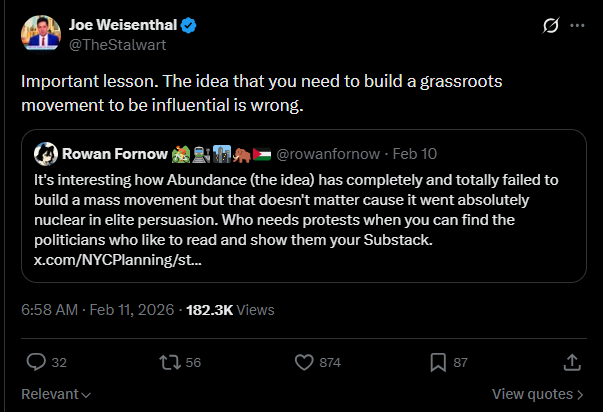
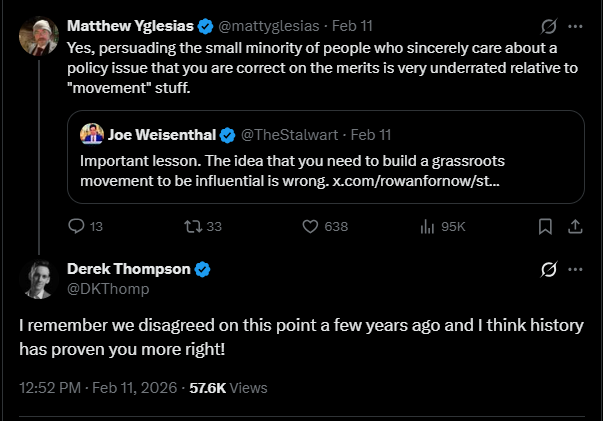
The push for a bipartisan grand coalition, also laid out in Niskanen’s manifesto, has not succeeded either. The right flank of the abundance ecosystem has openly embraced some of the most vile parts of Trumpism. In the lead-up to Abundance 2025, the Manhattan Institute’s Charles Lehman, one of the speakers at the conference, called for “deportation abundance.”
Even Utah Governor Spencer Cox, who headlined alongside Klein and Thompson, and has a long-standing reputation as a (relatively) compassionate moderate who wants us all to “disagree better,” has veered toward rank partisanship and entrenching the power of an ever more authoritarian Republican Party. Cox moved to pack the Utah Supreme Court in order to gerrymander Salt Lake City, in what was an awfully aggressive approach for anyone who isn’t dead set on preserving the MAGA regime. The gerrymander would have only picked up one seat. But Cox has embraced a cosmic view of politics, where Donald Trump’s survival from an assassination attempt in 2024 was “miraculous,” spinning a borderline messianic interpretation of Trump’s candidacy and saying to Trump, “You, and only you, can be [the] kind of leader” it will take to repair the country.
Meanwhile, the Trump officials who were praised by abundance advocates as sage and reasonable, particularly Energy Secretary Chris Wright and Interior Secretary Doug Burgum, have been anything but. Wright has raised concerns that he is using his post to advance the business interests of the nuclear energy firm Oklo, where he was previously a board member, and is taking point on the American colonial takeover of the Venezuelan oil industry. Burgum is keeping busy cheerleading threats to annex Greenland, ignoring natural disasters in the actual interior, explicitly serving the oil and gas industry, and whitewashing American history by scrubbing any discussion of climate change, colonial violence toward Native Americans, and other stains on our heritage from national parks and monuments. Oh, lest we forget, he also oversaw the removal of the word “transgender” from the Stonewall monument, where his Interior Department recently abortively removed the Pride flag itself.
Curtis Yarvin, whom prominent abundance intellectual Steve Teles links to in this piece as the far-right edge of abundance, is considered central to the “new right,” which James Pogue described as “a project to overthrow the thrust of progress, at least such as liberals understand the word.” Yarvin, an antidemocracy nutball who wants to replace the republican system of government with a dictatorship or monarchy, also believes white people are innately more intelligent than other races, and has minimized slavery.
Despite this movement being studded by such miscreants and autocratic enablers, abundance is poised to exert significant influence in the near term, especially through a donor class that absolutely loves it and inside organizing like Ezra Klein’s appearance at a major Senate Democratic retreat. But if abundance liberals are to avoid missing the moment and find durable standing within center-left politics, they have to confront a glaring contradiction: their relationship to the AI industry.
AI skepticism and populist anger at data centers are surging. But abundance groups are increasingly aligning with deeply unpopular tech-titan pet projects like California Forever, an attempt by Silicon Valley bigwigs to build their own city from scratch between Sacramento and San Francisco. Housing policy group California YIMBY endorsed the plan, which led to California state Senator Christopher Cabaldon expressing confusion at a recent conference. California Forever also sponsored a recent “Festival of Progressive Abundance” in Los Angeles. The Charter Cities Institute, which advocates for the creation of autonomous cities unbound by existing legal code and envisioned as techno-optimist Meccas, sent an open letter to the Trump administration in support of Freedom Cities, alongside researchers at the American Enterprise Institute, or AEI, which is considered an abundance organization in the list maintained by Inclusive Abundance, the ecosystem’s main organizing arm.
On top of AEI, there is a host of other broadly pro-tech libertarian think tanks included in the Inclusive Abundance list, such as the (Koch-aligned) Cato Institute, the Cicero Institute (chaired by Palantir co-founder Joe Lonsdale), primary Charles Koch influence operation Americans for Prosperity, and the Federation for American Innovation. FAI alum Michael Kratsios, now the head of the White House Office of Science and Technology, has been an aggressive AI booster and was central to Texas Senator Ted Cruz’s legislation that attempted to create a mechanism to functionally exempt the AI industry from any and all federal regulation.
Don’t just take it from me that abundance sometimes is awfully close to tech-libertarians; the Cato Institute itself has said so, and it is generally expert at what libertarianism means.
Abundance has been marketed as a movement focused on solving the crisis of housing affordability, but there has always been a distinct techno-optimist bent to the movement that looks favorably on AI and Silicon Valley. In the opening utopian vignette of Abundance, Klein and Thompson identify widely distributed wealth from artificial intelligence as the internal mechanism that enables our supposedly impending sci-fi-flavored future. Klein, in particular, was quite vocal that a major driver of his side of the project was about repairing the frayed relationship between progressives and technology—both the concept itself and the tech industry centered around Silicon Valley.
The Abundance 2025 conference, judging by its schedule, had as much programming around AI as it did around housing (there was more directly focusing on energy policy than either, though energy and AI are deeply interconnected). The author of President Trump’s AI Action Plan, Dean Ball (now at FAI), was a featured speaker at the conference, as was NVIDIA’s director of infrastructure policy and multiple other champions of AI.
Moreover, much, if not most, of the funding flowing into abundance organizing is closely linked to powerful Silicon Valley figures. Following the release of Klein and Thompson’s book, Open Philanthropy (another sponsor of the abundance conferences, since rechristened Coefficient Giving), which was launched by Facebook co-founder Dustin Moskovitz, unveiled a $120 million fund focused on advancing abundance ideas. Half of the fund—$60 million—came from Stripe’s Patrick Collison. Arnold Ventures is a frequent abundance funder, which launched the Abundance Academic Network and a new abundance-flavored Vox vertical, among others. John Arnold made his fortune in energy trading and more recently joined the board of Meta specifically to serve as an energy adviser for data-center buildout. When welcoming Arnold to the board, Mark Zuckerberg said that, “as we focus on building AGI,” Arnold’s “deep experience” in “energy infrastructure will help us execute our long-term vision.”
Ever wonder why AI advocates downplay the climate implications of natural gas–fueled AI data centers? Consider Renaissance Philanthropy, an early pro-abundance foundation, which was created with money from former Google CEO Eric Schmidt. Schmidt has publicly stated that humans will never manage to control climate change, and that our best bet is to pour near-unlimited resources into developing an AI that can solve the issue for us. And Schmidt’s views are hardly niche within the realm of our would-be AI oligarchs.
In the most on-the-nose example, Abundance 2025 also had two literal trade associations that represent major tech firms among its sponsors: Chamber of Progress and the New American Industrial Alliance. The former of these is funded by literally every prominent AI firm in the game, from Marc Andreessen’s a16z to Amazon, Apple, Google, OpenAI, NVIDIA, Midjourney, and others.
None of this is an aberration: Silicon Valley has been at the forefront of developing abundance thought since its inception. Among the earliest proto-abundance treatises was an essay in The Atlantic co-authored by Patrick Collison and Tyler Cowen that called for the launch of a new science dedicated to studying how to achieve progress, which they creatively dubbed “progress studies.” In the seven years since their essay, progress studies has intermingled with other movements, such as effective altruism and rationalism, mainline Koch-style libertarianism, and supply-side progressivism, with a dash of technofascism comprising what Steve Teles has christened the “Dark Abundance” subfaction. The amalgamation of all these strands led to what we now would call the abundance movement (or ecosystem).
Cowen, in turn, runs key abundance funder Emergent Ventures, which was launched with a grant from Palantir’s Peter Thiel. Patrick Collison has marshaled part of his fortune to organize an annual retreat for abundance diehards in Sevastopol, California, where those invested in the success of the movement can gather, commiserate, and plan future efforts. Venture capitalist Marc Andreessen, whose a16z invests heavily in AI, fintech, and crypto, wrote his own call for abundance in 2023, titled “The Techno Optimist Manifesto,” with a whole chapter on “abundance.” Notably, one of Ezra Klein’s early proto-abundance columns built on another viral Andreessen essay.
Now, it should be noted that there are some in the abundance ecosystem who have been critical of AI in recent years. Thompson, while an enthusiastic fan of AI, who has been explicit about wanting to convince skeptics, has written about the technology’s downsides; fledgling abundance magazine The Argument (itself frequently techno-optimist and replete with Silicon Valley funding from Arnold, Collison, Open Philanthropy, and Emergent Ventures) has published several good articles that scrutinize the more boondogglish side of Silicon Valley’s latest obsession.
Even beyond the array of pro-AI interests lining up behind the abundance agenda, though, the AI industry and the data-center construction boom raise what should be uncomfortable questions for abundance advocates.
The movement’s central premise is that we can’t build and that we have created too many veto points that let parochial interests block important construction projects. But the data-center boom clearly shows that we can build. Or at least that mega corporations can when they put their minds to it. Granted, the sets of restrictions that apply to multifamily housing, energy transmission infrastructure, and industrial-scale data centers are all different, but frequently abundance proponents target the exact types of procedural bottlenecks that communities that don’t want data centers are using to block or delay tens of billions of dollars’ worth of them from popping up. In particular, community input meetings, air quality standards, and public interest lawsuits are frequent boogeymen of the abundance framework. But they are now the chief means by which communities are fighting back.
The data-center buildout also creates acute examples of why the types of bottlenecks that abundists decry are both absolutely necessary and, sometimes, still too weak. Examples of massive data-center projects being built against the wishes of their neighbors have become commonplace, to the point that foisting nondisclosure agreements upon elected officials over the details of the terms local government is giving to AI companies to build in their communities for economic development is becoming something of an industry standard.
Abundance tells us that we struggle to build and that procedural measures like public interest lawsuits, zoning restrictions, and community input meetings are blocking essential public goods. But then, at the same time, it has so far offered no comment on the reality that we are building plenty of data centers, often even while overcoming those democratic processes.
In Memphis, when Elon Musk’s xAI started operating without going through the permitting process—potentially illegally—we got a taste of how things work without the “bottlenecks” that figures like Thompson and Klein decry. The data center spewed toxic gas over a community that already bore significant air pollution, and did it without the public even knowing about it; more than a dozen local officials signed NDAs, which led to even some City Council members being completely in the dark about xAI’s operations in the city.
Perhaps Musk’s “Colossus” data center couldn’t have been built or would have taken much longer if it hadn’t pulled the wool over the eyes of residents and their government and had actually followed the law. But the flip side is that the progress that those costs have borne is a chatbot that, while it does sometimes fact-check kooky conspiracy claims, declared itself “MechaHitler,” provided planning assistance for a home invasion, removed clothes from people’s pictures on X without their consent, and generated thousands upon thousands of images of child pornography. Thankfully, the only cost for creating such an innovative piece of technology was an entire community being bombarded with toxic emissions that cause cancer and respiratory disease. Data-center expansion is already causing tens of billions of dollars in additional public health costs annually, disproportionately in poor, minority-majority areas like South Memphis.
Moreover this type of “behind-the-meter” energy supply is extremely common and trending up. More than three-fourths of the on-site power currently being brought online at data centers is natural gas, which, while its fumes are less toxic than coal’s, still emits large amounts of carcinogenic and toxic pollutants. Even worse, many data centers have diesel backup generators, which are far more detrimental to the health of people living nearby, particularly because of higher levels of nitrogen oxide and PM2.5 particles.
Public sentiment is also clearly turning against data centers. While polling indicates that voters are largely agnostic on data-center buildout as a hypothetical, there is a large body of evidence on the underlying elements that shows deep hostility toward the AI industry.
Politico and Public First recently found that 37 percent of respondents supported data centers to 28 percent opposed, with another 28 percent neither supporting or opposing, though with a major split along party lines; Democrats narrowly opposed, 36 percent to 33 (27 percent for neither), while Republicans had fairly strong support, 45 percent to 26 (24 percent for neither). This is similar to what NBC found in the summer of 2025, with 44 percent of respondents thinking AI would improve their family’s future versus 42 percent who thought it would make it worse. News site Heatmap found that only 44 percent of respondents supported a data center being built, even less than other types of energy infrastructure, including gas-fired power plants and nuclear reactors. There is also a substantial polling literature that shows Americans are deeply apprehensive of AI generally, although with very different views along gender lines—men tend to be positive about AI, while women are skeptical.
While apathy may be the prevailing mood nationally, with most voters having heard nothing at all about data-center construction, nearly every state or county-level case study available shows massive backlash brewing. Most tellingly, in the places where people have heard about data centers, they detest them. Virginia Democrats vocally ran against data centers last year and scored impressive wins. The 30th district, which includes data-center capital of the world Loudoun County, saw the incumbent Republican ousted by John McAuliff, who worked overtime to tie his opponent to the data centers. Similarly, 2025 saw two statewide spots on the Georgia Public Service Commission flip to Democrats over anger about data-center-fueled energy price hikes, the first statewide races the party had won in decades. State-level polling has shown antipathy in the ever-crucial swing states of Pennsylvania, Wisconsin, and Michigan.
A growing number of localities have also instituted a pause on new data-center construction, including Prince George’s County in Maryland; St. Charles, Missouri; several Atlanta-area counties; and several counties in Indiana. State-level restrictions and moratoria are being debated across the country, from New York to Georgia to California. Given all of that, it’s hardly surprising that Morning Consult has shown that support for banning data-center construction has been surging; just between October and November 2025, the policy went from down by two points to up by five. It is becoming increasingly clear that this moment calls for campaigning on AI skepticism.
Abundance proponents, however, seem determined to swim against the current of public opinion. For some, as Eric Levitz implies in Vox, it’s a matter of the muddled picture of public opinion we have. For others, though, abandoning data centers would be like surrendering their raison d’être. Particularly for the groups that emerged out of the “progress studies” movement kick-started by Collison and Cowen’s Atlantic essay, part of the point of abundance has always been to foster a sense of techno-optimism.
There is nothing inherent to abundance thought that necessitates AI boosterism. Indeed on a recent podcast, Marshall Kosloff, who emceed Abundance 2025, recalled responding to a question about what the abundance line on AI is: “We want nothing to do with that.” As Austin Ahlman of the Open Markets Institute, one of Kosloff’s guests for the episode, pointed out, such sentiment is “nowhere close to where the status quo is,” where Silicon Valley elites clearly “view this as an easy vehicle for the regulatory structures that they need to very quickly do the AI buildout without any democratic discipline or oversight.”
In fact, in its “Abundance Landscape” report, Inclusive Abundance identifies artificial intelligence as one of the five core policy areas. Notably, transit, one of the most common talking points for abundance punditry, is excluded, though IA said it would include it in its 2026 report. Even outside of AI’s own dedicated policy area, the report also includes AI as one of the “opportunities” for abundance energy policy, saying “AI industry leaders and experts agree that this technology will need a tremendous amount of energy going forward. AI and energy experts must collaborate in order to meet the need for more energy.” A similar argument was made by Trembath in an article with Josh Smith of the Abundance Institute. The Abundance Institute itself has also pushed AI very aggressively, including encouraging the White House to attempt to preempt all state-level regulation via executive order.
In a bit of profound irony, data-center construction has broken free of the choke points decried by abundance to the point that it is now bidding up land value and resulting in further constraints on the supply of housing, according to reporting from The Wall Street Journal. Now the data-center buildout, as well as being deeply unpopular and undermining the intellectual case for abundance, is directly jeopardizing what is supposed to be the movement’s central animating goal.
Elements of abundance raise important questions, particularly about how to build state capacity and the importance of government efficiency to public buy-in for ambitious governance (articulated well in this podcast by Mayor Zohran Mamdani speaking to Derek Thompson). But the framing of these questions is also saddled with an association with the excesses of ambition of Silicon Valley moguls—and their dark, antidemocratic leanings. If it’s hard to get people to say yes to an apartment building in their backyard, it’s doubly so to convince them to site a giant warehouse spewing toxic emissions and spiking their electrical bills in their backyard—especially if the best non-bubblish case for the data center is that it will increase the odds they will be unemployed.
Dylan Gyauch-Lewis is a researcher at the Revolving Door Project.
Read More:
Politics, Abundance, Ai, Data Centers, Economy, Technology, Silicon Valley, Artificial Intelligence
---
ABuNDANCE STack dustin mosov
ballmer
5:44
5 minutes, 44 seconds
substate subsidized public housing. This is not the orientation of of at least this Yimi faction that uh funds abundance.
5:55
5 minutes, 55 seconds
Yeah. So Yimi is has sort of popped up all over the place in slightly different iterations.
6:04
6 minutes, 4 seconds
Um, this version focuses heavily on like private developers. The group that
6:12
6 minutes, 12 seconds
originally obtained these documents called the Phoenix Project. They're a local watchdog group. Um, they have done
6:21
6 minutes, 21 seconds
a lot of influence tracking that shows how real estate has teamed up with Silicon Valley to push this. Um, and
6:31
6 minutes, 31 seconds
really what this sort of specific subfaction of yimism that Zach Rosen is championing,
6:39
6 minutes, 39 seconds
there's both the housing stuff, but then there's also quite explicitly the we are taking control of local political
6:47
6 minutes, 47 seconds
institutions and uh trying to establish an edge so that democratic oversight can't stop
6:56
6 minutes, 56 seconds
building. M what what is the abundance capital stack?
7:03
7 minutes, 3 seconds
Yeah, so the abundance capital stack is the term that Rosen himself uses in the
7:10
7 minutes, 10 seconds
document for a $260 million annual capital inflow.
7:18
7 minutes, 18 seconds
120 million he said came from John Arnold, a former Enron executive energy
7:24
7 minutes, 24 seconds
trader, current Meta board member. 40 million from Dustin Mosovitz who is one
7:31
7 minutes, 31 seconds
of the co-founders of Facebook or Meta and a hundred million from Steve Balmer
7:39
7 minutes, 39 seconds
former Microsoft executive current [clears throat] uh alleged NBA salary
7:44
7 minutes, 44 seconds
cap of um his team the LA Clippers and I should Rosen
7:52
7 minutes, 52 seconds
when I reached out for comment said that the number for John Arnold was wrong. He didn't respond when I asked what the
8:00
8 minutes
right number was or whether the other numbers were correct. Uh but he did say that active grants were a poultry 40
8:07
8 minutes, 7 seconds
million a year. Um which you know soon that practically nothing at that point
8:15
8 minutes, 15 seconds
and but the commitments are up to the 260. Is that right?
Jun 24, 2026 The Majority Report w/ Sam Seder
Live-streamed on June 17, 2026. Dylan Gyauch-Lewis, senior researcher at the Revolving Door Project, joins to talk about her piece in The American Prospect: “New Documents Detail Nine-Figure, Silicon Valley–Funded Abundance Movement.” Watch the Majority Report live Monday–Friday at 12pm EST on YouTube or http://www.Majority.fm Dylan's work: https://prospect.org/2026/06/12/new-d...Revolving Door Project: https://therevolvingdoorproject.org/To connect and organize with your local ICE rapid response team visit ICERRT.com
---
AN 9 25 GRIST
Seventeen years ago, Californians bet on a grand vision of the future. They narrowly approved a $10 billion bond issue to build a high-speed rail line that would zip between San Francisco and Los Angeles in under three hours. This technological marvel would slash emissions, revitalize the state’s Central Valley, and, with some financial help from the feds and private sector, provide the fast, efficient, and convenient travel Asia and Europe have long enjoyed.
State officials promised to deliver this transit utopia by 2020. Instead, costs have more thandoubled, little track has been laid, and service isn’t expected to begin before 2030 — and only between Bakersfield and Merced, two cities far from the line’s ultimate destinations.
It’s little wonder the project finds itself in a precarious financial position, fighting political headwinds, and deemed a boondoggle by everyone from federal Transportation Secretary Sean Duffy to Abundance authors Ezra Klein and Derek Thompson. “In the time California has spent failing to complete its 500-mile high-speed rail system,” they wrote, “China has built more than 23,000 miles of high speed rail.”
The reasons for this vary with who’s being asked, but people with expertise often cite three fundamental missteps: creating a new agency to lead the effort, failing to secure adequate funding from the start, and choosing a route through California’s agricultural heartland. The state’s strict environmental review process hasn’t helped, either.
Such struggles are not unique to the Golden State, where support for the project remains strong. Although the private sector venture Brightline has seen some success, publicly funded high-speed rail efforts in Texas, Ohio, Washington, D.C., and beyond have stalled. Regulatory complexity, a political environment that favors cars and highways, and constant funding challenges stymie America’s aspirations even as other countries have spent big on tens of thousands of miles of track. Governor Gavin Newsom promises to see the nation’s most ambitious rail project through despite recently losing all federal support, but its troubled path underscores the systemic challenges of building big in America.
California has always been a car-crazy place, and by the early 1990s, transportation studies made clear that its highways would not keep pace with the growth to come. Policymakers saw an answer in bullet trains. The Legislature established the California High-Speed Rail Authority in 1996 and gave it the tough job of planning, designing, building, and running the system.
Some consider that a mistake because the agency lacked experience managing so big a project and navigating complex bureaucracy. Even some rail supporters concede it would have been better to let the authority provide oversight and leave the heavy lifting to the state Department of Transportation, or CalTrans. “It’s building a lot of overpasses and right-of-way, which Caltrans does all the time,” said Ethan Elkind, director of the University of California, Berkeley climate program in its Center for Law, Energy, and the Environment.
Without that experience, the authority’s 10 employees relied heavily on consultants like engineering firm WSP, running up expenses. “We paid WSP and their predecessor more than $800 million in consulting fees,” said Lou Thompson. He chaired the High Speed Rail Peer Review Group, established in 2008 to provide project oversight, from 2012 until 2024. The authority has in recent years eased its reliance on consultants, who reportedly have gone from 70 percent of its workforce to 45 percent over the past seven years.
Once the High-Speed Rail Authority set up shop, work proceeded in fits and starts. Even as it considered routes and started the myriad bureaucratic tasks the project required, political interest waxed and waned with the state’s fiscal health. Skeptics lamented the cost and questioned whether bullet trains would attract enough riders to be worthwhile. But rail advocates, environmentalists, unions, and others kept pushing forward and in 2008 convinced voters to approve Proposition 1A, securing $10 billion to finance construction.
It was never going to be enough — at the time, the cost was pegged at $45 billion, a figure that did not account for inflation — and funding has been a challenge from the start.
Still, the Obama administration saw an opportunity to show that the economy was bouncing back from the Great Recession. The federal American Reinvestment Recovery Act provided $3.5 billion to help get things started. The authority, which had already mapped a route through the Central Valley, soon began grading land, moving utilities, and taking other steps toward construction of the first leg, a 119-mile stretch from Bakersfield to Madera.
Things chugged along until 2013, when a state judge blocked the use of Prop 1A funds, ruling that some of the work did not meet the rules for bond expenditures. With federal support contingent upon the state’s cash, the federal grants had to be renegotiated — before they expired in 2017. “We were literally sitting there saying, ‘Well, if we don’t start going, we could lose $700 or $800 million of the federal money,” said Dan Richard, who was the High-Speed Rail Authority’s board chair from 2011 until 2019. That prompted the agency to do something no one wanted to do: Move forward without having acquired all of the necessary land. So it did.
Then President Donald Trump took office. He seemed interested in what California was attempting to build, having lamented that China and Japan “have fast trains all over the place” while the U.S. relies upon “obsolete technology.” His opinion soured when Gavin Newsom became governor in 2019 and the two sparred over the president’s policies. Trump later canceled nearly $1 billion in federal funds for the rail project.
The Biden administration restored it and provided another $3.1 billion from the Infrastructure Investment and Jobs Act. The infusion was to help build a station in Fresno and acquire trains for testing. Even with the windfall California remained at least $7 billion short of what it needed for the first short run through the Valley. The situation grew worse in July when Trump rescinded the entire amount after the Federal Railroad Administration said it saw no way of covering that shortfall and no path to completion by 2033.
Newsom said the move “reeks of politics” and the state is suing. But the impact goes beyond California by establishing a precedent to cancel projects at will. “How do you go to your voters and say, ‘Put up the money. We expect 50 percent federal share,’ without knowing that the next administration could turn around and say, ‘I don’t like that project,’” Richard said.
The High-Speed Rail Authority initially planned to rely upon state, federal, and private sector funding in equal measure, but California has provided 75 percent of the $14.6 billion spent so far. The authority wrote in a letter to the Railroad Administration that Newsom’s plan to allocate $1 billion, pulled from the state’s cap-and-trade program, toward the project each year for 20 years will be enough to finish the Central Valley segment. The governor also recently signed a bill requiring the authority to update its estimate on the funding gap for that leg of the journey.
With California seemingly on its own, Thompson said the project needs an income stream approaching $5 billion per year to build everything. That is one reason the authority in June asked the private sector and financial institutions to weigh in on the chance of public-private partnerships. Its CEO Ian Choudri private investors have shown “extreme interest.” VID]
Thompson isn’t buying it. “My opinion is that that is hot air,” he said. The way he sees it, no one’s going to invest until they can see that there is demand for the rail line.
One of the reasons Brightline is held up as an example of how to bring high-speed rail to the United States is its strategy includes building on public land. Part of its 235-mile line between Miami and Orlando stands on land owned by Florida East Coast Railway. The company’s planned run between Las Vegas and L.A. will largely follow Interstate 15.
California could have done the same and built along I-5, which bisects the Central Valley, but chose to go through major population centers 20 to 50 miles to the east. That pivotal decision increased the project’s cost and complexity. Following the freeway would have been straighter and flatter, without the elevated track, tunnels, and other infrastructure needed to traverse cities. The route also turned a state effort into a regional development project beset by local politics.
The High-Speed Rail Authority had good intentions, however. It hopes that bringing rail to places like Merced and Bakersfield might entice Silicon Valley and Los Angeles firms to open offices in the Central Valley, which would be a 90-minute ride from their headquarters. It also would boost local economies left behind by the state’s boom — and it has, to some extent. The project has added 11,000 construction jobs to the region. But that exacted its own toll.
“Those economic benefits have been really substantial, so that sort of worked, but it came at potentially the cost of not being able to build the system at all, because by starting it in the Central Valley they’ve basically blown all the money there,” said Elkind of the UC Berkeley Climate Program. Should the state once again ask voters for money, it would have had a stronger case if initial construction had occurred in major population centers, he said.
The route also created additional hurdles as the project navigated California’s environmental oversight rules. Going through several cities and all that farmland increased the number of stakeholders who had to be consulted, ballooning the environmental review process.
To be fair, the California Environmental Quality Act, or CEQA, has long protected the state’s rich biodiversity. But some rail proponents argue it has been used to stymie progress. High-Speed Rail Authority data shows it has spent more than $765 million on environmental review. Lawsuits stemming from CEQA can be particularly expensive. “If you have a $100 billion project, and let’s say that interest rates are 3% a year, every year’s delay costs you $3 billion,” Thompson said. “A $50,000 lawsuit can delay you for a year, and so there’s an enormous pressure on you to try to bargain your way out of these kinds of situations.”
California recently loosened CEQA requirements for the rail system’s maintenance facilities and stations, a move Newsom cheered. “These are very targeted exemptions that will help cut red tape and deliver on California’s vision of high-speed rail without compromising environmental protections,” gubernatorial spokesperson Daniel Villaseñor wrote in an email.
Whether that reform has an impact remains to be seen, because most of the environmental review is already completed. And regulation was never the project’s biggest problem. “It just seems like the easy, obvious answer,” said Hana Creger, associate director of climate equity at The Greenlining Institute. “But I think these things are a lot more complex.”
Given all of this, it can be easy to lose sight of what progress has been made. The authority is quick to note that 463 miles of the 494-mile system has cleared the environmental review process and is “construction ready.” It also boasts of having laid 70 miles of guideway — meaning track, elevated structures, or other riding surface — and erected 57 structures. All told, the project has created more than 15,500 jobs since its inception.
Despite the challenges, Newsom remains steadfast in his determination to see Californians one day riding the trains they were promised so many years ago.  ,” he said in May. “That’s our commitment.” That will surely resonate with his constituents; recent polling shows 62 percent of voters believe the state should continue financing the project, though opinions split sharply along partisan lines. Still, experts caution that support isn’t enough. Tangible progress and credible funding streams are essential to maintain momentum.
The High-Speed Rail Authority seems to understand this and is pressing ahead to connect Bakersfield to either Merced or Gilroy. There’s a lot to do before crews start laying track, but the goal is to finish that run by 2032 and the authority recently opened the bidding process to begin installing track next year. Looking further ahead, its latest plan, released late last month, calls for extending the line south to Palmdale by 2038, putting it within 80 miles of San Francisco and 40 miles of L.A. at a cost of $87 billion. “While challenges remain, so too does the potential to deliver a modern transportation system worthy of the state’s ambitions — one that reflects the scale, complexity, and promise of California itself,” Choudri wrote in the plan. “Let’s go build it.”
Assuming the project retains its $4 billion federal grants, the project has $29 billion available, with an additional $15 billion from Newsom’s proposal, according to the CHSRA. Thompson said the governor’s proposal, which would set aside $1 billion every year for the project, should keep it alive for the next four years. Beyond that, it will need an infusion of cash, likely from voters but possibly from a future presidential administration. “I think the path forward is that they could show some first segment success and then go back to the voters,” Elkind said. “You just got to get through this first era here, and get something built that they can show to the voters.”
Ultimately, California’s high-speed rail is more than a train line; it is a test of the nation’s ability to deliver transformative infrastructure. Its path forward remains uncertain, but every mile of track laid could lead to a turning point — not just for the state, but for the broader goal of building the kind of transportation network other countries take for granted.
This article originally appeared in Grist at https://grist.org/transportation/billions-spent-miles-to-go-the-story-of-californias-failure-to-build-high-speed-rail/.
Grist is a nonprofit, independent media organization dedicated to telling stories of climate solutions and a just future. Learn more at Grist.org
---
https://www.c-span.org/video/?468527-1/why-polarized
jANUARY 27, 2020
Why We're Polarized
Vox co-founder Ezra Klein looked into America’s political divide.
Thursday March 27, 02025 at 7:30pm PT
Get tickets to attend at Sydney Goldstein Theater
GET TICKETS
This program is co-presented by City Arts & Lectures, Manny's and The Long Now Foundation.
The Long Now audience is being offered $5 off the ticket price for this special evening with code THINKLONG. We hope you can join us for this book discussion.
Ezra Klein and Derek Thompson's forthcoming book Abundance is a once-in-a-generation, paradigm-shifting call to rethink big, entrenched problems that seem mired in systemic scarcity: from climate change to housing, education to healthcare. The conversation this evening will delve deeper into the abundance agenda within the context of civilizational-scale thinking.
The history of the twenty-first century in America is one of growing unaffordability and shortage. After years of refusing to build sufficient housing, the entire country has a national housing crisis. After years of slashing immigration, we don’t have enough workers. After decades of off-shoring manufacturing, we have a shortage of chips for cars and computers. Despite decades of being warned about the consequences of climate change, we haven’t built anything close to the clean energy infrastructure we need.
Progress requires the ability to see promise rather than just peril in the creation of new ideas and projects, and an instinct to design systems and institutions that make building possible. Klein and Thompson trace the political, economic, and cultural barriers to progress and how we can adopt a mindset directed toward abundance, and not scarcity, to overcome them.
Ezra Klein is a columnist and podcast host at The New York Times and the author of Why We’re Polarized (02020).
Derek Thompson is a staff writer at The Atlantic, host of the podcast Plain English and a news analyst with NPR. He is author of Hit Makers: How to Succeed in an Age of Distraction (02018).
==
https://en.wikipedia.org/wiki/Ezra_Klein
Ezra Klein (born May 9, 1984) is an American blogger, and progressive columnist. He is most known for his former work as a blogger and columnist for The Washington Post, as well his ongoing work as a contributor to Bloomberg News and MSNBC. He was formerly an associate editor of The American Prospect political magazine and a political blogger at the same publication.[1]
At The Washington Post, he managed a branded blog called "Wonkblog," which featured his writing and the writing of other policy reporters. Issues discussed in the blog included Health Care and Budget Policy.[2] He wrote a primer on policy called "Wonkbook", which was delivered by e-mail and on his blog each morning. In 2011, Klein's blog was the most-read blog at The Washington Post.[3]
In 2011, he was named one of the 50 most powerful people in Washington, D.C., by GQ.[4] In 2010, he was named Blogger of the Year by The Week magazine and The Sidney Hillman Foundation.[5][6] His blog was also named one of the 25 best financial blogs by Time magazine in 2011.[7] In 2013, Klein won the Online News Association Award for Best Online Commentary.[8] He also won the American Political Science Association's Carey McWilliams Award,[9] for "a major journalistic contribution to our understanding of politics." He appeared as one of 80 men featured in Esquire's 80th Anniversary issue and in a feature in The New York Times Style magazine.[10]
In January 2014, he announced he would be leaving The Washington Post to start a new media venture with several other veteran journalists.[11] He has joined Vox Media as Editor in-Chief for their news website, Vox.
Contents
Career:{:(style="margin-right:0px;margin-left:0px"):}:[edit:{]}:
Klein is editor in chief at Vox, and formerly wrote for and edited Wonkblog at the Washington Post. He frequently provides political commentary on MSNBC's The Rachel Maddow Show, Hardball with Chris Matthews,and The Last Word with Lawrence O'Donnell. He is a former contributor to Countdown with Keith Olbermann. On March 14, 2013, The Week magazine reported that Klein was among those being considered to host MSNBC's yet-unnamed 8 p.m. weekday prime-time show that would replace The Ed Show.[12] Ultimately, the time slot was filled with All In with Chris Hayes.[citation needed]
In May 2011 when Bloomberg View launched, Klein became a columnist there in addition to his work at The Washington Post and MSNBC.[13]
Klein started his first blog in February 2003.[14][non-primary ^source needed] He soon[when?] joined with Matt Singer, and the name was changed to "Klein/Singer: Political Consulting on the Cheap". In June 2003, he moved to the blog "Not Geniuses" along with Matt Singer, Ryan J. Davis, and Joe Rospars.[15][non-primary ^source needed] Following "Not Geniuses," Klein partnered with Jesse Taylor at Pandagon.[when?] This partnership helped Klein gain even more visibility, leading to his eventual founding[when?] of his blog "Ezra Klein".[16]
Besides his online contributions, Klein worked on Howard Dean's primary campaign in Vermont in 2003, and interned for the Washington Monthly in Washington, D.C. in 2004. "The media is as effective and important an agent for change as the legislative bodies, and I think it's where I'm happiest and most effective," Klein said.[17] In 2003, he and Markos Moulitsas were two of the earliest bloggers to report from a political convention, that of the California State Democratic Party.[18] In 2006, Klein was one of several writers pseudonymously flamed by The New Republic writer Lee Siegel (posting as a sock puppet calledsprezzatura).[19]
On December 10, 2007, Klein moved his blog full-time to the American Prospect.[20]
Klein's prolific blogging caught the attention of Steve Pearlstein, the Washington Post's veteran business columnist, to whom a friend referred Klein's work in the American Prospect. "I was blown away by how good he was—how much the kid wrote—on so many subjects," Pearlstein said. Pearlstein sent samples of Klein's work to managing editor Raju Narisetti. A few weeks after he heard from Pearlstein, Post foreign correspondent John Pomfret asked Klein to have lunch with him and financial editor Sandy Sugawara. Narisetti quickly hired Klein[when?] to be the Post’s first pure blogger on politics and economics.[21] On May 18, 2009, he began writing at the newspaper.[22]
Klein announced he would be leaving the Washington Post in January 2014, with the intent to start a new media venture with several other veteran journalists.[11] The new media venture was soon identified as Vox Media, which hired Klein and several associates to create a new politics site.[23] Klein had previously "proposed the creation of an independent, explanatory journalism website—with more than three dozen staffers" and an annual budget of more than US$10 million to remain at the Washington Post. During negotiations, Post publisher Katharine Weymouth and new owner Jeff Bezos did not make a counteroffer.[24]
Health care debate:{:(style="margin-right:0px;margin-left:0px"):}:[edit:{]}:
In December 2009, Klein wrote an article in the Washington Post, stating that Senator Joe Lieberman was "willing to cause the deaths of hundreds of thousands of people in order to settle an old electoral score", because Lieberman "was motivated to oppose health care legislation in part out of resentment at liberals for being defeated in the 2006 Connecticut Democratic Primary".[25] Klein based his estimate on an Urban Institute report that estimated that 22,000 people died in 2006 because they lacked health-care insurance.[26] This article was criticized by Jonah Goldberg of the National Review, who called it a "silly claim".[27]Charles Lane, also of the Washington Post, described Klein's article as an "outrageous smear". But EJ Dionne, also of the Washington Post, agreed with Klein's claim, saying that "Klein is right that there is not a shred of principle in Lieberman's opposition".[28] Klein later said he regretted the phrasing[29] and his position is that despite universal coverage, the social determinants of health are still powerful predictors that, on average, ensure the lower socioeconomic classes die sooner than those with more income and education.[30][31]
JournoList:{:(style="margin-right:0px;margin-left:0px"):}:[edit:{]}:
Main article: JournoList
In February 2007 Klein created a Google Groups forum called "JournoList" for discussing politics and the news media. The forum's membership was controlled by Klein and limited to "several hundred left-leaning bloggers, political reporters, magazine writers, policy wonks and academics".[32] Posts within JournoList were intended only to be made and read by its members.[33] Klein defended the forum saying that it "[ensures] that folks feel safe giving off-the-cuff analysis and instant reactions". JournoList member, and Time magazine columnist, Joe Klein added that the off-the-record nature of the forum was necessary because “candor is essential and can only be guaranteed by keeping these conversations private”.[32]
The existence of JournoList was first publicly revealed in a July 27, 2007, blog post by blogger Mickey Kaus.[34] However, the forum did not attract serious attention until March 17, 2009, when an article published onPolitico detailed the nature of the forum and the extent of its membership.[32] The Politico article set off debate within the Blogosphere over the ethics of participating in JournoList and raised questions about its purpose. The first public excerpt of a discussion within JournoList was posted by Mickey Kaus on his blog on March 26, 2009.[35]
In addition to Ezra Klein, members of JournoList included, among others: Jeffrey Toobin, Eric Alterman, Paul Krugman, Joe Klein (no relation to Ezra Klein), Matthew Yglesias, and Jonathan Chait.
On June 25, 2010, Ezra Klein announced in his Washington Post blog that he would be terminating the JournoList group. This decision was instigated by fellow blogger Dave Weigel's resignation from the Postfollowing the public exposure of several of his JournoList emails about conservative media figures.[36][37]
Klein had justified excluding conservative Republicans from participation as "not about fostering ideology but preventing a collapse into flame war. The emphasis is on empiricism, not ideology".[38]
Personal life:{:(style="margin-right:0px;margin-left:0px"):}:[edit:{]}:
Klein was born and raised in Irvine, California.[21] Klein is a middle child,[21] raised in a Jewish family.[39] His father is a mathematics professor, his mother an artist.[21] Religiously, he now identifies as an agnostic.[40]Klein went to school at University High School. He attended the University of California, Santa Cruz, but later transferred to the University of California, Los Angeles, from which he graduated in 2005 with a Bachelor of Arts in Political Science. While at UCSC, he applied to write for the City on a Hill Press but was rejected.[41]
Klein is married to Annie Lowrey, an economic policy reporter at The New York Times.[42] They were married in October 2011.[43] They have two rescue dogs named Patsy Klein and Calvin Klein.[44]
==
did not find place ucsc/ucla
EK: So, not from the Daily Bruin this is an incorrect thing on my Wikipedia page. It’s from the Santa Cruz City on a Hill Press. I was not highly committed to be part of the paper; I was just looking for things to do, so I lived.
==
https://www.vox.com**/2018**/4/10/17182692/bell-curve-charles-murray-policy-wrong
matt y
grafs]
chls Murray and his decades-old work on IQ and race, published in his 1994 book *The Bell Curve*, is back in the news because of a mini feud between “new atheist” author and podcasterSam Harris and Vox’s own Ezra Klein. Andrew Sullivan, the punditocracy’s original champion of Murray’s thinking on genetics, decided to jump in as well.
Harris and Klein and Sullivan have, at this point, spilled plenty of words limning their disagreements. And Harris, for his part, sees himself as exclusively defending The Bell Curve’s empirical claims about IQ, which is fine, but it’s important to consider Murray’s work with a view toward actual American public policy, which has been deeply influenced by Murray over the years, and which Donald Trump is looking to take in an even more Murray-esque direction.
The Bell Curve — co-authored with Richard Herrnstein — is, after all, not a work of scientific research but rather a political book written by one of the most prominent conservative policy entrepreneurs in America as part of a larger ideological project. Like several of Murray’s other books, including Losing Ground, In Our Hands, and Coming Apart,the basic subject of The Bell Curve is what should be done to help the disadvantaged in America. And the four books all reach the conclusion that, roughly speaking, we should do as little as is politically possible.
What’s more, despite the mythmaking around Murray, nobody has silenced or stymied him. He is one of the most successful authors of policy-relevant nonfiction working in America today. He’s ensconced at the center of the conservative policy establishment as an emeritus scholar at the American Enterprise Institute. In 2016, he won the Bradley Prize, a prestigious conservative award that carries a $250,000 stipend. He regularly publishes op-eds in the Wall Street Journal. The New York Times reviewed Coming Aparttwice. Tom Edsall featured it in a column (he says it raises “issues that are rarely examined with the rigor necessary to affirm or deny their legitimacy”), and David Brooks recommended it twice, lauding the “incredible data,” along with the analysis. PBS built an interactive around it.
To debate whether his ideas deserve to be part of the national debate is pointless, since the fact is that they are already central to it. After a long slog through the book, Murray and Herrnstein arrive at their central point. They write:
The technically precise description of America’s fertility policy is that it subsidizes births among poor women, who are also disproportionately at the low end of the intelligence distribution. We urge generally that these policies, represented by the extensive network of cash and services for low-income women who have babies, be ended.
Murray’s ideas are plain wrong. Diversity is demonstrably good for society and the economy, not the reverse. Social programs can and do improve lives. Murray’s influence has damaged the interests of millions of people. Murrayism does harm on an ongoing basis, and, far from having been shut out of the discourse, it as at the heart of the ideological agenda that currently governs the United States.
WhatThe Bell Curve says about policy
The Bell Curve is a long book that says a lot of things, many of which, as Murray’s partisans like to point out, are not especially controversial in academic psychology.
By the same token, Karl Marx’s work is full of observations that are well within the consensus of the economics profession — that high levels of unemployment reduce wages for the employed, that firms seek to maximize profits, that market economies are prone to sporadic crises, etc. What makes a controversial book controversial is that some of its content and its major conclusions are controversial, and that is true — and then some — for Murray.
The actual conclusion of The Bell Curve is that America should stop trying to improve poor kids’ material living standards because doing so encourages poor, low-IQ women to have more children — you read that correctly. It also concludes that the United States should substantially curtail immigration from Latin America and Africa. These are controversial policy recommendations, not banal observations about psychometrics.
Murray’s critics are frequently accused of mischaracterizing him, so I want to quote, at length, what he says the upshot of this is (emphasis in the original):
We are silent partly because we are as apprehensive as most other people about what might happen when a government decides to social-engineer who has babies and who doesn’t. We can imagine no recommendation for using the government to manipulate fertility that does not have dangers. But this highlights the problem: The United States already has policies that inadvertently social-engineer who has babies, and it is encouraging the wrong women. If the United States did as much to encourage high-IQ women to have babies as it now does to encourage low-IQ women, it would rightly be described as engaging in aggressive manipulation of fertility. The technically precise description of America’s fertility policy is that it subsidizes births among poor women, who are also disproportionately at the low end of the intelligence distribution. We urge generally that these policies, represented by the extensive network of cash and services for low-income women who have babies, be ended.
The government should stop subsidizing births to anyone, rich or poor. The other generic recommendation, as close to harmless as any government program we can imagine, is to make it easy for women to make good on their prior decision not to get pregnant by making available birth control mechanisms that are increasingly flexible, foolproof, inexpensive, and safe.
The other demographic factor we discussed in Chapter 15 was immigration and the evidence that recent waves of immigrants are, on the average, less successful and probably less able, than earlier waves. There is no reason to assume that the hazards associated with low cognitive ability in America are somehow circumvented by having been born abroad or having parents or grandparents who were. An immigrant population with low cognitive ability will — again, on the average — have trouble not only in finding good work but have trouble in school, at home, and with the law.
These claims about the baleful impact of social assistance spending are not uncontroversial claims about science. Indeed, they are not claims about science at all. And since they constitute what Murray himself views as the upshot of his book, and because Murray is a policy writer rather than a scientist, it is correct and proper for fair-minded people to read the book for what it actually is: a tract proposing the comprehensive revision of the American welfare state along eugenicist lines.
The Bell Curve set the stage for Trumpist immigration policy
Unlike on social welfare policy, Murray does not outline a specific immigration policy agenda. But in chapter 15, he writes that “the rules that currently govern immigration provide the other major source of dysgenic pressure” and remarks enigmatically that while earlier waves of immigrants may have been beneficial, “the self-selection process that used to attract the classic American immigrant — brave, hard working, imaginative, self-starting, and often of high IQ — has been changing and with it the nature of some of the immigrant population.”
He complains that “the nation’s political ground rules have yet to accept that the intelligence of immigrants is a legitimate topic for policymakers to think about” and eventually concludes “the kernel of evidence that must also be acknowledged is that Latin and black immigrants are, at least in the short run, putting some downward pressure on the distribution of intelligence.”
Murray’s intellectual influence on the current trajectory of American immigration policy is obvious. His warning about the dysgenic impact of Latin American and African immigration is echoed by President Trump, who recently remarked that there are too many arrivals from “shithole” countries, and in the Republican Party’s ongoing conversion to the cause of sharp cuts in legal immigration. Trump’s immigration proposals do not specifically reference IQ, but his drive for a switch to what he terms a “merit-based” immigration system is clearly animated by a Murray-esque concern that the wrong kind of people are moving to the US.
Murray wrote The Bell Curveto advance an agenda
The proposal to block immigration from Latin America and end social assistance to poor children is, to be clear, not an incidental aside in a book whose main purpose is to familiarize people with some psychometric research. The authors themselves, on page 549, do an admirable job of squarely posing the question “what good can come from writing this book?”
They offer a fourfold answer that consists entirely of hopes to change public policy for what they believe will be the better.
- First: Social engineering should be “highly targeted” at the “small segment of the population” that “accounts for such a large proportion” of social problems, while “the vast majority of Americans run their own lives just fine, and policy should above all be constructed so that it permits them to do so.”
- Second: Policymakers to need to design policies that work well for people who may not be as smart as the kind of people who are likely to be in a position to design policies. “There are hundreds of ways to frame bits and pieces of public policy so that they are based on a realistic appraisal of the responses they will get not from people who think like Rhodes scholars but people who think in simpler ways.”
- Third: “Much of public policy toward the disadvantaged starts from the premise that interventions can make up for genetic or environmental disadvantages, and that premise is overly optimistic.”
- Fourth: We should care less about gaps in life outcomes between different racial groups because “group differences in cognitive ability, so desperately denied for so long, can best be handled — can only be handled — by a return to individualism. A person should not be judged as a member of a group but as an individual. With that cornerstone of the American doctrine once again in place, group differences can take their appropriately insignificant place in affecting American life. But until that cornerstone is once again in place, the anger, the hurt, and the animosities will continue to grow.”
The book concludes with the thought that since individuals differ in ability, a fair society in a procedural sense is very unlikely to be an egalitarian society in the sense of outcomes.
Professional tennis tournaments, for example, are not a rigged game. Nonetheless, a tiny number of players amass the vast majority of the prize money. Not because anyone is cheating, but because some people are better than others at tennis. That’s not an unfamiliar point to political theorists; Michael Young’s 1958 classic *The Rise of the Meritocracy* is a book-length critique of what he saw as an emerging elite of skill, and John Rawls’s landmark work of political philosophy,*A Theory of Justice*, argues at length that a just society must offer a good dose of substantive equality and not just formal equality of opportunity for roughly the kinds of reasons Murray offers.
That said, it must be noted that while Murray calls on elites to be a bit more humble about themselves, his work is very much not a call for substantive equality.
Much is sometimes made of Murray’s support for the creation of a universal basic income program, but one must be clear that his thinking on this differs from that of most UBI proponents in three ways:
- One, he does not actually think that providing people with a UBI is a good idea. As he writes in his 2006 book, In Our Hands: “Imagine for a moment that the $2 trillion that the US government spends on transfer payments were left instead in the hands of the people who started with it. If I could wave a magic wand, that would be my solution.” The UBI is a compromise with the realities of public opinion, not something he backs on the merits.
- Two, his goal in promoting UBI is to make the welfare state less generous, not more generous. In exchange for creating a UBI, he wants to eliminate Social Security and Medicare, Medicaid and all other federal health programs, all means-tested social assistance (SNAP, Section 8 housing vouchers, TANF, and the earned income tax credit), and all federal assistance to students including veterans programs, Title I, and Pell Grants.
- Three, his UBI enacts a massive cut to total state spending on assistance — according to Murray, “as of 2014, the annual cost of a UBI would have been about $200 billion cheaper than the current system. By 2020, it would be nearly a trillion dollars cheaper.” To give a sense of scale here, all of Obamacare cost about $2 trillion over 10 years. Murray’s UBI would cut $1 trillion from social spending in one year. This is a plan to slash redistribution to the poor, not make it more generous.
Importantly, Murray’s idea is that once we eliminate the entire welfare state, we will replace it with a UBI program that provides a flat level of financial assistance per adult. A single mom raising two kids would receive no more than a childless man, and a married couple with one child would receive more than the single mom. That somewhat defies common sense, but The Bell Curve’s preoccupation with the problem of “encouraging the wrong women” to have children clarifies that the goal is to avert the alleged dysgenic impact of improving the material living conditions of low-income children.
Actually, helping people in need is good
Much of the rhetorical purpose of The Bell Curve seems to be devoted to muddying the waters between the claim that there are limits to how much reasonable policy interventions can do to equalize everyone’s abilities and social outcomes, and the claim that there is virtually nothing useful we can do with activist policy to help people. But while the former idea is well-grounded (so well-grounded that I’m not sure anyone denies it, including people who misguidedly, root and branch, reject the whole idea of general intelligence), the latter idea is completely wrong.
This skepticism about helping pervades Murray’s entire body of work, from Losing Ground, a book-length argument that the war on poverty was a counterproductive failure, which proclaims that “when reforms finally do occur, they happen not because stingy people have won, but because generous people have stopped kidding themselves,” to Coming Apart’sconclusion that a European-style welfare state is useless because “people need self-respect, but self-respect must be earned — it cannot be self-respect if it’s not earned — and the only way to earn anything is to achieve it in the face of the possibility of failing.”
Even when tasked with making the case for a UBI in a public debate, Murray was clear that his argument for it isn’t that the cash would help those who receive it but that its existence would encourage other people to be meaner to those in need:
Let’s think of the guy who is your complete screw-up. He drinks too much, he can’t hold on to a job, and he runs out of money 10 days before the end of the month. Well, under the UBI, he can no longer plead helplessness. His friends and his relatives can say to him, as they cannot say now, “Okay, we aren’t going to let you starve, but you’ve got to get your act together, and don’t tell us there’s nothing you can do, because we know you’ve got a thousand bucks hitting your bank account next month. You’ve got to start dealing with your problems.” That’s good. That kind of interaction, multiplied millions of times around the country, is having friends and relatives deal with human needs in ways that bureaucracies inherently are unable to deal with them.
Murray’s arguments about the spiritual inadequacies of social welfare provision are baffling to me, but the IQ-based argument mooted in The Bell Curve at least makes sense. Because people’s underlying capacities vary considerably, you’re not going to design a social policy that overcomes that intrinsic inequity.
That’s almost certainly true. Given everything we know about athletic ability, for example, it’s clear that no matter what we do, some people will always be more adept skiers than others. On the other hand, there’s also an obvious reality that most Americans (myself included) don’t get taught to ski as kids, and consequently, the whole average level of skiing competency in the United States is much lower than it could be if we set about trying to raise it.
Now, of course, a massive national campaign to make us all better skiers would be a stupid waste of time and resources.
But the following ideas are not stupid:
- Mercury emissions (mostly from coal plants) end up in the water, where they end up in fish, from whence they end up in the bloodstreams of children and pregnant women, poisoning their brains and lowering IQ. This problem was tackled in a limited way by the Obama-era Environmental Protection Agency, but the transmission of coal emissions into fish and thus into food is a highly globalized process that, like the better-known issue of climate change, really requires an international solution.
- As a bonus inconvenience, if you skip past the toxic heavy metals contained in most fish, eating fish is really good for kids’ neurological development, so to the extent that parents respond to environmental degradation by reducing the quantity and variety of fish that kids eat, kids’ brains suffer on the other side.
- Relatedly, neurologically damaging levels of lead are present in the soil of essentially every American city. There is also a lot of toxic lead lurking in the paint on old houses.
- Beyond heavy metal toxicity, there’s considerable evidence that good old-fashioned welfare works well. Research on the Mothers’ Pension programs from the early 20th century showed that kids whose mothers received a very modest welfare check ended up with early-adult incomes that were 20 percent higher than those of mothers who didn’t receive checks, and were also 35 percent less likely to be underweight as adults and received additional schooling.
- More modern welfare programs work too. A January 2015 paper by David Brown, Amanda Kowalski, and Ithai Lurie studied Medicaid expansions in the 1980s and ’90s and concluded that kids who benefited from expansion ended up paying more in cumulative taxes and receiving less in EITC disbursements than those who did not.
- Speaking of the EITC, in 2013, a paper by Michelle Maxfield found that kids whose parents benefited from increased EITC generosity had higher math scores, were more likely to graduate high school, and were more likely to complete one or more years of college.
- Indeed, it is in some ways likely that standard methods are undercounting the benefits of social assistance programs. Chloe East, Sarah Miller, Marianne Page, and Laura Wherry found in September 2017 that the grandchildren of low-income pregnant women who benefited from Medicaid expansion in the 1980s were less likely to suffer from low birth weight (which itself seems to correlate with low IQ, among other health problems).
As a society, we can, and should, take decisive action to reduce environmental contamination and improve the material living conditions of poor children and their parents. The evidence that doing this will have broad secondary benefits for cognitive development is overwhelming.
Meanwhile, though creating a school that is consistently better than an average school is (for understandable reasons) quite difficult, it appears to be possible and it does work — and not just for a narrow cognitive elite. Certain charter school networks produce consistently superior results — especially for low-income and minority kids — compared to mainstream public school systems. And Roland Fryer has shown that traditional unionized public schools that adopt some of these charters’ main pedagogical innovations produce similar results.
Individual schoolteachers vary in quality (like practitioners of other professions), with students taught by average teachers earning significantly more as adults than those taught by teachers in the bottom 5 percent of the distribution. A year’s worth of instruction by a great teacher induces $400,000 in additional earnings from a 20-student classroom. Something as simple as judicial decisions mandating that states equalize their school funding formulas seems to produce positive educational results for poor kids.
All of which is to say that the fatalism Murray promotes about social betterment is entirely misguided, and attempting to implement his reform of the welfare state would lead to not only massive short-term suffering but a massive erosion of our long-term prospects as a society. Yet unfortunately, Murray-style thinking is already very influential in American politics.
Murrayism is very influential in American politics
Despite the popular claim among Murray supporters that he’s been silenced and unfairly maligned, his views have shaped — and still shape — American policy outcomes.
Though the United States is generally quite a bit richer than Western Europe, the material living standards of American children are generally worse, with about 11.8 percent of US children living in absolute poverty (as indicated by the US poverty line), compared to only 6.2 percent of German or 3.6 percent of Swedish children. This is in large part because the US is already an outlier in terms of its refusal to provide cash support to parents.

Instead, the United States essentially eliminated substantial cash assistance to poor mothers in the mid-1990s. Murray’s biography page at All-American Speakers boasts that Murray provided “the intellectual foundation for the Welfare Reform Act of 1996,” and the fee for a Murray speech is in the $20,000 to $30,000 range. Altering the old, and genuinely very flawed, welfare system in Murray’s preferred direction rather than moving toward a universal child allowance meant that not only did the United States maintain its abnormally high level of child poverty, but it witnessed a substantial increase in deep poverty.
This relates in important ways to intelligence. A growing body of academic research — which includes DNA testing to control for potential genetic factors — indicates that the stress of growing up in poverty does concrete neurological damage to children’s brains over and above the issues with exposure to toxic chemicals. Murrayism traps poor children in a cycle where they have worse opportunities for intellectual development and then that underdevelopment is used as evidence that little can or should be done to improve their economic status.
And Republican politicians are seeking to proceed piecemeal with the Murray approach to social policy. Congressional Republicans made several runs at rolling back Medicaid expansion, and now the Department of Health and Human Services is working with GOP-run states to try to tighten eligibility requirements and reduce enrollment. State-level action to make SNAP benefits harder to access has become routine, and the GOP only dropped its plans for a big 2018 push to apply “welfare reform” principles to in-kind benefits programs because Democrat Doug Jones’s Senate special election win ensured the votes wouldn’t be there.
Murray’s views on immigration policy have emerged as the dominant school of thought coming out of the White House and are supported by the Republican Party as a whole, despite evidence that the restrictionism has no society-wide upside.
Even small aspects of this agenda that are already being implemented, like the rollback of the Deferred Action for Childhood Arrivals program, are economically harmful to most native-born Americans and the overwhelming preponderance of economic evidence suggests that the larger restrictions now on the table would have an even bigger negative impact on the economy.
Concern about the dysgenic impact of immigrants and assistance to low-income families, in short, has in fact become an impediment to both overall national prosperity and specifically to poor kids’ brain development and life prospects. And racial demagoguery is a key reason why.
What does race have to do with any of this?
One thing Murray’s defenders tend to get more right than his critics is that the racial portions of The Bell Curve are relatively marginal to the overall project (as Nathan Robinson writes at Current Affairs,Murray’s bizarre non-policy book Human Accomplishment makes far more provocative claims on race), which, despite its prurient interest in racial gaps, is fundamentally about economic class. Race is, however, central to the political project of maintaining a stingy welfare state.
Indeed, cross-sectional evidence marshaled by Alberto Alesina and Ed Glaeser for their 2004 book, *Fighting Poverty in the US and Europe: A World of Difference* (you can read their main findings here) concludes that racial animosity is the main explanation for America’s relative stinginess to poor families while experimental evidence shows that increasing the salience of racial conflict promotes reactionary politics and specifically confirms that associating means-tested social assistance with black people leads many whites to become more skeptical.
African Americans and Latinos are disproportionately poor in the United States, but most recipients of social assistance are, in fact, white. Despite the complaint that critics are throwing around charges of racism to silence Murray, the reality is that promoting a heavily racialized view of the overall question of whether we should try to help poor families or punish them serves as a useful marketing gimmick for both books and legislation.
[2 rew rep covers]
Murray does have a side agenda that is race-specific, however. Near the very end of The Bell Curve, he writes, somewhat euphemistically, “that group differences in cognitive ability, so desperately denied for so long, can best be handled — can only be handled — by a return to individualism” rather than with policies that seek to specifically address or remedy racism or racial disadvantage.
Talking to Harris on his podcast last year, Murray denounced an idea he calls “the equality premise,” arguing that the idea “that all groups of people only have differences in outcomes because of racism or sexism or inappropriate institutions, that assumption has created huge harm.” Affirmative action policies in college admissions, he argues, actually hurt black and Latino students by creating a “mismatch” between their abilities and those of their white and Asian peers, which leads to elevated dropout rates. (Matthew Chingos, who has researched the determinants of college completion in detail, says this isn’t true, and in fact, “students were most likely to graduate by attending the most selective institution that would admit them.”)
But Murray’s critique of affirmative action admissions, though incorrect, is a politically influential viewpoint in the United States rather than one in desperate need of signal-boosting. The Justice Department is backing away from consent decrees that aim to address racial inequities in policing, the Department of Housing and Urban Development is gutting fair housing enforcement, and a ProPublica report last year revealed a broad administration-wide push for all agencies to scale back civil rights enforcement generally. Instead of waging war on racial discrimination, the Trump administration is, in line with Murray’s recommendations, waging war on affirmative action policies.
The reality, however, is that the evidence that race-specific disadvantages exist and that race-specific remedies can help is overwhelming.
Recognizing how race works in America is important for policymaking
That women earn less than men and black people earn less than white people in America is well-known. But a landmark new study published last month by the Equality of Opportunity Project found a striking pattern in the interaction of these issues. While black women earn less than white women, that earnings gap essentially vanishes when you account for the fact that white women on average have richer parents than black women. But the earnings gap between black men and white men persists even with this control.

There is no plausible genetic explanation for this. Instead, it seems that black men suffer from a race-specific disadvantage that impairs their earnings. This, in turn, reduces the material living conditions of black girls, which impairs their earnings too. The exact mechanism at work is unclear, though the gender specificity suggests that perhaps the criminal justice system is playing a key role.
It’s also important to understand that while Murray’s specific remarks about race science tend to be hedged and a bit vague, and at times to profess a fair degree of agnosticism about the actual magnitudes, his discussion of why this is worth bringing up at all is very clear and sweeping — he believes, despite vast evidence to the contrary, that America needs to stop thinking about racial discrimination and race-conscious solutions.
It seems almost ridiculous to need to argue this, but racial discrimination is a quite real and salient feature of American society. Employers, for example, discriminate against job applications that feature stereotypically “black” names, and so do public officials when deciding what correspondence to answer.
But conversely, attentiveness to race can be useful in crafting policy solutions. Early studies of racial matching (or lack thereof) between teachers and students showed that black teachers have higher academic expectations for black students than non-black ones have. More recent inquiry shows that this has concrete effects, with black students seeming to learn more from black teachers. Promoting the message that African Americans suffer from irremediable intellectual incapacity would be actively harmful in this context, while trying to take affirmative measures to ensure fairer treatment of black students and adequate representation of African Americans as classroom leaders would make it better.
Similarly, an earlier study from the Equality of Opportunity Project showed that black and Latino kids with exceptional math skills are less likely to grow up to be inventors than similarly skilled white and Asian kids, and the research offered some suggestive evidence that a lack of role models may be an issue here.
And understanding the existence of discrimination in the labor market is critical to understanding the impact of different micro and macro policies. That includes everything from the finding that employer drug testing helps black job applicants because it lets them overcome negative stereotypes to the fact that African Americans benefit disproportionately from aggressively pro-employment monetary policy because a tight labor market makes discrimination more costly for employers and thus more surmountable.
Race, in short, continues to be a real and underrated factor in how American social and economic institutions function. And while raising the salience of racial issues can be counterproductive in some contexts by undermining political support for anti-poverty measures, it can be critical in other areas to improving the way schools, labor markets, and the criminal justice system work.
To put it bluntly, insisting that we pay more attention to ambiguous evidence about the role of IQ heritability in driving group differences is not a disinterested gesture of scientific inquiry, but a political move initiated by political polemicists who aim to heighten racial salience where it’s counterproductive and diminish it where it could be constructive.
People of goodwill who really do simply believe in open inquiry ought to take a good, hard look at the overall context in which this topic arises and think carefully about what exactly it is that they are trying to say.
Why is this discussion important?
Though he tends to back away from it under pressure, Murray is admirably clear in the conclusion to The Bell Curve and elsewhere about why he thinks it’s important to discuss IQ and heredity — he believes that focusing on this issue will build political support for restricting immigration from poor countries and reducing economic assistance to poor families. As a bonus, he hopes that throwing in specific hypotheses about group differences will build political support for eliminating race-conscious policymaking and curbing efforts to address race-specific disadvantage. The truth, however, is that these are not underrated policy ideas that are in need of amplification in the public arena.
They are, rather, terrible policy ideas that currently exert more influence over policymaking than they deserve and ought to be rebutted.
Scientific exploration of human genetics, of course, ought to continue, and we ought to be open-minded about what it may discover. From what we know so far, it really is clear that smart parents tend to have smart kids, but it is also very clear that a wide range of policy interventions, ranging from environmental cleanup to social welfare provision to improving schools, raise kids’ cognitive abilities and improve their labor market outcomes. It is also very clear that race is significant as a social phenomenon in the United States in ways that create meaningful disadvantages for members of minority groups and that attention to racial issues can lead to better outcomes.
Genetic research can tell us things about the harmful implications of racial inequities. Biomedical research on the development of pharmaceuticals and other health care technology, for example, often does not reflect the ethnic diversity of the American population, which means that we are often developing health interventions that don’t serve minority groups effectively.
Sam Oh, an epidemiologist at the University of California San Francisco Center for Genes, Environment, and Health, offered as an example to NPR that “African-Americans and Puerto Ricans don’t respond as well to some of the most common asthma controller medications,” even though these groups would benefit enormously from more effective treatment, since they are disproportionately likely to live in high-contaminant environments where asthma is common.
But to say that actual scientists should continue doing scientific research into the genetic bases of human cognition is a far cry from saying that lay journalists and policy analysts ought to go out of our way to promote the hypothesis that America’s class system reflects irremediable aspects of human biology. This is an idea that exerts too much rather than too little influence over American politics and public policy, and the racialized version of the hypothesis that Murray is known for is particularly damaging.
The notion that poor families deserve less help than they get because they are a cognitively disadvantaged group who will respond to assistance via overbreeding that undermines the quality of the national stock is not an unexplored suggestion in American history. But it is a uniformly pernicious one that continues to exert a powerful negative influence on the lives of millions of people — reenforcing traditional status hierarchies while immiserating the country as a whole by preventing vast swaths of the population from reaching their full potential to prosper and contribute.
==