a16z Andreessen Horowitz 2
---
MERRI OK
broliarchy?
see ABUNDANCE TECHNO FASCISM BS MANIFESTO
AI RERUN CRYPTO LOBBY DARK MONEY
rogan
GAVE DANIEL PERRY JOB CHOKEHOLD KILLER
99%
The Bernie Goetz case was really ground zero for this in New York city and really the nation because Rupert Murdoch’s New York post will become Fox News and Bernie Goetz will become that everyman–that resentful, rage-filled everyman–that over time will be allowed to do whatever he wants, even legally, as long as he just says he felt threatened.
ROMAN MARS: And the decades after, we have had more people enacting the Death Wish fantasy, taking their idea of justice into their own hands. In 2012, George Zimmerman, a neighborhood watch volunteer in Sanford, Florida, saw a Black teenager in a dark hoodie walking down the street. Zimmerman said he thought the teen was casing the area, looking for houses to rob. But rather than wait for police, Zimmerman got out of his car and gunned down 17-year-old Trayvon Martin. Trayvon had no weapons, only a bag of Skittles in his pocket. In 2020, Kyle Rittenhouse showed up at a Black Lives Matter protest in Kenosha, Wisconsin, with an AR-15 style rifle. He said he went to protect local businesses–to do what he thought law enforcement could not. Rittenhouse shot three people, killing two and wounding another.
HEATHER ANN THOMPSON: The modern day version of this kind of unleashing of rage and violence is perhaps not surprisingly much more extreme. How can it be that Kyle Rittenhouse can literally show up at a protest, guns in hand, and shoot three people, kill people, and have people celebrate him?
TUCKER CARLSON: Kyle Rittenhouse struck us as bright, decent, sincere, dutiful, and hardworking. Exactly the kind of person you’d want many more of in your country…
ROMAN MARS: Then, in 2023, Daniel Penny, a former Marine, got on the same New York City subway as Jordan Neely, a 30-year-old, unarmed, Black man. Neely was in the middle of a mental health crisis, and he began to shout and act erratically. Penny grabbed Neely from behind, brought him to the ground, and placed him in a chokehold for several minutes.
HEATHER ANN THOMPSON: Daniel Penny, like Bernie Goetz, deemed him threatening and killed him.
ROMAN MARS: And here, just like the other two cases, the same thing happened. They all claim self-defense. And they’re all lionized.
SEAN HANNITY: Daniel Penny was a good Samaritan. Put his own life at risk…
LARRY KUDLOW: I think he deserves a medal. New York needs this…
ROMAN MARS: And this support, it doesn’t stop with conservative media. It reaches beyond to billionaire businessmen, even the president of the United States.
ELLIOT WILLIAMS: Just put on your imagination hat and imagine if Daniel Penny is a Black man and Jordan Neely is a white man and Daniel Penny kills Jordan Neely in a chokehold. Close your eyes and imagine. Does Donald Trump invite him to sit in his private box at the Army-Navy game weeks later, after his acquittal? And I think the answer is no. Does Andreessen Horowitz, the most prestigious venture capital firm on the planet, give him a job offer days after his acquittal? And I think again the answer is no.
-=-=-=
11 26
Tech Influence Watch Tech Influence Watch
Industry contributions
$506.7 million
from tracked cryptocurrency and artificial intelligence industry companies and individualsⓘ
PAC funds on hand
$386.9 million
held by crypto- and AI-focused committees
PAC spending
$249.6 million
spent directly on federal elections this cycle
These three figures aren’t additive — they show the same money at three different stages, as it flows from donors to PACs to elections. » Follow the money flow
...
Top races influenced by crypto and AI industry super PAC money
» All races with crypto and AI industry spending
-=-=
11 26
Featured Tracker
Quid pro quo
Besides their Congressional election spending, companies have poured billions into Trump and his family. Enforcement cases were dropped, investigations were closed, and industries were invited to write their own regulations.
$5.4 billion+
to Trump & family by tracked entities
- United Arab Emirates$2.3B
- Advanced AI chips access, 15% stake in TikTok, ...
- Saudi Arabia$2B
- F-35 fighter jets agreement
- Justin Sun and Tron$232.7M
- SEC case settled, criminal investigation likely ended, ...
- Andreessen Horowitz$139.9M
- Four employees installed in White House positions
-=-=
11 26
Notable patterns
Cross-sector · 32 races · $138.4M
Crypto and AI PACs are spending in the same races, often through the same two committees
32 races have seen spending from both crypto and AI PACs, totaling more than $138.4 million. The most common pairing is Defend American Jobs (the Republican arm of the FairShake crypto super PAC network) and American Mission (the Republican arm of the Leading the Future AI PAC network), which have spent in 15 of these races, always supporting the same candidate. The two PACs share strategists and backers.
Intra-sector conflict · NY-H-12, MA-H-06, AZ-H-01, MT-H-01, NC-H-01
AI PACs have turned on each other in five House races this cycle
AI PACs have spent $32 million across these races. Each one pits the OpenAI– and Andreessen Horowitz–backed Leading the Future network against other AI PACs, and the largest fight was over Alex Bores in New York’s District 12.
Party lean · crypto vs. AI
Crypto PAC support leans Republican, AI PAC support leans Democratic
Crypto PACs have spent $84 million supporting Republicans and $31.1 million supporting Democrats (73% Republican, 27% Democrat). AI PACs have spent $35.7 million for Democrats and $28 million for Republicans (44% Republican, 56% Democrat).
Opposition spending · $70.9M
Most negative spending targets Democrats
Of the money spent opposing candidates rather than supporting them, $53.6 million has gone against Democrats, $13.5 million against Dan Osborn, an independent challenging Republican Senator Pete Ricketts in Nebraska, and just $3.7 million against Republicans. The largest target is Ohio Senate candidate Sherrod Brown ($24 million).
-=-=
-=-=
guk
Musk’s spending far outpaces all other donors in the elections, including fellow tech and finance moguls like Marc Andreessen, who also started his own Super Pac. Musk has put more money into this election cycle than what every top Silicon Valley donor, including himself, spent on the 2024 presidential election combined.
-=-=
mpu 8 26
def pol bd
Meet the Silicon Valley Billionaire Ruining The World
---
GGL 7 26
Your query likely refers to a convergence of recent venture capital news, political PACs, and federal crypto legislation involving Andreessen Horowitz (a16z). [1, 2]
- Ex-Partner's Critique: John O'Farrell, a former general partner at Andreessen Horowitz, published a New York Times op-ed criticizing the firm and its leadership for "political infiltration" in the AI and tech industries, specifically condemning political action committees (PACs) backed by the firm. [1]
- The GENIUS Act: a16z actively lobbied for the GENIUS Act—landmark bipartisan legislation establishing a federal regulatory framework for dollar-pegged stablecoins. The bill sets statutory boundaries for the SEC and CFTC and provides a clear pathway for state and federal stablecoin issuers. [1, 2, 3, 4]
- Crypto Lobbying & Industry Shifts: While a16z supported the GENIUS Act and raised a $2.2 billion fifth crypto fund, industry dynamics have shifted. For instance, Coinbase and a16z recently split over regulatory disagreements regarding stablecoin yields in related draft legislation. [1, 2, 3, 4]
---
mma
Right-wing media figures are split on AI and data centers
Amid internal divisions within the Trump admin on how to regulate AI, right-wing media are split on AI’s benefits and whether data centers pose a risk
Written by Jack Winstanley & Hanne MacDonald
Published 07/08/26
As novel AI tools continue to emerge and massive data center construction projects generate local and national controversy, right-wing media are divided over the impacts of the technology and the infrastructure that supports it. Some right-wing figures have been critical of AI, arguing it poses an “existential threat” to civilization and that data centers “deserve the rap they’re getting.” Others have championed continued growth of AI and data center construction, claiming that “data centers are good for society, good for the economy” and downplaying concerns that people living near them “might have to put on some earmuffs” or “might have to move.”
Trump administration takes steps to regulate AI as the technology comes under scrutiny
- On June 2, President Donald Trump signed an executive order asking companies to provide the government with early access to new AI models before they launch to assess them for cybersecurity risks. The executive order came after the Department of Defense’s showdown with Anthropic, which has been blacklisted by the Pentagon over security concerns, and the release of the company's Mythos product, which was explicitly marketed to exploit cybersecurity vulnerabilities. CNN,[6/2/26; White House,6/2/26; Anthropic, 4/7/26]
- Trump initially delayed signing the executive order, citing fears that it would impede U.S. competitiveness. The delay, which reportedly followed a call from former White House crypto and AI czar David Sacks, also coincided with splits within the administration over the extent to which the federal government should be stepping in to regulate AI models. Sacks reportedly advocated an anti-regulatory stance while Defense Secretary Pete Hegseth was “pushing for greater barriers to Mythos-type models.” NBC News,[5/21/26; Politico,5/28/26; Bloomberg, 12/6/24]
- On June 12, the Trump administration imposed export controls on Anthropic’s Fable and Mythos models, citing “national security authority.” Politico reports that the administration's move came after “tense calls” between Anthropic CEO Dario Amodei and administration officials who could not come to an agreement on how to remedy the White House's concerns. Politico, [6/13/26]
- Data centers are facing widespread backlash across the country — including Shark Tank investor Kevin O’Leary’s formerly planned 40,000-acre data center project in Utah — with some localities even prohibiting their construction.The rapid growth of data centers has angered residents across Utah. A coalition of groups in New Jersey have petitioned the governor to pause all data center projects due to their impacts on residents and the environment. Denver’s city council approved a one-year moratorium on new data center projects following public pushback. And, backlash against data centers has also begun to emerge in the Make America Healthy Again coalition, with one MAHA media figure calling the continued construction of data centers “not compatible with the promise to Make America Healthy Again.” Fortune,[5/11/26; Inside Climate News,5/14/26; NewJersey.com,5/17/26; Axios Denver,5/18/26; Media Matters, 6/10/26]
- Amid the growing data center backlash, right-wing media personalities have had mixed reactions, with some suggesting that China is behind the protests, while others have admitted that “a lot of the opposition is grassroots.” In one Fox Business appearance, O’Leary stated that “the Communist government of China is undermining the U.S. by fueling anti-AI data center protests.” Fox News later made on-air apologies for O'Leary's claim, noting there was “no evidence” and that Fox News “apologizes for the error.” Media Matters, [6/10/26; Business Insider, 6/29/26]
- Calls for regulation around AI have been brewing within the MAGA camp, with an open-letter signed by over 60 “loyal allies of President Trump,” including Steve Bannon, urging government security testing and approval of AI models. In the past year, several other open letters calling for limits or regulations on AI development were directed toward the administration. At least two were co-signed by Bannon, and at least one was signed by conservative media personality Glenn Beck. Axios, [5/18/26; NBC News, 3/4/26; Time, 10/22/25]
- ## Some right-wing media figures have criticized AI and data centers, highlighting negative impacts
- Podcaster Candace Owens urged people to “cause an uproar” over planned data centers in their communities. She added, “There are more of us than them.” YouTube, *Candace*,[5/20/26]
- :{:{Host Alex Jones called data centers “the new system to rape us.” In another episode, Jones explained that AI is “being deployed to make us obsolete.” He continued, “There's not enough hype of how dangerous this is.” The Alex Jones Network, *Alex Jones Live*, [5/17/26, 5/13/26]}:
}:
- Jones said that data centers “sound like a trillion fingernails on a chalkboard,” and stated that “the globalists are deploying it [AI] to replace us.” Jones continued, “They're stealing almost all the water and they do whatever they want.” With regards to AI rollouts, Jones stated, “We’re just stepping aside and saying yeah, we’re not going to have any prohibitions on this, we’re not going to have any controls. In fact, we’re not going to have any studies on it, even though the numbers are already showing young people and AI are losing IQ, getting depressed, alone, destroying relationships.” The Alex Jones Network, *Alex Jones Live*, [6/1/26]
- OnOutnumbered, Fox News contributor Mollie Hemingway shared sympathy for college graduates who booed commencement speakers discussing AI positively. She continued, “I actually kind of understand what the students are going through. Imagine that you have spent so much money to receive what is considered an education. … Then you have basically no job prospects because of how disruptive AI has been for the job market. I think it's something that people should understand.” Fox News, *Outnumbered*, [5/18/26]
- Podcaster Megyn Kelly stated that she is “very worried about AI,” and shared concerns that there is a lack of discussion on the “existential threat” AI could pose to human life. Additionally, Kelly called out the potential “elimination of all of our children's livelihoods.” In a later episode, Kelly doubled down, arguing that “the American public should have a piece of it” since “their kids are not going to have jobs” and adults “are going to have their livelihoods wiped out.” SiriusXM, *The Megyn Kelly Show*,[5/18/26, 6/11/26]
- Tucker Carlson criticized Trump for “encouraging more surveillance, more spying on Americans, to encouraging data centers across the country to abet that surveillance.” In another episode, Carlson also claimed that “there's been no real effort to explain to you or me or anyone how this is going to be great for us.” According to Carlson, major AI developers have focused on “telling us this is going to end everything that we love, including human autonomy, our jobs, our economy. It'll basically be a slave state run by machines.” YouTube, *The Tucker Carlson Show*, [5/20/26, 5/18/26]
All-In Podcastco-host Chamath Palihapitiya: “To be very clear and blunt, there is literally not a scintilla of evidence that AI has helped lift the operating margins of the S&P 500.” He also stated that the AI industry “doesn't have a measurable benefit for themselves,” and argued that “eventually it all comes home to roost” when AI investors want to see returns on their investments. YouTube, *All-In Podcast*, [5/8/26]
PBD Podcastco-host Tom Ellsworth stated that “data centers deserve the rap they’re getting.” He added that complaints about ambient noise, water use, and power problems were well-founded, though argued that legislation could be created to offset some of the concerns. YouTube, *PBD Podcast*,[5/11/26]
- On former Trump adviser Steve Bannon’sWar Roompodcast, American Principles Project President Terry Schilling argued that AI wants to “subjugate us and colonize all of rural America.” Schilling shared concerns that AI data centers will “drive up energy costs, it's going to drive up water costs, it's going to drive down the value of the land. … We have to stop this all over the country.” Real America’s Voice, *War Room*, [4/6/26]
- Podcaster Jimmy Dore argued that “our own government” is working with AI developers to “create a surveillance state and make sure we don't have jobs.”YouTube, *The Jimmy Dore Show*, [5/16/26]
- In a social media post played onWar Room, right-wing influencer Mike Cernovich argued that data centers would support “cradle to the grave surveillance.” In the video, which Bannon called “100% correct,” Cernovich also argued that Big Tech is using “populist messaging” to continue “profiteering.” Real America’s Voice, *War Room*, [5/14/26]
- Discussing the need to “beat China” at AI development, Daily Wire host Matt Walsh said, “If we impoverish millions of people and empower bureaucrats and Big Tech oligarchs with surveillance tools beyond their wildest imagination, then what good is it to win the race?” Walsh continued, “How is human welfare secured or advanced by creating a society where we are tracked and surveilled every hour of the day? And at the same time, millions of jobs become obsolete all at once.” The Daily Wire, *The Matt Walsh Show*, [5/14/26]
- Far-right podcaster Stew Peters stated, “The data centers are not a good thing. And there's not a good argument that makes the data centers a good thing,” calling them “digital prisons.” Peters also claimed that the data center project in Utah uses “more than two times the amount of power that the entire state currently uses.” The Stew Peters Network, *Stew Peters Financial*, [6/13/26]
- ## Others have expressed their support for AI and data center construction, with some dismissing potential harms
- TheBlaze’s Glenn Beck proclaimed, “If you are just against the data centers, I can’t help you. I think you’re wrong on that.” Later, he added, “If you don't like the idea of the data center in your county, how do you feel about your grandchildren being under the thumb of an all-powerful AI that comes from China? Because those are the stakes, as I see them.” TheBlaze, *The Glenn Beck Program*, [6/5/26]
- OnThe Mark Levin Show, guest host Brian Mudd argued that job loss due to AI is overstated since “less sexy-sounding companies” that build the data centers will be hiring. He stated, “Bottom line is, it always makes the news when you have like a high-profile tech company that announces AI related layoffs,” adding later, “What doesn't make the news is when all these less sexy-sounding companies and jobs, the construction jobs, HVAC jobs, the whatever that goes in, and you're certainly the small companies, those under 20 employees, all these jobs are being added.” Westwood One, *The Mark Levin Show*, [6/5/26]
- The Daily Wire’s Ben Shapiro pushed back on concerns about energy prices being impacted by data centers, stating, “Red states just regulate energy far less than blue states.” He also dismissed concerns about water consumption, claiming that “as for the argument that data centers are going to disproportionately consume water, we should look at what actually disproportionately consumes water in the United States. … Almonds.” The Daily Wire, *The Ben Shapiro Show*, [5/18/26]
- In another episode, Shapiro argued, “If you are concerned about things like inflation, one of the things that will allow for deflation, that will allow for prices to actually come down, is the increased productivity that is a result of innovation via AI.” The Daily Wire, *The Ben Shapiro Show*, [6/4/26]
- During an interview with podcaster and former FBI Deputy Director Dan Bongino, Heritage Foundation economist Peter St. Onge claimed that “AI uses almost no water” and suggested that companies “have to learn how to bribe local towns” to build data centers. St. Onge discussed concerns about power usage and data centers, claiming, “People worry about the energy usage of data centers. Trump recently required that AI companies have to build their own [power] generation. It's a very, very good idea. The water thing is B.S. — AI uses almost no water.” Rumble, *The Dan Bongino Show*, [5/29/26]
- Bongino minimized the environmental concerns of data centers, calling the criticism “an op.” Later in his podcast, Bongino argued that AI dominance was a national security concern, adding, “I know they're not popular. I get it. However, what are you going to do? AI — You're going to let China build a bunch of data centers to use advanced AI products to hack every single U.S. bank, contract system, water plant? We don't have a choice.” Rumble, *The Dan Bongino Show*, [5/27/26, 5/27/26]
- OnThe Joe Rogan Experience, MAGA billionaire Marc Andreessen said, “If you're ever going to build anything, a data center is the most benign thing you could ever build because it doesn't do anything.” He went on to describe the backlash to Kevin O'Leary's proposed data center in Utah as “a weird issue,” claiming, “You're never going to see it. It's out in the middle of nowhere.” YouTube, *The Joe Rogan Experience*, [5/19/26; Fortune, 12/11/24]
- PBD Podcastco-host Adam Sosnick dismissed concerns that ambient noise from data centers would harm people's hearing, saying that people living nearby “might have to put on some earmuffs” or “might have to move.” Sosnick: “If it's going to affect some people's hearings, you might have to move. They might not have to build the data plant, data centers, right there. But at the end of the day, data centers are good for society, good for the economy, and just, you might have to put on some earmuffs like in old school.” Valuetainment Media, *PBD Podcast*, [5/11/26]
- OnThe Five, Fox’s Greg Gutfeld argued that AI is “going to create as many jobs as it gets rid of.” Gutfeld also likened the advent of AI to the invention of the automobile, arguing, “The way the automobile sped up travel, AI is going to speed up research.” Fox News, *The Five*, [5/13/26]
- Podcaster Joe Rogan suggested that AI “could analyze where all the money goes and eliminate all the fraud and waste” in the federal government. He also argued that such AI integration “would be a great benefit and a way to make it so that your taxes directly benefit people.” YouTube, *The Joe Rogan Experience*, [5/5/26]
//
06/10/26 1:54 PM EDT
03/04/26 9:35 AM EST
06/10/26
---
---
[### America Needs More Techno-Optimism, with Marc ...

YouTube · a16z
23.5K+ views · 2 years ago](https://www.youtube.com/watch?v=rr3ErEa0kKA)

31:04
In this fireside chat, a16z Cofounder and General Partner Marc Andreessen sits down with economist, podcaster, and polymath Tyler Cowen to ...
Missing: STAND TOGETHER ABUNDANCE
---
GGL 6 26
AI Overview
Argentine President Javier Milei and Silicon Valley venture capitalist Marc Andreessen are aligned in their shared enthusiasm for technological acceleration and free-market policies. Andreessen has publicly praised Milei’s economic reforms—often referred to as his "chainsaw revolution"—referring to him as a "Techno-Optimist". [1, 2, 3, 4, 5]
Key intersections between Andreessen’s philosophy and Milei's Argentina:
- The "Techno-Optimist" Connection: Andreessen, author of the Techno-Optimist Manifesto, found an ideological ally in Milei. In late 2024, Andreessen hosted a widely viewed conversation with Javier Milei to discuss his economic transformation of Argentina. [1, 2]
- Low-Regulation AI Hub: Both share the belief that AI will heavily drive human prosperity. Milei has specifically invited tech companies to bypass heavy Western regulations and use Argentina as a low-regulation AI hub.
, 2, 4, 5]
- Foreign Tech Investment: Milei's government has actively courted leaders from Andreessen's Andreessen Horowitz portfolio, including OpenAI's Sam Altman, to secure large data center investments in the region. [1, 2]
To explore the critical reception of these tech-utopian ambitions in Latin America, you can read the analysis in The Ideas Letter. [1]
---
ggl 6 26
AI Overview

El Salvador President Nayib Bukele recently met with Marc Andreessen and Ben Horowitz, founders of Silicon Valley venture capital firm Andreessen Horowitz, to discuss tech investments and AI opportunities. The summit aimed to position the nation as a global tech hub by courting Silicon Valley's largest innovators. [1, 2, 3]
El Salvador's Vision:
- Tech Ecosystem: Bukele and the a16z founders explored building a localized tech ecosystem powered by the country's business-friendly, forward-thinking policies. [1, 2]
- Artificial Intelligence: Discussion heavily featured AI opportunities, with El Salvador marketing itself as an ideal jurisdiction with highly comprehensive AI regulations that support open-source development. [1, 2]
The Broader Context:
- Bitcoin Integration: The Central American country made international waves in 2021 by becoming the first to adopt Bitcoin as legal tender. [1]
- Development: Bukele is executing a strategy to transform the country into a modernized tech and economic powerhouse, a movement drawing significant interest from Crypto millionaires and tech giants alike. [1, 2, 3, 4, 5]
---
yt 1 26 astro? dark $?
chamber of progress
technet
am innovators network
a16z horowitz andree
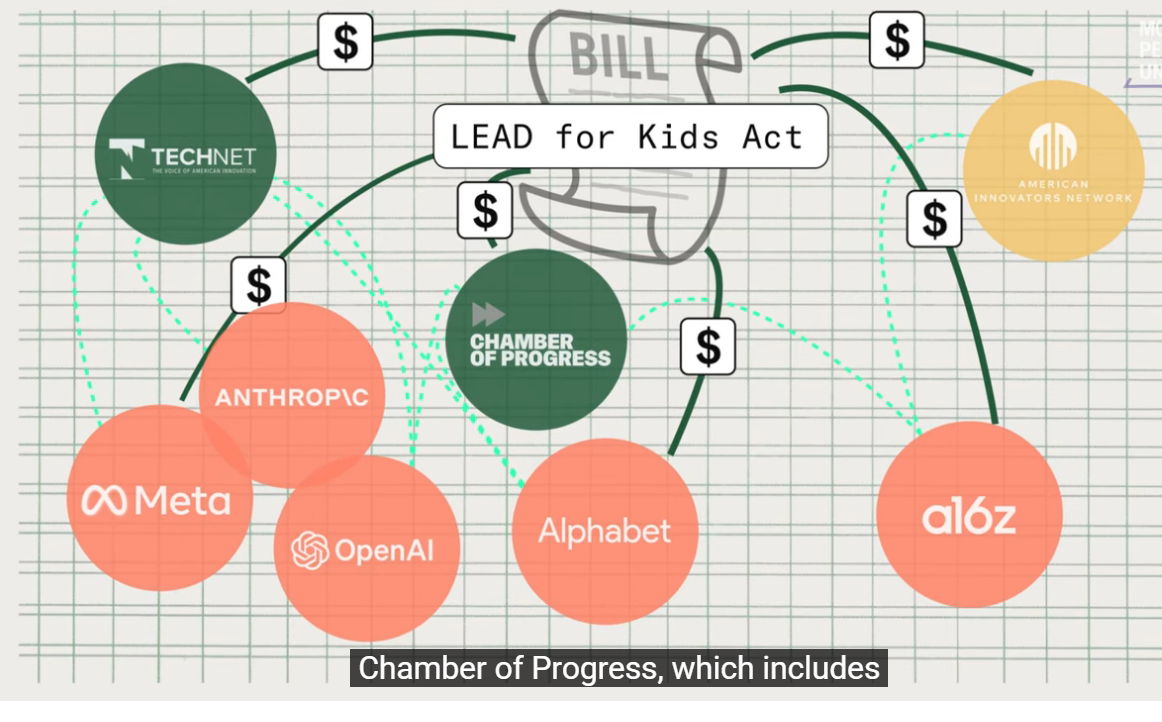
omg

397,988 views Jan 26, 2026
When OpenAI sent someone to Tyler Johnston's house, they wanted every text and email he had on the company.Tyler runs an AI watchdog, and he's just one of the people getting subpoenaed.This is just the beginning of the AI industry's aggressive new political strategy. ----- More Perfect Union is an Emmy-winning, nonprofit newsroom whose mission is to build power for working people.
...(Host) Tyler Johnston runs a small AI watchdog.
0:12
Last summer, he was out when he received an unusual text from his roommate.
0:17
(Tyler) “There's someone at the door with documents for you.”
0:19
(Karen) It was a man with subpoenas from OpenAI, the maker of ChatGPT.
0:23
(Tyler) They were asking for every former employee that we had spoken to and what we said to them,
0:27
every congressional office that we spoke to, every potential investor that we spoke to.
0:32
(Karen) Tyler is just one of many advocates suddenly being targeted.
0:36
As public demands to regulate the AI industry have escalated —
0:39
(Reporter) AI could put millions of Americans out of work.
0:41
(Reporter) — Concerns around safety for kids.
0:44
(Reporter) Customers could see their bills increased by 20 bucks each month.
0:47
(Reporter) AI clips of fake reports even reaching the Oval Office.
0:51
(Karen) its biggest players are going to political war.
0:54
(Alex Bores) They started texting my constituents.
0:57
(Rebecca) Google was involved, Meta was involved, OpenAI was involved.
1:00
The AI industry broadly is ready to play hardball.
1:03
(Karen) So I started investigating their tactics.
1:06
I found an aggressive playbook trying to silence critics, kill
1:10
legislation, and remake government in their interest.
1:14
I wanted to know: what are AI companies so afraid of?
1:18
They can't have any flies in the ointment, which also means no regulation and no guardrails.
1:22
(Karen) And what does it mean for the rest of us if they get what they want?
1:30
When OpenAI subpoenaed Tyler,
1:32
it tucked in an expansive demand that hinted at its real agenda.
1:37
(Tyler) They wanted every single document and text message and email
1:41
that we had that in any way related to OpenAI's restructuring.
1:45
(Karen) Founded as a nonprofit by Elon Musk and Sam Altman,
1:48
OpenAI had for years been raising billions of dollars
1:52
from investors through an internal for-profit arm.
1:55
Then, the nonprofit board attempted to fire Sam Altman,
1:58
and investors panicked that they could lose all their money.
2:02
(Catherine Bracy) In the wake of that, Sam Altman made some promises to his investors
2:05
that they would remove the power and control of the nonprofit from the for-profit entity.
2:11
(Karen) But many advocates, including Tyler and Catherine, stood in the way.
2:16
(Tyler) We released an open letter.
2:17
This was an open letter that was asking seven relatively simple questions, not opposing the restructuring
2:22
in any way, but asking for more transparency about what their plans were.
2:26
(Karen) But failure to restructure could force OpenAI
2:28
to give up $20 billion from its investors.
2:32
The company turned its influence operations into high gear
2:36
under the leadership of a man named Chris Lehane.
2:39
Whoever ends up winning on that ends up building the AI rails
2:43
for the world. Like, that is a bit of a zero sum game.
2:48
(Karen) Lehane began his career in Washington, earning the nickname
2:51
‘Master of Disaster’ in part for helping the Clintons navigate the Monica Lewinsky scandal.
2:57
He then pivoted to Silicon Valley, working at Airbnb and with the crypto industry.
3:02
(Tyler) I think that OpenAI brought him on because they knew that they needed someone
3:06
who was willing to be as fierce as possible.
3:09
(Karen) Lehane stacked his team with former staffers and confidants of Gavin
3:13
Newsom, Bill de Blasio and Kamala Harris.
3:16
OpenAI hired a lobbying firm run by Republican operative
3:19
Jeff Miller, who has deep ties to President Trump.
3:22
It launched new philanthropic efforts, underscored its economic importance to California
3:28
and threatened to leave the state if the restructuring was blocked.
3:32
With Elon Musk also suing OpenAI for abandoning its mission,
3:35
the company began to accuse its critics of being his puppets.
3:39
They were essentially implying
3:43
that we were a front for their competitors.
3:47
(Karen) The aggressive tactics paid off.
3:49
The subpoenas
3:50
also revealed that this is just the beginning.
3:54
I would have been happy to swear to the court that we are not funded by Elon Musk.....
Here’s what that means: We report on the real struggles and challenges of the working class from a working-class perspective. We attempt to connect those problems to potential solutions. We report on the abuses and wrongdoing of corporate power. And we seek to hold accountable the ultra-rich who have too much power over America’s political and economic systems. To support our independent journalism, subscribe, donate, and follow our other pages through the links below:
- Help fund our reporting: https://secure.actblue.com/donate/mpu...
- Substack: https://substack.perfectunion.us/
- TikTok:
 / moreperfectunion
- Twitter:
 / moreperfectus
- Bluesky: https://bsky.app/profile/moreperfectu...
- Facebook:
 / moreperfectus
- Instagram:
 / perfectunion
- Threads: https://www.threads.net/@perfectunion
- Website: https://www.perfectunion.us
---
GGL 6 26 SEDER
[### Ex-a16z partner slams old firm, othes 'political infiltration' in AI

CNBC
https://www.cnbc.com › 2026/06/11 › ex-a16z-partner-...](https://www.cnbc.com/2026/06/11/ex-a16z-partner-slams-old-firm-othes-political-infiltration-in-ai.html)
Jun 11, 2026 — Venture capitalist John O'Farrell, who resigned from Andreessen Horowitz in 2025 after nearly 15 years at the firm, published an op-ed on ...Read more
Missing: quit | Show results with: quit
[### We Can't Let My Former Venture Capital Colleagues Buy ...

The New York Times
https://www.nytimes.com › silicon-valley-ai-politics](https://www.nytimes.com/2026/06/11/opinion/silicon-valley-ai-politics.html)
Jun 11, 2026 — John O'Farrell was hired as the first outside general partner at Andreessen Horowitz in 2010. He resigned in May 2025. He retains investments in ...Read more
[### Andreessen Horowitz Partner Quit Firm, Horrified by What ...

Futurism
https://futurism.com › ... › Finance › Investing](https://futurism.com/future-society/andreessen-horowitz-partner-quit-ai-ethics)
Jun 13, 2026 — Former Andreessen Horowitz partner John O'Farrell quit the firm in May, warning that his colleagues are putting AI hype over humanity.
Missing: VC | Show results with: VC
[### John O'Farrell (venture capitalist)

Wikipedia
https://en.wikipedia.org › wiki › John_O'Farrell_(ventu...](https://en.wikipedia.org/wiki/John_O%27Farrell_%28venture_capitalist%29)
He resigned from the firm in May 2025. His venture capital investments included public companies Slack and PagerDuty ...Read more
John O’Farrell is an Irish former venture capitalist at the Silicon Valley firm Andreessen Horowitz, which he joined in June 2010 as the first general partner hired by founders Marc Andreessen and Ben Horowitz.[1] He resigned from the firm in May 2025[2]. His venture capital investments included public companies Slack[3] and PagerDuty[4]. He was featured on the Forbes Midas List of top technology investors in 2021.[5]. He serves on the U.S. board of UNICEF.[6] In his book "The Hard Thing About Hard Things", Ben Horowitz described O'Farrell as "the industry's greatest M&A negotiator" and wrote that if he had to choose one person to negotiate on his behalf at the final judgment, he’d pick “that Irish brother, John O'Farrell”[7].....
---
OOPS CONTEXT
POLITICO
The AI lobby plants its flag in Washington - POLITICO
Jun 6, 2025The AI lobby plants its flag in Washington A new wave of AI companies is lobbying up in Washington, and already getting much of what it wants.
By Mohar Chatterjee 06/06/2025
Top artificial intelligence companies are rapidly expanding their lobbying footprint in Washington — and so far, Washington is turning out to be a very soft target.
Two privately held AI companies, OpenAI and Anthropic — which once positioned themselves as cautious, research-driven counterweights to aggressive Big Tech firms — are now adding Washington staff, ramping up their lobbying spending and chasing contracts from the estimated $75 billion federal IT budget, a significant portion of which now focuses on AI.
They have company. Scale AI, a specialist contractor with the Pentagon and other agencies, is also planning to expand its government relations and lobbying teams, a spokesperson told POLITICO. In late March, the AI-focused chipmaking giant Nvidia registered its first in-house lobbyists.
AI lobbyists are “very visible” and “very present on the hill,” said Rep. Don Beyer (D-Va.) in an interview at the Special Competitive Studies Project AI+ Expo this week. “They’re nurturing relationships with lots of senators and a handful of members [of the House] in Congress. It’s really important for their ambitions, their expectations of the future of AI, to have Congress involved, even if it’s only to stop us from doing anything.”
This lobbying push aims to capitalize on a wave of support from both the Trump administration and the Republican Congress, both of which have pumped up the AI industry as a linchpin of American competitiveness and a means for shrinking the federal workforce.
They don’t all present a unified front — Anthropic, in particular, has found itself with conservatives, and on Thursday its CEO Dario Amodei broke with other companies by urging Congress to pass a national transparency standard for AI companies — but so far the AI lobby is broadly getting what it wants.
“The overarching ask is for no regulation or for light-touch regulation, and so far, they’ve gotten that,” said Doug Calidas, senior vice president of government affairs for the AI policy nonprofit Americans for Responsible Innovation.
In a sign of lawmakers’ deference to industry, the House passed a ten-year freeze on enforcing state and local AI regulation as part of its megabill that is currently working through the Senate.
Critics, however, worry that the AI conversation in Washington has become an overly tight loop between companies and their GOP supporters — muting important concerns about the growth of a powerful but hard-to-control technology.
“There’s been a huge pivot for [AI companies] as the money has gotten closer,” Gary Marcus, an AI and cognitive science expert, said of the leading AI firms. “The Trump administration is too chummy with the big tech companies, and basically ignoring what the American people want, which is protection from the many risks of AI.”
Anthropic declined to comment for this story, referring POLITICO to its March submission to the AI Action Plan that the White House is crafting after President Donald Trump repealed a sprawling AI executive order issued by the Biden administration.
OpenAI, too, declined to comment.
This week several AI firms, including OpenAI, co-sponsored the Special Competitive Studies Project’s AI+ Expo, an annual Washington trade show that has quickly emerged as a kind of bazaar for companies trying to sell services to the government. (Disclosure: POLITICO was a media partner of the conference.)
They’re jostling for influence against more established government contractors like Palantir, which has been steadily building up its lobbying presence in D.C. for years, while Meta, Google, Amazon and Microsoft — major tech platforms with AI as part of their pitch — already have dozens of lobbyists in their employ.
What the AI lobby wants is a classic Washington twofer: fewer regulations to limit its growth, and more government contracts.
The government budget for AI has been growing. Federal agencies across the board — from the Department of Defense and the Department of Energy to the IRS and the Department of Veterans Affairs — are looking to build AI capacity. The Trump administration’s staff cuts and automation push is expected to accelerate the demand for private firms to fill the gap with AI.
For AI, “growth” also demands energy and, on the policy front, AI companies have been a key driver of the recent push in Congress and the White House to open up new energy sources, streamline permitting for building new data centers and funnel private investment into the construction of these sites.
Late last year, OpenAI released an infrastructure blueprint for the U.S. urging the federal government to prepare for a massive spike in demand for computational infrastructure and energy supply. Among its recommendations: creating special AI zones to fast-track permits for energy and data centers, expanding the national power grid and boosting government support for private investment in major energy projects.
Those recommendations are now being very closely echoed by Trump administration figures. Last month, at the Bitcoin 2025 Conference in Las Vegas, David Sacks — Trump’s AI and crypto czar — laid out a sweeping vision that mirrored the AI industry’s lobbying goals.
Speaking to a crowd of 35,000, Sacks stressed the foundational role of energy for both AI and cryptocurrency, saying bluntly: “You need power.” He applauded President Donald Trump’s push to expand domestic oil and gas production, framing it as essential to keeping the U.S. ahead in the global AI and crypto race.
This is a huge turnaround from a year ago, when AI companies faced a very different landscape in Washington. The Biden administration, and many congressional Democrats, wanted to regulate the industry to guard against bias, job loss and existential risk.
No longer. Since Trump’s election, AI has become central to the conversation about global competition with China, with Silicon Valley venture capitalists like Sacks and Marc Andreessen now in positions of influence within the Trump orbit. Trump’s director of the Office of Science and Technology Policy is Michael Kratsios, former managing director at Scale AI. Trump himself has proudly announced a series of massive Gulf investment deals in AI.
Sacks, in his Las Vegas speech, pointed to those recent deal announcements as evidence of what he called a “total comprehensive shift” in Washington’s approach to emerging technologies.
But as the U.S. throws its weight behind AI as a strategic asset, critics warn that the enthusiasm is muffling one of the most important conversations about AI: its ability to wreak unforeseen harm on the populace, from fairness to existential risk concerns.
Among those concerns: bias embedded in algorithmic decisions that affect housing, policing, and hiring; surveillance that could threaten civil liberties; the erosion of copyright protections, as AI models hoover up data and labor protections as automation replaces human work.
Kevin De Liban, founder of TechTonic Justice, a nonprofit that focuses on the impact of AI on low income communities, worries that Washington has abandoned its concerns for AI’s impact on citizens.
“Big Tech gets fat government contracts, a testing ground for their technologies, and a liability-free regulatory environment,” he said, of Washington’s current AI policy environment. “Everyday people are left behind to deal with the fallout.”
There’s a much larger question, too, which dominated the early AI debate: whether cutting-edge AI systems can be controlled at all. These risks, long documented by researchers, are now taking a back seat in Washington as the conversation turns to economic advantage and global competition.
There’s also the very real concern that if an AI company does bring up the technology’s worst-case scenarios, it may find itself at odds with the White House itself. Anthropic CEO Amodei said in a May interview that labor force disruptions due to AI would be severe — which triggered a direct attack from, on his podcast, who said that line of thinking led to “woke AI.”
Still, both Anthropic and OpenAI are going full steam ahead. Anthropic hired nearly a dozen policy staffers in the last two months, while OpenAI similarly grew its policy office over the past year.
They’re also pushing to become more important federal contractors by getting critical FedRAMP authorizations — a federal program that certifies cloud services for use across government — which could unlock billions of dollars in contracts.
As tech companies grow increasingly cozy with the government, the political will to regulate them is fading — and in fact, Congress appears hostile to any efforts to regulate them at all.
In a public comment in March, OpenAI specifically asked the Trump administration for a voluntary federal framework that overrides state AI laws, seeking “private sector relief” from a patchwork of state AI bills.
Two months later, the House added language to its reconciliation bill that would have done exactly that — and more. The provision to impose a 10 year moratorium on state AI regulations passed the House but is expected to be knocked out by the Senate parliamentarian. (Breaking ranks again, Anthropic is lobbying against the moratorium.) Still, the provision has widespread support amongst Republicans and is likely to make a comeback.
---
---
PROTO-ABUNDANCE? CONTEXT INTERCEPT SAM BIDDLE NOV 2024
tech-industry-trump-military-contracts
Donald Trump pitched himself to voters as a supposed anti-interventionist candidate of peace. But when he reenters the White House in January, at his side will be a phalanx of pro-military Silicon Valley investors, inventors, and executives eager to build the most sophisticated weapons the world has ever known.
During his last term, the U.S. tech sector tiptoed skittishly around Trump; longtime right-winger Peter Thiel stood as an outlier in his full-throated support of MAGA politics as other investors and executives largely winced and smiled politely. Back then, Silicon Valley still offered the public peaceful mission statements of improving the human condition, connecting people, and organizing information. Technology was supposed to help, never harm. No more: People like Thiel, Palmer Luckey, Trae Stephens, and Marc Andreessen make up a new vanguard of powerful tech figures who have unapologetically merged right-wing politics with a determination to furnish a MAGA-dominated United States with a constant flow of newer, better arms and surveillance tools.
Trump’s election marks an epochal victory not just for the right, but also for a growing conservative counterrevolution in American tech.
These men (as they tend to be) hold much in common beyond their support of Republican candidates: They share the belief that China represents an existential threat to the United States (an increasingly bipartisan belief, to be sure) and must be dominated technologically and militarily at all costs. They are united in their aversion, if not open hostility, to arguments that the pace of invention must be balanced against any moral consideration beyond winning. And they all stand to profit greatly from this new tech-driven arms race.
Trump’s election marks an epochal victory not just for the right, but also for a growing conservative counterrevolution in American tech that has successfully rebranded military contracting as the proud national duty of the American engineer, not a taboo to be dodged and hidden. Meta’s recent announcement that its Llama large language model can now be used by defense customers means that Apple is the last of the “Big Five” American tech firms — Amazon, Apple, Google, Microsoft, and Meta — not engaged in military or intelligence contracting.
Elon Musk has drawn the lion’s share of media scrutiny (and Trump world credit) for throwing his fortune and digital influence behind the campaign. Over the years, the world’s richest man has become an enormously successful defense contractor via SpaceX, which has reaped billions selling access to rockets that the Pentagon hopes will someday rapidly ferry troops into battle. SpaceX’s Starlink satellite internet has also become an indispensable American military tool, and the company is working on a constellation of bespoke spy satellites for U.S. intelligence agency use.
But Musk is just one part of a broader wave of militarists who will have Trump’s ear on policy matters.
After election day, Musk replied to a celebratory tweet from Palmer Luckey, a founder of Anduril, a $14 billion startup that got its start selling migrant-detecting surveillance towers for the southern border and now manufactures a growing line of lethal drones and missiles. “Very important to open DoD/Intel to entrepreneurial companies like yours,” Musk wrote. Anduril’s rise is inseparable from Trumpism: Luckey founded the firm in 2017 after he was fired by Meta for contributing to a pro-Trump organization. He has been outspoken in his support for Trump as both candidate and president, fundraising for him in both 2020 and 2024.
Big Tech historically worked hard to be viewed by the public as inhabiting the center-left, if not being apolitical altogether. But even that is changing. While Luckey was fired for merely supporting Trump’s first campaign, his former boss (and former liberal) Mark Zuckerberg publicly characterized Trump surviving the June assassination attempt as “bad ass” and quickly congratulated the president-elect on a “decisive victory.” Zuckerberg added that he is “looking forward to working with you and your administration.”
:{To some extent, none of this is new: Silicon Valley’s origin is one of militarism. The American computer and software economy was nurtured from birth by the explosive growth and endless money of the Cold War arms race and its insatiable appetite for private sector R&D. :{And despite the popular trope of liberal Google executives, the tech industry has always harbored a strong anti-labor, pro-business instinct that dovetails neatly with conservative politics}:.
It would also be a mistake to think that Silicon Valley was ever truly in lockstep with progressive values. A 2014 political ad by Americans for a Conservative Direction, a defunct effort by Facebook to court the Republican Party, that “it’s wrong to have millions of people living in America illegally” and urged lawmakers to “secure our borders so this never happens again.” The notion of the Democrat-friendly wing of Big Tech as dovish is equally wrong: Former Google chair and longtime liberal donor Eric Schmidt is a leading China hawk and defense tech investor. Similarly, the Democratic Party itself hasn’t meaningfully distanced itself from militarism in recent history. The current wave of startups designing smaller, cheaper military drones follows the Obama administration’s eager mass adoption of the technology, and firms like Anduril and Palantir have thrived under Joe Biden.}:
What has changed is which views the tech industry is now comfortable expressing out loud.
:{:{A year after Luckey’s ouster from the virtual reality subsidiary he founded, Google became embroiled in what grew into an industry-wide upheaval over military contracting. After it was reported that the company sought to win Project Maven, a lucrative drone-targeting contract, employees who had come to the internet titan to work on consumer products like Search, Maps, and Gmail found themselves disturbed by the thought of contributing to a system that could kill people. Waves of protests pushed Google to abandon the Pentagon with its tail between its legs.}:
Even Fei-Fei Li, then Google Cloud’s chief artificial intelligence and machine learning scientist, described the contract as a source of shame in internal emails obtained by the New York Times. “Weaponized AI is probably one of the most sensitized topics of AI — if not THE most. This is red meat to the media to find all ways to damage Google,” she wrote. “I don’t know what would happen if the media starts picking up a theme that Google is secretly building AI weapons or AI technologies to enable weapons for the Defense industry.”}:
It’s an exchange that reads deeply quaint today. The notion that the country’s talented engineers should build weapons is becoming fully mainstreamed. “Societies have always needed a warrior class that is enthused and excited about enacting violence on others in pursuit of good aims,” Luckey explained in an on-campus talk about his company’s contributions to the Ukrainian war effort with Pepperdine University President Jim Gash. “You need people like me who are sick in that way and who don’t lose any sleep making tools of violence in order to preserve freedom.”
This “warrior class” mentality traces its genealogy to Peter Thiel, whose disciples, like Luckey, spread the gospel of a conservative-led arms race against China. “Everything that we’re doing, what the [Department of Defense] is doing, is preparing for a conflict with a great power like China in the Pacific,” Luckey told Bloomberg TV in a 2023 interview. At the Reagan National Defense Forum in 2019, Thiel, a lifelong techno-libertarian and Trump’s first major backer in tech, rejected the “ethical framing” of the question of whether to build weapons.” When it’s a choice between the U.S. and China, it is always the ethical decision to work with the U.S. government,” he said. Though Sinophobia is increasingly standard across party affiliations, it’s particularly frothing in the venture-backed warrior class. In 2019, Thiel claimed that Google had been “infiltrated by Chinese intelligence” and two years later suggested that bitcoin is “a Chinese financial weapon against the U.S.”
Related
Tech Billionaires Love Trump Now — Because He’s One of Them](https://theintercept.com/2024/08/07/silicon-valley-tech-billionaires-president-trump/)
Thiel often embodies the self-contradiction of Trumpist foreign policy, decrying the use of taxpayer money on “faraway wars” while boosting companies that design weapons for exactly that. Like Trump, Thiel is a vocal opponent of Bush- and Obama-era adventurism in the Middle East as a source of nothing but regional chaos — though Thiel has remained silent on Trump’s large expansion of the Obama administration’s drone program and his assassination of Iranian Maj. Gen. Qassim Suleimani. In July, asked about the Israeli use of AI in the ongoing slaughter in Gaza, Thiel responded, “I defer to Israel.”
Thiel’s gravitational pull is felt across the whole of tech’s realignment toward militarism. Vice President-elect JD Vance worked at Mithril, another of Thiel’s investment firms, and used $15 million from his former boss to fund the 2022 Senate win that secured his national political bona fides. Vance would later go on to invest in Anduril. Founders Fund, Thiel’s main venture capital firm, has seeded the tech sector with influential figures friendly to both Trumpism and the Pentagon. Before, an investor or CEO who publicly embraced right-wing ideology and products designed to kill risked becoming an industry pariah. Today, he can be a CNBC guest.
An earlier adopter of MAGA, Thiel was also investing in and creating military- and intelligence-oriented companies before it was cool. He co-founded Palantir, which got its start helping facilitate spy agency and deportation raids by Immigration and Customs Enforcement. Now part of the S&P 500, the company helps target military strikes for Ukraine and in January sealed a “strategic partnership for battle tech” with the Israeli Ministry of Defense, according to a press release.
Before, a tech investor or CEO who publicly embraced right-wing ideology and products designed to kill risked becoming an industry pariah. Today, he can be a CNBC guest.
The ripple effect of Palantir’s success has helped popularize defense tech and solidify its union with the American right. Thiel’s Palantir co-founder Joe Lonsdale, also an Anduril investor, is reportedly helping Trump staff his new administration. Former Palantir employee and Anduril executive chair Trae Stephens joined the Trump transition team in 2016 and has suggested he would serve a second administration. As a member of the U.S.–China Economic and Security Review Commission, Thiel ally Jacob Helberg has been instrumental in whipping up anti-China fervor on Capitol Hill, helping push legislation to ban TikTok, and arguing for military adoption of AI technologies like those sold by his employer, Palantir, which markets itself as a bulwark against Chinese aggression. Although Palantir CEO Alex Karp is a self-described Democrat who said he planned to vote against Trump, he has derided progressivism as a “thin pagan religion” of wokeness, suggested pro-Palestine college protesters leave for North Korea, and continually advocating for an American arms buildup.
“Trump has surrounded himself with ‘techno-optimists’ — people who believe technology is the answer to every problem,” Brianna Rosen, a strategy and policy fellow at the University of Oxford and alumnus of the Obama National Security Council, told The Intercept. “Key members of his inner circle — leading tech executives — describe themselves in this way. The risk of techno-optimism in the military domain is that it focuses on how technology saves lives, rather than the real risks associated with military AI, such as the accelerated pace of targeting.”
The worldview of this corner of the tech industry is loud, if not always consistent. Foreign entanglements are bad, but the United States must be on perpetual war-footing against China. China itself is dangerous in part because it’s rapidly weaponizing AI, a current that threatens global stability, so the United States should do the very same, even harder, absent regulatory meddling.
Stephens’s 2022 admonition that “the business of war is the business of deterrence” argues that “peaceful outcomes are only achievable if we maintain our technological advantage in weapons systems” — an argument that overlooks the fact that the U.S. military’s overwhelming technological superiority failed to keep it out of Korea, Vietnam, Iraq, or Afghanistan. In a recent interview with Wired, Stephens both criticized the revolving door between the federal government and Anduril competitors like Boeing while also stating that “it’s important that people come out of private industry to work on civil service projects, and I hope at some point I’ll have the opportunity to go back in and serve the government and American people.”
William Fitzgerald, the founder of The Worker Agency, a communications and advocacy firm that has helped tech workers organize against military contracts, said this square is easily circled by right-wing tech hawks, whose pitch is centered on the glacial incompetence of the Department of Defense and blue-chip contractors like Lockheed and Raytheon. “Peter Thiel’s whole thing is to privatize the state,” Fitzgerald explained. Despite all of the rhetoric about avoiding foreign entanglements, a high-tech arms race is conducive to different kinds of wars, not fewer of them. “This alignment fits this narrative that we can do cheaper wars,” he said. “We won’t lose the men over there because we’ll have these drones.”
In this view, the opposition of Thiel and his ilk isn’t so much to forever wars, then, but rather whose hardware is being purchased forever.
The new conservative tech establishment seems in full agreement about the need for an era of techno-militarism. Marc Andreessen and Ben Horowitz, the namesakes of one of Silicon Valley’s most storied and successful venture capital firms, poured millions into Trump’s reelection and have pushed hard to reorient the American tech sector toward fighting wars. In a “Techno-Optimist Manifesto” published last October, Andreessen wrote of defense contracting as a moral imperative. “We believe America and her allies should be strong and not weak. We believe national strength of liberal democracies flows from economic strength (financial power), cultural strength (soft power), and military strength (hard power). Economic, cultural, and military strength flow from technological strength.” The firm knows full well what it’s evoking through a naked embrace of strength as society’s greatest virtue: Listed among the “Patron Saints of Techno-Optimism” is Filippo Tommaso Marinetti, co-author of the 1919 Fascist Manifesto.
The venture capitalists’ document offers a clear rebuttal of employees’ moral qualms that pushed Google to ditch Project Maven. The manifesto dismisses basic notions of “ethics,” “safety,” and “social responsibility” as a “demoralization campaign” of “zombie ideas, many derived from Communism” pushed by “the enemy.” This is rhetoric that matches a brand Trump has worked to cultivate: aspirationally hypermasculine, unapologetically jingoistic, and horrified by an America whose potential to dominate the planet is imperiled by meddling foreigners and scolding woke co-workers.
“There’s a lot more volatility in the world, [and] there is more of a revolt against what some would deem ‘woke culture,’” said Michael Dempsey, managing partner at the New York-based venture capital firm Compound. “It’s just more in the zeitgeist now that companies shouldn’t be so heavily influenced by personal politics. Obviously that is the tech industry talking out of both sides of their mouth because we saw in this past election a bunch of people get very political and make donations from their firms.”
“It’s just more in the zeitgeist now that companies shouldn’t be so heavily influenced by personal politics. Obviously that is the tech industry talking out of both sides of their mouth.”
Despite skewing young (by national security standards), many in this rightward, pro-military orbit are cultural and religious traditionalists infused with the libertarian preferences of the Zynternet, a wildly popular online content scene that’s melded apolitical internet bro culture and a general aversion to anything considered vaguely “woke.” A recent Vanity Fair profile of the El Segundo tech scene, a hotbed of the burgeoning “military Zyndustrial complex” commonly known as “the Gundo,” described the city as “California’s freedom-loving, Bible-thumping hub of hard tech.” It paints a vivid scene of young engineers who eschewed the progressive dystopia of San Francisco they read about on Twitter and instead flocked to build “nuclear reactors and military weaponry designed to fight China” beneath “an American flag the size of a dumpster” and “a life-size poster of Jesus Christ smiling benevolently onto a bench press below.”
The American right’s hold over online culture in the form of podcasts, streamers, and other youth-friendly media has been central to both retaking Washington and bulldozing post-Maven sentiment, according to William Fitzgerald of Worker Agency. “I gotta hand it to the VCs, they’re really good at comms,” said Fitzgerald, who himself is former Google employee who helped leak critical information about the company’s involvement in Project Maven. “They’re really making sure that these Gundo bros are wrapping the American flag around them. It’s been fascinating to see them from 2019 to 2024 completely changing the culture among young tech workers.”
A wave of layoffs and firings of employees engaged in anti-military protests have been a boon for defense evangelists, Fitzgerald added. “The workers have been told to shut up, or they get fired.”
This rhetoric has been matched by a massive push by Andreessen Horowitz (already an Anduril investor) behind the fund’s “American Dynamism” portfolio, a collection of companies that leans heavily into new startups hoping to be the next Raytheon. These investments include ABL Space Systems, already contracting with the Air Force,; Epirus, which makes microwave directed-energy weapons; and Shield AI, which works on autonomous military drones. Following the election, David Ulevitch, who leads the fund’s American Dynamism team, retweeted a celebratory video montage interspersed with men firing flamethrowers, machine guns, jets, Hulk Hogan, and a fist-pumping post-assassination attempt Trump.
Even the appearance of more money and interest in defense tech could have a knock-on effect for startup founders hoping to chase what’s trendy. Dempsey said he expects investors and founder to “pattern-match to companies like Anduril and to a lesser extent SpaceX, believing that their outcomes will be the same.” The increased political and cultural friendliness toward weapons startups also coincides with high interest rates and growing interest in hardware companies, Dempsey explained, as software companies have lost their luster following years of growth driven by little more than cheap venture capital.
There’s every reason to believe a Trump-controlled Washington will give the tech industry, increasingly invested in militarized AI, what it wants. In July, the Washington Post reported the Trump-aligned America First Policy Institute was working on a proposal to “Make America First in AI” by undoing regulatory burdens and encouraging military applications. Trump has already indicated he’ll reverse the Biden administration’s executive order on AI safety, which mandated safety testing and risk-based self-reporting by companies. Michael Kratsios, chief technology officer during the first Trump administration and managing director of Air Force contractor Scale AI, is reportedly advising Trump’s transition team on policy matters.
“‘Make America First in AI’ means the United States will move quickly, regardless of the costs, to maintain its competitive edge over China,” Brianna Rosen, the Oxford fellow, explained. “That translates into greater investment and fewer restrictions on military AI. Industry already leads AI development and deployment in the defense and intelligence sectors; that role has now been cemented.”
The mutual embrace of MAGA conservatism and weapons tech seems to already be paying off. After dumping $200 million into the Trump campaign’s terminal phase, Musk was quick to cash his chips in: On Thursday, the New York Times reported that he petitioned Trump SpaceX executives into positions at the Department of Defense before the election had even begun. Musk will also co-lead a nebulous new office dedicated to slashing federal spending. Rep. Matt Gaetz, brother-in-law to Luckey, now stands to be the country’s next attorney general. In a post-election interview with Bloomberg, Luckey shared that he is already advising the Trump transition team and endorses the current candidates for defense secretary. “We did well under Trump, and we did better under Biden,” he said of Anduril. “I think we will do even better now.”
---
---