Patrick Collison Stripe
---
baby broliarch pending
thiel funder andreeson
mercatus
ezra klein abundance
tyler cowan gmu
In January 2025, Arc announced a partnership with Nvidia to integrate biology and machine learning.
---
whois -->
-=-=-=
The American Revelation Foundation
The American Revelation Foundation is a registered 501(c)(3) public charity located in Newark, Delaware, with the federal EIN 42-2190246. [1]
131 CONTINENTAL DR STE 305
Newark, DE 19713
United States
This address belongs to Legalink (Legalinc Corporate Services), the registered agent provider for Stripe Atlas companies, covering the $100 annual fee, automatic yearly renewals, and Stripe Dashboard management. [1, 2]
Address & Provider Details
- Location: 131 Continental Dr Ste 305, Newark, DE 19713
- Company: Legalinc Corporate Services Inc.
- Function: Official registered agent for Delaware businesses [1, 2]
Stripe Atlas Billing
- Annual cost: $100 per year
- Renewal timing: Charged yearly on your company creation date
- Account control: Update details inside the Stripe Dashboard [1, 2]
Organization Details
- EIN / Tax ID: 42-2190246
- Tax Status: 501(c)(3) Public Charity
---
tnr
In early February, Axios reported that “Ezra Klein’s Abundance movement is getting some backup” in the form of a new group: Next American Era, headed by former Democratic Congressional Campaign Committee head, Illinois congresswoman, and longtime Washington insider Cheri Bustos. Bustos’s group, per the report, would be committed to “‘pro-growth,’ deregulatory policies.” This is hardly surprising; for the past several years Bustos has been a literal corporate lobbyist at the extremely Trump-connected outfit Mercury Partners. Mercury saw its profits more than double in 2025 as it sold access to the Trump throne room.
Over the course of the three years for which we have lobbying disclosures, Bustos branched out from lobbying overwhelmingly on behalf of agriculture firms and municipal governments to work for energy firms and software behemoths, as well. In particular, Bustos registered as a lobbyist for OpenAI and Larry Ellison’s Oracle, two of the most central companies in the bubblish AI industry that is becoming increasingly omnipresent in our politics, economy, and daily lives. The two firms were also the biggest clients in Bustos’s portfolio; Oracle’s 2025 lobbying expenditures totaled over $11 million, while OpenAI’s were just under $3 million. Bustos’s next-largest clients in 2025 were Korea Zinc and battery manufacturer Gotion, both with around $2.5 million in total lobbying.
Facially, it seems odd for someone like Bustos, fresh off a stint of AI lobbying, to launch a centrist 501c(4) and immediately align with the abundance agenda, which generally represents itself as a movement focused on housing and utility transmission permitting. In reality, it’s of a kind with a deep techno-optimist, pro-AI undercurrent that has permeated abundance thought since before Derek Thompson coined the phrase “abundance agenda” in 2022.
In the spring of 2025, Thompson and Klein’s tome, Abundance, launched to a firestorm of discourse, both praise and criticism. Nearly a year later, the blaze has lessened—Trumpian destruction of the economy and democracy tends to take the wind out of the sails of cockeyed optimists, after all—but tensions in what writers on both sides (namely, Jonathan Chait and David Sirota) have called the “Democrats’ Civil War” continue to simmer.
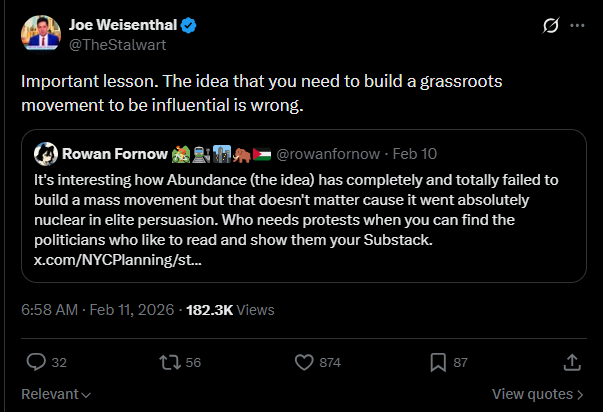
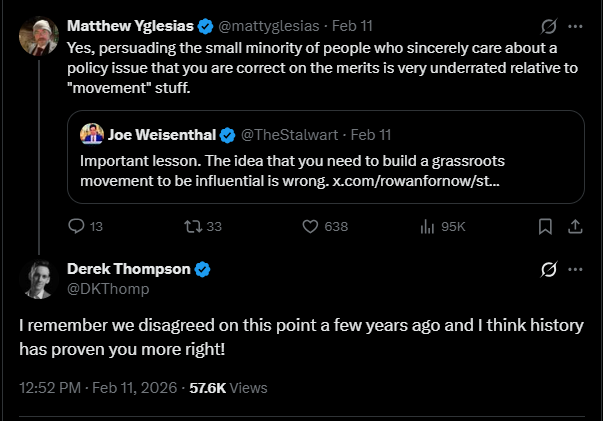
The abundance ecosystem has tried to develop a “grass-tops” movement, which parlays an elite influence campaign into building a mass constituency. Abundance world has certainly been successful at the first part; with hundreds of millions of dollars (this figure is meant literally, not figuratively) flowing into abundance organizations and Klein playing an intellectual power-broker role within Democratic politics—to the point that it raised eyebrows internally at The New York Times, according to reporting from Axios. But with sitting mayors and governors explicitly name-checking the book and its authors, abundance has thoroughly permeated the political class. It has not, however, been as successful at building a broad-base constituency. (It is perhaps difficult to focus on a gauzy future of plenty when fascist shock troops are loose on the streets, acting with impunity.)
Despite Abundance making theNew York Times bestseller list (tech tycoon Reid Hoffman sending copies to everyone he knows probably didn’t hurt), Democratic voters have been notably leery about the abundance framework. Polling has shown that the base is far more interested in tackling corporate greed than it is in municipal red tape, and Klein’s attempts to cast himself as a bipartisan mediator in the wake of the Charlie Kirk assassination have undermined his status as a leading light on the left.
At the Abundance 2025 conference, prominent abundance think tanker Alex Trembath of the Breakthrough Institute stood up to forcefully decry any allegations that the movement had been organized by elites, claiming that “abundance is not this astroturfed conspiracy. In fact, just the opposite: Abundance is emergent. Abundance is bottom-up.” He followed this declaration with the romantic sentiment that it was not donors who brought this movement together but fate, saying, “We were not herded and orchestrated: We found each other. The people and ideas in this ballroom pull on strands from multiple fields—think tanks, activists, organizers, elected officials, journalists, philanthropists, technologists, and entrepreneurs and investors.”
That is, notably, not what a bottom-up movement is. Grassroots movements are built on a foundation of organizing and mobilizing a mass membership. What Trembath actually described is very clearly a grass-tops strategy. Many people within abundance circles recognize, sometimes even celebrate, this dynamic. It was this very strategy that the Niskanen Center spelled out in its June 2024 manifesto charting how to build a so-called “abundance faction.”
The push for a bipartisan grand coalition, also laid out in Niskanen’s manifesto, has not succeeded either. The right flank of the abundance ecosystem has openly embraced some of the most vile parts of Trumpism. In the lead-up to Abundance 2025, the Manhattan Institute’s Charles Lehman, one of the speakers at the conference, called for “deportation abundance.”
Even Utah Governor Spencer Cox, who headlined alongside Klein and Thompson, and has a long-standing reputation as a (relatively) compassionate moderate who wants us all to “disagree better,” has veered toward rank partisanship and entrenching the power of an ever more authoritarian Republican Party. Cox moved to pack the Utah Supreme Court in order to gerrymander Salt Lake City, in what was an awfully aggressive approach for anyone who isn’t dead set on preserving the MAGA regime. The gerrymander would have only picked up one seat. But Cox has embraced a cosmic view of politics, where Donald Trump’s survival from an assassination attempt in 2024 was “miraculous,” spinning a borderline messianic interpretation of Trump’s candidacy and saying to Trump, “You, and only you, can be [the] kind of leader” it will take to repair the country.
Meanwhile, the Trump officials who were praised by abundance advocates as sage and reasonable, particularly Energy Secretary Chris Wright and Interior Secretary Doug Burgum, have been anything but. Wright has raised concerns that he is using his post to advance the business interests of the nuclear energy firm Oklo, where he was previously a board member, and is taking point on the American colonial takeover of the Venezuelan oil industry. Burgum is keeping busy cheerleading threats to annex Greenland, ignoring natural disasters in the actual interior, explicitly serving the oil and gas industry, and whitewashing American history by scrubbing any discussion of climate change, colonial violence toward Native Americans, and other stains on our heritage from national parks and monuments. Oh, lest we forget, he also oversaw the removal of the word “transgender” from the Stonewall monument, where his Interior Department recently abortively removed the Pride flag itself.
Curtis Yarvin, whom prominent abundance intellectual Steve Teles links to in this piece as the far-right edge of abundance, is considered central to the “new right,” which James Pogue described as “a project to overthrow the thrust of progress, at least such as liberals understand the word.” Yarvin, an antidemocracy nutball who wants to replace the republican system of government with a dictatorship or monarchy, also believes white people are innately more intelligent than other races, and has minimized slavery.
Despite this movement being studded by such miscreants and autocratic enablers, abundance is poised to exert significant influence in the near term, especially through a donor class that absolutely loves it and inside organizing like Ezra Klein’s appearance at a major Senate Democratic retreat. But if abundance liberals are to avoid missing the moment and find durable standing within center-left politics, they have to confront a glaring contradiction: their relationship to the AI industry.
AI skepticism and populist anger at data centers are surging. But abundance groups are increasingly aligning with deeply unpopular tech-titan pet projects like California Forever, an attempt by Silicon Valley bigwigs to build their own city from scratch between Sacramento and San Francisco. Housing policy group California YIMBY endorsed the plan, which led to California state Senator Christopher Cabaldon expressing confusion at a recent conference. California Forever also sponsored a recent “Festival of Progressive Abundance” in Los Angeles. The Charter Cities Institute, which advocates for the creation of autonomous cities unbound by existing legal code and envisioned as techno-optimist Meccas, sent an open letter to the Trump administration in support of Freedom Cities, alongside researchers at the American Enterprise Institute, or AEI, which is considered an abundance organization in the list maintained by Inclusive Abundance, the ecosystem’s main organizing arm.
On top of AEI, there is a host of other broadly pro-tech libertarian think tanks included in the Inclusive Abundance list, such as the (Koch-aligned) Cato Institute, the Cicero Institute (chaired by Palantir co-founder Joe Lonsdale), primary Charles Koch influence operation Americans for Prosperity, and the Federation for American Innovation. FAI alum Michael Kratsios, now the head of the White House Office of Science and Technology, has been an aggressive AI booster and was central to Texas Senator Ted Cruz’s legislation that attempted to create a mechanism to functionally exempt the AI industry from any and all federal regulation.
Don’t just take it from me that abundance sometimes is awfully close to tech-libertarians; the Cato Institute itself has said so, and it is generally expert at what libertarianism means.
Abundance has been marketed as a movement focused on solving the crisis of housing affordability, but there has always been a distinct techno-optimist bent to the movement that looks favorably on AI and Silicon Valley. In the opening utopian vignette of Abundance, Klein and Thompson identify widely distributed wealth from artificial intelligence as the internal mechanism that enables our supposedly impending sci-fi-flavored future. Klein, in particular, was quite vocal that a major driver of his side of the project was about repairing the frayed relationship between progressives and technology—both the concept itself and the tech industry centered around Silicon Valley.
The Abundance 2025 conference, judging by its schedule, had as much programming around AI as it did around housing (there was more directly focusing on energy policy than either, though energy and AI are deeply interconnected). The author of President Trump’s AI Action Plan, Dean Ball (now at FAI), was a featured speaker at the conference, as was NVIDIA’s director of infrastructure policy and multiple other champions of AI.
Moreover, much, if not most, of the funding flowing into abundance organizing is closely linked to powerful Silicon Valley figures. Following the release of Klein and Thompson’s book, Open Philanthropy (another sponsor of the abundance conferences, since rechristened Coefficient Giving), which was launched by Facebook co-founder Dustin Moskovitz, unveiled a $120 million fund focused on advancing abundance ideas. Half of the fund—$60 million—came from Stripe’s Patrick Collison. Arnold Ventures is a frequent abundance funder, which launched the Abundance Academic Network and a new abundance-flavored Vox vertical, among others. John Arnold made his fortune in energy trading and more recently joined the board of Meta specifically to serve as an energy adviser for data-center buildout. When welcoming Arnold to the board, Mark Zuckerberg said that, “as we focus on building AGI,” Arnold’s “deep experience” in “energy infrastructure will help us execute our long-term vision.”
Ever wonder why AI advocates downplay the climate implications of natural gas–fueled AI data centers? Consider Renaissance Philanthropy, an early pro-abundance foundation, which was created with money from former Google CEO Eric Schmidt. Schmidt has publicly stated that humans will never manage to control climate change, and that our best bet is to pour near-unlimited resources into developing an AI that can solve the issue for us. And Schmidt’s views are hardly niche within the realm of our would-be AI oligarchs.
In the most on-the-nose example, Abundance 2025 also had two literal trade associations that represent major tech firms among its sponsors: Chamber of Progress and the New American Industrial Alliance. The former of these is funded by literally every prominent AI firm in the game, from Marc Andreessen’s a16z to Amazon, Apple, Google, OpenAI, NVIDIA, Midjourney, and others.
None of this is an aberration: Silicon Valley has been at the forefront of developing abundance thought since its inception. Among the earliest proto-abundance treatises was an essay in The Atlantic co-authored by Patrick Collison and Tyler Cowen that called for the launch of a new science dedicated to studying how to achieve progress, which they creatively dubbed “progress studies.” In the seven years since their essay, progress studies has intermingled with other movements, such as effective altruism and rationalism, mainline Koch-style libertarianism, and supply-side progressivism, with a dash of technofascism comprising what Steve Teles has christened the “Dark Abundance” subfaction. The amalgamation of all these strands led to what we now would call the abundance movement (or ecosystem).
Cowen, in turn, runs key abundance funder Emergent Ventures, which was launched with a grant from Palantir’s Peter Thiel. Patrick Collison has marshaled part of his fortune to organize an annual retreat for abundance diehards in Sevastopol, California, where those invested in the success of the movement can gather, commiserate, and plan future efforts. Venture capitalist Marc Andreessen, whose a16z invests heavily in AI, fintech, and crypto, wrote his own call for abundance in 2023, titled “The Techno Optimist Manifesto,” with a whole chapter on “abundance.” Notably, one of Ezra Klein’s early proto-abundance columns built on another viral Andreessen essay.
Now, it should be noted that there are some in the abundance ecosystem who have been critical of AI in recent years. Thompson, while an enthusiastic fan of AI, who has been explicit about wanting to convince skeptics, has written about the technology’s downsides; fledgling abundance magazine The Argument (itself frequently techno-optimist and replete with Silicon Valley funding from Arnold, Collison, Open Philanthropy, and Emergent Ventures) has published several good articles that scrutinize the more boondogglish side of Silicon Valley’s latest obsession.
Even beyond the array of pro-AI interests lining up behind the abundance agenda, though, the AI industry and the data-center construction boom raise what should be uncomfortable questions for abundance advocates.
The movement’s central premise is that we can’t build and that we have created too many veto points that let parochial interests block important construction projects. But the data-center boom clearly shows that we can build. Or at least that mega corporations can when they put their minds to it. Granted, the sets of restrictions that apply to multifamily housing, energy transmission infrastructure, and industrial-scale data centers are all different, but frequently abundance proponents target the exact types of procedural bottlenecks that communities that don’t want data centers are using to block or delay tens of billions of dollars’ worth of them from popping up. In particular, community input meetings, air quality standards, and public interest lawsuits are frequent boogeymen of the abundance framework. But they are now the chief means by which communities are fighting back.
The data-center buildout also creates acute examples of why the types of bottlenecks that abundists decry are both absolutely necessary and, sometimes, still too weak. Examples of massive data-center projects being built against the wishes of their neighbors have become commonplace, to the point that foisting nondisclosure agreements upon elected officials over the details of the terms local government is giving to AI companies to build in their communities for economic development is becoming something of an industry standard.
Abundance tells us that we struggle to build and that procedural measures like public interest lawsuits, zoning restrictions, and community input meetings are blocking essential public goods. But then, at the same time, it has so far offered no comment on the reality that we are building plenty of data centers, often even while overcoming those democratic processes.
In Memphis, when Elon Musk’s xAI started operating without going through the permitting process—potentially illegally—we got a taste of how things work without the “bottlenecks” that figures like Thompson and Klein decry. The data center spewed toxic gas over a community that already bore significant air pollution, and did it without the public even knowing about it; more than a dozen local officials signed NDAs, which led to even some City Council members being completely in the dark about xAI’s operations in the city.
Perhaps Musk’s “Colossus” data center couldn’t have been built or would have taken much longer if it hadn’t pulled the wool over the eyes of residents and their government and had actually followed the law. But the flip side is that the progress that those costs have borne is a chatbot that, while it does sometimes fact-check kooky conspiracy claims, declared itself “MechaHitler,” provided planning assistance for a home invasion, removed clothes from people’s pictures on X without their consent, and generated thousands upon thousands of images of child pornography. Thankfully, the only cost for creating such an innovative piece of technology was an entire community being bombarded with toxic emissions that cause cancer and respiratory disease. Data-center expansion is already causing tens of billions of dollars in additional public health costs annually, disproportionately in poor, minority-majority areas like South Memphis.
Moreover this type of “behind-the-meter” energy supply is extremely common and trending up. More than three-fourths of the on-site power currently being brought online at data centers is natural gas, which, while its fumes are less toxic than coal’s, still emits large amounts of carcinogenic and toxic pollutants. Even worse, many data centers have diesel backup generators, which are far more detrimental to the health of people living nearby, particularly because of higher levels of nitrogen oxide and PM2.5 particles.
Public sentiment is also clearly turning against data centers. While polling indicates that voters are largely agnostic on data-center buildout as a hypothetical, there is a large body of evidence on the underlying elements that shows deep hostility toward the AI industry.
Politico and Public First recently found that 37 percent of respondents supported data centers to 28 percent opposed, with another 28 percent neither supporting or opposing, though with a major split along party lines; Democrats narrowly opposed, 36 percent to 33 (27 percent for neither), while Republicans had fairly strong support, 45 percent to 26 (24 percent for neither). This is similar to what NBC found in the summer of 2025, with 44 percent of respondents thinking AI would improve their family’s future versus 42 percent who thought it would make it worse. News site Heatmap found that only 44 percent of respondents supported a data center being built, even less than other types of energy infrastructure, including gas-fired power plants and nuclear reactors. There is also a substantial polling literature that shows Americans are deeply apprehensive of AI generally, although with very different views along gender lines—men tend to be positive about AI, while women are skeptical.
While apathy may be the prevailing mood nationally, with most voters having heard nothing at all about data-center construction, nearly every state or county-level case study available shows massive backlash brewing. Most tellingly, in the places where people have heard about data centers, they detest them. Virginia Democrats vocally ran against data centers last year and scored impressive wins. The 30th district, which includes data-center capital of the world Loudoun County, saw the incumbent Republican ousted by John McAuliff, who worked overtime to tie his opponent to the data centers. Similarly, 2025 saw two statewide spots on the Georgia Public Service Commission flip to Democrats over anger about data-center-fueled energy price hikes, the first statewide races the party had won in decades. State-level polling has shown antipathy in the ever-crucial swing states of Pennsylvania, Wisconsin, and Michigan.
A growing number of localities have also instituted a pause on new data-center construction, including Prince George’s County in Maryland; St. Charles, Missouri; several Atlanta-area counties; and several counties in Indiana. State-level restrictions and moratoria are being debated across the country, from New York to Georgia to California. Given all of that, it’s hardly surprising that Morning Consult has shown that support for banning data-center construction has been surging; just between October and November 2025, the policy went from down by two points to up by five. It is becoming increasingly clear that this moment calls for campaigning on AI skepticism.
Abundance proponents, however, seem determined to swim against the current of public opinion. For some, as Eric Levitz implies in Vox, it’s a matter of the muddled picture of public opinion we have. For others, though, abandoning data centers would be like surrendering their raison d’être. Particularly for the groups that emerged out of the “progress studies” movement kick-started by Collison and Cowen’s Atlantic essay, part of the point of abundance has always been to foster a sense of techno-optimism.
There is nothing inherent to abundance thought that necessitates AI boosterism. Indeed on a recent podcast, Marshall Kosloff, who emceed Abundance 2025, recalled responding to a question about what the abundance line on AI is: “We want nothing to do with that.” As Austin Ahlman of the Open Markets Institute, one of Kosloff’s guests for the episode, pointed out, such sentiment is “nowhere close to where the status quo is,” where Silicon Valley elites clearly “view this as an easy vehicle for the regulatory structures that they need to very quickly do the AI buildout without any democratic discipline or oversight.”
In fact, in its “Abundance Landscape” report, Inclusive Abundance identifies artificial intelligence as one of the five core policy areas. Notably, transit, one of the most common talking points for abundance punditry, is excluded, though IA said it would include it in its 2026 report. Even outside of AI’s own dedicated policy area, the report also includes AI as one of the “opportunities” for abundance energy policy, saying “AI industry leaders and experts agree that this technology will need a tremendous amount of energy going forward. AI and energy experts must collaborate in order to meet the need for more energy.” A similar argument was made by Trembath in an article with Josh Smith of the Abundance Institute. The Abundance Institute itself has also pushed AI very aggressively, including encouraging the White House to attempt to preempt all state-level regulation via executive order.
In a bit of profound irony, data-center construction has broken free of the choke points decried by abundance to the point that it is now bidding up land value and resulting in further constraints on the supply of housing, according to reporting from The Wall Street Journal. Now the data-center buildout, as well as being deeply unpopular and undermining the intellectual case for abundance, is directly jeopardizing what is supposed to be the movement’s central animating goal.
Elements of abundance raise important questions, particularly about how to build state capacity and the importance of government efficiency to public buy-in for ambitious governance (articulated well in this podcast by Mayor Zohran Mamdani speaking to Derek Thompson). But the framing of these questions is also saddled with an association with the excesses of ambition of Silicon Valley moguls—and their dark, antidemocratic leanings. If it’s hard to get people to say yes to an apartment building in their backyard, it’s doubly so to convince them to site a giant warehouse spewing toxic emissions and spiking their electrical bills in their backyard—especially if the best non-bubblish case for the data center is that it will increase the odds they will be unemployed.
Dylan Gyauch-Lewis is a researcher at the Revolving Door Project.
Read More:
Politics, Abundance, Ai, Data Centers, Economy, Technology, Silicon Valley, Artificial Intelligence
---
ref $
patrick-collison-dreams-abundance-verse conf?
---
Produced by ‘The Ezra Klein Show’
Why do some countries produce far more science Nobel laureates than others? Why did Silicon Valley happen in California rather than Japan or Boston? Why did the Industrial Revolution happen when it did and where it did?
These are just some of the questions that have inspired the formation of a new intellectual movement called “progress studies.” The basic idea is this: For hundreds of thousands of years, human history played out without any rapid, marked advance in material living standards. And then, suddenly, in just the past few hundred years, everything changed: Humanity achieved a truly mind-boggling amount of progress in the evolutionary blink of an eye. In the early 21st century, we are all living in the world that progress bequeathed. And yet we understand shockingly little about what drives that progress in the first place.
[You can listen to this episode of “The Ezra Klein Show” on Apple, Spotify, Amazon Music, Google or wherever you get your podcasts.]
That’s important because, at least according to some metrics, progress seems to be slowing down. We spend far more on scientific research but that research results in fewer breakthrough discoveries. Key economic indicators such as productivity growth have slowed. Many have argued that the technologies we’ve invented in recent decades, while highly impressive, aren’t as transformative as the technologies from the last century. All of which means that the questions animating progress studies aren’t mere academic exercises; they are central to understanding how we can bring about a better future for all.
Patrick Collison is the co-founder and chief executive of the multibillion-dollar payments company Stripe. But for years now, Collison has also been developing and advocating a worldview that has become the intellectual backbone of this new discipline. In 2019, Collison, alongside the economist Tyler Cowen, called for “a new science of progress.” And since then, an intellectual ecosystem has sprung up around it, full of its own magazines and thinkers and syllabuses and podcasts. And Collison himself is putting its theories into practice through organizations (like Fast Grants and Arc Institute) that he’s founded and funded.
This conversation is an attempt to better understand Collison’s worldview, and more broadly the worldview of progress studies. The ideas that animate progress studies are worth taking seriously on their own terms. But they are also important because they are becoming increasingly influential among a wealthy elite with the power and resources to shape all of our futures.
You can listen to our whole conversation by following “The Ezra Klein Show” on Apple, Spotify, Google or wherever you get your podcasts. A list of book recommendations from our guests is here.
(A full transcript of the episode is available here.)
---
Friday, January 21, 2022
Billionaires Play Big Role in Funding of New Think Tank Institute for Progress (IFP)
Get ready to learn another think think tank acronym: IFP. It stands for Institute for Progress, a new Washington, DC-based think tank that has been launched by Caleb Watney and Alec Stapp.
Its mission is to "accelerate scientific, technological, and industrial progress while safeguarding humanity's future." The founders say they will spend most of their initial attention on three key areas: 1) Metascience, 2) Immigration, and 3) Biosecurity.
Mr. Watney, the Co-CEO, was the director for innovation policy at the think tank Progressive Policy Institute (PPI). Before that, he worked as a technology policy fellow at the R Street Institute and as a graduate research fellow at the Mercatus Center.
Mr. Stapp, the other Co-CEO, was the director of technology policy at PPI, a research fellow at the International Center for Law and Economics, a technology policy fellow at the Niskanen Center, and a graduate research fellow at the Mercatus Center.
Scholars at the think tank include senior biosecurity fellow Nikki Teran, who previously worked with the Committee on International Security and Arms Control at the National Academy of Science, the Council on Strategic Risks, and the Open Philanthropy Project. Another scholar is senior immigration fellow Jeremy Neufeld, who previously worked at the Niskanen Center.
There are currently three external board members: Tamara Winter, who formerly worked at the Charter Cities Institute and the Mercacuts Center; Dan Correa, a former Obama Administration official who was CEO of the Federation of American Scientists (FAS) and worked at Stanford's Freeman Spogli Institute as well as the Information Technology and Innovation Foundation (ITIF); and Zachary Graves, a visiting fellow at George Mason University's Antonin Scalia Law School who formerly worked at the Cato Institute and R Street Institute.
IFP, whose new website can be found here, only accepts funding from individuals and foundations. It is currently funded with the support of Open Philanthropy, Emergent Ventures, Patrick Collison, John Collison, and Sam Bankman-Fried.
Facebook co-founder Dustin Muskowitz and wife Cari Tuna are the main funders of Open Philanthropy, an entity which supports numerous think tanks. George Mason University's Mercatus Center houses Emergent Ventures, a fellowship and grant program which was launched with a $1 million grant from the Thiel Foundation. That foundation was created and funded by billionaire Peter Thiel, co-founder of PayPal and early investor in Facebook.
Patrick Collison and his brother John Collison are Irish billionaires who co-founded online payment processor Stripe. Sam Bankman-Fried, another billionaire, is the founder and CEO of FTX, a cryptocurrency exchange.
The IFP founders note that Tyler Cowen, head of the Mercatus Center, played a big role in their thinking.
IFP joins a crowded field of policy shops in Washington, which has more than 400 think tanks large and small.
---
6 26 tALK
ryan breslow 2022 tweets and allegations against y combinator and stripe
Patrick Collison (born 9 September 1988) is an Irish entrepreneur. He is the chief executive officer of Stripe, which he co-founded with his younger brother, John, in 2010. He won the 41st Young Scientist and Technology Exhibition in 2005 at the age of sixteen. In 2020, he founded Fast Grants to fund COVID-19-related science with economist Tyler Cowen. In 2021, Collison co-founded Arc Institute, a nonprofit research organization, with bioscientists Silvana Konermann and Patrick Hsu.
Early life
Patrick Collison was born in Limerick on 9 September 1988 to microbiologist Lily and electronic engineer Denis Collison.[1][2][3] He and his brothers were brought up in the small village of Dromineer in County Tipperary.[3][4] The eldest of three boys, he took his first computer course when he was eight years old, at the University of Limerick, and began learning computer programming at the age of ten.[5]
Collison was educated in Gaelscoil Aonach Urmhumhan, Nenagh, before attending Castletroy College in Castletroy, County Limerick.[6]
Career
Young Scientist
Collison entered the 40th Young Scientist and Technology Exhibition with his project on artificial intelligence (nicknamed 'Isaac' after Isaac Newton, whom Patrick admired), finishing as individual runner-up.[6] He re-entered the following year, and won first place at the age of sixteen on 14 January 2005.[7][8] His project involved the creation of Croma, a LISP-type programming language.[8][9]
His prize of a €7,500 cheque and a trophy of Waterford Crystal was presented to him by President Mary McAleese.[5] His younger brother Tommy participated with his project on blogging in the Young Scientist and Technology Exhibition in 2010.[10]
Auctomatic
He attended Massachusetts Institute of Technology, but eventually dropped out in 2009 after starting businesses.[5][1] In 2007, he set up software company 'Shuppa' (a play on the Irish word siopa, meaning 'shop') in Limerick with his brother John Collison.[11] Enterprise Ireland did not allocate funding to the company, prompting a move to California after Silicon Valley's Y Combinator showed interest, where they merged with two Oxford graduates, Harjeet and Kulveer Taggar, and the company became Auctomatic.[11]
On Good Friday of March 2008, Collison, aged nineteen, and his brother, aged seventeen, sold Auctomatic to Canadian company Live Current Media, becoming millionaires.[11][12] In May 2008, he became director of engineering at the company's new Vancouver base.[5][11] Collison attributes the success of his company to his win in the Young Scientist and Technology Exhibition.[5]
Stripe
In 2010, Collison co-founded Stripe, which in 2011 received investment of $2 million including from PayPal co-founders Elon Musk and Peter Thiel, and venture capital firms Sequoia Capital, Andreessen Horowitz, and SV Angel.[13][1]
In November 2016, the Collison brothers became the world's youngest self-made billionaires, worth at least $1.1 billion, after an investment in Stripe from CapitalG and General Catalyst Partners valued the company at $9.2 billion.[14] By 2017, the brothers were notionally worth at least $3.2 billion each.[15]
In 2018, Stripe, under the direction of the Collison brothers, contributed $1 million to California YIMBY, a pro-housing development lobbying organisation.[16]
In September 2019, it was announced that Stripe had raised an additional $250 million at a valuation of $35 billion.[17] Together, the brothers hold a controlling interest in Stripe.[18]
Other
Both Collison and his younger brother John were featured on a young Irish persons rich list aired on an RTÉ television show during the 2008 Christmas period.[19]
On 18 July 2009, at the age of 20 and following the publication of the McCarthy Report, Collison outlined his ideas for the future of Ireland on popular talk-show Saturday Night with Miriam.[7]
According to Collison, he reads books and is interested in a broad range of subjects on history, technology, engineering, fiction, philosophy, and art. He publishes the list of books he read on his website. In November 2018, Collison published a piece in The Atlantic with Michael Nielsen entitled Science is Getting Less Bang for its Buck, arguing that increased investment in science has not produced commensurate output. In 2019, Collison published an opinion piece in the same outlet with Tyler Cowen arguing for a new academic discipline called "Progress Studies", which would study the cultural and institutional conditions which lead to the most progress and higher standards of living.[20]
Collison joined the board of Meta Platforms in April 2025.[21]
Forbes article
[FLAG]
A profile of the brothers published in Forbes in 2021 claimed the brothers had "escaped" from Limerick, describing it as a "warzone" because of a gang feud and it was "the 'murder capital' of Europe".[22] It claimed "shootings, pipe bomb attacks, and stabbings" happened there every night.[22] It also claimed that "Some bad neighbourhoods are even walled off by a dirty graffitied 10-foot-high barrier, like the Berlin Wall".[22]
The article received a lot of publicity online, causing a backlash.[22] Collison tweeted "Not only mistaken about Limerick but the idea of 'overcoming' anything is crazy. We are who we are because we grew up where we did".[22] John tweeted it was "daft".[22]
Patrick O'Donovan, a parliamentary representative for Limerick County, called for the magazine and author to apologise to the people of Limerick "for the insult and hurt caused" by it.[22] He also tweeted "I am calling on them to come to Limerick where I will gladly set the record straight in respect of what our county and city has to offer as opposed to what your work of fiction depicts," and "Please let me know when suits to visit."[22] Niall Collins, another representative for Limerick County, tweeted that the article was a "disgraceful description of Limerick, home to so many fine and decent people".[22]
The article was removed from the website on 9 April 2021.[22]
Personal life
In April 2022, Collison married Swiss-American biochemist and Stanford University professor Silvana Konermann, with whom he co-founded the Arc Institute. Collison met Konermann during the 2004 EU Young Scientist competition.[23][24]
Collison lives in San Francisco, California.[25][26]
In November 2024, Collison was criticized for visiting Israel and posting an image with the Israeli flag,[27] amid the Gaza war.[28][29][30]
References...}:
---
flag paid contrib?
Arc Institute is a nonprofit biomedical research organization based in Palo Alto, California.[1][2] It was co-founded by Stanford University biochemistry professor Silvana Konermann, UC Berkeley bioengineering professor Patrick Hsu, and Stripe CEO Patrick Collison, with Konermann as its inaugural executive director.[3][4] The institute operates in partnership with three San Francisco Bay Area research universities—Stanford, UC Berkeley, and UCSF.[2]
History
Arc Institute was founded in 2021 to provide scientists with research opportunities without the need for external grant applications.[4][5] This followed a collaboration between Konermann, Hsu, and Collison on Fast Grants during the COVID-19 pandemic.[6]
Arc Institute was launched with initial funding of $650 million.[5] Founding donors include Ethereum creator Vitalik Buterin, Stripe co-founders Patrick Collison and John Collison, angel investor Ron Conway, Color Genomics co-founder Elad Gil, Cue co-founder Daniel Gross, Facebook and Asana co-founder Dustin Moskovitz, Coefficient Giving chair Cari Tuna, General Catalyst CEO Hemant Taneja, and Jane Street Capital executives. Silvana Konermann is the executive director, and Patrick Hsu leads the development of research teams focused on technology related to biological research. Both Konermann and Hsu lead research labs in addition to their other roles at the institute.[5][7]
The institute houses laboratories at its facility at Stanford Research Park and funds projects at partner universities.[8][9][10] Carolyn Bertozzi and Aviv Regev serve on its scientific advisory board, and Nat Friedman, Reid Hoffman, and Meta Chief Financial Officer Susan Li serve on its board of directors. Dave Burke, former Vice President of Engineering for Google’s Android division, was named Chief Technology Officer in 2024.[11] Megan van Overbeek, former Vice President of Preclinical Research at Metagenomi Therapeutics, was named Chief Scientific Officer in 2026.[12]
Funding structure
Funding focuses on "high risk, high reward" science,[6] with flexible funding modeled after organizations like the Broad Institute,[13] Howard Hughes Medical Institute[3] and Chan Zuckerberg Biohub.[2][6] The institute's three main funding categories are Core Investigators, Innovation Investigators, and Ignite Awards.[14]
Arc core investigators work within the institute itself, and are given a budget to support a lab of up to 20 people and full funding for eight years of laboratory operations.[9][10] The institute also has technology development centers focusing on machine learning, genome engineering, cellular and animal models of human disease, and multiomics.[2][15]
Arc Innovation Investigators receive $1 million over five years, while Ignite Awards grant researchers from the three partner universities $100,000 for one year.[10]
Research
Arc Institute's stated mission is to "accelerate scientific progress, understand the root causes of complex diseases, and narrow the gap between discoveries and impact on patients". The institute brings together researchers from varied backgrounds to facilitate collaboration between biologists doing experimental research and researchers creating new technology.[9][2]
In 2024, Patrick Hsu and collaborators developed a new method of genetic engineering called "bridge RNA" with potential advantages in simplicity and precision compared to CRISPR.[16][17][15][18] The research was described in two papers published back-to-back in Nature in 2024.[19][20][15]
Also in 2024, Arc researchers led by Hsu and Brian Hie released a large language model trained on biological sequence data.[21][22] Called "Evo", the model uses deep learning to interpret DNA sequences at single-nucleotide resolution and design biological systems such as CRISPR-Cas complexes and transposable elements.[23] Evo was published in Science[24][25] and received recognition from The New York Times in its 2024 "Good Tech Awards".[26]
In January 2025, Arc announced a partnership with Nvidia to integrate biology and machine learning.[27] In April 2025, Arc announced a partnership with 10x Genomics and Ultima Genomics to create a curated atlas of single-cell data for building virtual cell models.[28]
References...
nyt
We Know Shockingly Little About What Makes Humanity Prosper
Patrick Collison calls for a new “science of progress.”
2022-09-27T05:00:07-04:00
ezra klein
I’m Ezra Klein. This is “The Ezra Klein Show.”
This is a great conversation today. But it’s a tricky one to introduce, because the guest I have — I’m not having him on for the thing he’s best known for. So Patrick Collison — by day, co-founder and C.E.O. of the multibillion-dollar payments company, Stripe; by night, by weekend, I think, one of the most important thinkers now in Silicon Valley — certainly, one of the most quietly influential, someone who is forging and traversing an intellectual path that a lot of other people are now following.
And it’s this second incarnation and role that I’m really interviewing him in today — the soft power side, I guess, of Patrick Collison. Collison’s work here centers around this question of progress. The argument is that human progress is much more precious and rare and fragile than we realize.
We maybe take it for granted. We live in this time when things have been changing, atop decades and decades, even centuries and centuries, even millennia now, when things have kept changing. But for most of human history, that was not true. It was not true.
There just was no market rapid advance in human living standards. It’s only in the past 10,000 years, and then practically in the past few hundred — just an eye-blink in the time human beings have been on Earth — that things kept changing, usually for the better. And the question is, why?
And Collison’s particular meta question is, given the clear fragility of forward motion here, given how rare it has proven to be — and so how easy it might be to lose — why isn’t the question of the conditions of progress more central? Why isn’t the study of progress in a wide multidisciplinary way a more common and central discipline?
Collison has written a few influential essays here, with the economist Tyler Cowen. He called for the inauguration of a discipline — they call it progress studies — and that now has people studying it. There’s people creating journals for it, creating syllabi and podcasts and books around the topic. It’s one of the more singularly successful calls for a research direction I have seen.
Separately, in a piece co-authored with the scientist, Michael Nielsen, Collison and Nielsen argued that, though it is hard to measure, it seems like the rate of scientific progress is slowing down, and that’s particularly true if you account for how much more we’re putting into science, in terms of money, of people, of time and technology.
Now, these ideas are not original to Collison. The point is not that nobody studied human progress before this or worried about the pace of scientific research. He wouldn’t claim that. It wouldn’t be true. But he is playing a distinctive role in their framing and their popularization, and in creating and funding a community around them.
And what I see in my travels here is that it is working. Something is burbling here. But I can’t find many big pieces where Collison really lays out his worldview. There are a couple essays, tweets, interviews, but he’s not been primarily writing this down.
What he has been doing is funding it through Fast Grants, which has been successful, but more than that, intellectually influential effort to show you can give out scientific grants quickly and with very little overhead, through the Arc Institute, a big biotech organization he’s creating to push a researcher-first approach to biotech, and through giving a bit of money, and a bit of time, and a bit of prestige, and a bit of networking to a lot of different projects that circle these questions.
He’s got this funny quality of being nowhere in particular, but also somehow, almost everywhere, if you’re interested in these questions. So what I wanted to do in this conversation was try to get as close as I could to the Patrick Collison worldview, the underlying theory of the case here that animates his thinking his funding, and the ways in which he’s trying to nudge the culture he’s a part of, or the ways in which he’s trying to actively create a culture he doesn’t yet see.
As always, my email — ezrakleinshow@nytimes.com.
Patrick Collison, welcome to the show.
patrick collison
Great to be back.
ezra klein
So you’ve made the argument that science — all science — is slowing down, that we’re putting more money and more people into research, and we’re getting less and less out of it. Tell me about that.
patrick collison
Well, I want to separate two things. There’s a question as to whether science in its totality is slowing down, in terms of the absolute returns from it. I think that might be true. You can maybe divide up the first half of the 20th century and the second half and so on, and sort of try to compare one with the other.
And we had general relativity and quantum mechanics and various other major breakthroughs in the first half. You can ask the question of, well, did we have as many in the second half? But in the second half, we did have the discovery of D.N.A. and molecular biology and lots of other things. So I don’t know that I would claim a total slowdown. The thing that I think is clearer and should be very concerning to us is, as you look at the number of scientists engaged in the pursuit of science, and if you look at the total amount that we’re spending, and as you look at the total output, as coarsely measured by things like papers and number of journals, all of those metrics have grown by, depending on the number, let’s say, between 20 and 100x between 1950 and, say, 2010.
And if you look at it on a per-capita basis, or a per-unit-of-work basis, now used to divide all those total outcomes by a factor of 50, and it seems like if you imagine yourself as the median scientist, you’re meaningfully less likely to produce anything like as consequential a breakthrough as you would have, say, in 1920. And so Michael Nielsen and I, in order to try to put slightly more rigor on that question — we went and we surveyed a bunch of scientists across a number of universities in a number of different disciplines, and we presented them with different Nobel Prize-winning breakthroughs.
And we tried to compute an approximate ordering of their significance in the eyes of these scientists. And the thing that would kind of have to be true — for the per-capita impact, we remain in constant — is we’d have to be discovering much more important things in the latter half of the 20th century in order to compensate for, to make it worthwhile, for us to be investing this 50-fold greater effort.
And we didn’t find that. In physics, in the estimation of physicists, there was a kind of flat-to-declining trend. It’s not super obvious which way it points, but in as much as there’s a trend visible, it’s probably slightly downwards. And in other fields, it was maybe similarly equivocal, perhaps a slight increase, visible in some, but importantly, in no fields that it looked like we’re on this crazy, exponentially improving trajectory, which is what you would have to have for this per-capita phenomenon to not be present. And I think that should be something we’re interested in for multiple reasons. One, because presumably, as a society, we’re interested in just how much more scientific progress and technological progress and so forth, how much more innovation is there going to be over the next 10 years or the next 50 years or the next century. But also, because there’s kind of two possibilities. One possibility is, fundamentally, we’re running out of low-hanging fruit, and it’s just going to be harder to do this stuff.
And in as much as we’re setting investment or making investment decisions around to what degree should be pursuing the stuff, I guess it’s important to know what we think the returns should be. Or the other possibility is, somehow, we’re doing it suboptimally. Something changed, and we were pursuing this process of discovery more effectively in the past, and presumably, for inadvertent reasons, something went wrong, and now, we’re just less efficient at it.
But either explanation — and it doesn’t necessarily have to be fully binary — but either explanation is important, and either explanation, I think, has prescriptions for what we should do going forward.
ezra klein
Let me start with the low-hanging-fruit explanation, which I think is a more popular one. And you have — in the piece you did on this with Michael Nielsen, the sad, but in the very academic way, very funny quote from the physicist Paul Dirac, who says of the 1920s, there was a time when, quote, “Even second-rate physicists could make first-rate discoveries,” which I just kind of love.
But the theory there is you can only make a lot of the big discoveries once. You discover quantum mechanics once. You discover the atom once. And most of them have just been made, so what you have now is more complicated, smaller, requires much larger teams of people, much more complicated experiments, with much more infrastructure.
So we’re just structurally in a period where it’s going to get harder and harder and harder to make big gains. Do you believe that?
patrick collison
I think it’s possible, but even though it’s intuitively compelling on some level, I’m not sure that it’s true. It’s probably true to at least some degree for some particular research direction, right? We go after discovering the various subatomic particles, and initially, without too much difficulty, we discover the electron or whatever.
And by the time we’ve discovered the nth quark, it’s now gotten super hard, and even with ever-larger particle accelerators, we’re not necessarily making breakthroughs of the same magnitude. So I think it’s pretty true for a given direction. But obviously, the question is, well, to what degree is progress in any area opening up other directions, right?
And so I mean, you mentioned the Dirac quote and, say, physics in the early part of the 20th century. Those discoveries opened up new techniques and investigation methodologies and so on, that then gave rise to molecular biology in the ‘50s, ‘60s and ‘70s. And so there’s kind of a combinatorial benefit, where discoveries over here or discoveries over there might unlock opportunities and major breakthroughs in areas that we could not have foreseen in advance.
There are lots of, quote unquote, “low-hanging-fruit discoveries” made in computers and computer science in the ‘70s, ‘80s, and ‘90s. Maybe we’re even still in that regime, right? We’re still making some pretty fundamental breakthroughs. And of course, again, those, quote, “low-hanging discoveries” would not have been possible without a lot of this optimization and discovery in other fields.
And so I think it’s probably true for a given research direction, but the relevant question for society is, is it true in aggregate. And there, it’s much less clear to me that it is.
ezra klein
I want to read something provocative you said in an interview with the economist Noah Smith. And you said, quote, “Most systems get worse in at least certain ways as they scale. The idea that science could have gotten worse in significant ways sometimes sounds strange to people. Like, we’re doing so much more. How could that be bad? But I think that misses the many examples of sensitivity of scientific processes to institutions and culture. Swiss nationals have won more than 10 times more science Nobels per capita than Italians have. 10 times. And yet, they’re neighbors. And Italy certainly isn’t lacking in scientific tradition — Fermi, Galileo, the oldest university in Europe, et cetera. The ‘how’ of science just really matters.”
And this seems, to me, to be where your exploration really goes. So tell me what you think might have gone wrong in the “how” of science.
patrick collison
So I think this point about the sensitivity of scientific outcomes to the specifics of the institutions and the cultures is very important and probably underappreciated. At the beginning of the 20th century, not only was the U.S. not a scientific powerhouse, but it barely had a presence in frontier research, whatsoever.
To become a credible researcher in the U.S. in 1900, you almost certainly had to go and spend time in, most likely, Germany, and failing that, in France or England — you know, what have you. And by 1900, the U.S. was already a pretty prosperous place, and it had a well-educated society, as societies went.
And yet, somehow — and it had universities, right? I mean, Harvard was hundreds of years old by that time. And so it checked many of the ostensible boxes, and yet, the sum total of the U.S.’ research output as of 1900 was still de minimis.
When James Conant, who was later president of Harvard for 20 years — when he went to Germany as a chemist, which was his original training, in the 1920s, he recounts how dispirited he was by what he found there and how far ahead of Harvard German research was, as of the early 20th century. And then, for a variety of reasons, all sorts of cultural, institutional funding — various transformations happened. And of course, by the latter half of the 20th century, the U.S. was the unquestioned leader at the frontier of scientific progress.
If you look backwards, you see where that locus has been, where the most successful and fertile scientific grounds have been — it has repeatedly moved. As we just said, maybe the 19th century, it was Germany.
Before that, in the 18th century, it was plausibly France. They had a couple of these really successful École Polytechnique and Grande École and so on. And so as a kind of first-order empirical matter, we can just notice, huh, this really seems to matter — and then, the example you just gave of the divergence between Switzerland and Italy.
And so then, if we kind of accept that, and we try to ask ourselves, well, specifically, what are the mechanisms? You know, what’s actually going on? It’s hard for me to say. It seems like the transmission of research culture by individual researchers matters a great deal.
And you see these kinds of pockets of the cultural transmission repeatedly crop up, where Gerty and Carl Cori — you probably haven’t heard of — they ran a little biology lab in Missouri, and no fewer than six of their trainees, of students they trained, went on themselves again to win Nobel Prizes.
And if we tell ourselves a standard kind of mechanistic story as to, well, it’s the funding level, it’s how much are we investing in science, or it’s something about whether there’s an institution in the courser sense, that can possibly be amenable to it, it’s very hard to explain these eddies where you see these pockets of excellence really produce these outsized returns. So I think it’s a complicated question.
I think all of aggregate culture, funding, institutional characteristics, and so on all contribute to it. But if I had to isolate a single variable, it seems to me that the research culture set by specific people and the tacit knowledge transmitted through direct experience is probably the number-one thing.
ezra klein
This, I think, is where I sometimes fall into my own pessimism on this. Because I want to believe, as you do, that we can double the rate of scientific advance, maybe even go further than that. But I think the prediction — if I’m putting this on institutions, on culture, on pockets of transmission and mentorship — I think the prediction I would make is then, even if you believe, say, that America had a great 20th century, but its institutions have become sclerotic, and we’ve slowed down, and everything is piled in lawsuits and review boards now, somewhere else that didn’t have that, that has a different culture, that has different institutions, would be pulling way ahead.
So you might think, well, China will be pulling way ahead. And you’ve noted this in some places. We’re getting a lot of peer-reviewed research out of China — huge number of citations out of China. We’re not seeing them dominate the big breakthrough advances of the era.
It doesn’t seem like Europe is lapping us. And so if you think this slowdown is somewhat global, then that seems to me to militate against questions of individual institutions, cultures, how different labs work, because there is so much variation that you should have some of these labs that are doing it right, some of these places that haven’t piled on a little bit too much bureaucracy. But I don’t think we really see that.
patrick collison
This diagnosis of these phenomena to cultural, institutional, mentorship-related, interpersonal dynamics, and your observation that it’s not obviously the case, that there are other places we can pointed that are doing it so much better — for me, my takeaway is that, well, successful cultures are a pretty narrow path. Homo sapiens emerged 200,000 years ago.
And as far as we can tell, for the first 190,000 years of our genesis, we think we were largely biologically equivalent to the people we are today. But as best we can tell, there was some kind of cultural capital that those people lacked for a very extended period of time before human societies in somewhat recognizable modern form started to emerge — agriculture, all the rest.
And in a similar vein, we had many billions of lives and centuries elapsed before the Industrial Revolution., and before we started to put together many of the input ingredients or enough of the input ingredients that we can get sustained improvement in standards of living and ongoing economic growth and progress. And so your point about, well, as I look around, I don’t see anything or anywhere that’s obviously better, I agree with that.
But again, my takeaway is that that’s what makes the question of how do we improve or how can we do somewhat better so urgent and pressing, where it’s many things have to go right. It’s not easy to be even as good as — or to get to a place where things are as good as they are today. What we have is very precious. And I think the threads and the themes that you’ve been pulling on of late — all of these dynamics underscore their importance.
ezra klein
I think that’s a good bridge to progress studies as an idea. And I want to have people hold in their heads that idea that progress is very narrow, that it is a very narrow bridge that we have walked on for a very short period of time. But let’s try to define it.
When you say progress here, what are you actually talking about? Is it just shorthand for economic growth or G.D.P.? What is progress?
patrick collison
Well, I don’t know that I would claim to put forth some kind of definitive definition. And I think, to some extent, our intuitions around it are probably broadly correct. And so it might not matter to define it super precisely and finely.
For, me it is something along the lines of our success in realizing a liberal, pluralistic and prosperous society, and a sense among people that their offspring can and probably will do better than they themselves have, and that more broadly, the future will be better than the past, and that we’re at least making incremental progress towards embodying values and morals that we collectively think we can be proud of.
But I don’t think anything that novel in that. I don’t think my conception of progress would differ that materially from some kind of average aggregate over any other group of people in the country.
ezra klein
I do think there’s something interesting, though, which is that if you look at eras that I think progress-studies-type people and economic-growth people and historians of economic growth study most closely, actually, some of the periods where people feel a lot of rapid progress don’t fit that at all. You have, say, the Industrial Revolution, where life spans and lifestyle get worse for a lot of the people.
I don’t think one will look at that period as unbelievably pluralistic. You have a lot of periods of war when you have very, very, very rapid technological progress, but it happens in context of much more martial societies. So there is an interesting tension, at least in periods — and some of them quite long, actually — where you can have fairly rapid economic progress, but it comes at a cost that I think isn’t always acknowledged, but is an important thing to think about.
patrick collison
Yeah. So I don’t think you could point to some of these periods in the past and say that they definitively embody to the extent that we would fully aspire to some of these broader traits and characteristics. But I think the question is more, what are they doing as — you have to judge it relative to the baseline that preceded them.
And I don’t know that the 18th century in the U.K. is some ideal as a society. But if you compare it to the 16th century in the U.K., the ideals and ideas of natural rights and religious tolerance and so on — they were somewhat better embodied by the 18th century than they had just a couple of centuries previously.
And similarly, in the U.S., say, during either war or the ‘30s or whatever, again, it’s not like that was any kind of perfect society, but assessed relative to the society of 1830, I think it compares relatively favorably. And I think it’s not a coincidence that Adam Smith — his first book, of course, was on ethics and morals and trying to instill better general ideals and behaviors across a society.
And maybe after that, he then argued for and laid many of the foundations of what we would recognize as modern economics. So I don’t think it’s perfect. But on average, I think the correlation is positive.
ezra klein
So let’s talk about the Industrial Revolution for a little bit here. I think a lot of people locate a takeoff in human living standards — it continues to this day — there. And it’s strange in a way, right? “There” is a very geographically contiguous spot. It’s the U.K. — England, actually, I should say, at that point.
And there is a moment in time that probably could have come at another moment in time, depending on how human history plays out in the counterfactual. I know that you have an interest in the theories of why then, why there. How do you work your way through them? What do you think is persuasive for why then, why there?
patrick collison
Well, you know, again, I caveat. With all of these topics we’re discussing through this podcast, maybe the first-order banner for all of them should be, I don’t know, these are my best guesses, and I think it’s important that all of us were pretty humble in the claims and the assertions and the beliefs that we hold.
Recently, I’ve been reading a bunch of Irish and Scottish writers around then. It’s very interesting, because for both the Irish and the Scots, there was a sort of a pressing and kind of obvious question where England was much more prosperous than they were or we were. And there’s no super obvious explanation for that. There wasn’t an obvious climatic or natural resource endowment that England benefited from that was lacking in Ireland or Scotland.
It wasn’t like England was actually a vastly larger polity. The orders of magnitude were comparable. And Bishop Berkeley wrote this book, “The Querist.” He was asking these questions directly, just like, what’s going on? What’s wrong with Ireland? You know, why can’t we do this?
And then, you have the Act of Union in 1707, uniting Scotland and England — and sort of similarly, of all these Scottish thinkers being like, all right, we’re now literally the same country. Why are we so much more impoverished? And then, if you shift to England, there’s Joel Mokyr and — you’ve read his work — and more recently, people like Anton Howes.
And in a similar vein, they go back to — I mean, the word, improvement, came from Francis Bacon, or it was kind of popularized as a concept by Francis Bacon. But that’s noteworthy, right? Like, that was not a pervasive broad concept in the 15th century.
I mean, literally, the word, improvement, in this broader societal context, came from word, “translated,” at the beginning of the 17th century. And the ultimate conclusion that these historians and scholars and analysts of the Industrial Revolution come to — and I think it’s a correct one — is somehow, whether it’s through Bacon or Newton or various of the tinkerers who produced some of the earliest technological breakthroughs, that somehow, this improving mind-set became pervasive.
You had societies explicitly — like the Hartlib Circle or the Lunar Society, or the Select Society, and the club, and so on — all these societies explicitly devoted to figuring out ways to advance the state of affairs that prevailed. And these societies were comprised of many of the leading people and thinkers and so on of the day.
And it seems maybe a bit satisfyingly squishy to attribute it to something so hard to pin down. But as you run through all the possible other explanations, it’s differences in IP law. It’s difference in the Malthusian conditions. It’s difference in the prevalence of coal, you know, et cetera, et cetera. Through various cross-sectional analyses, you can exclude most of these in looking at all of Ireland, Scotland, and England.
It really does seem to me that differences in the mind-set and in the culture are where you have to net out. And that’s not to say maybe that it’s fully sufficient. There might be other preconditions that are important. And then, maybe as a last thing to say, it is striking to me that many of these kind of original 18th-century economic writers and thinkers — and again, the kind of people we look to as the founders of much of the discipline — that they themselves were kind of centrally preoccupied with this.
And yeah, they were in favor of free trade and specialization and human labor and lots of these concepts that we’re now very familiar with, but they really thought that general mind-set played a big role, too.
ezra klein
So let’s talk about Joel Mokyr ideas for a minute. So Mokyr is an economic historian. People should read his book, “The Culture of Growth,” which is really fascinating. He argues, as you’re saying, that in this period, this mind-set that we can increase the store of usable knowledge, and then use it to alter nature, to better the human condition, takes hold.
That’s a new mind-set. It’s different than religious ideas of the past. It’s different than cultural ideas of the present. And that, plus a bunch of other things, particularly the republic of letters, the way people are writing letters back and forth, kind of combine into a culture that is able to grow.
But one of the things that I really take from his work, that sits in my head, is he believes it’s all very contingent. He really believes it might have not happened. But the other is that I think it opens up this question that as a tech person, I’m curious to hear your thoughts on, which is, he really believes — Mokyr really believes — that there is a communications infrastructure that arises at that time, that has a kind of culture of generosity and argument and honesty in it, and is built on writing letters slowly to one another, and then copying those letters over to other people.
And that culture is really good for intellectual advancement. I think one of the promises of the internet and the age we live in is, it’s all faster. We can write to people immediately. Things we write can go viral and be seen by 5 million people all of a sudden.
And that was going to speed up economic growth really, really rapidly. And I would say, you don’t see that. So I’m curious how you think about communication cultures here and what you think for all the advantages of ours we might not have.
patrick collison
I mean, I think it’s hard to say in aggregate. I feel it’s pretty likely that the effects are very heterogeneous across different populations. And you’ve made the case that you think Twitter is bad for journalism and for journalists.
And I guess you live this yourself with your now mostly inactive Twitter account, I guess, apart from announcements. And I think in the case of the internet, that it’s almost certainly a tremendously large gain that billions of people now have access to educational materials. And some of the otherwise hard-to-communicate tacit knowledge — that things like YouTube videos now made legible and available.
And I think it’s true that there are various gravity equations that we see across different disciplines. I mean, in economies themselves, in trade, where you rapidly decline in propensities to trade as countries get further from each other — but you have versions of this in academic disciplines as well, where geographic distance correlates inversely with likelihood of the exchange of ideas and so on.
And I think it’s clearly the case that the sort of reaction surface area has increased substantially by the internet there and represents a kind of efficiency gain for people looking to exchange in ideas. Many of the companies that Stripe works with are remote companies, and they might employ people across myriad countries, and that’s a kind of communication and efficiency gain that would certainly not otherwise be achievable.
I think it’s worth recognizing that the aggregate amount of G.D.P. that we are creating or gaining every year is so much larger now than — I mean, the percentage might be the same. But the total amount of stuff happening, or the increasing amount of stuff happening, is so much larger now than it was 100 or 200 or 300 years ago.
And so for all of those reasons, I think we should give superior communication technologies and faster communication technologies a significant amount of credit, even though the ways in which those are manifests might be hard to measure and somewhat prosaic.
Take my mom, for example. My mom works with a hospital in Minnesota. Our youngest brother has a physical disability. And in the course of that, she trained herself in treatment for cerebral palsy, this condition, and she wrote a book about it, and she did a master’s in this. And now, she’s trying to improve treatment for this condition throughout Ireland, in the U.S. and other countries as well.
She’s a retired Irish mother who spends some of her year living in the U.S. near her sons, spends the rest of her year living in Ireland, working at a hospital in Minnesota, who just got a proposal to have her book translated into German a couple of days ago. And that’s a relatively prosaic story, but literally, millions of these stories exist in kind of aggregate form around the world.
To circle back to the initial thrust of your question, though, I think it’s at least possible that the internet is bad for civic discourse. I’m not saying it is, but it’s certainly in the realm of plausibility — and that perhaps both things are true, where there’s some kind of iceberg where there are these enormous welfare gains that are not that legible, not that visible, lie beneath the surface, and then certain of the most visible manifestations, like what we see on cable news or what we see written in the papers — perhaps that is worse, and perhaps, slightly more structural judiciousness would be desirable there.
ezra klein
I want to try to flip that and suggest that — because I’m going to push some counter ideas on why we maybe don’t see as much progress as we wish we did. But one is that I think possibly, very large welfare losses lie beneath the surface. And beneath the surface of stories like the one you just told about your mother, I think we all have stories of ways or people for whom the internet has unlocked a possibility.
I mean, my whole career is built on the internet. I was an early blogger. I got rejected from my student newspaper. And if there was no blogging, like, god knows what would have happened to me. [LAUGHS] I mean, nothing too terrible, probably, but I wouldn’t have the career I have today.
And at the same time, I think that the group of people who, by luck or by temperament, proved very, very good at using the internet, to some degree, distracts from the many, many, many people for whom the internet is fundamentally a distraction machine, or for whom the internet is creating, because of what we built on it. You know, shorter attention spans — how many people would have had an idea, sitting in a room by themselves, or taking a walk, that they never have now, because they never have to have a moment where they’re thinking alone?
And so one thing that I think we’re all loathe to do is we’ll talk a lot about how it’s weird that we have so much more knowledge, but productivity isn’t increasing faster. It’s weird that we have so much more rapid communication between researchers, but science isn’t advancing faster. And then, the idea that maybe there are things happening to us that makes us less able to use that increasing stock of knowledge well, or makes us less able to collaborate in a useful way, I think, gets dismissed rather quickly.
But I don’t think it’s totally implausible. Now, I don’t want to say, like, the greatest technology we ever had was letter-writing. Obviously, the greatest technology we ever had was blogging in the early aughts when I became a blogger. And whatever happened in your 20s is, like, as good as it was ever going to get.
But I do wonder about these questions. And I think something Mokyr is right to put a lot of attention on is communicative cultures. Communication is how we collaborate. And if communication is in any way getting worse, it’s going to have pretty big macro effects.
The other thing is if you believe these cultures matter, weirdly, as big as we’re getting, the internet allows a certain disciplines culture to stretch boundaries and borders in time in a way that it would have been harder. I suspect that labs were more different 50 years ago than they are today.
The countries and the disciplines of researchers and the cultures of researchers in countries or cities are more different from each other 50 years ago than today, which is great if we have the best of all cultures today, but it’s not that great if you actually think variation is really important.
patrick collison
Let’s wrap up there. So first, I agree, as a basic matter, that there are welfare losses occurring across society that we should be worried about, and probably everybody listening to this is familiar with the Stephen Pinker case for optimism, and rather than focusing in the headlines, you zoom out, look at these long-term time series. And once one does that, things seem a lot more encouraging, whether you look at it by income or life expectancy or infant mortality or choose your metric.
Something that’s been striking to me of late is if you change the x-axis on those time series, and look at many of those phenomena and trends over a much shorter window, the valence changes substantially, and life expectancy in the U.S. is now, in fact, declining. According to C.D.C. data, 54 percent of teenage girls now report persistent feelings of sadness and hopelessness. And you could say, well, teenagers were never stereotyped as the most cheerful lot, but we do have some degree of longitudinal data here, and that number is up from being in the 20s as recently as 2009.
1/2 the population now is either prediabetic or diabetic — again, according to the C.D.C. Basically, point is, when we look at more recent windows, I think there are plenty of aggregate, emergent, complicated outcomes and phenomena that should give us concern. On the degree to which we should attribute the diagnosis to the internet or to our kind of communication media more broadly, it’s less clear to me in that — not saying it’s not true, but presumably, the life expectancy one is not — or at least if it is, the mechanism has to be very complicated.
There are a bunch of other health-related ones. So take, for example, say, the incidence of diabetes or pre-diabetes. And you could say, OK, fine, all those things might be true, but they’re totally different. I guess the question I wonder about is, well, we know that lots of basic biological outcomes are correlated with mental states and so on.
And so to what degree is there some more nuanced and complicated relationship there? But I think it’s a fair question, and I wonder a lot about it myself.
ezra klein
Let me ask you about how you think, over the long period here, about the relationship between technology and equity or egalitarianism. And something specific is in my mind. I flicked earlier at the way the Industrial Revolution, for an extended period of time, seems to have reduced a lot of people’s living standards. And it wasn’t till later you had changes in redistribution in labor unions and labor protections that the amount of material prosperity that was generating created more broad-based prosperity, particularly at a very high level. I don’t know that you can sustain that kind of thing today. We have much more a small-d democratic culture. If things aren’t working for people, it’s much easier for them to organize and be heard.
I think there’s a much more direct and complicated relationship now between whether or not people feel benefited by technology, and whether or not they are going to accept the conditions and the risks of rapid technological advance. But I’m curious, from your vantage point, how you see that both kind of historically and currently.
patrick collison
I agree with that. I worry a lot about the basic stability of a society that does not successfully generate and make sufficiently broadly accessible the benefits of economic growth. The world simply has too little prosperity. And if it is not the case that people in the U.S. or people in any country — if they either feel like things aren’t progressing, or if they feel like maybe somewhere distant from them, things are progressing but they personally will never be able to benefit from it, I think we put ourselves in a very dangerous and likely unstable equilibrium.
And if you go back to — well, you don’t have to go back very far in history to see, obviously, plenty of instances where this kind of instability brought the whole house of cards down. And so as a consequence of that, I worry a lot about, how do we simply make sure that — or one of the small things we each individually can do to try to make sure that society is generating enough economic gain and enough broadly experienced welfare gain that the whole compact can be maintained?
And again, I don’t think there’s a ready neat kind of singular answer to that. Maybe Stripe as part of our small little contribution in one little fissure. But I think the central question you’re getting at is super important.
ezra klein
And one of the questions I wonder about there — we’ve talked about the way progress has been very geographically lumpy, let’s call it, right? There’s a lot that happens in very small places, and it ends up affecting the whole world. Obviously, then, the gains of progress sometimes have that quality, too.
And I do think of one of the politically destabilizing effects of the past, let’s call it, 30 or 40 years of digital progress, is being the concentrations of wealth. We just used to have a lot more spread. Even putting the questions of rising inequality aside, just where rich people were was different.
And so where they were giving a lot of money to the local hospital was more spread out, say, across the country or in other countries across the land. But here, even as the internet is supposed to democratize distance, and in many ways, has — I mean, telework is not a fake phenomenon. It has really concentrated the wealth of that to, literally, where we’re sitting, but to New York. There’s a lot of money now in Austin.
And then, on top of that, you often have barriers of entry, in terms of how many homes can be bought. So it’s not even like people can move to the place where all the economic opportunity is happening. And I do think that creates some of the skepticism you see of technology.
I don’t think a lot of people’s — I think people are really excited about a lot of the goods they’ve gotten from it. But in this kind of macro political sense, as you’re saying, in a period of a lot of change, a lot of folks with real backing in the data don’t feel life has gotten better at the macro level.
Life expectancy, happiness, political stability — it’s not like you can look around and say, well, I got this computer in my pocket, and everything else is going great, too. It’s like, I got this computer in my pocket, and what it keeps telling me is that everything is going to hell. Now, maybe it’s telling me that a little bit too much, but there is validity to the narrative.
patrick collison
Yeah. So again, vehement in agreement on the sort of central importance of making sure that improvements in the standard of living are actually broadly realized across the society. That, too, I think, could serve as a manifesto for some of these Progress Studies ideas.
On the internet in particular, or on technology and the technology sector and so forth, I think it’s complicated and difficult to try to sort of fully collapse or linearize it or something, where on the one hand, you have some of these concentration dynamics you identify. At the same time, of course, it is also a tremendous and incredible dispersal agent in making some of those possibilities and opportunities be more broadly available.
I think it’s dangerous to take an excessively U.S.-centric perspective here. If you interact with or look at survey data, or otherwise try to assess what’s the sentiment of people in Poland, what’s the sentiment of people in India, or what’s the sentiment of people in Indonesia, they view the internet extremely positively. And I think correctly so, where their opportunities for advancement would be substantially curtailed in the absence of much of what the internet makes possible.
I think in places like the U.S., or actually, even at home in Ireland, some of this story is complicated by lots of other things, but including — and I think, substantially — dynamics around housing policy, where there’s an extensive literature showing that, for example, a very substantial moderating effect on the increase in wealth inequality that would otherwise have happened, or income inequality, was geographic reallocation and people responding rationally to, OK, things in New York are going great, or things in California are going great.
And if you look at the rate of increase of the Californian population, say, through the 1960s, that was a tremendously potent mechanism for us redistributing some of the economic gains that were being realized at the time. And of course, now, we have this crazy position, where California is losing population at the same time where the market caps of these companies and the profits of these companies are increasing very rapidly.
But as one assesses that dynamic and tries to ask the question of, well, why aren’t these gains being better or more broadly distributed, it’s certainly not clear to me that the answer even lies in the realm of technology qua technology. And I think it’s certainly more broadly, again, some of these considerations like geographic allocation.
ezra klein
Let me ask one more question on the geographic dimension, and then I’ll move on to it. And it’s on my mind, in part because when I try to think about progress, when I try to think about what inventions and innovations are coming really quickly, I actually see a bunch here. And I’ll use A.I. as an example.
I’ve met people who are trying to automate a bunch of legal contracts. It makes a ton of sense. People pay a lot all over the country — to some degree, all over the world — to get fairly basic legal contracts drawn up — wills and real estate documents and merger agreements and all kinds of — from the small to the large.
If you imagine that getting really effectively automated, though —
you think about Saint Louis, Missouri, where some of the people who are important pillars of the community work in law firms there, and what they do is contracts. They do estate planning and all the things that people have to do in contracts. And if it actually does get concentrated to really, really great contracting firms in the Bay Area or in New York, on the one hand, the democratizing potential will really be realized. Those contracts will get cheaper.
There’s also a theory in crypto of smart contracts. And on the other hand, you really will have a lot of that — the gains of that, economically, going to smaller areas and aggregated across a bunch of different domains. So graphic design, in all kinds of areas of the country — midlevel graphic designers get paid to make logos for local businesses.
It’s pretty clear they’re going to be able to do that really, really easily on things like DALL-E pretty fast. So you can imagine a lot of that area getting wiped out. And you kind of run through a couple of these. And before you get to really unbelievable and sci-fi-like dimensions of artificial intelligence, you just have a thing that is going to democratize a lot of capabilities in a way that’s going to put the money for those capabilities both a little bit back into the pockets of the people who need them, and then a lot into the people who run the best A.I. rigs and is going to have a really weird geographically destabilizing effect.
And that paradox of the internet both democratizing geography, and then concentrating wealth and capital in very small areas is, to me, a central challenge. Because if you get that wrong, if it goes too much in the concentration area, I think we’re going to lose a lot of the political stability we need here. But you’re more on top of these technological advances than I am. Do you think the trends there are going to play out differently than I’m worried they will?
patrick collison
First, yeah, it’s not — I don’t think it’s foreordained whether or not these are going to be centralized technologies. I don’t know. And on the one hand, there’s, I think, an obvious feature we can contemplate, where there are only three A.I. models, and they are rooted in the hegemons, the citadels of Silicon Valley technology, and we all are digital serfs who are subsistence-farming on their gains.
I think there’s also a very plausible story where these technologies prove substantially less defensible than we might have expected, and where, instead, they have this enormously decentralizing effect. Because otherwise, economies of scale that only large firms could benefit from can now be realized and pursued, even by massively smaller firms. And if we look at the recent history of A.I. — I don’t think any clear story there, but it does feel to me that it has been more biased towards the second story than the first.
There are now multiple companies with large language models. There are a number of very successful open-source A.I. efforts. Actually, there was a really cool example from Replit, which is a service — it’s a programming I.D. in the browser, used by kids learning to code, but also increasingly used by people who are pursuing serious programming.
And they recently released a GitHub copilot-like technology, where it will kind of autocomplete your code in the editor, and where you can do some pretty cool things. Like, you can highlight a block of code and ask it to be explained, and it’ll turn code into natural language, into English, and say, hey, here’s what this code is doing.
Anyway, they wrote a blog post about how they built this, and they describe how it was built by one guy over the course of a couple of weeks. And maybe that’s only the case in the early days of this AI technology. I mean, in early computer games, the first games were built by a single heroic person, and now, it’s these gigantic studios and enormous CapEx budgets.
And so I think the fact that this is the case today doesn’t mean that it will remain the case through time. But my takeaway is that at least not foreordained that AI or any of these other technologies will be centralizing forces. And then, the other thing to observe is that when we talk about these being centralizing, I think there’s a question as to, do we look at it in relative or absolute terms?
And my contention would be that, both from a moral standpoint, but maybe more importantly from kind of a political-economy standpoint, what will matter is whether, on an absolute basis, people feel like they are realizing opportunities, their lives are improving, that things are getting better, that their kids will be in a better situation and so forth. And exactly how much value is realized by the companies themselves doesn’t actually matter that much, compared to that former question.
And whether A.W.S. or whether any of these organizations has super high or super low profit margins, I don’t know is nearly as important as what is the actual effect on these communities and individuals across the society. And so in as much as one means — by centralizing, one means a large share of the profits, I think it is probably a more useful framing to look at it instead in terms of absolutes, and in particular, the absolute surplus generated by the users.
[MUSIC PLAYING]
ezra klein
What have you come to believe about the relationship between progress and war?
patrick collison
I am somewhat skeptical that war is as conducive to breakthroughs as we might intuitively conclude, or as is sometimes claimed. You’re probably familiar with Alexander Field’s work on the ‘30s here. And his basic claim is, the productivity gains we often attribute to the Second World War in the U.S. — like, those foundations actually were laid in the ‘30s, and then the first half of the ‘40s were a period of decreasing productivity as we massively, inefficiently reallocated our economic resources for the purposes of winning the war, which was probably a good thing to do, but inefficient in narrow economic terms.
And he has a new book coming out, I think, next month, that sort of extends this argument into the ‘50s.
And as one takes stock of the scientific breakthroughs — and so Stripe Press recently republished Vannevar Bush’s memoir, where he takes stock of this.
And obviously, you have, say, the Manhattan Project, and that’s a big deal, certainly. But it doesn’t feel to me that had the Manhattan Project not occurred, that peaceful development of nuclear technology would have been massively stymied. Maybe it would have taken another 10 years, but it was already happening to some meaningful extent.
And then, as you take stock of all the other breakthroughs that took place in the U.S. during the Second World War, there were some meaningful stuff like blood plasma and blood transfusions. There was some significant breakthroughs there. Some of the first antimalarial medications, radar, the proximity fuse, which I’m not sure is all that useful outside of military applications.
But by the time you get down to invention 6 on the list, I don’t know that as you compare that list to, again, some counterfactual of what would otherwise have ensued, that it looks radically better as you take stock of the Cold War and the enormous fraction of our economic resources and human capital that were devoted towards us, that the gains necessarily look that impressive. And so again, it’s super hard to judge. You don’t have proper controls and so on. But I’m skeptical.
ezra klein
Let me take the other side. So there’s a question of, during war, how much did we invent during World War II. And that’s a question of how much the threat of war or the competition with an adversary ends up charging up innovation and convinces us to put resources, both in terms of people and in terms of money, and maybe in terms of institutions, into projects we wouldn’t otherwise have done. I think there’s an argument, at least, that we went to the moon because of the Soviet Union. It would not have done that for some time. Probably would have eventually done it, but also, who knows?
As Derek Thompson, who I’m working on a lot of these ideas with, likes to point out, the Apollo Project was unpopular. It was not something that commanded wide popular support.
Even now, if you look at the CHIPS Act that passed, it passed, with all that spending on semiconductor research and other kinds of next-generation technologies, under the framework of, let’s compete more effectively with China. If you look at all the things Darpa has done or been part of, the fact that “defense” is the first word in the Darpa acronym, I think, is meaningful.
There’s something about what threat persuades societies to do, and persuades them to do technologically or what risks it allows otherwise-more-cautious governments to take, or what failures they could justify that allows them to have big successes. Something there doesn’t seem to small to me.
And maybe it’s my political side, where I so often see scientific funding justified in Congress in terms of countries we’re competing with or are adversaries with. And I see what the defense industry can do that other institutions cannot, because they don’t get a lot of political blowback. But I don’t know.
I worry a little bit about how much we seem to need the threat of another to accelerate things. And in a small way, maybe, we see what the pandemic — where we were willing to move much, much quicker on things like mRNA technology than I think we would have outside of it.
patrick collison
Yeah. So I think it’s certainly true that the crisis can cause the discontinuous shifts that have large effects, which in your example, say, are probably super beneficial. I don’t know. If you take Darpa as an example, it started as Arpa, as a more open-ended research institution and set of programs, and then with the Vietnam War, had the D pretended to it.
And we decided, in the face of threat, to make it more applied, to take more seriously its translational and kind of, quote unquote, “competition-oriented mandate.” And I think that was bad for Darpa. And the internet, which arose under Arpa — it’s hard to think of innovations of similar magnitudes that then occurred in then-Darpa’s subsequent, say, two decades.
If you take, say, U.S. science in general, the war — the Second World War — to some extent, the first, but much more so the second — precipitated an enormous centralization of U.S. science in its aftermath. Because we really marshaled together all of the — or a significant fraction of the scientific capacity of the U.S. in service of the war effort.
For, example the 50 percent overhead, the fraction of government grants that goes to universities — that was chosen in the early days of the coordination of the war effort, and has now become a kind of a pillar of academic and research funding in the U.S. And in the aftermath of the war, we sort have this question of OK, we’ve kind of pulled everything together. Now, what do we do?
And that became, in various ways, the N.I.H. and the N.S.F. and so on. I mean, the N.I.H. predated it, but the growth of the N.I.H. really occurred after the war. And the federal government, shortly thereafter, for the first time, became the majority funder of US science. And all that centralization — and I mean, you pointed out the benefits of variety and of experimentation and of heterogeneity, and having some degree of institutional and structural diversity and so on, I totally agree with all of that.
And I think all of that was very meaningfully curtailed by, again, the aftershocks of some of the threats that we faced during the war. And if you think about the things that we’re maybe happiest about having happened — the founding of the major new U.S. research universities in the latter parts of the 19th century or the revolution in health care and kind of medical practice that first happened at Johns Hopkins, and then kind of codified in the Flexner Report, or the great industrial research labs of Bell and Park and so on — or excuse me — Xerox — they didn’t obviously come from a place of fear or a threat.
They came from a place of hope and optimism and opportunity. And maybe there are some inventions that you’re more likely to get to from some of these external pressures. But yeah, if you gave me a dial, and I can kind of turn up or down the threat or fear index of society, it’s not super obvious to me that one would want to turn it up if what one cared about was the aggregate rate of progress.
ezra klein
That’s a good bridge, I think, to the question of institutions. And I take one of the main concerns of yours, of progress studies, as being around institutional slowdown. You have this idea that we don’t meta-maintain institutions very well.
They start in one place, and then over time, they crust over, and we don’t really know what to do with that. Give me a little bit of your thinking there.
patrick collison
I think institutions, the cultures they instill and act as kind of coordination points and training sites for — those of enormous consequence — I think much of the success of the U.S. and of various other Western countries has, in substantial part, been attributable to successful institutions. Most people would accept, I think, that there is, to some extent, consistent trends that tend to happen with institutions through time.
Just maybe most basically, the problem that gives rise to an institution in the first place is probably a pretty real and significant problem. No one would have taken the time to found the institution if it wasn’t. And there can be some degree of drift there, where we don’t necessarily decommission the institution once the problem has subsided or abated.
And then, you tend to attract a certain kind of person in the early days of an institution — people who are slightly less status and reputation and procedure-oriented, because a new institution almost never has that. And then, through time, the sort of collective or the mission-oriented incentives of the institution can kind of drift somewhat from the individual incentives that particular people are subject to.
I think all this stuff exists. And the thing that I observe, or that I just find myself thinking about is, we’ve had eras of institution formation in the U.S. It has not been kind of a constant rate through time. And the New Deal maybe, and say, the 30 years afterwards, and the Great Society — we bookend it with those start and endpoints.
That was a period of tremendously active institution construction and formation in the U.S., Darpa being — or Arpa originally being a good example, and indeed, NASA. And I guess I find myself wondering, one, if we didn’t have any of these institutions — and I’m not saying we should get rid of them. But if we didn’t have them, what institutions would we found today, first, and how high in the list would NASA be, for example?
And then, secondly, in as much as we accept that some of these institutional dynamics exist, like the fact that sclerosis as an emergent property arises, what do we do about that? And lots of people have told us it’s pretty — doesn’t need a lot of teasing apart to see it as one compares NASA and SpaceX and the respective budgets, and the respective achievements, and so forth, I think it’s hard to not at least wonder about their respective efficiencies.
And say, if society could only have SpaceX or NASA, which one would we choose, and what should we conclude from that, and to what extent do those phenomena generalize elsewhere? I don’t have answers to these questions. But I find that in the political discourse — not that anybody is celebrating that, but in the discourse, it’s very easy to get, I think, very wrapped up in questions of optimal funding levels, and should this number be 10 percent or 50 percent or higher or whatever, whereas to me, a lot of our satisfaction with the outcomes seems to hinge on deeper questions about the nature of the institution.
I don’t know that the problem or benefit, or anything good or bad about NASA is attributable to the budget, per se. It seems more, kind of, resonant in some of these deeper cultural questions. And then, in the recent pandemic, or in the — I don’t know. I was going to say, ongoing pandemic. But I guess as of two days ago, with the President’s verdict, it is now over.
ezra klein
It’s over. Congratulations, everybody.
patrick collison
Exactly. But anyway, I think that was maybe a vivid demonstration of many of these dynamics, where I don’t know this any of the story about the institutional response to the pandemic should be primarily one of funding. I think it’s much more about the dispositions and the attitudes and the cultural biases of entities like the N.I.H. and the F.D.A. and the C.D.C.
ezra klein
I find the NASA SpaceX example an interesting and provocative one. Because on the one hand, I think what you’re saying is completely true. And where a lot of the NASA programs and projects have gone in recent decades, is just — it’s sad. It’s just a sad story.
And on the other hand, the idea that you — the thought experiment of choosing between NASA and SpaceX — the thing that it immediately asks is, well, you can’t. Because without NASA, there is no SpaceX. And one way the private sector handles a lot of these questions — I mean, I’m always struck by how much of the way biotech research works is that big pharmaceutical companies acquire small biotech firms that have made a breakthrough or have come up with a very promising candidate. This is kind of an accepted thing that the big companies — they do a fair amount of research, but a major, major innovation transmission there is small groups do more, quicker, and they’re just going to buy them. And the NASA SpaceX example has a little bit of that dynamic to it, although with a different mechanism of financing. And I don’t know. I wonder if there aren’t deeper lessons there.
patrick collison
Yeah, I don’t mean here in the NASA example — like, I don’t think reducing it to a simple binary of this-or-that is correct. It’s more, what should we make of the differences in these two organizations? And given those observations or beliefs, what do we then think an efficient outcome might look like?
And do we think that where we are today — this prevailing status quo — is optimal? Or are there other things we can do better? And maybe an important thing to say within all of this is, to the extent that these are all kind of inevitably determined outcomes, maybe it doesn’t really matter if we think things would be better or worse. We’re going to end up in the same place, regardless. But I think for all of these, it’s super contingent. And various aspects of both funding decisions and, kind of, the precepts and methodologies of the N.I.H., how we design I.P. law, how we regulate and require and run clinical trials — there are tons of individual contingent decisions that we kind of have collectively made that give rise to the biotech and to the pharma ecosystem.
And certainly, in the case of space, you know, like, it doesn’t have to be this way other. Universes, no pun intended, are possible. I think perhaps the thing that people underappreciated with science in the U.S. is, it has been very different in the not-too-distant past.
Peer review is a relatively recent invention. Modern journals are a relatively recent invention. As I mentioned, the federal government being the primary funder of basic research is a relatively recent invention.
And molecular biology was, in significant part, a thesis by Warren Weaver at the Rockefeller Foundation. There’s a thing here, and we should aggressively pursue it. But importantly, it was not — it required an institution, an organization, that was not part of the standard apparatus, for want of a better term.
And the Broad Institute, over the last 25 years, has been enormously successful in the field of genomics and functional genomics and CRISPR, et cetera. And the Broad Institute is itself a kind of structural innovation, breaking somewhat from the more traditional prevailing university model. And so I think the fact that so many of our successes are associated with some degree of structural and institutional change should be somewhat thought-provoking for us.
ezra klein
You’ve been trying to work in the space of institution-building here, too. I want to talk about Fast Grants and about Arc a little bit. So let’s begin with Fast Grants. What is it, and what has it taught you?
patrick collison
Well, it’s mostly “what was it.” In the early days of the pandemic — well, I should preface all of this by saying — well, I’ll reaffirm my preface that I don’t know, to every question. But more importantly here, I will say, my now-wife is herself a scientist. We’ve known each other since we were teenagers. We spend a lot of time talking about science in various forms.
ezra klein
You met — am I allowed to say this? You met at a science competition.
patrick collison
That is true. We met at a science competition, 100 teenagers, and —
ezra klein
And she beat you.
patrick collison
And yes. I was the runner-up, and she was the winner. I had created a programming language and a new dialect of lisp, and she had created a new treatment for urinary tract infections. And so I really don’t envy the judges for having to figure out what framework one should use to make all these comparisons and lots of other people.
ezra klein
You sound a little bitter, man.
patrick collison
[CHUCKLES] I was gonna say, but no, we can all agree this the correct outcomes ensued. Anyway, so we were living together in March of 2020, holed up. And a number of her friends and colleagues were unsurprisingly with, I guess, a large fraction of all biology scientists, were trying to urgently repurpose their work to figure out, well, could they do something that would be somehow benefit to accelerating the end of the pandemic?
And by early April, so a couple of weeks into lockdown, when it was becoming apparent and striking to us, which was it is difficult for these people to get funding for their work. And that might sound a bit, kind of, surprising, because you think, well, don’t they have some degree of money already? And couldn’t they just go and just spend that?
But there are, obviously, significant rules around and restrictions around that which one can do with one’s grant money. This is money provided by the government for a purpose. And so it’s not like you can go and readily spend it on something totally unrelated.
And the money is administered by the university, and so you have to go through their proper procurement processes. Point is, lots of restrictions on scientists’ pecuniary ability to suddenly repurpose the research agendas. And we kind of thought, well — we assume maybe in the early weeks, that presumably various bodies — I don’t know who — some kind of amorphous other, some combination of C.D.C., F.D.A., N.I.H., philanthropies — whatever.
Somebody will come along and just give these scientists the obvious money that society clearly should, so they can go, and they can pursue these programs. Didn’t seem to be happening. I mean, to be fair, I don’t want to give us too much credit. Various people were doing things right off the bat in various different places, but we just personally knew of lots of specific examples of really good scientists who were unable to make progress of their work to the extent that they would like. So we tried to set up what we thought would be a pretty small initiative, and called Fast Grants.
The basic idea would be, you send us some kind of proposal. And initially, within 48 hours, you would get a funding decision and either receive money or not. We started out with a pretty small amount of money.
The initial donors — we were among them, but there were a number — contributed, best I recall, about $10 million. Launched the website early April 2020. Quickly inundated with, I think, four and a half thousand applications, which, given our promised 48-hour turnaround, was somewhat challenging.
I should say this was myself. This was Silvana, my wife, and this was Tyler Cohen. So we had an immediate question as to, how do we actually run a philanthropic endeavor? And how do we stand it up in very short order? And he, through Mercatus and through Emergent Ventures, had some experience of very efficient and somewhat-scaled grant-giving. And so the three of us worked together to put it together over the course of a week or so. We proceeded over the course of, roughly speaking, the next year, slightly more, to make about 200 grants, eventually dispersing almost — or slightly over, actually — $50 million in total, to universities around the world, though primarily in the U.S.
And you ask, kind of, what did we learn? A big surprise was how slowly other parts of the establishment mobilized. And various of the projects we funded or the labs we funded and so on — they’ve gone on to now do — none of them were directly implicated in the vaccine research project that ended up yielding so much fruit. So again, I don’t want to give Fast Grants too much credit. Eventually, the thing that really mattered, we had nothing to do with. But versus the projects, things like Saliva Direct, which was in the summer an early discovery that saliva tests work basically as well as the nasopharyngeal swabs we were all being subject to, or various discoveries around possible therapeutics, some of which are — still continue to go through clinical trials, and may still turn out to matter to a significant extent. And that 500 people are still dying in the U.S. per day from Covid, and — despite the existence of the vaccines and so on.
So anyway, various discoveries ensued that I think will prove to be important. And the second thing we learned, which is not really related to Covid or the pandemic, but has certainly been significant for us, is — it just got us thinking more deeply and broadly about the questions of, how do scientists choose what to do? And what are the constraints they’re subject to as a practical and applied matter?
And this gets back to all this discussion about both culture and institutions. And towards the end of Fast grants, we ran a survey of the grant recipients. And these are essentially all people who don’t normally — certainly don’t normally work on Covid. Covid didn’t exist. But they don’t even normally work on viruses, for the most part. These are basically kind of broadly drawn as a cross section across biology. And we just asked them, as a general matter in your regular research, if you could spend your grant money however you want, how much would you change your research agenda? So not an increase in the funding level, which tends to be what we discuss in as much as we’re discussing science policy across society. But much more specifically and narrowly, if you had complete autonomy in how you spend whatever grant money you’re getting, how much of your research agenda would change? And our intuition was that maybe a third of people would like to be doing something meaningfully different to what they actually are.
But of these scientists, and these are really good scientists, four out of five told us that they would change their research agendas, quote, “a lot.” We gave them three options. Not much, or not at all, a little, and then a lot. Four out of five chose the maximum option on our survey. So I just find this incredibly thought-provoking.
Basically, we seem to be in a situation where most of our top scientists aren’t doing what they think would be best for them to do. And we could say, no, our various committees and governing bodies and decision-making apparatus and so on, they know better. And I’m not saying it would be completely unreasonable for one to maintain that. But that would seem to be a very central question about the construction of our scientific apparatus. And I think that should give us some pause.
ezra klein
There are a couple things there. One is that it is a consistent observation I have learning about new areas that there is a way we’re taught the thing works, or people think the thing works, and there’s this huge middle layer. Right? So in politics, which I know very well, and legislation, you have the “Schoolhouse Rock” version of how a bill becomes a law. And then it’s, like, a filibuster is how a bill becomes a law or does not become a law.
We were talking about drug innovation earlier. I think the folk way people think it works is we make a discovery about a drug, and then, like, we make a drug out of it after some tests. But you talk to people who work on pharmaceuticals and just clinical trials.
And in science — I think if you had asked me as a high schooler, had some science classes, I’d have told you something about the scientific method. And then you talk to a scientist, and it’s grants. Like, grants are how science works. Grants are the middle layer between — you are a scientist, and you can do some science. And grants are how the N.S.F. and the N.I.H. work. They’re how a lot of the universities work. There’s fund-raising. I mean, there are different ways that it happens. To make the question of “Are we doing science well?” a little bit more precise, I think one version of that question is, “Are we doing grants well?” And I think that question is more tractable. People don’t feel as defensive about it.
But I’ve talked to a lot of scientists in the course of my work. I’ve covered health care for my entire career. And I don’t know any who think we’re doing grants well. I don’t know any who will not complain to you for hours.
And they may be wrong. And I do want to note — because they also just have somewhat different incentives. I mean, I was noting earlier, and I think it’s very real. The government, particularly when it gives out grants, needs to worry about the reputational cost of the grant. If the grant goes wrong, if not enough of the grants pay out into useful research. If Rand Paul can stand up in Senate and make what you did sounds silly, these things really end up mattering. And so you get a process that is optimizing for a lot of different things.
But the question of whether or not we do grants well ends up being really, really, really important in every country that does major capital science that I know of, and is just not the main question for a bunch of different reasons we ask.
patrick collison
Yeah. Another question we asked in our survey was how much time they spend on the grants. I think to some extent, this is perhaps — at least, of those who’ve spent some amount of time interacting with scientists, kind of more broadly known than perhaps the finding with respect to how they do — or the degree to which they can choose what they work on. But we found that — or they reported to us that they spend on the order of 40 percent of their time on grant administration.
And even if one were to maintain that the decision-making apparatus around what scientists do is somehow efficient, I think it is a very tenuous position to also try to argue that 40 percent of the best scientist’s time is optimally allocated towards grant applications, authorship and administration. And we’re not talking about an inconsequential 40 percent here.
I mean, this is 40 percent of the time of this super-elite 10,000, 100,000, whatever it is, some relatively finite number of people. And we’ve chosen to take and to redeploy almost half of their time in service of technocratic, bureaucratic undertaking. And getting back again to this point about people perhaps falsely assuming that things have been more inter-temporally consistent than they have, that percentage has increased very substantially over the last couple of decades as the overall edifice of science has grown, and as the kind of acceptance rates and the various thresholds for various grants has become more exacting.
ezra klein
How we allocate people’s time is really important. But also, just how we allocate talent is really important. And it brings me to something you said that I wanted to ask you about. This was in response to a question about whether big tech companies are hogging all the talent in society.
And you said, quote, “I don’t think that the ambitious upstarts who go into high speed rail in America, anyway, are going to have a great time or have much success in convincing their friends to follow them. And I suspect that for various reasons, too many domains look somewhat like high speed rail.” And so you go on to say that there’s a view that the internet is a frontier of last resort, and that you don’t think that’s totally wrong.
So tell me about that. Tell me about the idea of the internet as a frontier of last resort. But behind that, this idea that other frontiers where talented people might want to go and make their mark on society have closed.
patrick collison
You’re familiar with and you’ve probably written about the Stephen Teles idea of kludgeocracy. And I kind of like the term “kludgeocracy,” because rather than making some of the inhibitions that people might encounter in pursuing something like high speed rail, rather than casting those as being deliberate, the valence is more that it’s this kind of emergent, inadvertent and kind of complicated phenomena that nobody perhaps particularly wants or chose.
And I think the case of California’s high speed rail is quite striking, where — you’ve written about this and kind of similar projects and the New York subway expansion and so on. And congestion pricing and so on. But it’s striking where it’s not actually obviously a question of first order political will. Like, we’re willing to fund the high speed rail in California. We’re clearly willing to invest in building the subway expansion in New York. But somehow, somewhere between that first order decision and desire and our actual ability to kind of instantiate it, something really goes wrong.
And you contrast that with stories of — in the case of, say, California, Henry Kaiser and these various other early part of the 20th century operators in the physical realm. And for a variety of reasons, but mostly prosaic state and county-level complications and things that would extend the time horizon of one’s project, it has simply become meaningfully less-appealing for those people to undertake these initiatives. I mean, Foster City, not too far from where we are now, that’s named after the eponymous Mr. Foster.
He was a developer. He decided, well, with reclaimed wetlands, I’m going to build a city. California is growing quickly. The Bay Area is a — kind of propitious and will be a long-term successful area. And I think this place simply needs more housing.
And he, with that kind of founder energy, was able to give birth and rise to the city that now bears his name. I haven’t met anybody pitching me on a similar city on the shores of the Bay in the last couple of years. But I would imagine that were one to adopt that ambition today and to propose that maybe the San Jose Marsh wetlands should themselves be an expansion of San Jose, I don’t think one would get very far.
And in fact, even for much more sort of limited things, like additional runways or runway expansions at S.F.O., even they have now been stymied for decades at this point. That ability to translate that into something enunciated has dissipated and deteriorated. And then I think the kind of individual version is, and if I want to be that heroic solar farm entrepreneur or railway magnate, that my practical ability to do so has been meaningfully curtailed.
ezra klein
Yeah. I mean, that’s what I’m getting at here a little bit, which is talent really matters for a society. Where the most talented people go really matters for society. And a lot of those people want to go somewhere where they can have a really big effect. I think there’s been a huge rush to digital land because you can build on digital land. You can build quickly. I mean, it’s interesting to some of the dynamics we’re talking about, the temporal dynamics we’re talking about, that you see this dynamic even within the tech world.
There was a while where it was really exciting to go join Facebook, go join Google, go join one of the big companies. Because you could do so much. And that’s still, to some degree, true. But they got really big. And so crypto got — whatever you think of crypto, one thing that is exciting about it to people is the idea that it’s open land. That you can go in there and have a really big effect on it. Build something new just with a couple of friends that might change the whole direction of the field.
And on some level, it’s always going to be harder for, say, putting high speed rail through the middle of California. Right? I mean, just building things in the world is just going to be tougher.
But on the other hand, if you make building things in the world too hard, if you make grants too difficult — if you — I know a lot of doctors who their advice to young people is don’t become a doctor. And it always breaks my heart a little bit. We need really great people to be doctors.
And their point is not, don’t go heal sick people. Their point is, being a doctor is too hard now. The amount of time you spend dealing with insurance agencies and malpractice insurance and boards, and this and that, it’s just too much administration.
When industries become very complicated to operate in, you want to select for people who are good at operating complicated industries, which may be different than the people who are good at moving really fast and changing things dramatically. But two, you kind of subtly bias where different kinds of people in your society go. I think in China, if you want to change a lot, you still probably go into infrastructure construction, among other things. Right?
The idea that you might be a genius rail mind, in China, that’s great. There’s probably a lot of rail you can make. That’s not true here. And the point is not to make too much of the rail example, but to make a lot of the idea that talent flows towards where it can have an effect and people can live the kinds of heroic lives they want to lead. And if we have subtly pushed a lot of people into maybe not the right — not the socially optimal directions, that over time will have a pretty big effect on a society.
patrick collison
I think a constant is that some number of ambitious young people will want to do something, as you say, heroic. And yeah, I think maybe two things have changed. For one, for whatever reason, our predisposition to putting those people in positions of authority has diminished. And then secondly, even if placed, their ability to actually execute, again for various reasons, has been attenuated.
I’ve been reading about the university founders and presidents and those associated with some of the great US research institutions. And one thing that is striking is how many of them were so young when placed in those positions of authority. You know, Daniel Coit Gilman at Johns Hopkins, or William Rainey Harper at the University of Chicago. I think he was 32 when he was appointed president of the University of Chicago. Even in the recent past.
So my dad was in the first year of the University of Limerick in Ireland. Or at the time, it was called N.I.H.E. It kind of acquired university status later in its life. And the Irish guy who founded it and was really the dynamo behind it, I think he was 29 when he was put in charge of that project.
And I think it was in 1970 or ‘71 that he was charged with this mission. But as recently as 1970 in Ireland, we were willing to put a 29-year-old — I mean, that’s a person meaningfully younger than me in charge of the project of overseeing the creation of a major new research institution. And I don’t know that I have compelling or confident observations to offer in terms of the etiology underlying these changes. But I think the changes themselves are important, or at least we should assume they’re important if we come from a place of humility, where this is what has worked in the past. Enabling these ambitious young people who are willing to contemplate spending multiple decades in pursuit of some ambitious and idiosyncratic vision.
And maybe we’re more enlightened now. Maybe we figured out how to get all the same innovation and all the same breakthroughs without unleashing that force. But I guess my starting point, at least, would be, well, we should — before getting super confident in that or before really being deliberate about it, I think we should give some kind of credit and credence to the prescription and the methodology that’s worked heretofore.
ezra klein
And before books, let me end on this. We’ve talked a lot about scientific slowdown, about technological slowdown. But let’s say in the next 15-year time frame, what are the three technological or scientific possibilities you’re most excited by? If in 20 — I guess it’d be 2037, we’re having a conversation about how dumb this conversation was because it was right on the cusp of so much incredible stuff happening, what do you think is likely to be on that list?
patrick collison
I don’t know that I’ve super non-consensus answers. I think that there are fundamental a priori reasons to believe that the rate of progress in biology could increase substantially over the years, and to your question, kind of decades to come. So if in 2037 we are enormously impressed and struck by the discontinuity there, that would not shock me.
Clearly, over the past couple of years, there’s been acceleration in progress in A.I. And kind of far for me to try to point estimate for kind of where that is in 2037. But I would be surprised if that is not somewhere on that list.
And then I think there’s something about education in the broadest sense that feels to me like a very significant, and hopefully very positive change happening in the world right now. Maybe best embodied by YouTube. But also by Twitter and by blogs and Substacks and even Zoom and kind of the growing ease of being in some kind of cultural proximity to people one aspires to emulating, or following in the footsteps of, or otherwise kind of being more like.
And to the extent that one believes my story about the significance of sociology, and culture, and mentorship, and the kind of delicate transmission of tacit knowledge, it has until very recently only been possible for that to happen to a meaningful extent through physical co-location. And the fact that we’ve now thrown open those doors to such an extent feels to me like a really compelling and plausibly transformative change. And if it were the case in 2037 that we have multiplied by 20 the number of people who can — who have the initial mental models and understanding to become successful entrepreneurs, or successful scientists, or successful writers, or successful in whatever one might choose one’s domain to be, again, I think that would not be shocking. And I think it’s a pretty hopeful fact about the world.
ezra klein
And then always our final question. What are the three books you’d recommend to the audience?
patrick collison
Well, I’m right now reading “Revolution and Empire,” which is a book about Edmund Burke. And it is just fabulous. I very highly recommend it.
Edmund Burke, Ireland’s foremost political philosopher. And I’m embarrassed to say that I have known less about him than I feel like I ought to have. So I recommend that very highly.
And the autobiography by Warren Weaver, who I mentioned, at Rockefeller. I can’t remember if it’s called “Scene of Change” or “Scene of the Action.” But it’s Warren Weaver’s autobiography.
That’s not a great book in the sense that you don’t read it — you don’t find it to be a vivid, compelling page-turner. And your mind is not blown on every page. But I find myself thinking back to it quite a lot and having various parts of it sort of ricochet to my mind.
And then it all depends on what people are interested in and all the rest. And you should read the things you like. But I have on my desk at home right now “A Widening Sphere,” which is a history of M.I.T. And I was re-reading it recently. And my —
ezra klein
Who doesn’t re-read the histories of M.I.T.?
patrick collison
[LAUGHS] Well, William Barton Rogers, the founder, was the son of an Irishman, and started M.I.T. substantially with his brother. And I find it very inspiring, I guess back to what we were saying earlier, how motivated he was and they were by a kind of broad-based desire for societal betterment. Like, M.I.T. didn’t inadvertently end up being a significant contribution to American prosperity and ingenuity and welfare. He was really immersed in that milieu.
He paid a lot of attention to some of the cultural dynamics we were describing in England, and the Darwins. And the early writing on M.I.T., if you go and just read the first two pages of the founding manifesto, it wasn’t utopian in some kind of implausibly lofty sense. But it was somebody who knew they weren’t founding a run of the mill nth technical college.
And I feel like it’s easy to get cynical always. It’s easy to assume that the things that really worked out worked out through happenstance, as opposed to optimism and ambition. But yeah, I find the history of MIT to be a kind of inspiring reminder that sometimes these implausible, lofty, ambitious, long-term initiatives can work out much better than one would hope.
[MUSIC PLAYING]
ezra klein
Patrick Collison, thank you very much.
patrick collison
Thanks for having me. [MUSIC PLAYING]
ezra klein
“The Ezra Klein Show” is produced by Annie Galvin and Rogé Karma. Fact-checking by Michelle Harris, Mary Marge Locker and Kate Sinclair. Original music by Isaac Jones.
Mixing by Sonia Herrero, Isaac Jones and Carole Sabouraud. Audience strategy by Shannon Busta. Special thanks to Kristin Lin and Kristina Samulewski.
[MUSIC PLAYING]
---
AN no lnx
Slow motion civil war: Here's how Donald Trump is the Jefferson Davis of a new red state confederacy
It’s a slow motion civil war, and it’s being fought by Trump’s “very fine people.”
By Lucian K. Truscott IV / Salon November 17, 2018, 12:39 PM GMT
In both cases, they were young, and they were white, and they were male, and the actions they took started civil wars.
In 1861, they were cadets from the Citadel Military Academy in South Carolina. On January 9, of that year, they were manning an artillery battery on Morris Island, an uninhabited island in Charleston Harbor when they fired on the United States steamship Star of the West, which was attempting to resupply the American garrison at Fort Sumter. The shots they fired that day, along with the bombardment of the fort by the Confederate States Army beginning on April 12 of that year, are generally considered by historians to be the first shots fired in what became the American Civil War.
In 2017, they were members of the so-called “alt-right” — white supremacists, neo-nazis, neo-confederates, white nationalists, and neo-fascists who were in Charlottesville for the so-called “Unite the Right” rally. On the night of August 11, 2017, as many as 200 of them marched carrying burning torches through the campus of the University of Virginia chanting white supremacist slogans such as “blood and soil” and “Jews will not replace us.” When they reached the statue of Thomas Jefferson, founder of the University of Virginia, they clashed with a group of students who had surrounded the statue. The alt-right demonstrators swung and threw their torches and used pepper spray against the counter-protestors, injuring several.
The next day, the alt-right demonstrators marched through Charlottesville carrying Confederate and Nazi flags chanting “white lives matter,” “Jewish media is going down,” and “make America great again.” Many demonstrators were armed, some with semi-automatic assault-style rifles. They clashed again with counter-protestors, and at 1:45 p.m., a white supremacist demonstrator identified as James Alex Fields Jr. drove his 2010 Dodge Challenger into a crowd of counter-protestors, injuring 19 and killing 32-year-old Heather Heyer.
She was not the first to die in the new civil war. Already dead were black churchgoers in Charleston, South Carolina; a native of India in Olathe, Kansas; an Army lieutenant in College Park, Maryland; and many others.
But the death of Heather Heyer would become a focus of the violence and killing in the new civil war, because President Trump would put it there.
Later the day she died, President Trump went before the cameras at his golf club in Bedminster, New Jersey, and said, "We all must be united and condemn all that hate stands for. There is no place for this kind of violence in America. Let's come together as one!" Responding to a question, he went on to say, "we condemn in the strongest possible terms this egregious display of hatred, bigotry and violence on many sides, on many sides." He was roundly criticized that day and the next for blaming the violence that caused multiple injuries and the death of Heather Heyer on “many sides.”
Responding to the criticism three days later, Trump addressed the media at Trump Tower and repeated his claim that there was “blame on both sides.” Responding to another question, Trump asserted, "Not all of those people were neo-Nazis, believe me. Not all of those people were white supremacists by any stretch.” He went on to criticize the movement to take down Confederate statues as “an attempt to change history,” and criticized “the very, very violent alt-left.” He went on to defend the protest by the alt-right in Charlottesville by saying “there were very fine people on both sides.”
In an interview the next day, Steve Bannon, who was then serving in the White House as Trump’s Chief Strategist, called Trump’s press conference the previous day “a defining moment” in Trump’s presidency because Trump had chosen “his people” over “globalists.”
At a rally in Phoenix, Arizona a week later, Trump defended his statements at the Trump Tower press conference and again criticized the movement to take down Confederate statues. “They're trying to take away our culture, they're trying to take away our history,” Trump said. “And our weak leaders, they do it overnight.”
Like a blind squirrel who found an acorn, Steve Bannon was right that Trump’s remarks after Charlottesville were a defining moment in his presidency. Trump had taken the side of “his people” when he told the world there were “very fine people on both sides,” and said “they” were taking away “our” culture and history.
It was crystal clear who “our” refers to, crystal clear why Trump felt compelled to note that “not all” of the demonstrators in Charlottesville were “neo-Nazis” and “white supremacists.” He stood with those defending the celebration of the Confederacy with statues of Confederate generals like Robert E. Lee and Stonewall Jackson. ”Our” people are white people.
The New York Timescreated a stunning portrait of the new civil war on the cover of its Sunday magazine on November 11. Against a photograph of a burning Nazi swastika at a white supremacist rally in Georgia this year, the Times displayed a list of 70 white supremacist demonstrations, shootings, bombings, and planned attacks going back to the killing of nine African Americans at the Emanuel African Methodist Episcopal Church in Charleston, South Carolina by white supremacist Dylann Roof on June 17, 2015. The Times used the list to illustrate an article about how federal and state law enforcement agencies have failed to respond to the threat of white supremacist violence in this country. Read another way, it’s a list of battles in the new civil war.
On January 28, 2017, a mosque in Victoria, Texas was burned down by Marq Vincent Perez, who was later convicted of arson in the commission of a hate crime, among other charges.
On February 4, 2017, there was a white supremacist rally by Identity Evropa in New York’s Times Square.
On February 17, 2017, the white supremacist Knights Party held a “Love your Heritage” flag rally in Harrison, Arkansas.
On May 20, 2017, 23-year-old United States Army Second Lieutenant Richard Collins III was stabbed to death in a hate crime by 22 year-old-Sean Urbanski, a member of a white supremacist Facebook group known as “Alt-Reich: Nation.” Second Lieutenant Collins was black. Urbanski is white.
On May 21, 2017, the white supremacist East Coast Knights conducted a ceremonial cross-burning in Quarryville, Pennsylvania.
On January 2, 2018, 19-year-old Blaze Bernstein was killed in a park in Lake Forest, California. Twenty-one year old Samuel Woodward has been charged with the killing as a hate crime. Racist, anti-Semitic, homophobic and misogynistic materials were found in Woodward’s social media accounts. Bernstein was Jewish and out as a gay man. The two had attended the same high school and knew each other.
On January 27, 2018, there was a League of the South rally in Tallahassee, Florida.
On March 17, 2018, there was another League of the South rally in Knoxville, Tennessee.
On April 7, 2018, there was a League of the South roadside demonstration in Wetumpka, Alabama.
On May 19, 2018, there was a League of the South demonstration in Berry, Alabama.
On September 29, 2018, there was a League of the South demonstration in Newport, Tennessee.
The League of the South is a white supremacist, neo-Confederate organization headquartered in Killen, Alabama. Designated by the Southern Poverty Law Center as a hate group, the League of the South has stated its goal is a “free and independent Southern republic” comprised of the former states of the Confederacy, ruled by white men.
On October 13, 2018, there was a “Build the Wall” rally in Greenville, South Carolina.
Also on October 13, 2018, there was a “Law and Order March” by the Patriot Prayer group in Portland, Oregon. Far right groups such as the Proud Boys have allied themselves with Patriot Prayer and attended their rallies.
On October 25, 2018, a white gunman shot and killed two black patrons of a Kroger supermarket in Jeffersontown, Kentucky. Gregory Bush, 51, has been charged with three counts of federal hate crimes and two state counts of murder and ten counts of wanton endangerment. The shooter is a suspected white supremacist who shouted out “whites don’t kill whites” as he gunned down the two Kroger shoppers.
On October 27, 2018, 46-year-old Robert Gregory Bowers walked into the Tree of Life Synagogue in Pittsburgh, Pennsylvania and shot to death 11 people and wounded six more. The gunman shouted “all Jews must die” during the attack. He is a suspected white supremacist and anti-Semite who has posted pro-Nazi material on internet websites.
Over a period of several days in October of this year, Trump supporter Cesar Sayoc allegedly sent at least 14 mail bombs to a total of 12 prominent Democratic critics of President Trump, including former President Barack Obama, presidential candidate Hillary Clinton, former Vice President Joe Biden, Congresswoman Maxine Waters, and Senator Kamala Harris. Sayoc had been living in a van covered with pro-Trump and anti-Democrat stickers, including several with photos of prominent Democrats such as Hillary Clinton with the crosshairs of a rifle sight superimposed on them.
That is only a partial list of the killings and other incidents carried out by members of the “alt-right” and white supremacists. It happens day by day, week, by week, month by month, one after another.
It’s a slow motion civil war, and it’s being fought by Trump’s “very fine people.” The warriors in this civil war include a lot of people who are fighting against what might be called a pluralistic United States. Many of them have guns. Some of them have bombs. Some of them have killed the people they are at war with. Others have held repeated rallies and demonstrations to express their dissatisfaction with the United States as it is presently comprised. Many want a separate state of white people, ruled by white people. They want a new Confederate States of America.
Trump is helping to give them one. Beginning on March 10th of this year, Trump held 45 rallies to support Republican candidates in the midterm elections. Reading that list is reading the list of Trump’s America: Southaven, Mississippi. Johnson City, Tennessee. Richmond, Kentucky. Missoula, Montana. Houston, Texas. Columbia, Missouri. Fort Myers, Florida. Elkhart, Indiana. Macon, Georgia. Murphysboro, Illinois. Topeka, Kansas. Wheeling, West Virginia.
Red districts in Trump’s red state confederacy.
This weekend, Trump will travel to California, which is not one of the states in Trump’s confederacy. It’s a state he dismisses for its “sanctuary” cities and for its high taxes and its liberal political leadership and for is “mismanagement” of its forests, which he claims cause the fires that have destroyed the places he will presumably visit. To prepare for the visit by Trump, the citizens of California might consult the citizens of Puerto Rico, another place Trump doesn’t consider part of his confederacy, which he visited after a natural disaster. He might even toss them some paper towels.
Donald Trump has made a decision that he isn’t the president of the United States of America, but president of the red states of America. Trump has embraced a new confederacy, and he is their Jefferson Davis, and a new civil war has been joined.
---
http://www.rightwingwatch.org/post/a-year-after-charlottesville-melee-silicon-valley-still-profits-off-extremism
A year ago, Americans watched on in horror as the extremism and hate of the so-called “alt-right”, which had long been festering online, materialized in a very real and terrifying form on the streets of Charlottesville.
In response to the violence, which left counter-demonstrator Heather Heyer dead and dozens of others injured, tech companies belatedly woke up to the fact that they were effectively providing safe spaces for far-right hate. These companies made promises to the public that they would take action, and soon cracked down on some of the far-right’s most prominent figures and organizations.
Far-right figures were booted off Twitter, domain-hosting companies shut downneo-Nazi forums like **Stormfront, and Richard B. Spencer, one of the most immediately recognizable figures in the latest rebirth of the racist white identitarian movement that branded itself an alternative to the likes of the Ku Klux Klan and neo-Confederate groups, has been repeatedly kicked from fundraising platforms.
But one year later, many of the most well-documented hate groups and conveners of extremism online are still operating on the backs of some of the largest tech industry giants. The tech companies are aware of this problem, but they seem to have chosen indifference.
One of the most flagrant offenders is Stripe,an online payment processing company that works with some of the biggest names in tech, including Amazon, Facebook, Microsoft and Salesforce. But such while major content providers Apple, Spotify, Facebook, and YouTube have taken half-measures to give the appearance that they’re cracking down on hate, payment processing systems, and especially Stripe, haven’t even done that much, continuing to allow its purveyors to collect profits via their services.
What makes the inaction of the payment processing companies so infuriating is that they are still readily working with such groups and websites — even those who can’t be bothered to hide their racism and anti-Semitism behind layers of “irony” and “humor,” as do many in the ranks of the 2.0 form of white identitarianism — despite repeated promises that they would do just that.
Stripe, for instance, is servicing payments for the League of the South, Occidental Quarterly, and Counter–Currents Publishing.The League of the Southis an openly white supremacist, neo-Confederate group that advocates Secession and the creation of a southern theocracy. Its leaders say that immigration “will eventually weaken and destroy our civilization.” (Intriguingly, a whole section of the group’s website is devoted to “Russian Outreach.”)
Counter–Currents Publishing and Occidental Quarterly, meanwhile, have been part of the “intellectual vanguard” of the far-right for decades, flogging books such as “Truth, Justice, & a Nice White Country.” One of the most important figures in this white nationalist “intellectual” sphere is Jared Taylor, whosits on the board for Occidental Quarterly. Taylor has been a prominent figure on thewhite supremacist scene for more than 25 years, and frequently appearsat far-right conferences, including those convened by Spencer.
Former Counter–Currents contributor Jason Jorjani wasfilmed last September by theanti-racism group Hope not Hate saying that the far-right’s plans will end “with concentration camps and expulsions and war — at the cost of a few hundred million people.”[pix]
The site Gab.ai, a “free speech” social media platform that quickly became a haven for white supremacists banned from more conventional sites like Twitter, also runs its premium account payments through Stripe. Members of Gab Pro can use Stripe processing to profit via the website by offering subscriptions to paywalled content. As indicated by the blue checkmarks next to their handles on the site, Gab Pro members include neo-NazisAndrew Anglin of The Daily Stormer, failed Senate candidatePatrick Little and “Crying Nazi”Christopher Cantwell, just to name a few. Last week, Gab was forced to remove two posts from Little that contained violent anti-Semitic threats.
As a payment processor, there are two ways for Stripe to facilitate financial transactions between its clients and the banking system: via plug-ins and payment gateways. In the case of payment gateways, Stripe is an active part of allowing the money to move from the client to the banks. For example, when a person decides to donate to League of the South, Stripe will take his credit card information and check it against the banking system. If the information matches, Stripe allows the user’s donation to pass through its “gateway” and into the banking system.
Plug-ins are a bit more complicated. They can be described as a tool that Stripe gives away so that a website can better control its own financing. When Stripe gives away the plugin, however, someone has to sign over bank account details to the website owner or administrator. That, plus the information on the site, gives Stripe a record of who it is working with and on what site the plug-in will appear. [2 pix]
To its credit, Stripe has already removed its service from some sites popular with extremists, including BitChute, FreeStartr, and GoMakerSupport. But the problem appears to be systemic, and when we asked the company about its servicing for other extreme hate groups, we didn’t receive an answer.
In Stripe’s user agreement, under “Prohibited Businesses,” it says it will not service “any business or organization that a. engages in, encourages, promotes or celebrates unlawful violence or physical harm to persons or property, or engages in, encourages, promotes or celebrates unlawful violence toward any group based on race, religion, disability, gender, sexual orientation, national origin, or any other immutable characteristic.”
A tech employee familiar with financial processing, who asked us to keep their identity anonymous for fear they may lose their job for speaking with us, told us that Stripe “almost certainly” knows it provides its services to extremists.
“A company like Stripe is going to have employees dedicated to monitoring their brand,” the tech worker told us. “They’re not dumb. They read Twitter. They read the news. If a racist website is breaking their terms of service, it’ll get flagged eventually. The system works slowly … but it’s up to major tech companies like Stripe to enforce their own terms of service.”
Sources close to Stripe say that company has had major internal discussions over how best to handle sites like League of the South, a debate echoed on a wider scale throughout Silicon Valley — seen most recently with the drawn-out drama of Alex Jones getting deplatformed.
On one hand, the sources noted, Stripe is aware that it can no longer advocate complete neutrality. But the company also can’t arbitrarily decide who it refuses to work with, especially considering that on the other side of the coin, Stripe would like to work with some websites — such as websites that publish erotic art and operate in the marijuana business — but can’t because of its current terms and conditions. The sources added that, in their opinions, Stripe had done a good job of booting the organizers of the original Unite the Right from their system, and making sure that they didn’t sneak back in.
As a Business to Business (B2B) company, Stripe prefers to operate quietly, and is more responsive to its more immediately image conscious financial partners. This is where banking regulations come in.
A crucial part of Stripe’s terms and conditions isits Financial Service Terms section, which notes that Stripe partners with Wells Fargo for access to the financial system. Under the 2001 Patriot Act, Wells Fargo signed on to a Know Your Customer regulation, which requires banks and the payment processors they work with to collect information on their users to prevent money laundering and terrorist financing.
But according to Dennis Lormel, a former head of financial crimes at the FBI, although banks may be obligated to note who they do business with, it is still up to them to decide on an individual basis if the reputational risk of kicking groups or individuals off their platforms is worth it. Because groups like League of the South operate in a legal gray area — endorsing violence but not explicitly spreading it — banks often determine that kicking them off is not worth their time. This is particularly true, Lormel said, as these type of groups have been known to readily sue banks.
...Ive been axed from Patreon, without explanation, warning or notice -- no doubt as part of the ongoing efforts of the Left to deny all platforms to those who reject its agenda. To those who supported me there, thank you, and I'm sorry we couldn't follow through on plans.
...
Other financial processing companies have declared anti-hate policies on their transaction systems, including Patreon, which unrolledpolicies that forbid those who engage in hate speech, doxing, illegal activities, and bullying and harassment from using its crowdfunding site to enrich themselves. As a result, some far-right extremists, such as Faith Goldy, have beendenied access to their platforms.
However, Patreon continues toallow extremist James Allsup, an advocate of white identitarianism, to continue to use Patreon to enrich himself. Allsup this year joined the white extremist group, Identity Evropa, according to the Southern Poverty Law Center, and in 2017 marched with extremist groups at the Unite the Right convergence in Charlottesville. He also spoke that year at a rally in Washington, D.C., convened by Spencer.
Read: [Richard Spencer Is Begging For Money To Fight Lawsuit Against Him]
For his own part, Richard Spencer told us he’s been unable to reach a human contact at Stripe to talk about the status of his account. He called it “ridiculous” that he has been, as he believes, “singled out as a bad actor” to serve as a public martyr for display to signal that companies like Stripe are combating hate on their platforms.
Spencer says he was cut off from the platform shortly after the Unite the Right converging of far-right groups in Charlottesville on August 12, 2017. The night before the streets of Charlottesville turned deadly, Spencer led a torchlit march to the campus of University of Virginia, steering a column of far-right activists who chanted, “Jews will not replace us.” Some of the marchers attacked a small band of UVA students who mounted a counter-protest.
Spencer told us that he had used Stripe for about five years prior to the ban imposed on him and the National Policy Institute, the innocuously named far-right extremist organization he helms. He said he used the platform to process hundreds of thousands of dollars worth of financial tractions — which he said he conservatively estimates to total at least a $250,000, but speculated it could have been as much a $1 million — for conference registrations, donations and book sales, all without a hitch.
“There are groups that seem quite similar to my operation, and indeed places I’ve written for in my career, that are apparently able to use these payment systems,” Spencer told us, saying he felt it was “unfair” he was “singled out.” He later added, “I have become the poster boy for this,” and compared himself to conspiracy theorist Alex Jones, who has been given the boot from many online services. It should be noted that those extremists who still have access to big-tech payment systems could be viewed as Spencer’s competitors.
Kicking white nationalists like Spencer from platforms can have serious implications for their ability to recruit and organize. Spencer said that his operation has experienced large setbacks since he lost access to simple payment processing online.
“I, in a way, have not recovered from the deplatforming since Charlottesville, and everything it entails,” Spencer said. “The payment processing — that is more devastating than the social media. I mean, I would give up my Twitter account if we could maintain something like payment processing that is made so easy through Stripe.”
Spencer told us he had “made some headway in cracking the nut” of payment processing for his group, but when we asked for more details he laughed and said, “I’m not going to tell you.”
This article was co-authored by Luke Barnes, a reporter at the progressive online news site, ThinkProgress. His work focuses on Big Tech, far-right extremism and organized crime.
:{:{===}: