CHINA 2
see three
see China for earlier 7/16
no merri
new tag chna
see china chem
see anti- sino
see guo
===
putin pivot to xi china as ukraine sanctions hit
---
OMFG
AN 2 26
Donald Trump's aggressive "America First" agenda has caused a "profound shift" around the world, with a new analysis reported on by The Guardian showing the extent to which more countries are siding with China as strong U.S. alliances have "crashed."
On Friday, The Guardian published a report sharing the findings of a survey by the firm, FocalData. Using the results of United Nations votes over the first year of Trump's second term as a measure of how much the nations of the world are siding with either the interests of the U.S. or China. The results, as depicted in a chart showing a map of the world, are significant, with many more countries, including once-key allies, shifting towards China, as Trump's machinations have "started to redraw the geopolitical map in favour of China."
Based on the map created with FocalData's findings, every UN country in Europe has shifted more towards China in the last year, as have the likes of Canada, New Zealand and Australia. Most of South and Central America has made the same shift, except for Peru. Africa and Asia are closer to an even split, but countries that shifted towards China are still in the majority, including major players like Japan, South Korea, India and even Russia.
Among the countries that have shifted more towards the U.S. are North Korea, South Africa, Madagascar, Iran, Iraq, Indonesia, and Nigeria.
Though the shifts show some notable trends, many countries have not yet changed their overall voting allegiance. Most of Europe, for example, remains largely aligned with the U.S. despite the shift towards China. Still, the trends show a world power balance in the midst of a historic shift.
"In 2026, the world is now diplomatically closer to Beijing than it has been in recent memory," The Guardian explained. "With significant shifts in alignments taking place during the start of Trump’s second presidential term."
The report further detailed: "The total number of countries strongly aligned with the US has crashed under Trump, in contrast to China, which has maintained its allies. When comparing all of Trump’s years in the White House, including his first term, with those of his immediate predecessors – Barack Obama and Joe Biden – the number of countries strongly aligned with the US has collapsed, from 46 to just seven. The number of countries closely in China’s orbit has remained broadly constant."
---
---
TRUMP SAYS 100% TARIFFS NOV 1?!
AN 10 25
SUBSIDY SOYBEAN TO CHINA, us ZIP
ADMITS MONEY ONLY TO INFL ELECTION, PROP UP LOSER, IF SOCIALIST ELECTED, TAKE BACK
BESSANT BUDIES ARE INVESTED?!
Even MAGA is fuming as Trump official raises pledge to 'total of $40 billion for Argentina'
On Tuesday afternoon, October 14, U.S. President Donald Trump met with visiting Argentina President Javier Milei at the White House. Trump is offering the South American country, which has suffered major problems with its currency, a $20 billion bailout.
Trump, talking to reporters, made it clear that the bailout money is conditional on the right-wing Milei staying in office.
Trump told reporters, "If he loses, we are not going to be generous with Argentina… I think he’s going to win. And if he wins, we're staying with him — and if he doesn’t win, we're gone."
$20 billion, however, may not be all the money Argentina receives from the U.S. According to Treasury Secretary Scott Bessent, Argentina may receive as much as $40 billion from the U.S. when all is said and done.
As Semafor's Eleanor Mueller reports, "The Trump administration is 'working on a $20B facility that would be adjacent to our swap line' for Argentina, Bessent [told] reporters Wednesday.
"That would be a total of $40B for Argentina," Bessent added, according to Mueller.
The $40 billion figure and Bessent's comments are getting a lot of reactions on X, formerly Twitter.
MeidasTouch's Ron Filipkowski posted, "Now we are up to $40 billion for Argentina. Can anyone stop Bessent from unilaterally sending unlimited amounts of our money to South America? And Republicans won’t even negotiate with the Democrats on health care for Americans. Where is Congress?"
X user Jordan wrote, "America First is slashing SNAP funding for hungry American families while sending $40 billion to Argentina.
Another X user, Scott, commented, "Why doesn't congress have to approve 40 billion of our tax [money] going to Argentina? Can Bessent legally send our tax [money] there?"
Rep. Melanie Stansbury (D-New Mexico) tweeted, "Breaking news! 15 days into a government shutdown, and Trump has promised a $40 billion bailout to the Argentinian government on the backs of the American people using YOUR taxpayer dollars, while threatening to cut off food assistance to American families."
Self-described "straight, white alpha male" Politics Sloth wrote, "MAGA — 'We need to stop sending money overseas [and] use the money on Americans!' Support cutting government programs — bailing out a foreign country."
Some MAGA Republicans are speaking out as well, arguing that giving $40 billion to Argentina is inconsistent with the America First agenda.
America First proponent Kwasny posted, "Wow. Yesterday, it was $20 billion. Today, it is $40 billion? Sounds like you are pulling numbers from your rear end."
White House Xray wrote, "The Monroe Doctrine 2.0: Dollar Diplomacy edition. Trump's admin rebrands imperialism as 'philosophical charity' -—where foreign aid becomes a loyalty test administered through ATMs. They’ve tied $40 [billion] to Milei’s Oct 26 election, Trump admitting 'we don’t have to do it' (10/15). Yet during America’s 15th day of shutdown, farmers beg for relief while Medicaid gets $1 [trillion] cuts. Bessent calls this 'strategic interest' as Argentina’s market drops 30percent YTD - but US workers? 'Gone,' per Trump’s playbook. Priorities: ideological crusades abroad, austerity at home."
trade war trump says 200 deals, talked w/ china this am; china says no and is widely believed?!
an 5 25
'Naked influence peddling': Chinese company 'dealt series of devastating blows' despite MAGA ties shien?
---}:
an 3 25
South African centibillionaire Elon Musk — one of President Donald Trump's closest advisors — is now reportedly scheduled to receive a top-secret briefing involving the United States' top-secret plans in the event the nation goes to war with China.
The New York Times reported Thursday evening that the Tesla and SpaceX CEO will be visiting the Pentagon on Friday to get "access to some of the nation’s most closely guarded military secrets." Those war plans are detailed in "20 to 30 slides" that reveal exactly how the U.S. would plan to fight a war against the world's most populous nation and second-largest economy. The Times Julian E. Barnes, Maggie Haberman, Eric Lipton, Ryan Mac and Eric Schmitt noted that the briefing comes despite Musk having "extensive financial interests in China."
"If a foreign country was to learn how the United States planned to fight a war against them, it could reinforce its defenses and address its weaknesses, making the plans far less likely to succeed," the reporters wrote.
READ MORE:'We're against it': Fox host says the quiet part out loud in segment about disabled kids
Some Musk critics expressed worry that China has significant leverage over the centibillionaire. Progressive activist Murshed Zaheed opined that the Times' reporting included "bats--- crazy" details about Musk's potential conflicts of interest toward the end of the report. In the final five paragraphs of the article, the Times reported that the Tesla factory in Shanghai — which was "built with special permission from the Chinese government" — is responsible for "more than half of Tesla's global deliveries." Tesla also has a $2.8 billion loan agreement with Chinese lenders "for production expenditures."
Consultant Matt Ortega pointed out that Chinese President Xi Jinping could simply tell Musk to "provide us with the U.S. war plan or we will close your Shanghai factory." Journalist Radley Balko exclaimed that Musk getting access to Chinese war plans was "insanity." Former FBI counterterrorism official Frank Figliuzzi called Musk getting the war plans a "clear and present danger." And author and journalist Tim Weiner reminded his followers that Vivek Ramaswamy — who co-founded the Department of Government Efficiency (DOGE) with Musk — once said in 2023 that the tech billionaire would "jump like a circus monkey when Xi Jinping calls in the hour of need."
"If you give the war plans to Musk, you might as well give them to China," Weiner wrote on Bluesky.
Defense Department spokesperson Sean Parnell implied to the Times that Musk's visit was merely casual, saying: "The Defense Department is excited to welcome Elon Musk to the Pentagon on Friday. He was invited by Secretary Hegseth and is just visiting."
READ MORE:'Mob boss government': Trump deal with law firm over executive order ripped as 'shakedown'
Click here to read the Times' report in full (subscription required).
---
---
[### Trump just declared an 'energy emergency.' Here's what it ...

The Washington Post
https://www.washingtonpost.com › 2025/01/20 › trump...](https://www.washingtonpost.com/climate-environment/2025/01/20/trump-day-one-executive-orders-energy/)
2 days ago — In a Day 1 executive order, President Donald Trump withdrew from the landmark climate accord. Additional orders on energy are expected.
NO LNX WAPO
Trump just declared an ‘energy emergency.’ Here’s what it means.
In Day 1 executive orders, President Donald Trump withdrew from the landmark climate accord and pushed to dismantle his predecessor’s environmental agenda.
January 20, 2025
By Maxine Joselow, Chico Harlan and Evan Halper
During his first moments as the nation’s 47th president Monday, Donald Trump moved to withdraw the United States from the Paris agreement, boost domestic fossil fuel production and reverse many of former president Joe Biden’s signature efforts to combat climate change and other pressing environmental problems.
The flurry of executive orders drew cheers from the fossil fuel industry but raised fears among U.S. allies about the future of global climate initiatives. The United States ranks as the largest historical emitter of planet-warming greenhouse gases, and its exit from the Paris accord threatens to derail emissions-cutting efforts during a critical four-year period.
Nations pledged in 2015 to limit global temperature rise to 1.5 degrees Celsius (2.7 degrees Fahrenheit) above preindustrial levels — a crucial threshold for averting the most catastrophic climate impacts. But scientists recently confirmed that 2024 was the first year to surpass this threshold — and the hottest year on record.
Trump signed an executive order pulling out of the Paris climate accord during an event with supporters at Capital One Arena in D.C. He slammed the accord as “unfair” and “one-sided,” prompting loud applause from the crowd.
Later on Monday in the Oval Office, Trump signed additional executive orders declaring a “national energy emergency,” boosting oil and gas drilling in Alaska, “unleashing American energy” and stopping new offshore wind projects in federal waters. It was not immediately clear what government actions the energy emergency would entail, although Trump allies have suggested it could allow federal agencies to quickly approve pipelines and other fossil fuel infrastructure deemed important to national security.
In the orders, Trump directed agencies to review dozens of Biden’s environmental policies and, if possible, quickly reverse them. He instructed the Energy Department to end the Biden administration’s pause on approving new facilities that export liquefied natural gas, and he instructed the Interior Department to lift restrictions on oil and gas drilling across millions of acres of federal lands in Alaska, including in the Arctic National Wildlife Refuge.
“We will drill, baby, drill,” Trump declared in his second inaugural address Monday, adding that the United States has “the largest amount of oil and gas of any country on Earth, and we are going to use it.” (In fact, Venezuela and Saudi Arabia have the biggest oil reserves, according to the U.S. Energy Information Administration.)
It is common for presidents to sign executive orders on their first day that reverse some of their predecessors’ decisions. But the contrast between Biden’s climate legacy and Trump’s energy agenda is particularly pronounced, heralding a seismic shift in policy across the federal government.
Some of the steps outlined in Trump’s executive orders, such as ending the pause on new LNG exports, will take effect immediately. Other efforts, such as rewriting complicated regulations, could take months or even years.
For instance, it could take years for the Environmental Protection Agency and the Transportation Department to weaken fuel-efficiency standards for cars and light trucks, which Biden strengthened. Though Trump has described these rules as an “electric vehicle mandate,” they do not ban the sale of new vehicles powered by gasoline or diesel.
In some cases, market forces could have a greater impact on the nation’s energy landscape than the new administration’s policies. The price of oil, for instance, tends to dictate companies’ decisions about major new investments in drilling and refining.
Trump had made no secret of his energy agenda for his first day in office, frequently boasting about his plans after his November victory over Biden.
“I will sign Day One orders to end all Biden restrictions on energy production, terminate his insane electric vehicle mandate, cancel his natural gas export ban, reopen [Arctic National Wildlife Refuge] in Alaska — the biggest site, potentially anywhere in the world — and declare a national energy emergency,” Trump said in December.
Former North Dakota governor Doug Burgum, Trump’s pick for interior secretary and “energy czar,” also suggested during his confirmation hearing Thursday that the incoming administration could consider declaring an energy emergency because of soaring electricity demand.
“This is part of a larger crisis our nation is facing around electricity,” Burgum told the Senate Energy and Natural Resources Committee.
The energy emergency declaration relies heavily on concerns about the nation’s power grid not being able to keep up with surging demand, particularly from tech companies developing artificial intelligence. It stresses that the nation’s “ability to remain at the forefront of technological innovation” requires more energy.
In a call with reporters Monday morning, officials with the incoming administration stressed that the order is focused, in part, on keeping the United States ahead of China in the AI arms race.
The tech companies building these data centers had initially planned to power them solely with clean energy. But new wind and solar generation is not keeping up with the needs of the immense AI infrastructure, and tech companies are routinely being told their projects will have to wait years to come online.
Pulling out of Paris again
Among Trump’s initial climate moves, the decision to exit the Paris agreement stands as the most internationally consequential, reinforcing a sense that the United States is an unreliable partner in the global effort to reduce emissions. That sense had been growing even before Trump’s election, as the United States expanded its oil and gas production after joining other nations in pledging to phase out fossil fuels.
“We are back to countries performing actions in their narrow, short-term interests,” said Li Shuo, director of the China climate program at the Asia Society Policy Institute. “That will inform the judgment of all the other political capitals in the world that the zeitgeist of global climate action is not where it should be.”
In Beijing, China’s Foreign Ministry expressed concern over Trump’s decision to withdraw from the Paris agreement.
“Climate change is a common challenge faced by all of humanity. No country can stand apart from it or stay unaffected,” said Guo Jiakun, the ministry’s spokesman. “Upholding the concept of a shared future for mankind, China will work with all parties to actively tackle the challenges of climate change and jointly advance the global transition toward a green and low-carbon [future],” Guo said at a press briefing Tuesday.
Though Trump announced a similar action in 2017, at the start of his first term, the circumstances then were different: A rule stated that parties could withdraw from the accord, which came into force in 2016, only once it was three years old. Because the withdrawal process takes a year, the United States technically remained a member of the agreement until Nov. 4, 2020 — one day after voters awarded the presidency to Biden.
This time, the United States will be able to exit the accord more quickly. And the move will come at a perilous time for global climate efforts.
Right-wing parties, particularly in Europe, are gaining traction by pushing back against green policies. Wealthy countries are falling well short in financing climate-related projects in poorer nations, swelling a sense of injustice between the Global North and Global South — and leaving some countries worried about the viability of future global negotiations.
“A lot of countries could use [the U.S. exit] as an excuse to do little,” said Linda Kalcher, a former U.N. climate adviser and the founder of Strategic Perspectives, a Brussels-based climate policy group.
At the same time, many countries see an economic case for the clean-energy transition — and a political opportunity to fill a power vacuum.
China might have the most to gain, policymakers and experts predict. Already, China’s share of global solar panel manufacturing exceeds 80 percent. And Chinese-made EVs are surging in competition against those of American and European automakers. The United States’ withdrawal from the Paris accord could further cement a perception of Beijing as the superpower that can help the world cope with climate perils.
When Trump pulled out of the Paris agreement the first time, a group called America is All In announced that dozens of states, cities and corporations were still committed to the pact. Gina McCarthy, the former White House climate czar under Biden and the managing co-chair of America is All In, promised in a statement to continue that fight.
“Our states, cities, businesses, and local institutions stand ready to pick up the baton of U.S. climate leadership and do all they can — despite federal complacency — to continue the shift to a clean energy economy,” she said.
3 23 bi-part tiktok BS
---
mma mg 1 24
After years of convoluted attempts by Republicans and right-wing media to somehow prove that China had compromised President Joe Biden via his son Hunter Biden’s business interests, Democrats revealed on Wednesday that China directed millions of dollars straight to Donald Trump’s businesses while he was serving as president.
Democrats on the House Oversight Committee detailed the transactions in an extensive new report titled “White House for Sale: How Princes, Prime Ministers, and Premiers Paid Off President Trump.” Based on records obtained through litigation, the report finds that the government of China and two state-owned entities spent at least $5,572,548 at Trump Tower in New York City and the Trump International Hotels in Washington, D.C., and Las Vegas, Nevada.
The report also finds that “the ability of Trump family businesses to secure trademarks in China improved markedly and rapidly after Trump entered office,” describes these payments and similar ones to Trump-owned businesses from other countries as unconstitutional “foreign emoluments,” and links the payments to how “Mr. Trump inexplicably took positions favorable to specific Chinese interests” as president.
As The New York Times noted in its writeup, “the transactions … offer concrete evidence that the former president engaged in the kind of conduct that House Republicans have labored, so far unsuccessfully, to prove that President Biden did as they work to build an impeachment case against him.”
Indeed, the right has tried to damage Biden’s political standing by suggesting that he had been compromised by foreign payments to his son’s businesses since at least 2018, when conservative activist Peter Schweizer tried to repeat his success in damaging Hillary Clinton’s campaign. While such claims have collapsed time and time again, they’ve nonetheless become the heart of Republicans’ ludicrous push to impeach Joe Biden.
They’ve also led right-wing media figures to offer comments that seem comically detached from reality given the direct payments detailed in the Democratic report. Commentators have cited payments to Hunter Biden’s businesses as evidence of “the real Biden crimes, potentially treasonous corruption charges after years of selling Joe Biden's power all over the world, including places like China,” said that “we have to know why and where is the president compromised” given that “more money is flowing into the Bidens' bank accounts from China than all the other countries,” and argued that if Joe Biden “can be compromised by the likes of China,” that would make “Watergate look like a smash-and-grab.”
The right’s inept efforts to paint Joe Biden as compromised by China
The insinuations in Schweizer’s book spawned major lines of attack from Rudy Giuliani, John Solomon, Sean Hannity, and other Trumpists that revolved around the bogus conspiracy theory that Joe Biden had taken corrupt action in Ukraine when he was vice president due to his son’s position with a Ukrainian company. Trump’s obsession with this falsehood led him to try to leverage U.S. military aid to Ukraine to get that country’s president to announce an investigation into the Bidens, yielding Trump’s first impeachment for abuse of power and obstruction of Congress in 2019.
The attacks took on new urgency and refocused on Hunter Biden’s business interests in China in the waning days of the 2020 presidential campaign, when Trump and Fox tried to turn disgruntled former Hunter Biden business partner Tony Bobulinski into a household name. Bobulinski had alleged that Joe Biden had met with him in 2017 as part of a joint business venture involving Bobulinski, Hunter Biden, and Chinese oil company CEFC China Energy Co.
Right-wing outlets desperately trumpeted the Bobulinski story even as less credulous reporting revealed that the venture reportedly “never received proposed funds from the Chinese company or completed any deals” and corporate records “show no role for Joe Biden,” who denied any role in the business and was in any case neither in public office nor running for one at the time. And Bobulinski himself acknowledged that when they met, Joe Biden did not ask about the proposed deal.
The right’s Hunter Biden push failed to lift Trump to victory in 2020. But they responded with more of the same, spending the first years of Joe Biden’s administration trying to damage his political standing with similar attacks. And when Republicans won the House in 2022, they pledged to follow through with investigations into what Trumpists like Hannity termed the “Biden Crime Family.”
The House Republican investigations produced a series of reports detailing tangential issues to smear Joe Biden that soared on right-wing media outlets and crashed everywhere else.
In one particularly farcical case, House Oversight Committee Chairman Rep. James Comer alleged that a Hunter Biden business entity “made direct monthly payments to Joe Biden” after it “received payments from Chinese-state linked companies & other shady entities,” which purportedly proved that “Joe Biden knew & benefitted from his family's business schemes."
Fox host Jesse Watters, over onscreen text that read “China Paid Hunter’s Company, Who Then Paid Joe,” said this showed that “China, after being threatened by Hunter, wired millions of dollars to him, and then Hunter started sending his dad payments.” For Hannity, Comer had revealed that “not only did Joe Biden discuss his son's business ventures, but he also received direct payments from one of Hunter's corporations.”
In reality, Joe Biden took over many of his son’s expenses during a period when Hunter was in the depths of drug addiction and Joe Biden was out of office. That included buying his son a truck to use. Hunter Biden made three payments, each for $1,380, to repay his father for the initial payments on the truck before taking over future payments directly.
This was happening at the same time the Chinese government was trying to curry favor with Trump — the sitting president — by making payments directly to the companies he owned and that his sons oversaw. And those revelations from the House Democratic report are the tip of the iceberg as far as corruption during Trump’s presidency is concerned.
While Fox shills like Watters have been contorting the facts to declare Joe Biden “a money laundering operation for foreign nationals,” they’ve curiously missed the massive influence peddling that happened right before their eyes. I wouldn’t hold my breath for that to change — as of posting, Fox had not mentioned the Democratic report.
---
SEAN HANNITY (HOST): To be very honest, I think we're making a big mistake if we don't get to the bottom of this. I cannot, for the life of me, you know, imagine what the media and how the country and the left in this country would be reacting if Donald Trump and the Trump Organization or the Trump family were making tens of millions of dollars from our top geopolitical foes like China and Russia. I can't imagine the left in this country not going insane, but lo and behold, here we are.
Donald J. Trump’s businesses received at least $7.8 million from 20 foreign governments during his presidency, according to new documents released by House Democrats on Thursday that show how much he received from overseas transactions while he was in the White House, most of it from China.
...
Using documents produced through a court fight, the report describes how foreign governments and their controlled entities, including a top U.S. adversary, interacted with Trump businesses while he was president. They paid millions to the Trump International Hotel in Washington, D.C.; Trump International Hotel in Las Vegas; Trump Tower on Fifth Avenue in New York; and Trump World Tower at 845 United Nations Plaza in New York.
...
“By elevating his personal financial interests and the policy priorities of corrupt foreign powers over the American public interest, former President Trump violated both the clear commands of the Constitution and the careful precedent set and observed by every previous commander in chief,” Representative Jamie Raskin of Maryland, the top Democrat on the Oversight Committee, wrote in a foreword to the report.
Among the countries patronizing Mr. Trump’s properties, China made the largest total payment — $5.5 million — to his business interests, the report found. Those payments included millions of dollars from China’s Embassy in the United States, the Industrial and Commercial Bank of China and the Hainan Airlines Holding Company.
---
accusations are confession/ projection:
an 1 24
badash
while serving as President of the United States, Donald Trump’s businesses accepted millions of dollars from numerous foreign governments, including China and Saudi Arabia – the very acts House Republicans have baselessly alleged Joe Biden performed as Vice President and as a private citizen before being elected President, despite having provided no actual proof.
“Donald J. Trump’s businesses received at least $7.8 million from 20 foreign governments during his presidency, according to new documents released by House Democrats on Thursday that show how much he received from overseas transactions while he was in the White House, most of it from China,” The New York Times reported Thursday. The paper calls it “concrete evidence that the former president engaged in the kind of conduct that House Republicans have labored, so far unsuccessfully, to prove that President Biden did as they work to build an impeachment case against him.”
The Wall Street Journal adds that the “report, underpinned by documents provided to House investigators by the accounting firm Mazars USA, offers a fuller picture of how Trump’s businesses benefited during his presidency as foreign officials may have tried to curry favor with Trump.”
In a break with tradition, as President, Donald Trump’s first foreign trip was to Saudi Arabia (video below), in May of 2017. One month earlier, Trump met with China’s President Xi at Mar-a-Lago. Ivanka Trump received patents from China that same day.
READ MORE: CNN Host Debunks Mike Johnson’s False Hundreds of ‘Known Terrorists’ Claim in Real Time
The 156-page report, “White House for Sale: How Princes, Prime Ministers, and Premiers Paid Off President Trump,” was produced by the House Democrats on the Oversight Committee under Ranking Member Jamie Raskin (D-MD), a former constitutional law professor. He calls the findings and conclusions in the report “astounding,” and says “they demand urgent action by the Congress and by the American people.”
The Journal offers staggering details from the report.
“Hundreds of pages of expenses seen by the Journal include at least $210,000 in real estate and lodging fees by Saudi Arabia in 2018, the same year Trump publicly doubted U.S. intelligence assessments that Saudi Crown Prince Mohammad bin Salman ordered the murder and dismemberment of Washington Post columnist Jamal Khashoggi,” the WSJ writes. “And a few months earlier, a Saudi delegation paid $2,000 for coffee table flowers and towers of cookies at the same hotel.”
“Newly disclosed receipts also show that Hainan Airlines Holding, which then had connections to China’s leadership, incurred $195,662 in charges at the Trump International Hotel in Las Vegas during a 14-month period beginning days before Trump was elected in 2016,” the Journal adds. “Malaysia paid for a $10,000-per-night suite in Trump’s Washington hotel in September 2017 for then-Prime Minister Najib Razak while he was under a U.S. investigation for his role in a multibillion-dollar corruption scandal that ultimately helped topple his government. Malaysia’s spending caused a 70% jump in average nightly room revenue at Trump’s Washington hotel compared with other nights that month, the report said.”
READ MORE: ‘Outlandish and Feral’: Trump Plans to Turn DC Trial Into Conspiracy-Fueled Reality TV Show
Ranking Member Raskin writes in the report: “By elevating his personal financial interests and the policy priorities of corrupt foreign powers over the American public interest, former President Trump violated both the clear commands of the Constitution and the careful precedent set and observed by every previous Commander-in-Chief.”
“Article I, Section 9, Clause 8 of the Constitution forbids the President to accept money payments or gifts ‘of any kind whatever’ from foreign governments and monarchs unless he obtains ‘the Consent of the Congress’ to do so,” he observes. “Yet Donald Trump, while holding the office of president, used his business entities to pocket millions of dollars from foreign states and royalty and never once went to Congress to seek its consent. This report sets forth the records showing foreign government money—and all the spoils from royals we can find—pouring into hotels and buildings that the President continued to own during his presidency, all in direct violation of the Constitutional prohibition.”
Watch video of Trump being honored by Saudi Arabia during his first foreign trip below or at this link.
---
so much ignorance, hypocrisy hard to tell from just bad faith
https://www.alternet.org/weaponized-nonsense-lauren-boebert-climate/
no lnx twt vid
Lauren Boebert (R-Colorado) referred to climate change as a "religion" during a floor speech in the House of Representatives on Tuesday.
:{:{
"It's past timeHouse Democrats start to have a little empathy and dismount their moral high horse of climate change. There are thousands of children currently today slaving away in the Congo at Chinese-owned mines. They have to dig for cobalt with their bare hands. }:Instead of freeing these slaves and even ourselves from the need of these, this resource, they want to buy Chinese-made products," Boebert hollered."It's clear they have a climate religion. They worship the Earth while I worship the Creator, not the creation. We are here to be good stewards of our land. So stop sacrificing the American families at your altar of climate change."}:
Exploitative slave labor is a major problem in the industrial extraction of rare-earth minerals like cobalt, which is an essential material in a vast array of products such as electric cars, medical devices, and smartphones. As National Public Radio noted in February, "cobalt is used in the manufacture of almost all lithium-ion rechargeable batteries used in the world today."
READ MORE: Lauren Boebert declares war on Disney and immediately loses
NPR further pointed out that "the mines have taken over everything. Hundreds of thousands of people have been displaced because their villages were just bulldozed over to make place for large mining concessions." NPR added that "it's not chattel slavery from the 18th century where you can buy and trade people and own title over a person like property. But the level of degradation, the level of exploitation is on par with old-world slavery."
NPR added that Chinese companies "have about 70, 80% of the refined cobalt market and probably half of the battery market."
:{
Yet Boebert's own actions and record do not square with her proclamation. First, her Bible explicitly commands in numerous passages that humans be "good stewards" of the Earth.
Faith leaders have championed this idea too. Pope John Paul II once said that "the Earth will not continue to offer its harvest, except with faithful stewardship. We cannot say we love the land and then take steps to destroy it for use by future generations."}:
READ MORE: 'Such a pathetic hateful person': Lauren Boebert buried for tweeting unprovoked attack on immigrants
Second, Boebert opposes legislation and regulations aimed at protecting the environment, putting her at odds with science and reality. In 2021, Boebert filed a bill to nullify the Paris Climate Agreement, which President Joe Biden rejoined, prompting outrage from residents of her district.
"As the 'representative' of a district in which 59% of constituents are worried about global warming, 56% think Congress should do more to address global warming, and 72% think carbon dioxide should be regulated as a pollutant, Boebert’s sweeping, ill-informed bill is not only a rebuke to District 3 — which will suffer the impacts of a warming climate disproportionately — but an abrogation of fact itself," Darmouth student Soleil Gaylord wrote for Colorado Newsline that year.
Jacobin Magazine compared Boebert's anti-climate bill of running a "self-enrichment scheme" aimed at "benefiting her husband's fossil fuel business."
Last month, Boebert trivialized the climate crisis by tweeting, "Nothing against climate change. I totally believe in it. It happens four times every year."
Twitter users called out her hypocrisy after Tuesday's outburst.
LoveToHike: "Um aren't Christians supposed to be stewards of the Earth?"
Christian SoxKehd: "Then why is she fine as humanity is destroying the Creator's gift to us? If you hold him in the exalted reverence you claim, wouldn't you wish to preserve the gifted home He left for us."
Gayle Glade: "I don't care if her higher power is Jiminy Cricket or Buddha. That's private. What she is PAID to do is be a legislator. As such she needs to deal with facts, figures, science, and reality. Nothing more. She can preach on Sundays. Mon-Fri she's on constituent time!"
Ken: "If @laurenboebert worships the creator, then wouldn't she and other so-called 'Christians' do what it takes to protect what the creator created?"
KevinMc: "God spent 3 out of 7 days creating the Earth...1 day creating the rest of the universe...2 days creating sea creatures, animals and humans...and then God rested. God thought the Earth was the most important part of his creation...seems worth saving. 'True' story. Look it up."
Waffle Pocket: "Lauren Boebert coming out strong against the planet Earth."
Mo Ray: "Little Miss Cliché trots out her tired talking points to mock those of us who would rather not trash the planet, it's neither helpful nor accurate. Most scientists believe that climate change is real, it's not a religious movement, simply an attempt to prevent further damage."
Randy Watson: "The only creator she worships is Smith & Wesson."
Half Centaur: "Another in a long string of GOP 'weaponized nonsense.'"
Watch below or at this link.
READ MORE: 'Then why are you allowed to vote?' Lauren Boebert goes down in flames after new Constitution gaffe
FROM YOUR SITE ARTICLES
Lauren Boebert’s gun-obsessed restaurant is facing an 'uncertain future': report ›
'How confident your stupidity is': Lauren Boebert lampooned for posting crudely-cropped US map ›
Watch: House Republican told to 'search your heart' during contentious climate change hearing ›
RELATED ARTICLES AROUND THE WEB
Lauren Boebert's Anti-Climate Legislation Is a Self-Enrichment ... ›
Rep. Boebert Introduces Bill to Block Paris Agreement ... ›
Republican Leaders Want to Reinvent the Party's Climate Image ... ›
11 22 an ah
During his 2016 presidential campaign, Donald Trump promised that if he won, there would be a strict separation between his businesses and his political activities. But according to reporting in the New York Times, foreign officials from six different countries “spent more than $750,000” at the Trump International Hotel in Washington, D.C. “when they were seeking to influence his administration, renting rooms for more than $10,000 per night.”
Times journalists Luke Broadwater and Eric Lipton, in an article published by the Times on Monday, November 14, report, “The governments of Malaysia, Saudi Arabia, Qatar, the United Arab Emirates, Turkey and China spent more money than previously known at the Trump International Hotel at crucial times in 2017 and 2018 for those countries’ relations with the United States, according to the documents, which were obtained by the House Oversight Committee and released on Monday.”
The foreign officials, according to Broadwater and Lipton, were big spenders.
READ MORE: **Donald Trump is 'indeed furious' about Mehmet Oz’s defeat and is blaming Melania: reporter**
“The Malaysian prime minister, for instance, hired a $1500 personal trainer during his stay at the Trump hotel in 2017,” the Times journalists note. “The Saudi Ministry of Defense rented several suites, costing $10,500 each, with rooms reserved under the name ‘His Excellency.’ Qatari officials spent more than $300,000 there in the weeks leading up to a meeting with Mr. Trump in 2018."
Broadwater and Lipton add, “The documents build on the public record of how Mr. Trump’s hotel brought in millions during his presidency from foreign governments. The Oversight Committee has previously estimated that the hotel received more than $3.75 million from foreign governments from 2017 to 2020, raising concerns about possible violations of the Constitution’s foreign emoluments clause.”
Rep. Carolyn B. Maloney, the New York Democrat who chairs the House Oversight Committee, told the Times that the documents “sharply call into question the extent to which President Trump was guided by his personal financial interest while in office rather than the best interests of the American people.”
“It paints an extremely troubling picture,” Maloney commented to the Times.
READ MORE:**'He’s never been weaker': Conservatives 'rage at Trump' over red tsunami that never materialized**
Broadwater and Lipton report, “The (House Oversight) Committee disclosed the latest documents as it released a letter from Ms. Maloney to the National Archives seeking additional documents about the Trump hotel and communications with foreign governments. The National Archives confirmed on Monday that it had received the letter. Ms. Maloney said the additional documents were needed to ‘determine whether former President Trump distorted U.S. foreign policy to serve his own financial interests at the expense of the American people and in violation of his oath of office.’”
https://www.alternet.org/2022/02/alfred-mccoy-climate-change-survival/
new biden Sos hawkish on china in confirm?
How China spreads its propaganda version of life for Uyghurs
by Jeff Kao, ProPublica, and Raymond Zhong, Paul Mozur and Aaron Krolik, The New York Times
ProPublica is a Pulitzer Prize-winning investigative...
https://www.alternet.org/2021/01/pompeo-china/
2024 bid? tariff on tomatoes and cotton?
by Cate Cadell and Tony Munroe BEIJING (Reuters) - With hours left in Donald Trump's presidency, China's foreign ministry took aim at its chief U.S. antagonist, "lying and cheating" Secretary of State Mike Pompeo, and said it would seek cooperation with the incoming administration of Joe Biden. Pompeo, who has unleashed a barrage of measures against China in his final weeks in office, delivered his own parting shot on Tuesday when he announced that the Trump administration had determined that China has committed “genocide and crimes against humanity” by repressing Uighur Muslims in Xinjiang. "...
FROM YOUR SITE ARTICLES
- Mike Pompeo gets a withering indictment from a former aide in ... ›
- Republicans are now demonizing China — but these Trump Cabinet ... ›
- Pompeo immediately flip-flops on claim 'experts' think coronavirus ... ›
RELATED ARTICLES AROUND THE WEB
trump gop still blames king flu?
NZ kia 15?! china billion ppl go home for holidays w/o masks?!
https://www.alternet.org/2020/10/trumps-hhs-director-lies-about-how-u-s-is-doing-as-well-as-the-rest-of-the-world/
https://www.alternet.org/2020/10/montana-gop-senator-got-influx-of-cash-after-vote-to-extend-investor-visa-program-rampant-with-fraud/
igor salon
the republicans have attacked Montana Gov. Steve Bullock for encouraging Chinese investment in his state even though Sen. Steve Daines, a GOP incumbent, voted to reauthorize a visa program that had been criticized for "rampant" fraud.
The National Republican Senatorial Committee recently released an ad alleging that Bullock, who is challenging Daines in a neck-and-neck race that could decide control of the Senate, has a "dangerous relationship" with China because he urged investment in Montana under the EB-5 visa program, which provides visas to immigrants who invest at least $500,000 in the United States.[vid?]
video in the ad was first reported by National Review, which noted that Bullock has called for reforms to the program. The report also noted that the top beneficiary of the fraud-plagued program in Montana has been the Yellowstone Club, a resort in Big Sky, Montana, whose owner has donated to Bullock and where the governor has hosted fundraisers.
The article added that the top executive at CrossHarbor Capital Partners, which owns the club, also donated to Daines, who "has not co-sponsored legislation" that would implement reforms to the program. Investor Brian Su, who advocates for EB-5 visas, donated tens of thousands to Daines and other Republicans after Daines voted to extend the program without any reforms to address potential fraud.
Daines reportedly met with Su, a major Republican donor, at the Yellowstone Club at the invitation of CrossHarbor Capital Partners before voting for the extension. He received an influx of donations from the company's executives two days after the vote.
Daines, who has extensive ties to China, and then-Rep. Ryan Zinke, R-Mont., who later served as President Trump's Interior secretary, met with Su at the Yellowstone Club in 2016 to court Chinese investment in Montana.They promised to provide investors with maximum support and assistance, according to a translation of an article published in the Chinese media outlet Chuansongme.
Su is the founder of the Artisan Business Group, which helps Chinese investors establish relationships in the U.S., and is a "leading authority on EB-5 marketing and promotion." Su visited the Yellowstone Club at the invitation of CrossHarbor Capital Partners, according to Chuansongme.
Su donated $3,000 to Daines' Big Sky Committee around the time of the meeting, the only individual contribution on the committee's September 2016 Federal Election Commission report. Su has donated $6,500 to Daines' campaign, leadership PAC and super PAC since 2016. He has also donated $10,000 to the Montana Republican Party and more than $59,000 to the NRSC and Republican candidates and political committee
==
dn 920
still building hiugur camps? still using anyway, expand technique to tibet
https://thehill.com/opinion/national-security/497093-republicans-blasting-china-forget-that-the-gop-enabled-beijings
5/20
a deadly pandemic wreaks havoc in an election year, Republicans are leveling relentless attacks against China. To be sure, Beijing’s initial response to the coronavirus outbreak was littered with errors, egregious injustices and conspiracy-mongering.
But the GOP’s tough talk on China – which, ironically, also strays into conspiracy theory territory – marks the culmination of a particularly stark turnaround. After all,Republicans eagerly enabled China’s meteoric ascent from a sleepy, insular country to the world’s second-largest economy.
Time for a quick history lesson. Throughout the 20th century, China was a poor, agricultural country. In 1978, sweeping economic reforms set China on a path of rapid urbanization. The mass migration of millions of people from China’s rural hinterlands to mega-cities changed the country at a stunning pace.
Indeed, in the span of a few short decades, a vast pool of inexpensive, newly-urbanized labor transformed China from an impoverished, rural economy into a manufacturing juggernaut.
But China’s enormous capacity to build and make things on the cheap needed an equally massive market to buy its products. Enter Republicans and corporate America who, along with a handful of “centrist” Democrats, eagerly handed an enormous strategic gift to Beijing.
Beginning in 2000, China’s economic growth began to skyrocket. Beyond its entry into the World Trade Organization, much of China’s rapid expansion over the last two decades can be traced to a single act of Congress.

In a seminal vote, the United States normalized trade with Beijing, opening the floodgates to the mass outsourcing of well-paying American manufacturing jobs to China. Indeed, the astounding, post-2000 decline in U.S. manufacturing employment fits neatly with a surge in cheap Chinese imports around the same time.
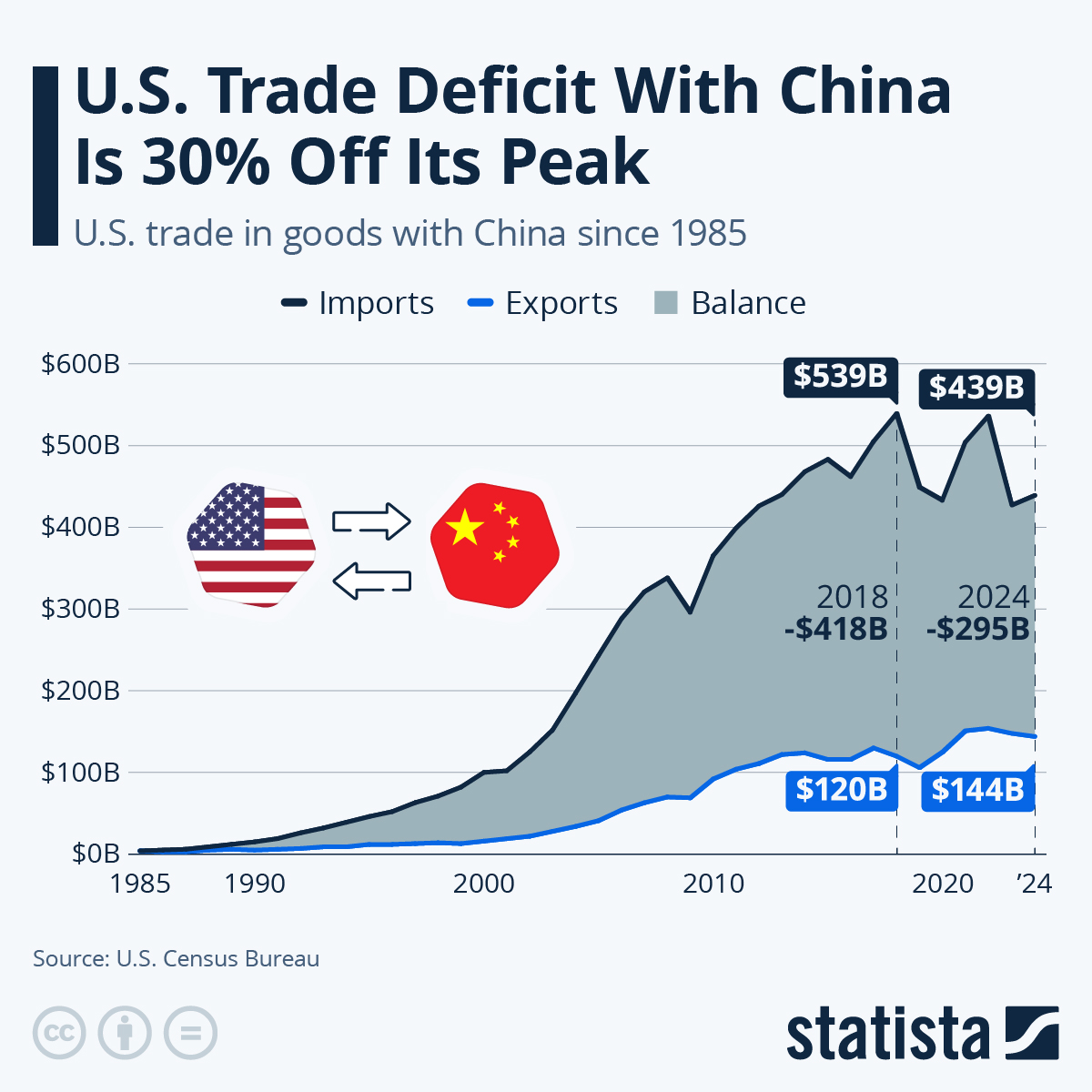
A whopping 75 percent of House Republicans voted in favor of shipping American jobs to China. Democrats, wary of the myriad economic, environmental and labor repercussions of normalizing trade with China, rebuked a “centrist” president and voted against the measure by a two-to-three margin.

A year later, George W. Bush formalized Congress’s vote, granting preferential trade status to China.
Republicans, in short, enabled Beijing’s astounding economic and military rise by swapping millions of good-paying American jobs for cheap Chinese imports. But the GOP’s overwhelming vote in favor of unfettered trade with China came at a staggering cost.
Beginning in the 2000s, the United States witnessed an alarming increase in so-called “deaths of despair.” Driven largely by opioid overdoses, alcohol abuse and suicide, white, blue-collar Americans – Trump’s base – began dying at shocking rates. While an increasing mortality rate is unheard of in first-world countries, several studies have directly linked trade-inflicted manufacturing job losses to the opioid-fueled “deaths of despair” devastating America.

In other words, the GOP’s eagerness to inflate corporate and shareholder profit via cheap, overseas labor has decimated countless American families and communities. But this did not start with Republicans’ vote to normalize trade with China. NAFTA, for example, was negotiated by the first Bush administration, passed Congress with overwhelming GOP support and fulfilled Ronald Reagan’s “vision.”
More broadly, four decades of post-Reagan Republican ideology have gutted America’s middle class. As the United States confronts a historic pandemic, startling images of miles upon miles of cars – each representing an American family – awaiting supplies at overwhelmed food banks expose this dangerous and depressing reality.
- [Trump slams China, WHO for COVID-19 spread at virtual United Nations...
- Trump blasts China on coronavirus in UN speech
Such visceral scenes of poverty – unheard of among the United States’s first-world allies – should be equally unfathomable in a country with America’s immense wealth and capacity for broadly-shared prosperity. Mass food insecurity is not the hallmark of a great nation.
Ultimately, the flaws in China’s early response to this devastating pandemic must be thoroughly investigated. But instead of distracting Americans to protect a failed president, Republicans would be wise to reflect on the immensely damaging long-term repercussions of their ideology and policies. A healthy dose of moral, patriotic soul-searching is long overdue.
Marik von Rennenkampff served as an analyst with the U.S. Department of State’s Bureau of International Security and Nonproliferation, as well as an Obama administration appointee at the U.S. Department of Defense. Follow him on Twitter @MvonRen.
ref
https://www.uschamber.com/press-release/facts-over-fear-win-china-pntr-debate
facts Over Fear Win China PNTR Debate
Tuesday, May 23, 2000
WASHINGTON, D.C. – United States Chamber of Commerce President Thomas Donohue called today's bipartisan House vote granting permanent normal trade relations (PNTR) to China "a victory of fact over fear and a historic win for the American economy and our national security.
"The truth about free trade won today," said Donohue. "PNTR opens China's markets for American products, businesses and farmers, and creates jobs for workers here at home. Once Congress focused on the facts, no amount of union pressure to isolate this country could defeat the fact that this trade deal with China is in America's best interest.
"American business and workers – from the new economy to the old and the small to the large – clearly recognized the significance of this vote," he said. "As co-chair of theBusiness Coalition for U.S. – China Trade, we worked with a broad based group of supporters, from the grassroots to the Congress, to overcome an all-out blitz of misinformation by union leaders and their allies."
This was a bipartisan victory, Donohue concluded, and he commended members of Congress from both sides of the aisle, for many of whom "this was a particularly tough vote, given the tremendous pressure from the opponents of free trade."
The Chamber has actively supported the China trade deal by mobilizing a massive grassroots effort in 66 congressional districts, beginning over a year before the vote. In addition, 20 lobbyists fanned out across Capitol Hill organizing over 400 congressional meetings and more than 30 Chamber field staffers organized numerous events in targeted congressional districts.
"This vote recognizes that the China trade agreement is overwhelmingly in our favor. China's concessions are its price of admission to the WTO," said Donohue. "The choice was clear: embrace and benefit from China as a trading partner, or stick our heads in the sand and hope they go away. Congress made the right choice today."
The U.S. Chamber of Commerce is the world's largest business federation representing more than three million businesses and organizations of every size, sector and region.
nyt no lnx
https://www.nytimes.com/2019/07/20/us/politics/china-red-scare-washington.html
A New Red Scare Is Reshaping Washington
[pix Steve Bannon, former adviser to President Trump, restarted the Committee on the Present Danger to warn against China’s rise. Mr. Bannon, seen here with a traditional bindi during an event hosted by the committee and the National Indian American Public Policy Institute, says the fight with China is “the defining event of our time.”Credit...Alex Garcia for The New York Times
By Ana Swanson
July 20, 2019
WASHINGTON — In a ballroom across from the Capitol building, an unlikely group of military hawks, populist crusaders, Chinese Muslim freedom fighters and followers of the Falun Gong has been meeting to warn anyone who will listen that China poses an existential threat to the United States that will not end until the Communist Party is overthrown.
If the warnings sound straight out of the Cold War, they are. The Committee on the Present Danger, a long-defunct group that campaigned against the dangers of the Soviet Union in the 1970s and 1980s, has recently been revived with the help of Stephen K. Bannon, the president’s former chief strategist, to warn against the dangers of China.
Once dismissed as xenophobes and fringe elements, the group’s members are finding their views increasingly embraced in President Trump’s Washington, where skepticism and mistrust of China have taken hold. Fear of China has spread across the government, from the White House to Congress to federal agencies, where Beijing’s rise is unquestioningly viewed as an economic and national security threat and the defining challenge of the 21st century.
“These are two systems that are incompatible,” Mr. Bannon said of the United States and China. “One side is going to win, and one side is going to lose.”
The United States and China have been locked in difficult trade negotiations for the past two years, with talks plagued by a series of missteps and misunderstandings. Mr. Trump has responded to the lack of progress by steadily ratcheting up American tariffs on Chinese goods and finding other ways to retaliate. China has responded in kind.
The two sides now appear far from any agreement that would resolve the administration’s concerns about China, including forcing American companies operating there to hand over valuable technology. Even if a deal is reached, the two sides are busy constructing broader economic barriers.
In addition to placing a 25 percent tariff on roughly half of the goods China exports, the United States has restricted the kinds of technologies that can be exported to China, tried to cut off some Chinese companies, like telecom giant Huawei, from purchasing American products and rolled out hurdles for Chinese investment in the United States.
American intelligence agencies have also ratcheted up efforts to combat Chinese espionage, particularly at universities and research institutions. Officials from the F.B.I. and the National Security Council have been dispatched to Ivy League universities to warn administrators to be vigilant against Chinese students who may be gathering technological secrets from their laboratories to pass to Beijing.
The administration paints the crackdown as necessary to protect the United States. But there are growing concerns that it is stoking a new red scare, fueling discrimination against students, scientists and companies with ties to China and risking the collapse of a fraught but deeply enmeshed trade relationship between the world’s two largest economies.
“I’m worried that some people are going to say, because of this fear, any policy is justifiable,” said Scott Kennedy, a China expert at the Center for Strategic and International Studies. “The climate of fear that is being created needs to help generate the conversation, not end the conversation.”
[Image Concern over China’s ambitions as an economic and military power has spread across Washington, fueling what some say could be a new Red Scare.
Anti-China sentiment has spread quickly, with Republicans and Democrats, labor union leaders, Fox News hosts and others warning that China’s efforts to build up its military and advanced industries threaten America’s global leadership, and that the United States should respond aggressively. Skepticism has seeped into nearly every aspect of China’s interaction with the United States, with officials questioning China’s presence on American stock markets, its construction of American subway cars and its purchase of social media networks.
Yet there is little agreement on what America can or should do. The United States has tried for decades to entice and cajole China to become a more open society, but the Communist Party has steadily tightened its grip over the Chinese people and the economy. American leaders now face a choice of whether to continue down a path of engagement that could leave the country vulnerable to economic and security threats — or embark on a path of disengagement that could weaken both economies and might one day even lead to war.
An increasing number of people in Washington now view the decoupling of the two economies as inevitable — including many of the members of the Committee on the Present Danger. At an inaugural meeting in April, Mr. Bannon, Senator Ted Cruz of Texas, Newt Gingrich, the former House speaker, and others issued paeans to Ronald Reagan — a former member of the group — and were met with standing ovations as they called for vigilance against China.
They praised Mr. Reagan’s Cold War victory over the Soviet Union and his doctrine of “peace through strength,” but there was also an air of inevitability that war might come, only this time with China.
Mr. Bannon was just off the plane from Rome, with a slight shadow of a mustache and his silver hair brushed back. Clad in a black button-down and long black suit jacket, he thumped the podium as he described China as a rising power and the United States as a declining power that would inevitably clash.
“This is the defining event of our time, and 100 years from now, this is what they’re going to remember us for,” he said.
The committee’s two earliest iterations, in the 1950s and again in the 1970s, called for an arms buildup to counter the Soviets. The second iteration, formed over a luncheon table at Washington’s Metropolitan Club in 1976, issued documents warning against Soviet expansionism, with titles like “Is America Becoming Number 2?”
The group reached the height of its influence during the Reagan administration, in which dozens of its members eventually held posts, including as the national security adviser and C.I.A. director. But as the Soviet threat faded, so did the committee.
The group was briefly active again starting in 2004, this time to warn against the threat of Islamic extremism. The committee’s vice chair, Frank Gaffney, is the founder of the Center for Security Policy, a think tank that argues that mosques and Muslims across America are engaged in a “stealth jihad” to “Islamize” the country by taking advantage of American pluralism and democracy.
The group’s activity largely died down until concern over China rekindled interest.
Today’s committee acknowledges that the threat from China is different from Soviet Russia because the American and Chinese economies are much more integrated. But Washington is increasingly reaching back into the Cold War toolbox to confront the threat.
The administration has placed Chinese tech companies on an “entity list,” essentially blacklisting them from doing business with American firms. In keeping with a law passed last year, the administration has increased its checks of Chinese investment, including of minority stakes in American companies. Last June, the administration began restricting visas for Chinese graduate students in sensitive research fields like robotics and aviation. And the United States has begun barring Chinese academics from the United States if they are suspected of having links to Chinese intelligence agencies.
“They’re not the Soviet Union. But this kind of government control, statism, never works for long,” Larry Kudlow, the White House chief economic adviser, said in a July 16 interview with Sinclair Broadcast Group. The possibility that China could collapse like the Soviet Union has “always been an undercurrent” in the trade war, he said.
The new Cold War has not been one-sided. Many of the changes in Washington have been triggered by a darker turn in Beijing.
China has increased its scrutiny of American firms, and many American companies and their employees in China now fear reprisal. In addition to detaining millions of Chinese Muslims, democracy activists and others, Chinese authorities have jailed foreign diplomats, academics and businesspeople — prompting some to cancel or delay trips to China.
China is also projecting its power abroad, funding global infrastructure and constructing an archipelago of artificial islands with giant air bases reaching almost to the shores of Malaysia and Indonesia.Beijing has made it clear that it intends to help its companies dominate the industries of the future, from artificial intelligence and supercomputers to aerospace equipment. Its policies have sought to replace imports of high-tech products with Chinese-made goods, pressuring multinationals to move factories from the United States and resulting in the loss of American jobs.
China has rejected entreaties by the Trump administration to curb these activities, arguing that it is simply pursuing its own economic development. In an interview after trade talks broke down in May, Liu He, China’s top negotiator, said that areas of disagreement between the United States and China focused on “major matters of principle” on which China was unlikely to bend.
The chill in relations has begun to weigh on Chinese investment in the United States, along with Chinese students and tourism. Chinese investment in American residential and commercial real estate has begun to decline. Companies are increasingly diversifying away from China, wary of the president’s ongoing economic war.
[Image The United States and China have been engaged in a protracted trade war, with Washington accusing Beijing of breaking a deal earlier this year.
Nintendo, GoPro, Hasbro and other companies are reconsidering factories in China, choosing to source products from Vietnam, the United States, Mexico and India instead.
Susan Shirk, the chair of the 21st Century China Center at the University of California at San Diego, said the United States is at risk of being gripped by “an anti-Chinese version of the Red Scare” that is driving Chinese talent away and could rupture what little good will is left between the two countries.
“We’ve made this mistake once before, during the Cold War,” Ms. Shirk said. “And I don’t think we should make it again.”
Chinese nationals and Americans of Chinese heritage say they have felt the chilling effects. Some suspect they are being passed over for promotions and grants. Supporters of engagement have been dismissed as apologists or even traitors.
“Chinese Americans feel targeted,” said Charlie Woo, chief executive of Megatoys and a member of the Committee of 100, an organization of prominent Chinese-Americans. “And that’s really hurtful.”
The Trump administration and the Committee on the Present Danger have been careful to say their targets are the Chinese government and the Communist Party, not the Chinese people. But the distinction can be a difficult one to make. In the rush to protect against new threats from China, the line between preparedness and paranoia is sometimes unclear.
At a Senate hearing last year, Christopher A. Wray, the F.B.I. director, said the Trump administration was trying to “view the China threat as not just a whole-of-government threat, but a whole-of-society threat,” adding, “I think it’s going to take a whole-of-society response by us.”
Many Chinese people and their defenders have bristled at the implication that the entire Chinese society poses a national security threat.
Toby Smith, vice president for policy at the Association for American Universities, said that American universities were working hard to remain vigilant to espionage threats, but that they thrive on openness and access to talent and science from around the world — including from China.
“The situation with China is different than the Cold War,” he said. “The concern with the Soviet Union was primarily military. Now it’s a concern about economic competitiveness.”
==
https://www.thenation.com/article/archive/steve-bannon-foreign-policy-crusade-china/
no lnx
The Nation
Steve Bannon’s Foreign Policy Crusade Against China
Bannon joins forces with neocons and re-forms the Committee on the Present Danger to focus on China.
By James Carden AUGUST 5, 2019
[Steve Bannon leaves a House Intelligence Committee meeting on Capitol Hill, January 16, 2018. (AP Photo / Jacquelyn Martin)
On July 21, The New York Times, having demonized Russia as America’s top enemy since at least 2012—if not longer—showed something of a change of heart, and informed readers that “given its economic, military and technological trajectory, together with its authoritarian model, China, not Russia, represents by far the greater challenge to American objectives over the long term. That means President Trump is correct to try to establish a sounder relationship with Russia and peel it away from China.”
That analysis might well have come from the pen of Steven K. Bannon, who, in a surprise twist, recently teamed up with arch-neocon and noted Islamophobe Frank Gaffney to re-form the Cold War–era Committee on the Present Danger (CPD) in order to “educate and inform American citizens and policymakers about the existential threats presented from the Peoples Republic of China under the misrule of the Chinese Communist Party.”
This is the fourth go-around for the CPD, which rears its head every couple of decades in order to inflame, inflate, and then capitalize on the latest hysteria gripping Washington.
First founded in 1950 at the dawn of the McCarthy era, the CPD emerged just as the Truman administration adopted, via National Security Council directive 68, a militarized version of George Kennan’s containment policy. A little over a quarter-century later, in 1976, just as the budding neoconservative movement was turning its attention away from the hippies and “long-hairs” they viewed as defiling university campuses, CPD reformed and took US-Soviet policy as its focus. With the backing of cold warriors like Senator Henry “Scoop” Jackson, the committee agitated for the Carter administration to take a tougher line against the Soviets. As it happens, the CPD found a receptive audience in Carter’s national security adviser, Zbigniew Brzezinski, whose hawkish anti-Soviet policies anticipated those of the succeeding administration—so much so, that President Reagan considered asking Brzezinski to stay on as national security adviser.
Reagan’s victory in 1980 was the high-water mark of the CPD’s influence. By one account, nearly a sixth of its members, including George Shultz, Paul Nitze (author of the aforementioned NSC-68), and William Casey, took up positions within the new administration.
With the collapse of the USSR came the collapse of the Cold War–era CPD. But it didn’t take long for an new enemy, and hence, a new committee to emerge. In 2004, under the leadership of Gaffney, CPD reformed, this time in order to cheerlead the so-called Global War on Terror. Yet, when things went somewhat less than optimally in Iraq and elsewhere, the CPD slinked away—that is, until this past March when, under the aegis of Bannon and Gaffney, it was reestablished in order to take on China.
Dr. Lyle Goldstein, research professor at the China Maritime Studies Institute at the US Naval War College, says, “The CPD will certainly not be alone among Washington think tanks in taking up extreme causes with a highly selective approach to deploying information. Still, the impact could be extremely deleterious for US-China relations.”
“If Americans are serious about a genuine debate on China, they should actually welcome more analysis from scholars and diplomats with actual knowledge of China,” says Goldstein.
Chas Freeman, senior fellow at the Watson Institute at Brown University, who served as deputy ambassador to China and, later, assistant secretary of defense for international affairs under President Clinton, describes the Bannon-Gaffney committee as “a who’s who of contemporary wing-nuts, very few of whom have any expertise at all about China and most of whom represent ideological causes only peripherally connected to it. Almost none speak or read Chinese. There are a few exceptions, almost all of them vocal advocates of greatly enhanced relations with Taiwan.”
A look through the committee’s membership would seem to bear Freeman out. In addition to Bannon and Gaffney, the committee’s members include neocon hard-liners such as retired Lt. Gen. Jerry Boykin, William Bennett, James Woolsey, and Frank Wolf.
AN EXISTENTIAL THREAT?
Not surprisingly, given its personnel, the CPD paints the most alarming picture possible of China’s goals and motives. According to the committee’s “guiding principles,” in the face of the threat posed by a resurgent China, America “must mobilize all instruments of national power to protect its people, territory, human freedom, vital interests and allies from the Chinese Communist Party.”
“There is,” they say, “no hope of coexistence with China as long as the Communist Party governs the country.”
What’s more, a strong stench of xenophobia runs through the CPD’s bill of indictment. The committee believes the Chinese Communist Party has been successful in “undermining and subverting Western democracies from within” through its “control, domination and exploitation of Chinese diaspora communities, including overseas students, professors and researchers.”
If the CPD took as its focus the economic challenge China poses to the United States, it might have been easier to take it a bit more seriously. After all, as Sherle R. Schwenninger, director of the World Economic Roundtable, tells me, “Chinese corporations are now becoming peer competitors with American corporates and the US will soon face even greater competitive pressures as a result of China’s 2025 program aimed at building national champions in more advanced sectors of the economy.” But the committee, says Schwenninger, seems to be taking “legitimate concerns over Chinese economic practices and instead is intent on blowing them up into a call for a new cold—potentially hot—war by demonizing China.”
Nevertheless, the committee’s message will likely fall on fertile ground in Trump’s Washington. In addition to the trade war, the Pentagon’s national defense strategy has elevated China and Russia as the country’s principal national security threats, downgrading terrorism. Meanwhile, federal law enforcement agencies have been busy targeting Chinese college students, research scientists, and businessmen. FBI Director Christopher A. Wray has even espoused the view that “the China threat as not just a whole-of-government threat, but a whole-of-society threat” that will require “a whole-of-society response by us.”
But not everyone is buying into the hysteria. “The debate on China in this country is nonsensical,” says Freeman. “We are repeatedly told that China is an enemy because it is an autocracy. But the truth is the Chinese don’t care how foreigners govern themselves—they are opposed to democracy at home; they are not opposed to democracy abroad.”
According to Freeman, “The assault on China rests upon the assumption that everyone else has to be governed in the same way we are.” As Goldstein puts it, “China has not used force on a large scale (a ‘war’) in four decades and thus has shown remarkable restraint for a great power. Its defense spending is significantly lower than that of the US; it has one single base overseas, and no real alliances.”
The Manichaean impulse to split the world into white hats and back hats, an impulse the CPD has embodied on and off for 70 years, leads not to peace and prosperity but to runway defense budgets, nuclear and conventional arms races, proxy wars, and the erosion of civil liberties at home.
James W. Carden is a contributing writer for foreign affairs at The Nation. He served as a policy adviser to the Special Representative for Intergovernmental Affairs and the Office of Russia Affairs at the US State Department.
==
8/20
predictable mo-fo, see https://www.ipcc.ch/srocc/chapter/chapter-2/
2019
In summary, there is very high confidence that glacier and snow cover decline have affected and will continue to change the amounts and seasonality of river runoff in many snow-dominated and/or glacier-fed river basins. The average winter runoff is expected to increase (high confidence), and spring peak maxima will occur earlier (very high confidence). Although observed and projected trends in annual runoff vary substantially among regions and can even be opposite in sign, there is high confidence that average annual runoff from glaciers will have reached a peak, with declining runoff thereafter, at the latest by the end of the 21st century in all regions regardless emission scenario. The projected changes in runoff are expected to affect downstream water management, related hazards and ecosystems (Section 2.3.2, 2.3.3).
https://climate.nasa.gov/news/3008/stunning-forecast-a-century-of-ice-loss-for-nearly-100000-glaciers/
Pat Brennan,
NASA's Jet Propulsion Laboratory
The ice in one of the world’s highest concentrations of non-polar glaciers could see significant melting before the end of the century, potentially affecting sea levels around the globe, according to a new computer model from the NASA Sea Level Science Team.
The region, known as High Mountain Asia, could see ice loss run from 29 to 67 percent, depending on the level of greenhouse gas emissions over the period modeled.
According to the study, water flow in monsoon-fed river basins, driven largely by melting glaciers, could hit its peak by 2050 – potentially reducing runoff beyond that time and forcing changes in how water is consumed, or forcing communities to find other water sources. Understanding the coming changes in such flows is critical to proper planning for hydropower, irrigation, and water supplies.
A Leap Forward in Glacier Modeling
The new “Python Glacier Evolution Model,” or PyGEM, uses extensive data sets, instead of less detailed estimates from isolated, regional effects or extrapolations based on a small number of glaciers.
“This is a huge advance compared to previous studies,” said David Rounce, a researcher at the University of Alaska, Fairbanks, and a member of the NASA Sea Level Science Team, who is lead author of the new modeling study. “We are able to assess changes in glacier mass and runoff at an unprecedented scale.”
By sheer number, High Mountain Asia accounts for 44 percent of all the glaciers in the world—apart from the Greenland and Antarctic ice sheets—though it accounts for only a fraction of glacial mass. The melting of these glaciers over decades contributes significantly to rapid, and accelerating, global sea-level rise.
As they grow in power and precision, computer models are revealing the intricate dance of climate, ice-melt, and sea-level rise with increasing clarity....[map]
==
wtf? someone alluded to Chines active measures could rival ussr? i thot trade war was over; they PO'd on kung flu and Honk Kong?
https://www.alternet.org/2020/07/houstons-chinese-consulate-abruptly-ordered-to-close-by-trump-administration/
Anna Fifield, The Washington Post
“Houston’s Chinese Consulate abruptly ordered to close by Trump administration” was first published by The Texas Tribune, a nonprofit, nonpartisan media organization that informs Texans — and engages with them — about public policy, politics, government and statewide issues.
CHANGSHA, China — The United States has ordered China to close its consulate in Houston by Friday, an abrupt move that opens up a new front in a battle for supremacy between the world’s two biggest economies.
Beijing immediately vowed to retaliate for the “unprecedented escalation,” leading to speculation it could order the closure of the U.S. Consulate in Wuhan, which has been shuttered since the coronavirus epidemic spread across the city in January.
The confrontation in the diplomatic sphere widens a conflict that already incorporated trade and technology, freedom of the press and religion, students and scientists, as well as the novel coronavirus and the race for a vaccine.
Analysts on both sides say that bilateral relations are at their worst since before 1979, when the United States formally recognized the People’s Republic of China.
“At this rate, I wouldn’t even be surprised if Trump decides to sever diplomatic relations with China someday,” said Chu Shulong, a professor in American politics and diplomacy at Tsinghua University, suggesting that this was part of President Trump’s reelection strategy.
“Trump has no limits, no principles and no morals, and that’s why he can stoop so low and yet few bother to raise an eyebrow,” Chu said.
The Trump administration decided to order the closure of China’s Consulate in Houston, which was opened in 1979 and is situated in an area with a large Chinese community, “in order to protect American intellectual property and Americans’ private information,” State Department spokeswoman Morgan Ortagus said Wednesday.
“The United States will not tolerate the PRC’s violations of our sovereignty and intimidation of our people, just as we have not tolerated the PRC’s unfair trade practices, theft of American jobs and other egregious behavior,” she said, using the abbreviation for China’s official name, the People’s Republic of China.
The State Department did not elaborate on the alleged infractions, but Ortagus suggested that China had violated the Vienna Convention, which governs diplomatic relations between states. Under the convention, diplomats must “respect the laws and regulations of the receiving State” and “have a duty not to interfere in the internal affairs of that State.”
In Copenhagen, Secretary of State Mike Pompeo, when asked by a journalist about the order to close the Houston consulate, cited the reporter’s question that noted the United States had “long complained” about alleged Chinese intellectual property theft.
“Your point that this has been going on for a long time makes our point,” Pompeo told the journalist. “President Trump has said ‘enough.’ We’re not going to allow this.”
The first sign of the American order came when Houston NBC affiliate KPRC2aired video showing people in the courtyard of the consulate apparently burning documents after 8 p.m. local time on Tuesday.
Police and fire officials went to the scene in response to calls from neighbors but, in accordance with diplomatic rules, did not enter the building, the television station reported.
Witnesses in nearby apartment buildings told police that people were burning paper in what appeared to be trash cans, a police official told the Houston Chronicle. The consulate staff had been told they would be evicted from the building at 4 p.m. Friday, the paper quoted the unnamed official as saying.
In Beijing, the Foreign Ministry responded angrily to the order. The U.S. government “abruptly informed” China on Tuesday that it had to immediately close its consulate in Houston, Wang Wenbin, a Foreign Ministry spokesman, told reporters Wednesday.
“The U.S. has far more diplomatic missions and staff working in China. So if the U.S. is bent on going down this wrong path, we will resolutely respond,” Wang said.
Analysts expect the Chinese government to respond by ordering one of them closed. Beijing was particularly incensed that the United States evacuated its consulate in Wuhan in January, as the virus began spreading rapidly across the city.
It has still not reopened, and the embassy and other consulates are operating with skeleton staffs, according to American officials.
Hu Xijin, the firebrand editor of the Communist Party-affiliated Global Times newspaper who often shares information on Twitter that has not been officially announced, revealed the 72-hour time frame
“This is a crazy move,” he wrote.
The Global Times started polls on Twitter and its Chinese equivalent, Weibo, asking: “Which US consulate general in China is most likely to be closed?” It gave four options: “Hong Kong and Macao, Guangzhou, Chengdu or other.”
The order came amid American attacks on China’s political system, its harassment of Chinese diplomats and its intimidation of Chinese students, Wang said.
He said the consulate had been getting prank phone calls and even received a bomb threat on Monday. He added that U.S. authorities have opened China’s diplomatic pouches and searched Chinese diplomats’ property.
The United States and China have been locked in a tit-for-tat battle for supremacy that began at the start of the Trump administration, centered on trade and technology. Both sides have expelled journalists this year and have been slapping sanctions on each other’s officials.
But the hostilities have become much more serious with Trump’s efforts to blame the Chinese government for the coronavirus that emerged from Wuhan at the end of last year and retaliatory actions over journalists in the two countries.
U.S. officials on Tuesday accused China of sponsoring criminal hackers, including two former engineering students, who were targeting biotech firms around the world working on coronavirus vaccines and treatments.
The Foreign Ministry on Wednesday renewed its travel warning for Chinese students in the United States, advising them to be aware of arbitrary interrogations, the confiscation of personal belongings and possible detentions.
Wang Yong, a professor of international studies at Peking University, said certain people in Washington seem hellbent on promoting a cold war between China and the United States and the complete decoupling of the two countries, not just in the economic arena but across the board.
“I think they have political considerations, mainly around the election,” Wang said. “They are taking such a tough approach, demonizing and turning hostile to China, making China an enemy, to mobilize people domestically and reverse the unfavorable situation of President Trump in the election.”
This would lead to international instability, he said. “In the end, it will harm U.S. interests and harm China. It won’t benefit the United States.”
Chu, the Tsinghua professor, agreed that there was potential for further tension.
“China could always evict a U.S. Consulate in retaliation, and that could go on and on,” he said. “If the eviction stays a largely technical move, then the two governments should be able to reach a compromise in the next few months; but if it turns out to be strategic, then this risks escalating into Cold War 2.0.”
Many analysts in China view Trump’s campaign against the country as part of an effort to boost his chances of winning second term.
“China is an easy target, and a ‘big bad guy’ that Trump is all too eager to open fire on in order to win conservatives over in his reelection campaign,” Chu said.
This article originally appeared in The Texas Tribune at https://www.texastribune.org/2020/07/22/houston-chinese-consulate-close-donald-trump/.
==
https://yyy.theguardian.com/environment/2020/jul/07/hold-on-brother-final-days-of-doomed-crew-on-chinese-shark-finning-boat
lied to about job, salary skimmed, passport taken
720 ew
https://www.ecowatch.com/china-swine-flu-2020-2646296386.html
https://www.ecowatch.com/china-swine-flu-2020-2646296386.html
Scientists in China have identified a strain of H1N1 that is rapidly spreading amongst workers in the country's pig farms. They warn that the fast spreading strain of swine flu has pandemic potential, if it is not contained quickly, according to The New York Times.
An outbreak of H1N1 caused widespread fear in 2009 when it killed 285,000 people around the world. The new strain is a derivative of H1N1, according to the scientists who published a paper on it on Monday in the scientific journal Proceedings of the National Academy of Sciences (PNAS).
The disease, which researchers called the G4 virus, now shows "all the essential hallmarks of a candidate pandemic virus," said the study, as CNN reported.
The researchers say that the disease is not yet an immediate problem, but they noted that pig farm workers also showed elevated levels of the virus in their blood, and that "close monitoring in human populations, especially the workers in the swine industry, should be urgently implemented," as Reuters reported.
Angela Rasmussen, a virologist at Columbia University's public health school, urged the public to remain calm and not "freak out," according to CNN.
"Our understanding of what is a potential pandemic influenza strain is limited," she posted on Twitter. "Sure, this virus meets a lot of the basic criteria but it's not for sure going to cause a hypothetical 2020 flu pandemic, or even be a dominant strain in humans."
Chinese researchers based at several institutions, including Shandong Agricultural University and the Chinese National Influenza Center, discovered the G4 virus during a pig surveillance program, according to CNN. Over a seven-year span, from 2011 to 2018, the researchers took more than 30,000 nasal swab samples from pigs in slaughterhouses and veterinary teaching hospitals across 10 Chinese provinces.
Those samples revealed 179 swine influenza viruses, but only a fraction of them posed any concern to the researchers, as several only showed up in a single year while others declined to non-threatening levels.
The strain in question though, G4 EA H1N1, has been common on China's pig farms since 2016 and replicates efficiently in human airways, according to the study. So far, it has infected some people without causing disease, but health experts worry that means the virus is lurking and mutating into something different and a sudden change can happen without warning, according to The New York Times.
Recent evidence "indicates that G4 EA H1N1 virus is a growing problem in pig farms, and the widespread circulation of G4 viruses in pigs inevitably increases their exposure to humans," the study said.
In the last three years of the study, researchers collected blood samples from workers on various pig farms and from people in nearby households. The study found that 10.4 percent of the workers and 4.4 percent of the others tested positive for G4 EA H1N1, and that 20.5 percent of workers between the ages of 18 and 35 tested positive for the virus, as The New York Times reported.
"It may be that with further change in the virus it could become more aggressive in people much as SARS-CoV-2 has done," said Ian H. Brown, the head of the virology department at Britain's Animal and Plant Health Agency and one of two scientists who reviewed the paper before it was published, in an email to The New York Times.
The good news is that there is no evidence yet that G4 could spread from person to person, the most promising sign so far, according to Carl Bergstrom, a professor of biology at the University of Washington who spoke to CNN.
"This is not a *new* new virus; it's been very common in pigs since 2016," he wrote on Twitter. "There's no evidence that G4 is circulating in humans, despite five years of extensive exposure. That's the key context to keep in mind."
Chinese Foreign Ministry spokesman Zhao Lijian told a daily news conference on Tuesday that China was closely following developments. "We will take all necessary measures to prevent the spread and outbreak of any virus," he said, as Reuters reported.
Whether or not the virus does spread in humans remains to be seen, but it is a reminder that our animal farming practices increase our susceptibility to animal diseases.
"Pig farming is a massive industry in China and pigs can be important hosts from which novel influenza viruses may emerge," said James Wood, head of veterinary medicine at the University of Cambridge, to CNN. He added that the study was a "salutary reminder that we are constantly at risk of new emergence of zoonotic pathogens and that farmed animals, with which humans have greater contact than with wildlife, may act as the source for important pandemic viruses."
- If Factory Farm Conditions Are Unhealthy for Animals, They're Bad ... ›
- Coronavirus Pandemic Linked to Destruction of Wildlife and World's ... ›
- Jane Goodall: COVID-19 Is Result of Our Unhealthy Relationship ... ›
- The meat we get from factory farms is a pandemic risk, too - Vox ›
- Special Report: Before coronavirus, China bungled swine epidemic ... ›
- Swine fever: 'Double punch' for countries facing COVID-19 threat ... ›
viruses public health pigs china science factory farming
POW
facial recognition
omfg // covid app tracking?!
https://en.wikipedia.org/wiki/Social_Credit_System
Social Credit System (Chinese: 社会信用体系; pinyin: shèhuì xìnyòng tǐxì) is a national reputation system being developed by the Chinese government.[1][2][3] The program initiated regional trials in 2009, before launching a national pilot with eight credit scoring firms in 2014.[4][5] In 2018, these efforts were centralized under the People's Bank of China with participation from the eight firms.[4] By 2020,[needs update] it is intended to standardize the assessment of citizens' and businesses' economic and social reputation, or 'Social Credit'.[1][6][7][8][9][10]
The social credit initiative calls for the establishments of unified record system for individuals, businesses and the government to be tracked and evaluated for trustworthiness.[11][12][13][14] Initial reports suggest the system utilizes numerical score as the reward and punishment mechanism;[15][14] recently conducted reports suggest there are in fact multiple different forms of social credit system experimenting at the same time.[16][17] Numerical system has been implemented only in several regional pilot programs, while the nationwide regulatory method has been based primarily on blacklisting and whitelisting.[5][16][18] The credit system is closely related to China's mass surveillance systems such as the Skynet[19][20][21], which incorporates facial recognition system, big data analysis technology and AI.[22][23][15][24][25]
By 2018, some restrictions had been placed on citizens which state-owned media described as the first step toward creating a nationwide social credit system.[26][27][28][9][29][30] As of November 2019, in addition to dishonest and fraudulent financial behavior, other behavior that some cities have officially listed as negative factors of credit ratings includes playing loud music or eating in rapid transits,[31] violating traffic rules such as jaywalking and red-light violations,[32][33] making reservations at restaurants or hotels but not showing up,[34] failing to correctly sort personal waste,[35][36][37] fraudulently using other people's public transportation ID cards,[38] etc; on the other hand, behavior listed as positive factors of credit ratings includes donating blood, donating to charity, volunteering for community services, and so on.[39][40][41]
As of June 2019, according to the National Development and Reform Commission of China, 26.82 million air tickets as well as 5.96 million high-speed rail tickets have been denied to people who were deemed "untrustworthy (失信)" (on a blacklist), and 4.37 million "untrustworthy" people have chosen to fulfill their duties required by the law.[42][43] In general, it takes 2–5 years to be removed from the blacklist, but early removal is also possible if the blacklisted person has done enough remedies.[44][45] Certain personal information of the blacklisted people is deliberately made accessible to the society and is displayed online as well as at various public venues such as movie theaters and buses,[45][46][47][48] while some cities have also banned children of "untrustworthy" residents from attending private schools and even universities.[49][50][51][52][53] On the other hand, people with high credit ratings may receive rewards such as less waiting time at hospitals and governmental agencies, discounts at hotels, greater likelihood of receiving employment offers and so on.[38][39][40][54]
Supporters of the Credit System claim that the system helps to regulate social behavior, improve the "trustworthiness" which includes paying taxes and bills on time and promote traditional moral values,[55][56][57] while critics of the system claim that it oversteps the rule of law and infringes the legal rights of residents and organizations, especially the right to reputation, the right to privacy as well as personal dignity, and that the system may be a tool for comprehensive government surveillance and for suppression of dissent from the Communist Party of China.[58][59][60][61]
...The Social Credit System is an example of China's "top-level design" (顶层设计) approach. It is coordinated by the Central Leading Group for Comprehensively Deepening Reforms.[10] It is unclear whether the system will work as envisioned by 2020, but the Chinese government has fast-tracked the implementation of the system, resulting in the publication of numerous policy documents and plans since the main plan was issued in 2013. If the Social Credit System is implemented as envisioned, it will constitute a new way of controlling both the behavior of individuals and of businesses.[10]
Testing
In 2015, the People's Bank of China licensed eight companies to begin a trial of social credit systems.[5][64] Among these eight firms is Sesame Credit (owned by Alibaba Group and operated by Ant Financial), Tencent, as well as China's biggest ride-sharing and online-dating service, Didi Chuxing and Baihe.com, respectively.[65][5] In general, multiple firms are collaborating with the government to develop the system of software and algorithms used to calculate credit.[65][66]
The Chinese central government originally considered that the Social Credit System be run by a private firm, but by 2017 it has acknowledged the need for third-party administration. In 2017, no licenses to private companies were granted.[5] By mid-2017, the Chinese government had decided that none of the pilots would receive authorization to be official credit reporting measures.[67] The reasons include conflict of interest, the remaining control of the government, as well as the lack of cooperation in data sharing among the firms that participate in the development.[17] However, the Social Credit System's operation by a seemingly external association, such as a formal collaboration between private firms, has not been ruled out yet.[5] In November 2017, Sesame Credit denied that Sesame Credit data is shared with the Chinese government.[68] As of mid 2018, only pilot schemes have been tested.[26][27][28][9][29][30]
Private companies have also signed contracts with provincial governments to set up the basic infrastructure for the Social Credit System at a provincial level.[69] As of March 2017, 137 commercial credit reporting companies are active on the Chinese market.[10] As part of the development of the Social Credit System, the Chinese government has been monitoring the progress of third-party Chinese credit rating systems.[6]
Social credit systems
There are multiple social credit systems in China right now. Scholars have conceptualized four different types of systems, including judicial system (discredited blacklist system), municipal social credit system, People's Bank of China financial credit system, and commercial credit-rating system.[17] These four systems are not interconnected seamlessly, but relevantly independent from each other with their own jurisdictions, rules, and logic.
Judicial system
In 2013, the Supreme People's Court (SPC) of China started a blacklist of debtors with roughly 32,000 names. The list has since been described as a first step towards a national Social Credit System by state-owned media.[70][71] The SPC also began working with private companies – for example, Sesame Credit began deducting credit points from people who defaulted on court fines.[70]
In March 2018, Reuters reported that restrictions on citizens and businesses with low Social Credit ratings, and thus low trustworthiness, would come into effect on May 1.[72][73] By May 2018, several million flight and high-speed train trips had been denied to people who had been blacklisted.[27]
Financial system
There are also commercial pilots developed by private Chinese conglomerates that have the authorization from the state to test out social credit experiments. The pilots are more widespread than their local government counterparts, but function on a voluntary basis: Citizens can decide to opt-out of these systems at any time on request. Users with good scores are offered advantages such as easier access to credit loans, discounts for car and bike sharing services, fast-tracked visa application, or free health check-ups and preferential treatment at hospitals.[61] The algorithms used to assign scores in commercial pilots remain unknown, although sources say some pilots use a big-data analysis and artificial intelligence approach.[66]
In 2017, People's Bank of China issued a jointly owned license to “Baihang Credit” valid for three years.[74] Baihang Credit is co-owned by the National Internet Finance Association (36%) and the eight other companies (8% each), allowing the state to maintain control and oversee the creation of a new commercial pilot.[75]
In April 2019, the People's Bank of China announced that a new version of the Personal Credit Report would be put out which allows the ability to collect more personal information. State-run media has described it as "more detailed, more comprehensive and more precisely.”[76]
Local government
In December 2017 the National Development and Reform Commission and People's Bank of China selected “model cities” that demonstrated the steps needed to make a functional and efficient implementation of the Social Credit System. Among them are Hangzhou, Nanjing, Xiamen, Chengdu, Suzhou, Suqian, Huizhou, Wenzhou, Weihai, Weifang, Yiwu, and Rongcheng.[77][78] These pilots were deemed successful in their handling of “blacklists and ‘redlists’”, their creation of “credit sharing platforms”, and their “data sharing efforts with the other cities”. The local government Social Credit System experiments are focused more on the construction of transparent rule-based systems, in contrast with the more advanced rating systems used in the commercial pilots: Citizens often begin with an initial score, to which points are added or deducted depending on their actions. The specific number of points for each action are often listed in publicly available catalogs. Cities also experimented with a multi-level system, in which districts decide on scorekeepers who are responsible for reporting scores to higher-ups. Some experiments also allowed citizens to appeal the scores they were attributed.[79] The government alleges these systems mean to penalize citizens generally agreed as ‘untrustworthy’. They claim they will be able to “change people’s behavior by ensuring they are closely associated with it.”
As of 2018, over forty different Social Credit System experiments were implemented by local governments in different Chinese provinces.[80] The pilot programs began following the release of the 2014 “Planning Outline for the Construction of a Social Credit System” by Chinese authorities. The government oversees the creation and development of these governmental pilots by requesting they each publish a regular “interdepartmental agreement on joint enforcement of rewards and punishments for ‘trustworthy’ and ‘untrustworthy’ conduct.”[81] In April 2018, journalist Simina Mistreanu described a community where people's social credit scores were posted near the village center.[63] As of mid-2018, it was unclear whether the system will be an 'ecosystem' of various scores and blacklists run by both government agencies and private companies, or if it will be one unified system. It is also unclear whether there will be a single system-wide social credit score for each citizen and business.[28][9][29][30][27]
...
==
420 an
tom Cotton: Ban Chinese students from learning science so they can’t ‘steal’ coronavirus vaccine
Sen. Tom Cotton (R-AR) on Sunday argued that the United States should ban Chinese students from learning about science while they are in the United States.
==
==
aha: djt schizo on china (or just trimming spasmotically given situation of minute 9eg public opinion or fox trump whisperers); all RW docs need enemy, so china chetaed currency mmanip his recycled 70 BS (to explain away their econ rise vs us loss mfg vs truth we subsidized offshore, and global cap'l 1% race to the bottom; his big claim he is master negit and will force better deal on china, hance trade war'tariff (force, transactional]; covid disaster force villify, but that's hard wired xeno; note 40K ppl came after travel ban china, so now 420 he has further cut immigration tho US NY(C) epicenter
==
Gaffney Suggests China Made Coronavirus to Attack Trump, US, and Hong Kong Protesters
rww 420
==
imi 420
Vijay Prashad and a team of writers have produced an authoritative account of how the U.S. has done everything in its power to distort China’s response to the coronavirus, principally as a means of distraction from our own failures at home.
https://independentmediainstitute.org/growing-xenophobia-against-china-in-the-midst-of-coronashock/
...A week later, on January 20, Dr. Zhong Nanshan said that the novel coronavirus could be spread from human to human (Dr. Zhong, a member of the Communist Party of China, is a famous respiratory expert and a leading person in the fight against SARS in China). Some medical workers were infected by the virus. That day Chinese President Xi Jinping and Premier Li Keqiang instructed all levels of government to pay attention to the spread of the virus; the National Health Commission and other official bodies were told to begin emergency response measures. Wuhan went into full lockdown on January 23, three days after human-to-human transmission of this virus was established. The next day, Hubei province activated its Level-1 alert. On January 25, Premier Li assembled a coordinating group. He visited Wuhan two days later.
:{
}:
It is unclear if China could have done anything different as it faced an unknown virus. A WHO team that visited China from February 16 to 24 praised the government and the Chinese people in its report for doing their utmost to stem the spread of the virus; thousands of doctors and medical personnel arrived in Wuhan, two new hospitals were built for those infected by the virus, and various civic bodies went into action to assist families under lockdown. What the Chinese authorities did to stem the rise of the infections—as a major new study shows—was to put those infected in hospitals and those who had been in touch with them into quarantine. This targeted policy was able to identify those who had been in the chain of infection and thereby break the chain.
The World and China
The Indian state of Kerala’s Health Minister K. K. Shailaja followed the rise of the cases in Wuhan and began emergency measures in this state of 35 million people in India. She did not wait. What China was doing taught Shailaja and her team how to respond. They were able to contain the virus in this part of India.
The United States was informed about the severity of the problem early. On New Year’s Day, Chinese Center for Disease Control officials called Dr. Robert Redfield, head of the U.S. Centers for Disease Control and Prevention, while he was on vacation. “What he heard rattled him,” wrote the New York Times. Dr. George F. Gao, the head of the Chinese CDC, spoke to Redfield days later, and Dr. Gao “burst into tears” during the conversation. This warning was not taken seriously. A month later, on January 30, U.S. President Donald Trump took a very cavalier position. “We think it’s going to have a good ending for us,” he said of the coronavirus. “That I can assure you.” He did not declare a national emergency till March 13, by which time the virus had begun to spread in the United States....
Facts and Ideology
Florida Senator Marco Rubio accused the WHO of “servility to the Chinese Communist Party.” He wrote that the United States will open “investigations into the WHO’s unacceptably slow decision-making on whether to declare a global pandemic and into how China has compromised the integrity of the WHO.” U.S. funds for the WHO are in the balance. Characteristically, Rubio offered no facts.
Was the WHO slow in declaring a global pandemic? In 2009, the first known case of H1N1 was detected in California on April 15; the WHO declared a global pandemic on June 11, two months later. In the case of SARS-CoV-2, the first known cases were detected in January 2020; the WHO declared a global pandemic on March 11—one and a half months later. In the interim, the WHO sent in investigation teams to Wuhan (January 20-21) and to Beijing, Guangdong, Sichuan, and Wuhan (February 16-24); their investigation, before the declaration, was thorough. The timeframe for the WHO declaration is similar, even faster in 2020 than it was in 2009.
Whether it is the New York Times or Marco Rubio, there is an urgency to conclude that China’s government and Chinese society are to blame for the global pandemic, and that their failures not only compromised the WHO but caused the pandemic. Facts become irrelevant. What we have shown in this report is that there was neither willful suppression of the facts nor was there a fear from local officials to report to Beijing; nor indeed was the system broken. The coronavirus epidemic was mysterious and complex, and the Chinese doctors and authorities hastily learned what was going on and then made—based on the facts available—rational decisions.
Part 3: How China Broke the Chain of Infection
As information about coronavirus emerged, the Chinese government and Chinese society began to organize an immense campaign against its spread.
==
==
420 admitted wuhan kia 50% higher
==
an 420
hong Kong activists arrested over last year’s democracy rallies
Hong Kong (AFP) – Police in Hong Kong carried out a sweeping operation against high-profile democracy campaigners on Saturday, arresting 15 activists on charges related to massive protests that rocked...
==
https://www.alternet.org/2020/04/robert-reich-heres-how-ceos-are-ruining-america/
no lnx
Robert Reich: Here’s how CEOs are ruining America
Written by Robert Reich / Robert Reich's Blog April 13, 2020
Today, America’s wealthiest business moguls – like Jamie Dimon, head of JPMorgan Chase – claim that they are “patriots before CEOs” because they employ large numbers of workers or engage in corporate philanthropy.
Rubbish.
CEOs are in business to make a profit and maximize their share prices, not to serve America. And yet these CEOs dominate American politics and essentially run the system.
Therein lies the problem: They cannot be advocates for their corporations and simultaneously national leaders responsible for the wellbeing of the country. This is the biggest contradiction at the core of our broken system.
A frequent argument made by CEOs is that so-called “American competitiveness” should not be hobbled by regulations and taxes.Jamie Dimon often warns that tight banking regulations will cause Wall Street to lose financial business to banks in nations with weaker regulations. Under Dimon’s convenient logic, JPMorgan is America.
Dimon used the same faulty logic about American competitiveness to support the Trump tax cut. “We don’t have a competitive tax system here,” he warned.
But when Dimon talks about “competitiveness” he’s really talking about the competitiveness of JPMorgan, its shareholders, and billionaire executives like himself.
The concept of “American competitiveness” is meaningless when it comes to a giant financial enterprise like JPMorgan that moves money all over the world. JPMorgan doesn’t care where it makes money. Its profits don’t directly depend on the wellbeing of Americans.
“American competitiveness” is just as meaningless when it comes to big American-based corporations that make and buy things all over the world.
Consider a mainstay of corporate America, General Electric. Two decades ago, most GE workers were American. Today the majority are non-American. In 2017, GE announced it was increasing its investments in advanced manufacturing and robotics in China, which it termed “an important and critical market for GE.” In 2018, over half of GE’s revenue came from abroad. Its once core allegiance to American workers and consumers is gone.
Google has opened an Artificial Intelligence lab in Beijing. Until its employees forced the company to stop, Google was even building China a prototype search engine designed to be compatible with China’s censors.
Apple employs 90,000 people in the United States but contracts with roughly a million workers abroad. An Apple executive told The New York Times, “We don’t have an obligation to solve America’s problems. Our only obligation is making the best product possible” – and showing profits big enough to continually increase Apple’s share price.
American corporations will do and make things wherever around the world they can boost their profits the most, and invest in research and development wherever it will deliver the largest returns.
The truth is that America’s real competitiveness doesn’t depend on profit-seeking shareholders or increasingly global corporations. The real competitiveness of the United States depends on only one thing: the productivity of Americans.
That in turn depends on our education, our health, and the infrastructure that connects us. Yet today, American workers are hobbled by deteriorating schools, unaffordable college tuition, decaying infrastructure, and soaring health-care costs.
And truth be told, big American corporations and the CEOs that head them – wielding outsized political influence – couldn’t care less. They want tax cuts and rollbacks of regulations so they can make even fatter profits. All of which is putting Americans on a glide path toward lousier jobs and lower wages. How’s that for patriotism?
The first step toward fixing this broken system is to stop buying CEOs’ lies. How can we believe that Jamie Dimon’s initiatives on corporate philanthropy are anything other than public relations? Why should we think that he or his fellow CEOs seek any goal other than making more money for themselves and their firms? We can’t and we shouldn’t. They don’t have America’s best interests at heart — they’re making millions to be CEOs, not patriots.
Big American corporations aren’t organized to promote the wellbeing of Americans, and Americans cannot thrive within a system run largely by corporations. Fundamental reform will be led only by concerned and active citizens.
==
==
punish china for covid?
https://www.alternet.org/2020/04/did-lindsey-graham-just-violate-the-14th-amendment-during-an-appearance-on-fox-news/
no lnx
Did Lindsey Graham just violate the 14th Amendment during an appearance on Fox News?
U.S. Sen. Lindsey Graham of South Carolina addresses the National Guard Association of the United States 138th General Conference, Baltimore, Md., Sept. 11, 2016. (U.S. Army National Guard photo by Sgt. 1st Class Jim Greenhill)
Written by Matthew Chapman / Raw Story April 10, 2020
On Fox News Thursday in discussion with Sean Hannity, Sen. Lindsey Graham (R-SC) made an extraordinary statement: That he wants the United States to “cancel” some of the national debt held by the Chinese government as punishment for allowing the coronavirus to spread beyond its borders.
“I want to get the medical supply chain back in the United States, and I want to start canceling some debt that we owe to China, because they should be paying us, not us paying China,” said Graham. “So I think you’re going to see a bipartisan pushback against China to punish them so severely to deter them in the future.”
Putting aside the thorny legal question of whether a foreign country can be legally held at fault for the spread of a deadly disease, there is a big problem with what Graham is proposing: the 14th Amendment.
The amendment, one of the three “Reconstruction Amendments” passed in the wake of the Civil War, contained a clause at the end that was designed to prevent Southern politicians — who historically wielded outsized power in Congress — from canceling the U.S. war debt, which could have shielded the white landowners who led the war effort from having to pay taxes: “The validity of the public debt of the United States, authorized by law, including debts incurred for payment of pensions and bounties for services in suppressing insurrection or rebellion, shall not be questioned.”
At a bare minimum, this amendment would appear to make it unconstitutional to “cancel” Treasury bonds held by the Chinese government or businesses. But it might go even further than that — some have interpreted the phrase “shall not be questioned” more literally, to mean that public officials are bound not to say anything that would make creditors “question” the validity of the public debt. If that is the case, then Graham would have violated the Constitution simply by saying he wants debt held by China to be canceled.
Either way, far from the “bipartisan pushback” Graham is predicting, his idea will go nowhere.
Watch below:
Acyn Torabi
@Acyn
Lindsey Graham says he’s going to push to cancel some of the US debt to China
Embedded video
==
==
someone pointed out pandemics come out of ~ ecology, logging etc
https://theconversation.com/the-new-coronavirus-emerged-from-the-global-wildlife-trade-and-may-be-devastating-enough-to-end-it-133333
OVID-19 is one of countless emerging infectious diseases that are zoonotic, meaning they originate in animals. About 75% of emerging infectious diseases are zoonotic, accounting for billions of illnesses and millions of deaths annually across the globe.
When these diseases spill over to humans, the cause frequently is human behaviors, including habitat destruction and the multibillion-dollar international wildlife trade – the latter being the suspected source of the novel coronavirus.
The COVID-19 pandemic has forced governments to impose severe restrictions, such as social distancing, that will have massive economic costs. But there has been less discussion about identifying and changing behaviors that contribute to the emergence of zoonotic diseases. As a conservation biologist, I believe this outbreak demonstrates the urgent need to end the global wildlife trade.
Markets for disease
As many Americans now know, the COVID-19 coronavirus is one of a family of coronaviruses commonly found in bats. It is suspected to have passed through a mammal, perhaps pangolins – the most-trafficked animal on the planet – before jumping to humans.
The virus’s spillover to humans is believed to have occurred in a so-called wet market in China. At these markets, live, wild-caught animals, farm-raised wild species and livestock frequently intermingle in conditions that are unsanitary and highly stressful for the animals. These circumstances are ripe for infection and spillover.
The current outbreak is just the latest example of viruses jumping from animals to humans. HIV is perhaps the most infamous example: It originated from chimps in central Africa and still kills hundreds of thousands of people annually. It likely jumped to humans through consumption of bushmeat, or meat from wildlife, which is also the likely origin of several Ebola oubreaks. PREDICT, a U.S.-funded nonprofit, suggests there are thousands of viral species circulating in birds and mammals that pose a direct risk to humans.
Decimating wildlife and humans...
==
==
someone pointed out pandemics come out of ~ ecology, logging etc
https://theconversation.com/the-new-coronavirus-emerged-from-the-global-wildlife-trade-and-may-be-devastating-enough-to-end-it-133333
OVID-19 is one of countless emerging infectious diseases that are zoonotic, meaning they originate in animals. About 75% of emerging infectious diseases are zoonotic, accounting for billions of illnesses and millions of deaths annually across the globe.
When these diseases spill over to humans, the cause frequently is human behaviors, including habitat destruction and the multibillion-dollar international wildlife trade – the latter being the suspected source of the novel coronavirus.
The COVID-19 pandemic has forced governments to impose severe restrictions, such as social distancing, that will have massive economic costs. But there has been less discussion about identifying and changing behaviors that contribute to the emergence of zoonotic diseases. As a conservation biologist, I believe this outbreak demonstrates the urgent need to end the global wildlife trade.
Markets for disease
As many Americans now know, the COVID-19 coronavirus is one of a family of coronaviruses commonly found in bats. It is suspected to have passed through a mammal, perhaps pangolins – the most-trafficked animal on the planet – before jumping to humans.
The virus’s spillover to humans is believed to have occurred in a so-called wet market in China. At these markets, live, wild-caught animals, farm-raised wild species and livestock frequently intermingle in conditions that are unsanitary and highly stressful for the animals. These circumstances are ripe for infection and spillover.
The current outbreak is just the latest example of viruses jumping from animals to humans. HIV is perhaps the most infamous example: It originated from chimps in central Africa and still kills hundreds of thousands of people annually. It likely jumped to humans through consumption of bushmeat, or meat from wildlife, which is also the likely origin of several Ebola oubreaks. PREDICT, a U.S.-funded nonprofit, suggests there are thousands of viral species circulating in birds and mammals that pose a direct risk to humans.
Decimating wildlife and humans
Trade in wildlife has decimated populations and species for millennia and is one of the five key drivers of wildlife declines. People hunt and deal in animals and animal parts for food, medicine and other uses. This commerce has an estimated value of US$18 billion annually just in China, which is believed to be the largest market globally for such products.
My own work focuses on African and Asian elephants, which are severely threatened by the wildlife trade. Demand for elephant ivory has caused the deaths of more than 100,000 elephants in the last 15 years.
Conservationists have been working for years to end the wildlife trade or enforce strict regulations to ensure that it is conducted in ways that do not threaten species’ survival. Initially, the focus was on stemming the decline of threatened species. But today it is evident that this trade also harms humans.
For example, conservation organizations estimate that more than 100 rangers are killed protecting wildlife every year, often by poachers and armed militias targeting high-value species such as rhinos and elephants. Violence associated with the wildlife trade affects local communities, which typically are poor and rural.
The wildlife trade’s disease implications have received less popular attention over the past decade. This may be because bushmeat trade and consumption targets less-charismatic species, provides a key protein source in some communities and is a driver of economic activity in some remote rural areas.
Will China follow through?
In China, wild animal sales and consumption are deeply embedded culturally and represent an influential economic sector. Chinese authorities see them as a key revenue generator for impoverished rural communities, and have promoted national policies that encourage the trade despite its risks.
In 2002-2003, severe acute respiratory syndrome, or SARS – a disease caused by a zoonotic coronavirus transmitted through live wildlife markets – emerged in China and spread to 26 countries. Then as now, bats were a likely source.
In response, the Chinese government enacted strict regulations designed to end wildlife trade and its associated risks. But policies later were weakened under cultural and economic pressure.
Now repercussions from the COVID-19 pandemic are driving faster, stronger reforms. China has announced a temporary ban on all wildlife trade and a permanent ban on wildlife trade for food. Vietnam’s prime minister has proposed a similar ban, and other neighboring countries are under pressure to follow this lead.
[poster friends not food china]

Conservation scientists are hearing rumors that wildlife markets on China’s borders – which often sell endangered species whose sale is banned within China – are collapsing as the spread of coronavirus cuts into tourism and related commerce. Similarly, there are reports that in Africa, trade in pangolin and other wildlife products is shrinking in response to coronavirus fears.
However, I worry that these changes won’t last. The Chinese government has already stated that its initial bans on medicinal wildlife products and wildlife products for non-consumption are temporary and will be relaxed in the future.
This is not sufficient. In my view, terminating the damaging and dangerous trade in wildlife will require concerted global pressure on the governments that allow it, plus internal campaigns to help end the demand that drives such trade. Without cultural change, the likely outcomes will be relaxed bans or an expansion of illegal wildlife trafficking
.[vid yao ming]
Africa has borne the greatest costs from the illegal wildlife trade, which has ravaged its natural resources and fueled insecurity. A pandemic-driven global recession and cessation of tourism will drastically reduce income in wildlife-related industries. Poaching will likely increase, potentially for international trade, but also for local bushmeat markets. And falling tourism revenues will undercut local support for protecting wild animals.
On top of this, if COVID-19 spreads across the continent, Africa could also suffer major losses of human life from a pandemic that could have started in an illegally traded African pangolin.
Like other disasters, the COVID-19 pandemic offers an opportunity to implement solutions that will ultimately benefit humans and the planet. I hope one result is that nations join together to end the costly trade and consumption of wildlife.
==
blamed for covuid in several ways
...
- ### Tactic 4: Attack science
The backbone of most climate disinformation is a feigned or real mistrust of science and scientific evidence. It is from this place that climate science, scientists, and the institution where they work are attacked by those whose narratives, worldviews, or values they inconvenience, including Fox News.
The spread of the coronavirus has put our experts in the scientific community in the national spotlight as we rightfully turn to them for information and sound recommendations. It has also triggered one of Fox News’ most oft-employed attacks on the scientific community: They are politicized and therefore compromised.
On the March 6 edition of *Lou Dobbs Tonight*, Fox’s Dr. Marc Siegel claims coronavirus concerns are being intentionally overblown to hurt Trump politically by dismissing the World Health Organization as “overly political” and “incompetent.”
On the March 4 edition of *The Ingraham Angle*, host Laura Ingraham’s guest attempted to discredit the Center for Disease Control by calling it a “highly politicized organization.”
- ### Tactic 5: Legitimize and spread conspiracy theories
The most notorious climate change conspiracy theory -- originating from then-future President Trump -- is that it is a hoax “created by and for the Chinese in order to make U.S. manufacturing non-competitive.” Another commonly cited conspiracy theory is that climate scientists distort findings or tamper with evidence for financial gain. This claim, which Fox has peddled, was the basis for the manufactured scandal “Climategate,” which Fox News seized on and ferociously promoted.
As the lethal outbreak of coronavirus spread around the world and the U.S. government warned that it would spread within the United States, Fox News was among the right-wing media outlets spreading conspiracy theories. That included one of the most prominent theories, which claims that coronavirus was manufactured and leaked by the Chinese government, and one of the most racist claims, that it was a result of people consuming animals alive.
On February 10, Fox News prime-time host Tucker Carlson speculated about the unsubstantiated bioweapon theory, asking his guest whether COVID-19 is “not a naturally occurring virus” or was “somehow created by the Chinese government.” His theory was debunked by his guest Dr. Janette Nesheiwat, a medical director of a chain of urgent care clinics.
Even though this theory has been widely debunked (even on air during a Fox program), on February 25, Fox Business host Lou Dobbs claimed that “we don’t know yet whether or not this was an engineered virus” and said that there is “a research lab some 300 yards from the epicenter of this outbreak.”
Carlson, on his January 23 show, also blamed the emergence of the virus on Chinese culture, advancing the unproven theory that it was a result of people consuming animals “alive.”
While many of the tactics Fox News has used to misinform and mislead its views about the climate crisis and the coronavirus outbreak are the same, its goals are different. As applied to the climate crisis, Fox wields these tactics in an attempt to blunt aggressive climate action. As applied to the coronavirus, Fox has deployed them to shield Trump from political backlash. Either way, these tactics are shameful and dangerous -- and their impact is not easily corrected...
tikTok Told Moderators: Suppress Posts by the “Ugly” and Poor
Sam Biddle, Paulo Victor Ribeiro, Tatiana Dias
The China-based social media company also has policies censoring various forms of political speech, leaked documents reveal.
the makers TIKTOK, the Chinese video-sharing app with hundreds of millions of users around the world, instructed moderators to suppress posts created by users deemed too ugly, poor, or disabled for the platform, according to internal documents obtained by The Intercept. These same documents show moderators were also told to censor political speech in TikTok livestreams, punishing those who harmed “national honor” or broadcast streams about “state organs such as police” with bans from the platform.
These previously unreported Chinese policy documents, along with conversations with multiple sources directly familiar with TikTok’s censorship activities, provide new details about the company’s efforts to enforce rigid constraints across its reported 800 million or so monthly users while it simultaneously attempts to bolster its image as a global paragon of self-expression and anything-goes creativity. They also show how TikTok controls content on its platform to achieve rapid growth in the mold of a Silicon Valley startup while simultaneously discouraging political dissent with the sort of heavy hand regularly seen in its home country of China.
On TikTok, livestreamed military movements and natural disasters, video that “defamed civil servants,” and other material that might threaten “national security” has been suppressed alongside videos showing rural poverty, slums, beer bellies, and crooked smiles. One document goes so far as to instruct moderators to scan uploads for cracked walls and “disreputable decorations” in users’ own homes — then to effectively punish these poorer TikTok users by artificially narrowing their audiences.
Today, The Intercept and The Intercept Brasil are publishing two internal TikTok moderation documents, recreated with only minor redactions, below. One lays out bans for ideologically undesirable content in livestreams, and another describes algorithmic punishments for unattractive and impoverished users.The documents appear to have been originally drafted in Chinese and later — at times awkwardly — translated into English for use in TikTok’s global offices. TikTok is owned by ByteDance, a Beijing-headquartered company that operates a suite of popular sites and social apps, a sort of Chinese analog to Facebook. ByteDance, founded in 2012, has come under scrutiny by the U.S. government over its ties to the Chinese Communist Party and numerous reports that the app’s censorship tactics mirror those of Beijing; Sens. Chuck Schumer and Josh Hawley have both worked to limit TikTok’s use by government personnel, arguing that it presents a risk to national security.
TikTok spokesperson Josh Gartner told The Intercept that “most of” the livestream guidelines reviewed by The Intercept “are either no longer in use, or in some cases appear to never have been in place,” but would not provide specifics. Regarding the policy of suppressing videos featuring unattractive, disabled, or poor users, Gartner stated that the rules “represented an early blunt attempt at preventing bullying, but are no longer in place, and were already out of use when The Intercept obtained them.”
Sources indicated that both sets of policies were in use through at least late 2019 and that the livestream policy document was created in 2019. Gartner would not explain why a document purportedly aimed at “preventing bullying” would make zero mention of bullying, nor why it offers an explicit justification of attracting users, not protecting them.
Excluding Undesirable Users From the “For You” Fire Hose
One moderation document outlining physical features, bodily and environmental, deemed too unattractive spells out a litany of flaws that could be grounds for invisibly barring a given clip from the “For You” section of the app, where TikTok videos are funneled to a vast audience based on secret criteria. Although what it takes to earn a spot on the “For You” section remains a mystery, the document reveals that it took very little to be excluded, all based on the argument that uploads by unattractive, poor, or otherwise undesirable users could “decrease the short-term new user retention rate,” as stated in the document. This is of particular importance, the document stresses, for videos in which the user “is basically the only focus of the video … if the character’s appearance or the shooting environment is not good, the video will be much less attractive, not worthing [sic] to be recommended to new users.”
... [docs]
==
==
intercept 3/20
as U.S. Blames China for Coronavirus Pandemic, the Rest of the World Asks China for Help
Joe Penney
China’s private and public sectors are filling gaps in medical equipment where other states are failing
==
bio-weapon, several asian countries blamed?
china said us army? ~ djt not on my watch
320 mma
covid wuhan chinese flu
nRA board member Ted Nugent: “Asian culture” is “evil”
:{
}:
==
===
racist Fox News host blames Chinese people for coronavirus: ‘They eat raw bats and snakes’
Fox News’ Jesse Watters went after his favorite target Monday night: Chinese people. As host of the The Five, a show on which the cumulative intelligence of the panel adds up…
==
lee f
https://theintercept.com/2020/02/15/dark-money-irs-reporting-501c
DARK MONEY GROUPS backed by foreign corporate donors are supporting the Trump administration’s decision to roll back one of the last remaining ways for authorities to monitor the flow of unlawful campaign cash in American elections.
In recent years, 501(c) nonprofits have become the entities of choice for secret campaign spending.These nonprofit groups, which do not have to report any donor information to the public, can receive unlimited contributions from any source and, thanks to the Supreme Court’s 2010 Citizens United decision, spend unlimited amounts on elections.
Foreign spending, whether by a foreign national or a foreign-owned corporation, is still illegal under federal law. But the law has been poorly enforced, and the few instances in which penalties have been applied in recent years have come in reaction to publicly reported foreign corporate spending to Super PACs, such as The Intercept’s reporting on Chinese corporate donations in 2016 and the recent federal indictment over a shell company owned by a Russian national that gave to President Donald Trump’s Super PAC in 2018.
The one check on foreign contributions to dark-money groups has been the Schedule B form, which reports 501(c) donor information confidentially to the Internal Revenue Service. Under a new rule proposed last September by the Treasury Department and the IRS, nonprofits will no longer be required to report donor information, even to the government, allowing an unprecedented level of secrecy.
Lobbyists for foreign-funded groups have pushed the administration to move forward with the rule, which is close to being finalized. The U.S. Chamber of Commerce, the largest business lobby organization in the world, spent over $10 million to influence the last 2018 midterm election cycle using its general fund. The group, which has foreign corporate donors, has lobbied in support of the IRS rule to repeal the Schedule B requirement, claiming in a letter to officials that the accidental leak of donors could reduce corporate free speech rights.
“Identifying, harassing, and intimidating the organization’s supporters is a chief means of silencing that organization’s speech,” wrote Caroline L. Harris, the Chambers’ chief tax policy counsel, and Ryan P. Meyers, the deputy general counsel of the group, in a regulatory letter to officials overseeing the rule change. “The Chamber applauds the work of Treasury and the Internal Revenue Service (IRS) in eliminating onerous reporting requirements.”
The National Association of Manufacturers, which counts several corporations based in foreign countries as members, in a letter to IRS officials, similarly called the Schedule B requirement an “unnecessary administrative filings that raise the potential for misuse in a way that chills protected speech.”
Both NAM and the Chamber of Commerce, which spends more than $160 million a year, are organized as 501(c)(6) trade associationsand under no obligation to disclose donor money to the public — only to the government through the annual Schedule B form to its 990 annual filing. After the Citizens United decision, the two groups led an effort to defeat the DISCLOSE Act, legislation that would have forced groups engaged high-dollar election advocacy to reveal donor information. The Chamber also lobbied successfully to stop President Barack Obama from issuing an executive order to force government contractors to disclose grants to 501(c) groups.
Foreign-based firms such as Brazilian petrochemical firm Braskem, Al Zayani Investments in Bahrain, and Turkish conglomerate Tekfen are listed on the Chamber’s website as dues-paying members. Faced with criticism in the past that its foreign funding might bleed into the Chamber’s vast domestic lobbying and campaign spending budget, the group has claimed that any foreign donations are walled off from domestic funds, and that foreign donors make up a small percentage of its overall budget.
But the removal of the Schedule B requirement could make those claims impossible to verify. A large foreign national firm could provide multimillion-dollar donations for use in U.S. elections to the Chamber under the new rule and such giving would never be reported to government officials.
That’s precisely the danger of removing Schedule B forms, campaign finance experts warn. The Campaign Legal Center, a campaign finance watchdog that has filed the ethics complaints that led to enforcement action on foreign money in the past, cautioned the IRS that the rule would simply open the door to more foreign spending.
“Congress has failed to pass new transparency legislation, and the FEC has failed to enforce the transparency laws that are on the books,” said Brendan Fischer, director of Campaign Legal Center’s federal reform program. “As a result, the only donor disclosure reports that dark-money groups file with any federal agency are the confidential Schedule B reports filed with the IRS. These confidential donor reports are one of the few ways that federal agencies could detect and deter foreign money in U.S. elections.”
It’s not hard to comprehend the many ways in which completely secret legal entities could incentivize illegal election behavior. In 2016, reporters from the Telegraph conducted a sting operation on a Republican campaign operative working in support of Trump. The operative was offered a $2 million check from a Chinese businessman by the reporters. He responded by offering a plan for how to conceal the money, suggesting that it be routed through his consulting firm to a pair of 501(c)4 groups and then to a pro-Trump Ssuper PAC.
The FBI is also investigating the National Rifle Association over allegations that the group, which is organized as a 501(c)4, may have received financial support from Russian sources. McClatchy reported that counterintelligence officials believe that Russian interests may have contributed to the NRA’s $30 million election advertising campaign in 2016.
Foreign firms increasingly finance major American business associations. As The Intercept has previously reported, a major Chinese chemical company joined the American Chemistry Council, a 501(c)6 that routinely lobbies lawmakers and spends money in elections.
The Trump administration had originally tried to remove the Schedule B form last summer in a surprise decision. A federal judge in Montana, however, ruled that the IRS had failed to follow proper regulatory procedure and ordered the agency to conduct a formal rule-making to allow the public and stakeholders to weigh in on the change.
“The rise of ‘dark money’ in U.S. elections has made it easy for foreign entities to contravene these laws by funneling money into U.S. elections through groups that that [sic] do not publicly disclose their donors, such as 501(c)(4) social welfare organizations and 501(c)(6) trade associations,” wrote the Campaign Legal Center in a letter to the IRS.“This change would further enable foreign entities to donate millions of dollars to such organizations for the purpose of influencing U.S. elections without any risk of scrutiny by federal regulators.”
Republican-aligned think tanks have joined the business-backed push to eliminate the Schedule B.Several nonprofits backed by billionaire Charles Koch, including his marquee group Americans for Prosperity, testified on February 7 in support of the rule change. FreedomWorks, a conservative grassroots group backed by business interests, has also mobilized hundreds of letters to the agency.
Hans von Spakovsky, a former Federal Election Commission member now with the Heritage Foundation, appeared at the hearing alongside other conservative activists in support of the rule change.
Von Spakosvsky, an avowed critic of campaign finance regulations and voting rights laws, testified that “their claim that this will somehow allow foreign money to suddenly flood into American elections is absurd,” according to a transcript of his remarks. Von Spakovsky said the FEC had plenty of authority and expertise in combating foreign money during his tenure, despite the fact that the agency has historically only intervened to investigate foreign money through disclosed political action committees on a few occasions in its 45-year history. He did not cite any examples of the FEC investigating 501(c) groups.
==
==
220 an
no lnx
Nations are rejecting the president’s foreign policy puffery as autocrats ditch Trump and embrace China
Written by Washington Monthly February 18, 2020
Venezuela is a bipolar nation in the eyes of the world. More than 50 countries recognize the government of interim President Juan Guaidó. The rest of the world — most significantly Russia and China — continue to support and strengthen the grip of President Nicolás Maduro.
It’s bad enough that the Trump administration has been all bark and no bite, trying to flip the failed Latin American state’s leadership with tough rhetoric and State of the Union ovations. What’s worse is that America under its current leadership has shown that there are neither significant consequences nor consequential actions that can be taken when a foreign country snubs Washington in favor of Moscow or Beijing.
The latest nation to reject President Trump’s foreign policy puffery? The former American colony and current conflict-ridden country of the Philippines.
Flattery is not foreign policy, and Trump’s fan-boy attitude towards Rodrigo Duterte has not convinced the populist Filipino leader that Manila’s future and his personal power are assured by remaining allied with the United States. Instead, he has chosen to throw in his lot with Xi Jinping and the promise posed by China as a regionally rising economic superpower.
This is not only bad news for America’s strategic rebalancing in the Pacific and for regional security. It is really bad news for those other Southeast Asian nations looking around their neighborhood and trying to figure out how to balance their economic and security interests against their long-standing American trading and security alliance partners.Any way you look at this, Duterte’s move is big. On Tuesday, Duterte let the United States know that he was dumping the 69-year-old treaty alliance that allowed American forces to remain and train in the Philippines.
It’s not just the carrot of Chinese capital that has attracted Duterte to Beijing. The Philippine president feels insulted and justifies turning away from the United States by saying “America is very rude” to Filipino friends accused of human-rights violations.
Human rights, however, have never been a priority for the Trump administration. POTUS arrived in the White House ready and willing to toss democratic principles, values, norms and rules in the dumpster.
Duterte has it all wrong.
Trump is a true ally who embraces Duterte’s autocratic rhetoric. Trump envies Duterte’s dictatorial style and tough-guy approach to law enforcement and politics. Trump entered office encouraging American law enforcement to use extrajudicial measures —whether slamming perps heads into cop-car roofs or encouraging the illegal actions of Arizona Sheriff Joe Arpaio. The latest outrage is Trump’s admiration for summary death penalties for drug dealers.
Duterte has encouraged vigilantism by everyone from civilians to police to government forces. His approach has been to give a pass to anyone who kills a suspected drug user or dealer. He flaunts his own tough-guy credentials by bragging about personally killing criminals. He waves around guns to prove his seriousness and reinforce his power.
Trump has tried to court Duterte’s loyalty to — and love for — America. POTUS practices a populism aligning his personal leadership style with Duterte’s. Despite the anti-charm offensive, and regardless of the two countries’ clearly shared interests, the Philippine leader just bet his country’s future on the People’s Republic of China.
In effect, long-standing military relations have just been reversed, and America has been told to go home.
The U.S.-Philippine relationship has never really been smooth. Duterte still harbors resentment for a 1906 Moro massacre so fierce and unjust that it drew the attention of Samuel Clemens—Mark Twain. Volcanoes and tightening American budgets in the 1990s shut down Clark Air Base. Entire Filipino communities that relied on employment and business from U.S. bases suddenly were out of luck.
The two countries’ relationship survived the Marcos regime and the destructive Mt. Pinatubo volcano. In fact, the Yellow Revolution that overthrew full-fledged dictator Ferdinand Marcos brought to power an Aquino family boasting deep American training and credentials. Corazon Aquino felt both grateful and indebted to the United States for supporting the overthrow of the Marcos regime and the successful transition to a civilian-led and functional electoral democracy.
The bad news? Philippine’s successor democracy gave voters the conditions to sweep into office the tough-talking populist politician Duterte in 2016.
Philippine democracy is now threatened, in part, because China is happy to support reliable autocratic leaders and because Trump’s feckless and personality-driven foreign policy toward Asia has alienated and pushed away Manila. The Trump administration’s foreign policy lacks strategic coherence. Instead, it favors super-summitry and presidential high-fives.
From Manila to Caracas, rightist and leftist leaders calculate which allies will serve them best and where to place their bets. Throwing off perceived post-colonial American shackles for neo-colonial Chinese chains is a bad choice. Unfortunately for the West and democracy, both Venezuela and the Philippines have wagered against Trump’s America.
dn 120
Chinese Artist & Filmmaker Ai Weiwei on State Violence from Mexico to Hong Kong to Xinjiang
2014, 43 students from Ayotzinapa Rural Teachers’ College disappeared after they were abducted in Iguala, Mexico. More than five years after their disappearance, the families of the students are still fighting for justice. The story is the subject of a stunning new documentary by the world-renowned Chinese artist and activist Ai Weiwei. The film, “Vivos,” follows the families of the disappeared students in their daily lives as they grapple with the absence of their loved ones and attempt to hold the Mexican government accountable for their disappearance. We sat down with Ai Weiwei earlier this week at the Sundance Film Festival in Park City, Utah, to speak with him about “Vivos,” why his next project will focus on Hong Kong, and more.
==
==
https://www.alternet.org/2020/01/trumps-shocking-and-deeply-disturbing-foreign-conflicts-of-interest-detailed-in-explosive-new-report
no lnx
Trump’s ‘shocking and deeply disturbing’ foreign conflicts of interest detailed in explosive new report
Written by Brad Reed / Raw Story January 20, 2020
Even though President Donald Trump has been impeached for his efforts to shake down the Ukrainian government to investigate his political opponents, Democrats in Congress are still working on uncovering information about Trump’s unprecedented conflicts of interests with foreign governments.
A new report from Politico shows just how deep Trump’s foreign conflicts of interest go, and they show multiple potential violations of the Constitution’s so-called emoluments clause that bars the president from taking payments from foreign governments.
Among the conflicts include “state-owned companies in China, Saudi Arabia and South Korea” that are building Trump resorts, as well as countries that “are constructing roads and donating public land for new developments” at Trump properties. The report cites recently disclosed documents showing that “the Trump administration authorized foreign governments to rent condos in Trump World Tower in New York.”
The Trump administration and the Trump Organization have been infamously uncooperative with congressional investigations and have instead taken a strategy of dragging things out through the courts for as long as possible.
Nonetheless, Congressional Democrats remain determined to get to the bottom of the president’s shady foreign dealings.
“The level of this is shocking and deeply disturbing,”Rep. David Cicilline (D-RI), tells Politico. “This president has a habit of doing things out in the open, which are completely improper or even illegal and somehow … the average person thinks, ‘Well, if he’s doing it out in the open it must be OK; I must not completely understand the rules.’ But it’s not.”
==
https://www.alternet.org/2019/12/trumps-top-economic-aide-just-made-a-stunning-admission-about-the-presidents-dealing-with-china
no lnx
Trump’s top economic aide just made a stunning admission about the president’s dealings with China
White House Director of Economic Policy Larry Kudlow addresses reporters Tuesday, Nov. 27, 2018, in the James S. Brady Press Briefing Room of White House, on the upcoming G-20 summit in Buenos Aires, Argentina. (Official White House Photo by Keegan Barber)
Written by Cody Fenwick December 19, 2019
White House Director of Economic Policy Larry Kudlow made a stunning admission on Wednesday as he was discussing President Donald Trump’s trade negotiations with China.
Eamon Javers, a CNBC journalist covering the economy, reported on the remarks Kudlow made to a group of reporters. Kudlow said that Henry Kissinger, President Richard Nixon’s former secretary of State, had recently been to the White House — and he has also recently met with Chinese leader Xi Jinping twice.
“I asked if Kissinger is playing a back channel role in trade talks,” Javers said.
“Well, now you’re getting into the family jewels,” Kudlow responded.
This alone is a jarring revelation. Kissinger has been persuasively accused of international war crimes as he has enabled dictators and mass atrocities abroad. Having ties to Kissinger, let alone having him actively work to shape policy, should be toxic for any sitting politician.
And then he went on:
Eamon Javers
@EamonJavers
Replying to @EamonJavers
Kudlow said President Xi told Kissinger that he would rather “deal with President Trump, who will focus more on trade in the economy, rather than democrats who won't talk about key trade issues, but instead will go on about human rights and other things.”
Eamon Javers
@EamonJavers
Replying to @EamonJavers
He added: “Now, let me be careful here. President Trump made it very clear that we favor freedom and democracy and a peaceful solution in Hong Kong, and that we oppose, of course, the maltreatment of the Muslims and the Uigurs.”
Of course, it’s no secret that Trump doesn’t about human rights abuses in China — or anywhere. Nothing about his moves on foreign policy or his public statements have given any indication that he genuinely cares about countering authoritarian regimes, promoting democracy, or empowering the rights of minorities. And Trump openly embraces and lauds brutal rulers like Xi, Russia’s Vladimir Putin, and North Korea’s Kim Jong-un, while often spurning the leaders of democratic allies of the United States.
But still, Kudlow’s caveat aside, it was remarkable for a top adviser to the president to admit on the record that the Chinese prefer Trump over Democrats because he doesn’t “go on about human rights and other things.”
==
https://theintercept.com/2019/11/06/shutterstock-china-censorship-tech/
==
https://www.rollingstone.com/politics/politics-news/trump-hong-kong-bill-917935/
==
China Ramps Up Coal Power Again, Despite Pressure to Cut Emissions
:{BY: LESLIE HOOK, FINANCIAL TIMES
Concerns about air pollution had prompted China to suspend construction of hundreds of plants in 2016, but many have since restarted. Read More}:
:{
}:
:{
}:
==
https://www.alternet.org/2019/11/heres-what-key-details-in-leaked-documents-reveal-about-chinas-detention-camps/
https://www.rightwingwatch.org/post/bannon-schweizer-and-the-mercers-team-up-to-advance-conspiracy-theory-targeting-biden/
When President Donald Trump yesterday urged China to investigate the business dealings of the political opponent Trump apparently fears most—former Vice President Joe Biden—his purpose was likely as much to inject some disinformation into the presidential campaign as it was a request for back-up material for his claim. Which is not to suggest that China might not have some incentive to come up with some disinformation to please Trump; he is, after all, conducting a trade war against the superpower to the East. And besides, it makes for a great diversion from all of that impeachment nonsense.
Trump’s attempts to prove that his opponent (who does not own hotels frequented by foreign leaders looking to do business with the United States) to be corrupt follows a script familiar to those who remember the Uranium One non-scandal with which pro-Trump players sought to tar Trump’s 2016 presidential opponent, Hillary Clinton.In fact, the allegations against Biden and his son, Hunter, are being advanced by the same crew that crafted and pushed the Uranium One narrative: Steve Bannon and Peter Schweizer.
This part of the formula has been tried and tested: Schweizer, employed by the Bannon-founded Government Accountability Institute, writes a book full of cherry-picked facts that, without context, paint a damning portrait of Trump’s opponent.
With such explosive claims made, mainstream outlets feel compelled to report, if not on the claims themselves, then on the fact that the allegations were stated by some person of note.
Bannon has been publicly shunned by his former patrons, Robert and Rebekah Mercer, ever since he turned up in Michael Wolff’s book, “Fire and Fury: Inside the Trump White House,” saying unflattering things about the first family. So Bannon found a new source in Miles Kwok (Guo Wengui), a fugitive Chinese billionaire, who is said to have created a $100 million fund for Bannon’s latest enterprise, Committee for the Present Danger: China, which Bannon leads with professional Islam-hater Frank Gaffney.
Meanwhile, the Government Accountability Institute chugs along without Bannon, still receiving millions from the Mercer Family Foundation. (In 2017 alone, the foundation granted GAI $1.7 million.) The non-profit appears to exist solely to support the work of Peter Schweizer, author of the book “Clinton Cash: The Untold Story of How and Why Foreign Governments and Businesses Helped Make Bill and Hillary Rich,” from which the Uranium One narrative sprang. Last year, Schweizer re-emerged with a new tome, “Secret Empires: How the American Political Class Hides Corruption and Enriches Family and Friends,” which presents the right’s case against Biden, seeking to implicate the candidate in the business schemes of his son, who doubtlessly enjoyed opportunities granted him by virtue of his famous last name. (The Daily Beast reports that Schweizer apparently lifted some passages for that book from a Wikipedia entry on Patrick Daley, son of the former Chicago mayor, Richard M. Daley.)
But just as Schweizer was never able to prove that Hillary Clinton had any involvement with the investment of a Russian energy firm in U.S. uranium stores, he has not proven any involvement by Biden in the business dealings of his son, Hunter, in either Ukraine or China.
In April, Bannon launched his new “committee” with an event at the St. Regis Hotel in New York. That same day, Biden was kicking off his presidential bid with an event in western Pennsylvania. Speaking at a podium in a ballroom dripping crystal chandeliers, Bannon said to his audience of right-wing hedge-fund operators and business people, “Joe Biden has to answer the question: What did you know, when did you know it, and how much money has your family, and you personally, taken from the most murderous regime of the 21st century?”
Which is a lot like that age-old example of an unfair question: When did you stop beating your wife?
https://www.alternet.org/2019/09/the-national-plot-against-american-global-leadership/
no lnx wa mo
nat'l plot against American global leadership
Written by Washington Monthly September 30, 2019
America is looking inward, resembling a sullen, sometimes confused navel-gazing couch-potato. It’s tired of going outside and bored with the world.
The president of the United States went to the United Nations last week to let foreign leaders know we were picking up our marbles and going home. He just told the entire world that globalism is dead. Long-live insular, parochial patriotism!
National pride, defense, and attention to domestic issues are keenly important, of course. But America’s two wide oceans and friendly neighbors do not divorce us from the rest of the world’s trade, economy, or politics, even if our national “Netflix and Chill ” attitude makes foreigners seem distant and irrelevant.
As America sits in darkness, twiddles its thumbs and fiddles with its video-game controller, our country is also desperately trying to figure out how to reckon with our failed overseas adventures. How do we extract ourselves from our foolish foreign wars. Recent steps forward seem instead to take us down a notch. We’re still trying to reconcile how we spent such unjustifiable amounts of our nation’s blood and treasure in places we bombed and occupied, uninvited, after 9/11.
During this expensive 18-year distraction and our current global withdrawal, the rest of the world has taken advantage of our insecurity and division, recognizing that this is the moment for our adversaries to grow their influence and stretch their borders—a chance to build their global futures.
China is busy constructing islands to expand its territory, Russia is building bridges to physically tether its illegally occupied neighbor to the motherland. America’s strategic power competitors are actively developing, squatting or usurping land to grow their power and presence beyond their current boundaries. They are sparing no expense to buy and bully their way further onto the world stage.
What about the United States? Under the current leadership, it’s still trying to get Mexico to sign an IOU to build a border wall with a “big beautiful door.” Instead of bridges, America is building walls.
America’s new foreign policy lens is a monocle focused on China’s meteoric growth and insatiable ambition. Our policymakers should instead be wearing bifocals. Better yet, progressives should see the whole picture, becauseas America actively tries to ground a high-flying China, it has lost sight of a Russia quietly spreading its wings.
Russia’s recent 12-mile, $4 billion dollar bridge to its occupied and annexed Crimean peninsula is the most obvious of connectors to an expanded future. Less visible are Moscow’s growing military and economic ties to various nations around the world.
In Ukraine and Georgia, Russia’s presence is increasingly permanent. From Syria to Egypt, Turkey, and Iran, Moscow’s strategic and regional interests are an exercise in thuggish petro-politics. Its unstated “Energy First” security policy is driving its aggressive meddling in Venezuela. Most concerning, the Kremlin’s relationship with Beijing is warming up.
Vladimir Putin and Xi Jinping now are besties who conduct joint military exercises and form a U.N. Security Council veto bloc. With Russia economically sanctioned and China in the U.S. penalty box, these two nations are accommodating each other’s needs and finding common cause. They are witnessing a fracturing, anti-globalist and increasingly insular West ready to forsake the world entirely. New Russian relationships may seem like ephemeral convenient alliances, but Putin wants to make them enduring and permanent, beyond just friends with benefits.
President Trump may think his personal touch, Russian outreach, and Putin praising is going to entice Moscow to help contain Beijing, but this scenario is a policy fantasy. Russia pursues its raw economic and security interests in a cynical zero-sum game. It supports authoritarians and ignores abuses of human rights, press freedom, and democratic norms. This suits many world leaders perfectly.
Erdogan, Orban, Sisi, Assad, Xi—a rogues’ gallery of authoritarians and assassins make up Moscow’s expanding universe. These nations together seek to challenge the previously stable Western-dominated world order and are maneuvering to limit Washington’s influence.
The Trump administration favors bilateral agreements over multilateral institutions and alliances, hoping for weaker partners and better deals by dumping allies to pursue an America First folly. This practice allows Russia both to build bridges and destroy American inroads. It helps give Xi a boost when America threatens his economy. It keeps Nicolás Maduro in power—despite Vice President Mike Pence forcefully telling Caracas he must go.
China and Russia are going for broke in this great game by building ports, dams, roads, railways, pipelines, communications infrastructure, and political partnerships around the world—and, eventually, all the way up to America’s borders. They may be making an expensively bad geopolitical bet. Or not.
Trump doesn’t really care. Instead of countering or matching our adversaries’ expansionist global strategy, America’s developer-in-chief wants to build only one permanent thing: a solid, reliable, and exclusively nativist political movement at home.
Markos Kounalakis, Ph.D. is a foreign affairs columnist for McClatchy News, a visiting fellow at the Hoover Institution, and President and Publisher emeritus of the Washington Monthly.
==
https://www.alternet.org/2019/09/you-cant-put-capitalism-over-sustainability-and-other-lessons-from-china/
korten yes
...What I experienced during my brief visit was a deeply conflicted country with a political system that offers little room for open public debate, and which is stuck in an economic framework known in China as the Two Mountains theory. One “mountain” represents a commitment to a healthy environment of clean water and vibrant mountains lush with life. The other represents a commitment to maintaining one of the world’s highest GDP growth rates by catering to the interests of big business. An article by economic historian Richard Smith on China’s recent economic history underscored for me the deep and largely irreconcilable conflict between environmental health and maximizing GDP.
The conflict between growth and sustainability is all too frequently resolved in China by prioritizing the second mountain—with harsh consequences for human and environmental health. It seems closely connected to the conflict between the presumed commitment of China’s government to advancing the interests of workers, who struggle under harsh conditions and low pay, and an economy that churns out new billionaires at a rate of two per week.
My overall message in China boiled down to this: If your goal is to turn out billionaires, then concentrate on growing GDP by giving control of the economy to profit-maximizing corporations. If your goal is instead to increase the well-being of people and the Earth, then abandon GDP as a relevant indicator and focus instead on growing indicators of the outcomes you want while shifting power to people and community.
Seems like a rather straightforward choice for a government dedicated to an ecological civilization and workers’ well-being. Indeed, it would seem to be such for all governments that presume to represent the interests of their people. Given the extent to which my message challenged the official commitment to growing consumption to grow GDP, it seemed to get a remarkably positive hearing...
big green grid investment 12 wks afte mtg w/ Jeremy Rifkin wrote The Green New Deal: Why the Fossil Fuel Civilization Will Collapse by 2028, and the Bold Economic Plan to Save Life on Earthaudio interview 9/19.
rifkin
==
919 desmog
Chinese giant Wanhua Chemical officially withdrew its plans to build a $1.25 billion plastics manufacturing complex in St. James, Louisiana, in the heart of the already industrialized Cancer Alley. The news bought relief to opponents of the plant.
“I’m glad they won’t be coming,” Eve Butler, a lifelong resident of St. James Parish, told me in a call. “I live straight across the river from where the plant was going to be built.” Butler was part of a group of residents, local community groups, and environmental advocacy nonprofits that took part in a concentrated battle to stop the Wanhua plant from being built.
==
new 819
https://www.alternet.org/2019/08/trumps-biggest-facebook-supporter-is-a-chinese-cult-hoping-for-the-apocalypse/
no lnx
Trump’s biggest Facebook supporter is a Chinese cult hoping for the apocalypse
Written by Mark Sumner / Daily Kos August 20, 2019
This is not the death cult you expected. While Donald Trump may regularly count on the support of people who believe that supporting Israel means making sure that every Jewish citizen of that state is handy to be either converted or slaughtered in the any-day-now End Times, this is another group of religious fanatics counting on Trump to fulfill their world (and atheist) -destroying dreams. Until recently, the contents of website The Epoch Times have been so out there, so beyond the pizzagate conspiracy theories of Gateway Pundit and the black helicopter lizard men of Infowars, that it’s been regarded as too odd to be considered part of the right-wing “mainstream.” No more. Under Trump, all bets are off. And a group that’s willing to top the online spending of Democratic candidates to express its support for Trump is definitely welcome in the fold … even if they do want him for his finger on the nuclear trigger.
It’s easy to understand why any group looking for an apocalypse might look to Trump as just the man for the job. But not every cult manages to spend more on Facebook than presidential campaigns. The leaders of the group that is counting on Trump to begin the “Last Havoc” have now spent more than $1.5 million to buy 11,000 pro-Trump spots on social media.In April alone, those ads netted 3 billion views, making this foreign-backed group one of the top video creators on the Internet and a major player in American politics.
As NBC News reports, The Epoch Times may look like just another online conspiracy site belonging to another small cult of slavish Trump followers itchin’ for some good old-fashioned smiting from above. But this “small New York-based nonprofit” is actually controlled by Falun Gong, a Chinese religious group aiming to both bring down Beijing and democracy while cheering for the end of all things. If on the surface they look like another fundamentalist site attacking science, reason, and “humanists,” it’s because they are.
...
also facial recognition dna uigurs
MIT is collaborating with a Chinese company called iFlytek, which supplied voice recognition technology to Xinjiang. By the way, this is why we're using a voice actor for Alim. China has his voice now. And engineers at NPR told us, even if we tried distorting Alim's voice to protect his identity, it could be reverse-engineered.
==
student group officers in US monitor students //saudis
==
https://www.alternet.org/2019/07/theres-a-simple-way-to-defeat-the-right-wings-favorite-talking-point-once-and-for-all/
gov't bank buys debt? also japan
nyt
BUSINESS
|
Steve Bannon and a Fugitive Billionaire Target a Common Enemy: China
Steve Bannon and a Fugitive Billionaire Target a Common Enemy: China
Stephen K. Bannon, the former strategist to President Trump, and Guo Wengui, who is wanted in China, have teamed up.
Just months after being pushed out of the White House, Stephen K. Bannon, President Trump’s former chief strategist, met with a fugitive Chinese billionaire at a suite in the luxurious Hays-Adams Hotel in Washington.
The billionaire, Guo Wengui, who is also known as Miles Kwok, was living in New York City and had landed on China’s most-wanted list, accused of bribery, fraud and money laundering. He was also a dissident and fierce critic of Beijing, seeking political asylum in the United States. And Mr. Bannon — increasingly obsessed with the emerging China threat — was eager to talk about the Communist Party, corruption and American naval operations in the South China Sea.
Since their first discussion in October 2017, they have met dozens of times — in Dallas, on Mr. Guo’s yacht and, more often, at the billionaire’s $67.5 million apartment in the Sherry-Netherland Hotel, overlooking New York’s Central Park. The two shared a stage two weeks ago in Manhattan, at a news conference they organized to announce plans to set up a $100 million fund to investigate corruption and aid people they deem victims of Chinese government persecution.
“We both naturally despise the Chinese Communist Party,” Mr. Guo said in an interview last week, referring to Mr. Bannon. “That’s why we’ve become partners.”
It’s an unusual partnership between two political gadflies with a common, if overly grand, objective: bringing about the demise of the Chinese Communist Party.
One is an exiled businessman who claims to have evidence of corruption at the highest levels of government in China. The other is a former Goldman Sachs banker who delights in lobbing political grenades at what he calls the “party of Davos,” a band of global elites that he says has undermined America’s interests at home and abroad.
As tensions between the United States and China grow, the two men are hoping to stoke them even further, by effectively calling for the overthrow of Beijing’s leadership. Mr. Guo is dipping into his fortune, while Mr. Bannon has agreed to provide a strategy.
Mr. Bannon is, in effect, reprising the role of political provocateur he played before joining the Trump campaign in the summer of 2016. Back then, he was running the conservative news site Breitbart, and helping promote conspiracy theories through the publication of books like “Clinton Cash,” which aimed to destroy Hillary Clinton’s White House bid.
In an interview in his hotel room two weeks ago, Mr. Bannon, 65, said the new China-related fund he will head, without pay, will gather evidence, share it with authorities — in the United States and elsewhere — and publish it in the media. The fund also targets Wall Street banks and law firms, which he says are complicit in China’s misdeeds.
The project, he says, is consistent with his populist and nationalist agenda. China’s reckless behavior, he contended, is endangering the global economy, and sapping America’s strength.
“As a populist, this is outrageous,” Mr. Bannon said, noting that American financial institutions have helped back the worrisome global buying sprees of Chinese companies, with cash raised from ordinary people, includinggovernment pension funds. “The elites in this country have to be held accountable. We have to get the facts on the table.”
Mr. Guo, 50, insists that the fund offers a way to strike back at Beijing. China has pressed the Trump administration to extradite him so that he can face a raft of charges in China — allegations he strongly denies. Billions of dollars in assets he controlled have been frozen by Beijing. And Interpol, the global police organization, has issued a warrant seeking his arrest.He now travels with a phalanx of security guards, saying he fears for his life.
The Chinese Embassy could not be reached for comment. But the Guo-Bannon alliance has alarmed some analysts, who view the two men as purveyors of conspiracy theories fueling anti-China sentiment.
“The problem with these types of reckless, loose-cannon accusations is that they undermine the ability of responsible analysts and policymakers to identify the genuine cases of Chinese wrongdoing and fashion realistic and effective policy responses,” said Michael D. Swaine, a senior fellow at the Carnegie Endowment for International Peace in Washington.
For Mr. Bannon, the new effort plays to a longstanding and complicated interest in China. As a young naval officer in the 1970s, he patrolled the South China Sea. He also lived for a time in Shanghai, where he ran a small online gaming company. In recent years, he has come to view China as a military threat to the United States, and a fierce economic rival that refuses to play by the rules.
In helping elect Donald J. Trump, Mr. Bannon counseled him to take a tough line on China and step up trade pressure on Beijing. Mr. Trump obliged by tapping the Harvard-trained economist Peter Navarro, a longtime China critic known for his book “Death by China,” and Michael Pillsbury, a China hawk at the Hudson Institute, as top trade advisers.
The effort has bristled some of Beijing’s friends like President Milos Zeman of the Czech Republic, right, who met with President Xi Jinping of China in Prague in 2016.
It was during his time at the White House, Mr. Bannon says, that he first heard about Mr. Guo. The Chinese billionaire was living in New York, broadcasting allegations of high-level government corruption in China on Twitter and YouTube — some credible, some outlandish and still unproved. By then, he had also applied for political asylum.
Alarmed by his social media campaign and his public denunciations of the Communist Party, Beijing began pressing the Trump administration to extradite Mr. Guo. Chinese investigators said he has ties to Ma Jian, a former spy chief now imprisoned in China on charges of bribery and abuse of power.
Inside the White House, there were disagreements over how to deal with Mr. Guo. Several Western businessmen, apparently eager to cozy up to Beijing, lobbied President Trump to accede to China’s demands, according to people familiar with the talks.
Mr. Bannon said he sided with those in the administration who opposed any handover, viewing Mr. Guo as a potentially valuable “intelligence asset.”
They met only after Mr. Bannon was forced out of the White House. Mr. Bannon says he received a call from Bill Gertz, a Washington journalist who has long been critical of China. Mr. Gertz told him that Mr. Guo was scheduled to give a talk in Washington at the Hudson Institute, a conservative think tank. The talk was canceled at the last minute.
Over lunch, Mr. Guo and Mr. Bannon discussed China’s military capabilities, as well as the financial implications of Beijing’s rule, including what impact the country’s mounting corporate debt might have on its economy. A friendship emerged.
“It was fantastic. He really impressed me,” Mr. Bannon said of his first meeting with Mr. Guo. “We talked about President Trump’s approach to China, and he went into corruption in the Chinese Communist Party.”
Mr. Bannon later introduced Mr. Guo to people in the hedge fund community, including J. Kyle Bass, who has soured on China and sought to profit by short-selling the Chinese currency.
As Mr. Bannon sharpened his critique of China’s rise, he also began meeting privately with some of America’s leading experts on China, to seek their counsel and outline his agenda. Few welcomed his strident remarks, according to people who attended some of the sessions. But more recently, analysts say, his positions have gotten a warmer reception.
“The tectonic plates are shifting,” says Orville H. Schell, the director of the Center on U.S.-China Relations at the Asia Society. “Many analysts would have totally rejected him two years ago. But people are more sympathetic now that engagement with China has been defrocked.”
Mr. Schell adds, “On the China question, he’s no longer the skunk at the party.”
But Mr. Bannon is getting blowback from some of Beijing’s friends. On a trip abroad this year to drum up support for nationalist and populist leaders in Eastern and Central Europe, Mr. Bannon says, he was scolded for his positions on China by Milos Zeman, president of the Czech Republic and one of Beijing’s closest allies in the region.
“He threw down on me hard,” Mr. Bannon says. “He said: ‘Tell Trump you didn’t learn from Hitler. You can’t fight on two fronts. You can’t take on radical Islam and China. You will end up in the bunker, like Hitler.”
A spokesman for President Zeman said that he had challenged Mr. Bannon on American tariffs against China, and that the two men had parted ways in a very “cold atmosphere.”
Mr. Bannon is unbowed. He has agreed to serve as chairman of the so-called Rule of Law Fund, the $100 million effort that Mr. Guo is financing. The fund plans to publicize its findings and offer financial support to businessmen, government officials and others who run afoul of the Chinese authorities — including those who flee overseas, like Mr. Guo himself.
Mr. Bannon has also joined Mr. Guo in targeting the HNA Group, the huge Chinese conglomerate that borrowed heavily and spent billions around the world, before debt and regulatory pressures forced the company to curb its global ambitions.
Until Twitter suspended his account late last year, Mr. Guo was waging an online war against HNA and its top executives. He claimed, without proof, that the company was engaged in bribing top officials and their relatives, and has even spun conspiracy theories about the death of the company’s co-chairman Wang Jian in an accident in France last summer. HNA declined to comment.
At their joint news conference last week, Mr. Bannon took the stage at the Pierre Hotel on Fifth Avenue in Manhattan to say, “Literally hundreds, if not thousands, of the best and brightest” in China have disappeared, been imprisoned or committed suicide under unusual circumstances and without due process.
“Today is about recklessness and accountability,” he added, noting that American financial institutions have close ties to political elites in Beijing. “Who profited off this? Who looked the other way?”
A version of this article appears in print on Dec. 4, 2018, on Page B1 of the New York edition with the headline: Bannon and Exiled Critic Find Mutual Foe in China. Order Reprints | Today’s Paper | Subscribe
Related Coverage
The Billionaire Gadfly in Exile Who Stared Down Beijing
May 30, 2017
Image
Billionaire Who Accused Top Chinese Officials of Corruption Asks U.S. for Asylum
Sept. 7, 2017
Image
The Mystery of the Exiled Billionaire Whistle-Blower
Jan. 10, 2018
==
omfg2
https://www.alternet.org/2019/04/how-artificial-intelligence-systems-could-threaten-democracy/
U.S. technology giant Microsoft has teamed up with a Chinese military university to develop artificial intelligence systems that could potentially enhance government surveillance and censorship capabilities. Two U.S. senators publicly condemned the partnership, but what the National Defense Technology University of China wants from Microsoft isn’t the only concern.
As my research shows, the advent of digital repression is profoundly affecting the relationship between citizen and state. New technologies are arming governments with unprecedented capabilities to monitor, track and surveil individual people. Even governments in democracies with strong traditions of rule of law find themselves tempted to abuse these new abilities.
In states with unaccountable institutions and frequent human rights abuses, AI systems will most likely cause greater damage. China is a prominent example. Its leadership has enthusiastically embraced AI technologies, and has set up the world’s most sophisticated surveillance state in Xinjiang province, tracking citizens’ daily movements and smartphone use.
Its exploitation of these technologies presents a chilling model for fellow autocrats and poses a direct threat to open democratic societies. Although there’s no evidence that other governments have replicated this level of AI surveillance, Chinese companies are actively exporting the same underlying technologies across the world.
Increasing reliance on AI tools in the US
Artificial intelligence systems are everywhere in the modern world, helping run smartphones, internet search engines, digital voice assistants and Netflix movie queues. Many people fail to realize how quickly AI is expanding, thanks to ever-increasing amounts of data to be analyzed, improving algorithms and advanced computer chips.
Any time more information becomes available and analysis gets easier, governments are interested – and not just authoritarian ones. In the U.S., for instance, the 1970s saw revelations that government agencies – such as the FBI, CIA and NSA – had set up expansive domestic surveillance networks to monitor and harass civil rights protesters, political activists and Native American groups. These issues haven’t gone away: Digital technology today has deepened the ability of even more agencies to conduct even more intrusive surveillance.
For example, U.S. police have eagerly embraced AI technologies. They have begun using software that is meant to predict where crimes will happen to decide where to send officers on patrol. They’re also using facial recognition and DNA analysis in criminal investigations. But analyses of these systems show the data on which those systems are trained are often biased, leading to unfair outcomes, such as falsely determining that African Americans are more likely to commit crimes than other groups.
AI surveillance around the world
In authoritarian countries, AI systems can directly abet domestic control and surveillance, helping internal security forces process massive amounts of information – including social media posts, text messages, emails and phone calls – more quickly and efficiently. The police can identify social trends and specific people who might threaten the regime based on the information uncovered by these systems.
For instance, the Chinese government has used AI in wide-scale crackdowns in regions that are home to ethnic minorities within China. Surveillance systems in Xinjiang and Tibet have been described as “Orwellian.” These efforts have included mandatory DNA samples, Wi-Fi network monitoring and widespread facial recognition cameras, all connected to integrated data analysis platforms. With the aid of these systems, Chinese authorities have, according to the U.S. State Department, “arbitrarily detained” between 1 and 2 million people.
My research looks at 90 countries around the world with government types ranging from closed authoritarian to flawed democracies, including Thailand, Turkey, Bangladesh and Kenya. I have found that Chinese companies are exporting AI surveillance technology to at least 54 of these countries. Frequently, this technology is packaged as part of China’s flagship Belt and Road Initiative, which is funding an extensive network of roads, railways, energy pipelines and telecommunications networks serving 60% of the world’s population and economies that generate 40% of global GDP.
For instance, Chinese companies like Huawei and ZTE are constructing “smart cities” in Pakistan, the Philippines and Kenya, featuring extensive built-in surveillance technology. For example, Huawei has outfitted Bonifacio Global City in the Philippines with high-definition internet-connected cameras that provide “24/7 intelligent security surveillance with data analytics to detect crime and help manage traffic.”
Hikvision, Yitu and SenseTime are supplying state-of-the-art facial recognition cameras for use in places like Singapore – which announced the establishment of a surveillance program with 110,000 cameras mounted on lamp posts around the city-state. Zimbabwe is creating a national image database that can be used for facial recognition.
However, selling advanced equipment for profit is different than sharing technology with an express geopolitical purpose. These new capabilities may plant the seeds for global surveillance: As governments become increasingly dependent upon Chinese technology to manage their populations and maintain power, they will face greater pressure to align with China’s agenda. But for now it appears that China’s primary motive is to dominate the market for new technologies and make lots of money in the process.
AI and disinformation
In addition to providing surveillance capabilities that are both sweeping and fine-grained, AI can help repressive governments manipulate available information and spread disinformation. These campaigns can be automated or automation-assisted, and deploy hyper-personalized messages directed at – or against – specific people or groups.
AI also underpins the technology commonly called “deepfake,” in which algorithms create realistic video and audio forgeries. Muddying the waters between truth and fiction may become useful in a tight election, when one candidate could create fake videos showing an opponent doing and saying things that never actually happened.
In my view, policymakers in democracies should think carefully about the risks of AI systems to their own societies and to people living under authoritarian regimes around the world. A critical question is how many countries will adopt China’s model of digital surveillance. But it’s not just authoritarian countries feeling the pull. And it’s also not just Chinese companies spreading the technology: Many U.S. companies, Microsoft included, but IBM, Cisco and Thermo Fisher too, have provided sophisticated capabilities to nasty governments. The misuse of AI is not limited to autocratic states.
==
ref
https://www.axios.com/china-us-technology-surveillance-state-5672b822-fdde-45f9-ac77-e7b5574e9351.html
American companies eager to enter China’s massive market brace themselves for potential intellectual property theft or forced technology transfers. But there’s another threat at play: their technology is being used for surveillance.
The big picture:China has sophisticated systems of state surveillance, and elements of these systems have long been powered by technologies developed by American companies. Beijing has used U.S. tech to surveil its citizens, violate human rights and even modernize its military.
The entanglement
Companies doing business in Chinaoften get caught in a web: Beijing uses its economic leverage to draw them in and then uses their technology for police-state tactics. As a result, "there are American companies enabling or complicit in major human rights abuses," says Elsa Kania, a technology and national security expert at the Center for a New American Security.
Another concern is American universities and research institutions partnering with Chinese companies that work with state security, she says.
- Thermo Fisher Scientific,a Massachusetts company, has supplied the Chinese government with DNA sequencers that it is now using to collect the DNA of ethnic minorities in Xinjiang, Human Rights Watch reports. At a Thursday hearing, Sen. Marco Rubio called Thermo Fisher's operations in Xinjiang "sick."
- iFlyTekis a Chinese company that recently launched a 5-year partnership with the Massachusetts Institute of Technology. Beijing has used iFlytek’s voice recognition technology "to develop a pilot surveillance system that can automatically identify targeted voices in phone conversations," according to Human Rights Watch.
- Cisco,in 2011, participated in a Chinese public safety project that set up 500,000 cameras in Chongqing, according to the Wall Street Journal.
- Yahoo,in 2005, gave the personal information of a Chinese journalist to China's government. That information was used to put the man in jail.
Tech giants,like Facebook, Apple and LinkedIn, have faced scrutiny in the past for censoring or reportedly offering to censor content in China.
"Not all of these companies realize the extent to which their activities could be exploited," Kania says.
Companies often take on projects for the Chinese government in the name of curbing crime, according to Scott Kennedy of the Center for Strategic and International Studies, but "the boundary between promoting public safety and protecting the state is increasingly blurred with these types of technologies."
The other side:Axios reached out to all of the companies listed above. The responses we received by deadline:
- Thermo Fisher Scientific: "We design our products with great care and work with governments to contribute to good global policy. We are proud to be a part of the many positive ways in which DNA identification has been applied — from reducing human trafficking to exonerating the unjustly accused."
- Cisco saidit "has never custom-tailored our products for any market, and the products that we sell in China are the same products we sell everywhere else ... We do not and will not supply video surveillance cameras or video surveillance monitoring software in our public infrastructure projects."
- Oath,which now owns Yahoo: “We’re deeply committed to protecting and advocating for the rights to free expression and privacy of our users around the world."
- LinkedIn:"[A]s we said at the time of our launch in February 2014, it’s clear to us that in order to create value for our members in China and around the world, we will need to implement the Chinese government’s restrictions on content, when and to the extent required."
The stakes
"A lot of people wanted very much to believe that once China had exposure to the outside world, political liberalization would come with economic liberalization," Sophie Richardson, China director at Human Rights Watch, tells Axios. "They're getting a lot richer and a lot more powerful and no more politically liberal."
What's next:
- Some companieshave pulled out of China of their own accord in the past. Google refused to censor its search engine in China in 2010, leading to its ouster from the country. Other companies may follow suit if they realize their technology is being misused, says Kania.
- If companies cannot be held accountable by internal ethics guidelines, shareholders or users, the government may need to step in through export controls or limits on funding to researchers that collaborate with China, she says.
- Worth noting:There's already a U.S. law that prohibits the export of crime-control products to China, but the sale of cameras and other dual use technologies that could be used for surveillance are not banned, reports the Wall Street Journal.
Go deeper:The rise of AI-powered surveillance
==
omfg
https://www.vanityfair.com/news/2019/04/china-created-a-racist-artificial-intelligence-to-track-muslims
The Chinese government is using facial-recognition software to “track and control” a predominantly Muslim minority group, according to a disturbing new report from The New York Times. The Chinese government has reportedly integrated artificial intelligence into its security cameras to identify the Uighurs and appears to be using the information to monitor the persecuted group. The report, based on the accounts of whistleblowers familiar with the systems and a review of databases used by the government and law enforcement, suggests the authoritarian country has opened up a new frontier in the use of A.I. for racist social control—and raises the discomfiting possibility that other governments could adopt similar practices.
Two people familiar with the matter told the Times that police in the Chinese city of Sanmenxia screened whether residents were Uighurs 500,000 times in a single month. Documents provided to the paper reportedly show demand for the technology is ballooning: more than 20 departments in 16 provinces sought access to the camera system, in one case writing that it “should support facial recognition to identify Uighur/non-Uighur attributes.” This, experts say, is more than enough to raise red flags. “I don’t think it’s overblown to treat this as an existential threat to democracy,” Jonathan Frankle, an A.I. researcher at the Massachusetts Institute of Technology, told the Times.“Once a country adopts a model in this heavy authoritarian mode, it’s using data to enforce thought and rules in a much more deep-seated fashion than might have been achievable 70 years ago in the Soviet Union. To that extent, this is an urgent crisis we are slowly sleepwalking our way into.”
Racial profiling has long been a concern in the use of artificial intelligence. But in the United States and other Western countries, much of that scrutiny has centered on biases built into A.I. systems. Computer scientist Aylin Caliskan put the matter succinctly in a 2017 interview with Vox: “Many people think machines are not biased. But machines are trained on human data. And humans are biased.” Already, studies have shown this to be the case. A 2016 investigation by ProPublica found that machine-learning software rated black people at higher risk of committing another crime after an initial arrest. (The software’s conclusions were based on current incarceration rates.) American lawmakers have highlighted these concerns as the A.I. race heats up. “Algorithms are still made by human beings, and those algorithms are still pegged to basic human assumptions,” Rep. Alexandria Ocasio-Cortez said at an event in January. “They’re just automated assumptions. And if you don’t fix the bias, then you are just automating the bias.”
In China, however, the government appears to be exploiting that bias, purposely using the technology to keep tabs on a subset of its population. China has faced increasing criticism from human-rights groups for its treatment of the country’s 11 million Uighurs, about a million of whom are believed to be detained in Chinese indoctrination camps, which the government characterized to the Times as “vocational training centers that curb extremism.” But the secret use of artificial intelligence as part of its crackdown on the Muslim minority is likely to exacerbate fears about the government’s increasingly aggressive approach to the group, and about the abilities of governments worldwide to use technology for nefarious purposes. China appears to be the first country to use the systems explicitly for racial profiling, but experts are concerned that others will follow. “Take the most risky application of this technology, and chances are good someone is going to try it,” Clare Garvie, an associate at the Center on Privacy and Technology at Georgetown Law, told the Times. “If you make a technology that can classify people by an ethnicity, someone will use it to repress that ethnicity.”
OMFG
blackwater has relationship with china?!
https://www.democracynow.org/2019/4/17/libyan_humanitarian_crisis_worsens_as_over
...GONZÁLEZ: And could you talk about the role of Erik Prince and his former mercenary organization, Blackwater, in Libya?
ANAS EL GOMATI: Well, it’s really the UAE’s role that is behind this. I think, in 2010, theUAE, Mohammed bin Zayed, gave over half a billion dollars to the Frontier Services Group, which is now led by Erik Prince, formerly of Blackwater. And since then, allegedly, according to Western print media, Erik Prince, alongside the UAE, established an air base, a military base, a drone base, in eastern Libya between 2014 and '16.Now, this is well documented by the U.N. Panel of Experts on the Security Council, where the year that Libya was supposed to be delivered an enduring peace, a sustainable peace, a concession by both sides in the civil war, in 2016, when they announced the beginning of this new chapter in Libya's history and delivered this Government of National Accord in Tripoli, was the very year that the UAE violated the arms embargo in Libya in unprecedented levels but also began to establish the final touches and final pieces of this air base in eastern Libya called al-Khadim. Now, it possesses a massive arsenal of drones, Wing Loongs, which are Chinese kind of mimics of the American Predator F1 drone, but it also houses at least two Air Tractors, which are kind of industrial—industrial kind of aircraft that have been kitted out with air-to-surface missiles. And at the very least, this kind of move—I mean, it’s very, very difficult to pin down, so that’s whyI’m using the word “alleged,” because I don’t want to get sued. But at the very least, there have been many, many investigations that have pinned this to Erik Prince’s Frontier Services Group.
At least in the last two years, that arsenal of drones and Air Tractors have been used to support Khalifa Haftar’s ground offensives in Benghazi and in Derna, that have displaced around 100,000 people in Benghazi but have also led to 1,700 people being imprisoned in Derna. And many of those ground invasions, many of those military assaults, are now being investigated by the ICC for war crimes. So, I think it’s that kind of tacit and underlying kind of discreet military assistance that the UAEprovided, that the French provided in Benghazi, that has not only bolstered Khalifa Haftar in the east of the country but has been the platform and the pretext for this latest offensive in Tripoli.
And we should remind ourselves that thi
...
DHS considers classifying fentanyl as a weapon of mass destruction
Phillip Smith / Independent Media Institute
Typically produced in China and then smuggled through Mexico or sent directly to the United States via package delivery services, fentanyl has been implicated in tens of thousands of drug overdose deaths in recent years.
==
https://www.alternet.org/2019/03/behind-the-robert-kraft-arrest-lies-a-tangled-web-of-sex-money-and-corruption-with-trump-at-the-center/
It has seemed odd from the very beginning that New England Patriots owner Robert Kraft, a billionaire several times over, would patronize a massage parlor called the Orchids of Asia for a little quickie on his way to the AFC championship game. After all, men like Kraft can easily hire high end escorts and they often have mistresses on the side. Why go to a cheap strip mall?
But Kraft wasn’t the only vastly wealthy john who got caught in the sting that has put him in the headlines. Private equity mogul John Childs and former Citigroup president John Havens were also arrested. There is obviously more to this sordid story of Chinese sex trafficking to come out in the days to come. With the recent re-evaluation of the extremely disturbing Jeffrey Epstein case from the previous decade, it seems that an illegal sex trade has been thriving in the ultra-rich enclaves of South Florida.
A woman named Cindy Yang founded the “day spa” where all these wealthy powerful men went to release their … stress. Although Yang no longer owns the specific business where Kraft was videotaped receiving oral sex, it was known for offering the same “services” in her time. Her family still operates several similar enterprises that are also under suspicion for sex trafficking and prostitution. And wouldn’t you know it, Yang is a big-time Republican who now owns a company that sells access to another wealthy and powerful man with a big presence in South Florida: the president of the United States.
The Miami Herald first reported that Yang had attended a Super Bowl gathering at Mar-a-Lago, and produced a selfie of Yang and President Trump posing together at the party. The Herald also published pictures of other events showing Yang and Trump’s adult sons, along with a trio of Florida Republicans — Sen. Rick Scott, Gov. Ron DeSantis and Rep. Matt Gaetz — as well as onetime vice-presidential nominee Sarah Palin and Republican National Committee chair Ronna McDaniel.
According to the Herald, Yang had shown no interest in politics prior to 2016 — she never even voted — but “has now become a fixture at Republican political events up and down the East Coast.” These gatherings all charge big donations to attend, although much of the money collected at Mar-a-Lago affairs goes straight into Trump family coffers to pay for the event. It’s a tidy form of double dipping — and, at least in general terms, not illegal.
Yang and her family have been generous to Trump and the GOP, giving more than $42,000 to the Super PAC Trump Victory and more than $16,000 to the Trump 2020 campaign in 2017 alone. As David Corn, Dan Friedman and Daniel Schulman of Mother Jones reported last Saturday, that’s just the cost of doing business for Yang’s company, which was started a year into Trump’s presidency. Yang and her husband, Zubin Gong, started GY US Investments LLC, which they describe as an international consulting firm, in 2017. Displaying pictures of Mar-a-Lago, it openly markets access to Trump to Chinese business representatives.
For obvious reasons, national security experts were alarmed by this report. This startling combination of sex trafficking, prostitution and politicians presents a perfect opportunity for espionage and blackmail. In an explosive follow-up report on Sunday, the Mother Jones reporters make clear that these observers were right to be concerned:
Yang is an officer of two groups with ties to China’s Communist government. And she founded a Miami-based nonprofit that promotes “economic and cultural exchange” between China and the West in coordination with “senior … Chinese leaders” in the United States, according to a profile of Yang posted on a Chinese social media platform … .
[A] cursory examination of the organization’s leadership structure reveals that [Yang’s nonprofit] is directly subordinate to the Communist Party’s United Front Work Department. In July, the Daily Beast reported, “‘Peaceful reunification associations’ — the term refers to Beijing’s intent to obtain sovereignty over Taiwan—have a close relationship with the [Communist Party’s] United Front Work Department, in some cases functioning almost as an extension of its Overseas Chinese Affairs Office.”
If you were following politics in the 1990s, you might be getting a little feeling of déjà vu. Chinese fundraising scandals were a staple of political investigations during the Bill Clinton years. Perhaps you remember the names Johnny Chung, Yah-Lin “Charlie” Trie, John Huang, James Riady and Maria Hsia. These were all major Democratic Party and Clinton donors who were investigated for campaign finance law violations and, in a couple of cases, connections to Chinese intelligence and other Chinese government officials.
The Justice Department first started investigating all this in 1996, right after that year’s presidential campaign. Congress soon took it up and the matter escalated into a major scandal that continued for years. Republicans repeatedly demanded an independent counsel but were rebuffed by Attorney General Janet Reno, who insisted the Department of Justice was capable of handling this investigation. It did. The probes resulted in several guilty pleas, large fines and probation. There was no evidence of any collusion with the Clinton administration or the DNC, and the campaigns returned the money.
The Republican majority in Congress made fools of themselves, as they are wont to do in these situations, and turned the congressional hearings and investigations into a circus. The House Oversight Committee, chaired at the time by the slightly daft Rep. Dan Burton, R-Ind., spent more than $7 million on its investigation, at the time the most expensive congressional probe in U.S. history.
Congressional expert Norm Ornstein said at the time:
Barring some dramatic change, I think the Burton investigation is going to be remembered as a case study in how not to do a congressional investigation and as a prime example of investigation as farce.
The Clinton campaign finance scandals were messy and damaging. But there was no sex trafficking or prostitution involved, and those foreign donors weren’t putting cash into the president’s personal bank account, as Yang and company are doing with big parties at a private club owned by the president. This is blackmail just waiting to happen — if it hasn’t happened already.
Presidents divest themselves of their businesses not just to avoid the “appearance” of conflict of interest, but to avoid the possibility of compromise. This president seems to have a peculiar fetish for putting himself in as many compromising positions as possible.
==
vaquita mex fish bladder rx
==
Desperate for new markets, Saudi Crown Prince hawks OPEC oil in India and China
EW
https://www.ecowatch.com/worlds-most-polluted-cities-2630812632.html
The latest data on the world's most polluted cities is out, and confirms that Asia has a major crisis on its hands when it comes to air pollution.
The report, released by Greenpeace and software company IQAir AirVisual, shows that 22 of the world's 30 most polluted cities are in India. Five are in China, two in Pakistan and one is the capital of Bangladesh: Dhaka.
While India dominates the list numerically, Bangladesh is actually the world's most polluted country on average when weighted by population, followed by India and Pakistan, The New York Times reported.
The report looked at 2018 air quality data assessing levels of particulate matter PM2.5, a particularly dangerous form of air pollution that has been linked to a growing number of health problems from pneumonia and heart disease to dementia and diabetes.
The report assessed 3,000 cities and found that 64 percent of them had PM2.5 levels higher than World Health Organization (WHO) safety guidelines, according to The Guardian. Every city in Africa and the Middle East exceeded the guidelines, as well as 99 percent of South Asian cities and 89 percent of East Asian cities. The study estimates that air pollution will cause seven million early deaths next year, CNN reported.
"Air pollution steals our livelihoods and our futures, but we can change that," Executive Director of Greenpeace Southeast Asia Yeb Saño told The Guardian. "We want this report to make people think about the air we breathe, because when we understand the impacts of air quality on our lives, we will act to protect what's most important."
The report indicated that China was having some success in its war on pollution. PM2.5 levels fell around 12 percent for the Chinese cities listed in the report between 2017 and 2018, The New York Times reported. India, however, has had less success. Its cities' pollution levels saw relatively no change between the two years.
"We're still in denial," Jai Dhar Gupta, founder of Indian pollution mask company Nirvana Being, told The New York Times. "The priority for 99 percent of Indians is necessities: food, shelter and clothing. Health and environment are not even in the top 10."
Here are the world's 100 most polluted cities according to the report, as summarized by CNN:
- Gurugram, India
- Ghaziabad, India
- Faisalabad, Pakistan
- Faridabad, India
- Bhiwadi, India
- Noida, India
- Patna, India
- Hotan, China
- Lucknow, India
- Lahore, Pakistan
- Delhi, India
- Jodhpur, India
- Muzaffarpur, India
- Varanasi, India
- Moradabad, India
- Agra, India
- Dhaka, Bangladesh
- Gaya, India
- Kashgar, China
- Jind, India
- Kanpur, India
- Singrauli, India
- Kolkata, India
- Pali, India
- Rohtak, India
- Mandi Gobindgarh, India
- Xingtai Shi, China
- Shijiazhuang, China
- Ahmedabad, India
- Aksu, China
- Handan, China
- Anyang, China
- Baoding, China
- Linfen, China
- Wujiaqu, China
- Xianyang, China
- Jaipur, India
- Jiaozuo, China
- Hengshui Shi, China
- Xuzhou, China
- Cangzhou Shi, China
- Pingdingshan, China
- Kaifeng, China
- Asansol, India
- Howrah, India
- Xuchang, China
- Zhengzhou, China
- Tangshan, China
- Puyang, China
- Luohe, China
- Shangqiu, China
- Kabul, Afghanistan
- Xinxiang, China
- Shihezi, China
- Laiwu, China
- Nanyang, China
- Amritsar, India
- Xiangyang, China
- Zhumadian, China
- Liaocheng, China
- Heze, China
- Kizilsu, China
- Xian, China
- Luoyang, China
- Yuncheng, China
- Jincheng, China
- Manama, Bahrain
- Urumqi, China
- Yangquan, China
- Zhoukou, China
- Mumbai, India
- Ulaanbaatar, Mongolia
- Huaibei, China
- Weinan, China
- Mandideep, India
- Talcher, India
- Suzhou, China
- Zaozhuang, China
- Sanmenxia, China
- Bozhou, China
- Zigong, China
- Jalandhar, India
- Jingmen, China
- Panchkula, India
- Turpan, China
- Kuwait City, Kuwait
- Zibo, China
- Taiyuan, China
- Langfang, China
- Binzhou, China
- Hebi, China
- Lukavac, Bosnia-Herzegovina
- Dubai, United Arab Emirates
- Udaipur, India
- Ludhiana, India
- Changji, China
- Dezhou, China
- Huainan, China
- Fuyang, China
- Kathmandu, Nepal
==
The Chao Connection
Though third in this list because their influence is the least known and understood, the Chao family had by far the most significant effect on McConnell’s personal life and career. Thanks to second wife Elaine and her family, McConnell became a millionaire many times over and forged ties with contacts at the highest echelons of Chinese government and business.
Elaine Chao’s father is shipping magnate, James Chao.
The South China Morning Post takes up the story.
He ordered two ships to be built at the state-owned shipyard in Shanghai during Mr Jiang’s tenure as mayor. He started meeting Mr Jiang regularly, including three months after the Tiananmen Square crackdown in 1989, when most other American businessmen were avoiding the leadership. Later Mr Chao’s business ties to Beijing would deepen as he started chartering his ships to mainland giants, such as Cosco and Sinotrans.
As McConnell’s acquaintance with Elaine Chao developed into a serious relationship, contributions began to pour into his campaign from the Chao family and their business associates. Their wedding ensured that the spigot was never turned off.
Ms Chao and Mr McConnell married in February 1993, and in December the pair met Mr Jiang in Beijing, joined by Ms Chao’s father. Mr McConnell was the second Republican Senator to meet Mr Jiang since Tiananmen, a move which helped him build ties with senior mainland envoys in the US.
Through the Chao family, McConnell cultivated friends in very high places — Mr Jiang is none other thanJiang Zemin, Secretary of the Communist Party from 1989 to 2002 and President of the People’s Republic of China from 1993 to 2003.
There’s little if any doubt that this prompted Senate Majority Leader Bob Dole to appoint McConnell as chair of the Senate Appropriations subcommittee for foreign operations and export financing in 1994. Certainly members of the US-China Business Council were impressed, and their corporate donations flowed freely into McConnell’s campaign coffers.
The change in his fortunes attracts the billionaire donors and McConnell is catapulted to rising star status.
In Shanghai on May 22, 2014, Chinese and Russian firms establish a number of partnerships. Among them are these two:
the Russian State Development Bank and the Export Import Bank of China sign an agreement on a $500 million credit line to finance projects in Russia
the Kremlin-controlled VTB Bank and the Bank of China ratify a partnership in investment banking, trade finance and capital markets transactions, and inter-bank lending.
The following year, the Export Import Bank of China (now partnered with the Russian State Development Bank) extends a $37.5 million loan to the Chao family shipping company, Foremost, to finance the construction of two bulk carriers being built by the state-owned China Shipbuilding Industry Corporation (CSIC). Among those present for the signing of the deal are James Chao (Chairman of Foremost) with his daughters, Angela (Deputy Chairman) and Elaine.
Seven months later in May 2016, Elaine’s sister Angela Chao is elected to the Board of Directors at the Bank of China — now partnered with Russia’s VTB bank which has been operating under US sanctions since 2014.
So not only does McConnell have links to China via the Chao connection, both he and the Chao family interlink with the Russians.
Fast forward to 2018: McConnell retains his position as senate tyrant after the midterms; Elaine Chao is the Secretary of Transportation in Trump’s cabinet, and the Chao family maintains extensive contacts and business investments in China including a seat on the Board of the Bank of China which is partnered with the Russian VTB Bank that is part-owned by oligarch Oleg Deripaska who shares ownership in Rusal with Viktor Vekselberg whose business partner Len Blavatnik donated $3.5million to McConnell’s Senate Leadership Fund.
“Oh what a tangled web we weave when first we practise to deceive.”
~ Sir Walter Scott
On June 7 CNBC reports:
Revelations about Russia’s meddling in America’s 2016 presidential election have pushed Congress to turn up the heat on China, as it seeks to tamp down foreign influence on American institutions.
Rep. Christopher Smith, R-N.J., on Tuesday introduced a bill that would require an unclassified interagency report on Chinese political influence operations.
That must have jolted McConnell, especially when Marco Rubio declared that he would follow suit.
A search of the Library of Congress Roll Call database found that Chris Smith’s bill, HR6010, was introduced on June 5 whereupon it was referred for further action to the Committee on Foreign Affairs. It never surfaced again.
There’s no record of Marco Rubio introducing a similar bill in the senate. His effort was very effectively thwarted
It should now be clear that McConnell has far more to worry about than his upcoming re-election and whatever the hell Trump’s base are thinking. He has more strings attached to his person than an intricate marionette and those controlling the strings are not known for being even-tempered, understanding or forgiving.
It’s little wonder then that he’s blocked every bipartisan bill to protect the Special Counsel’s investigation. Even when the latest bill was strongly and vociferously supported by members of his own caucus, he refused to allow it to come to the floor for a vote. It’s hardly surprising when you realise how enmeshed he is in corruption. He must be terrified of being caught — so the last person he’d want to protect is Special Counsel Robert Mueller.
This also explains why he was so aggressively opposed to President Obama going public with warnings regarding Russia’s attack on American democracy in 2016. If prior to that meeting he was blissfully unaware that USIC was onto the Russians, the suddenness of that unwelcome knowledge, and the realisation of his own jeopardy, must have come as one helluva shock. He wasn’t protecting his party or the GOP presidential nominee when he refused his consent, he was desperate to protect himself.
And that brings us back to why McConnell is perpetuating this shutdown. Some of those pulling his strings may also be involved at some level with Trump’s perfidy. If protecting himself means sticking with Trump then McConnell’s heightened sense of self preservation is going to kick in hard.
But it’s likely to be more complicated than that. For all his posturing, McConnell’s inadequacy renders him weak and his weakness is exacerbated by fear. Running home to Kentucky rather than confronting the expanding disaster in DC is both a physical as well as symbolic attempt to hide from it all.
Weakness, especially a sense of inadequacy, breeds vindictiveness. If he can’t take his dislike and disdain for Trump out on the man himself then he’ll turn his attention to a more acceptable and accessible target: Democrats. Particularly House Democrats. Their vow to conduct real oversight must have really intensified his stress levels. But he has one weapon he can use against them, he can block everything in the senate that they pass in the House. It’s petty and vindictive but that’s how low he’s going.
Nor does he care about the hardships being faced by furloughed employees. The numbers of those affected are already staggering. While there’s no precise accounting of them all, the guesstimate has to take into account the 800,000 furloughed plus their families, plus those in private businesses which depend on working government agencies, plus their families. Already the number must be between 3 and 4 million. By the end of this week, more sections will shut down as their funding also runs out.
No end in sight.
Because the tyrant in charge of the senate isn’t just flawed, isn’t just inadequate to the enormity of the situation, he’s also corrupt. No honorable man would subject his fellow citizens to such privation and misery if he had the power to prevent it.
Addison Mitchell McConnell is without conscience, without benevolence and without honor.
==
==
https://yyy.theguardian.com/news/2018/dec/07/china-plan-for-global-media-dominance-propaganda-xi-jinping
no lnx
As they sifted through resumes, the team recruiting for the new London hub of China’s state-run broadcaster had an enviable problem: far, far too many candidates. Almost 6,000 people were applying for just 90 jobs “reporting the news from a Chinese perspective”. Even the simple task of reading through the heap of applications would take almost two months.
:{
}:
For western journalists, demoralised by endless budget cuts, China Global Television Network presents an enticing prospect, offering competitive salaries to work in state-of-the-art purpose-built studios in Chiswick, west London. CGTN – as the international arm of China Central Television (CCTV) was rebranded in 2016 – is the most high-profile component of China’s rapid media expansion across the world, whose goal, in the words of President Xi Jinping, is to “tell China’s story well”. In practice, telling China’s story well looks a lot like serving the ideological aims of the state.
:{
}:
For decades, Beijing’s approach to shaping its image has been defensive, reactive and largely aimed at a domestic audience. The most visible manifestation of these efforts was the literal disappearance of content inside China: foreign magazines with pages ripped out, or the BBC news flickering to black when it aired stories on sensitive issues such as Tibet, Taiwan or the Tiananmen killings of 1989. Beijing’s crude tools were domestic censorship, official complaints to news organisations’ headquarters and expelling correspondents from China.
:{
}:
But over the past decade or so, China has rolled out a more sophisticated and assertive strategy, which is increasingly aimed at international audiences. China is trying to reshape the global information environment with massive infusions of money – funding paid-for advertorials, sponsored journalistic coverage and heavily massaged positive messages from boosters. While within China the press is increasingly tightly controlled, abroad Beijing has sought to exploit the vulnerabilities of the free press to its advantage.
:{
}:
In its simplest form, this involves paying for Chinese propaganda supplements to appear in dozens of respected international publications such as the Washington Post. The strategy can also take more insidious forms, such as planting content from the state-run radio station, China Radio International (CRI), on to the airwaves of ostensibly independent broadcasters across the world, from Australia to Turkey.
...
[lobbyists US]
https://www.alternet.org/environment/us-china-investment-war-quietly-emerging-and-environment-will-be-ultimate-casualty-0
~ envir/AGW
October 3, the U.S. Senate passed a law to create an agency called the International Development Finance Corporation (IDFC), to replace the Overseas Private Investment Corporation (OPIC) set up in 1969. The IDFC will invest up to $60 billion in developing countries and, unlike OPIC, is empowered to make equity investments. It is designed to counter what some in Washington describe as China’s “economic warfare” of indebting developing countries and garnering diplomatic influence and support, largely through infrastructure projects such as the Belt & Road Initiative.
The IDFC is set up by the Better Utilization of Investments Leading to Development Act (the Build Act), which passed the House of Representatives in August with bipartisan support, and has been lauded in international development circles for its pro-development agenda. But there are at least four very concerning aspects of the Build Act, making it likely that the environment will be the ultimate casualty in this new front in the US-China war of influence.
1. Key environmental threshold removed
A key environmental safeguard imposed on OPIC has slipped out of the Build Act. OPIC’s authorizing statute required it to refuse support for any project which “will pose an unreasonable or major environmental, health, or safety hazard, or will result in the significant degradation of national parks or similar protected areas.”
This underpinned the very first step in OPIC’s project screening procedures, designed to ensure that environmentally damaging projects don’t get supported. A 2003 report to Congress shows that this provision formed the basis for OPIC to decide whether a project was ‘categorically prohibited’ from receiving support. According to OPIC’s environmental handbook, this captured “large dams that disrupt natural ecosystems, infrastructure and raw material extraction in primary tropical forests and other protected or ecologically fragile areas.”
History also shows us how important this provision could be for pulling support for projects already underway. In 1995 OPIC canceled $100 million of political risk insurance for a U.S. company operating the world’s largest gold mine in Indonesia. The cancellation was prompted by environmental contamination from the mine that poisoned fish and local water supplies, and reports of killings and torture by the company’s private security services. While the legal basis for the decision has never been made clear, it could well have been the above provision.
2. Host country notification requirements removed
Another of OPIC’s environmental mandates has been stripped from its successor organization under the Build Act. OPIC’s authorizing statute required it, before supporting a project, to contact the host country government, inform them of the likely environmental impacts and the international environmental standards applicable to the project, and any U.S. regulations that would apply if the project was carried out there. OPIC had to share any environmental impact assessments carried out, and to take into account any comments received in response. This provision was used by OPIC to notify governments from Liberia to Ghana to Pakistan of OPIC’s potential support to projects in those countries with the potential to have “significant adverse environmental impacts.” IDFC, on the other hand, will not be required by its authorizing statute to engage and assist host country governments in this way.
3. Climate ignored
Climate considerations are entirely absent from the Build Act. OPIC was sued in 2003 by Greenpeace, Friends of the Earth and four cities in Colorado and California. OPIC accepted liability for financially supporting fossil fuel projects from 1990 to 2003 that accounted for nearly eight percent of global carbon emissions—almost one-third of total U.S. emissions. In a settlement agreement, OPIC committed to establishing a goal of reducing greenhouse gas emissions associated with its projects by 20 percent over ten years and increasing financing for renewable energy. The creation of IDFC would have been an opportune moment to carry such commitments over to the new body taking over OPIC’s mandates by enshrining them in the Build Act. As it stands, climate does not appear anywhere in the law.
4. Foreign policy interests prioritized
The Build Act explicitly mixes sustainable development with geopolitical strategic objectives, stating that one of the objectives of the IDFC is “to provide countries a robust alternative to state-directed investments by authoritarian governments and United States strategic competitors using high standards of transparency and environmental and social safeguards, and which take into account the debt sustainability of partner countries.”
This explicit inclusion of foreign policy objectives is a major departure from OPIC’s authorizing statute, which did not even contain the words ‘foreign policy.’ The reference to environmental and social safeguards rings hollow in light of the key environmental safeguards imposed on OPIC that have been stripped from IDFC’s authorizing statute.
The Build Act requires the IDFC to develop guidelines and criteria to ensure that each project it supports has “a clearly defined development and foreign policy purpose.” The requirement that all projects serve a foreign policy purpose, combined with weakened environmental protections, could see the IDFC supporting environmentally damaging projects if they are seen to be in US foreign policy interests—for instance, if it was thought that if not financed by IDFC, the project would instead be financed by a ‘strategic competitor,’ with debt, influence and diplomatic relations accruing to that competitor rather than the U.S.
OPIC’s track record has included support to projects that reportedly mismanaged hazardous waste in Chile, contaminated water and degraded forests in Liberia, and failed to recognize the existence of an indigenous community in Bolivia because it did not carry out a social and environmental assessment. It is hard then to see how its successor agency, with a weaker environmental mandate, a broader potential investment portfolio, and an explicit dictate to out-compete Chinese money, is well placed to do better.
This article was produced by Earth | Food | Life, a project of the Independent Media Institute, and was originally published by EcoWatch.
==
==
https://www.alternet.org/economy/chinas-belt-and-road-initiative-marshall-plan-reverse
At the end of World War II, much of Europe was in shambles and the continent was faced with the prospect of famine and years of future economic blight. Fortunately, the region’s prospects were transformed by the Economic Recovery Program (better known as the “Marshall Plan”), which injected billions into Western Europe, providing shipments of food, staples, a reconstruction of infrastructure, and the concomitant revival of civilian industrial production. As well as a program designed to induce political stability and economic recovery in Europe, the Marshall Plan also entrenched the economic and political structures through which the U.S. hegemony was consolidated in the post-WWII period.
Is China’s much-vaunted “Belt and Road” initiative (BRI), a multibillion-dollar infrastructure program spread across the developing countries of Africa and Asia, a “modern-day... Marshall Plan,” as a recent New York Times article suggests?
No.
It’s the opposite. Rather than spawning growth, BRI is foisting debt on poor countries ill-equipped to service it, harming their development prospects, and precluding their ability to buy Chinese exports (which was one of the aims of the original Marshall Plan). And Beijing has been funding this initiative via debt-laden Chinese companies, at a time when the country is facing mounting economic challenges both internally and externally. Far from creating a new growth hub with China as its apex,BRI risks creating a new “Axis of Economic Instability” for Beijing and a precipitating cause for a currency collapse in China itself: a project dependent on an endless provision of RMB funding boosts domestic inflation (if it triggers capital flight and therefore erodes the value of the currency), rapidly depletes foreign exchange reserves (as the monetary authorities use those reserves to arrest the currency’s decline), and consequently creates a potential new locus of financial instability for the global economy.
At a time of mounting U.S. protectionism (which has limited China’s ability to offset its considerable industrial overcapacity via exports), the much-touted Belt and Road initiative was hyped as a massive investment program featuring Beijing-financed infrastructure projects across the globe, a modern-day Silk Road designed to expand China’s economic growth and geopolitical ties across the globe. In reality, BRI offers nothing of the sort. The “beneficiary” countries instead have become strewn with Chinese style white elephant projects of marginal economic utility, anything from, as a New York Times article explains, a Thai theater “rigged with hydraulic seats [that] will give moviegoers the sensation of flight, [or] in Australia, an indoor ski slope… going up near the beaches of the Gold Coast.” Even when these projects align more closely to the stated infrastructure goals of the BRI, they often hemorrhage cash, such as Sri Lanka’s Mattala Rajapaksa International Airport, or the multibillion-dollar Gwadar port in Pakistan.
Furthermore, what Professor Brahma Chellaney describes as “debt-trap diplomacy” has ensured that:
“The projects that China is supporting are often intended not to support the local economy, but to facilitate Chinese access to natural resources, or to open the market for its low-cost and shoddy export goods. In many cases, China even sends its own construction workers, minimizing the number of local jobs that are created. …
“China is taking steps to ensure that countries will not be able to escape their debts. In exchange for rescheduling repayment, China is requiring countries to award it contracts for additional projects, thereby making their debt crises interminable. Last October, China canceled $90 million of Cambodia’s debt, only to secure major new contracts.”
Debt-trap diplomacy, then, has precluded the beneficiaries from becoming viable new markets for China’s exports, as the recipient economies are crushed by debt and their local manufacturing is effectively displaced by China’s own imported workforce, which ultimately detracts from their growth potential.
Even though the initiation of the projects results in a short-term boost for China’s companies (and their imported workforces), there will eventually be a toll taken on China. This is because BRI has placed Beijing in the invidious position of bailing out the Chinese companies responsible for building up many of these white elephants in the first place. As Kenya’s East African reported, “China Export and Credit Insurance Corporation, known as Sinosure… has already incurred losses of more than $1 billion on the Ethiopian-Djibouti railway alone.” True, there is nothing stopping Beijing from upping the fiscal ante to keep everything operational, as it can always issue more currency to meet the future funding requirements. But doing so leaves the country’s policymakers with a whole host of unappealing options in the aftermath, as it deals with the consequences of effectively replicating its own homegrown capital investment bubble with a new one abroad in Eurasia—not the least of which is the potential for a collapse in China’s renminbi.
Although the general perception remains that China has been devaluing its currency to offset the impact of Trump’s tariffs, in fact, since August, the opposite has been true: Beijing has been intervening to support the RMB and prevent it from declining. To this point, the government’s actions have been buttressed by rising foreign portfolio inflows, as they create an external source of demand for the Chinese currency. But, as Professor Robert Wade illustrated in his seminal work on the 1997 Asian financial crisis, Governing the Market,these kinds of capital inflows can be very capricious. Instability tends to engender capital flight, as domestic wealth often follows the foreign money out, looking for a stable place to park it.
If conditions begin to turn ugly in China, the relative stability of its currency could evaporate and degenerate into a destabilizing collapse. As a recent Council of Foreign Relations study points out, a big decline in the currency “risks exacerbating the foreign-debt burden of [China’s] highly leveraged corporates, [as well as enhancing the] prospect of a balance-of-payments crisis, in which China would struggle to pay for imports and service foreign debt.”
Responding to the threat of a balance of payments crisis, China has sought to restrict further debt issuance. According to ING Bank, government bond net issuance growth within China collapsed in October. ING speculates that “the abrupt decline... [came] at a time when the economy requires it the most” and that “this year’s new issuance of around CNY 4 trillion according to a media report citing China Chengxin Credit Rating Group might have reached this year’s stimulus limit.”
Traditionally, the threat of those kinds of collapses has usually forced the government’s hand because economic upsets in China have historically led to political upheaval. Beijing is therefore likely to yield and provide yet more bailouts, including those companies badly exposed by initiatives such as the BRI. Given the scale of likely RMB creation required, that could well trigger a weaker currency, which in turn could spur yet more foreign capital flight, turning a gentle decline into a rout.
A collapse in the currency could also create much higher domestic inflation, which historically in China has been a precipitant of political upheaval. Unfortunately, selling foreign exchange reserves to support the RMB (the usual method used to support the currency) might well place China’s banking system below the safety threshold recommended by the IMF and therefore expose a lot of Chinese institutions to even greater risk. Rather than minimizing it, China’s Belt and Road initiative ironically might turn out to be (in the words of U.S. Vice President Pence) a “constricting belt” and “one-way road” to economic disaster.
In China today, many of the country’s policymakers resemble the characters in Jean-Paul Sartre’s play No Exit. They are trapped in a room, unable to agree on future policy, and unwilling to exit even after the locked door to the room is opened because they have no idea where they will be if they exit. Or in the case of BRI, they have no real idea of the ultimate policy consequences when they elect a particular course of action to avert a multiplicity of potential crises.
This article was produced by Economy for All, a project of the Independent Media Institute.
==
*Unruly Waters: How Rains, Rivers, Coasts and Seas Have Shaped Asia's History* by Sunil Amrith — Right now Asian nations are building hundreds of dams across the Himalayas, even as climate change threatens the region and the world. That makes this an important time to look to the past to see how humans and nature have clashed and coexisted.
:{
}:
==
6/18 ngo
The study was carried out by the Nepali International Centre for Integrated Mountain Development (ICIMOD), together with the University of Utrecht and experts in glaciers from the Centre national de la recherche scientifique, (CNRS) in France.It alerts that between 70% and 99% of the Himalayan ice will have disappeared by 2100. The increase in rainfall and snowfall in the mountain range, predicted by the Intergovernmental Panel on Climate Change (IPCC), will not compensate for the thawing caused by the rise in atmospheric temperature. The iconic photograph of the immense white mountain ranges crowned by Everest may radically change to the grey of bare rocks in less than a century.
The human problem spreads downstream, as the Indus River in Pakistan, the Ganges and Yamuna Rivers in India and the Bramaputra River in India and Bangladesh, whose waterways are among the most polluted in the world, suffer the consequences of melting ice as the seasonality of floods and the water quality change. On the other hand, satellite data (see article) showed in 2009 that the aquifers of the upper Ganges basin were falling at a rate of 33 cm in their water table each year. In addition to the overexploitation of groundwater, vital for agriculture, the cause of this loss is the decline in glacial ice.
The bad news about the ice on the world’s roof also comes from the northern slope of the mountain range. Another study, driven by theChinese government, concludes that 247 km2 of the more than 46,000 glaciers in Tibet, almost 15% of the world’s remaining glaciers, melt each year. These glaciers are the source of the largest rivers in China: the Yangtze, the Hongshui and the Yellow River. FAO warns that if the rivers on the Eastern slope are added to this list, such as the Irawadi, which runs through Burma, and the Mekong, which irrigates China, Laos, Cambodia and Vietnam, and which are also affected by the alteration of the ice upstream, the subsistence of more than 2 billion people, almost 30% of the world’s population, is threatened.
https://www.21stcentech.com/climate-change-impact-major-rivers-asia/
2013
...The map above shows howAsia’s rivers rely on Himalayan glaciers to provide much of the water that feeds China, India, Vietnam, Laos, Thailand, Burma, Nepal, Bhutan and Pakistan.These glaciers are twenty times the size of those found in the European Alps and feed the Ganges, Indus, Mekong, Yangtze, Huang He (Yellow), Brahmaputra (a major branch of the Ganges), Irrawaddy and Salween rivers which provide drinking water and irrigation for 1.5 billion people in nine countries.
Before we look at the river basins themselves it is important to understand what exactly scientists are observing in the Himalayas and the Tibetan Plateau. The eastern and central parts of this area of the world are seeingaccelerated melting affecting water sourcesfor rivers draining from that area. While the western areas remain unchanged or are seeing glacier growth so that rivers relying on these sources are unaffected.
This variability in the Himalayan glaciers is attributed to the difference in mean altitudes between the western and eastern parts of the mountain and plateau area with the east experiencing greater heating because of terrain features and higher elevation. Other potential factors include atmospheric pollution drifting in from the burning of forests in India and Indonesia, and from desert dust and increased desertification along the edge of the Gobi.
For those areas that continue to rely on the annual monsoon precipitation the melting of alpine glaciers and the snow pack will have less impact. But the monsoons have a lesser affect on the upper reaches of these rivers where headwaters originate. That means if glacial melt increases or decreases it may impact populations in the upper courses more than the monsoon-fed downstream areas. But monsoons are seasonal and from time to time they don’t come and these areas experience drought. It is during these times that the glaciers become the significant provider of continuous river flow. Needless to say if climate change models are right, and most scientists believe very strongly that they are, Himalayan glaciers will play a significant and growing part in the increasing water crisis in this part of the world.
So let’s look at these glacier fed rivers and the enormous importance each plays for the people, animals and plants that live along their banks.
Ganges River
Also known at the Ganga stretches 2,525 kilometers (over 1,500 miles). The main river originates from the melt-water of the Gangotri Glacier in the western Himalayas and flows south and east through an enormous flood plain to its delta on the Bay of Bengal. In Bangladesh the river is joined by its main tributary, the Brahmaputra. The Ganges crosses much of Northern India and Bangladesh. A number of its lesser branches originate in land-bound Nepal.
The Ganges River Basin serves as the agricultural heartland of both India and Bangladesh and the most heavily populated river basin in the world. The river has been dammed for generating hydroelectricity. Much of it is subject to seasonal monsoons with river levels fluctuating dramatically. Water is drawn off for irrigation as well. It is a water source for cities that lie along its course. Industries draw from it. And it is sacred to Hindus.
Today the river faces serious challenges from water overuse with some areas running dry at times. So what will happen should the glaciers of the Western Himalayas experience intensive melting? The Ganges, already running dry in many places would simply cease to exist for periods of time. For the 655 million who depend on it this represents an impending catastrophe.
Indus River
Almost 40% of the water that flows in the Indus River comes from the glaciers of the Tibetan Plateau making it far more vulnerable to any changes in the rate of Himalayan melting. Stretching 2,900 kilometers (1,800 miles) it is Pakistan’s major source of freshwater for urban and agricultural use and a lifeline for the 300 million who live on its banks or near it.
Much of the country through which the Indus flows is extremely arid and other than seasonal monsoons gets little precipitation. This makes it an important source of irrigation and even more susceptible to climate change. The history of the river valley shows just how much small variations in precipitation can exact an enormous toll on people dependent on the river with evidence of an earlier civilization succumbing to past climate events.
Mekong River
Made famous to much of us here in North America because of the Vietnam War, this extraordinary river stretches 4,350 kilometers (2,700 miles) from its origins in the Eastern Himalayas to its delta at the southernmost tip of Vietnam. In China it is known as the Lancang. It contains the second largest freshwater fishery in the world with fish representing the largest protein contributor to the 60 million who live along the river’s banks and tributaries.
The Mekong crosses through four countries (China, Laos, Cambodia and Vietnam) and it is the cooperation of these countries or lack of it that represents a significant threat to the future health of the river basin in the 21st century. China is building numerous dams in the upper Mekong and Laos plans to make similar investments. The dams fulfill the demand for hydroelectricity. The dams already built are impacting river levels downstream significantly. If more (all in the planning stage) get constructed the lower Mekong may run dry. Now add to this climate change with altered seasonal rainfall and rising temperatures in the highland plateaus of the Himalayas affecting glaciation, and the river may encounter even greater fluctuations.
Yangtze River
The third longest river in the world stretching 6,418 kilometers (3,988 miles), the Yangtze is the heart and soul of the Middle Kingdom. It rises from the glaciers of the Tibetan plateau with its basin covering 20% of China. One-third of China population, close to 450 million, live on or near its banks. But increasing melting of the glaciers that feed the Yangtze is threatening the river because unlike the Indus or Ganges, there is no seasonal monsoon to make up the shortfall.
Another Yangtze problem is human water use along the river with much of the flow being taken up by agriculture and industrial use. Today the discharge of raw sewage and industrial pollutants is threatening fish farms and compromising drinking water. Add to this changes in the river flow created by the Three Gorges Dam and the engineering of a South-to-North Water transfer project to replenish the Huang He River to the north and you have a serious water crisis on your hands.
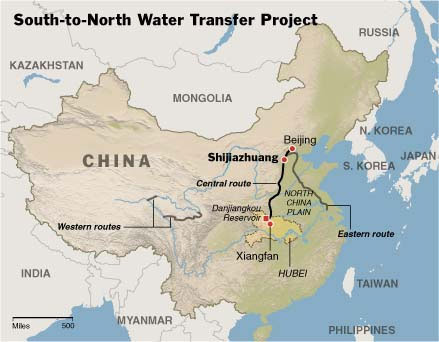
Huang He (Yellow) River
China’s second river and the second longest in Asia is as central to the rise of Chinese civilization as the Yangtze is central to the country. Known as the Huang He or Yellow it is 5,464 kilometers (3,395 miles) long and originates to the north of the Yangtze in the Qinghai-Tibetan plateau. It has always been a temperamental river with major floods throughout its history. These have been some of the worst human disasters ever recorded. Some of the floods originate from collapsed ice dams formed at the river’s glacial source. These ice dams and their breakup continue to be a problem even today with the Chinese government occasionally bombing the ice buildup before it becomes dangerous.
It is this river of all those in this part of Asia that is most susceptible to the environmental impact of global warming and climate change. Since 1966 the glaciers that feed the river have shrunk by 17%. The melting is 10 times the average rate seen over the last 300 years. The cause is rising temperatures and growing deserts as the permafrost melts and the ground dries up. Scientists estimate that overall land degradation in the Huang He source has reached 34.4%.
With water levels in decline, China is embarking on a massive water diversion scheme called the South-to-North Water Transfer Project.
Brahmaputra River
Measuring 2,900 kilometers (1,790 miles), the Brahmaputra originates in the Angsi Glacier of the Western Himalayas. Of all the rivers described here it is the least developed by those who live on its banks. The river crosses the Tibetan Plateau in China before making a dramatic turn into India and finally joining the Ganges near its mouth in Bangladesh. Tributaries of the Brahmaputra flow from Bhutan as well. So all in all the river basin serves four countries.
The population that lives along its banks or nearby numbers well over 30 million. The area is seismically unstable and the river is prone to mudslides along its steep slopes which create temporary dams and flash floods. Yet China is in the process of building a dams in the upper reaches for both flood control and power generation.
Like the Ganges, the Brahmaputra gets its source water from glacial melt but as the river turns into India and Bangladesh also receives a significant amount from the monsoon. Both these water sources may be affected by rising atmospheric temperatures which inevitably will accelerate the melt (although not seen yet in the Western Himalayas) and create variability in the seasonal monsoon (already happening).
Irrawaddy River
At 2,170 kilometers (1,340 miles) this river is the largest in Myanmar (Burma). Most of the 47 million in the country live on or near the Irrawaddy. Its tributaries flow from the eastern margins of the Tibetan plateau and although not directly fed by glaciers originates high in the same mountains as the other rivers we have described here.
China, Myanmar’s closest economic partner, is in the process of building seven hydroelectric dams along the river and its tributaries. The largest of these, the Myitsone, is an ecological disaster compromising 47 villages and destroying spawning habitats for native fishes. And that doesn’t take into consideration the downstream consequences with diminished flow and impacts to the river delta, a principal growing area for the country.
==
In the Mount Everest Region, World's Highest Glaciers Are Melting, Receding BY: KUNDA DIXIT In this photo essay, the editor of the Nepali Times describes dramatic changes underway in the ice and snow of the Himalayan Mountains. Read more ...Researchers monitoring the supraglacial ponds say their area has grown by 70 percent in the past 10 years alone. The ponds are fringed by ice cliffs and caves that accelerate the melting. The melted ice has carved an outflow channel through the left lateral moraine, so there is no large glacial lake on the Khumbu like elsewhere in Nepal. Scientists conclude that the Khumbu Glacier is not about to vanish, and the Icefall is not going to turn into a waterfall any time soon. However, the permanent ice catchment of the glacier above 6,000 meters could start to deplete under a worst-case scenario of 5 degrees Celsius warming. |
==
https://boingboing.net/2018/11/16/wwmd.html
China's increasing inequality and rocky transition to market capitalism has created a rising tide of wildcat strikes from independent trade unions, who have found powerful allies in national student communist movementswhose members were made to study Marxism in an effort to purge the country's intelligentsia of "bourgeois" ideologies of liberalism and democracy.
The students -- who call themselves "Marxists" and "Maoists" -- took the message to heart and mobilized in solidarity with the striking workers, in defiance of the Chinese state.
Now the state has struck back: Chinese communist student activists and leaders have gone missing, often after public kidnappings at the hands of presumed state enforcers who drive up in black, unmarked cars and force the students inside. Some of these students have not been heard from since.
The disappearances have created a wave of terror among the activists and their friends, who say that the retaliation is arbitrary and untargeted, sometimes aimed at prominent leaders and sometimes at young people who were essentially just bystanders during meetings and strikes.
But as public attention grew, the government quickly tightened the net around the young protesters. On August 11, one of the main organizers, Shen Mengyu, a graduate of Sun Yat-sen University, another elite school in southern China, was detained by a group of unidentified men.
Yue disappeared on August 24, along with a number of her fellow students. No official arrest reports have been announced yet by police and neither Shen or Yue have been seen since.
Following their disappearance, a group of alumni and students at Peking University set up the "Finding Yue Movement" to lobby for the graduates' release. One of the organizers, Zhang, was among those who disappeared in the past week.
"There is a pervasive sense of fear particularly after what happened in Peking University a few nights ago ... (Zhang's) crime was essentially to draw attention to the fact that another student had disappeared," Friedman, the American professor, told CNN.
Young Marxists are going missing in China after protesting for workers[Ben Westcott and Yong Xiong/CNN]
yikes DN
environmental news, a new scientific study has found air pollution can lead to a huge reduction in cognitive intelligence. One of the study’s authors, Xi Chen at Yale School of Public Health, said,“Polluted air can cause everyone to reduce their level of education by one year, which is huge.” The study, which was based in China, also suggests pollution can lead to increases in Alzheimer’s and other forms of dementia.
==
https://www.exposedbycmd.org/2018/08/14/koch-subsidiary-invista-build-1-billion-new-plant-china
don w
The Center for Media and Democracy (CMD) has previously reported on Koch Industries’ foray into China with its investment in SINA Corp, a leading Chinese tech company. Now comes the announcement by the fiber company INVISTA, a wholly owned Koch subsidiary since 2004, that it will spend $1 billion to build a facility in China to manufacture a chemical used in the production of nylon.
The new infusion of Koch cash into China comes in addition to more than $600 million INVISTA has invested in China over the past five years.
Koch Industries certainly has the money. The Tax Cuts and Jobs Act of 2017, which slashed tax rates for corporations and the wealthy, is expected to provide the Kochs, as individuals and as partners in Koch Industries, with a windfall of as much as $1.4 billion per year.
Meanwhile, Koch subsidiaries in the United States have announced hundreds of layoffs this year.
==
2008, San Diego-based Sempra Energy opened a liquefied natural gas (LNG) import terminal called Costa Azul on a picturesque stretch of beach in Baja California, Mexico, over the protests of environmentalists, residents, and surfers.
Costa Azul was built on the claim that the U.S. was running out of natural gas, but now Sempra is arguing the opposite: It wants to put another facility there to export the U.S.’s glut of gas as LNG to Asian markets. And with Trump’s ongoing trade war with China prompting the Asian powerhouse to slap a 25 percent tariff on LNG imports from the U.S., shipping that gas from Mexico out of Costa Azul may provide a safe haven for U.S. companies with access to the Pacific Coast.
Steve Horn and Martha Pskowski document the history, legal battles, and environmental costs associated with the Costa Azul LNG terminal and its role in the fracked gas rush sweeping the U.S.
And Sempra has been busy lately. It spearheaded the recent launch of the “Global Natural Gas Coalition” to promote exporting fracked gas, with the support of Trump administration officials and a labor union.
==
China’s Breadbasket Could Suffer the Worst of Climate Change’s Deadly Heat Waves
Deadly heat waves are breaking records and making headlines around the world this summer, but they have nothing on the heat waves that the North China Plain is likely to see in the future if we don't act now to combat climate change.
Keep reading...
=
one app to rule them all
https://www.democracynow.org/2018/8/1/a_threat_to_global_democracy_how
https://www.alternet.org/news-amp-politics/are-we-quietly-planning-go-war-china
==
American solar market may be about to get boost from an unexpected source: Energy analysts say the Chinese government's decision to dramatically cut its solar power subsidies will create a glut of solar panels and send their prices tumbling worldwide.
It comes at a crucial time for American solar installers. Falling prices could take the sting out of President Trump's solar panel tariffs, which have raised costs in the United States and led to billions of dollars in cancelled and frozen U.S. investments.
"It's changing the tone from negative to positive for the U.S.," said Xiaoting Wang, an analyst with Bloomberg New Energy Finance (BNEF).
==
https://www.ecowatch.com/global-climate-change-economies-2573570033.html
Climate Change Damage in China Could Harm U.S. Economy, Study Finds
By Tim Radford
German scientists have shown once again that climate change remains a global problem, with China's climate impact, for instance, hurting the economy of the U.S. Disastrous flooding—likely to increase as the world warms, and ever more water enters the atmosphere—in one country could reverberate in ways that could harm another nation's economy.
More precisely, China alone could experience a total of $380 billion in economic losses over the next 20 years: this adds up to about 5 percent of the nation's annual economic output.
About $175 billion of total losses could be attributed to future climate change—and as these losses are passed down the global trade and supply network, the U.S. and the European Union could be most affected.
If so, river flooding in China alone—aside from the ever-greater extremes of heat and windstorm that are predicted to arrive with higher temperatures—could bring U.S. losses of up to $170 billion in the next 20 years.
"The EU will suffer less from indirect losses caused by climate-related flooding in China due to its even trade balance. They will suffer when flooded regions in China temporarily fail to deliver, for instance, parts that European companies need for their production, but on the other hand Europe will profit from filling climate-induced production gaps in China by exporting goods to Asia.
"This yields the European economy currently more climate-prepared for the future," said Sven Norman Willner, of the Potsdam Institute for Climate Impact Research, who led the study.
"In contrast, the U.S. imports much more from China than it exports to this country. This leaves the U.S. more susceptible to climate-related risks of economic losses passed down along the global supply and trade chain."
He and his co-authors report in Nature Climate Change that they took a look at the economic challenge for the world as a whole in the limited case of river flooding: damage caused by human-induced climate change, as a consequence of the combustion of fossil fuels at a rate that has already begun to change the chemistry of the atmosphere, could become a significant factor in the global economy, and river flooding has always been a problem.
Heat Rises by 1°C
But as temperatures rise—and they have already risen by a global average of about 1°C in the last century, as ever more greenhouse gases have reached the atmosphere—so does evaporation, and so does the capacity of the atmosphere to hold moisture, which must eventually fall as rain.
The researchers looked at projections of near-future flood hazards on a regional scale that humans could expect to see on the basis of greenhouse gases already emitted. They then incorporated what is already known about economic network response to river flooding and its effects, taking into account the dynamics of international trade.
In research of this kind, the Potsdam Institute has what racing tipsters call "form." One of the researchers, Anders Levermann, has already warned that greenhouse gases are forcing up sea levels; that warming carries with it global economic threats; and that the numbers of humans at risk from the worst of the future floods are rising.
The news is not all bad: climate change could also bring more rain to the countries of the African Sahel, but the same changes could mean ever higher levels of hurricane damage in the U.S.
Complicated Prospect
The latest study has its own complexities: much depends on the course of international trade and the capacity of those countries not flooded to make good the shortfalls that follow flood disasters in one river system. In essence, international relations and natural hazard vulnerabilities have become entangled.
The entanglement remains, even though America's President Trump has imposed tariffs to protect U.S. industry. Unless nations adapt further, climate change will accelerate flood losses worldwide by about 15 percent, to a global total of $600 billion within the next two decades. China's losses could increase by 82 percent. America will still feel the shock, the researchers say.
"We find that the intensification of the mutual trade relation with China leaves the EU better prepared against production losses in Asia than the U.S. The prospect that the U.S. will be worse off can be traced back to the fact that it is importing more products from China than it is exporting," said professor Levermann.
"Interestingly, such an unbalanced trade relation might be an economic risk for the U.S. when it comes to climate-related economic losses. In the end, Trump's tariffs might impede climate-proofing the U.S. economy."
He continued: "Trump's tariff sanctions are likely to leave the U.S. economy even more vulnerable to climate change. As our study suggests, under climate change, the more reasonable strategy is a well-balanced economic connectivity, because it allows to compensate economic damages from unexpected weather events—of which we expect more in the future."
RELATED ARTICLES AROUND THE WEB
- China Contributes 10% of Human Influence on Climate Change ... ›
- China's Role in Climate Change, and Possibly in Fighting It - The ... ›
- Mapping The Potential Economic Effects Of Climate Change : The ... ›
- How Does Global Warming Affect The Economy? ›
==
ecowatch 5/18
China’s Global Infrastructure Initiative Could Bring Environmental Catastrophe
By Nexus Media, with William F. Laurance
Humans are ravaging tropical forests by hunting, logging and building roads and the threats are mounting by the day.
China is planning a series of massive infrastructure projects across four continents, an initiative that conservation biologist William Laurance described as "environmentally, the riskiest venture ever undertaken."
In a commentary published in the journal Nature Sustainability, he and an international team of researchers urge China to weigh the possibly disastrous consequences of its Belt and Road Initiative. Laurance, a research professor at James Cook University in Cairns, Australia, recently spoke with Nexus Media about the potential dangers, including the impact on climate change. This interview has been edited for length and clarity.
You used some strong language to describe this project's potential impact on the environment. Why do you feel so strongly about it?...
==
https://www.ecowatch.com/us-china-foreign-waste-2553215414.html
U.S. Asks China to 'Immediately Halt' Ban on Foreign Waste
Last year, China—the world's largest importer of waste—announced it no longer wanted to take in other countries' trash so it could focus on its own pollution problems.
This unexpected policy shift, which took effect Jan. 1, has left exporters in the U.S., Canada, Ireland, Germanyand other European countries scrambling for solutions for their growing mountains of trash, the New York Timesreported.
But rather than using this as an opportunity to improve and reshape domestic waste management and to force manufacturers to produce less waste, Washington has asked Beijing to reverse the ban.
On Friday, a U.S. representative at the World Trade Organization's (WTO) Council for Trade in Goods expressed concerns that China's foreign waste ban could cause a fundamental disruption in global supply chains for scrap materials, Reuters reported.
"We request that China immediately halt implementation and revise these measures in a manner consistent with existing international standards for trade in scrap materials, which provide a global framework for transparent and environmentally sound trade in recycled commodities," the official said at the meeting in Geneva.
"China's import restrictions on recycled commodities have caused a fundamental disruption in global supply chains for scrap materials, directing them away from productive reuse and toward disposal."
The request will likely fall on deaf ears amid President Donald Trump's threat to impose penalties on up to $60 billion in Chinese imports. He has also called China an "economic enemy" of the U.S. and announced steep tariffs on solar panels, steel and aluminum imports.
China's regulation, announced last July, is designed to reduce the country's environmental pollution by banning 24 types of imported waste, including plastics, mixed paper, mining slap and discarded textiles.
...
one road one belt one world? new silk road?
==
https://www.desmogblog.com/2018/02/06/fracking-appalachian-storage-hub-china
no many link
China Is Financing a Petrochemical Hub in Appalachia. Meet its Powerful Backers.
By Steve Horn • Tuesday, February 6, 2018 - 11:42
U.S. President Trump, Chinese President Xi Jinping, and West Virginia Commerce Sec. Thrasher join in the Great Hall in Beijing for MOU signing for the Appalachian Development Hub in November 2017
Over the past year, oil and gas industry plans to build a petrochemical refining and storage hub along the Ohio River have steadily gained traction. Proponents hope this potential hub, which would straddle Pennsylvania, Ohio, West Virginia, and Kentucky, could someday rival the industrial corridor found along the Gulf Coast in Texas and Louisiana.
Those plans center around creating what is known as the Appalachian Storage Hub, which received a major boost on November 9 during a trade mission to China attended by President Donald Trump and U.S. Secretary of Commerce Wilbur Ross. At that trade mission, also attended by Chinese President Xi Jinping, the China Energy Investment Corp. announced the signing of a memorandum of understanding (MOU) to invest $83.7 billion into the planned storage hub over 20 years. For comparison, West Virginia's gross domestic product (GDP) in 2016 was $72.9 billion.
Though called the Appalachian Storage Hub as a broad-sweeping term, in practice the hub could encompass natural gas liquids storage, a market trading index center, a key pipeline feeding epicenter, and a petrochemical refinery row. Its prospective development has been spurred by the current construction of a $6 billion petrochemical refining facility in Pennsylvania owned by Shell Oil.
The proposed hub has come under fire from grassroots groups. But this proposal also has a powerful set of backers, including West Virginia's five-member congressional delegation, the state's Governor and Secretary of Commerce, West Virginia University, the chemical industry's trade association, Shell Oil, and the Trump administration, among others.
Detractors of the planned petrochemical hub believe that its construction would buoy the oil and gas industry in its efforts to further develop drilling and hydraulic fracturing (“fracking”) projects in Pennsylvania's Marcellus Shale and Ohio's Utica Shale basins.
A “major concern we have about the whole complex is that it will encourage a second or third wave of gas fracking in our region, from the Marcellus, the Utica, and the Rogersville field, which is a much deeper layer of shale gas and oil and has been recently tested and a few commercial wells have been built into it,” Robin Blakeman, project coordinator with the Ohio Valley Environmental Coalition, recently told the radio show Between the Lines. “It’s not commercially viable yet, but we think this complex will make it commercially viable.”
...
==
https://www.ecowatch.com/china-trees-soldiers-2534965590.html
==
https://www.ecowatch.com/china-reforestation-project-2524893906.html
https://www.democracynow.org/2017/12/29/as_trump_attacks_media_with_fake
Committee to Protect Journalists has published its 25th annual survey of journalists killed and jailed around the world. This year, the list of those killed included 42 journalists and four media workers. A record 262 journalists were imprisoned around the world, with Turkey, China and Egypt topping the list for the second year in a row. Mexico reached an historic high in journalists killed this year, and the country leads the world in journalists killed in a non-conflict zone. This comes as President Donald Trump has waged a relentless campaign to discredit journalists in the United States, often with rhetoric that could potentially incite his followers to violence. We speak with María Salazar-Ferro, the director of the Emergencies Department of the Committee to Protect Journalists.
==
https://www.alternet.org/environment/american-corporations-and-consumers-are-driving-chinese-air-pollution-which-has-now
A recent study of air pollution in the western United States made a startling finding: despite a 50 percent drop over the past 25 years in U.S. emissions of smog-producing chemicals like nitrogen oxides (NOx), smog actually increased during that period in rural western states, even in such pristine environments as Yellowstone National Park.
Most of this increase, according to the researchers, was traced to the "influx of pollution from Asian countries, including China, North and South Korea, Japan, India and other South Asian countries.” Over the same period that NOx emissions declined in the U.S., they tripled in Asia as a whole. In media reports of the study, China and India are described as the "worst offenders" of this fugitive "Asian pollution."
Left only with these findings, a reasonable conclusion would be that the U.S. has become more environmentally enlightened in recent decades, while Asia—particularly "developing" Asia—is a veritable eco-reprobate, sacrificing not only its own but global airsheds to choking pollution. In explaining why the U.S. should exit the Paris Climate Accord, President Trump's anti-environmental EPA director, Scott Pruitt, expressed this view, saying that China and India "are polluting far more than we are."
The missing bit
A similar study of global air pollution drift in 2014, focusing on China and the U.S., made comparable findings, but included an important factor missing from the more recent study: production for export. Among other things, the researchers of the older study asked how much of the Chinese air pollution drifting to the western U.S. was occasioned specifically in the production of exports for world markets (including the top destination for Chinese manufactures: the United States)
The answer? In 2006, up to 24 percent of sulfate concentrations over the western United States were generated in the Chinese production of goods for export to the U.S. Applying these findings to the more recent study, it's likely that a significant percentage of the Asian nitrogen oxides now choking the U.S. West were also emitted in the production of goods destined for American markets.
In other words, it's meaningless to speak of "Asian pollution" in this context. Though the pollution was emitted in Asia, it properly belongs to the country or countries on whose behalf and at whose behest it was produced. Even more accurately, the pollution finally belongs to the transnational corporations (TNCs) who are the real drivers and beneficiaries not only of offshoring, but also of insatiable consumerism through marketing and obsolescence.
Profit vs. Planet
Economic globalization has enabled the manic scouring of the world by TNCs for the most "liberal" (read: unregulated) environments in which to locate production facilities – the places where expenses can be minimized and profits maximized. Since the biggest drags on corporate profiteering come from taxes, environmental regulations and decent labor protections and wages, the global relocations of TNCs have largely been towards countries where those costs are lowest, or absent altogether.
...
http://www.alternet.org/environment/here-are-worlds-top-10-dirtiest-companies
Ten corporations and state-owned entities are responsible for over 36 percent of global fossil fuels emissions since 1988, according to a new study published by the Carbon Disclosure Project.
Among the top ten polluters is British-Dutch owned-Shell, as well as the Exxon Mobil Corporation, whose former CEO, Rex Tillerson, currently serves as the U.S. Secretary of State. The governments of China, Saudi Arabia, Russia, Iran, India, and Mexico also own entities, which make the top ten list.
The study, which also shows that 100 companies are responsible for over 70 percent of global emissions, highlights the critical role of corporations and powerful state actors not only perpetuating environmental damage, but also in combatting climate change.
If fossil fuels continue to be extracted at the same rate over the next 20 years, the world could see a 4°C rise in global temperatures by the end of the century, leading to mass extinctions and widespread starvation.
Here are the top ten corporate and state-entity polluters:
1. China (Coal): 14.3 percent
China's state-led coal production has tripled to almost 4 billion tons since 2000, contributing to around half of all global emissions.
2. Saudi Arabian Oil Company (Aramco): 4.5 percent
Saudi Arabia's state-owned Aramco has the world's largest crude oil reserves and the highest daily production output of any company in the world.
3. Gazprom OAO (Russian): 3.9 percent
Russian-owned Gazprom OAO has been the target of environmental protests for its Arctic drilling.
4. National Iranian Oil Co: 2.3 percent
Iran's state-owned natural gas company has had unilateral control over the country's oil reserves since 1948.
5. ExxonMobil Corp: 2.0 percent
ExxonMobil is the world's seventh largest corporation, an offspring of John D. Rockerfeller's Standard Oil Company. ExxonMobil has lobbied against climate change action in the U.S. Congress.
6. Coal India: 1.9 percent
State-owned Coal India is the largest producer of coal in the world.
7. Petroleos Mexicanos (Pemex): 1.9 percent
In 2009, Mexican state-owned Pemex was Latin America's second largest corporation.
8. Russia (Coal): 1.9 percent
Russia saw a 70-percent increase in coal production since the late 1990s.
9. Royal Dutch Shell PLC (Shell): 1.7 percent
Shell is the seventh largest corporation in the world, and involved in every area of the coal and gas production chain. The British-Dutch owned company has been implicated major oil spills in Nigeria.
10. China National Petroleum Corp (CNPC): 1.6 percent
The state-owned oil and gas corporation is the largest integrated energy company in China.
==