anduril pAlantIr
---
NO MERRI
DEREG TO MAX AUTONOMOUS WEAPONS AI
see thiel palantir
LONSDALE KARP
SEE PALMER LUCKEY OG TRUMP
1789 CAPITAL TRUMP KIDS
WHY CORP BAD ACTOR?
---
$ to yvette herrell
---
GGL 7 26
AI TERMINATOR = MAX DEREG
GGL 7 26 AI Overview
Palmer Luckey is a key defense-tech billionaire driving the shift toward autonomous weapons. As the founder of Anduril Industries, he works closely with the Trump administration to modernize the U.S. military using AI-powered tech. He shares overlapping military modernization and deregulation goals with Elon Musk. [1, 2, 3, 4, 5]
[### The Pentagon's Favorite Tech Guy Is This Hawaiian Shirt- ...

The New York Times
https://www.nytimes.com › 2026/03/02 › technology](https://www.nytimes.com/2026/03/02/technology/pentagon-anduril-palmer-luckey.html)
Mar 2, 2026 — Palmer Luckey, who founded the defense tech start-up Anduril, has become the It Guy as President Trump aims to modernize the U.S. military ...
AI Overview

Anduril Industries, founded by Palmer Luckey, is a defense-tech company that secured a $20 billion enterprise contract with the U.S. Army to streamline drone and counter-drone capabilities. The startup builds autonomous weapons systems—such as drones and submarines—and has built the "Arsenal-1" factory in Ohio for mass production. [1, 2, 3, 4, 5]
Luckey broadly supports the Trump administration’s regulations on the defense industry, which include capping CEO salaries at $5 million and banning dividends. Backed by advisers like Elon Musk, who advocate opening Pentagon contracts to entrepreneurial tech companies, Anduril continues to scale up production to modernize the U.S. military. [1, 2, 3, 4]
For a closer look at Anduril's AI-driven weapons and manufacturing plans:
---
an 5 26
As President Donald Trump's war withIranhas dragged on for the last two months, a new NOTUS reportrevealed that defense contractors have been flooding congressional candidates with their hands on major regulatory powers with campaign money.
In a report published Friday, NOTUS revealed several telling findings from campaign contribution data pulled from Jan. 1 through March 31, revealing that "the defense industry spent millions" to boost the funding for candidates likely to play a role in regulatory decisions surrounding them, as well as other "competitive races" in general.
"Some of the lawmakers who have received the most contributions from defense interests sit on key congressional committees that routinely make decisions that profoundly affect the financial fortunes of military contractors," NOTUS explained. "For example, Congress is tasked with scrutinizing the Pentagon’s $1.5 trillion budget request for 2027 — a nearly $500 billion increase."
Political action committees connected to "11 defense contractors, including Lockheed Martin, Northrop Grumman, Leidos, RTX, Anduril," poured a total of $4.7 million into congressional campaigns during the first quarter of 2026, NOTUS found.
The report further dug into the specific lawmakers being wooed with big money donations and how much they have been taking in.
"Rep. Ken Calvert [a California Republican] chairs the House Defense Appropriations Subcommittee, which is charged with drafting the Defense Department’s budget," the report continued. "The Republican is running in a competitive race after California Democrats gerrymandered his district, and his campaign committee received more than $200,000 during the first three months of 2026 from defense contractor PACs and direct contributions from top defense executives, according to FEC records."
Across two days in early March, Calvert took in two separate payments from "from leaders at military vehicle manufacturer AM General: Darrell Duckworth, an executive director, and Chief Financial Officer Ryan DuRussel." A week and change later, "the political action committees of Lockheed Martin and RTX, Raytheon’s parent company," also made two separate donations of $5,000 to the lawmaker. A senior congressional adviser for Calvert insisted to NOTUS that "His votes and actions are always based on what he believes is in the best interest of the constituents he represents and all Americans."
"House Armed Services Committee Chair Rep. Mike Rogers of Alabama received $68,000 last quarter through his campaign," the report added. "Rogers, a Republican who oversees the National Defense Authorization Act, has said he’s focused on making it easier for new defense firms such as Anduril and ShieldAI to secure defense contracts. Palmer Luckey, co-founder of Anduril, donated $7,000 to Rogers’ campaign in March."
It has not just been Republicans getting this money, either, with NOTUS reporting that most Democrats continue to accept defense PAC money, despite some swearing it off. Rep. Adam Smith of Washington, the ranking Democrat on the House Armed Services Committee, received "about $130,000 from industry PACs and executives." This included "$7,000 from Anduril co-founder and CEO Brian Schimpf, $1,000 from RTX Vice President of State and Local Government Relations Peter Holland and $1,000 from BAE Systems Vice President of Strategy Chris Rappa," as well as, "$5,000 contributions from PACs tied to defense contractors Northrop Grumman, SpaceX and Leonardo DRS."
In an email to the outlet, Smith also asserted that these extensive contrbituons would not have any sway over his voting decisions.
"I have opposed the Iran War since before it started and I oppose the $1.5 trillion defense budget increase," Smith said. "No contribution changes that. I’ve spent decades pushing back on wasteful defense spending and challenging entrenched interests in the Pentagon."
---
TOM D
A Secret War Inside the Pentagon Could Divide the Trump Universe
A new military industrial complex is being born, and it could have very different goals and profit-takers than the existing one.
Words: Michael Klare
Date: February 12, 2025
Last April, in a move generating scant media attention, the Air Force announced that it had chosen two little-known drone manufacturers — Anduril Industries of Costa Mesa, California, and General Atomics of San Diego — to build prototype versions of its proposed Collaborative Combat Aircraft (CCA), a future unmanned plane intended to accompany piloted aircraft on high-risk combat missions. The lack of coverage was surprising, given that the Air Force expects to acquire at least 1,000 CCAs over the coming decade at around $30 million each, making this one of the Pentagon’s costliest new projects. But consider that the least of what the media failed to note. In winning the CCA contract, Anduril and General Atomics beat out three of the country’s largest and most powerful defense contractors — Boeing, Lockheed Martin, and Northrop Grumman — posing a severe threat to the continued dominance of the existing military-industrial complex, or MIC.
For decades, a handful of giant firms like those three have garnered the lion’s share of Pentagon arms contracts, producing the same planes, ships, and missiles year after year while generating huge profits for their owners. But an assortment of new firms, born in Silicon Valley or incorporating its disruptive ethos, have begun to challenge the older ones for access to lucrative Pentagon awards. In the process, something groundbreaking, though barely covered in the mainstream media, is underway: a new MIC is being born, one that potentially will have very different goals and profit-takers than the existing one. How the inevitable battles between the old and the new MICs play out can’t be foreseen, but count on one thing: they are sure to generate significant political turbulence in the years to come.
The very notion of a “military-industrial complex” linking giant defense contractors to powerful figures in Congress and the military was introduced on Jan. 17, 1961, by President Dwight D. Eisenhower in his farewell address to Congress and the American people. In that Cold War moment, in response to powerful foreign threats, he noted that “we have been compelled to create a permanent armaments industry of vast proportions.” Nevertheless, he added, using the phrase for the first time, “we must guard against the acquisition of unwarranted influence, whether sought or unsought, by the military-industrial complex. The potential for the disastrous rise of misplaced power exists and will persist.”
Ever since, debate over the MIC’s accumulating power has roiled American politics. A number of politicians and prominent public figures have portrayed US entry into a catastrophic series of foreign wars — in Vietnam, Cambodia, Laos, Iraq, Afghanistan, and elsewhere — as a consequence of that complex’s undue influence on policymaking. No such claims and complaints, however, have ever succeeded in loosening the MIC’s iron grip on Pentagon arms procurement. This year’s record defense budget of approximately $850 billion includes $143.2 billion for research and development and another $167.5 billion for the procurement of weaponry. That $311 billion, most of which will be funneled to those giant defense firms, exceeds the total amount spent on defense by every other country on Earth.
Over time, the competition for billion-dollar Pentagon contracts has led to a winnowing of the MIC ecosystem, resulting in the dominance of a few major industrial behemoths. In 2024, just five companies — Lockheed Martin (with $64.7 billion in defense revenues), RTX (formerly Raytheon, with $40.6 billion), Northrop Grumman ($35.2 billion), General Dynamics ($33.7 billion), and Boeing ($32.7 billion) — claimed the vast bulk of Pentagon contracts. (Anduril and General Atomics didn’t even appear on a list of the top 100 contract recipients.)
Typically, these companies are the lead, or “prime,” contractors for major weapons systems that the Pentagon keeps buying year after year. Lockheed Martin, for example, is the prime contractor for the Air Force’s top-priority F-35 stealth fighter (a plane that has often proved distinctly disappointing in operation); Northrop Grumman is building the B-21 stealth bomber; Boeing produces the F-15EX combat jet; and General Dynamics makes the Navy’s Los Angeles-class attack submarines. “Big-ticket” items like these are usually purchased in substantial numbers over many years, ensuring steady profits for their producers. When the initial buys of such systems seem to be nearing completion, their producers usually generate new or upgraded versions of the same weapons, while employing their powerful lobbying arms in Washington to convince Congress to fund the new designs.
Over the years, non-governmental organizations like the National Priorities Project and the Friends Committee on National Legislation have heroically tried to persuade lawmakers to resist the MIC’s lobbying efforts and reduce military spending, but without noticeable success. Now, however, a new force — Silicon Valley startup culture — has entered the fray, and the military-industrial complex equation is suddenly changing dramatically.
*
Consider Anduril Industries, one of two under-the-radar companies that left three MIC heavyweights in the dust last April by winning the contract to build a prototype of the Collaborative Combat Aircraft. Anduril (named after the sword carried by Aragorn in J.R.R. Tolkien’s The Lord of the Rings) was founded in 2017 by Palmer Luckey, a virtual-reality headset designer, with the goal of incorporating artificial intelligence into novel weapons systems. He was supported in that effort by prominent Silicon Valley investors, including Peter Thiel of the Founders Fund and the head of another defense-oriented startup, Palantir (a name also derived from The Lord of the Rings).
From the start, Luckey and his associates sought to shoulder aside traditional defense contractors to make room for their high-tech startups. Those two companies and other new-fledged tech firms often found themselves frozen out of major Pentagon contracts that had long been written to favor the MIC giants with their bevies of lawyers and mastery of government paperwork. In 2016, Palantir even sued the US Army for refusing to consider it for a large data-processing contract and later prevailed in court, opening the door for future Department of Defense awards.
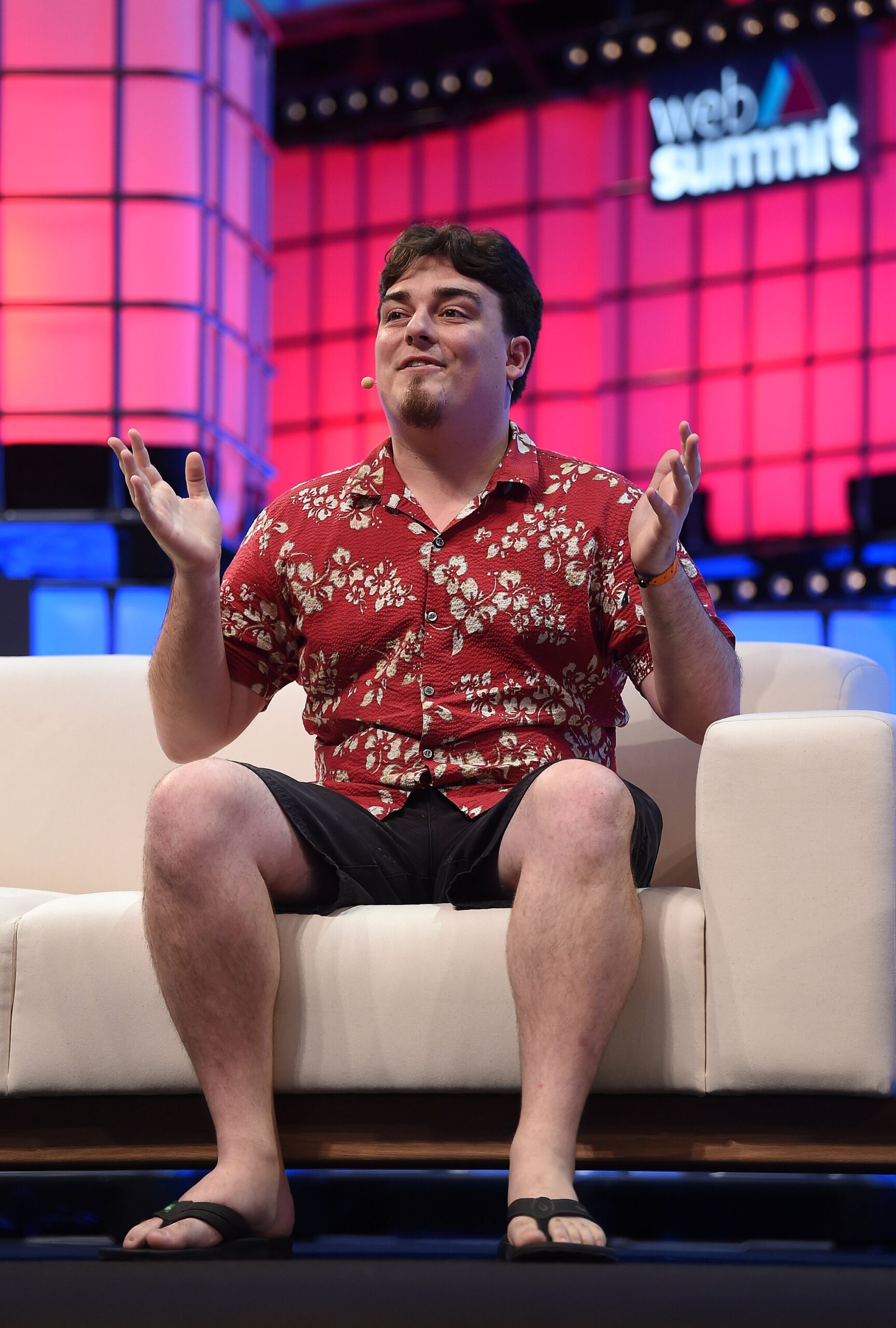 Palmer Luckey, found of Anduril, photographed on stage at the Web Summit in Lisbon, Portugal, on Nov. 8, 2018 (Diarmuid Greene/Web Summit/Wikimedia Commons)
In addition to its aggressive legal stance, Anduril has also gained notoriety thanks to the outspokenness of its founder, Palmer Luckey. Whereas other corporate leaders were usually restrained in their language when discussing Department of Defense operations, Luckey openly criticized the Pentagon’s inbred preference for working with traditional defense contractors at the expense of investments in the advanced technologies he believes are needed to overpower China and Russia in some future conflict.
Such technology, he insisted, was only available from the commercial tech industry. “The largest defense contractors are staffed with patriots who nevertheless do not have the software expertise or business model to build the technology we need,” Luckey and his top associates claimed in their 2022 Mission Document. “These companies work slowly, while the best [software] engineers relish working at speed. And the software engineering talent who can build faster than our adversaries resides in the commercial sector, not at large defense primes.”
To overcome obstacles to military modernization, Luckey argued, the government needed to loosen its contracting rules and make it easier for defense startups and software companies to do business with the Pentagon. “We need defense companies that are fast. That won’t happen simply by wishing it to be so: it will only happen if companies are incentivized to move” by far more permissive Pentagon policies.
Buttressed by such arguments, as well as the influence of key figures like Thiel, Anduril began to secure modest but strategic contracts from the military and the Department of Homeland Security. In 2019, it received a small Marine Corps contract to install AI-enabled perimeter surveillance systems at bases in Japan and the United States. A year later, it won a five-year, $25 million contract to build surveillance towers on the US-Mexican border for Customs and Border Protection (CBP). In September 2020, it also received a $36 million CBP contract to build additional sentry towers along that border.
After that, bigger awards began to roll in. In February 2023, the Department of Defense started buying Anduril’s Altius-600 surveillance/attack drone for delivery to the Ukrainian military and, last September, the Army announced that it would purchase its Ghost-X drone for battlefield surveillance operations. Anduril is also now one of four companies selected by the Air Force to develop prototypes for its proposed Enterprise Test Vehicle, a medium-sized drone intended to launch salvos of smaller surveillance and attack drones.
Anduril’s success in winning ever-larger Pentagon contracts has attracted the interest of wealthy investors looking for opportunities to profit from the expected growth of defense-oriented startups. In July 2020, it received fresh investments of $200 million from Thiel’s Founders Fund and prominent Silicon Valley investor Andreessen Horowitz, raising the company’s valuation to nearly $2 billion. A year later, Anduril obtained another $450 million from those and other venture capital firms, bringing its estimated valuation to $4.5 billion (double what it had been in 2020). More finance capital has flowed into Anduril since then, spearheading a major drive by private investors to fuel the rise of defense startups — and profit from their growth as it materializes.
*
Along with its success in attracting big defense contracts and capital infusions, Anduril has succeeded in convincing many senior Pentagon officials of the need to reform the department’s contracting operations so as to make more room for defense startups and tech firms. On Aug. 28, 2023, Deputy Secretary of Defense Kathleen Hicks, then the department’s second-highest official, announced the inauguration of the “Replicator” initiative, designed to speed the delivery of advanced weaponry to the armed forces.
“[Our] budgeting and bureaucratic processes are slow, cumbersome, and byzantine,” she acknowledged. To overcome such obstacles, she indicated, the Replicator initiative would cut through red tape and award contracts directly to startups for the rapid development and delivery of cutting-edge weaponry. “Our goal,” she declared, “is to seed, spark, and stoke the flames of innovation.”
As Hicks suggested, Replicator contracts would indeed be awarded in successive batches, or “tranches.” The first tranche, announced last May, included AeroVironment Switchblade 600 kamikaze drones (called that because they are supposed to crash into their intended targets, exploding on contact). Anduril was a triple winner in the second tranche, announced on Nov. 13. According to the Department of Defense, that batch included funding for the Army’s purchase of Ghost-X surveillance drones, the Marine Corps’ acquisition of Altius-600 kamikaze drones, and development of the Air Force’s Enterprise Test Vehicle, of which Anduril is one of four participating vendors.
Just as important, perhaps, was Hicks’ embrace of Palmer Luckey’s blueprint for reforming Pentagon purchasing. “The Replicator initiative is demonstrably reducing barriers to innovation, and delivering capabilities to warfighters at a rapid pace,” she affirmed in November. “We are creating opportunities for a broad range of traditional and nontraditional defense and technology companies… and we are building the capability to do that again and again.”
*
Kathleen Hicks stepped down as deputy secretary of defense on Jan. 20 when Donald Trump reoccupied the White House, as did many of her top aides. Exactly how the incoming administration will address the issue of military procurement remains to be seen, but many in Trump’s inner circle, including Elon Musk and Vice President JD Vance, have strong ties to Silicon Valley and so are likely to favor Replicator-like policies.
Pete Hegseth, the former Fox News host who recently won confirmation as secretary of defense, has no background in weapons development and has said little about the topic. However, Trump’s choice as deputy secretary (and Hick’s replacement) is billionaire investor Stephen A. Feinberg who, as chief investment officer of Cerberus Capital Management, acquired the military startup Stratolaunch — suggesting that he might favor extending programs like Replicator.
In a sense, the Trump moment will fit past Washington patterns when it comes to the Pentagon in that the president and his Republican allies in Congress will undoubtedly push for a massive increase in military spending, despite the fact that the military budget is already at a staggering all-time high. Every arms producer is likely to profit from such a move, whether traditional prime contractors or Silicon Valley startups. If, however, defense spending is kept at current levels — in order to finance the tax cuts and other costly measures favored by Trump and the Republicans — fierce competition between the two versions of the military-industrial complex could easily arise again. That, in turn, might trigger divisions within Trump’s inner circle, pitting loyalists to the old MIC against adherents to the new one.
Most Republican lawmakers, who generally rely on contributions from the old MIC companies to finance their campaigns, are bound to support the major prime contractors in such a rivalry. But two of Trump’s key advisers, JD Vance and Elon Musk, could push him in the opposite direction. Vance, a former Silicon Valley functionary who reportedly became Trump’s running mate only after heavy lobbying by Peter Thiel and other tech billionaires, is likely to be encouraged by his former allies to steer more Pentagon contracts to Anduril, Palantir, and related companies. And that would hardly be surprising, since Vance’s private venture fund, Narya Capital (yes, another name derived from The Lord of the Rings!), has invested in Anduril and other military/space ventures.
Named by Trump to direct the as-yet-to-be-established Department of Government Efficiency, Elon Musk, like Anduril’s Palmer Luckey, fought the Department of Defense to obtain contracts for one of his companies, SpaceX, and has expressed deep contempt for the Pentagon’s traditional way of doing things. In particular, he has denigrated the costly, generally ill-performing Lockheed-made F-35 jet fighter at a time when AI-governed drones are becoming ever more capable. Despite that progress, as he wrote on X, the social media platform he now owns, “some idiots are still building manned fighter jets like the F-35.” In a subsequent post, he added that “manned fighter jets are obsolete in the age of drones anyway.”
His critique of the F-35 ruffled feathers at the Air Force and caused Lockheed’s stock to fall by more than 3%. “We are committed to delivering the world’s most advanced aircraft — the F-35 — and its unrivaled capabilities with the government and our industry partners,” Lockheed declared in response to Musk’s tweets. Over at the Pentagon, Air Force Secretary Frank Kendall had this to say: “I have a lot of respect for Elon Musk as an engineer. He’s not a warfighter, and he needs to learn a little bit more about the business, I think, before he makes such grand announcements as he did.” He then added, “I don’t see F-35 being replaced. We should continue to buy it, and we also should continue to upgrade it.”
President Trump has yet to indicate his stance on the F-35 or other high-priced items in the Pentagon’s budget lineup. He may (or may not) call for a slowdown in purchases of that plane and seek greater investment in other projects. Still, the divide exposed by Musk — between costly manned weapons made by traditional defense contractors and more affordable unmanned systems made by the likes of Anduril, General Atomics, and AeroVironment — is bound to widen in the years to come as the new version of the military-industrial complex only grows in wealth and power. How the old MIC will address such a threat to its primacy remains to be seen, but multibillion-dollar weapons companies are not likely to step aside without a fight. And that fight will likely divide the Trumpian universe.
This article wasoriginally publishedat TomDispatch.
contrib?ind=D opensecrets
| 6 | Anduril Industries | $2,315,256 | $2,315,196 | $872,143 | $1,442,043 | $0 | $0 | $0 |
|---|---|---|---|---|---|---|---|---|
| 7 | General Dynamics | $2,232,417 | $2,232,417 | $2,232,417 | $2,232,417 | $2,232,417 | $2,232,417 | $2,232,417 |
---
an 12 25
President Donald Trump's eldest son is poised to benefit from a multi-million business deal secured with the Pentagon, The Daily Beast reports.
Vulcan Elements, a "little known startup" backed by Donald Trump Jr. "is slated for a roughly $620 million Defense Department loan under the deal," the *Financial Times* reports.
The recipient of investments from Trump Jr.'s 1798 Capital venture firm, Vulcan is a tiny rare-earths start-up, whose deal with the Defense Department will increase the domestic industrial supply of magnets, they explain.
The president's "persistent confusion about magnets has spurred mockery from his detractors, who have noted that his public comments on the matter are uncannily reminiscent of a 2010 song by Insane Clown Posse, “Miracles,” writes The Daily Beast, "which features rapper Shaggy 2 Dope delivering the immortal lines: 'F—— magnets, how do they work?'"
The loan is part of a wider $1.4 billion investment in the sector, appears to represent the largest ever granted by the Pentagon’s Office of Strategic Capital, and only the latest plushy government deal handed to a company backed by Trump Jr., The Daily Beast explains.
Vulcan is just the latest to profit off of Trump Jr.'s last name.
"Four firms within 1789 Capital’s portfolio, which also holds significant investments in other government contractors like SpaceX and Anduril, have reportedly landed contracts worth a combined $735 million since the MAGA leader assumed office for the second time in January," they note.
"Vulcan Elements’ deal with the Pentagon stands out both for the record-breaking size of the loan, and for the nature of services it will provide under the arrangement," they explain.
Kedric Payne, an ethics attorney, cries foul, telling the Financial Times, "Presidents are expected to avoid even the appearance that they are using their office to financially benefit themselves or their family."
“While we do not know for certain if, or how, the president may have influenced this loan, it falls under the cloud of conflicts of interest we have seen throughout his administration," Payne adds.
---
---
meidas 5 min
55:50
well Trump married to immigrants I mean you know so that there is there is contradiction there of course but
55:55
without the technology that these people are supporting Trump with and providing and getting military contracts and
56:02
government contracts with Trump wouldn't be able to send bounty hunters out with
56:07
software on their phones with their kind of Amazon military costumes and round people up
56:13
yeah there's a role for the the tech industry Um, one of the interesting things that I'd been looking into was um
56:20
there was a project at the Claremont Institute, which is a Trump Allied think tank called the administrative state project. And that the um one of the
56:28
thinkers are on that project uh was co-writing opeds with the CTO of Palunteer. So it was all about thinking
56:36
around it was there there has been a lot of strategy and thinking um around how
56:42
the immigration how technology and tech advanced tech companies like Palunteer
56:48
will further the immigration enforcement push that we're seeing in America. So,
---
20 Things You Didn’t Know About Anduril Industries Allen Lee 2 Years Ago
Artificial Intelligence
Anduril Industries is a pioneering company that specializes in the development and production of life-saving and defense products across a broad scope of industries. This business has not been in operation very long but it has grown dramatically in a short period of time and it has become a leader in the AI industry with a wide range of specialties within that sphere. If you have not yet heard of Anduril Industries, don’t feel bad because it’s been in operation for only a little over two years, but here are 20 things you didn’t know about the company to help you become more familiar with its purpose and benefits.
- Anduril Industries was founded in 2017
Anduril was established by five co-founders. They are Palmer Luckey, Trae Stephens, Brian Schimpf, Matt Grimm, and Joseph Chen. The company is headquartered in the greater Los Angeles area of California. As Anduril enters its third year of operation it does so as one of the most successful tech startups in the United States.
Latest Videos
- Anduril Industries is good for America
Anduril was created to provide some of the most necessary products and services known. National defense is one of the top priorities of the firm. American national security is a complex challenge and Anduril is committed to solving some of the most complicated problems within this arena through next-generation technology that aims to provide a national defense as well as the protection of troops in the field.
- The firm falls under multiple categories
Anduril Industries works with several different technologies and is classified under several different industries with the main classification being Artificial Intelligence. Products developed also involve sensor technology, virtual reality, robotics, computer vision, and aerospace-related products. The life-saving technology is AI-based and it is used for fighting wildfires, performing search and rescue missions, protecting American military troops, and a lot more. The goal of Anduril is to develop advanced technologies that are on the cutting edge for protecting America’s status as a global leader.
- Anduril is an early-stage funding firm
Anduril Industries has been the recipient of venture capital funding from just two rounds since its inception. The first round of Series A funding closed on June 11, 2019, led by the Founders Fund firm, raising $41 million. The second was a round of Series B funding which closed on September 11, 2019. Four investors back Anduril Industries with venture capital including Human Capital, Andreessen Horowitz, Founders Fund and Anorak Ventures.
- All five of the co-founders are a part of the executive leadership team
There are a total of six team members on the executive leadership team for Anduril Industries. Five of the six occupy executive positions within the company. Brian Schimpf is the CEO, Matt Grimm is the COO and the other three maintain executive privilege as a founder. Katherine Bovie is also recognized as a part of the executive team. She is an investor and general catalyst. Marc Berte is the one board member for Anduril.
- Anduril is on a fast track
Anduril is currently experiencing a phase of rapid growth. It’s not often that a company that has been in existence for just two years rises to the top as we’ve seen with Andril delivers customized products with speed and precision in areas where the needs represent life and death situations. The stakes are high and Anduril has risen to the occasion.
- The operations of Anduril Industries are diverse
There is no one single thing that Anduril Industries does when it comes to the products that it creates through advanced technology. This is likely to remain the case as the company moves forward. The aim of the tech crew is to perpetually remain on a mission to solve national security challenges to enhance security and defense. Anduril Industries develops from a concept of customized technologies with new products in defense that are changing the world around us. The components are custom engineered for each client contracting the services. The firm provides services in a variety of places throughout the world.
- Anduril makes a range of products
Anduril produces everything from hardware for consumers to national security software. Technologies are also used to create autonomous vehicles, watercraft, and sensor platforms. Virtual reality is also a technology that is used in the creation of its AI products. This is one of the reasons why the company must maintain a fleet of diverse workers, some of who specialize in certain technologies and crafts, and others who are jacks of all trades. The workforce for Anduril Industries is as diverse as the products and services that it creates and produces. This makes it a novelty in the business world.
9. Anduril makes massive AI security systems
Leaders at Anduril recently gave reporters a look at some of the projects that they’ve been involved in first-hand. It was a field test for surveillance defense systems for the United States military as well as for other agencies. Through the use of sensors, this cutting-edge technology can track a person who is walking wherever he or she goes into a specific location. There are motion detectors in use and cameras that can find and follow an unauthorized person who slips into a building or certain area and it doesn’t require much effort on the part of humans to accomplish these tasks because it is a networked system that relies on computer-vision algorithms to determine what the object is that the camera is looking at. Just one technician is needed to operate this massive detect and follow system.
- Anduril is good for Border Patrol
In recent years there have been a lot of problems with US border security. There have also been multiple instances of Border Patrol officers and even local citizens near the border being hurt and killed. With the latest security systems in place, there is the possibility to monitor miles of borderlands, detecting and following intruders and alerting officials to the placement of those that are illegally crossing borders.
- Anduril Industries saves lives
After reviewing just a few of the technologies that Anduril Industries creates it is not difficult to see how the technology saves lives. It alerts personnel to the whereabouts of the enemy or any other kind of threat to enhance their knowledge of what may be coming towards them. This provides key personnel with a system of advanced warning and lessens the chances for a surprise attack happening.
- The systems are intensely detailed
Anduril’s intruder detection systems do much more than to spot and track an individual. It is also embedded with special technologies that determine if the individual is authorized to be in a specific area as well as if he or she is carrying a weapon. This is known as the Lattice system and it has multiple capacities.
- Anduril’s products are useful in multiple environments
The technologies and systems that Anduril manufactures and distributes have implications for use all over the world. Currently, these systems are still under development and it is believed that there are plans to use them in urban environments, in battlefields, and in multiple different environments for the enhancement of security. There are implications for military use as well as for civilian security needs.
- Some of Anduril’s clients are confidential
When asked about the types of clients that Anduril currently serves, the answers were straightforward. Some of them include multiple branches of the United States government with contracts already signed and in place. The leaders were upfront about the fact that the company will not release a complete list of the companies, agencies, and organizations that they receive work orders from, or are engaged in contracted work for. Still, Anduril confirmed that they are involved with dozens of government agencies, Homeland security being among them.
- One of the primary founders is in his twenties but is already an accomplished entrepreneur
Palmer Luckey is one of the predominant founders of Anduril. He is in his mid-twenties. Prior to founding Anduril, he established the well-known and successful Oculus, which is a virtual reality company. After establishing the company and getting it off the ground, it was sold to Facebook. He has a lot of ideas to contribute to the products created by Anduril and is an integral part of the team of engineers who provide solutions for national security issues.
- Anduril is tied to Trump supporters
We also learned that Luckey is a known political supporter of President Donald Trump. When he first formed Anduril he called upon engineers to join him who were both “dedicated, and patriotic.” The company was first little more than a website when it was first developed. The company retains a “MAGA-friendly ideology and Luckey himself reportedly made large donations to businesses and organizations that were Trump-friendly. He also met with cabinet officials from Trump.
17. Anduril Industries reached unicorn in less than 3 years
Anduril Industries is one of the fastest-growing new startup businesses in the world today. The company was just launched in 2017 and already it has achieved unicorn status. This classification is reserved for businesses that have a valuation of $1 billion or more. So far, there are approximately 122 employees working for Anduril Industries in its late growth stage of development. This is a venture capital-backed company that raised $17 million in seed money to get the company off the ground in January of 2017. In May of 2018, a round of Series A funding led by Founders Fund yielded $41 million and the most recent round of Series B funding was led by Andreessen Horowitz, Oculus, and CNBC investors resulting in an undisclosed amount.
- Anduril’s testing phase was impressive
Anduril Industries conducted a series of tests on Lattice in the state of Texas. The firm set up Sentry towers and communications antennae, cameras with laser enhancement and radar in a strip with a radius of two miles. The artificial intelligence-powered system was successful in its initial run and in a report that was completed by the US Customs adn Border Protection agency, thanks to the system that was in place for a ten week test period, there were a total of 55 unauthorized border crossovers detected.
- Anduril may provide Trump’s border wall
The Lattice system for detection, identification and a detailed reading about intruders has the potential to cover hundreds of miles of surveillance protection. While it may not offer a physical wall it does provide a virtual form of protection that provides alerts for border patrol staff. Could this be the solution to the failed bid to build a physical wall? There are quite a few at Anduril who believe that this may well be the case.
- Anduril Industries is still private
Although the news has been abuzz with rumors about a potential IPO for Anduril Industries, as of this time, the company still remains privately owned. Although it is now classified as a unicorn company, it has not yet made the move to go public and sell its common shares publicly on the stock exchange. According to Crunchbase.com, it has raised just $41 million in venture capital funding with a total of four investors but there is a lot about Anduril that has not yet been disclosed. This is a fairly secretive venture, but considering the main thrust of the products and their intended use for national defense protection, it makes sense that much of the work cannot be openly discussed. Investors are eying Anduril Industries and monitoring the news for more information about IPO filing because this is a company that is likely to bring in a host of buyers if and when stock does become available. Until that time, we’ll just have to continue to listen for any updates.
ABOUT THE AUTHOR
Allen LeeMore from this Author
Allen Lee is a Toronto-based freelance writer who studied business in school but has since turned to other pursuits. He spends more time than is perhaps wise with his eyes fixed on a screen either reading history books, keeping up with international news, or playing the latest releases on the Steam platform, which serve as the subject matter for much of his writing output. Currently, Lee is practicing the smidgen of Chinese that he picked up while visiting the Chinese mainland in hopes of someday being able to read certain historical texts in their original languag
---
bb
1. I explicitly warned about the contracting firm Archimedes in 2011, in an article on the Romas/COIN capability for The Guardian and a more extensive report on Echelon2.org, the website on which my org Project PM compiled our research. The longer report can be found at http://wiki.project-pm.org/wiki/Romas/COIN and the HBGary emails from which this largely derives may be found at Emma Best’s site, or Wikileaks if you’re feeling nostalgic, but at any rate key portions are quoted or summarized there. Romas was a data mining, surveillance, and propaganda apparatus of rather impressive complexity, operated for an unknown U.S. government client by Northrop.
2. Between February of 2011, when a hack by some of my old acquaintances revealed Glenn had been among those targeted by the rather baroque Team Themis consortium (Palantir, HBGary, Endgame Systems, Berico), and June 2012, I occasionally discussed with Glenn other firms and technologies that had been discovered in the HBGary emails stolen by Anonymous and supplemented by tax filings, patents, recorded phone calls I made to execs atTASC, Booz Allen Hamilton, Palantir, etc. In April of 2012, I sent him a Guardian piece I’d written that provided an update of relevance to him (thePalantir employee the firm blamed as solely responsible for the firm’s role in targeting Glenn and others, Matthew Steckman, and thereafter put “on leave” or “suspension” pending an “investigation”, had been rehired; later, in prison, I would learn that he had since been promoted; a few weeks ago I learned he was now at another firm, Anduril, made up largely of ex-Palantir employees and involved mostly in building AI for drones that catch immigrants).
The article also made one more pass at trying to get people interested in “persona management”, which had been discovered by a Daily Kos user on Feb 16, picked up via our various Anonymous IRC networks and Twitter accounts immediately thereafter, fleshed out a bit by Raw Story on Feb 17 (which made clear that this was a crowd-sourced discovery, along with much of what had been determined about the program thus far, and then, uh, discovered again by The Guardian on March 17 (“Revealed: US spy operation that manipulates social media”). The two reporters at Guardian made no mention of the Daily Kos fellow, or Raw Story, or any of the individuals who had been putting out material on this since, in public, with the intent of bringing it to widespread attention, and who were indeed already under investigation by FBI and various European agencies (me, Jake Davis/Topiary, and a Norwegian 16-year-old called Whitekidney). They did discover (I think) that the firm that won this contract for CENTCOM— which involves deploying fake online people with highly developed backgrounds, software that allows a single person to easily control ten such avatars (usually called personas back then) — was Ntrepid,but the two writers couldn’t figure out They couldn’t figure it out because they were two writers, and somewhat shabby ones. They weren’t a crowd-sourced research network, as Project PM now was; no single journalist is. Two journalists aren’t, either, even with an editor thrown in. I know that many in the press believe this is adequate. This would not even be true were the press a meritocracy.
I ended my last email reply to Greenwald thus: