campus free sp 2 BS
SEE CRT BS
SEE MAIN [BS ADDED HERE 9 26
SEE KOCH SP 1ST
-=-=
-=-=
RawStory NO LNX $
RawStory
Secret donors paid millions to Clarence Thomas-linked law firm with Supreme Court cases
Alexandria Jacobson, Investigative Reporter
September 21, 2026
Secret donors paid millions to Clarence Thomas-linked law firm with Supreme Court cases
Clarence Thomas attends the swearing-in ceremony of Pam Bondi as attorney general at the White House. Photograph: Kent Nishimura/Reuters
A conservative law firm with deep ties to Justice Clarence Thomas, President Donald Trump and a history of arguing more than a dozen cases on hot-button right-wing causes before the Supreme Court took in more than $33.5 million from nonprofit dark money networks, according to new watchdog research.
Consovoy McCarthy, a boutique conservative law firm started in 2014, brought in more than $29 million since 2015 from nonprofits associated with Leonard Leo, a co-chair of the Federalist Society, a Project 2025 contributor and architect of the conservative supermajority on the Supreme Court, alone, according to tax filings analyzed by True North Research, a progressive investigative research firm.
Leo has a well-documented history of using his networks to funnel money to ultraconservative causes, from working to limit access to abortion medication to supporting anti-trans laws.
ALSO READ: Bombshell memo on horrific race massacre exposes complicit FBI: 'They lied like crazy'
Nonprofits do not need to disclose the identities of their donors, and when such groups support political causes without revealing the sources of their funding, it's considered “dark money.”
Consovoy McCarthy has “become a go-to for these far-right networks, especially networks tied to Leonard Leo ... who's seeking to impose his agenda on all Americans by weaponizing the court system,” said Alyssa Bowen, deputy director at True North Research.
“We've seen Consovoy McCarthy undertake a ton of cases furthering Leo's agenda as they're enriching themselves with Leo cash and cash from other far-right dark money operatives.”
Have a tip? I want to hear it.
I'm an investigative reporter covering politics and government accountability. If you have information the public should know — inside government, a campaign or anywhere power operates with too little scrutiny — I want to hear from you."
I protect sources and can communicate securely and confidentially.
Alexandria Jacobson
Investigative Reporter, Raw Story
alexandria@rawstory.com
Consovoy McCarthy took in money from nonprofits associated with other conservative activists like Edward Blum, who has brought at least eight cases to the Supreme Court, mostly about race-conscious college admissions and voting rights.
“You've got money funneled through a nonprofit organization, you don't really know if there's a wealthy mega donor or special interest helping bankroll the legal arguments that are appearing before a court,” said Michael Beckel, money in politics reform director at Issue One, a bipartisan nonprofit that advocates for reducing the influence of money in politics.
“You don't know if a wealthy donor or special interest is helping underwrite this type of legal advocacy when so much money flows through a nonprofit network.”
Consovoy McCarthy argued high-profile cases before the Supreme Court, including Students for Fair Admissions v. Harvard, which effectively ended affirmative action in 2023 and was spearheaded by Blum.
The biggest nonprofit contribution Consovoy McCarthy took in was more than $1.8 million from Students for Fair Admissions in 2018.
In total, the firm took in nearly $8.8 million from the nonprofit founded by Blum, according to tax filings.
“There's a lot of money behind the legal challenges to a lot of these high-profile cases that we see from voting rights law to affirmative action cases, other race-conscious policies,” Beckel said.
“These are very hot-button issues right now, and where there's heat, there's fire, and when you've got the ability to bring big guns into the courtroom, there's some donors who are more than willing to have their money help pay for that type of legal representation all across the ideological spectrum.”
The firm also represented Trump in his effort to conceal his tax returns.
Six of Consovoy McCarthy’s 11 partners clerked for Thomas. Another clerked for Chief Justice John Roberts.
“When you've got many of your partners previously clerking for a specific Supreme Court justice, that can give you an edge in the courtroom. That can give you an edge in recruiting and landing new clients. It can give you an edge in landing major cases before the Supreme Court,” Beckel said.
“These are individuals who might have a particular insight into how Clarence Thomas approaches the decisions that he makes on the bench. If you've got lawyers with special insights into how a Supreme Court justice thinks, that can be very lucrative.”
Thomas McCarthy, co-founder of Consovoy McCarthy, Blum and Leo could not be immediately reached for comment for this story.
'Sad state of politics'
The 85 Fund, managed by Leo, is formerly known as the Judicial Education Project and is the oldest in his dark money network. It gave Consovoy McCarthy $5.65 million between 2016 and 2023.
America First Legal Foundation, co-founded by Stephen Miller, White House deputy chief of staff and a recipient of funding from the Leo-connected donor-advised fund, DonorsTrust, paid Consovoy McCarthy nearly $235,000 in 2022.
Do No Harm, a medical and policy advocacy nonprofit associated with Blum and funded by Leo's network, paid Consovoy McCarthy more than $1.4 million total in 2022 and 2024. The Southern Poverty Law Center has designated Do No Harm as an anti-LGBTQ+ hate group that promotes conversion therapy.
Consovoy McCarthy was paid more than $544,000 from the Project on Fair Representation, founded by Blum.
“There's a coordinated effort by a few billionaire-backed political operatives that are throwing … their weight behind legal cases that undermine policies that help people and benefit politicians or billionaires,” Bowen said.
Speech First, which says it works to protect free speech rights on college campuses and is associated with the conservative billionaire Koch brothers, paid the firm more than $7.3 million total between 2018 and 2024.
The U.S. Chamber Litigation Center, which works on “defending Trump-era deregulation in court,” paid Consovoy McCarthy nearly $200,000.
Defending Education, formerly Parents Defending Education, which advocates for removing critical race theory and diversity, equity and inclusion from schools, paid Consovoy McCarthy $4 million total since 2021. Blum is a board member.
These nonprofits have been considered dark money networks with lack of transparency about their funders.
“Dark money has an incredible influence in the judicial system, as well as the political arena writ large,” Beckel said.
...
-=-=
Stanford controversy NIALL FERGUSON
In 2018, leaked emails showed he told two College Republican student activists at Stanford University, John Rice-Cameron and Max Minshull, to coordinate "opposition research" on Michael Ocon, a left-leaning student leader. Ferguson resigned from his leadership role in the Cardinal Conversations program after the email chain became public knowledge.[13]^
---
TPUSA AM COMEBACK TOUR UCB 11 11 25 ROB SCHNEIDER
JDV TUCKER XIAN SPKR FRANK TURRETZ SP
bk manual for creating atheists
Archive
https://archive.org › details › manualforcreatin0000bogh
A manual for creating atheists : Boghossian, Peter G. (Peter Gregory ...
Favorite A manual for creating atheists by Boghossian, Peter G. (Peter Gregory) Publication date 2013 Topics Atheism, Rationalism, Faith and reason, Religion -- Controversial literature Publisher Durham, North Carolina : Pitchstone Publishing Collection internetarchivebooks; inlibrary;
American philosophy professor and author
Peter Gregory Boghossian is an American philosopher and college professor. He was an assistant professor of philosophy at Portland State University for ten years, and his areas of academic focus include atheism, critical thinking, pedagogy, scientific skepticism, and the Socratic method Continued in Wikipedia
DUCK
YT NTD
WEST CIV US LAST BASTION OF HOPE; EU BRING IN PPL WHO HATE THEM; IF NO ASSIM = INVASION; BRAINWASH REGURG; in own prison / mid; ALAN WATTS CLIMB LADDER GRADES ETC VS FDN BELIEF IN GOD NOTHING WORLD CAN DO TO YOU JOB, GOD WILL GIVE YOU ANOTHER FAM; DO WHAT YOU LOVE; TO LEAD IN TECH WE MUST PROTECT FREE SP; FACT EMPIRICAL EVIDENCE CANCELLED, VIOLENCVE ON UNIV CAMPUS; 60 MIN IN ; POLS MANIP YOU VIA SOC MEDIA EMOT --> GET AWAY W ANY ATTROCITY; BERK NIMBY VACANT LOTS; SPECULATION BLK ROCK ANTI-TRUST; PLUMBER NOT POL SCI BS FASTEST WAY TO MILLIOnAIRE, WELDER 6 FIG TO START; WE IMPORTED POVERTY DRYWALL; OMAHA FR PREIST JC ALREADY WON THIS IS MOP UP MISSION; THX YOU FOR COURAGE TO COME HERE; SNL 50 DINERO HATES TRUMP ONLY 1 PERFECT JC; TURN PPL INTO SCHMUCKS, HOW SUPPORT; I LIVE YOU CANNOT BEAT AT CANCEL CULT THEY ARE BETTER; KIRK LOVED U AND THIS CTY; GOD PICKS PPL WE WD NOT PICK; KING DAVID SO MUCH FOR EMPIR BS BEFORE; BS ADS HONEY FOR ALZ; ice recruit; fdr; draft; cannot take care of vets bc immigr; mic shill sicko
freedom t shirts
ANDREW not peter? SPIKE FR SP BIT BLOCKED; those outside setoff tear gas = authoritarian
brn student 1st amend censor rfk used tech; gaza suppr mistake, fcc but pivit to flag burn; rob s
uc stopped prot fpr buy tkr kid said; richard lyons chanc;
---
no lnx many pix
Anti-fascist protesters clash with attendees outside Turning Point event at UC Berkeley
Skirmishes led to at least three arrests, as protesters traded jeers with those attending the event — held two months after Charlie Kirk’s assassination.
by Natalie Orenstein
:{:{Nov. 10, 2025,}:
We work for you — reporting on the stories our community needs. Our journalists attend city council and school board meetings, follow tips and make the calls to keep you informed on the important issues in Berkeley. Will you chip in today to support that work during our year-end fundraising campaign?
Protesters hold signs and chant outside Turning Point USA’s campus tour event at UC Berkeley. Credit: Richard H. Grant for Berkeleyside
Dozens of anti-fascist protesters, some with faces wrapped in keffiyehs, pulled out microphones and noisemakers, crowding in on the people in Jesus shirts and MAGA hats lined up early to catch the final stop of Turning Point USA’s fall campus tour following the assassination of its founder Charlie Kirk at a Utah Valley University event two months ago.
As Kirk’s fans waited to enter Zellerbach Hall on Bancroft Way, some hoping to claim standby tickets, protesters alternated chants: “No Trump, No KKK, no fascist USA” with “antisemites, go home,” and, “Fuck your dead homie,” a reference to Kirk.
Around 5 p.m., a clash quickly broke out on Bancroft Way between the protesters and a man selling Kirk memorial “Freedom” t-shirts. The quick skirmish seemingly ended in the detention by Berkeley police of both the t-shirt vendor and a protester with whom he had fought. (It wasn’t immediately clear what set off the confrontation.)
“I was gay until Charlie Kirk showed me the way!” the vendor yelled.
Berkeley police officers separate two men fighting before the event. Both were taken away by police. Credit: AP/Noah Berger)
A man selling Charlie Kirk memorial “Freedom” t-shirts outside the event is detained by police. Credit: Richard H. Grant for Berkeleyside
A protester blows cigarette smoke at the t-shirt vendor, who was engaged in a shouting match with protesters before the fight began. Credit: Richard H. Grant for Berkeleyside
About a dozen Berkeley police in helmets corralled the crowd, while a number of UCPD officers stood at the ready inside the Zellerbach Hall plaza. Private security guards screened attendees as they entered the plaza. Nearby, two police officers held pepper ball launchers aimed at protesters.
The audience inside Zellerbach Hall, with many people wearing red hats, waits for the program to start. Credit: AP/Godofredo Vásquez
As attendees filed into the event, about 20 UCPD officers wearing riot gear and holding zip ties lined up outside Eshleman Hall — about 100 feet from an ongoing protest that alternated between a dance party vibe and screaming matches between protesters and those lining up for the event. One man in a freedom shirt screamed out, “Spray them, tase them, lock them up,” encouraging police to arrest anti-fascist protesters.
Protesters were also detained by police in the ticketed area outside the event venue.
Law enforcement face off against protesters from across a barrier outside Zellerbach Hall. Credit: Alex N. Gecan
During the speech, a crowd of about 200-300 remained outside the venue, facing off with law enforcement officers with BPD, UCPD and the California Highway Patrol.
The event, held before a packed crowd, many wearing freedom shirts and MAGA hats, wrapped up without disruption shortly before 9 p.m.
The event ended somewhat less dramatically than it began. By the time it began letting out, protesters had surrounded all four exit points, and yelled insults and chants at both the police and attendees. Some attendees screamed back at them as they walked out, but most filed out quickly without making eye contact as officers created a barrier between them and the protesters.
By 9:30 p.m., police seemed to outnumber protesters, and most of the activity had died down. The crowd outside of Yogurt Park was larger than the group still near the venue.
There were three arrests in total as of just after 7 p.m., according to a UC Berkeley spokesperson, two made by Berkeley police officers and one by UC police. Berkeley police spokesperson Byron White said one of the arrests was on suspicion of battery, but did not say what prompted the other arrest. Neither spokesperson shared further information about the arrests.
A protester is detained by police in the ticketed area inside the plaza outside Zellerbach Hall. Credit: AP/Noah Berger
A protester scuffles with a Berkeley police officer before the event as other officers separate two men fighting. Credit: AP/Noah Berger
There were many disagreements among the protesters on the left, some intentionally provoking people coming to see the Turning Point event, and others pleading with each other not to engage. “This is what they want — they want to see fights,” one protester told another.
Early Monday morning, UC police arrested four students on suspicion of felony vandalism, as they allegedly attempted to hang a large cardboard insect on Sather Gate and hung posters advertising a protest of the Turning Point event, highlighting incendiary quotes of Kirk’s.
Kirk was an adversary of the left because of his often overtly racist, misogynist, homophobic and xenophobic messaging, which ranged from calling the Civil Rights Act a “huge mistake” to claiming that birth control creates “bitter young women.”
Protesters face off against police. Credit: AP/Noah Berger
A protester waves a torn-apart Turning Point shirt. Credit: Richard H. Grant for Berkeleyside
Kirk launched Turning Point USA in 2012, aiming to spread conservatism at college and high school campuses. The organization takes aim at what they see as dominant liberal thinking and stymying of conservative students by universities, including keeping a “professor watchlist,” seeking to “expose and document college professors who discriminate against conservative students and advance leftist propaganda.” (Some professors on other campuses have seen an uptick in threats against their safety since Kirk’s death.)
Headline speakers are Rob Schneider and Frank Turek
Kirk was originally scheduled to headline the Berkeley stop, debating students outdoors with his signature “Prove Me Wrong” format.
In his place, Christian apologist and Kirk mentor Frank Turek and comedian Rob Schneider gave addresses. Also speaking were comedian Jobob Taeleifi; Andrew Doyle, author of the book “Free Speech and Why it Matters”; philosopher Peter Boghossian; and John Paul Leon, the president of UC Berkeley’s Turning Point chapter, who came on stage doing a Trump dance.
Turek, who was present when Kirk was assassinated, compared Kirk to Christ, saying he was martyred, and said he’s gotten emails from people in Sweden saying they’ve converted to Christianity because of Kirk’s death.
“The folks here at Berkeley are big into justice,” he said. “There is no justice unless God exists, there are no rights unless God exists.”
Actor and comedian Rob Schneider speaks during the event. Credit:AP/Godofredo Vásquez
Many of the speakers criticized the protests in their remarks, arguing it was demonstrative of an opposition to free speech on the left.
Schneider, who rose to fame via Saturday Night Live and his sidekick roles in Adam Sandler movies, began by thanking “antifa” for their welcome outside and said protesters were coming from a place of emotion rather than reason. “We must be awake, we must be aware, and we must fight for” freedom, he said.
Speaker Andrew Doyle, second from the right, is joined by Schneider, far left, author Frank Turek, center, and Peter Boghossian, right. Credit: AP/Godofredo Vásquez
He also took a swipe at Berkeley. “Berkeley claims to be a liberal town,” he said. “They claim to want affordable housing. They have vacant lots they can build on, but they always get stopped. Why? Because they want affordability, just not in our backyard.”
Schneider’s comments don’t reflect Berkeley’s current housing politics: While the city’s often fraught debates over development once drew national attention, many of its leaders have come to embrace housing construction, and candidates endorsed by Yes-In-My-Backyard advocacy groups hold a majority on the City Council. Housing production has swelled to its highest levels in decades, according to data submitted to state regulators.
Many came from far away to see Turning Point event
Mary Pelican, with her fashion honoring Charlie Kirk. Credit: Richard H. Grant for Berkeleyside
While some Cal students were in attendance, many came from other universities or were non-students excited about the one California event on tour.
A number of people in line for the event Monday said they’d driven as far as five hours because they’re big fans of Kirk. Ella Klosek, 18, said she and her boyfriend had driven from Santa Maria to Sacramento Sunday to stay with family before coming to the event.
Like many of those who spoke to Berkeleyside, she said Kirk’s religious beliefs, not explicitly his politics, drew her to follow his work. She said his “traditional family values” inspired her — “what it looks like to be a godly husband or wife.”
The event was moved indoors for safety reasons, Leon told CalMatters.
He said the chapter’s membership has grown significantly since Kirk’s assassination.
The shooting also prompted UC President James B. Milliken to contact all UC chancellors, urging them to review their events policies and increase security measures.
“Universities are places where civil discussion and debate can and should occur, without the fear or threat of harm,” Milliken wrote.
Assistant Vice Chancellor Dan Mogulof declined to share details on the security plan ahead of Monday’s event, citing “obvious reasons.”
But he said the university’s Major Events policy applied due to the size of the gathering. That policy requires extra preparation by the student group hosting the event — in this case the Berkeley chapter of Turning Point — and triggers increased security. He said it would be several weeks before the total cost of the event to the university can be tallied and shared.
In addition to the protocols outlined in the plan, Turning Point is banning attendees from bringing bags inside the venue.
“UC Berkeley always works to support the rights and ability of all speakers to participate in events hosted by student organizations without regard for their beliefs and perspectives,” Mogulof said.
Monday arrests echo battles over far-right speakers during Trump’s first term
U.S. Army veteran Jefferson Silver, a protester, watches police line up outside the event. Credit: Richard H. Grant for Berkeleyside
Questions around controversial campus events and the university’s role in supporting or derailing them came to a head during the first Trump presidency.
In February 2017, when the Berkeley College Republicans brought far-right speaker Milo Yiannopoulos to Cal, about 150 activists — many identifying as “black bloc” antifa — descended on campus, setting fire to portable lights, throwing Molotov cocktails, and ultimately leading to the cancelation of the event.
The dramatic incident put a target on Cal and the city of Berkeley’s back. Repeated protests by largely non-student, conservative demonstrators overtook city parks and streets. At these events throughout 2017, “alt-right” activists, including members of now-prominent groups like the Proud Boys, duked it out with antifa and other counter-protesters on the left, with many skirmishes turning into bloody brawls and ending in injuries and arrests.
When the Berkeley College Republicans invited Ann Coulter to campus, UC Berkeley initially canceled the engagement, citing safety concerns given the violent protests happening at the school and city, then offered an alternative date.
A protester dressed in an animal costume outside Zellerbach Hall. One group of Bay Area activists described the protest they planned before the event as “our costume dance party for justice.” Credit: Richard H. Grant for Berkeleyside
The student group sued the university in response, claiming the administration was intentionally stifling conservative speech. The lawsuit ended in a settlement in 2018, with Cal agreeing to amend its events policy and pay attorney fees. But that agreement came after another attempt by the Berkeley College Republicans to “test” the university by inviting right-wing personality Ben Shapiro to campus. That event, also at Zellberbach, cost UC Berkeley $600,000 in security costs.
Just a couple of weeks later, Cal spent $800,000 on Yiannopoulos’ return to campus, which Mogulof at the time called “the most expensive photo-op in the university’s history.”
The current Major Events policy requires student or outside event hosts, in this case Turning Point, to pay for the venue rental, insurance, and “basic” but not “extraordinary” security costs.
Another, more recent event at Zellerbach also resulted in protests and cancellation. About 200 pro-Palestine demonstrators shut down a talk by conservative Israeli attorney Ran Bar-Yoshafat in February 2024, which was organized by pro-Israel student groups.
Anti-fascist protesters clash with attendees outside Turning Point event at UC Berkeley
---
In a campus full of gold and blue, red hats populated the south side of University of California, Berkeley as over 300 attendees arrived for a speaking event Monday where actor Rob Schneider and speaker and author Frank Turek appeared as featured guests for the Berkeley chapter of the conservative advocacy group Turning Point USA.
Watch More
Two months after the fatal shooting of TPUSA founder Charlie Kirk at Utah Valley University on Sept. 10, the final stop of the controversial college speaking tour happened Monday at UC Berkeley and was met by over 100 protesters looking to voice dissatisfaction about the organization and overall conservative movement.
The event and protests remained relatively peaceful, but multiple people were taken into custody by police. Two of those individuals were in a physical altercation that left one of them bloodied in the face before being separated by Berkeley police and placed into separate vehicles.
The brawl occurred after a protester allegedly threw the merchandise the Kirk supporter was selling onto the floor. As the argument between both men became physical, they began to fight by Bancroft Way. Police created a perimeter around the fight that blocked traffic for several city blocks.
Comedian and actor Rob Schneider responds to a question with panelists Frank Turek, Andrew Doyle, and Peter Boghossian during a Turning Point USA event at Zellerbach Hall on the UC Berkeley campus in Berkeley, Calif., on Monday, Nov. 10, 2025. (Photo by Carlos Avila Gonzalez/San Francisco Chronicle via Getty Images)
:
A car later traveled down Bancroft with the sound of loud banging trailing behind it, which spooked many protesters. The vehicle then stopped across from the gathering of over one hundred and proceeded to produce vast amounts of smoke and loud bangs. The vehicle then sped away, a police car in pursuit.
Turning Point USA is a nonprofit conservative advocacy group that has found a foothold across many college campuses. The chapter at UC Berkeley was founded in 2019 and has quickly become a vocal conservative group on a campus known for its largely progressive student body.
Protests against TPUSA's event were organized by several groups. Activists like By Any Means Necessary showed up with megaphones and signs in an attempt to disrupt the event and show the university that they didn't like TPUSA's presence.
UC Berkeley administrators have historically not set limits on what groups can come on to campus to speak. Campus spokesperson Dan Mogulof said the university worked with the school's chapter of Turning Point USA to ensure they could conduct their event safely.
Protesters confront University of California police outside of a Turning Point USA event at the University of California, Berkeley (UC Berkeley) on November 10, 2025 in Berkeley, California. The event was the last stop of a tour begun by group founder Charlie California. The event was the last stop of a tour begun by group founder Charlie Kirk that has since served as a series of memorials for Kirk, who was fatally shot at an event in September. (Photo by Justin Sullivan/Getty Images)
"UC Berkeley always works to support the rights and ability of all speakers to participate in events hosted by student organizations without regard for their beliefs and perspectives," said Mogulof in an email. "The campus relies on the professional security assessments and recommendations provided by UCPD so that events sponsored by student organizations can be held successfully and safely."
In preparation for the event, the university closed four adjacent buildings as a precaution and created five points of entry and exit that could be monitored by dozens of police and security forces. Private security was joined by law enforcement from the University of California Police Department, Berkeley and San Francisco police departments, the Alameda County Sheriff's Office, and the California Highway Patrol.
Student Anna Martinez found the presence of Turning Point USA advocates disruptive and said she was disappointed to see that a building she needed to enter was blocked due to the event.
"All of these student buildings are closed so a group of conservative speakers can feel safe, when we students don't feel safe when they come here," Martinez said.
:{:{Protesters confront University of California police outside of a Turning Point USA event at the University of California, Berkeley (UC Berkeley) on November 10, 2025 in Berkeley, California. The event was the last stop of a tour begun by group founder Charlie California. The event was the last stop of a tour begun by group founder Charlie Kirk that has since served as a series of memorials for Kirk, who was fatally shot at an event in September. (Photo by Justin}:
On the day of the event, both protesters and attendees traveled from across the state, with some coming as far as the Central Valley or Lake Tahoe.
Mario Fierro from Visalia said he wanted to show up and support TPUSA because he feels the conservative movement in California has been forgotten about.
"California is a diverse place, but there's still a place for conservative people and conservative values that we uphold," said Fierro. "We come willing, open-armed, willing to converse and willing to engage with the other side and hopefully do everything peaceful."
Grace Fortune, a high school teacher from Lodi, said she wanted to attend the event because she feels TPUSA supports her Christian faith.
"Ever since Charlie Kirk got assassinated, I support them," she said. "There should be clubs for anyone you know that can be proud of what they believe in and not feel ashamed for what they believe in."
Fortune said that the politics were not as important to her as what she said Kirk's Christian message was.
"It was more about the faith in Christ and being proud and courageous about his faith in Christ," she said.
The rest of the night remained relatively free of violence, but the tension between police and protesters was palpable. Police would swap positions in regular intervals and would hold their batons in case protesters broke across the barricade, while other officers waited to the side with empty projectile firearms.
On the opposite side, protesters chanted things like "fascists are not welcome here!" and "hey hey! Ho ho! Fascists have got to go!" directly into the faces of the police officers. They held steady with their chanting and occasionally paused to boo and yell "shame" at the officers.
Protester Christopher Jones decided to show up because the type of speech TPUSA promotes helps fuel hatred and bigotry, he said.
"Do we have free speech? Yes. But that doesn't mean we want hate speech to come to this campus and be full of rhetoric that targets those most vulnerable," said Jones. "It's a mockery to have them come here and say they are nonviolent when their very words create harm across the country."
2025 Bay City News, Inc.
---
2:09
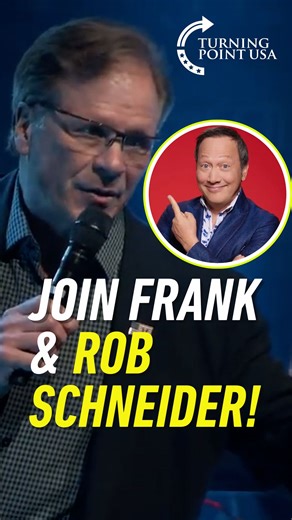
Join Frank at UC Berkeley TONIGHT (MON. 11/10) in Zellerbach Hall as he teams up with TPUSA and author/comedian Rob Schneider for the American Comeback Tour. We'll continue Charlie Kirk's mission of bold faith, open dialogue, and honest conversation about culture, faith, and truth.The event starts at 6:30 PM PT but doors open at 5:00 PM so grab your spot early! Can't attend in person? Watch the livestream on TPUSA's Rumble account. . . . #UCBerkeley #DrFrankTurek #RobSchneider #TPUSATour | Cross
19h
0 views
Facebook](https://www.facebook.com/reel/1216429797207411/)
- More Videos

RedState
'Berserkeley': Antifa Thugs Violently Attack Attendees at TPUSA's 'This ...
TodayTurning Point USA's "This Is Turning Point" tour was held on Monday night at the University of California Berkeley. This event is the final stop for the re-branded tour following the assassination of TPUSA founder Charlie Kirk. Comedian Rob Schneider and Christian apologist Dr. Frank Turek were the featured speakers for the sold-out event held at Berkeley's Zellerbach Hall.
- Only include results for this siteRedo search without this siteBlock this site from all resultsNEW
Share feedback about this site

YouTube[
##
TodayThe American Comeback Tour, featuring American actor and comedian Rob Schneider and American author Frank Turek, hosted by Turning Point USA, takes place at ...
- Only include results for this siteRedo search without this siteBlock this site from all resultsNEW
Share feedback about this site

KRNV
Smoke bombs and chaos: Turning Point USA's final tour stop ... - KRNV
TodayTurning Point USA held its final stop of the "American Comeback Tour" UC Berkeley, which was met with a crowd of masked protesters who set off smoke bombs outside of the event.
- Only include results for this siteRedo search without this siteBlock this site from all resultsNEW
Share feedback about this site

NTD News
LIVE NOW: Turning Point USA Tour Featuring Rob Schneider ... - NTD News
TodayThe American Comeback Tour, featuring American actor and comedian Rob Schneider and American author Frank Turek, hosted by Turning Point USA, takes place at the University of California-Berkeley.
- Only include results for this siteRedo search without this siteBlock this site from all resultsNEW
Share feedback about this site

San Francisco Chronicle
Charlie Kirk's Turning Point presses on with UC Berkeley date
Sep 22, 2025Turning Point USA continues its tour after Charlie Kirk's assassination, with Rob Schneider and Frank Turek set to headline at UC Berkeley.
- Only include results for this siteRedo search without this siteBlock this site from all resultsNEW
Share feedback about this site

The Mercury News
How UC Berkeley is preparing for Turning Point's final tour stop after ...
7 days agoTwo months after conservative advocate Charlie Kirk's assassination during a tour stop at a Utah university, his organization, Turning Point USA, will conclude its "American Comeback Tour ...
- Only include results for this siteRedo search without this siteBlock this site from all resultsNEW
Share feedback about this site
KCRA Channel 3
https://www.kcra.com › article › turning-point-usa-continues-tour-uc-berkeley › 68026439
Turning Point USA will continue tour, end series at UC Berkeley
Sep 24, 2025Of the dates announced, the final stop will be at UC Berkeley on Nov. 10, featuring actor Rob Schneider and author Frank Turek.
- Only include results for this siteRedo search without this siteBlock this site from all resultsNEW
Share feedback about this site
theturningpointtour.com
https://theturningpointtour.com
Brainwashed Tour - This is the Turning Point
November 10th University of California - Berkeley - EVENING EVENT Berkeley, CA
- Only include results for this siteRedo search without this siteBlock this site from all resultsNEW
Share feedback about this site

memesita.com
https://www.memesita.com › america-tour-2025-rob-schneider-frank-turek-berkeley-tickets-info
America Tour 2025: Rob Schneider & Frank Turek - Berkeley | Tickets ...
5 days agoWhen you see "Rob Schneider" and "University of California, Berkeley" in the same sentence, your brain immediately starts generating questions. And after digging into the details of the "American Comeback Tour" stop on November 10th, hosted by the TPUSA Berkeley chapter, we have
---
3 25 put here for context contrast
also david french 3 25 an conservatives faculty/ silenced [no evidence eg] and current omg BS legit retaliation?!
an 3 25
Since March 8, Mahmoud Khalil — a 30-year-old Columbia University student — has been held in a federal detention center in Louisiana for, Trump Administration officials allege, expressing sympathy to the terrorist group Hamas during protests on the campus.
Khalil, who was born in Syria to Palestinian parents, is a legal resident of the United States and is not accused of any acts of violence. And his wife is a U.S. citizen. But Khalil is at risk for deportation, and critics of the Trump Administration and U.S. Attorney General Pam Bondi are arguing that his detention is an example of thought policing — not an action based on legitimate national security concerns.
Two of those critics are attorneys Thomas Anthony Durkin and Bernard Harcourt (a law professor at Columbia University in New York City).
READ MORE:Sabotaging Social Security: Behind the leaked memo to cut agency staff and critical services
In an op-ed published by The Guardian on March 21, Durkin and Harcourt argue that the movement to deport students for saying controversial things recalls the late Sen. Joseph McCarthy's (R-Wisconsin) witch hunt of the 1950s.
"The legal risks are real," Durkin and Harcourt warn. "They are perilous, and they are alarming. Where a designated foreign terrorist organization (FTO) — such as Hamas, the Popular Front for the Liberation of Palestine, or related organizations such as the Samidoun Palestinian Prisoner Solidarity Network — is concerned, the line separating political advocacy from material support to terrorism can be razor thin, and any doubt tends to be resolved against those engaged in the political advocacy. FTOs are foreign organizations that the Bureau of Counterterrorism in the U.S. State Department designates as terrorist entities under Section 219 of the Immigration and Nationality Act."
The legal scholars add, "Once such a designation is made, it becomes unlawful for a U.S. person to knowingly provide that group with 'material support or resources.'"
According to Durkin and Harcourt, the "questionable legal strategy" being used against Khalil and other student protesters raises major civil liberties concerns.
READ MORE:'Clear and present danger': Experts alarmed at 'insanity' of Musk getting secret war plans
"Legal jeopardy for political advocacy has long existed in this country despite its storied embrace of the First Amendment," the attorneys explain. "But the Justice Department's new taskforce and threatened anti-terrorist prosecutions reach deeper into policing political dissent than anything seen since the McCarthy era. The consequences could be far more draconian than the usual campus risk of a misdemeanor civil-disobedience arrest or student discipline. The threat to the values of free speech and open debate on college campuses could hardly be more consequential."
READ MORE:Trump official urging Fox viewers to buy Tesla stock decried as 'abuse of power'
*Thomas Anthony Durkin and Bernard Harcourt's full op-ed for The Guardian is available at this link.
---
https://www.politico.com/news/2023/01/31/florida-new-college-conservative-trustees-00080541
taLLAHASSEE, Fla. — The newly-installed conservative board of trustees at New College of Florida ousted its current president in favor of former state education commissioner Richard Corcoran Tuesday, launching the initial move in reshaping the campus under the vision of Gov. Ron DeSantis.
The decision came at the first board meeting since DeSantis appointed six new trustees with the idea of overhauling the liberal arts college in Sarasota into a more conservative-leaning institution. That track was accelerated Tuesday when the board paved the way for new leadership as students and parents protested the major changes that appear bound for New College.
“Some have said these recent appointments amount to a partisan takeover of the college. This is not correct,” said trusteeMatthew Spalding, a constitutional government professor and vice president at Hillsdale College’s D.C. campuswho was appointed by DeSantis. “It’s not a takeover — it’s a renewal.”
A leadership switch from President Patricia Okker to Corcoran as interim leader is one of several moves made Tuesday by the board, which also signaled its intent to abolish diversity, equity and inclusion programs on campus — all policies pushed by DeSantis. The changes are major developments at the school spurred by the new appointees, including Christopher Rufo, a conservative activist who has advised DeSantis on critical race theory, and Eddie Speir, the co-founder of Inspiration Academy, a Christian charter school in Bradenton, Fla.
Tuesday’s meeting was met with apprehension from dozens of students and parents who protested what they called a “hostile takeover” at New College. They urged Okker to stay on as president and push back against the new mandates from the DeSantis administration to model the school as a“Hillsdale of the South” in reference to the private conservative religious “classical“ college in Michigan.
Okker in an emotional address told the board — and the campus — that she couldn’t continue to serve as president amid accusations that the students are being inundated with liberal indoctrination.
“The reality is, and it’s a hard reality and it’s a sad reality, but the vision that we created together is not the vision I have been given as a mandate here,” Okker said.
In remaking the board at New College, the DeSantis administration said the school was “completely captured by a political ideology that puts trendy, truth-relative concepts above learning” and in need of change following downward enrollment trends. To move on from Okker, trustees agreed to a “generous” exit package that includes at least 12 months of paid professional development leave and benefits. Corcoran is unable to begin serving until March, leaving Okker’s chief of staff Bradley Thiessen in charge until then.
“New leadership is the expectation and I think it makes sense,” Rufo said at the meeting. “I don’t think it’s a condemnation of Dr. Okker, scholarship or skills or character.”
DeSantis’ changes at New College follow other efforts to reshape higher education in Florida. Earlier Tuesday, the GOP governor proposed several changes to Florida’s university system, including pressing the GOP-led Legislature to cut all funding for diversity, equity and inclusion programs and to allow university leaders to launch tenure review of professors. Last year, DeSantis and state Republicans placed GOP allies in top university posts and pushed legislation that could limit how professors teach race.
New College is also now set to review its Office of Outreach & Inclusive Excellence at the request of Rufo as part of the state’s stance against diversity, equity and inclusion programs in schools. Rufo originally pushed to abolish the office outright, including four positions, and take other actions tied to diversity and equity, but decided to request further details on the program for a discussion in February.
New College trustees also want former Senate President Bill Galvano to serve as their general counsel and attorney. They asked the interim president on Tuesday to enter negotiations with the former Republican lawmaker who practices law in Sarasota.
Tuesday’s meeting was tense at times, with audience members frequently shouting over and at the new trustees as they spoke. Several parents and students addressed the board before they huddled, often criticizing their plans to retool the university and asking them to leave the college alone.
Some faculty said students felt “hopeless” about what could happen at the school, which is a unique college of under 700 undergraduates where students craft personalized education plans and don’t receive letter grades.
“Many students came here to feel safe and access the education that is their right as Floridians,” Diego Villada, Assistant Professor of Theater and Performance Studies, told the board. “And the impulse to make this a place where race, intersectionality and DEI are banned indicates to them that you want everyone to be the same – to be like you.”
Trustees, though, made it clear that the New College overhaul is fully underway, a message that came the same day DeSantis pledged to invest millions of dollars into recruiting faculty to the school.
“The campus needs a deep culture change. You sat up here, you called us racists, sexists, bigots, outsiders,” said trustee Mark Bauerlein, professor emeritus of English at Emory University who was appointed by DeSantis. “We are now in a position of authority in the college. And the accusations are telling us that something is wrong here.”
- Filed under:
- Florida,
- College,
- Ron DeSantis,
- College Board
aha yikes used to be k12? see campus free sp BS
an maya 1 23
Amid his attempt to ban race-related conversations from higher education classrooms, Florida Governor Ron DeSantis _{distributed a memo}_ requesting course data from state colleges that teach “diversity, equity and inclusion,” reports ABC News.
The request comes after a judge recently temporarily blocked the passing of the governor’s Stop WOKE (Wrongs to Our Kids and Employees) Act, which would ban race-related coursework, also known as critical race theory (CRT) from college and university classrooms.
In a statement from his office regarding the proposed law, DeSantis said, "No one should be instructed to feel as if they are not equal or shamed because of their race. In Florida, we will not let the far-left woke agenda take over our schools and workplaces. There is no place for indoctrination or discrimination in Florida."
READ MORE:_{**'Tone of humility': Florida columnist issues dire warning to Ron DeSantis**}_
Those who support DeSantis’ law believe CRT is “discriminatory” and that students should not learn about the history of oppression and privilege in the U.S.
Critical race theory — taught in mostly graduate school programs, and not K-12 classrooms — according to The Brookings Institution, _{asserts that}_ “U.S. social institutions (e.g., the criminal justice system, education system, labor market, housing market, and healthcare system) are laced with racism embedded in laws, regulations, rules, and procedures that lead to differential outcomes by race.”
ProPublica recently reported that DeSantis _{:{referred to the :(style="background-color:#ffff66;"):}:**Stop WOKE Act**}_ as the “the strongest legislation in the nation against the state-sanctioned racism that is critical race theory.”
On the other hand, those who adamantly disagree with the law say it restricts free speech. Daily Beast columnist Wajahat Ali called it “a racist dog whistle but with a facially neutral cover.”
READ MORE:_{**'Cold War' getting 'hotter and hotter' as Trump and DeSantis conflict comes to light**}_
The memo says, “Governor Ron DeSantis has prioritized a cost-effective higher education system that delivers high-quality service to Floridians to best prepare them for employment.” It continues, “Additionally, state law requires dutiful attention to curriculum content at our higher education systems.”
A State University System of Florida Board of Governors representative said all 12 colleges _{confirmed receipt}_ of the governor’s memo, according to ABC. And each institution is required to submit requested data by Friday, January 13.
note it does not say anyone was punished, just that they were afraid they wd be
an 6 22
The University of Houston has settled with a conservative free speech group that sued the school over an anti-discrimination policy that the group argued was overly broad and violated students’ First Amendment rights.
As part of the settlement, UH officials will have to pay $30,000 in attorney’s fees to Speech First and UH officials must keep in place its amended anti-discrimination policy.
In this case, Speech First, a group that actively litigates college policies they view as student censorship, targeted UH’s anti-discrimination policy that has been in place since 2012. According to that policy, unlawful harassment was defined as “humiliating, abusive, or threatening conduct or behavior that denigrates or shows hostility or aversion toward an individual or group” or conduct that created a hostile living or working environment or interfered with an individual’s academic or work performance.
Examples of such harassment included “epithets or slurs,” “negative stereotyping” and “denigrating jokes.”
It also stated “[m]inor verbal and nonverbal slights, snubs, annoyances, insults, or isolated incidentsincluding, but not limited to microaggressions,” would be considered harassmentif the actions occurred repeatedly and targeted a particular group of people based on their race, sex or gender or other status that keeps them protected from discrimination.
But in May, three months after Speech First filed its suit, the university amended its policy. Later that same month, U.S. District Judge Lynn Hughes, a Reagan appointee, blocked the university from reinstating its original anti-harassment policy.
“This is a huge win for the First Amendment,” said Cherise Trump, executive director of Speech First, a group that pushes back against what it calls “toxic censorship culture” on campuses. “It sends a message to the University of Houston and other universities that they will be held accountable if they enact unconstitutional policies on campus.”
In a statement, UH officials said they have come to an “amicable” agreement and consider the matter resolved.
“As a result of our discussions, a revised anti-discrimination policy has been adopted,” Chris Stipes, director of UH media relations, said in a statement. “The UH System remains committed to protecting the constitutional rights of our students and employees.”
Speech First filed the lawsuit on behalf of three conservative students identified only as “A,” “B” and “C” who said they felt they could not express their beliefs on campus for fear they would be punished under UH’s older policy.
As examples, the lawsuit listed how the students feared retaliation if they shared personal beliefs such as “affirmative action in college admissions is racist” or “allowing biologically male athletes who identify as female to compete in women’s sports is fundamentally unjust.” All three said they were uncomfortable acknowledging fellow students’ preferred pronouns outside of a cisgender identity.
In documents, lawyers for the university argued that its policy specifically addresses unlawful harassment of students and would not consider those statements and ideas provided by the students in the lawsuit as a violation of the policy.
University lawyers have also argued there is no evidence that the anti-discrimination policy has ever been used against students.
When the university amended the anti-discrimination policy in mid-May, it specified that harassment must rise to the level of creating a hostile work environment for employees or to deny a student equal access to education by creating a hostile learning environment. That is the standard set by the 1999 Supreme Court decision in Davis v. Monroe County Board of Education, which states that schools violate the Title IX ban on sex-based discrimination if they remain deliberately indifferent to sexual harassment to the point it prevents a student from receiving an equitable education.
Two years ago, the U.S. Department of Education Office of Civil Rights under former President Donald Trump used that definition of sexual harassment when it issued revised rules and standards for investigating Title IX violations on college campuses, which was a more narrow definition for sexual harassment than any previously used.
Speech First lawyers argue that many universities, including UH, adopt harassment policies outside of that guidance that are too broad, providing a chilling effect to students’ free speech.
A UH lawyer said the definition of sexual harassment in the Davis case did not limit schools from enacting other policies to address unlawful harassment and should not be considered the standard for universities as they craft disciplinary policies to address other instances of inappropriate behavior.
“Speech First has tried to bootstrap Davis in numerous other cases, and to date none has held that Davis imposed the outer bounds for addressing unlawful harassment,” they wrote.
But when Hughes, the federal district judge, granted a preliminary injunction late last month preventing UH from reinstating its original anti-harassment policy, he sided with Speech First.
“Restraint on free speech is prohibited absent limited circumstances carefully proscribed by the Supreme Court. Any limitation deserves the upmost scrutiny,” he wrote, stating the group would likely win the case. “The University says that it will be injured if recourse is unavailable for harassment against students of faculty. As important as that is, students also need defenses against arbitrary professors.”
This is the latest victory for Speech First, which has sued universities across the country over free speech policies, including the University of Texas at Austin. The case against UT-Austin took a similar path. Speech First sued the university in 2018 over language in multiple freedom of expression policies. UT-Austin amended some of the policies before settling with the organization and agreed to discontinue the university’s Campus Climate Response Team, part of the division of student affairs and the division of diversity and student engagement that investigated student reports of bias incidents on campus.
This lawsuit comes as other free speech debates have bubbled up on Texas college campuses throughout this past academic year.
At Collin College in North Texas, three professors have sued the school, arguing their contracts were not renewed in retaliation for exercising their First Amendment rights on a variety of issues, including one professor who publicly criticized the school’s COVID-19 response.
Nearby at the University of North Texas in Denton, thousands of students and community members signed a petition calling on school administrators to expel a right-wing student, arguing her campus activism and statements opposing gender-affirming care for transgender children created an unsafe learning environment for transgender students on campus.
In that instance, administrators denounced the student’s comments, but they said she and her right-wing campus group had not violated any university policies.
==
no one gets 1 mil$/yr to spread left ideas?!
pension plan?
no lnx
Walker’s New Job Will Pay Plenty
National group he will run has lots of money. But Walker won’t be able to run for office.
By Bruce Murphy - Jul 15th, 2019
The Scott Walker era is over in Wisconsin.
After threatening to run for either governor or senator in Wisconsin in upcoming elections, Walker has announced he will be taking a job as president of the Young America’s Foundation, a national non-profit based in the Washington D.C. area (northern Virginia) that works to promote conservative ideas among young people and is perhaps best known for running the Reagan Ranch.
“This would preclude me from running for governor in this next cycle or running for the U.S. Senate if Ron Johnson’s seat is open,” Walker told the Journal Sentinel. “I won’t be engaged in anything else. This will be my sole occupation.”
That’s because it’s a full-time job and Walker agreed to serve in the position for four years. But he won’t be starting the job until January 2021, when the group’s current president, Ron Robinson, steps down after more than 40 years.
Walker has campaigned for political office in 15 elections over 29 years. Why would he agree to abandon his political hopes, which still seemed to be burning as hotly as ever, and wait that long for this position?
Walker told the newspaper that he and his wife, Tonette, have spent “a lot of time thinking about and praying about” the move. “But it just feels like God’s calling us to take on this mission.”
But the money he will earn might also have something to do with his decision. Walker’s past financial disclosure statements show he’s not a wealthy man. Going into his 2016 reelection campaign for governor Walker “reported a Barclays credit card with a balance of $10,000 to $15,000 at a high interest rate of 27.2 percent; a Bank of America credit card also with debt of $10,000 to $15,000; andfederal loans of up to $250,000 to pay for college for his two sons,” as Politico reported.
The salary for his current job, as fundraising chairman for the National Republican Redistricting Trust, is not known, but the likely compensation for the job with Young America’s Foundation will be quite lucrative. The group’s most recent federal tax form, for 2017, shows that Robinson earned slightly more $1 million a year in total compensation.
The group is very well funded, with total assets of $69.5 million in 2017, and a $23.7 million annual budget, with $5.9 million of that going to salaries and expenses. The group had some $24 million in investments, which earned $2.7 million in investment income in 2017.
The intended use of the endowment funds, the group notes on its tax form, is to support its program activities, including the Reagan Ranch, National Journalism Centerand national conservative student programs and seminars.
Young America’s Foundation calls itself “the principal outreach organization of the Conservative Movement.” Founded in 1977, it merged in 2011 with Young Americans for Freedom, a group launched in 1960 by conservative icon, William F. Buckley. The group has been active in battles over speech at universities and in sending conservative speakers to college campuses.
3 22
https://www.alternet.org/2022/03/jack-petocz-florida/
suspended for handing our gay flag
i'm sure FIRE is on the case
an 1 22
Baker College, one of the largest private schools in Michigan, is threatening legal action against a former faculty member who spoke to ProPublica and the Detroit Free Press for an investigation published this month.
Jacqueline Tessmer, who taught digital media for 14 years at Baker’s campus in Auburn Hills, told the news organizations that students often came to the nonprofit college unprepared to succeed and exited without degrees or good jobs but with heavy debt from loans. “Baker College has ruined a lot of people’s lives,” she said in the story.
A Jan. 19 letter to Tessmer — sent by the law firm Plunkett Cooney on behalf of Baker — demanded she retract her statements, which it described as “false and defamatory.” It did not specify what, if anything, was false. Arguing that Tessmer was in violation of a nondisparagement clausein a settlement she reached with Baker in an employment dispute, attorney Courtney L. Nichols also demanded that she “agree voluntarily to remit payment to Baker College for the damages it has suffered as a result of your violation(s), including attorney fees.” The letter did not include a dollar amount.
Since publication, Baker has not contacted either news organization to contest the validity of her statements. Before publication, the Free Press and ProPublica informed Baker that Tessmer would be quoted and shared her comments. Baker did not specifically address those quotes or Tessmer’s time at the college.
Baker’s letter to her after publication gave her seven days to respond. Tessmer said in an interview this week she stands by her comments and will not meet the college’s demands.
She said she didn’t see how it would be possible to make a retraction even if she wanted to, given that she expressed her opinion “based on what I did in service to the college” and her comments were only “a couple of sentences in a giant article.”
“I could be quiet, but is it really going to matter at this point?” she added.
The story on Baker examined the college’s low graduation rates, its aggressive marketing and the oversight of a Board of Trustees that has included former presidents of the school.
In addition to the letter to Tessmer, Baker responded to the article by emailing students, writing a letter to the editor in the Free Press, and placing a statement on its website that disparaged the story and touted the school’s achievements. Officials have defended the 111-year-old college as an affordable open enrollment school whose practices are reviewed by regulators and accreditors.
Neither Baker nor its lawyer has responded to a request for comment on the legal threat.
Tessmer’s relationship with Baker ended in a lawsuit she filed for breach of contract and retaliation. The school disputed her claims in a countersuit, and the case ended in a settlement in 2014. The letter from Baker’s lawyer also suggested that if Tessmer had spoken about the settlement, she would be in violation of it.
“This is what they do,” said Tessmer, now self-employed. “They scare. They huff and they puff, and it works a lot of the time. I mean, it’s worked on me.”
The letter to Tessmer said that if she did not comply, “Baker College will consider its available recourse.”
As of Thursday evening, Tessmer had not heard again from the law firm.
1/22
- Newsweek|3 days ago
- The cancellation comes after Florida Gov. Ron DeSantis vowed to push for legislation banning critical race theory from being taught in schools.
- NH bill takes aim at professors peddling CRT in classroom
- Campus Reform|6 days ago
- If passed, the bill will prevent professors from 'teaching that any one group of people is inherently superior, racist, sexist or oppressive.'
- Poll: Over half of American teachers oppose the teaching of critical race theory
- The College Fix|5 days ago
- Over half of the nation's (CRT) in schools according to a recent EdWeek Research Center survey. Education Week's Eesha Pendharkar, who says conservatives have "mischaracterized" CRT as a movement "to indoctrinate white students with a liberal agenda,
- As Republicans peddle ban, educators insist critical race theory not taught
- The Roanoke Times|4 days ago
- Patrick, filed a bill that would make it a misdemeanor crime for those who teach critical race theory and other such concepts.
- Exclusive: Florida school district cancels real history as anti-CRT censorship spreads
- Salon on MSN.com|3 days ago
- Florida county cancels civil-rights seminar for teachers over CRT "red flags" as educators face climate of fear
- Anti-CRT bill passed out of Senate committee likely unconstitutional, opponents say
- Mississippi Today|7 days ago
- The Senate Education Committee passed legislation banning critical race theory in Mississippi K-12 public schools and in public universities.
- 'Corporate-sanctioned racism'? How war on critical race theory spread from schools to big business
- USA Today on MSN.com|6 days ago
- Critical race theory is not just an issue in schools. Republicans want to restrict how companies like CVS and Verizon talk to employees about racism.
- Local educators, parents react toGov. Youngkin's ban of Critical Race Theory
- WTKR.com|9 days ago
- Gov. Glenn Youngkin's first executive order bans "inherently divisive concepts, including Critical Race Theory" from being taught in schools.
- WATCH: Mississippi Black Senators Walk Out Over Stupid CRT Vote
- Crooks and Liars|3 days ago
- "We did not need to spend time on this. Even the author of the bill said this was not occurring in Mississippi."
- Black Mississippi State Senators Stage Walkout as Critical Race Theory Ban Passed
- Common Dreams|5 days ago
- "We cannot continue to stumble into the future backwards," said one Black senator who taught for 33 years. "That's what this bill does."
- Black Senators in Mississippi Protest as the State Senate Passed Bill that Would Ban Teaching Critical Race Theory
- The Root on MSN.com|6 days ago
- It's happening all over the country. White people have had enough of Critical Race Theory. In Florida, Gov. Ron DeSantis is pushing to have a bill that would prohibit schools from making white people feel uncomfortable when talking about racism.
- Virginia governor, Republicans off to a rough start with ban on critical race theory
- The Grio|9 days ago
- The state's GOP leaders would do well to remember that they do not have a mandate to run wild with far-right governance.
- Critical race theory debate in Kansas shifts to curriculum transparency. How will it affect the classroom?
- The Topeka Capital-Journal on MSN.com|2 days ago
- Kansas lawmakers shifted from merely focusing on objectionable areas of instruction to giving parents and community members curriculum transparency.
- Supreme Court Will Hear Challenge to Affirmative Action at Harvard and U.N.C.
- New York Times|3 days ago
- The court's new conservative supermajority may be skeptical of admissions programs that take account of race to foster educational diversity.
- School District in Florida Cancels Professor's Civil Rights Lecture Over Concerns of Critical Race Theory
- The Root on MSN.com|3 days ago
- The debate over critical race theory has continued to affect how students across the country learn about the history of the United States and the controversy has played out once again in the state of Florida.
- States weigh Texas-style enforcement for guns, schools after Supreme Court abortion ruling
- USA Today on MSN.com|1 day ago
- Texas allowed private citizens to sue over abortions. State lawmakers are considering whether to import that same approach to other divisive issues.
- Biden Expected to Nominate a Black Woman to the Supreme Court
- New York Times|4 hours ago
- The president's promise highlights a group that has struggled to become part of the very small pool of elite judges in the nation's higher federal courts.
- Biden is expected to nominate a Black woman to the Supreme Court
- Chicago Tribune|7 hours ago
- President Joe Biden and his legal team have spent a year preparing for this moment: the chance to make good on his pledge to name the first Black woman to the Supreme Court.
- NC Critical Race Theory bill tries something new, but fails | Charlotte Observer
- Charlotte Observer|13 days ago
- By the Editorial Board The North Carolina Senate's new bill on Critical Race Theory in schools makes an important and welcome distinction that separates it from CRT bills in the N.C. House and ...
- Conservative legislators: Diversity efforts form of critical race theory
- Leavenworth Times|8 days ago
- Conservative legislators assailed diversity efforts in Kansas school districts as tantamount to critical race theory, hearing from parents who termed the lesson plans and curriculum as "Marxism," a sign the issue is not going away ahead of the upcoming legislative session The debate on critical race theory has raged for months,
821 common dr
no lnx
The secret corporate memo behind today's guerilla war on campus progressives
Nancy MacLean , Lisa Graves and Common Dreams August 25, 2021
As college students return to classes this fall, the latest culture war campaigns will join the pandemic in upsetting campus life. If recent experience is any guide, their proximate cause will be well-funded right-wing groups that thrive on provoking and publicizing conflicts: "Campus Reform" (part of the Leadership Institute), Turning Point USA, and more.
:{
}:
When the University of North Carolina tried to hire a distinguished journalist, for example, Turning Point USA's Charlie Kirk had this to say: "Nikole Hannah-Jones is a racist and a liar." He urged allies to "find the names of the biggest donors at your school and email them"—and monitor faculty with his ProfessorWatchlist.org. Campus Reform obtained the offer letter sent to Hannah-Jones and Fox News cranked up its outrage machine. We know the rest of the story.
Such groups have actively targeted professors who teach about structural racism in American history. The latest buzzword is "CRT," critical race theory, which they claim is dividing students at all educational levels, even though CRT is mainly a law school elective.
Such clashes have multiple sources, but the least understood one is how they serve a long-term strategy to disrupt and transform higher education so it better serves corporate interests.
The initial mission statement was a confidential memorandum issued 50 years ago this week, on August 23, 1971, by a tobacco lawyer named Lewis Powell, Jr., at the behest of his neighbor Eugene Sydnor, a leader in the U.S. Chamber of Commerce. Powell's memo, which was shared with numerous CEOs, only became public after it was leaked to a reporter.
The memo carried the foreboding title "Attack on the American Enterprise System." It was filled with socialist fear mongering akin to the political rhetoric of 2020. Powell alleged "a wide-ranging attack from many in the media, in politics, and on the campus." His proposed corporate counterattack put higher education in the crosshairs. Powell recommended that donors and trustees exert power over education "to address the campus origin of this hostility." He urged "constant surveillance" of textbooks.
Powell upbraided corporations for enabling popular animus by "appeasement, ineptitude and ignoring the problem." He urged CEOs to engage in a long war to embed ideas then regarded as radical into the mainstream. "Strength lies in organization," he counseled, "and the scale of financing only available by joint effort." He also urged corporate funding of new institutions to advance the mission.
Less than two months later, President Richard Nixon nominated Powell to the U.S. Supreme Court, where he spent the next 15 years re-shaping the Constitution to give corporations more rights.
Soon after Powell's memo, an heir to the Coors fortune helped create the Heritage Foundation. The new American Legislative Exchange Council (ALEC), created to advance the corporate agenda in the states, moved in with Heritage.
But such advocacy was not enough for the young leader of one of the largest privately held companies in America, Charles Koch. In 1974, he issued "The Anti-Capitalist Mentality," a blistering follow up to Powell's memo contending that taxes were forcing corporations to subsidize universities hostile to their agenda and that CEOs were putting too few strings on their giving.
America has seen these seeds grow since the 1970s into action by the wealthiest few on the political right to create pro-corporate centers and institutes, fund faculty hires and research, pay for lectures and seminars, change curricula, and even underwrite fields such as law and economics. They have also engaged in collective power plays, as with the American Council of Trustees and Alumni, launched in 1995 to coordinate the muscle of donors.
The corporate donors most committed to disrupting higher education have been those also known for polluting debate with disinformation that serves their bottom lines while endangering the rest of us.
A case in point is Koch Industries, a fossil fuel conglomerate that has spent three decades as a key funder of climate science denial. The Koch family has spent nearly half a billion dollars at more than 500 colleges and universities since 2001, and millions more before that.
It's a shrewd pincers' action: push to cut taxes that fund public universities and then appeal to trustees to accept Koch's ideologically driven campus investments. Meanwhile, the Koch-funded Leadership Institute publishes Campus Reform, which targets professors. Koch's foundation has publicly condemned "inciting harassment of scholars" and said it does not fund Campus Reform but it has long funded the Leadership Institute, whose selling point is its campus network.
So, where is the 50-year plan to counter Powell's memo and Koch's implementation of it? For the health of our democracy, we need to disarm the war on knowledge and reason, now painfully evident in the widespread resistance to life-saving vaccines and masking.
One step is to expose the theories and money fueling disinformation. Another step is to restore public funding for public universities so that self-interested donors cannot distort what is taught and who teaches it. Robust public funding can rescue the pursuit of knowledge that supports evidence-based public policy rather than the coin-operated output preferred by some CEOs.
omfg:
aha
univ is an institution (// "gov't schools") that does science, is rational , teaches critical thinking, questioning; but AM values Story 1 sacred, sacrosanct so evil to attack them.
trad DTricks is used in election to get pwr, now used to hold onto power, using tools of state = fascism [tho nixon]
aha: // mlk on switch out modifier: good trouble, gang of 5 we are the new/true radicals; appropriation/inversion/perversion of lefty god term[at the same time attacking woke, new PC]; for left/reality racial diversity does being intellecti\ial diversity dofferent POV; builds on Lichter? Horo BS of how lefty commie profs discriminate ~ conservatives; gop is in death spiral, at least demographically so must cheat to preserve minority power[states rights BS ~ HR1 ~ voter suppress, gerry, dark corp $); GOP can't win in mktplace of ideas[libtard bankrunpted by covid fail; must explain away fail by saying media, soc media and univ ~ them
msnbc moral panic: you raise kids w/ right values/american and univ makes them into liberals[and/or gay?]
https://www.alternet.org/2021/06/ron-desantis-2653505905/
Florida goes full fascist': Ron DeSantis sparks furious backlash with ‘authoritarian’ campus political surveys
Raw Story June 23, 2021
Gov. Ron DeSantis signed legislation requiring Florida students, faculty, and staff to register their political views in surveys in an effort to promote "intellectual diversity" at colleges and universities, and the measure set off backlash across social media.
Critics decried the law, which DeSantis claims will promote freedom of speech, as a "thoroughly Orwellian" attempt to gain control over academic debate at institutions of higher learning....
https://www.alternet.org/2021/07/conservative-thought-on-college-campuses/
Eric Kaufmann published last month a perplexing account of ideological diversity on college campuses for National Review. He opens the piece by noting that, in a recent survey of female college students, only 6 percent said they would date a Trump supporter, which, as Kaufmann see it, "reveals the predilection among many young elite Americans for progressive authoritarianism." Kaufman then segues into an account of discrimination against conservatives and the problem of liberal over-representation. This, he maintains, like race-based discrimination, merits federal intervention. Solution? Mandating "viewpoint neutrality" in higher education.
Kaufmann's piece was roundly and rightly criticized for its troubling implications regarding free speech as well its bizarre inferences about dating and authoritarianism. I won't rehearse those arguments. But there is something else worth noticing.
Many commentators, including some on the left, have uncritically accepted two of the premises underlying Kaufmann's argument. One, that social justice is increasingly illiberal. Two, that ideological imbalance on college campuses is a societal problem.
For example, in his critique of Kaufmann, New York's Jonathan Chait writes, "Despite veering off immediately into absurdity, Kaufmann does identify a real problem. Many elite American institutions, most dramatically but not exclusively in academia, are becoming ideological monocultures in which commitment to progressive goals is becoming a formal or informal criteria for membership within the community."
This description of a "monoculture" echoes concerns previously voiced by writers from across the political spectrum. In 2019, Nicholas Kristof wrote, "Yet while I admire campus activism for its commitment to social justice, I also worry that it sometimes becomes infused with a prickly intolerance, embracing every kind of diversity except one: ideological diversity." Similarly, the signatories of the 2020*Harper*'s letter, ranging from leftists to conservatives, also critiqued the social left's "restriction of debate." In this same vein, George Packer's most recent piece in The Atlantic characterized current social justice in America as bordering on tyranny.
When writers—from the left, center or right—reference "ideological conformity" or "monoculture," they often offer little in the way of details. References to homogeneity of thought surely sound troubling. But it all remains very abstract. What's missing is concrete description. So let's unpack these claims a bit to see the box is empty.
Democracy relies on debate between citizens. This does not presume every debate is worthwhile, though. Nor does it imply ideological conformity is always bad. We should not, for example, be concerned about conformity concerning the tooth fairy or the shape of Earth. It's good to agree that the human body is made of cells, that Germany invaded Poland in 1939 and that 2 + 2 = 4. Conformity is often the result of the truth.
Some might protest. The problem of ideological conformity doesn't revolve around objective facts, some say; rather, it's about the lack of representation of conservative thought. OK, but be specific. What conservative thought has been silenced?
Critics of "monoculture" aren't concerned that the work of Milton Friedman or Frederick Hayek is excluded from economics courses—such a concern would be false. In 2021 alone, Google Scholar yields around 8,000 results for articles mentioning these authors. Nor should we worry that anti-capitalist sentiment is taking over college campuses, given the sheer number of works churned out extolling the merits of markets. Universities from Georgetown to Cornell to Texas Tech have whole institutes devoted to this subject. Libertarians, conservatives and liberals all participate.
So one has to ask, again, what conservative thought is being ignored exactly? More likely, the complaint is that college classrooms lack positive representations of the current political beliefs of the Republican Party. And herein lies a small problem: the political beliefs of the GOP are, in fact, diametric to the entire project of education.
Just to make a quick list: according to current Republican belief, climate change is, at best, a natural phenomenon unaffected by human behavior and hardly worth worrying about. More often, it doesn't exist. The party also continues to deny the results of a fair and secure democratic election. Republicans have also argued that masks are an ineffective public health measure, covid is just like the flu and George Soros, a Jewish billionaire, pays protesters who disagree with Republican Party policy. Within the party, doubts still remain about whether Barack Obama was born in the United States.
The list goes on. Just the past few weeks have seen Fox News run endless anti-vaccination commentary, including the assertion that guidelines are akin to apartheid. Breitbart featured headlines on the Marxist threat to Taylor Swift. The Federalist published deep dives into Obama's potential connections to critical race theory. The American Conservative published a piece arguing the mass graves of Native children in Canada were "good, actually" as they were a product of a "sincere concern for the salvation of their souls." In the Meantime, Claire Lehmann, the editor of Quillette, spent her week tweeting about Black women's nails as a signal of possible drug abuse.
Given all this, why exactly should we be worried about Republican thought being less well-represented on college campuses? Are we concerned that students won't learn enough falsehoods? That they won't be exposed to enough racism? That covid denialism isn't being taught in biology class? That psychologists aren't seriously considering debates over whether or not Black people are intellectually inferior?
Or maybe conformity really boils down to colleges and universities recognizing and promoting the scientific consensus that gender is fluid, which aligns with guidance from the American Medical Association, the American Psychiatric Association and the American Psychological Association? Is this the terrifying monoculture?
Look, colleges should be maximally permissive in order to protect academic freedom. They should do everything they can to be ideologically blind while hiring. No one should try to ascertain an applicant's ideology. Trump supporters should be hired just as readily as Biden supporters. No professor should be sanctioned for teaching conservative economic theories. Nor should any professor get in trouble for being skeptical of critical race theory or Marxism or any other intellectual framework. However, professors should be sanctioned when they fail to do the basic requirement of their job: education. Modern conservative thought is antithetical to this project.
So do I fear this liberal monoculture in academia? No. One, academia is actually quite ideologically diverse. Two, in cases where "ideological conformity" does exist—such as "the earth is round" and "racism is bad"—perhaps we shouldn't be that fearful of it.
Overall, if analysts are concerned by the lack of representation of conservative ideology, they should be more explicit about which ideas within the Republican potpourri of falsehoods and bigotry should be adopted in college curricula.
FROM YOUR SITE ARTICLES
- GOP 'indoctrination' law aimed at Florida colleges is a 'disgraceful ... ›
- Rising GOP star Ron DeSantis goes after campus thoughtcrime with ... ›
- Why Bashing 'Politically Correct' Campuses Is Hurting Conservatism ... ›
- Miami paper slams new Florida law aimed at college professors ... ›
RELATED ARTICLES AROUND THE WEB
- Campus conservatives aren't under siege — but there's more to the ... ›
- What liberals and conservatives get wrong about free expression on ... ›
- Evidence That Conservative Students Really Do Self-Censor - The ... ›
hypocrisy
Former Associated Press reporter Emily Wilder was fired from the international media company late Thursday following a pressure campaign by right-wing media, including publications such as The Federalist and The Washington Free Beacon working in tandem with the Standford College Republicans. Wilder was "canceled," if you will, for pro-Palestinian activism during her years in college — not at the AP.
The campaign to have Wilder fired started on Monday with the Stanford College Republicans taking to Twitter to bill the reporter's past pro-Palestine demonstrating as controversial, coming to the verdict that she would never be able to be impartial while covering national news.[twt pix]
"Recently, we discovered that theAssociated Press has hired former Stanford anti-Israel agitator, Emily Wilder, who referred to the late Sheldon Adelson as a 'naked mole rat' as one of their 'journalists,'" the college Republican organization tweeted. The series of tweets from the Standford Republican chapter went onto claim that the reporter, who is Jewish, during her college years belonged to a "Students for Justice in Palestine," on-campus group. The college Republicans — who appear to have their own questionable Twitter activity — also took offense to Wilder calling right-wing provocateur Ben Shapiro a "little turd" and Sheldon Adelson a "naked mole-rat."
From there, the right-wing outrage machine got ahold of the story, including The Federalist, The Washington Free Beacon, and Fox News, which billed the reporter as being "anti-Israel." Notably, the Free Beacon ran their hit-piece with no attached byline and didn't return Salon's request for comment as to why.
On Thursday, an all-staff email from AP News director Peter Prengaman to employees read: "A note to say that news associate Emily Wilder is no longer with the AP[twt pix]
but the Associated Press claims it wasn't her activism in college. "While AP generally refrains from commenting on personnel matters, we can confirm Emily Wilder's comments on Thursday thatshe was dismissed for violations of AP's social media policy during her time at AP," an AP spokesperson told The Wrap.
"Amazing how quickly a talented young reporter's career can be snuffed out by a Twitter mob that decided to feign outrage over some college tweets. And if @vv1lder somehow violated @AP's social media rules, the solution is to offer guidance, not termination, to a new reporter," TheWashington Post's Glenn Kesslerwrote on Twitter following the ouster.
[twt pix] responding to her firing, Wilder told SFGATE that her firing was nothing more than a right-wing outrage mob that reportedly disdains "cancel culture," doing what they claim to resent.
"There's no question I was just canceled," told SFGATE reporter Eric Ting on Thursday following the news of her firing. "This is exactly the issue with the rhetoric around 'cancel culture.' To Republicans, cancel culture is usually seen as teens or young people online advocating that people be held accountable over accusations of racism or whatever it may be, but when it comes down to who actually has to deal with the lifelong ramifications of the selective enforcement of cancel culture — specifically over the issue of Israel and Palestine — it's always the same side."
in her interview with SFGATE, Wilder noted an "onslaught of absolutely vile messages" she received after right-wing media began running with the story. Wilder didn't immediately return a request for comment from Salon.
While The Associated Press might have folded to the demands of the right-wing mob, many journalists on Twitter voiced their support for the young journalist. "Shame on @AP @peterprengaman. I stand with Emily. Her reporting at our newspaper was excellent. Reverse your decision NOW," The Arizona Republic's reporter Rebekah Sanders wrote. The Washington Post's Dave Weigel responded: "'Hire @vv1lder' is something more and more people are saying."
"Every journalist should be outraged about @AP firing [Wilder] over college activism in favor of freedom for Palestinians. The industry is rife with clear double-standards on this," Los Angeles Times investigative reporter Adam Elmahrek commented on the firing. The Daily Beast's senior politics reporter Will Sommer replied, "It's crazy that editors are still falling for these bad-faith campaigns from right-wing media."
The decision to out Wilder comes on the heels ofright-wing pundits cheering the Israeli airstrike that leveled a building in Gaza on Saturday, housing several international news outlets, including The Associated Press.
FROM YOUR SITE ARTICLES
- 'Criminal complicity': Outrage as Biden pushes $735 million ... ›
- The Associated Press says it can't declare a winner in Iowa as ... ›
- Fox News confirms shocking story on Trump's contempt for ... ›
https://www.amazon.com/No-Safe-Spaces-Adam-Carolla
// d'souza
Adam Carolla and Dennis Prager raise the alarm on cancel culture and identity politics.
The First Amendment and free speech are under attack in America today. A growing number of Americans don't believe you have the right to speak your mind if what you have to say might offend someone, somewhere. They advocate for "safe spaces" to protect people from ideas they may find troubling, and will tear down or “cancel" anyone and anything that stands in their way.
In NO SAFE SPACES, comedian and podcast king Adam Carolla and radio talk show host Dennis Prager take the audience on a powerful and entertaining journey to expose how identity politics is threatening free speech everywhere in America. Along the way, Carolla and Prager show Americans how to have the courage to defend their First Amendment rights.
Influential personalities from the right and the left collaborated in this very relevant, thought-provoking documentary feature film!
Adam Carrolla
Dennis Prager
Jordan Peterson
Ben Shapiro
Adam Carolla
The Adam Carolla Show is the #1 daily downloaded podcast in the world!
Dennis Prager
Dennis Prager's radio shows and podcasts reach over 11 million listeners daily.
Jordan Peterson
Jordan Peterson's book 12 Rules for Life is a worldwide best-seller with over 4 million followers across his social channels.
Ben Shapiro
The Ben Shapiro Show consistently ranks in the Top 5 in the podcast industry with over 15 million podcasts downloaded per month.
Van Jones
Tim Allen
Cornel West
Alan Dershowitz
Van Jones
Tim Allen
Cornel West
Alan Dershowitz
lady liberty
“No Safe Spaces is a film every American should see. I could barely move when it was over. Powerful, emotional, and a call to action for anyone worried about the intellectual fascism happening in this country. A brave, timely, and important film.” – Megyn Kelly
carolla
“No Safe Spaces is smart, vital, urgent, and provocative..."
- Owen Gleiberman, Variety
Editorial Reviews
Comedian and podcast king Adam Carolla wit radio host Dennis Prager take the audience on a powerful and entertaining journey to expose the growing threat to free speech taking place on university campuses, in social media, and at your place of work.
Product details
MPAA rating : s_medPG13 PG-13 (Parents Strongly Cautioned)
Product Dimensions : 0.7 x 7.5 x 5.4 inches; 2.72 Ounces
Media Format : Anamorphic, NTSC
Run time : 1 hour and 40 minutes
Release date : September 15, 2020
Actors : Adam Carolla, Dennis Prager
Studio : Mill Creek Ent
https://www.thecollegefix.com/south-dakota-legislature-passes-intellectual-diversity-bill/
The College Fix
Original. Student reported. Your daily dose of Right-minded news and commentary from across the nation
FREE SPEECH POLITICS
South Dakota Legislature passes intellectual diversity bill
GRAHAM PIRO - STAFF REPORTER •MARCH 14, 2019
UPDATED
Sponsor says she’s ‘thrilled’ with passage
After multiple legislative failures, the South Dakota Legislature has passed a bill to promote intellectual diversity on campus. HB 1087 is on its way to the governor’s desk after the House passed the Senate-amended bill, 51-12, on Tuesday.
“We are thrilled that South Dakota has become the first state in the nation to adopt legislation requiring universities to promote intellectual diversity and not simply be dominated by the left,” Rep. Sue Peterson, a sponsor of the bill, told The College Fix in an email.
She called this leftist domination “a national epidemic which has undermined the education of thousands of students and fueled out-of-control political correctness at the expense of hard-working taxpayers.”
South Dakota is not the first state to adopt this type of legislation, however. Colorado and Tennessee both passed similar legislation in 2017.
Of the 12 representatives who voted against the bill, nine were Democrats, and three were Republicans. Seven representatives were excused from voting.
The South Dakota Board of Regents had adopted new policies last year intended to promote free expression and debate on campus. Peterson had previously expressed to The Fix that she wanted to lock in these reforms via legislation.
The bill forbids any public institution of higher education from discriminating “against any student or student organization based on the content or viewpoint of their expressive activity,” according to its language.[...?]
MORE: Push to support intellectual diversity underway in South Dakota
4/5/19: This article was updated to reflect that both Colorado and Tennessee passed legislation protecting speech on campus in 2017, prior to South Dakota’s bill....
==
==
excess evil or just well covered by cmd?
wisconsin Assembly Passes Bill Designed to Chill Campus Protests
by David Armiak | February 12th, 2020 Modeled after a similar measure drafted by the right-wing Goldwater Institute, the bill imposes mandatory disciplinary sanctions on anyone under the jurisdiction of an institution “who engages in violent or other disorderly conduct that materially and substantially disrupts the free expression of others.”
===
https://www.alternet.org/2019/10/students-burn-a-latina-authors-books-that-addresses-white-privilege-report/
==
not vetted
What liberals and conservatives get wrong about free expression on college campuses
Timothy Ryan, University of North Carolina at Chapel Hill and Mark McNeilly, University of North Carolina at Chapel Hill
A lot of the pressure that leads college students to keep their views to themselves comes from other students, not faculty, new research shows.
==
https://www.c-span.org/video/?463545-1/the-case-free-speech
919 quite good
The Case Against Free Speech
Journalist P.E. Moskowitz argued that the term “freedom of speech” is being defined and redefined by the Left and the Right to advance their agendas.
.... HE'S THE AUTHOR OF HOW TO KILL A CITY, FORMER STAFF WRITER FOR AMERICA. THEY WRITTEN FOR PUBLICATIONS INCLUDING THE GUARDIAN NEW YORK TIMES, REPUBLICAN FROM BOTH FEET FEET. GRADUATE OF HAMPSHIRE, GRADUATE SCHOOL OF JOURNALISM, WE LIVE IN NEW ORLEANS. GEORGE IS A VISITING SCHOLAR. HAVING TOP PREVIOUSLY ADDRESSED, STATE PRISON AND VENEZUELA. VENEZUELA SCHOOL OF PLANNING. HE IS COEDITOR OF THE DUKE UNIVERSITY PRESS SERIES RADICAL AMERICA AND AUTHOR OF THREE BOOKS. PLEASE JOIN ME IN WELCOMING P.E. AND GEORGE....
NEW 3/19
new 919
https://yyy.theguardian.com/world/2019/sep/03/the-myth-of-the-free-speech-crisis
no lnx
The long read
The myth of the free speech crisis
How overblown fears of censorship have normalised hate speech and silenced minorities. By Nesrine Malik
Tue 3 Sep 2019
When I started writing a column in the Guardian, I would engage with the commenters who made valid points and urge those whose response was getting lost in rage to re-read the piece and return. Comments were open for 72 hours. Coming up for air at the end of a thread felt like mooring a ship after a few days on choppy waters, like an achievement, something that I and the readers had gone through together. We had discussed sensitive, complicated ideas about politics, race, gender and sexuality and, at the end, via a rolling conversation, we had got somewhere.
In the decade since, the tenor of those comments became so personalised and abusive that the ship often drowned before making it to shore – the moderators would simply shut the thread down. When it first started happening, I took it as a personal failure – perhaps I had not struck the right tone or not sufficiently hedged all my points, provoking readers into thinking I was being dishonest or incendiary. In time, it dawned on me that my writing was the same. It was the commenters who had changed. It was becoming harder to discuss almost anything without a virtual snarl in response. And it was becoming harder to do so if one were not white or male.
As a result, the Guardian overhauled its policy and decided that it would not open comment threads on pieces that were certain to derail. The moderators had a duty of care to the writers, some of whom struggled with the abuse, and a duty of care to new writers who might succumb to a chilling effect if they knew that to embark on a journalism career nowadays comes inevitably with no protection from online thuggery. Alongside these moral concerns there were also practical, commercial ones. There were simply not enough resources to manage all the open threads at the same time with the increased level of attention that was now required.
In the past 10 years, many platforms in the press and social media have had to grapple with the challenges of managing users with increasingly sharp and offensive tones, while maintaining enough space for expression, feedback and interaction. Speech has never been more free or less intermediated. Anyone with internet access can create a profile and write, tweet, blog or comment, with little vetting and no hurdle of technological skill. But the targets of this growth in the means of expression have been primarily women, minorities and LGBTQ+ people.
A 2017 Pew Research Center survey revealed that a “wide cross-section” of Americans experience online abuse, but that the majority was directed towards minorities, with a quarter of black Americans saying they have been attacked online due to race or ethnicity. Ten per cent of Hispanics and 3% of whites reported the same. The picture is not much different in the UK. A 2017 Amnesty report analysed tweets sent to 177 female British MPs. The 20 of them who were from a black and ethnic minority background received almost half the total number of abusive tweets.
The vast majority of this abuse goes unpunished. And yet it is somehow conventional wisdom that free speech is under assault, that university campuses have succumbed to an epidemic of no-platforming, that social media mobs are ready to raise their pitchforks at the most innocent slip of the tongue or joke, and that Enlightenment values that protected the right to free expression and individual liberty are under threat. The cause of this, it is claimed, is a liberal totalitarianism that is attributable (somehow) simultaneously to intolerance and thin skin. The impulse is allegedly at once both fascist in its brutal inclinations to silence the individual, and protective of the weak, easily wounded and coddled.
This is the myth of the free speech crisis. It is an extension of the political-correctness myth, but is a recent mutation more specifically linked to efforts or impulses to normalise hate speech or shut down legitimate responses to it. The purpose of the myth is not to secure freedom of speech – that is, the right to express one’s opinions without censorship, restraint or legal penalty. The purpose is to secure the licence to speak with impunity; not freedom of expression, but rather freedom from the consequences of that expression.
The myth has two components: the first is that all speech should be free; the second is that freedom of speech means freedom from objection.
The first part of the myth is one of the more challenging to push back against, because instinctively it feels wrong to do so. It seems a worthy cause to demand more political correctness, politeness and good manners in language convention as a bulwark against society’s drift into marginalising groups with less capital, or to argue for a fuller definition of female emancipation. These are good things, even if you disagree with how they are to be achieved. But to ask that we have less freedom of speech – to be unbothered when people with views you disagree with are silenced or banned – smacks of illiberalism. It just doesn’t sit well. And it’s hard to argue for less freedom in a society in which you live, because surely limiting rights of expression will catch up with you at some point. Will it not be you one day, on the wrong side of free speech?
There is a kernel of something that makes all myths stick – something that speaks to a sense of justice, liberty, due process and openness and allows those myths to be cynically manipulated to appeal to the good and well-intentioned. But challenging the myth of a free speech crisis does not mean enabling the state to police and censor even further. Instead, it is arguing that there is no crisis. If anything, speech has never been more free and unregulated. The purpose of the free-speech-crisis myth is to guilt people into giving up their right of response to attacks, and to destigmatise racism and prejudice. It aims to blackmail good people into ceding space to bad ideas, even though they have a legitimate right to refuse. And it is a myth that demands, in turn, its own silencing and undermining of individual freedom. To accept the free-speech-crisis myth is to give up your own right to turn off the comments.
At the same time that new platforms were proliferating on the internet, a rightwing counter-push was also taking place online. It claimed that all speech must be allowed without consequence or moderation, and that liberals were assaulting the premise of free speech. I began to notice it around the late 2000s, alongside the fashionable atheism that sprang up after the publication of Richard Dawkins’s The God Delusion. These new atheists were the first users I spotted using argumentative technicalities (eg “Islam is not a race”) to hide rank prejudice and Islamophobia. If the Guardian published a column of mine but did not open the comment thread, readers would find me on social media and cry censorship, then unleash their invective there instead.
As platforms multiplied, there were more and more ways for me to receive feedback from readers – I could be sworn at and told to go back to where I came from via at least three mediums. Or I could just read about how I should go back to where I came from in the pages of print publications, or on any number of websites. The comment thread seemed redundant. The whole internet was now a comment thread. As a result, mainstream media establishments began to struggle with this glut of opinion, failing to curate the public discussion by giving into false equivalence. Now every opinion must have a counter-opinion.
[The dark side of Guardian comments
I began to see it in my own media engagements. I would be called upon by more neutral outlets, such as the BBC, to discuss increasingly more absurd arguments with other journalists or political activists with extreme views. Conversations around race, immigration, Islam and climate change became increasingly binary and polarised even when there were no binaries to be contemplated. Climate change deniers were allowed to broadcast falsehoods about a reversal in climate change. Racial minorities were called upon to counter thinly veiled racist or xenophobic views. I found myself, along with other journalists, regularly ambushed. I appeared on BBC’s Newsnight to discuss an incident in which a far-right racist had mounted a mosque pavement with his car and killed one of the congregation, and I tried to make the point that there was insufficient focus on a growing far-right terror threat. The presenter then asked me: “Have you had abuse? Give us an example.” This became a frequent line of inquiry – the personalisation and provocation of personal debate – when what was needed was analysis.
It became common for me and like-minded colleagues to ask – when invited on to TV or radio to discuss topics such as immigration or Islamophobia – who was appearing on the other side. One British Asian writer was invited on to the BBC to discuss populist rage. When he learned that he would be debating Melanie Phillips – a woman who has described immigrants as “convulsing Europe” and “refusing to assimilate” – he refused to take part, because he did not believe the topic warranted such a polarised set-up. The editor said: “This will be good for your book. Surely you want to sell more copies?” The writer replied that if he never sold another book in his life as a result of refusing to debate with Melanie Phillips, he could live with that. This was now the discourse: presenting bigotry and then the defence of bigotry as a “debate” from which everyone can benefit, like a boxing match where even the loser is paid, along with the promoters, coaches and everyone else behind arranging the fight. The writer Reni Eddo-Lodge has called it “performing rage”.
Views previously consigned to the political fringes made their way into the mainstream via social and traditional media organisations that previously would never have contemplated their airing. The expansion of media outlets meant that it was not only marginalised voices that secured access to the public, but also those with more extreme views.
This inevitably expanded what was considered acceptable speech. The Overton window – the range of ideas deemed to be acceptable by the public – shifted as more views made their way from the peripheries to the centre of the conversation.Any objection to the airing of those views would be considered an attempt to curtail freedom of speech. Whenever I attempted to push back in my writing against what amounted to incitement against racial or religious minorities, my opponents fixated on the free speech argument, rather than the harmful ramifications of hate speech.
In early 2018, four extreme-right figures were turned away at the UK border. Their presence was deemed “not conducive to the public good”. When I wrote in defence of the Home Office’s position, my email and social media were flooded with abuse for days. Rightwing media blogs and some mainstream publications published pieces saying my position was an illiberal misunderstanding of free speech. No one discussed the people who were banned, their neo-Nazi views, or the risk of hate speech or even violence had they been let in.
What has increased is not intolerance of speech; there is simply more speech. And because that new influx was from the extremes, there is also more objectionable speech – and in turn more objection to it. This is what free-speech-crisis myth believers are picking up – a pushback against the increase in intolerance or bigotry. But they are misreading it as a change in free speech attitudes. This increase in objectionable speech came with a sense of entitlement – a demand that it be heard and not challenged, and the freedom of speech figleaf became a convenient tool. Not only do free speech warriors demand all opinions be heard on all platforms they choose, from college campuses to Twitter, but they also demand that there be no objection or reaction. It became farcical and extremely psychologically taxing for anyone who could see the dangers of hate speech, and how a sharpening tone on immigration could be used to make the lives of immigrants and minorities harder.
When Boris Johnson compared women who wear the burqa to “letterboxes” and “bank robbers”, it led to a spike in racist incidents against women who wear the niqab, according to the organisation Tell Mama, a national project which records and measures anti-Muslim incidents in the UK. Pointing this out and making the link between mockery of minorities and racist provocation against them was, according to Johnson’s supporters, assailing his freedom of speech. The British journalist Isabel Oakeshott tweeted that if he were disciplined by his party for “perfectly reasonable exercise of free speech, something has gone terribly wrong with the party leadership”, and that it was “deplorable to see [the Tory leadership] pandering to the whinings of the professionally offended in this craven way”.
Free speech had seemingly come to mean that no one had any right to object to what anyone ever said – which not only meant that no one should object to Johnson’s comments but, in turn, that no one should object to their objection. Free speech logic, rather than the pursuit of a lofty Enlightenment value, had become a race to the bottom, where the alternative to being “professionally offended” is never to be offended at all. This logic today demands silence from those who are defending themselves from abuse or hate speech. It is, according to the director of the Institute of Race Relations, “the privileging of freedom of speech over freedom to life”.
Our alleged free speech crisis was never really about free speech. The backdrop to the myth is rising anti-immigration sentiment and Islamophobia. Free-speech-crisis advocates always seem to have an agenda. They overwhelmingly wanted to exercise their freedom of speech in order to agitate against minorities, women, immigrants and Muslims.
But they dress these base impulses up in the language of concern or anti-establishment conspiracism. Similar to the triggers of political-correctness hysteria, there is a direct correlation between the rise in free speech panic and the rise in far-right or hard-right political energy, as evidenced by anti-immigration rightwing electoral successes in the US, the UK and across continental Europe. As the space for these views expanded, so the concept of free speech became frayed and tattered. It began to become muddled by false equivalence, caught between fact and opinion, between action and reaction. The discourse became mired in a misunderstanding of free speech as absolute.
As a value in its purest form, freedom of speech serves two purposes: protection from state persecution, when challenging the authority of power or orthodoxy; and the protection of fellow citizens from the damaging consequences of absolute speech (ie completely legally unregulated speech) such as slander. According to Francis Canavan in Freedom of Expression: Purpose As Limit – his analysis of perhaps the most permissive free speech law of all, the first amendment of the US constitution – free speech must have a rational end, which is to facilitate communication between citizens. Where it does not serve that end, it is limited. Like all freedoms, it ends when it infringes upon the freedoms of others. He writes that the US supreme court itself “has never accepted an absolutist interpretation of freedom of speech. It has not protected, for example, libel, slander, perjury, false advertising, obscenity and profanity, solicitation of a crime, or ‘fighting’ words. The reason for their exclusion from first-amendment protection is that they have minimal or no values as ideas, communication of information, appeal to reason, step towards truth etc; in short, no value in regard to the ends of the amendment.”
Those who believe in the free-speech-crisis myth fail to make the distinction between “fighting” words and speech that facilitates communication; between free speech and absolute speech. Using this litmus test, the first hint that the free speech crisis is actually an absolute speech crisis is the issues it focuses on. On university campuses, it is overwhelmingly race and gender. On social media, the free speech axe is wielded by trolls, Islamophobes and misogynists, leading to an abuse epidemic that platforms have failed to curb.
This free speech crisis movement has managed to stigmatise reasonable protest, which has existed for years without being branded as “silencing”. This is, in itself, an assault on free expression.
What is considered speech worthy of protection is broadly subjective and depends on the consensual limits a society has drawn. Western societies like to think of their version of freedom of speech as exceptionally pristine, but it is also tainted (or tempered, depending on where you’re coming from) by convention.
There is only one way to register objection of abhorrent views, which is to take them on. This is a common narcissism in the media. Free speech proponents lean into the storm, take on the bad guys and vanquish them with logic. They also seem, for the most part, incapable of following these rules themselves.
Bret Stephens of the New York Times – a Pulitzer prize-winning star columnist who was poached from the Wall Street Journal in 2017 – often flatters himself in this light, while falling apart at most of the criticism he receives. For a man who calls for “free speech and the necessity of discomfort” as one of his flagship positions as a columnist, he seems chronically unable to apply that discipline to himself.
In his latest tantrum, just last week, Stephens took umbrage against a stranger, the academic David Karpf, who made a joke calling him a “metaphorical bedbug” on Twitter, as a riff on a report that the New York Times building was suffering from a bedbug infestation. (The implication was that Stephens is a pain and difficult to get rid of, just to kill the punchline completely.)
Stephens was alerted to the tweet, then wrote to Karpf, his provost, and the director of the School of Media and Public Affairs, where Karpf is a professor. He in effect asked to speak to Karpf’s managers so that he could report on a man he doesn’t know, who made a mild joke about him that would otherwise have been lost in the ether of the internet because – well, because, how dare he? The powerful don’t have to suffer “the necessity of discomfort”; it’s only those further down the food chain who must bear the moral burden of tolerance of abusive speech. Stephens’s opponents – who include Arabs, whose minds Stephens called “diseased”, and Palestinians, who are en masse one single “mosquito” frozen in amber – must bear it all with good grace.
Stephens has a long record of demanding respect when he refuses to treat others with the same. In response to an objection that the New York Times had published an article about a Nazi that seemed too sympathetic, he wrote: “A newspaper, after all, isn’t supposed to be a form of mental comfort food. We are not an advocacy group, a support network, a cheering section, or a church affirming a particular faith – except, that is, a faith in hard and relentless questioning.” He called disagreement “a dying art”. This was particularly rich from someone who at one time left social media because it was too shouty, only to return sporadically to hurl insults at his critics.
In June 2017, Stephens publicly forswore Twitter, saying that the medium debased politics and that he would “intercede only to say nice things about the writing I admire, the people I like and the music I love”.
He popped up again to call ex-Obama aide Tommy Vietor an “asshole” (a tweet he later deleted after it was flagged as inappropriate by the New York Times). In response to a tweet by a Times colleague (who had himself deleted a comment after receiving flack for it, and admitted that it had not been well crafted), Stephens said: “This. Is. Insane. And must stop. And there is nothing wrong with your original tweet, @EricLiptonNYT. And there is something deeply psychologically wrong with people who think there is. And fascistic. And yes I’m still on Twitter.”
A dying art indeed. Stephens again deactivated his account after bedbug-gate, retreating to the safe space of the high security towers of the New York Times where, I am told, the bedbug infestation remains unvanquished.
Stephens is a promoter of the “free speech crisis” myth. It is one that journalists, academics and political writers have found useful in chilling dissent. The free-speech-crisis myth serves many purposes. Often it is erected as a moral shield for risible ideas – a shield that some members of the media are bamboozled into raising because of their inability to look past their commitment to free speech in the abstract.
Trolling has become an industry.It is now a sort of lucrative contact sport, where insults and lies are hurled around on television, radio, online and in the printed press. CNN’s coverage of the “Trump transition”, after Donald Trump was elected as US president, was a modern version of a medieval freak show. Step right up and gawk at Richard Spencer, the Trump supporter and head of far-right thinktank the National Policy Institute, as he questions whether Jews “are people at all, or instead soulless golem”. And at the black Trump surrogate who thinks Hillary Clinton started the war in Syria. And at Corey Lewandowski, a man who appeared on CNN as a political commentator, who appears to make a living from lying in the media, and who alleged that the Trump birther story, in which Trump claimed that Barack Obama was not born on US soil, was in fact started by Hillary Clinton.
In pursuit of ratings – from behind a “freedom of speech” figleaf, and perhaps with the good intention of balance on the part of some – many media platforms have detoxified the kind of extreme or untruthful talk that was until recently confined to the darker corners of Reddit or Breitbart. And that radical and untruthful behaviour has a direct impact on how safe the world is for those smeared by these performances. Trump himself is the main act in this lucrative show. Initially seen as an entertaining side act during his election campaign, his offensive, untruthful and pugnacious online presence became instantly more threatening and dangerous once he was elected. Inevitably, his incontinence, bitterness, rage and hatemongering, by sheer dint of constant exposure, became less and less shocking, and in turn less and less beyond the pale.
A world where all opinions and lies are presented to the public as a sort of take-it-or-leave it buffet is often described as “the marketplace of ideas”, a rationalisation for freedom of expression based on comparing ideas to products in a free-market economy. The marketplace of ideas model of free speech holds that what is true factually, and what is good morally, will emerge after a competition of ideas in a free, unmoderated and transparent public discourse, a healthy debate in which the truth will prevail. Bad ideas and ideologies will lose out and wither away as they are vanquished by superior ones. The problem with the marketplace of ideas theory (as with all “invisible hand”-type theories) is that it does not account for a world in which the market is skewed, and where not all ideas receive equal representation because the market has monopolies and cartels.
But real marketplaces actually require a lot of regulation. There are anti-monopoly rules, there are interest rate fixes and, in many markets, artificial currency pegs. In the press, publishing and the business of ideas dispersal in general, there are players that are deeply entrenched and networked, and so the supply of ideas reflects their power.
Freedom of speech is not a neutral, fixed concept, uncoloured by societal prejudice. The belief that it is some absolute, untainted hallmark of civilisation is linked to self-serving exceptionalism – a delusion that there is a basic template around which there is a consensus uninformed by biases. The recent history of fighting for freedom of speech has gone from something noble – striving for the right to publish works that offend people’s sexual or religious prudery, and speaking up against the values leveraged by the powerful to maintain control – to attacking the weak and persecuted.The effort has evolved from challenging upwards to punching downwards.
It has become bogged down in false equivalence and extending the sanctity of fact to opinion, thanks in part to a media that has an interest in creating from the discourse as much heat as possible – but not necessarily any light. Central in this process is an establishment of curators, publishers and editors for whom controversy is a product to be pushed. That is the marketplace of ideas now, not a free and organic exchange of intellectual goods.
The truth is that free speech, even to some of its most passionate founding philosophers, always comes with braking mechanisms, and they usually reflect cultural bias. John Milton advocated the destruction of blasphemous or libellous works: “Those which otherwise come forth, if they be found mischievous and libellous, the fire and the executioner will be the timeliest and the most effectual remedy, that mans [sic] prevention can use.” Today, our braking mechanisms still do not include curbing the promotion of hate towards those at the bottom end of the social hierarchy, because their protection is not a valued or integral part of our popular culture – despite what the free-speech-crisis myth-peddlers say.
Free speech as an abstract value is now directly at odds with the sanctity of life. It’s not merely a matter of “offence”.Judith Butler, a cultural theorist and Berkeley professor, speaking at a 2017 forum sponsored by the Berkeley Academic Senate, said: “If free speech does take precedence over every other constitutional principle and every other community principle, then perhaps we should no longer claim to be weighing or balancing competing principles or values. We should perhaps frankly admit that we have agreed in advance to have our community sundered, racial and sexual minorities demeaned, the dignity of trans people denied, that we are, in effect, willing to be wrecked by this principle of free speech.”
[Political correctness: how the right invented a phantom enemy
Read more]
We challenge this instrumentalisation by reclaiming the true meaning of the freedom of speech (which is freedom to speak rather than a right to speak without consequence), challenging hate speech more forcefully, being unafraid to contemplate banning or no-platforming those we think are harmful to the public good, and being tolerant of objection to them when they do speak. Like the political-correctness myth, the free-speech-crisis myth is a call for orthodoxy, for passiveness in the face of assault.
A moral right to express unpopular opinions is not a moral right to express those opinions in a way that silences the voices of others, or puts them in danger of violence. There are those who abuse free speech, who wish others harm, and who roll back efforts to ensure that all citizens are treated with respect. These are facts – and free-speech-crisis mythology is preventing us from confronting them.
This is an edited extract from We Need New Stories: Challenging the Toxic Myths Behind Our Age of Discontent, published by W&N on 5 September and available at guardianbookshop.co.uk
new
https://www.alternet.org/2019/09/the-right-wings-massive-free-speech-hypocrisy-bret-stephens-and-mo-brooks-are-the-tip-of-the-iceberg/
no lnx
The right-wing’s massive free-speech hypocrisy: Bret Stephens and Mo Brooks are the tip of the iceberg
Written by Sophia Tesfaye / Salon September 1, 2019
Last week’s embarrassing “bedbug” saga, in which a harmless joke finally drove New York Times columnist Bret Stephens off Twitter, is a perfect example of the incredibly thin skin possessed by most of the vocal “free speech warriors” who have used fear-mongering over the supposed silencing of discourse on college campus to leapfrog from the right wing into the mainstream. The hilarious anecdote also usefully breaks down the false premise upon which this particular battle in the culture wars is built on.
After it was reported this week that the New York Times headquarters has a bedbug infestation, David Karpf, an associate professor at George Washington University, tweeted: “The bedbugs are a metaphor. The bedbugs are Bret Stephens.”
Without even being tagged in a tweet that had initially garnered zero retweets, Stephens noticed. He then wrote an email to Karpf to bemoan his lack of civility, sending a copy to the provost of Karpf’s university.
“I’m often amazed about the things supposedly decent people are prepared to say about other people — people they’ve never met — on Twitter,” Stephens wrote in a now-infamous email to Karpf. “I would welcome the opportunity for you to come to my home, meet my wife and kids, talk to us for a few minutes, and then call me a ‘bedbug’ to my face.”
Stephens later explained on MSNBC that he snitched to Karpf’s boss not in an effort to get him fired, but because “managers should know” about their employee’s private speech. This is the same Bret Stephens who has warned against trigger warnings in the classroom: “If you can’t speak freely, you’ll quickly lose the ability to think clearly.”
A day before Stephens’ Twitter-induced meltdown, aright-wing Republican congressman called for a university professor to be fired for his speech.
After Allen Frances, former chair of the Duke University department of psychiatry, appeared on CNN last weekend, Rep. Mo Brooks, R-Ala., took to Twitter to call for his firing. Brooks objected to Frances’ argument that “Trump is as destructive a person in this century as Hitler, Stalin and Mao were in the last century.”
Brooks, who has previously compared Democrats and the media to Hitler, declared in a recent press release: “I support freedom and free enterprise. I oppose free speech suppression and Socialism.”
Both calls for suppression of speech from prominent voices on the right come about a week after a targeted campaign by right-wing media resulted in a professor actually losing his job because of political speech and association.
Conservative websites piled on Jeff Klinzman, an adjunct English professor at Kirkwood Community College in Cedar Rapids, Iowa, over a post on a Facebook page named“Iowa Antifa.”After someone shared a tweet in which Trump referred to antifa protesters as “Radical Left Wack Jobs who go around hitting … people over the heads with baseball bats,” Klinzman commented, “Yeah, I know who I’d clock with a bat,” ABC affiliate KCRG reported.
Trump said in July that his administration was considering designating anti-fascists as a terrorist organization after GOP Sens. Bill Cassidy of Louisiana and Ted Cruz of Texas introduced a non-binding resolution to label members of antifa groups as “domestic terrorists.”
Klinzman was forced to resign from his teaching position following the national outcry.
Few so-called free speech advocates came to Klinzman’s defense. Not New York Times columnist Thomas Friedman, who once wrote, “Political correctness on college campuses has run ridiculously riot,” or his colleague Ross Douthat, who complained about the “fainting-couch politics of recent campus and online progressivism.”
Even fewer have taken up the cause of Ismail B. Ajjawi,a 17-year-old Palestinian student recently detained at Boston’s Logan Airport on his way to Harvard University. The Harvard Crimson reported that U.S. officials interrogated Ajjawi, who was arriving to begin his freshman year at Harvard on a full scholarship, for eight hours. After searching his phone and computer, authorities eventually revoked his visa and sent him home to Lebanon, where he had lived as a refugee. Ajjawi’s visa cancellation came just days before the U.S. State Department removed Palestine from its official list of countries.
According to a written statement by Ajjawi, an immigration officer claimed she “found people posting political points of view that oppose the U.S.,” though she discovered nothing Ajjawi had posted himself.
Not enough details are available on Ajjawi’s case to know whether any of his friends’ offensive posts were threatening in nature. But since there was no official boasting about having stopped a potential terrorist, it seems highly unlikely there was any imminent threat or any apparent history of radicalism. Indeed, Ajjawi is not even being punished for something he said — but for something his friends apparently said.
And his case comes the same week an inspector general released a report on political targeting within the State Department.
That investigation was launched following media reports of political retribution and the administering of a sort of loyalty test after Donald Trump’s inauguration. The State Department inspector general’s office found a pattern of inappropriate actions by Kevin Moley, assistant secretary of state for the department’s Bureau of International Organization Affairs, and his senior adviser, Mari Stull.
According to Foreign Policy, Stull’s job had been to “scour the social media accounts of employees, diplomatic staffers, and employees of international organizations connected to the US, to determine if they’re devoted and dutiful to Trump and his agenda.”
Moley and Stull were also accused of deciding not to fill a bureau role that dealt with human rights because they did not like the leading candidate for the role, possibly because of the person’s relationship with the LGBTQ community. The person’s past work with a UN agency that deals with Palestinian refugees was also said to have bothered Stull, who felt the agency was anti-Semitic.
The IG’s report found that Stull had referred to her colleagues in the IO Bureau as the “swamp” on her personal Twitter account. On the allegation that Stull retaliated against career officials perceived as politically disloyal, the inspector general “found evidence of leadership and management deficiencies and mistreatment of career employees in the Bureau of International Organization Affairs.”
The majority of the employees the inspector general’s office interviewed, the report stated, “either directly experienced hostile treatment or witnessed such treatment directed at others.”Many of the bureau’s staffers said Stull “made positive or negative comments about employees based on perceived political views,” including referring to career employees as “‘Obama holdovers,’ ‘traitors,’ or ‘disloyal.’”
Stull told Foreign Policy that the inspector general’s “report is politically motivated payback for my efforts to implement President Trump’s agenda over the resistance of Deep State bureaucrats who opposed his reform agenda.”
Free speech is just a tool for conservatives, who have no serious commitment to the First Amendment or any other doctrine of basic human rights. The moment such freedom doesn’t further their ideology, it magically disappears.
==
new 519
guk no lnx
US schools accused of censoring climate crisis message in graduation speeches
This article is more than 1 month old
Students say authorities have barred them from reading a text that warns of ‘catastrophic climate change’ for being too political
Oliver Milman
@olliemilman
Fri 7 Jun 2019 07.00 BST Last modified on Thu 20 Jun 2019 16.03 BST
Protesters participate in a global climate strike outside the White House in Washington DC, on 24 May.
Schools and colleges across the US have been accused of censoring students who have attempted to use their graduation speeches to speak out on the unfolding climate crisis.
A youth-led movement called Class of 0000 is encouraging students to read out a prepared text at their graduation ceremonies that warns of “catastrophic climate change” and tells elected leaders to “have plan to get to zero emissions, or get zero of our votes”.
Teen activists face US government in crucial hearing over climate trial
Read more
More than 350 students set to speak at ceremonies as valedictorians, or in other roles, have pledged to read the message, but many have complained that educational authorities have barred them from doing so as the global climate emergency is deemed too political to mention.
In the US education system, a valedictorian is typically a student with the highest academic performance in the class. This student delivers a farewell speech for the class at its graduation.
Emily Shal, an 18-year-old senior class president, felt that her school considered that the climate message was “too controversial” for her graduation speech. Shal had read the speech at a talent show before the graduation ceremony and said she still received backlash from school authorities.
“The administration were very mad, they were pissed,” said Shal, who attends Whittier Tech high school in Haverhill, Massachusetts. “Everyone was telling me I was in trouble. They now consider me rogue and rebellious. I was really worried about repercussions.”
Worried that she would be dragged off stage if she made the climate speech, Shal decided to apologize and comply with the demand not to mention climate change at the ceremony last week. She said a large majority of her classmates consider climate a “huge topic” that needs to be addressed.
“The school thinks it is a political issue that shouldn’t be brought up,” she said. “My freedom of speech was definitely taken away. We are tearing down our home, the Earth, and it should be our No 1 concern in the world. But it’s not.”
Whittier Tech said: “We are saddened that our former student felt that she would not have Whittier’s support in speaking about a subject she is clearly passionate about. She does and she would have.
“Whittier Tech does not benefit from discouraging students from freely expressing their opinions on relevant, worldly topics. We do not participate in such discouragement.”
Jessica Lopez, another 18-year-old senior, was told by the principal of Health Sciences high and middle college in San Diego that she shouldn’t mention climate change as it’s political and instead “should be celebrating our achievements” in a more traditional graduation speech.
Lopez said she was surprised as her school is “friendly and innovative” and previously allowed students to take part in a walkout to protest school shootings.
“It’s shocking to me that we could voice our opinions then, but are silenced when we want to talk about climate change,” she said. “I was very upset and felt like I didn’t want to go up there and be a hypocrite. It’s created a lot of tension between the class and the administration.”
In lieu of her planned speech, Lopez and most of her class plan to don badges that say “No Planet B” for the ceremony.
“A lot of adults blame our generation for being sensitive but we have to deal with the problems they have caused,” Lopez said. “It’s really frustrating. We are vocal about climate change because no one else is going to do anything about it. On this issue, it feels like the adults are the children.”
In other incidents, two students at Albany high school in California said their attempts to get climate change mentioned in graduation speeches were rebuffed. One, Tamara Valenzuela, used social media to attack the decision.
A separate student, Saisantosh Tiruchinapalli from Arizona, was told he could mention the importance of voting but not climate change.
The climate crisis has become a deeply polarized issue in the US, to the point that recent polling shows it divides voters even more than issues such as abortion and gun control.
A growing youth climate moment has sought to break the political deadlock in the wake of a series of dire warnings from scientists over the flooding, wildfires, drought and societal unrest that global heating is spurring.
Many of the US students planning to speak out say they were inspired by Greta Thunberg, a Swedish teenager who inspired an international wave of school strikes over the climate crisis.
Meanwhile, the Sunrise Movement, one of the US groups that helped organize the Class of 0000 initiative, has been driven by youth activists and has been at the forefront of championing the Green New Deal, a plan to rapidly decarbonize the US economy.
• This article was amended on 13 June 2019 to clarify that Albany high school students were not told to drop climate change from graduation speeches, though no speeches containing the Class of 0000 message were selected. It was further amended on 20 June 2019 to clarify comments from Emily Shal and to add a response from the school, Whittier Tech.
==
new 519
ALEC Teams up with Anti-LGBT Alliance Defending Freedom to Promote So-Called “Campus Free Speech” Bills
By David Armiak — The noted hate group is also a dues-paying member of ALEC, CMD has found.
==
NEW 419
https://kpfa.org/episode/talkies-april-17-2019/
There’s an assault on learning underway, with devastating implications for democracy, and humanity itself. Attacking forces, while directed by the current administration (Betsy DeVos!) and right-wing think tanks, have long been at work, and long been combatted. Henry Reichman tells the story, and calls us to the fight. Hosted by Kris Welch.
:{
}:
campus st group can't afford say 20k $ spkr fee for say coulter, so RW org/fdn pays, then students just "front"/ invite.
https://www.alternet.org/2019/03/trump-to-sign-executive-order-mandating-campus-free-speech/
no lnx
Trump to sign executive order mandating campus ‘free speech’
Trump to sign executive order mandating campus ‘free speech’ White House/Shealah Craighead
written by David Badash / The New Civil Rights Movement March 21, 2019
255
At 3:30 Thursday afternoon President Donald Trump is scheduled to sign the executive order he promised while speaking at the far right Conservative Political Action Conference (CPAC) several weeks ago. The order, framed as protecting…
At 3:30 Thursday afternoon President Donald Trump is scheduled to sign the executive order he promised while speaking at the far right Conservative Political Action Conference (CPAC)several weeks ago. The order, framed as protecting “free speech” on college and university campuses, is actually a direct threat to defund them by rescinding a wide array of federal grants for research and other programs.
Embedded video
CPAC 2020
?
@CPAC
“I will be signing an executive order requiring colleges and universities to support free speech if they want federal research dollars” @realDonaldTrump #CPAC2019 #WhatMakesAmericaGreat
Trump isn’t actually advocating for “free speech,” he’s working to make it easier for far right extremist groups and their positions to enter the marketplace of ideas – unencumbered, and without context or warning, on the nation’s colleges and universities. It is a literal attempt to move the nation to the right – or alt-right – starting with college-aged Americans.
Leading up to the push for the executive order are several years of conservative outrage that came to national attention when far right wing or extremist pundits like Ann Coulter, Ben Shapiro, and Milo Yiannopoulos saw their speeches canceled at various colleges, mostly due to overwhelming outrage from students who pay thousands or tens of thousands of dollars to receive an education.
According to the President’s son, Donald Trump Jr., today’s executive order is the result of a “push” from the far right wing group Turning Point USA (TPUSA), founded by conservative activist Charlie Kirk.
Donald Trump Jr.
?
@DonaldJTrumpJr
Super excited today that @realdonaldTrump is signing an executive order today to protect free speech rights for ALL students!
Great work by @TPUSA and @charliekirk11 who have been pushing this since the first time I met him years ago
A big momentous day! #MAGA
41.3K
5:36 AM - Mar 21, 2019
Twitter Ads info and privacy
17.2K people are talking about this
Kirk, perhaps best known for being a close friend of Donald Trump Jr., is also known for the embarrassingly false tweets he produces on a regular basis. Trump Jr. and TPUSA are closely aligned, as are TPUSA and the Trump campaign. Politico calls Kirk “Trump’s man on campus,” and The Weekly Standard called him “Kid Trump.” Trump last year was interviewed by Kirk at a White House event for college students hosted by an anti-gay hate group.
One year ago, almost as if publishing a prediction, the Southern Poverty Law Center (SPLC) warned of “Turning Point USA’s blooming romance with the alt-right.”
Fast forward to this past December.
Kirk and TPUSA’s Communications Director Candace Owenstraveled to London to launch Turning Point in the UK, as Buzzfeed News reported last month.
Owens, in a discussion with potential recruits, brought up Hitler and, as many reports state, appeared to defend him, saying, “if Hitler just wanted to make Germany great and have things run well, OK, fine. The problem is that he wanted, he had dreams outside of Germany.”
Headlines encapsulated her remarks:
“Candace Owens: Hitler Was ‘OK’ Until He Tried to Go Global” (Daily Beast)
“One of Trump’s most vocal black supporters seemed to defend Hitler in a recent speech” (Washington Post)
“Candace Owens’ Bonkers Take On Nationalism Includes A Defense Of Hitler” (Huffpost)
“Candace Owens: If Hitler Was Just a Nationalist, He’d Be Fine” (Ebony)
One year earlier, in December of 2017, the award winning journalist Jane Mayer at The New Yorker published an article on TPUSA titled, “A Conservative Nonprofit That Seeks to Transform College Campuses Faces Allegations of Racial Bias and Illegal Campaign Activity.”
That lengthy and in-depth article includes this disturbing revelation:
As Turning Point’s profile has risen, so has scrutiny of its funding and tactics. Internal documents that I obtained, as well as interviews with former employees, suggest that the group may haveskirted campaign-finance laws that bar charitable organizations from participating in political activity. Former employees say that they were directed to work with prominent conservatives, including the wife of the Supreme Court Justice Clarence Thomas, in aid of Republican Presidential candidates in 2016. Perhaps most troubling for an organization that holds up conservatives as the real victims of discrimination in America, Turning Point USA is also alleged to have fostered an atmosphere that is hostile to minorities. Screenshots provided to me by a source show that Crystal Clanton, who served until last summer as the group’s national field director, sent a text message to another Turning Point employee saying, “i hate black people. Like fuck them all .?.?. I hate blacks. End of story.”
This is the organization that President Trump, the Trump family, and the Trump campaign are not only intimately involved with, but now creating national policy with.
All Americans, but especially college students, educators, researchers, and actual civil rights supporters and advocates, should be extremely concerned.
==
I'm so excited with the turnout for Young Americans for Liberty at SJSU during the Student Organization Fair. With the help of current YAL members and our friend and ally from Michigan, we had the chance to engage in conversation with so many students about the liberty movement. It makes me happy to see how so many people took genuine interest to have an open dialogue with us in a time where tensions have been higher than ever. Photo Credit: Isaac Edikauskas (YAL Michigan State Chair)
#youngamericansforliberty #SJSU #YAL #CampusAction
no lnx gurad uk
The long read
The free speech panic: how the right concocted a crisis
Illustration: Nathalie Lees
Snowflake students have become the target of a new rightwing crusade. But exaggerated claims of censorship reveal a deeper anxiety at the core of modern conservatism. By William Davies
Thu 26 Jul 2018 01.00 EDT Last modified on Fri 10 Aug 2018 07.00 EDT
Everyone knows free speech is under attack in the UK. Revelling in their own victimhood, “snowflake” students not only refuse to debate ideas they disagree with, but actively seek to silence them. News outlets that challenge liberal opinion, such as the Daily Mail, become targets for online campaigns and boycotts. An entire generation of “millennials” is leaving university and entering the workforce without the emotional resilience to cope with disagreement. The danger posed by the “student Stasi” isn’t just tyranny on campus: core enlightenment values of individual liberty and reason are under threat.
The free speech panic: how the right concocted a crisis – podcast]
This alarming narrative can now be found in news stories, political speeches and op-ed columns in Britain on a daily basis. A rising sense of panic has accelerated during the past three or four years, thanks to a succession of student “no-platforming” protests, targeting Germaine Greer, Boris Johnson, Peter Tatchell and Jacob Rees-Mogg, among others. The 2015 campaign to remove a statue of the imperialist Cecil Rhodes from Oriel College Oxford was quickly framed as evidence that student campaigns were seeking to rewrite history. The same year, the libertarian website Spiked launched a Free Speech University Ranking, which led to a Telegraph headline declaring “the suppression of free speech in university campuses is reaching epidemic levels”.
Government ministers have been eager to add their own voices to this moral panic. “Universities told to guarantee free speech” was splashed on the front page of the Times in October 2017, heralding the launch of a Office for Students (OfS), which now regulates the “market” for higher education. The then universities minister, Jo Johnson, declared that the regulator would fine or blacklist any institution that failed to protect freedom of speech. The Times’s leader roared its approval, declaring it “wrong for taxpayers’ money to be used for pandering to intellectual vulnerability when it should be building intellectual resilience”.
An orthodoxy is emerging that young people, and especially students, routinely exaggerate and nurture their own emotional vulnerability. This idea has been imported from the US, where it received its best-known articulation in a 2015 Atlantic article by lawyer Greg Lukianoff and psychologist Jonathan Haidt, entitled The Coddling of the American Mind. According to Lukianoff and Haidt, American undergraduates have become increasingly prone to a syndrome of “vindictive protectiveness”, whereby individuals attack anyone or anything that threatens their emotional wellbeing. “Political correctness”, and its various campus manifestations such as “safe spaces”, become a kind of pathology that not only harms the sufferer, but damages the capacity to argue and reason.
In this anxious climate, a genre of public intellectuals has emerged whose main appeal is their professed willingness to stand up for free speech. World-famous scholars such as Niall Ferguson and Richard Dawkins present themselves as courageous contrarians, combating various forms of moral fundamentalism. Journalists such as Brendan O’Neill, editor of Spiked, and a cluster of conservative provocateurs occupying the pages of the Spectator, now specialise in dismantling the perceived shibboleths of the liberal left. Here it is not only “political correctness” that is deemed oppressive, but any apparent “liberal” consensus, such as the evidence for climate change, the predicted economic harm of Brexit or the obvious deficiencies of Donald Trump’s character.
The language of “free speech” and “censorship” is old, but the fervour of this panic is new. Of course, this could be entirely due to a sudden rise of censorious behaviour. But this explanation is hard to credit for one obvious reason: the current wave of “free speech” advocacy has coincided directly with the rise of social media, amateur publishing and the “citizen journalism” that is now possible at virtually zero cost. The proliferation of platforms that grant anyone a public voice should, in principle, have put concerns about censorship to rest. After all, even very bad writers with offensive opinions can now see their words published – or broadcast their voices via YouTube and podcasting. By any measure, speech is less regulated or inhibited than ever before. This has spawned some ugly argumentative tactics, including the hostile mobilisation of online supporters against opponents, which have made public debate angrier and less inviting to many. But, as unattractive as this is, it is not censorship. The claim that free speech is under attack is often a mask for other political frustrations and fears.
Meanwhile, the ideal of free speech is being stretched to the point where the phrase starts to mean too much. A government consultation document on the OfS stated that “freedom of speech within the law is the cornerstone of higher education”, a claim that suggests a very skewed idea of what actually goes on in universities. Debate, whether in clubs, student societies or seminars, is a crucial aspect of campus life, but it would be perverse to characterise the value of a lecture, a tutorial or reading material in terms of freedom of speech. The concept of free speech has become a political totem, particularly on the right, and especially where universities are concerned.
Too much has already been written about the rise of snowflakes and the threat that political correctness poses to Enlightenment values. The more intriguing question is why free speech has become such a cherished value for conservatives. Unlike in the US, where this cause has been taken up by many self-identified centrists and liberals, in Britain this is now primarily a conservative issue, whose elevated profile is thanks to the concerted efforts of conservative newspapers and politicians.The panic surrounding free speech appears to satisfy a political need, at a time when the identity of conservatism is under siege from a range of demographic and economic threats.
There is no question that the liberal public sphere (which was born in the coffee houses and merchant newspapers of 17th-century Europe) is experiencing unprecedented upheavals thanks to the rise of digital platforms. Political commentary and public critique, originally the exclusive preserve of bourgeois gentlemen, is bypassing traditional bottlenecks with disorientating results. Different norms and cultural expectations are colliding all the time, as doubt is cast on the authority of “mainstream” media and democratic institutions. The claim that certain people are being silenced is often a convenient spin on the way this messier, less-predictable world means that prominent voices have lost authority. In this context, the defence of free speech promises to restore a traditional cultural order.
Some newspapers and politicians are so insistent that free speech is in danger that they are willing to concoct threats out of thin air. Many prominent cases of censorship reported in the British press have later been correctly understood as something else altogether. The most shocking example of this occurred in October 2017, when the Telegraph ran a front-page headline declaring “Student forces Cambridge to drop white authors”, above a large photograph of the student concerned, Lola Olufemi, who then received a stream of racist and sexist abuse. A correction was published the next day (on page two) admitting that Olufemi had merely made some recommendations in an open letter on how to bring more non-white authors into the curriculum, and had not sought to force anyone to do anything. But the harm to Olufemi had been done, while any outrage on the part of Telegraph readers was left intact.
A report published in March by the Parliamentary Joint Committee on Human Rights sought evidence that free speech was under threat at British universities, but discovered very little. The committee noted that existing rules imposed by the Charity Commission (which oversees Student Unions and insists on charities’ political neutrality) and the government’s “Prevent duty” (which seeks to ban extremist expression on grounds of national security) were creating burdensome restrictions on events organisation. But the committee concluded that “the press accounts of widespread suppression of free speech are clearly out of kilter with reality”. Nevertheless, the Telegraph wrung a dramatic headline out of the report: “Universities cannot be ‘safe spaces’ say MPs as they warn of ‘chilling effect’ on free speech”.
“No-platforming” protests always gain copious media coverage, but it is not clear that they are representative of any broader problem. YouGov published polling data in June showing that British students were on average no less tolerant of opposing views than the general public. In the US, the political scientist Jeffrey Sachs has shown that there has been no generational shift in attitudes to free speech, contrary to what Haidt in the Atlantic and others have claimed. Spiked’s Free Speech University Rankings, which purport to reveal a censorship crisis, often treat any written code of conduct (such as an HR policy on the use of abusive language) as a form of censorship.
But these facts have done little to slow the relentless news reports and opinion columns about censorious snowflakes. So what is the reason for this obsession? One part of the answer is naked self-interest. For many parts of the press, stoking a panic about free speech is a useful way of resisting calls for media regulation. A simplistic binary is established between unbridled commercial freedom on the one hand and censorship on the other, and politicians are invited to take sides.
Ever the forward thinker, the former Times journalist Michael Gove voiced his opposition to the Leveson inquiry into the culture, practice and ethics of the press while it was still under way, telling a meeting of journalists in February 2012 that it had created a “chilling atmosphere towards freedom of expression”. The Conservative party’s willingness to stand up for the interests of newspaper owners was subsequently confirmed by their 2017 general election manifesto, which included a pledge to abandon the plan for “Leveson two”, which had intended to probe further into the legality and oversight of newspaper activities.
The more diffuse political worry among conservatives is that leftwing ideas are crowding out rightwing ones, especially in universities. The suggestion is that conservative students and scholars are being silenced, and that intolerance is now a hallmark of the left. The Oxford University theologian Nigel Biggar has complained (in columns in the Times and elsewhere) that he has been hounded for his attempts to paint the British empire in a morally virtuous light, to the point where he now has to organise seminars “in secret” (which sounds suspiciously like a euphemism for “invite-only”).
Some feel so strongly about this issue that facts are discarded altogether. At a speech at the Festival of Higher Education in June, Sam Gyimah, the universities minister, told an anecdote about a student at King’s College London making a formal complaint of “hate speech” against a history lecturer, who had allegedly taken the British side in a class about the Berlin Blockade. In an interview with the Times a few days later, Gyimah claimed that “at one institution when I turned up to speak to students they read the safe-space policy and it took 20 minutes”. The academic news website Research examined both of these claims, following up with the institutions concerned, and found no evidence that either was true.
The plea that conservatives have become an oppressed minority, especially on campuses, is reshaping politics across the west, with some frightening consequences in the form of the “alt-right” and resurgent nationalism. It draws energy from the sense that the left is uniquely intolerant of dissent, and is allowing its cultural and moral worldview to interfere with the pursuit of knowledge. The humanities are viewed as the worst culprits, having turned “truth” into a political issue that is ultimately a matter of perspective. For many free speech advocates, this sinister moral agenda is seeking to colonise other disciplines, including even the natural sciences.
But these emotive claims are often concealing something more prosaic though no less troubling for conservatives: demography is against them. In Britain, the way voting behaviour now correlates with age is quite startling: in the 2017 general election, Labour beat Conservatives by 66% to 19% among 18-19 year-olds, while these numbers were roughly reversed among the over-70s. The age at which someone becomes more likely to vote Conservative than Labour is 47 and rising. If this is a “cohort effect”, as appears likely, this means that younger people will retain these political views as they grow older, rather than shift to the right.
Given that graduates also tend to lean more to the left than non-graduates, and the number of graduates is increasing, it is scarcely any surprise that universities now provoke anxiety among conservative commentators and politicians. As Sachs has shown in the US context, the fact that no-platforming protests are more often led from the left is due to the far larger number of leftwing students, and not a reflection on leftwing values. Of course, this doesn’t make it acceptable for conservative students to feel unwelcome or uncomfortable, any more than it is acceptable for other minorities to feel that way. But nor does it imply that a typical leftwing individual is any more censorious than a typical rightwing one.
The brute problem, from the point of view of conservative newspapers and politicians, is that the number of conservatives is falling. In an analogue age, when the public sphere was still guarded by traditional gatekeepers, this wouldn’t be so threatening: as long as newspaper editors and political parties still represented establishment interests and values, the vagaries of public opinion and demographic change didn’t matter so much. But in this less predictable, more open political and media landscape, dwindling numbers potentially means dwindling influence. Claims that traditional voices are being censored are often a distortion of the fact that they are simply not being listened to as much. Many conservatives must wish there were simply fewer people going to university.
Push a little further beyond the veneer of free speech controversies, and we can identify a deeper problem that universities pose to conservatism, both intellectually and politically. This resides in the moral and philosophical disputes that have fuelled the “culture wars” ever since the late 1960s. The core question that brings liberalism, conservatism, nationalism and identity politics into such conflict with each other is a fundamental one: who has the authority to describe society? Whose version of history will be heard? How will documents and artefacts be interpreted and judged? For a number of reasons, sections of the conservative commentariat and political class no longer trust universities to provide the answers.
If we reflect on the past half-century of culture wars, one clear trend is evident, especially in Britain and the US. Despite its many protestations to the contrary, the right has been far more successful at establishing a stronghold in the media, whereas the left has done better in universities. This isn’t simply about the political values of the people who are employed in these fields, or the ideas they generate. It is also about the different structures and mechanisms through which ideas and knowledge are validated. Out of a combination of ideological commitments and self-interest, media and universities have come to advance particular – and often conflicting – ideals of how knowledge and culture should be produced, accredited and paid for.
To the extent that it offers a market for public expression, the private-sector media has played a crucial role in advancing the pro-business agenda that triumphed with the elections of Margaret Thatcher and Ronald Reagan. For a figure such as Rupert Murdoch, treating “free speech” and “free market” as synonymous has very clear benefits. In the UK, where there are strict broadcasting regulations, this landgrab was mainly limited to the press, whereas in the US its victories include talk-radio and Fox News. But as Gove implied when making his criticism of Leveson, it is a core principle of contemporary conservatism that the market is the only guarantor of intellectual and political liberty. This is crystallised in the neologism beloved of free speech advocates: “the marketplace of ideas”.
Universities, meanwhile, are distinguished partly by their resistance to market principles. Current reforms (such as the introduction of the OfS) seek to weaken this resistance, but are a long way from eliminating it. At a university, who gets to speak, to publish, to be heard is – in principle – determined by critical judgment and public reputation, not by market forces. Whether a scholar’s work appears in an academic journal, or whether one receives a research grant, is determined by the evaluation of one’s peers, who ought to be basing their judgment on the credibility, originality and coherence of an argument. In a world increasingly governed by market forces and economic metrics, all of this can be grounds for suspicion from outsiders, if not outright resentment. In a populist climate, such feelings are happily stoked by certain corners of the press and politicians, who insinuate that universities are manipulating their curricula and research findings purely to promote their own cultural tastes.
Political correctness: how the right invented a phantom enemy | Moira Weigel
Read more]
Of course, scholarly ideals of intellectual exchange are never perfectly realised. But what’s indisputable is that universities have ways of valuing things that are different from how the market values things. Moreover, unlike the market (where price is the single arbiter of everything), the criteria that are used to judge academic work are never set in stone. Especially in the humanities, where the threat of political correctness is deemed greatest, established judgments and critiques can always be challenged. Controversies break out over the merits of different texts or ideas, and “the canon” is never permanently agreed. This is also what intellectual freedom means.
Conservatives like to paint universities as a monoculture of political correctness, but often the deeper anxiety is that the traditional monoculture of the nation, which dates back more than 200 years, is being questioned by feminists and post-colonial critics. Thus another paradox of the free speech panic is that what gets termed censorship is often quite the opposite – namely, the opening up of scholarly debate to a broader range of perspectives. This doesn’t mean that universities are “relativist”, simply that they employ mechanisms for establishing truth and consensus that are not used in the business world.
The conservative complaint against universities is therefore deeply inconsistent. On the one hand, universities are accused of acting like a cartel, resisting market forces so as to cling on to their traditional advantages. By this account, higher education needs to be “modernised” with the injection of competition, just as other public services experienced under Thatcher and Blair. On the other hand, universities are accused of being overwhelmed with trendy political correctness and moral relativism, which pose a fundamental threat to the fabric of the nation and the traditional identities that sustain it.
Unable to think through the latent contradiction between these two ideological complaints (one demanding greater liberal pluralism and modernity, the other demanding less), conservative ministers and newspapers end up appealing to “free speech” as some unwieldy synthesis of free markets and cultural traditionalism. The suspicion is that, despite all the rhetoric of freedom, they don’t mind intellectual conformity per se – just as long as it’s conformity to the right cultural standard.
As these culture wars continue, it produces the strange sight of both sides claiming defeat, so as to mobilise their own forces around a sense of injustice. The left can point to the dominance of neoliberal policy ideas since the 1970s as that which needs to be resisted, together with the cultural power of conservative media outlets such as the Daily Mail. The right can point to the ascendency of identity politics and the sustained influence of universities over cultural and public life, which has grown especially in the UK since the early 1990s, thanks to the expansion of higher education.
These culture wars have reached a deadlock. One thing that has emerged from them, however, is a distinctive community of “free speech” advocates, whose natural habitat is neither newspapers nor universities, but the digital spaces that now exist somewhere between the two. Nobody is benefiting more from the free speech panic, both reputationally and financially, than these free speech warriors. In the process, the very idea of free speech is being strategically reconfigured, even weaponised, to help push content virally towards online audiences. In the age of digital platforms, where there is an over-abundance of content, the claim that one’s ideas are dangerous or censored has become one of the most effective ways of attracting attention – the commodity that retains greatest scarcity value in the current media landscape. To understand what is new – but also deceptive – about contemporary free speech controversies, we also need to consider what changes once the public sphere becomes digital.
Earlier this year, the phrase “intellectual dark web” was coined to identify a group of academics and journalists who regard themselves as iconoclastic enemies of political correctness. A fawning New York Times profile of them reported that, “feeling largely locked out of legacy outlets, they are rapidly building their own mass media channel” online. Given that this group (according to a website set up to celebrate them) includes Harvard psychologist Steven Pinker, Spectator columnist Douglas Murray and Yale sociologist Nicholas Christakis, it’s not clear why they would feel “locked out of legacy outlets”.
The internet allows these men to play two contradictory roles at once, appearing as heretics shunned by the “mainstream” and as global celebrities. Presenting oneself as an “outsider” is a proven strategy for going viral. Nobody has mastered this strategy as well as the famed Canadian psychologist and bestselling author Jordan Peterson, who curates his online presence with immaculate care. At the same time that the internet unsettles the institutions and norms of the public sphere, generating confusion in the process, it is also the precondition of a new style of conservatism, in which moral authority is asserted via overt displays of hostility. Resisting censorship (regardless of whether there is actually any there to resist) becomes a way of proving one’s commitment to truth.
The template for this rugged intellectualism was created during the latter stages of the Iraq war, by the movement known as “new atheism”. This assembled polemicists such as Dawkins, Christopher Hitchens and Sam Harris, offering a fresh assault on not only evangelical Christians but Islamic fundamentalism at the same time. They were defending evolutionary science and secular values, but as much as anything they were asserting their right to attack the beliefs of others, regardless of how cherished those might be. The belief system of this rationalist vanguard was best summed up in the famous George Orwell line: “If liberty means anything at all, it means the right to tell people what they do not want to hear.” For speech to be “free”, it has to seek out an audience to offend. Far from being an obstacle to free speech, this suggests that “snowflakes” (who are all too willing to take offence) are actually one of its component parts.
The landmark polemics of the new atheists were Dawkins’ The God Delusion and Hitchens’s God is Not Great, published in 2006 and 2007 respectively. But in the decade that followed, the public sphere was transformed by the rapid expansion of digital platforms, combined with the spread of smartphones that can serve as video cameras and broadcasters. Whatever can be captured as “content” can now be freely shared across a panoply of platforms. Information and ideas no longer need to pass through the traditional bottlenecks of professional publishing, and there is far wider choice of platforms and intellectual communities to engage with. This is partly why the politics of which platform to stand on, and who to share it with, is now so political. “No-platforming” does not realistically seek to ban a speaker from all platforms; it seeks to prevent them from using a particular one.
This has had profound implications for what freedom of expression means. On the one hand, the rise of YouTube, Facebook and podcasts involves an obvious democratisation of the power to speak and write publicly. Nobody can really be silenced if they possess a smartphone and a social media account. But at the same time, the power to be listened to remains very unevenly distributed. There may be near-infinite bandwidth and data storage, but there remains a finite quantity of attention, and much of it is still channelled via the “legacy” institutions of universities and professional journalism. Platforms now offer something that was unavailable for the first four centuries of the modern public sphere: a widely accessible medium in which to publicly and liberally question the judgment of editors and experts.
The most decisive interventions in this new media ecology are not acts of censorship, or silencing, but of curation – selecting and promoting the content that is most likely to go viral. Peterson’s sudden fame is due in no small part to a single Channel 4 News interview with Cathy Newman in January this year, in which he robustly resisted her argument. By June, the interview had been watched 10m times on Channel 4’s YouTube channel, but had also been edited and shared via innumerable conservative blogs and YouTube channels.
Cathy Newman interviewing Jordan Peterson on Channel 4 in January.
Facebook Twitter Pinterest Cathy Newman interviewing Jordan Peterson on Channel 4 News in January]
Live debates (such as those that take place on campuses) are now routinely captured, edited and shared as video by event organisers and audience members’ smartphones. This radically expands the political possibilities of an event, allowing a speaker to perform for the camera (and a potential audience of millions), using the live audience as a mere prop to show off one’s courage. Jeremy Corbyn has been accused of using prime minister’s questions in a similar way, aiming primarily for snippets of good video content for the Labour party to share on Facebook.
Hostility and bravado are proven tactics for commanding attention online, if they can be curated in a flattering way. This helps explain the resurgent emphasis on speech as that which needs liberating: the old-fashioned forum of the debating chamber has been revived, now that video of polemical combat can so easily be shared online. Hitchens drew adoration for his capacity to quickly and wittily dismiss an opponent in an argument. That same skill, otherwise referred to as “owning” an adversary, now generates video clips that can zip around the internet to an audience of millions. For Peterson’s fans, the standout moment of the Channel 4 interview was when Newman seemed lost for words and admitted “you’ve got me”. (She was subsequently the target of a vicious trolling campaign, including death threats, from Peterson’s admirers, although nobody thought to describe this intimidation as censorship.)
If one can claim to be ignored by the mainstream media, no-platformed by universities or silenced by snowflakes, the capacity to attract attention online is all the greater. This tactic is not the preserve of the right. Corbynistas make great play of how their rallies and achievements are ignored by the media. Outspoken remainers such as Andrew Adonis and Alastair Campbell have suggested that some sort of cover-up is under way at the BBC, which is suppressing criticism of Brexit. Framing editorial judgment as censorship provokes greater passion and engagement, just as the judgment of scholars is portrayed as a censorious imposition of their own leftist prejudices. The perennial irony of all free speech controversies is how much attention they end up bestowing on apparently censored and dangerous views.
In this new digital public sphere, it is always possible to discover content that reinforces one’s ideological position and that can be used as evidence of one’s moral rectitude. An Islamophobe can find evidence of a Muslim man inciting violence. A climate change denier can find the one study that shows the planet getting cooler. A journalist can locate a Facebook group in which student activists talk of banning certain forms of speech. News doesn’t need to be “fake”, it just needs to be strategically extracted from the vast archive of digital content, and presented to the public as the frightening new norm. The British press are masters of this, establishing a new role for newspapers in tracking down online behaviour that will nourish their readers’ prejudices.
This is generating some weird forms of collective self-deception. A reader of the Times or the Daily Mail can convince themselves that they are a marginalised minority, while political correctness is now hegemonic.It becomes possible to see universities wholly through the lens of their most radical students, ignoring everything else. Politicians or journalists can point to anyone with a platform (and today, that is basically everyone) and declare that this person has now gained control of the public sphere, while everybody else is being silenced. But this is really a symptom of there being ever more freedom of expression, rather than less.
Taking together the newspapers’ constant focus on censorious snowflakes, the dubious anecdotes of the universities minister, the attacks on politically correct academics, and the self-styled heretics of the intellectual dark web, we can see the contours of an entire conservative programme in action. Despite the fact that communication has become, in many ways, positively anarchic, free speech now offers conservatives a guiding ideological principle, at a time when the right’s previous ideological bedrocks are no longer dependable. To really grasp why free speech has become the focus of a new crusade in Britain, we need to consider why conservatism has become rudderless.
The broader crisis of conservatism is that the free-market revolution of the late 20th-century is rapidly undoing the moral vision that originally fuelled it. When Thatcher and Reagan came to power, they promised that the free market would reward individual effort and responsibility, delivering upward mobility and property ownership to those who were willing to work for them. After more than a decade of stagnant real wages and spiralling housing costs, not even conservatives dare suggest that contract survives, especially not for those born after 1980. Family, that other bulwark of conservative ideology, isn’t much of an aspiration to a 30-year-old who is stuck living with their parents.
Meanwhile, it is not clear that the “freedom” once associated with “the market” has very much to do with enterprise or risk-taking any longer. Increasingly, as the work of inequality scholars such as Danny Dorling and Thomas Piketty has shown, it seems to mean growing autonomy for the very wealthy, and rising indebtedness and stress for everybody else. This poses a problem for the political right: short of acting as the servants of the super-rich, what is the point of conservatism today? When capitalism can no longer make good on the conservative moral vision of hard work and enterprise, where else is there to go?
In this moral and political crisis, the idea of free speech does what the idea of free markets can no longer plausibly do. A romantic ideal extracted from the past is seized and celebrated as a virtue that needs resuscitating. Meanwhile, the “snowflake” fills an ideological role once occupied by the “lazy welfare scrounger” or “feckless poor”. In 2018, nobody can realistically claim that being poor or unemployed is a pleasant lifestyle choice, or that the distribution of income in society is a fair reflection of effort. Just look at the outcry when Theresa May tried to justify prolonged wage stagnation to a nurse during the 2017 general election campaign. That game is up.
What conservatives can claim instead is that certain people – primarily the young – need to become better at enduring this hardship. It is no coincidence that this stress on the importance of building “resilience”, being forced to “hear what you don’t want to hear”, has coincided with a decade of economic stagnation, which has been regulated in such a way as to maximise the security of asset holders, while impoverishing the future of everyone under 40.
How statistics lost their power – and why we should fear what comes next | William Davies
Read more
The suggestion that young people are uniquely intolerant and self-indulgent is a useful way of avoiding talking about other things. It throws the blame back on to a generation that is now suffering the aftermath of the credit-based economic model that, with a little help from monetary policy-makers, inflated their parents’ house prices and pension pots. At a time when student mental health is deteriorating, the panic surrounding “free speech” reinforces the notion that there is something wrong with young people, and not with their environment.
Promoting “free speech” might paper over the growing ideological cracks in the conservative edifice for a while. But it is afflicted by such deep contradictions of its own that it is hard to see how it can co-ordinate a political movement. In many ways, speech has never been freer than it is today, including speech that is hostile, emotional and potentially extreme. The traditional barriers and gatekeepers that used to restrict access to the public sphere and the intellectual canon are losing power, and nobody knows what the ultimate outcome will be. That uncertainty is the price one pays for intellectual and political freedom, rather than their death-knell.
William Davies is a sociologist and political economist. His next book Nervous States: How Feeling Took Over the World is out in September.
==