OFFSHORE DRILL 2
===
4/17 see primary
merri ok
see seismic, sonar, oil spills
html cranor
==
freight ship anchor storm CA --> spill
katie porter hearings?
===
-=-=
heated 2 25
Earthjustice has filed “the first environmental lawsuit against the Trump administration.”The environmental law firm sued “to stop the Trump administration from opening up vast new areas to offshore oil and gas drilling,” the New York Times reports. “The suit is an opening shot in what is likely to be a series of cases aimed at thwarting the White House’s push for what it calls “energy dominance” by pivoting toward fossil fuels and away from cleaner energy sources like solar and wind.
Minnesota’s lawsuit seeking to hold Big Oil financially responsible for climate change is moving forward. A state judge denied a motion seeking to dismiss Minnesota’s 2020 lawsuit accusing Exxon, the American Petroleum Institute, and Koch Industries of running a “campaign of deception” to mislead consumers about climate change.
===
===
'Epic ocean victory': Biden permanently bans offshore drilling across 625 million acres
an 1 25
---
obama sally jewell pro?!
guk
kure Beach, North Carolina, doesn’t seem a likely place to call itself “ground zero” for a key plank of Barack Obama’s presidential legacy. The small coastal town’s concerns rarely stretch beyond its golden beaches and shucked oysters; but it has found itself at the forefront of a struggle to head off a huge expansion in US oil drilling.
Obama’s interior department has proposed prising open the US’s Atlantic seabed for oil and gas drilling, ending various congressional and presidential bans that stretch back to 1984. The nascent 2017-2022 plan, to be finalised by the end of the year, would lease out nearly 104m acres of the Atlantic – stretching from Maryland down to Georgia – to petroleum companies.
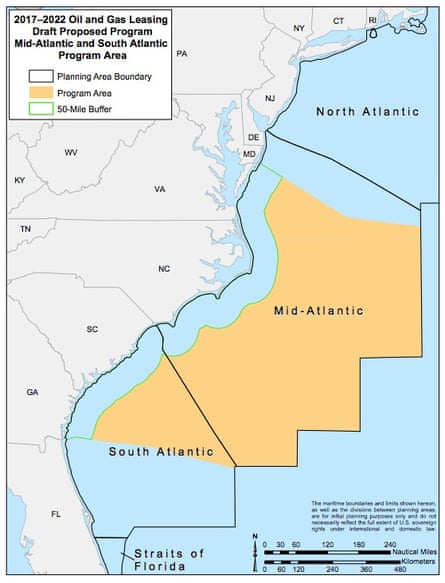
Photograph: Bureau of Ocean Energy Management.
The potential drilling, which the interior secretary, Sally Jewell, says is “a key part of the president’s efforts to support American jobs and reduce our dependence on foreign oil”, has dismayed his allies. Obama has been accused of deploying the sort of tortured logic last seen when he initially allowed Shell into the Arctic while attempting to forge a climate legacy via a 196-nation pledge to cut greenhouse emissions and phase out fossil fuel use by the second half of the century.
Democratic presidential contenders Hillary Clinton, Bernie Sanders and Martin O’Malley have all distanced themselves from opening up a new fossil fuel frontier in the Atlantic. Edward Markey, a Democratic senator from Massachusetts, has even fretted that any oil spill would cause a “tragedy” along the entire eastern seaboard.
“Everyone I know here doesn’t want the drilling,” said Mo Linquist, who runs an arts store and gallery in Kure Beach. “I voted for Obama in both his elections, so I was so disappointed they would open it up. What were they thinking?”
In Kure Beach, the concerns are more immediate than the spectre of a Deepwater Horizon-like spill. The community, located on a thin island south of Wilmington, has been in a mild state of uproar for the past two years, when its then mayor Dean Lambeth put his name to a letter supporting seismic testing for oil and gas. The letter was penned by America’s Energy Forum, a lobbying group backed by the American Petroleum Institute.
Irate residents claim that seismic testing, during which compressed air guns are blasted underwater to help ascertain whether rock formations contain fossil fuels, would harm marine life, including 20 species of marine mammals – among them the endangered right whales that traverse the area.
This could drive away visitors from the tourism-dependent town, which has a winter population of 2,000 that swells tenfold during summer. Eight applications for seismic testing are before the federal regulator, the Bureau of Ocean Energy Management.
Lambeth was ousted as mayor by anti-drilling candidate Emilie Swearingen in an election in December. Tuesday night was Kure Beach’s moment in the spotlight, as hundreds of residents crammed into the small council chambers to see the outcome of a vote brought by Swearingen to oppose drilling and seismic testing.
It passed unanimously, to whoops and some tears in the audience, many of whom wore T-shirts for the anti-drilling group Oceana.
Our marine life means so much to us; it’s our environment, our economy, our tourism and most of all, our quality of life
Emilie Swearingen
From being the first Atlantic-facing community to raise the issue of drilling, Kure Beach, after much angst, became the 100th east coast municipality to formally oppose drilling or air-gun blasting. The issue has bloomed into a cause célèbre along the east coast, with actors Ted Danson, Kate Walsh and Sam Waterston among those set to lobby lawmakers in Washington DC next week to rule out any Atlantic drilling.
Swearingen said she hoped the small but persistent voice of Kure Beach will echo in Washington.
“Kure Beach has become ground zero for seismic testing and offshore oil,” Swearingen said. “We helped 99 other communities out there stand up to the plate to tell Congress and the president of the United States to not put our coastal communities at risk.
“Our marine life means so much to us; it’s our environment, our economy, our tourism and, most of all, our quality of life. Some things are way too precious for money to buy.”
Finding a supporter of offshore drilling in Kure Beach is tricky.
Residents attend a public meeting about oil drilling in the Atlantic. Photograph: Oliver Milman/The Guardian
Shawn Cook, who moved to the island from the west coast 18 years ago and has run the Shuckin Shack oyster restaurant for the past decade, said he has “never run into anyone who wants it”.
“The only person who was for it was Dean Lambeth,” he said. “How do you put a price tag on the Earth? Obama is just flip-flopping. One disaster and all these people would lose their jobs. It would be a ghost town.”
The residents of Kure Beach are rightfully proud of the near-pristine beaches that stretch along the island – “It’s not as busy as Wrightsville. It’s very quaint down here,” as Linquist puts it. Once considered a rather rough fishing village, the area has become gentrified amid an influx of people from the north-east states, bringing with it a relatively new recycling practice and raised property prices. A similar process has taken place in nearby Carolina Beach and Wilmington.
The rows of pastel-coloured houses are well kept, the streets clean. New developments are popping up. If there’s a yearning for jobs and money from big oil, it’s well hidden.
“The community is thriving,” Cook said. “We are doing just fine as we are.”
But there are powerful voices in favour of oil drilling. The Department of the Interior is legally required to factor in the “interest of potential oil and gas producers” and the “laws, goals, and policies of affected states”. The will of small towns like Kure Beach is up against the clout of eight separate governors and big business.
The next president could also be in favour: on the rare occasions when Republican candidates are asked about the future livability of the planet rather than Donald Trump’s antics, all have broadly supported drilling.
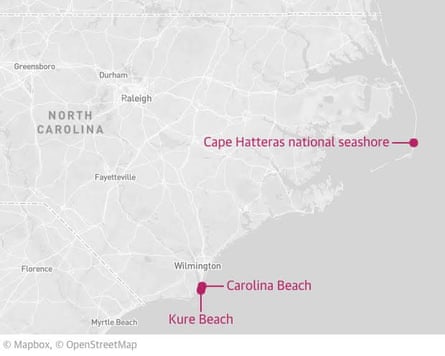
Photograph: Guardian
Nikki Haley, the South Carolina governor who recently shot to national prominence for her State of the Union response, has said she’s a “strong supporter” of offshore drilling. Pat McCrory, her North Carolina counterpart, is, if anything, even more enthusiastic.
“Governor McCrory supports job-creating offshore energy exploration provided it includes revenue sharing between the federal government and mid-Atlantic states, as is done with Gulf coast states,” a spokeswoman said.
“With revenue sharing in place, coastal towns would have the resources they need to mitigate any environmental impacts and protect our vibrant visitor industry.”
McCrory wants to bring forward the Atlantic lease sales (under the current plan, they would take place in 2021) and has also questioned why the leases will be 50 miles out to sea. The federally administrated 1.7bn-acre outer continental shelf starts three miles from shore, stretching out to the 200-mile limit that makes up US waters. A 50-mile “buffer” has been proposed for the Atlantic section so drilling wouldn’t interfere with fishing and marine mammals.
Whether the states will be able to get a slice of the federal oil bounty is uncertain. The volume of the resource is also hard to pin down – the whole east coast is thought to contain 4.7bn barrels of oil and 37.5tn cubic feet of natural gas. But these estimates were conducted 30 years ago – improved seismic testing could reveal a far greater haul.
The American Petroleum Institute estimates 6,000 barrels of oil equivalent could be pumped per day by 2026, rising to 1.34m barrels by 2035. Around 60% of the resource would be natural gas, API said, with oil making up 40%.
The lobby group claims North Carolina and South Carolina would be the biggest beneficiaries of the 280,000 jobs and $195bn in new investment it forecasts will be created by Atlantic drilling.
“Our nation’s new status as the world’s leading producer of oil and natural gas is saving American families and businesses billions in energy costs,” said Eric Wohlschlegel, an API spokesman. “It has also enhanced global security by diminishing the influence of less-stable oil-producing regions.”
Proponents of the offshore drilling say North Carolina and South Carolina would see 280,000 new jobs created as a result of the expansion. Photograph: Alamy
Wohlschlegel dismisses the idea that offshore drilling isn’t compatible with beachside locales that require tourism to prosper.
“Alabama is proud of their ‘turquoise waters and sugar-white sands’ as highlighted on the state’s official travel website,” he said. “But coastal Alabama is also able to brag about a second economic engine – offshore oil and natural gas.
“If we are fortunate enough to develop the Atlantic offshore oil and natural gas resources, our industry will work to partner with and complement existing businesses, not detract from them.”
But while the Gulf of Mexico has been a longstanding oil region, offshore drilling is new to the east coast and could alter its character. During the disastrous 2010 Gulf oil spill, there were fears that the oil could seep up the east coast.
Prof Lawrence Cahoon, a marine biologist at the University of North Carolina, recalls getting frantic telephone calls over the possibility the Carolinas could see their beaches and marine life become coated in oil.
“During the BP oil spill, there were models shown on TV that predicted oil would get out of [the] Gulf and get up the east coast and people started canceling their summer rentals in North Carolina,” he said.
“I had panicked calls from the visitors’ bureau asking if it was really a problem; they were terrified. I said no there is no chance of that. It didn’t get to within 1,000 miles of us, but that was simply the perception of an oil spill. If we had an actual oil spill here, it would be devastating.”
Cahoon said he was “stunned” by the beauty of the North Carolina beaches when he moved to the area from New Jersey. The beaches are flushed clean by Gulf Stream waters and don’t contain much of the heavy industry seen elsewhere.
The area is also a biodiversity hotspot – Cape Hatteras, a formation that juts out from North Carolina, is a site where the Gulf Stream meets the cooler Virginia stream from the north. It teems with marine life; beaked, right and pilot whales inhabit the area, as do porpoises and, in the warmer months, sea turtles. Several species of seabird would also be at risk from any oil spill.
There are competing views on how seriously whales are affected by seismic testing, but, as Cahoon points out, “absence of evidence doesn’t mean evidence of absence”. A current lack of any infrastructure to contain and clean up any spill is also a concern.
“This is a very dynamic area of ocean. It would be very, very difficult to contain an oil spill,” Cahoon said. “The North Atlantic makes the Gulf of Mexico look like a lake. It’s a lot rougher and has stronger currents. A big spill would foul at least some of the beaches if it went on long enough, which would be an economic disaster. It would be a significant challenge.”
The oil drilling plan will be pulled apart and argued in various public and congressional comment periods over 2016. But residents of Kure Beach feel they have won their own little battle, if only for now.
“We now feel we have the representation we wanted,” Linquist said. “If we can say on a grassroots level that we don’t want this, our voices will be heard. I have to believe that. I’m an optimist.”
- This article was amended on 21 January 2016 to clarify that environmental group Oceana did not officially back anti-drilling candidate Emilie Swearingen for mayor.
===
more NC
The Good, the Bad & the Ugly of Drilling 02/20/2015 by Frank Tursi WILMINGTON –
The first N.C. skirmish in what will certainly be a decades-long battle over offshore drilling played out in this old port city Tuesday. Proponents of drilling marshaled their forces in an old train station downtown. Over sandwiches stuffed with roast beef or ham, chicken salad or turkey, they struck a martial chord. Drilling, they said, is good for the economy, good for our nation’s security. It is decidedly the right thing to do.
! Across the bridge over in Wrightsville Beach, drilling opponents, amid color photos of the BP rig blowing sky high, rallied their troops at a late afternoon press conference. Drilling, they said, will despoil beaches and wreck local economies. It is a decidedly dumb thing to do. The goal of both events was to encourage people to turn out for a public meeting that day at the Blockade Runner Hotel in Wrightsville Beach. The Bureau of Offshore Energy Management, known to all as BOEM, regulates energy production in federal waters. It held the meeting to get the people’s thoughts on the Obama administration’s recent proposal to open a portion of the Atlantic seaboard to oil and natural gas development. More than 400 people attended, by far the largest turnout at the three meetings the agency has had so far on the East Coast. If nothing else, drilling, it seems, is decidedly good for the meeting business.
The Good About Drilling About 160 people showed up at the Coastline Conference and Events Center, the former train station, to grab a free sandwich at what was billed as an Offshore Energy Luncheon. The N.C. Energy Forum provided the eats. Algenon Cash If you never heard of it, you’re forgiven. It is one of 27 state groups that are part of a larger effort known as America’s Energy Forum, which notes on its website that it is comprised of “concerned citizens committed to two goals – achieving energy security for our country and holding our elected officials more accountable in shaping energy policies.” Some have disparaged the forum as a fake grassroots group. The Center for Media and Democracy’s SourceWatch calls it an “astroturf” project of the American Petroleum Institute, or API, the largest trade group of oil and gas producers in the country. API admits to it, though you have to search pretty hard to find it. There it is, though, at the bottom of the forum website in tiny type: “Sponsored by the American Petroleum Institute.” David McGowan III, the executive director of the N.C. Petroleum Council – an API group – later confirmed the affiliation in an email.
No one talked about the connection at the luncheon, which was mostly attended by men in suits. Don Loren, a retired rear admiral, was on the agenda as the keynote speaker. He was to talk about the importance of oil and natural gas to the country’s security. Loren, a 31-year Navy veteran, commanded guided-missile frigates and destroyer squadrons, was a deputy assistant Defense secretary and is an expert in counterterrorism. He’s now with Vets4Energy, still another API group. Unfortunately, while the audience was munching, the admiral was stuck in port, so to speak. Bad weather had left him stranded at the Charlotte airport. So Algenon Cash was pressed into service. His day job is an investment banker in the Triad, but he’s also chairman of the N.C. Energy Forum, traveling the state with his pro-energy message. Sometimes, it’s not warmly received. He attended a fracking hearing back in August in Raleigh dressed in an orange t-shirt that said “JOBS” in big letters and “Powered by natural gas” in smaller letters beneath it. Many of the 500 people there showered him with boos.
The explosion of BPs Deepwater Horizon oil rig weighed heavily on the minds of many at the press conference. Photo: Surfrider There was nothing but enthusiastic applause Tuesday. Standing in front of a large poster that proclaimed “Energy Security = National Security,” Cash stressed that we are in the midst of an “energy revolution,” triggered largely by fracking that has made America the world’s top producer of natural gas. “We have left decades of scarcity behind us,” Cash told his audience. “That would have been unthinkable just a few years ago.” This revolution, he said, has made America more secure and less reliant on despotic, foreign governments for its energy. It has also provided real economic benefits, which he adroitly ticked off: the 9.8 million jobs that that the oil and gas industry supports, industry wages that are seven times the national average, soaring pension plans and 401ks that invest in oil and gas stocks.
The API website has more on all this if you’re interested. But the revolution is threatened by the “vocal minority,” Cash said. Using emotional arguments and erroneous science, it has stymied such things as the Keystone XL Pipeline, he noted. “You know what? I’m not very different from my friends in the environmental community,” Cash said. “I want clean water for my kids. I want clean air. It’s important that we do this right. It’s important that we protect the environment. Bureaucrats in Washington with their overreaching regulations and stifling one-size-fits-all policies are also a threat, Cash said. “We firmly believe that the energy resources throughout this country belong to you,” he said. “It should be the people’s choice in how they’re used.” He urged his audience to take that message to the BOEM folks at the public hearing. Afterwards, Cash couldn’t come up with an example of a burdensome regulation or explain how a populist energy policy would work. Should states, for instance, control all drilling off their shores? “We just think that the states should have more say in energy development,” Cash said. The Bad About Drilling Almost 300 of Cash’s “vocal minority” crowded into a room at the Blockade Runner for a press conference called by 10 environmental groups. It was a very different crowd than the one at lunch. There were people with tattoos and pierced noses, kids in t-shirts and torn jeans from the University of North Carolina Wilmington, lots of young families toting small children, middle-aged couples and bearded retirees.
Many in the crowd wore blue Oceana t-shirts, handed out by one of the sponsoring groups. Other groups distributed fact sheets to help people submit commits at the BOEM hearing, which was going on just across the lobby. Jonathan Barfield Jr. One wall was dominated by a huge photograph of BP’s Deepwater Horizon oil rig engulfed in flames and ringed by fire boats spewing jets of water. The explosion and massive spill in 2010 fouled 68,000 square miles of the Gulf of Mexico, an area about the size of Oklahoma. Oil washed up on 125 miles of Louisiana’s coast and along the Mississippi, Florida and Alabama coastlines. Scientists say dolphins are still dying from the aftereffects. None of that was mentioned at lunch, but the BP spill and its aftermath were very much on the minds of people at the press conference. “I’m for offshore drilling,” said Jonathan Barfield Jr., “as long as it’s done on another continent.” Barfield is chairman of the New Hanover County Board of Commissioners and was one of the speakers at the press conference. Before taking up the microphone, he looked at the photo of the burning rig and wondered what would happen to his community if something like that were to occur here. “What would happen to our economy? What would happen to our estuaries?” he asked. “We need to make sure that we never find out.” James Lewis came from Morehead City to attend the press conference and public hearing. He had a big button pinned to his shirt that had an oil rig encircled with an X. We’re pursuing the wrong kind of offshore energy, he said. “Oil and water don’t mix,” Lewis said. “There’s plenty of wind out there that we could have.” Speakers talked about a spill’s effects on fisheries, on tourist-based economies, on people’s health.
The Oceana website and many others have more on all this if you’re interested. Dave Taylor of Beaufort doesn’t have to consult a website. He’s been there. “I’ve lived in California. I’ve lived on the Gulf Coast. I’ve walked on tar balls on the beach,” he said. “I’ve seen what could happen and I don’t want it to happen here.” The Ugly Politics of Drilling Meanwhile, BOEM folks across the hall dutifully explained their environmental review process and welcomed written comments. The flow chart for how the agency analyzes all the information it obtains and how it permits each step in process is long and complex. One BOEM official told a very earnest questioner that it would be 2030 maybe longer before any oil or natural gas from the Atlantic reaches consumers somewhere in the world. “And that’s if the politics don’t change,” he said.
Read more at Coastal Review, coastalreview.org.
===
biden wants offshore wind?
===
breitbart.com› environment › 2021 › 01 › 24 › expert-biden-actions-against-american-oil-gas-energy-production-could-kill-many-1-million-jobs
Jan 24, 2021Frank Macchiarola, senior vice president of Policy, Economics and Regulatory Affairs at the American Petroleum Institute (API), said in an interview onSiriusXM's Breitbart News Saturday with host Matt Boyle that if President Joe Biden puts a permanent ban on oil and gas development on federal waters and land, it could cost 1 million American jobs.
---
Explore Offshore [vs steyer CA mobilization on prop 23?]
The American Petroleum Institute launched its Explore Offshore project in June 2018 “seeking to convince Hispanic and black communities to support the Trump administration’s proposed expansion of offshore drilling,” Reuters reported. [72]
“We want to build support in minority communities because the message that increasing the supply of affordable energy and good paying jobs will resonate,” said Erik Milito, API’s director of Upstream and Industry Operations. [72]
Explore Offshore describes itself as a “national coalition that supports offshore energy exploration and production to help supply affordable energy for American consumers, small businesses, and manufacturers.”
“Explore Offshore’s mission is to unite supporters of offshore energy development and promote its benefits and its importance to our nation’s economy and energy security,” its website claims.
Coalition members include representatives from Florida, North Carolina, South Carolina, Georgia and Virginia. The U.S. Chamber of Commerce and a range of local affiliates are listed on its coalition page. [68], [70]
According to Reuters, Explore Offshore has partnered with a number of black and Hispanic business groups including the Virginia, Florida and North Carolina Hispanic Chambers of Commerce and the Florida Black Chamber of Commerceand South Carolina African American Chamber of Commerce. [72]
Only one African-American man, South Carolina African American Chamber of Commerce chairman Stephen Gilchrist, was involved in the group. Gilchrist reportedly “counts [Steve] Bannon as a friend.” While the group identifies itself as a “bipartisan coalition,” its sole Democrat is Jim Webb, who has praised “gallantry” of Confederate soldiers and defended “the venerable Robert E. Lee” according to a Politico story on Webb’s roots. [75], [73], [74]
July 24, 2018
Representatives from API and API‘s “Explore Offshore South Carolina” attended a luncheon hosted by the SC African American Chamber of Commerce to discuss “the Economic impacts and safety of Offshore Energy.” [71]
May 16, 2018
Explore Offshore, a “project of the American Petroleum Institute”ran an ad campaign on Facebook promoting offshore drilling in Florida. According to Facebook’s political ad archive, the ads were removed because they lacked a “Paid for by” label while including political content. [68], [69]
The ad text read as follows:
“Contrary to what the opposition wants you to believe, offshore energy exploration has occurred safely alongside marine life, commercial fishing, military activities, and tourism for decades in the Gulf.
‘Not only have these industries co-existed with energy production, but in many cases energy development has stimulated and bolstered investments, increased higher-paying jobs, and supported retail and tourism in coastal towns along the Gulf,’ Cornelia Horner, a spokeswoman with the American Petroleum Institute.
The choice is simple when you have the facts. Say yes to exploring our offshore resources in Florida.”
===
===
JUNE 22, 2018
UPDATED 3 YEARS AGO
Big Oil eyes U.S. minority groups to build offshore drilling support
By Valerie Volcovici
WASHINGTON (Reuters) - The largest U.S. oil and gas lobby group is seeking to convince Hispanic and black communities to support the Trump administration’s proposed expansion of offshore drilling, arguing it would create high paying jobs, including for storm-displaced Puerto Ricans.
The American Petroleum Institute (API) launched its “Explore Offshore” campaign earlier this month to counter offshore drilling foes in coastal southeast states from Virginia to Florida, where lawmakers and governors on both sides of the aisle have expressed fear an oil spill could ruin tourism.
“We want to build support in minority communities because the message that increasing the supply of affordable energy and good paying jobs will resonate,” said Erik Milito, API’s director of Upstream and Industry Operations.
As part of the campaign, API has partnered with a number of black and Hispanic business groups, including the Virginia, Florida and North Carolina Hispanic Chambers of Commerce and the Florida Black Chamber of Commerce and South Carolina African American Chamber of Commerce.
A Pew Research poll published in January showed that 56 percent of Hispanics and 54 percent of blacks opposed offshore drilling, compared to 48 percent of white people.
The Interior Department in January announced a proposal to open up nearly all U.S. offshore waters to drilling, triggering a backlash from coastal states that rely on tourism.
Interior Secretary Ryan Zinke told a Senate panel in April that he is likely to scale back the proposal following meetings with coastal governors. Shortly after he unveiled his offshore drilling proposal, Zinke offered an exemption for Florida after he held a private meeting with Republican Governor Rick Scott.
The oil and gas industry is keen to pursue seismic testing in areas they believe hold the largest reserves along the southern Atlantic coast and to Florida’s eastern Gulf shorelines.
The API campaign published op-eds in local newspapers this week, including one by Stephen Gilchrist, chair of South Carolina’s African American Chamber of Commerce. In it he touts API’s major talking point that oil and gas exploration jobs offer locals an average salary of $116,000 without requiring a college degree.
“It’s a myth that communities of color are not interested in supporting offshore exploration,” he wrote in South Carolina’s Post and Courier. “I’ve personally attended town hall meetings up and down South Carolina’s coast where there has been significant support for the economic opportunity offshore exploration holds - especially in communities that have been historically disenfranchised.”
JOBS OUTWEIGH ENVIRONMENT
API, however, acknowledged it needs to hold community meetings and improve local outreach to sway minority communities that have been inclined to oppose offshore drilling.
Miriam Ramirez, a co-chair of the API’s Florida campaign and a former Puerto Rico state senator said she thinks the lure of higher-paying jobs, especially for victims of 2017’s Hurricane Maria, would create economic opportunities that outweigh environmental concerns.
“We have an influx of thousands of Puerto Ricans in Florida, including doctors and engineers who plan to relocate permanently,” Ramirez said.
A study released in March by Oceana, an Ocean conservancy group, found Interior’s offshore drilling plan would put more than 2.6 million jobs and nearly $180 billion in gross domestic product at risk for only two year’s-worth of oil and just over one year’s-worth of gas at current consumption.
“Jobs that come from offshore drilling do not guarantee local good paying jobs compared to the tourism industry, which can keep jobs local,” said Pricey Harrison, a North Carolina state representative and president of the National Caucus of Environmental Legislators.
Julio Fuentes, president of Florida’s Hispanic Chamber of Commerce, said he is reaching out to new Puerto Rican evacuees, as well as existing local communities that are skeptical of offshore drilling, by hosting roundtables with business leaders and community organizations.
“I always like to talk about the safety aspect of it,” Fuentes said.
“Since the BP oil spill, there have been over 100 new industry standards put in place,” he said, referring to the devastating Deepwater Horizon oil spill in the Gulf of Mexico in 2010 that caused tremendous damage to beaches and coastlines in Gulf coast states.
But environmental justice advocates counter that there is no way to guarantee safe offshore drilling.
Marce Gutierrez-Graudins, president of conservation group Azul, said it takes only one spill or accident to deprive lower-income Hispanic communities access to the shore, which she argues is an important form of escape from the stress of urban areas where many minorities live.
Reporting By Valerie Volcovici; Editing by Bill Berkrot
Our Standards: The Thomson Reuters Trust Principles
==
===
desmog 521
Meanwhile, a new government report highlights federal failures to oversee offshore drilling. The report found that 97 percent of the time, existing regulations on environmental protection and cleanup are not enforced. More proposed rules to fix the broken regulatory system, however, are a distraction from the real issue of the government failing to hold the oil industry accountable, **argues Justin Mikulka**.
===
620 an
https://www.alternet.org/2020/06/trump-plans-to-unleash-offshore-oil-drilling-in-florida-after-the-election/
==
420
https://www.ecowatch.com/offshore-drilling-deepwater-horizon-2645687373.html
no lnx many
A Decade After the Deepwater Horizon Explosion, Offshore Drilling Is Still Unsafe
Ten years ago, on April 20, 2010, the BP Deepwater Horizon oil rig exploded, killing 11 crew members and starting the largest ocean oil spill in history. Over the next three months, between 4 million and 5 million barrels of oil spewed into the Gulf of Mexico.
I was a member of the oil spill commission appointed by President Obama to investigate the causes of the disaster. Later, I served as a courtroom witness for the government on the effects of the spill. While scientists now know more about these effects, risks of deepwater blowouts remain, and the energy industry and government responders still have only very limited ability to control where the oil goes once it's released from the well.
The spill commission found that multiple identifiable mistakes caused the blowout. Our report cast doubt over how safety was addressed across the offshore oil industry and the government's ability to regulate it.
As the oil spill commission's report showed, drilling ever deeper into the Gulf involved risks for which neither industry nor government was adequately prepared. The industry had felt so sure that a blowout would not happen that it lacked the capacity to contain it. Neither BP nor the government could do much to control or clean up the spill.
Safety improvements are threatened
The presidential commission recommended numerous reforms to reduce the risks and environmental damages from offshore oil and gas development. The industry developed systems to contain blowouts in deep water and has deployed them worldwide. Improvements in operational safety were made within companies and across the industry.
The Department of the Interior acted quickly to reorganize its units. It created a Bureau of Safety and Environmental Enforcement to avoid conflicts of interests with its leasing, development and revenue collection responsibilities. After four years in development, the bureau issued new well control rules in 2016 governing drilling safety.
But despite progress on a number of fronts, Congress has not enacted legislation to improve safety or even raise energy companies' ridiculously low liability limits for oil spills – currently just US$134 million for offshore facilities like the Deepwater Horizon. The Trump administration has reversed or relaxed safety reforms. It has loosened the safe pressure margins allowed in a well, dispensed with independent inspections of blowout protectors and removed requirements for continuous onshore monitoring of offshore drilling.
[vid]
Some of these changes were ordered by political appointees over the recommendations of the safety bureau's technical experts. While the bureau is charged with focusing singularly on safety and the environment, its director, Scott Angelle, has been a prominent proponent of the administration's aggressive "energy dominance" strategy, ordering expanded oil production and elimination of costly regulations. Imagine the message this sends about priorities to people in government and industry who are responsible for ensuring safety.
Where contamination lingers
Before the Deepwater Horizon disaster, the deep Gulf of Mexico ecosystem was egregiously understudied in all respects, while a multi-billion-dollar industry intruded into it. Now scientists know much more about what happens when large quantities of oil and gas are released in a seafloor blowout.
Scientists learned much about the effects of the spill through monitoring the blowout, assessing damages to natural resources and investigating the fate and effects of escaping oil. More has been spent on these studies and more results published than for any previous oil spill.
A substantial portion of oil released from the mile-deep well was entrained in a plume of droplets spreading out 3,000 feet below the Gulf's surface. Footprints of contamination and effects extended far beyond the area where oil slicks were observed.
NASA | Satellites View Growing Gulf Oil Spill.
[vid]
Nearly all of the oil released has since degraded. Populations of most affected organisms have recovered. But contamination lingers in sediments in the deep Gulf, and in some marshes and beaches where oil came ashore. Populations of long-lived animals the oil killedmight not recover for decades. These include sea turtles, bottlenose dolphins, seabirds and deepwater corals.
And yet, as scientists synthesize results from this 10-year research initiative, very little practical advice is emerging about what can be done to respond more effectively to future blowouts from ever-deeper drilling in the Gulf.
Surely, we can more rapidly contain blowouts. The effectiveness of injecting chemical dispersants into the plume gushing from the well remains in debate. How much oil do dispersants keep from reaching the surface, where it threatens those working to stanch the blowout, as well as birds, sea turtles and coastal ecosystems? But the research has not revealed more effective approaches in controlling released oil.
Safety first is the big lesson...
==
https://theconversation.com/a-decade-after-the-deepwater-horizon-explosion-offshore-drilling-is-still-unsafe-132846
==
an 220
‘Invisible oil’ from Deepwater Horizon spill may have reached the Florida Keys
==
https://www.desmogblog.com/2018/04/23/8-years-bp-oil-spill-sick-cleanup-workers-waiting-louisiana-court
Years After BP Oil Spill, Sick Cleanup Workers Still Waiting for Day in Court
On the eighth anniversary of the BP oil spill, Retired Lt. Gen. Russel Honoré stood in front of the New Orleans Federal Court House and called “bullshit” on the court’s handling of claims made by those who participated in the cleanup efforts.
Thousands of workers BP hired to clean up the spill that polluted the Gulf of Mexico in 2010 have claimed exposure to oil and the dispersant has made them sick and still have not had their day in court. “It’s a crying damn shame we’ve allowed this in America,” Honoré said.
===
3/18
Trump Administration Offers 77 Million Acres in Gulf of Mexico to Oil Industry...[also trying 220?]
==
==
drilled 220
Swamp Thing: Fossil Fuel Insiders in the Department of Interior Are Shaping Offshore Drilling Policy
==
Rubio may lift hold on deputy secretary nominee
:{:{}:
Florida Republican Sen. Marco Rubio said yesterday he hopes to resolve this week the hold he placed on the Interior deputy secretary nominee because of concerns over the administration's proposal to expand offshore drilling in his state.
12/19
}:
===
new 819
https://www.mediamatters.org/legacy/oil-industry-enlists-minority-groups-publish-pro-drilling-op-eds
As part of a partnership with the American Petroleum Institute (API), the largest oil and gas lobbying organization in the U.S., Black and Hispanic business groups have been placing op-eds in local newspapers touting the benefits of offshore drilling, as Reuters recently reported. Black and Hispanic Americans are more likely to be opposed to offshore drilling than white Americans, according to a Pew poll conducted in January. The op-ed campaign is part of an industry-driven effort to make offshore drilling look more broadly supported and to shift minority opinion by enlisting groups that purport to represent communities of color.
Op-eds push oil industry statistics but fail to disclose oil industry connections
Media Matters identified six newspapers in the Southeast that have published op-eds by minority business leaders or political leaders who argue in favor of increased offshore oil and gas drilling along the Atlantic Coast. Most of these minority authors are affiliated with the Explore Offshore alliance, which they mention in their pieces -- but they neglect to disclose that Explore Offshore is a project of API and that many of the talking points and statistics they cite in their op-eds come straight from API materials.
API announced the Explore Offshore alliance on June 6, billing it as a “bipartisan coalition representing a diverse group of community organizations, businesses, and local associations across the Southeast that support safe and responsible expanded U.S. access to oil and natural gas through advanced technologies.” The minority business groups in the coalition are highlighted on the Explore Offshore homepage, while most other coalition members are listed in less prominent places on the website -- an indication that API wants to highlight Black and Hispanic participation. The minority groups in the coalition include the Florida Black Chamber of Commerce, the Florida State Hispanic Chamber of Commerce, the North Carolina Hispanic Chamber of Commerce, the South Carolina African American Chamber of Commerce, and the Virginia Hispanic Chamber of Commerce, plus one minority religious organization, the Hispanic Pastors Association.
Florida:
In Florida, The Palm Beach Post and the Tallahassee Democrat published a pro-drilling op-ed written by Julio Fuentes, president and CEO of the Florida State Hispanic Chamber of Commerce. The Tampa Bay Times published a like-minded op-ed co-authored by Miriam Ramirez, a former member of Puerto Rico’s Senate and a co-chair of Explore Offshore Florida, a state affiliate of API's national Explore Offshore coalition.
Fuentes and Ramirez and her co-authors took figures from API’s one-pager about the benefits of drilling in Florida’s waters. Fuentes wrote (emphasis added):
Continued offshore development would put more than 56,000 Floridians to work and add $4.5 billion per year to our economy.
API's one-pager says (emphasis added):
Employment in Florida due to spending by the Eastern Gulf offshore oil and natural gas industry is projected to reach over 56,000 jobs.
…
Contributions to Florida’s state economy due to spending on Eastern Gulf [Outer Continental Shelf] oil and natural gas exploration and development activities could be nearly$4.5 billion per yearby the end of the forecast period.
Ramirez and her co-authors wrote (emphasis added):
Economic studies show that the industry’s spending would bring Florida $1.3 billion per year in government revenue within 20 years of opening up the area for oil and natural gas development.
API's one-pager says (emphasis added):
Florida could see a 37.5% share of the Eastern Coast bonuses, rents and royalties generated which are projected to reach $1.3 billion per year within 20 years.
The Florida State Hispanic Chamber of Commerce, which Fuentes runs, receives support from Duke Energy and Florida Power & Light, two large utilities that are building natural gas-fired plants in Florida. The chamber and the two utilities have backed anti-environment campaigns in the past. In 2016, the Florida State Hispanic Chamber of Commerce joined Duke, Florida Power & Light, and other power companies in supportingAmendment 1, a deceptive, utility-backed ballot measure designed to restrict consumer access to rooftop solar power in Florida. The Florida State Hispanic Chamber of Commerce also receives support from Florida-based, third-party energy supplier Liberty Power, a company that recently paid a settlement to New York state for engaging in deceptive practices and is the subject of a cease-and-desist complaint filed by Connecticut’s Office of Consumer Counsel for allegedly deceiving consumers.
The other Florida minority group that's part of API's Explore Offshore alliance, the Florida Black Chamber of Commerce, has fossil fuel ties as well. It is closely affiliated with the National Black Chamber of Commerce, which has received extensive funding from fossil fuel interests including ExxonMobil and Koch Industries. The National Black Chamber notoriously led minority opposition to the EPA's Clean Power Plan, which would limit pollution from power plants. Eugene Franklin, president of the Florida Black Chamber of Commerce, served on the board of directors of the National Black Chamber of Commerce. Both the Florida chamber and the national chamber supported the pro-utility Amendment 1 in 2016.
South Carolina:
In South Carolina, The Post and Courier and The Greenville Newspublished a pro-drilling op-ed by Stephen Gilchrist, chair of the South Carolina African American Chamber of Commerce and chair of Explore Offshore SC, the South Carolina branch of API's Explore Offshore coalition. Gilchrist also apparently relied on API statistics in his op-ed, writing (emphasis added):
Offshore development could … add $3.8 billion to our state budget per year. This could create 34,000 much needed jobs in the state
But Gilchrist appears to have gotten one of those API talking points wrong by a factor of 20. He claimed that offshore drilling could add $3.8 billion to South Carolina's budget each year, but API’s South Carolina one-pager claims the $3.8 billion would come in over a 20-year period (emphasis added):
Employment due to offshore oil and gas development activities on the Atlantic Coast in South Carolina could reach over 34,000 jobswithin 20 years
…
The cumulative effect on the state budget from 2020-2040 is projected to be over $3.8 billion.
Gilchrist has cultivated questionable alliances that many African-Americans in South Carolina would not be comfortable with. In 2015, Gilchrist invited Donald Trump to an event for Black entrepreneurs that was co-hosted by the South Carolina African American Chamber of Commerce. The crowd at the event was “predominantly white,”according to The Post and Courier. In late 2017, Gilchrist invited his friend Steve Bannon, former Trump advisor and white nationalist sympathizer, to a minority business roundtable sponsored by his group.
Virginia:
In Virginia, the Daily Press published an op-ed co-authored by former state Del. Winsome Earle Sears, an African-American, who now serves as co-chair of Virginia Explore Offshore, API's Virginia coalition. Like her cohorts in other states, she drew talking points right from API materials. From her op-ed (emphasis added):
With the exploration and potential for development of offshore energy resources, Virginia could gain 25,000 jobs, many with an average salary of $116,000 — more than double the commonwealth’s average. We’re also projected to attract $1.5 billion per year in private investment
From API’s announcement of its Explore Offshore coalition in Virginia (emphasis added):
- By 2035, the oil and natural gas industry could create over 25,000 new high-paying jobs in Virginia
- Offshore development could result in $1.5 billion in private investment into Virginia ...
- The average salary for oil and natural gas exploration and development jobs is $116,000.
The Virginia Hispanic Chamber of Commerce, which is part of API's Explore Offshore coalition, joined a number of oil and gas trade associations in signing a letter to the Bureau of Ocean Energy Management urging the agency to allow more offshore drilling. The Virginia Hispanic chamber has also partnered with Dominion Energy, Virginia’s largest and most powerful utility.
Conservative groups with anti-environment agendas and fossil-fuel ties have a history of trying to co-opt minorities
API is mimicking a well-worn strategy in which polluters target minority and low-income communities with industry-funded research and disinformation about energy. For example, in recent years, Americans for Prosperity, the American Legislative Exchange Council, the Edison Electric Institute, and the Heartland Institute, among many others, have waged a campaign to hinder the growth of solar energy at the state level. That effort has included the false claim, often advanced via minority politicians and front groups, that net-metering policies designed to make rooftop solar power more accessible would harm minority and low-income people.
Fossil fuel industries and their allies, including the National Black Chamber of Commerce, also targeted minority groups with misinformation about the EPA’s Clean Power Plan, which, if fully implemented, would have prevented thousands of premature deaths and tens of thousands of asthma attacks each year.
These tactics are especially insidious because research consistently shows that minority and low-income communities suffer disproportionately from the burning of fossil fuels and the impacts of climate change. The third U.S. National Climate Assessment, released in 2014, found:
Climate change will, absent other changes, amplify some of the existing health threats the nation now faces. Certain people and communities are especially vulnerable, including children, the elderly, the sick, the poor, and some communities of color.
In early 2018, EPA scientists published a study in the American Journal of Public Healththat found people of color in the U.S. are exposed to more air pollution than white people are, with African-Americans exposed to the most. A number of other studies have documented the negative health effects of air pollution on minority and low-income communities. A joint report released in 2017 by the NAACP and the Clean Air Task Force found that natural gas facilities in particular are harmful to Black Americans:
- [M]any African American communities face an elevated risk of cancer due to air toxics emissions from natural gas development: Over 1 million African Americans live in counties that face a cancer risk above EPA’s level of concern from toxics emitted by natural gas facilities.
- The air in many African American communities violates air quality standards for ozone smog. Rates of asthma are relatively high in African American communities. And, as a result of ozone increases due to natural gas emissions during the summer ozone season, African American children are burdened by 138,000 asthma attacks and 101,000 lost school days each year.
Blacks and Hispanics also suffer disproportionately from climate change impacts such as extreme weather. Just last year, Hurricanes Harvey and Maria devastated African-American and Latino communities in Houston and Puerto Rico.
Polls have shown that nonwhite people in the U.S. are more concerned about climate change than white people are. A 2015 poll of African-Americans found that 60 percent of respondents ranked global warming as a serious issue, while a 2017 survey of Latinos found that 78 percent of respondents were worried about global warming.
Surveys have also documented strong support among minority groups for clean energy solutions. A 2015 poll found that 66 percent of African-Americans believed that using more renewable energy would create new jobs, and 57 percent believed that shifting to clean energy would decrease their energy costs. A separate poll conducted in 2015 foundthat 84 percent of Latinos believed that the U.S. should mandate greater use of clean energy sources like solar and wind power.
Clearly, minority communities understand the risks of climate change and want clean energy solutions to mitigate those risks.
But API has chosen to partner with minority business groups to erode support for clean energy solutions and promote pro-fossil fuel arguments that would harm the very communities these organizations purport to represent. And, in a decision that demonstrates just how out of touch Explore Offshore is with minority communities, API recruited former Sen. Jim Webb (D-VA), a confederate apologist, to be a national co-chair.
Newspapers in the Southeast and around the country should not be letting oil industry allies spread propaganda and claim to represent minority interests. Op-eds that more accurately represent Black and Latino aspirations would point out that these communities have the most to lose from expanded offshore drilling and the most to gain from a shift to clean energy.
==
==
ew 519
Hallie Templeton
As part of its Blue Economy initiative, the Trump administration has developed a map to provide oceanindustries information on areas ripe for oil rigs and floating factory farms.
The map brands these areas as "ocean neighborhoods." Though that sounds pretty cozy, it is nothing close to reality. What's in store for these "neighborhoods?" Massive rigs and other infrastructure, increased vessel traffic and noise, the inherent risk of dirty oil spills and blowouts and unavoidable toxic discharge.
Although the map touts "a fountain of data for use by industry," it ignores several components of the ocean ecosystem and certain coastal communities that are already struggling and need increased protections — not increased development. Users can view the migratory pathways of sharks and fish — but not other migratory species like seabirds and turtles. You can see critical habitats designated pursuant to the Endangered Species Act, but not the habitats for every threatened or endangered species (not all species receive critical habitat protection). Finally, feeding areas for cetaceans (whales, dolphins and porpoises) are shown, but what about breeding areas for these struggling species? And, where are the other species protected under the Marine Mammal Protection Act: sirenians (manatees and dugongs) and marine carnivores (like seals, otters, walrus and polar bears)? Trump's new industry-focused map does not include this vital information.
While we're at it, what about coastal communities throughout the Gulf of Mexico that are already bearing the brunt of extensive offshore drilling? Thanks to offshore drilling, they are struggling with basic needs like drinkable water and breathable air. But, the map doesn't pay them any credence. Trump must not see them as a priority in determining where to develop next.
Since taking office, Trump has prioritized rolling back decades of progress in ocean protection policy. Both former presidents George W. Bush and Barack Obama took steps toward establishing a strong foundation for healthy oceans with protections for marine mammals, the creation of sanctuaries and monuments, improving U.S. fisheries and crafting policies to shield massive swaths of our waterways from dirty drilling activities. Trump has attempted to abolish much of that progress. This map is just one more Trump handout to Big Oil and others in the booming business of ocean industrialization.
Thankfully, we have checks and balances in our federal government to help prevent Trump's bad policies. In January 2019, members of Congress joined together to introduce a series of bills that would protect the majority of our coastlines from offshore drilling activities. And in March 2019, a federal judge nixed Trump's attempt to expand offshore drilling in the Arctic and North Atlantic coasts and upheld protections placed by former President Obama.
States can also attempt to resist Trump through stronger local policies. For example, an inspiring number of governors — including Republicans and Democrats — from coastal states opposed Trump's plan for expanded offshore drilling. Unfortunately, Trump responded by proposing to take away states' rights to object to coastal development off their coasts.
Thanks to major pushback from organizations like Friends of the Earth, Trump has temporarily postponed the next phase of his plan for offshore drilling expansion. But the recent issuance of his ocean industrialization map reinforces that Trump will continue providing corporate handouts and pushing to industrialize our remaining wild places. Click here to tell the Trump administration to permanently pull the plug on its five-year plan to expand offshore drilling. Remember: our oceans are home to important and endangered marine species, and shouldn't be treated as mere uncharted areas for mega-corporations to industrialize.
9 States Sue 'Flat-Out Wrong' Trump Administration Over Seismic Blasting in Atlantic https://t.co/L1t0GESjWG
— Enviro Voter Project (@Enviro_Voter) December 24, 2018
Hallie Templeton is senior oceans campaigner at Friends of the Earth.
RELATED ARTICLES AROUND THE WEB
- Trump Continues 'War on America's Oceans' With New Executive ... ›
- Trump Regulators Gave Oil Industry a Pass to Injure Whales, and ... ›
- Donald Trump Just Remade Ocean Policy—Here's What That Means ›
- Trump administration approves seismic tests that could harm ... ›
- Trump Is Giving Our Oceans to the Oil Industry - Waterkeeper Alliance ›
===
==
ew 519
no lnx
OFFSHORE OIL DRILLING
Trump Weakens Rules Meant to Prevent Next Deepwater Horizon Spill
Olivia Rosane May 03 ENERGY
Spill-response crews in the Gulf of Mexico, Deepwater Horizon Oil Spill on June 22, 2010. Dr. Oscar Garcia / Florida State University / Flickr
The Trump administration announced Thursday it was rolling back offshore oil drilling regulations put in place after the BP Deepwater Horizon oil spill, the largest ocean spill in U.S. history.
Officials announced changes to the Well Control Rule on the Louisiana coast, not far from where the 2010 oil rig explosion killed 11 workers and poured around 200 million gallons of oil into the Gulf of Mexico, The Washington Post reported.
"The well control rule was one of the most important actions we took, as a nation, in response to the BP-style disaster at sea," Natural Resources Defense Council (NRDC) Director of Strategic Engagement Bob Deans said in a statement of the original rule. "The rule draws directly from lessons learned from that debacle. It creates tools to help reduce the risk of these dangerous industrial operations at sea."
The NRDC explained how the Trump's Department of Interior (DOI) was weakening that rule, which was finalized by the Obama administration in 2016:
The agency is walking back components of the well control rule, such as removing requirements for real-time backup monitoring by onshore experts and annual certification of the blowout preventer's integrity by an approved third-party expert. Blowout preventers will now be allowed to simply close, instead of achieving an effective seal, which mirrors standards set by the American Petroleum Institute. (A malfunction of a blowout preventer is what caused the 2010 disaster.) Together, the changes represent a favor to the oil industry and a threat to "workers, waters, and wildlife," Deans says.
In a statement Thursday, Interior Secretary David Berhnardt insisted the change was made with safety in mind.
"Today's final rule puts safety first, both public and environmental safety, in a common sense way," Bernhardt said, as The Washington Post reported. "Incorporating the best available science, best practices and technological innovations of the past decade, the rule eliminates unnecessary regulatory burdens while maintaining safety and environmental protection offshore."
But officials at DOI division the Bureau of Safety and Environmental Enforcement said the changes would also save the offshore oil and gas industry about a billion dollars over 10 years.
"Given David Bernhardt's close ties to his former clients and friends in the fossil fuel industry, it's no surprise that he's seeking to give them free rein to spoil our coasts and public waters and put workers in harm's way," Sierra Club Lands Protection Program Director Athan Manuel said in a statement. "These safeguards were put in place in response to the worst environmental disaster in U.S. history, and with this latest favor for oil and gas companies Bernhardt is putting us at risk of a similar disaster."
The Deepwater Horizon spill had disastrous consequences for the environment and economy of the Gulf of Mexico, The Washington Post reported. Those included:
$95 million in losses for the Gulf fishing industry just in 2010
The deaths of one million seabirds
The deaths of more than 150 whales and dolphins
The deregulation is part of President Donald Trump's overall push to expand offshore oil drilling and "energy dominance," The Huffington Post explained. It comes about a month after a judge blocked Trump's attempt to open up the Arctic ocean to drilling, leading the DOI to likely postpone plans to make more than 90 percent of coastal waters available for oil and gas leasing, NPR reported.
RELATED ARTICLES AROUND THE WEB
Seismic airgun blasting ›
Deepwater Horizon ›
Deepwater Horizon Anniversary: Trump Administration Ignores ... ›
Trump to Ease Drilling Rules Set After Deepwater Horizon Disaster ... ›
The Deepwater Horizon oil spill led to new rules. Trump repealed ... ›
===
https://thinkprogress.org/offshore-drilling-opposition-trump-bernhardt-11bf9f6288db/
South Carolina Rep. Joe Cunningham (D) is bringing his local fight against drilling in U.S. waters to Washington, D.C., with a bipartisan bill that would ban offshore drilling and seismic testing along both the East and West Coasts.
Cunningham’s bill introduced this week is part of an ever-growing bipartisan backlash to the Trump administration’s plans to open up the majority of U.S. waters to offshore drilling. Politicians from every single state along the Pacific and Atlantic coasts have voiced opposition to the proposal, setting up the dispute to be a dominant issue in the 2020 election.
The bill comes at the same time as President Donald Trump’s nominee to lead the Interior Department (DOI), David Bernhardt, is coming under increased scrutiny over the administration’s controversial plans to further expand offshore drilling.
Drilling has long been active off the Gulf Coast, but numerous accidents and oil spills over the years — which negatively impacted human health, local economies, and the environment — have made the issue a non-starter in other coastal states. Cunningham’s bill, the Coastal and Marine Economies Protection Act, seeks to prevent this happening on a wider scale.
"It’s an honor to have the opportunity to lead this bipartisan bill across the finish line to ban offshore drilling off our coast once and for all,” said Cunningham, who slammed offshore drilling efforts as “a hand-out to the oil and gas industries.”
Cunningham won his race in a major upset last November, due in no small part to his opposition to offshore drilling, which is unpopular in coastal South Carolina. And since his election, the moderate Democrat has emphasized his drilling stance, going so far as to literally bring an air horn to a subcommittee hearing earlier this month to emphasize the effects that loud seismic testing has on marine mammals.
“I’ve been clear from the very beginning that our beaches, businesses, and way of life should not be for sale. South Carolinians want nothing to do with offshore drilling and the devastating threat it poses to our vibrant natural resources,” Cunningham said Thursday.
Among the co-sponsors of the Coastal and Marine Economies Protection bill is Rep. Francis Rooney (R-FL). His support signals the political realities of offshore drilling in coastal states, even those led by Republicans who traditionally support fossil fuels. Rooney has critiqued his party many times for failing to acknowledge climate change and push for action to address the phenomenon.
“This bill deserves the support of everyone who cares about healthy oceans, marine life, our coastal economies and all they support,” said Alexandra Adams, legislative director with the Natural Resources Defense Council (NRDC), in a statement.
Senators grilled Bernhardt on fossil fuel industry ties
But the Trump administration isn’t in line with those sentiments. Under former Interior Secretary Ryan Zinke, the federal government announced plans in early 2018 to open virtually all U.S. waters up to offshore drilling. The still unreleased five-year Outer Continental Shelf Oil and Gas Leasing Program (OCS) — which would lay out the specifics of expanding offshore drilling — has been a source of controversy ever since.
That could spell trouble for Bernhardt, the former lobbyist Trump tapped to lead DOI. On Thursday during a Senate hearing on his nomination to lead the department, Bernhardt was confronted by skeptical senators on the issue.
“If a member of the New England delegation votes for your confirmation and then you move for offshore drilling, I don’t know if I can go home again,” said Sen. Angus King (I-ME).
Maine was once the lone coastal holdout on offshore drilling under former Gov. Paul LePage (R), who supported the Trump administration’s efforts. But Gov. Janet Mills (D), who replaced LePage after the 2018 midterms, is a staunch opponent.
“Can I get your personal assurance here today that the position of the state’s congressional delegation will be a major consideration in making this decision?” King asked Bernhardt about the department’s decision-making on the issue. “Absolutely, it’s required,” replied Bernhardt.
Lawmakers, however, remain skeptical of DOI’s intentions. During the partial government shutdown in January, DOI called at least 40 employees back to work at the Bureau of Ocean Energy Management (BOEM) in an effort to keep drilling plans on track. That prioritization came at a time when offshore wind projects remained stalled. The decision also rankled many Democrats and a number have repeatedly probedBernhardt’s moves during the shutdown.
Democrats want answers about the Interior Department’s decisions during the shutdown
With Republicans maintaining control of the Senate, lawmakers are likely to confirm Bernhardt. But the battle over offshore drilling isn’t going away — it could rear its head again in 2020, when voters head to the ballot box.
That reality could see more Republicans from coastal states following the lead of lawmakers like Rooney, who signed onto Thursday’s offshore drilling bill. Florida, for instance, approved a constitutional amendment banning offshore drilling in November and the state has sought an exemption from the Trump administration’s plans. (Zinke promised the state one, but it is unclear if that pledge still holds.)
Meanwhile, in vulnerable South Carolina, where drilling could severely hurt tourism and wildlife, both the governor and attorney general have come out against drilling off the state’s coasts. Anti-drilling activists in the state have told ThinkProgress they plan to press the issue in 2020 and target lawmakers up for re-election who support offshore drilling efforts. And the bill introduced in the House this week may serve as an opportunity to test the commitment of lawmakers to opposing drilling ambitions.
Cunningham said he has spoken with both of his state’s senators, Lindsey Graham (R) and Tim Scott (R), about the issue. “Both of them realize that it’s the will of South Carolinians not to have offshore drilling,” he said, expressing that he expects them “to make the right call” if his bill advances to the Senate.
At DOI, meanwhile, the OCS program seems to have stalled. The proposed plan has largely been expected imminently, but Bernhardt appeared to backtrack on Thursday, stating that the process was at “step one, not step seven” in an abrupt about-face.
“We’re at the very beginning of our process,” he said during his hearing. “I don’t know what the timing is, because it’s not done to the point where they’re bringing it to me yet.”
===
3/19
Trump administration is moving to permit a handful of private companies to start using seismic surveys in the Atlantic. This destructive tool in the oil exploration industry can cause marine creatures — including dolphins, whales, fish and zooplankton — catastrophic harm, including death.
"I will tell you we wouldn't work really really hard to get the [Atlantic] seismic permits out, if it was an area that wasn't going to be available," said Joe Balash, who oversees the the Bureau of Ocean Energy Management, the agency responsible for permitting the Atlantic seismic permits and crafting the five-year drilling plan. When Balash says that area is going to be "available," he means they intend to make the Atlantic coast available to oil companies to drill.
The League of Conservation Voters has led efforts to halt drilling in the Arctic and Atlantic and other areas where drilling has been off-limits. We've organized and put pressure on members of Congress and we're currently suing the Trump administration to block its Arctic drilling plans.We can stop the Trump administration again, but we need your help.
There's more to this fight — the Senate also just announced that oil lobbyist David Bernhardt's confirmation hearing to be Interior Secretary has been scheduled for next Thursday. Believe me — if confirmed, Bernhardt, who currently oversees the Interior Department as the Acting Secretary, will ram through Trump's plan for drilling in the Atlantic and in other oceans off our beaches.
==
==
https://99percentinvisible.org/episode/crude-habitat/
sta barb hist
==
https://www.alternet.org/news-amp-politics/trump-plans-unleash-fossil-fuel-industry-conduct-violent-destructive-assaults
Defenders of ocean habitats and marine life are up in arms on Friday as the Trump administration is set to approve new abilities for the fossil fuel industry to conduct widescale and "deafening" underwater seismic in federal waters off the U.S. Atlantic coast.
The decision is expected to come from the National Marine Fisheries Service, a division of the Commerce Department, but conservation groups say it is a smack in the face to ocean ecosystems and a political nonstarter they vow to fight tooth and nail.
"This action flies in the face of massive opposition to offshore drilling and exploration from over 90 percent of coastal municipalities in the proposed blast zone," said Diane Hoskins, campaign director at Oceana. "These permits were already denied because of the known harm that seismic airgun blasting causes. President Trump is essentially giving these companies permission to harass, harm and possibly even kill marine life, including the critically endangered North Atlantic right whale – all in the pursuit of dirty and dangerous offshore oil. This is the first step toward offshore drilling in the Atlantic and we're going to make sure coastal communities know what's happening and fight this."
Michael Jasny, director of the Marine Mammal Protection Project at NRDC, said the president's action is totally detached from the reality of the threats the world's ecosytems now face.
"Just one week after issuing dire warnings on the catastrophic fallout of climate change to come, the Trump Administration is opening our coastlines to for-profit companies to prospect for oil and gas—and is willing to sacrifice marine life, our coastal communities and fisheries in the process," fumed Jasny. "This is the first step towards drilling and scientists warn that seismic activity alone could drive the endangered North American right whale to extinction. We'll stand with citizens, coastal businesses, scientists, lawmakers, and commercial and recreational fishermen who oppose seismic blasting, and we will fight this illegal action."
According to theWashington Post:
In addition to harming sea life, acoustic tests — in which boats tugging rods pressurized for sound emit jet engine-like booms 10 to 12 seconds apart for days and sometimes months — can disrupt thriving commercial fisheries. Governors, state lawmakers and attorneys general along the Atlantic coast say drilling threatens beach tourism that has flourished on the coast in the absence of oil production.
Seismic testing maps the ocean floor and estimates the whereabouts of oil and gas, but only exploratory drilling can confirm their presence. The Deepwater Horizon oil spill that soiled the Gulf of Mexico resulted from an exploratory drill. Another gulf disaster that looms almost as large has spewed oil for more than 14 years. The Taylor Energy Co. spill of up to an estimated 700 barrels a day started when a hurricane ripped up production wells, and could continue for the rest of the century, according to the Interior Department.
"Seismic blasting is a violent, destructive precursor to unnecessary offshore oil drilling," said Angela Howe, Surfrider Foundation Legal Director, in a statement. "According to estimates from theBureau of Ocean Energy Management (BOEM), the seismic exploration projects could directly harm tens of thousands of whales and dolphins, in addition to thousands of manatees, seals, and sea turtles. This type of damage to our coastal resources is unacceptable. The Surfrider Foundation and our strong coalition of allies will stand up to protect our ocean, waves and beaches for the future."
While the seismic blasting is awful enough, Earthjustice warns that this is only a part of the Trump adminstration's assault on the oceans and marine life. As the group notes:
While destructive in their own right, the seismic tests are only a first step in the Trump administration’s broader plans for dramatic expansion of offshore drilling in the Atlantic and beyond. The Department of the Interior has proposed opening 90 percent of U.S. federal offshore waters to the fossil fuel industry, exposing nearly every coastline in the nation to the risk of an environmentally devastating oil spill and the degradation that comes with industrializing more of our rich ocean environments. Since the planning process for this offshore leasing expansion got underway, more than 1.45 million Americans have demonstrated intense opposition with rallies, marches and comments submitted to the Department of Interior agency responsible for crafting the plan.
"As usual, the Trump administration is pulling out all the stops to give favors to the fossil fuel industry, whatever the cost to coastal communities and wildlife," said Athan Manuel, the lands protection program director for the Sierra Club. "We will continue to fight back against their dangerous plans to subject our coasts to seismic blasting and expanded offshore drilling."
===
==
The Well Control Rule, finalized in 2016, requires real-time oversight of risky drilling operations and precautionary failsafe measures to stop a spill when things go wrong. Last year the Trump administration began rewriting the rule, which the fossil fuel industry regards as a “burden.”
With the Trump administration’s ongoing push for more drilling in the Gulf of Mexico and its proposal to open virtually every mile of coastline to new oil and gas rigs, now is not the time to tinker with offshore safety and environmental standards.
https://earthjustice.org/news/press/2018/interior-moves-to-erode-key-protection-standard-on-offshore-oil-and-gas-drilling?_ga=2.47805924.253773879.1532379284-1627324521.1532379284
aPRIL 27, 2018
Washington, D.C. —
Only a week after the anniversary of the worst oil spill in U.S. history, the Department of the Interior today announced its intended rollback of protection standards enacted to prevent another Deepwater Horizon tragedy. The well control rule, finalized under President Obama in 2016, requires real-time oversight of risky drilling operations and precautionary failsafe measures to stop a spill when things go wrong. Interior officials began re-writing the rule after President Trump issued an executive order last year calling for offshore drilling controls — regarded as a “burden” by the fossil fuel industry — to be rolled back.
On a stakeholder call today, officials from the Bureau of Safety and Environmental Enforcement emphasized the number of provisions affected, not the substance of the protections they provide. While details will be clear once the proposal is issued, this rule change is clearly designed to take regulators out of the process rather than increase any oversight.
The following is a statement from Steve Mashuda, Managing Attorney for Oceans at Earthjustice:
“History has already taught us the lesson that when the oil industry drills, it spills. The administration’s attempt to erode commonsense safety and environmental protections designed to prevent another tragedy on the scale of Deepwater Horizon is deeply troubling. With Interior’s ongoing push for more drilling in the Gulf of Mexico and its proposal to open virtually every mile of coastline to new oil and gas rigs, now is not the time to tinker with safety and environmental standards. Americans deserve better than this dangerous and unnecessary race to expose our coastal communities and treasured marine environments to the risk of devastating oil spills. Our energy future lies in clean renewable energy, not at the bottom of the ocean — and not at the bottom of the regulatory barrel.”
The draft rule will now be sent to the Federal Register to be published next week, and agency officials will accept public comment on the proposal for 60 days.
==
https://www.ecowatch.com/deepwater-horizon-investigation-trump-2561729233.html
Deepwater Horizon Anniversary: Trump Administration Ignores Advice on Preventing Explosions, Injuries, Blowouts
The Trump administration is ignoring advice from the bipartisan commission that investigated the BP Deepwater Horizon disaster as officials move to repeal offshore drilling safety regulations adopted in its aftermath.
Friday is the eighth anniversary of the explosion that killed 11 oil workers and caused more than 210 million gallons of oil to flow uncontrolled into the Gulf of Mexico for more than three months, killing thousands of marine mammals and birds.
"Deepwater Horizon was a deadly reminder that offshore drilling is dangerous. Refusing to learn from this disaster threatens workers, wildlife and coastal communities," said Miyoko Sakashita, oceans program director at the Center for Biological Diversity. "Trump's plans to get rid of safety rules dishonor the dead and ramp up the risk of another catastrophe."
The National Commission on the BP Deepwater Horizon Oil Spill and Offshore Drilling made a series of recommendations in its January 2011 report to President Obama. Only the most significant ones—including a well-control rule that would have prevented the explosion and blowout preventer rule to seal compromised wells—were adopted. They are now being targeted for significant rollbacks by the administration, which is expected to publish revisions in the near future.
Commission co-chairs Bob Graham and William K. Reilly wrote to Interior Secretary Ryan Zinke almost a year ago, shortly after President Trump ordered an expansion of offshore drilling and more industry-friendly rules to govern it, urging restraint in his deregulatory zeal.
"The Commission members hold the unanimous view that weakening or rescinding the Well Control Rule would aggravate the inherent risks of offshore operations, put workers in harm's way, and imperil marine waters in which drilling occurs," they wrote in a May 8, 2017 letter, in which they called that rule "the most broadly important measure to come out of what the Commission learned."
Offshore incidents—including fires, explosions, injuries and the loss of well control (also known as blowouts)—have all steadily declined since 2014, according to data from Bureau of Safety and Environment Enforcement, which was created in the wake of the 2010 disaster. Better regulations and inspections adopted after Deepwater Horizon seem to be paying off, despite the Trump administration's stated desire to rescind them.
Yet the annual number of offshore oil spills (those spilling more than 2,100 gallons of oil, chemicals or drilling mud) has remained high since 2010, when Deepwater Horizon was among nine offshore oil spills. From 2012 through 2017, there was an average of more than 20 serious offshore spills per year, the bureau's data showed. From 2000-2009, spills averaged 17 per year.
That number could dramatically increase in the coming years as the administration tries to expand drilling in almost every U.S. ocean. Based on its draft 2019-2024 outer continental shelf oil and gas program and our analysis of historic federal spill data, oil spills could increase to more than 100 per year. This does not account for catastrophic oils spills like the Deepwater Horizon or a weakening of regulations.
Aging offshore drilling infrastructure and an oil industry more concerned with profits than public safety are likely factors in the high number of annual spills.
As The New York Times reported last month ("Trump Rollbacks Target Offshore Rules 'Written with Human Blood'"), small oil companies backed by private equity firms have bought up older offshore wells in the Gulf and are pushing hard to make them more profitable. These companies had much higher rates of offshore safety violations than the industry average and have publicly pushed the Trump administration to roll back offshore drilling safety regulations.
"Offshore drilling can't be made safe, but they can make it much more dangerous. This is pure greed coupled with an administration that is reckless and willfully ignorant," Sakashita said. "The legacy of Deepwater Horizon shouldn't be just ecological destruction. We need to learn from it."
The spill left the seafloor coated in oil and dispersant chemicals to this day. Studies show dolphins, sea turtles and some fish species are still experiencing problems due to the spill. Yet the Trump administration continues to permit offshore fracking and seismic oil surveys that harm sperm whales and other imperiled specie
...
==
Trump Administration Offers 77 Million Acres in Gulf of Mexico to Oil Industry
The Trump administration is holding the biggest offshore oil and gas lease auction in U.S. history Wednesday, offering all 77 million acres of unleased, available federal waters in the Gulf of Mexico.
The sale comes as administration officials seek to rescind drilling safety rules approved after the BP Deepwater Horizon disaster, reduce royalties paid by oil companies, and expand offshore drilling into every ocean in the country.
...
https://www.ecowatch.com/gulf-of-mexico-oil-leases-2550890044.html
==
https://www.desmogblog.com/2018/03/06/california-trump-offshore-drilling-exxon-koch
Public officials throughout the state of California have made headlines for loudly opposing Secretary of the Interior Ryan Zinke's decision to approve offshore drilling in California and throughout the Pacific Outer Continental Shelf region.
This move is part of the Trump administration's broader plans to lease record amounts of offshore areas in the Gulf of Mexico and open up the Atlantic Ocean for drilling. Many city governments, county governments, the California Assembly, California Attorney General Xavier Becerra, and Governor Jerry Brown have all come out against Zinke's plan. Less discussed, though, is the fact that companies are already drilling offshore in southern California, an area perhaps better known for its popular beaches and oceanside resort cities.
Some of those offshore platforms are visible during a trip along Highway 1, the famed Pacific Coast Highway. More of those lease holdings are owned by ExxonMobil than any other company, according to a review of U.S. Bureau of Ocean Energy Management leasing data for the Pacific region. However, Koch Industries is also already a player in drilling off the California coast.
In all, some 188,869 acres of offshore land are dedicated to drilling in the Golden State. Production occurs on 38 different lease holdings. All of these leasings were put in place before the federal government enacted a moratorium on new drilling in California in 1982. The ban arrived in the aftermath of a massive offshore oil spill near Santa Barbara in 1969. That spill, resulting from a well blowout under Union Oil Company's Platform A, spewed as much as 4.2 million gallons of crude into the Pacific Ocean.
After that oil spill, the California State Lands Commission, which has also come out against the Trump proposal, imposed a state ban on new leases in 1994 through the California Coastal Sanctuary Act. Drilling agreements on the books before 1982, however, have been allowed to continue, and that's where ExxonMobil, Koch, and other companies come into play.
Of the 38 leases, ExxonMobil is the lead designated operator on 16 of those. Koch, by comparison, is more of a minor player. The company owns a 10.4 percent stake in one offshore drilling operation run by Beta Offshore Company and a 3.7 percent stake in another operated by Freeport McMoran, both of which sit off the coast of Santa Barbara County.
[maps]
Credits: U.S. Bureau of Ocean Energy Management (BOEM)
While neither Koch Industries nor the Koch-funded Americans for Prosperity (AFP) branch in California have weighed in on the offshore drilling expansion under Trump, its New Hampshire chapter did celebrate the development in a January press release.
“Opponents of this proposal don’t have any plan to deliver affordable and reliable energy,” said AFP. “As the discussion on Secretary Zinke’s proposals goes forward, we should be mindful to let the needs of Granite Staters drive the debate, not hyperbole, speculation, or fearmongering.”
ExxonMobil has not made any public statements to date on the prospects of more drilling on the Pacific Coast. The company has been angling, though, for years to do more drilling on the other side of the Pacific Ocean in the South China Sea.
Given the drilling that is already taking place in the state, the California-based group Consumer Watchdog pointed out in a February 2017 report that offshore drilling has actually increased under the watch of Governor Brown. Brown is often described as the most environmentally friendly governor in the U.S.
“[O]il production continues from 1,366 offshore wells in existing leases, according to the California Department of Conservation,” reads the Watchdog report. “Since 2012, regulators issued about 238 permits for new wells in existing offshore leases, and 171 of those offshore wells are currently active.”
Despite the drilling currently happening off its coast, California appears poised to do everything within its power to stop offshore drilling from expanding in the state, as the Trump administration proposal would have. That includes denying zoning permits and other regulatory permits needed by cities and counties to participate in what is the complex business of high-volume offshore drilling.
Retired Navy commanders, too, have expressed concerns because offshore drilling in southern California couldimpact military preparationsat its Camp Pendleton Base in Oceanside, located in San Diego County.
==
https://www.ecowatch.com/offshore-drilling-tourism-recreation-2535424916.html
==
https://www.ecowatch.com/ireland-fossil-fuels-2532749165.html
===
==
https://www.ecowatch.com/governors-climate-circle-of-blue-2524543786.html
1/18
revolt on offshore:
https://www.democracynow.org/2018/1/11/trump_expands_offshore_drilling_in_assault
Bipartisan opposition is growing to President Trump’s proposal to greatly expand offshore oil and gas drilling. The reversal of the Obama-era restrictions would open more than a billion acres of water in the Arctic, Pacific, Atlantic and Gulf of Mexico to offshore oil and gas drilling. Initially the Interior Department moved to allow offshore oil and gas drilling in nearly all of the United States’ coastal waters, but then announced it has dropped plans to open up the waters off the coast of Florida, following fierce opposition by Florida’s Republican Governor Rick Scott. Scott is an ally of President Trump, and the state is also home to Trump’s winter resort at Mar-a-Lago. Now governors and lawmakers from Georgia, South Carolina, North Carolina, Virginia, Maryland, Delaware, New York, New Jersey, California, Oregon, Washington and other states are asking why only Florida is being exempted. We speak to Subhankar Banerjee, professor of art and ecology at the University of New Mexico. Banerjee is the author of “Arctic National Wildlife Refuge: Seasons of Life and Land” and editor of “Arctic Voices: Resistance at the Tipping Point.”
SHAIKH: Bipartisan opposition is growing to President Trump’s proposal to greatly expand offshore oil and gas drilling. The reversal of the Obama-era restrictions would open more than a billion acres of water in the Arctic, Pacific, Atlantic and Gulf of Mexico to offshore oil and gas drilling. Initially the Interior Department moved to allow offshore oil and gas drilling in nearly all of the United States’ coastal waters, but then announced it has dropped plans to open up the waters off the coast of Florida, following fierce opposition by Florida’s Republican Governor Rick Scott. Scott is an ally of President Trump, and the state is also home to Trump’s winter resort at Mar-a-Lago. But now governors and lawmakers from Georgia, South Carolina, North Carolina, Virginia, Maryland, Delaware, New York, New Jersey, California, Oregon, Washington and other states are asking why only Florida is being exempted.
AMY GOODMAN: The move comes as the Trump administration is also moving forward on plans to open the Arctic National Wildlife Refuge to drilling. The Republican tax bill, which Trump signed into law last month, included a little-discussed provision to drill in the Arctic. On Wednesday, during a press conference with the prime minister of Norway, Trump boasted about his embrace of fossil fuels.
PRESIDENT DONALD TRUMP: I am for massive oil and gas and everything else and a lot of energy. Putin can’t love that. I am for the strongest military that the United States ever had. Putin can’t love that. But Hillary was not for a strong military. And Hillary, my opponent, was for windmills. And she was for other types of energy that don’t have the same capacities, at this moment, certainly.
AMY GOODMAN: We go now to Albuquerque, New Mexico, where we’re joined by Subhankar Banerjee, professor of art and ecology at the University of New Mexico. Professor Banerjee is the author of Arctic National Wildlife Refuge: Seasons of Life and Land and editor of Arctic Voices: Resistance at the Tipping Point.
Well, we come back to you, Professor Banerjee, because, while first we talked to you about the inclusion of opening up the Arctic to drilling, to satisfy Senator Murkowski, to get her to sign on to the tax bill, that tax bill was signed off on. She supported it. And now, if you can take us from there, what has happened since?
SUBHANKAR BANERJEE: Thank you, Amy, thank you, Nermeen, for giving voice to our Arctic oceans.
So, the Department of Interior released their five-year Outer Continental Shelf oil and gas lease plan last Thursday, which is really—there is no other way to say it than that it is an all-out attack on our oceans, across the country, and on coastal communities. It is so expansive. As you mentioned, it plans to open up more than a billion acres of federal waters. It’s very hard to comprehend the scope of this, from Florida—although Florida, as you said, he’s pulling back—to Alaska, from California to Maine, and every state, as well as the entire Gulf of Mexico. So, it’s a massive plan. There are 47 leases that they plan to offer, which is the largest number of offshore leases ever in the history of the United States. And in terms of acreage, also, like you said, Nermeen, more than a billion acres, it is the largest. And plans to open up the entire Arctic seas of Alaska, the Beaufort and the Chukchi seas, our undeveloped Arctic Ocean. Now, this decision comes on the heels of opening up the Arctic National Wildlife Refuge, as, Amy, you mentioned. And that came right after the administration offered, on December 6th, what they call the largest lease sale ever within the National Petroleum Reserve in Western Arctic of Alaska. So they’re on an all-out war against conservation and indigenous rights and against small communities across the country.
Now, in addition to the lease sale, this massive offshore lease sale plan, they have done two more things that we need to pay attention to. One is weakening of offshore regulations, safety regulations that were put in place after Deepwater Horizon. And the other is weakening of federal oversight on offshore oil and gas lease plan. And I will speak briefly the immediate history of those two components, which is extremely important.
The reason Deepwater Horizon happened in the Gulf of Mexico, British Petroleum’s, BP’s Deepwater Horizon, which spilled more than 200 million gallons of crude oil into the Gulf of Mexico, devastating wildlife and coastal communities, was because BP was trying to save costs and was trying to become the top dog in the entire Gulf of Mexico offshore drilling operations, trying to beat out Shell. And so, in that process, they basically cut costs and did not do proper safety. So the blowout preventer is what caused that blowout to happen, the largest blowout and spill in the U.S. history. Subsequent to that, several years of work went in that led to establishing offshore safety equipment regulations. So, exactly the week before last week, the Obama—I mean, the Trump administration announced weakening of those regulations. So, it’s extremely important.
The other is, right before that, in early December, the Department of Interior also killed a study that would have reviewed offshore how the agency, which is the Bureau of Ocean Energy Management, controls and does oversight of offshore oil and gas leasing program. So they killed that study. That is also very significant. And we may have forgotten by now, but in 2008 the agency that used to do oversight of all offshore oil and gas operations, as well as the leasing program, used to be called Mineral Management Service. That agency got caught up in a wide-ranging ethics scandal, including sex and drugs, that was actually reported in The New York Timesat the time, in 2008. So, following that and following the Deepwater Horizon, President Obama decided to get rid of the Mineral Management Service and created what he called at the time Bureau of Ocean Energy Management, Regulation, and Enforcement, which later became BOEM, or Bureau of Ocean Energy Management.
So, in addition to this billion acres, of trying to open this up, all of our ocean water, and the weakening of our safety equipment regulations, as well as the weakening of oversight, is an all-out war against our oceans and our coastal communities, that we need a all-out antiwar movement now, nothing less than that.
NERMEEN SHAIKH: Well, Professor Banerjee, I want to go back to what you were talking about earlier, namely the Arctic region. This is a region that you’ve studied for a very long time, and the indigenous communities who work there, as well as the biological diversity that exists there. Could you talk about what the impact of this will be in that region and why the Arctic is so important to biodiversity?
SUBHANKAR BANERJEE: Thank you, Nermeen, for bringing that up. The Arctic seas of Alaska, the Beaufort and Chukchi, still continues to be our only undeveloped seas in North America. And the Arctic Ocean, in those seas in Arctic Alaska, harbors an incredibly rich diversity of life. And it is also considered the least understood and one of the most ecological complex seas on Earth.
Just to give you a simple example, in those Arctic seas, I mean, I have seen about three species of whales, but you can see actually eight different species of whales, three of which are Arctic, and five come from warmer waters, like the coast of Mexico, where they are giving birth, and then they go up to the Arctic. There are gray whales,blue whales, beluga whales and bullhead whales and many others. And then the Arctic communities, coastal communities, the indigenous Iñupiat people, call themselves “people of the whales” and the seas “our garden.” So, opening those up, for many of the Iñupiat communities, other than the ones who are the corporate Iñupiat, is a outright violation of their human rights.
So, we are talking about seas that we don’t even understand very well, and are incredibly ecologically rich, and indigenous people depend on it. Just to alert you to one thing that Audubon Alaska published late last year, a massive report called “Ecological Atlas of Bering, Beaufort and Chukchi Seas.” It’s an amazing report. The Trump administration wants to open up all of that. So, it’s not only the Arctic seas, but the other seas in Alaska. There are 19 leases planned in the entire Alaskan water.
AMY GOODMAN: So, let’s talk about what just happened, this remarkable meeting where the interior secretary, Ryan Zinke, reportedly flew down to Florida to meet with Governor Rick Scott, and afterwards announced that Florida would be taken off the map for opening up to offshore drilling, because it would threaten tourism and the economy. So, governors across the United States are basically saying, “Me, too.” They have expressed outrage at Interior Secretary Zinke’s decision to grant just Florida the exemption—again, Florida, of Republican Governor Rick Scott, also of Mar-a-Lago. This is Oregon Democratic Governor Kate Brown speaking to CNN’s Anderson Cooper.
GOV. KATE BROWN: My question is, to Secretary Zinke: Why is this OK for Florida and not OK for Oregon?
ANDERSON COOPER: Is this politics?
GOV. KATE BROWN: In what universe is this OK?
ANDERSON COOPER: I mean, is this about electoral politics?
GOV. KATE BROWN: Absolutely. What can I—what can I think otherwise? Is it about the governor wanting to run for the U.S. Senate? Or is it about President Trump wanting to protect Mar-a-Lago? I don’t know the answer to that, because Secretary Zinke hasn’t returned our calls. … There was absolutely no input from governors, coastal governors. We had no clue that this was coming, and we had no opportunity to express our outrage. We are outraged. This is absolutely unacceptable. There has been no drilling off the Pacific Coast for three decades.
AMY GOODMAN: So, that’s Oregon Democratic Governor Kate Brown. Today,Roy Cooper, the governor of North Carolina, just went ballistic. He said, “We jut into the ocean.” He said, “Many of our towns and cities have already said they do not want this offshore drilling,” that the BP oil spill costs dwarf their annual budget. Professor Subhankar Banerjee, is this actually an opening right now, Zinke exempting Florida? Because of the outcry of not only Democratic governors, like Brown and Cooper, you’re talking about the governors of New Hampshire, of Massachusetts, New Jersey, Maryland, South Carolina, Georgia are enraged.
SUBHANKAR BANERJEE: Yes. So, let me point that out. As you said, it’s really a kind of a #MeToo movement. I like that thing. And what they’re doing is—Washington Post published an article late last night in which Michael Brune, the director of the Sierra Club, pointed out something quite important, that what the Department of Interior is doing in regard to the Florida decision, they are not actually following the procedure, proper procedure. There is something called a procedural act. They’re not even following that. So it’s a very ad hoc, arbitrary process. What does this mean now? Is he going to release another draft plan? Is he going to just strike out that Florida language by hand? And now there will be—there is already an outrage across the country from all governors, all of these coastal governors, except, I think, couple of them who support. But there is outrage across.
But let me actually highlight something else they are doing. Not only they are not following proper procedure, but they are, in my opinion—and this has not yet been reported by the media—in my opinion, they are both—they are setting up a process that will discourage and suppress public input. And there are two components to this. So, what happens is, with this massive offshore plan, the Department of Interior, by law, by the National Environmental Policy Act, have to hold public hearings across the country. That process, the way they are undermining that process is, instead of—in the way public hearing used to happen, you would—all public would gather in a big auditorium somewhere. There would be federal officials sitting behind a table. All of us would go in there and give our testimonies in an open mic, and that will be recorded. That’s the normal process. And I have done this numerous times. And I am sure you both have done it, you both have covered such public hearings across the country.
Now what they’re doing is they are getting rid of that and saying something, in their words—and you can look it up on the Bureau of Ocean Energy Management Regulation website—is, they are calling it “open-house” style. So there will be no such thing what used to happen in the past. Public still can go in there as they please during the day. There will be no really this kind of formal recording or anything like that. There will be a small video playing on a continuous loop, that the public can look at, ask some questions, maybe put in a comment. What does that do? It’s a form of discouraging the public to engage in a proper public hearing. So they’re getting rid of the idea of public hearing. There is not really a public hearing. They’re just going to accept some comments.
The second component of that, how they’re suppressing the public input process, is they’re only going to hold this kind of public meeting in one location in each of the 23 states, at the state capitol. So let’s say you’re coastal community in California or any of the states. The public meeting will take place in Sacramento, but you are hundreds of miles away. Or let’s say in Alaska. The meeting will take place in Anchorage, whereas the indigenous people, who are living literally like close to a thousand miles away, how are they going to come to this meeting in such a short notice?
So, two things have to happen. I would encourage senators and governors across the country to slow down this process and understand what they are doing with regard to the public participation. They are undermining the public participation.
NERMEEN SHAIKH: Well, I also wanted to ask you, Professor Banerjee, about the threats faced by environmental scientistsunder the Trump administration. In August, Democracy Now! interviewed Interior Department whistleblower Joel Clement, a senior official at the Interior Department who had focused on the dangers that climate change poses to Alaska Native communities in the Arctic. We spoke with Clement after he was transferred to an unrelated job within the Interior Department where he was tasked with collecting royalty checks from oil and gas companies.
*JOEL CLEMENT: There’s been a long pattern, since the administration took over, of suppressing science, muzzling scientists, sidelining subject matter experts. The biggest concern is that doing so has huge consequences for Americans—and, particularly in my case, those Alaska Natives. I mean, that permafrost is melting. They’re fully exposed to storms now that the sea ice has receded. And that concern is not going to be limited to Alaska Natives for long.
NERMEEN SHAIKH: So that’s Interior Department whistleblower Joel Clement speaking in August. He has since, of course, resigned. So, Professor Banerjee, can you talk about the threats faced by environmental scientists under the Trump administration?
SUBHANKAR BANERJEE: This is—thank you for bringing this up. This is not only the Trump administration, but previous administrations have done this, is there is—any scientist working on pathbreaking work on Arctic offshore, or offshore at large, that somehow gets entangled with oil and gas issues, are being silenced and punished. So, Joel Clement is the latest of this. I’ll give you two more examples. And Joel Clement’s work is, again, pathbreaking, because the coastal erosion is an extremely significant issue for indigenous communities all across Arctic Alaska, both—all across Arctic Alaska. And he was trying to highlight that. And so, as we are speaking right now, the Department of Interior is actually hosting what they call some sort of a symposium to do a massive overhaul or reorganization of their senior staff members. And Joel Clement got caught up in that, but he’s extremely courageous, so he went and blew the whistle. Democracy Now! covered it.
Now let me give you a couple of more examples. Charles Monnett was a leading federal Arctic biologist who studied the polar bear biology and the first scientist to bring attention to the plight of polar bears from climate change. His research was published, and that research he did in the Beaufort Sea, where Trump administration will try to open up to oil drilling. He did the research in 2004, when polar bears were drowning in the Beaufort Sea because of melting sea ice. The research was published in the peer-reviewed journal Polar Biology in 2006, which actually inspired the animation in Al Gore’s film, An Inconvenient Truth, and brought worldwide attention to the plight of polar bears from climate change. Fast-forward, the Bush administration then went after Charles Monnett and his studies. Again, they demoted him, and they did all sorts of things to cover his funding and so on and so forth. But Obama administration went one step further, because Obama administration was also really pushing for oil and gas development in the Chukchi and Beaufort seas. The Obama administration Department of Interior actually put Charles Monnett under house arrest in 2012 for six weeks, after which he was released without any charges being leveled against him.
Then there’s a third example ofProfessor Richard Steiner of University of Alaska Fairbanks, who spoke out against oil and gas issues in the Bering Sea. The University of Alaska took away all his federal funding, from agencies like National Science Foundation and the National Oceanic and Atmospheric Administration. He protested. Democracy Now! did the coverage. Amy, you spoke with Rick Steiner also. And he protested and filed a lawsuit, and then he resigned.
So, to draw attention to all of these issues, I am convening a major conference called “The Last Oil” at the University of New Mexico, that will take place from February 21 to 23rd, to bring attention to this form of silencing, punishing, as well as marginalization of indigenous people all across the Arctic.
AMY GOODMAN: Finally—
SUBHANKAR BANERJEE: So, we are in a time they are doing everything to undermine the public process. They’re silencing scientists. They’re marginalizing and silencing indigenous communities. We need a all-out antiwar movement, antiwar-style movement now.
AMY GOODMAN: Professor Banerjee, we just have a few seconds, but I wanted you to comment on this latest news, far from you, here in New York City, the mayor, de Blasio, and the city announcing that the city will sue five fossil fuel giants over their contributions to global warming, the suit targeting BP, Chevron, ConocoPhillips, ExxonMobil, Royal Dutch Shell, this coming as Mayor de Blasio announced plans to divest some $5 billion in fossil fuel investments from the city’s public employee pension fund, leading 350.org co-founder Bill McKibben to tweet, “One of the biggest days in 30 years of the climate fight. Earth’s mightiest city now in full-on fight with its richest, most irresponsible industry.” We just have 10 seconds. But as you see all of this happening, this movement that you’re talking about, do you take hope in this?
SUBHANKAR BANERJEE: There is hope in this. And we are deeply grateful to the mayor of New York City for taking the lead. Believe it or not, the small Iñupiat community of Kivalina actually filed a lawsuit against 23 fossil fuel companies. That was thrown out in court, but a very famous history. So, now, the mayor of New York City highlighting this and bringing it is extremely important. And at a year when we just saw such extreme climate change events—three Category 4, Category 5 hurricanes, Harvey, Irma, Maria, the extreme wildfire, out-of-season wildfire in California in December, now the flood and the mudslide that is taking place—we need to transition away from fossil fuels, not enmesh ourselves in projects that will lock us in for five decades of fossil fuels development. So we really—
AMY GOODMAN: We want to thank you so much for being with us.
SUBHANKAR BANERJEE: —welcome and grateful to the New York City mayor.
AMY GOODMAN: Subhankar Banerjee, professor of art and ecology at University of New Mexico, speaking to us from the university, from New Mexico Public Television. Professor Banerjee is author of Arctic National Wildlife Refuge: Seasons of Life and Land and editor of Arctic Voices: Resistance at the Tipping Point. An exhibition of his Arctic work, Long Environmentalism in the Near North, is on display at the University of New Mexico Art Museum.
==
==
The Trump administration has proposed allowing offshore oil and gas drilling in nearly all of the United States’ coastal waters. The reversal of the Obama-era restrictions would open more than a billion acres of water along the Eastern Seaboard and in the Arctic and allow oil companies to drill off the coast of California for the first time in decades. The proposal faces opposition from environmental groups and the governors of New Jersey, Delaware, Maryland, Virginia, North Carolina, South Carolina, California, Oregon, Washington and Florida.
==
Trump Administration, Which Wants More Offshore Drilling, Shuts Down Study Into Its Safety
The Trump administration, which is trying to expand offshore oil drilling, has issued a stop-work order on an independent study aimed at making the process safer.
The Interior Department's Bureau of Safety and Environmental Enforcement (BSEE) ordered the National Academies of Sciences, Engineering, and Medicine (NASEM) to halt its study on Dec. 7.
"The National Academies are grateful to the committee members for their service and disappointed that their important study has been stopped," the organization said Thursday.
The intention of the 2016 study was to review and update BSEE's offshore oil and gas operations inspection program to enhance safety. The program was established after the 2010 Deepwater Horizon spill that killed 11 people and gushed an estimated 3.1 million barrels of oil into the Gulf of Mexico, the largest man-made oil spill in history.
NASEM said that within 90 days, the stop-work order will either be lifted and work on the study can resume, or the contract to perform the study will be terminated.
BSEE spokesman Greg Julian said the study "was paused ... to allow time to ensure that there are no duplicate efforts."
But Sierra Club's Kelly Martin said the move was in line with the Trump administration's push for a major expansion of offshore drilling.
"I think this is an example of Trump demonstrating he wants to open up federal waters to more drilling at the expense of people on the planet," Martin told the Associated Press. "He is much more supportive of corporate polluters than protecting people's safety."
The Center for Biological Diversity similarly tweeted: "Can dangerous offshore oil drilling be made safer? Trump and Co. don't even want to know. Hostile to science and public safety, they're pushing for more offshore drilling and shutting down study into its safety."
This is the second NASEM study halted by the Interior Department in the last four months. In August, a study on the potential health effects for people living near surface coal mining sites in Central Appalachia was stopped pending a review of contracts by the department. The National Academies said it has not received any update on the status of that review and the study remains on hold.
“Given how important this study is to the citizens and communities surrounding these surface mining sites in Appalachia, the National Academies believe the study should be completed and are exploring options to do so. Some private donors have expressed an interest in funding the completion of the study," NASEM said.
RELATED ARTICLES AROUND THE WEB
- Trump Green Lights Arctic Drilling Project in Polar Bear Habitat ›
- Governor Urges Trump to Drop Virginia From Offshore Drilling Plan ... ›
===
https://www.ecowatch.com/biggest-attack-marine-mammals-2509135255.html
Congress: Biggest Attack on Marine Mammals in Decades
By Michael Jasny
On Thursday, the House Natural Resources Committee passed a bill, called the "SECURE American Energy Act" (H.R. 4239), that can only be described as an oil industry wish-list. The bill's purpose is to mow down environmental concerns that stand in the way of the complete exploitation of fossil fuels in this country. For the oceans, this would mean an end to national monument designation and to some of those pesky safety regulations that were put in place after the Deepwater spill, among other things. And although it hasn't received much attention—yet—one late addition to the bill targets marine mammals in a very big way.
H.R. 4239 would eviscerate one of the core provisions of the Marine Mammal Protection Act (MMPA), the law that for more than 45 years has been the bulwark of conservation for many of our most iconic ocean species. The Protection Act works by placing safeguards on human activities, like offshore oil exploration, that harm whales, dolphins and other marine mammals. Simply put, H.R. 4239 would gut a whole lot of those safeguards.
What would this mean for marine mammal protection? For starters:
- H.R. 4239 would allow industry to harm huge numbers of marine mammals, by killing the safeguard limiting its impacts to "small numbers."
- It would eliminate the requirement that activities have the "least practicable impact" on marine mammals, allowing industry to proceed without attempting to minimize harm.
- It would prevent the wildlife agencies from requiring industry to monitor the long-term consequences of its actions.
- It would establish an impossibly short timeline for the wildlife agencies to review industry activities for their marine mammal impacts, and automatically permit those activities if the agencies fail to meet it.
- And, having turned much of our marine mammal law into a dead letter, it would exempt industry from having to comply with Endangered Species Act protections for marine mammals as well.
Destroying the Marine Mammal Protection Act would pave the way for seismic blasting—the first big step in oil and gas development—off the East Coast. As my colleagues and I have written, the industry's blasting is known to seriously compromise marine life from zooplankton to fish to the great baleen whales, and scientists have warned of "significant, long-lasting and widespread impacts" on entire species and populations if the oil industry gets the green light. Blasting the Atlantic is broadly opposed by more than 120 coastal communities from southern New Jersey to Florida, by more than 40,000 coastal businesses, by fishing associations, Chambers of Commerce, and more. But the oil industry doesn't care what the coast thinks.
Nor, of course, does it care about the love that people in this country have for whales and other marine mammals. In a recent poll, some 76 percent of Americans said they want to protect marine mammals from threats, including from offshore oil and gas exploration, and 73 percent said they support the Marine Mammal Protection Act. When the Committee released its bill, there was no mention of its bid to gut the Act in its press release, and that's not surprising. If I were them, I wouldn't want to let folks know what I was doing here either.
The "SECURE American Energy Act" (H.R. 4239) may come to a vote on the House floor this week. Please demand that your representatives strongly oppose this legislation and its attack on marine mammals. You can sign our petition here; and you can go here to find the office number of your Congressional representative and give them a call.
==
==
https://www.ecowatch.com/atlantic-coast-oil-drilling-2478784738.html
Americans Red and Blue Unite Against Trump's Plan to Drill the Atlantic
By Jeff Turrentine
President Trump, to put it mildly, hasn't worked too hard to bring Democrats and Republicans together on many issues. By almost any account, the partisan divide in this country today is wider than it's been in living memory, certainly wider than it was before he took office.
But on one issue, at least, the president seems to have bridged that divide and fostered some much-needed unity. When it comes to endorsing Trump's plan to open up the Atlantic coast to oil and gas drilling, citizens in both red and blue states—as well as their elected officials—are speaking with one voice.
They're saying, "Hell, no."
When Trump issued an executive order unveiling his new America-First Offshore Energy Strategy back in April, his administration announced that the National Outer Continental Shelf Oil and Gas Leasing Program would be one of its key components. Under the aegis of this new program—which essentially reverses the Obama administration's 2016 ban on drilling in the Atlantic—the U.S. Department of the Interior would begin considering new leases for oil and gas rigs along the Eastern Seaboard for a five-year period beginning in 2019.
Trump knew the move would enrage many of those who didn't vote for him and who already oppose his pro-extraction, anti-renewables energy policy. But by oh-so-cleverly placing the words America First in his plan's name, he probably thought he'd have no trouble picking up support in states where he had performed well in the election, or where the GOP controls the statehouse or the legislature (or both).
Except that's not what happened.
The response from South Carolina—where Trump beat Hillary Clinton by more than 14 points, and where the Trump-supporting Republican governor, Henry McMaster, routinely enjoys the cooperation of a state legislature dominated by members of his party—must have caught the president off guard. "I'm against it," said the governor, flatly and unequivocally, back in June. His objection is shared by the mayors of Republican-heavy cities and towns up and down South Carolina's coast. It's also shared by the president of the state's Small Business Chamber of Commerce, who also leads the multistate Business Alliance for Protecting the Atlantic Coast, which represents more than 40,000 businesses that oppose the drilling leases.
Other Republican governors along the eastern coast who publicly oppose offshore drilling include Larry Hoganof Maryland and Chris Christie of New Jersey—the latter of whom enthusiastically endorsed Trump during the GOP primaries. While the GOP governors of Georgia and Florida, Nathan Deal and Rick Scott, respectively, have kept their mouths shut on the issue so far, their silence is a statement in and of itself. Both endorsed Trump for president, and both of their states went for Trump over Clinton. But they know the vast majority of their constituents don't want oil spills lapping at their coastlines, or the whale-killing seismic blasting that paves the way for the industry. These governors will keep quiet as long as it's politically feasible, although the pressure from newspaper editorial boards, citizens' groups and the business community suggests that time is almost up.
The public comment period for the Atlantic drilling program formally ended last week, and it's now up to the Interior Department, under the leadership of Ryan Zinke, to weigh the administration's desire to dramatically ramp up offshore oil and gas production against the public's response not to. We can safely assume that Trump and his cabinet won't give a moment's thought to objections raised by Democratic governors and lawmakers, environmental organizations and citizens' groups that are already perceived by the administration as hostile. In the president's childishly binary worldview, anyone who has ever disagreed with him on anything is, de facto, an enemy of the state whose opinion isn't worthy of consideration.
But can the president afford to defy the firmly expressed wishes of his base? Of Republican governors? Of business leaders and chambers of commerce in deep-red states? Of conservative stakeholders who are deeply (and rightly) worried about the potential destruction of the shores they call home?
As Trump and Zinke (or more likely their staffers) sift through the tens of thousands of public comments, perhaps it will finally dawn on this administration that the environment simply doesn't work as a wedge issue. Regardless of how they might vote or self-identify ideologically, American citizens have made it abundantly clear that they don't want wildlife-threatening seismic blasts or unnecessary, and leak-prone, oil rigs off their own coastlines. It's a loser on every level—environmental, economic and, yes, political.
Which brings me to my next point: We need to stop treating the protection of the environment as a "political" issue in the conventional sense of that word. We all breathe air and drink water. We all need clean, nontoxic neighborhoods and a safe food supply. We all deserve to enjoy and appreciate natural wonders like oceans, beaches and waterfronts. And we all contribute, through either our actions or our inactions, to the future condition of the planet that our children, and their children, will inherit.
Some have speculated that Trump's primary presidential motivation is nothing more than destroying Barack Obama's legacy. If this is true, then he won't heed the many voices—including those within his own party—telling him to put this idea of drilling in the Atlantic out of its misery and move on to something else. But if he actually cares about something more than spite, or even if he just wants to do the right thing, he'll listen to the American people and try to carry out their will.
===
https://www.ecowatch.com/santa-barbara-offshore-drilling-2465777011.html
Santa Barbara Becomes First California City to Pass Resolution Against Offshore Oil and Gas Drilling
The Santa Barbara City Council approved a resolution Tuesday opposing new drilling off the California coast and fracking in existing offshore oil and gas wells. The resolution is the first in a new statewide campaign to rally local governments against proposals to expand offshore fossil fuel extraction in federal waters.
The vote—which makes Santa Barbara the first California city to oppose both fracking and new offshore drilling—follows President Trump's April 28 executive order urging federal agencies to expand oil and gas leasing in federal waters. The order could expose the Pacific Ocean to new oil leasing for the first time in more than 30 years.
"I'm thrilled to be part of this community effort to protect natural resources, the water supply and community health," said Santa Barbara City Council member Jason Dominguez, who sponsored the resolution. "At the same time, we can improve our economy, develop green markets, and bring quality jobs and living wages to the area."
....
==
==
717 reuters
WASHINGTON (Reuters) - Eni US will become the first energy company allowed to explore for oil in federal waters off Alaska since 2015 after the Trump administration this week approved a drilling plan on leases the company has been sitting on for 10 years.
The Bureau of Ocean Energy Management approved the drilling plan of Eni US, a unit of Italy's Eni on Wednesday as part of President Donald Trump's plan to boost oil and gas drilling and make the country "energy dominant."
The approval is conditional on Eni getting other state and federal permits, which in past cases are generally granted once BOEM gives the green light.
"We know there are vast oil and gas resources under the Beaufort Sea, and we look forward to working with Eni in their efforts to tap into this energy potential," said BOEM's acting Director Walter Cruickshank.
Eni plans to drill into the Beaufort Sea from an artificial island using extended wells more than 6 miles (10 km) long starting in December. Eni did not immediately return a request for comment on its drilling plans.
Trump in April signed an America-First Offshore Energy Strategy executive order to extend offshore oil and gas drilling to areas in the Arctic and other places that have been off limits to support the industry.
Eni's leases, which were set to expire by the end of the year, were outside of an area protected by former President Barack Obama weeks before he left office. The company's plan to move ahead with risky and expensive drilling comes despite years of low oil prices and dangerous Arctic conditions.
Royal Dutch Shell Plc quit its exploration quest offshore Alaska in 2015 after a ship it had leased suffered a gash in mostly uncharted waters and environmentalists had discovered an existing law that limited the company's ability to drill.
Environmentalists complained that the administration rushed the approval of Eni's plan, providing the public only 21 days to comment on the plan and only 10 days to comment on scoping for an environmental review required by federal law.
An environmental lawyer said her group would work to stop the drilling. "We'll fight Trump's reckless giveaway of our oceans for the sake of polar bears, whales and ice seals and the fragile ecosystems where they live," said Kristen Monsell, a lawyer with the nonprofit group, the Center for Biological Diversity.
==
http://www.ecowatch.com/seismic-tesing-oil-drilling-2402920868.html
Seismic Testing to Begin in Atlantic Ocean in Push for Offshore Drilling
The Interior Department announced it is moving forward with seismic surveys in the Atlantic Ocean following President Donald Trump's executive order last month to aggressively expand offshore drilling in protected areas off the Arctic and Atlantic oceans.
Six permit applications by energy companies—ones that were rejected by the Obama administration—are being reviewed by the department.
The oil and gas industry has long pushed for seismic surveys used to search for oil and gas deposits deep below the ocean's surface.
However, environmental groups warn that the surveys are an extremely loud and dangerous process.
"Seismic airguns create one of the loudest manmade sounds in the ocean, firing intense blasts of compressed air every 10 seconds, 24 hours a day, for weeks to months on end," Dustin Cranor, Oceana's senior director of U.S. communications, told EcoWatch. "The noise from these blasts is so loud that it can be heard up to 2,500 miles from the source, which is approximately the distance from Washington, DC to Las Vegas."
"These blasts are of special concern to marine life, including fish, turtles and whales, which depend on sound for communication and survival," Cranor said. He noted that the government's own estimates show that seismic airgun blasting in the Atlantic could injure as many as 138,000 marine mammals like dolphins and whales, while disturbing the vital activities of millions more.
Furthermore, Greenpeace said "pursuing this development stands at cross-purposes with the nation's necessary and rapidly accelerating move away from fossil fuels, and with previous commitments to address global climate change."
Sea Shepherd Conservation Society's Capt. Paul Watson explained, "One of the major threats to the survival of cetaceans, is noise pollution. More seismic testing and military LFS testing will result in more strandings. This decision equates to a death sentence for thousands of whales and dolphins."
Seismic data has not been gathered in the mid- and south-Atlantic regions, from northern Florida to Delaware, for at least 30 years.
The Interior Department said that the surveys are needed to update information about the Outer Continental Shelf that was gathered more than three decades ago, "when technology was not as advanced as today."
The Associated Press reported that any new drilling activity is expected to be limited to the coasts of Virginia, North and South Carolina and Georgia.
Interior Sec. Ryan Zinke said that the surveys will help "a variety of federal and state partners better understand our nation's offshore areas ... and evaluate resources that belong to the American people."
Industry groups applauded the department's decision to review the permit applications. "There has been no documented scientific evidence of noise from these surveys adversely affecting marine animal populations or coastal communities," Randall Luthi, president of the National Ocean Industries Association, said.

Trump's executive order was aimed at rolling back President Obama's permanent ban on new offshore oil and gas drilling in the Arctic and Atlantic oceans.
"Renewed offshore energy production will reduce the cost of energy, create countless new jobs, and make America more secure and far more energy independent," Trump said before signing the document last month.
But Greenpeace said that Atlantic drilling would threaten the region's vibrant fishing and tourism industry, warning that "a spill equivalent to the BP Gulf oil disaster could coat beaches stretching from Savannah to Boston."
Additionally, Cranor pointed out that more than 120 East Coast municipalities, 1,200 elected officials, and an alliance representing 35,000 businesses and 500,000 fishing families have publicly opposed offshore drilling and/or seismic airgun blasting.
"These individuals and groups understand that nearly 1.4 million jobs and more than $95 billion in gross domestic product are at risk if dangerous offshore drilling activities occur in the Atlantic Ocean," Cranor explained.
Conservation groups have filed a lawsuit against President Trump, challenging his decision to reverse President Obama's ban.
==
trump zinke
http://www.ecowatch.com/trump-expand-offshore-drilling-2383011441.html
==
==