modi bjp
---
SEE FACEBOOK
1219 primary on air emergency, madrid, killed protestors
see india
musk phone call?
---
6 24
lost outright majority?
===
---
AN 3 26
Canada on Monday announced "landmark" new deals with India as it moves away from reliance on the U.S., per a report from The Daily Beast, as Donald Trump continued to alienate allies with his military strikes on Iran.
Per the report, Canadian Prime Minister Mark Carney and Indian Prime Minister Narendra Modi announced a major 10-year "strategic energy partnership as well as agreements on technology, critical minerals, space, defense and education." The partnership will also include a free trade deal by the end of the year as both countries, who are ostensibly key allies of the U.S., seek to avoid exposure to Trump's sweeping global tariffs. The deal is intended to generate as much as $50 billion in bilateral trade between Canada and India.
Spurred into action by the unprecedented political and economic hostility from the U.S. during Trump's second term, Canada has been seeking new partnerships with other nations. Carney is scheduled to visit with two other key U.S. allies, Australia and Japan, in the coming days. Speaking about the new deal with India, the Canadian prime minister touted just how much engagement with India has resulted from Trump's aggressive global trade moves, and celebrated the two nations "charting our own course for the future."
"There has been more engagement between the Canadian and Indian governments in the last year than there has been in more than two decades combined," Carney said. "This is not merely the renewal of a relationship, it is the expansion of a valued partnership, with new ambition, focus and foresight. A partnership between two confident countries, charting our own course for the future."
The announcement came three days into Trump's unpopular military operation against Iran, conducted in cooperation with Israel. Polls have recently found that more Americans were opposed to the idea of military action against the Middle Eastern nation than supported it, with allies close to Trump worried that he will turn off his own MAGA base by focusing on foreign conflicts that they have long opposed.
As Canada creates new partnerships overseas, allies have also begun to distance themselves from Trump's operation in Iran. U.K. Prime Minister Keir Starmer on Monday said that the country would not be aiding the U.S. in the campaign, stating that his government "does not believe in regime change from the skies." Spanish Foreign Minister Jose Manuel Albares said that the U.S. will not be allowed to use military bases in Spain to conduct operations in Iran, with the country's government condemning the strikes.
---
---
BULWARK 9 25
Yet ANOTHER Right-Wing Payola Media Scandal!
This time, the allegations involve paying influencers to post positively about India, a country increasingly in MAGA’s crosshairs.
Sep 08, 2025
*Welcome back to False Flag! A few years ago, heterodox conservative professor Jordan Peterson vowed to launch Peterson Academy, an online, accredited college that would offer “a high-level, university-quality equivalent” degree for just $2,000.
*Last week, a YouTube investigation into the Peterson Academy was . It revealed price increases, nonexistent exams, and disappointed students starting to suspect that they had paid the annual $399 fee just to watch a couple videotaped lectures.
*With Peterson’s daughter now in charge of the “school” and Peterson himself taking a break from public life, I think traditional academia can rest safely—well, however safe they can feel in the Trump 2.0 era.
*This week, we’re taking a look at the machinations inside a different institution than academia—this one more right-leaning. We’re looking at the MAGA movement’s X power users and whether they’re for sale. Also on tap: Ben Shapiro’s Daily Wire and the Stalinesque disappearance of its once highly visible CEO. Let’s go.
C’mon. Not Again!
RIGHT-WING MEDIA HAS BEEN ROCKED—yet again—by allegations of a payola scheme on X.
This time, the posts alleged to have been part of a pay-for-play operation were meant to improve how Trump supporters view India. They came as Donald Trump and his supporters started to take an increasingly hostile turn towards the country.
The scandal broke into public view last week when a popular, anonymous right-wing account called “Aesthetica” noted that a number of right-wing influencers—including pundit Chuck Callesto and right-wing meme account “Defiant L’s”—had posted suspiciously similar messages on X defending India and warning that MAGA criticism of the country would only push it closer to China.
“India isn’t the problem,” read one from the account @iAnonPatriot. “Pushing them toward China’s alliance is!”
The “Aesthetica” post highlighting these tweets raised suspicions that the MAGA influencers posting them were on the take. That’s because, while India is traditionally viewed as an American ally, the country has lately become incredibly unpopular among the very online right. In fact, anti-Indian racism has been surging on X, fueled by anger over the belief that H-1B tech visas are fueling unemployment for Americans, as well as Trump’s increasingly hostile tone toward the country over its government’s refusal to nominate him for a Nobel Peace Prize.
While the “Aesthetica” post merely raised the prospect of the screenshotted accounts being part of a “paid propaganda” campaign, it didn’t actually deliver the literal receipts. Yet at least one of the influencers called out ended up apologizing, albeit in vague terms.
“The L is on me this time,” said the anonymous operator of “Defiant L’s,” a meme account that scours X for liberals they feel should admit defeat, adding that they had made “an honest mistake.”
Others, however, denied wrongdoing. Rogan O’Handley, an influencer who uses the handle “DC_Draino” and regularly visits the Trump White House, said he was eager for Trump to deal harshly with India.
“I fully support Trump bringing the hammer down on India,” O’Handley wrote in a follow-up post on X. “For the record, I have never and would never take a dime from the Indian government or anyone connected to them or any other government.”
Curiously, others who were accused of participating in the payola scheme phrased their denials very specifically. Similarly to DC_Draino, David Freeman, the operator of the popular MAGA meme account “Gunther Eagleman,” wrote that he “never took a penny from India or any other foreign entity.” That leaves open the possibility that a third-party entity working on an issue related to India may have been involved.
When I asked Freeman via DM whether I could send him questions about the controversy, he replied: “hit me up with any questions.” When I asked him who was involved in the alleged pay-for campaign and whether he was paid, though, he never responded. Days later, I’m now asking: Gunther, where are you?
Join
This isn’t the first time MAGA accounts have found themselves in a payola scandal. Back in March, several popular pro-Trump X users were involved in a scheme to oppose Health and Human Services Secretary Robert F. Kennedy Jr.’s effort to stop people from using food stamps to buy soda and other junk food.
Influenceable, the social media startup allegedly involved in the soda campaign, didn’t respond to a request for comment about whether it organized the pro-India posts. But Aesthetica claimed to have the goods on who did: Students for Trump founder Ryan Fournier.
Fournier, who is an avid social media poster, didn’t respond to my requests for comment. And there’s no clear proof that he’s behind the posts—or, if he was, who he was working for.
However, he has recently gone public about his desire to see improved India relations.
“India has always had President Trump’s back,” he wrote in one post.
And there is also some anecdotal evidence to suggest Fournier is not above trying to pay people to post a certain way. QAnon account “MJTruthUltra” recently posted a direct-message exchange that purported to show Fournier offering him $250 to participate in another social media campaign.
How widespread the recent slate of pro-India posting has been is difficult to comprehensively know. But several of the posters did use language similar to an August 26 post on the Gateway Pundit by far-right personality Elijah Schaffer, which ran right around when the first posts on X began. Entitled “Exposed: The Shocking Truth About Who’s Really Cashing In on Russian Oil!,” the piece positions Schaffer as, somehow, an expert on Indian oil economics:
Russia’s share of India’s oil imports rose dramatically—from under 2% in 2021 to about 33% in 2024. But Gross Refining Margins (GRMs) for Indian refiners between FY22 and FY25 actually fell. By FY25, GRMs were lower than when the conflict began—hardly proof of windfall profits.
Do I believe that Schaffer—best known outside of the right for getting ousted from the Blaze after allegedly sexually assaulting a coworker—really cares that much about Indian oil refining? Absolutely not!
I’ve written before about the trend of right-wing influencers who suspiciously get very into niche policy issues in ways that are suspiciously beneficial to big businesses, as with Laura Loomer’s sudden embrace of the intricacies of Venezuelan oil sanctions policy. But Schaffer’s is on another level.
For starters, he could certainly use some cash. On August 24, Schaffer claimed that he had been carjacked at gunpoint in the driveway of his Florida home, with the robbers making off with his high-end BMW. Disastrously for the far-right pundit, Schaffer said he hadn’t noticed that his insurance company had canceled his auto insurance a month before, and he later said he was now out $104,000.
Gateway Pundit owner Jim Hoft didn’t respond to my questions about whether Schaffer’s blog post about the Indian oil industry was a paid promotion.
The Daily Wire’s CEO mystery deepens*
Remember Jeremy Boreing? For years, the Daily Wire’s trash-talking CEO was almost as big of a presence for the conservative media outlet as his cofounder, pundit Ben Shapiro.
Boreing, the company’s self-proclaimed “god king,” enjoyed a reputation as a sort of budding Rupert Murdoch of the Trumpian digital age. He even launched his VID]
 after Harry’s Razors dropped its ads at the outlet.
But then, in March of this year, Boreing was abruptly demoted and essentially vanished from public view. Even as Boreing’s rivals on the right went wild with speculation about what went wrong, the Daily Wire insisted that all was well, and Boreing merely stepped down “to focus on creative projects for the company.” (Several of those projects, like a children’s show about a family of chinchillas, were soon obliterated through layoffs.)
As if to signal that Boreing was still in good standing with the company he once ran, the Daily Wire also said Boreing would continue to host Daily WireBackstage, a macho video series where Boreing moderated a panel of Daily Wire stars—Shapiro, Matt Walsh, Michael Knowles, and Andrew Klavan—as they talked politics, smoked stogies, and munched on .
Mysteriously, Backstagenever aired another episode after Boreing’s ouster. But late last month, the Daily Wire announced that it was effectively bringing back Backstageunder a new name,  *. The cast is the same, except now Boreing has vanished.
The ad promoting the new show appears to take some jabs at Boreing’s old position asBackstage’s moderator, declaring the show will have “no safe words, no moderator!” At one point in the ad, Walsh jokes that, perhaps, “we do need a moderator.”
The references to the Daily Wire’s vanished CEO don’t end there. In a promotional spot for Friendly Fire, Walsh said that the Daily Wire would mark its tenth anniversary “not by looking back, but by launching what’s next.”
The Friendly Fireannouncement comes amid another Daily Wire campaign to get an immediate payout from its biggest fans. Late last month, the company debuted a $1,500 “lifetime membership” that offers “unlimited access” to its premium content—which works out to roughly six years of all-access Daily Wire subscriptions at the normal price.
That premium content will apparently include access to Boreing’s passion project: a long-delayed streaming TV show called the Pendragon Cycle—a fantasy adaptation of the King Arthur story.
I say that because the lifetime membership page contains a single image teasing a new show, now dubbed Rise of The Merlin: The Pendragon Cycle. As I wrote earlier this year, production videos of the show’s Game of Thrones–style medieval battles made the show look comically expensive, so I’m sure the Daily Wire wants to sell those lifetime memberships as quickly as possible.
---
2019 elections?
part-3-who-were-key-players-responsible-facebooks-support-modi-and-bjp
---
facebook-algorithm-favours-polarising-politics-helps-bjp
AL JAZ
...Advantage, dominant and polarising party
“The primary interest of a platform like Facebook is to maximise the engagement and duration that users spend on its platform, so that it can sell more advertising,” says former political consultant Singh. “Due to this, the Facebook algorithm often ends up promoting the most outrageous and inflammatory content that would get emotional responses from users.”
A study by researchers at Northeastern University, the University of Southern California and non-profit tech justice organisation Upturn in the US showed in December 2019 that Facebook’s ad-delivery algorithm promotes political polarisation.
“For campaigns, such delivery may inhibit them [politicians] from reaching beyond their existing ‘base’ on Facebook, as getting ads delivered to users the platform believes are not aligned with their views may become prohibitively expensive,” the study said.
In effect, Facebook encourages putting blinkers on its users by diminishing access to diverse views through its pricing algorithm. So, in India, anyone Facebook infers to be inclined towards pro-Hindutva politics and Prime Minister Narendra Modi can be targeted at a lower price if the content of the advertisement also eulogises the two. But it would be more expensive to show the same audience the advertisements that disparage pro-Hindutva politics and Modi.
...
---
https://www.genocidewatch.com/single-post/on-facebook-in-india-hate-speech-thrives
wapo
On Facebook in India hate speech thrives
- Genocide Watch
- Oct 2, 2023
On Facebook in India hate speech thrives
The Washington Post
September 26, 2023, published October 2, 2023
By Joseph Menn and Gerry Shih
SAN FRANCISCO — Nearly three years ago, Facebook’s propaganda hunters uncovered a vast social media influence operation that used hundreds of fake accounts to praise the Indian army’s crackdown in the restive border region of Kashmir and accuse Kashmiri journalists of separatism and sedition.
What they found next was explosive: The network was operated by the Indian army’s Chinar Corps, a storied unit garrisoned in the Muslim-majority Kashmir Valley, the heart of Indian Kashmir and one of the most militarized regions in the world.
But when the U.S.-based supervisor of Facebook’s Coordinated Inauthentic Behavior (CIB) unit told colleagues in India that the unit wanted to delete the network’s pages, executives in the New Delhi office pushed back. They warned against antagonizing the government of a sovereign nation over actions in territory it controls. They said they needed to consult local lawyers. They worried they could be imprisoned for treason.
Those objections staved off action for a full year while the Indian army unit continued to spread disinformation that put Kashmiri journalists in danger. The deadlock was resolved only when top Facebook executives intervened and ordered the fake accounts deleted.
“It was open-and-shut” that the Chinar Corps had violated Facebook’s rules against using fictional personas to surreptitiously promote a narrative, said an employee who worked on the Kashmir project. “That was the moment that almost broke CIB and almost made a bunch of us quit.”
Three others who were involved confirmed the previously unreported internal battle. Most of those who spoke to The Washington Post discussed company matters on the condition of anonymity. Facebook did not dispute their account.
The Kashmir case is just one example of how Facebook has fallen short of its professed ideals in India under pressure from Prime Minister Narendra Modi’s Bharatiya Janata Party (BJP). India, a country with a population that is 80 percent Hindu and 14 percent Muslim, has long wrestled with religious strife. But in the past decade, the Hindu nationalist BJP has been accused of abetting violence and fanning incendiary speech against Muslims to stoke support from its political base. And often, when harmful content is spread by BJP politicians or their allies on Facebook, the platform has been reluctant to take action. The company denied acting to favor the BJP.
The rise of Modi and his Hindu-first state
India’s Prime Minister Narendra Modi swept into power nearly a decade ago. Since then, he has repeatedly rallied voters in this vast democracy and entrenched his party’s power by exploiting differences between the Hindu majority and Muslim minority.
Religious tensions have existed in India since independence in 1947, and Modi’s right-wing followers in his Bharatiya Janata Party and beyond turned to inflammatory rhetoric and violence against Muslims to secure support from Hindus.
The BJP and affiliated Hindu nationalist groups have been in the global vanguard of using technology to advance political aims, tightening their grip with an ideology that imperils India’s traditional secularism and equality among religious faiths. Disinformation and divisive, often bigoted online posts and videos are rampant.
Government censorship of critical views has been on the rise. Social media platforms and other Big Tech firms, protective of their position in one of the world’s largest markets, have often given Modi and his allies what they want.
Despite concerns over repression and accelerating autocracy, the Biden administration has been actively courting Modi, hoping that India can help contain Chinese expansionism in the Indo-Pacific region.
Canada’s explosive announcement on Sept. 18 that Indian government agents may have assassinated a Sikh separatist leader on Canadian soil underscores the uncomfortable choices the United States and other Western countries face in moving closer to Modi’s India.
For Silicon Valley, which has seen user numbers in the United States plateau and international growth become critical to Wall Street shareholders, India is the biggest remaining prize and an ideal market. It is substantially English-speaking and rapidly growing, a tech-savvy democracy that is being wooed by the Biden administration to counter China. The number of Facebook users in India is greater than the entire U.S. population; India is also one of the biggest markets for X, formerly known as Twitter. That has meant special treatment for content that otherwise would violate both platforms’ terms of service.
Facebook’s cautious approach to moderating pro-government content in India was often exacerbated by a long-standing dynamic: Employees responsible for rooting out hackers and propagandists — often based in the United States — frequently clashed with executives in India who were hired for their political experience or relationships with the government, and who held political views that aligned with the BJP’s.
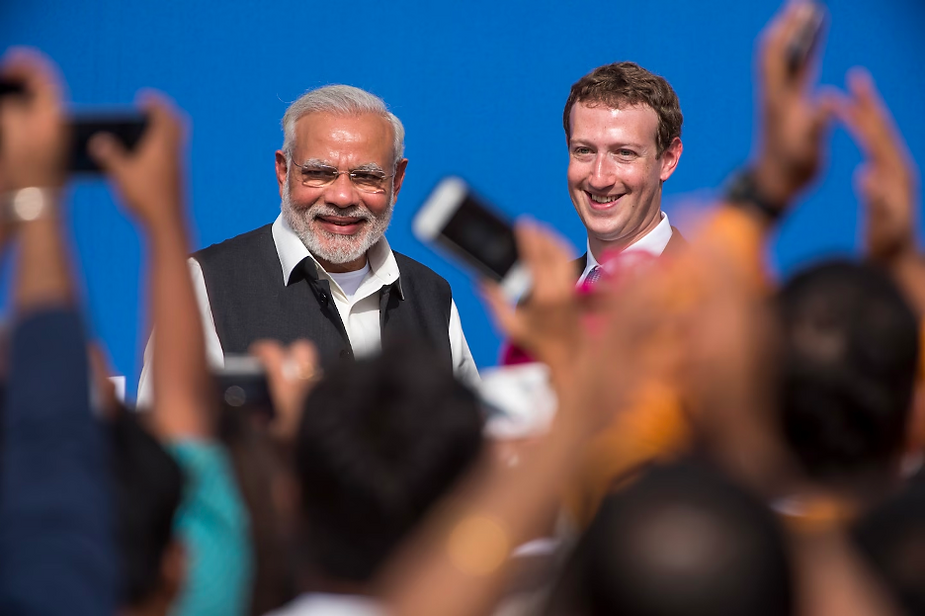
{Indian Prime Minister Narendra Modi and Facebook's Mark Zuckerberg at a September 2015 town hall meeting at the company's headquarters in Menlo Park, Calif. (David Paul Morris/Bloomberg/Getty Images)*}:
Interviews with more than 20 current and former employees and a review of newly obtained internal Facebook documents illustrate how executives repeatedly shied away from punishing the BJP or associated accounts. The interviews and documents show that local Facebook executives failed to take down videos and posts of Hindu nationalist leaders, even when they openly called for killing Indian Muslims.
In 2019, after damning media reports and whistleblower disclosures, Facebook’s parent company, now named Meta, bowed to pressure and hired an outside law firm to examine its handling of human rights in India. That probe found that Facebook did not stop hate speech or calls for action ahead of violence, including a bloody religious riot in Delhi in 2020 that was incited by Hindu nationalist leaders and left more than 50 people, mostly Muslims, dead. Meta never published the document, strictly limited which executives saw it and issued a public summary that emphasized the culpability of “third parties.”
Social media companies today do not lose much when they call out the Russian or Chinese governments for propaganda or dismantle networks of fake accounts tied to those countries. Most U.S. social media platforms are banned in those countries, or they do not generate significant revenue there.
But India is at the forefront of a worrying trend, according to Silicon Valley executives from multiple companies who have dealt with the issues. The Modi administration is setting an example for how authoritarian governments can dictate to American social media platforms what content they must preserve and what they must remove, regardless of the companies’ rules. Countries including Brazil, Nigeria and Turkey are following the India model, executives say. In 2021, Brazil’s president at the time, Jair Bolsonaro, sought to prohibit social networks from removing posts, including his own, that questioned whether Brazil’s elections would be rigged. In Nigeria, then-President Muhammadu Buhari banned Twitter after it removed one of his tweets threatening a severe crackdown against rebels.
The day before May’s tight election in Turkey, Twitter agreed to ban accounts at the direction of the administration of President Recep Tayyip Erdogan, including that of investigative journalist Cevheri Guven, an Erdogan critic.
A man carrying a child runs amid clashes that erupted in Srinagar after New Delhi revoked the semiautonomous status of Indian Kashmir in August 2019 and placed the region under direct Indian rule. (Faisal Khan/Anadolu Agency/Getty Images)*
“Nigeria very much took Modi’s playbook, and it exacerbated existing tensions in Turkey,” a former Twitter policy lead said, speaking on the condition of anonymity to discuss internal matters.
“All of the hard questions around tech come to a head in India. It is a huge market, it is a democracy, but it is a democracy with weak judicial protections, and it’s really geopolitically important,” said Brian Fishman, a former U.S. Army counterterrorism expert who led efforts to fight extremism and hate groups for Facebook until 2021.
U.S. officials depend on nuclear-armed India as a strategic counterweight to neighboring China. And they have been willing to overlook human rights abuses and other problems in India because the officials deem the geopolitics a higher priority, former U.S. officials say. India’s success against the internet companies has inspired many imitators, Fishman added.
“We’re moving into an era around the globe where governments have gotten off their hands and built legal frameworks, and in some cases extralegal frameworks, that allow them to directly pressure the companies,” he said.
{Muslims in Srinagar shout anti-Indian slogans during an August 2019 protest of New Delhi's change in the status of Indian Kashmir. (Tauseef Mustafa/AFP/Getty Images)*}:
A covert campaign
When Facebook’s U.S. investigators first saw the posts from accounts that purported to be residents in Kashmir, it wasn’t hard to find evidence of a central organization. Posts from different accounts came in bursts, using similar words. Often, they praised the Indian military or criticized India’s regional rivals — Pakistan and its closest ally, China.
The technical information about some of the accounts overlapped, and the geolocation data associated with some accounts led directly to a building belonging to the Indian army.
The disinformation hunters also found that the fake accounts often tagged the official account of the Chinar Corps, India’s main military force in Kashmir, showing that they were not putting great effort into disguising themselves.
For a couple of months, employees said, the Facebook team mapped out the network in preparation for rooting out the whole operation, a standard procedure for combating coordinated inauthentic behavior.
Often, the accounts promoted YouTube videos about problems in Pakistan. Some featured a channel run by Amjad Ayub Mirza, a writer from the Pakistani-controlled part of Kashmir who has declared that Muslims are treated well in India and has called on minorities in Pakistan to rise up against the government.
“The reality is that the people being persecuted inside India and also outside the country are actually the Hindus,” Mirza once told an interviewer. “One has to ponder over the question — where did terrorism start from? Terrorism started from Pakistan.”
In just 32 minutes on May 24, 2021, a Post review found, 28 accounts from the covert Chinar Corps network on Twitter shared a post criticizing Pakistan’s treatment of Muslim Uyghurs who had fled oppression in China. Some made the point in English or Hindi that “Pakistan is not a safe place for Muslim minorities.” Twitter released its database of network account activity to researchers last year, and The Post obtained it. Though the database did not attribute the accounts to any entity, employees at Twitter and Facebook told The Post they were from the Chinar Corps. A research team at the Stanford Internet Observatory pointedto circumstantial evidence of a connection between the accounts and the military unit. Facebook said it did not preserve its accounts, making research more difficult.
At least 43 tweets contained some version of: “My religion is Islam, but my culture is Hinduism.” Another dozen said the account holders were Muslim but “Indian first.”
The campaign was unfolding at a sensitive time in Kashmir, claimed in its entirety by both India and Pakistan and divided into Indian- and Pakistani-controlled sections. For decades, India administered its portion as a semiautonomous region while its army fought a separatist insurgency that was supported by many Muslims there and often backed by Pakistan.
Indian security personnel patrol Srinagar in August 2019 after New Delhi ordered restrictions on movement and a telecommunications blackout in Indian Kashmir. (AFP/Getty Images)*
In 2019, the Modi government stunned the world by announcing a constitutional change that revoked Kashmir’s semiautonomous status and transferred it to New Delhi’s direct rule. The move triggered protests as well as the army crackdown in Kashmir, which included alleged tortureand widespread internet shutdowns. With popular anger reaching a boiling point in Kashmir, the Indian government felt pressed to respond.
In public, Indian officials argued that Kashmir’s Muslims would benefit from closer integration with India.
Meanwhile, the Chinar Corps covertly spread its messaging. Jibran Nazir, a Kashmiri journalist working in central India, said he was “shocked” to one day find his photo adopted as the avatar of two anonymous Twitter accounts spreading the #NayaKashmir, or “New Kashmir” hashtag, which touted Kashmir’s prosperity under New Delhi’s control.
“They were recently created accounts that had more than 1,000 followers each,” Nazir recalled. “The accounts wanted to show Kashmiris are doing well, which they’re not.”
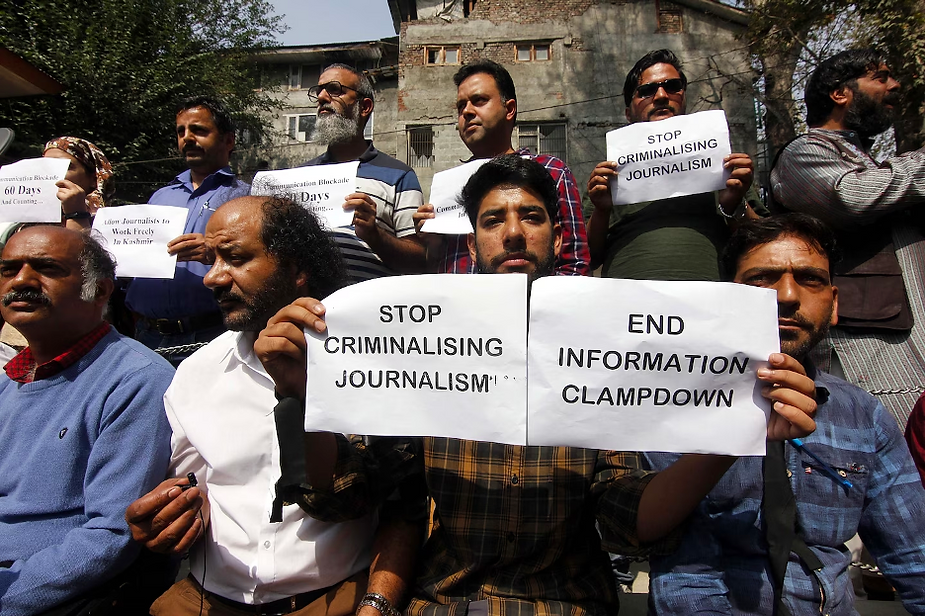
*Journalists gather in Srinagar 60 days after the change in governing status to protest New Delhi's communications blockade. (Faisal Khan/Anadolu Agency/Getty Images)
The Chinar Corps’s stealth operation kept pushing that line — but also went further. It called out independent Kashmiri journalists by name, disclosing their personal information and attacking them using the anonymous Twitter accounts @KashmirTraitors and @KashmirTraitor1, according to Stanford’s analysisand The Post’s review.
One target was journalist Qazi Shibli and his publication, the Kashmiriyat.
“@TheKashmiriyat posts #fake news on the various operations conducted by the #IndianArmy causing hate amongst people for the #Army,” @KashmirTraitors wrote in a series of tweets. “Even the positive things like ration distribution that are happening in #Kashmir are shown in a negative prospect in posts of @TheKashmiriyat.”
“The #traitor behind this account and website is @QaziShibli (born in 1993) who has been detained numerous times under various charges for cybercrimes and posting content against national security.”
Shibli’s home was raided, and he was jailed repeatedly on charges including violation of the Public Safety Act, according to the Committee to Protect Journalists. The pressure online was crippling, Shibli said.
“A lot of people left work at the Kashmiriyat” because of the attacks, he told The Post. “It got to the point that a lot of people were not willing to work with us.”
Shibli said that sources dried up and that even personal friends grew afraid to speak with him.
The @KashmirTraitors tweet with the most “likes” targeted journalist Fahad Shah in early 2021, saying the founder of the Kashmir Walla magazine “rigorously publishes content on anti-#India sentiments.”
Shah’s coverage of Kashmir had been published by the Guardian, Foreign Affairs and Time. He was later arrested and accused of “frequently glorifying terrorism, spreading fake news, and instigating people” under the Unlawful Activities Prevention Act. He remains in prison today.
A security official recently based in Kashmir with knowledge of the matter confirmed the existence of the Chinar network, saying it was a failed attempt to counter narratives from Pakistan.
A couple of months into its investigation, Facebook’s Coordinated Inauthentic Behavior team handed its findings to supervisors and security policy chief Nathaniel Gleicher, who then informed Facebook’s team in India.
Executives there began raising objections. It wasn’t the first time they had.
A relative tends to the grave of an insurgent in late 2022 at a cemetery in Indian Kashmir near the de facto border between India and Pakistan. (Tauseef Mustafa/AFP/Getty Images)
Turning a blind eye
Even before Modi’s rise in 2014, the major U.S. social media companies were overwhelmed by the sheer number of languages and cultures that make up India, according to current and former employees. Inflammatory speech was often coded with slang or references that eluded those unfamiliar with India’s political history, culture or latest memes.
But the problem wasn’t just about resources. Employees described broad reluctance to take down posts of any kind from Modi’s BJP or its affiliates or to make designations that would cast India in a negative light.
Indian content moderation “was always a hands-off situation because of the political pushback,” said a former employee familiar with the India team. During internal discussions with executives in California and elsewhere, the India office argued in effect that “this is our area; don’t touch it,” the employee said. India-related content policy employees “would use a case-law-setting tone, instead of what human harm was being done.”
Kashmiri villagers mourn an Indian soldier who was killed in a clash with insurgents this year as Indian Kashmir marked the fourth anniversary of its change in status. (Tauseef Mustafa/AFP/Getty Images)
After U.S. Facebook employees in 2020 warned that Indian Hindu nationalist groups were spreading the hashtag #coronajihad, implying that Indian Muslims were intentionally spreading the coronavirus in a conspiracy to wage holy war, a content policy staffer for the region pushed back, arguing that the meme didn’t amount to hate speech because it wasn’t explicitly targeting a people, two former employees recalled. (Facebook eventually barred searches for that hashtag, but searching for just “coronajihad” returns accusatory posts.)
In late 2019, Facebook data scientist Sophie Zhang tried to remove an inauthentic network that she said included the page of a BJP member of Parliament. She was repeatedly stymied by the company’s special treatment of politicians and partners, known as Xcheck, or “cross check.” Facebook later said many of the accounts were taken down though it could not establish that the BJP parliamentary member ’s page had been part of the network.
The following year, documents obtained by Facebook employee-turned-whistleblower Frances Haugen show, Kashmiris were deluged with violent images and hate speech after military and police operations there. Facebook said it subsequently removed some “borderline content and civic and political Groups from our recommendation systems.”
In one internal case study on India seen by The Post, Facebook found that pages with ties to the Hindu nationalist umbrella organization Rashtriya Swayamsevak Sangh (RSS) compared Muslims to “pigs” and falsely claimed that the Quran calls for men to rape female family members. But Facebook employees did not internally nominate the RSS — with which the BJP is affiliated — for a hate group designation given “political sensitivities,” the case study found.
The mother of an Indian soldier helps carry his coffin after he was killed in a clash that broke out during a fall 2021 anti-insurgency operation in Indian Kashmir. (Narinder Nanu/AFP/Getty Images)
In a slide deck about political influence on content policy from December 2020, Facebook employees wrote that the company “routinely makes exceptions for powerful actors when enforcing content policy,” citing India as an example.
A key roadblock was Facebook’s top policy person and lobbyist in the region, Ankhi Das, who told employees it would hurt the company’s business prospectsto take down posts such as one by a prominent BJP official that called for shooting Muslims. She also shared commentary on her personalpage in which a former official described Muslims as a traditionally degenerate community.
After an August 2020 Wall Street Journal story spotlighted her interventions, Das resigned that October.
But the pro-government leanings extended beyond Das and reflected a long-standing culture within Facebook to treat India — and its powerful BJP government — with a light touch, according to current and former employees in India and the United States.
After Das’s departure in 2020, Meta appointed Shivnath Thukral, a former public-relations executive who had been head of public policy at Meta’s WhatsApp subsidiary since 2017, to oversee public policy for Meta in India on an interim basis. He assumed the position on a permanent basis in November 2022.
Thukral was closer to the BJP than Das: He had worked on Modi’s national campaign in 2014 and had collaborated with Hiren Joshi, a longtime Modi aide who is today the prime minister’s head of communications, on a pro-Modi website called Modi Bharosa, or “Modi is Trust,” recalled a former Modi staffer who worked with both men. The site churned out glowing articles about Modi’s economic record and accused his political rivals of fomenting riots or misgoverning the country.
Around the time of Das’s departure, the BJP’s head of social media, Amit Malviya, kept the pressure on Facebook by sharing, in interviews with news outlets and on Twitter, the employment and personal backgrounds of Facebook employees and calling out those who had previously worked for liberal politicians or causes.
Soon after, Facebook India’s head, Ajit Mohan, addressed the staff at an all-hands meeting. His message: He didn’t want Facebook employees to become the focus of external attention.
In response to inquiries for this story, Facebook said it has hired more staff, now reviews content in 20 Indian languages and has partners that can fact-check in 15 languages.
“We prohibit coordinated inauthentic behavior, hate speech and content that incites violence, and we enforce these policies globally,” Facebook spokesperson Margarita Franklin said in the company’s only direct comment.
“As a global company, we operate in an increasingly complex regulatory environment and are focused on keeping people safe when they use our services and ensuring the safety of our employees in a manner consistent with applicable laws and human rights principles.” Facebook declined to make any of the employees named in this article available for interviews.
Kashmiri villagers, inspecting a building south of Srinagar that was damaged in an August 2021 gunfight, flee after rumors of incoming Indian soldiers. (Dar Yasin/AP)
Report buried
As the controversy over its handling of hate in India grew in 2019, Facebook hired the law firm Foley Hoag to study and write about its performance there in what is called a human rights impact assessment.
Some rights groups worried that the firm would go easy on Facebook because one of its human rights lawyers at the time, Brittan Heller, was married to Gleicher, Facebook’s head of security policy.
But the firm interviewed outside experts and Facebook employees and found that dozens of pages that were calling Muslims rapists and terrorists and describing them as an enemy to be eliminated had not been removed, even after being reported.
Foley Hoag cited multiple underlying issues, including the lack of local experts in hate speech, the application of U.S. speech standards when Indian laws called for greater restriction of attacks on religion, and a legalistic approach that, for example, withheld action if a subject of threats was not explicitly targeted for their ethnicity or religion.
Foley Hoag found that the company allowed incendiary hate speech to spread in the lead-up to deadly riots in Delhi in 2020 and violence elsewhere, according to people briefed on its lengthy document. It recommended that the company publish the report, name a vice president for human rights and hire more people versed in Indian cultures.
Instead of releasing the findings, Facebook wrote a mostly positive four-page summary and buried it toward the end of an 83-page global human rights report in July 2022. That readout said the law firm “noted the potential for Meta’s platforms to be connected to salient human rights risks caused by third parties.” It said the actual report had made undisclosed recommendations, which the company was “studying.”
Foley Hoag partner Gare Smith said by email that the firm’s human rights impact assessment “was conducted in accordance with the highest ethical standards and pursuant to guidance provided by the U.N. Guiding Principles on Business and Human Rights. Inasmuch as it was conducted under privilege, we cannot comment on specific elements of the Assessment or on our client’s summary of it.”
Facebook said that it discloses more on its human rights performance than any other social media company and that it withheld the full report because of concerns about employee safety.
Facebook executives similarly downplayed problems reported by outside groups. The London Story, a Netherlands-based human rights group, reported hundreds of posts that it said violated the company’s rules. Facebook asked for more information, and then asked for it in a different format, then said it would work to improve things if the group stayed quiet. When nothing happened, the group succeeded in getting a meeting with the company’s Oversight Board, created to handle a small number of high-profile content disputes.
It took more than a year to remove a 2019 video with 32 million views, according to the London Story’s executive director, Ritumbra Manuvie.
In the video, Yati Narsinghanand, a right-wing cleric, says in Hindi to a crowd: “I want to eliminate Muslims and Islam from the face of earth.” Facebook took it down just before the London Story released a report on the issue in 2022.
Versions were then posted again. One remained visible as of Monday, but on Tuesday, after Facebook was asked for comment, it was no longer available.
A Kashmiri man tending to his cattle walks on a hillock in Tosamaidan, southwest of Srinagar, in June 2021. The meadow was once an artillery firing range for the Indian army. (Dar Yasin/AP)
Mounting fears
When Facebook’s investigators brought their Kashmir findings to the India office, they expected a chilly response. The India team frequently argued that Facebook policies didn’t apply to a particular case. Sometimes, it argued that they didn’t apply to sovereign governments.
But this time, their rejection was strident.
“They said they could be arrested and charged with treason,” said a person involved in the dispute.
Facebook’s India team, including policy chief Thukral and communications head Bipasha Chakrabarti, was especially nervous after police raids on Twitter, two people recalled. In 2021, the Indian government was feuding with Twitter over its refusal to take down tweets from protesting farmers. Officials dispatched police to the home of Twitter’s India head and anti-terrorism units to two Twitter offices. Some officials publicly threatened Twitter executives with jail time.
Two former Facebook executives said they had believed that their colleagues’ fears were genuine, though no legal action was ever taken against them.
“I’m not angry at Facebook,” one said. “I’m angry at the Indian government for putting the people who worked on this in a position where they couldn’t address the harms that they found.”
Blocked by their own colleagues, Facebook’s U.S. threat team passed the Chinar Corps information to their counterparts at Twitter. Facebook employees said they had been hoping that Twitter would follow the leads and root out the parallel operation on that platform. The team’s members also hoped that Twitter would do the first takedown, giving Facebook political cover so it wouldn’t have to face government retribution alone and its internal dispute could be resolved.
Twitter, which had been more forceful in pushing back against the Indian government, took no action. It told Facebook staff members that it was having technical issues.
In truth, the San Francisco company was changing direction.
The Indian police raids and public comments from government officials criticizing the company had scared off firms that Twitter had planned to use for promotion, former Twitter employees said. “We saw a very obvious slowdown in user growth,” one former policy leader said. “The government is very influential there.”
The former executive added: “We had just promised [Wall] Street 3x user growth, and the only way that was going to be possible was with India.”
Another former policy staffer said Twitter’s bigger problem was physical threats to employees,while former safety chief Yoel Roth wrote in the New York Times this month that Twitter’s lawyers had warned that workers in India might be charged with sedition, which carries a death penalty.
In any case, Twitter was tired of leading the way with takedowns, and it changed how it treated the government overall. The company did not respond to a request for comment.
Fishman, the former senior Facebook executive, said the U.S. tech companies will not respond more forcefully to Indian government pressure unless they receive help from the U.S. State Department, where onetime cybersecurity executive Nate Fick has been named the first cyber ambassador and has built out a team focused on internet freedom and security issues.
“If we want free speech, [if] we want free elections, while these companies are not the most popular institutions in the world, we need U.S. policy to have their backs at times,” Fishman said. Fick did not respond to requests for comment.
But while Indian activist groups and international democracy monitors have warned about the erosion of democratic norms under the Modi government, the Biden administration has largely refrained from publicly criticizing a country seen as a crucial strategic counterweight to China in the Indo-Pacific.
After meetings with Modi in Washington and New Delhi this year, Biden offered no criticism. Uzra Zeya, U.S. undersecretary of state for civilian security, democracy and human rights, visited India in July. She did not publicly comment about India’s human rights or its democracy after meeting Foreign Secretary Vinay Kwatra but said in a Twitter post: “Grateful for the vital #USIndia partnership & shared efforts to advance a free & open Indo-Pacific, regional stability, and civilian security.”
A senior State Department official, speaking on the condition of anonymity because of the sensitivity of the issue, said that despite the lack of public comment, American diplomats are engaged with India on censorship and propaganda.
“These are precisely the kinds of issues that we raise on a bilateral basis at both the working and senior levels of government,” he said. “The U.S. is committed to ensuring that tech is a force for empowerment, innovation and well-being, and working to ensure that the world’s largest democracy is aligned with us on this vision is a top policy priority.”
Continued silence
As Facebook’s India team delayed acting on the Chinar inauthentic network, the propaganda investigators in Washington and California worked on less controversial subjects.
“You have only so much time in the day, and if you know you are going to run into political challenges, you might spend your time investigating in Azerbaijan or somewhere else that won’t be an issue. Call it a chilling effect. That dynamic is real,” said Fishman, the former senior Facebook executive.
The impasse continued until the U.S. team demanded action from Nick Clegg, then Meta’s powerful vice president of global affairs, who had been put in charge of India public policy. Clegg was later named president of global affairs.
Finally, after discussions with Facebook’s top lawyers, Clegg ruled in favor of the threat team, employees said.
But the India executives had a request: They asked that Facebook at least break with past practice and not disclose the takedown.
Since coming under fire for failing to spot Russian propagandists using its platform during the 2016 U.S. presidential campaign, Facebook has routinely announced significant removals of disinformation. It often describes what the campaign was trying to do and how it did it, and there is frequently direct attribution to a national government or enough detail for readers to guess.
The idea is to increase transparency that could help disinformation hunters and deter its spreaders from trying again. Smaller takedowns are described more briefly in quarterly summaries.
This time, the India side argued that it would be unwise to embarrass the Indian military and that doing so would increase the likelihood of legal action.
Clegg and Facebook chief legal officer Jennifer Newstead agreed, staffers said. At their direction, Facebook changed its policy to state that it would disclose takedowns unless doing so would endanger employees.
Following standard practice, Facebook removed the fake accounts, and the official Chinar Corps pages they had been working with on Facebook and Instagram, on Jan. 28, 2022. (After the Indian army publicly complained about the takedown of the official pages, they were reinstated.)
That March, Twitter followed Facebook and quietly removed the Chinar Corps’s parallel network on its platform and shared it with researchers. In private meetings with Facebook and Twitter executives, the army defended its fake accounts and said they were necessary to combat Pakistani disinformation.
Facebook didn’t disclose the takedown, and Twitter hasn’t issued what had been twice-yearly summaries of its enforcement actions since one for the period that ended in December 2021.
A month later, Facebook issued a quarterly “adversarial threat report” that listed takedowns of inauthentic networks targeting users in Iran, Azerbaijan, Ukraine, Brazil, Costa Rica, El Salvador and the Philippines.
It said nothing about India.
Shih reported from New Delhi. Jeremy B. Merrill in Atlanta and Karishma Mehrotra in New Delhi contributed to this report.
*Design by Anna Lefkowitz. Visual editing by Chloe Meister, Joe Moore and Jennifer Samuel. Copy editing by Feroze Dhanoa and Martha Murdock. Story editing by Mark Seibel. Project editing by Jay Wang.
*:{ByJoseph Menn
*Joseph Menn joined The Post in 2022 after two decades covering technology for Reuters, the Financial Times and the Los Angeles Times. His books include "Cult of the Dead Cow: How the Original Hacking Supergroup Might Just Save the World" (2019) and "Fatal System Error: The Hunt for the New Crime Lords who are Bringing Down the Internet" (2010).
*ByGerry Shih
{Gerry Shih is the India Bureau Chief for the Washington Post, covering India and neighboring countries.Twitter}:
What this series reveals
Part 1: Narendra Modi’s Bharatiya Janata Party and its Hindu nationalist allies have built a massive propaganda machine, with tens of thousands of activists spreading disinformation and religiously divisive posts via WhatsApp. Parent company Meta says WhatsApp cannot monitor content, no matter how inflammatory.
Inside the vast digital campaign by Hindu nationalists to inflame India
Part 2: Social media giants have been reluctant to police Indian content that violates their terms of service. After Facebook discovered a vast influence operation using fake accounts secretly operated by the Indian army, some company employees moved to shut it down, but executives in the New Delhi office stalled the action.
Under India’s pressure, Facebook let propaganda and hate speech thrive
Part 3: A new generation of Hindu vigilantes frequently stream their armed attacks against Muslims on platforms like YouTube and Facebook, amassing large followings and winning BJP protection. While rights activists have repeatedly flagged hateful influencers to social media companies, the accounts are rarely removed.
The Indian government has become increasingly aggressive in restricting online criticism and dissent, frequently ordering social media companies to take down posts and blocking the internet altogether in areas with significant dissension. More stories to come.
---
MMA
---
kpfa event? w/ arundati roy update 6 24 modi govt up on treason charges for 2014 comments on Kashir
https://kpfa.org/episode/a-rude-awakening-july-31-2020/
no shock absorbers, redundant resilience vs nature "efficiency"= systems // noam c crit analysis on how neo-lib cap'l system can't deal w/ covid
===
---
https://www.alternet.org/2021/06/india-modi/
// trump fail covid
---
https://www.alternet.org/2021/05/bill-gates-vaccine-india/
globetrotter
While the incompetence of the Indian government is starkly visible in its handling of the second wave of the COVID-19 crisis, its performance has been far worse on the vaccine front. The BJP-led government of Prime Minister Narendra Modi, which seems to believe in the ideology of free-market capitalism, thinks that the market will magically produce the number of vaccines the country needs. This would explain why it has starved seven public sector vaccine manufacturing units—according to an April 17 article in Down to Earth—of any support instead of ramping up much-needed vaccine production.
The rights to produce the public sector vaccine, Covaxin, which has been developed bythe Indian Council of Medical Research(ICMR) and National Institute of Virology (NIV)](https://www.icmr.gov.in/pdf/press_realease_files/Press_Release_ICMR_03_March_2021.pdf), in collaboration with Bharat Biotech, have been given to the private company partner on an exclusive basis. The Indian government also believed that Serum Institute of India, another private sector company and the world's largest vaccine manufacturer, which has tied up with AstraZeneca for producing [Covishield, would make vaccines according to the country's requirements without any prior orders or capital support. The government did not even see the necessity to intervene and prevent India's new Quad ally, the U.S., from stopping sending India supplies of the required raw materials needed by India for manufacturing vaccines.
The sheer negligence by the government is further highlighted by the fact that even though India has about 20 licensed manufacturing facilities for vaccines and 30 biologic manufacturers, all of which could have been harnessed for vaccine manufacturing, only two companies are presently producing vaccines. That too is at a pace completely inadequate for India's needs.
India has a long history of vaccine development, which can be traced back to the Haffkine Institute for Training, Research and Testing, in Mumbai, in the 1920s. With the Patents Act, 1970 and the reverse engineering of drugs by the Council of Scientific and Industrial Research (CSIR) laboratories, the country also broke the monopoly of global multinationals. It is this change, fought for by the Left, that led to India emerging as the largest generic supplier of drugs and vaccines in the world and becoming the global pharmacy of the poor.
Bill Gates recently spoke to **Sky Newsin the UK regarding India and South Africa's proposal to the World Trade Organization on the need to lift intellectual property (IP) protection for COVID-19 vaccines and medicines during the pandemic. Gates claimed that IP is not the issue and that "moving a vaccine… into a factory in India… It's only because of our grants and our expertise that can happen at all." In other words, without the white man coming in to tell India and other middle-income countries how to make vaccines and provide them with his money, these countries would not be able to make vaccines on their own.
This is a rehash of the AIDS debate, where the Western governments and Big Pharma argued that developing generic AIDS drugs would lead to the manufacturing of poor-quality drugs and theft of Western intellectual property. Bill Gates, who built his fortune on Microsoft's IP, is the leading defender of IP in the world. With his newfound halo as a great philanthropist, he is leading Big Pharma's charge against the weakening of patents on the global stage. The role of the Bill and Melinda Gates Foundation, a major funder of the World Health Organization, is also to dilute any move by the WHO to share patents and knowledge during the pandemic.
Indian companies are the largest manufacturers of existing vaccines by volume in the world, according to the WHO's Global Vaccine Market Report 2020. When it comes to measuring vaccine manufacturing by value, however, the global share held by multinational corporations or Big Pharma is much bigger than that of India. For example, as per the WHO report, GlaxoSmithKline (GSK), with 11 percent of the global market by volume, generates 40 percent of the market by value, while Serum Institute with 28 percent of the market by volume has only 3 percent of the market by value. This shows that the patent-protected vaccines with monopoly pricing get much higher prices. This is the model that Bill Gates and his ilk are selling. Let Big Pharma make the big bucks even if it bankrupts the poorer countries. The Western philanthropic money of Gates and Warren Buffett will 'help' the poor Third World to get some vaccines, albeit slowly. As long as they get to call the shots.
The Modi government's approach to vaccines is based on the central pillar of Rashtriya Swayamsevak Sangh ideology—which serves as the ideological parent of the ruling BJP—that the task of the state is only to help big capital. Anything else including planning is seen by the right wing as socialism. In the case of vaccines, it means not to make any attempt to get the companies, both in the public and private sectors, to make necessary preparations for a quick vaccination program: to put in the money and provide the necessary supply chain. Instead, the government believed that India's private pharmaceutical industry would do all of this on its own.
It forgot that the Indian pharmaceutical industry was the product of public domain science—the CSIR institutions—the public sector and nationalist companies like Cipla. They all came out of the national movement and built India's pharmaceutical industry. It is institutions like the Haffkine Institute under Sahib Sokhey's leadership and the Center for Cellular and Molecular Biology (CCMB) built under the leadership of Dr. Pushpa Bhargava that led to India's vaccine and biologics capacity. It is on this base that India's vaccine manufacturing capacity rests.
It is not niji (private) companies that built the vaccine capacity in India, as Prime Minister Narendra Modi claims. The private sector companies rode on the back of public sector science and technology that was built in the country between the 1950s and the 1990s.
The Indian government recently opened up vaccinations for all adults in the country on May 1. To vaccinate all the eligible population—above 18 years of age—India would require about 2 billion doses of the vaccine in order to give the required two shots per person. To plan for the production of an order of this size, apart from technology and capital support, India also needs to plan for the complex supply chain that is required for production. This includes raw materials and intermediate supplies such as filters and special bags. There are at least 37 "critical items" that are currently embargoed by the U.S. from exports under the Defense Production Act, 1950, a relic of the U.S.'s Korean War....
---
https://www.alternet.org/2021/05/brazil-india/
covid fail --> hunger (illegal to ask for O2 online?!)
---
321 lilsis
Google Invests Billions in India as Modi and Allies Stage Corporate Takeover of Agriculture
In profiting from its India investments while not condemning the Modi government’s human rights abuses, Google & US Big Tech are validating the repression of protesters.
---
an 321
https://www.alternet.org/2021/03/india-famine/
---
an 1120
india moves toward a de facto unitary state — here's why that's dangerous for its future
IMI
---
https://www.alternet.org/2020/10/policing-the-digital-frontiers-is-india-weaponizing-technology-to-silence-civil-society/
on June 15, 2020, Amnesty International andCitizen Lab, an interdisciplinary laboratory based at the Munk School of Global Affairs at the University of Toronto, uncovered a coordinated spyware campaign that targetednine Indian human rights defenders between January to October 2019.
In the world’s largest democracy, these types of incidents are a concern especially when viewed alongside the government’s broader crackdown on dissent. Under the Bharatiya Janata Party (BJP) led government, India has gained global notoriety forsilencing critical voices throughfrivolous defamation suits,arrests and detentions of citizens engaging in peaceful protests, and theimprisonment of journalists.
The activists were sent multiple emails, containing links to malicious software, disguised as important communications. If downloaded, the software would infect a user’s phone or computer withNetWire, a piece of commoditymalware designed to cause extensive damage to data and systems or to gain unauthorized access to a network.
Eight of the individuals targeted had been calling for the release of those indicted in the Bhima Koregaon case dating back to 2018 when, in the wake of violent attacks against Dalit communities in Maharashtra, police arrested several activists known for their advocacy work on behalf of these communities.
Unanswered questions about Pegasus in India
Three of the individuals targeted with Netwire were also targeted earlier in 2019 in the now infamous NSO WhatsApp hack, a spyware attack in which at least two dozen academics, lawyers, Dalit activists and journalists in India were targeted with Pegasus), a spyware that canextract a user’s private data, including passwords, contact lists, calendar events, text messages, and even voice calls. Some variants of it can even turn on a phone’s camera and microphone to capture activity in the phone’s vicinity.
The individuals were informed about this attack by Whatsapp, who contacted and alerted them that their phones had been under state-of-the-art surveillance for a two-week period in May 2019. This hack was part of a wider attack that targeted at least 100 members of civil society around the world and led to Whatsapp suing the NSO group in a US court.
Following the revelation of the Pegasus attacks in November 2019, NSO defended itself saying that it only sells its technology to “licensed government intelligence and law enforcement agencies. Consequently, several of those targeted in India wrote to the Parliamentary Standing Committee on Information Technology asking whether the government had authorized the use of this spyware. Unfortunately, the Indian government’s Ministry of Home Affairs and the Ministry of Information Technology refused to give a straight answer to this question, only claiming that “no unauthorized interception” had taken place. Subsequently, the government sought to shift the blame on Whatsapp, insinuating that the tech platform had allowed the breach to take place and had not informed it about it. Embarrassingly, Whatsapp responded stating that it actually had informed the country’s nodal cyber response agency when the attacks had first taken place.
Illegally intercepting or accessing computer devices is recognized as a criminal act under international law and India’s Information Technology Act. If the hackers were private actors, it is concerning as to why the Indian government has not yet released details of any criminal investigations against them, despite sufficient evidence of a crime having been committed against its own citizens. The alternative scenario, if it happens to be true, is doubly concerning. State surveillance through the use of spyware not only violates India’s own laws around the interception of private communications but also poses a huge threat to free expression, privacy and freedom of thought.
BJP surveillance measures
While less invasive forms of surveillance have been used by different ruling powers through the decades in India, the BJP’s measures are excessive, to say the least. In December 2018, the Ministry of Home Affairsgave ten agencies blanket legal authority “to intercept, monitor or decrypt information generated, transmitted, received or stored in any computer.” This order was challenged in the Supreme Court to which the governmentresponded with a statement that “the veil of privacy can be lifted for legitimate state interest.” The order continues to be enforced, pending a final judgement by the apex court.
In May 2020, the Ministry of Information and Broadcasting floated and closed a bid for a tool to provide “fact verification and disinformation detection on social media platforms.” According tomedia reports, this was the eighth attempt by this government, since it came into power in 2014, to “explicitly and directly monitor social media”. This latest attempt at mass surveillance is currently beingchallengedin court by the Internet Freedom Foundation. Given the Supreme Court’s 2017 ruling on privacy being a fundamental right, there is hope that this attempt too will be thwarted.
It is important to note that these attempts to monitor citizens’ lives are being made in the absence of a personal data protection law, which if enacted in line with international human rights standards, could offer some protection against these repeated attempts at surveillance. Unfortunately, the data protection bill introduced by the BJP-led government in 2019, which is currently undergoing joint parliamentary review, fails to meet such standards. It seeks to give the government unrestricted access to personal data on vaguely worded grounds of sovereignty, violating key legal safeguards around necessity and proportionality, as enshrined in international law and recognized by the Indian Supreme Court as intrinsic to safeguarding the right to privacy. There are further concerns that this is a backdoor attempt to provide legislative backing to the State’s passive surveillance activities online, which are currently conducted outside the remit of the law, merely through executive action, and thus escape meaningful oversight. Understandably, the bill has faced massive pushback from civil society, and even the United Nations Special Rapporteur on Privacy has expressed concern.
A global trend
These attempts to monitor and police digital spaces are not unique to India alone –digital authoritarianism is on the rise around the world, especially in countries where rising nationalism, combined with weaker rule of law has emboldened governments to crackdown on dissent, increasingly with the aid of technology supplied by dubious corporations eager to make a quick buck.
Spyware, one of the most invasive surveillance tools, has managed to evade regulation at the international level so far, largely because surveillance is a topic that governments are not keen to discuss, mostly due to diplomatic, political and national security reasons. Consequently, the lack of an international framework to regulate its production, sale and use coupled with an increasing interest by repressive regimes in the private lives of their critics, has led to an uptick in the use of spyware, as tracked by Citizen Lab. Concerned by this troubling trend, the UN’s Special Rapporteur on Freedom of Expression released a report, calling on governments to “establish an immediate moratorium on the global sale and transfer of private surveillance technology until rigorous human rights safeguards are put in place to regulate such practices and guarantee that governments and non-State actors use the tools in legitimate ways”. The US State Department has also released guidance to “assist U.S. companies seeking to prevent their products or services with surveillance capabilities from being misused by foreign government end-users to commit human rights abuses.”
These are steps in the right direction, which have taken effect largely due to the tireless advocacy done by civil society organizations who are bravely calling out human rights abuses, pushing for rights-respecting legislation and engaging in strategic litigation. Countries seeking to prevent the decline of democracy must support these groups, in India and elsewhere, by engaging them as trusted partners in the fight to keep the internet equal, open and free.
Written by Ayesha Khan
This postoriginally appeared on Global Voices
---
https://www.alternet.org/2020/09/when-politicians-use-hate-speech-political-violence-increase/
politicians deepen existing divides when they use inflammatory language, such as hate speech, and this makes their societies more likely to experience political violence and terrorism. That's the conclusion from a study I recently did on the connection between political rhetoric and actual violence.
President Donald Trump is not the only world leader who is accused of publicly denigrating people based on their racial, ethnic or religious backgrounds.
In the 2019 parliamentary campaign in India, politicians from theruling Bharatiya Janata Party targeted Muslims as part of a widespread electoral strategy to galvanize Hindu nationalism. Similarly, in the 2019 Polish election, incumbent president Andrzej Duda made demonization of the LGBT community as well as foreigners the centerpiece of his successful reelection campaign.
Hate speech has also figured prominently in the recent rhetoric of political leaders in a variety of countries including Russia, Colombia, Israel, Egypt, Ukraine, the Philippines, Italy, Greece, Sri Lanka and Iraq.
These remarks are not just empty rhetoric or political theater. My research shows that when politicians use hate speech, domestic terrorism increases – in the U.S. and in other countries.
Indeed, since the beginning of Trump's 2016 presidential campaign, domestic terrorism has more than doubled in the United States. During the Obama administration's two terms, the U.S. averaged 26.6 incidents of domestic terrorism per year, according to the Global Terrorism Database. The most active year, by far, was 2016, which saw 67 attacks, more than double Obama's overall average. During the first two years of Donald Trump's presidency, 2017 and 2018 – the latest year for which data are available – domestic terror activity stayed that high, with 66 and 67 attacks, respectively
[graf]
polarizing politics paves the way
Hateful rhetoric targeting minority groups is an established technique to unify and mobilize political supporters and to delegitimize and dehumanize political opponents. Hate speech by politicians also serves to deepen political polarization.
More polarized societies are especially susceptible to bouts of political violence and terrorism when politicians use hate speech. Examples include Weimar Germany in the 1920s and 1930s, which featured assassinations of leftist politicians and street brawling by Nazi partisans; Argentina in the 1970s during the so-called “Dirty War" in which government-backed right-wing death squads fought with left-wing political movements who themselves engaged in terrorism; and Turkey in the late 1970s early 1980s, when ultranationalist right-wing organizations and leftist opposition movements attacked each other.
When taken to an extreme, hateful rhetoric by political leaders can precipitate civil wars and genocides, as was the case in the 1990s in Rwanda, where Hutu extremists used anti-Tutsi radio broadcasts to foment widespread violence.
Examining the data
For my analysis, I used statistical data on domestic terrorist incidents from the Global Terrorism Database at the University of Maryland, and major party figures' use of hate speech in about 150 countries between 2000 and 2017 from the Varieties of Democracy project at the University of Gothenburg, Sweden.
I tried to determine the relationship between politicians using hate speech and the number of domestic terror attacks the country experienced the following year. Other elements can affect domestic terrorism, so I factored into my analysis each country's political system, its gross domestic product per capita, its population size, its degree of ethnic and linguistic diversity and its level of media freedom.
To further distinguish political violence that was specifically produced by hate speech, I also factored in how much domestic terrorism the country had experienced in previous years and whether or not the country was experiencing a civil war.
[graf]
violence climbs when politicians speak with hate
What I found is that countries where politicians frequently weave hate speech into their political rhetoric subsequently experience more domestic terrorism. A lot more.
Countries such as Costa Rica or Finland, where the data show politicians “never" or “rarely" employed hate speech, experienced an average of 12.5 incidents of domestic terrorism between 2000 and 2017. Countries where politicians were found to “sometimes" use hate speech in their rhetoric, such as Belgium or Cyprus, experienced 28.9 attacks on average.
However, domestic terrorism was quite frequent in countries whether politicians used hate speech “often" or “extremely often." Such countries, including Iraq, Russia, Turkey and Sudan, experienced an average of 107.9 domestic terrorist attacks during that period.
What public figures say can bring people together, or divide them. How politicians talk affects how people behave – and the amount of violence their nations experience.
James Piazza, Liberal Arts Professor of Political Science, Pennsylvania State University
This article is republished from The Conversation
---
---
https://theconversation.com/trumps-use-of-religion-follows-playbook-of-authoritarian-leaning-leaders-the-world-over-140050
It was a striking moment: Donald Trump, Bible in hand, posing for photos in an apparent moment of political theater made possible by the dispersal of protesters through the use of tear gas.
:{:{}:
}:
The president’s visit to St. John’s Episcopal Church, known as “the Church of the Presidents,” came immediately after giving a Rose Garden speech framing himself as “your president of law and order” and threatening to send federal troops to “restore security and safety in America.” The next day, Trump made another high-profile visit to a place of worship, this time Washington’s St. John Paul II National Shrine.
Coming at a time of social turbulence, critics accused Trump of following authoritarian-leaning world leaders by sidling up to religion to reinforce an image as a strongman defending a particular brand of tradition. Bishop of the Episcopal Diocese of Washington Mariann Budde said as much, commenting that Trump used the Bible at St. John’s “as if it were a prop or an extension of his military and authoritarian position.”
As a scholar who has researched the interaction of politics and faith for decades, I know how potent religion can be as a political tool.
A powerful tool
Religion creates meaning in our lives by articulating values about how we relate to one another. But just as it can unite us, religion can also be a source of division – used to “other” people who are not of the faith and don’t share the same traditions and rituals.
When enough people perceive – or can be convinced – that traditional elements of the social fabric are at risk, religious signaling through the use of symbols and images can help would-be authoritarians cement their power. They present themselves as protectors of the faith and foes of any outsider who threatens tradition.
Russian President Vladimir Putin sunbathes with a cross on display over his bare chest. Alexey Nikolsky/AFP via Getty Images]
In Russia, this phenomenon is seen in President Vladimir Putin’s forging of a strategic alliance with the Russian Orthodox Church. For his part, Putin presents himself not just as a commanding leader, but also as a devoutly religious Russian. When he appears shirtless, for example, the large cross he wears around his neck is always visible. Meanwhile, the Church promotes traditional moral values and maintains a distance from the rest of the worldwide Orthodox Christian community, thereby separating the “truly Russian” from the outsider. In their most recent collaboration, Putin and the Church proposed amendments to the Russian constitution that would enshrine Russians’ faith in God, define marriage as the union of a man and a woman and, tellingly, proclaim “the great achievement of the [Russian] people in defense of the Fatherland.” These changes, all of which are intended to reinforce Putin’s base of support, would be jarringlynationalistic additions to the constitution.
Putin benefits from this insider-outsider dynamic in advancing his goal of restoring Russia to his vision of its past territorial glory. In justifying the Russian incursion into Crimea, Putin argued that the region had “sacral importance for Russia, like the Temple Mount in Jerusalem for the followers of Islam and Judaism.” Defending and expanding Russian territory is a much easier sell if it is framed as the defense of the holy.
Religious imagery
We see a similar dynamic in India, where Prime Minister Narendra Modi’s grip on power relies in large part on his embrace of a version of Hindu nationalismthat elevates Hindus as “truly Indian” insiders and singles out Muslims as outsiders.
Like Putin, Modi wraps himself in religious imagery. He makes high-profile visits to remote Hindu temples while electioneering and never wears green because of its association with Islam.
Then-prime minister candidate Narendra Modi visits a shrine on horseback while electioneering in 2014. Strdel/AFP via Getty Images
Modi’s Hindu nationalism cements his popularity among devout Hindus and builds public support for anti-Muslim policies, such as stripping the only majority-Muslim state in India of its autonomy and enacting a controversial new law preventing Muslim migrants from attaining Indian citizenship.
Trump as savior
Trump has stumbled in attempts to portray himself as personally devout, declining to name a favorite passage from the Bible and stating that he has never sought forgiveness from God for his sins.
Nevertheless, public opinion polls have consistently shown that white Christians comprise the core of Trump’s base, although there are recent signs of a dip even among this key group.
And while it is important to note that many white Christians do not support Trump, 29% of evangelicals go so far as to say they believe he is anointed by God.
Where Trump succeeds is in presenting himself as a Christian nationalist, much as Putin and Modi style themselves as the stout defenders of their countries’ dominant religions.
One way Trump achieves this end is by making statements such as this one on the campaign trail earlier this year: “We’re going to win another monumental victory for faith and family, God and country, flag and freedom.”
In their new book “Taking America Back for God,” sociologists Andrew Whitehead and Samuel Perry contend that many of Trump’s white Christian supporters see him as their long-awaited savior – not just the protector of traditional religion, but also the defender of a bygone way of life.
In that imagined past, white men ruled the roost, families went to church every Sunday and outsiders knew their place.A deep-rooted desire for a return to that past may have been why Trump’s Make America Great Again slogan has proved so potent. As Yale scholar Philip Gorski has argued, that phrase can be interpreted to mean “making white Christianity culturally dominant again.”
As such, we should not be surprised that in the current moment of crisis Trump is attempting to use religion to reinforce differences between his supporters and his opponents. Like Putin, he is posing as the defender of a particular version of a glorious past. And echoing Modi, he is doing this by building support through the denigration of the outsider.
---
==
india and brazil covid surge 6/3/20, brazil #2 behind US; west pt cadets (ceremony is still on?!) dn
==
==
6/2 1st cyclone in hist --> mumbai?
an 5/20
India’s treatment of Muslims and migrants puts lives at risk during COVID-19
Jay Ramasubramanyam, The Conversation
by Jay Ramasubramanyam, Carleton University In India, the second most populous country in the world, the COVID-19 pandemic has exposed pre-existing fault lines of inequality and communalism, exposing current problems…
==
Trump’s trip to India: Fluffed by another right-wing strongman
Heather Digby Parton / Salon February 26, 2020
Trump had a great time being hosted by Hindu nationalist Narendra Modi: Just another strongman yanking his chain.
---
an 120
hindu fascism: An all-American threat
Like all cities with large Indian diasporas, Chicago has Devon Avenue where purveyors of Indian clothing, food, and wares congregate. Chicago’s obsession with honorary street signs gives away the sectarian…
---
An act of mass surveillance’: India’s use of facial recognition tech against protesters angers privacy advocatesEoin Higgins / Common Dreams
---
==
https://www.alternet.org/2019/12/indias-government-is-going-to-war-against-its-own-people/
4 shot live ammo?
---
---
India’s Upper House Passes “Anti-Muslim” Citizenship Bill
---
https://www.alternet.org/2019/10/russia-accusations-a-distraction-from-tulsi-gabbards-actual-troubling-ties
no lnx docs?
Russia accusations a distraction From Tulsi Gabbard’s actual troubling ties
Written by Ari Paul / FAIR October 26, 2019
When 2016 Democratic presidential nominee Hillary Clinton (Campaign HQ, 10/17/19) accused Rep. Tulsi Gabbard, a long-shot Democratic primary candidate, of being a Russian-groomed foil, the media reverberations were sweeping. Coverage of the row prompted more coverage, with some takes defending Gabbard’s moral compass and others prolonging the obsession with the idea that Russia is interfering in American politics.
Lost in the noise is the reality that Gabbard’s most troubling attribute is her documented connection to the far-right Hindu nationalist, or Hindutva, movement known as Rashtriya Swayamsevak Sangh (RSS), the parent organization of India’s ruling BJP party.
There is no evidence that Gabbard, who rarely polls above 3%, is any kind of Russian agent, plucked by Moscow to sway the 2020 election toward the reelection of Donald Trump. But those silly accusations eventually mix into the media as they look to explain how an idiosyncratic candidate like Gabbard can gain the support not only of anti-war leftists who see her as a champion of nonintervention, but also of far-right white nationalists like David Duke and Richard Spencer...
==
intercept
Network of Hindu Nationalists Behind Modi’s “Diaspora Diplomacy” in the U.S.
Rashmee Kumar
“Howdy, Modi” corralled not just Donald Trump and 50,000 Indian Americans, but also a delegation of U.S. politicians.
---
919 modi US visit TX
https://theintercept.com/2019/09/21/howdy-modi-trump-anders-brevik/
QUESTION: WHAT IS the connection between controversial Indian Prime Minister Narendra Modi — who is visiting Houston this Sunday for the “Howdy, Modi” summit, as well as a meeting with President Donald Trump — and a spate of white nationalist terrorist attacks across the West?
Answer: Anders Breivik.
You remember Breivik, right? The homicidal Islamophobe who massacred 77 people in Norway in 2011? Brevik, who was sentenced to 21 years in prison, is now viewed as a “saint” by far-right activists. Christopher Hasson, the Coast Guard lieutenant and self-proclaimed white nationalist accused of plotting the assassination of prominent Democrats and journalists, has cited Breivik as an influence. The Christchurch shooter Brenton Tarrant described the Norwegian mass murderer as his “true inspiration” and even suggested that they had been in contact, while the El Paso shooter Patrick Crusius, in turn, expressed support for the “Christchurch shooter and his manifesto,” as did the San Diego synagogue shooter.
But where did Breivik himself draw inspiration from? It probably won’t shock you to hear that he name-checked a range of conservative and far-right commentators from the U.S. and the U.K. in his rambling and racist manifesto. But it might surprise you to discover that this modern icon of white nationalist terrorism also mentioned India, and in particular Hindu nationalism, on a “remarkable 102 pages” of his 1,518-page screed.
BREIVIK CALLS ON his “Hindu Nationalist brothers” to “rise up” against the Muslim conquerors of India, and extols Hindu nationalist groups because “they dominate the streets” and “do not tolerate the current injustice and often riot and attack Muslims when things get out of control.” However, he complains, “this behaviour is nonetheless counterproductive.”
“Instead of attacking the Muslims,” he continues, “they should target the category A and B traitors in India and consolidate military cells and actively seek the overthrow of the cultural Marxist government.”
For Breivik, it is essential that far-right, Islamophobic movements in Europe and India “learn from each other and cooperate as much as possible” because “our goals are more or less identical.” He even provides a list of online resources for his readers — and it includes the website of the Rashtriya Swayamsevak Sangh among them.
The RSS is a far-right, male-only paramilitary volunteer organization, founded in India in 1925. Breivik may have been lauding the RSS in 2011; but back in the 1920s and 1930s, the founders of the RSS were heaping praise on Europe’s far-right, totalitarian regimes — from Mussolini’s fascists in Italy to Hitler’s Nazis in Germany.
M.S. Golwalkar, the second leader of the RSS, wrote about how he was inspired by Nazi Germany, which he said displayed “race pride at its highest” and was “a good lesson for use” in India. V.D. Savarkar, who coined the term “Hindutva” to refer to the RSS’s vision of India as a Hindu state, claimed that “Germany had every right to resort to Nazism, and Italy to Fascism.” He even compared India’s Muslims to “Jews in Germany.” A former member of the RSS — and acolyte of Savarkar — would later assassinate Mahatma Gandhi, in protest of the latter’s pro-Muslim views.
SO WHERE DOES Modi fit in here? The Indian prime minister is the leader of the right-wing Bharatiya Janata Party, which is accurately described by Breivik in his manifesto as “the political arm of the RSS.” Modi himself began training with the RSS when he was 8 years old; by the age of 22, he was a full-time “pracharak,” or missionary, for the group. As chief minister of the state of Gujarat — the scene of brutal anti-Muslim pogroms in 2002 — Modi oversaw the distribution of high school textbooks that described Hitler as a leader who “lent dignity and prestige to the German government.”
Today, as prime minister, Modi continues to bestow praise on the likes of Golwalkar and Savarkar. He considers the former to be his ideological mentor and “Pujniya Shri Guruji” — a guru worthy of worship — and the latter to be an epitome of “courage, patriotism, and unflinching commitment to a strong India.”
Meanwhile, on Modi’s watch, the secretive RSS has seen a spike in membership — to around 6 million members — and an unprecedented level of political influence in the nation’s capital, despite the fact that a former inspector general of police once described the group as “the country’s No. 1 terror organisation.”
The rise of Modi, the RSS, and Hindu nationalism has led to an explosion of hate crimes in India. “Today, under Modi’s iron-fisted regime, Christians, Dalits, Muslims, Sikhs, and every Hindu who disagrees with the hate, violence, and supremacy of the RSS lives in fear of their lives,” South Asia affairs analyst Pieter Friedrich explained to Houston City Council on Tuesday, as part of a last-ditch attempt by anti-Modi activists to prevent the prime minister’s high-profile summit in the city. Mobs have beaten and murdered Muslims for allegedly slaughtering or even transporting cows; churches have been burned and vandalized.
“Fascism,” as Yale University scholar Jason Stanley told me earlier this year, “always involves something like white nationalism, but it doesn’t need to be white nationalism.” Is it any wonder that the Hindu nationalist from India has formed such a close friendship with the white nationalist in the White House? They have fascism in common. Modi, though, is much more dangerous than Trump — unlike the latter, the former is a true believer, a proud ideologue.
It is therefore difficult to disagree with Friedrich. “Rather than ‘Howdy, Modi,’” he told council members on Tuesday, “the City of Houston ought to be saying, ‘Adios, Modi.’”
==
https://www.alternet.org/2019/09/how-democracy-is-being-turned-on-its-head-in-india/
no lnx
How democracy is being turned on its head in India
Written by Teesta Setalvad / Independent Media Institute September 19, 2019
There were some notable differences between the swearing-in ceremonies of the Hindu-supremacist government of Narendra Modi in its first victory on May 26, 2014, and its re-election on May 30, 2019.
The 2014 victory was tentative yet triumphant. There were attempts to paint a narrative of the South Asian leaders who were invited, including Pakistani Prime Minister Nawaz Sharif and others. While Indian elite and stars from Bollywood dotted the forecourt of the president’s residence (Rashtrapati Bhawan, in New Delhi), the message to neighbors was that India is the Big Brother offering a hand to other nations. Modi, who touts the humble beginnings he overcame, has repeatedly shown a penchant for trying to make history and create a grand narrative. By the 2019 swearing-in ceremony, it seemed that Modi’s government had abandoned the pretense that India needed the approval of the outside world.
India’s first prime minister, Jawaharlal Nehru, was a celebrated internationalist. His firm belief in collaborations among the developing nations, fed on his socialist roots, led him, along with other legendary leaders, to the emergence of the Non-Aligned Movement (NAM). There was a major shift for India in the 1990s when the Indian National Congress, under a leadership committed to freeing India from a controlled economy, chose the path of neoliberal economics, drawing closer to the United States and Israel.
Then came the vitriol of the campaign that led to Modi’s first victory, his almost no-holds-barred unleashing of hatred, and his rhetoric of “us versus them” (where “us” can only mean “Hindu India”—never mind the segregations of caste complications that come with the term). His master stroke of inviting “enemy nation” Pakistan to share the glory of his electoral win was hailed by many as a strategic shift—one that never materialized.
Appealing to a vast section of India as the “tea seller” from a humble background, there was no shame for his followers that the man aspired to riches, wearing an outrageously expensive coat (when he met President Obama in Delhi months later) or using a luxe Mont Blanc pen as he signed documents to take his oath—crass expressions of personal wealth.
The first five years of the regime were signs of the time to come. An immediate centralization of power, an assault on university campuses (especially on student leaders who questioned this hegemonic and proto-fascist ideology that has groomed Modi since teenage years), cutbacks on workers’ and farmers’ rights, arrests on activists and lawyers and worst of all, lynchings of Indians who did not fit the definition of the ‘ideal’ Indian—that is, Muslims, Dalits, Christians and communists (read: dissenters) were brutally killed. The slaying of rationalists Narendra Dabholkar, Govind Pansare, M.M. Kalburgi and Gauri Lankesh (only the first happened before 2014) by an extreme right-wing group was also something India has not seen.
The ideology of this Bharatiya Janata Party (BJP) regime is the Rashtriya Swayamsevak Sangh (RSS). Founded in 1925, its core belief is that India should not be a democratic republic but a Hindu theocracy;it subscribes to unequal and discriminatory levels of citizenship (following both Mussolini and Hitler) and is wedded (in its own writings) to overthrow the Constitution. Propaganda around the glory of the nation and “development” subsumed the gory 2014-2019 reality of violence, fear and lynchings. The unilateral move to “liberalize” India’s legal currency crippled India’s flagging economy and virtually killed the informal sector. Reports of the aggrandizement of the ruling party’s coffers came in only to be snuffed out by men who led the party and were intolerant of media reporting reality. Those men are now in positions of unbridled power today.
I wrote some months ago that this government has all but declared a war against its own people. That was before the 2019 results that took the supremacist victory to even higher levels, making a mockery of parliamentary debate and all-party dialogue. The second Modi regime sworn in this year has demonstrated in just three months what we can expect.
Parliament, which met to pass the budget in July, has been used thereafter to push through legislation without even the show of referring them to parliamentary committees for consultation or feedback. Not only does this second regime seem in a particular hurry, but, as Modi’s swearing-in ceremony on May 30 showed—the number of guests at the same venue had doubled to 8,000—there was no need (nor inclination) this time for India to send any messages internationally. One-sixth of the world lives in India, and as sole spokespersons for those over whom they now rule, the Modi 2.0 regime felt no real need to assuage any foreign concerns.
The first session of Parliament in 2008 made rushed amendments to the Unlawful Activities Prevention Act (UAPA) that perverted its meaning in a way that sanctioned the curbing of civil liberties of minorities, as well as nationalist violence against them under the guise of fighting vaguely defined terrorism. (Before that, the UAPA had last been amended by the 2004 Indian National Congress party-led regime with the intention of preventing terrorism—and, ironically, at the time, those amendments were supported by the supremacist BJP, with only the parliamentary left vociferously opposing validating laws that had serious questions for personal liberties.) Even during the previous 10 years of Congress rule—which had an otherwise decent record—of legislating on rights (be it the right to information, right to rural work, right to food, or rights of forest workers/Adivasis), these draconian provisions of the then-amended UAPA were used selectively in targeting youth from the minority on charges—often judged by courts to be fabricated—of “terrorism.” Now these aberrations have been taken a step further.
And the Modi 2.0 regime has now passed an amendment that allows even an individual to be unilaterally declared a terrorist—without judicial scrutiny and only by the government’s executive decision—and his/her properties to be attached and seized. As if these amendments were not bad enough, the completely unilateral and unconstitutional abrogation of Article 370 of the Indian Constitution and stripping the state of Jammu and Kashmir of its special status (a legal requirement under the state’s Instrument of Accession to the Indian Union) on August 5 are the worst examples of Modi 2.0 regime’s running roughshod over law, decency, morality and the Constitution.
The Kashmir Valley has been blocked in or blotted out, internet and communications shut down, even landline phone connections shut down. A fundamental decision that affects the very existential reality of the Kashmiri people has been taken without hearing their voice or representation. The state has been under the president’s rule for months. If the Modi 1.0 government will be recognized for subverting and perverting India’s institutions by appointing to crucial posts men and women who have no regard for notions of equality and non-discrimination, then the second time around, the regime will be known for targeting any opposition to Indian federalism. No Indian state is now safe from these rapacious hands.
How did the Modi 2.0 regime notch up its spectacular victory?
A realistic assessment before the results were out was that the BJP itself would get about 180-200 and the National Democratic Alliance party would notch up about 220 or 240 seats out of the total 542 seats that make up the Indian Parliament. It’s the 80-100 seats extra and the massive margins in some that appeared programmed (and even manipulated for some) to send out a message.
The manner in which the Election Commission of India (ECI) functioned through the entire seven-stage polling phase has raised eyebrows. There was clear effort neither to question the huge display of funds (beyond legal limits) used by the ruling party nor to check violation of election law, through misuse of official position or speech that violated constitutional norms (read: hate speech). More money was spent on the Indian 2019 election than on the American elections ($6 billion!), of which 80 percent was spent by the ruling BJP. They have, through their enactment of a non-transparent and opaque law (electoral bonds)—during the last term—ensured that they both have the money and do not need to disclose the source. Neither the ECI nor India’s Supreme Court has in any real sense questioned this abuse. This reflects on the erosion (if not complete takeover) of India’s institutions whom we expect to uphold foundational constitutional principles.
The RSS, the ideological backbone of the BJP election machine, has always had a formidable cultural and social presence, again made easy with the free flow of funds from abroad to its various outfits.Whether the RSS works on charity or education, a core component is its ideological slant, bending or perverting Indian minds toward an unquestioning authoritarianism where a supremacist male Hindu hierarchy is both valorized and validated.
Through demonetization and election bonds, that access to funds has grown even further, and the BJP now has an election machine that can compete with the RSS’s octopus-like organization.
Propaganda, the key tool of any authoritarian protofascist regime, is run or fueled through the BJP’s paid saffron shirts.The party has put in place a formidable 24–hour–connected network that disseminates their message (read: propaganda), which is not one message but rather several layered messages: these praise the one strong leader willing to strike out for drastic change, vilify the opposition (the BJP since its last term has spoken of a “Congress-mukt [free] Bharat [India]”), “promote” every government scheme that they have introduced—its efficacy multiplied and glorified a thousand times over through this well-oiled propaganda—and all the while, layer this with a subconscious message of othering and “hatred.”
Months before the May 2019 elections, the poor economic conditions, farmers’ protests, a revived and belligerent opposition, and charges of corruption over the Rafale deal had started to bother the BJP’s dispensation of propaganda. Come February 2019 and the Pulwama terror attack on Central Reserve Police Force (CRPF) personnel in the Kashmir Valley was quickly diverted away from the abysmal intelligence and governance failure that it was, and instead spun into a high-voltage, chest-thumping show of nationalistic machismo. Within a week, a staged “attack” on Pakistan at Balakot—even the efficacy, efficiency and truth behind this raises serious questions—provided the requisite miniscule and banal fodder to refurbish Modi as the man India needed, the man against evil.
Finally, serious questions of electronic voting machine (EVM) tampering have also been raised that cannot be wished away. The battle to be fought needs to factor in and deal with all of these things. The scarcely veiled and calibrated messages of Muslim-bashing/othering, aggressive pseudo-nationalism, and the “selling” of the government schemes need to be dealt with. As does the shameful belittling of the opposition that is also happening at alarming speed with little regard for facts or the truth. It is this formidable body of misinformation and meticulously well-organized and well-oiled/heeled organization that we collectively need to counter.
How, is the question? Who can do this? Political parties in the Opposition that look moribund need to be moved, shoved, and pushed by Indian citizens. Remember also that (unlike in 2014 when even if the results were more startling, they at least appeared believable) this time, state power has also been (illegally) used to garner data from Facebook and other platforms to the service of one party, to help further disseminate the propagandist message, through WhatsApp groups and Facebook messaging. There is also the structural issue of sections of voters who have been deliberately or otherwise disenfranchised (missing voters). The questions to address remain: How will we rectify those missing voters? And how will we bring voters out to the polls?
A hard and meticulous strategy for political education and cultural messaging that includes the history and relevance of principles of constitutionalism is as relevant today as ever before and needs to be not just created and disseminated but organized.Every space, school, college, office, and gram panchayat needs to be involved. The campaign needs to be sustained, layered, fun, historic, relevant, and aimed at building real perceptions away from heaps of propaganda-filled hate.
Two little instances give me hope. One is from last month, when left parties organized a protest at Azad Maidan in Mumbai against the dismantling of Article 370 of the Constitution. Many present felt that engaging with the Mumbai commuter was useful. There was curiosity in the midst of misinformation, that then can be our first lesson: how do we refurbish energies toward rebuilding a sense of resistance after first establishing our new sense of communities?
Second, our Opposition may be weak in Parliament. However, can Indians creatively work to show a strong united opposition on India’s streets?
Teesta Setalvad is a writer, activist, and journalist living in India. She is a writing fellow for Globetrotter, a project of the Independent Media Institute, and the secretary of Citizens for Justice & Peace. She has been a longtime advocate for civil rights for all Indian citizens, especially minorities and women.
This article was produced by Globetrotter, a project of the Independent Media Institute.
---
https://www.alternet.org/2019/09/howdy-modi-why-trump-and-the-indian-prime-minister-need-each-other/
no lnx
‘Howdy, Modi’: Why Trump and the Indian prime minister need each other
Written by M.K. Bhadrakumar / Independent Media Institute September 20, 2019
Prime Minister Modi takes to the stage Sunday at the NRG Stadium in Houston, Texas, in an event billed “Howdy, Modi,” sponsored by “hundreds of Indian-American groups.” The event was choreographed to celebrate Modi’s return to America after what seemed an interminably long gap of two years and three months.
The political managers of Modi and President Trump since negotiated a deal leading to the latter’s guest appearance at “Howdy, Modi.” The Washington Post noted, “For Trump, the rally provides access to a pool of voters—Indian Americans—that he hopes to court in next year’s presidential elections, even if the community tends to lean heavily Democratic.”
The Modi government is apparently willing to make some trade concession to the U.S. that “would allow Trump to claim a victory on one of his signature issues”—to quote from the Washington Post report. The external affairs minister, S. Jaishankar, probably alluded to it when he told reporters Tuesday that he expected to see some of the “sharper edges” in the U.S.-India relationship “addressed in some form in the not-too-distant future.” Trump has alluded to making some big announcement during “Howdy, Modi.”
Texas was one of the potential swing states in the 2016 U.S. presidential election, where Trump won by a 9 percent margin over Hillary Clinton. (The last Democratic presidential candidate to win Texas was Jimmy Carter in 1976.) But the ground beneath Trump’s feet is shifting.
The Republican retirements from the House of Representatives have given Democrats hope of expanding their gains next year in Texas, where changing demographics in suburbs have reshaped the electorate in some districts. Texas may be emerging as a battleground heading into the 2020 campaign, and the state has rapidly diversifying suburbs where growth isn’t just centered around Hispanics but includes Asian Americans. A very heavily immigrant community will decide Trump’s prospects in Texas.
Modi is also scheduling meetings in Houston with energy CEOs, including the heads of Exxon Mobil and Cheniere Energy. Modi has informed Trump that India wants to continue being a buyer of U.S. energy and, more importantly, has big plans to make investments in the shale industry. Energy is a key template of “America First.” Trump instinctively promised to ensure that top U.S. energy officials will be in attendance in Houston.
In sum, Delhi made an offer to Trump he couldn’t possibly refuse. Having said that, “Howdy, Modi” is also a win-win. For Modi too, the event brings a bonanza.
The camaraderie on display is expected to boost Modi’s image, which took a beating recently over Kashmir and from the government’s abject failure on the economic front.
Modi places great store for his legacy as the “first Indian prime minister” who has done something or has visited X-Y-Z countries. And “Howdy, Modi” is the first time that any U.S. president and Indian prime minister will have addressed a public rally together. It’s a big deal for Modi.
Modi stands to gain by projecting that Trump’s presence at the rally signifies the U.S.’s acquiescence with what Delhi has done in Jammu and Kashmir. Indeed, Trump himself seems to be conscious of such a possibility. At any rate, the day after “Howdy, Modi,” he’ll have a bilateral meeting with Imran Khan in New York.
Trump is open to a resumption of the talks with the Taliban, and Imran Khan has openly stated that the Afghan peace process brooks no delay.
While Trump can’t help it if Indians cite his presence at “Howdy, Modi” as a diplomatic triumph for Delhi’s muscular Kashmir policies, he is making sure that the understanding he has reached with Imran Khan will not get eroded.
Trump openly empathized with Pakistan’s stance that Kashmir is a “Muslim issue” and offers every now and then to mediate, but that is not keeping him away from “Howdy, Modi” to espouse his affinities with Indians.
Trump gets away with it because he is singularly devoid of emotions. The Saudi Crown Prince Mohammed bin Salman and Israeli PM Benjamin Netanyahu just had a bitter taste of it.
Not too long ago, Trump had joined King Salman of Saudi Arabia for an Al-Ardha, the traditional men’s sword dance of the bedouins, in a nostalgic reminder of former heroic battles, bringing to life timeless victories and pride of Saudi history. But when Saudi Arabia actually came under attack last Saturday, Trump ducked. He feels Saudi Arabia’s defense is entirely its business, not America’s—and if at all the U.S. were to protect Saudi Arabia, Saudis should bankroll it.
Netanyahu also used to propagate that he had Trump eating out of his hands, but when he needed Trump in the elections this week, the latter didn’t deliver.
There was no on-the-record confirmation of support from the White House for Netanyahu’s Jordan Valley annexation decision, nor did Netanyahu receive the defense pact he sought from the U.S., making do with a vague promise from Trump to speak about it when they meet next time.
The Jerusalem Post ruefully commented when the election results came, “Perhaps potential voters thought: ‘If Bibi isn’t as close with Trump as he used to be, maybe he isn’t so indispensable after all.’”
The point is, the Indian Diaspora in America may get delusional, but Modi himself would know Trump by now. Why do such a gig in Texas, which must be costing a fortune to the Sangh Parivar?
In 2016, the Modi government rooted for Hillary Clinton—and Trump won. What if Joe Biden wins in 2020? Palmer Report says Biden currently enjoys a double-digit lead over Trump.
Rahul Gandhi has a point when he tweeted, “‘Howdy’ economy doin’, Mr Modi? Ain’t too good it seems.” “Howdy, Modi” does seem an act of escapism from the economy and Kashmir, and it doesn’t add up.
M.K. Bhadrakumar is a former diplomat who served for more than 29 years as an Indian Foreign Service officer with postings including India’s ambassador to Turkey and Uzbekistan.
This article was produced in partnership by Indian Punchline and Globetrotter, a project of the Independent Media Institute
---
https://www.c-span.org/video/?447404-2/antisocial-media
JUNE 22, 2018
Antisocial Media
Professor Siva Vaidhyanathanargued that Facebook is undermining democracy.
UVa
FACEBOOK HAS MESSED WITH POLITICS AROUND THE WORLD. HOW FACEBOOK IS A SOURCE OF TREMENDOUS DISSENSION, HATRED AND OTHER SORTS OF PROBLEMS. HOW RUSSIA USE FACEBOOK TO TRY TO MIX WITH ESTONIA. A VERY STABLE DEMOCRACY. HOW THEY HAD, IN CONCERT WITH THEIR INVASION WITH CRIMEA FLOODED UKRAINE WITH PROPAGANDA. SO IT HAD THE STATE APPOINTS THAT I HAVE BEEN ACCUMULATED. I WAS JUST GOING TO PUT THEM IN ELECTRONIC FOLDERS. I HAVE MATERIAL ON WHAT FACEBOOK DOES WITH THEIR DATA AND I THOUGHT WE COULD STRING THIS TOGETHER I HAD A PROPOSAL AND SENT IT OUT AND GOT A STRONG RESPONSE. EVERYBODY ELSE IS COMING AROUND TO THE IDEA THAT FACEBOOK ACTUALLY PLAYED A CRUCIAL ROLE, NOT JUST IN AMERICAN POLITICS BUT IN HOW POLITICS WORK AROUND THE WORLD. WHAT HAVE WE SEEN SINCE?
WE HAVE SEEN CLEAR EVIDENCE THAT THE VERY NATURE OF FACEBOOK CONTRIBUTES TO THE DISTRIBUTION OF THE WORST KINDS OF HATE SPEECH AND CALLS FOR GENOCIDE IN PLACE LIKE SRI LANKA AND ME AND MORE. THAT IT HAS CONTRIBUTED TO THE ELECTION, A MAJOR DRIVER OF THE ELECTION IN THE PHILIPPINES. THAT, IT IS A PHENOMENON THAT LACKS GOVERNMENTS INTO POWER IN PLACES LIKE CAMBODIA. THAT IT PLAYS A HUGE ROLE IN THE ELECTIONS IN KENYA LAST YEAR. THAT IT PLAYED A HUGE ROLE IN THE BREXIT REFERENDUM BEFORE OUR ELECTIONS. THE OTHER THING IS THE EFFECT OF THE -- PARTY IN INDIA IN THE WAYS IT HAS USE FACEBOOK. TO DISTRIBUTE PROPAGANDA, TO CUT DOWN CRITICS AND'S SPREAD LIES. TO HARASS CRITICS AND INSTIGATE WIDESPREAD THREATS AGAINST ACADEMICS, LEADERS OF ORGANIZATIONS, JOURNALISTS AND OPPOSITION PARTY LEADERS. THAT'S BEEN GOING ON FOR ABOUT THREE YEARS AND THAT'S A FRIGHTENING SITUATION. PUTTING THAT TOGETHER HAVE TO CONCLUDE, THE U.S. GOT OFF PRETTY EASY, NOT ALL AMERICANS HAVE GOTTEN OFF EASY, THINGS ARE WORSE IN OTHER PLACES AND IN PLACES WHERE FACEBOOK MATTERS MORE. THEY HAPPEN TO BE THE PLACES WHERE FACEBOOK INSTIGATED A PHILANTHROPIC EFFORT TO SPREAD HEIST THE DATA CONNECTIONS TO THE POOREST PEOPLE IN THE WORLD.
...
---
***
authoritarian playbook anti-social media; modi, duterte
https://www.democracynow.org/2018/8/1/a_threat_to_global_democracy_how
“Black Elevation.” “Mindful Being.” “Resisters.” “Aztlan Warriors.” Those are the names of some of the accounts removed from Facebook and Instagram Tuesday after Facebook uncovered a plot to covertly influence the midterm elections. The tech giant said 32 fake accounts and Facebook pages were involved in “coordinated inauthentic behavior.”
:{:{}:
}:
This announcement comes just days after the company suffered the biggest loss in stock market history: about $119 billion in a single day. This is just the latest in a string of controversies surrounding Facebook’s unprecedented influence on democracy in the United States and around the world, from its pivotal role in an explosion of hate speech inciting violence against Rohingya Muslims in Burma to its use by leaders such as Philippines President Rodrigo Duterte in suppressing dissent. Facebook has 2.2 billion users worldwide, and that number is growing. We speak with Siva Vaidhyanathan, author of “Antisocial Media: How Facebook Disconnects Us and Undermines Democracy.” He is a professor of media studies and director of the Center for Media and Citizenship at the University of Virginia.
---
---
==
bloomberg
...
“They’re too cozy with power,” said Mark Crispin Miller, a media and culture professor at New York University.
:{:{}:
}:
That problem is exacerbated when Facebook’s engine of democracy is deployed in an undemocratic fashion. A November report by Freedom House, a U.S.-based nonprofit that advocates for political and human rights, found that a growing number of countries are “manipulating social media to undermine democracy.” One aspect of that involves “patriotic trolling,” or the use of government-backed harassment and propaganda meant to control the narrative, silence dissidents and consolidate power.
Internally, Facebook executives are grappling with how to distinguish between what constitutes trolling harassment and protected political speech. Zuckerberg has long maintained the company doesn’t want to play censor, but Facebook has drawn some lines—banning Greece’s Golden Dawn, the ultranationalist party, for example. The company also often removes the most extreme content, from white nationalists in the U.S. and from the Islamic State, as well as content it catches violating its “community standards” on hate speech and violence. Not all such content gets caught.
:{:{}:
}:
In retrospect, the nexus of power and data at Facebook seems inevitable. In 2007, Facebook opened its first office in Washington. The presidential election the following year saw the rise of the world’s first “Facebook President” in Barack Obama, who with the platform’s help was able to reach millions of voters in the weeks before the election. The number of Facebook users surged around the Arab Spring uprisings in the Middle East around 2010 and 2011, demonstrating the broad power of the platform to influence democracy.
By the time Facebook named Harbath, the former Giuliani aide,to lead its global politics and government unit, elections were becoming major social-media attractions. They now rank alongside the Super Bowl and the Olympics in terms of events that draw blockbuster ad dollars and boost engagement.
Facebook began getting involved in electoral hotspots around the world. They went toArgentina in 2015, where now-President Mauricio Macristreamed campaign rallies live on Facebook and, once elected, announced his entire cabinet on the site, complete with emojis. The same year, Poland’s nationalist president, Andrzej Duda, became one of the first world leaders to livestream his inauguration on the social network. Even as Duda has overseen a crackdown on press freedom in the country, Facebook’s corporate website says the company was “integral” to his electoral success and that his page is “one of his office’s main communication channels.”
:{:{}:
}:
Facebook has embedded itself in some of the globe’s most controversial political movements while resisting transparency. Since 2011, it has asked the U.S. Federal Election Commission for blanket exemptions from political advertising disclosure rules that could have helped it avoid the current crisis over Russian ad spending ahead of the 2016 election,Bloomberg reported in October. After a Congressional inquiry into Russian election meddling, Facebook has pledged to be more transparent about ad buyers and said it’s open to regulation.
The company’s relationship with governments remains complicated. Facebook has come under fire in the European Union, including for the spread of Islamic extremism on its network. The company just issued its annual transparency report explaining that it will only provide user data to governments if that request is legally sufficient, and will push back in court if it’s not. Despite Facebook’s desire to eventually operate in China and Zuckerberg’s flirtation with the country’s leaders, it’s still unwilling to compromise as much as the government wants it to in order to enter.
India is arguably Facebook’s most important market, with the nation recently edging out the U.S. as the company’s biggest.The number of users there is growing twice as fast as in the U.S. And that doesn’t even count the 200 million people who use the company’s WhatsApp messaging service in India, more than anywhere else on the globe.
By the time of India’s 2014 elections, Facebook had for months been working with several campaigns. Modi, who belongs to the nationalist Bharatiya Janata Party, relied heavily on Facebook and WhatsApp to recruit volunteers who in turn spread his message on social media. Since his election, Modi’s Facebook followers have risen to 43 million, almost twice Trump’s count.
Within weeks of Modi’s election, Zuckerberg and Chief Operating Officer Sheryl Sandberg both visited the nation as it was rolling out a critical free internet service that the government later curbed. Harbath and her team have also traveled there, offering a series of workshops and sessions that have trained more than 6,000 government officials.
As Modi’s social media reach grew, his followers increasingly turned to Facebook and WhatsApp to target harassment campaigns against his political rivals. India has become a hotbed for fake news, with one hoax story this year that circulated on WhatsApp leading to two separate mob beatings resulting in seven deaths. The nation has also become an increasingly dangerous place for opposition parties and reporters. In the past year, several journalists critical of the ruling party have been killed. Hindu extremists who back Modi’s party have used social media to issue death threats against Muslims or critics of the government.
On the night of Sept. 5, a Honda motorcycle pulled in front of the Bengaluru home of Gauri Lankesh, an outspoken critic of Modi who had been targeted by patriotic trolls on Facebook and other social media. As the Indian journalist was unlocking her gate, three bullets struck her in the head and chest, killing her. No arrests have been made.
The final editorial Lankesh had written for her newspaper was titled “In the Age of False News.” In it, she lamented how misinformation and propaganda on social media were poisoning the political environment.
==
==
https://www.alternet.org/world/theres-specific-ideology-unites-trump-worlds-other-majoritarians
Washington and New Delhi are having a mutual lovefest these days.
Donald Trump is popular in India — where only 17 percent of the population considers the president “intolerant,” compared to a global average of 65 percent — and he has warmly welcomed Indian Prime Minister Narendra Modi to the White House. Both leaders are eager to bump up bilateral security cooperation to the next level.
Even Donald Trump Jr. is getting in on the act. He’s visiting India this week as part of the Trump organization’s myriad economic connections to the subcontinent. Indians, treating the president’s son as a representative of the White House, are paying a lot of rupees to gain access to his ear.
Who can blame them? It’s virtually impossible to disaggregate the different components of the Trump megaplex.
The U.S.-India love connection, which predates Trump, is based on mutual economic interest and similar concerns about Pakistan and China. But Trump and Modi bring something else to the equation. Both leaders share a personalistic, business-friendly governing style best captured by Modi’s phrase “minimum government, maximum governance.”
But there’s another, underlying similarity. Trump is borrowing a page from Modi’s book on how to advance majoritarian politics in a multiethnic country.
“Majoritarianism insists on different tiers of citizenship,” writes Mukul Kesavan in The New York Review of Books. “Members of the majority faith and culture are viewed as the nation’s true citizens. The rest are courtesy citizens, guests of the majority, expected to behave well and deferentially.”
This kind of majoritarianism is most prominently on display these days in Myanmar — where the government considers the Rohingya minority to be foreigners, not citizens at all, and thus has no problem expelling them (or, in some cases, killing them). Majoritarianism has also been a major feature of political life in Pakistan, Bangladesh, and Sri Lanka.
In India, meanwhile, Modi heads a right-wing nationalist party that believes that the country is essentially Hindu with no particular obligation to guarantee minority rights. Indeed, several disturbing examples of mob rule have taken place during Modi’s tenure, and the government has both explicitly and through various dog whistles appealed to Hindus over (and against) Muslims.
As Kesavan points out, majoritarianism is not simply Islamophobia — in India or Myanmar or anywhere else.
Majoritarian politics results from the patiently constructed self-image of an aggrieved, besieged majority that believes itself to be long-suffering and refuses to suffer in silence anymore. The cultivation of this sense of injury is the necessary precondition for the lynchings, pogroms, and ethnic cleansing that invariably follow.
The besieged majority: What better way of capturing the appeal of Trumpism in the United States? In the looking-glass world of 2018, Donald Trump, too, has a dream: to make white people, regardless of the contents of their character, once again supreme.
Of course, majoritarianism looks a little different in the United States than in South Asia. But this malign philosophy helps explain not only some political dynamics in America, but also the pattern of friendships that Trump has developed around the world.
...
---
http://www.alternet.org/right-wing/donald-trump-polluter-chief
...His decision to withdraw from the Paris Climate Agreement, which obliged this country to reduce its coal consumption and take other steps to curb its carbon emissions, was widely covered by the American mainstream news media. On the other hand, the president’s efforts to promote greater fossil fuel consumption abroad -- just as significant in terms of potential harm to the planet -- have received remarkably little attention.
Bear in mind that while Trump’s drive to sabotage international efforts to curb carbon emissions will undoubtedly slow progress in that area, it will hardly stop it. At the recent G-20 summit in Hamburg, Germany, 19 of the leaders of the world’s 20 largest economies reaffirmed their commitment to the Paris accord and pledged to “mitigate greenhouse gas emissions through, among other [initiatives], increased innovation on sustainable and clean energies.” This means that whatever Trump does, continuing innovation in the energy field will indeed help reduce global greenhouse gas emissions and so slow the advance of climate change. Unfortunately, Trump’s relentless drive to promote fossil-fuel consumption abroad could ensure that carbon emissions continue to rise anyway, neutralizing whatever progress might be made elsewhere and dooming humanity to a climate-ravaged future.
How the two sides of the ledger -- green energy progress versus Trump’s drive to boost carbon exports -- will balance out in the years ahead cannot be foreseen. Every boost in carbon emissions, however, pushes us closer to the moment when global temperatures will exceed the two degrees Celsius rise from pre-industrial levels that scientists say is the maximum the planet can absorb without suffering catastrophic consequences. Those would include rising sea levels that could drown New York, Miami, Shanghai, London, and many other coastal cities, as well as a sharp drop in global food production that could devastate entire populations.
Spreading the Cult of Carbon
President Trump’s pursuit of increased global carbon consumption is proving to be a two-front campaign. He’s working in every way imaginable to increase the production of fossil fuels domestically, even as he engages in a diplomatic blitzkreig to open doors to American fossil-fuel exports abroad.
At home, he’s already reversed numerous Obama-era restrictions on fossil fuel extraction, including curbs on mountaintop removal -- an environmentally hazardous form of coal mining -- and on oil and gas drillingin Arctic waters off Alaska. He’s also ordered the administrator of the Environmental Protection Agency (EPA), Scott Pruitt -- a notorious enemy of environmental regulations opposed by the energy industry -- to dismantle the Clean Power Plan, President Obama’s program to sharply reduce the use of coal in domestic electricity generation.
These and similar initiatives have gotten a fair amount of media attention already, but it’s no less important to focus on another key aspect of Trump’s pro-carbon global initiative which has gone largely unnoticed. While, under the Paris climate accord, the other industrial powers are still obliged to help developing countries install carbon-free energy technologies, Trump has freed himself to sell American fossil fuels everywhere to his heart’s content. At that G-20 meeting, for example, he forced his peers to insert a clause in their final communiqué stating, “The United States of America states it will endeavor to work closely with other countries to help them access and use fossil fuels more cleanly and efficiently.” (The “more cleanly and efficiently” was undoubtedly his modest concession to the other 19 leaders.)
To spread the mantra of fossil fuels, Trump has become the nation’s carbon-pusher in chief. He’s already personally engaged in energy diplomacy, while demanding that various cabinet officials make oil, gas, and coal exports a priority. On June 29th, for instance, he publicly ordered the Treasury Department to do away with “barriers to the financing of highly efficient overseas coal energy plants.” In the same speech, he spoke of his desire to supply American coal to Ukraine, currently cut off from Russian natural gas thanks to its ongoing conflict with that country. “Ukraine already tells us they need millions and millions of metric tons [of coal] right now,” Trump said, pointing out that there are many other countries in a similar state, “and we want to sell it to them, and to everyone else all over the globe who needs it.”
He added, “We are a top producer of petroleum and the number-one producer of natural gas. We have so much more than we ever thought possible, and we’re going to be an exporter... We will export American energy all over the world, all around the globe.”
In his urge to preserve the reign of fossil fuels, President Trump has already taken on a unique personal role, meeting with foreign officials and promoting cooperation with key American energy firms. Take the June 26th White House visit of Indian Prime Minister Narendra Modi. While the media reported on how the two of them took up the subject of future arms sales to India, it made no mention of energy deals. Yet Secretary of Energy Rick Perry revealed that this topic was crucial to their encounter. At a Trump-hosted dinner for Modi at the White House, Perry reported, “we talked about the three areas of which there will be great back-and-forth cooperation -- deal-making, if you will. One of those is in LNG [liquefied natural gas]. The other side of that is in clean coal. Thirdly is on the nuclear side. So there is great opportunity for India and the United States to become even stronger allies, stronger partners -- energy being the glue that will hold that partnership together for a long, long time.”
To put this in context, making deals to sell coal to India is like selling OxyContin to an opioid addict. After all, in 2015, that country overtook the United States to become the world’s second-biggest consumer of coal (after China). To keep up the pace of its rapid economic growth, India had plans to increase its reliance on coal yet more, which would mean a steady increase in carbon emissions. India now trails only China and the United States as an emitter of carbon dioxide and its share is expected to grow. However, it is also likely to suffer disproportionately from climate change, which its emissions will only accelerate. Given that future extreme heat events are expected to periodically destroy crops on which a large part of its population depends, Modi’s government has recently begun seeking ways to reduce the country’s long-term reliance on fossil fuels, in part by becoming a solar superpower. In other words, in pitching coal to India -- a true case of bringing coals to Newcastle (or at least Mumbai) -- Trump is functionally working to sabotage India’s struggle to free itself from the scourge of carbon addiction.
==
https://www.democracynow.org/2017/6/26/indian_pm_modi_was_once_banned
==
desmog
On June 3, two days after President Trump announced that the United States would withdraw from the Paris climate accord, Indian Prime Minister Narendra Modi exchanged a hug with French President Emmanuel Macron during an official visit to Paris. Modi and Macron pledged to achieve emissions reductions beyond their nations’ commitments under the Paris Agreement, and Macron announced he will visit India later this year for a summit on solar power.
For observers who equate India’s energy production with a reliance on coal, this exchange came as a surprise. Modi’s internationally visible pledge would put India three years ahead of schedule to achieve its “Intended Nationally Determined Contribution” to the Paris climate agreement. Instead of shifting to 40 percent renewables by 2030, India now expects to surpass this goal by 2027.
---
http://www.alternet.org/world/what-will-it-take-defeat-indias-hate-politics-ballot-box
There is no disputing that the Bharatiya Janata Party’ (BJP) decisive, even spectacular, victory in the politically-significant state of Uttar Pradesh signals not just that much of Narendra Modi’s personal popularity remains, but also that his party, grounded with the huge organizational muscle of the Rashtriya Swayamsevak Sangh (RSS), has mastered the fix required to win. This space dealt with the use of money and muscle, as well as the carefully-spun anti-minority rhetoric of Modi and his men, as the seven-phase polls in Uttar Pradesh wound down to the last day on March 8. The utter disregard for the Muslim minority vote or their concerns has laced the BJP’s policy framework and campaign, especially since Modi captured the national leadership in the run-up for the last general election in May 2014.
The high-decibel superlatives on Indian television channels were cheekily described by one of India’s sane television watchers, the veteran Shailaja Bajpai, when she wrote of a “Dear Modi from Trump” column on March 16. Bajpai describes the terms used by India’s television anchors: “’Look how they described your brilliant victory in the polls: “‘Modi Tsunami Sweeps,’ ‘Tsunamo,’ ‘Modi juggernaut,’ ‘Modiwave,’ ‘NaMoStar,’ ‘NaMoStan,’ ‘NaMoIsDominant,’ ‘NaMoForNewIndia,’ ‘Modi, Modi, Modi’” and goes on in Trump mode to bemoan the American New York Times and BBC as ‘losers’ in comparison! What makes Indian television so grovel fear a brazen corporate connect?
While there is no denying at all that the ‘Modi phenomenon’ needs serious, focused and rigorous political tackling, there is no gainsaying the fact either that the BJP’s saffron chariot may have been convincingly halted in Uttar Pradesh just as dramatically as it was in Bihar just a year and a quarter back in November 2015, had the ‘secular’ opponents to what we in India dub as a proto-fascist force like the RSS tied up in a grand alliance.
Narendra Modi's party finally ended up with an impressive 312 seats in a House of 403, polling 39.7 percent of the state's votes, while the Samajwadi-Congress alliance won just 54 seats. Mayawati's Bahujan Samaj Party finished third with 19 seats. The BJP's two allies, the Apna Dal and the Suheldev Bharatiya Samaj Party, together won 13 seats, with the Apna Dal's 9 seats outdoing the Congress's 7.
But what about the vote share? While there is no disputing that the defeat of all ‘secular’ forces in the politically-significant state of Uttar Pradesh has been ignominious, and the victory of the BJP under Modi decisive, the disparity between vote share and seats won tells a story. Details of the constituency wise wins are still to come in. But have a look at what is already up on the Election Commission of India Website.
A whopper of 312 seats won by the saffron BJP was a result achieved with a decisive 39.7 voter share, itself a significant feat. What is not so explicable however—until one dissects both India’s first past the post system, voter distribution and share over vast regions and constituencies—is the fact that second in vote share is the Bahujan Samaj Party (BSP) that even in the state assembly seats of 2017 got the second highest vote share at 22.9 per cent. The Samajwadi Party (SP) at a close number 3 with 21.8 per cent of the vote share won 47 seats and the Congreess with barely 6.2 per cent of the vote share got 7 seats!
A careful analysis of the final tally clearly shows that the BJP's votes in 183 of the seats it has won are less than the combined votes of the Samajwadi-Congress alliance and Mayawati's party, which outgoing chief minister Akhilesh Yadav had tried courting on the eve of the results.
Had the leaders of the three parties that opposed the RSS-BJP and ensured that it was a triangular contest (Akhilesh Yadav of the SP, Rahul Gandhi of the Congress and Mayawati of the BSP) struck a successfully functioning pre-poll alliance, the BJP would have won just 129 seats. The BJP's allies, too, would have lost seven of the seats they won, and the coalition would have bagged 135 seats in all.
The Opposition alliance would have racked up a tally of 263, a clear majority. Not as dramatic as what the BJP clocked in, but a clear majority nevertheless. And Uttar Pradesh would have been saved the current brand of rabid majoritarianism. In the other significant state of Bihar—the second state defeating the ‘charismatic prime minister’ after Delhi state in January 2015—it was the Congress that had helped forge such a coalition between hardened rivals Nitish Kumar (Janata Dal United) and Lalu Prasad (Rashtriya Janata Dal) in Bihar in the autumn of 2015 at a time the BJP was nationally on a political high.
In that election, too, the BJP had received more votes than any other party—24.4 percent of those polled in the state overall. But the "grand alliance" of the JDU (16.85 percent of the vote), RJD (18.35 percent) and the Congress (6.66 percent) swept the election with a combined vote share of 41.86 per cent, winning 178 seats in a House of 243. The BJP won just 53 seats. The die has however now been metamorphically cast.
Have a quick look at only some of these 183 seats where the tally of the SP-INC and BSP’s votes is higher than that of the winning candidates, from the BJP. In the rural seat of Ajgara, that falls within the parliamentary seat of the prime minister (Varanasi), the number-two candidate, Lalji Sonkar (SP), polled a significant 62,429 votes, and the number three from the BSP polled 52,480. Together, this amounts to 114,909 votes—a decisively higher number than that polled by the winner from the BJP’s alliance partner, the Sukhdev Bharatiya Samaj Party, Kailash Nath Sonkar, who got 83,778 votes.
...
==
http://www.alternet.org/world/11-disturbing-parallels-between-hate-politics-india-and-united-states
There is a strange sense of déjà vu these days. Quick on the heels of assuming the U.S. presidency, Donald Trump has unleashed a series of brutal actions, proving that he is true to his word. Chillingly, it has been reported that an executive order currently being battled in the courts could bar 500,000 legal residents from returning to their homes after traveling abroad.
Large sections of the media within the U.S. have been prompt in condemnation and this column will therefore not list the obvious. Limiting myself to the surge of protest spurred by the most brazen Friday, January 28 executive order of banning immigrants from seven Muslim-majority countries, I cannot but bring myself to draw some comparisons.
In India, on May 16, 2014, I wrote on my Facebook wall quoting from the famous Berthold Brecht lines: “In the dark times, Will there also be singing?/Yes, there will also be singing. About the dark times.”
Narendra Modi had swept to power that day. There was a palpable silence in the public domain that May, and for close to six months at least, there was no real resistance from a large section of the public sphere, the Indian media. I wrote about how the pernicious attacks on freedoms within India are a warning to Trump's America. Now the worst, in a sense, has happened. And even as, with dark humor, we wonder what Modi and Trump discussed in their telephone conversation, it's worth sparing a thought for the quality of protest and resistance that both of the world's largest democracies have evoked.
As a woman, I felt humbled by the six-continent Women's March to protest the way politics is turning in the United States. I also wondered shakily why Mohsin Shaikh's brutal, hate-driven murder in June 2014, within days of Modi's capture of Delhi, drew protests that were much smaller and more scattered. As Indians, we often argue that Trump is out of line, but India is "normal," a phenomenal blindness that is clearly on display.
Consider these parallels in India:
- Muslims not allowed. The Citizenship Bill amendments, introduced in Parliament but not yet passed, clearly exclude Muslims from the subcontinent from trying to avail of citizenship. What is that if not blatantly exclusionary?
- The Mexican wall. Isn't India far down the fencing road—with Pakistan and Bangladesh? Isn't there a view that all economic migrants are "illegal Bangladeshis," which the ruling party clearly and unequivocally says? What is so different from the Trumpian Mexican-as-outsider line?
- Erosion of civil rights. As far as outrage about protest and civil rights groups, how much do we in India actually support groups and individuals who fight in courts for civil rights and other things? They are mostly dismissed as toxic, out of the mainstream or such.
- Voter disenfranchisement. Well, the Indian Supreme Court has ruled in favor of BJP states that have tried to tie representation with literacy, toilets or other accessories. So you cannot contest local elections in several BJP states if you did not go to school or don't have a toilet. Is that not eventually curtailing democracy?
- Rise of corporate power. The corporate land grab has been made official by the Modi regime's nullifying existing federal (central) legislation by overarching authority to local administrations to disempower the farmer.
- Similarly, rights of the indigenous people over forests have been curtailed.
- Histrionics over culture and assimilation. The mass hysteria over "allowing" Pakistani film artists to perform in Indian films. What does that make us?
- Attacks on Centers of Higher Learning. Indian universities have become battlegrounds for the Modi regime's theocratic, majoritarian notion of politics, education and culture. Student leaders, articulate and aggressive, have been faced with sedition cases that are still pending. One Dalit research-scholar even took his own life (the protest movement calls it an "institutional murder") and another Muslim scholar has simply disappeared for over three months from one of India's most prestigious campuses, the Jawaharlal Nehru University (JNU). In both instances—as in others where university campuses have turned into battlegrounds—the agent provocateur has been the Akhil Bharatiya Vidyarthi Parishad (ABVP), the strong arm of the supremacist Rashtriya Swayamsevak Sangh (RSS).
The ABVP bears a sinister similarity to the Jamiat-e-Talaba of Pakistan. “If you want to change a country, change its students,” noted American journalist Dan Brooks in an article in 2011. The RSS wants to “change India” just as the Jamaat-e-Islami (IJT) is trying to “change Pakistan.” If the ABVP is the former’s instrument for “changing students” in India, the IJT is the latter’s tool for “changing students” in Pakistan.
- Online abuse. India's leading political party, the BJP, allegedly directly commanded online abuse against key Indian public figures, including journalists, actors and political opponents, claims a new book. A former BJP volunteer has reportedly alleged that the party ordered a special social media unit of party volunteers to target specific individuals and troll them on social media. Former volunteer Sadhavi Khosla, who quit the BJP in 2015, claims in the book that she was part of the party's social media unit and was one among many party volunteers who was allegedly pushed to target public figures, perceived by the party as dissidents and/or anti-Modi.
- And this list is incomplete without the facile decision of de-monetization that has set back India's economy, virtually crippling the informal sector.
These are just some thoughts. Let's be a bit careful before we join the lament about Trump. We must see a spade for what it is back home.
Protests swelled across America, flooding airports in New York, Newark, Denver, Los Angeles, San Diego, Denver, Portland, San Francisco, Los Angeles and beyond. A Brooklyn Court declared Trump's order illegal and unconstitutional. The University of Michigan defied Trump's witch-hunt of undocumented students by refusing to provide key information. Academics have protested, the U.S. media is on fine display and it seems time that we in India, breathe deeply and take stock.
How have Indians responded post-2014 to a Modi-fied India? People? Opposition political parties, academics, cultural practioneers, the media, our courts? It is time to take stock.
It has not been all gloom and doom, certainly. While large sections of the electronic media have caved in to crass corporate interests, the "other" media has emerged, fairly brave and unflinching. In print, the newspapers have not been as crudely supine, though sharp, critical and consistent campaigns against the executive-driven majoritarianism are sorely missing.
Both situations, in a sense, happened due to the easy and available play of the politically ambiguous, where even sharp critics of Modi and Trump came across as confusing and rattled. Both leaders emerged in reaction to decades of a certain kind of politics, and while none in programmatic vision or policy really signal change, strongmen appeared to give large numbers of people succor.
The real problem with this paradigm, however, is and was the hate politics that the rise of Modi and Trump effectively mean. I argued then, as I feel more certain now, that it was not just the development plank that won Modi his clinching victory with a bare 31 percent of the vote in May 2014, but the fact that here was a man who had "successfully overseen the pogrom of 2002" that won him chunks of the vote.
...
---
==
WWF and Leonardo DiCaprio: Wild Tiger Populations Increase for First Time in 100 Years 4/16 see Big Cats.
==
http://time.com/3702622/india-narendra-modi-delhi-elections/
he anti-corruption Aam Aadmi, or Common Man, Party has defeated Indian Prime Minister Narendra Modi's Bharatiya Janata Party in local elections in Delhi, interrupting the so-called "Modi wave" that swept through India last year
Narendra Modi wasn’t a candidate in the recently concluded city-wide elections in Delhi, the early results of which, on Tuesday morning, pointed to an overwhelming victory for an upstart ant-corruption political party. But as the ballots were counted and the scale of the Aam Aadmi, or Common Man, Party’s (AAP) triumph became clear, there was little doubt that the Indian Prime Minister had nonetheless suffered a crushing loss—his first since he led his Hindu nationalist Bharatiya Janata Party (BJP) to victory in national elections last year.
Modi’s lieutenants had hoped that his personal popularity—which helped the BJP secure the biggest single-party majority in thirty years in the national contest last May—would carry them over the finish line in Delhi. Although the BJP nominated a chief ministerial candidate for the city’s top job, its campaign billboards and posters centered on images of a smiling Modi and the party’s radio advertisements encouraged voters to elect a “Modi government.” Images of Kiran Bedi, an ex-senior police officer whom the BJP recruited late in the contest to be its chief ministerial nominee, were less common in the party’s hoardings—and when they appeared, were often smaller and clearly secondary to Modi’s.
But right from the start, the BJP struggled to replicate the kind of momentum that had propelled it to victory on the national stage last year. In May, Modi had deftly harnessed a growing feeling of disillusionment with the then Congress Party-led national government to gallop to victory, promising better governance and an emphasis on economic development following a series of high-profile corruption scandals and a period of lackluster economic growth. BJP strategists dusted off the same playbook for the Delhi contest. Alongside shots of Modi, the party’s saffron-colored billboards promised “all-round development” for the city if its citizens backed the party with an absolute majority in Delhi’s 70-seat legislature.
The gambit failed—and spectacularly so. By mid-afternoon on Tuesday, the AAP had won at least 31 seats and was leading in a further 36 seats, suggesting almost complete control of the Delhi legislature. The BJP, in contrast, had won 2 seats, and was a leading in a third, while the Congress had been wiped off the Delhi map, failing to win even one seat
---
Narendra Damodardas Modi (Gujarati: [nəreːnd̪rə d̪ɑːmoːd̪ərəd̪ɑːs moːd̪iː] ( listen), born 17 September 1950) is the 15th and current Prime Minister of India, in office since 26 May 2014.[1][2] Modi, a leader of the Bharatiya Janata Party (BJP), was the Chief Minister of Gujarat from 2001 to 2014 and is the Member of Parliament (MP) fromVaranasi. He led the BJP in the 2014 general election, which gave the party a majority in the Lok Sabha (the lower house of the Indian parliament) – a first for any party since 1984 – and was credited for October 2014 BJP electoral victories in the states of Haryana and Maharashtra.[3]
The prime minister, a Hindu nationalist, is a member of the Rashtriya Swayamsevak Sangh (RSS)[4][5] and is a controversial figure domestically and internationally;[6][7][8][9]his administration was criticised for its failure to prevent the 2002 Gujarat riots.[9][10] Modi's economic policies (credited with encouraging economic growth in Gujarat) have been praised,[11] although his administration has also been criticised for failing to significantly improve the human development in the state.[12]
Contents
- 1 Early life and education
- 2 Early political career
- 3 Chief Minister of Gujarat
- 4 National government
- 5 Prime Minister
- 6 International diplomacy
- 7 Personal life
- 8 Image
- 9 Books
- 10 Awards and recognition
- 11 References
- 12 Further reading
- 13 External links
==