Islam Muslim
===
theconv 220
conservative Islamic views are gaining ground in secular Bangladesh and curbing freedom of expression](https://theconversation.com/conservative-islamic-views-are-gaining-ground-in-secular-bangladesh-and-curbing-freedom-of-expression-128692)
8 25 LOOMER GETS WOUNDED GAZA KIDS BLOCKED FROM US
---
FRONT ASTRO?
// SPENCER PRATT
MCA Presents: The United States Multifaith Unity Statement
It’s time to turn the page of history. The Muslim Coalition for America is proud to partner with the Simon Wiesenthal Center (SWC) on a historic project: The United States Multifaith Unity Statement.
OMAR QUDRAT
the conv an 8 25
When people use the term “Orwellian,” it’s not a good sign.
It usually characterizes an action, an individual or a society that is suppressing freedom, particularly the freedom of expression. It can also describe something perverted by tyrannical power.
It’s a term used primarily to describe the present, but whose implications inevitably connect to both the future and the past.
In his second term, President Donald Trump has revealed his ambitions to rewrite America’s official history to, in the words of the Organization of American Historians, “reflect a glorified narrative … while suppressing the voices of historically excluded groups.”
This ambition was manifested in efforts by the Department of Education to eradicate a “DEI agenda” from school curricula. It also included a high-profile assault on what detractors saw as “woke” universities, which culminated in Columbia University’s agreement to submit to a review of the faculty and curriculum of its Middle Eastern Studies department, with the aim of eradicating alleged pro-Palestinian bias.
Now, the administration has shifted its sights from formal educational institutions to one of the key sites of public history-making: the Smithsonian, a collection of 21 museums, the National Zoo and associated research centers, principally centered on the National Mall in Washington, D.C....
==
700 kia blasphemy
https://www.alternet.org/2020/02/execution-for-a-facebook-post-why-blasphemy-is-a-capital-offense-in-some-muslim-countries/
==
https://theconversation.com/religious-minorities-around-the-world-face-an-uncertain-future-5-essential-reads-128895
hu right china, india sri l...muslim, rohinga
==
==
Don’t blame Sharia for Islamic extremism – blame colonialism
Mark Fathi Massoud, University of California, Santa Cruz
:{:{
}:}:
There is no inherent tension between Islam and democratic values. Like any use of religion in politics, the application of Sharia as law depends on who is using it – and why.
Warning that Islamic extremists want to impose fundamentalist religious rule in American communities, right-wing lawmakers in dozens of U.S. states have tried banning Sharia, an Arabic term often understood to mean Islamic law.
These political debates – which cite terrorism and political violence in the Middle East to argue that Islam is incompatible with modern society – reinforce stereotypes that the Muslim world is uncivilized.
They also reflect ignorance of Sharia, which is not a strict legal code. Sharia means “path” or “way”: It is a broad set of values and ethical principles drawn from the Quran – Islam’s holy book – and the life of the Prophet Muhammad. As such, different people and governments may interpret Sharia differently.
Still, this is not the first time that the world has tried to figure out where Sharia fits into the global order.
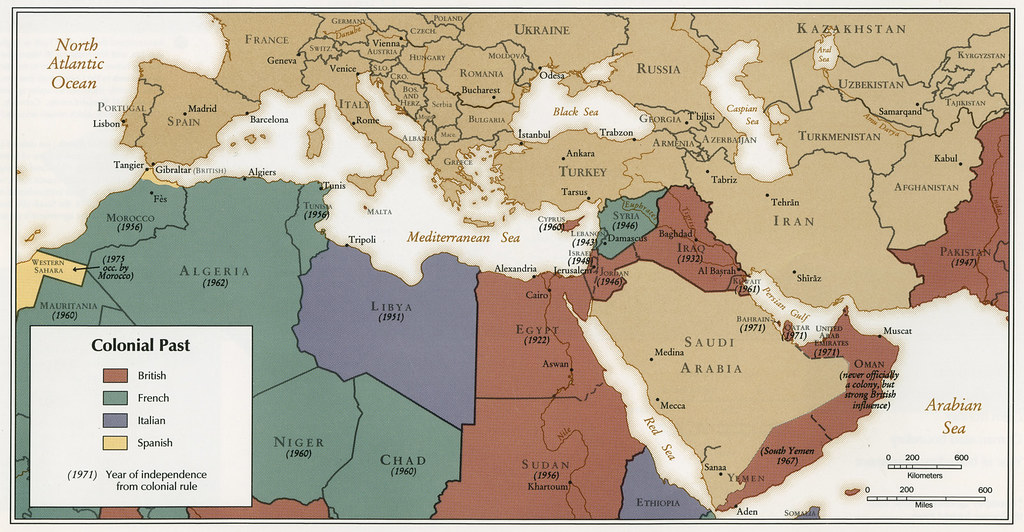
In the 1950s and 1960s, when Great Britain, France and other European powers relinquished their colonies in the Middle East, Africa and Asia, leaders of newly sovereign Muslim-majority countries faced a decision of enormous consequence: Should they build their governments on Islamic religious values or embrace the European laws inherited from colonial rule?
The big debate
Invariably, my historical research shows, political leaders of these young countries chose to keep their colonial justice systems rather than impose religious law.
Newly independent Sudan, Nigeria, Pakistan and Somalia, among other places, all confinedthe application of Sharia to marital and inheritance disputes within Muslim families, just as their colonial administrators had done. The remainder of their legal systems would continue to be based on European law.
:{[map]
}:France, Italy and the United Kingdom imposed their legal systems onto Muslim-majority territories they colonized. CIA Norman B. Leventhal Map Center, CC BY
To understand why they chose this course, I researched the decision-making process in Sudan, the first sub-Saharan African country to gain independence from the British, in 1956.
In the national archives and libraries of the Sudanese capital Khartoum, and in interviews with Sudanese lawyers and officials, I discovered that leading judges, politicians and intellectuals actually pushed for Sudan to become a democratic Islamic state.
They envisioned a progressive legal system consistent with Islamic faith principles, one where all citizens – irrespective of religion, race or ethnicity – could practice their religious beliefs freely and openly.
“The People are equal like the teeth of a comb,” wrote Sudan’s soon-to-be Supreme Court Justice Hassan Muddathir in 1956, quoting the Prophet Muhammad, in an official memorandum I found archived in Khartoum’s Sudan Library. “An Arab is no better than a Persian, and the White is no better than the Black.”
Sudan’s post-colonial leadership, however, rejected those calls. They chose to keep the English common law tradition as the law of the land.
Why keep the laws of the oppressor?
My research identifies three reasons why early Sudan sidelined Sharia: politics, pragmatism and demography.
Rivalries between political parties in post-colonial Sudan led to parliamentary stalemate, which made it difficult to pass meaningful legislation. So Sudan simply maintained the colonial laws already on the books.
There were practical reasons for maintaining English common law, too.
Sudanese judges had been trained by British colonial officials. So they continued to applyEnglish common law principles to the disputes they heard in their courtrooms.
Sudan’s founding fathers faced urgent challenges, such as creating the economy, establishing foreign trade and ending civil war. They felt it was simply not sensible to overhaul the rather smooth-running governance system in Khartoum.
:{
}:The Sudanese city of Suakim in 1884 or 1885, just prior to British colonial rule. The National Archives UK]
The continued use of colonial law after independence also reflected Sudan’s ethnic, linguistic and religious diversity.
Then, as now, Sudanese citizens spoke many languages and belonged to dozens of ethnic groups. At the time of Sudan’s independence, people practicing Sunni and Sufi traditions of Islam lived largely in northern Sudan. Christianity was an important faith in southern Sudan.
Sudan’s diversity of faith communities meant that maintaining a foreign legal system – English common law – was less controversial than choosing whose version of Sharia to adopt.
Why extremists triumphed
My research uncovers how today’s instability across the Middle East and North Africa is, in part, a consequence of these post-colonial decisions to reject Sharia.
In maintaining colonial legal systems, Sudan and other Muslim-majority countries that followed a similar path appeased Western world powers, which were pushing their former colonies toward secularism.
But they avoided resolving tough questions about religious identity and the law. That created a disconnect between the people and their governments.
In the long run, that disconnect helped fuel unrest among some citizens of deep faith, leading to sectarian calls to unite religion and the state once and for all. In Iran, Saudi Arabia and parts of Somalia and Nigeria, these interpretations triumphed, imposing extremist versions of Sharia over millions of people.
In other words, Muslim-majority countries stunted the democratic potential of Sharia by rejecting it as a mainstream legal concept in the 1950s and 1960s, leaving Sharia in the hands of extremists.
But there is no inherent tension between Sharia, human rights and the rule of law. Like any use of religion in politics, Sharia’s application depends on who is using it – and why.
Leaders of places like Saudi Arabia and Brunei have chosen to restrict women’s freedomand minority rights. But many scholars of Islam and grassroots organizations interpret Sharia as a flexible, rights-oriented and equality-minded ethical order.
:{
}:Women in Saudi Arabia have campaigned for gender equality, including the right to drive cars. Reuters/Faisal Nasser
Religion and the law worldwide
Religion is woven into the legal fabric of many post-colonial nations, with varying consequences for democracy and stability.
After its 1948 founding, Israel debated the role of Jewish law in Israeli society. Ultimately, Prime Minister David Ben-Gurion and his allies opted for a mixed legal system that combined Jewish law with English common law.
In Latin America, the Catholicism imposed by Spanish conquistadors underpins laws restricting abortion, divorce and gay rights.
And throughout the 19th century, judges in the U.S. regularly invoked the legal maxim that “Christianity is part of the common law.” Legislators still routinely invoke their Christian faith when supporting or opposing a given law.
Political extremism and human rights abuses that occur in those places are rarely understood as inherent flaws of these religions.
When it comes to Muslim-majority countries, however, Sharia takes the blame for regressive laws – not the people who pass those policies in the name of religion.
Fundamentalism and violence, in other words, are a post-colonial problem – not a religious inevitability.
For the Muslim world, finding a system of government that reflects Islamic values while promoting democracy will not be easy after more than 50 years of failed secular rule. But building peace may demand it.
:{
}:
https://www.alternet.org/2019/01/how-muslims-won-the-american-war-of-independence/
==
==
http://www.alternet.org/environment/why-isis-wants-paris-climate-talks-fail
==
http://www.alternet.org/environment/islamic-leaders-issue-bold-call-rapid-phase-out-fossil-fuels
Islamic Leaders Issue Bold Call for Rapid Phase Out of Fossil Fuels
By
August 20, 2015
Islamic leaders have issued a powerful call to 1.6 billion Muslims around the world to work towards phasing out greenhouse gas emissions by 2050 and a 100 percent renewable energy strategy.
The grand mufti’s of Lebanon and Uganda endorsed the Islamic declaration on climate change, along with prominent Islamic scholars and teachers from 20 countries, at a meeting in Istanbul.
Their collective statement makes several detailed political demands likely to increase pressure on Gulf states ahead of the Paris climate summit in December.
It calls for oil-producing countries and rich nations to lead by example in phasing out fossil fuels “as early as possible and no later than the middle of the century”.
Clear emissions reductions targets and monitoring systems should be agreed in Paris, the statement says, along with “generous financial and technical support” for poorer countries to help wean them off fossil fuels.
So far, Morocco is the only Middle Eastern country to present an emissions-cutting climate pledge ahead of the summit. But Hakima el-Haite, the country’s environment minister said that the declaration could help to change current modes of thought and behavior around climate change in some Gulf states.
“It is an emotive call for a spiritual fight against climate change that will be very important for Muslims,” she told the Guardian. “It speaks to issues of fairness, accountability, differentiation and adaptation in the Paris agreement. I think that the right way to make this sort of call is through the Qur’an.”
The Istanbul declaration was made by Islamic figures from Bosnia to Indonesia and follows a ground-breaking Papal encyclical [3] last month. Heads of state, corporations, and all peoples are addressed in the Istanbul call, which carries a universal and startlingly bleak message.
“We are in danger of ending life as we know it on our planet,” the declaration says. “This current rate of climate change cannot be sustained, and the earth’s fine equilibrium (mīzān) may soon be lost.”
“What will future generations say of us, who leave them a degraded planet as our legacy?” the religious leaders ask. “How will we face our Lord and Creator?”
Din Syamsuddin, the chairman of the Indonesian Ulema Council which represents 210 million Muslims welcomed the statement, saying: “The climate crisis needs to be tackled through collaborative efforts, so let’s work together for a better world for our children, and our children’s children.”
The United Nations’ climate chief, Christiana Figueres said that the statement showed how a clean energy future rested on a shift in how the world’s environment and people were valued. “Islam’s teachings, which emphasize the duty of humans as stewards of the Earth and the teacher’s role as an appointed guide, illuminate pathways to take the right action on climate change,” she said.
The declaration on climate change was also welcomed by Cardinal Peter Turkson, the president of the Pontifical Council for Justice and Peace, “with great joy, and in a spirit of solidarity”. Turkson pledged that the Catholic Church would work with the declaration’s authors to protect their common earthly home.
RELATED STORIES
5 Reasons Pope Francis' Encyclical on the Environment Matters [3]
The Dalai Lama Endorses Pope Francis’ Climate Change Encyclical [4]
Climate Denial Is Immoral, Says Head of U.S. Episcopal Church [5]
Arthur Neslen is the Europe environment correspondent at the Guardian. He has previously worked for the BBC, the Economist, Al Jazeera, and EurActiv, where his journalism won environmental awards. He has written two books about Israeli and Palestinian identity.
==