offshore wind
new 1119 PROMOTE PRIMARY ON SHILL WATTERS BS
MERRI OK
SEE WIND 2 MAIN
see STEVENSON DAVID BODUS STUDY RODNEY MACKINAC BURGUMTRUMP TRANS
SEE CHINA COP 30 11 25
see shillenberger and morano PATRICK MOORE
HORNER
MILLOY
SEE FOX
VOUGHT DOGE RECISSION? 80% DONE ~ COURT?
see whale wind BS leemanrenamed whale wind BS offshore
SEE BROWN U
ferocity of attacks on wind in general a mystery?
note fox 3rd party BS TPPF
---
New Modeling Shows Offshore Wind’s Benefits to Climate, Health, and Energy Bills
New analysis from Resources for the Future (RFF) finds that developing 32 planned or proposed offshore wind farms off the Atlantic and Gulf coasts would reduce emissions, environmental damages from those emissions, deaths, and consumer energy bills. The detailed modeling projects that, because offshore wind farms prevent polluting electricity generation from natural gas and coal, each year of operation would prevent approximately 2,100 premature deaths.
In the face of recent cost increases and project cancellations, governments are deciding how strongly to support offshore wind development. This new study finds that the offshore wind farms would bring net benefits to society, with a projected benefit-to-cost ratio of 14 to 1.
---
EPI LEGIT
David Stevenson, who led a national campaign against offshore wind power for the Delaware-based Caesar Rodney Institute, is now fighting land-based solar and wind farms and promoting fossil fuels and nuclear power with the Michigan-based Mackinac Center for Public Policy, a group funded by the donor network of petrochemical billionaires Charles and Chase Koch.
The Caesar Rodney Institute (CRI) and Mackinac Center are both affiliated with the State Policy Network (SPN), which serves as the central hub of a 50-state network of right-leaning think tanks. SPN has long sought to derail state clean energy and climate change policies, and is funded by right-wing and corporate donors that include fossil fuel interests.
“The free-market policy approach employed by affiliated state think tanks helps to identify policies that are focused on helping all people to flourish,” SPN states in the FAQ section of its website.
SPN’s approach to energy policy contradicts its claim to promote policies based on free market principles. In 2024, SPN identified preventing states from adopting wind and solar power as one of the network’s legislative priorities. SPN further encourages politicians to pick winners and losers in the electricity sector by favoring coal, natural gas, and nuclear power.
Last year, SPN credited years of work by CRI and SPN’s Offshore Wind Working Group with laying the groundwork for the Trump administration’s efforts to halt the nation’s offshore wind boom.
Stevenson has said he resigned from his position at CRI in October over a salary dispute, after spending 14 years as Director of CRI’s Center for Energy & Environmental Policy. Stevenson landed his new job as the Mackinac Center’s Director of Energy and Environmental Policy by December. He replaced Jason Hayes, who left the Mackinac Center for the Trump-aligned America First Policy Institute.
During his first few months in Michigan, Stevenson has supported the Mackinac Center’s efforts to derail Michigan’s Healthy Climate Plan and 100% by 2040 clean energy standard, and enable fossil fuels and nuclear power to supplant renewable energy sources like wind and solar power as the Great Lakes State’s primary power sources for the future.
At the Mackinac Center, Stevenson will have at his disposal the resources of an SPN group with significantly more funding than CRI and that, unlike CRI, has received hundreds of thousands of dollars in publicly reported funding annually from Koch-led groups in recent years.
CRI reported revenue of $463,000 for 2024 in its most recent annual report to the IRS. The Mackinac Center reported revenue of over $11 million for 2024, and its lobbying arm, Mackinac Center Action, reported nearly $1.5 million in revenue.
The Kochs’ Stand Together Trust and Stand Together Fellowship organizations reported contributing close to $1.7 million to the Mackinac Center for Public Policy between 2020 and 2024.* The Koch group Americans for Prosperity contributed $550,000 to Mackinac Center Action in 2023 and 2024.
Stevenson and the Mackinac Center use their opposition to wind and solar power as leverage to push for propping up uneconomic coal plants and increasing gas and nuclear power
“Two news outlets, including Bloomberg News, declared him [Stevenson] to be the man who killed offshore wind,” Jarrett Skorup, the Mackinac Center’s Vice President for Marketing and Communications, said in an article earlier this year announcing Stevenson’s hiring.
The Bloomberg story Skorup referenced was the first to report on a policy proposal prepared by Stevenson that showed how CRI’s anti-offshore wind campaign fit into a broader policy agenda that included using the promise of emerging small modular reactor technology (SMR) as leverage for delaying the planned closure of the coal-fired Indian River power plant in Delaware.
In early January of last year, Stevenson emailedcopies of a “SMR Nuclear proposal” he’d prepared for Delaware’s Governor Matt Meyer to Natalie Magdeburger, the mayor of Fenwick Island, along with a copy of a draft anti-offshore wind executive order intended for then president-elect Donald Trump. The Energy and Policy Institute obtained a copy of Stevenson’s email and the attachments through a records request to the Town of Fenwick Island.
[MANY DOCS]
Under Magdeburger’s leadership, the Town of Fenwick Island contributed $10,000 in taxpayer money to the CRI’s anti-offshore litigation fund, as requested by Stevenson.
“CRI is funded entirely from the voluntary contributions of individuals, foundations and corporations,” CRI says on the FAQ section of its website. “CRI neither solicits nor accepts government funding.”
State think tank affiliates of SPN must “not accept government funding,” according to SPN’s website.
The “SMR Nuclear proposal” Stevenson shared recommended that Meyer initiate a dialogue with Exelon and Delmarva Power about purchasing the Indian River coal-fired power plant in Delaware, which would close the following month. Stevenson’s proposal pointed to “headwinds” facing offshore wind, including from the incoming Trump administration, and recommended Exelon purchase the Indian River plant and eventually convert it to SMR.
“Since there is a long lead time to build SMR’s Exelon would need to operate with coal until the replacement becomes available,” Stevenson said in the proposal, which called for Exelon to sell the power from the plant to Delmarva Power, which is owned by Exelon.
Stevenson’s proposal said Delaware would also need to waive Indian Point’s compliance with the Regional Greenhouse Gas Initiative (RGGI) for the extended period when the plant would continue to burn coal. CRI has long opposed RGGI, the multi-state cap-and-trade program that’s helped reduce power sector greenhouse gas emissions in the Northeast and generated funding for energy efficiency and clean energy programs that have saved utility customers $2.7 billion as of 2023.
In 2017, Stevenson acknowledged that his consulting firm, Alternative Strategies Consulting, had worked for “utilities and large energy users” while under examination in a lawsuit where he challenged Delaware’s implementation of RGGI. Stevenson said at the time that he was required to keep the names of all of his clients confidential.
Republican state lawmakers in Delaware have since picked up on the idea of restarting the Indian River coal plant, and potentially converting it to SMR or gas. The plant’s owner, NRG, has said it closed the Indian River plant for economic reasons after two straight years of financial losses for the plant.
Earlier this year, Stevenson contributed to a report where the Mackinac Center laid out its 2026 energy policy recommendations for state lawmakers in Michigan, and called for replacing aging coal plants with nuclear, not wind and solar, power.
“… both the JH Campbell and Monroe coal-fired plants may be suitable locations for either large scale or small modular reactor units,” the Mackinac Center report said.
The report claimed that state lawmakers could save millions by delaying power plant closures, and linked to a December blog post by Stevenson defending the Trump administration’s controversial orders delaying the planned closure of the J.H. Campbell coal plant originally scheduled for May of last year. In the blog post, Stevenson pointed to a 2025 report where the Mackinac Center called for keeping the J.H. Campbell and Monroe plants running until 2040, long past their planned closure dates.
Consumers Energy, which owns the J.H. Campbell plant, has reported that the cost of complying with the Trump administration’s orders has reached $400 million. Consumers Energy is passing those costs on to electric utility customers throughout the 15-state Midcontinent Independent System Operator (MISO) regional power grid that includes Michigan. Consumers Energy had previously expected that replacing the J.H. Campbell plant with solar power and energy storage would save Michigan customers $600 million by 2040.
In March, Trump appointees at the U.S. Department of Energy and the Department of Justice cited Stevenson’s blog post in a legal brief defending the J.H. Campbell plant orders against a legal challenge by Michigan’s Attorney General Dana Nessel. Trump’s Secretary of Energy Chris Wright has issued multiple orders over the past year requiring Consumers Energy to delay closing the J.H. Campbell plant using emergency powers under Section 202(c) of the Federal Power Act.
“The Trump Administration is crying wolf over a non-existent energy emergency, while at the same time undermining every effort made to increase the efficiency, affordability, and reliability of domestic energy markets,” Nessel said last month, after Wright issued his fifth order targeting the plant for continued operation.
In his blog post, Stevenson argued that the J.H. Campbell plant should remain open at least until the Michigan Public Service Commission approves a new generation plan for Consumers Energy, and that state utility regulators should consider nuclear and natural gas as options for replacing Campbell.
The Mackinac Center wants to keep a DTE coal plant that buys petroleum coke from Koch Carbon running until 2040, rather than closing it by 2032
The Monroe coal plant is owned by DTE, which currently plans to close two of the plant’s four coal-burning units in 2028, and the remainder in 2032. DTE expects to save customers $1.4 billion by closing the plant.
Fuel receipt data compiled by the Energy Information Administration through Form 923 shows the Monroe plant buys petroleum coke from Koch Carbon, a subsidiary of Koch Industries, where Charles Koch is chairman and CEO and his son Chase is an executive vice president. Koch Carbon’s piling of petroleum coke in Detroit drew public scrutiny and protest in 2013, prompting the company to move the piles to Ohio. DTE was listed as one of the recipients of the pet coke stored at the Detroit location in Koch Carbon’s response to a request for information from the EPA’s Air Enforcement and Compliance Assurance Branch.
Stevenson and the Mackinac Center want to repeal Michigan’s landmark clean energy laws
In March, Stevenson delivered testimony in support of Michigan House Energy Committee Chair Pauline Wendzel’s “Project Lighthouse” legislation, House Bills 5710 and 5711, which would repeal Michigan’s landmark [2023 clean energy laws](https://www.michigan.gov/mpsc/commission/workgroups/2023-energy-legislation#::text=The%20laws%20also%20include%20three%20one-time%20proceedings:,Increases%20the%20cap%20from%201%25%20to%li%25).
The legislation approved by Republicans in the Michigan House would slow down the “build-out of the cheapest, fastest energy, limiting Michigan’s ability to leverage federal investments and pushing the state toward more expensive, long-term fossil fuel infrastructure” if it becomes law, according to the Michigan League of Conservation Voters (LCV).
It would also remove “basic planning and reporting requirements, allowing pollution to go unreported and increasing costs as energy demand grows,” Michigan LCV said.
In his testimony in support of the legislation, Stevenson again pointed to a 2025 report prepared for the Mackinac Center by the Center for the American Experiment, a Minnesota-based SPN affiliate, and Always on Energy Research, a SPN partner. The Lignite Energy Council, a coal industry group that’s opposed 100% clean energy legislation in neighboring Minnesota, paid the Center of the American Experiment $115,000 for electrical grid and reliability modeling in 2023.
The 2025 reportclaimed that powering Michigan with coal, gas, large-scale nuclear, and SMR would be cheaper than transitioning to a mix of wind, solar, nuclear, and energy storage. In addition to postponing the closures of the J.H. Campbell and Monroe plants until 2040, the report called for outfitting the state’s existing coal and gas plants with carbon capture and storage (CCS). The report also claimed relying on wind, solar, and energy storage “could lead to numerous blackouts throughout the year.”
“Our study might be contested,” Stevenson acknowledged in his testimony.
SMR projects in the U.S. and globally have run into cost overruns, according to the Institute for Energy Economics and Financial Analysis. Multiple high-profile utility projects aimed at demonstrating the commercial viability of CCS for coal plants have devolved into costly economic boondoggles mired in public scandal.
Always on Energy Research has churned out similar reports for other SPN groups, including two reports focused on New England’s power grid prepared for the Americans for Prosperity Foundation and SPN groups based in Connecticut, Maine, Massachusetts, New Hampshire, and Rhode Island. The Acadia Center, an environmental group working to halve carbon emissions in the Northeast by 2030, has published rebuttals of Always on Energy Research reports on New England.
“Misleading analysis grossly inflates the cost of clean energy, selectively ignores fuel savings, and proposes highly unrealistic alternative scenarios,” the Acadia Center said of Always on Energy Research’s methodology in its latest rebuttalin January.
Stevenson received funding from SPN to lead a nuclear waste discussion group with nuclear industry contacts
Isaac Orr of Always on Energy Research noted in a presentation to state lawmakers in North Dakota in September that Stevenson had joined Always on Energy Research as the group’s Director of Nuclear Development. The presentation included a slide that listed Stevenson’s nuclear industry contacts:
INDUSTRY CONTcts gfx always on
Orr’s presentation also said that Stevenson “currently chairs a discussion team to end the used nuclear fuel problem with key members of the nuclear industry, and states that may host recycling and storage through federal legislation.”
Stevenson said in an article last summer that he received a grant from SPN to form the discussion group, in which he described SPN affiliates’ work with supportive lawmakers to identify potential host-states for nuclear waste.
DonorsTrust contributed $50,000 to Always on Energy Research, $200,000 to CRI, nearly $2.9 million to the Mackinac Center, and over $9.8 million to the State Policy Network in 2024. DonorsTrust does not publicly disclose the names of its donors, but tax-exempt foundations that donate to Donor Trust are required to report those contributions publicly in their annual reports to the IRS.
Right-wing tech investor Peter Thiel’s foundation contributed $426,775 to DonorsTrust in 2024, and $1,276,111 in 2023. Thiel has backed major advanced nuclear and SMR start-ups like Oklo, Helion, and General Matters.
Stoking opposition to wind and solar farms
Last year, Stevenson sent President Trump’s political appointees to the U.S. Department of Interior a barrage of messages recommending actions the agencies could take to fulfill Trump’s campaign pledge to halt offshore wind development. EPI obtained copies of the communications through a FOIA request.
Stevenson served on Trump’s first Environmental Protection Agency transition team in 2016. The Mackinac Center has credited Stevenson’s earlier research as having “played a role” in killing the Clean Power Plan, the Obama-era EPA’s attempt to regulate greenhouse gas emissions from power plants nationally for the first time.
“Hi, I have been actively opposing offshore wind for both economic and environmental reasons since 2017, and formed a national coalition, the American Coalition for Ocean Protection, assisting a number of beach community groups organize and grow,” Stevenson said in one email sent to multiple Trump administration officials at DOI in mid-April of 2025.
Stevenson’s anti-offshore wind campaign began in Delaware with the launch of CRI’s Save Our Beach View campaign, which stoked local opposition to offshore wind projects planned off the coasts of Maryland and Delaware.
In 2021, Stevenson and CRI announced the launch of the American Coalition for Ocean Protection (ACOP) to raise money for anti-offshore wind litigation through the Ocean Environment Legal Defense Fund. Membership in ACOP included anti-offshore wind groups and SPN think tanks based along the East Coast, plus the Mackinac Center in Michigan.
The Mackinac Center has a history of opposing offshore wind power development in the Great Lakes region, but supports continued operation of Enbridge’s Line 5 oil and gas pipeline. Tribes, environmentalists, and the State of Michigan have fought for years to shut down Line 5, which runs below the Straits of Mackinac that connects Lake Michigan and Lake Huron, due the risk of a catastrophic spill.
CRI initially served as a fiscal sponsor for the anti-offshore wind group Protect Our Coast NJ.
CRI also offered to serve as a conduit to raise money for anti-offshore wind “Save the Horseshoe Crabs” ads in response to an email from Dianna Harris of Protect Our Coast Delmarva obtained from the Town of Fenwick Island.
“We are planning a zoom call next week with a wider group of about 50 people that have been paying close attention so we may raise some money then,” Stevenson said in one email to Harris.
In 2025, Stevenson and David Wojiick of the Committee for a Constructive Tomorrow served as the lead signers on a letter that called on Trump’s Secretary of the Interior Doug Burgum to revoke federal approvals for eleven offshore wind projects, including four that were already under construction. Cosigners included anti-offshore wind activists from the East and West Coasts, the Great Lakes region, and representatives of multiple SPN affiliate and partner groups.
Stevenson emailed the letter to Burgum to Trump appointees at DOI and BOEM. Laura Keehner Rigas, a White House Liaison to DOI, received a copy of the letter from Stevenson, and forwarded Stevenson’s email to four other political appointees.
“Thank you!” Deidre Kohlrus, a Senior Advisor to Burgum, responded to Rigas.
While operating out of Delaware, Stevenson signaled openness to solar and had solar panels on his roof. Upon arriving at the Mackinac Center, Stevenson quickly got to work attacking solar farms in Michigan.
“The future of electric generation is clearly nuclear, not solar, and state legislation needs to change in recognition of this reality,” Stevenson said in a January blog post for the Mackinac Center.
The Mackinac Center has for years served as a platform for promoting the views of anti-wind and anti-solar activists in Michigan, including Kevon Martis. In 2024, Martis was the public face of the Citizens for Local Choice ballot committee, which aimed to repeal a 2023 Michigan law that streamlined siting of wind and solar farms. Citizens for Local Choice failed to gather enough signatures to get the issue on the ballot, but received a $10,000 contribution from Tom Rastin, a retired gas industry executive who has bankrolled opposition to solar farms in neighboring Ohio.
“Solar projects often face resistance from local governments,” Stevenson wrote in his blog post in January.
“Recognizing local opposition, the Legislature gave the Michigan Public Service Commission authority to override local permit bans,” Stevenson said in the same blog. “Opponents to this law are attempting to repeal it through a ballot initiative.”
Citizens for Local Choice appears to be inactive, but Republican lawmakers in Michigan targeted the 2023 siting law this year as part of Project Lighthouse, as the Mackinac Center noted in another blog post.
Michigan ranked among the top 10 states for new solar additions during the first quarter of this year, according to the Solar Energy Industries Association.
Stand Together Trust reported contributions to the Mackinac Center for Public Policy that totaled $525,000 in 2022 and $400,000 in 2023, both for general operating support, and $421,400 for 2024 for “KAP” (the Koch Associate Program). Stand Together Fellowship contributed $350,000to the Mackinac Center for education in 2020.*}:
Top photo is a screenshot from a Michigan House video of David Stevenson’s testimony before the Energy Committee on April 14, 2026*
Always On Energy ResearchAmerican Coalition for Ocean ProtectionCharles KochChase Kochcitizens for local choiceCommittee for a Constructive TomorrowDavid StevensonDavid WojiickDeidre KohlrusDepartment of InteriorDonald TrumpDoug BurgumEnbridgekevon martisKoch CarbonLaura Keehner RigasLignite Energy CouncilOcean Environment Legal Defense FundProtect Our Coast DelmarvaProtect Our Coast New JerseyStand Together Trusttom rastin
---
pbs 5 26
AMNA NAWAZ: Meanwhile, I want to turn to another piece of critical reporting you have been doing, tracking the money around the Trump administration, new reporting that
0:07
7 seconds
energy companies are set to get nearly a billion dollars to not build offshore wind farms. I know the president has been critical of these projects in the past, but why that payout?
0:17
17 seconds
LIZ LANDERS: Several large-scale wind energy projects on the East and West Coast of the U.S.
0:22
22 seconds
have been canceled in the last few months. In March, the administration announced a nearly $1 billion payout to TotalEnergies, which is a French company, to abandon an offshore wind project.
0:34
34 seconds
They had bought two leases in 2022, one off the coast of North Carolina. That was for more than
0:40
40 seconds
$133 million, and then another off the coast of New York for $795 million. And then last week,
0:48
48 seconds
more than $900 million in additional payouts were made for two more projects, Bluepoint Wind off of the coast of New York and New Jersey and Golden State Wind off of the coast of California.
0:59
59 seconds
So between the last few months, there have been nearly $2 billion in these payments. The administration had initially tried to block some of these wind projects from going forward,
1:09
1 minute, 9 seconds
citing national security concerns. That was batted down in several different courts.
1:14
1 minute, 14 seconds
And the interior secretary, Doug Burgum, told the Associated Press that these projects were only viable when they were propped up
by taxpayer subsidies under the Biden administration. We reached out to the Department of Interior to ask about this. We did not hear back from them in time.
1:27
1 minute, 27 seconds
AMNA NAWAZ: Nearly $2 billion in payments. So does the administration have the spending authority to do that? LIZ LANDERS: There are serious questions about the legality of this.
1:35
1 minute, 35 seconds
I spoke with Liz Klein earlier today. She was the former director under President Biden of the Bureau of Ocean Energy Management. And she does not think that it is legal
1:44
1 minute, 44 seconds
for the administration to be taking these kinds of steps. Here's a little bit of what she had to say.
1:50
1 minute, 50 seconds
ELIZABETH KLEIN, Former Director, Bureau of Ocean Energy Management: Many of us believe they have gone outside of what is lawful, certainly outside of any appropriate process. They have
crafted these agreements, which really the best way to describe them are backdoor deals that lack transparency. They lack an appropriate process that you would normally follow.
2:10
2 minutes, 10 seconds
LIZ LANDERS: Klein says that the agency that she used to oversee does not have the statutory or regulatory authority to refund the monies to these companies after
2:19
2 minutes, 19 seconds
they paid for the lease. And, Amna, this is raising questions for members of Congress and also Republicans in New York state who are questioning the administration's moves here.
2:28
2 minutes, 28 seconds
AMNA NAWAZ: Liz Landers, great reporting, as always. Thank you so much. LIZ LANDERS: Of course.
---
OMFG AN GRIST 3 26
On Monday, President Trump’s Department of the Interior announced that it will refund almost $1 billion to a French multinational oil company.
*This story was originally published by Grist. Sign up for Grist's weekly newsletter here.
The company, TotalEnergies, had spent that amount during the Biden administration to secure two leases allowing it to build offshore wind farms in the Atlantic Ocean. The Trump administration, which has taken every step possible to block offshore wind development, is so opposed to this possibility that it’s paying Total to give up those leases — which the company wasn’t even using — in exchange for a promise that Total will invest the money in oil and gas projects off the U.S. Gulf Coast — which it was already doing.
“This is a backdoor deal done with zero transparency, no public process, and no consideration of the impacts to ratepayers in states that had been planning on that offshore wind to meet their energy needs,” said Elizabeth Klein, who led the federal Interior Department’s Bureau of Ocean Energy Management under former President Joe Biden.
The administration may have been trying to buy Total off to avoid litigation, according to Hannes Pfeifenberger, principal at the economic consulting firm the Brattle Group. The French company purchased its offshore wind lease in the coastal area known as the New York-New Jersey Bight for a historically high amount, paying around four times the typical per-acre rate for such leases. Were the administration to attempt to block development, Total might have sued to avoid losing its entire investment.
“[Trump’s Interior Department] might have been responsible for damages if the offshore wind developers sued the government for selling them leases and then basically making permitting impossible,” said Pfeifenberger, adding that other developers who purchased leases in the same auction might now look to take the same path out.
But Klein and other industry experts also noted that the settlement does not deal a permanent blow to offshore wind development, beyond moves the Trump administration had already taken: Trump has already frozen all offshore wind lease auctions and vowed to oppose any new wind farm construction. At worst, the settlement will just set the timeline on new offshore wind development back by a few more years. Though Total’s ocean rights will return to the government for now, a future president could lease them out to another energy company.
“Obviously no one expects this administration to be conducting any offshore wind lease sales, but future administrations will,” said Klein.
There are other ways that the settlement may be less significant than it seems. Industry experts say most companies that hold ocean leases are looking to offload them or let them sit undeveloped until Trump is out of office. Even before this payoff, most experts believed that wind companies would not return to the Atlantic without legislative reform to protect approved permits from executive interference.
The oil side of the settlement is even more confusing. The Interior Department’s announcement says that TotalEnergies will “invest approximately $1 billion — the value of its renounced offshore wind leases — in oil and natural gas,” including offshore oil platforms in the Gulf of Mexico and a liquefied natural gas, or LNG, facility in Texas. But the company is already plowing billions of dollars into new offshore platforms, and it made a “final investment decision” on an expansion of its Texas LNG facility last year. The lease refund would only go to offset these existing investments, not to generate new infrastructure the company hadn’t already planned.
A statement from TotalEnergies CEO Patrick Pouyanné announcing the deal contained multiple grammatical errors, and it ended on a humdrum note, with the executive saying “we believe this is a more efficient use of capital.”
As for the debate in the U.S. Senate around so-called permitting reform legislation to secure energy projects from cancellation, the settlement with Total has done nothing to disrupt negotiations. That’s a stark contrast to what happened after the administration’s previous stop-work order on five under-construction wind farms in December, which caused bipartisan Congressional negotiations to collapse. Speaking to reporters last Friday, Senate Democrat Sheldon Whitehouse said that permitting reform talks are proceeding apace despite the new settlement.
“So far, so good, with respect to addressing substantive issues,” said Whitehouse, who represents Rhode Island and is known for his leadership on climate and energy issues. He noted that the Trump administration has declined to appeal any of the court injunctions against its actions targeting the five active wind farms.
“At the moment, I think they’re getting a strong signal from Republicans and Democrats in the Senate: Knock it off, cut out the nonsense,” he said.
This article originally appeared in Grist at https://grist.org/politics/trump-interior-offshore-wind-total/.
---
---
MMA
Right-wing media’s cynicism about climate leaves out ongoing global success of renewables
Special ProgramsClimate & Energy
Written by Ilana Berger
Published 02/02/26
Right-wing media are suggesting that the energy transition has permanently fallen out of favor as a global priority, evidenced by business leaders’ and governments’ rapid shift in focus toward artificial intelligence. But other recent milestones and ambitious projects signal that long-term interest in climate action is still very much alive.
At the World Economic Forum’s annual convening of elites in Davos, for instance, which has championed corporate climate ambitions for the past several years, right-wing media claimed the message this year was that renewable energy “literally cannot be used.”
Although it’s true that U.S. financial companies such as BlackRock — whose CEO, Larry Fink, headed this year’s conference — have largely abandoned net zero goals, and the Trump administration, which has encouraged fossil fuel expansion abroad, brought thatattitude to the conference, conversations about the clean energy transition continued to take place at Davos.
And reporting from The Wall Street Journal and CNBC demonstrate that business leaders are still talking about renewables, and the European Union just hit “‘a major tipping point’ of the clean energy era” according to The Guardian, with renewables generating “30% of the EU’s electricity in 2025” compared to just 29% from coal, oil, and gas.
The Trump administration pushed its fossil fuel agenda at Davos
- In a “free wheeling special address” to the World Economic Forum, Trump said that “windmills” are “losers” and “the more windmills a country has, the more money that country loses and the worse that country is doing.”Trump has spread misinformation about wind energy for years. He also falsely claimed during the Davos speech that he has not “been able to find any wind farms in China.” According to PolitiFact, “China has about 44% of the world’s wind farm capacity, ranking No. 1 globally and almost triple what the U.S. has.” CNBC, [1/23/26; PolitiFact, 1/21/26; Media Matters, 10/2/23]
- The Financial Times wrote that during a speech at a private dinner hosted by BlackRock CEO Larry Fink, U.S. Secretary of Commerce Howard Lutnick “told his audience that the world should focus on coal as an energy source rather than renewables.” Financial Times, [1/21/26]
- According to The New York Times, at Davos, “the focus on climate and stopping biodiversity loss has taken a backseat” where it was once “a center for the corporate climate movement.” The shift can largely be attributed to “pushback from Republicans, the fallout from the war in Ukraine and the return of President Trump to the White House,” David Gelles wrote for The New York Times. Instead, “Panels on AI, the energy transition, and industrial reinvention were packed. Private discussions focused on expansion, deployment, and long-term prospects,” wrote CNBC. The New York Times, [1/22/26; CNBC, 1/24/26]
- While the conference has historically touted a focus on corporate sustainability, it has been rife with greenwashing and false climate solutions for years.The New Republic noted of Davos in recent years: “Oil companies were formal partners for the event, which was marketed as being carbon-neutral while it involved a bunch of corporate and governmental executives flying via private jet to an Alpine town whose signature sport climate change is currently decimating. The confab hyped ‘solutions’ like carbon credits and carbon capture that would allow corporations to keep polluting as usual—even as rigorous reporting showed a lot of carbon credits weren’t backed by real reductions and carbon capture wasn’t yet feasible at scale.” The New Republic, [1/23/26]
Right-wing media suggest climate solutions are no longer relevant, often citing Davos
- On Fox Business, climate skeptic Marc Morano said that Davos was a sign that Trump has “completely obliterated the entire climate agenda.” “This just goes to show you that the entire climate agenda, within one year of Donald Trump getting to work, … has just decimated it,” Morano said. Fox Business, *The Bottom Line*, [1/23/26; Fox News Primetime, 8/9/21]
- On One America News, Morano told host Dan Ball, “Even the billionaire class is departing from the climate agenda, including Michael Bloomberg. Washington Post editorial [board] has been doing anti-Green New Deal-type editorials.” One America News, *Real America with Dan Ball*, [1/27/26]
- On Newsmax, Morano and host Carl Higbie discussed how climate change is “nowhere to be found” at Davos and has “dropped down off the list” of priorities. Higbie said Morano “laid out that the global elites have dropped the doom and gloom of [the] climate agenda, largely because it doesn't fit with their billionaire agenda when they fly in on their private jets. … This was like the center of their agenda and now it's nowhere to be found.” Morano claimed, “They did a survey of World Economic Forum members before this conference started, and climate has just dropped down off the list. It's so bad.” Newsmax, *Carl Higbie Frontline*, [1/22/26]
- Fox host Greg Gutfeld said that Trump made the climate agenda “irrelevant.”On The Five, Gutfeld said, “Wherever Trump goes, wherever that place is is kind of rendered permanently different. Sometimes even irrelevant. … Look at the climate agenda, look at the trans movement. Davos falls into the same pattern. It looks like another small town leveled by the orange tornado.” Fox News, *The Five*, [1/22/26]
- RedState headline: “Davos Ditches Climate: Elites Now Eyeing Economy Instead.”The right-wing outlet wrote that “this year in Davos … interest in all things climate seemed to be nearing an all-time low,” claiming that “the general run of citizens - you know, the people who elect a lot of the ‘elites’ at Davos - are a lot more worried about the price of eggs than their carbon footprints.” RedState, [1/22/26]
- Fox host Rachel Campos-Duffy said that while the network typically mocks “all the private planes that come into Davos,” 2026 “feels very different from other years” because “nothing starts until President Trump arrives — until daddy's home, as so many people say.” Campos-Duffy noted that Fox News usually mocks “all the private planes that come into Davos because, of course, this is the elite globalist crowd that will tell you you can't travel in your car, you shouldn't take a plane, and actually wants to limit your ability to take long-haul flights as they fly in privately.” She added, “Here you have this global conference where President Trump is about to blow it up in terms of his negotiations and stands, and yet nothing starts until he arrives. … President Trump is the leader that everyone is — that everything hinges on.” Fox News, *Fox & Friends*, [1/21/26]
- On Infowars,War Roomhost Harrison Smith said, “It’s kind of weird how the World Economic Forum and the Davos meeting used to be so into climate change. Remember how they would talk about nothing but climate change for a long time, and now this year it’s like not even a concern?”Infowars, *War Room*, [1/20/26]
- Fox News headline: “Conservative groups declare 2025 a tipping point on ‘climate hysteria’ as Trump unleashes energy agenda.”The report highlighted several fossil-fuel advocacy groups that outlined “2025 as a pivotal year in trading climate activism for energy production and economic realism.” It also quoted American Energy Institute CEO Jason Isaac’s claim that “governments, investors, and even climate activists are abandoning the hysteria and choosing energy security, affordability, reliability, and common sense. President Trump led this shift by putting America’s energy strength first.” Fox News Digital, [12/19/25; E&E News, 2/28/25; Energy & Policy Institute, 8/5/24; Daily Kos, 11/2/22]
- Right-wing media celebrated a November 2025 memo from Bill Gates, claiming that he flipped on climate change and no longer thinks it is important.In the memo, Gates wrote that climate change will have “serious consequences” but that he does not think it will “lead to humanity’s demise.” Right-wing media presented Gates’ comments to argue that climate change is not a concern and never has been. Media Matters, [11/14/25]
Recent reporting shows continued global interest in renewable energy expansion
- In 2025, wind and solar generation exceeded fossil fuel generation in the European Union, according to a report from the U.K. think tank Ember Energy.“Wind and solar generated a record 30% of EU electricity, higher than fossil power for the first time on record,” which generated 29%, the report said. Ember Energy, [1/22/26]
- The U.K. and nine other European countries just announced plans to build 100 gigawatts of offshore wind power in the North Sea, enough to power 143 million homes. The governments signed a declaration that promises “to collectively build 5GW of offshore wind capacity every year between 2031 and 2040 by helping to support private sector investments.” The Guardian, [1/26/26]
- The CEO of German insurance and asset manager company Allianz, Oliver Bäte, told CNBC that “he disagreed with the suggestion that it may just be a matter of time before net zero is dismissed in Europe, saying short-term thinking on this issue is ‘bulls---.’” “Asked about political leaders backtracking on their much-vaunted European Green New Deal and Norway’s oil fund reportedly defending a push from companies to water down their climate goals, Bäte said anyone who has children ‘will have to worry’ about the planet’s future.” CNBC, [1/22/26]
- In a Davos interview with The Wall Street Journal, Fortescue Metals Group CEO Andrew Forrest, said he was surprised that green energy and sustainability have been dropped from the agenda because renewable energy has allowed him to “compete with the rest of the world” and “deliver … the lowest cost product.” He also told the Journal, “I’m saying to all of my fellow leaders in business and politics, to say, Hey, you are your values. … If you drop your values just because there’s pressure on them or people don’t agree with them or you get political pushback, then, well, who actually are you?” The Wall Street Journal, [1/21/26]
- The CEO of one of the world’s largest iron ore mining companies, Forrest has been vocal about keeping climate goals relevant and “convened three private meetings with between 20 and 50 CEOs” on the topic at Davos, according to Axios. Forrest acknowledged that other leaders “fear retribution” from Trump, but told Axios, “Everyone cares what the economics are, and the economics are going straight to green energy.” Axios, [1/27/26]
- Recapping the event, The World Economic Forum wrote, “Davos in 2026 will be remembered as a week when geopolitics owned the stage – yet the climate and nature crisis persisted in the wings.” Ester Baiget, co-chair of WEF’s Alliance of CEO Climate Leaders and CEO of Novonesis, a Danish biotech company, said during the convening, “Business-smart is climate-smart – they are two sides of the same coin.” Leaders spoke about the plummeting price of renewable energy and energy storage, the global electric vehicle transition, and the importance of getting ahead of climate change tipping points that will “self-amplify warming and undermine the basis for stable economies.” World Economic Forum, [1/30/26; Climate Home News, 1/21/26]
---
MMA
===
POLITICO E AND E
Internal emails reveal Interior’s Empire Wind deliberations}:
:{:{By Ian M. Stevenson, Benjamin Storrow | 08/28/2025}:
The messages show the Trump administration included offshore wind foes in the push to cancel permitted projects.
Turbines operate off the coast of Block Island, Rhode Island. Julia Nikhinson/AP
When NOAA scrutinized a wind project off the coast of New York this spring, it turned to a new hire who had spent years criticizing offshore wind.
Annie Hawkins — who helmed a fishing industry group opposed to coastal wind projects before joining NOAA as its top lawyer — was one of several senior officials included in a planning email in the days leading up to an Interior Department order that halted construction on Empire Wind, according to emails obtained by POLITICO’s E&E News.
The emails — obtained in a Freedom of Information Act request — provide a glimpse into President Donald Trump’s sustained attack on the wind industry. They show that administration officials moved quickly in April to assemble findings that would later be cited by Interior Secretary Doug Burgum as the rationale for halting construction of the 54-turbine project.
It is unclear what role Hawkins played in deliberations over the Empire Wind stoppage, which was later reversed. The documents indicate she was included on one email and later removed. NOAA, which is part of the Commerce Department, declined to comment. Interior and its Bureau of Ocean Energy Management, which oversees offshore wind, did not respond to requests for comment. Hawkins referred questions to NOAA.
But Hawkins’ presence on the email chain is likely to raise questions among offshore wind supporters.
The emails also show that senior officials at Interior received detailed recommendations from Green Oceans, a Rhode Island group opposed to offshore wind, for how to cancel leases granted to offshore wind developers. Interior issued a stop work order last week to Revolution Wind, a project off Connecticut and Rhode Island.
The administration’s deliberations around Empire Wind came shortly after the project developer, Equinor, began offshore construction and amid a public campaign from congressional Republicans and offshore wind opponents to have the project stopped.
Matthew Giacona, who was then deputy director at BOEM, thanked officials at NOAA in an email dated April 11 for their “engagement this week” and invited them to assist in Burgum’s review of offshore wind leases and permits. On the first day of his second term in January, Trump halted all new wind permits and ordered a review of existing leases.
If NOAA “has any reports or analyses that can be provided to inform the Secretary’s comprehensive assessment, these inputs would be extremely helpful as we ensure the Secretary has full information available as he continues his review,” Giacona wrote in the April 11 message.
Erik Noble, NOAA’s principal deputy assistant secretary for oceans and atmosphere, replied: “Message received. We will be in touch.”
Included on Noble’s email were officials such as Hawkins, Interior policy adviser Brittany Kelm, Interior Deputy Solicitor Damon Hagan, Interior Associate Solicitor Karen Hawbecker and BOEM chief of staff Jennafer Foreman. Hawkins was later removed from the email chain, according to the documents.
BOEM officials appear to have begun drafting the stop work order before they received the report from NOAA. Bureau officials shared a draft of an order to Equinor to shut down construction on Empire Wind on the morning of April 15.
In a separate reply 20 minutes before noon on April 15, Noble replied to Hawbecker, Hagan, Kelm and other administration officials with a “technical screening analysis” of the Empire Wind project.
Hawbecker promptly forwarded the report to BOEM’s then-acting Director Walter Cruickshank and James Anderson, BOEM’s associate director of the Office of Budget & Administration.
“FYI — here’s NOAA’s document,” Hawbecker wrote. “I’m assessing it now.”
Less than three hours later, Cruickshank sent an email with a draft of the order to two BOEM officials. “This is close hold until it’s sent. No word yet on when that will be, as the Secretary’s Order needs to come first,” he wrote.
‘Flawed science’
That NOAA report became the administration’s justification for taking the rare step to halt construction. In an email April 17, Anderson called the report “the basis of” another memo from Burgum ordering the construction halt. Burgum himself posted on social media that NOAA scientists had “revealed” the project’s approval was “built on bad & flawed science.”
But Interior has not released the contents of the report. In response to a prior records request from E&E News, the department blacked out all 27 pages of its findings.
Interior’s deliberations came as offshore wind opponents called for the Trump administration to stop Empire Wind.
Rep. Chris Smith, a New Jersey Republican, sent Burgum a letter in late March calling on Interior to halt the project. The leader of a fishing group penned an opinion piece in the New York Poston April 10 warning of ecological destruction if the Trump administration allowed Empire Wind to move forward.
Steve Milloy, a conservative activist who questions climate science, followed with an opinion piece in the Daily Caller saying Interior needed to stop construction of offshore wind projects underway to satisfy the intent of Trump’s Day 1 executive order.
Trump lifted the work stoppage in May after claiming to strike a deal with New York Gov. Kathy Hochul, a Democrat, to permit two pipelines in the state. Hochul rejected that claim, but said she was open to permitting pipelines that complied with state law.
The order nevertheless represented a massive setback for Equinor, which has estimated it cost the company more than $200 million. It also raised issues for other offshore wind developers like Ørsted, which suddenly found itself unable to sell a share of a nearby project under construction at an attractive price.
Equinor declined to comment on the emails.
Matt Walker, a regional campaign manager at the Natural Resources Defense Council, an environmental group, called the administration’s stop-work orders “reckless, rushed and entirely unjustified.”
“According to email records, the administration apparently needed no more than a few hours to assess information about the Empire Wind project before putting a stop-work order in place,” he said by email.
Hawkins was one of the leading critics of offshore wind before joining NOAA, regularly criticizing the industry as the head of the Responsible Offshore Development Association.
RODA, as the group is commonly known, repeatedly criticized the Biden administration’s for moving too quickly to permit offshore wind projects. In 2020, before Biden took office, the group called for a five-year moratorium on new offshore wind leasing. It later filed an unsuccessful legal challenge to Vineyard Wind, a 62-turbine development being built off the coast of Massachusetts.
Hawkins previously worked as an attorney representing the Fisheries Survival Fund, an industry group for the scallop industry that unsuccessfully challenged Empire Wind’s lease in court.
‘We’ll talk soon’
But Hawkins has not always been critical of Empire Wind. In 2021, she hailed negotiations between Equinor and fishermen over Empire Wind’s turbine placement as a model for collaboration between the fishing and wind industries.
“Is it a solution to all the problems, and if we do this there are no impacts? Absolutely not. Is it a potentially good, effective way to minimize some of the impacts? Yes,” Hawkins told E&E News at the time. “It does highlight that there are things we can do working together to minimize the impacts.”
The records also show how one anti-wind nonprofit, Green Oceans, shared detailed recommendations with Interior for how to revoke offshore wind leases and scored a meeting with a senior Interior official in May.
In emails to Burgum and acting Assistant Secretary for Lands and Minerals Management Adam Suess, the organization shared a 68-page report called “Cancelling Offshore Wind Leases.”
The report includes detailed analyses of relevant laws and regulations, pointing out potential law violations for wind projects off the coasts of Massachusetts and Rhode Island. It was written by Maureen Koetz, president of Planet A* Strategies, who previously worked at the Nuclear Energy Institute and as aide to former Sen. Pete Domenici, a New Mexico Republican.
One of the potential issues the report flagged was national security.
BOEM and the Department of Defense “still do not have an adequate analysis or evaluation of the cumulative impacts to national security” of the projects in New England, the report stated.
The Green Oceans group sent the report to Suess on May 2 — two weeks after the Empire Wind stop-work order — along with a reminder about a meeting scheduled the following week.
“I appreciate it,” Suess wrote back to the group. “We’ll talk soon.”
Last week, BOEM halted work on Revolution Wind, a 65-turbine project off of Rhode Island that is 80 percent completed. BOEM said in a letter to Ørsted that the stoppage was needed to address “national security interests of the United States.”
Green Oceans, which was founded in 2023 by a group of property owners, has emerged as one of the leading offshore wind opponents in New England.
Elizabeth Knight, a co-founder of Green Oceans, could not be reached for comment.
---
NO LNX
America elected a simpleton and the wreck he leaves behind could be permanent
U.S. President Donald Trump attends a ceremony marking the 24th anniversary of the September 11, 2001, attacks on the United States at the Pentagon, in Washington D.C., U.S., September 11, 2025. REUTERS Evelyn Hockstein
Sabrina Haake, Raw StoryNovember 25, 2025
Since Donald Trump has been back in office, energy prices have increased at more than double the rate of inflation. The Consumer Price Index from the end of October reported an “all items price index” increase for food, shelter, and transportation of 3.0 percent over a 12-month period, while energy services for the same period rose by 6.4 percent.
After promising to slash energy prices, Trump has done the opposite. His energy policies reflect the same ethos driving everything else in his retribution playbook: reward donors and inflict pain on Democrats, even when the economic consequences are nationwide.
Lust for retribution
In early October, Trump announced the claw-back of billions of dollars in federal funding for utilities, money that had been appropriated to reinforce power grids and reduce electricity prices.
Targeting blue states exclusively, Budget Director Russ Vought announced the cancellation of “nearly $8 billion in Green New Scam funding to fuel the Left’s climate agenda.” In all, 321 Congressionally set awards supporting 223 wind, solar, and transmission projects were trashed.
Trump’s aversion to clean energy isn’t the only factor driving costs. His refusal to upgrade the grid, his half-baked export and tariff initiatives, and his blind support for energy-sucking AI data centers are all contributing to surging energy prices with no relief in sight.
As Canary Media framed it, “Trump slapped tariffs on certain wind turbine materials and opened a sham “national security” probe to pave the way for even more. He halted construction on a nearly completed offshore wind farm and moved to revoke permits for two more. He canceled hundreds of millions in port funding critical to offshore wind development and imposed new directives to stifle renewable projects on federal lands.”
Trump’s dedication is showing: after only ten months of Trump 2.0, US household electric bills have increased by 10 percent, and are expected to continue climbing.
UN Climate Summit
Trump is doing more than reversing US climate successes, he’s also undermining progress in other parts of the world. Last month, when the International Maritime Organization agreed on the world’s first carbon tax on global shipping to encourage the transition to cleaner fuels, Trump released a childish Truth Social rant threatening to retaliate.
This month, he ignored the UN Climate Summit in Brazil. Thankfully, California Governor Gavin Newsom attended, representing the world’s fourth-largest economy. Newsom highlighted California's efforts to step up on climate where Trump has stepped out.
Facing down the embarrassment of an antiquated, know-nothing, pro-fossil fuel regime, Newsom didn’t hold back. When asked about the US retreat from global climate action, he called Trump “an invasive species … He’s a wrecking ball president trying to roll back progress of the last century … he’s doubling down on stupid.”
Newsom did more than talk. While he was at the summit, he signed new Memoranda of Understanding (MOUs) with Brazil, Colombia, and Chile to advance clean energy, wildfire prevention, and other climate-related initiatives. He also expanded California’s existing partnerships with China and Mexico on clean energy development and zero-emission freight corridors.
Newsom managed to bolster California's profile as a stable international business and climate partner despite the optics of a US president ruled by ego and impulse.
Our loss, China’s gain
In September, addressing the UN, Trump called climate change a “con job” and urged other world leaders to abandon their climate efforts despite the Earth’s rising temperatures. Trump claimed falsely that China sells wind turbines to the world without using them at home, and told assembled leaders, “If you don’t get away from the green energy scam, your country is going to fail.”
The next day, China pledged the reverse. Xi Jinping announced China’s plan to increase electric vehicle sales and dramatically increase wind and solar power, targeting a 600 percent increase over 2020 levels.
Despite Trump’s claim, China has vastly expanded wind power developments at home, adding 46 gigawatts of new wind energy this year alone, enough to power than 30 million homes. Meanwhile, our Cro-Magnon regime froze permits for wind farms and issued stop work orders, ending tens of thousands of wind energy jobs in the process.
Critics agree that Trump’s withdrawal from climate efforts ceded valuable ground to China, which is now rapidly expanding its renewable and EV industries. China’s Ming Yang Smart Energy just unveiled OceanX, a two-headed offshore wind turbine. OceanX is expected to cut offshore energy costs to one-fifth of Europe’s costs while allowing wind farms to operate with fewer, more powerful turbines.
“China gets it,” Newsom said at the UN Climate Summit, “America is toast competitively, if we don’t wake up to what the hell they’re doing in this space, on supply chains, how they’re dominating manufacturing, how they’re flooding the zone.”
:{:{Newsom is right. Americans are suffering the tragedy of an uninformed and unstable president who rejects science, a president}:
---
---
MMA 10 25
Frequent Fox appearances are central to the Trump administration's climate and energy misinformation strategy
Special ProgramsClimate & Energy
Written by Evlondo Cooper
Research contributions from Harrison Ray
Published 09/29/25
Fox News and Fox Business have not simply covered President Donald Trump’s destructive climate and environmental agenda — they have served as the administration’s preferred vehicles for selling it to the public.
Since late July, Environmental Protection Agency Administrator Lee Zeldin, Energy Secretary Chris Wright, and Interior Secretary Doug Burgum have made dozens of appearances across Fox News and Fox Business programs to defend the proposed repeal of the EPA’s endangerment finding, shift blame for soaring electricity bills away from fossil fuel volatility, and portray offshore wind projects as both unreliable and dangerous.
By turning to Fox networks, senior Trump officials gain a platform where destructive environmental deregulation is framed as common sense and basic policy questions are never asked. What emerges from these appearances is not legitimate debate or accountability journalism, but a symbiotic relationship that allows the Trump administration to launder harmful misinformation through Fox’s news and opinion programming — leaving viewers with a distorted picture of climate science, energy policy, and the real stakes of the administration’s environmental rollbacks.
Topline findings
- Doug Burgum, Chris Wright, and Lee Zeldin have appeared a combined 36 times on Fox networks from July 29 through September 21. Zeldin and Burgum are tied for the most appearances during this period, with 13 apiece, followed by Wright with 10.
- Fox Business’Mornings with Maria Bartiromofeatured the three Trump administration officials the most, with 8 total appearances, followed by the network’sVarney & Co.(7 combined appearances) and Fox News’America Reports(5 appearances). Kudlow, The Ingraham Angle, and Fox & Friends each hosted the Trump officials twice during the studied period.
- ## Trump officials used Fox appearances to push misinformation after the administration proposed repealing the EPA’s landmark endangerment finding
- While Fox networks have spread misleading claims about climate and energy for years, the appearances by administration officials in the weeks following the proposed repeal of the endangerment finding released on July 29 offer a snapshot of how they work hand-in-hand with the Trump White House to downplay the scientific basis for greenhouse gas regulation, distort the causes of rising electricity prices, and attack renewable energy.
EPA Administrator Lee Zeldin
Zeldin has leaned on Fox’s coverage to launder claims that climate regulations are illegitimate and that reliance on renewable energy is driving economic pain.
During the August 13 episode of Fox Business’ Kudlow, Zeldin argued that the endangerment finding — a 2009 scientific determination that provided the legal framework for the EPA to regulate greenhouse gas emissions — rested on “a lot of mental leaps” and claimed that “the Clean Air Act doesn’t make any reference to the greenhouse gases.” (In reality, the Supreme Court’s Massachusetts v. EPA ruling explicitly found that greenhouse gases qualify as air pollutants under the Act.) He paired that dismissal with charges that Obama-era scientific findings were exaggerated and “pessimistic,” and closed the segment by promoting natural gas pipelines as the only path to affordable energy and job growth.
- Video file
Video
Citation
From the August 13, 2025, episode of Fox Business' Kudlow
- During the September 1 episode of Fox News’ One Nation with Brian Kilmeade, Zeldin presented Trump’s deregulatory agenda as the backbone of U.S. “energy dominance,” dismissing offshore wind projects as inefficient and unreliable for consumers. In contrast, he again portrayed fossil fuel expansion — particularly natural gas — as both environmentally superior and essential for national security.
Energy Secretary Chris Wright
Wright has similarly leaned on Fox to attack renewable energy as too costly, unreliable, and an obstacle to America’s economic and technological ambitions. He also used his appearances to make sweeping claims that fossil fuel expansion is the only realistic path forward and to blame renewable energy for electricity price increases.
During a segment about the “importance of unleashing U.S. energy” to meet growing demand from artificial intelligence on the September 4 episode of Fox & Friends, Wright told viewers that artificial intelligence represents “perhaps the highest use of electricity.” Later that day on Fox News’ The Ingraham Angle, Wright described offshore wind projects as a “guaranteed” driver of higher electricity costs, telling host Laura Ingraham that wind and solar are “variable, parasitic sources” that make the power grid less reliable and more expensive. He also claimed that by adopting offshore wind, the United States would be “competing for the most expensive electricity in the world.” Ingraham did raise the issue of higher electricity costs during the Trump administration but allowed Wright to spin, evade, and double down on falsely blaming renewable energy.
- Video file
Video
Citation
From the September 4, 2025, edition of Fox News’ The Ingraham Angle
- On the September 19 episode of Fox Business’ Mornings with Maria Bartiromo, Wright labeled global investment and uptake of renewables such as wind and solar as a “complete trainwreck” and insisted that climate change is a “slow-moving, gradual phenomenon, nowhere near a crisis or a disaster.”
Interior Secretary Doug Burgum
Burgum has also used Fox appearances to promote the administration’s fossil fuel expansion agenda while attacking renewables as unreliable and costly.
During the August 2 episode of Fox Business' Maria Bartiromo’s Wall Street, Burgum defended the administration’s proposed rollback of the endangerment finding, agreeing with Zeldin and Wright that the EPA had overstepped its authority. He also blamed increased energy costs on Obama- and Biden-era climate regulations, pushed deregulation as a way to unleash economic growth, and attacked offshore wind.
- Video file
Video
Citation
From the August 2, 2025, episode of Fox Business' Maria Bartiromo’s Wall Street
- On the August 20 episode of Mornings with Maria Bartiromo, Burgum announced a sweeping offshore oil and gas leasing plan while continuing to attack offshore wind. He tied fossil fuel production to U.S. dominance in the race for artificial intelligence, claiming that only coal and gas could deliver the electricity needed for growth, and contrasted this with “blue state” reliance on renewables, which he described as intermittent, subsidized, and responsible for high electricity costs.
- ## The climate and energy realities Fox keeps from its audience
- Fox networks have repeatedly provided Zeldin, Wright, and Burgum with a platform to repeat administration talking points and propaganda without pressing them on the evidence that undercuts their claims. As a result, Fox viewers have been left with a curated narrative that omits the most important facts.
For example, on Kudlow, after Zeldin dismissed the endangerment finding as “a lot of mental leaps,” Fox host and former Trump economic adviser Larry Kudlow never pointed out that it was grounded in the Supreme Court’s 2007 Massachusetts v. EPA decision and decades of scientific consensus. Nor did viewers hear that it has prevented hundreds of thousands of premature deaths and delivered billions in net economic benefits.
And when Wright insisted that renewables drive up electricity prices on The Ingraham Angle, the Fox host did not mention that analysts instead point to fossil fuel volatility, surging demand from AI data centers, and Trump’s own decision to roll back and cancel renewable energy projects as the primary drivers of increased electricity costs.
On Mornings with Maria Bartiromo, as Burgum railed against offshore wind energy and celebrated coal and gas as the foundation of energy dominance, Bartiromo never noted that solar energy combined with battery storage is now the cheapest and fastest-to-build source of new power, or that clinging to coal plants saddles consumers with higher bills while increasing pollution. Instead, the segment cast fossil fuels as the only reliable option, ignoring the economic and health benefits of renewables.
The Trump administration’s reliance on Fox News and Fox Business is not incidental; it is a core communications strategy. By prioritizing their appearances on Fox networks, officials like Zeldin, Wright, and Burgum gain access to a powerful megaphone while shielding themselves from scrutiny or accountability. Fox’s “straight news” programs give their talking points the appearance of neutrality, and its opinion hosts repeat and amplify those same claims until they harden into conventional wisdom.
The result is the laundering of misleading talking points: Administration officials feed misinformation into Fox, the network recycles and legitimizes it, and audiences are left with a propagandistic narrative that obscures the public health costs of climate change and environmental deregulation and dismisses the economic benefits of clean energy.
- ## Methodology...
---
---
factcheck by old org?!
No, Offshore Wind Will Not Drive Right… | The Breakthrough Institute
jan 2025
### Seaver Wang Seaver Wang is Director of the Climate and Energy team.
No, Offshore Wind Will Not Drive Right Whales Extinct
A Reminder That Common Environmentalist Tropes Often Boomerang
Jan 24, 2025
“If you’re into whales, you don’t want windmills,” Trump asserted in an Inauguration Day speech before supporters in Washington D.C.. The same day, Trump issued an executive order withdrawing all areas of the outer continental shelf from offshore wind leasing.
This dramatic reversal for the U.S. offshore wind sector marks a clear victory for offshore wind critics who have long warned that wind projects would devastate Atlantic whale populations. Such arguments have amassed surprising popularity. Earlier this month for example, controversial commentator and self-described journalist [past Breakthrough co-founder?] Michael Shellenberger published a tweet thread to viral acclaim claiming that offshore wind projects off the East Coast of the U.S. threaten the North Atlantic right whale with extinction and calling upon the new Trump administration to “end the slaughter.” In his post, Shellenberger shared, a September 2023 movie produced by his organization Environmental Progress that allegedly investigates the links between wind farm construction and whale deaths.
But upon cursory examination, Thrown to the Wind commits numerous factual errors on critical points, systematically omits contextualizing information, neglects to discuss the many other threats that whales currently face, and generally dresses up uncritical sensationalism with vigorous hand waving and worn appeals to science. In 29 minutes of runtime, Shellenberger’s “documentary” presents only tenuous circumstantial evidence that no credible researcher would deem sufficient to support his bombastic, confident claims that offshore wind projects are killing and will kill endangered whales en masse.
When placed in context of the total sum of human shipping, surveying, and construction activities and broader human impacts upon the sea, a conclusive assertion that wind projects represent the existential threat to right whales rightly appears ridiculous. Moreover, Shellenberger appears wholly uninterested in discussing any technical, operational, or policy solutions that could ameliorate or even eliminate any impacts that offshore wind might pose to whales.
Yet this forgettable cinema project actually highlights a broader long standing problem—the boomer environmental movement’s endemic reliance upon appeals to emotion and simplistic tropes to resist new technology and construction. Despite paying reverent lip service to science, old-school conservationists now routinely eschew evidence-based inquiry in favor of such run-of-the-mill indie documentaries. All of this video content borrows from the same playbook—suggestive tricks of cinematography, hamfisted appeals to emotion, grave sermons on the inviolability of the “precautionary principle”, vague claims about the “fragility of intertwined ecosystems” and the certainty of collapse should the objectionable project of the day move forward. Unfortunately, such misleading messaging is often as effective as it is ubiquitous, as evidenced by the social media splash made by Shellenberger’s posts—20,000 retweets, 48,000 likes, and over a million views.
What this all highlights is how commentators of all stripes readily invoke marine wildlife protection for their own purposes. Shellenberger and others attack the offshore wind sector by spinning a whale slaughter narrative while ignoring far more impactful threats whales face from fishing gear and boat strikes. Yet their tactics parallel those of ocean conservation groups catastrophizing about how seafloor minerals exploration will destroy the ocean carbon cycle—with an equal passion for flashy claims that contradict evidence-based reasoning. Meanwhile mainstream environmentalists lament the miniscule quantities of fish eggs and plankton ingested by a nuclear power plant’s cooling system while simultaneously calling for offshore wind development on the same patch of coast.
All of this agenda-driven messaging suffers from the same lack of holistic perspective. Human civilization already interacts profoundly with the ocean through ship traffic, dredging, transoceanic cables, fishing, naval activity, aquaculture, coastal construction, and countless other activities. All of this meanwhile takes place against a larger backdrop of human impacts from nutrient pollution, plastic waste, ocean acidification, noise, and ocean warming. We already have no choice but to balance new activities like wind farm development, now and forever, within this larger landscape of ubiquitous human activities at sea and human impacts on oceans. If we want to work seriously to advance infrastructure development with well-managed impacts on the ocean environment, then we simply must let go of the traditional environmentalist reliance on selective narratives.
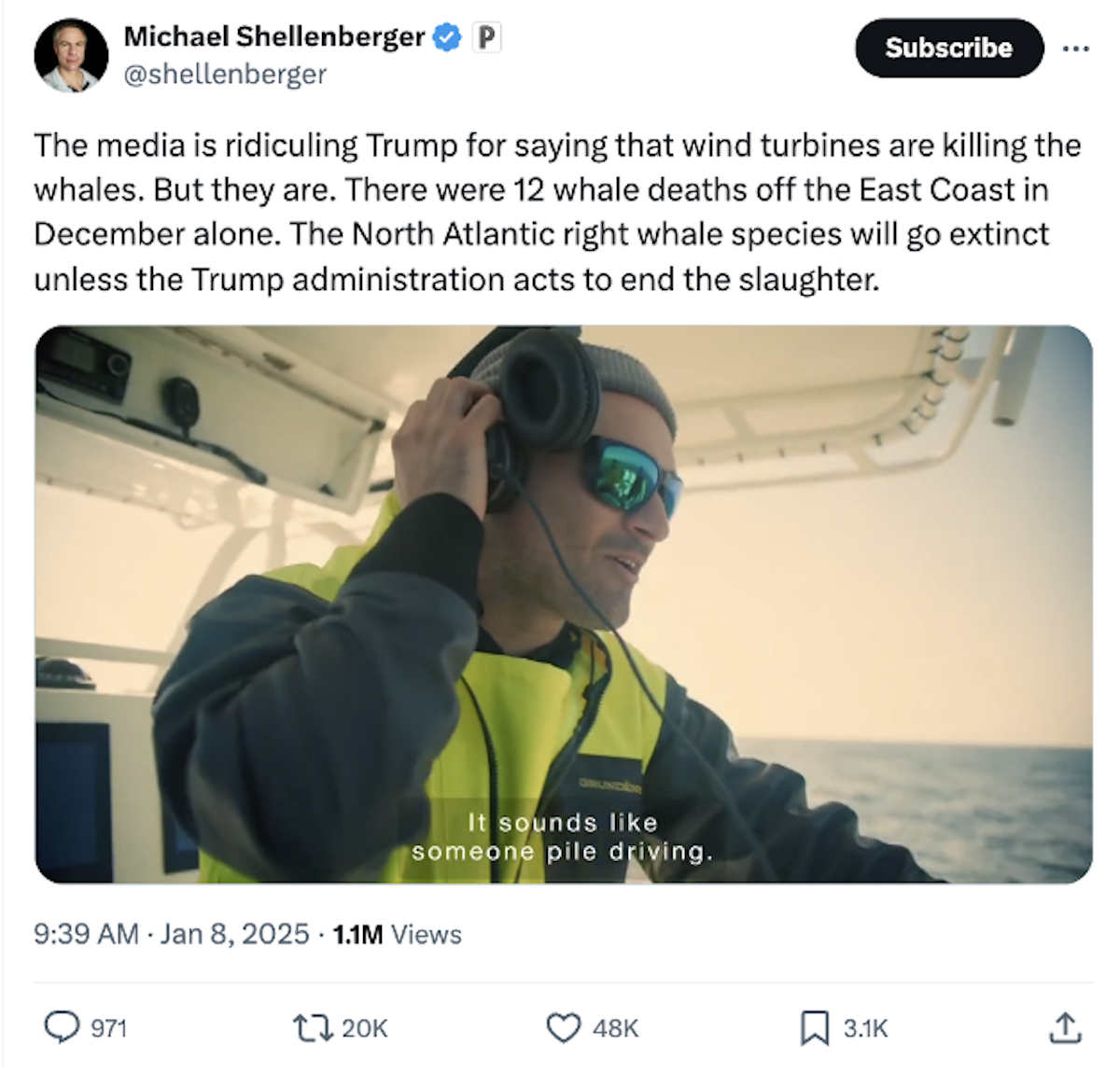 Link to tweet: https://x.com/shellenberger/status/1877002130776572270
What does Thrown to the Wind get wrong?
From the very start, Shellenberger’s brazen tweet makes a sweeping causal conflation. He claims that all 12 whale deaths off the U.S. East Coast throughout December 2024 occurred because of wind turbines, and that the North Atlantic right whale will go extinct unless Trump puts a stop to wind project development.
Having reviewed the film Thrown to the Wind in detail, such gyrating leaps of illogic accurately describe Shellenberger’s work on the subject.
Thrown to the Wind’s glaring sin is that it noticeably sidesteps discussion of any other possible causes of whale deaths, particularly the two consistent top known causes of death—entanglement in discarded fishing nets and gear, and collisions with boats of all kinds. These two factors accounted for 25 out of 41 known right whale deaths between 2017 and 2024. If a film were really centering whale welfare, one would expect it to touch at least briefly upon all the varied threats that whales face in practice.
It only gets worse from there. None of 12 East Coast whale deaths in December 2024 were right whales, contrary to what a casual reader might take Shellenberger’s tweet to imply. One of these dead whales washed ashore far away in North Carolina, where no wind construction is ongoing. Several of the dead whales appeared on beaches along the north side of Cape Cod, the side opposite from early-stage wind project development off Martha’s Vineyard south of Cape Cod’s southern coast. And while whale autopsy work on most of these dead whales is still in progress, initial findings so far have already ruled out offshore wind as the clear culprit in a couple cases—a Minke whale dead of disease, and a young humpback whale found on Cape Cod’s north side struck head-on by a boat.
Skating over such inconvenient details, Shellenberger and colleagues pin the blame for whale deaths squarely upon underwater noise pollution from offshore wind development. They claim to have shadowed ships performing preliminary work at the Vineyard Winds offshore wind site and to have taken damning measurements of noise emitted from such work.
A trailer clip Shellenberger shared prominently includes an off-the-cuff statement by a boat crew member recording noise from a survey vessel, who remarks “it sounds like somebody is pile driving.” This alludes to the process of pounding monopile structures into the offshore continental shelf, upon which developers later place the wind turbines themselves. Yet the fast-paced chirping sounds recorded from the small boat clearly do not originate from pile driving, which exhibits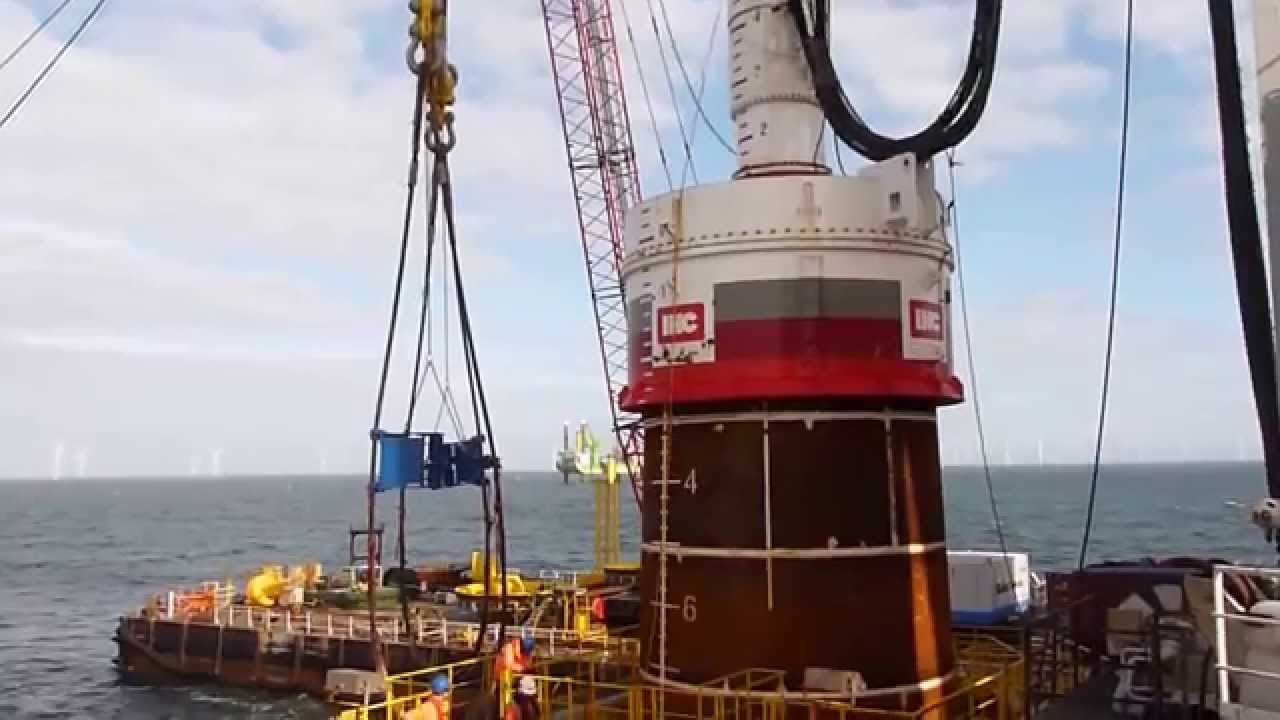 between strikes. Robert Rand, who the film credits as an acoustics expert, does correctly identify the noise as scanning sonar shortly thereafter in the film. This clarification is left out of the shorter promotional clip. Yet in any case, multibeam and sidescan sonar typically operate at frequencies above what humpback whales can hear and dissipate over short distances, and are used across oceanic industries like fishing, dredging, and scientific surveys. If sonar systems posed an existential threat to large whales, culpability would extend far beyond the offshore wind sector.
The film’s commentary on underwater sound levels also neglects context regarding the volume of the sounds measured. The film crew claims to have measured 150 decibels of sonar sound at a good distance from a specific seafloor surveying vessel in the Vineyard Wind development area, MISS EMMA MCCALL, then around 90 dB of sonar noise at a distance of 0.5 nautical miles in a separate instance. In comparison, the underwater noise from a moving cargo ship can be 190 dB at the source, while some research papers report that whale watching boats can produce 138-169 dB at the source (all decibel measurements are with respect to 1 μPa at 1 m). Coastal dredging to maintain harbor channels for ships and boats generates 180 dB.
How noisy does underwater sound have to be to bother marine life? Natural “ambient noise levels experienced in gentle weather conditions”, as it turns out, typically reach 94 dB. The U.S. National Marine Fisheries Service defines a continuous noise threshold of 120 dB beyond which there is a “possibility of behavioral impacts, generically, to marine mammals.” In other words, not all of the wind farm zone noise measured by the film crew was even particularly distinguishable from background ocean noise let alone harmful, while offshore wind operations are far from the only potentially loud noise sources in the coastal marine environment.
MISS EMMA MCCALL also uses exactly the same gear to survey across the U.S. East and Gulf coasts for offshore cables, underwater pipelines, offshore oil and gas drilling, dredging, government and scientific research, and other seafloor surface characterization activities. As of time of this writing, MISS EMMA MCCALL is docked in the Gulf of Mexico.
At another key point, the film shows charts comparing regional ship traffic in the mid-Atlantic and New England against the locations of reported whale deaths over different time frames. Predictably, the charts do show an increase in ship activity in the Martha’s Vineyard region in 2022 and 2023, while the number and location of whale deaths seems to fluctuate wildly between periods. Shellenberger quips in response to a colleague: “I appreciate your caveat about not suggesting causality, but it’s impossible not to look at these correlations and imagine there’s some connection.” His comment unintentionally reveals the skew characterizing the whole documentary project—a deliberate disinterest in alternative hypotheses, uncertainties, and sources of error.
The film, for example, does not seem particularly concerned with comparing its ship traffic and whale deaths narrative against the actual timeline of wind farm construction. Before 2022, the US built just 7offshore wind turbines. Five turbines near Block Island, Rhode Island constructed between 2015-2016, and two turbines off Virginia constructed in 2020. This calls into question the significance of the ship traffic imagery shown from December 2016 through the end of 2021.
The film team’s presentation of ship traffic in inconsistent time periods does not account for seasonal patterns of boat traffic around the Martha’s Vineyard, Nantucket, Cape Cod regions during the summer months. Nor do they consider the seasonal pattern of whale activity, in which whales are present year-round but concentrate off New England largely in the winter and spring months. In response, federal agencies and wind farm developers have also explicitly agreed that developers will concentrate onsite activity during summer months—another factor that the superficial commentary does not consider.
Meanwhile, dead whales washing ashore do not exactly offer the clear narrative that Shellenberger and company would like. Dead whales appearing on beaches are obviously decoupled in time and place from where and when they died, and researchers often require months of autopsy work to investigate the cause of death. Whale strandings, by nature, are a metric carrying considerable error—an inherently incomplete picture of whale mortality with a lot of chance thrown in that could create illusions of trends. The time needed to detect robust trends in whale deaths in response to a new stressor may be quite long. Simultaneously, one can easily imagine other explanations for increasing whale deaths on the U.S. East Coast since 2016, such as infectious disease, marine pollution, climate shifts, or significant shifts in boat traffic during and after the COVID-19 pandemic.
As the film’s final piece of evidence, activist Lisa Linowes claims that a letter to the Bureau of Ocean Energy Management by NOAA Chief of Protected Species Sean Hayes warns that wind turbine turbulence will destroy the plankton that whales feed on. This assertion utterly butchers the actual scientific concern the letter by NOAA scientists highlights—a far more mundane risk that turbines could change local patterns of water circulation and stratification, shifting where zooplankton occur. Many anti-wind activist groups regularly cite this NOAA letter, but few groups draw attention to the NOAA scientists’ proposed solution to protect whales from negative impacts—an incremental 20 kilometer shift of the wind farm development zone. This policy suggestion stands in sharp contrast to how Shellenberger’s film frames the threat to whales from offshore wind projects as a yes or no binary, as opposed to any interest in exploring solutions throughout the whole spectrum of impacts and countermeasures.
Make no mistake—this critique of Shellenberger’s film does not seek to dismiss the real concerns regarding possible negative impacts upon whales from offshore wind development. As evidenced by federal regulations, industry countermeasures, and academic research and oversight, such concerns do demand serious study and attention. But members of the public worried about whale welfare are far better off reading the actual NOAA letter and related scientific work themselves rather than wasting time on this “documentary.”
On the future of humans, the ocean, and the Earth
Overall society would benefit by drawing some much-needed lessons from this silly film. Likely, many clean energy advocates and climate hawks have nodded along so far with this critique of Thrown to the Wind.
Yet members of the broader environmental coalition should consider how this film is actually representative of the highly unscientific, typical documentary often celebrated by the environmental movement. Thrown to the Wind’s distorted narrative echoes that of films like the widely-panned Seaspiracy, which spun similarly superficial and unscientific narratives about fishing and ecological collapse. The ranks of junk food movies on nuclear power include examples like Meltdown: Three Mile Island, which earned a Netflix release despite wildly mischaracterizing numerous technical and historical facts and leaning heavily on appeals to emotion.
One could literally shoot the same kind of documentary speculating about how geothermal power will poison the flamingos, complete with an eerie musical score, camera angles lingering melancholically on a flamingo chick, and sermonizing over the sins of industrializing nature. This is a mirror image of classical environmentalist doco-dramas, just mobilized for different ideological purposes. Shellenberger, after proclaiming the “Death of Environmentalism” just two decades ago, has now essentially chosen to leap into the same grave.
Critics do not need to make up arguments against offshore wind. Shellenberger is likely grossly overstating the impacts of offshore wind development on Atlantic whale populations so far, but neither is it reasonable to argue that the old Biden administration goal of expanding offshore wind capacity from 42 megawatts to 30,000 megawatts by 2030 would have zero impacts upon whales. A more rational discussion of impacts management can appreciate the full spectrum of tradeoffs between building many wind farms speedily and cheaply versus slower, limited construction with obligations to implement a whole suite of high-cost mitigative measures.
From a big picture perspective, one can easily imagine that in a techno-economic future where nuclear power or advanced geothermal scale with great commercial success, the entire case for offshore wind could weaken to the point of non-viability. But the future technological breakthroughs are hard to predict and society needs more clean energy tools, not less.
Meanwhile, one thing is certain: the fate of Atlantic whales will depend upon a far richer set of factors—ranging from fishing to navy sonar to climate shifts—than just offshore wind turbines alone.
---
---
mma
Years of falsehoods from Fox News helped solidify offshore wind as a prime target for Trump
Against all evidence, right-wing media insist Trump is “saving the whales” and reducing energy costs through his nonsensical executive orders
Special ProgramsClimate & Energy
Written by Ilana Berger
Published 02/04/25
- One of President Donald Trump’s many January 20 executive orders paused permitting and leasing for offshore wind projects in the United States, a victory for anti-renewable energy activists who have vilified the technology for years.
The order follows years of Fox News bashing offshore wind farms based largely on falsehoods repeated by the president and self-proclaimed conservationists with ties to fossil fuel interests. In addition to his so-called conservation efforts, Trump has promised to halve energy costs in his first year in office, and he immediately declared a “national energy emergency” with the intent of doing so. Economists and energy experts say he won’t succeed.
Offshore wind opponents, contradicting insights from marine mammal experts, maintain that the development of offshore wind farms along the East Coast is causing large whale die-offs. This poorly understood phenomenon has affected several whale species in the area since 2016. Trump and Fox News personalities, and other right-wing media figures, have characterized these projects as particularly destructive to wildlife, including birds.
Yet while they are feigning concern for whales, right-wing media are not mentioning offshore drilling for oil and gas — an activity that Trump has encouraged, and one that harms marine life. During these segments praising Trump's move to pause wind projects, they also haven’t focused on the jobs that would likely be eliminated if new offshore projects fail to materialize, while job loss has been a key focus of theirs in coverage of former President Joe Biden’s 2021 cancellation of an extension on the crude oil Keystone pipeline.
- ## There is no evidence that offshore wind farms are responsible for killing large numbers of whales — a claim Trump used to justify his hostility toward the industry
- :{During his inaugural address, Trump amplified the baseless claim that “if you’re into whales, you don’t want windmills.”Trump specifically implied whale mortality events in New England were due to offshore wind projects in the region. The Washington Post, [1/21/25, :{Newsmax, The Record with Greta Van Susteren, 1:(style="background-color:#ffff00ff"):}:/21/25]}:
- Scientists say there is no evidence that offshore wind is contributing to whale deaths, but fishing gear entanglement, vessel collisions, and the changing migration patterns of whale prey could be contributing.The Woods Hole Oceanographic Institution writes there is “no evidence” to support the claims that offshore wind projects are responsible for an uptick in whale deaths. “Of all the right whales that have died over the last several decades, the cause of death for juveniles and adults is always vessel strike or fishing gear entanglement,” according to Woods Hole whale biologist Mark Baumgartner. National Oceanic and Atmospheric Administration reports support these findings. Woods Hole Oceanographic Institution, [5/9/24; Yale Environment 360, 3/8/23; Factcheck.org, 3/31/23; National Oceanic and Atmospheric Administration, accessed 2/3/25]
- Some types of sonar can harm marine life – but those technologies are not used for offshore wind surveying.As biologist Scott Travers explains for Forbes, seismic blasting used for oil and gas exploration can harm marine life because it is “loud enough to penetrate hundreds of miles into the ocean floor.” The National Oceanic and Atmospheric Administration has said that sound produced by high-resolution geophysical surveys used by offshore wind energy companies “produce much smaller impact zones because, in general, they have lower noise, higher frequency, and narrower beam-width.” According to Travers, the technology used for offshore wind surveying is less harmful because developers are “primarily interested in what’s on the seabed, not what’s beneath it.” National Oceanic and Atmospheric Administration, accessed [1/30/25; Forbes, 4/25/24]
- Scientists say climate change is harming whale populations. According to Woods Hole, scientists also suspect climate change has been “changing the distribution” of prey sought out by the whales. “Following their prey, the whales traveled farther north than they had before, into areas without protection. It wasn’t that people weren’t willing to protect them in these locations, simply that no one expected the whales to show up there.” While scientists feel that more research and careful monitoring is needed, reporting from NPR’s WCAI radio station and science reporting effort Science Friday found that “more than a half dozen scientists and right whale conservation advocates interviewed for this story said the biggest risk to right whales and other endangered species is the very danger offshore wind is designed to address: climate change.” Woods Hole Oceanographic Institution, [5/9/24; Science Friday, 3/29/24]
- ## Right-wing media used the false whale narrative to praise Trump’s executive order
- On Newsmax’sSavage Nation, guest Tucker Carlson praised the executive order targeting offshore wind power and complained about “the amount of destruction that it’s wrought to the environment,” mentioning whales specifically. He also claimed without evidence that “it’s proven — we know that wind turbines, offshore wind turbines, kill whales,” adding, “I really hope the president, by executive order, will end the destruction of nature in the name of green energy.” Newsmax, *Savage Nation with Michael Savage*, [1/28/25]
- While discussing Trump’s initial executive orders, Fox host Mark Levin compared wind turbines to “old-time tombs and other things that these past ancient people built” and said, “They’re killing birds, they’re killing whales, they make noise, and they do ... not a damn thing.”He praised Trump for promising to “end leasing to massive wind farms that degrade our national landscapes and fail to serve American energy consumers.” [Fox News, Life, Liberty & Levin, 1/27/25]
- Fox host Rachel Campos-Duffy and climate denier Marc Morano claimed Trump is “saving the whales.”Campos-Duffy said that Trump debunked “the left’s claim that wind energy is better for the environment.” She told Morano that she “hates windmills,” labeled them as “bird murderers” and “whale murderers,” and declared, “I think Donald Trump is like the whale whisperer. He’s saving the whales.” Morano said that “Donald Trump is turning out to be the greatest environmental hero of the 21st century,” not just because of “endangered species in terms of especially offshore wind and whales,” but also because he is “bringing in more fossil fuels from the western world.” Fox News, *Fox & Friends Weekend*, [1/25/25; DeSmog, accessed 1/30/25]
- Fox anchor Bret Baier and correspondent Bryan Llenas highlighted various attacks on offshore wind turbines, including Trump’s claim that they are “ugly, unreliable, and expensive,” “interfere with military radars,” and “kill whales.” Llenas said: “President Biden gave a billion dollars in government subsidies to the Danish energy company Orsted back in 2023 just to see them pull the plug on two wind projects off the coast of New Jersey, citing the high costs. Now, critics have raised concerns that wind turbines interfere with military radars, conservationists claim they disrupt fish migration and kill whales.” Right-wing media celebrated when Orsted scrapped those projects, even though they would have created 15,000 jobs over their lifetimes. Fox News, *America’s Newsroom*, [1/24/25; Media Matters, 11/14/23]
- On his new One America News show, former Republican lawmaker Matt Gaetz called offshore wind “a whale torturing project.”OAN, *The Matt Gaetz Show*, [1/21/25]
- On Fox Business, National Review writer Carolina Downey claimed that Trump will “drill, baby, drill, as he promised to the American people,” adding that “he's also going to save the whales because he's cutting into those wind projects which we know are affecting the whale population.”Fox Business, *Mornings with Maria*, [1/21/25]
- ## Fox News has waged a yearslong campaign against offshore wind
- In 2023, Fox News aired 54 segments falsely linking offshore wind to whale deaths.That year alone, at least 15 programs on the network reported on the false link between offshore wind and whale deaths, including the network’s so-called straight news program Special Report With Bret Baier. Media Matters, [1/18/24]
- Fox News has played a key role in the proliferation of offshore wind misinformation by regularly airing false claims about the technology and providing a platform to groups that are bankrolled by the fossil fuel industry.A 2023 report from the Center for American Progress illustrated how the fossil fuel industry is bankrolling offshore wind misinformation, “with money flowing through interest groups, think tanks, and astroturf groups to achieve its ultimate goal of slowing, if not stopping, the expansion of offshore wind in the United States.” Fox has amplified several of these groups, including Protect Our Coast NJ and people associated with the Texas Public Policy Foundation and Environmental Progress. The latter group’s founder and president, Michael Shellenberger, has appeared frequently on Fox News to spread offshore wind misinformation. The Center for American Progress, [12/11/23; Media Matters, 1/18/24,1/12/23,2/3/23,8/29/23]
- Fox News began linking offshore wind projects to whale deaths as early as 2022. In August 2022, Meghan Lapp, a fisheries liaison for the fishing company Seafreeze, whose campaign to stop offshore wind development has been bankrolled by the Texas Public Policy Foundation, appeared on Fox News’ Jesse Watters Primetime. Distilled, [1/31/23; Foxnews.com, 8/26/22]
- ## Fox News ranted about job casualties after the cancellation of the Keystone XL pipeline, but offshore wind projects were also set to create jobs
- Blocking offshore wind projects would hurt American manufacturing. According to Oceanic Network, “64% of manufacturing and supply-chain investment” supporting the offshore wind industry is in Republican districts. Felicia Sanchez, a partner with the law firm K&L Gates, pointed out to Utility Dive that “it’s hard to say ‘we’re going to end offshore wind’ when you’re also impacting a vast supply chain that has already been going for the last few years that has been implemented — when ports have been developed, and vessels have started to either be under construction or have come out of the yard ready to work in offshore wind.” Canary Media, [1/28/25; Utility Dive, 1/21/25]
- Fox News personalities expressed outrage about job losses for more than a year and a half after then-President Joe Biden decided not to proceed with the construction of the Keystone XL pipeline project. According to AP News, “The Keystone XL pipeline was intended to be an expansion of the existing Keystone pipeline, which runs about 2,687 miles from Alberta to Illinois and Texas, and is operating.” In 2021, in the first nine days after news outlets reported that Biden would be scrapping the project, Fox News made misleading claims about jobs 74 times. The network offered several misleading or decontextualized estimates for how many jobs would be lost, ranging from about 11,000 to 42,000. The numbers were a far cry from the State Department’s actual estimate of just 35 long-term jobs. Meanwhile, Trump’s executive order will impact many wind energy projects, not just one. Media Matters, [6/29/22, 1/28/21; AP News, 3/17/22; PolitiFact, 7/21/22]
- ## By excluding solar and wind, Trump’s executive order undermines his declaration of a “national energy emergency”
- Trump declared a national energy emergency, which unlocked special authorities to boost the “production and sale of a wide range of energy resources” and “to expedite the completion of all authorized and appropriated infrastructure, energy, environmental, and natural resources projects.” S&P Global, [1/22/25; Whitehouse.gov, 1/20/25]
- Trump’s national energy emergency counterintuitively excludes certain renewable energies, including offshore wind.The executive order does not mention solar or wind in its definition of the “energy resources” Trump wants to expand. Director of the Harvard University environmental economics program Robert N. Satvins told The New York Times, “If there really were an energy emergency, then the right thing to do would be to increase supplies of all forms of energy, and to try to use energy conservation initiatives.” Whitehouse.gov, [1/20/25; The New York Times, 1/21/25]
- Experts are skeptical that Trump’s declared energy emergency will fulfill its purported goal of lowering energy costs for Americans.Trump cannot force energy companies to produce more, and currently, it would not be profitable for them to do so because crude oil is abundant. In October 2024, the World Bank predicted an “oil glut next year with a supply-demand gap that's been this large only twice before” in part because Chinese consumers are pivoting away from gas-powered cars. And despite a predicted increase in power demand from AI, experts also say the technology could ultimately boost supply and hurt oil prices. The New York Times, [1/24/25; Axios, 10/29/24; Whitehouse.gov, 1/20/25; Reuters, 9/3/24]
- Trump cannot reverse the transition to renewable energy. In a recent report, Citigroup analysts wrote that, despite uncertainties, “Clean energy is cheaper, more widely available, and more efficient. … For advocates of clean energy transition, the power of economics will prevail.” In October, BloombergNEF found that even “a total repeal of the IRA’s tax credits” — a scenario BNEF called “unlikely” — “would not entirely stymy the US’s clean power momentum.” Fortune, [1/27/25; BloombergNEF, 10/31/24]
===
no lnx
What to know about Trump’s pause on wind development
In a wide-ranging executive order, Trump paused offshore wind lease sales and halted the approval of leases, permits and loans for both offshore and onshore wind energy projects.
January 21, 2025
By Maxine Joselow
During his first moments back in the Oval Office on Monday evening, President Donald Trump signed an executive order that pauses wind energy development on federal lands and waters, shocking and dismaying many climate advocates and clean-energy firms.
The executive order temporarily stops offshore wind lease sales in federal waters and halts the approval of leases, permits and loans for both offshore and onshore wind energy projects. It also temporarily prohibits the development of the Lava Ridge Wind Project, a large wind farm in Idaho that the Biden administration approved in December.
Though Trump has long disdained wind energy, the order is broader than many observers had expected. Here’s what to know about the order and how it could reverberate across the country.
What does Trump’s executive order mean for U.S. wind energy?
“We think the EO is likely to significantly curtail the U.S. offshore wind industry over at least the next four years,” Timothy Fox, managing director at the research firm ClearView Energy Partners, said in an email.
Wind energy in the United States has faced several economic challenges, including rising interest rates, soaring inflation and supply chain bottlenecks. These financial hurdles, along with local opposition to projects, have contributed to a decline in domestic wind energy investment in recent years.
Trump’s executive order adds a big new political obstacle to the sector’s future growth, even as many Democratic-led states in New England are counting on offshore wind to meet their ambitious climate goals, Fox said.
“The EO could have negative implications beyond Trump’s term because project developers may be wary of investing in a sector that faces demonstrable high election risk,” he said.
Jason Grumet, CEO of the American Clean Power Association, warned that the executive order could harm states that supported Trump in the 2024 election. He said wind meets more than half of electric power demand in seven key states that backed Trump: Iowa, Kansas, New Mexico, North Dakota, Oklahoma, South Dakota and Wyoming.
At the same time, Grumet said, roughly 99 percent of onshore wind projects are on private land, rather than federal land overseen by the Interior Department.
“It’s long been understood that the government does not proactively interfere with private enterprise on private land, and we continue to assume that that fundamental premise of a free economy will not be significantly undermined,” he said.
What does it mean for wind projects that are approved or underway?
The executive order states that the interior secretary, in consultation with the attorney general, will “conduct a comprehensive review” of the “necessity of terminating or amending any existing wind energy leases.”
That language “strongly suggests that the Administration may try to undo leases issued and project permitted by the Biden Administration,” Fox said, adding that “there may be sufficient authority to do so.”
Yet former North Dakota governor Doug Burgum, Trump’s pick for interior secretary and “energy czar,” suggested during his confirmation hearing Thursday that offshore wind projects that are already underway could move forward.
In response to a question from Sen. Angus King (I-Maine) about offshore wind projects in the Gulf of Maine, Burgum said, “I’m not familiar with every project that the Interior has underway, but I’ll certainly be taking a look at all of those, and if they make sense and they’re already in law, then they’ll continue.”
Trump is targeting a project that Biden just green-lit. Can he stop it?
The order specifically targets the Lava Ridge Wind Project in southern Idaho, saying the Biden administration’s environmental analysis of the project may suffer from “legal deficiencies.” It instructs the Interior Department to “place a temporary moratorium on all activities and rights” of the company behind the project, Magic Valley Energy, an affiliate of the New York-based energy firm LS Power.
The Lava Ridge Wind Project is near a former incarceration camp where thousands of Japanese Americans were unjustly imprisoned during World War II. It has already faced opposition from local Republican politicians and descendants of those who were incarcerated.
Magic Valley Energy did not immediately respond to a request for comment.
Why is Trump so critical of wind energy?
Trump’s disdain for wind power dates to 2006, when he bought an 1,800-acre estate in Scotland near a planned wind farm that he warned would be “monstrous” and “really ugly.”
The Trump Organization sought to build a golf course there, and it sued to block the wind project, saying the turbines would ruin the view for golfers. In December 2015, less than a year before the U.S. election, judges on Britain’s top court unanimously rejected that claim.
But the battle raged on. While in the White House, Trump frequently attacked the clean-energy source. And during an April fundraising dinner with oil executives, Trump claimed that wind power is unreliable, unattractive and bad for the environment, The Washington Post previously reported.
“I hate wind,” Trump told the oil executives over a meal of chopped steak at his Mar-a-Lago Club and resort in Florida, according to a person with knowledge of the meeting, who spoke on the condition of anonymity to describe a private conversation.
Do offshore wind projects kill whales or birds?
Trump falsely claimed during a Monday speech that “big, ugly windmills” are killing whales and birds.
“If you’re into whales, you don’t want windmills,” Trump told a crowd of supporters at the Capital One Arena in Washington, adding that “they kill your birds, and they ruin your beautiful landscapes.”
Leading scientists and federal agencies, including the National Oceanic and Atmospheric Administration, have said there is no evidence that offshore wind development is responsible for a recent spate of whale deaths on the East Coast. The biggest threat to marine mammals, many scientists say, is climate change, which offshore wind can help address by lowering greenhouse gas emissions from the power sector.
While turbines can kill birds, research suggests that house cats cause far more bird deaths in the United States each year, and that painting the turbine blades black can help reduce fatalities.
Dino Grandoni contributed to this report.
---
gmail 3 24 busted on BS
Against the Wind
By Gary Leabman, Climate Reality Specialist
A speedboat approaches workers constructing an offshore wind farm 35 miles off shore from Long Island, NY. The message from a bullhorn to the workers is "We're here to save the whales", suggesting that windmills cause whales to beach themselves. According to Sierra Magazine, Spring 2024, climate change disinformation leader, Marc Morano, is opposing offshore wind projects like that one. -His message from a speedboat to construction workers: “We’re here to save the whales.”- [This is a duplicate of the second sentence above.] Never mind that whale beaching events happened long before any exploration equipment was sent to find suitable locations for wind turbines. He failed to stop construction. So now 12 turbines are providing renewable wind power to over 70,000 homes in New York.
Only 15% of the public, and perhaps 1% of scientists, still deny that humans are accountable for the weather extremes experienced in recent decades. A new type of strategy being utilized is called “climate delayism”, in which there is a coordinated attempt to delay climate solutions through disinformation. Not by coincidence, Morano receives funding from fossil fuel interests like ExxonMobil and the Charles Koch Foundation. Between 1990 and 2014 ExxonMobil and it’s foundation gave over half a million dollars to organizations to try to delay renewable projects. Meanwhile, dark-money groups like Donors Trust gave Morano’s team nearly $8 million in just 9 years according to federal tax data.
According to a 2023 Washington Post survey, 7 out of 10 Americans said they would be okay with a wind farm in their community. In New Jersey, Morano purchased billboards reading “Save the Whales-Stop Windmills”. Such disinformation resulted in only 5 of 10 people in New Jersey believing that there is a connection, according to a 2023 survey by Monmouth University. Although it’s not true, social media and certain televised broadcasts willingly spread such disinformation.
There currently are 230 local measures across 35 states to restrict the development of renewable energy. However, Missouri will soon contain part of the Grain Belt Express transmission line to take wind energy produced in Kansas, across Missouri and Illinois, to the Indiana border. After years of protest by the Farm Bureau and some local communities, this privately funded project will take clean energy produced in Kansas to provide clean wind power to local communities such as Hermann. To quote the Columbia Missourian last October, “A 750 mile interstate power line promises to deliver wind-generated electricity to Columbia at nearly half the price the city now pays. But the savings cannot be certain until the line is built and contracts are proposed”.
According to a 4-1 decision by the Missouri Public Service Commission last October,
“The Project will result in $17.6 billion in savings to Missouri ratepayers and $7.6 billion in social benefits, compared to the projected $5.7 billion dollar cost of the Project.” These are projections over 15 years. Social benefits include financial support to FFA chapters and the Trust for Public Land to create parks in project areas. The energy capacity of this transmission line will equal the power from 4 nuclear power plants. Missouri workers will also have part of over 22,000 jobs during construction which will end up providing enough power for over 3.2 million homes.
The book Drawdown says that “Wind farms have small footprints, typically using no more than 1% of the land they sit on, so grazing, farming, recreation, or conservation can happen simultaneously with power generation.” Onshore wind generation is growing rapidly; Drawdown estimates 1.23 trillion dollars investment can result in 7.4 trillion dollars net savings by 2050. For comparison, the International Monetary Fund estimates the fossil fuel industry received more than 7 trillion dollars in subsidies in 2022, both direct and indirect. Indirect fossil fuel subsidies include the health care costs from air pollution, environmental damage, and the escalating property damage from extreme weather events which their greenhouse gasses contribute to global warming.
Whether onshore or offshore, clean renewable wind power has few of those consequences.
Those who are “against the wind” are blowing smoke to cover the ongoing damage to our atmosphere. If the political wind changes, curtailing instead of promoting the progress being made during the transition to renewable energy, the global warming challenges for our children and grandchildren will be much harder, if not impossible, to achieve.
---
Marc Morano
Weekly update ⋅ March 22, 2024
Offshore wind opponents mount court challenge to Virginia project - WorkBoat
The activist groups got a shout-out from Marc Morano, who runs the website Climate Depot disputing climates scientists' reports about escalating ...
---
Coalition of Public Interest Groups Will Be Seeking Injunction to Stop Virginia Offshore Wind ...
The Heartland Institute
Marc Morano is the publisher of the award-winning ClimateDepot.com, a global warming and eco-news center founded in 2009. Morano was named one of only ...
---
'Fiscal sanity': GOP House budget proposal emphasizes US energy production | Fox News
Fox News
FIRST ON FOX: The House Republican Study Committee (RSC), released its annual budget proposal, emphasizing a series of energy policies it said ...
---
Go Green With Heat Stroke At 2024 Summer Olympic Games in Paris
One America News Network
Go Green With Heat Stroke At 2024 Summer Olympic Games in Paris. with Marc Morano ... Marc Morano. Video still from Tipping Point on One America News ...
---
---
11 23
WASHINGTON— The Biden-Harris administration today announced its approval of the Empire Wind offshore wind project – the sixth approval of a commercial-scale offshore wind energy project under President Biden’s leadership. Today’s announcement supports the Administration’s goal of deploying 30 gigawatts of offshore wind energy capacity by 2030.
Empire Wind US LLC proposes to develop two offshore wind facilities, known as Empire Wind 1 and Empire Wind 2. The lease area is located about 12 nautical miles (nm) south of Long Island, N.Y., and about 16.9 nm east of Long Branch, N.J. Together these projects would have up to 147 wind turbines with a total capacity of 2,076 megawatts of clean, renewable energy that the Bureau of Ocean Energy Management (BOEM) estimates could power more than 700,000 homes each year. The projects would support over 830 jobs each year during the construction phase and about 300 jobs annually during the operations phase.
“Under President Biden’s leadership, the American offshore wind industry is continuing to expand rapidly — creating good-paying union jobs across the manufacturing, shipbuilding and construction sectors," saidSecretary Deb Haaland. “Today’s approval of the sixth offshore wind project adds to the significant progress towards our Administration’s clean energy goals. Together with the labor community, industry, Tribes, and partners from coast to coast, we will continue to expand clean energy development in a manner that will benefit communities, strengthen our nation’s energy security, and address climate change.”
“BOEM and our partners have already achieved so much in pursuit of the Administration’s goal of reaching 30 gigawatts of offshore wind energy capacity by 2030,” saidBOEM Director Elizabeth Klein.“Extensive engagement with Tribes, other government partners, ocean users, concerned citizens, and more has helped us to avoid or reduce user conflicts while facilitating the responsible development of offshore wind projects. We look forward to continuing our work with them as we move this industry forward.”
Bidenomics and the President’s Investing in America agenda are growing the American economy from the middle out and bottom up – from rebuilding our nation’s infrastructure, to driving over half a trillion dollars in new private sector manufacturing and clean energy investments in the United States, to creating good-paying jobs and building a clean energy economy that will combat the climate crisis and make our communities more resilient.
Since the start of the Biden-Harris administration, the Department of the Interior has approved the nation's first six commercial-scale offshore wind energy projects. BOEM has held four offshore wind lease auctions, which have brought in almost $5.5 billion in high bids, including a record-breaking sale offshore New York and New Jersey and the first-ever sales offshore the Pacific and Gulf of Mexico coasts. BOEM has also advanced the process to explore additional opportunities for offshore wind energy development in the U.S., including in the Gulf of Maine and offshore Oregon and the U.S. Central Atlantic coast. The Department has also taken steps to evolve its approach to offshore wind to drive towards union-built projects and a domestic-based supply chain.
Invaluable feedback was gathered through nation-to-nation consultations with Tribes, input from federal, state and local agencies, and from public meetings and comments in analyzing the project’s potential environmental impacts and developing possible alternatives and mitigation measures.
The Record of Decision includes measures aimed at avoiding, minimizing, and mitigating the potential impacts that may result from the construction and operation of the project. Among those measures, Empire Wind, LLC has committed to establishing fishery mitigation funds to compensate commercial and for-hire recreational fishers for any losses directly arising from the project.
The Record of Decision will be published in the Federal Registerin the coming days and can be found on the BOEM website.
---
whalES get save from executuon admit bidenomics high rate inflation in china won't work connecticut collapse NY and gnd falling apaRTY, BUSES CVATCH ON FIRE
gm HONDA FORD MICH BATT PLANT, LOSING X PER
MAKE CARS FOR POLS INSTEAD OF CUSTOMERS SMART MONEY IS IN OIL EXXON HESS 11B BARELS OF OIL OFFSHORE... RUNN OT OF MINEALS BEFORE OIL STALIN BILLIINS GONE WINDMILLS NEVERR MADE IT OUT OF FACTORY BIGGEST GREN BAILOT IN HISORY...I ALREADY HAVE THIS
Major wind project dependent on Biden admin waiving taxpayer safeguard: internal docs | Fox News
Major wind project dependent on Biden admin waiving taxpayer safeguard: internal docs
Fox News
'The Green Fraud' author Marc Morano joins 'Jesse Watters Primetime' to discuss the collapsing green industry. EXCLUSIVE: A Massachusetts wind project ...
grab FF
Green Economy
Major wind project was dependent on Biden admin waiving taxpayer safeguard: internal docs
Thomas Catenacci By Thomas Catenacci Fox News
Published January 15, 2024 4:00am EST | Updated January 15, 2024 4:29am EST
Marc Morano: Biden's green energy agenda is in complete collapse
'The Green Fraud' author Marc Morano joins 'Jesse Watters Primetime' to discuss the collapsing green industry.
EXCLUSIVE: A Massachusetts wind project, which recently became the first utility-scale offshore wind project to deliver electricity to the grid, wouldn't have been financially viable if the Biden administration hadn't intervened, according to internal documents reviewed by Fox News Digital.
Federal officials with the Bureau of Ocean Energy Management (BOEM) acknowledged in the unearthed communications shared with Fox News Digital that granting a waiver on development fees designed to safeguard taxpayers was "critical" for the 800-megawatt Vineyard Wind project. BOEM ultimately waived the financial assurance for decommissioning costs fee for the project in June 2021.
"The more we dig into the details of the Vineyard Wind project the more concerning it becomes. The Biden administration brags that this is the first utility-scale offshore wind project. But clearly, without BOEM contorting the approval process and waiving requirements meant to protect taxpayers, Vineyard is unlikely to ever have gotten off the ground," Michael Chamberlain, the director of watchdog group Protect the Public's Trust (PPT), which obtained the documents, told Fox News Digital.
"Both BOEM and the developer have admitted as much. This situation does not bode well," Chamberlain continued. "If government has to bend the rules to make these projects feasible, it's just a matter of time before the 'clean energy transition' is dead in the water. The only questions may be how many taxpayer resources are put at risk and how much of the American public’s trust is squandered before it happens."
GIANT OFFSHORE WIND PROJECT AXED IN BLOW TO BIDEN'S GREEN GOALS
Vineyard Wind of New Bedford, the construction/layover work happening at the New Bedford Marine Terminal. A view of stacked GE Haliade- X turbine blades.
Wind turbine blades are stacked at the New Bedford Marine Terminal in Massachusetts on June 14, 2023. The blades are for the Vineyard Wind project. (David L. Ryan/The Boston Globe via Getty Images)
On June 15, 2021, BOEM Office of Renewable Energy Programs Chief James Bennett sent a letter to Vineyard Wind's developer, informing the firm that the agency had approved a March 2021 request to waive the fee. Under the action, Vineyard Wind isn't required to pay the development fee until 15 years after the project enters operations under its 20-year power purchase agreements.
Vineyard Wind first submitted the request in December 2017, but the Trump administration rejected it, forcing the developer to resubmit it in March 2021. Federal statute mandates that developers pay the fee prior to construction on their lease, a potentially hefty fee designed to guarantee federal property is returned to its original state after a lessee departs its lease.
DC GREENLIGHTS AGGRESSIVE ELECTRIC VEHICLE MANDATE DESPITE CRITICS SOUNDING ALARM ON HIGH CONSUMER COSTS
In addition, Meredith Lilley, an energy program specialist at BOEM's Office of Renewable Energy Programs, acknowledged in an internal email also on June 15, 2021, that waiving the fee by August 2021 was vital to ensure Vineyard Wind could maintain financial viability. The move notably came one month before BOEM approved the project's construction and operations plan.
"Issuing a decision to Vineyard Wind on this request is critical to enabling them to carry on with the Vineyard Wind 1 Project because it is a key determinant of the project’s value, which Vineyard Wind needs to know now in order to secure financing and achieve financial close in early August," Lilley wrote in the email to other federal officials involved in internal deliberations.
Biden and wind projects
President Biden points to a wind turbine size comparison chart during a meeting about the Federal-State Offshore Wind Implementation Partnership on June 23, 2022. (Drew Angerer/Getty Images)
And according to Bennett, BOEM waived the fee because the project included risk reduction factors, including insurance policies to cover damages, use of proven wind turbine technology, and the use of power purchase agreements "with guaranteed electricity sales prices that, coupled with the consistent supply of wind energy, ensure a predictable income over the life of the project."
The letter also stated that the "regulatory departure" would reduce Vineyard Wind's financial assurance burden, enabling the developer to invest freed-up capital in construction and enabling the project to enter operations sooner. In addition, it explained the fee was waived also because it "promotes the production and transmission of energy from a source other than oil and gas."
TOP OFFICIALS WARNED BIDEN ADMIN ABOUT DANGERS WIND ENERGY PROJECTS POSE TO FISHING INDUSTRY, LETTER SHOWS
"In 2021, per its regulatory authority, BOEM approved Vineyard Wind 1’s request to defer providing the full amount of its decommissioning financial assurance until year 15 of actual operations under its 20-year Power Purchase Agreement for the Vineyard Wind 1 offshore wind energy project offshore Massachusetts," a BOEM spokesperson told Fox News Digital in a statement.
"BOEM deferred this requirement for Vineyard Wind 1 with the condition that such financial assurance would be provided in full during a time when the project risk is low — that is, during the time when the offshore wind lessee has guaranteed financial support through an assured price for the electricity generated by the project," the spokesperson added.
President Biden delivers remarks at the 2022 White House Tribal Nations Summit at the Department of the Interior on Nov. 30.
President Biden delivers remarks at the White House Tribal Nations Summit alongside Interior Secretary Deb Haaland. The pair have made approving and permitting offshore wind a priority as part of the administration's climate agenda. (Pete Marovich/Getty Images)
The revelation comes days after Vineyard Wind's developers, lawmakers and environmental groups celebrated the project beginning to send electricity to the grid. The milestone was achieved after one wind turbine entered operations at the offshore site which will eventually host 62 turbines.
After the turbine began producing electricity on Jan. 2, the Sierra Club said the project "will aid tremendously in reducing dangerous fossil fuel air pollution" and fellow eco group the Conservation Law Foundation added that "New England’s transition away from polluting fossil fuels and towards clean, renewable energy is underway in earnest."
BIDEN ADMIN MAKES STUNNING ADMISSION ON CLIMATE AGENDA IN LEAKED INTERNAL MEMO
"They've made it very, very clear that they will approve these projects really regardless of anything," Meghan Lapp, the fisheries liaison for Rhode Island-based fishing company Seafreeze, told Fox News Digital in an interview.
"They don't care about the impacts to fishing communities," she added. "They don't care about the impacts to coastal communities. They don't care about the impacts to marine mammals. Even though there's a lot of regulation on all of these other things and all of those other spheres, offshore wind gets a pass."
Wind turbines
Wind turbine blades for the Vineyard Wind project are stacked on racks on July 11, 2023, in New Bedford, Massachusetts. (AP Photo/Charles Krupa, File)
Lapp's company Seafreeze is spearheading a lawsuit against Vineyard Wind over the project's impacts on the fishing industry, the environment and coastal communities. Lapp expressed concern that, if the case leads to a court order to remove the project's turbines, there will be no funds for that removal operation given BOEM's waiver.
"If we win, we want those turbines gone. We want them taken out," she said. "The entire time, throughout the regulatory process for all of these wind farms, the federal government keeps saying, 'Don't worry, there are decommissioning funds.' Well, now come to find out there are no decommissioning funds for Vineyard Wind. If we win the case, who's going to take them out? And that's a big, big problem."
CLICK HERE TO GET THE FOX NEWS APP
Vineyard Wind — which is a joint venture between Danish energy developer Copenhagen Infrastructure Partners and New England utility services company Avangrid — was first proposed years ago, but was fast-tracked once President Biden entered office. In May 2021, the Department of the Interior (DOI) formally approved the project, marking the first utility-scale offshore wind farm to receive federal approval.
Then, in July 2021, BOEM approved Vineyard Wind's construction and operations plan and, four months later, DOI Secretary Deb Haaland joined then-Massachusetts Gov. Charlie Baker and other officials for the commemorative groundbreaking of the project in Barnstable, Massachusetts.
Thomas Catenacci is a politics writer for Fox News Digital.
Fox News First
---
---
mma 1 24
in January 5, Fox host Jesse Watters attacked AP News’ climate coverage, seemingly in response to a story dispelling offshore wind misinformation. The segment repeated the false claim — debunked by several fact checks from a variety of sources — that offshore wind development is killing whales.
The same false claim appeared on Fox News at least as early as December 2022 and proliferated on the network throughout 2023, with at least 54 segments pushing the misinformation seemingly intended to hurt support for offshore wind.
In early 2023, Fox News helped propel the false narrative into a right-wing media story which has persisted even though no evidence supports the link between the slew of whale deaths along the East Coast and offshore wind development.
An analysis by Media Matters found that:
- Fox News aired at least 54 segments suggesting that offshore wind development is causing whale deaths. At least 15 programs on the network have reported on the false link between offshore wind and whale deaths, including the network’s so-called straight news program Special Report With Bret Baier.
- 12 of the 54 (22%) segments appeared on Fox & Friends (on its daily or weekend program), 11 of the 54 (20%) segments appeared on Jesse Watters Primetime, and 9 (17%) appeared on The Story with Martha MacCullum.
- 26 of 54 segments aired in the first two months of 2023. With 14 segments, coverage peaked in February 2023. At least one segment pushing the false claim appeared on Fox every month of 2023 except May and October.
A December report by the Center for American Progress illustrates how the fossil fuel industry is bankrolling offshore wind misinformation, “with money flowing through interest groups, think tanks, and astroturf groups to achieve its ultimate goal of slowing, if not stopping, the expansion of offshore wind in the United States.”
Fox News has played a key role in the proliferation of offshore wind misinformation by regularly airing false claims about the technology and providing a platform to some of the groups identified in the report, including Protect Our Coast NJ and people associated with the Texas Public Policy Foundation and Environmental Progress, whose founder and president, Michael Shellenberger, has appeared frequently on Fox News to spread offshore wind misinformation.
Methodology...
---
---
mma 1 24 no pix
Fox host Jesse Watters and climate contrarian Michael Shellenberger attempted to delegitimize the trusted news wire service AP News, seemingly in response to a recent story from the outlet countering disinformation that Fox regularly pushes about offshore wind projects.
Video
CitationFrom the January 2, 2024, edition of Fox News' Jesse Watters Primetime
On the January 2 edition of Jesse Watters Primetime, Watters claimed that “liberal money is literally getting global warming stories planted on the front page of America's papers.” AP News has received grants from various foundations with a broad array of focuses and philanthropic leanings, which AP has used to hire more journalists and produce better climate change coverage.
But the expansion, during which the news agency hired about 20 climate journalists, was announced in February 2022. Though Watters and Shellenberger targeted the news service’s climate coverage as a whole, they also zeroed in on one December story titled “Contrary to politicians’ claims, offshore wind farms don’t kill whales. Here’s what to know.”
During the segment, Shellenberger, who authors a right-wing Substack called Public, refuted the article by repeating myths about offshore wind turbines killing whales, despite a lack of evidence to support those claims.
Shellenberger alleged AP News is accepting “millions of dollars … to basically do propaganda” on behalf of foundations that have “direct investments in things like those whale-killing wind farms,” presumably because the climate reporting grant came in part from foundations that also support renewable energy development. Shellenberger also called the article “disinformation,” even though the information it presents has been widely confirmed by experts who work with marine mammals and reiterated by several fact checks from a variety of sources.
Despite having produced a documentary attempting to vilify offshore wind projects in 2023, Shellenberger has failed to offer concrete evidence that this development is responsible for the unusual mortality even**t that is affecting whales on the Atlantic coast. Scientists say that while it’s nearly impossible to link the event to a single cause, fishing gear entanglement, vessel collisions, and the changing migration patterns of whale prey due to warming waters could all be contributing to an increase in whale deaths.
Far from indicating a genuine concern about biased reporting, the segment advanced a longstanding and concerted campaign led by Fox News to spread panic about offshore wind energy and hinder the transition away from fossil fuels.
Throughout 2023, Watters helped spearhead the right’s dubious obsession with whale conservation through his early coverage of wind projects in New York and New Jersey.
In reality, the story Shellenberger and Watters are attacking is far from “propaganda.” Not only does it quote both scientists and think tanks that are opposed to offshore wind development, but it also fails to mention that these think tanks have deep ties to the fossil fuel industry, as do smaller activist groups involved in the supposed whale conservation effort in the Mid-Atlantic region. When it comes to climate change, Fox won’t settle for anything less than science denial.
related
- ### Fox anchor and climate contrarian defend Trump's unhinged comments about whales and offshore wind
10/02/23 5:07 PM EDT
11/14/23 2:47 PM EST
08/29/23
---
REF 1
AP NO LNX
Contrary to politicians’ claims, offshore wind farms don’t kill whales. Here’s what to know.
FILE - A Block Island Wind Farm turbine operates, Dec. 7, 2023, off the coast of Block Island, R.I., during a tour of the South Fork Wind farm organized by Orsted. Unfounded claims about offshore wind threatening whales have surfaced as a flashpoint in the fight over the future of renewable energy. (AP Photo/Julia Nikhinson, File)
FILE - A Block Island Wind Farm turbine operates, Dec. 7, 2023, off the coast of Block Island, R.I., during a tour of the South Fork Wind farm organized by Orsted. (AP Photo/Julia Nikhinson, File)
Photos
8
BY CHRISTINA LARSON, JENNIFER MCDERMOTT, PATRICK WHITTLE AND WAYNE PARRY
Updated 12:01 PM PST, December 23, 2023
Share
PORTLAND, Maine (AP) — Unfounded claims about offshore wind threatening whales have surfaced as a flashpoint in the fight over the future of renewable energy.
In recent months, conservatives including former President Donald Trump have claimed construction of offshore wind turbines is killing the giant animals.
Scientists say there is no credible evidence linking offshore wind farms to whale deaths. But that hasn’t stopped conservative groups and ad hoc “not in my back yard”-style anti-development groups from making the connection.
The Associated Press sorts fact from fiction when it comes to whales and wind power as the rare North Atlantic right whale’s migration season gets underway:
WHERE ARE U.S. OFFSHORE WIND PROJECTS?
To date, two commercial offshore wind farms are under construction in the United States. Danish wind energy developer Ørsted and the utility Eversource are building South Fork Wind, located 35 miles (56 kilometers) east of Montauk Point, New York. Ørsted announced Dec. 7 that the first of its 12 turbines there is now sending electricity onto the grid. Vineyard Wind is building a 62-turbine wind farm 15 miles (24 kilometers) off Massachusetts. Both plan to open by early next year, and other large offshore wind projects are obtaining permits.
READ MORE:
Gary Chastagner, a Washington State University professor called "Dr. Christmas Tree" shows an example of a less-desirable tree due to fewer top branches, grown in a small plantation of Turkish fir trees to produce disease and insect-resistant Christmas trees at the school's Puyallup Research and Extension Center on Thursday, Nov. 30, 2023, in Puyallup, Wash. Chastagner has been working with breeders to see if species from other parts of the world — for instance, Turkish fir — are better adapted to conditions being wrought by climate change. (AP Photo/Jason Redmond)
As climate warms, that perfect Christmas tree may depend on growers’ ability to adapt
Yaad Ali, left, and his son Musikur Alam, row a boat to collect drinking water in the floodwaters in Sandahkhaiti, a floating island village in the Brahmaputra River in Morigaon district, Assam, India, Aug. 30, 2023. (AP Photo/Anupam Nath)
AP photos reveal intensity, insecurity and inequality in 2023 as world altered by climate change
Scientific diver Morgan Murphy-Cannella holds bull kelp with a dark patch of reproductive spores as she surveys a reforestation project, Friday, Sept. 29, 2023, near Caspar, Calif. Kelp forests play an integral role in the health of the world’s oceans, one of the issues being discussed at the United Nations climate summit in Dubai. (AP Photo/Gregory Bull)
From urchin crushing to lab-grown kelp, efforts to save California’s kelp forests show promise
There are also two pilot projects — five turbines off Rhode Island and two off Virginia. The Biden administration aims to power 10 million homes with offshore wind by 2030 — a key piece of its climate goals.
Lawsuits from community groups delayed Ørsted’s two large offshore wind projects in New Jersey and the company recently announced it’s cancelling those projects. That decision was based on their economic viability and had nothing to do with offshore wind opposition in New Jersey, said David Hardy, group executive vice president and CEO Americas at Ørsted.
FILE - A pair of North Atlantic right whales interact at the surface of Cape Cod Bay, in Massachusetts, on March 27, 2023. Unfounded claims about offshore wind threatening whales have surfaced as a flashpoint in the fight over the future of renewable energy. (AP Photo/Robert F. Bukaty, File, NOAA permit # 21371)
A pair of North Atlantic right whales interact at the surface of Cape Cod Bay, in Massachusetts, on March 27, 2023. (AP Photo/Robert F. Bukaty, File, NOAA permit # 21371)
ARE U.S. WIND FARMS CAUSING WHALE DEATHS?
Experts say there’s no evidence that limited wind farm construction on the Atlantic Coast has directly resulted in any whale deaths, despite politically motivated statements suggesting a link.
Rumors began to swirl after 2016, when an unusual number of whales started to be found dead or stranded on New England beaches -- a trend that predates major offshore wind farm construction that began this year.
“With whale strandings along the Northeast earlier this year in places like New Jersey, the reality is that it’s not from offshore wind,” said Aaron Rice, a marine biologist at Cornell University.
In answering questions about whale strandings earlier this year, the National Oceanic and Atmospheric Administration reported that around 40% of recovered whale carcasses showed evidence of death from fishing gear entanglement or vessel strikes. The others could not be linked to a specific cause.
In Europe, where offshore wind has been developed for more than three decades, national agencies also have not found causal links between wind farms and whale deaths.
Meanwhile, U.S. scientists are collecting data near offshore wind farms to monitor any possible impacts short of fatality, such as altered behavior or changes to migration routes. This research is still in preliminary stages, said Doug Nowacek, a marine biologist at Duke University who helped put trackers on whales this summer off Massachusetts as part of a 5-year federally-funded study.
FILE - A Block Island Wind Farm turbine operates, Dec. 7, 2023, off the coast of Block Island, R.I., during a tour of the South Fork Wind farm organized by Orsted. Unfounded claims about offshore wind threatening whales have surfaced as a flashpoint in the fight over the future of renewable energy. (AP Photo/Julia Nikhinson, File)
A Block Island Wind Farm turbine operates, Dec. 7, 2023, off the coast of Block Island, R.I., during a tour of the South Fork Wind farm organized by Orsted. (AP Photo/Julia Nikhinson)
WHAT REAL DANGERS DO WHALES FACE?
While the exact causes of recent whale strandings along the East Coast mostly are not known, whales do face dangers from human activities.
The biggest threats are shipping collisions and entanglement in fishing gear, according to scientists and federal authorities. Underwater noise pollution is another concern, they say.
Some advocates for protecting whales have characterized the push against offshore wind power as a distraction from real issues. “It seems that this is being used in an opportunistic way by anti-wind interests,” said Gib Brogan, fisheries campaign director at the environmental group Oceana.
Since 2016, humpback whales have been dying at an advanced rate — one the federal government terms an “unusual mortality event.” The much rarer North Atlantic right whale with fewer than 360 on Earth is also experiencing an unusual mortality event.
NOAA reports 83 whales have died off the East Coast since Dec. 1, 2022. Roughly half were humpbacks between Massachusetts and North Carolina, and two were critically-endangered right whales in North Carolina and Virginia.
FILE - Guests observe the five turbines of America's first offshore wind farm, Block Island Wind Farm, Dec. 7, 2023, off the coast of Block Island, R.I., during a tour of the South Fork Wind farm organized by Orsted. Unfounded claims about offshore wind threatening whales have surfaced as a flashpoint in the fight over the future of renewable energy. (AP Photo/Julia Nikhinson, File)
Guests observe the five turbines of America’s first offshore wind farm, Block Island Wind Farm, Dec. 7, 2023, off the coast of Block Island, R.I., during a tour of the South Fork Wind farm organized by Orsted. (AP Photo/Julia Nikhinson, File)
WHAT’S BEING DONE TO PROTECT WHALES NEAR WIND FARMS?
Federal law sets limits on human-generated sound underwate r for continuous noise and short sudden bursts.
Marine construction projects can reduce possible impact on marine mammals, including by pausing construction during migration seasons, using “bubble curtains” to contain sound from pile-driving and stationing trained observers with binoculars on ships to look for marine mammals.
Offshore wind developers are taking steps required by regulators, but also are voluntarily adopting measures to ensure marine mammals are not harmed. Ørsted won’t drive piles between Dec. 1 and April 30, when whales are on the move. It uses additional lookout vehicles, encircles monopiles for turbines with bubble curtains and does underwater acoustic monitoring.
Equinor plans to use acoustic monitoring and infrared cameras to detect whales when it starts developing two lease areas off Long Island with its partner bp. The company says it will limit pile driving to months when right whales are least likely to be present.
FILE - People walk down the beach to take a look at a dead whale in Lido Beach, N.Y., Jan. 31, 2023. Unfounded claims about offshore wind threatening whales have surfaced as a flashpoint in the fight over the future of renewable energy. (AP Photo/Seth Wenig, File)
People walk down the beach to take a look at a dead whale in Lido Beach, N.Y., Jan. 31, 2023. (AP Photo/Seth Wenig)
WHY ARE SOME PEOPLE ALLEGING WIND FARMS CAUSE WHALE DEATHS?
One vocal opponent of offshore wind is the Heritage Foundation, a conservative think tank based in Washington, D.C. Diana Furchtgott-Roth, director of the foundation’s center for energy, climate and environment, wrote in November that Ørsted’s scrapped New Jersey wind project was “unsightly” and a threat to wildlife.
“Whales and birds ... stand to gain if offshore wind abandons the Garden State,” Furchtgott-Roth wrote.
Ørsted’s Hardy said claims about wind farms killing whales are “not scientific” but “very much politically-driven misinformation.”
The Heartland Institute, another conservative public policy group, has also pushed back at offshore wind projects. H. Sterling Burnett, director of the Arthur B. Robinson Center on Climate and Environmental Policy at the institute, said the wind projects are subject to unfairly lax regulatory restrictions compared to fossil fuel projects.
“We think it should be held to the same standard that any oil and gas project would be,” Burnett said.
Smaller anti-wind groups have also organized in coastal communities to oppose projects they feel jeopardize water views, coastal industries and recreation.
FILE - A barge carries blades for the third turbine at the South Fork Wind farm, Dec. 7, 2023, east of Montauk Point, N.Y. Unfounded claims about offshore wind threatening whales have surfaced as a flashpoint in the fight over the future of renewable energy. (AP Photo/Julia Nikhinson, File)
A barge carries blades for the third turbine at the South Fork Wind farm, Dec. 7, 2023, east of Montauk Point, N.Y. (AP Photo/Julia Nikhinson)
WHAT’S THE IMPACT OF MISINFORMATION?
Offshore wind opponents are using unsupported claims about harm to whales to try to stop projects, with some of the loudest opposition centered in New Jersey.
Misinformation can cause angst in coastal communities where developers need to build shoreside infrastructure to operate a wind farm.
Republican politicians have taken opposition from shore towns and community groups seriously. GOP congressmen from New Jersey, Maryland and Arizona got the U.S. Government Accountability Office to open an investigation into the offshore wind industry’s impacts on commercial fishing and marine life and want a moratorium on projects.
New Jersey’s Democrat-controlled Legislature remains steadfastly behind the industry.
FILE - The first operating South Fork Wind farm turbine is visible, Dec. 7, 2023, east of Montauk Point, N.Y. Unfounded claims about offshore wind threatening whales have surfaced as a flashpoint in the fight over the future of renewable energy. (AP Photo/Julia Nikhinson, File)
The first operating South Fork Wind farm turbine is visible, Dec. 7, 2023, east of Montauk Point, N.Y. (AP Photo/Julia Nikhinson)
ARE WHALES IMPACTED BY CLIMATE CHANGE?
One reason whale advocates push for renewable energy is that they say climate change is harming the animals — and less reliance on fossil fuels would help solve that problem.
Scientists say global warming has caused the right whale’s preferred food — tiny crustaceans — to move as waters have warmed.
That means the whales have strayed from protected areas of ocean in search of food, leaving them vulnerable to ship strikes and entanglements. Large whales play a vitally important role in the ecosystem by storing carbon, so some scientists say they are also part of the solution to climate change.
_
Associated Press climate and environmental coverage receives support from several private foundations. See more about AP’s climate initiative here. The AP is solely responsible for all content.
PATRICK WHITTLE
Whittle is an Associated Press reporter based in Portland, Maine. He focuses on the environment and oceans.
---
REF 2 GRIST
A conservative think tank just sent 8,000 teachers a new climate denial ‘textbook
‘The 1990s called. They want their scientific misinformation back.’
PublishedFeb 06, 2023
After decades of intense public debate and misinformation campaigns, nearly three-quarters of Americans now accept that climate change is happening; not only that, more than half understand it is caused by human activity. This shift has forced fossil fuel companies — and the organizations they fund — to alter their tactics to avoid regulation. Where they once denied climate science outright, companies now engage in “discourses of delay,” publicly accepting the science but working to stall climate policy by redirecting blame, pushing non-transformative solutions, and emphasizing the downsides of taking action.
But the Heartland Institute, the infamous, free-market think tank that has operated at the center of climate misinformation for decades, is still hanging onto the old ways as it pushes on with its attempt to discredit established climate science.
This week, the organization sent copies of its book “Climate at a Glance” to 8,000 middle and high school teachers across the country, in order to provide them, it says, with “the data to show the earth is not experiencing a climate crisis.”
H. Sterling Burnett, who directs Climate and Environmental Policy for the Heartland Institute and edited “Climate at a Glance,” said he hoped the book would reach educators who are teaching climate change, “not to replace the material they have, but to supplement it.”
But science education advocates aren’t too worried about the impact of the materials.
“This is not Heartland’s first rodeo,” said Glenn Branch, deputy director of the non-profit National Center for Science Education, which promotes and defends accurate science education. “In previous campaigns, the bulk of teachers and students who received the materials threw them out or put them in the recycling bin.”
The institute’s last big mailout was in 2017 when it sent out 350,000 copies of its “Why Scientists Disagree About Global Warming.” According to Branch, while only a few picked up the information and taught from it, a number of educators used the materials in their classrooms to teach about propaganda techniques. Branch also thinks the fact that this year’s campaign is so scaled back from the 2017 mailout means even Heartland itself recognizes this as a failing strategy.
The new 80-page document, presented in the style of a slick and authoritative textbook, covers 30 climate topics often discussed in science classes. Many of the sections acknowledge modest planetary warming, but assert that it is either good for species and ecosystems, or doesn’t really have the impacts on extreme weather events that climate scientists say it does.
“They typically give a straightforward observation or statistic that’s not in dispute and add some commentary that’s wildly exaggerated or a completely false interpretation,” said Branch. A section on crop production, for example, notes how a longer growing season improves yields; it does not acknowledge the net-negative impact of a hotter, drier climate and extreme precipitation on agriculture in the long term. A page on sea-level rise says “levels have been rising at a fairly steady pace since at least the mid-1800s,” but the rate has actually more than doubled in the 2000s when compared to most of the 20th century.
“It’s a misleading interpretation of scientific facts and questionable inferences drawn from cherry picked data from unreliable sources,” said Robert Brulle, a visiting professor of sociology at Brown University who has researched the public relations strategies of the fossil fuel industry. “It almost seems quaint that they’re still running with this. It’s like ‘The 1990s called. They want their scientific misinformation back.’”
Burnett defends the institute’s new booklet. “People say ‘oh, you don’t have the proper context’,” he said, “but that’s their opinion on what the proper context should be.”
Founded in Chicago in 1984, the Heartland Institute received hundreds of thousands of dollars from fossil fuel companies and industrial billionaires the Koch brothers until association with outright science denial started to become more of a liability for the industry. The last of the big oil companies mostly gave up on funding extreme climate denial groups like Heartland around 2007, said Brulle. Any direct links that might still exist would be hard to find; climate misinformation has historically been funded and spread through a network of front groups, and Heartland no longer discloses its major supporters. While its revenue has declined over the years, it still receives millions from conservative foundations and philanthropies.
“What Heartland is hoping for is to catch those who haven’t been equipped to understand climate science well enough to realize the highly misleading nature of the materials,” said Branch. A survey from 2015 found that about 57 percent of high school and middle school science educators have not formally studied climate change. As states increasingly add climate change to their science standards, Branch hopes to see more states follow in the path of Washington, California, Maine, and New Jersey in appropriating funds for teacher professional development on the issue, which would equip them with the tools to identify misinformation.
Even if teachers today are unlikely to fall for Heartland’s claims, the organization’s messaging could still help the fossil fuel industry in a roundabout way. In social science there’s a theory called the radical flank effect, explained Brulle, where a position that is perceived as extreme can be made to look more moderate by a position that is even more extreme.
“If Exxon Mobil is saying ‘climate change is probably real and it can cause harm, but we can adapt,’ without Heartland, they’re the extremists,” said Brulle. “But if Heartland is out there saying ‘climate change is going to be good for us,’ it makes the major oil companies look moderate and reasonable.”
---
REF 3 MOJO
NO LNX PIX
ENVIRONMENT
JULY 31, 2023
Inside the Republican Plot to Dismantle US Environmental Policy
Heritage Foundation’s “Project 2025” is a blueprint for a GOP president to gut climate protections.
DHARNA NOOR
Bio
White man with blue shirt stands behind black background.
Charles Koch, chief executive officer of Koch Industries, is shown at The Broadmoor Resort in Colorado Springs, Colo.David Zalubowski/AP
This story was originally published by the Guardian and is reproduced here as part of the Climate Desk collaboration.
An alliance of rightwing groups has crafted an extensive presidential proposal to bolster the planet-heating oil and gas industry and hamstring the energy transition, it has emerged.
Against a backdrop of record-breaking heat and floods this year, the $22 million endeavor, Project 2025, was convened by the notorious rightwing, climate-denying think tank the Heritage Foundation, which has ties to fossil fuel billionaire Charles Koch.
Called the “Mandate for Leadership: The Conservative Promise,” it is meant to guide the first 180 days of presidency for an incoming Republican president. Climate experts and advocates criticized planning that would dismantle US climate policy.
The nearly 1,000-page transition guide was written by more than 350 right-wingers and is full of sweeping recommendations to deconstruct all sectors of the federal government—including environmental policy. “Heritage is convening the conservative movement behind the policies to ensure that the next president has the right policy and personnel necessary to dismantle the administrative state and restore self-governance to the American people,” the foundation’s president, Kevin Roberts, said in an April statement.
The guide’s chapter on the Department of Energy proposes eliminating three agency offices that are crucial for the energy transition, and also calls to slash funding to the agency’s grid deployment office in an effort to stymie renewable energy deployment, E&E News reported this week.
House Republicans have been adding “poison pills” to spending bills, with provisions that would slash environmental funding.
The plan, which would hugely expand gas infrastructure, was authored by Bernard McNamee, a former official at the agency. McNamee was also a Donald Trump appointee to the Federal Energy Regulatory Commission. He previously led the far-right Texas Public Policy Foundation, which fights environmental regulation, and served as a senior adviser to the Republican senator Ted Cruz.
Another chapter focuses on gutting the Environmental Protection Agency and moving it away from its focus on the climate crisis. It proposes cutting the agency’s environmental justice and public engagement functions, while shrinking it as a whole by terminating new hires in “low-value programs,” E&E News reported. The proposal was written Mandy Gunasekara, who was the former chief of staff at the EPA under Trump.
The guide also features a chapter on the Department of the Interior written by William Perry Pendley, who controversially led the Bureau of Land Management under President Trump and worked to eliminate drilling regulations.
Before his time in the Trump administration, Pendley headed the Mountain States Legal Foundation, a conservative law firm, where he advocated for selling off public lands. He also authored a book, Sagebrush Rebel, praising Reagan’s anti-regulatory policies.
“He did a bunch of terrible things,” said Kert Davies, director of special investigations at the Center for Climate Integrity, about Pendley’s time at the Department of the Interior. “He worked to dismantle [the Bureau of Land Management] while he was in it.”
The House anti-environment proposals come as waters off the Florida coast reach temperatures more commonly found in hot tubs.
The Heritage Foundation has enjoyed a longstanding influence in GOP politics, even helping Ronald Reagan win the presidency, authors Naomi Oreskes and Erik M Conway detail in their 2023 book, The Big Myth. Many of Reagan’s policy proposals were cribbed from the pages of the think-tank’s first Mandate for Leadership, published in 1980, which asserted that the US was in the middle of a “crisis of overregulation.”
“It doesn’t trouble me that any individual or institution would develop advisory plans for politicians. What troubles me is the Heritage Foundation’s long history…of working to undermine environmental protection at the expense of health and wellbeing of the American people, at the expense of life on Earth,” said Oreskes, a history of science professor at Harvard.
Meanwhile, House GOP members are also continuing to attack federal climate funding in their spending bill proposals, putting governmental functions at risk.
Earlier this month, the Clean Budget Coalition—composed of more than 250 advocacy groups—that Republican representatives were slipping restrictions on climate spending into the government’s annual spending bills, bills that must be passed before current funding expires on September 30 to avoid a government shutdown. This week, the coalition found that House Republicans had added additional “poison pills” to spending bills, including ones that target environmental funding.
The spending bills are currently in the House appropriations committee, which is chaired by Texas Republican Kay Granger, a top recipient of campaign funding from the oil and gas industry, the Lever reported this week. They will go to a full vote in the House, and then the finalized proposals will move into negotiations with the Senate. If Biden vetoes them, a government shutdown could be on the way.
“Republicans in Congress continue to show they will stop at nothing to undermine environmental protections and attack anything that would help addressing the climate crisis,” said David Shadburn, a senior government affairs advocate at the League of Conservation Voters.
“These disgraceful poison pill riders are nothing short of corporate giveaways to the corrupt fossil fuel industry.”
Some of the provisions would hamstring the EPA’s powers, blocking the agency from enforcing new pollution limits on power plants and tailpipe emissions or from implementing controls on mercury and other toxic air pollution, and effectively shuttering a critical program for deploying carbon-free energy.
“House appropriations Republicans are abusing the appropriations process to impose a cycle of environmental injustice,” said Deanna Noël, climate campaigns director for the consumer advocacy nonprofit Public Citizen.
Other “poison pills” would prohibit listing the dunes sagebrush lizard under the Endangered Species Act, remove protections for the greater Yellowstone ecosystem’s population of grizzly bears, and bar the Department of the Interior from creating a working group to help restore bison populations. Still others would require the energy secretary to sell 1 million barrels of refined petroleum from the Strategic Petroleum Reserve, and block the implementation of a rule forcing federal defense contractors to disclose their greenhouse gas emissions and create emission reductions plans.
Every GOP representative can submit proposals to the House appropriations committee, and since no member is required to sign off on specific proposals, it is not clear who exactly is responsible for each “poison pill.” But as the Lever reported, many Republican representatives who have effectively championed the provisions are recipients of funding from polluting industries.
For instance, a proposal to halt climate-related fisheries research funding was written by a subcommittee led by Rep. Hal Rogers of Kentucky, whose top campaign contributors include mining and fossil fuel interests. Another proposal would bar funding for the UN’s Green Climate Fund; it was buried in a bill being overseen by major energy funding recipient Rep. Mario Díaz-Balart of Florida, the Lever reported.
“These disgraceful poison pill riders are nothing short of corporate giveaways to the corrupt fossil fuel industry,” said Noël.
The proposals come as waters off the Florida coast reach levels of heat more commonly found in hot tubs, and as much of the nation continues to swelter under triple-digit temperatures.
---
REF 3 POLITICO
NO LNX PIX
SUSTAINABILITY
The ‘very liberal’ doctor, the pro-GOP car dealer and the movement against offshore wind
How critics of one of President Joe Biden’s top climate priorities are seizing on a spate of whale deaths and skewing the science.
Tucker Carlson on Fox News segment about whale deaths and wind turbines
Fox News
By BENJAMIN STORROW
07/19/2023 04:30 AM EDT
Tucker Carlson was worried about whales.
A fourth humpback had just washed up dead on a New Jersey beach in the span of a month, and the then-host of one of America’s top-rated cable programs said he knew why.
“The government’s offshore wind projects, which are enriching their donors, are killing a huge number of whales,” Carlson declared in a Jan. 13 segment on Fox News titled “The Biden Whale Extinction.”
A representative of the fishing industry echoed the message, telling Carlson’s millions of viewers that wind companies’ use of sonar to map the seabed was driving humpbacks to their deaths. Scientists call the claim baseless. But the Fox News show offered it a national megaphone — helping it become a rallying cry for an increasingly coordinated network of activists who are fighting wind projects from New England to Delaware.
Now that movement has succeeded in galvanizing political opposition against a key plank of President Joe Biden’s climate strategy.
The beach coastline of Ocean City, N.J.
A large offshore wind energy project planned off the coast of New Jersey would run cables from the wind farm to potentially three locations, including Ocean City. | Ted Shaffrey/AP Photo
The wind critics include a scattering of people and groups spanning the political spectrum — among them, a commercial fishing trade group from Long Island, a wealthy Rhode Island doctor who describes herself as “very liberal Democrat,” and the GOP-supporting owner of a D.C.-based car dealership empire.
But the anti-wind push is also getting financial, legal and organizational support from national far-right and libertarian groups, including those with a history of spreading falsehoods about climate change and downplaying the risks that offshore oil drilling poses to marine life, according to interviews and documents reviewed by POLITICO’s E&E News.
This story is based on interviews with a dozen people who are organizing efforts to oppose offshore wind projects, as well as scientists and environmentalists. E&E News also reviewed tax documents, regulatory filings and emails obtained under New Jersey’s Freedom of Information Act.
The wind opponents are gaining traction.
Some Republicans in Congress have called for a moratorium on offshore wind projects. In New Jersey, where the debate has been particularly fierce, more than 40 mayors organized by a D.C. lobbyist called for a wind moratorium, and a recent poll found that more residents support halting wind projects (39 percent) than building them (35 percent). Wind detractors have packed public meetings in Rhode Island, and opponents have filed lawsuits in Massachusetts, New York and New Jersey to halt projects.
“If polar bears were the symbol of climate change, the whales are a symbol of pristine oceans,” said Sterling Burnett, who leads environmental policy at the Heartland Institute, one of the conservative movement’s most public critics of accepted climate science.
Twenty-five beachings of humpback whales have been reported from Massachusetts to North Carolina in 2023 alone, according to federal data, including seven in New Jersey and five in New York.
Scientists say offshore wind does pose potential risks to marine wildlife. But they worry the controversy over sonar and humpback whales is distracting from attempts to protect the giant mammals from real dangers related to offshore wind, such as increased boat traffic or the construction of projects near an important feeding ground.
And they say those harms need to be weighed against a far greater threat to marine life — the planet-altering impact of burning fossil fuels. Soaring temperatures endanger the entire marine ecosystem, including whales, by blanching coral reefs, altering feeding grounds and changing migration patterns.
The right whale, for instance, suffered a serious setback in the last decade when it began appearing in the Gulf of St. Lawrence, leading to a string of deadly vessel strikes.
“Climate change is the big story,” said Barbara Sullivan-Watts, a retired marine biologist from the University of Rhode Island. “If we prevent building renewable energy — there is a big attempt to prevent solar farms and offshore wind farms — we’re missing the big picture.”
Some scientists are even more blunt.
Michael Moore, a scientist who studies whale deaths for the Woods Hole Oceanographic Institution on Cape Cod, called the claim that sonar is killing humpbacks a “conspiracy theory.”
Wind opponents are “just NIMBYs,” said Robert Kenney, a marine biologist who retired from the University of Rhode Island after four decades studying the endangered North Atlantic right whale. “You lie enough and use social media to spread it, and there is a certain group of people who believe it.”
200 dead whales
The uproar over whales comes as developers begin to install foundations for the country’s first two major offshore wind projects off Massachusetts and New York. Both are slated to begin producing electricity later this year — provided they survive their pending legal challenges.
MOST READ
1239919482
The Lloyd Austin fallout is growing: ‘Someone’s head has to roll’
Michigan Republicans vote to remove chair Kristina Karamo as she promises not to accept result
‘We Don’t Want to Be a National Laughingstock’: How Lauren Boebert Blew Her Safe Seat
Pentagon didn’t inform Biden, White House for days about Austin’s hospitalization
Why Jan. 6 is a problem for Trump’s campaign
The rise in opposition complicates the climate strategies of the Biden administration and several Northeastern states, which are looking to offshore wind to slash emissions and power the economy. If offshore wind projects fail, they will need to find other large sources of carbon-free power.
In some ways, today’s fight resembles the first battle over offshore wind 20 years ago, when wealthy beachfront property owners such as the late Massachusetts Sen. Edward Kennedy and the fossil fuel mogul William Koch helped defeat a plan to install 130 turbines off Cape Cod.
The stakes are higher now.
In 2021, Biden announced a plan to power 10 million homes with offshore wind by the end of the decade. Reaching that milestone would reduce carbon emissions 78 million tons by 2030 — roughly equivalent to what all the power plants in New York, New Jersey and New England emitted last year.
Under Biden, the U.S. has moved to open parts of the Pacific and Gulf of Mexico to offshore wind leasing. But development is moving fastest in the waters along the Northeast, where generating electricity from ocean turbines is a cornerstone of states’ climate efforts. Developers plan to install more than 3,400 turbines and lay about 9,800 miles of transmission cable over 2.3 million acres of ocean along the East Coast — an area larger than Delaware.
“Every study shows that all the clean energy goals of the Northeastern states are dependent on offshore wind,” said Johannes Pfeifenberger, an economist at the Brattle Group, a consulting firm, who has studied the offshore wind industry on behalf of environmental groups. “Every megawatt-hour of offshore wind production will displace a megawatt-hour of natural gas production, which will reduce emissions.”
The clean energy push is also getting backing this time from many of the world’s largest oil companies. BP, Shell, Total Energies and Equinor are involved in offshore wind projects planned along the East Coast. That has not stopped some environmental groups from accusing the wind opponents of acting as a front for fossil fuel interests.
The opposition to the new wave of wind grew slowly. At first, it was largely limited to commercial fishermen, who feared that the installation of sea turbines would destroy their fishing grounds, and a handful of beach groups, which argued that glinting towers on the horizon would drive tourists away and depress property values.
The opponents made little headway with the public. Then, humpback whales and dolphins started washing up dead around New York and New Jersey late last year.
January’s Fox News segment gave the movement a national boost.
The guest on Carlson’s program was Meghan Lapp, a prominent offshore wind critic who works at a Rhode Island seafood processor called Seafreeze. She told Carlson that wind companies’ use of sonar was like “carpet bombing the ocean floor with intense sound,” but acknowledged it can’t be definitively linked to whale strandings. Instead, she argued that the surveys were the only change to the ocean in recent years.
“Now, magically there are a bunch of humpback whales dying,” she said.
Seafreeze is suing to halt construction of Vineyard Wind, the country’s first major offshore wind farm, arguing that it would destroy fishing grounds and threaten the right whale. Other plaintiffs in the case include the Long Island Commercial Fishing Association, a trade group, and several other fishing companies.
They are represented by lawyers from the Texas Public Policy Foundation, a conservative organization with a history of promoting fossil fuels and questioning the dangers of climate change. A federal judge recently rejected their request to halt construction of Vineyard Wind, a 62-turbine project planned south of Martha’s Vineyard. The fishing companies appealed the decision.
Lapp and Fox News did not respond to requests for comment. Carlson, who has since embarked on his own media venture, did not respond to requests for comment.
But when Lapp testified at a March field hearing in New Jersey hosted by four Republican House members, she said fishermen faced “annihilation” at the hands of federal officials who permit wind projects.
“Offshore wind is the single greatest threat to U.S. commercial fishing,” Lapp testified.
Scientists who study marine mammals paint a different picture of what’s behind the humpback deaths. For one thing, they say the rapid rise in ocean temperatures driven by climate change is pushing whale species into new territory. As a result, humpback whales appear to be chasing their prey, a small fish called menhaden, closer to shore.
“When foraging in nearshore waters, the whales are in closer proximity to major shipping channels,” Peter Thomas, executive director of the federal Marine Mammal Commission, told a gathering convened by the National Academies of Sciences, Engineering and Medicine in March. The humpbacks’ presence close to land increases the risk of vessel strikes, he said.
Scientists have expressed even more concern about wind’s impact on the right whale, whose numbers have plummeted to fewer than 350 animals largely due to fatal vessel strikes and entanglements with fishing gear. The right whale has been observed with growing frequency in recent years off of southern New England, where as many as 16 wind projects could eventually be built.
The National Marine Fisheries Service and a group of independent researchers that advises the government on marine mammals have recommended that regulators prohibit development around Nantucket Shoals, a key right whale feeding ground. When researchers and environmentalists raised concerns about the noise associated with installing turbine foundations, regulators imposed a series of protective measures to protect marine wildlife during construction. And scientists say more research is needed to determine whether wind projects alter the marine environment, like ocean currents that carry plankton fed on by species like the right whale.
Wind opponents, though, have focused mainly on humpbacks and contend that recent strandings of the species are part of the trend of unexplained deaths dating back to 2016, which overlaps with the onset of wind developers’ survey activity. About 200 humpbacks have been found dead from Maine to Florida since 2016, according to NOAA.
Wind critics blame both the sonar surveys and other activities related to the preparation for building offshore turbines.
A police officer in Seaside Park, N.J., photographs a dead whale.
A police officer in Seaside Park, N.J., photographs a dead whale on the beach on March 2. | Wayne Parry/AP Photo
They also argue that federal regulators have failed to investigate the dead whales for signs of hearing damage. Such inspections are complicated by the fact that whales’ ears begin to deteriorate within hours of their deaths.
“They don’t have the data, and so they’re guessing,” Bonnie Brady, who leads the Long Island Commercial Fishing Association, said in an interview. “There is no proof without checking the ears on every soon-to-be-dead whale.
“These animals,” she added, “deserve more than that.”
Boomers, sparkers and air guns
Two types of seismic surveys are used to map the ocean floor. One uses a device known as a seismic air gun to generate low-frequency sound pulses that can harm marine wildlife. The oil and gas industry often uses air guns to probe deep beneath the seabed for hydrocarbons.
Offshore wind developers generally use a different survey technology — one that scientists say is not historically linked to hearing damage among whales.
This second kind, known as high-resolution geophysical surveys, bounce narrow sound waves off the ocean floor. They tend to use higher frequencies to map the seabed. Scientists believe they are inaudible to baleen whales such as humpbacks, though toothed whales and dolphins can detect them at close range.
Offshore wind developers also use a subset of HRGs that operate at low frequencies, much like an air gun. Known as boomers and sparkers, they are generally towed along the ocean floor by a survey vessel to get a picture of the geology beneath the seafloor. Scientists think it is possible that humpback whales can hear those frequencies.
But boomers and sparkers differ from air guns in important ways. They do not penetrate deep beneath the seabed. Wind operators also tend to use one device at a time on a narrow stretch of ocean, whereas oil and gas operators sometimes use as many as two dozen air guns at once over a broad area, marine biologist Brandon Southall said.
“The signals aren’t that different than individual air guns, but you have one or two instead of 30,” said Southall, who helped develop the federal government’s acoustic standards for protecting marine mammals from human-made noise. “The overall sound pressure is several orders of magnitude lower than a full air gun.”
Southall conceded that scientists have a lot to learn about the hearing of large whales, which, unlike dolphins and sea lions, have not been studied in a laboratory setting. But he noted that various industries have spent decades using the same kinds of survey technology deployed by wind developers. That has resulted in extensive observation of whale response.
“These types of systems are not new,” Southall said.
New Jersey Gov. Phil Murphy (D) speaks at an international offshore wind conference in Atlantic City, N.J.
New Jersey Gov. Phil Murphy (D) speaks at an international offshore wind conference in Atlantic City, N.J., on April 28, 2022. | Wayne Parry/AP Photo
And he noted that many of the whales found dead along the East Coast in recent years have shown signs of fatal interactions with people. Rapid decomposition sometimes makes it difficult for investigators to determine a cause of death, but NOAA has attributed about 40 percent of the deaths to vessel strikes or entanglements with fishing gear.
“Maybe,” Southall said, “we should focus on the things that we know are actually killing whales a little bit more.”
Cocktails and ‘bright, bright lights’
Yet the claim that wind is killing whales continues to spread. In Rhode Island, some wind critics participated in a walkout at a public forum featuring marine biologists and environmental experts. Others have penned op-eds in local newspapers to raise concerns over wind’s impact on whales.
The opposition in Rhode Island is led by Green Oceans, a group of beachfront property owners that has promoted claims that offshore wind will harm marine wildlife while failing to cut greenhouse gas emissions. Green Oceans is part of the Save Right Whales Coalition, a network of beach groups founded by Lisa Linowes, a longtime wind critic, and Michael Shellenberger, a prominent nuclear power advocate.
Elizabeth Knight, a doctor who founded Green Oceans, describes herself as a “very liberal Democrat” who is “pro almost everything” to address climate change. Tax records show she purchased a $7.3 million home in the tony beach community of Little Compton, R.I., with her husband in 2020.
Her first brush with offshore wind came after seeing a survey vessel with “bright, bright lights very close to shore” during drinks at a friend’s. The encounter prompted her to read a federal environmental review of a Danish company’s plan to install up to 100 turbines about 15 miles off Rhode Island.
She was troubled by regulators’ decision to allow developers to harass marine mammals during construction, potentially distributing their behavior and causing the animals to flee areas where work is occurring, and questioned whether the project would really cut emissions. She also objected to the oil industry’s role in offshore wind projects.
“Nobody ever mentions that all of these companies have their roots in the oil industry,” she said. She added that oil companies “come from a culture that denied climate change for years. So you know, they could be denying the harm they’re going to produce on the ocean.”
The project planned off Rhode Island is being built by Ørsted, a Danish company that has transitioned from a fossil fuel-based utility and natural gas driller to one of the world’s largest offshore wind developers.
Suzanne Hornick, left, and Susan Cox look out to sea from a beach in Ocean City, N.J.
Suzanne Hornick (left) and Susan Cox look out to sea from a beach in Ocean City on July 8, 2021, where power cables from an offshore wind farm are projected to come ashore. They are among opponents of offshore wind who question its impact on the ocean, environment and economy. | Wayne Parry/AP Photo
In New Jersey, local wind opponents received a critical boost from a D.C. lobbyist who organized calls for a wind moratorium. Dan Ginolfi is a senior public policy adviser at Warwick Group Consultants, a Maryland-based consulting firm that represents municipalities in federal coastal issues. A native of the Jersey Shore, Ginolfi has long been drawn to the ocean and considers himself an environmentalist. He was vegan for many years and even enthusiastic about wind energy for a time.
But when a developer proposed installing 1,000-foot-tall turbines 9 miles off the Jersey Shore, Ginolfi started having second thoughts. He began to think of the Ocean Casino, a resort on the Atlantic City boardwalk that stands about 700 feet tall and is visible nearly 30 miles away from his family home in Stone Harbor.
“I said, well, man, that’s not what I expected,” Ginolfi said. He added later, “The sheer size made me look at the details of the proposals and the associated environmental impacts.”
In January, four days after Lapp’s appearance on Fox, Ginolfi drafted a letter to Biden calling for a moratorium on wind construction until the whale deaths can be investigated. He sent it to New Jersey mayors representing coastal communities, asking them to sign it. More than 45 did.
The letter generated a wave of media coverage and bolstered opponents’ support among the state’s elected officials.
Conservative groups eager to kill Biden’s climate agenda amplified opponents’ claim that wind surveys are killing whales.
In late January, the Illinois-based Heartland Institute posted an article on its website declaring, “The evidence seems clear that offshore wind development is killing whales by the hundreds.” The John Locke Foundation, a conservative think tank from North Carolina, promoted an op-ed from the Washington Free Beacon alleging that Democrats had “declared war on innocent animals that stood in the way of their radical green energy agenda.” The CO2 Coalition, a far-right group that contends carbon dioxide is good for the planet, published a piece conflating humpback deaths with concerns about the right whale.
“I don’t think I’m bragging to say that we, Heartland and the other groups in the coalition I’m working with have had some impact,” Burnett said. “Legislators are starting to notice because beach communities are starting to complain.”
Heartland has long promoted false theories about climate change. The group’s former president, Joseph Bast, once likened the climate debate to a war and said, falsely, that “real peer-reviewed science shows the human impact on climate is probably too small to measure and not worth trying to prevent or undo.” The U.N. Intergovernmental Panel on Climate Change, and a host of other reputable scientific bodies, have found just the opposite.
Now, in the debate over offshore wind, Heartland has cast itself as a defender of wildlife. It has formed a coalition called Save the Whales along with the two other groups: the Committee for a Constructive Tomorrow and the American Coalition for Ocean Protection, a legal fund set up to help pay for lawsuits against offshore wind projects.
The connections between national organizations like Heartland and local beach groups aren’t always obvious.
In 2019, homeowners in Bethany Beach, Del., received a letter from a resident warning about a Danish developer’s plan to install wind turbines the height of the Chrysler Building off the coast. The letter said the project would drive tourists away, destroying jobs even as it raised electricity rates. It asked residents to complete a survey and donate to a group called Save Our Beach View.
The letter did not mention that Save Our Beach View was run by the Caesar Rodney Institute, a libertarian think tank based in Delaware, or that the institute had authored the message. Caesar Rodney’s role in writing the letter was first reported by The Intercept.
The letter ultimately yielded 1,225 survey responses, earning Caesar Rodney a nomination for a communications award from the State Policy Network, a national coalition of libertarian think tanks.
Caesar Rodney has gone on to help Nantucket residents fight Vineyard Wind; collect donations for Protect our Coast NJ, a group that has sued New Jersey to stop a project off the coast; and run the American Coalition for Ocean Protection, the legal fund providing assistance to beach groups fighting offshore wind projects.
David Stevenson, who leads Caesar Rodney’s energy and environment program, is on the board of policy advisers at Heartland. He also served on the EPA transition team during the Trump administration. In March, Stevenson presented at Heartland’s annual conference in Orlando, Fla., about the danger offshore wind poses to right whales and to ask for donations to finance lawsuits fighting wind projects.
His concern over offshore wind contrasts to his past positions on energy development in the ocean. When Delaware was weighing a ban on offshore oil and gas development in 2018, Stevenson told a Heartland interviewer that “the risks of seismic testing and oil spills have been exaggerated and are manageable.”
In a March interview with E&E News, Stevenson conceded that “there is not a smoking gun” linking humpback deaths to wind developers’ surveys, but he accused federal regulators of failing to properly investigate the fatalities. What the strandings have done, he said, is generate public interest.
“What I’m trying to do is steer folks beyond that unprovable initial reaction of why they’re all suddenly interested, look at the rest of the story,” Stevenson said. “And the rest of the story is also bad.”
Caesar Rodney and Heartland have both received funding from a foundation run by the owner of a D.C.-area auto dealership chain. In 2021, the John J. Pohanka Family Foundation donated $50,000 to Cesar Rodney and $100,000 to Heartland.
Geoffrey Pohanka, who is listed in tax documents as the foundation’s trustee, owns the Pohanka Automotive Group. He also serves as the chairman of the National Auto Dealers Association and contributed more than $1 million to Republican candidates running for federal office during the last election cycle. He owns a home in Bethany Beach, near two proposed wind projects, and runs a “Global Cooling” website that declares climate change is “not what many say it is.”
In an interview, Pohanka declined to discuss his foundation’s charitable donations. But he lambasted offshore wind, saying the industry has oversold its economic benefits while downplaying the visual impact to beach communities.
Environmentalists have labeled some wind opponents NIMBYs, as in “Not In My Backyard,” saying they simply don’t want turbines built where they can see them. But Pohanka said his opposition goes deeper than that.
“I could probably put up with it OK. But a lot of people won’t,” Pohanka said. “It’s not about me. It’s about us. It’s about the shore community. It’s about nature. I feel strongly in that.”
Reporter Heather Richards contributed.
A version of this report first ran in E&E News’ Energywire. Get access to more comprehensive and in-depth reporting on the energy transition, natural resources, climate change and more in E&E News.
Correction: An earlier version of this story mischaracterized a blog post on the John Locke Foundation website, which excerpted an op-ed in the Washington Free Beacon.
FILED UNDER: WIND, TUCKER CARLSON, WIND ENERGY
POLITICO
---
mma 12 23
- ...Watters was the first Fox News host to falsely claim that offshore wind developments resulted in whale deaths. While he had no evidence to back up his claim, Watters ran numerous segments suggesting that the recent deaths of whales across New York and New Jersey beaches were caused by the development of offshore wind turbines. This narrative became a recurring talking point used by right-wing media and conservative politicians to slow renewable energy development. Media Matters, [2/2/23, 7/17/23; NPR, 2/22/23]
- Watters has cast doubt on election integrity in the 2020 election. Watters emphasized that Biden “allegedly” got more votes than any previous presidential candidate. Watters also pushed lies about Arizona’s election audit, claiming that tens of thousands of “questionable ballots” were found in Maricopa County. Media Matters, [10/8/22, 1/20/22]
- Watters was instrumental in spreading doubt about the attack on Paul Pelosi, saying, “If we’ve learned anything about the Pelosis, you just gotta keep asking questions.” Watters continued to “keep asking questions” about Pelosi’s attack even after police released body cam footage that seemingly undermined Watters’ preferred — and extremely homophobic — narrative that Paul Pelosi was attacked by his leftist gay lover: “We still don’t know who opened the door. Was it Paul? Was it the cops? Did they not play that part of the footage in the courtroom? Why is this, such a simple detail, so hard to pin down?” Watters asked. Twitter/X, [10/31/22; Media Matters, 12/16/22]
- ## In 2023, Jesse Watters pushed even more outlandish conspiracy theories
- CONSPIRACY THEORY: The Biden administration is selling oil from the U.S. Strategic Petroleum Reserve to China in order to buy guns for IRS agents. Watters alleged a scheme between the Biden administration and the Chinese Communist Party to “prop up Democrats before the midterms” by selling “taxpayer oil to the Chinese, the companies with the Hunter connection, and then use the revenues to buy guns for IRS agents.” Fox News, *Jesse Watters Primetime*, [1/2/23]
- CONSPIRACY THEORY: The CIA is working with drug cartels to “destabilize Mexico” and ensure a cheap labor market. Watters claimed it is “suspicious” that the Biden administration seemingly “buries” stories about the threat of cartels at the southern border, then suggested the supposed leniency was due to the FBI and CIA helping Biden win the 2020 election after then-President Donald Trump threatened the cartels with a border wall. Watters cited an unnamed “journalist” to boast that this theory used to be considered a “conspiracy,” but now “everybody just assumes” the CIA is working with cartels. He warned his audience “the U.S. government's working with the narcos” to keep Mexico as an “economic puppet” and “juicy labor with natural resources that our multinationals can take advantage of.” Fox News, *Jesse Watters Primetime*, [1/6/23]
- CONSPIRACY THEORY: PBS gave a softball interview to Biden because he threatened to defund the network. Watters claimed that PBS did not hold Biden accountable “for being crooked” because the public broadcast network is “a government-owned channel” that “is doing interviews with their own boss.” He suggested that Biden threatened to take away the outlet’s funding if it asked uncomfortable questions, saying, “Hey, take it easy on me or I am going to cut your paycheck.” Fox News, *Jesse Watters Primetime*, [2/9/23]
- CONSPIRACY THEORY: Global warming is solely “corporate propaganda” encouraged by big businesses to price gouge their products.Watters downplayed the threat of global warming as “a sunburn” and argued that climate change is “more about corporate propaganda. They’re just saying, ‘You have to buy, or you’re going to die.’” Watters explained that “you’ve got to get a new car, you got to get solar panels, you got to get a new stove,” while corporations “get the money and our prices go up.” Fox News, *Jesse Watters Primetime*, [2/1/23]
- CONSPIRACY THEORY: Democrats colluded with the FBI, CIA, and Big Tech to censor conservatives and hijack elections. Watters touted the debunked “Twitter Files” to assert that Democrats colluded with the FBI, CIA, and Big Tech to censor conservatives and rig the 2020 election for Joe Biden. Watters claimed that instead of refuting the accusations, Democrats decided to “punish these journalists for blowing up the silent censorship arm of the Democratic Party.” Fox News, *Jesse Watters Primetime*, [3/9/23; Media Matters, 12/15/22]
- CONSPIRACY THEORY: Germany, Denmark, and Great Britain are going to use offshore windmills to spy on the U.S. In an effort to villainize green energy, Watters suggested that offshore wind would become “our biggest national security threat.” He then described how Germany, Denmark, and Great Britain “own our precious coastlines for wind” and warned that those countries could be susceptible to foreign bribes to spy on the United States. “Sure, they're our allies, but every ally can flip,” he said. “Our enemies would pay good money to these countries for a slice of our coast.” In an interview with Rep. Jeff Van Drew (R-NJ), Watters said that “a couple decades ago, we were killing a lot of Nazis,” and questioned whether Germany could put “little espionage technology” into the windmills or even “launch a missile” from them. Fox News, *Jesse Watters Primetime*, [3/24/23]
- ...
---
11 23 fox
victory celebration
The wheels are starting to fall off the green energy bandwagon. The rose-colored glasses are clearing up and reality is sinking in. AND OTHER TRITE EXPRESSIONS
The giant push toward a net zero utopia is not practical and has been a complete disservice to the American consumer. Components of the green movement are experiencing major setbacks, namely offshore wind, electric vehicles (EVs), and investments.
Offshore wind projects are struggling to secure financing and stay on track. The biggest blow came last month, when the world’s largest offshore wind developer Ørsted canceled two major projects off the New Jersey coastline, taking the wind right out of Gov. Phil Murphy’s green energy sails. Ørsted is also suspending work on offshore projects in Maryland and Delaware.
President Biden previously set a goal of ensuring 50% of car purchases are electric by 2030. The White House said EPAs recent tailpipe rules would provide a "clear pathway for a continued rise in EV sales."
The EV market is also losing steam. Sales are slumping and manufacturers are scaling back on production. (Anna Moneymaker/Pool/Getty Images | Sean Gallup/Getty Images)
Among the wave of cancellations are projects in Massachusetts, Rhode Island, New York and Connecticut. Several other projects are on the ropes and a host of companies are paying millions to break their contracts.
BIDEN ADMIN QUIETLY RELEASED STUDY SHOWING GREEN ENERGY RECEIVES FAR MORE SUBSIDIES THAN FOSSIL FUELS
The industry hit another snag recently when Germany-based Siemens Gamesa Renewable Energy pulled the plug on its wind turbine blade facility in Portsmouth, Virginia. Siemens Gamesa, one of the world’s leading suppliers, says, "development milestones to establish the facility could not be met."
According to BloombergNEF, at least half of U.S. wind contracts have or are at risk of being terminated. The causes are typically due to skyrocketing inflation, high interest rates, choked supply chains and financial troubles.
Offshore wind is leaving a ‘heavy environmental footprint’ on the East Coast: CFACT’s Craig RuckerVideo
Offshore wind is costly and difficult to implement.
The EV market is also losing steam. Sales are slumping and manufacturers are scaling back on production.
EXPERT WARNS GREEN ENERGY PROJECTS ‘ARE NOT WORTH IT’ AS PRICES SPIRAL ‘OUT OF CONTROL’
Ford Motor Company stands to lose $4.5 billion on its EV business for 2023 and will be delaying many of their EV investments.
General Motors said it was restructuring EV goals, Honda shelved plans to develop affordable EVs with GM, and Hertz said it will slow their rate of purchasing them due to high repair costs. Elon Musk is even considering putting off plans for a $1 billion plant in Mexico.
Nobody wins in this push for electric vehicles besides China: Lisa BootheVideo
Most, if not all, manufacturers are reporting major losses per EV sold. Ford lost $62,000 per vehicle in the third quarter; one luxury electric vehicle company lost an astounding $430,000. Countless others are losing tens of thousands of dollars per vehicle, quarter after quarter.
Car dealers are slashing EV prices. EVs sit on lots nearly twice as long as internal combustion engines. Even industry-leader Tesla has been shaving thousands off their retail prices due to unmet sales expectations.
This kind of loss is not sustainable for any company.
EV MARKET COULD BECOME THE ‘NEXT BIG FLOP’: ECONOMIST
President Biden pushes electric vehicles despite high pricesVideo
The EV market is niche. Those who want one have one. But the rest of America is not convinced they would be better off with an EV on account of a multitude of reliability factors. Nor can they afford the steep price tag.
Consequently, the last few months have seen stock prices drastically dropping in companies across the green spectrum. From wind to solar to EVs to fuel cells, investors are abandoning the "green" energy ship in droves. It might be sinking.
Siemens Energy stock is down 45%; Ørsted, 67%; Power Inc., a hydrogen fuel cell producer, 71%; Charge Point Holdings Inc., an EV charging company, 70%; Blink Charging Co., another EV charging company, 72%; and Nikola Corp., maker of heavy-duty EVs, has gone from $65 a share in mid-2020 to the current price of less than $1 per share.
Green energy agenda is ‘environmental nightmare’: Michael ShellenbergerVideo
A recent Wall Street Journal article noted that such companies are "finding it more difficult to secure financing than at any time in the past decade."
CLICK HERE FOR MORE FOX NEWS OPINION
We need to read between the lines here. The green energy revolution is not working, nor is central planning. You cannot force Americans to buy cars they don’t want any more than you can force energy transitions that aren’t viable.
Green energy is wholly inadequate to meet the needs of all Americans, and turns out, is insanely expensive.
Doug Burgum: Green New Deal spending is buried in Biden's 'Inflation Creation Act'Video
The World Economic Forum says that getting to net zero by 2050 will cost an extra $3.5 trillion a year. The U.S. has already poured hundreds of billions into the effort and continues to keep shoveling. All on the backs of the American taxpayer, to save a mere fraction of temperature. Maybe.
CLICK HERE TO GET THE FOX NEWS APP
Heritage Foundation’s chief statistician estimates that even if all fossil fuels were eliminated from the United States, not even 0.2 degrees Celsius would be salvaged.
It’s time to quit throwing other people’s money into these projects and let the market dictate the solutions.
CLICK HERE TO READ MORE FROM KRISTEN WALKER
Kristen Walker is a policy analyst for the American Consumer Institute, a nonprofit education and research organization. For more information about the Institute, visit www.theamericanconsumer.org or follow us on Twitter @ConsumerPal.
LNX
The wheels are starting to fall off the green energy bandwagon. The rose-colored glasses are clearing up and reality is sinking in.
The giant push toward a net zero utopia is not practical and has been a complete disservice to the American consumer. Components of the green movement are experiencing major setbacks, namely offshore wind, electric vehicles (EVs), and investments.
Offshore wind projects are struggling to secure financing and stay on track. The biggest blow came last month, when the world’s largest offshore wind developer Ørsted canceled two major projects
The EV market is also losing steam. Sales are slumping and manufacturers are scaling back on production.
EXPERT WARNS GREEN ENERGY PROJECTS ‘ARE NOT WORTH IT’ AS PRICES SPIRAL ‘OUT OF CONTROL’
EV MARKET COULD BECOME THE ‘NEXT BIG FLOP’: ECONOMIST
We need to read between the lines here. The green energy revolution is not working, nor is central planning. You cannot force Americans to buy cars they don’t want any more than you can force energy transitions that aren’t viable.
The World Economic Forum says that getting to net zero by 2050 will cost an extra $3.5 trillion a year. The U.S. has already poured hundreds of billions into the effort and continues to keep shoveling. All on the backs of the American taxpayer, to save a mere fraction of temperature. Maybe.
---
---
an 1123
...right-wing media figures and climate deniers have used the cancellation of two major wind projects that were set to be built off the coast of New Jersey to make misleading claims about renewable energy as a whole. In addition to falsely claiming that there is evidence offshore wind projects are killing whales, they are using the project challenges to misleadingly attack the Biden administration’s climate agenda and argue against renewable energy subsidies.
On October 31, Danish global offshore wind developer Orsted announced it would be canceling Ocean Wind 1 and 2, citing high inflation, rising interest rates, and a choked supply chain.
Some right-wing media are calling the scrapped projects a “tremendous winfor all New Jerseyans,” even though they would have provided 15,000 jobs. Ocean Wind 1 and 2 would have also provided2.2 gigawattsof electricity to 1 million homes to help meet the Biden administration’s goal of deploying 30 gigawatts of offshore wind energy by 2030. It would have also helped New Jersey meet its goalof reaching 100% clean energy by 2035.
Below are some examples of how bad actors spun the setback to deride renewable energy and omitted important facts and context:
- ## FALSE CLAIM: The project cancellation is proof that offshore wind energy is not economically viable, which some said shows that Biden's clean energy plan is failing.
- OnFox & Friends Weekend, frequent guest and climate change denier Marc Morano insisted that the cancellation shows that “the Green New Deal agenda isn’t … sustainable” and “Biden is failing on this green agenda.” “The story isn't as simple as you are hearing from Orsted, the windmill maker. It's not about supply chains — OK, it is a little bit about that. But this is a larger issue. This proves that the Green New Deal agenda isn't even sustainable with hundreds of billions of dollars of federal money this round, with Obama’s round. And what’s happened here is the local politics along the East Coast has had an impact as well. … Biden is failing on this green agenda, and it’s not just the wind. It’s happening in the EV world; it’s happening throughout the entire green agenda. Fox News, *Fox & Friends Weekend*, [11/4/23]
- On Fox Business’ The Evening Edit, Forbes Editor-in-Chief Steve Forbes insisted that roadblocks facing offshore wind were due to “subsidizing things that don’t work” rather than inflation.Forbes contended that from the beginning, the offshore wind projects “weren't viable at all,” and said that instead of blaming setbacks on inflation, people should blame them on “the incompetence of doing something that makes no financial sense. We have plenty of energy in this country. Get what we have here instead of subsidizing things that don’t work.” Fox Business, *The Evening Edit*, [11/2/23]
- In a New York Post op-ed, James E. Hanley, who is affiliated with a Koch-connected think tank, wrote of cancelled wind projects that “the renewable-power fantasy is being blown apart.” “If offshore wind had to compete on the free market, we wouldn’t even be talking about it," he wrote. Hanley once wrote an article titled “Green Jobs Are a Cost, Not a Benefit.” New York Post, [11/2/23; American Institute for Economic Research, 11/1/21; DeSmog, accessed 11/6/23]
- Anti-renewable energy activist Michael Shellenberger disputed wind energy isn’t “good for the environment and the economy.”He said: “Experts said wind energy was good for the environment and the economy, but it wasn't. And now, with the cost of wind energy rising, along with industry demands for subsidies, @Orsted has abandoned the projects it had planned to build off the coast of New Jersey. Victory!!!” Twitter/X, [11/1/23]
- Fox Digital quoted Daniel Turner of energy group Power The Future, who called offshore wind projects “green dreams.” FoxNews.com wrote: “‘When green dreams run into hard reality, the results are never pretty,’ Daniel Turner, founder and executive director of energy group Power The Future, said in a statement. ‘Wind power receives billions in taxpayer support, yet we see project after project failing.’ ‘In this case, it’s the people of New Jersey left holding the bag,’ Turner said.” FoxNews.com, [11/1/23]
- ## FACT: Experts see long-term growth for offshore wind energy despite setbacks, and renewable energy is booming thanks in part to Biden’s climate policy.
- The industry is facing a perfect storm of challenges, some of which are being fueled by the post-pandemic economy and have held up other energy projects as well. Developers first signed fixed-price contracts pre-pandemic and didn’t sufficiently hedge for inflation in costs of steel and other essential materials, as well as rising financing costs due to increased interest rates. Canary Media, [11/2/23; E&E News, 5/31/23]
- Offshore wind is still a nascent technology in the U.S. and is experiencing growing pains, but that doesn’t mean it’s failing.Experts say federal regulators have been slow to approve offshore permits, particularly during the Trump administration, which was accused of slow-walking projects. Investment in domestic manufacturing of components, specialized ships needed to install turbines, and the labor force will likely drive down costs in the long term. E&E News, [11/2/23; Inside Climate News, 8/19/19; Climate Nexus, accessed 11/13/23; Spectrum News, 4/3/23; Utility Dive, 3/6/23]
- The price of offshore wind fell by 60% between 2010 and 2022, even with price spikes. According to the International Energy Agency, “Although there has been a rise in costs in recent years … which has created difficulties in particular for wind power in some advanced economies, these cost reductions have largely followed anticipated learning rates linked to the scaling up of deployment and technology innovation.” International Energy Agency, [10/10/23]
- A recent report found that with more ambitious targets, offshore wind could supply 25% of U.S. electricity while creating nearly 400,000 new jobs. The report was put out by GridLab; the University of California, Berkeley’s Goldman School of Public Policy; and Energy Innovation. A GridLab program manager wrote that “the long-term prospects for offshore wind remain promising as a result of improving technology and falling costs," adding: “Today’s prices spikes are like the early days of land-based solar and wind, which after reaching maturity are now America’s cheapest forms of electricity. Establishing a robust domestic offshore wind supply chain now will drive down prices as more turbines are built, and technological advancements will set the industry up for success.” Utility Dive, [8/3/23]
- Other offshore wind projects are still moving forward, including the largest one yet. The Interior Department recently approved the Coastal Virginia Offshore Wind project, which would power over 900,000 homes and support 1,100 jobs annually once operation begins. The New York Times, [10/31/23]
- Biden’s Inflation Reduction Act has jump-started investments in clean energy technology. Over a year since the IRA was signed into law, companies have invested more than $350 billion in U.S.-based clean energy projects. In that time, there have also been over 100 new clean-technology manufacturing announcements and nearly $80 billion in private investment. Canary Media, [8/16/23; American Clean Power Association; accessed 11/6/23]
- ## FALSE CLAIM: Surveying for offshore wind projects led to a significant spike in whale deaths
- Right-wing media have been amplifying and echoing renewable energy opponents who are falsely claiming that offshore wind projects are causing a slew of whale deaths off of the East Coast.Specifically, they have claimed, without evidence, that high-resolution geophysical surveying using sonar to map the ocean floor can be directly linked to the spike in whale deaths. Media Matters, [8/29/23, 10/2/23]
- Right-wing media have been dishonestly pitting conservationists against clean energy advocates on this issue. In some cases, right-wing media have been amplifying offshore wind opponents with direct ties to the fossil fuel industry, framing them as environmentalists. Politico, [7/19/23; Media Matters, 2/3/23]
- Fox Business host Maria Bartiromo: “I thought the Democrats were interested in environmental issues. You’ve got the whales dead and people are blaming these wind farms.”Fox Business, *Mornings With Maria Bartiromo*, [11/2/23]
- Fox host Jesse Watters claimed his show saved the whales from Orsted. Watters said, “Primetime has just scored another big victory. The whales have received a stay of execution along with my beach views. We have been telling you for months how Biden's offshore wind projects are destroying the Jersey shore. … Despite billions in giveaways, the windmill still won't work.” Fox News, *Jesse Watters Primetime*, [11/1/23]
- Just The News claimed that “conservation groups believe that offshore wind development is driving an increase in whale deaths along the East Coast.”Just The News, [11/1/23]
- Ryan Maue, a White House scientist under then-President Donald Trump who was fired after promoting climate skepticism, said the cancellation was “excellent news to every sea creature.” Twitter/X, [10/31/23; The Hill, 1/12/21]
- ## FACT: There is no evidence that offshore wind activities are contributing to the spike in whale deaths on the East Coast.
- Scientists say there is no evidence that offshore wind is contributing to whale deaths, but fishing gear entanglement, vessel collisions, and the changing migration patterns of whale prey could be contributing. “Scientists who study whale behavior in general say it is impossible to definitively link the strandings to a single cause given the complexity of the ocean, the dramatic changes the North Atlantic has experienced in recent decades, and how much is still unknown about how these changes might be affecting baleen whales,” reports Yale Environment 360. Yale Environment 360, [3/8/23; Factcheck.org, 3/31/23]
- :{Some types of sonar can harm marine life – but those technologies are not used for offshore wind surveying.While military sonar and seismic blasting used for oil and gas exploration can harm whales, the National Oceanic and Atmospheric Administration has said that sound produced by high-resolution geophysical surveys used by offshore wind energy companies “produce much smaller impact zones because, in general, they have lower noise, higher frequency, and narrower beam-width.” :{The Guardian, [7/16/16; The Texas Tribune, 1/:(style="background-color:#e0e000ff"):}:17/23; NOAA, accessed 11/10/23]}:
- Scientists say climate change is harming whale populations. Scientists say that rapidly rising ocean temperatures are pushing whales’ prey, such as zooplankton and menhaden, closer to shore, putting whales in closer proximity to major shipping channels and pushing them into areas with fewer regulatory protections. Politico, [7/19/23; The New York Times, 10/25/22]
---
gmail morano 7 23
we usually try not to cover the same issue in back-to-back posts, but while yesterday we connected some dots between industry-backed disinformation organizations and front groups opposing offshore wind, today they're connecting them for us.
On Monday evening, the New York Post ran a story headlined "Fishermen, activists protest offshore wind farms near Montauk, cite recent whale deaths." According to the Post's Josh Christenson, "the coalition, organized by the _{Committee for a Constructive Tomorrow}_, sent out three boats to South Fork Wind Farm, roughly 20 miles from both Martha’s Vineyard and Montauk, NY, holding signs that read 'STOP WINDMILLS SAVE WHALES' while shouting through a bullhorn at machinery operators to halt construction."
but "coalition" is certainly being generous, as the accompanying video and photos show a total of nine people, at least two of whom are Marc Morano and Craig Rucker of dark money-backed CFACT (and two more who may also be CFACT staff, although it's hard to tell).
Eight of them appeared to be on a pretty luxurious powerboat, and on another small boat, one lone guy who was just barely able to unfurl his banners as the video-recording drone whizzed by. Unlike the other boat, this one at least had fishing poles.
It’s unclear who or where the "professional New Jersey fishermen" were that the NYPost described as participating in the protest against the South Fork Wind Farm between the shores of Martha's Vineyard and Montauk, NY (100 miles north of NJ and 20 miles off the coast of Rhode Island.)
There does not appear to be footage of a professional fishing vessel participating in this embarrassing display.
Maybe we're just cynical, but it sure looks like a bunch of fossil fools booked a pleasure cruise in the ritzy-est part of Long Island, brought along a couple friends and banners calling wind turbines "windmills," and convinced the super-legitimate journalists over at Rupert Murdoch's NY Post to cover it
:{:{}:
}:
---
post reuters?!
neW ORLEANS — Pumping carbon dioxide into the air makes the planet greener; the United Nations puts out fake science about climate change to control the global energy market; and wind and solar energy are simply “dumb.”
These are among the messages that flowed from the America First Energy Conference in New Orleans this week, hosted by some of the country’s most vocal climate change doubters — and attended by a handful of Trump administration officials.
The second annual conference, organized by the conservative think tank the Heartland Institute, pulled together speakers from JunkScience, the Committee for a Constructive Tomorrow, and the Center For Industrial Progress, along with officials from the US Department of the Interior and the White House for panels that included “Carbon Taxes, Cap & Trade, and Other Bad Ideas,” “Fiduciary Malpractice: The Sustainable Investment Movement,” and “Why CO2 Emissions Are Not Creating A Climate Crisis.”
The day-long conference reflected the political rise of global warming skeptics in Donald Trump’s America that is occurring despite mounting scientific evidence — including from US government agencies — that burning oil, coal and natural gas is heating the planet and leading to drought, floods, wildfires and more frequent powerful storms.
A similar conference blasting the link between fossil fuels and climate change last year drew then-Environmental Protection Agency chief Scott Pruitt, who was appointed by Trump to reverse Obama-era climate initiatives and roll back regulations hindering drillers and miners, but who has since resigned amid a flurry of ethical controversies.
The US officials who joined included White House special assistant Brooke Rollins, Interior Department Assistant Secretary Joe Balash, and Jason Funes,an assistant in the office of external affairs at Interior. They praised the administration’s moves to clear the way for oil industry activity, and steered clear of commenting on climate change.
But their presence gave climate change doubters at the conference a boost: “It’s a step in the right direction,” said self-described climate change doubter Roy Spencer, a principal research scientist at the University of Alabama, referring to the US officials in attendance.
In an email, Interior Department spokeswoman Heather Swift said department officials “speak at thousands of conferences every year and share ideas with a diverse group of individuals.” A White House spokesperson did not immediately comment.
Tim Huelskamp, president and CEO of the Heartland Institute, said the views presented at the conference — once on the fringes of US politics — would be proven right.
“The leftist claims about sea level rise are overblown, overstated or frankly just wrong,” he said in an interview. Regarding the United Nations’ findings on climate change, he said it was “fake science” motivated by a desire for “power and control.”
“Coming Soon!”
Evidence of sea level rise, however, is strewn across the state that hosted the conference.
New Orleans has been ravaged repeatedly by hurricanes that scientists say will become stronger and more frequent due to climate change. And the rest of Louisiana is losing coastline at one of the fastest rates on the planet due to sea level rise and encroaching industry, according to the National Oceanographic and Atmospheric Administration.
“It’s a nice world they live in,” said Steve Cochran, campaign director of Restore the Mississippi River Delta, an environmental consortium involved in coastal restoration programs, referring to the attendees at the America First Energy Conference. “It’s not the world we live in.”
The Governor’s Office of Louisiana, a state that has earmarked tens of billions of dollars to fend off coastal erosion and relocate a Native American tribe from a sinking offshore island, did not respond to requests for comment about the conference.
In the conference exhibit hall, the words “Coming Soon!” in big orange letters framed a Heartland Institute advertisement for the fifth volume in its “Climate Change Reconsidered” book series. Attendees also passed around a book titled “Dumb Energy: A Rant Against Wind and Solar Energy.”
The more than 40 speakers praised Trump for withdrawing from the Paris climate accords, a global agreement to fight climate change mainly by cutting carbon emissions; and for rolling back regulations to allow oil companies to lead the biggest energy surge in the nation’s history.
But they warned that proponents of the US oil and gas boom are still locked in an epic struggle with climate activists in academia and within federal agencies.
“The deep state is real,” said Congressman Clay Higgins, a Louisiana Republican, addressing the conference. “They’re certainly anti-fossil fuel.”
Higgins joked about renewable energy sources, like wind and solar, saying there is probably a conference somewhere in the United States where people are talking about “how the future of the world’s engine will be provided by rainbow dust and unicorn milk.”
David Legates,professor of climatology at the University of Delaware, argued that increased carbon dioxide emissions will not only leave the planet unharmed, but benefit plant life by allowing it to consume water more efficiently.
“So, you would expect, therefore, that this will be a greener planet,” Legates said.
Funes of the Interior Department spoke on a panel called “The Future of Coal, Oil, and Natural Gas,” alongside Joe Leimkuhler, vice president of drilling at LLOG Exploration Co., and Fred Palmer, who joined Heartland in 2016 after retiring from coal company Peabody Energy.
“Oil production under President Trump has increased 2 million barrels per day since the beginning of his administration,” Funes said. “The US is exporting four times as much oil as it exported a decade ago.”
On the sidelines of the conference, Funes said he only attended the conference to speak about the nation’s surging oil production, and he refused to comment about the views of other speakers.
Efforts to reach Balash and Rollins were unsuccessful.
But in the dinner keynote address, Balash embraced the most obvious mutual terrain between the conference organizers and the Trump administration — the US deregulation push.
“Last year, this administration rolled back 22 regulations for every one that it proposed,” Balash said. “Unfortunately, I think we need about a decade of that to get back to a reasonable place.”
---
ref 1
:{:{}:
}:
in April, we noticed fisherman Jerry Leeman was impressively adept at anti-offshore wind media relations work, and wondered if he was receiving assistance from professional disinformation operatives. Then last month, we spotted a tell suggesting Leeman was working with none other than Steve Milloy, the template for tobacco shills turned climate deniers, to launch his new fishing lobby group. Now, we’ve spotted another clue that Leeman's career change from the high seas to lobbying for the fishing industry has some big fish on the line.
Yesterday, The Daily Signal, the Heritage Foundation's disinformation website posing as media, announced that "A conservative nonprofit launched by former Vice President Mike Pence is representing 11 conservative groups in supporting fishermen challenging the extensive power of the federal bureaucracy."
the 11 groups filing an amicus curiae brief to tell SCOTUS to deconstruct the administrative state are basically a handy list of the current crop of Koch-world front groups, including "Project 21 Black Leadership Network," the "Young America Foundation" that trains right-wing propagandists, and "Students for Life of America", whoseboard includes the billion-dollar donationrecipient Leonard Leo. (And of course Pence's political career {was revived by Koch cash}_ and the Heritage Foundation has been _{funded by Koch et al}.)
So what do the Koch fronts say to one another? Well, they’re scheming to try to convince the Supreme Court (which Leonard Leo packed) to overturn the Chevron Deference, a long standing judicial precedent giving federal agencies like the EPA and FDA the necessary latitude to enforce the statutes Congress writes. Last year, before the Supreme Court turned "major questions" from right-wing industry dreams into a reality, we and many others explained that SCOTUS may narrow or eliminate the Chevron deference, and severely constrain the federal government's ability to regulate.
SCOTUS didn't go that far with "major questions" last year, but this term, they've taken a case calling for the Chevron ruling to be overturned: Loper Bright Enterprises v. Raimondo. At issue? The federal government's regulation of the fishing industry.
And who should turn up in not one but two stories last May (in Fox and the National Review, a Koch-backed disinfo outlet) as the working-class fisherman who's also able to give quotes about Loper Bright and the regulations being challenged? And who was the podcast guest in *another* Daily Signal piece in June about regulations harming the fishing industry?
That's right — none other than Jerry Leeman! Seems even as he was writing op-eds about how he's "a trawler" who "cannot run a net off the back of my boat with wind turbines obstructing the water column," he was also trawling the murky waters of disinfo media.
Yet a month later, he reportedly "stepped away" from fishing, and it would seem that's because he landed the most lucrative of all catches: a position in the Koch disinfo machine.
---
via rww
https://www.huffpost.com/entry/offshore-wind-moratorium-whale-deaths_n_642599d9e4b02a8d518d12f0
no pix lnx twt
federal officials have repeatedly stressed that there is no evidence linking offshore wind development along the East Coast to a recent string of whale deaths.
Regardless, GOP lawmakers are citing those deaths in an effort to ban offshore wind — the latest in a growing, misinformation-rich campaign to stymie a ballooning renewable energy sector that stands to compete with America’s powerful oil and gas industry.
:{:{“The current system in place has allowed offshore wind to move forward too quickly & too recklessly in an attempt to solidify the legacies of green new deal advocates,”Rep. Jeff Van Drew (R-N.J.) wrote in a Twitter thread last week. “They hurt the environment, raise energy prices, & will destroy existing industry.”}:
Van Drew is part of a group of Republicans who introduced a resolution this month that calls for an immediate federal moratorium on offshore wind leasing and construction activity pending the outcome of an investigation to “determine the true impacts” of this development.}:
The resolution specifically notes that 23 dead whales have washed up along the East Coast since December and accuses regulatory agencies of having “an unclear process for determining all contributing causes of death of whales through necropsies.”
Along with Van Drew, the measure currently has five other GOP co-sponsors: Reps. Marjorie Taylor Green (Ga.), Andy Harris (Md.), Chris Smith (N.J.), Scott Perry (Pa.) and Anthony D’Esposito (N.Y.).
[ pix Offshore wind energy opponents gather during a "Save the Whales" rally on Feb. 19 in Point Pleasant, New Jersey.]
To be clear, there are a lot of unknowns about how offshore wind will impact wildlife and marine ecosystems in the short and long term. Like all other offshore industries, wind development has the potential to disrupt and harm whales and otherwise negatively impact the ocean environment.
But the National Oceanic and Atmospheric Administration and independent scientists have for months been pushing back against sweeping claims that offshore wind activities, including sonar surveys, are to blame for recent whale deaths. Such misinformation has featured prominently on Fox News and other conservative media in recent months.
“When you think about this obsession with green energy — the argument is always like ‘oil and gas is so bad for the environment,’” Fox News host Laura Ingraham said on her show March 10. “How ironic that what they are doing is almost certainly killing large swaths of the whale population.”
Greene, one of Congress’ proudest conspiracy theorists, has peddled similar nonsense. In an interview with Fox News host Sean Hannity in February, she claimed — again, without evidence — that whales are washing up because of “wind farms that are being placed all over the ocean.”
“People are calling the alarms over how [wind farms] are not only killing unknown thousands of bird species but also causing whales to beach themselves at record numbers,” Greene said.
There are only two small wind farms in operation in U.S waters, one off the coast of Rhode Island and another off Virginia. Together, they have just seven turbines and a capacity of 42 megawatts.
More than a dozen other large-scale projects are in various stages of permitting and development, but none are currently under construction — a reality that makes the conservative narrative particularly deceitful.
As part of a broader climate agenda, the Biden administration set a goal of securing 30 gigawatts of offshore wind energy by 2030, enough to power 10 million homes for a year and cut 78 million metric tons of carbon dioxide emissions. So far, it has granted final approval to two major offshore wind projects: the long-stalled Vineyard Wind project off the coast of Massachusetts, and South Fork Wind project off Rhode Island.
The recent whale strandings are part of what federal authorities have classified as an “unusual mortality event” that dates back to 2016.
“At this point, there is no evidence that noise resulting from wind development-related site characterization surveys could potentially cause mortality of whales, and no specific links between recent large whale mortalities and currently ongoing surveys,” reads an FAQ on the NOAA’s website.
Rather, officials have pointed to vessel strikes and entanglement in fishing gear— the two biggest human threats to whales, including humpbacks and the critically endangered North Atlantic right whale.At least 190 humpback whales have died along the East Coast since 2016. Forty percent of the animals that underwent necropsies showed signs of being struck by a boat or an entanglement.
“Since December 1, 2022, injuries consistent with vessel strike were identified in many of the animals necropsied,” Lauren Gaches, spokesperson for NOAA Fisheries, told Inside Climate News this month.
Conservative lawmakers and media outlets are following the lead of fossil fuel-allied groups in exploiting whales to fight offshore wind. As HuffPost reported in November, anti-offshore wind groups, including some of the nation’s most hard-line climate change denial outfits, have branded themselves guardians of the endangered right whale as they threaten legal action against newly approved offshore wind projects.
:{:{}:
Meanwhile, these same groups have advocated for increased offshore drilling while remaining silent about the documented threats to whales posed by oil and gas development. The NOAA estimates that 22% of the population of the endangered Rice’s whale in the Gulf of Mexico was lost as a result of the 2010 Deepwater Horizon oil spill.}:
[The Block Island Wind Farm off Rhode Island is the first commercial offshore wind farm in the United States.
Those groups include the Heartland Institute and the Committee for a Constructive Tomorrow, better known as CFACT,both of which have long histories of peddling climate change disinformation and cheerleading for the fossil fuel industry. In one of the more ironic and laughable moves of this anti-wind crusade, Peter Murphy, a senior fellow at CFACT, labeled the Biden administration “deniers” on par with the tobacco industry.
“As with the tabacco [sic] companies of yesteryear that disputed their product caused cancer, the Biden NOAA and climate-change cohorts are deniers, claiming there is ‘no evidence’ off-shore wind sites are harming whales,” Murphy wrote in a March 18 post to CFACT’s website, without presenting evidence to the contrary. “Rather, the agency attributes some of whale fatalities to ‘pre-mortem vessel strike,’ while conceding ‘more research is needed.’”
It is no secret that the tobacco and fossil fuel industries have a shared playbook for downplaying and dismissing the harm they have caused. In fact, a trove of documents compiled in 2016 by the Washington-based Center for International Environmental Law, or CIEL, showed that tobacco and oil giants have worked collaboratively for over half a century, sharing marketing and advertising strategies, research institutes, PR firms and even scientists.
:{:{}:
CFACT is a member of the Cooler Heads Coalition, a group of conservative charities and nonprofits “focused on dispelling the myths of global warming,” according to its website. Between 1997 and 2007, CFACT received nearly $600,000 from oil giant ExxonMobil.}:
Few if any oil companies have done more to sow doubt about human-caused climate change than ExxonMobil.
In this July 31, 2010, file photo, a dolphin swims through an oil sheen from the Deepwater Horizon oil spill off East Grand Terre Island, where the Gulf of Mexico meets Barataria Bay, on the Louisiana coast.
In his post, Murphy concluded that “at the very least, there needs to be a moratorium on construction of off-shore wind turbines, which from a climate perspective alone are ineffective and a colossal waste, and now hazardous to the largest mammals on the planet.”
:{:{}:
Three days later, Republicans introduced their resolution for an offshore wind moratorium.}:
Among other things, the resolution declares that “Atlantic coast offshore wind leases represent a transformative industrialization of vital environmental and maritime resources of the United States.”
There is no question wind farms will industrialize large swaths of U.S. waters. But one of the biggest threats to global ocean health is the burning of planet-warming fossil fuels. Oceans have absorbed an estimated 93% of the excess heat from human-caused climate change. This ocean warming has come with devastating impacts, from mass bleaching of coral reefs to the collapse of fisheries.
The NOAA notes on its website that whales, including the endangered right whale, are particularly vulnerable to climate change, as warming ocean temperatures impact the availability of zooplankton and other prey.
Without a herculean global effort to shift away from fossil fuels and halt planetary warming, scientists warn the impacts to the ocean and marine life will continue to mount.
“The percentage of animal species exposed to potentially dangerous conditions increases significantly the faster the world warms,” climate scientist Katharine Hayhoe tweeted this month, summarizing a finding of the latest United Nations climate report. “In general, ocean species like coral and tropical species are most at risk.”
Offshore wind could ultimately help rein in fossil fuel emissions and combat the global crisis — if disinformation doesn’t get in the way.
Media Matters, a media watchdog group, published a report last week that found that of the 288 Facebook posts from right-wing media in January and February that mentioned wind energy, a whopping 84% included unsubstantiated claims that offshore wind farms impact whale populations. The most popular post was a clip from Fox News’ Jesse Watterstitled “Wind Surveying is KILLING our Whales.”
Related
Republican Party
renewable energy
Whales
wind power
Climate Deniers Exploit Endangered Whales In Bid To Kill Offshore Wind
---
https://www.mediamatters.org/facebook/misinformation-about-recent-whale-deaths-dominated-discussions-offshore-wind-energy
no lnx twt
:{:{after a slew of whale deaths along the east coast of the U.S., right-wing media have been promoting false fossil fuel industry talking points about offshore wind projects on Facebook.}:
Media Matters found that in the first two months of 2023, from January 1 - March 1:
Of the 288 posts that mention wind energy, nearly 84% specifically mentioned the unsubstantiated claim that offshore wind farms impact whale populations. These posts received 73,457 (73%) out of 101,277 interactions on posts about wind energy.
22 out of the top 50 most-interacted with posts about offshore wind energy contained misinformation claiming that they may be responsible for whale deaths on the East Coast.
None of the posts with misinformation had fact-checks from Facebook moderators, and nearly all of them were from right-leaning pages.}:
Right-leaning pages earned 90% of interactions on posts about wind energy.
Many posts that did not contain misinformation still promoted a misleading narrative about offshore wind projects.
According to NOAA and other experts, there is no evidence that proposed offshore projects have contributed to what the agency is calling an “unusual mortality event.”
:{:{Ramping up offshore wind development has been a focus of Biden’s energy agenda. In 2021, the administration set a goal of deploying 30 Gigawatts of offshore wind by 2030. More recently, the Inflation Reduction Act granted $100 million for offshore wind projects and reopened additional areas for lease in the eastern Gulf of Mexico and the Atlantic for wind development.}:
This effort, along with concerns over what is causing whale mortality, has mobilized clean energy opponents and sparked extensive coverage and discussion on Facebook, driven almost entirely by right-leaning pages.}:
84% of Facebook posts about wind energy also mentioned whale populations
Out of the 288 posts on the topic of wind energy from the study period, 241, or 84%, specifically mentioned whale populations. From December 1 to March 1, 16 humpback whales have been stranded on or near beaches in states along the Atlantic coast, mostly in New Jersey and New York. North Atlantic Right Whales have also been experiencing an unusual mortality event along the Atlantic Coast since 2017; 6 have been found dead so far in 2023.
Currently, there are only two functional wind farms in the U.S., with about 20 proposed offshore wind projects in various stages of development in 11 states along the East Coast. This has become the perfect opportunity for anti-renewable activists and fossil fuels industry shills posing as environmentalists sympathetic to the plight of whales to launch a public relations and legal campaign in opposition to these offshore wind projects.
Right-wing media, and particularly Fox News,have propelled these efforts in response to Biden’s push for offshore wind. One of the top posts with the most interactions, about 1,600, featured a FoxNews.com article with a headline that read, “SOMETHING FISHY: Congressman says green energy projects may be to blame for animal deaths.” That Congressman isRep. Chris Smith (R-NJ), who introduced legislation that would mandate a federal investigation into the role wind energy development may have played in the recent uptick in whale deaths.
Fox News article with image of beached whale
Smith isn’t the only lawmaker that spoke out after extensive right-wing media coverage. Reps. Jeff Van Drew (R-NJ), Rep. Andy Harris (R-MD), as well as a dozen New Jersey mayors have all called for a moratorium on offshore wind construction.
Another popular post was a screenshot of a tweet from Monica Crowley, a right-wing podcaster, former Trump official, and former Fox News contributor. The post suggests environmentalists do not care about whales dying because, in this instance, it does not fit their political agenda. It was shared by several pages affiliated with The Western Journal, including the Tea Party Community and Conservative Tribune. The February 13 tweet itself had over 100,000 likes, shares, and comments.
screenshot of a tweet from Monica Crowley
22 out of the top 50 posts with the most interactions about offshore wind and whales contained misinformation on the topic.
Nearly half of the top 50 posts examined by Media Matters incorrectly linked whale deaths to offshore wind projects.
The most popular post from our study, which had nearly 19,500 interactions, was a clip from the January 11 edition of Fox News’ Jesse Watters Primetime where Watters claimed that surveying for wind projects is killing whales. On January 11, Watters did a segment on his prime time show where he attempted to misleadingly portray Protect Our Coasts NJ as a grassroots oceans advocacy organization.
Jesse Watters plays video of beached whale
The second most popular post, which had almost 15,500 interactions came from Power the Future, whose founder, Daniel Turner, is an alumnus of the Charles Koch Institute. The post links to an opinion piece by Turner claiming that “radical environmentalists” are blaming whale deaths on fishing communities when they should, without evidence, be blaming wind farms.
Power The Future posts an article about "radical wind farm activists" from the Daily Caller
None of the posts were labeled as misleading by Facebook fact-checkers
None of the posts which contained blatant misinformation were labeled as such by Facebook through its fact-checking partnerships. In general, these posts failed to note NOAA’s statement on the topic or statements from any experts that have pointed out the improbability of a connection between the mortality event and offshore wind, especially given that whales face many other risks such as vessel strikes and entanglement. Some posts also accused environmentalists, Democrats and the Biden administration of being dismissive about the plight of whales. In reality, Biden’s massive investments in renewable energy may actually be key to helping save marine life; burning fossil fuels is impacting the species by limiting the availability of their food and changing marine migration patterns.
Other social media posts that were not included in this study and contain similar misinformation on the topic have been repeatedly fact-checked by other sites.
:{:{Many posts that did not contain misinformation still promoted a misleading narrative about offshore wind projects}:
Several posts Media Matters looked at featured articles and reports from USA Today, NPR, POLITICO, and Greenpeace that called out this misinformation campaign around offshore wind.
However, these debunks were outnumbered by content that, even if it acknowledged the lack of evidence to support anti-wind talking points, still gave them credence by repeating them over and over again without an immediate debunk and framing the issue as a real debate when very few groups actually disagree with NOAA, and those that do have no evidence to support their claims. Some coverage is also omitting or muddling key details about how far along the wind projects are to make them seem more directly correlated with whale deaths. }:
Even left-leaning pages were complicit in this. For example, a NowThis video asked: “Could Offshore Wind Developments be Causing Whales to Die?” The answer is no, but that isn’t evident until the end of the video.
All in all, the fact that content about all of the benefits offshore wind could bring to coastal communities paled in comparison to perceived harms reveals the success of fossil fuel industry propaganda online.
Is offshore wind killing whales?
Conservative New Jersey activist jumps into anti-wind crusade
Out of all of the posts about whales and offshore wind, 31 posts (13%) came from the page of a conservative activist Joseph Rudy Rullo, who unsuccessfully ran for New Jersey governor in 2017. So far, in 2023, Rullo has dedicated his Facebook page which has 384,000 followers, to spreading misinformation about offshore wind development and bashing New Jersey Gov. Phil Murphy for opting to not implement a moratorium on offshore wind development off of the New Jersey coast. He has also been used as a source on the topic for local New Jersey news.
Rullo has directed his followers to take steps to actively oppose offshore wind projects, such as attending New Jersey EPA meetings as well as the February 19 rally to “save the whales.” At the rally, “organizers” with the fossil fuel industry front group Protect Our Oceans NJ addressed the crowd along with lawmakers.
Right-leaning pages posted the most about wind energy compared to left-leaning and ideologically nonaligned pages
Right-leaning pages that post about news and politics have almost completely dominated the Facebook conversation about wind energy in general, not just offshore wind. Right-leaning pages posted more often, and earned more total interactions than either nonaligned or left-leaning pages. Right-leaning pages earned over 91,300 interactions on posts about wind energy, or 90% of all interactions on posts about wind energy, while nonaligned pages earned over 5,800 interactions (6%), and left-leaning pages earned 4,077 interactions (4%).
Right-leaning Facebook pages made 192 posts about wind energy issues, over twice the volume of nonaligned pages, which had 81 posts. Left-leaning pages made just 15 posts. All in all, right-leaning pages made up 67%, or nearly three-quarters of Facebook posts about wind energy.
These posts mainly focused on offshore wind projects and marine life, but also pushed misinformation about the functionality of wind turbines on land and their environmental impact, in addition to making exaggerated statements about how often they experience structural issues.
For example, one Newsmax headline suggested that green energy is flawed while in the same video a Newsmax correspondent admitted that according to the Department of Energy, the “reliability rate of a wind turbine is about 98% so these collapses and failures are quite rare by industry standards.”
Jon Glasgow on wind turbines on American Agenda
The threat that wind turbines pose to birds, which has long been exaggerated and pale in comparison to other threats to avian life such as climate change, buildings, pesticides, and domestic cats was also a theme. The idea has been a staple of climate change deniers with deep ties to the fossil fuel industry, such as Robert Bryce and more recently resurrected by renewable energy skeptics on Twitter.
Methodology
Using CrowdTangle, Media Matters compiled a list of 1,773 Facebook pages that frequently posted about U.S. politics from January 1 to August 25, 2020.
For an explanation of how we compiled pages and identified them as right-leaning, left-leaning, or ideologically nonaligned, see the methodology here.
The resulting list consisted of 771 right-leaning pages, 497 ideologically nonaligned pages, and 505 left-leaning pages.
Using CrowdTangle, Media Matters compiled all posts for the pages on this list that were related to wind energy or whales deaths that contained the keywords: “wind energy,” “wind turbines,” “wind turbine,” “wind farm,” “wind farms,” “offshore wind,” “wind projects,” “wind project,” “wind development," “dead whale,” “whale death,” or “whale deaths” in the post itself or in the headline or description of any included link from January 1, 2023, through March 1, 2023.
Two Media Matters researchers then reviewed the posts to determine which ones were relevant to the topic of wind energy, and which were relevant to the topic of offshore wind and whales specifically.
Finally, researchers coded 50 posts with the most interactions to determine whether they contained misinformation about offshore wind and whale mortality. Misinformation in this case was defined as the suggestion that there is evidence that offshore wind development, most frequently the sonar used in undersea surveys, has been or may be contributing to whale deaths. If coding differed, posts were reviewed and discussed to reach a consensus.
THE LATEST
Trump to return to Fox as they rekindle their mutually beneficial relationship
03/23/23 11:27 AM EDT
YouTube has done nothing to stem the tide of COVID-19 misinformation from Outkick’s Clay Travis
03/23/23 11:21 AM EDT
Several January 6 defense teams have cited Fox News as a reason for storming the Capitol
03/23/23 10:40 AM EDT
Misinformation about recent whale deaths dominated discussions of offshore wind energy on Facebook
03/23/23 10:39 AM EDT
A Florida-based right-wing media site endorsed by Gov. Ron DeSantis is supported by puppy mill money
03/23/23 10:32 AM EDT
Pagination
Current page1
…
Next page
IN THIS ARTICLE
Climate deniers
Related
Fox News is rapidly escalating its anti-offshore wind campaign
02/03/23
Fox News' Jesse Watters fails to disguise oil-industry funded group as a grassroots “ocean advocate” organization
01/12/23
Newsweek Falsely Blames Wind Turbines For Whale Beachings
04/04/1
---
---
mma 2 23
Over the past several days Fox networks have aired numerous segments insinuating that the recent deaths of whales across New York and New Jersey beaches are due to the development of offshore wind turbines.
There is no evidence to back up these claims.
NOAA Fisheries, the office within the National Oceanic and Atmospheric Administration responsible for the management of marine life, specifically addressed the question on January 24. NOAA stated that the recent whale deaths are “not related to offshore wind development.” The agency further wrote, “Of the whales examined, about 40 percent had evidence of human interaction, either ship strike or entanglement. Vessel strikes and entanglement in fishing gear are the greatest human threats to large whales.” Indeed, nearly 3,000 ships passed through the Port of New York and New Jersey, near where whale deaths are occurring, in the last year — “a figure that vastly undercounts all the ocean traffic in the region and dwarfs the number of vessels that have anything to do with offshore wind.”
Importantly, NOAA Fisheries noted climate change as a contributing factor in the whale deaths. The world’s oceans are rapidly warming, with temperatures reaching a record high in 2022. This is forcing a change in the migration patterns of marine life, including whales, and “can lead to increased interactions with humans as some whales move closer to near shore habitats,” the agency writes.
Additionally, there aren’t even any wind turbines off of the coast of New Jersey. The whale deaths have also been happening at an increased rate since at least 2016, the NOAA reports, which long predates any offshore wind development in the region.
This is not stopping Fox from promulgating claims that offshore wind is killing these whales
On the January 30 edition of Tucker Carlson Tonight, Tucker Carlson sarcastically mocked a Politico article which stated that “there is no evidence the wind work and whale deaths are linked.”
“We have no idea why a dozen whales just turned up dead on the beaches of New Jersey,” Carlson said. “Does it have anything to do with the construction of wind turbines off the coast? ‘That's speculation,’ Politico reported. ‘Probably climate change.’ So the story was ridiculous, but what we didn’t get at first was that Politico was paid to run it.”
Carlson took issue with the fact that the article was featured in a newsletter sponsored by the Natural Resources Defense Council, later calling Politico “prostitutes” for publishing another article sponsored by offshore wind turbine manufacturers. In reality, Politico’s energy newsletters are typically sponsored by energy companies, not environmental groups — with the vast majority of these sponsorships coming from fossil fuel companies.
The next night, Carlson stated that “so-called green NGOs, supported of course by the people they give money to in the Biden administration, are backing the construction of massive offshore wind turbines that appear to bekilling large numbers of whales.” Carlson then hosted a local Republican politician from Nassau County, New York, who called “going all-electric” a “danger to our America,” and stated that “there will always be fossil fuels, at least in my lifetime.”
Carlson’s two recent segments follow a January 13 segment detailing “The Biden whale extinction.” (Another chyron during that episode read “Green New Deal wind farms are killing whales.”)
Questions about offshore wind development were also raised on Fox during the January 31 editions of both America’s Newsroom, with reporter Alexis McAdams stating, “As the whale deaths continue, some lawmakers and activists are calling for a hold on the preparations for offshore wind projects,” and The Story, with guest anchor Trace Gallagher stating, “It's the eighth whale to die along the shore of New Jersey and New York in the last two months, fueling the debate about whether the deaths are natural or maybe related to nearby offshore wind projects and the push to go green.”
Several more such segments covering the whale deaths ran on February 1. On Fox Business’ Varney & Co., correspondent Madison Alworth discussed the costs of offshore wind development without noting the massive economic benefits to local and state communities before stating, “All of this is the cost of this clean energy, but as you heard these conservationists saying it's costing our environment even more, and we're already seeing that expense.”
“Not in my backyard,” concluded host Stuart Varney.
Another segment on The Story began with Gallagher stating that, “The mayors of a dozen New Jersey towns [are] now calling for an immediate halt on plans to build thousands of offshore wind turbines as coastal communities raise concerns about the number of whales washing up dead on nearby beaches and soaring financial costs threaten the push to go green.”
Later, Alworth began a segment on Special Report with Bret Baier by claiming “conservationists say that offshore wind turbines are far from clean and may be doing more harm than good for the environment.” She ended the report by again mentioning the economic costs associated with wind turbines and none of the financial benefits.
Finally, Jesse Watters Primetime ran two segments linking offshore wind development to the whale deaths. In one, Alworth cited “conservationists” concerned with whale deaths saying “this clean energy might not be clean at all,” and she again brought up the economic costs of wind turbines without mentioning their benefits. In the second, host Jesse Watters interviewed ex-Greenpeace Canada member Patrick Moore to rail against renewable energy and complain that Greenpeace has been compromised by wind companies. Watters ended the segment by stating that wind turbines are “not good for the Jersey shore, for the Atlantic Ocean, and, as you said, it's not great for consumers either.”
Fox’s guests are not scientists — they have fossil fuel connections and an interest in blocking renewable energy development
Moore is a climate science denier who has consulted for polluting companies. He also (falsely) claims that he is a founder of Greenpeace, which allows Fox to paint him as a credible guest on climate, energy, and environmental issues.
Watters also tried this trick — obfuscating the credibility of an environmental advocate — in an earlier segment on offshore wind and whale deaths. On January 11, Mike Dean of Protect Our Coast NJ was labeled as an “ocean advocate,” and Dean went on to baselessly blame wind development for whale deaths, declaring, “The harms with these projects and the costs are limitless, and it’s really hard to find any benefits at all.” Fox did not note that Dean’s group appears to be backed by the Caesar Rodney Institute, a libertarian think tank with a history of hostility toward climate and environmental policies. The institute has also received funding from the fossil fuel industry, which has a long history of blocking renewable energy projects.
On the January 13 edition of Tucker Carlson Tonight, Carlson hostedMeghan Lapp, a fisheries liaison for the fishing company Seafreeze. Lapp claimed, without evidence, thatoffshore wind development means “essentially carpet bombing the ocean floor with intense sound.” In fact, Lapp has been appearing on Fox News since at least 2019 insinuating that offshore wind development is killing whales. She even appeared in Carlson’s 2021 anti-wind documentary which was chock full of misinformation and debunked talking points.
What has not been mentioned on Fox, and what has been excellently reported on by climate writer Michael Thomas, is that Lapp is a fossil fuel industry ally. Her campaign to stop offshore wind development has beenbankrolled by T:(style="background-color:#ff9900ff"):}::{exas Public Policy Foundatio**n, a fossil fuel-funded think tank that has fought climate policies tooth and nail. TPPF, of course, has spent decades advocating for offshore oil drilling — choosing to downplay the horrific environmental impacts of that practice while embellishing the impacts of offshore wind development.
Finally, Bonnie Brady of the Long Island Commercial Fishing Association appeared on the aforementioned Varney & Co., The Story, and Special Report segments on February 1. Brady, like Lapp, is being backed by TPPFin her campaign to stop offshore wind development. Last year, both Lapp and Brady appeared in a TPPF film entitled “A Heavy Wind: The Threat to an American Heritage,” which detailed commercial fishermen fighting offshore wind projects.
One recent Fox segment interspersed with their offshore wind coverage illustrates the complete hypocrisy of Fox’s climate-related programming
During Fox’s fearmongering about offshore wind development on February 1, America Reports ran a segment with Sen. Dan Sullivan (R-AK) that sang the praises of the Willow Project, a major oil and gas drilling project in Alaska’s national petroleum reserve. Sullivan called the project “actually really good for our environment,” while Fox anchor John Roberts noted some benefits of the project, including billions in revenue and hundreds of jobs created.
While Roberts did ask a question about climate advocates not wanting to lock the U.S. into more fossil fuel extraction, this segment did not mention the massive environmental costs associated with the project. Environmental advocate and journalist Bill McKibben noted in a recent article on the project that Alaska is “already warming faster than almost any place on the planet.Warming so fast that taxpayers are already having to pony up huge sums of money to relocate coastal villages inland. Emissions from the Willow project’s oil would cause $19.8 billion in climate damages; it would generate $3.4 billion in federal tax revenue, which is…a lot less.”
McKibben also cited a Center for American Progress analysis of the project which found that “allowing the Willow project to proceed would result in double the carbon pollution that all renewable progress on public lands and waters would save by 2030.”
Contrast Fox’s fawning coverage of an oil drilling project with its dismissive, conspiracy theory-laden, and climate denial-infused coverage of offshore wind, and you get a perfect sense of why Fox cannot be trusted on climate and environmental issues. While it’s true that there are valid concerns with offshore wind’s impacts on the environment and local marine life — something that has been taken into consideration by government authorities in reviewing previous offshore wind projects —the reality is that fossil fuel projects are significantly more detrimental to the environment and climate than renewable projects.
You will rarely if ever hear these facts reported on Fox, as the network has time and again proved to be nothing more than a mouthpiece for the fossil fuel industry, and its offshore wind coverage cannot be taken seriously.
---
---
mma 1 23
In an embarrassing attempt to undermine renewable energy, Fox host Jesse Watters platformed a fossil fuel industry-funded envoy flimsily disguised as an “ocean advocate” for Protect Our Coast NJ. Watters hosted self-described “Jersey Shore Lifer” Mike Dean, although he was misidentified on-screen as Mike Davis. Dean’s Twitter account demonstrates opposition to climate science, frequently retweeting Big Oil shill Steve Milloy and “#climatescam” posts.
dean – without evidence – blamed recent whale deaths in New Jersey on wind development and claimed, “The harms with these projects and the costs are limitless, and it’s really hard to find any benefits at all.” (While the cause of the deaths are not known yet, factors including oceanic plastic pollution, the presence of an anomalously large whale population in the area for this time of year due to warmer waters, and underwater sonar use by the military could all lead to these “unusual mortality events.”)
While Protect Our Coast NJ’s website boasts the group as “residents, homeowners, business owners, fishermen and visitors of the New Jersey coastal communities,” reporting has indicated that other interests are playing a part in the group’s activities. Popular Information’s Michael Thomas reported that the donation page redirects to a PayPal page for the Caesar Rodney Institute. The website also links to content from right-wing media’s favorite climate contrarian Michael Shellenberger. The Caesar Rodney Institute is a part of the State Policy Network, a network of conservative and libertarian think tanks.
The Caesar Rodney Institute has a history of hostility toward government environmental regulation and climate change mitigation policies. In 2021, the Caesar Rodney Institute’s Energy and Environment director, David Stevenson, a former member of the Trump EPA transition team, established the American Coalition for Ocean Protection (ACOP), a legal defense fund for groups to file lawsuits to fight offshore wind developments on the Eastern Seaboard. In 2022, the ACOP announced a partnership with Marc Morano’s Committee for a Constructive Tomorrow and the Heartland Institute to fend off a coastal Virginia offshore wind project.
As reported by The Intercept’s Lee Fang, the Caesar Rodney Institute has received funding from the American Energy Alliance, which in return was funded by fossil fuel insiders like the American Fuel and Petrochemical Manufacturers and Stand Together Chamber Commerce, a Koch Industries business trade group.
---
---
can America’s First Floating Wind Farm Help Open Deeper Water to Clean Energy?
BY: KRISTOFFER TIGUE
Floating wind turbines could be spinning off Maine’s coast by 2022, and serving as a model for other states with deep waters and deep local opposition.
---