Ozone/ H CFC
see Montreal Protocol CFC Montreal Protocol (negotiated in 1987 and put into effect in 1989),
this shd be low level? disambig?
acid rain and ozone hole back?!
new report on ozone hole less rosy? 9 23?
---
U.S. chemical manufacturer Honeywell International released chlorofluorocarbons (CFCs)—climate super-pollutants and ozone depleting substances that are banned except for limited uses under an international environmental agreement—according to a report released Oct. 10 by the Environmental Investigation Agency (EIA), a non-profit environmental organization based in Washington, D.C.
The findings highlight exemptions granted to the chemical industry in the U.S. and internationally that allow for ongoing emissions that threaten efforts to curb climate change and delay the full recovery of the ozone hole.
EIA monitored chemical concentrations at the fenceline of a chemical plant owned by Honeywell in Baton Rouge, Louisiana. The group detected CFC-113 and CFC-114, man-made chemicals that are among the most potent greenhouse gases and ozone depleting compounds ever assessed. Honeywell has reported increasing emissions of both substances to the U.S. Environmental Protection Agency in recent years.
However, EIA also detected CFC-13, a chemical that Honeywell had not reported to the EPA as having emitted since 2018. The group also detected two hydrofluorocarbons (HFCs), potent greenhouse gases that the company did not report to the EPA in recent years, including in 2022 when EIA detected the chemicals in the air outside the facility.
Global fluorochemical production and use, including CFCs as well as other fluorinated chemicals, are responsible for the equivalent of approximately 870 million metric tons of carbon dioxide per year, an amount roughly equal to all of Germany’s annual greenhouse gas emissions, according to the report.
“A large chunk of these could be coming from known, legal production facilities,” Avipsa Mahapatra, climate campaign lead for EIA, said.
Honeywell defended its reporting practices after the EIA released its report.
“Honeywell complies with and provides air quality reporting as required by the Environmental Protection Agency,” Honeywell spokesman Mike Hockey wrote in a statement. “We are committed to greenhouse gas reduction and have pledged to become carbon neutral at our facilities and operations.”
Shayla Powell, a spokeswoman for the EPA, said the agency will follow up with Honeywell with questions about their 2022 greenhouse gas reporting following the EIA report. Any potential changes or updates to the facility’s emissions reported by the EPA would go through additional verification by the agency, Powell said.
Companies may not be required to report their emissions to the EPA if the volume of pollution doesn’t exceed certain thresholds. EIA did not attempt to quantify the volume of pollution it detected. Companies may also not be required to report certain emissions if they meet other federal reporting exemptions for fluorinated gases.
EIA also conducted monitoring near chemical manufacturer Chemours’ chemical plant in Corpus Christi, Texas. The group reported the detection of hydrofluoro-olefin-1234yf (HFO-1234yf), a synthetic refrigerant manufactured at the facility. Unlike HFC refrigerants, HFOs have low direct climate impacts, but are considered per- and poly- fluoroalkyl substances (PFAS), the report stated. PFAS are commonly called “forever chemicals” because they break down very slowly in the environment. Elevated exposure to PFAS has been linked to cancer.
“The report released by the non-profit Environmental Investigation Agency (EIA), appears to be an attempt to discredit the importance of hydrofluoroolefin (HFO) solutions in helping advance global climate goals,” Cassie Olszewski, a spokeswoman for Chemours, said in a written statement. “As a chemical manufacturer, we use numerous advanced technologies both in emissions controls and leak detection, including infrared technology. The EIA report is based on unvalidated air sampling using infrared spectroscopic gas detection (ISGD) technology.”
EIA stands by its methodology, which was reviewed and validated by an independent, external expert, and its findings, Mahapatra said.
Chemours continues to implement and advance state-of-the-art technologies to reduce emissions of fluorinated chemicals, including HFOs, Olszewski said.
“It is important to note—while no consistent definition exists—HFOs are generally not identified as PFAS,” she added. “HFOs are not persistent, have been through rigorous global regulatory approval processes and are deemed safe for their intended use.”
On a pound-for-pound basis, many fluorinated gases, including the CFCs and HFCs detected by EIA at the Honeywell plant, are thousands of times worse for the climate than carbon dioxide. Fluorinated gases are the fastest growing type of greenhouse gases emitted globally, according toa recent assessment by the United Nations’ Intergovernmental Panel on Climate Change. They are also among the longest lasting greenhouse gases,according to the EPA.
The production and use of CFCs was banned by more than 190 countries by 2010 under the Montreal Protocol, a binding environmental agreement, in an effort to stop the destruction of atmospheric ozone that protects Earth from harmful ultraviolet radiation from the sun. The agreement, which was first finalized in 1987, allowed chemical manufacturers to continue producing CFCs so long as they were used as feedstocks to make other chemicals that were less damaging to atmospheric ozone and the climate.
At the time, policymakers felt the feedstock exemption would have little to no impact on the release of CFCs into the atmosphere because it was believed that all CFCs would be consumed in the production of other chemicals.
That has not proven to be the case.
A study published earlier this year in the journal Nature Geoscience reported growing atmospheric concentrations of five CFCs, including CFC-13, that were banned under the Montreal Protocol except for feedstock use.
Illegal production of CFCs in China was a known source of emissions prior to a recent government crackdown. The current report underscores that feedstock emissions in other countries also play a role in increasing atmospheric concentrations of the gases.
“It is absolutely confirming what scientists have found in the atmosphere, that there are large emissions of these substances greater than would be expected under the Montreal Protocol,” said Stephen Andersen, director of research at the Institute for Governance and Sustainable Development, an environmental organization based in Washington, D.C. “What this fenceline measuring does is it proves that it’s not all coming from developing countries. It’s [also] coming from developed countries, including the United States.”
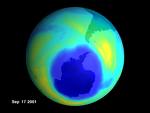
At current levels, increasing CFC emissions will add only a slight delay to the ongoing recovery of the atmospheric ozone layer. The ozone hole over Antarctica is on track to befully restored by 2066.
The EIA report draws attention to growing CFC feedstock use and emissions that have been reported elsewhere, including in annual Toxic Release Inventory reports filed by Honeywell to the EPA.
From 2014 to 2021, CFC-113 and CFC-114 releases from Honeywell’s Baton Rouge facility increased by 52 percent and 36 percent, respectively, based on emissions data the company reported to EPA. Worldwide, production of CFCs and other ozone depleting feedstocks increased by 75 percent over the past decade, according to a 2022 report by the World Meteorological Organization.
The EIA report may help explain growing and previously unaccounted for CFC concentrations detected by atmospheric scientists.
Luke Wester, a researcher at the University of Bristol in the United Kingdom and lead author of the Nature Geosciences study, said the EIA report highlights the need for increased emissions monitoring and reporting.
“If you’re going to reduce these emissions, or emissions of any greenhouse gas, you really need verification that emissions reduction is happening and that can only happen with completing an extensive monitoring,” Western said.
The report bolsters calls to tighten the feedstock loophole for CFCs and other ozone depleting substances under the Montreal Protocol.
“This is a no brainer,” said Andersen, who was the lead author ofa paper published in the Proceedings of the National Academy of Sciences in 2021 calling for reducing feedstock exemptions in the Montreal Protocol. “In a world that is in a climate crisis, this is an easy solution to get started,” he said.
Delegates from around the world are scheduled to meet in Nairobi, Kenya from October 23-27 for the annual “Meeting of the Parties” of Montreal Protocol members. “One of the agenda items of this Meeting of Parties is definitely looking at feedstocks,” Mahapatra said.
The State Department, which heads the U.S. delegation to the Montreal Protocol, declined to comment on whether or not the U.S. would support limiting existing exemptions for chemical feedstocks.
*A previous version of this story misidentified the chemical that EIA detected at the Chemours chemical plant in Corpus Christi, Texas. The chemical detected was hydrofluoro-olefin-1234yf (HFO-1234yf)
incredibly inert so won't affect product
podcast
but when does break cascade effect
==
https://theintercept.com/**2020/09**/19/wildfires-trump-election-epa-environment/
sharon lerner
as WILDFIRES DESTROY millions of acres in California, Oregon, and Washington, and an unprecedented series of hurricanes cause historic flooding in the South, leaving parts of the region uninhabitable, the Trump administration has been racing to reverse rules designed to prevent exactly these kinds of climate disasters.
Throughout his presidency, Donald Trump has presided over the rollback of more environmental rules and regulations than any other president. The result has been that, even as climate change is on track to soon force millions of Americans from their homes and eventually heat the Earth to temperatures not seen for 34 million years, the leader of the country that bears more responsibility for the climate change than any other has doubled down on the decimation of efforts meant to combat both pollution and the climate crisis.
“The Trump administration is the first in the history of the agency to devote itself so relentlessly to a rollback agenda without even a pretense of meaningfully reducing environmental pollution,” said John Walke, an attorney and senior adviser to the NRDC Action Fund.
starting with his choice of Scott Pruitt, a climate denier whose rise through Oklahoma politics was fueled by the oil and gas industry, to lead the Environmental Protection Agency, Trump has has signaled his disregard for the climate and public health throughout his time in office. While Trump has called climate change a “Chinese hoax” and a “con,” federal agencies under him have taken countless actions — from the removal of information about climate change on the EPA website to the decision to withdraw from the Paris climate agreement;the retooling of models used by the U.S. Geological Survey; and the **cancellation**of NASA’s carbon monitoring program — that set back the effort to address the climate crisis, and ultimately endanger the environment.
In recent months, the pace of these assaults has quickened. The frenzied efforts of federal agencies during the last months before a presidential election are often referred to as “midnight regulation.” But the work the Trump administration has recently been hurrying to complete would be more accurately described as “midnight deregulation.”
A sign with the words “Trump Digs Coal” can be seen on a factory building in a coal mining area in Hazleton, Penn., on Feb. 2, 2017.
Photo: Maren Hennemuth/Picture Alliance/Getty Images
Protections Obliterated
As soon as he entered office, Trump began the environmental reversals that will likely be the most enduring legacy of his administration. In March 2017, the Environmental Protection Agency signaled that it would not complete the planned ban of a neurotoxic pesticide called chlorpyrifos. The decision came after consulting closely with industry groups and after the Dow Chemical Company, which makes the pesticide, donated $1 million to the Trump inaugural committee. The Trump EPA has since completed dozens of other environmental rollbacks, including gutting the Clean Water Act; weakening restrictions on facilities that emit toxic air pollution; scrapping a rule that required mining companies to set aside money to cover the costs of cleaning up pollution; rewriting the National Environmental Policy Act so that it no longer requires government to consider the cumulative environmental impacts of major federal projects on communities; and ensuring that the coal industry is now able to dump mining waste in streams.
Among the recently finalized actions that will have devastating and long-lasting climate consequences are the rescinding of limits on methane emissions during oil and gas production and processing. Methane is a climate pollutant that traps over 80 times more heat than carbon dioxide in a 20-year period, and the U.S. is already releasing way too much of it. The rollback of methane rules, which was finalized in August — and opposed by many of the major oil companies that will be affected by it — is specifically designed to ignore climate considerations and is expected to increase the amount of the greenhouse gas released each year by 4.5 million metric tons. The additional pollution released will have the same impact as 100 coal-fired power plants each year, according to the Environmental Defense Fund, which is suing the administration over the rule.
The EPA’s weakening of fuel economy standards for cars and light trucks, which was finalized in March while most people were focused on the coronavirus pandemic, will also speed climate change and lead to more catastrophic weather events and wildfires. The change, which reduces fuel efficiency for these vehicles by 27 percent, is expected to result in at least 867 million metric tons of additional carbon dioxide pollution, the equivalent of the annual emissions from 216 coal plants.
The EPA has also reversed its policy of requiring businesses to inspect for leaks from refrigerators and air conditioners. The revision to the regulations, which was finalized in February, affects the release of hydrofluorocarbons, chemicals that can cause hundreds of times more warming than carbon dioxide and often leak from cooling equipment. According to the agency’s own science, the new rulewill result in an increase of greenhouse gas emissions that has the same warming potential as 2.9 metric tons of carbon dioxide each year.
Meanwhile, the Department of Interior finalized its plan to open up Alaska’s Arctic National Wildlife Refuge to oil drilling, a move that environmentalists expect to not only be devastating to the 700 species of plants and animals that live there but also greatly increase carbon emissions. In 2018, the Federal Energy Regulatory Commission limited its consideration of greenhouse gas emissions from natural gas projects. And, through an executive order, Trump weakened regulations that were put in place to mitigate flooding from sea-level rise.
Perhaps most devastating is the loss of the Clean Power Plan. That Obama-era plan was designed to reduce climate pollution by more than 400 million tons by 2030. Instead, Trump replaced it with the far weaker Affordable Clean Energy Rule in 2019.
Deadly Consequences
In many cases, this deregulation will have a measurable human toll. Changes to the Mercury and Air Toxics Standards, which the EPA made in April, undermined limits on mercury and other toxic air pollution coming from coal-fired power plants that were put in place in 2011. Those regulations had prevented between 4,000 and 11,000 premature deaths each year, according to the agency’s own calculations. But under Trump, the EPA has decided that it is no longer necessary to regulate this pollutant, which causes brain damage in developing fetuses and increases heart attacks in adults.
If it stands, the methane rollback, which is being challenged by environmentalists, will also result in illness and death. In addition to hastening climate change,methane turns into ozone, which causes chronic diseases, including respiratory damage, cancer, asthma, and heart disease. Fence-line communities, which are disproportionately made up of people of color, including the more than 1 million African Americans who livewithin a half-mile of an oil and gas facility, will be among the hardest hit by the pollution. And the replacement of the Clean Power Plan is expected to lead to thousands of deaths.
With less than seven weeks until the election, and the wildfires and flooding continuing to spread along with the recognition that they are part of a larger climate apocalypse, the Trump administration is still scrambling to finish the deadly destruction of some of the rules and processes that were put in place to protect human health.
Among other hugely consequential rules still hanging in the balance are the standards for particulate matter and ozone, both of which stem from power plants. Since 1977, the law has required that a Clean Air Scientific Advisory Committee, orCASAC, made up of independent scientists help set the standards. While the committee still exists, the Trump EPA has gutted it, removing many of the independent scientists from it and all of the epidemiologists, and instead stacked it with industry-friendly experts. CASAC is now headed byLouis Anthony “Tony” Cox Jr., an industry consultant who disputes well-established science showing that particulate matter kills by increasing rates of heart and lung disease. He has worked for Exxon Mobil, the American Chemistry Council, and the American Petroleum Institute.
EPA administrator Andrew Wheeler fired a panel of scientists that historically advised CASAC on particulate matter — which includes dust, dirt, soot, and smoke — and dispensed with a panel of ozone experts in what he claimed was an effort to “streamline” the standard-setting process. The result is that the EPA is now trying to finalize the current standards for both particulate matter and ozone, which independent scientists say are not protective of health. Although weather affects ozone levels, the proposed standard doesn’t consider the effects of climate change.
Maintaining the standards for the air pollutants, both of which result from power plant emissions, is a “sop to the oil and gas industry” that will prove deadly, according to Bernie Goldstein, a physician who served as chair of CASAC and a Reagan-appointed EPA assistant administrator who is now a member of the Environmental Protection Network.Already more than 100,000 people in the U.S. die because of air pollution, including particulate matter and ozone. “More people will die because the pollutant standards aren’t high enough,” said Goldstein.
Goldstein is particularly concerned about the increased vulnerability to these air pollutants during the coronavirus pandemic — something the EPA did not factor into its standard-setting process, even though it issued its proposal after the pandemic began. “The idea that something that violently attacks the heart and lungs the way Covid-19 does will interact with air pollutants that also attack the heart and lungs is a no-brainer,” he said.
Trump is working with the Agriculture Secretary Sonny Perdue to expand logging in Alaska’s Tongass National Forest, removing decades-old protections from the 10 million acres that absorb more carbon than any other national forest. And the administration is attempting, through the Department of the Interior, to fast-track the environmental reviews of oil and gas drilling projects, including the Mountain Valley natural gas pipeline and a natural gas terminal in Oregon.
Also among the unfinished business at EPA is the rollback of 2015 protections that protect farm workers and agricultural communities from pesticide exposure. If the Trump administration succeeds with its change, farm workers — who are overwhelmingly Latino and already dozens of times more likely to be poisoned by pesticides than non-farm workers — will face even greater exposure.
And the EPA is taking the last steps to finalize its “Strengthening Transparency in Regulatory Science” rule, which would limit the use of independent science in the agency’s decision-making by employing a strategy first devised by tobacco companies. The proposal was sent to the White House regulatory review office earlier this week, and Wheeler said he hopes to finalize it by the end of the year.
Meanwhile, the administration is still at work on two proposed rules affecting the Endangered Species Act: One will open up designation of critical habitat to challenges by industry, and the other will institute changes in the interpretation of the Migratory Bird Treaty Act, pushed by the oil and gas industry, that “will result in the deaths of many birds,” according to Noah Greenwald, endangered species director at the Center for Biological Diversity.
The Trump administration has already been “devastating for endangered species,” according to Greenwald. “It’s been a terrible waste of four years at a time when we don’t have four years,” he said. “While scientists around the world have been raising alarms about the extinction crisis, they’re rushing to finalize these rules.”
:{
A melted pro-Trump sign remains at a burned residence during the Bear fire, in the Berry Creek area of unincorporated Butte County, Calif., on Sept. 14, 2020.
]]}:
Reversing the Damage
The Center for Biological Diversity is just one of the environmental organizations that have been using the courts to challenge the Trump rollbacks.Overwhelmingly, these suits have succeeded. Only 12 out of 81 lawsuits related to environment, energy, and natural resources deregulation were decided in the Trump administration’s favoras of August 31, according to the Institute of Policy Integrity at New York University School of Law.
If Trump loses the election, a Democratic administration could fairly easily resolve many of the suits that are still pending. “Biden could quickly signal that he won’t defend Trump rollbacks in court,”said William Buzbee, a professor of law at Georgetown University Law Center. “Administrative law is flexible and always gives a future president the ability to reverse the damage of his predecessor.” A Biden administration could also simply reverse the Trump administration’s withdrawal from the Paris climate agreement — a move that won’t be finalized until a day after the election and will take a new president 30 days to reenter.
Depending on the date of the rollback, if Biden is elected and there is also a Democratic majority in both the House and Senate, some of the changes could be reversed through a law called the Congressional Review Act.
But other damage inflicted by the Trump administration on environmental protections will take longer to reverse. Some finalized rules will require years of formal rule-making to change. And there will be no way to revive the Clean Power Plan. “It is pretty close to dead,” Thomas McGarity, professor at the University of Texas at Austin School of Law, said of the centerpiece of the Obama administration’s climate initiative. “If the next administration wants to do something on climate change and they try to do it administratively they’re going to have to start over.”
Some of the harm that Trump has inflicted by disputing established climate science and rolling back desperately needed climate protections is irreparable. “It will be impossible make up for the four years spent ignoring and worsening the climate crisis,” said Buzbee. “The amount of additional CO2 and methane in the atmosphere will linger for decades if not centuries. That loading into the Earth’s atmosphere cannot be recovered and that time cannot be recovered.”
The climate reversals have irrevocably undercut the international effort to address the most pressing issue of our time. “Climate change is in the end a trust game,” said Buzbee. “Nations constraining their own polluters have to trust that others will step up and also do their part. But by stepping back, the U.S. has lost credibility.”
Buzbee, who judges Trump as already “the worst president for the environment in U.S history,” predicts that the environmental impact of a second Trump term would be immeasurably more destructive. “They’d have the time to finish and defend all the first-term rollbacks,” he said. “I’m not sure the EPA and the major environmental statutes could withstand the onslaught.”
While the administration is racing to complete its rollbacks, the Sunrise Movement has sent its members door-to-door to convey the stakes of the election to voters. “Our movement is talking to hundreds of thousands of young people in swing states across the country to communicate the opportunity we have to organize and mobilize under a Biden admin,” said Stephen O’Hanlon, a co-founder of the Sunrise Movement. “Biden wasn’t the first choice of many young people, but he is the clear choice.”
Activist and writer Bill McKibben has put a finer point on the environmental consequences of unseating Trump. “This is going to be the most important election for the next few million years,” McKibben tweeted on Tuesday, sending out a video of the president once again denying climate science even while being briefed on the fires that have killed dozens of people and destroyed millions of acres of land.
EPA Spokesperson James Hewittprovided the following comment in response to an inquiry from The Intercept:
This story is pushing a false narrative that isn’t rooted in fact. Under this EPA, air pollution in this country has fallen 7 percent, we’ve delisted 61 Superfund sites, invested $40 billion in water infrastructure, collected more in criminal and civil penalties than the Obama Administration did in their first term, and are finalizing a final Lead & Copper rule. All regulatory decisions are grounded in science and our legal statutes unlike the last administration.
Environmental experts took issue with all of the claims in the EPA’s response. Asked about the air pollution reductions, Elena Craft, senior director of climate and health at the Environmental Defense Fund, said she was unclear of any measure by which air pollution has fallen by 7 percent and added that “I can’t think of a single action that this administration has done that would result in a reduction of emissions.”
While the EPA has delisted many Superfund sites, it also has the largest backlog of unfunded construction projects at Superfund sites in 15 years. According to Betsy Southerland, who retired after 30 years of working for the EPA, the agency is trying to take credit for work done under previous administrations. “Delisting is just a paperwork exercise documenting that a project was completed in previous years,” she said. “This administration has the worst record of any previous in terms of the number of projects that were ready for construction that they did not fund. Rather than request the funding needed for these sites, they actually asked for cuts in the Superfund budget every year.”
Southerland also said that the agency’s touting of the lead and copper rule was disingenuous: “The proposed lead rule did not lower the concentration that would trigger lead pipe replacement. And they slowed the required rate of replacing lead pipes.”
As for the penalties, EPA’s own data shows that in fiscal 2019, the agency conducted the smallest number of inspections of polluters in at least 18 years,with about half the number of inspections conducted a decade earlier.A 2019 report from The Environmental Integrity Project documents these trends and shows that the number of criminal environmental cases opened and polluters charged fell sharply under Trump.
http://**tobaccodocuments.org**/pm/2046323544-3547.html
(Philip Morris files)
Epa Watch - Volume 1 Number 1 - White House, Congress Clash Over Indoor Air Legislation Date: 19920221/P
Length: 4 pages
2046323544-2046323547
Page 3: 2046323546
Toxic Terrorism"
Edward Returners, an MIT-trained biochemist and vice president of the American Council on Science and Health, recently told the Washington Times that basing ozone depletion fears on the NASA findings is an act of "toxic terrorism." Mr. Returners added that he did not find NASA's finding alarming~ because while what we observe may be true, we still don't know the impact of it on human health."
S. Fred Singer, director of the Washington Institute for Values in Public Policy, was no less critical, pointing out that high levels of chlorine in the atmosphere have been observed before. "They are an indication of nothing," observed Mr. Singer, who is on leave from his position at the University of Virginia's department of environmental sciences.
==
http://www.herinst.org/BusinessManagedDemocracy/environment/tanks/ozone.html
During the 1990s several think tanks began casting doubt on the evidence that a build up of chlorofluorocarbons (CFCs) were causing ozone depletion and an ozone hole over the antarctic each year.
 The Cato Institute published Eco-scam: The False Prophets of Ecological Apocalypse by Ronald Bailey. In it Bailey argues that scientists working for NASA have promoted the ozone depletion theory in order to bolster its budget. Like the critics of the global warming theory, and usually these are the same people, Bailey and others emphasise the uncertainties surrounding the theory and the natural fluctuations in ozone levels that occur over time:

the impact of man-made chlorofluorocarbons (CFCs) on the ozone layer is a complex question that turns on murky evidence, tentative conclusions, conflicting interpretations, and changing predictions....it turns out that ozone depletion, like the other environmental dooms analyzed here, is less a crisis than a nuisance....
The think tanks also exaggerated the cost of dealing with the problem. The Competitive Enterprise Institute (CEI), argued that the phasing out of CFCs would cost “$44.4 to $99.4 billion over the next decade”.
The British Institute of Economic Affairs published A Contrarian View of Environmental Problems by Matt Ridley which argued that “global temperatures may actually be falling” and “the ozone layer is getting thicker, not thinner, over temperate latitudes.” This argument was meaningless since ozone depletion is occurring close to the Earth’s poles.
A related criticism was that there had been no measured increase in UV radiation detected in cities in the US as a result of ozone depletion. These critics ignored the evidence of increases in UV radiation at ground level in Australia.

Scientists
Since about 1993 a series of publications came out suggesting that ozone depletion was a scam or a hoax or at least grossly exaggerated. Most of these were based on the claims of a handful of scientists based at corporate-funded think tanks. Perhaps the most quoted of these is Fred Singer, executive director of the think tank, the Science and Environmental Policy Project (SEPP). SEPP has argued that global warming, ozone depletion and acid rain are not real but rather are scare tactics used by environmentalists.
He is an associate editor of 21st Century Science and Technology which, according to the journal Science, is published “by supporters of Lyndon LaRouche”. Maduro wrote a book entitled The Holes in the Ozone Scare: The Scientific Evidence That the Sky Isn’t Falling with writer Ralf Schauerhammer, published by 21st Century. In it they argued that most chlorine in the stratosphere comes from natural sources such seawater and volcanoes. Atmospheric scientists, however, pointed out that the chlorine from these sources is washed out of the air by rain long before it reaches the stratosphere whereas CFCs are not soluble in water.
Media
Drawing on these few scientific ‘experts’, who prefer to publish their dissent in think tank and right wing publications rather than peer reviewed scientific journals, conservative and business magazines and radio talk back hosts, such as Rush Limbaugh, spread the idea that ozone depletion was not really a problem and that no action needs to be taken. For example Business Week quoted Fred Singer and Ronald Bailey it its article entitled What’s Flying out the Ozone Hole? Billions of dollars in which it argued that “the propaganda of the Chicken Littles has prevailed over science—and the cost of needlessly replacing cooling equipment will be staggering.” Another Business Week article a year later quoted Fred Singer as saying that the CFC phaseout was “based mainly on panicky reactions to press releases...“ The articles were written by Paul Craig Roberts, the chairman of a Washington think tank and a Distinguished Fellow of the Cato Institute.
[[Reference: Paul Craig Roberts, ‘What’s Flying out the Ozone Hole? Billions of dollars’, Business Week (13 June 1994), p. 22; Paul Craig Roberts, ‘Quietly, now, let’s rethink the ozone apocalypse’, Business Week (19 June 1995), p. 26.]]
The surge of backlash publications also reached the mainstream press. The Washington Post reported that “the problem appears to be heading toward solution before [researchers] can find any solid evidence that serious harm was or is being done.”
Delaying Regulation
isn’t the first time that the media has serviced those seeking to discredit ozone depletion theories. In the 1970s when the connection between fluorocarbons from aerosol spray cans and ozone depletion were first made:
the aerosol industry launched a PR campaign that emphasized ‘knowledge gaps’ instead of gaps in the Earth’s atmospheric shield. Industry press releases formed the basis for articles in numerous newspapers and magazines that questioned the ozone depletion ‘theory’, enabling aerosol spray manufacturers to buy additional time before their product was banned. In this case, industry profits were deemed more important than the prevention of skin cancer.
This time, think tanks and their scholars have provided the Republicans in Congress with the rhetoric to oppose a more general CFC phaseout. The Republicans have sought to retract US agreement to the terms of the Montreal Protocol, the international convention aimed at phasing out CFCs worldwide. And a bill was introduced to repeal the provisions of the Clean Air Act relating to production and use of CFCs. New Scientist reported in September 1995:
America’s Republicans thumbed their noses at the vast majority of the world’s scientists last week by claiming there is no proof that CFCs are destroying the ozone layer. Without proof, they argued, there is no good reason why the US should rush to ban the manufacture of CFCs by the end of the year.
The appropriately named Republican, John Doolittle, told the House of Representatives Science Committee that ozone depletion was debatable, based on pseudo science and that “we’re not giving Mother Nature enough credit for being able to replenish the ozone layer.” He dismissed peer-review as “mumbo jumbo.” Also writing in New Scientist, Jeff Hecht argued that:
What the Republicans are doing is playing lawyers’ games with science. They demand that theories that they consider inconvenient be proved beyond any doubt—something that is impossible in science...
The theory is so widely accepted that is originators received a Nobel prize for chemistry. Yet the Republicans don’t like this because it implies the need to regulate industrial production of the harmful chemicals that damage the ozone layer....
If they could find a few scientists who weren’t 100 per cent convinced that CFCs depleted ozone, they seemed ready to abandon the Montreal Protocol.
==
https://www.newsweek.com/ozone-hole-our-heads-194308
no lnx
Is The Ozone Hole In Our Heads?
BY SHARON BEGLEY ON10/10/93
NEWS
IT STARTED SMALL-MAGAZINES CALLING attacks on disposable diapers "vigilante environmentalism." It grew bolder-industry claiming that inhaling some forms of asbestos poses no real danger, and that dioxin isn't the poison it's made out to be. Now the backlash against environmentalism is in full swing. In the latest assault, ecorevisionists have been filling books, op-ed pages and radio airwaves with attacks on what many scientists consider one of the most menacing global threats, and the one on the strongest scientific footing: depletion of the planet's protective ozone layer by chlorofluorocarbons (CFCs). In a typical broadside, Garbage magazine concludes in this month's cover story, "The real [ozone] crisis ... is our gullibility." Rush Limbaugh says that anyone who claims that CFCs destroy ozone is a "dunderhead alarmist."
The ozone backlash centers on two main points: CFCs do not destroy the ozone layer, which blocks dangerous ultraviolet rays; and even if ozone is thinning, that poses no threat to human health. The revisionism thrives because it sounds plausible, even to some scientists. Derek Barton, a Nobel Prize-winning chemist at Texas A&M, signed a petition calling for the repeal of the international pact phasing out CFCs. "There's so much propaganda [around the ozone issue] that I just don't believe it," he says. "But I haven't looked into it scientifically." Yet enlisting a Nobelist gives the skeptics credibility.
If experts can't agree, what's a layperson to think? A guide to the issues:
CFCs, the Pac-Men of ozone, are heavier than air, says zoologist Dixy Lee Ray, former chairman of the Atomic Energy Commission and author of this year's "Environmental Overkill." So they could never waft 30 miles up to where ozone protects the planet from UV rays. It's true that CFCs are five times heavier than air. But air movements mix heavy and light molecules. Since 1975, researchers have collected thousands of stratospheric samples-all with CFCs.
Chlorine from volcanoes and seawater entering the atmosphere dwarfs any ozone-eating chlorine from CFCs, say ozone skeptics. But this natural chlorine dissolves in water; most falls out as rain long before it reaches the ozone layer. CFCs, in contrast, are insoluble; they reach the stratosphere and stay there for decades. Ray also claims that the "1976" eruption of an Alaskan volcano spewed 570 times the world's CFC production; unfortunately, the blast occurred 700,000 years ago. Another popular line of attack holds that Mount Erebus, an Antarctic volcano. causes the infamous ozone hole over the South Pole. But Erebus sputters rather than erupts, so its chlorine falls out as rain before it reaches the ozone layer. Even ozone critic S. Fred Singer, of the Science and Environmental Policy Project, concedes, "Most, though not all, of the chlorine reaching the stratosphere is from CFCs."
Even if the Antarctic ozone hole is caused by CFCs, say critics, that doesn't mean anyone other than penguins has to worry. "The ozone hole is real and genuine," says Singer, "but you cannot prove from existing data that global ozone depletion [due to CFCs] has occur-red" anywhere outside Antarctica. Moreover, the measured 4 to 5 percent ozone loss over the last decade, and the 8 to 10 percent drop in winter, is swamped by seasonal variations in ozone of up to 40 percent, argues Singer. Atmospheric chemist F. Sherwood Rowland of the University of California, Irvine, calls that argument "disingenuous: the ozone changes over the Northern Hemisphere are outside the range of natural loss."
If ozone loss is a danger, everyone agrees that it's because the thinner the ozone layer, the more cancer-causing UV rays reach the planet. Revisionists say there is no evidence that more UV-B is coming through and, even if it is, the extra exposure would hardly be off the charts. "A 10% increase in UV-B ... would also be experienced moving 60 miles toward the equator," writes Singer. but that's little comfort: the southward movement of the an population has helped skin-cancer rates.) And except for one set of suspect data, says Rowland, "we have seen increases in UV-B." Smog absorbs some UV-B, periodically hiding the effects of ozone loss, but when smog is factored in, more UV-B is reaching Earth. There is a 45 percent increase in UV over part of Argentina in the summer, for instance.
Who cares if skeptics pummel ozone science? After all, the global pact calling for the phaseout of CFCs by 1996 is unlikely to change. (Ozone loss will reach 10 percent or more around the turn of the century, estimates physicist Michael Oppenheimer of the Environmental Defense Fund. Then, thanks to the CFC ban, it will recover over the next 100 to 150 years.)Yet by calling ozone science a sham, ideologues have a better chance of derailing the next environmental treaty: to control gases that trap heat in the atmosphere. As early as this week, President Clinton might unveil his long-promised plan to scale back emissions of these greenhouse gases to 1990 levels by the year 2000 [BTU tax? got slammed?!]. If the critics are right, the globe has little to worry about. But if they win the debate and are wrong, it will be too late for repairs.
==
==
Archive [December 1997]
no pix lnx
Fasten your seatbelts — you are about to get some real science from one of the foremost experts on global climate change. In fact, Dr. Singer devised the basic instrument for measuring stratospheric ozone. He was somewhat reluctant to discuss the political aspects of the global warming debate — though I tried. Still, as a scientist, he backed me up … and confirmed things I’ve been saying for years.
Rush: Dr. Singer.
Singer: Good evening.
Rush: How are you, sir?
Singer: Fine. I’m sitting here in Bonn, Germany, looking out at the Rhine River.
Rush: Are you in Europe, sir, in order to escape the devastating climatological effects of El Niño?
Singer: [Laughs] No, no. I’m here because I was invited to make a presentation to the Austrian Parliament in Vienna. We did that a few days ago and it was quite exciting.
Rush: Did they listen to you?
Singer: They listened. The politicians didn’t agree, but the public did.
Rush: I read your November 10th article, “The Sky Isn’t Falling, and the Ocean Isn’t Rising” in The Wall Street Journal in which you really do destroy the claim that the ocean is rising due to global warming. You explain that sea levels have been rising at the rate of seven inches per century for hundreds of years due to changes in the shape of the ocean basins. Is there any way that this can be blamed on America? And is there a government regulation that can fix it?
Singer: No, and I don’t think we can stop the tides. I don’t think we can stop the earth from going around the sun. There are all sorts of things we can’t stop. Nature has its own way of doing things.
Rush: The proponents of the fear-mongering global warming theory are trying to scare Americans into believing that our advanced technological lifestyles are responsible for this. Only if we change, only if we roll back our lifestyle and live in a more primitive fashion are we going to be able to fix the problem. Yet even the proponents of this admit that their data are not conclusive. They say they need five to 20 more years to figure it all out. What’s going on?
Singer: I think it’s even worse here in Europe, because in Europe the public seems to believe a lot of this. In America — thanks to efforts like yours — the public, I think, is quite skeptical. Mr. Clinton is having a very difficult time convincing people that a calamity is about to happen. And I don’t think he’s succeeding.
Rush: What scientific evidence could you cite to back up your conclusions on the environment? Because one of the things we’re treated to every day is this mantra that “scientists agree.” For example, this document from the United Nations, this climate control paper, had 2,000 pages and 2,500 signatures. The head of our EPA is constantly saying: “2,500 scientists agree.” And yet, we have learned that the seven-page summary of that 2,000 page document doesn’t at all reflect what’s in the 2,000 pages. The 2,000 pages basically say, we don’t know” and “we can’t prove” and so forth. But the seven-page summary fed to the media declares that global warming is certain. Why this mad dash by some to believe something that isn’t happening?
Singer: These are the points I’ve been making here — and they are not my points really, they are points of a large number of us scientists who all agree on this — people like Pat Michaels of the University of Virginia, my colleague down there, and lots of people from Harvard and MIT and many other institutions. First of all, the data, the actual measurements taken with weather satellites, show conclusively that the climate is not warming. It’s been cooling. It’s been getting colder for the last 20 years.The surface data we have before then showed that the climate has been changing both up and down, in no particular pattern. It seems to be controlled mainly by the sun. This is what the majority of us are beginning to believe.
Rush: Isn’t that a bit radical, Dr. Singer — that the sun may actually have something to do with temperature on earth?
Singer: [Laughs] Well, you might think so. People think the sun is constant. But Dr. Sallie Baliunus at Harvard and others have shown conclusively that the sun is variable. And since the sun varies, the climate will vary as well.
Rush: Now I know you base your theories and your conclusions on science, but clearly politics has entered this. Why do you think the President and the Vice President are so insistent on convincing Americans that global warming is happening when it isn’t? And that we are responsible for it when we’re not?
“The actual measurements taken with satellites show conclusively that the climate is not warming. It’s been getting colder for the last 20 years.” — Dr. Fred Singer]
Singer: Well, I like to think that they’re misinformed about the science. I like to think that they’ve been listening to the wrong people. What I would really ask them to do, what we have asked them to do, is to have a scientific debate, to permit a scientific debate in which we can hash out all of our differences. We’ll bring our data. Let them bring their data. Then we’ll see how it comes out.
Rush: And have they accepted that?
Singer: Not so far. We find it very difficult to get other scientists, those who support the position of the United Nations and the Administration to debate. They won’t debate. Instead they just call us names.
Rush: At a scientific conference in October, the Vice President compared any doubts over global warming to the tobacco companies denying links between smoking and cancer.
Singer: This is typical of the names we’re being called. Secretary of the Interior Bruce Babbitt calls people who disagree with him “un-American.” He thinks we shouldn’t disagree with him.
Rush: This hasn’t deterred you.
Singer: It’s preposterous.
Rush: But this is clearly political pressure. What about your colleagues on the same side as you — are they able to withstand the political pressure? Obviously, they’re not going to get government grants for their research.Are they able to withstand the pressure and still maintain the purity of their beliefs?
Singer: It’s a tough situation. You’ll find that the younger scientists who depend very much on grants and contracts from the government for research are very careful about what they say. They may agree with us in private. In fact, they tell us that they agree with us, but they won’t sign their names to it. More mature scientists, scientists who have tenure or scientists who are retired, have no hesitation about speaking out.
Rush:So junk science and propaganda is threatening good science?
Singer: That, I think, is it in a nutshell.
Rush: A professor of physics at Purdue, now deceased, a gentleman named L.L. Van Zandt, wrote a letter in 1992 in National Review about CO2. He said that human activity releases 6 billion tons of CO2 a year. Nonhuman activity, such as oceans, trees and volcanos, etc., releases 200 billion tons of CO2 a year. How can we possibly as humanity be causing catastrophe when our contribution is so infinitesimal?
Singer: Our contribution is indeed small. But it does make a difference — because CO2 has been rising in the atmosphere.I’m willing to accept the fact that humans are making a contribution to CO2 in the atmosphere. But that’s not quite the point. The point is, does it have any effect on the climate? That we don’t see yet.
Rush: Wouldn’t we by now?
Singer: We should have. But we don’t. If CO2 really has an effect the way their theory says it does, then we should be seeing a very substantial warming. Instead, as I mentioned, the weather satellites, the best global data we have, show a cooling over the last 20 years.
Rush: So this sounds to me as if it’s inarguable. It’s not even debatable. Yet they won’t debate you. So you have some scientists who persist in perpetuating a false premise. It has to be political. What is their ultimate aim?
Singer: I suppose different people have different motives. I like to believe that scientists are basically honest. They may be misinformed. They may be believing in their own theories.They may believe in mathematical models instead of measurements. A lot of people are like that. They will reject measurements because they don’t fit in with the theoretical results that they’re working on.
Rush: Maybe so, but that is strange if the data are as conclusive as you seem to think they are. I’m by no means a scientist, but the satellite data is plenty for me, plus everything else that you and your colleagues have researched and presented. If it’s enough for me as a non-scientist to understand it, what is there possibly for these scientists to gain by looking at this data and ignoring it to pursue this agenda?
Singer: They look at other data that show different results. We explain that these other data really cannot match the satellite data, because the satellite data are the only global data that we have — the only instruments that cover the whole globe twice a day, 30,000 measurements a day; measurements with instruments that are accurate, that are not affected by urban effects or by all kinds of disturbances that occur on the ground. We do have the best data, I’m convinced of that. My scientific career is really based on satellites and remote sensing. I was in charge of the weather satellite service for the U.S. government.
Rush: You sound reluctant to discuss the motives of those who disagree with you. You’re content to suggest that you and they are in the midst of a scientific disagreement. But I tell you, I do question their motives.It seems to me if you’re going to ignore facts in pursuit of an agenda, you have to have a reason for it, or a payoff.You’ve got to have something to gain by doing it. And I’m curious to know what you think that might be.
Singer: I think theagendamany people have — and I won’t single out scientists now, but many people, politicians and the public — is they want to reduce the use of energy. They want to eliminate energy from our daily lives. Well, that’s a hopeless task. But they’ve tried to do that now for a long time. You may remember something called the Club of Rome.
Rush: Oh, yes.
Singer: They said, “We’re going to run out of oil in ten years, so we’ve got to stop using energy.” They said that in 1970. Of course, we haven’t run out of oil. We’ve got more oil now than we had in 1970, because we found so much. A few years later, there was the oil crisis. Again they said, “We’ve got to stop using oil” — this time because “the Arabs control the oil and they’re going to be rich and we’re going to be poor.” Well, Japan doesn’t have any oil and they became very rich; and we’re not doing too badly either, compared to other countries, and we import more oil than anybody else.
Rush: Right. If it weren’t for NAFTA, who knows how well we might be doing.
Singer: Now their latest excuse is global warming. To many people, global warming is just an excuse to restrict the use of energy. And they want to do that because they would like to stop economic growth.
Rush: Ah! And for what reason would they like to stop economic growth?
Singer: A number of reasons. There are some people who want to do this so they can collect taxes on energy. Energy taxes. BTU taxes. Other people want to stop economic development because they think it’s bad for nature. They think man is an enemy of nature. There are people who are extreme in this matter and believe that human beings really don’t belong on this world.
Rush: Human beings are not natural.
Singer: Right. And there’s another group of people who see it as an opportunity for a kind of world government. They think if we can control energy use throughout the world, then we’ve got to have an authority, a world authority, that assigns energy quotas, that keeps track of how much energy’s being used everywhere. We have inspectors who will come and tell us whether we’re up to our quota or exceeding our quota. They will sanction us or fine us or do other things to us. They think that’s a great idea.
Rush: Would you put the Vice President in any of these categories?
Singer: I hate to do that. I don’t know where he stands on these issues personally. All I know is that he is misinformed. And I would love to be able to tell him what the real facts are.
Rush: Well, you probably could any day of the week. The real question is whether he would listen to you. That’s the problem.
Singer: That’s right. He’s referred to us as the kind of people who believe global warming is the empirical equivalent of the Easter Bunny.Those are his words.
Rush: But when he compares you to tobacco companies denying a link between smoking and cancer, he’s now saying you’re killing people. He’s saying people like you and me and others who share your interpretation of your data are really no different than people who want to go out and willingly kill people.
Singer: Yeah, well, we’re used to that. But the funny thing is, if the climate did warm — and it does warm from time to time and it cools from time to time — whenever climate warms, it’s good for people. Agriculture benefits. We have longer growing seasons. We have fewer frosts. More carbon dioxide in the atmosphere makes plants grow faster.
Rush: Yes. Replenishes the rain forest.
Singer: We get more precipitation. Farmers get more rain. And what we’ve just discovered is that the sea level will not rise as fast — it may even go down if it warms.
Rush: As your piece in The Wall Street Journal explains.
Singer: Right. And this is based on the analysis of data. Real data.
Rush: The proponents of this fear-mongering recite this statistic: “The United States has five percent of the world’s population but we consume 20 percent of the world’s resources.” This is supposedly bad — even though the use of these resources ends up basically feeding the world.We share our technological advancement with the world; the world’s a better place because of our freedom and our use of these resources. What do they mean when they say that’s too much usage, that we’ve got to make it more equitable and fair? Aren’t they really saying that we’ve got to make the U.S. civilization and lifestyle more primitive or less advanced?
“To many people, global warming is an excuse to restrict the use of energy — because they would like to stop economic growth.” — Dr. Fred Singer]
Singer: Yes. We use a lot of energy because we produce goods. And we produce goods for the rest of the world. We export food. We export all sorts of things to the rest of the world, which provide jobs and advance our welfare. I think what we should do is to bring the rest of the world up to our level rather than go down to their level.
Rush: Right. So one might say that the problem with the world is an unequal distribution of capitalism, not too much usurpation of resources.
Singer: Capital is quite willing to go to other countries where the economic climate is favorable — where the authorities are oriented toward capitalism, not socialism.
Rush: Precisely. Well, we’ve got the big climate control conference coming up in December in Kyoto, Japan.
Singer: Yes, and I’ll be there.
Rush: What do you expect to happen there, Dr. Singer?
Singer: Not much.
Rush: That would be good, wouldn’t it?
Singer: [Laughs] Yes. Look, I don’t see countries getting together on a single goal. The Europeans have really gone overboard. When we spoke to the Parliament in Austria last week, we told them they’re committing economic suicide. We can’t stop them if they want to do that, but we certainly don’t want to join them. And I think they’re looking to us to join them. In fact they would like for us to lead the parade. They want us to commit economic suicide first.
Rush: Probably so that they won’t have to, is the bottom line. Well, I know you’re shying away from any political interpretation here, but I’m going to try to ask you this question anyway. The Vice President has his entire political future wrapped up in this issue. As I look at winners and losers in the global warming debate, I see the biggest loser as Vice President Gore. If somehow this theory is debunked, and if the Kyoto conference doesn’t go the way he wants it to, his entire foundation for the future of his political career has been undermined. And that’s why I worry that something other than nothing will occur in Kyoto.
Singer: If something does happen in Kyoto, if we do go the way of restricting energy use in the United States by rationing or by taxes, then working people will really suffer. The labor unions are very strongly against Kyoto, and as you know, Al Gore’s support depends to a large extent on labor unions. So he’s in a very tough position. It will be interesting to see what he does.
Rush: I’m glad you have the optimism about Kyoto that you do. Since there’s so much false data that is being treated as true and being acted upon as though it’s true, people are a little bit pessimistic. Let me ask you — if cooling may be going on, how would it manifest itself? How would cooling affect our climate, globe and economy?
Singer: If it should cool — and you know the climate does change all the time — that would be not very good for us. Particularly it would be bad for developing countries, because they don’t have the resources we have to defend ourselves against a worsening climate. Generally, a cooler climate is considered bad. It requires more heat. It requires more energy. It is also bad for agriculture. If we look back into history, we see that all the tough periods in human history occurred when the climate was cold.
Rush: Now if indeed the scientists who disagree with you were right, that we are experiencing a tremendous warming caused by human activity and output of CO2, is there anything that we could do to stop it?
Singer: I don’t think we can and I don’t think we should. I think the best thing to do is to adjust to any climate change, as we have adjusted to climate changes in the past. After all, we adjust to climate change throughout the year, from winter to summer. We adjust to climate change when we move to the south. In past history, people have moved from the frozen north in Scandinavia all the way into Italy and Spain. They’ve done pretty well. Adjustment is the key; and adjustment is easy if we have a good economy. So we need to protect our economy, we need to make sure that people have enough resources, help poor people get resources so they can adjust, if climate should change either way, either cold or hot.
Rush: When gigantic ozone holes have supposedly been discovered at the South Pole, human activity and primarily human activity in the United States has been blamed. My question to you is this: If it became the policy of the United States government, for whatever reason, to destroy 100 percent of the ozone layer in the stratosphere, could we do it?
Singer: No. No, the ozone layer in the stratosphere is constantly being replenished by the sun. You can make it thinner for a short time with a lot of effort, but you cannot destroy it.
Rush: Does it stand to reason then that if we tried to destroy it and couldn’t — could we then destroy it when we’re not trying to?
Singer: The ozone varies up and down all the time, from day to day. Tremendous variations. It’s hard to say whether, in fact, there is a general tendency in global ozone. Certainly there is a thinning, which we call the hole, in the Antarctic. But that’s a temporary phenomenon. It occurs every October and then the ozone comes back again. So ozone always recovers because the sun, solar radiation, always makes more. [See The Way Things Ought to Be excerpt above.]
Rush: Thank you, Dr. Singer, for your time. I’ve enjoyed talking to you very much.
Singer: I enjoyed talking to you.
Dr. Singer, professor emeritus of environmental sciences at the University of Virginia and president of The Science & Environmental Policy Project in Fairfax, VA, is author of Hot Talk, Cold Science: Global Warming’s Unfinished Debate (Independent Institute, 1997)
==
==
OzoneGate
by Eric Posner on December 7, 2009 in Climate Change, Uncategorized
In 1974, a pair of scientists published a paper claiming that chlorofluorocarbons, a compound used in refrigerators, air conditioners, aerosol spray cans, and other devices, migrated into the atmosphere, where they damaged the ozone layer. The ozone layer protects human beings from some of the harmful effects of the sun; the predictable consequence of its loss would be millions of skin cancer cases. The scientists’ work was hotly contested; it eventually gained support in the scientific community, but there were also dissenters. EPA would later regulate the use of CFCs in aerosols, but it was clear that unilateral regulation by the U.S. government would not solve the problem. CFCs manufactured and used in any country could damage the ozone layer.
The American government turned to the Europeans, the other major manufacturers and users of CFCs. Europeans, however, did not trust the science and expressed skepticism about the CFC theory. After further scientific research established that an ozone hole had opened up above Antarctica, and that the likely cause was the emission of CFCs, the Americans dragged the still skeptical Europeans into a treaty regime that tightly regulated the use of CFCs and other ozone-depleting gases. The Montreal Protocolis the most successful environmental treaty ever (the only successful environmental treaty?). The hole has been gradually shrinking and is expected to disappear later this century.
The odd part of this story is that, while not everyone agreed with the scientists who found the link between CFCs and ozone depletion, and that indeed, like everything else, the link was uncertain, albeit likely, governments were able to agree on a treaty regime. The leading supporters of a treaty werethose tree-huggers in the Reagan administration, who were persuaded by a cost-benefit analysisthat the benefits from a ban on CFC greatly exceeded the costs—with the benefits properly discounted given residual scientific uncertainty. There were ozone skeptics, but no Ozone Skeptics. There was a reasonable scientific theory but no models that got everything right all the time. There was an observable hole (if you believed the scientists who measured it) but the physical processes that linked it to refrigerators and aerosol cans could obviously not be demonstrated to the public.
Where were the Climate Skeptics back then? Or was ozonegate, like asteroidgate, a non-event because the climate is a “complex system” whereas, um…. Why didn’t “hierarchical and individualist” citizens find the Montreal Protocol “threatening to their identities”? (Cf. Dave Hoffmanon asteroidgate.) Were scientists more honest in those days? Commentators more sober? The public more credulous?
http://volokh.com/2009/12/07/ozonegate-and-climategate/
OzoneGate and ClimateGate
by Jonathan H. Adler on December 7, 2009 9:06 am in Climate Change, Environment
In his post below, Eric Posner asks why ozone depletion and the phaseout of CFCs and other ozone-depleting substances did not produce the same degree of backlash as does global warming.
Where were the Climate Skeptics back then? Or was ozonegate, like asteroidgate, a non-event because the climate is a “complex system” whereas, um…. Why didn’t “hierarchical and individualist” citizens find the Montreal Protocol “threatening to their identities”? (Cf. Dave Hoffmanon asteroidgate.) Were scientists more honest in those days? Commentators more sober? The public more credulous?
I would challenge some of Eric’s assumptions. There were climate skeptics back then(indeed, some of the ozone skeptics back then are climate skeptics now) and “hierarchical and individualist” citizens (as represented by right-of-center authors, commentators, and think tanks) challenged the scientific claims. Accepting his implicit assumption that the scientific case for a link between CFCs and ozone depletion at the time was no greater than for apocalyptic climate change today, there was still much less at stake, so the scientific debate had less salience, and there was less political controversy. I’ll briefly expand on each point.
First, there was significant skepticism about initial ozone depletion claims, skepticism that was echoed and amplified by those who opposed government regulation. Questions about ozone depletion were raised in Dixy Lee Ray’s best-selling *Trashing the Planet* and echoed by Rush Limbaugh. In 1989, National Reviewpublished the article “My Adventures in the Ozone Layer” by Dr. Fred Singer, a prominent skeptic of both ozone depletion concerns and climate change. Early on, such skepticism was warranted, but as scientific evidence accumulated, many of those inclined toward skepticism accepted the basic claim that CFCs could and did cause ozone depletion. Ronald Bailey’s 1993 *Eco-Scam*, for instance, accepted the basic scientific claims and acknowledged that ozone depletion could have been a significant concern. Still, even today there are pockets of skepticism related to ozone depletion, particularly about the contribution of certain chemicals, such as methyl bromide.
[see limbaugh singer interv 2/1997 same o3 BS]
Second, policies to control ozone depletion are not nearly as far-reaching or intrusive as policies to limit the emission of greenhouse gases. CFCs and other ozone-depleting substances were always specialized chemicals. They were in widespread use as coolants, but they still don’t compare to carbon dioxide, the most ubiquitous by-product of modern industrial civilization. Buying new refrigerators and retrofitting car air-conditioners may be expensive or inconvenient, but it hardly compares to the sorts of measures contemplated to reduce greenhouse gas emissions. So it’s not surprising that there was less outrage or resistance to the scientific claims. This also highlights an important difference between climate change and [Eric’s asteroid example: the anti-asteroid rockets would presumably be financed by general tax revenues and provided as a public good, whereas climate policies will impose disproportionate costs and controls on specific sectors of the economy.]
Third, there’s an important wrinkle in the history of U.S. policy on ozone depletion that Eric omits. Initially, the U.S. government was adamantly opposed to controlling CFCs, beyond the initial 1978 ban on their use in aerosol cans. In the 1980s, however, the U.S. government did not support a CFC phase-out until industry was on board. And industry was not on board until the leading CFC manufacturer, DuPont, faced significant competition for its patented CFC compounds and and was well-positioned to dominate the replacement market. When DuPont joined the call for a complete phaseout in 1988, the CFC trade industry still voiced some skepticism about the science, but DuPont was ready to sell more expensive CFC substitutes — compounds for which there would have been no real market without the phaseout. For those interested, I summarized this history near the end of my 1996 article, [*Rent-Seeking Behind the Green Curtain*.]
In retrospect, the CFC phaseout was a good idea, but even assuming that the level of scientific certainty was no greater when the CFC phaseout was adopted than there is with climate change today, there are many important differences between the two policy debates. First,there was less reason for skepticism to blossom into sustained political opposition because there was less at stake — the phaseout’s costs were concentrated on a few industries, not spread economy wide, and a CFC phaseout did not threaten regulatory controls on ordinary Americans. Second, the potential economic benefits to dominant industry players meant powerful economic interests supported the phaseout, interests that far outweighed those sectors likely to experience significant costs (and, in these sectors as well, groups rapidly emerged to capture the rents a phaseout could produce). So there were powerful “bootleggers” to support the environmental “baptists.” Third, the most significant effects of a phaseout were likely to be felt overseas, in those nations in which a CFC phaseout would diminish the availability of affordable refrigeration technologies, and those nations could be easily bought off. I also think the nature of the CFC threat — a potential increased risk of skin cancer — generates more political traction than a change in temperature.
Another important difference between ozone depletion and climate change, is that there was reason to believe that a near-total phaseout of CFCs was the only meaningful way to address the threat of ozone depletion, whereas there may be ways to address climate change concerns that don’t involve empowering a massive regulatory bureaucracy. While most climate policy proponents advocate far-reaching regulatory programs, covering everything from industrial emissions and transportation to product design and land-use, there are alternative ways of reducing greenhouse gas emissions, atmospheric concentrations, or the threat of enhanced greenhouse warming (if not all three), ranging from revenue-neutral carbon taxes to technological fixes, to various forms of geoengineering. Because there is a disproportionate emphasis on regulatory controls, some opponents of clmate policies suspect some climate policy advocates are as interested in imposing such controls as they are in saving the planet — as then-Senator Tim Wirth said some 20 years ago, global warming was an excuse to “do the right thing” even if the problem wasn’t real.
To reiterate my own views, I believe that human activity contributes to global warming, and that it is a serious concern (even if I don’t accept claims that global warming threatens human civilization). ClimateGate is a real scientific scandal that may justify increased caution about some of the more definitive or apocalyptic statements about climate science, but I do not see it compromising the essential case for a human contribution to climate change. My policy preference is for measures that do the most to address the actual threats posed by warming while minimizing consequent restrictions on liberty or the imposition of costs on those who have not contributed signficantly to the problem. I think massive regulatory programs are ill-adivsed, and that proposed cap-and-trade programs will provide massive opportunities for rent-seeking while doing little to reduce actual emissions or enhance our capacity to deal with the problem. On the other hand, I would welcome a revenue-neutral carbon tax, combined with other policies to enhance technological innovation, and believe that industrialized nations should help more vulnerable nations adapt to the inevitable, and at this point unavoidable, near to medium term effects of projected warming. I’ve also argued (in this article) that principled adherence to libertarian principles justifies greater action on climate change.
420 icn
US. Appeals Court in D.C. Restores Limitations on Super-Polluting HFCs
BY PHIL MCKENNA
==
icn 320 omg
Long Phased-Out Refrigeration and Insulation Chemicals Still Widely in Use and Warming the Climate
New study concludes that “banked” CFCs have greenhouse gas impacts equal to all registered U.S. cars and slow the shrinking of the ozone hole.
starting decades ago, international governments phased out a class of chemical refrigerants that harmed the ozone layer and fueled global warming. Now, a new study indicates that the remaining volume of these chemicals, and the emissions they continue to release into the atmosphere, is far larger than previously thought.
The findings point to a lost opportunity to cut greenhouse gas emissions on a par with the annual emissions from all passenger vehicles in the United States, but also highlight a low-cost pathway to curb future warming, researchers say.
The study, published Tuesday in Nature Communications, looks at "banked" volumes of three leading chlorofluorocarbon (CFC) chemicals whose production is banned but remain in use today in older refrigeration and cooling systems and in foam insulation. CFCs were phased out of production in developed countries by 1996, and in developing countries by 2010, under the Montreal Protocol because of the leading role they played in creating the so-called "ozone hole" in the atmosphere.
Emissions from these remaining CFC sources were equivalent to 25 billion metric tons of carbon dioxide from 2000 to 2020, the study concludes. Averaged over 20 years, that equals the emissions of 270 million automobiles per year according to theEPA's greenhouse gas equivalency calculator, more thanall registered U.S. passenger vehicles.
"If we don't deal with these banks, they are going to be emitted and contribute to delaying ozone hole recovery and contribute to future warming," Megan Jeramaz Lickley, a researcher at Massachusetts Institute of Technology's Department of Earth, Atmospheric, and Planetary Sciences and lead author of the study said.
Potent Emissions, Easy to Cut
The Montreal Protocol is widely viewed as the world's most successfulinternational environmental agreement for the significant reductions it has achieved in chemicals that deplete atmospheric ozone and warm the planet. The size of the ozone holepeaked in 2006 and is slowly shrinking, though scientists warn that the recent resumption in production of banned CFC-11 could prolong the recovery.
Lickley and colleagues calculate that continued emissions from stored CFC banks will equal 9 billion metric tons of carbon dioxide from 2020 to 2100. That exceeds the greenhouse gas reduction the European Union pledged to make from 2019 to 2030 under the Paris Climate agreement, the study notes.
The chemicals analyzed in the current study—CFC-11, CFC-12 and CFC-113—are short-lived climate pollutants, highly potent greenhouse gases that don't remain in the atmosphere for very long. The three CFCs are approximately 5,000 to 10,000 times more effective at trapping heat in the atmosphere than carbon dioxide and remain in the atmosphere forroughly 55 to 110 years. In contrast, carbon dioxide can remain in the atmosphere for centuries. Reining in even a small amount of CFC emissions can therefore have a big impact in addressing climate change over the scale of a human lifetime.
Reducing banked CFC emissions would also be relatively easy and inexpensive compared to efforts to reduce emissions from other sectors, Lickley said....
==
https://insideclimatenews.org/news/21012020/china-india-hydrofluorocarbon-hfc-23-greenhouse-gas
==
==
130 intercept
https://theintercept.com/2020/01/18/ozone-layer-epa-united-states-pollution/
OZONE LAYER RECOVERY IS BEING UNDERMINED BY POLLUTION FROM U.S. COMPANIES
Sharon Lerner
The EPA has declined to consider the ozone-depleting potential of chemicals released by U.S. companies.
also brought back acid rain?!
==
619
Scientists are zeroing in on the source of a powerful climate pollutant that was banned years ago but has mysteriously been increasing, with potentially damaging consequences for climate change.
Months of tracking the pollutant's rise in the atmosphere had pointed investigators to Asia and then to eastern China. They announced on Wednesday that they had found at least 40 to 60 percent of the global increase in trichlorofluoromethane (CFC-11), a chlorofluorocarbon, was originating in and around the Chinese provinces of Shandong and Hebei.
The emissions appear to be from new production of the chemical—in violation of the 1987 Montreal Protocol, a treaty under which countries had agreed to phase out ozone-damaging pollutants, including CFCs—the scientists write in a new study published in the journal Nature.
After decades of thinning, Earth's ozone layer is slowing recovering, the United Nations (UN) said in a report released Monday, highlighting how international cooperation can help tackle major environmental issues.
==
After decades of thinning, Earth's ozone layer is slowing recovering, the United Nations (UN) said in a report released Monday, highlighting how international cooperation can help tackle major environmental issues.
The ozone layer, which protects humans and other species from the sun's highly hazardous ultraviolet radiation, has been declining since the 1970s due to the effect of chemicals such as chlorofluorocarbons (CFCs) and similar gases found in refrigerants and aerosol spray cans.
But the new study — Scientific Assessment of Ozone Depletion: 2018— shows that ozone in parts of the stratosphere has recovered at a rate of 1-3 percent since 2000 due to the success of the 1987 Montreal Protocol, the landmark multilateral environmental agreement that phased out ozone-depleting substances.
“It's really good news,” report co-chairman Paul Newman, chief Earth scientist at NASA's Goddard Space Flight Center, told the Associated Press. “If ozone-depleting substances had continued to increase, we would have seen huge effects. We stopped that.”
That said, the ozone layer still has a long road to complete recovery. If progress continues, the Northern Hemisphere and mid-latitude ozone should be healed by the 2030s, followed by the Southern Hemisphere in the 2050s and polar regions by 2060, according to the study.
“I don't think we can do a victory lap until 2060,” Newman added to the AP. “That will be for our grandchildren to do.”
Notably, scientists have recently detected a mysterious rise of CFCs out of eastern Asia.
Newman also pointed out to the AP that the refrigerants that are currently being used also need to be replaced themselves with chemicals that do not worsen global warming.
Next year, the Montreal Protocol is set to be strengthened with the ratification of the Kigali Amendment, which slashes climate-warming gases in refrigerators, air conditioners and related products.
Still, the new report is “an inspiration for more ambitious climate action to halt a catastrophic rise in world temperatures,” the UN said in a press release of the new report, adding the findings “provide a ray of hope” less than a month after the Intergovernmental Panel on Climate Change released its dire report urging drastic action to stave off catastrophic climate change.
The writers of the new report said that with the full implementation of the Kigali Amendment, the world can avoid up to 0.4 percent of global warming this century, meaning that it will play a major role in keeping the global temperature rise below 2°C.
“The Montreal Protocol is one of the most successful multilateral agreements in history for a reason,” Erik Solheim, head of UN Environment stated in the press release. “The careful mix of authoritative science and collaborative action that has defined the Protocol for more than 30 years and was set to heal our ozone layer is precisely why the Kigali Amendment holds such promise for climate action in future.”
==
omfg
Trump Admin ‘Waging a War on Children’ Through EPA Rollbacks
The White House removed references to climate change and its impacts on children from a U.S. Environmental Protection Agency (EPA) proposal rolling back Obama-era regulations on hydrofluorocarbons (HFCs), E&E reported Wednesday.
An earlier draft of the proposal from the EPA showed language that described how "children, the elderly and the poor ... are most vulnerable to climate-related health effects" and detailed specific impacts of climate change on children that wasdeleted during a White House Office of Information and Regulatory Affairs review.
"Every day we see more evidence that this administration is actively working against the health and safety of the most vulnerable Americans — our children," Ken Cook, president of the Environmental Working Group, said Wednesday in a statement. "Tragically, it's not an exaggeration to say that the Trump administration is waging a war on children."
The original proposal to roll back limits on household appliance use of HFCs, which are thousands of times more potent than carbon dioxide when released into the atmosphere, was introduced last month. The deleted language follows the agency's decision to put the director of its childrens' health office on a mysterious "administrative leave" that many speculate is an attempt to sideline the office's work entirely.
For a deeper dive:
E&E, The Hill, Pacific Standard, ThinkProgress
RELATED ARTICLES AROUND THE WEB
- EPA Shakeup Risks Sidelining Science, Environmentalists Say ›
- EPA Wants Coal Plants to Emit More Toxic Mercury ›
==
Children's health language deleted from climate rule
Maxine Joselow, E&E News reporter
Published: Tuesday, October 2, 2018
The White House scrubbed language about how climate change affects children's health from a draft EPA proposal on heat-trapping chemicals, new documents show.
==
https://insideclimatenews.org/news/23092018/antarctica-warming-southern-ocean-human-greenhouse-gas-ozone-ice-loss-study
Southern Ocean around Antarctica is warming at an alarming rate—twice that of the rest of the world's oceans. Now, researchers have developed more powerful evidence pointing to the human causes.
Though warming had been observed in the past, there was little historical data to allow scientists to pinpoint the causes with much certainty.
In a new study, researchers used climate models, the past observations that did exist and data flowing in from new ocean-going sensors to show howgreenhouse gas emissions and the depletion of ozone in the atmosphere have led to both a warming of the Southern Ocean and an increase in its freshwater content. The findings also rule out natural variability as a major source of those changes.
"The observed warming is due to human influence," said oceanographer Neil Swart, a research scientist with Environment and Climate Change Canada who led the study, published Monday in the journal Nature Geoscience. "That may have been suspected or proposed before, but this is the evidence that really proves it."
Ocean-Going Floats and Climate Models
The Southern Ocean is notoriously inhospitable, clogged with ice and home to rough seas and weather. As a result, there weren't many measurements in the past.
In 2004, a partnership of 30 countries across the world launched the Argo program to improve what's known about the world's oceans, and now there are close to 4,000 programmable floats collecting data in the oceans worldwide. That is helping improve what's known, but the lack of complete data going back decades has, in the past, left researchers wondering if their conclusions were robust....
https://insideclimatenews.org/news/27062018/hfcs-global-warming-climate-pollution-lawsuit-trump-epa-regulations-kigali-amendment
Eleven states and the District of Columbia sued the Trump administration on Wednesday, demanding enforcement of regulations on super-polluting greenhouse gases in air conditioners and refrigerators.
A similar lawsuit was filed by environmentalists on Tuesday. Both challenge an attempt by Environmental Protection Agency Administrator Scott Pruitt to roll back federal regulations on the class of chemicals known as hydrofluorocarbons, or HFCs.
The HFC lawsuits are the latest in a string of legal challenges to the Trump administration's far-reaching agenda of rolling back environmental regulations, especially those relating to climate change. Instead of launching a new formal rulemaking procedure to rescind or replace the HFCs rule, Pruitt announced in Aprilthat the agency would no longer enforce the Obama-era rule, which a federal court had partially struck down in a case brought by two foreign HFCs manufacturers.
The court had struck down only part of the HFCs rule, leaving some elements in place, yet Pruitt's move essentially eliminated the rule entirely. By using "guidance" to do that rather than going through the formal rulemaking process, Pruitt violated administrative law, the NRDC's Lissa Lynch wrote in a blog post explaining her group's lawsuit over the move.
"Throwing out these commonsense restrictions on this potent pollutant is contrary to the law and science, and it is disruptive to the manufacturers that have invested in alternatives," Massachusetts Attorney General Maura Healey said in announcing the states' lawsuit. "We are suing to protect the health of our residents and the planet."
An EPA spokesperson, asked about the lawsuits, said the agency does not comment on pending litigation.
Thousands of Times More Potent Than CO2
HFCs have become the world's fastest growing greenhouse gases as use of refrigeration and cooling spreads in a warming and more populous world. In the short term, they are thousands of times more potent as global warming gases than carbon dioxide, and while they don't last as long in the atmosphere, the short-lived climate pollutants have a rapid global impact.
The Obama administration finalized a rule in 2015 to phase out the chemicals. By then, U.S. manufacturers were already producing less damaging alternatives, and many companies supported the phase-down.
An analysis by Lawrence Berkeley National Laboratory estimated the rule would have provided about 4 percent of the cuts in greenhouse gas emissions the U.S. needed to meet its obligations under the Paris climate agreement.
What About the Kigali Amendment?
Another move to phase out HFCs has been developing at theinternational level, and the Trump administration at one point indicated it supported it.
In 2016, nations agreed to an update to the Montreal Protocol called the Kigali Amendment that requires all countries to slash production and consumption of HFCs by at least 80 percent over the next 30 years. It has the backing of a wide array of U.S. businesses, many of which manufacture safer alternatives to HFCs. But the Trump administration has yet to send it to the Senate for ratification.
Thirteen Republican senators, led by John Kennedy of Louisiana and Susan Collins of Maine, have urged the White House to move forward with the treaty, saying the amendment would help domestic companies by leveling the playing field worldwide and giving them long-term certainty on what chemicals to use going forward.
In the meantime, Pruitt's deregulatory moves, if they survive court challenges, would undercut U.S. progress toward meeting the Kigali goals.
Connections to an Ethics Scandal
HFCs have come up in the ethics allegations swirling around Pruitt, as well, the Washington Post reportedthis week. Emails obtained by the Sierra Club under the Freedom of Information Act show that J. Steven Hart, a lobbyist whose wife rented Pruitt a condo on Capitol Hill last year, had contacted Pruitt's chief of staff in 2017 seeking to discuss the HFCs rule and issues it might cause for companies. The agency has maintained that Hart did not lobby the agency on environmental issues. The matter is under investigation by both the EPA's inspector general and the House oversight committee.
The attorneys general who sued over HFCs represent New York, California, Delaware, Illinois, Minnesota, New Jersey, Oregon, Vermont, Washington and the District of Columbia, and they were joined by the Pennsylvania Department of Environmental Protection. Earlier this year, California regulators adopted their own state prohibition on HFCs in new air-conditioning and refrigeration.
"The Trump EPA is seeking to gut critical climate protection rules through the backdoor—once again endangering New Yorkers while thumbing their nose at the law," New York Attorney General Barbara Underwood said.
PUBLISHED UNDER:
SHORT-LIVED CLIMATE POLLUTANTS
==
==
https://www.ecowatch.com/ozone-recovery-2522813339.html
Hailed as an example of how concerted global action can help solve a planetary crisis, a new study conducted by NASA scientists documented the first direct evidence that an international effort to ban chlorofluorocarbons (CFCs) has led to the recovery of the Antarctic ozone hole.
Published in the journal Geophysical Research Letters on Thursday, the study uses satellite observations to demonstrate that the decline in atmospheric chlorine that resulted from the implementation of the Montreal Protocol, enacted in 1989, has led to "about 20 percent less ozone depletion during the Antarctic winter than there was in 2005—the first year that measurements of chlorine and ozone during the Antarctic winter were made by NASA's Aura satellite."
"We see very clearly that chlorine from CFCs is going down in the ozone hole, and that less ozone depletion is occurring because of it," Susan Strahan, an atmospheric scientist from NASA's Goddard Space Flight Center and one of the study's lead authors, said in a statement.
In a video (above) published on NASA's website on Thursday, Strahan explained the significance of the study and why the Montreal Protocol should be celebrated as a great success.
While CFCs and other ozone-depleting substances were phased out by the mid-1990s, the study notes that the Antarctic ozone hole—which was first discovered in 1985—"is healing slowly" because the man-made substances that caused the hole in the first place "have long lifetimes."
Given that fact, researchers believe that it could be several decades before the ozone hole is eliminated altogether.
"CFCs have lifetimes from 50 to 100 years, so they linger in the atmosphere for a very long time," noted Anne Douglass, an atmospheric scientist at Goddard's Space Flight Center and one of the study's co-authors. "As far as the ozone hole being gone, we're looking at 2060 or 2080. And even then there might still be a small hole."
Responding to the study's results on Twitter, Greenpeace called for the success of Montreal Protocol to be used as a model for tackling the climate crisis.
...
==
Saved From the Ozone Hole
Is environmental science any different?
Consider the men and women who laid the scientific foundations for the Montreal Protocol to the Vienna Convention for the Protection of the Ozone Layer. Established in 1985, that Convention protects us from the potentially devastating effects of ozone depletion. Today, the ozone hole is on the mend and scientists expect a full recovery in the coming decades — something that would not have happened without the work of the environmental scientists who first recognized threats to stratospheric ozone in the early 1970s.
Scientists working at NASA and the University of California realized then that chemicals released into the atmosphere from supersonic transport planes and the space shuttle could react with ozone in the stratosphere and destroy it. Because of this threat, NASA began to fund studies of the chemical reactions involved. Meanwhile, Sherwood Rowland and Mario Molina at the University of California, Irvine, recognized that a certain class of chemicals known as chlorinated fluorocarbons, or CFCs, found in hairspray and other consumer products, had the potential to destroy ozone on a global scale. At first, their predictions were viewed skeptically even by their colleagues: Could hairspray really end life on Earth as we knew it? That seemed an adventurous, if not outrageous, claim.
In 1985, however, Joseph Farmer of the British Antarctic Survey announced the discovery of an area over Antarctica in which stratospheric ozone was dramatically diminished: the “ozone hole.” The following year, a team led by National Oceanic and Atmospheric Administration (NOAA) scientist Susan Solomon suggested that ozone was indeed being depleted by chlorine chemicals derived from CFCs in catalytic reactions on polar stratospheric clouds.
In 1987, Harvard Professor James Anderson sent an experiment aloft in a NASA U-2 plane over the Antarctic, establishing by direct measurement that the ozone layer had been massively depleted there and that those depletions correlated with CFCs. This was a striking confirmation of the earlier hypotheses. Later, his team obtained similar measurements over the Arctic. All this research was NASA-funded.
On the basis of this work, Republican President George H.W. Bush, Secretary of State George Schultz, and Assistant Secretary of State John Negroponte gave their support to the Montreal Protocol to the Vienna Convention and so committed the world to reducing, and later to phasing out, the use of CFCs. In 1988, with the president’s support, Congress ratified the Montreal Protocol.
Susan Solomon has since been elected to the U.S. National Academy of Sciences, the European Academy of Sciences, and the French Academy of Sciences. In 2008, she was named by Time magazine as one of the 100 most influential people in the world. James Anderson has won more prizes than you can count. In 1995, Rowland and Molina shared the Nobel Prize in chemistry for their work on ozone depletion.
If ozone science had been distorted, corrupted, or otherwise incorrectly done, none of them would have received such honors. More important, if the science had been wrong, we would be in dire straits right now because the ozone hole would not be recovering. Among other things, skin cancer rates in America would be about 60% higher than they are today. Livestock, crops, and wild plants and animals would have been affected, too.
Bush, a Republican president, was not duped. He did the right thing and protected us from harm, but few people realize just how well the Montreal Protocol has worked and at what little cost. It was ratified by 197 nations -—in other words, the whole world! — and production and consumption of ozone-depleting chemicals has fallen 98%.
Not only did this cost very little as manufacturers quickly replaced ozone-depleting chemicals with new, less harmful products, but the world profited. The Protocol stimulated competition in technological innovation that reduced manufacturing costs, improved efficiency and safety, and lowered prices for consumers, while we avoided significant economic losses in agricultural and fishery yields and adverse human health impacts. The indirect health profits in terms of avoided cases of cancers and cataracts alone have been estimated at 11 times the direct costs of implementation. And there was no net loss of jobs, although there was a shift to more skilled jobs carried out by better-trained workers under safer conditions.
As the risk of disruptive climate change became widely recognized in the 1990s, the ozone success story offered a model for how we might tackle climate change, especially as it refuted the familiar conservative claims that environmental protection restrains growth, hurts the economy, and leads to job loss, or that benefits accrue to polar bears but not people. But the Republican shift to the right was already underway. When it came to the subject of regulation, the GOP was on the road to rejecting any science that pointed in that direction.
In the early part of the twentieth century, Republicans had been pioneers in environmental protection; in its middle years, they had worked with Democrats to pass bills like the National Environmental Policy Act and the Clean Air Act. By the 1980s, however, resistance to environmental measures that might limit private sector prerogatives was starting to overshadow their historic commitment to a safe and beautiful America. By the 1990s, regulation was seen as bad in principle, even when, as in the ozone case, it was clearly and demonstrably good in practice.
Climate Science and the Hoaxers
The ink on the Montreal Protocol was scarcely dry when ozone science was attacked as corrupt and politically motivated (in much the same way that environmental science is being attacked today). In 1995, Republican Congressman Dana Rohrabacher organized a hearing on “scientific integrity” meant to challenge such science.Representatives of private industry and conservative think tanks began to claim that the science behind the Montreal Protocol was incorrect, that fixing the problem would be devastating to the economy, and that the scientists involved were exaggerating the threat to get more money for their research. Entered into the Congressional Record was the now-familiar claim that there was “no scientific consensus” on ozone depletion, shown to be completely false by the Nobel Prize awarded to Rowland and Molina only a few weeks later.
Stance on Climate Change
". . . I am one of the strong supporters of the proposition that the available records indicate climate warming over the past century or so. It's just that I don't believe the observed warming is due to an increase in greenhouse gases." [2]
| Reassessing the Montreal Protocol | Reassessing the Montreal Protocol | Reassessing the Montreal Protocol | Reassessing the Montreal Protocol | Reassessing the Montreal Protocol | Reassessing the Montreal Protocol | Reassessing the Montreal Protocol | Reassessing the Montreal Protocol | Reassessing the Montreal Protocol | Reassessing the Montreal Protocol | Reassessing the Montreal Protocol | Reassessing the Montreal Protocol | Reassessing the Montreal Protocol | Reassessing the Montreal Protocol | Reassessing the Montreal Protocol | Reassessing the Montreal Protocol | Reassessing the Montreal Protocol | Reassessing the Montreal Protocol | Reassessing the Montreal Protocol |
|---|---|---|---|---|---|---|---|---|---|---|---|---|---|---|---|---|---|---|
 | | | | | | | | | | | | | | | | | | |
| Health and biological effects of increased UV exposure may be overestimated | | |||||||||||||||||
| Friday, November 01, 1996 | Friday, November 01, 1996 | Friday, November 01, 1996 | Friday, November 01, 1996 | Friday, November 01, 1996 | Friday, November 01, 1996 | Friday, November 01, 1996 | Friday, November 01, 1996 | Friday, November 01, 1996 | Friday, November 01, 1996 | Friday, November 01, 1996 | Friday, November 01, 1996 | Friday, November 01, 1996 | Friday, November 01, 1996 | Friday, November 01, 1996 | Friday, November 01, 1996 | Friday, November 01, 1996 | Friday, November 01, 1996 | Friday, November 01, 1996 |
| by Hugh W. Ellsaesser | by Hugh W. Ellsaesser | by Hugh W. Ellsaesser | by Hugh W. Ellsaesser | by Hugh W. Ellsaesser | by Hugh W. Ellsaesser | by Hugh W. Ellsaesser | by Hugh W. Ellsaesser | by Hugh W. Ellsaesser | by Hugh W. Ellsaesser | by Hugh W. Ellsaesser | by Hugh W. Ellsaesser | by Hugh W. Ellsaesser | by Hugh W. Ellsaesser | by Hugh W. Ellsaesser | by Hugh W. Ellsaesser | by Hugh W. Ellsaesser | by Hugh W. Ellsaesser | by Hugh W. Ellsaesser |
I have been recommending for some time that the U.S. delay implementation of the Montreal Protocol and initiate action to withdraw from this treaty to phase-out CFCs at the earliest opportunity. My reasons for this position are: (1) As of now there is no accepted explanation for increases and decreases in ozone layer depths over the past 35 years; and (2) the health and biological effects of increased UV exposure have been grossly misrepresented. The ozone depletion theory, of course, maintains that man's use of chlorofluorocarbons (CFCs) is causing a thinning of the earth's protective ozone layer allowing more ultraviolet radiation to reach the surface. This in turn is said to increase the skin cancer risk to millions around the world. However, there is little proof to substantiate either of these two tenets. Regarding ozone loss, computer models have failed to demonstrate any reliability whatsoever. There has indeed been a slight decline in global ozone levels, probably due to sunspot activity and natural dynamics in the atmosphere, but in no way has this decline paralleled the computer model calculations. This, in fact, has been noted by NASA's Dr. Robert Watson who stated: "[our models] do not predict that ozone decreased the way it did over the Northern Hemisphere during the past 17 years," and also by NASA's Dr. James Anderson who said, "We don't know much of anything...We've confused computer models of the atmosphere with the real thing.We're making huge extrapolation based on nothing but models, and models are often wrong." :{The original 5% decline in ozone, predicted from the continued use of Freon, was estimated to cause a 14% increase in skin cancer incidence. For the U.S. this would mean an increase from about 600,000 to 685,000 new skin-cancer cases per year. But between 1979 and 1993, our ozone levels did drop by 5% and has anyone noticed the intolerable effects this was supposed to produce. Of course not, because such an increase in UV is merely the equivalent of each of us moving 70 miles south of our present homes -- hardly a dangerous thing to do.}: The public has been misled to an even great extent in that the possible beneficial consequences of increased UV have been consistently ignored. For land vertebrates (including man), the only natural source of vitamin D required to metabolize calcium into bone is from the action of solar UV on the oils in the skin. Shortages in vitamin D during the growing years can lead to the very serious disease of rickets in youth or to osteomalacia in later life. In the U.S., it is estimated that 20 to 25 million people now suffer from osteomalacia. Among these there are over twice as many bone fractures per year (typically on the femur or spine) as there are new cases of skin cancer per year. Theoretically, an increase in UV exposure would alleviate this condition. At least two other diseases, namely colon and breast cancer, have also been reported with incidences inversely related to exposure to sunlight. To be sure, environmental groups, the media, and United Nations organizations have been concerned about the issue of ozone depletion. But let us hope the new incoming Congress has the willingness to cut through any cloud of emotion that might be shadowing this issue and remove our nation from the ill-founded mandates of the Montreal Protocol. Dr. Ellsaesser, a CFACT advisor, is a participating guest scientist at the atmospheric science division of the Lawrence Livermore National Laboratory (retired). November, 1996}} |
a denier blog?! russell cook
pbs nova 2000 pretty convince pro agw but he cites as root of his dissent
https://www.pbs.org/wgbh/nova/transcripts/27gwwarming.html
About
Physicist John Droz recently told state legislators in North Carolina that “real science is about adjudicating the facts, not casting aspersions on the source.”
As common citizens without science expertise, the majority of us are forced to leave the debate over the actual causes of global warming to the scientists. But we can participate in another process, namely finding out for ourselves whether the narratives about the issue and its scientists ring true.
The Accusation
At this web site, I dig deeply into the accusation that scientists and others who express skepticism about the theory of man-made global warming are being paid by the fossil fuel industry to lie about the issue.
The origin of this claim goes back to the early 1990s, when some book references and magazine/newspaper articles suggested skeptic scientists were out to “reposition global warming as theory (not fact)” at the behest of the coal industry, which supposedly had produced a memo with that implied instruction. But this insinuation, lacking real evidence and general believability, was falling flat in the eyes of the public.
Then an ex-Boston Globe reporter named Ross Gelbspan began repeating the accusation in December 1995, more or less simultaneously with his infamous *Harper’s* magazine “The Heat Is On” article, and in an NPR “Living on Earth” radio show interview. In the latter, he reworded the memo phrase as “reposition global warming as theory rather than fact.”
From that point forward, luminaries such as Al Gore credited Gelbspan as a Pulitzer-winning investigative journalist who discovered and exclusively exposed the “reposition global warming” memo and other associated leaked memos, which were “evidence” of a fossil fuel industry disinformation campaign reminiscent of the way the tobacco industry employed ‘shill experts’ to confuse the public about the hazards of cigarette smoking.
Newsweek magazine article by Sharon Begley, there is this first item::{

… ecorevisionists have been filling books, op-ed pages and radio airwaves with attacks on what many scientists consider one of the most menacing global threats, and the one on the strongest scientific footing:depletion of the planet’s protective ozone layer by chlorofluorocarbons (CFCs). … Rush Limbaugh says that anyone who claims that CFCs destroy ozone is a “dunderhead alarmist.”
Time flies in the world of menacing global threats. Who does Rush Limbaugh call ‘alarmist’ these days? But there’s more in that old article. It goes on to state that the backlash concerned whether CFCs do actually deplete the ozone layer (over twenty years later, this is still a serious topic for debate), and whether it is harmful if they do. Then it detailed this exchange:

… ozone critic S. Fred Singer, of the Science and Environmental Policy Project, concedes, “Most, though not all, of the chlorine reaching the stratosphere is from CFCs.”
Even if the Antarctic ozone hole is caused by CFCs, say critics, that doesn’t mean anyone other than penguins has to worry. “The ozone hole is real and genuine,” says Singer, “but you cannot prove from existing data that global ozone depletion [due to CFCs] has occurred” anywhere outside Antarctica. … Atmospheric chemist F. Sherwood Rowland of the University of California, Irvine, calls that argument “disingenuous: the ozone changes over the Northern Hemisphere are outside the range of natural loss.”
For readers who are new to this blog, there is far more to that particular situation than just a disagreement over scientific pronouncements, as I detailed in my January 16, 2015 post.
But here’s what the article was ultimately aiming for:

Who cares if skeptics pummel ozone science? After all, the global pact calling for the phaseout of CFCs by 1996 is unlikely to change. (Ozone loss will reach 10 percent or more around the turn of the century, estimates physicist Michael Oppenheimer of the Environmental Defense Fund. Then, thanks to the CFC ban, it will recover over the next 100 to 150 years.) Yet by calling ozone science a sham, ideologues have a better chance of derailing the next environmental treaty: to control gases that trap heat in the atmosphere.
In October 1993, you could just as well say, “we’re going to ram through our ban on CFCs whether you like it or not.” But the can’t-miss thing there is the bullhorn call: “We need to shut down these critics, otherwise the next most menacing global threat might not have any success at being perceived as a threat.”
How do you do that? Try prompting a guy named Justin Lancaster to say Dr Singer committed a nasty act when he tricked Al Gore’s mentor and former college teacher Roger Revelle into recanting his long-held views on the harm of global warming. No need to stop there – try prompting a nationally recognized network TV journalist to say Dr Singer is a paid shill of the fossil fuel industry.
Oops, that worked out well. As detailed in a 2006 Marc Sheppard American Thinker article,

A libel suit was filed in April of 1993, prompted by Lancaster’s words, which also included suggestions that Singer’s purpose in listing Revelle as a co–author was “to undermine the pro–Revelle stance of [then] Sen. Gore.” It was revealed during the suit’s discovery period that Gore had called Lancaster shortly after learning of the New Republic article. Numerous links between Gore, Gore’s staff, and the actions of Lancaster were also discovered …
‘Concurrent with Mr. Lancaster’s attack on Mr. Singer, Mr. Gore himself led a similar effort to discredit the respected scientist. Mr. Gore reportedly contacted 60 Minutes and Nightline to do stories on Mr. Singer and other opponents of Mr. Gore’s environmental policies. The stories were designed to undermine the opposition by suggesting that only raving ideologues and corporate mouthpieces could challenge Mr. Gore’s green gospel. The strategy backfired. When Nightline did the story, it exposed the vice president’s machinations ….
[Ted Koppel:] ‘There is some irony in the fact that Vice President Gore, one of the most scientifically literate men to sit in the White House in this century, that he is resorting to political means to achieve what should ultimately be resolved on a purely scientific basis.’
Yet, even in the face of Gore’s blatant abuse of public office, the suit was, ultimately, settled. On 4/29/1994, Dr. Lancaster issued a statement in which he “fully and unequivocally” retracted his claims against Dr. Singer.

So what do you do in the face of twin wipeouts? Give up? No, you just ignore the Roger Revelle episode (who?) and abandon efforts to dazzle seasoned journalists you can’t actually control, but you still concentrate on refining that second angle, since everybody with a brain in their head hates somebody who is paid to lie.
A “Pulitzer-winning reporter” ought to do fine, he can say he was a believer in the global warming issue when he was tapped to co-author a March 1995 newspaper article, then a skeptic, then a firm believer once he discovered months later that skeptic climate scientists were part of an industry misinformation campaign. Just make sure Lancaster keeps his mouth shut about specific dates, and actions, and make sure no journalists ever question the core evidence this ‘Pulitzer winner’ discovered or question anything else associated with him, lest they report the whole effort is an accusation built on a foundation of sand.


In my January 15, 2016 blog post, I noted that Sharon Begley was one of the “repeaters” of Ross Gelbspan’s “reposition global warming as theory rather than fact” phrase, since her own Aug. 13, 2007 Newsweek “Global-Warming Deniers: A Well-Funded Machine” article repetition of it looked more or less like that. But from revisiting Begley’s article containing the repetition – click image below – the situation may be worthy of deeper examination, considering who appears in close proximity to the phrase and what that person says:[[pix/]
The reaction from industries most responsible for greenhouse emissions was immediate. “As soon as the scientific community began to come together on the science of climate change, the pushback began,” says historian Naomi Oreskes.
Back in late 2009, when I first told Dr Singer about the lack of substance behind narratives about ‘corrupt skeptic climate scientists’ and who those filtered back to, he replied, “If I can find a multi-millionaire willing to underwrite the legal expenses, I would sue them all: desmog, Gelbspan, Begley etc.” I still have the email.

At that time, I didn’t think much could be made of Sharon Begley’s amplification of the seemingly already virally repeated “reposition global warming” phrase in her 2007 Newsweek article, and I didn’t attach any significance to her bit about initial pushback against the idea of catastrophic man-caused global warming. But regarding the way she all but put out a clarion call for somebody to do something about potential pushback in 1993 over a matter she had no science expertise to judge, and considering how her 2007 article quoted Naomi Oreskes, one of the few people who actually saw those Western Fuels ICE documents firsthand, it might be worthwhile for other more intensive investigators to find out just what level of involvement Begley had in formulating and carrying out character assassination efforts to shut down Gore’s critics.
This entry was posted in mainstream media reporting and tagged Al Gore, Justin Lancaster, Naomi Oreskes, S. Fred Singer, Sharon Begley by Russell Cook. Bookmark the permalink.
}: