2024 Election node
2024 tag also
merri ok
SEE TRUMP 18
SEE RESISTANCE POST MORT
see voter suppression 4 steal
see election integrity bs
see 2022 prep fuckery
see big lie
SEE SOCIAL MEDIA manosphere rogan pod paRASOCIAL ALGO
SEE FOX 9
see cruel stunt vice signal}:
see poll offical target = civil society ~ poll watcher
see post-trump
see putin 4 russia active measures disinfo bomb scares
sinema? jim banks
---
---
---
---
---
AN
Study confirms what many suspected: the 2024 election was rigged
U.S. President Donald Trump places a hand over his heart during a Veterans Day ceremony at Arlington National Cemetery in Arlington, Virginia, U.S., November 11, 2025. REUTERS/Kevin Lamarque
:{Thom HartmannJuly 10, 2026
It sure looks like tech billionaires and foreign dictatorships gave us Trump in 2024. This is as bad as the massive Russian bot presence on Facebook and Twitter back in 2016, which Robert Mueller documented gave Trump the presidency that time.
A peer-reviewed study released Thursday in Nature, the world’s most prestigious scientific journal, has finally put hard numbers to what a lot of us suspected the moment the 2024 election was called for Trump (and Republicans in Congress) by the big networks: the algorithms that control our largest social media platforms intentionally and explicitly tilted the playing field, and they tilted it for Donald Trump and the GOP.
Researchers at New York University Abu Dhabi created hundreds of “sock puppet” TikTok accounts in New York, Texas, and Georgia (via VPN), uploaded to them either pro-Democratic or pro-Republican videos to show their political leanings, and then watched what TikTok’s algorithm fed back to them every day over the 27 weeks leading up to Election Day.
Across more than 280,000 recommendations, Republican-seeded accounts received about 11.5 percent more “party-aligned content” than their Democratic counterparts, while the pro-Democratic accounts were force-fed 7.5 percent more attacks from the other side. As Professor Talal Rahwan put it:
“The algorithm wasn’t just giving people what they want; it was giving one side more of what the other side says about them.”
The pro-rightwing bias was even more dramatic when researchers looked at how the candidates’ own accounts did. Candidate Trump’s official TikTok videos were pushed to Democratic-leaning users 27 percent of the time, while Kamala Harris’s videos only reached Republican-leaning users just 15.3 percent of the time.
Translation: Leading up to the 2024 election, TikTok was working overtime to expose Democrats and lefties to MAGA’s most persuasive messaging, all while shielding rightwingers, independents, and Republican voters from Harris’s voice.
Making it even more astonishingly consequential, studies show that TikTok matters enormously to young people; roughly half of TikTok users under 30 say they use the app to keep up with politics and news, and that TikTok-engaged demographic shifted a mind-boggling full 10 percentage points toward Trump between 2020 and 2024 following this exposure.
Young men, for example, flipped from voting 56 percent Biden in 2020 to 56 percent choosing Trump in 2024, the kind of swing that decides battleground states.
Even more troubling, other research shows that TikTok isn’t an outlier. It’s one piece of a much larger algorithm-run social media ecosystem, and that system is now the main way a plurality of Americans engage with politics. Pew Research, for example, found that 42 percent of US social media users consider these platforms “important” for getting involved in political and social issues, and almost none of them have any idea how the top-secret social media algorithms decide what they see.
Sometimes it’s so obvious that it’s surprising it’s not a bigger news story.
Researchers at the Queensland University of Technology found a “structural break for Musk’s metrics around July 13th, 2024,” the exact day Elon Musk endorsed Trump. Overnight, algorithm-driven view counts on Musk’s own X posts jumped 138 percent and retweets exploded 237 percent, far above what any other major account experienced.
And it wasn’t just Musk’s own posts that got the boost; other pro-MAGA, pro-white supremacy, pro-GOP right-wing accounts across X were also systematically amplified. A separate peer-reviewed field experiment published this year in Nature randomly assigned active US users to either an algorithmic or chronological X feed for seven weeks. The result — what could only be called successful brainwashing of those being fed posts by the X algorithm — was astonishing.
The scientists noted that those on the algorithmic feed shifted “towards more conservative positions, particularly regarding policy priorities, perceptions of criminal investigations into Donald Trump, and views on the war in Ukraine.”
And once people are initially convinced of a worldview, changing their mind is a huge and usually unsuccessful undertaking, which is why rightwing billionaires were so eager to fund Charlie Kirk and other programs to indoctrinate schoolkids. Switching back to a chronological feed didn’t undo the damage.
This was on top of the roughly $277 million Musk personally spent electing Trump and Republicans, $239 million of it through his America PAC, making him by a wide margin the largest individual donor of the 2024 cycle.
Then there’s Mark Zuckerberg. After spending a decade telling Congress that Meta was politically neutral, Zuckerberg watched Trump win, metaphorically dropped to his knees, and immediately killed the fact-checking systems on Facebook and Instagram that kept identifying and calling out Trump’s and Republicans’ lies and misrepresentations.
Like a loyal puppy (or a terrified rabbit), Zuck called Trump’s reelection “a cultural tipping point,” wrote a $1 million check to Trump’s inaugural slush fund, replaced his head of global policy with longtime Bush-era Republican Joel Kaplan, and then announced he was moving Meta’s trust-and-safety operation from California to Texas. Meta’s institutional pivot toward Trump and MAGA wasn’t even subtle.
YouTube — also largely owned and run by right-wing billionaires — isn’t innocent either. A UC Davis audit using 100,000 sock-puppet accounts found that right-leaning users get systematically funneled into channels pushing rightwing extremism, conspiracy theories, and hard-right “otherwise problematic content,” while left-leaning users see nothing comparable.
A separate Brookings analysis found that YouTube’s algorithm tugs every user, regardless of where they start, “in a moderately conservative direction.”
I’ve been around digital media since the very beginning. My business partner Nigel Peacock and I were running forums on CompuServe back in the early 1980s, when “going online” meant a 300-baud modem screeching into your phone line and a connection bill that could put a small business under in a month.
The platforms were primitive, slow, and gloriously pluralistic; gatekeepers were a handful of sysops who worked with Nigel and me (CompuServe paid us) trying to keep the message boards clean and useful. Things were civil, the feed was chronological, and there was no anonymity; even political arguments were reasonable.
None of us back then imagined that one day a few billionaires would be able to flip a switch in Beijing, San Francisco, or Austin and successfully shift the political mood of an entire continent overnight. But that’s exactly where we are today, and it appears to have been the tipping point that brought us Trump and all the horrors that accompanied him.
The closest historical parallel is the era of William Randolph Hearst and the Yellow Press at the turn of the 20th century. Hearst’s chain of newspapers reached more readers than any information outlet in human history up to that point, and when he decided it would be in his interest for America to have a war with Spain in 1898, he largely manufactured one with wild, sensationalist coverage of an explosion in the boiler room of the USS Maine in Havana harbor, casting it as an attack against America.
He’s said to have cabled his illustrator in Cuba, “You furnish the pictures, and I’ll furnish the war.” And, sure enough, within just a few months, America was at war.
The difference between Hearst and the men running today’s platforms isn’t moral; it’s mechanical. Hearst had to print on physical paper and ship it on physical trains. Musk, Zuckerberg, and the executives at TikTok and Google/YouTube can rewrite the political information environment in which hundreds of millions of people are marinating in real time, with no editor, no copy desk, and — unless things change — exactly zero public accountability.
So what do we do about these men effortlessly swinging our elections invisibly and without spending a penny of their own money? Three things are at the top of the list that Democrats in Congress and Democratic candidates need to make priorities.
First, Congress needs to require algorithmic transparency, as I suggested in The Hidden History of Big Brother in America. Senators Markey and Blumenthal have introduced excellent bills demanding that platforms disclose how their recommendation systems weight political content and forcing them to submit to fully independent audits. Given the political power these platforms and their billionaire owners command and how they’ll fight to hang onto it, none of these types of bills will pass without sustained public pressure.
Second, we need to repeal or substantially reform Section 230 of the Communications Decency Act so that algorithm-driven platforms are treated legally like the publishers they are, rather than like the telephone wires they used to travel over.
Third, the Justice Department’s antitrust division needs to be unleashed against the handful of companies that now control the political conversation in America. Standard Oil was broken up in 1911. AT&T was broken up in 1984. There is nothing about Meta, X, or Google that makes them more sacred that these behemoths that preceded them.
Call your senators today through the Capitol switchboard at (202) 224-3121 and tell them you want algorithmic transparency legislation and Section 230 reform. Make sure your voter registration is current at vote.org, check on your state-level legislators at openstates.org, and start telling everyone you know that science has now proven that the 2024 election wasn’t a free and fair contest of ideas.
It was — based on this new research — a rigged information environment run by a handful of billionaires that put a corrupt, predatory fellow billionaire in the White House and helped install billionaire-friendly Republican lickspittles in Congress and state houses across the country.
We can fix this mess. But only if we stop scrolling and start demanding change.
---
---
DUCK 5 26
- - [
 rawstory.com
Researchers expose algorithm skew that boosted Trump in 2024
2 days ago
](https://www.rawstory.com/trump-2676859361/)
- [
 truthout.org
- [
TikTok Algorithm Favored Conservative Content in 2024 POTUS Race, Study Suggests
23 hours ago
](https://truthout.org/articles/tiktok-algorithm-favored-conservative-content-in-2024-potus-race-study-suggests/)
A NEW study examining the algorithms of the social media site TikTok appears to suggest that content users received on the platform skewed more politically conservative during the 2024 presidential election, regardless of a user’s personal preferences.
Researchers Talal Rahwan and Yasir Zaki at New York University’s Abu Dhabi campus created over 300 “dummy” botaccountstomimic real-life users during the 2024 race. The bots “lived” in Democratic-leaning New York, Republican-leaning Texas, and the “purple” state of Georgia.
After creating the accounts, the researchers trained some to follow and react positively to Democratic messaging, while others were trained to support Republican content. Afterward, the researchers monitored the accounts’ “For You” pages for 27 weeks during the campaign, analyzing over 280,000 videos that were suggested by TikTok.
For the Republican bots, the outcome was predictable: the algorithm resulted in an 11.5 percent higher chance that they’d see more Republican-leaning content than Democratic-leaning posts.
But for the Democratic bots, it was different. Those accounts were 7.5 percent more likely to see Republican posts than Democratic ones.
Related Story
|
TikTok Restricts Gaza Journalist Bisan Owda’s Account Mere Days After US Deal
Owda’s account had 1.4 million followers, she said.
By Sharon Zhang , TruthoutJanuary 29, 2026
“Our findings show partisan imbalances in political information exposure on a platform dominated by algorithmic recommendations, with implications for platform governance and democratic discourse,” the researchers wrote in their study, which was published in *Nature*this week.
“The question arises whether the partisan content recommended on TikTok is skewed towards one party over the other,” the authors added.
TikTok responded to the study’s findings, claiming that its conclusions were largely incorrect. In a statement, the company stated:
This artificial experiment with fake accounts does not reflect how people actually use TikTok. In reality, people discover and watch a wide variety of content on our platform which they continuously shape and can control through more than a dozen tools the authors seem unaware of.
But the study’s authors defended their conclusions.
“Our finding isn’t just about reinforcement; Democratic accounts were shown significantly more anti-Democratic content than Republican accounts were shown anti-Republican content,” Rahwan said, speaking to *The Guardian* about the study’s findings.
“The algorithm wasn’t just giving people what they want; it was giving one side more of what the other side says about them,” Rahwan added.
How social media sites design their algorithms — and whether they are skewed toward one political party over another, accidentally or purposefully — could have real repercussions for elections and the political direction of the country. Indeed, according to data collected from Pew Research, 57 percent of Americans used digital devices “often” to get their news in 2024, higher than any other media, including television (33 percent) and the radio (11 percent).
“In an environment where margins are thin, systematic differences in the kind of political information recommended to tens of millions of young voters are worth taking seriously,” Zaki said.
TikTok Algorithm Favored Conservative Content in 2024 POTUS Race, Study Suggests | Truthout
---
Nature
https://www.nature.com › articles › d41586-026-01314-0
TikTok's algorithm systematically skewed to the right during the 2024 ...
2 days agoAn audit of TikTok's recommendation algorithm using hundreds of automated 'bot' accounts during the 2024 US presidential election finds that the 'For You' feed of the platform steered ...
---
Scott Galloway on TikTok, Musk, and the Radicalization Pipeline | Best of Lincoln Square
959 views Premiered 3 hours ago #politics #lincolnsquare #democracy
nathan taylor election truth alliance
open src data
pakman  10 25
2,326,966 views Sep 23, 2025 The David Pakman Show
-- Nathan Taylor, Executive Director of Public Engagement for Election Truth Alliance, joins us to discuss discrepancies in the 2024 election and how to bolster election integrity Election Truth Alliance Website: https://electiontruthalliance.org/202...Become a Member: https://www.davidpakman.com/membershipSubscribe to our (FREE) Substack newsletter: https://substack.davidpakman.comGet David's book: https://davidpakman.com/bookInstagram:  / davidpakmanshowFacebook:
 / dpakmanReddit:
 / thedavidpakmanshowDiscord: https://www.davidpakman.com/discordBluesky: https://bsky.app/profile/davidpakman....Threads: https://www.threads.net/@david.pakman
latinos POd about help to migrants?!
---
7 25 ggl
AI Overview
Based on information from various sources, here's a summary of Russia's interference efforts related to the 2024 US election and its impact on the campaigns of Donald Trump and Kamala Harris:
Russia's Interference Efforts:
Russia engaged in disinformation and propaganda campaigns primarily aimed at undermining Democratic candidates, including Joe Biden and Kamala Harris, and promoting those who favored less U.S. involvement in international affairs, particularly concerning Ukraine and NATO. They employed various tactics, such as creating fake videos, manipulating content, and spreading false narratives on social media and through fake news sites, to sow division and erode trust in the election process.
After Biden's withdrawal, Russian efforts shifted to targeting Kamala Harris and her supporters, including the creation of a fake video attempting to show ballots being destroyed. U.S. intelligence assessed that Russia preferred Trump's election due to his perceived skepticism of U.S. support for Ukraine, and Russian state media often portrayed Trump favorably while criticizing Harris. Russia also recruited right-wing influencers to spread pro-Kremlin content and conspiracy theories, and non-credible bomb threats linked to Russian email domains briefly disrupted voting on Election Day.
Impact on Trump and Harris:
Generally, Russia's influence efforts aimed to benefit Trump, although he dismissed the allegations. Russia targeted Harris and the election process after Biden's withdrawal, spreading disinformation to denigrate her.
U.S. Response:
The U.S. government countered these efforts through actions such as sanctions, indictments, and seizing websites used for propaganda.
Overall Impact:
While these influence efforts were widespread, researchers indicate there is currently no evidence suggesting they significantly altered the overall outcome of the 2024 US elections. However, the nature of these attempts underscores the ongoing threat of foreign interference in democratic processes.
---
:{:{---}:
guk agence fr 15 Aug 2024
Russia is putting generative artificial intelligence to work in online deception campaigns, but its efforts have been unsuccessful, according to a Meta security report released on Thursday.
The parent company of Facebook and Instagram found that so far AI-powered tactics “provide only incremental productivity and content-generation gains” for bad actors and Meta has been able to disrupt deceptive influence operations.
Meta’s efforts to combat “coordinated inauthentic behavior” on its platforms come as fears mount that generative AI will be used to trick or confuse people in elections in the United States and other countries.
Musk’s ‘fun’ AI image chatbot serves up Nazi Mickey Mouse and Taylor Swift deepfakes
Read more](https://www.theguardian.com/technology/article/2024/aug/14/musk-ai-chatbot-images-grok-x)
Russia remains the top source of “coordinated inauthentic behavior” using bogus Facebook and Instagram accounts, David Agranovich, Meta’s security policy director, told reporters.
Since Russia’s invasion of Ukraine in 2022, those efforts have been concentrated on undermining Ukraine and its allies, according to the report.
As the US election approaches, Meta expects Russia-backed online deception campaigns to attack political candidates who support Ukraine.
Facebook has been accused for years of being used as a powerful platform for election disinformation. Russian operatives used Facebook and other US-based social media to stir political tensions in multiple US elections, including the 2016 election won by Donald Trump.
Experts fear an unprecedented deluge of disinformation from bad actors on social networks because of the ease of using generative AI tools such as ChatGPT or the Dall-E image generator to make on demand content in seconds.
AI has been used to create images and videos, and to translate or generate text along with crafting fake news stories or summaries, according to the report.
When Meta scouts for deception, it looks at how accounts act rather than the content they post.
skip past newsletter promotion
Influence campaigns tend to span an array of online platforms, and Meta has noticed posts on X, formerly Twitter, used to make fabricated content seem more credible. Meta shares its findings with X and other internet firms and says a coordinated defense is needed to thwart misinformation.
“As far as Twitter (X) is concerned, they are still going through a transition,” Agranovich said when asked whether Meta sees X acting on deception tips. “A lot of the people we’ve dealt with in the past there have moved on.”
X has gutted trust and safety teams and scaled back content moderation efforts once used to tame misinformation, making it what researchers call a breeding ground for disinformation.
---
[### Ahead of US Election, TikTok and Facebook fail to block ...

Global Witness
https://globalwitness.org › campaigns › digital-threats](https://globalwitness.org/en/campaigns/digital-threats/before-us-election-tiktok-and-facebook-fail-to-block-harmful-disinformation-youtube-succeeds/)
Oct 17, 2024 — Just weeks before the US presidential election, Facebook and TikTok approved ads containing harmful election disinformation.
Ahead of US Election, TikTok and Facebook fail to block disinformation | Global Witness
Just weeks before the US presidential election, Facebook and TikTok approved ads containing harmful election disinformation. This is despite a similar Global Witness investigation published two years earlier that found failures in their moderation systems.
A new Global Witness investigation examined if YouTube, Facebook, and TikTok can detect and remove harmful election disinformation.
Our new investigation found that Facebook and TikTok had improved their moderation systems. But, major issues remain.
- TikTok did the worst. It approved 50% of ads containing false information about the election. This despite its policy explicitly _banning all political ads_.
- Facebook did much better. It approved just one of the eight ads submitted, in an improvement on its previous performance.
- YouTube did the best. Although it approved 50% of the ads submitted, it told Global Witness that it wouldn’t publish any of the ads without more identification (like a passport or driver’s license). However, there may still be room for improvement: YouTube rejected all but one of the ads because they referenced the election, rather than because they referenced the election and contained disinformation.
Ads Testing Scorecard US election 2024
Social media has become the public sphere through which voters gather information, discuss politics and follow election campaigns. It is also the primary means for political campaigns to access new audiences and ‘get out the vote’. Disinformation spreading through social media platforms has been a serious issue in _previous US elections_, and the same is true for this year. As one of the most influential nations in the world, as well as one of the greatest emitters of greenhouse gas, the outcome of the US election will have a major impact in the global fight against climate breakdown.
YouTube and Facebook are by far the most popular social media platforms among US adults – with 83% and 68% of adults reporting use of them, respectively. TikTok’s user base is smaller (only 33% of US adults), but it is the key platform through which to mobilise the youth vote. Both the Harris and Trump campaigns have invested in ads on online platforms.
With election day in the US just three weeks away, all three platforms must ensure their political ad policy enforcement is watertight.
*How did we test if we could get election disinformation onto social media platforms?...
---
5094602-a-landslide-just-0-15-percent-of-all-voters-determined-trumps-2024-victory
How close, exactly, was the 2024 election?
President Donald Trump and his allies have called his win a “landslide” and “blowout.” From their telling, Trump’s “sweeping,” “historic” victory has given MAGA a “powerful mandate” to govern.
:{Some commentators have pushed back, noting, for instance, that Trump’s 1.5 percent popular vote victory is one of the smallest ever — just a fraction of Lyndon B. Johnson’s 22.6 percent landslide win in 1964.
Trump failed to secure a majority of the popular vote, at 49.7 percent, unlike George W. Bush in 2004 (50.3 percent), Barack Obama in 2008 and 2012 (52.9 percent and 51 percent) and Joe Bidenin 2020 (51.3 percent). And while Trump won all seven swing states, his 312 electoral votes were only a handful more than Biden’s 306 in 2020 — and far less than Obama’s 365 in 2008 or Ronald Reagan’s 525 in 1984.}:
These rebuttals are all true. Yet they obscure a deeper point. If the size of your mandate is the size of your win, neither popular vote margins nor electoral vote totals are the best place to look.
Take first the national popular vote margin. This number tells us how divided voters are across the country, but it is simply not how we pick winners under the Electoral College system. In the starkest example, Hillary Clintonwon nearly 3 million more votes than Trump did in 2016, an apparent Democratic blowout — except for the fact that she lost.
The electoral vote total isn’t much more illuminating. While electoral votes do decide who becomes the president, the winning candidate’s margin is easily inflated by most states’ winner-take-all rules. In 2000, had Gore gained an additional 538 votes out of the 6 million cast in Florida, he would have won 25 more electoral votes (and the election).
Ultimately, both measures miss the heart of what it means for an election to be “close”: How far was the nation from a different election outcome?
To precisely answer that question, we developed a new measure that we call the Determinative Popular Vote (DPV). As we describe in a forthcoming article in Election Law Journal, DPV is the minimum number of votes — placed across the right states — that a candidate would have needed to change the Electoral College outcome.
If you’re a political junkie, you probably saw something like DPV discussed informally after the past few elections. In 2016, for example, despite winning the popular vote by nearly 3 million votes, Clinton lost to Trump in the Electoral College. Had Clinton won just 77,000 more votes in Pennsylvania, Wisconsin and Michigan, she would have won the Electoral College. (In fact, had Clinton flipped one district in Nebraska instead of Wisconsin, a mere 62,000 voters would have also thrown the contest to the House of Representatives).
In 2020, though Biden won by an even bigger popular vote margin of 7 million, just 43,000 additional Trump votes across Arizona, Georgia and Wisconsin would have tied the Electoral College and chaotically thrown the election to the House.
Those tiny fractions of voters — 0.04 percent in 2016 and 0.03 percent in 2020 — determined the election, irrespective of millions of others. In 2016, these determinative voters broke against the popular vote winner, choosing Trump; in 2020, they broke with the popular vote winner, choosing Biden. Everyone’s vote counted, but the real outcome came down to the choices of just a sliver of swing state voters.
A similar story happened in 2024. Trump defeated Harris 312 to 226 in the Electoral College and won 2.3 million more popular votes. But had Harris won Michigan, Wisconsin and Pennsylvania — which Trump won by just 230,000 votes — then she would have secured exactly the 270 electoral votes needed for the win.
A mere 0.15 percent of voters nationwide was the difference between Trump’s second term and Harris’s first. Is that really a mandate?
The point is not a partisan one. As DPV reveals, Biden’s win in 2020 was closer than Trump’s in 2024, even as Biden’s popular vote margin more than tripled Trump’s. That is the sober clarity only a measure like DPV can provide, since it accounts for where votes are cast — which, for better or worse, is pertinent in our Electoral College system.
Looking at DPV historically further reveals the relative closeness of the 2024 election. In our article, we calculated DPV for every presidential election since 1836. 2024 is the 13th closest among these 48 elections. If the 2024 election was a landslide, then so too must be the other 35.
Under the Electoral College — where a handful of swing states are central to the outcome — a small number of fortunate, “determinative” voters ultimately pick the president. Politicians will always have an incentive to overstate their margin of victory. Determinative Popular Vote now makes it harder to do so, as it puts into plain sight how close we actually were to a different election outcome.
So yes, Trump clearly won the 2024 election. But it was no blowout — and he has no major mandate.
Mark Haidar is an associate at Elias Law Group. Aidan Calvelli is a Ph.D. candidate at Princeton University.}:
---
12 24 ymail fs4ppl
2024 was another record-shattering year for campaign spending, with $16 billion spent on federal races. According to OpenSecrets, nearly $4.5 billion came from independent expenditure groups such as super PACs, and $1.1 billion came from dark money groups.
Citizens United created a massive loophole for foreign interests to acquire stakes in U.S. corporations and then use that leverage to influence or control the corporation’s political activity, including campaign contributions, contributions to super PACs, and independent expenditures. Companies like Amazon and Airbnb, which have significant foreign ownership, have circumvented direct bans on foreign influence enshrined in federal law and used their money to impact the outcome of elections and to advance political agendas in their favor.
WATCH: Re-Introducing the “Get Foreign Money Out of U.S. Elections Act”
Share this video on Facebook and X!
Congressman Jamie Raskin and Senator Sheldon Whitehouse have reintroduced the “Get Foreign Money Out of U.S. Elections Act,” a bill to ban foreign-influenced corporations from contributing to candidates, parties, or committees (including super PACs) or from engaging in their direct election spending. Free Speech For People was instrumental in drafting and helping to pass this model legislation in Minnesota, San Jose, California, and Seattle, Washington, and we have worked closely with the offices of Congressman Raskin and Senator Whitehouse to reintroduce this federal bill.
Now more than ever, we must do all we can to restore faith and confidence in our democracy. By banning multinational corporations from pouring unlimited sums of money into our elections, we are upholding the letter of the law and getting us one step closer to a democracy that is truly by and for the people.
---
---
an 12 24
When Chris LaCivita was hired as co-manager for Donald Trump's 2024 presidential campaign, Democratic strategists expected the veteran GOP operative to play hardball. LaCivita was behind the Swift Boat Veterans strategy, which attacked 2004 Democratic presidential nominee John Kerry's military record and helped President George W. Bush win a second term.
Republicans have lost the popular vote in most of the United States' post-1980s presidential elections, but there were two exceptions: Bush in 2004 and Trump in 2024. And LaCivita was a part of both campaigns.
During an interview with Politico's Jonathan Martin published in Q&A form on December 19, LaCivita and GOP pollster Tony Fabrizio discussed Trump's narrow victory over Vice President Kamala Harris. And Fabrizio explained why he considered 2024 a "black swan election."
READ MORE:'We want retribution': Atlantic staffer warns MAGA is even more disturbing in-person
Fabrizio told Politico, "If you look at all the events that took place and said, now we're going to have an election and just one of them is going to occur — you'd say, 'Wow, that’s incredible.' You have two assassination attempts. The incumbent candidate leaving in the middle of the race. You had his replacement being chosen without getting a single vote. You had all of these different things happening — candidate getting indicted, candidate getting convicted. Those were all challenges that we faced."
Fabrizio added, "Nothing was inevitable to us. We knew that the environment was primed for us to be victorious. But it was us — think about a farm, right. You got all of this fertile land but if you don’t farm it right, you're not going to get a crop."
During the interview, Fabrizio recalled discussing the popular vote with Trump.
Fabrizio explained, "So, the president asked me Election Day, he said: 'What about the popular vote?' I said: 'Well, sir, popular vote is tough.' It really depends on what happens in states like New York and California. Because it all depends on what their margins are, how much we lose them by."
READ MORE:'No real mandate': Baptist minister dispels a major GOP myth about Trump's election
Fabrizio and LaCivita recalled that when President Joe Biden dropped out of the race and Harris became the nominee, they didn't take her campaign lightly.
Fabrizio told Politico, "I would say, the first couple of weeks after he dropped out, Harris just took off like a rocket…. Her image changed 20 points. But what happened is — I used to describe it like a wave coming up on the shore, and the wave hit its high-water mark and then it just receded back. And so, the one thing she was never able to do was close the sale…. Because they just didn't really have a coherent message. "
According to LaCivita, Trump's television background proved advantageous in the 2024 election.
LaCivita told Politico, "Donald Trump is a man who has made a large part of his living in a visual medium: TV. He understands that politics is a visual medium. And so he looks at everything through the prism of that. And your average candidate for public office doesn’t look at the world that way."
:{READ MORE::{MAGA Republicans ramp up plan to 'indoctrinate' public schools with Christian nationalism}:
*Read the full Politico interview at this link.
---
an 11 24
The 2024 presidential election was particularly bleak for Democrats, as Republicans swept every battleground state in the Electoral College and even won the popular vote for the first time in 20 years. But at the state level, Democratic candidates notched several big wins that will allow the party to have a few extra arrows in its quiver over the next few years.
The Guardian reported that in multiple state legislatures — including statehouses in several key swing states — Democrats are now well-positioned to use their new gains to frustrate President-elect Donald Trump's agenda in their own backyards. In addition to keeping three governorships in Democratic hands, the party also managed to flip numerous Republican seats in both chambers of several state capitols.
Some of the bigger marquee wins include keeping their one-seat majority in the Pennsylvania House of Representatives, despite Vice President Kamala Harris and Sen. Bob Casey (D-Penn.) losing at the federal level. In North Carolina, Democrats elected Attorney General Josh Stein to become the next governor. Stein dispatched Republican nominee Mark Robinson by a whopping 14-point margin despite Harris losing the Tar Heel State by more than 173,000 votes. North Carolina Democrats also managed to finally wipe out Republicans' legislative supermajority, meaning Stein's future vetoes can't be overridden.
READ MORE:[Mark Robinson on track for 'largest defeat in more than 40 years' of any NC gov candidate
Daniel Squadron, who is the co-founder of the States Project, told the Guardian that Democratic state legislative candidates outperforming Harris was likely due to both their reliance on face-to-face campaigning, and on the high quality field of state house and senate candidates across the country.
"That is the only way it was possible to hold the Pennsylvania house when the statewide results were so disappointing," Squadron said. "It’s the reason the North Carolina house supermajority was broken."
One of the most significant victories for Democrats on election night was in Wisconsin, where Democrats flipped 10 seats in the state assembly and four seats in the state senate. This win notably came a year after the Wisconsin Supreme Court — which has a 4-3 liberal majority — struck down Republicans' heavily gerrymandered state legislative maps in favor of fairer ones.
According to the Princeton Gerrymandering Project, Wisconsin's prior legislative districts were among the most unfair in the United States, with Princeton giving "F" grades to both the state assembly map and the state senate map in 2022. Vox writer Ian Millhiser referred to the Badger State's old maps "America's worst gerrymander" in 2023. Democrats are poised to make additional gains in the Wisconsin legislature in the 2026 elections, when the governor's mansion will also be on the line.
READ MORE:**'America's worst gerrymander' official overturned by Wisconsin Supreme Court**
Andrew Whitley, who is the executive director of the Wisconsin senate Democratic caucus, attributed his party's gains to candidates' deep knowledge of local issues in their own respective districts. He also pointed out that candidates were able to use hot-button national issues like abortion bans to convince voters to send them to the capitol.
“It’s very rare when you have bottom-of-the-ticket state legislators over-perform Kamala and Senator [Tammy] Baldwin,” Whitley said. “They worked their a—es off.”
“It’s going to be truly historic,” he added. “Gone are the days where a manufactured majority can override vetoes and pass super-regressive policies. We’re actually going to have some balance, and we’re on the cusp of not only having a balanced legislature, but a trifecta.”
Click here to read the Guardian's full article.
READ MORE:[Ex-North Carolina GOP gov admits Republicans knew Mark Robinson was a 'ticking time bomb'
---
an 11 24
Despite his unpopularity among the American electorate, dozens of felony convictions and a failed coup attempt, Donald Trump still managed to not only win the Electoral College but also the national popular vote. One former Republican White House staffer is offering three main reasons why Trump defied the odds in 2024.
In a Friday essay for the Atlantic, David Frum — who was a speechwriter for former President George W. Bush — noted Trump "waged a relentless campaign against any and all rules that restrained him" in his third bid for the presidency. He also pointed out that Trump notched three "all-important successes" that paved the way for his eventual November 5 victory.
"First, he frightened [President Joe] Biden administration’s Justice Department away from holding him to account in courts of law in any timely way," Frum wrote. "Second, he persuaded the courts themselves — including, ultimately, the Supreme Court — to invent new doctrines of presidential immunity to shield him."
READ MORE:'Going to pay a lot more': Here's how Trump's deportations will lead to huge tax increases
"Third, he broke all internal resistance within the Republican Party to his lawless actions," he continued. "Republican officeholders, donors and influencers who had once decried the January 6 attempted coup as utterly and permanently debarring — one by one, Trump brought them to heel."
As if to illustrate Frum's point, Trump's sentencing in the New York hush money cover-up case has now been indefinitely postponed. Judge Juan Merchan issued a one-page ruling on Friday announcing that the late November sentencing date for Trump's 34 felony convictions had been scuttled, and did not announce a new date. His two federal cases will likely be officially dismissed once Trump takes office on January 20, and his Fulton County, Georgia election interference trial will likely be delayed until 2029, after Trump's final term ends.
Frum observed that because American institutions and the courts failed to hold Trump accountable, whether the ex-president (and now president-elect) would ever face any consequences for his actions ultimately came down to the election. He opined that regardless of how the American electorate may have felt about the importance of preserving democracy, a majority of voters viewed the economy as a higher priority — hence Trump winning with voters who ranked that issue as the most important.
"So the ancient struggle resumes again: progress against reaction, dignity against domination, commerce against predation, stewardship against spoliation, global responsibility against national chauvinism," Frum wrote. "No quitting."
READ MORE: Day one: Trump planning 'largest mass deportation operation'
:{Click here to read Frum's essay in its entirety (subscription required).
---
no lnx
:{alternet
US plutocrats $276 billion richer since Trump win—and the GOP wants to give them even more
Elon Musk attends the America First Policy Institute (AFPI) gala at Mar-A-Lago in Palm Beach, Florida, U.S., November 14, 2024. REUTERS/Carlos Barria
Jake Johnson and Common Dreams November 22, 2024
An analysis released Wednesday showed that the United States' 815 billionaires have seen their combined wealth surge by roughly $280 billion since Donald Trump's victory in the 2024 presidential election earlier this month, a finding that came as Republicans continued to lay the groundwork for another massive tax giveaway for the rich.
Citing Forbes data, Americans for Tax Fairness (ATF) noted that the collective net worth of the nation's billionaires jumped $276 billion between November 4—the day before Election Day—and November 12. Elon Musk, the world's wealthiest man and a Trump confidant, accounted for 20% of the total billionaire wealth surge, with his net worth growing by $57 billion in just a week.
ATF found that U.S. billionaire wealth is now at an all-time high of $6.7 trillion—a fact that hasn't deterred Republican lawmakers from pursuing additional tax cuts for the wealthiest Americans, which they want to pay for in part by slashing Medicaid and federal nutrition assistance.
"Among the tax handouts the GOP hopes to offer America's plutocrats is a weakening or elimination of the estate tax, the federal government's only curb on dynastic wealth," ATF noted. "As proof of the party's intent, the new Republican majority in the U.S. Senate has chosen as its next leader the chamber's main champion of estate-tax repeal, John Thune (R-S.D.)."
The group observed that scrapping the estate tax would save billionaire households an estimated $2.7 trillion while depriving "working Americans of the exact same amount of funding for vital public services like Medicare, childcare, education, and housing."
Since the highly regressive 2017 Trump-GOP tax cut that Republicans are looking to extend and expand, U.S. billionaire wealth has risen by $3.8 trillion—over 131%—according to ATF.
"Instead of addressing the nation's growing economic inequality and the growing shortfall in federal revenue, President Trump and congressional Republicans plan to make the situation even worse by enacting a new tax cut package that gives billionaires tax breaks on the backs of working people," the group said Wednesday. "This Republican tax plan will start with extending all the expiring provisions in the 2017 Trump law—which alone will balloon the federal debt by $5 trillion over the next decade—but will likely include new handouts to the very wealthy, such as elimination of the estate tax."
During a hearing on Wednesday, Sen. Elizabeth Warren (D-Mass.) voiced similar concerns about the Trump-GOP tax agenda, which also includes cutting the statutory corporate tax rate from 21% to 15%.
"President-elect Trump has proposed making every single 2017 tax cut for the wealthy permanent," Warren said during the Senate hearing. "In fact, he plans to go further by cutting the corporate tax rate even more, so that giant corporations making record profits off struggling Americans can shovel even more cash to their rich executives and shareholders."
"The tax fight is starting now, and every person in the United States, every person in the Senate, needs to show the American people what side we stand on," said Warren. "Will we sign our names to more giveaways to President-elect Trump's billionaire buddies, or will we fight for tax fairness for the American people?"
---
an 11 24
Although President-elect Donald Trump's victory over Vice President Kamala Harris in the 2024 election was hardly the "landslide" that many of his allies claim it was, Democratic strategists and organizers were clearly disappointed this year.
Trump, according to Cook Political Report, picked up 312 electoral votes compared to 226 for Harris. The president-elect won the popular vote as well, defeating Harris by roughly 1.5 percent in Cook's vote count (as of Friday, November 22). That's a close election — not a "landslide" — but it's a victory nonetheless.
Moreover, Republicans held the U.S. House of Representatives while flipping the U.S. Senate, where they will have a 53-47 majority in 2025. Longtime Democratic Senators Bob Casey Jr. of Pennsylvania, Jon Tester of Montana and Sherrod Brown of Ohio were voted out of office.
READ MORE:'Wrong': Christian GOP senator fears 'slippery slope' of OK school chief’s Bible push
But Democrats, for all their disappointments in 2024, had their share of wins as well. And The American Prospect's Luke Goldstein, in an article published on November 22, stresses that the Democrats who fared well on Election Night had a "compelling economic message."
"Across the country," Goldstein explains, "candidates not named Kamala Harris found success by more effectively selling the achievements of the Biden Administration and casting a more convincing economic message.… By looking at frontline swing races, it’s very clear that candidates who anchored their messaging specifically in fighting corporate power overperformed the national ticket."
Goldstein adds, "These economic positions weren't branded as progressive or radical but instead, addressed what exit polling showed was top of mind for voters in this election: inflation and overall cost of living."
Goldstein points to Rep. Sharice Davids (D-Kansas), who was reelected, as an example of a Democrat who prevailed with a strong economic message. Others include Rep. Marie Gluesenkamp Perez (D-Washington State), Rep. Pat Ryan (D-New York), Rep. Chris Deluzio (D-Pennsylvania) and Rep. April McClain Delaney (D-Maryland).
READ MORE:House passes bill 'giving Donald Trump unlimited authority' to target political enemies
Zac Donley, Davids' communications director, told The American Prospect, "High costs, particularly for groceries, have been a top priority that many Kansans mentioned while Rep. Davids was on the campaign trail. She is working hard to reduce these costs through a variety of solutions."
Goldstein notes, "Harris' suburban coalition carried her in blue states, but it couldn't bring in enough working-class voters to win nationally. A compelling economic message was better equipped to do that not just in Massachusetts, but in frontline districts and red states across the country."
READ MORE:Ron DeSantis slams the door on Matt Gaetz's hopes of being a senator
*Luke Goldstein's full article for The American Prospect is available at this link.
---
---
no lnx
alternet-
Until there’s a liberal media apparatus, the Democrats will live in Trump’s America
Donald Trump gestures next to Patty Morin, whose daughter Rachel was killed in Maryland last year, during a campaign rally at Santander Arena in Reading, Pennsylvania, U.S., November 4, 2024. REUTERS/Brian Snyder
John Stoehr November 21, 2024
It takes time for things to stick properly, so please bear with me while I say again that Kamala Harris did not lose the election because of things she said. She lost because of things Donald Trump said she said.
So Democratic Party critics are basing their criticism not on what Harris said but on what Trump said she said, as they are accepting as true the allegations of the president-elect against the vice president.
By focusing on things that Trump said she said, rather than on things she said, these critics are missing the real lesson from the 2024 election – that her policies were not the determining factor in her defeat. It was the ear-splitting volume of the accusations against her and the absence of equal and opposite accusations against him.
In the final weeks of the election, the Trump campaign spent more than $29 million on television ads attacking Harris on trans rights. It was “by far, the biggest focal point when it comes to Trump’s ad spending — one of the best barometers of messaging priority there is,” wroteThe Bulwark’s Marc Caputo on October 24. “By contrast, the campaign has spent $5 million over that same time period on TV ads on the economy, making that topic their fifth-most emphasized.”
According to a new study by a Democratic pollster, Trump’s attack ads largely explain the outcome of the election. The report calculated the percentage of swing voters who voted for Trump in the belief that Harris supported federal funding of transgender surgeries on undocumented immigrants. It was a whopping 83 percent.
Conclusion:
“These voters — who remained open to persuasion until the very end — delivered not just a rejection of Harris but what they believed the Democratic Party stands for, absorbing rightwing narratives.”
Harris didn’t lose because of things she said.
She lost because of things Trump said she said.
Critics of the Democratic Party will point out that, ackshually, Harris did say she supported access to gender-transition care for undocumented immigrants. But that was once, in 2019, during her first run, and it wasn’t a campaign pledge. She wasn’t running on it. She gave an affirmative answer to an ACLU questionnaire. This year, her campaign explicitly rejected the questionnaire as having any bearing on her platform as the 2024 nominee. Indeed, she did what critics say she should do. She backed away from lefty woke things like trans rights.
And it didn’t matter.
It didn’t matter because what she said, the substance of her message wasn’t as important to the outcome of the election as the volume of it, which is to say, the substance of what she said could not be heard through the din of the rightwing media apparatus. As media expert Matthew Sheffield said today, nothing was going to get through that, not even the shared reality of the economy. “Through seven TV channels, more than 1,500 talk-radio stations, and millions of social media posts. Republicans sold a fictional narrative about the economy to unsuspecting Americans. Trump inherited a strong economy from Obama and then destroyed it. Democrats never told the story.”
They couldn’t. No one was listening, because no one could hear it. Trump’s attack ads worked in tandem with thousands of media sites, including the one formerly known as Twitter, that have been operating around the clock since 2020, often in parallel with the Washington press corps. They were able to take one small thing Harris said years ago and turn it into a caricature so ridiculous that a convicted felon like Donald Trump could look like a viable candidate by comparison.
It was so loud some voters didn’t know what the Democrats stand for.
And that includes some Democratic voters.
Harris won more votes than Trump did in 2020 (she now has 74.3 million to his 74.2), but she did not win as many as Joe Biden in 2020. (He won 81.3 million votes, the most ever, while Trump won 76.8 million this year, the second-most ever.) Where did they go?
You could say voter suppression laws, but I think a bigger source of “voter suppression” was lies and propaganda, directly or indirectly from rightwing media outlets or from anti-trans attack ads, or in the form of “false-flag efforts” funded by billionaires, including Twitter’s Elon Musk, to make Democratic voters feel like there’s no point in voting for Harris. “The entire goal of the campaign was to push her numbers down,” a top Trump adviser told the Post. Clearly, it worked.
The volume of the rightwing media apparatus, especially when it’s in sync with the Washington press corps, is so loud that it can feel like the ultimate arbiter of our political reality. As one CNN anchor put it this morning, this is Donald Trump’s America. We’re just living in it. Until there’s a liberal media apparatus, one that can meet bad info with good info, the Democrats will continue living in Trump’s America, too.
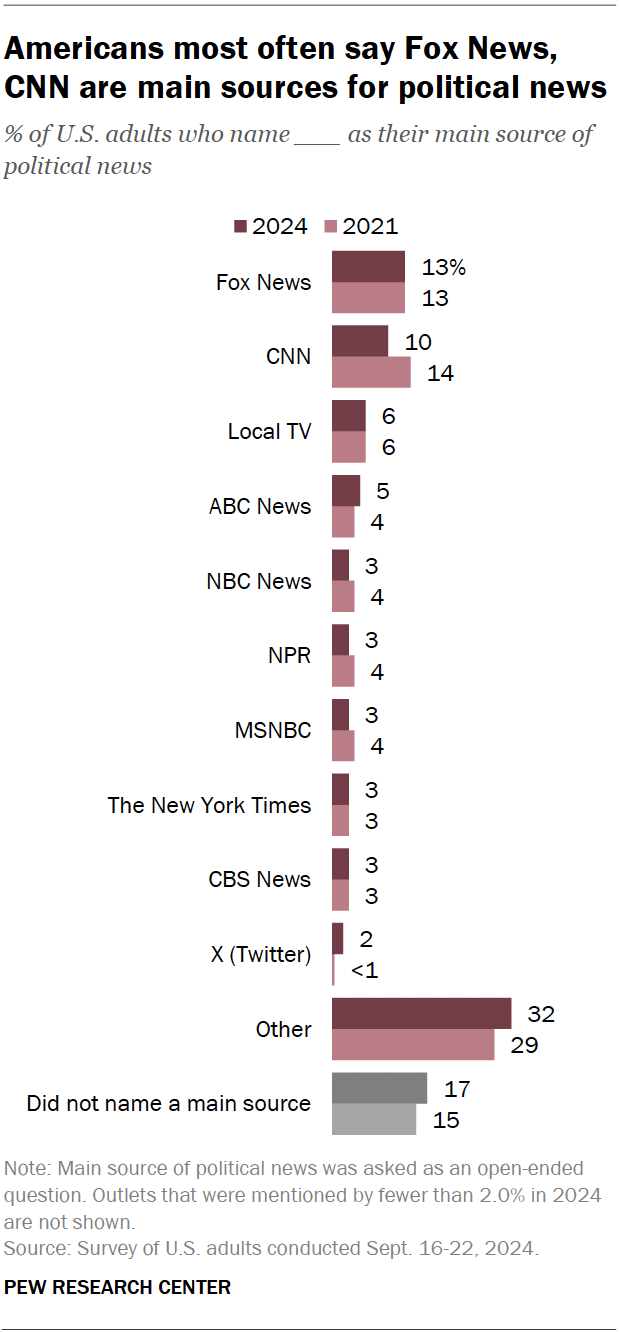
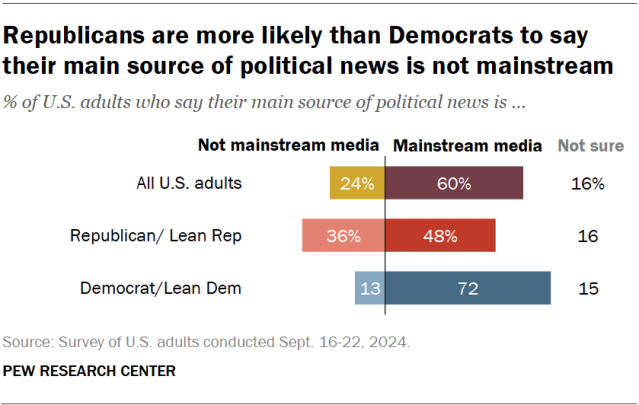
Americans’ top sources for political news | Pew Research Center
grafs
Exit Poll: A Majority of New Trump Voters Used Social Media as Main News Source
Exit Poll: News Sources & Social Media
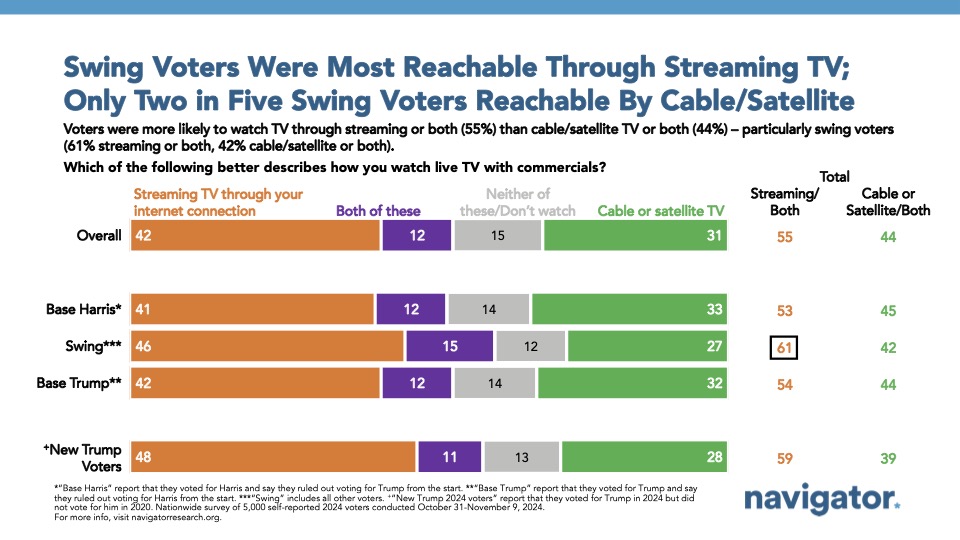
This Navigator Research report is the third in a series of releases of findings from our post-election survey among 5,000 self-reported 2024 general election voters. This release focuses on the 2024 election media environment, including what news sources the electorate was most likely to use, how voters viewed live television ads, and what social media platforms were most popular among “swing voters” and the overall electorate.
Trump voters and “swing voters” largely got their news from social media and alternative sources like podcasts.
:{:{“Swing voters” — defined here as those who did not rule out voting for Donald Trump or Kamala Harris from the start of the campaign — largely got their news from social media. Leading up to the election, 45 percent of “swing voters” and 52 percent of new Trump voters cited getting their news through social media, a far greater share than the national electorate (37 percent).}:
Television news was much less popular with “swing voters” and Trump voters, with only 38 percent of “swing voters” and 31 percent of base Trump voters citing using broadcast television as their news source; fully half of base Harris voters got their news from broadcast television (50 percent). However, Trump voters were most likely to regularly watch a cable news channel, with 52 percent regularly watching Fox News. Base Harris voters were most likely to watch CNN (39 percent).}:
- Alternative news sources like social media and podcasts were much more prevalent among “swing voters” (52 percent) and new Trump voters (59 percent) compared to the overall electorate (43 percent). One in five new Trump voters said podcasts alone were a main news source (21 percent) compared to just 12 percent of base Harris voters and 14 percent of the overall electorate.
- 61 percent of “swing voters” said they watch live TV through a television internet streaming service while only 42 percent said the same for cable and satellite television.


[ ]
Trump won his biggest margins among those who reported watching Fox News, listening to podcasts, using Facebook, and using Twitter/X.
:{:{Trump led among those getting their news from social media and podcasts, with Facebook being their most frequented social media platform. Those who say they use social media as their main news source voted for Trump over Harris by 6 points (51 percent Trump – 45 percent Harris). Similarly, those who used podcasts as their main news source voted for Trump by a 16-point margin (56 percent Trump – 40 percent Harris), while Harris won by 17 points among those watching broadcast news (57 percent Harris – 40 percent Trump). }:
Among “swing voters” and base Trump voters, the most popular social media platforms for daily usage were Facebook (80 percent “swing voters,” 81 percent of base Trump voters) and YouTube (75 percent of “swing voters,” 69 percent of base Trump voters).}:
- Among those reporting daily usage of Twitter/X, 52 percent reported voting for Trump, while 44 percent reported voting for Harris. Similarly, daily Facebook users leaned towards Trump by a 4-point margin (50 percent Trump – 46 percent Harris) and daily Instagram users leaned towards Harris by a 5-point margin (50 percent Harris – 45 percent Trump).
---
How AI, TikTok, and Instagram Are Shaping the U.S. Election | Faculty of Arts and Sciences
Growing up in Taiwan, Herbert Chang '18 saw firsthand how technology and politics could be tightly intertwined.
"Because of its contentious history with China, Taiwan receives a ton of misinformation, but also boasts a high freedom-of-speech index. It's a particularly interesting space," he says, "to study how technology and democratic values come together."
Now, as an assistant professor in the Quantitative Social Science Program, Chang studies the role of technology and social networks in politics and human relationships, with a special interest in the impact of artificial intelligence.
This fall, working with a PhD student and five undergraduates as part of his lab and new course, AI and Machine Learning for Social Science, Chang led two groundbreaking studies that examine the role of AI and social networks in political engagement online. The resulting papers are under review by prestigious journals.
"This is the first U.S. election that coincides with the release of sophisticated generative AI," Chang says. This technology is being used to create images and memes, which are then uploaded to social networks like Twitter, Instagram, and TikTok. "This is really important to understand—especially as an analysis unbiased by the results of the elections," he says.
In the first study, the team investigated how AI-generated content influences political discussions on Instagram. With LLM-based tools, they collected more than 500,000 Instagram images and found that AI-generated content alone does not increase engagement among users—but when AI-generated content is combined with a meme, it's more likely to go viral. In other words, when an AI-generated image is overlaid with text or given some kind of cultural context, it is much more effective at stirring up discussion.
"Generative AI and the meme format produces a synergistic effect," Chang says.
"Our paper definitely challenges assumptions that AI will dominate online discourse," says Mingyue Zha '27, who took part in the research with fellow students Maya Magee '25, Sean Noh '28, Ben Shaman '26, Tracy Weener '26, and Guarini PhD candidate Chiyu Wei. "However, it also highlights the potential of meme content that is AI-generated, which does synergize and increase social media engagement."
One implication is that thanks to platforms like Instagram, where mass exposure isn't limited to politicians and legacy media, political discourse is shifting away from traditional media. "There's more opportunity for 'ground up' discussion by organizations who aren't MSNBC or Fox News," Chang says.
Another (and perhaps more sinister) implication is that AI is actually "mediating our content and information quite significantly, especially in this political context," Chang says.
Thanks to AI-powered meme-generating tools like MidJourney, users can simply type in general prompts about what kind of meme they'd like to create, and the system automatically generates one for them. But users don't have much ability to tweak the resulting meme, meaning the AI technology is ultimately responsible for it—and, therefore, for shaping the increased chatter around it.
The researchers found that about 15% of memes were generated by AI. Additionally, when considering synthetic memes versus normal memes over time, the biggest difference occurs during Donald Trump's conviction.
The second ongoing study offers a large-scale, systematic analysis of the influence of TikTok and Instagram on political discourse. The team collected more than 800,000 Instagram posts and 1 million TikTok posts curated from election-related key words, and has begun analyzing divergences across the two platforms.
Understanding their differences is important because while Instagram and TikTok are the two largest visual social media platforms, they operate in different ways. Instagram content is driven by social networks, meaning a user will be exposed to content by their online "friends" or followed accounts. TikTok, meanwhile, is algorithm driven, so users are exposed to content based on machine learning—technology chooses what they see based on a variety of datasets and past online behaviors.
"Pragmatically, this means that if you're a politician or you're trying to start a social movement, your strategies on the two platforms would be different," Chang says. "On Instagram, you might want to leverage the social network and work with big players to gain solidarity across different audiences. But that might not be effective on TikTok, where you'd want to invest more broadly in individual micro-influencers."
The team is observing that Instagram is used more for sharing breaking news from established media accounts, whereas TikTok has more in-depth commentary from individuals.
"My students are incredibly talented and come from diverse backgrounds—from pre-med to computer science to QSS," Chang says. "They are also perfect collaborators. As frequent users of these platforms, they have incredible insight into how these platforms work and strategies for generating visibility."
"We all worked on different parts of the project based on our experiences and interest, so it was super rewarding to see how everything came together to create new insights that show how this election is taking place over social media," Noh says. "It's a constant learning process, and it's been so cool to be studying something so important and relevant while it's actually happening."
This year's presidential election feels especially significant to Zha, who recently obtained her U.S. citizenship after living in the country for the past 10 years.
"Not only is this the first U.S. election where I'm able to vote, it's also one of the most pivotal elections of our lifetimes, especially since many issues on the ballot will have huge ramifications on the future of my generation," she says.
"One of the most rewarding aspects of being part of this research has been gaining a deeper understanding of how people discuss and engage with electoral issues, as well as how social media platforms influence and mediate this discourse."
Zha also found inspiration in fellow students. "We're able to support each other's work and challenge each other, achieving far more as a team than we could alone," she says. "Herbert's mentorship and encouragement have been instrumental in making this collaborative environment possible."
Chang will continue live-tracking the U.S. presidential election using a dataset curated for his course this fall. "I want students to know that their projects at Dartmouth are directly relevant to the world right now," he says.
At the end of the day, the irony that he wouldn't be able to conduct this research without machine learning, and that there also wouldn't be any research to conduct without AI, isn't lost on Chang.
"AI can be used to generate fake content or misinformation, but it can also be used as a form of civic engagement, and to help identify malicious trends," he says. "It's a technological arms race I'm excited to continue navigating with my students."
---
ggl 4 25
How news influencers talked about Trump, Harris in 2024 ...
Pew Research Center
https://www.pewresearch.org › ... › Platforms & Services
Feb 6, 2025 — So what were audiences hearing from news influencers in the lead-up to the 2024 presidential election? What is a news influencer? We use the ...
How disinformation defined the 2024 election narrative
Brookings
https://www.brookings.edu › articles › how-disinformat...
Nov 7, 2024 — Disinformation shaped views about the candidates, affected how voters saw leader performance, and generated widespread media attention.
Videos
6:16
A look at social media's role in the 2024 election
YouTube · CBS Mornings
Nov 19, 2024
1:57
Social medias impact on the 2024 election
YouTube · Kentucky Kernel
Nov 7, 2024
8:28
Social media's impact on the 2024 presidential election ...
Facebook · ABC News Live
Nov 4, 2024
Feedback
View all
Exit Poll: A Majority of New Trump Voters Used Social ...
Navigator Research
https://navigatorresearch.org › 2024-post-election-surve...
Dec 2, 2024 — Report on the 2024 election media environment, including the electorate's news sources and the most popular social media platforms among ...
Social Media and its impact on the 2024 presidential election
Kentucky Kernel
https://kykernel.com › news › social-media-and-its-imp...
Celebrity and influencer impact As we transition into fall and enter election season, Vice President Kamala Harris has incorporated the “brat summer” craze ...
How AI, TikTok, and Instagram Are Shaping the U.S. Election
Dartmouth
https://faculty.dartmouth.edu › news › 2024/11 › how-...
Nov 4, 2024 — Two groundbreaking studies by professor Herbert Chang '18 and a team of students illuminate how AI-generated imagery and social media influence political ...
Media Influence on Politics: 7 Election Trends in 2024
School of Journalism and Communication | University of Oregon
https://journalism.uoregon.edu › news › media-influenc...
Oct 15, 2024 — Journalism experts analyze the media's influence on politics and discuss 2024 election trends like news fatigue, misinformation, polling and ...
The Evolving Role of Social Media in the 2024 U.S. Elections
Policy Center
https://www.policycenter.ma › podcasts › evolving-role-s...
Platforms like X (formerly Twitter) and TikTok have transformed political campaigns. Initially leveraged by figures like Obama, social media's role surged ...
US Elections: Political Media Consumption Trends
GWI
https://www.gwi.com › blog › trends › political-media
6 trends for political media ahead of the 2024 US Presidential Election · Social media is Gen Z's go-to · Political influencers are a force to be reckoned with ...
Social media disinformation looms over presidential election
University of Michigan News
https://news.umich.edu › social-media-disinformation-l...
Oct 23, 2024 — It's been a bizarre time for the presidential elections. University of Michigan School of Information researchers—experts on social media, ...
---
an 11 24
Democrats may have lost the White House and their U.S. Senate majority, but one silver lining is that in nearly every battleground state, Republicans lost close Senate races.
According to USA TODAY, almost all of the Senate races in the states that decided the Electoral College majority — like Arizona, Michigan, Nevada, Pennsylvania and Wisconsin — broke for Democrats. The lone exception is Sen. Bob Casey (D-Pennsylvania), with the Associated Press (AP) calling the race for Republican Dave McCormick. This may change, however, as NBC News has yet to call the race and Casey has yet to officially concede. With 126,000 more votes that have yet to be counted, Casey is only behind McCormick by 41,000 ballots.
While the AP has yet to call the Arizona Senate race, Rep. Ruben Gallego (D-Arizona) currently leads Republican Kari Lake by roughly 30,000 votes. There are roughly 622,000 more outstanding ballots remaining. The bulk of those votes are in reliably Democratic Maricopa County, which houses Phoenix.
READ MORE:**'I can't vote for them': AZ Republicans explain why they're abandoning Trump and Kari Lake**
Some of the marquee Senate races that ended up in Democrats' favor include Rep. Elissa Slotkin (D-Michigan) defeating former Rep. Mike Rogers (R-Michigan) in the Mitten State, Sen. Tammy Baldwin (D-Wisconsin) winning a third six-year term over Republican businessman Eric Hovde in the Badger State and Sen. Jacky Rosen (D-Nevada) prevailing over Republican Sam Brown.
While red-state Democrats like Sens. Sherrod Brown (R-Ohio) and Jon Tester (D-Montana) lost their reelection battles, they still outperformed Vice President Kamala Harris by eight percentage points and 13 percentage points, respectively. And control of the House of Representatives still has yet to be determined, with neither party currently clinching the 218 seats needed for a majority in the lower chamber of Congress.
Democrats' strong performance in down-ballot races is particularly surprising given that President-elect Donald Trump swept Vice President Kamala Harris in almost all of those states (Arizona ballots are still being counted, but Trump is ahead). USA TODAY reported that even though Senate races are for federal office, voters often split tickets as they feel more personally connected to Senate candidates given their strong relationship with their home states.
"[V]oters in some places are making real distinctions to say this is not somebody who is aligned with Trump or represents him in the same way, or this is someone who has the state’s interest in mind in a way that other candidates don’t,” University of Wisconsin-Madison political science professor Barry Burden told the paper. “And that really is a different story from one state to the next.”
READ MORE:**GOP Senate candidate's business received millions from bank linked to Mexican drug cartel**
Democratic Senate candidates' success could also be chalked up to candidates staking out their own positions independent from President Joe Biden, whose popularity rating has been underwater for several years. While Gallego touted his positions on border security, Slotkin emphasized her pro-manufacturing industry positions, Rosen talked up her work with Republicans to improve Nevada's infrastructure and Baldwin embraced Wisconsin's farmers.
"[Swing state voters are] much more responsive to who the individuals are and to their performance in office and much less susceptible to the Washington style of defining politics," Burden said. He described voters who split their tickets between both parties as "more casual voters," though he observed that "they end up being the ones who make a big difference."
Click here to read USA TODAY's article in its entirety.
READ MORE:[Kari Lake gave election-denying speech in front of Confederate flag
---
---
AN 11 24
November 5, 2024 wasn't just a good day for President-elect Donald Trump — it was also a big win for the world's wealthiest men, according to a new report.
CNN reported Thursday that in the immediate aftermath of the election, the net worths of the 10 richest billionaires in the world skyrocketed. The Bloomberg Billionaire Index, which tracks the growth and contraction in net worth of the super-rich in real time, showed that there was a $64 billion jump in the collective wealth of centabillionaires at the top of the list.
The biggest financial boon of the night went to Tesla and SpaceX CEO Elon Musk — who also owns X (formerly Twitter) — with the Bloomberg Billionaires Index pegging the Trump megadonors net worth at $290 billion. That's a $26.5 billion jump from before the election. Amazon founder Jeff Bezos saw his total wealth climb by more than $7.1 billion following the decision. And Oracle co-founder Larry Ellison (who backed Trump) saw his net worth grow by more than $5.5 billion on Wednesday.
READ MORE:GOP rep complains its 'ridiculous' for Harris to ask billionaires to 'pay their fair share'
Other ultra-high net worth individuals who saw their fortunes increase include Microsoft CEOs Bill Gates and Steve Ballmer, who come in at #6 and #10 on the Billionaire Index, respectively. Gates saw his net worth jump nearly $2 billion to $159 billion, and Ballmer got $2.81 billion more after the election, pegging his net worth at $146 billion.
Meanwhile, CNN reported that Google executives Larry Page and Sergey Brin (ranking at #7 and #8 on the index, respectively) also saw a significant bump in their net worths along with Berkshire Hathaway CEO Warren Buffett. None of those men publicly endorsed a candidate in this election cycle.
The spike in net worths of the 10 richest men is likely due to the value of their stock portfolios jumping significantly after Trump's election victory on Tuesday night, with ultra-high net worth individuals holding most of their assets in the form of company stock. According to CNN, the Dow Jones Industrial Average, the Nasdaq Composite and the S&P 500 Index all hit new record highs after Trump was elected to a second term. Investors are likely bullish on a second Trump term bringing about a new round of tax cuts for corporations and the wealthy.
"There is this huge perception of business friendly, tax-friendly regime coming into place, especially with [Republicans] winning the Senate," AgentSmyth chief operating officer Michael block told the network.
READ MORE:Trump raged at billionaire donors during private dinner and called Harris a slur: report
Trump's signature accomplishment in his first term was the Tax Cuts and Jobs Act of 2017, which provided roughly $1.5 trillion in federal income tax cuts — primarily to the richest Americans. The Center on Budget and Policy Priorities (CBPP) wrote in a report earlier this year that the top one percent of income earners will see an average tax cut of approximately $60,000 in 2025.
"As a share of after-tax income, tax cuts at the top — for both households in the top 1 percent and the top 5 percent — are more than triple the total value of the tax cuts received for people with incomes in the bottom 60 percent," CBPP researchers wrote.
Click here to read CNN's report in full.
READ MORE:'Absurd!' US billionaires pay lower tax rate than working class for first time
===
11 6 24
KOS HUNTER
*Disinformation kills democracies—and our political climate is now one in which disinformation runs roughshod over all else
Originally posted at [The Journal of Uncharted Blue Places
Once again, Americans have voted to send Donald Trump scuttling back into the White House. We are all very worn and it's not a good morning for trying to piece together any grand narrative from that, and already on the various social platforms we're seeing Hot Takes from all of the people who have made lucrative careers about being very wrong about everything.
Rather than attempting one of their triple-bank-shot explanations for why Americans saw the ugliest campaign ever waged and still voted for the coup-attempting narcissistic criminal who headed it, I think simpler explanations will suffice. Trump did nothing he hasn't done for the last ten years. There were no October surprises. Disinformation flew fast and furious, as it has for the same ten years, and we knew it would. Indeed, the anecdotal voter interviews that have peppered the airwaves in the last six months have shown, incontrovertibly, that most voters believe very very false things and using those falsities to justify their ballots.
Here is what we know for certain:
1) Americans are much, much crueler people than we care to admit to ourselves. Trump closed out the campaign with overt racism and calls for ethnic cleansing, and Americans who voted him either liked the idea of ethnic cleansing very very much, cheering and egging him on, or at worst tut-tutted and claimed that it would be worth it because of some largely fictional belief about the economy being "better" back in the days of mass pandemic death.
This isn't particularly surprising. But we like to pretend it isn't there, even as Americans rally around monuments to murderous slaveholding rebels and set off pipe bombs to kill whoever their conspiracy theories have convinced them are enemies—the newspapers and television broadcasts go to great lengths to suppose that it is an expression of "economic anxiety" or that the people holding the torches only want their "culture" preserved. Pretending it isn't there is, in every generation, the primary tool used to defend those hatreds.
2) In nearly every modern election we've seen the same result play out: People vote, often overwhelmingly, to protect abortion rights, civil rights, voting rights, and other cornerstones of the Democratic Party agenda. Then they pull the lever or fill out the bubble to elect Republicans to be the ones in charge of enacting that agenda.
We can piss around with bank-shot explanations of this all we want, but voters are quite consistent in producing this result. Americans wantbroadly liberal policies—and they want them to be delivered by pompously religious white men.
The simplest explanation for that is the one Trump voters themselves bellow. Voters want broad rights when they think those rights will go to people like them—and absolutely do not want those same protections if they think someone who does not look like them will be in charge of dispensing them.
We see this play out in healthcare debates, where broad portions of the (Southern, especially) electorate overwhelmingly approve of "Obamacare" policies but would rather chew their own feet off than let a Black president hand them out. Donald Trump is the avatar for the oldest sort of "identity politics" the nation has: Racism. Misogyny. The American demand to gainonly if it involves taking from somebody else.
3) The most defining characteristic of this election, however, remains the same. It was a race held in a media environment in which factual information was not just deprioritized in favor of the stakeless professional gossipfests that every outlet insists to be the only true form of political coverage, but factual information was hidden from the public by those same sources. We heard all about Joe Biden's alleged unfitness for office because The New York Times publisher and editors yellow-journalismed their way into making it a supposedly defining moment.
In the meantime, Donald Trump's speeches show a man so reduced in form that many of his ramblings are literally incoherent—and you would not know that, if you did not have to watch a steady stream of them, because those same editors scraped his actual words out of their stories in favor of reporting what a spokesperson later claimed Trump "meant."
Flush all of that aside, and you would still be left with a social media and real-world media environment so stuffed with intentional disinformation that stumbling on true facts becomes a game of chance. Voter after voter responds to interviewer questions by saying nonsensical things that aren't true, but that they believe to be true. Voters believe that Trump will "protect" abortion rights because that's what they read—even as he brags of curtailing them. Voters believe Trump will only deport "bad" immigrants—even though the authors of those deportation policies insist that no, they mean to deport legal immigrants and the American children of legal immigrants both, whether criminal or pillars of their communities.
And that is because the media, the "free press" we like to blather on about with undeserved pride, has been fully and completely captured by (1) corporate entities that have a vested interest in feeding Americans some "truths" while hiding others, and (2) a collection of individual members of the billionaire class who dump more money into promoting intentional partisan disinformation than all of the rest of the American public can muster.
That's not democracy. You can't have democracy, if that's the playbook to be used; democracy hinges entirely on the ability of a citizenry to guide the direction of their country by examining the true state of the country and casting votes accordingly. If there is no true state to be determined—only a progression of "migrant caravans" that may or may not exist, or midwestern cities supposedly taken over by Muslims or captured by Columbian cartels, or a candidate who both brags of his anti-abortion record while well-dressed men on television claim the opposite—all of it is moot. The vote measures nothing. There are no "issues," only dueling slates of propaganda.
And that is not where we are heading. That is where we are. It has happened. It has been happening for decades. It accelerated when Rupert Murdoch and Roger Ailes launched an entire news network devoted to manipulating the information environment. It accelerated when we abandoned protections that had been set in place to ensure no one wealthy freak of nature could single-handedly control a large portion of the entire nation's communications apparatus. It is done.
And that is why the party that set a violent mob on the U.S. Capitol four years ago has seen no consequences, legal or otherwise, for an act of horrific betrayal. Those who own the media outlets insisted that the seditionists not be thrown out of our discourse, because the people who own the media outlets depend on those extremists to dismantle what they, too, need or want dismantled. The heads of CNN scrambled to find extremist voices willing and insistent on normalizing even criminal acts—and it has become a revolving door, as each of the extremists they bring to the air get ejected again after doing or saying something that can no longer be papered over. Jeff Bezos intervened to blunt The Washington Post's full assessment of Trump—because Jeff Bezos, the man, has a space program and government contracts to court.
As does his direct competitor, Elon Musk, a fellow billionaire who dismantled Twitter and replaced it with an engine to promote conspiracy theories and white supremacy.
Democracy cannot exist if facts do not exist, and political journalists, the parties, and the people who have purchased everything from our communications networks to their own Supreme Court justices are insistent, already, that facts do not exist.
That is where we are. Getting back will require defeating all of that—and a government soon to be headed by men who have very loudly declared their intent to never, ever give it back.
===
AN 11 24
WASHINGTON — On the final frantic Sunday of the presidential race, while Vice President Kamala Harris spoke at a Black church service in Michigan, former President Donald Trump told supporters at a Pennsylvania rally that he “shouldn’t have left” the White House after he lost the 2020 presidential election.
At a campaign rally at an airplane tarmac in Lititz, Pennsylvania, Trump again perpetuated the falsehood that the 2020 presidential election was stolen from him and claimed that this year’s election would also be stolen because election results could take a while to be counted.
“These elections have to be decided by 9 o’clock, 10 o’clock, 11 o’clock on Tuesday night,” he said. “Bunch of crooked people.”
Election officials have warned thatresults could take days to finalize.
The comments came as new polls showed good news for Harris. A highly regarded pollster in Iowa showed a shocking lead for Harris there and New York Times-Siena College polls of the seven major battleground states showed slight leads for Harris in some Sun Belt swing states, while Trump made gains in the Rust Belt.
As the campaign dwindles to its final hours, here are seven key developments from this weekend:
Trump says he ‘shouldn’t have left’ White House
Trump spent much of his Lititz rally complaining about the election process and media coverage, seeming to repeat his false claim that he was the rightful winner of the 2020 election.
“I shouldn’t have left, I mean, honestly,” Trump said. “We did so well, we had such a great — so now, every polling booth has hundreds of lawyers standing there.”
He also joked about shooters targeting reporters covering his event, the Pennsylvania Capital-Star reported.
He pointed to protective glass covering him on two sides and noted a press section was on another side of him.
“To get me, someone would have to shoot through the fake news,” Trump said. “And I don’t mind that so much.”
In a statement that seemed to contradict the plain meaning of Trump’s remark, campaign spokesperson Steven Cheung denied Trump was encouraging violence against reporters.
“The President’s statement about protective glass placement has nothing to do with the Media being harmed, or anything else,” Cheung wrote. “It was about threats against him that were spurred on by dangerous rhetoric from Democrats. In fact, President Trump was stating that the Media was in danger, in that they were protecting him and, therefore, were in great danger themselves, and should have had a glass protective shield, also. There can be no other interpretation of what was said. He was actually looking out for their welfare, far more than his own!”
Harris heads to the Big Apple
Harris made an unscheduled trip to New York City Saturday, where she made a surprise appearance during the alongside actress Maya Rudolph, who portrays the veep in the live sketch comedy show.
In the three-minute opener, Rudolph approaches a vanity dresser and wishes she could talk to “someone who was in my shoes” as a “Black, South Asian woman running for president, preferably from the Bay Area.”
Rudolph turns toward the faux mirror, and Harris, on the other side, responds, “You and me both, sister.”
They wore identical suits and Harris turned to Rudolph and said that she is “here to remind you, you got this.”
“Because you can do something your opponent cannot do. You can open doors,” Harris said, joking about a recent campaign event where Trump tried to open the door to a garbage truck.
Rudolph cackled, doing an impersonation of Harris’ laugh, before the two women began a pep talk with puns of Harris’ first name.
“Now, Kamala, take my palmala,” Rudolph said. “The American people want to stop the chaos.”
“And end the dramala,” Harris said.
Harris and Rudolph then stood side-by-side and said they were going to vote for “us.”
Harris joked and asked Rudolph if she was registered to vote in the battleground state of Pennsylvania.
Harris headed from New York to Michigan, where she spoke Sunday at the historically Black Greater Emmanuel Institutional Church of God in Christ in Detroit.
Polling bombshell in a non-swing state
Polling in the latest Des Moines Register/Mediacom Iowa Poll, reported a shocking lead for Harris in a state that Trump easily won in 2016 and 2020, with women and independent voters breaking for the Democratic presidential nominee.
The poll shows Harris leading with 47% of likely voters compared to 44% with Trump, according to the Register.
The Trump campaignquickly called the Iowa poll “a clear outlier,” and instead cited a poll by Emerson Collegeas accurate, which showed the former president having 53% support compared to 43% for Harris.
Trump also took his grievances to his social media site, Truth Social.
“All polls, except for one heavily skewed toward the Democrats by a Trump hater who called it totally wrong the last time, have me up, BY A LOT,” he wrote. “I LOVE THE FARMERS, AND THEY LOVE ME.”
The New York Times/Siena College Sunday polls found that Harris is improving in North Carolina and Georgia while Trump has gained in Pennsylvania and maintains a strong advantage in Arizona. Harris is still ahead in Nevada and Wisconsin, according to the poll, but Michigan and Pennsylvania remain tied. The poll of Georgia showed Harris with a 1-point edge.
Both candidates were within the polls’ margins of error, meaning that the seven swing states could tip to either candidate.
While both Democratic and Republican politicians have expressed confidence in winning the election, polling experts said during a panel hosted by the conservative-leaning American Enterprise Institute in late October there’s no way to know for sure who will control the White House until all the votes are counted.
Kristen Soltis Anderson, founding partner at Echelon Insights, said there’s about a 60% chance that this year’s nationwide polling has been mostly correct, though she emphasized that the people who focus their careers on political polling are dedicated to providing a realistic understanding of where campaigns are headed.
“We are trying our very hardest to get it right,” Anderson said. “Even if you don’t believe in our altruism or even if you don’t believe in our academic and intellectual integrity, believe in nothing else than our financial incentives. You want to be the pollster who was right. It is very good business to be the pollster who is right.”
Jeff Horwitt, partner at Hart Research, said during the panel his firm has wrapped up its polling for this election year and expressed skepticism about the polls that emerge close to Election Day.
“Because our job, for our political clients, is to tell them the contours of the election,” Horwitt said. “How do we convince voters to vote for our candidate? What are the most effective messages? What do we have to think about? So the public polls are seeing now, they’re super interesting, and they’re important, but they’re not actionable.”
Trump welcomes sexist insult
As Trump spent his weekend in a campaign blitz across North Carolina, he welcomed a sexist remark from a rallygoer in Greensboro who suggested that Harris worked as a prostitute.
During the Saturday night rally, Trump questioned whether Harris’ previously worked at a McDonald’s. Her campaign has stated that she worked the summer job in 1983. In a campaign photo opportunity, Trump visited a closed McDonald’sin Pennsylvania where he handed fries to pre-screened people at the drive through.
“It’s so simple,” Trump said. “She’s a significant liar, and when you lie about something so simple, so she never worked there –”
“She worked on a corner,” a man from the crowd shouted.
Trump laughed at the crude comment.
“This place is amazing,” Trump said. “Just remember, it’s other people saying it, it’s not me.”
Harris has significantly gained support with women, according to the Pew Research Center.Trump has often dismissed criticism that he has lagged among women.
During a rally last week in Wisconsin, and in an attempt to win over women voters, Trump said that he would protect women and “I’m going to do it whether the women like it or not.”
Trump repeats ‘father of fertilization’ claim
At a Greensboro, North Carolina, rally Saturday, Trump again called himself “the father of fertilization,” a title he first gave himself during a Fox News town hall with women voters last month.
“I consider myself to be the father of fertilization,” he said Saturday.
The Iowa poll — and other late surveys — showed a stark gender gap, with women voters increasingly preferring Harris.
Nearly twice as many Iowa independent women voters, 57% to 29%, favored Harris. That represents a major gain for Harris since a September survey by the same pollster showed the vice president’s edge with independent women was only 5 percentage points.
Democrats have sought to exploit their advantage with women voters by emphasizing Trump’s record on abortion access. The former president appointed three of the U.S. Supreme Court justices who voted in 2022 to overturn the federal right to an abortion.
A flurry of state-level policymaking on reproductive rights has followed, including restrictions on in vitro fertilization, a common fertility treatment.
Trump has said he opposed an Alabama Supreme Court ruling that outlawed the treatment in the state, but had not previously taken a position on the issue.
Early voters up to 76 million
More than 76 million voters had already cast ballots through early and mail voting by midday Sunday, according to the University of Florida’s Election Lab.
Roughly half of those have come in states that track voters’ partisanship. About 700,000 — roughly 2% of the total — more Democrats have voted in those states than Republicans, but the numbers include California, where Democrat Joe Biden won more than 5 million more votes than Trump in the 2020 election.
Among the six states — Georgia, Michigan, North Carolina, Colorado, Idaho and Virginia — that track voters’ gender, women accounted for 54% of the vote, compared to 43.6% for men.
‘Election eve’ blitz
The candidates for president and vice president plan to sprint across the key swing states in the campaign’s final days, with particular focus on Pennsylvania, the largest of the contested states where polling has shown a deadlocked race.
The Harris campaign announced Sunday the vice president would be in Pittsburgh and Philadelphia on Monday, the night before Election Day, for rallies and musical performances. Scheduled entertainers and speakers included Oprah Winfrey, The Roots, Lady Gaga and Katy Perry.
Harris is also set to hold an event in Allentown, Pennsylvania, a majority-Latino city, on Monday. Part of Harris’ closing message has highlighted racist comments Trump and his supporters have made about Latinos.
After spending much of the weekend in North Carolina, Trump will also hold a rally in Pittsburgh on Monday evening.
Minnesota Gov. Tim Walz, Harris’ running mate, will be in Milwaukee on Monday.
Trump running mate Ohio Sen. J.D. Vance will hold events in Georgia, Wisconsin, Michigan and Pennsylvania on Monday.
Harris will hold an election night watch party at her alma mater, Howard University, in Washington, D.C.
Trump’s watch party will be at his Mar-a-Lago club in West Palm Beach, Florida.
Nevada Current is part of States Newsroom, a nonprofit news network supported by grants and a coalition of donors as a 501c(3) public charity. Nevada Current maintains editorial independence. Contact Editor Hugh Jackson for questions: info@nevadacurrent.com. Follow Nevada Current on Facebook and X.
---
an 10 24
All across the country, Republican candidates who openly doubt the outcome of the 2020 election are running in statewide elections. This includes Republican nominees for both U.S. Senate races as well as gubernatorial elections, and even candidates seeking to oversee their respective state's elections.
CNN found that of the 51 Republican statewide hopefuls on the 2024 ballot, 23 of them — a full 45% of all Republican statewide candidates – are election deniers. And many election deniers are seeking office in some of the most hotly contested battleground states in presidential elections.
34 states are holding U.S. Senate elections in November. And 14 Republican Senate candidates have gone on the record supporting election-denying narratives. This includes incumbents like Sens. Marsha Blackburn (R-Tennessee), Ted Cruz (R-Texas), Josh Hawley (R-Missouri) and Rick Scott (R-Florida) as well as candidates seeking to oust Democrats like Sam Brown in Nevada, Kari Lake in Arizona, Bernie Moreno in Ohio and Royce White in Minnesota.
READ MORE:Analysis reveals Trump loyalists have 'infiltrated' election boards in key states
Governors also play an important role in safeguarding elections by signing Electoral College certificates after their respective states' electors meet following a presidential election. In the event a far-right election denier becomes governor, it's possible a legislature may have to intervene in order to make sure electoral college certificates get signed.
This possibility has become a concern for many former governors, who recently co-signed an open letter to current governors urging them to certify their states' Electoral College certificates following the November election. Co-signers include former Governors Jeb Bush (R-Florida), Tom Corbett (R-Pennsylvania), Gray Davis (D-California), Jim Hodges (D-South Carolina) and Mark Schweiker (R-Pennsylvania), among others.
"We write as bipartisan former Governors with an eye to December 11th. This is the deadline for issuing and sending Certificates of Ascertainment to the National Archives. This is six days before the Electoral College will meet in state capitals across our nation," the letter read. "While there is much to debate on the campaign trail, we expect all candidates and the American people will agree that this time-honored process during our post-election period is not open for debate. It is simply a ministerial and administrative duty."
Some of the more notable election deniers running for governor include Mike Braun in Indiana, Greg Gianforte in Montana, Mike Kehoe in Missouri, Patrick Morrisey in West Virginia and Mark Robinson in North Carolina. While four of those states are reliably red, North Carolina is regarded as a battleground state, with both Vice President Kamala Harris and former President Donald Trump in a dead heat. Robinson is currently trailing Democrat Josh Stein – the current attorney general — in the gubernatorial race by double digits.
READ MORE:Mark Robinson on track for 'largest defeat in more than 40 years' of any NC gov candidate
Perhaps the most dangerous office for an election denier to hold is secretary of state, which in most states is the official tasked with overseeing the conducting of all elections. Republican candidates who have gone on record casting doubt on the result of the 2020 election include Denny Hoskins in Missouri, Dennis Linthicum in Oregon, H. Brooke Paige in Vermont and Kris Warner in West Virginia.
Hoskins and Warner are heavily favored to win given their states' strong Republican leanings. After winning the Missouri Republican primary in August, Hoskins insinuated President Joe Biden was not the true winner of the 2020 election, saying: "[W]e have to ensure that none of the electoral fraud that took place in 2020 and stole the election from President Trump happens here."
According to CNN, Hoskins has also urged supporters to watch convicted felon Dinesh D'Souza's debunked film "2000 Mules," which baselessly suggests that the 2020 election was stolen from Trump via ballot drop boxes in Arizona, Georgia and Michigan. He is running against Democratic state representative Barbara Phifer in November.
Click here to read CNN's report in its entirety.
READ MORE:'Not messing around': Dems battle election deniers and frivolous lawsuits' in swing states
---
===
note fight over freedom term, biden proud of EV progress
mma
Trump campaign echoes right-wing media’s lies about an EV mandate
Special ProgramsClimate & Energy
Written by Ilana Berger
Published 09/10/24
- The Biden administration is cutting car pollution and incentivizing automakers to produce electric vehicles. Right-wing media repeatedly misconstrued these efforts, falsely claiming they were attempting to take away voters’ gas-powered cars or forcing them to buy electric vehicles. No such federal mandate exists. Yet now the Trump-Vance campaign has adopted this false claim.
- ## Harris has supported efforts to expand access to electric vehicles during her time as vice president, but that did not include a federal mandate
- The EPA finalized a tailpipe emissions rule in March, but it was not a mandate.In March, the EPA established tailpipe emissions standards for the auto industry in a bid to slash greenhouse gas emissions. According to NPR, “The EPA rules are not written as an EV mandate or a ban on the sale of gas cars. … Instead, the EPA sets standards that apply across an entire fleet – meaning an automaker still can make vehicles with higher emissions, as long as they also make enough very low or zero-emission vehicles that it averages out.” NPR, [3/20/24]
- E&E News clarified that “there is no EV ‘mandate’ from the administration, although President Joe Biden and Vice President Harris have backed a series of climate policies that seek to incentivize the production and purchasing of EVs.” E&E News, [9/3/24]
- The New York Times also wrote of the EPA rule that it “does not mandate sales of electric vehicles, and consumers can still buy and drive gas-powered cars.” The New York Times, [3/20/24]
- The Inflation Reduction Act allocated billions toward supporting the adoption of EVs through tax credits, loans, and funding for charging networks, critical minerals, and battery manufacturing. Harris cast the tie-breaking vote that passed the Inflation Reduction Act, which created $47 billion in EV investment on top of tax credits and loans. Atlas EV Hub, [9/2/22; accessed 9/6/22; Twitter/X, 8/7/24]
- Harris also oversaw parts of the Infrastructure Investment and Jobs Act that distributed funding to school districts for electric buses and to states for EV charging stations.The act, also known as the Bipartisan Infrastructure Law, provided $7.5 billion to build a network of charging stations, and $900 million of that went to the electric school bus initiative. AP News, [12/13/21; Spectrum News, 5/29/24]
- ## Right-wing media falsely claim that the Biden-Harris administration has already implemented an EV mandate
- Former Texas Gov. Rick Perry and Fox contributor Tammy Bruce claimed that “the EV mandate” is an example of Harris “moving money into these Green New Deal projects.” On The Evening Edit, Bruce said that Harris admitted during her CNN interview that “the Inflation Reduction Act was about moving money into those, that New Green Deal projects.” “Yeah, and that’s what this administration is all about … pushing money into these programs. The EV mandate’s a great example of it,” said Perry. Fox Business, *The Evening Edit*, [8/30/24]
- On Newsmax’s American Agenda, right-wing commentator Tom Del Beccaro said, “Michigan really should be easy for Trump at this point. They — Kamala put in the EV mandates. She’ll do it again, and the EV mandates have been a disaster.”Newsmax, *American Agenda*, [8/29/24]
- The Washington Examiner falsely characterized tax credits in the IRA as an “EV mandate.” “Kamala Harris’ EV mandate costs taxpayers $7,500 and Ford $44,000 per car,” the article said. “Kamala Harris has debuted yet another 180-degree policy reversal via press release,” the article said. The Washington Examiner, [8/28/24]
- Fox host Sean Hannity called the EPA rule a “ban” and claimed that the administration is “finding any way they can to trick you, the American people, into supporting something that many Americans don't want.” Fox contributor Ari Fleischer, former White House press secretary under George W. Bush, said, “I think all of us want to do something about carbon emissions, etc., but the best way to do it is not through command and control mandates that will not work.” Fox News, *Hannity*, [3/20/24]
- ## After a Harris campaign official said Harris does not support an EV mandate, right-wing media insisted that she could not change, or has not changed, her position on the issue
- In August, Harris’ director of rapid response, Ammar Moussa, wrote in an email to supporters that “Vice President Harris does not support an electric vehicle mandate.” The Hill, [8/29/24]
- On Hannity, Fox host Jeanine Pirro said that Harris “can’t say she is against the EV mandate when she is the one who, I believe, sponsored the bill. And in addition to that, the bill had times built in where, after 2030 you had to have only 50 percent of the cars could be fossil fuel or gas-fueled, and by 2040-45 -- I mean, these are not flip-flops, Joe. These are lies."Fox News, *Hannity*, [8/29/24]
- On The Faulkner Focus, Fox News contributor Steve Hilton claimed that Harris “does want to take away your car.” Hilton said, “They claim that it’s not a mandate because it’s not mandating what you buy, it only mandates what can be sold. As if there is a difference between those two things. … As far as it stands today, Kamala Harris does want to take away your car, she does want to take away your truck.” Fox News, *The Faulkner Focus*, [8/28/24]
- ## Former President Trump and his running mate JD Vance have adopted the false right-wing media claim that there is a federal EV mandate and that it is negatively impacting voters
- At an August 8 press conference at Trump’s Mar-a-Lago club in Palm Beach, Florida, Trump said that if Harris becomes president, “everybody’s going to be forced to buy an electric car, which they're not going to do, because they don't want that. People want gasoline-propelled cars. They want hybrids. They want to have everything, and they want electric.” Politico, [8/8/24]
- In March, when the Biden administration finalized a new Environmental Protection Agency rule that set strict limits on pollution from new gas-powered cars, Trump campaign national press secretary Karoline Leavitt called the move a “job-killing electric vehicle mandate at the federal level.”FoxNews.com, [3/28/24]
- Trump’s official campaign account posted on X: “Crooked Joe Biden’s INSANE and RADICAL EV mandates will BAN your gasoline-powered vehicles and force you to buy expensive and unreliable electric vehicles. President Trump will always protect your FREEDOM to drive what you want!”Twitter/X, [3/20/24]
Related
On Facebook, content trashing electric vehicles reliably draws engagement
07/03/24
01/19/24
09/02/22
===
an com dr 8 24
The “Party of Lincoln,” as Republicans call themselves, seems intent on undermining just about everything President Abraham Lincoln lived and died for. This includes Republican efforts to upend the way elections are run, by restricting who gets to vote, how voting is conducted, and how votes are counted and certified.
The outcome of the tight presidential race between former U.S. President Donald Trump and Vice President Kamala Harris will hinge on the votes in a handful of swing states. From Georgia to Arizona, Nevada to Michigan, Republicans are mounting an all-out assault on the election process that journalist Ari Berman refers to as a “five-alarm fire for democracy.”
“It appears that Georgia Republicans are laying the groundwork not to certify the presidential election if Kamala Harris wins,” Berman said on the Democracy Now! news hour. “They’re doing exactly what Trump wanted them to do in 2020. Trump made Georgia the epicenter of the attempt to try to overturn the election. He asked local and State Board of Elections and election officials not to certify the election. They refused to do so; they followed the law. It seems like in 2024 they’re going to extraordinary lengths to try to implement the measures that failed in 2020, to try to rig the election for Trump.”
The Republican Party of today, desperate to suppress the votes of people of color, could not be further from the Party of Lincoln.
Georgia Republicans altered how counties count and certify votes. The Democratic Party of Georgia, the Democratic National Committee, and 10 Democratic county election officials from across Georgia have sued, seeking to roll back the changes. Their lawsuit argues, “Georgia’s State Election Board has passed a host of last-minute rules that threaten to sow chaos and impede the vote-canvassing process.”
Berman warns: “These state and local election boards have been taken over, in some cases, by election deniers, by MAGA extremists…The administration of elections matters so much because you can cast a vote, you can have your vote counted, but it doesn’t actually matter until votes are certified.”
In Texas, the Republican-controlled state government has for years tried to restrict voting in districts where Democratic candidates do well. Donald Trump won Texas by over five percentage points in 2020, but President Joe Biden won the cities of Dallas, Fort Worth, Houston, Austin, and El Paso as well as the Rio Grande Valley.
Texas Gov. Greg Abbott announced this week that he has purged over 1 million voters from Texas voter rolls. This increasingly common tactic inevitably removes legally-registered voters, often through faulty data screens that target likely Democratic voters.
Meanwhile, Texas’ Republican Attorney General Ken Paxton, who’s currently agreed to do community service to avoid a felony criminal securities fraud trial, and survived an unrelated impeachment trial in the Republican-controlled state senate, has been raiding nonprofit organizations that provide services to immigrant and Latino communities.
Last week, under Paxton’s orders, the homes of a dozen members of LULAC, the League of United Latin American Citizens, were raided and searched by Texas authorities, including SWAT teams. One activist’s door was broken down. Texas House candidate Cecilia Castellano, running for an open seat to represent Uvalde, the town devastated by one of the worst school shootings in U.S. history, had her home raided. Government agents took her cell phone and, weeks ahead of election day, threw her campaign into chaos.
LULAC said in a statement, “Attorney General Paxton’s actions clearly aim to suppress the Latino vote through intimidation and any means necessary to tilt the electoral process in favor of his political allies.” LULAC has called on the Justice Department to investigate Paxton over the raids.
Juan Proaño, CEO of LULAC, said on Democracy Now!, “In the last U.S. Census, they reported 12.1 million Latinos in the state of Texas. For the first time, Latinos actually outnumber non-Hispanic whites, which is at 12 million. When you take into account not just the Latino population in the state of Texas, but the African American and Asian population… the minority community in Texas now stands at over 60%. Texas is and has been a majority-minority state. So, we see these, effectively, as tactics for the Republicans to actually stay in control of the government in Texas.”
If further evidence of Republican attempts to subvert the will of the voters were needed, Pluribus News, a nonprofit news organization, reports that Republican-controlled state governments are altering language on progressive state ballot initiatives to confuse or mislead voters. Arizona, for example, inserted “unborn human being” in place of fetus or embryo in the ballot initiative intended to guarantee the right to an abortion. Voters in Florida and Ohio will face similar confusing language in their ballot initiatives.
In President Lincoln’s final public address, three days before his assassination, Lincoln advocated that the right to vote be granted to formerly enslaved Black men (as only men could legally vote, until 1920). The Republican Party of today, desperate to suppress the votes of people of color, could not be further from the Party of Lincoln.
an 8 24
[vid]
When , that Donald Trump would not concede the presidential election if he lost, Trump's defenders accused the "Real Time" host of having "Trump derangement syndrome." But Trump, just as Maher predicted, refused to admit defeat after losing the 2020 election to now-President Joe Biden.
Now, four years later, a variety of Trump critics — from Maher to Democratic elections lawyer Marc Elias — are warning that Trump will do the same thing again if he loses the 2024 election.
But The Guardian's Sam Levine, in an article published on August 12, stresses that there is a crucial difference between 2020 and 2024: Trump and his MAGA allies "may be better prepared" to steal the election this time.
READ MORE:Trump is losing it because he's afraid of losing
"(Cleta) Mitchell, a close Trump ally, has spent the last few years building up a network of activists focused on local boards of elections," Levine explains. "And the Republican National Committee's election litigation team is now being led by Christina Bobb, an election denier who is now facing criminal charges for her efforts to overturn the 2020 race."
The reporter continues, "The RNC claims it is recruiting an army of 100,000 poll observers who could provide significant disruption during voting and counting…. But more significantly, the idea that the 2020 election was stolen has moved from the fringes to being a pillar of the Republican Party. A January poll from PRRI found that 66 percent of Republicans believe the 2020 election was stolen."
Elias laments that election denialism has become the GOP's "standard position."
The attorney and Democracy Docket publisher told The Guardian, "I think we saw efforts by Republicans in 2020 that were pretty ham-handed. I worry that there will be both legal and extralegal efforts by Republicans to keep ballots from being counted."
READ MORE:['Has he met his boss?' Vance mocked after whining about Dems turning tables on the GOP
Similarly, Ben Berwick, an attorney for Protect Democracy, told The Guardian, "It's all part of creating sort of a pretext to say, 'Oh, we need to throw out this set of ballots' or 'We can't really know who the real winner is.' I think much of it won't stick, but I think the point is to have enough of it stick to create enough uncertainty for that critical post-election period."
Richard Pildes, an election law expert at New York University, told The Guardian he is "definitely concerned" that there will be "a lot of efforts to disturb" vote counting.
Sean Morales-Doyle of the Brennan Center for Justice at New York University Law School, believes that MAGA election denialism is much more sophisticated in 2024 than it was four years ago.
Morales-Doyle told The Guardian, "This has started earlier in the cycle and is louder and is more consistent. That is all just at a different level than it was before 2020.”
READ MORE:**Inside the GOP plot to silence Texas voters**
*Read The Guardian's full report at this link.
===
an 7 24
MAGA fumes over report 4th of July gas prices lowest in 3 years: 'Why is CBS campaigning for Biden?'
---
AHA DOH TRUMP WANTS TO RUN AS CHANGE CAND THO INCUMBENT, AND UTTER FAIL SO JUST CREATES NEW REALITY EG GOOD ECONOMY DESPITE EMPIRICAL FACTS
HOW BIG IS VIOLENT CRIME AS ISSUE? // BIDEN OPEN BORDER CRIME WAVE, BIDEN CRIME FAMILY
NICE RIPOSTE HONKY GOOD SPOX FRONT MAN DEM HELLHOLES CITIES
ABC News host Jonathan Karl fact-checked Sen. Tim Scott (R-SC) after he claimed that violent crime was up under Joe Biden's presidency.
During an interview on Sunday, Karl asked Scott if he agreed with the Supreme Court's decision to strike down a ban on bump stocks, which allow some guns to fire more rapidly.
"We trust and believe and respect the decision of the Supreme Court," Scott opined. "What we need to focus on, Jon, is the violence that we're seeing across this nation. Under Joe Biden, we've seen the greatest increase in violent crime in my lifetime."
Karl pointed out that Scott was in error.
"Actually, Senator, as you probably know, the latest stats on violent crime and on the murder rate, they're actually down this past year," the host said.
"Under Joe Biden, neighborhoods like the ones I grew up in have never been ravaged [more]," Scott insisted.
Watch the video below from ABC.
---
an 6 24
the handful of U.S. Senate races that will decide partisan control of the upper chamber of Congress will come down to whether voters go with battle-tested, highly experienced Democrats or wealthy Republican political neophytes self-funding their campaigns, according to a new report.
On Wednesday, online news outlet NOTUS reported that the Republican Party's inability to fund Senate challengers' campaigns with small-dollar fundraising means the GOP is now depending on multimillionaire candidates to stay competitive with Democrats. Republican Senate primary winners in battleground states have mostly been businessmen with no prior experience in elected office, like Eric Hovde in Wisconsin, Dave McCormick in Pennsylvania, Bernie Moreno in Ohio and Tim Sheehy in Montana.
"We’ve focused on recruiting candidates who are really strong fundraisers or who are capable of making a personal investment in their campaign to try and close the money gap," an unnamed Republican aide told NOTUS.
READ MORE:**Busted: GOP Senate candidate running on rural roots grew up 'three miles from a Trader Joe's'**
Another unnamed senior GOP strategist speaking anonymously to NOTUS told the publication that the Republican Party' "shrinking small-dollar base has left it scrambling" in order to field competitive Senate candidates. The strategist added that the GOP's small-dollar donor base continues to shrink with every election cycle.
"You’re not going to make it up from there, so where are you going to do it?” the strategist said. “And that leaves you with people who have their own funds.”
The National Republican Senatorial Committee (NRSC), which is the GOP's Senate campaign arm, has still raised nearly $134 million for the 2024 cycle, according to Ballotpedia data as of April 30. That's more than the Democratic Senatorial Campaign Committee (DSCC) $116 million. However, the DSCC has $41 million in cash on hand compared to the NRSC's $36 million. And Democratic Senate candidates in battleground states still have a significant money advantage over their Republican candidates.
In 2024, Republicans need a net gain of just two Senate seats in order to retake the majority. with Sen. Joe Manchin (I-West Virginia) retiring in a state that's voted for Republican presidential candidates in the last six consecutive elections, that effectively means the GOP needs just one Democratic-held seat to flip. And with multiple Democratic candidates in red states like Montana and Ohio running for another term, the Senate could flip to Republican control by ousting Sens. Sherrod Brown (D-Ohio) or Jon Tester (D-Montana). The difference may come down to campaign cash.
READ MORE:**These 10 U.S. Senate seats are most likely to flip in 2024**
In the 2024 cycle, Tester has raised more than $36 million, and still has $11 million in cash on hand according to Opensecrets. Brown is similarly flush with cash, having raised more than $39 million with nearly $16 million on hand. Sen. Bob Casey (D-Pennsylvania), who is running for a fourth term this fall, has raised an impressive $23 million with almost $12 million still available to spend this cycle. Sen. Tammy Baldwin (D-Wisconsin) is still sitting on more than $10 million in cash on hand with more than $26 million raised so far.
According to Cook Political Report, Republicans are outside of the margin of error in the Pennsylvania and Wisconsin Senate races, meaning they'll be leaning heavily on Montana and Ohio in their effort to win back the Senate majority. Latest polling averages show Baldwin and Casey are nearly 10 points ahead of their Republican opponents. RealClearPolling figures show Brown leads Moreno by approximately five points in Ohio, and Tester has a similar lead over Sheehy in the Big Sky State.
5 24
fox News and the MAGA media are lining up their shot at American democracy
The bullet is in the chamber
WRITTEN BY MATT GERTZ
PUBLISHED 05/14/24
With the presidential election less than half a year away, evidence is everywhere that the right is planning to end the American experiment in representative government if it fails to legitimately return Donald Trump to the White House.
It was clear just a few months after Trump’s seditious plot to subvert the 2020 presidential election concluded with a violent mob of his supporters storming the U.S. Capitol that the right-wing propaganda apparatus was laying the groundwork to try again in 2024. Fox News and the rest of the MAGA media, which spent the weeks after the 2020 election fabricating and amplifying a host of election fraud lies and conspiracy theories to undermine the results, had begun working to institutionalize Trump’s lie that the 2020 election had been stolen from him and to construct an alternative path to the presidency in which compliant party officials would secure a Republican victory by any means necessary.
Fox had become a loaded gun aimed at American democracy. Three years later, the bullet is in the chamber.
The disinformation ecosystem which revolves around Fox is telegraphing a plan to reject the results of the 2024 election if Trump loses. The former president’s propagandists will once again use baseless allegations of widespread fraud as a pretext to seek to overturn the vote — and GOP leaders are publicly signaling their willingness to comply.
Ultimately, this preordained coup scheme may not matter. As in 2020, Joe Biden might win by too large a margin in too many states for the plot to succeed. Or, as in 2016, Trump might win outright.
But in the event that Biden triumphs in a close election, the MAGA faithful have developed and road-tested a plan to steal it.
Fox stars aided Trump’s 2020 subversion plot. They were lying. And they’ll do it again.
It is sometimes unclear whether Fox’s falsehoods are deliberate lies. But filings in Dominion Voting Systems’ defamation suit, which the network settled in April 2023 for $787.5 million, demonstrate beyond dispute that Fox’s coverage of the 2020 election results was rooted in malicious fabrication.
Fox’s top executives and biggest stars knew for a fact that Biden was the legitimate winner of the 2020 election, even as the network’s coverage sought to undermine the legitimacy of the vote. The network, filings show, was intentionally peddling conspiracy theories in support of Trump’s stolen-election deception in order to compete with its far-right rivals.

These lies mattered. Communications revealed by the suit show that top Fox executives were aware the network was “uniquely positioned to state the message that the election was not stolen” but did not out of fears of losing viewers. They further show that when then-Fox Corp. Chair Rupert Murdoch asked his employees for evidence Fox had “fed the story that the election was stolen and that January 6 [was] an important chance to have the results overturned,” he received a list of 50 examples in response.
But the only lesson Fox’s executives apparently learned from fueling an attempted coup is that they need better lawyering to keep their damning internal emails and text messages off the front pages and avoid paying a record settlement.
Fox retained and even promoted some of its most unhinged election deniers, while punishing or even firing employees who fought the false narratives. In the years that followed, the network restocked its prime-time lineup with Trump loyalists who parrot whatever the former president says, put Trump allies and even a family member on the payroll, and replaced “news side” veterans with GOP operatives.
It’s no wonder that former employees keep loudly warning that Fox is a dangerous cesspool that produces Trumpian propaganda. The cogs who remain on the job, meanwhile, know without a doubt that they are part of a machine that manufactures lies. The pressure the network faces to hold on to its audience — including by promoting voter fraud conspiracy theories and other right-wing extremism — is stronger than ever. And so if Trump demands that Fox’s propagandists again focus on building him a pretext to overturn an election, they will do it.
The emerging right-wing scheme to overturn the 2024 election
Trumpists in the media and elsewhere have spent the years since Trump’s defeat laying the groundwork to rerun his subversion plot, systematically removing the guardrails that helped stymie the scheme in 2020, and helping him back to the Republican nomination. The result is a turnkey operation prepared to generate false election fraud claims and convert them into a rationale for Republican political leaders to reverse the results of the election and reinstall Trump in the White House.
MAGA propagandists are priming their audiences to disbelieve the election results and take action in response. They keep viewers in a state of terror with incendiary warnings that Biden is a jack-booted dictator who is deliberately trying to endanger their families, ensuring that some fraction would seek his removal by any means necessary. They valorize the January 6 insurrectionists as honorable patriots who did what they thought was right and were smeared by the media and punished by “deep state” malefactors. They flood the right-wing information ecosystem with lies and conspiracy theories about Democrats tainting past election results.
And they have already begun warning that the 2024 election will be rife with election fraud — and that only such cheating could explain a Trump defeat.
Video
CitationFrom the March 25, 2024, edition of Real America's Voice's War Room
STEVE BANNON (HOST): There are no “issues" with the 2020 election — they stole it. Let me repeat that. They stole it. And they hate when we say this. They stole it. And they're on notice. They're not going to be able to steal it again. People are doing a ton of work on this, and that's still not enough, but it's going to get better. The hairy eyeball is going to be on them.
The only way they defeat Trump is to steal it. The only way they defeat Trump is they steal it. The only way they defeat Trump is they steal it. He is unstoppable.
We saw how this played out in 2020: Trump’s coup plan relied on blanketing right-wing media with stolen-election lies in order to provide cover for GOP partisans to reverse the outcome in states Biden won. Under pressure from the Fox-addled rank and file, Republican election officials would refuse to certify results in key areas, GOP state legislators would overturn the results, and GOP members of Congress and Vice President Mike Pence would hand Trump the election.
This scheme failed in part because too many Republican officials were unwilling to aid the effort. But since then, Trumpist propagandists like War Room host Steve Bannon and Fox’s lineup of right-wing stars have helped make election denial a core GOP value, and now, the guardrails are collapsing:
- Republicans purged their ranks of the sorts of GOP officials who resisted Trump’s subversion effort at the local, state, and federal level.
- Election lies seem to have become a benefit in GOP primaries and effectively a job requirement at the Republican National Committee, one enforced by the MAGA chorus.
- Prominent election deniers are recruiting their followers to take positions within the election infrastructure.
- In the House, Rep. Mike Johnson’s (R-LA) zealous efforts to overturn the election helped garner him the speakership, while in the Senate, Minority Leader Mitch McConnell (R-KY) is on his way out of the leadership after voting to certify the electoral votes and criticizing Trump’s role in the insurrection.
- Pence is effectively a party outcast after rejecting Trump’s entreaties to overturn the 2020 election results, and the politicians seeking to replace him on the GOP ticket are pushing voter fraud lies and refusing to say they will accept the results of the 2024 election.
Donald Trump will once again stand as the Republican presidential nominee this fall, less than four years after he attempted a coup to remain in office. He still maintains, unbowed by time, notoriety, or criminal charges, that the 2020 election was stolen. At the same time, he has embraced the January 6 offenders, regularly describing them as “hostages,” promising to consider blanket pardons for their actions, and treating their attack on the Capitol as “not a moment of national shame but of celebration,” as NPR described it.
None of this seemed to give right-wing propagandists much pause as Trump romped to the nomination. The Murdochs may have begun the primary season with other plans, but Fox had spent years crafting a political environment in which any criticism of Trump was inherently illegitimate, and its stars ultimately rallied to his side.
As Trump’s victory became inevitable, his vanquished rivals were reduced to complaining — accurately — that Fox and its ilk had taken Trump’s side, while the few right-wing commentators who had criticized Trump and endorsed his primary opponents bent the knee.
If he loses in 2024, Trump will reject the results and seek to overturn them, as he has throughout his political career. Indeed, he began laying the groundwork for such a strategy during the GOP primaries, warning that only Democratic “cheating” could explain such an outcome. And he has no apparent qualms over whether his deliberate radicalization of his supporters leads to right-wing political violence. Indeed, he is signaling that is exactly what he wants.
No one can say they didn’t know what was coming
Here’s part of an interview with Trump that Time magazine published on April 30, six months before Election Day:
Mr. President, in our last conversation you said you weren't worried about political violence in connection with the November election. You said, “I think we're going to win and there won't be violence.” What if you don't win, sir?
Trump: Well, I do think we're gonna win. We're way ahead. I don't think they'll be able to do the things that they did the last time, which were horrible. Absolutely horrible. So many, so many different things they did, which were in total violation of what was supposed to be happening. And you know that and everybody knows that. We can recite them, go down a list that would be an arm’s long. But I don't think we're going to have that. I think we're going to win. And if we don't win, you know, it depends. It always depends on the fairness of an election. I don't believe they'll be able to do the things that they did the last time. I don't think they'll be able to get away with it. And if that's the case, we're gonna win in record-setting fashion.
Polls suggest that the 2024 presidential election will be close. But according to Trump, he’s “way ahead” and on track to win “in record-setting fashion.” The only thing that can prevent that outcome, Trump claims, is “the things that they did the last time,” i.e. the Democratic election fraud conspiracy theories he’s been hocking since before the 2020 vote. And if that happens, Trump says, his supporters might respond to such a result with violence.
None of this is even remotely subtle.
In the lead-up to the 2020 election, some political commentators expressed doubts over whether Trump would really respond to defeat by refusing to accept the election results and taking action to try to remain in office.
But that is precisely what Trump did. Now he is saying quite clearly that he will do it again if given the chance. And his propagandists in the right-wing media will have had four years to lay the groundwork to ensure his plot’s success.
Five days after the Time interview dropped, Semafor founder Ben Smith published a Q-and-A with Joe Kahn, the executive editor of The New York Times. The interview began like this:
Ben Smith: Dan Pfeiffer, who used to work for Barack Obama, recently wrote of the Times: “They do not see their job as saving democracy or stopping an authoritarian from taking power.” Why don’t you see your job as: “We’ve got to stop Trump?” What about your job doesn’t let you think that way?
Joe Kahn: Good media is the Fourth Estate, it’s another pillar of democracy. One of the absolute necessities of democracy is having a free and fair and open election where people can compete for votes, and the role of the news media in that environment is not to skew your coverage towards one candidate or the other, but just to provide very good, hard-hitting, well-rounded coverage of both candidates, and informing voters. If you believe in democracy, I don’t see how we get past the essential role of quality media in informing people about their choice in a presidential election.
To say that the threats of democracy are so great that the media is going to abandon its central role as a source of impartial information to help people vote — that’s essentially saying that the news media should become a propaganda arm for a single candidate, because we prefer that candidate’s agenda. It is true that Biden’s agenda is more in sync with traditional establishment parties and candidates. And we’re reporting on that and making it very clear.
It’s also true that Trump could win this election in a popular vote. Given that Trump’s not in office, it will probably be fair. And there’s a very good chance, based on our polling and other independent polling, that he will win that election in a popular vote. So there are people out there in the world who may decide, based on their democratic rights, to elect Donald Trump as president. It is not the job of the news media to prevent that from happening. It’s the job of Biden and the people around Biden to prevent that from happening.
> It’s our job to cover the full range of issues that people have. At the moment, democracy is one of them. But it’s not the top one — immigration happens to be the top [of polls], and the economy and inflation is the second. Should we stop covering those things because they’re favorable to Trump and minimize them? I don’t even know how it’s supposed to work in the view of Dan Pfeiffer or the White House. We become an instrument of the Biden campaign? We turn ourselves into Xinhua News Agency or Pravda and put out a stream of stuff that’s very, very favorable to them and only write negative stories about the other side? And that would accomplish — what?
That exchange generated a lot of smart responses. Critics pointed out that Smith’s question mischaracterized Pfeiffer’s critique; that Kahn’s response ignores the actual criticisms mounted by his paper’s critics, including Biden himself; that the Times’ business interests lead Kahn to endorse “a kind of performative neutrality in politics coverage”; and that, contra Kahn’s claims, the Times does not generally base its coverage decisions on polling and, if it did, the result should be a greater focus on the impact of Trump’s policy proposals on inflation and immigration than the paper actually provides.
What strikes me most about Kahn’s answer is his apparent lack of urgency. A former president left office after using the lie that the election he lost had been rigged to try to reverse the outcome, culminating in a violent assault by his supporters on the U.S. Capitol. He has all but promised to try again, and after transforming his party into a personality cult which treats the insurrectionists as heroes and his election lie as unvarnished truth, he very well could succeed.
That is the central reality of the 2024 presidential election, one that should be foregrounded to the readers and viewers on news outlets at every opportunity but often fades from the discourse. The former president’s media allies are foreshadowing their eagerness to take every possible opportunity to participate in his scheme. And the leader of the nation’s most powerful mainstream press organ gives no indication that he has considered those implications in any but the shallowest way. We are all in a lot of trouble.
//
Fox News propagandists and GOP leaders are pushing the country toward the abyss
11/06/20
Fox News is a loaded gun aimed at American democracy
05/14/21
They did it and will do it again – if no one stops them
---
biden hires precinct workers, gop gather lawyers, poll watchers
const sheriffs say will grab machines
---
---
hit things polls, prepare for voter suppress violence?
---
---
mma 4 24
a panel on MSNBC’s Morning Joe Thursday highlighted the role right-wing misinformation is playing in distorting perceptions about the state of the economy and the rate of inflation, which a majority of Americans incorrectly believe is headed in the wrong direction.
Wall Street Journal economic reporter Greg Ip drew attention to the enormous disparity between perception and reality when it comes to consumer sentiment about the economy in an April 4 article, titled “What’s Wrong With the Economy? It’s You, Not the Data.” Ip pointed to public opinion data showing that a vast majority of respondents incorrectly believed inflation has gone up in the past year, when indeed it has fallen significantly and stabilized in the nearly two years since peaking in June 2022. Furthermore, Ip highlighted a survey showing that by 40-to-60 point margins, respondents think the overall U.S. economy is getting worse while their own state economy is getting better. He also cited data indicating that by a nearly 2-to-1 margin, a majority of Americans wrongly believe the economy — which has enjoyed robust job creation and GDP growth — has gotten worse over the past year.
Ip's article spurred a conversation on the set of MSNBC's Morning Joe, where co-hosts Mika Brzenski and Joe Scarborough and New York Times columnist and CNBC anchor Andrew Ross Sorkin keyed in on the role played by the partisan misinformation ecosystem in fomenting pessimism and distorting reality.
“The misinformation that’s been put out across the country about this issue is so shocking, because of the way people feel versus the actual reality of the numbers,” said Sorkin. “It’s hard to tell people that you shouldn't feel one way, and I know that is true, but the numbers are directionally, shockingly, going in a good place.”
NBC News national affairs analyst John Heilemann chimed in that while the economy has improved, the tapering of inflation happened slowly, and that from a political standpoint for the Biden White House, “You cannot argue people out of their feelings,” with Heilemann recommending a different approach.
“You have to figure out a way to say to them, hey, we know that prices are still too high, we know you're still feeling it in your pocketbook now, but look at all the progress we've made,” Heilemann said. “Give us some more time, because you know it's just going to be worse with Donald Trump. He's not on your side. We're on your side, we fixed a lot of stuff. This thing still, we need some work, we've made some progress, but not enough.”
Indeed, liberal and conservative economists agree that Trump’s policies would make inflation worse — but mainstream media outlets have barely covered this.
Scarborough then contrasted the poll findings that people thought their own state economies were doing well while the rest of the country was doing badly, then turned the question back to the sheer volume of right-wing media misinformation.
“I'm sorry but, you know, if you looked at certain cable news channels you would think we were in the middle of a Great Depression, that illegal immigrants were racing through schools across America stabbing people in the face, and that leprosy is going to be spread by migrants going across the border, and that trans athletes are coming to your middle school to beat up your, you know, sixth-grade girl,” Scarborough declared. “I mean, seriously, turn it on any time. Turn it on any time, and it’s the economy is in free fall, migrants are coming to kill you, and trans athletes. I mean, it's constant — it’s a constant, constant churning of these messages. And it has an impact on polls after [airing] 24/7.”
Right-wing media have often painted the completely false picture of the dystopian, even post-apocalyptic America that Scarborough described. On those exact topics that Scarborough mentioned, for example, Fox News has ignored or dismissed positive economic news, falsely depicted a “war on fossil fuels” when in fact the country is producing more energy than ever, and depicted minimum wage increases as a danger to the economy and American way of life. Fox has also run an obsessive level of coverage depicting migrants as a criminal threat to the country, and hyped supposed new threats without any empirical evidence. (Scarborough’s reference to immigrants purportedly carrying leprosy was actually a Fox News narrative from 2018.)
And of course, Fox has engaged in a vast culture war against transgender people, and the network drastically picked up its coverage in 2021 as soon as Democrats took control of the White House and Congress. This intense coverage has continued for years, including targeted hate campaigns, treating urban legends as if they’re real news, and whipping up new cultural battles via days of relentless coverage and dishonestly edited footage.
Watch the full segment from Morning Joe below:
---
---
Inside the Saudi scheme for killing Biden’s election hopes - Alternet.org
---
---
---
an 1 24
as the third anniversary of the deadly January 6 insurrection approaches this weekend, one columnist is calling on journalists and editors to stop treating the future of democracy like a standard partisan issue.
In her latest column for The Guardian, Margaret Sullivan expressed her frustration about the beltway media's tendency to find a both-sides angle when covering former President Donald Trump's repeated threats to democracy.
"In a constant show of performative neutrality, journalists tend to equalize the unequal, taking coverage down the middle even though that’s not where true fairness lies," Sullivan wrote, urging reporters to "get beyond delivery and appearances, to get beyond poll numbers and approval numbers – all the things that they are most comfortable with."
"The mainstream media is not nearly as comfortable with communicating the larger concepts, even when the stakes are this high," Sullivan continued. "Constantly under attack from the right, they fear looking like they are 'in the tank' for a particular candidate or party, so they fall back on those traditional building blocks of coverage – numbers, polls, approval ratings."
"That may have worked in the past, or at least been relatively unobjectionable," she added. "Not any more."
Sullivan cited several examples of false "both sides" narratives in prominent publications, including a New York Times article that she said was "typical of the mainstream media’s tone and focus." That article noted that President Joe Biden was giving a speech in Valley Forge, Pennsylvania on the anniversary of January 6 to remind Americans that his predecessor's lies about the 2020 election helped fuel an attack on the US Capitol, but framed it as "an effort to redirect attention from Mr. Biden’s low approval numbers." ABC News had a similar approach in a recent article with the headline "One attack, two interpretations: Biden and Trump both make the Jan. 6 riot a political rallying cry."
Vanity Fair special correspondent Molly Jong-Fast criticized that headline in a post to X (formerly Twitter).
READ MORE:Michigan elections chief: 'Direct line' between Trump's Detroit call and January 6 riot
"There aren’t two sides to a violent insurrection in the United States capitol," she tweeted.
In her column, Sullivan lauded former Washington Post executive editor Marty Baron's blunt evaluation of the threat to democracy Trump posed when he said the ex-president is "the only politician I’ve heard actually talk about suspending the constitution."
"He’s talked about using the military to suppress entirely legitimate protests using the Insurrection Act. He’s talked about bringing treason charges against the then-outgoing chairman of the joint chiefs of staff. He’s talked about bringing treason charges against Comcast, the owner of NBC and MSNBC. He’s talked explicitly about weaponizing the government against his political enemies," Baron said. "And, of course, he continues to talk about crushing an independent press... all of those [threats], by nature, by definition, are authoritarian."
Sullivan ended her column by asking journalists and editors to "remember that being in favor of democracy isn’t a journalistic crime. In fact, it’s a journalistic obligation."
READ MORE:'We're going to come after the people in the media': Trump ally calls for prosecuting journalists
Read Sullivan's full columnby clicking here.
---
---
yikes
MMA 1 24 MG
Three years after the January 6 insurrection, the initial broad agreement about that day’s depravity lies in ruins. That consensus didn’t unravel on its own — right-wing commentators deliberately dismantled it for power and profit.
Republicans have made their peace with the violent mob of Donald Trump’s supporters that stormed the U.S. Capitol as the culmination of his plot to remain in office, according to a Washington Post/University of Maryland poll the paper reported on Tuesday.
“Republicans are showing increased loyalty to the former president as he campaigns for reelection and fights criminal charges over his attempt to stay in power after losing in 2020,” the Post reported. “They are now less likely to believe that Jan. 6 participants were ‘mostly violent,’ less likely to believe Trump bears responsibility for the attack and are slightly less likely to view Joe Biden’s election as legitimate than they were in a December 2021 Post-UMD survey.”
Right-wing propagandists engineered that shift in GOP views of the January 6 insurrection by creating a revisionist counternarrative out of lies they repeated over and over again. Their work created a permission structure for Republicans to stop caring about the assault of hundreds of law enforcement officers amid an effort to overturn a presidential election by force. That helped ensure that the mob’s leader would remain the GOP’s presumptive nominee in 2024, positioned to carry out the party’s top priorities of cutting taxes for rich people, banning abortions, building huge migrant deportation camps to expel undocumented immigrants Trump claims are “poisoning the blood” of the country, and deploying state power against left-wing “vermin.”
Trump’s 2020 election subversion effort received strong support among his media allies, many of whom backed his claims of a stolen election even as they privately acknowledged those claims were false. When Trump urged the violent mob he had summoned to Washington, D.C., to “fight like hell” to stop the steal — and they responded by attempting to do just that and attacked the Capitol — the right’s propagandists could have washed their hands of the then-president and his violent supporters.
They made a different choice. As I detailed last month:
The right-wing effort to minimize January 6 and Trump’s role in fomenting it began that very day. Fox hosts who knew better told their viewers that Trump’s supporters had been responding to reasonable fears that the election had been stolen, while any violence may have been caused by antifa interlopers.
In the intervening years, Trumpist media stars — led by former Fox host Tucker Carlson — cosseted their viewers with a slew of lies about January 6. There was no “insurrection,” just a “political protest [that] got out of hand” in which “the overwhelming majority” of participants were “orderly and meek.” The rioter shot and killed by law enforcement while trying to breach the speaker’s gallery was a martyr, while the officers who were nearly beaten to death during the attack deserve mockery. The violence was orchestrated by undercover federal agents as part of a sinister plot to imprison patriotic Americans for their conservative views. The events were comparable to staffers for a late-night talk show shooting an unauthorized video in the Capitol complex, or a Democratic congressman foolishly pulling a fire alarm, or progressive protests at state capitols.
Trump’s 2020 subversion effort ultimately failed — but he still claims that he won the election, and gives every indication that he could try again should he lose in 2024. Voters expect as much: Roughly 7 in 10 respondents say Trump won’t accept the results of the election if he is defeated, according to the Post/UMD poll.
After a yearslong right-wing drumbeat of stolen-election lies and insurrection revisionism, and the corresponding purges of dissident Republican leaders and terror campaigns against election workers, the battleground is more favorable to a second attempt to overturn an election through lies and violence.
Colorado, the 14th Amendment, and the right’s January 6 revisionism}:
:{:{12/20/23}:
:{:{05/14/21}:
---
---
50 pt leAD HUBRIS?
11 23
an
ahead of the Iowa caucuses in January, GOP mega donors who are looking to replace ex-President Donald Trump as the leading 2024 GOP nominee are "starting to run out of time" — but not giving up hope, according to a Wednesday Axios report.
Some mega-donors, like Home Depot co-founder Bernie Marcus are certain the MAGA hopeful will prevail, though Trump is not his first choice.
"There are people I've spoken to that are still sitting on the fence, that don't know what to do," Marcus said to ABC News, according to Axios. "They dislike the person Trump, but they recognize that the talent is there."
Additionally, in a recent op-ed for Real Clear Politics, he wrote, "Let's face it: Donald Trump is going to win the nomination."
However, other major Republican donors are looking to help ex-South Carolina Governor Nikki Haley take Trump's place.
Axios points out "Deep-pocketed establishment donors have been lining up behind Haley," such as GOP mega-donor Ken Griffin who said earlier this month that he is "actively contemplating" supporting Haley, and JPMorgan Chase Chief Executive Officer Jamie Dimon, who "has had private conversations with her."
Furthermore, "Americans for Prosperity Action, the leading political arm of the Koch network, said that Haley "will have the full weight and scope of AFP Action's unmatched grassroots army and resources," according to the news outlet.
Narrative Strategies founding partner Ken Spain emphasized, "The hope is this is increasingly becoming a two-person race with [former UN ambassador Nikki Haley] ... as the establishment alternative. It's still long shot, but a bet worth placing if you're an anti-Trump big money donor."
:{:{READ MORE:'Blatantly unconstitutional': Nikki Haley ripped for 'fascist' proposal to outlaw anonymity on social media}:
*Axios' full report is available here.
---
---
Critics rip third-party movement as useful idiots for Trump campaign - Alternet.org
---
an 11 23
GOP-led U.S. House of Representatives has been in a state of chaos in 2023. After Rep. Kevin McCarthy (R-California) was ousted as speaker thanks to a "motion to vacate" triggered by far-right Rep. Matt Gaetz (R-Florida), the House went through three nominees before finally confirming Rep. Mike Johnson (R-Louisiana).
Rep. Jim Jordan (R-Ohio) was among the GOP speaker nominees who were rejected by the House Republican Conference. And some of the Republicans who voted against Jordan received death threats, including Rep. Ken Buck (R-Colorado). A frustrated Buck has announced that he won't be seeking reelection in 2024, and he isn't alone.
In an article published on November 23, the Wall Street Journal's Siobhan Hughes describes the wave of House members who —frustrated by all the chaos — have decided against running in 2024.
Hughes explains, "A dozen lawmakers — six Democrats and six Republicans — have said in November that they don't plan to continue serving in Congress, the most in any month since at least 2011, based on data compiled by news site Ballotpedia. Just Tuesday, Republican Rep. Bill Johnson of Ohio, 69 years old, announced he would leave office early next year to lead Youngstown State University."
Rep. Dan Kildee (D-Michigan) is among the Democrats who has decided against seeking reelection.
Kildee told WSJ, "The last few years have been among the most difficult and frustrating times in my professional career with a chaotic House. It's hard to erase that experience from one's mind in making this decision."
Some of the House members who are frustrated by all the chaos plan to serve out the remainder of their terms; others plan to leave before that. Ten-term Rep. Brian Higgins (D-New York) is departing the House in February 2024 to head a performing arts center in Buffalo. And he obviously isn't optimistic about what lies ahead.
READ MORE:How Steve Bannon uses his Capitol Hill 'cavelike studio' to fuel House GOP chaos: report
Higgins told WSJ, "This is a bad patch. But it's the start of a bad patch, not the end of it. Spending more time doing considerably less is not a way that I want to spend the next decade."
READ MORE: Mike Johnson says separation of church and state is a 'misnomer'
*The Wall Street Journal's full report is available at this link (subscription required).
---
---
an 11 23
Many Democratic strategists and activists — as well as some right-wing Never Trump conservatives — were delighted when liberal Judge Janet Protasiewicz defeated, by double digits, far-right MAGA Republican Dan Kelly in a Wisconsin Supreme Court race in April. Wisconsin is considered a must-wing state for President Joe Biden in 2024, and now-Justice Protasiewicz has made it abundantly clear that she has no use for voter intimidation or election denialism.
But MAGA Republicans and 2024 GOP presidential frontrunner Donald Trump haven't given up on Wisconsin. In an article published by the conservative website The Bulwark on November 21, journalist Bill Lueders describes efforts by MAGA Republicans, Trump allies and QAnon conspiracy theorists to rig Wisconsin in Trump's favor.
Lueders reports that this scheme was described on the November 8 episode of "The Coach Mel Show," hosted by pro-Trump QAnon conspiracy theorist Melody Jennings. Her guest was Brett Galaszewski, who chairs the Milwaukee County Republican Party and is a member of the far-right Turning Point USA.
According to Lueders, Galaszewski "urged viewers to do three things: join the county party's newly formed 'Election Integrity Committee,' become a poll worker, and push to get the state's top elections official removed from office."

"Galaszewski (said) that his group has set out to recruit 'upwards of 2000 poll workers in Milwaukee County to make sure that we have our eyes and ears in all facets of next year’s election,'" Lueders notes. "The purpose of this effort, he explained, is to 'just shave off a small percentage of liberal votes' in order to shift the statewide outcome, because 'the left is going to try everything that they can to mess with this again.' Galaszewski also implored the show's audience to join the battle against Wisconsin Elections Commission administrator Meagan Wolfe."
Media Matters' Alex Kaplan has described that November 8 conversation as "yet another connection between the right-wing election denial and QAnon movements." And Lueders points out that QAnon members "believe the U.S. government is controlled by Satan-worshiping pedophiles who eat human flesh."
"(A) bill that passed the (Wisconsin State) Assembly with a lone recorded 'no' vote from Supreme Moore Omokunde, a Milwaukee Democrat, would require that election observers be placed no farther than three feet from where voters give their names and addresses and register to vote," Lueders explains. "Just imagine what that would be like: Republican election observers perched just over the shoulders of the QAnon poll workers who have signed up to 'just shave off a small percentage of liberal votes.' What could possibly go wrong?"
*Read Bill Lueders' full report for The Bulwark at this link.
---
---
---
trump launder superpac $ 10 22
---
---
https://www.alternet.org/jericho-march-extremists-illustrate-threat/
an 5 23
no lnx
as Donald Trump plots a return to the White House in 2025, his past courtship of militant far-right groups — some of whom led the mob that overran the U.S. Capitol — highlights an ongoing threat of political violence in the United States.
Trump has continued to signal to violent extremists since Joe Biden’s inauguration in January 2021. In February, the former president amplified a user on the Truth Social platform who pledged that his supporters will “physically fight for him” to win the Republican nomination while warning that “we Are Locked and LOADED.”
Jacob Glick, a former investigative counsel for the January 6th Committee, told Raw Story it’s largely beside the point whether Trump directly or indirectly coordinated with the militant groups that attacked the Capitol — including, most prominently, leaders of the Proud Boys and Oath Keepers, who have been convicted of seditious conspiracy.
“The scheme is in plain sight,” said Glick, who now serves as policy counsel at the Institute for Constitutional Advocacy and Protection at Georgetown University Law Center. “The fact is that both Trump’s authoritarianism and the fascistic bloodlust of the militant groups who aligned with him were out in the open. They each saw each other without necessarily communicating directly. That doesn’t make it any less dangerous. That’s how this anti-democratic dynamic has operated throughout history.”
A patch on a tactical vest worn by a Trump supporter at the Jericho March rally reads: "Water boarding is how we baptize the terrorists." Jordan Green/Raw Story
Glick pointed to one particular strand of the Jan. 6 story as exemplifying Trump’s proximity to the militant groups.
:{:{}:
}:
Robert M. Weaver, then employed in the U.S. Department of Health and Human Services, co-organized the Jericho March — a series of quasi-religious gatherings attended by a loose coalition of Trump supporters who staged weekly rallies in state capitols that culminated with a major demonstration in Washington, D.C., in December 2020.
The Jericho March helped set the stage for what transpired less than a month later on Jan. 6, 2021.
Texts obtained by the January 6th Committee show that Weaver communicated extensively with Oath Keepers founder Stewart Rhodes, a featured speaker at the rally, and also received confirmation of Trump’s approval through an undisclosed contact within the Trump camp.
:{:{}:
}:
“What the messages show is a really egregious instance of a pro-Trump political operative serving in the administration at the time who was extremely active in Stop the Steal — welcoming the help of armed extremists and didn’t reject it,” Glick told Raw Story.
A representative for the Trump campaign could not be reached for comment.
Weaver’s collaboration with Rhodes — now among six Oath Keepers convicted of seditious conspiracy — represents a “mainstreaming and normalization of political violence” seen in multiple instances of crossover between political operatives and militants in the runup to Jan. 6, Glick said, adding, “The Jericho March was 1,000 percent in that category.”
‘Let his church roar’
Weaver presented an unlikely candidate to lead the Christian nationalist wing of the election denial movement. It’s a movement that materialized quickly, one bent on keeping Trump in power after 2020 election returns showed the former president losing the electoral vote to Democrat Joe Biden.
A member of the Quapaw Tribe in Oklahoma with a business background in healthcare and employee benefits, Trump had made Weaver part of his administration. Then-President Trump first tapped Weaver to lead the Indian Health Service in 2017. But Weaver withdrew following a report by the Wall Street Journal that indicated his resume inaccurately stated his qualifications.
Despite being denied the leadership post, which required Senate confirmation, Weaver in July 2020 joined U.S. Department of Health and Human Services staff as anadviser to the Center for Faith-Based and Neighborhood Partnerships.
While other political operatives such as Ali Alexander, Amy Kremer, Felisa Blazek and Tomi Collins began organizing weekly rallies to sow doubt about the result of the 2020 election, Weaver launched a similar effort tomobilize Christians and a smaller subset of conservative Jews behind Trump. Weaver teamed up with Arina Grossu, a former Family Research Council spokesperson who was also working at Health and Human Services at the time, to lead what they called the Jericho March.
A self-described “holy roller, speaking-in-tongues” Pentecostal Christian, Weaver recalled during a Dec. 9, 2020, interview with Christian radio host Eric Metaxas that two days after the election he cried out to God in prayer, and then heard a voice telling him: “It’s not over.”
Weaver told Metaxas: “And the vision was of people all over the crowd, shofars blowing. I saw Catholics. I saw evangelical Christians. Charismatic Christians. I saw all kinds of nuns. I saw Jewish rabbis. I saw people praying. The church was united. And I knew that we were supposed to march on the 12th, that God was showing us that. And I knew we were also supposed to go to the contested states, and do the same thing. And it wasn’t just one time. God said to do it every day at noon, so we’ve been doing it since.”
]A man holding a pro-Second Amendment flag raises his hand during a praise song at the Jericho March in Washington, D.C. on Dec. 12, 2020. Jordan Green/Raw Story
As described by Weaver and others, the Jericho March was inspired by the Book of Joshua in the Old Testament, in which Joshua, the successor to Moses, leads an army of Israelites who conquer the ancient city of Jericho by marching around it seven times while blowing horns, with the walls crumbling at the seventh pass.
“God had told me that this was about unity,” Weaver said. “He told me to let his church roar.”
On the same day he described his vision to Metaxas, Rhodes added Weaver to the “Dec. 12 DC Security/Leadership” Signal chat, according to the communications which Weaver turned over to the January 6th Committee.
In a separate text obtained by the January 6th Committee, Weaver introduced Rhodes to Stephen Brown, whom the organizers hired to handle logistics for the event, writing: “Steve meet Stewart with Oathkeepers security. Please get with him to work on extra security.” Not only did the Oath Keepers provide additional security for the rally, but Rhodes spoke from the stage during the event.
Responding to news on the eve of the rally that the Supreme Court would refuse to hear a challenge filed by the Texas attorney general, Rhodes launched into a rant in the “Dec. 12 DC Security/Leadership” chat labeling the justices as “compromised or deep state traitors” and calling on Trump to invoke the Insurrection Act.
:{:{}:
}:
“We are at war,” Rhodes wrote. “At war with China and all its American proxies, who are the domestic traitors and insurrectionists. Trump needs to be a wartime president and wage war on our enemies. That is all he has left. If he doesn’t do that, then we will have to fight against an illegitimate Biden regime and all of the deep state with him. It will be a bloody and desperate fight.”
Rhodes' comments on theSignal chat previewed his remarks when he took the stage the next day.
“He had these grand visions of being a paramilitary leader,” Jason Van Tatenhove, a former spokesperson for the Oath Keepers, told the January 6th Committee during a public hearing last July. “And the Insurrection Act would have given him a path forward with that. The fact that the president was communicating, whether directly or indirectly messaging that gave him the nod. All I can do is thank the gods that things did not go any worse that day.”
Trump ‘encouraged by’ Jericho marches
While Stewart Rhodes, the Oath Keepers founder, was emboldened by Trump’s flirtation with the Insurrection Act in 2020, the Jericho March organizers were able to cite the president’s approval to galvanize supporters. Trump’s benediction was passed down to Weaver through a contact at the White House, his co-organizer told the January 6th Committee.
:{:{}:
}:
In a Nov. 10, 2020 Jericho March newsletter obtained by the committee, Arina Grossu wrote: “President Trump is also aware of the Jericho Marches and is encouraged by them.”
One of the staff members asked Grossu how she knew that Trump was aware of the marches.
“So that is a question for Rob,” she responded. “I don’t have — I was not in those conversations or in any of those — I did not have that kind of connection.”
Grossu also told the committee thatin the days leading up to the Dec. 12 rally, “there was talk that maybe he would fly over,” and indeed Trump did signal his approval to the rally by flying over in Marine One that day.
President Trump flies over the Jericho March in Washington, D.C. on Dec. 12, 2020. Jordan Green/Raw Story
Again, Grossu said her information came from Weaver.
“Rob would probably know more about details of that,” she said. Grossu said she did not know the identity of Weaver’s point of contact at the White House.
The committee did not depose Weaver, although he did provide documents. Reached by phone by Raw Story last week, Weaver abruptly hung up.
The Dec. 12, 2020, Jericho March event in Washington, D.C. was a pivotal moment in the lead-up to the insurrection,in Glick’s view.
Two days later, the duly appointed electors would meet to cast electoral votes on behalf of their respective states. And in the early morning hours of Dec. 19, following a late-night meeting at the White House at which Trump’s allies urged him to call out the National Guard to seize voting machinery, Trump would summon his supporters to Washington, D.C., on Jan. 6 with his infamous “be there, will be wild” tweet.
:{:{}:
}:
“It’s all of the January 6th story compressed into one disturbing arc,” Glick said. “December 12th was such an important day in terms of proving that model of political-militant coordination can work. They were able to replicate it on January 6th.
“December 12th was also important because Trump flew over the rally,” he continued. “That night D.C. descends into violence. He sends out his tweet a week later. We see Trump witnessing firsthand the violent potential of the Stop the Steal movement on the ground in D.C. Then, a few days later, when his paths to victory are all but closed off, he calls out his supporters again.”
“Be there, will be wild” was only the culmination of Trump’s courtship of militant groups, Glick said.
“The dynamics are crystal clear in the January 6th Committee report, in the DOJ prosecutions and in public reports,” Glick said. “Trump leaned into the potentially violent power of his base, while he was simultaneously orchestrating multiple illegal schemes to undermine the election. His extreme base followed those cues. They engaged in a call and response that stretched back for months and years before January 6th.”
Trump cultivated militant far-right groups throughout the 2020 campaign.
The former president kicked off his last re-election campaign with a speech in Orlando, Fla. in June 2019 in which he complained that “our patriotic movement has been under assault from the very first day” as members of the Proud Boys street gang prowled the streets outside the venue chanting, “Pinochet did nothing wrong” in homage to the late Chilean dictator known for extrajudicial execution of political opponents.
Days before a January 2020 Second Amendment rally in Richmond, Va. that attracted militia members, neo-Nazis and conspiracy theorists, Trump tweeted: “Your 2nd Amendment is under very serious attackin the Great Commonwealth of Virginia.” As protests against COVID restrictions took shape across the country — including one in which men in tactical gear carried assault rifles into the Michigan state capitol — a couple months later, Trump tweeted, “LIBERATE MICHIGAN,” and, “LIBERATE VIRGINIA, and save your great 2nd Amendment. It is under siege.”
During his first debate with Joe Biden in September 2020, Trump infamously instructed the Proud Boys to “stand back and stand by.” And in the closing days of the campaign, he minimized a plot by Three Percenters to kidnap Michigan Gov. Gretchen Whitmer,telling supporters at a rally in Lansing that “people are entitled to say maybe it was a problem, maybe it wasn’t.”
‘2024 is the final battle’
The same contours of desperation that drove Trump’s 2020 campaign are in place again for his 2024 bid.
While Trump is the early favorite to again win the Republican presidential nomination, significant trouble looms for him. The multiple criminal investigations against Trump may only increase the incentive for him to inflame his supporters with appeals to base fears. He will also face a 2024 Republican primary featuring several legitimate, conservative candidates intent on ending Trump’s political career for good.
Recalling that the Trump campaign sought to link civil unrest that erupted during his administration to Biden, Kristofer Goldsmith — a military veteran who leads the anti-sedition group Task Force Butler — predicted that Trump will encourage rioting during the 2024 election in order to inflict political damage on his Democratic opponent.
“Any opportunity he has to inspire a riot, especially in American cities — what are traditionally considered Democrat-controlled areas — he has every incentive to inspire riots, and there are tons of neo-Nazis around the country who are desperate for that kind of permission structure,” Goldsmith said.
While militant leaders such as Rhodes looked to Trump for approval to carry out acts of violence, Trump signaled to extremists at key moments during the 2020 campaign when he needed to energize his base by invoking fears about federal investigations, gun control, urban crime, and pandemic restrictions.
Goldsmith said Trump shows every sign of similarly exploiting anti-LGBTQ hate as the 2024 campaign unfolds.
RELATED ARTICLE: How Trump-backing Jan. 6 ‘marshals’ ditched their pink vests and staged an insurrection
“The way that the last two years have gone with the radicalization of the Republican Party and the adoption of legislation specifically targeting, taking away the rights of, and imposing restrictions on the LGBTQ community, I expect Trump to use that,” Goldsmith told Raw Story. “I expect Trump to use the LGBTQ community as a punching bag to further radicalize the Republican Party — to give permission to elements of the far right that have a desire to go out and use violence.”
:{:{}:
}:
During a campaign rally in New Hampshire last month, Trump demonstrated how his rhetoric has evolved since he left the White House in January 2021. Specifically, he used anti-LGBTQ language and apocalyptic political imagery to excite his supporters.
“Does anybody really believe what’s going on in this country?” Trump asked. “I will sign a law prohibiting child sexual mutilation in all 50 states. And this is what we must do to save our country from destruction. 2024 is the final battle. If we don’t take it over, we’re not going to have a country anymore.”
Far from condemning those who committed violence on his behalf, Trump has offered symbolic support.
The former president glorified the rioters who attacked the Capitol by playing a recording of Jan. 6 defendants housed at the D.C. jail singing “The Star-Spangled Banner” during a recent rally in Waco, Texas. And last week, during a CNN town hall in New Hampshire, Trump said he was inclined to pardon many of those who face criminal charges in the attack. That signaling gives a green light to future violence, Goldsmith said.
“He wants to assure his fascist troops and out-and-out neo-Nazis that he will go to bat for them if they commit violence on his behalf,” Goldsmith said.
Again, as in 2020, Trump is refusing to acknowledge the legitimacy of any outcome in the 2024 election that does not make him the victor, while claiming that America’s very nationhood is at stake.
:{:{}:
}:
“I’m just telling you,” he said during his campaign rally in New Hampshire last month, “if we allow them to cheat, because that’s the only way they’re going to win the election — if we allow them to cheat again, you’re not going to have a country.”
FROM YOUR SITE ARTICLES
'Sick and disgusting': Republican skewers Trump after he claims MAGA rioters were 'zero threat' to Congress ›
'Very ugly': MAGA supporter violently clashes with anti-Trump protesters outside courthouse ›
'Who wants to tell her?' Ex-Trump lawyer teased over shock from MAGA 'threats of violence' ›
RELATED ARTICLES AROUND THE WEB
Biden warns Trump's extreme MAGA Republicans are a 'danger' to ... ›
Joe Biden says Trump ideology threatens US democracy - BBC News ›
Trump's MAGA forces threaten to upend vote for RNC chair | AP News ›
---
---
an 1 23
rep. Jim Banks (R-Ind.) is expressing interest in supporting a piece of legislation that would prohibit women from leaving the state to receive abortion treatment.
During a recent appearance on "The Pat Miller Show," Banks floated desire for stricter federal regulations to further restrict access to abortion care.
At one point during the discussion, Miller offered an example of a scenario where women could circumvent laws in one state by traveling to another state to have the procedure done.
"Our work as a pro-life movement is far from over," Miller said. "If a young lady can hop in a car in Fort Wayne and in an hour and a half she can be in a place in Michigan or in just under 3 hours, she could cross the line into Illinois and achieve what she was able to do with abortion clinics here in Indiana. The fight is far from over."
Then, Banks weighed in with his opinion as he expressed support for more laws. According to Banks, the move would be one to "save lives" and "protect babies."
"That's exactly right," Banks said, adding, "And I'm for federal legislation, for stronger laws at the state levels. Whatever we can do to save lives, to protect babies. That's what this fight is all about."
Watch the video below or at this link.
---
---
mma 11 22
News reports over the past several months reveal that Republican candidates and elected officials — as well as allied groups — are using multiple strategies to undermine the upcoming 2022 elections and beyond. Tactics include trying to abolish or disrupt mail-in and early voting, particularly in Pennsylvania; challenging the eligibility of registered Democratic voters in Georgia; preparing legal challenges of GOP election losses; and supporting the fringe legal theory that state legislatures are the ultimate authority of elections. Right-wing media have supported all of these tactics during this election cycle.
Right-wing media have already allied with election conspiracy theory organizations to urge their audiences to volunteer and seek offices involved with running elections in order to help subvert them. They have also supported various election deniers seeking office this year, including a cabal of QAnon-linked conspiracy theorists running for secretary of state in various swing states who are promising to steal elections in preparation for a possible 2024 run by the defeated former President Donald Trump.
But these are not the only Republican strategies to subvert elections, and right-wing media so far have supported or covered for each of the following plots.
Fox News is covering up attempts by Trump allies to suppress voting in Georgia and other states
On September 1, Bloomberg News reported that a group called VoterGA, which is supported by Trump's disgraced former national security adviser Michael Flynn and election denier Patrick Byrne, “is challenging the eligibility of tens of thousands of Georgia voters” following the enactment of a law in 2021 that encouraged such challenges. According to Bloomberg, similar eligibility challenges are happening in Texas and Florida, “but the challenges in Georgia are the most extensive currently underway”:
The group, VoterGA, filed eight boxes Monday containing what its leader says are 37,500 challenges to voters in Gwinnett County, a once solidly Republican area of suburban Atlanta that has voted Democratic since 2016.
…
The Gwinnett challenges bring the total this election cycle to about 65,000, due largely to a 2021 overhaul of Georgia voting laws enacted in response to unfounded allegations of widespread fraud in 2020. The law effectively encouraged mass challenges of voter eligibility.
In the month and a half after the Georgia law was signed into effect, Fox News defended or advocated for these unnecessary voter restrictions in at least 270 separate segments. Despite Bloomberg’s recent reporting, the GOP’s allies at Fox News, including in its so-called “news” division, continued to defend the Georgia voter suppression law that made these mass voter eligibility challenges feasible. They also pretended that high early-voter turnout invalidated any accusations of voter suppression while failing to even mention the pattern of voter challenges:
- During an October 9 Fox News Sunday interview with Democratic gubernatorial nominee Stacy Abrams, Fox anchor Shannon Bream tried to use a net increase in early voting as proof against Abrams' claims of Republican-led voter suppression, proclaiming that “a net increase of 763,380 voters … sounds like the opposite of voter suppression.”
- Fox anchor Harris Faulkner presumptuously stated on October 19, “So no suppression there,” after presenting strong early-turnout numbers.
- Fox host Sean Hannity claimed on October 20 that the high voter turnout was “debunking the media mob and the Democrats' false narrative that Georgia’s election law is Jim Crow 2.0.”
- On October 26, Fox’s The Five co-host Geraldo Riverasaid that “it certainly seems unlikely that there is a climate of voter suppression” in Georgia “when you have this kind of record turnout.”
- Fox anchor Bill Hemmer and Fox contributor Sean Duffy criticized Abrams on October 25 for calling out “barriers to access” from the 2021 Georgia law, again citing turnout numbers.
Right-wing media are already laying the groundwork for “scorched-earth legal tactics” to overturn midterm losses
On October 23, Rolling Stone reported on a Trump-directed plot “laying the groundwork to challenge the 2022 midterm election results” through a series of “in-person meetings and conference calls” in recent months where he and his Republican allies “often discuss the type of scorched-earth legal tactics they could deploy.” Rolling Stone reports that Trump is fixated on Pennsylvania, but there are “plans in multiple states.” From the article:
And they’ve gamed out scenarios for how to aggressively challenge elections, particularly ones in which a winner is not declared on Election Night. If there’s any hint of doubt about the winners, the teams plan to wage aggressive court campaigns and launch a media blitz. Trump himself set the blueprint for this on Election Night 2020, when — with the race far from decided — he went on national television to declare: “Frankly, we did win this election.”
Trump has been briefed on plans in multiple states and critical races — including in Georgia. But Pennsylvania has grabbed his interest most keenly, including in the Senate contest between Democrat John Fetterman and the Trump-endorsed GOP contender Mehmet Oz. If the Republican does not win by a wide enough margin to trigger a speedy concession from Fetterman — or if the vote tally is close on or after Election Night in November — Trump and other Republicans are already preparing to wage a legal and activist crusade against the “election integrity” of Democratic strongholds such as the Philly area.
An October 27 Associated Press report suggested this Trump tactic is already happening. According to the report, “more than 100 lawsuits have been filed this year” regarding the elections, “largely by Republicans” to target voting rules, registration, use of voting machines, and the counting of ballots. The AP stated that “the cases likely preview a potentially contentious post-election period,” and that unlike Trump’s attempts to overturn the 2020 election, this effort is much more organized:
The current effort, however, is more formalized, well-funded and well-organized and is run by the Republican National Committee and other legal allies with strong credentials. Party officials say they are preparing for recounts, contested elections and more litigation. Thousands of volunteers are ready to challenge ballots and search for evidence of malfeasance.
And as Media Matters senior fellow Matt Gertz explained on October 28, theright is already attacking the integrity of Pennsylvania’s elections, using a logjam created by the state's Republican-led state legislature as an excuse to question the validity of election results. Pennsylvania law prevents the counting of early mail-in ballots until Election Day, resulting in early tabulations that could show Republican candidates with a lead that decreases as mail-in ballots are tabulated over time. (This so-called “red mirage” phenomenon was extensively reported on in 2020.)
As if on cue, right-wing media are already lying that the Pennsylvania statewide races will be stolen by Democrats, using routine and expected delays in reporting the election results as an excuse:
- On October 28, Hannity told Pennsylvania Republicans to “have poll watchers in every single location” due to delays in counting mail-in ballots forced by the Republican legislature.
- On October 27, Terrance Bates of Real America’s Voice asked GOP Pennsylvania gubernatorial nominee Doug Mastriano if “the fix is in.”
- Convicted criminal and former Trump strategist Steve Bannon declared on October 27 that “the only way” Democrat Josh Shapiro can win the Pennsylvania gubernatorial race “is to cheat.”
- During an October 24 interview with Mastriano, radio host and campaign speaker Wendy Bell said Democrats are already “cheating” because they “lead in the early voting.”
- Fox host Tucker Carlson said on October 26 that it would be “absurd” for voters to accept the Pennsylvania Senate election as legitimate if Fetterman wins.
- Fox and talk radio host Mark Levinsaid on October 19: “They’re trying to steal the election for Fetterman.”
Trump and his allies are attempting to end early and mail-in voting in Pennsylvania
In addition to Trump’s reported focus on overturning Democratic victories in Pennsylvania, Semafor reported on October 18 that he and his allies are also working to change laws that allow for mail-in voting in the state, and that he’s already “woven talking points” from the campaign to overturn Pennsylvania’s mail-in voting law into his rallies in the state:
Former President Donald Trump is increasingly focused on changing voting rules in Pennsylvania, joining efforts to whip Republicans against a bipartisan mail-in voting law that’s become a Trump world obsession since he lost the state by over 80,000 votes.
Trump has spoken in recent weeks with allies who are leading a campaign to overturn the law, known as Act 77. Most recently, on September 6, he met with former Trump official Michael Caputo, Sam Faddis, a former CIA operations officer who ran for Congress in Maryland in 2016, and Pennsylvania county commissioner Doug McLinko at Trump Tower. Trump pledged to lend his support to their efforts, Faddis told Semafor.
In addition to lobbing the attacks on the integrity of Pennsylvania’s elections covered above, right-wing media personalities and allied groups have driven conspiracy theories about voter fraud in the state that are putting election workers and volunteers at risk of violence. Right-wing media are also targeting early mail-in ballots in other states, particularly Arizona. While Fox News has ignored reported examples of armed right-wing activists intimidating voters at ballot drop boxes, others are defending and supporting these risks to voters’ lives:
- QAnon supporter Melody Jennings, who founded an organization backing an effort to monitor ballot drop boxes, has taken credit for people monitoring an Arizona drop box during the state’s primaries — which she called a “dry run” for the midterm general elections. This effort has led to multiple complaints of voter intimidation, including one case where armed men in camouflage have reportedly staked out a drop box in Maricopa County. Jennings defended this blatant example of voter intimidation.
- On October 25, Bannon defended armed right-wing activists staking out drop boxes, saying: “It's not intimidation to put a set of eyeballs on these things — not intimidation.”
- Bannon has also repeatedly hosted Jennings on his program so she can promote her organization and its mission to monitor ballot drop boxes.
Right-wing media have endorsed the radical “independent state legislature” theory, which would allow Republicans to steal future elections
Atlantic staff writer Barton Gellman, who has written extensively of Trump's attempts to subvert and even overthrow American democracy, reported in July about a Supreme Court case being pushed by Republicans that could result in the court giving state legislatures ultimate authority over elections, allowing them to disregard constitutions, court rulings, and existing state laws in order to abuse election administration or alter results. As Gellman explained, it’s a “genuinely radical proposition” that “has never been accepted by any state or federal court.” From Gellman’s July 29 article in The Atlantic:
Republican lawyers, taking note of their structural advantage among battleground-state lawmakers, set forth the “independent state legislature” (ISL) doctrine. The doctrine is based on a tendentious reading of two constitutional clauses, which assign control of the “Manner” of congressional elections and the appointment of presidential electors in each state to “the Legislature thereof.” Based on that language, the doctrine proposes that state lawmakers have virtually unrestricted power over elections and electors. State courts and state constitutions, by this reading, hold no legitimate authority over legislatures in the conduct of their U.S. constitutional functions.
…
The immediate question in Moore is whether the state supreme court, applying the state constitution, can override the legislature’s choice on the manner of drawing election districts. (Until ISL came along, the long-standing answer was “yes.”) But advocates of the independent-state-legislature doctrine have their eyes on a bigger prize: the presidency.
If you give the legislature a blank check on the manner of appointing presidential electors, then a Republican majority could—in the most muscular version of ISL—simply disregard a Biden victory in the state’s popular vote and appoint Trump electors instead.
Fox News personalities approved of the 2020 attempt by Trump to use this bogus legal theory to overturn election results in swing states. Fox host Mark Levin was particularly aggressive in pushing this approach, and his eagerness to end American democracy via the independent state legislature theory has continued unabated in recent weeks. Other conservative media figures have defended it as well:
- Levin has repeatedly claimed that the independent state legislature theory is just a straightforward reading of the U.S. Constitution, even though it has never been accepted by a court. On September 30, Levin said that “even a relatively illiterate person can read that the state legislatures, specifically the legislature, determine the election processes by which electors are chosen to be president and vice president.” On October 3, Levin ranted: “‘Oh, that's the independent state legislature theory.’ No, that's what it says in the Constitution.” And on October 25, Levin even cut voters out of the loop on how presidential electors are chosen: “Article 2, section 1, Clause 2 of the Constitution, which we've talked about endlessly, provides, simply put, that the state legislatures shall determine how electors are chosen. It says legislatures. Doesn't say governors, doesn't say lower courts, doesn't say federal courts. Doesn't say voters. Legislatures.”
- On October 25, radio host Sebastian Gorka mocked Hillary Clinton for warning about the independent state legislature theory.
- Fox host Jesse Watters similarly attacked Clinton on October 25, accusing her of “undermining faith in our democracy” with her warning.
---
---
an 10 22
Among political journalists, Arizona has been one of the most closely watched swing states in the 2022 midterms — and it is also a place where some disturbing events have occurred in late October. The Phoenix campaign office of Democratic Arizona Secretary of State Katie Hobbs, who is running for governor against far-right MAGA Republican and conspiracy theorist Kari Lake, was the target of a break-in, and armed men in tactical gear have been hanging around ballot drop box locations in Maricopa County.
Laura Thornton, director of the Alliance for Securing Democracy, has been observing authoritarian trends and movements all over the world. Thornton is worried about anti-democracy trends in the United States in general, but in an op-ed published by the Daily Beast on October 28, she lays out a list of reasons why she is especially worried about Arizona.
“For more than two decades,” Thornton explains, “I lived overseas working to advance democracy and credible elections, including leading multiple election observation teams, conducting election audits and reform efforts, and training election management bodies. In my new role at the Alliance for Securing Democracy at the German Marshall Fund, I work both abroad and at home and can view U.S. democracy through the lens of my experience and global best practice.”
Thornton now considers Arizona “Ground Zero” in the far-right movement to undermine democracy in the U.S.
“According to the Arizonans I met,” Thornton writes, “the state is in a dangerous place, and Maricopa is in the eye of the storm — representing one of the largest voting districts in the country…. Arizona election officials are still battling false claims over the 2020 results, while under intense scrutiny for the upcoming midterms. Rogue ‘poll watchers’ stake out drop boxes, photographing citizens, taking down license plate numbers, and harassing voters as they deliver their ballots. Vile, descriptive death threats inundate the inboxes of hard-working election officials. Enormous resources, machinery, and staff have been poured into the county to keep up with constantly evolving election regulations, such as a recent decision to mandate a recount for any election with a 1 percentage point or lower difference in results, to mitigate against problems that do not exist.”
Thornton cites Lake and Mark Finchem, the far-right GOP nominee for Arizona secretary of state, as “instigators” of Arizona’s “volatile state” who have been “propagating false allegations of fraud in the 2020 elections.”
“Kari Lake, the Republican gubernatorial candidate, has called for a 2020 ‘redo’ and has not committed to accepting the results of an election she does not win,” Thornton observes. “This has caused, according to Maricopa officials, a fresh onslaught of violent threats against their offices. Mark Finchem, secretary of state candidate, is one of the most prolific spreaders of Big Lie conspiracy theories, was part of the riots outside the U.S. Capitol on January 6, and has a laundry list of election ‘reforms’ he pledges to enact…. Election administrators told me they’ve seen an exodus of staff due to the threats and harassment, just when they need more personnel than ever to accommodate demands from policymakers to ‘enhance integrity.’”
READ MORE:Democrats blame Kari Lake for 'inciting violence' after Katie Hobbs’ campaign office was burglarized
Arizona is among the swing states that journalist Alex Shephard discusses in a report for The New Republic published on October 25. Shepard views Arizona and Pennsylvania as two of the swing states where Trump is using the 2022 midterm as a “test run” for a coup attempt in 2024. If Democrat John Fetterman defeats his Republican opponent, Dr. Mehmet Oz, in Pennsylvania’s U.S. Senate race, Shephard warns, Trump will claim that Fetterman’s victory was due to voter fraud.
According to Shephard, “Trump is using Pennsylvania’s election as a kind of test case for 2024, to see whether he and his allies can successfully challenge a legitimate result. Fetterman has consistently polled ahead of Oz since the general election campaign, but the election is expected to be close: Republicans have regained momentum in recent weeks, and many suspect that the polls are once again overstating a Democratic advantage. If Fetterman wins outright or the election is close enough to prompt a recount, Trump will swoop in and declare it illegitimate, claiming widespread corruption in Philadelphia involving voting machines and mail-in ballots.”
Trump, Shephard writes, is using the 2022 midterms to “lay the groundwork for challenging his own potential loss in 2024.”
According to Thornton, the election officials she has spoken to in Maricopa County, Arizona “are indeed worried about violence.”
“It might simply be too late to put this deranged genie back in the bottle,” Thornton laments, “but the leaders who created that genie must be held to account. Voters have the power to do so by refusing to elect them to office. Rewarding them for their lies will send Arizona down a dark, undemocratic path, and the few brave leaders whom I met will not be able to stop this trajectory.”
READ MORE:Democrats are blowing it in a race that has life-or-death implications for democracy: conservative
---
---
yikes see also indep legis BS
an 10 22 me
a new analysis is highlighting the possibility of a disturbing outcome for the upcoming midterm elections. According to Newsweek, it is projected that election deniers could win approximately 189 races across the country.
"A previous investigation by The Washington Post found there are 291 Republicans 'election deniers' who have 'denied or questioned the outcome of the last presidential election' standing across the United States," the news outlet reported. "This constitutes more than half the total number of GOP candidates who are running for office."
"Out of the 291 Republican 'election deniers,' counting both Congressional and state races, it concluded that 171 are 'favored' to win, with another 48 running in 'close races.'"
READ MORE: Election deniers failed to hand Wisconsin to Trump — but paved the way for future GOP success
The news outlet's analysis goes on to project that "of the 48 in tight contests, 18 are more likely than not to win." The latest findings have led to heightened concerns about the possible door midterm elections could reopen for former President Donald Trump.
Reed Galen, the co-founder of The Lincoln Project, offered his opinion of what election-denier victories could mean for the former president.
Galen said, "Election deniers will destroy confidence in our democratic institutions because they don't care about the truth and are uninterested in governing."
"Their only purpose is to obtain power so they can reinstate Donald Trump as President in 2024 regardless of the outcome of the vote. If they take office, they will throw the idea of free and fair elections out the window to get the results they want."
READ MORE: Why Ron DeSantis is stumping for election deniers in key swing states: report
Gummer Ramer, who is affiliated with the Defend Democracy Together campaign, echoed similar sentiments. "Across the country, at all levels of government, election-denying candidates easily made their way through the primary," he said. "This is an indictment of the modern-day GOP."
"To win a Republican primary, you have to lie and promote conspiracy theories about the 2020 election," Ramer continued. "This constant sowing of distrust in election results is absolutely terrible for our democracy."
READ MORE: Election deniers and defenders poised for next voting war battle
---
---
yikes
[[https://slate.com/news-and-politics/2022/05/ginni-and-clarence-thomas-steal-2024-election-coup.html
dahlia &
no lnx many
Clarence and Ginni Thomas Are Telling Us Exactly How the 2024 Coup Will Go Down
BY DAHLIA LITHWICK AND MARK JOSEPH STERN
MAY 23, 2022
Justice Clarence Thomas sits side-by-side with his wife and conservative activist Virginia Thomas.
On Friday, the Washington Post broke the news that Ginni Thomas sent emails to Arizona elections officials asking them to set aside the will of the voters and submit a slate of fake electors who would support Donald Trump, even after he demonstrably lost the 2020 presidential election. The news barely caused a ripple because there is seemingly nothing to be done about Justice Clarence Thomas’ refusal to recuse in cases that materially affect his spouse, even as he has already decided several matters surrounding the 2020 election … and also because that same spouse had written far more inflammatory, QAnon-style texts to Trump’s chief of staff urging him to set aside the 2020 contest, and nothing was done about that either.
In reality, of course, there is plenty to be done about Supreme Court justices who decline to be bound by federal recusal statutes and judicial ethics canons. But unless and until there is a ravenous public appetite for reforms to the court, we will continue to watch this play out in mute horror, as though it’s a Netflix special about the Tudors, and the only recourse we have is to return to our mutton farming. Reforms aside, there is another more crucial lesson from the Thomases’ tag-team efforts to seat a president who lost an election: What’s past is prologue, and what was done sloppily in 2020 is being mapped out by experts for 2024.
It’s easy to dismiss the demented texts and emails from a sitting justice’s spouse to public officials who have long-standing professional connections to that justice as zany conspiracy theorizing. Ginni Thomas can be lumped into the QAnon weirdos bucket with Cleta Mitchell, Sidney Powell, Rudy Giuliani, and Mike Lindell—hapless insurrection enthusiasts who were unable to marshal a single winning argument in an actual court of law after the 2020 election. But the other way to look at the texts and emails that were pinging around the highest echelons of power and influence in the weeks after November 2020 is as a warning and road map for what is already being put into place for the next presidential contest.But next time, the lawyers won’t be sweating brown makeup or referencing crackpot theories of Italian election meddling.
What Thomas was emailing was a prefabbed piece of legal advocacy that urged Arizona state officials to “Please stand strong in the face of political and media pressure. Please reflect on the awesome authority granted to you by our constitution. And then please take action to ensure that aclean slateof electors is chosen for our state.” That isn’t just words. It’s actually a theory underlying the subversion of an entire presidential election. It’s also a theory her husband has endorsed as a matter of constitutional law. It didn’t work in 2020 because the legal and political structures to support it weren’t in place at the time. Those pieces are being put into place as we type this.
Recall, for instance, that back in November of 2020, it wasn’t clear there were five votes at the Supreme Court to support the proposition that state legislatures could simply set aside election results they deemed tainted by impropriety. Recall that when lawyer/insurrectionists John Eastman (a Thomas clerk) and Jeffrey Bossert Clark floated that notion at the White House and elsewhere, serious DOJ attorneys told them in no uncertain terms to go away. Recall finally that one of the lawmakers in Arizona, Shawnna Bolick, is married to a state Supreme Court justice and is parent to Clarence Thomas’ godchild. Bolick, as Jane Mayer of the New Yorker reported in 2021,later introduced legislation that “would enable a majority of the legislature to override the popular vote … and dictate the state’s electoral college votes itself.” In other words, what Bolick couldn’t lawfully do in 2020 is a thing she hopes to do under color of law in future. Oh, and Bolick is now running for secretary of state, the office that oversees state elections.
The New York Times reported this weekend on the proliferation of Bolick’s fellow travelers: election-deniers seeking or holding office in states that will decide the winner of the 2024 presidential race. According to their tally, at least 357 sitting Republican legislators in swing states “have used the power of their office to discredit or try to overturn the results of the 2020 presidential election.”That number amounts to “44 percent of the Republican legislators in the nine states where the presidential race was most narrowly decided.” Moreover, election deniers around the country are running for secretary of state and attorney general—vying to be swing states’ top election officer and top cop, respectively. If successful, they can use this power to aggressively investigate bogus claims of voter fraud, attempt to nullify Democratic ballots, refuse to certify the true results, and even try to approve an “alternative” slate of electors for the loser. This is what Ginni Thomas was pushing two years ago, and what her husband has already deemed constitutionally permissible.
Will any of this work? The Thomases clearly think it will. At the same time Ginni was lobbying state legislators to overturn the results, Clarence was developing and promoting a constitutional theory that would lend legitimacy to just such a brazen coup. The justice has become an avid fan of the “independent state legislature doctrine,” a verifiably false, pseudo-originalist theorythat allows state legislatures to ignore the real results and rig elections for Republicans. Thomas repeatedly deployed this theory during the 2020 race in an effort to void mail ballots in battleground states(which disproportionately favored Democrats). He later peddled a somewhat sanitized version of the Big Lie, falsely asserting that mail ballots—specifically, those used to elect Joe Biden in 2020—are highly susceptible to voter fraud.Ever since, he has continued to champion the theory whenever lower courts’ election law rulings happen to help Democrats. As our colleague Richard Hasen has pointed out, it looks increasingly likely that the Supreme Court will decide this issue by 2024.
The symmetry between Ginni and Clarence Thomas’ work has never been more obvious. While Clarence fought to give state legislatures the constitutional authority to reject election results, Ginni lobbied state legislators to do exactly that. A casual observer might assume they were working in tandem, with Clarence handling the law and Ginni working on the political side. They aren’t particularly subtle about it. You need only read Ginni’s emails and Clarence’s opinions to see exactly how the 2024 coup attempt will go down because it’s identical to the 2020 coup attempt: If a Democrat prevails, red state officials will question the legitimacy of the results, giving state legislatures an opportunity to throw them out and declare the Republican to be the real winner. This has nothing to do with liberals squelching Ginni Thomas’ feminist drive to have a separate and distinct political life apart from that of her spouse. More power to her. This has everything to do with two public actors working together to ensure that red state legislatures decide future elections in lieu of the voters.
The question remaining isn’t whether it’ll happen; the question is whether it’ll succeed. The Thomases tried this approach in 2020, but like Trump’s other allies, they developed their strategy a bit too late and didn’t buff out the crackpot edges until recently. But this time they’re putting in the work with plenty of time to spare. If Republicans succeed in pulling off a much more respectable coup in 2024, Americans will have every right to be furious and appalled. But no one will have any excuse to be surprised, because Clarence, Ginni, Eastman, Clark, and their many powerful friends are currently laying out the game plan right before our eyes.
For more on Ginni Thomas’ role in efforts to overturn the 2020 election, listen to this episode of What Next.
----
lnx
...recall, for instance, that back in November of 2020, itwasn’t clear there were five votes at the Supreme Court to support the proposition that state legislatures could simply set aside election results they deemed tainted by impropriety. Recall that when lawyer/insurrectionists John Eastman (a Thomas clerk) andJeffrey Bossert Clark floated that notion at the White House and elsewhere,serious DOJ attorneys told them in no uncertain terms to go away. Recall finally that one of the lawmakers in Arizona, Shawnna Bolick, is married to a state Supreme Court justice and is parent to Clarence Thomas’ godchild. Bolick, as Jane Mayer of the New Yorker reported in 2021, later introduced legislation that “would enable a majority of the legislature to override the popular vote … and dictate the state’s electoral college votes itself.” In other words, what Bolick couldn’t lawfully do in 2020 is a thing she hopes to do under color of law in future. Oh, and Bolick is now running for secretary of state, the office that oversees state elections.
the New York Times reported this weekend on the proliferation of Bolick’s fellow travelers: election-deniers seeking or holding office in states that will decide the winner of the 2024 presidential race. According to their tally, at least 357 sitting Republican legislators in swing states “have used the power of their office to discredit or try to overturn the results of the 2020 presidential election.” That number amounts to “44 percent of the Republican legislators in the nine states where the presidential race was most narrowly decided.” Moreover, election deniers around the country arerunning forsecretary of state andattorney general—vying to be swing states’ top election officer and top cop, respectively. If successful, they can use this power to aggressively investigate bogus claims of voter fraud, attempt to nullify Democratic ballots, refuse to certify the true results, and even try to approve an “alternative” slate of electors for the loser. This is what Ginni Thomas was pushing two years ago, and what her husband has already deemed constitutionally permissible.
Will any of this work? The Thomases clearly think it will. At the same time Ginni was lobbying state legislators to overturn the results, Clarence was developing and promoting a constitutional theory that would lend legitimacy to just such a brazen coup. The justice has become an avid fan of the “independent state legislature doctrine,” averifiably false, pseudo-originalist theory that allows state legislatures to ignore the real results and rig elections for Republicans. Thomasrepeatedlydeployed this theory during the 2020 race in an effort to void mail ballots in battleground states (which disproportionately favored Democrats). He later peddled a somewhat sanitized version of the Big Lie, falsely asserting that mail ballots—specifically, those used to elect Joe Biden in 2020—are highly susceptible to voter fraud. Ever since, he hascontinued to champion the theory whenever lower courts’ election law rulings happen to help Democrats. As our colleague Richard Hasenhas pointed out, it looks increasingly likely that the Supreme Court will decide this issue by 2024...
---
ref
no lnx
stern
the Supreme Court will not overturn a century of pro-democracy precedent and two centuries of historical practice to give state legislatures unlimited power over elections—yet.
That’s the upshot of the court’s orders on Monday in two huge redistricting cases out of Pennsylvania and North Carolina. The court refused to block new congressional maps drawn by the high court of each state, declining—for now—to embrace a radical theory rejecting state courts’ authority over election law. In the process, however, four justices did endorse this theory, and three attempted to blow up North Carolina’s upcoming election in a dissent with terrifying implications for democracy. The court stepped back from the abyss, but the ensuing reprieve may not last for long.
Both of Monday’s orders involve this year’s redrawing of congressional maps. In Pennsylvania, the Republican-controlled legislature drew a GOP gerrymander, which the Democratic governor vetoed. Because of this impasse, the Pennsylvania Supreme Court stepped in to draw new, fairer districts. In North Carolina, the Republican-controlled legislature drew a GOP gerrymander, which the Democratic governor could not veto under state law. Voters challenged the map under the state constitution, and in February, the state Supreme Court struck it down. The legislature drew a new map, which a trial court rejected and replaced with its own, fairer version.
Republicans appealed both court-drawn maps to SCOTUS. They claimed that these plans violated the U.S. Constitution’s elections clause, which says that the “manner” of federal elections “shall be prescribed” by the “legislature.” For at least a century, SCOTUS has read this language to give other organs of state government a say in election law. But conservative scholars have devised a theory known as the “independent state legislature doctrine” that would give legislatures complete control over elections, including voting rules and redistricting. Under this theory, state constitutional provisions governing elections would be null and void, and state courts would have no power to intervene in election disputes. The legislature alone would set the rules—and, in extreme versions of the theory, even dictate the outcome of an election.
The Supreme Court has never endorsed this doctrine, and has explicitly rejected it as recently as 2015. There is a good reason why: It contradicts the original meaning of the elections clause as well as historical practice reaching back to the early days of the republic. A mountain of evidence proves that Framers never intended to give states lone authority over federal elections, and instead expected state constitutions to impose substantive limits on election law.Exhaustive research demonstrates that—aside from a few opportunistic arguments raised by congressional partisans in the 19th century—state legislatures, state courts, federal courts, and Congress have all rejected the doctrine for more than two centuries.
And yet, for nearly two decades, the conservative legal movement, working alongside Republican politicians, has pushed relentlessly to enshrine this theory into law. It nearly succeeded during the 2020 election, when Justices Clarence Thomas, Sam Alito, Neil Gorsuch, and Brett Kavanaugh deployed the theory in an effort to void thousands of disproportionately Democratic ballots. They failed, but their stance encouraged Republicans to try again this year—hence Monday’s cases.
Perhaps the most galling aspect of Alito’s dissent is its hypocrisy.
The Pennsylvania challenge was always a tougher sell: The plaintiffs demanded at-large congressional districts for the first time since the 18th century because there was no backup map in place and no time for the legislature to draw one. Moreover, the case invoked the most extreme possible version of the independent state legislature doctrine, which excludes even the governor from redistricting. It was no surprise, then, that the court disposed of that challenge with no noted dissent.
By contrast, the North Carolina case teed up the elections clause issue perfectly, and thus divided the court. Because it’s a shadow docket order, we don’t know exactly how each justice voted, but it appears that Chief Justice John Roberts and Justice Amy Coney Barrett joined the liberals in turning away the challenge without comment. Kavanaugh wrote that Republicans had “advanced serious arguments on the merits” but concluded that it was too late for the federal judiciary to intervene, citing the Purcell principle. Alito, joined by Thomas and Gorsuch, dissented, declaring that the North Carolina Supreme Court had likely violated the elections clause by striking down the legislature’s congressional map.
Alito’s dissent, which wholeheartedly adopted the independent state legislature doctrine, is a master class in disingenuousness. He omitted more than a century of SCOTUS precedent rejecting the doctrine. He ignored the Purcell principle, which he has consistently used to halt lower court orders protecting voting rights. He disregarded the North Carolina legislature’s express approval of judicial supervision over redistricting. And he dismissed the North Carolina Supreme Court’s decision as mere “legislation”—even though the majority engaged in an exhaustive overview of the state constitution’s guarantee that “all elections shall be free.”
“This guarantee of ‘free elections’ dates all the way back to the North Carolina Constitution of 1776,” Alito wrote, “but for 246 years that language was not found to prohibit partisan gerrymandering.” Implying that the court’s Democratic majority was motivated by politics rather than law, he fumed: “Only this year did the State Supreme Court change course and discern in the State Constitution a judicially enforceable prohibition of partisan gerrymandering.” (The long dormancy of a constitutional provision did not stop him from adopting a novel reading of the Second Amendment in 2008.)
Alito also complained that the North Carolina Supreme Court cited state constitutional guarantees of free speech, assembly, and association, which “make no reference to elections.” Unmentioned is the glaring fact that the First Amendment does not mention elections either, yet Alito has repeatedly used it to strike down election regulations. (It seems supporting Republican candidates counts as free speech, while supporting Democratic candidates does not.)
Perhaps the most galling aspect of Alito’s dissent, though, is its hypocrisy. When the court prohibited federal courts from evaluating partisan redistricting in 2019, it assured the nation that state supreme courts could still strike down such gerrymanders. “Our conclusion [does not] condemn complaints about districting to echo into a void,” the court insisted. Alito, Thomas, and Gorsuch joined this opinion. Now they’ve revealed it was a bait-and-switch.
It is mildly encouraging that Kavanaugh did not join this flamethrowing dissent and applied his own rule against intervening on the eve of an election. But he also made it clear that he will vote to take up the North Carolina case next term. That makes four votes to consider the independent state legislature doctrine—all that’s required to put the case on the calendar. It now appears inevitable that, in 2023, the Supreme Court will decide whether state legislatures have unrestricted power to rig federal races for Congress and the presidency. Roberts has already disclaimed the theory, meaning the fate of democracy really is in Barrett’s hands. Her vote on Monday suggests she is hesitant to go along with this scheme. But then again, she might just be picking her battles, since her vote would not have changed the outcome.If Barrett ultimately sides with the four far-right conservatives, the 2024 elections may be decided before they begin.]]
---
last update after 1870 disasters?
an 6 22
Pennsylvania state legislator Russ Diamond had a problem. Joe Biden carried the commonwealth by 80,000 votes, thereby securing its 20 electors. According to a newly released trove of emails, Diamond and fellow Republican state legislators wanted instead to send electors dedicated to Donald Trump. They just needed the right excuse.
If that sounds outrageous, that’s because it is.
At first, it seemed allegations of electoral fraud might do the trick. Trump and his lawyers blanketed the airwaves with outlandish claims about fraud at the polls. But when the Trump legal team made their case to the Pennsylvania legislature, their efforts struck Diamond as unconvincing and frankly incompetent. If there was no fraud, how could they justify overriding the will of the voters?
Luckily for Diamond, an obscure conservative law professor had recently said in testimony that state legislatures didn’t need evidence of fraud to disregard the will of the people. It was enough, Professor John Eastman said, that the legislature objected to the rules under which the election was conducted. [SCOTT PERRY NOW?] After watching Eastman’s testimony, Diamond decided Eastman was just the man to help him write a resolution purporting to nullify the will of his state’s voters.
“Honestly, the Trump legal team was not exactly stellar at PA's hearing, failed to provide the affidavits of their witnesses, and made a glaring error by purporting that more ballots had been returned than mailed out,” Diamond admitted in an email to Eastman. “It is for this reason that I latched onto your comments that actual fraud is irrelevant when the election itself is unlawful.”
Diamond sent Eastman a draft resolution predicated on Eastman’s crackpot theory that the US Constitution gives state legislatures the unchecked power to disenfranchise their own voters after the fact if legislators don’t like the results of an election.
Eastman praised Diamond’s efforts but urged his protegé to go still further and actually name Trump electors in the resolution, as opposed to simply announcing their intent to do so.
“One big question, though. Do you want to only go half way, and require another resolution to actually choose a slate of electors? Or should you do it all in one resolution?,” Eastman wrote. “I don't know the dynamic of your Legislature, so can't answer that. But my intuition is that it would be better to do what you need to do in one fell swoop.”
The Pennsylvania Secretary of State and the courts had made some tweaks to facilitate voting during the pandemic. Republicans challenged these changes in court and lost. But Eastman promised that these changes could give the Pennsylvania legislature the excuse it needed to throw out the election, even without any evidence of fraud.
Eastman argued that it would be more politically palatable if the legislature could claim that the new rules cost Trump the election and they as legislators were simply righting that wrong by nullifying the election and replacing Biden’s electors with Trump’s.
Knowing that the mail-in vote favored Biden, Eastman suggested that the legislature pass a resolution arbitrarily declaring a certain percentage of perfectly legal mail-in ballots to be illegal based on a convoluted formula Eastman made up.
That way, Eastman said, the legislature could claim Trump won. “That would help provide some cover,” he asserted. (In fact, Trump would still have lost under Eastman’s metric, but that’s beside the point.)
Ultimately, Pennsylvania state legislators did not pass a resolution openly nullifying the results of their state’s election and naming alternative electors. Instead, at the urging of Trump’s legal team, Pennsylvania Republicans secretly named a slate of pseudo-electors, as did Republicans in six other states that Biden won.
The threat of an Eastman gambit has not passed.
If anything, it has gotten worse.
Republicans who take Eastman’s arguments seriously are gaining ground in state legislatures and key election administration posts.
The GOP may retake the House and Senate this year, which couldput GOP legislators in charge of certifying the next presidential election.
A bolder state legislature could still attempt the Eastman gambit in 2024. A GOP-controlled Congress might agree to count the illegitimate electors chosen by politicians, instead of those chosen by the people.
That is why Congress must reform the Electoral Count Actto specify that if there are two slates of electors claiming to represent a state, Congress must only count electors courts have affirmed as legitimate.
---
---
an 6 22
An expert on fascism and authoritarianism is offering a brutal assessment of Florida Gov. Ron DeSantis (R), labeling him one of the most dangerous men in the Republican Party.
According to Business Insider, Ruth Ben-Ghiat —a New York University historian who authored the book, "Strongmen: Mussolini to the Present"— explained why DeSantis stands to rise in popularity and how he differs from former President Donald Trump.
Speaking to Insider, Ben-Ghiat noted that while Trump may need to face prosecution for the purpose of accountability and saving the United States' democracy, DeSantis could take his place to push the radicalized Republican agenda as a "populist nominee."
"What we do find in history is prosecution, in the longer term, is one of the only things that deflates these guys' personality cults, because those cults are founded on the idea that they are invincible, they are infallible," Ben-Ghiat said. "Now, if that does happen to Trump — DeSantis has already absorbed all the lessons of Trump."
Ben-Ghiat has also penned a number of other pieces to lay out her arguments.
"He's clearly readying himself for a national run, whether it's in 2024 or later. And he's a very dangerous individual," Ben Ghiat said. "He's dangerous because he is equally repressive, but doesn't have the baggage of Trump. It's hard to have the baggage of Trump."
DeSantis' latest initiatives also support Ben-Ghiat's theory. Over the last several months, the Republican governor has backed some of the most controversial pieces of legislation, attacking the rights of members of the LGBTQ community. DeSantis has also waged war on Critical Race Theory (CRT).
Per Business Insider: "DeSantis has recently signed controversial bills like Florida's 'Don't Say Gay' bill — which limits teachers' curriculum around sexual orientation and gender identity in grades Kindergarten through third — and the Stop WOKE Act, which restricts how race is discussed in workplaces, schools, and colleges. He also implemented an Office of Election Crimes and Security, rankling voting rights advocates."
Although DeSantis remains coy about a presidential run in 2024, many political experts do believe he is laying the groundwork for a national run.
---
---
https://www.alternet.org/2022/06/ron-johnson-obsessing-hunter-biden/
an 6 22
Ron Johnson (R-WI) made it clear why it's so difficult to get Republicans and Democrats to come together around gun safety solutions that are overwhelmingly supported by American voters.
On Tuesday, Johnson was asked about increasing the age to buy a gun to 21 and expanding background checks. Instead of talking about bipartisan efforts or indicating what he would support, he turned to attack Hunter Biden.
The right has used President Joe Biden's son in the same way they used Hillary Clinton's emails. The last surviving Biden son is the source of several conspiracy theories involving Ukraine and China. Former President Donald Trump even went so far as to claim that Hunter Biden got $1.5 billion from China and used the government plane to do it. There's never been any proof to confirm it. At the same time, Hunter Biden isn't listed on the Forbes list of American billionaires. FactCheck.org ruled the claim unsubstantiated and Trump hasn't been able to provide the world with proof for his claims.
Still, Republicans have decided that if they take back the House and Senate, their main goal will be bringing down President Joe Biden by destroying his children, who haven't served in the White House as a senior advisers. Republicans have indicated that they intend to spend the two years leading into the 2024 election investigating Biden and Vice President Kamala Harris in an attempt to get Donald Trump reelected.
It prompted those online to question why Ron Johnson cares more about the president's son over the safety of children, churches, movie theaters and other mass shooting sites.
Others couldn't help but joke that Hunter Biden's laptop never killed anyone.
See the comments below:
---
---
https://www.alternet.org/2022/05/analysis-explains-how-trump-s-dark-money-fiasco-is-so-out-of-control-he-can-t-even-make-sense-of-it/
A federal inquiry is shedding light on the mysterious financial connection between more than a dozen political committees and dark money organizations aligned with former President Donald Trump.
According to The Daily Beast, the issues with the organizations also appear to be connected to former Trump White House aide Corey Lewandowski. In fact, the news outlet reports that: "Anyone who’s taken even the quickest of peeks at Trump’s personal financial disclosures would recognize the pattern."
Speaking to The Beast, Brendan Fischer, deputy executive director of the government accountability organization, Documented, weighed in with details about the extent of the questionable nature of these Trump-aligned organizations.
Per The Beast, a list of more than 12 political committees and dark money groups has been released. In fact, all of the organizations contain similar names and wording.
- Make America Great Again PAC (converted from the old Trump campaign)
- Make America Great Again Action (super PAC)
- Make America Great Again, Again! (super PAC)
- Trump Make America Great Again (small-dollar joint fundraising committee)
- Make America Great Again Policies Inc (a 501(c)(4) nonprofit)
- America First Policy Institute (a 501(c)(3) nonprofit)
- America First Works (formerly America First Policies; a 501(c)(4) nonprofit)
- America FirstLegal Foundation(a 501(c)(3) nonprofit)
- America First Action (super PAC)
- Save America (leadership PAC)
- Save America JFC (joint fundraising committee)
- Trump Victory (high-dollar joint fundraising committee)
“Typically, former presidents focus on their presidential library, or start a charitable foundation, but Trump is staying in the political game and raising a staggering amount of cash,” Fischer said.
“It is worth emphasizing: All of this is totally unprecedented for a former president,” Fischer told The Daily Beast. “Even if Trump kept it simple, and just had one hard money PAC, asingle super PAC, and a pair of 501(c)(3)/501(c)(4) nonprofits, there would be no parallel with any former president in American history.”
The handling of each organization also includes distinctive activity patterns which The Beast has pointed out.
"His first such disclosure revealed positions with more than 500 entities, nearly 400 of which used his name or initials. And Trump has 'organized' the mess in a stultifying Russian-nesting-doll structure—companies within companies within companies. Frequently, one company will be held under multiple Trump companies at the same time, each with stakes in still other Trump companies."
It has also been noted that the structure of each entity has given the Trump Organization a substantial advantage for "financial flexibility while making it difficult to follow the billions of dollars that Trump, his family, and his accountants move across the organization."
Brett Kappel, a campaign finance specialist who also focuses on nonprofit law for Harmon Curran, offered his assessment of the situation.
“The central lesson of Watergate is ‘Follow the money,’” Kappel told the news outlet. “And this byzantine structure of different types of legal entities—which are subject to different fundraising restrictions and file different reports with different agencies according to different filing schedules—appears to be designed to make that task as difficult as possible.”
---
---
https://www.politico.com/news/2022/04/11/2024-presidential-campaign-dark-money-00024241
no lnx grf tbl
2024 ELECTIONS
2024 hopefuls are already in a dark-money arms race
At least a dozen potential candidates for president have nonprofit groups that can raise undisclosed money aligned with them.
Former Secretary of State Mike Pompeo, speaks at the CPAC on Friday, Feb. 25, 2022, in Orlando, Fla. | John Raoux/AP Photo
By SCOTT BLAND
04/11/2022
When Mike Pompeo announced his political action committee last June, he set off a wave of news stories heralding the move as a potential step toward a 2024 presidential campaign. But the former secretary of State kept his next big launch behind the scenes.
Two months later, Pompeo allies including Ulrich Brechbuhl, a close friend, West Point classmate and former State Department official, quietly formed a nonprofit group — Champion American Values Fund — to work alongside Pompeo’s Champion American Values PAC. According to corporate records from Delaware and Virginia, Brechbuhl serves as president of the organization, which can raise and spend unlimited funds without disclosing its donors — an increasingly popular feature for politicians eyeing the White House.
At least a dozen potential candidates for president in 2024 have active nonprofit groups aligned with them, according to a review of corporate filings, campaign disclosures and financial records obtained by POLITICO. Some of them, like the nonprofits affiliated with Pompeo or Sen. Tim Scott (R-S.C.), have never been publicly revealed before. Others, like those supporting President Joe Biden and former President Donald Trump, have been operating in the open for years.
What they all have in common is the ability to pay staffers, fund polling and policy research, run ads and accept money from megadonors without divulging those funders’ names — or much information about any spending until many months after the fact. It’s the latest escalation in a fundraising arms race that has seen personal benefactors, super PACs and now secret money become common building blocks of presidential campaigns.
Every candidate who seeks the White House in 2024 will have to start disclosing their campaign fundraising and spending once they officially declare their campaigns. But in the meantime, and in the absence of new legislation or an enforcement crackdown from tax or campaign-finance regulators, prospective presidents can use nonprofits to shield their donors — and much about their preparations — from the public eye.
“Anybody thinking seriously about running for president in 2024 needs to have a large, sophisticated soft-dollar operation up and running by no later than this year’s general election,” said Luke Thompson, a Republican strategist who runs Protect Ohio Values, the super PAC backing J.D. Vance in Ohio’s Senate race.
“With a small number of donors, you can do a lot of list-building, a lot of polling and research, and another really valuable thing you can do is keep staff members you’re going to hire and lock them down,” Thompson continued.
It’s unclear just how big many of these groups are now, since they don’t have to file tax returns detailing their financial activities until 11-plus months after the end of each fiscal year. Nonprofits can’t spend more than half of their money on expressly political activity, but they can still make a big mark on the electoral landscape.
Advancing American Freedom, the group founded in 2021 by former Vice President Mike Pence, estimated it would raise $5 million and spend nearly that much last year, according to a filing with state regulators in North Carolina. And the Pence nonprofit announced plans earlier this year for a $10 million TV ad campaign targeting 16 House Democrats. By comparison, Pence’s PAC — Great America Committee, which cannot accept individual contributions of more than $5,000 per year — has raised over $557,000 and spent $787,000 since January 2021.
Pompeo’s Champion American Values Fundand the Scott-aligned Opportunity Matters Network, which also formed in 2021, have yet to make any filings detailing their size. But the Scott-aligned group has taken in $650,000 from its sister group, a super PAC funded by donors including tech billionaire Larry Ellison, according to the super PAC’s campaign finance disclosures. Scott’s political operation declined to comment on its activity.
Pompeo’s political operation also declined to comment.
But one of the larger known 2024-affiliated nonprofits, former U.S. Ambassador to the United Nations Nikki Haley’s Stand for America,shows just what potential candidates can do with such a vehicle leading up to a presidential election.
Haley’s group raised $9.3 million in 2020, according to its most recent federal tax filing, which was obtained by POLITICO. The largest donor gave $750,000, and another six donors gave at least $100,000 apiece. But most of the nonprofit’s money came in smaller increments, and it spent big on mail and digital fundraising activities, building up a money-raising program for Haley, who last ran for office in 2014.
Stand for America spent more cash — $9.9 million — than it raised in 2020, including $3.1 million on fundraising expenses, its tax filing says. The group’s biggest vendor was Coldspark Digital, a vaunted Republican consulting firm that boasts on its website of “building a low-dollar fundraising operation from scratch” for the former South Carolina governor. The firm also works with Haley’s PAC, according to FEC records.
“The last time she had been a candidate was 2014 — an eternity in the digital age,” the site notes. Now, she has a growing list stocked with fresh email addresses and engaged supporters. If Haley chooses to run for president, her campaign could rent or buy the list built at Stand for America.
There’s more to the machinery than fundraising, too. The nonprofits are also housing staff and promoting policy that could become foundational pieces of presidential campaigns. Stand for America’s executive director, Timothy Chapman, previously ran the conservative Heritage Foundation.
The Haley group published a policy book and sends out daily and weekly policy-focused newsletters to hundreds of thousands of people on its list, and it has worked with GOP members of Congress and Hill staff on policy pushes related to China and other issues, according to the nonprofit.
The top ranks of Pence’s organization include board president Marc Short, Pence’s chief of staff as vice president, and executive director Paul Teller, another Pence aide during the Trump years who was Sen. Ted Cruz’s Senate chief of staff during his 2016 presidential run. The group has been hard at work developing Pence’s newly released policy platform.
Pence has already given a handful of major policy speeches over the last year and is likely to continue the series working off major themes in his new “Freedom Agenda,” according to a person familiar with Advancing American Freedom’s plans. The group is also convening big donors, like at the retreat it held last year in Jackson, Wyo.
As far-reaching as the 2024 nonprofit activity already is, the track record of similar groups that operated in the 2016 primaries show how much more they can do with dark money.
A dark-money group laid groundwork for Sen. Marco Rubio’s 2016 presidential bid in secret for a year before he launched his campaign. The nonprofit, Conservative Solutions Project, paid hundreds of thousands of dollars to Rubio’s data-analytics consultants to conduct detailed research on voters in early caucus and primary states. It later spent millions on an ad campaign boosting Rubio and ultimately raised more than $22 million — almost all of it from at most two secret donors, OpenSecrets found.
Before New Hampshire’s 2016 primary, another nonprofit group used pushy “social pressure” tactics to induce people there to vote, generating backlash. But since the group’s origin was unclear, it didn’t generate blowback against John Kasich, the candidate the nonprofit was formed to support.
And the shadows created by the nonprofit world’s scant, time-lapsed disclosure requirements even give cover to supporters of presidential rivals colluding against another opponent, CREW found. Right to Rise Policy Solutions, the nonprofit aligned with Jeb Bush, sent $500,000 in 2016 to the nonprofit linked to then-New Jersey Gov. Chris Christie, America Needs Leadership — which financed mailers in 2016 attacking Rubio and Kasich in New Hampshire.
It was nearly two years later that the pro-Bush group finally disclosed the donation that linked it to the Christie group’s attacks against their mutual rivals.
The biggest of the dark-money groups — also known as 501(c)(4) organizations, after their section of the tax code — associated with 2024 contenders are the ones aligned with Biden and Trump. Building Back Together, the group charged withbuilding public support for Biden’s agenda, has spent at least $22.8 million on advertising since the beginning of last year, according to AdImpact, a TV and digital ad-tracking service.
Then there’s America First Works, the nonprofit group paired with Trump’s super PAC in the 2020 election. It raised $51.3 million that year as Trump ran for reelection and ended the year with $7.7 million in the bank, its latest tax filing showed. The group has also formed an alliance with another newer nonprofit, America First Policy Institute, CNBC reported. America First Policy Institute was launched by Trump White House officials Brooke Rollins and Larry Kudlow soon after his 2020 election loss, and Trump’s PAC sent a $1 million contribution to the group in June 2021.
With Biden expected to run for reelection, there’s been more nonprofit activity on the GOP side so far. But several prominent Democrats have affiliated dark-money groups, too, which could be involved in a national campaign at some point in the future.
New Jersey Gov. Phil Murphy, a wealthy former investment banker, immediately raised questions about whether he was considering a future presidential run when some of his closest political aides and his wife launched Stronger Fairer Forward, a new nonprofit, in February. (Murphy already benefits from another supportive nonprofit that has backed his agenda as governor.)
Transportation Secretary Pete Buttigieg also has a nonprofit associated with the PAC he launched after ending his 2020 presidential run, though both entities have been quiet since Buttigieg joined Biden’s cabinet.
But the bulk of the build-up has centered around ambitious Republicans. Others with supportive nonprofit groups run by allies include Sens. Tom Cotton (R-Ark.) and Ben Sasse (R-Neb.). Axios reported Rubio, the Florida senator, has used an email list built up by a nonprofit group, Stand Up to China, run by one of the same operatives who helmed his 2016 outside groups.
Maryland Gov. Larry Hogan, who is term-limited and declined entreaties to run for Senate this year, has said he’s considering seeking the presidency. Meanwhile, a group founded by close political allies in 2019 has been running national digital ads, promoting Hogan as a problem-solver and calling attention to his statement that Trump running for president in 2024 would be bad for the country and the GOP.
The new nonprofit got off to a slow start, raising only $340,000 in 2020, according to its tax filing, as Hogan suspended fundraising efforts for the group to focus on managing his state through the coronavirus pandemic, according to a person familiar with the group’s activity.
But in 2021, the nonprofit aggressively promoted a number of Hogan’s signature policies, including boosting police funding and decrying gerrymandering. The group was also involved in bringing together bipartisan members of Congress to discuss national infrastructure legislation.
Notably, Hogan already had a supportive nonprofit group founded in 2019, Change Maryland, backing his agenda as governor. The two groups together raised between $3 and $4 million in 2021, according to the person familiar with their activity.
But the new group has a name more befitting a politician with national ambitions: An America United.
FILED UNDER: CAMPAIGN FINANCE, MARCO RUBIO, JOE BIDEN,
POLITICO
---
---
trump mini-me's try to out trump trump eg canadian mothertruckers vaxx
February 08, 2022
In Ottawa, Canada’s capital city, anti-vax truckers have been protesting a Canadian law that went into effect on January 15 and requires truckers entering Canada from the United States to show proof that they have been vaccinated for COVID-19. And far-right Republicans, from Florida Gov. Ron DeSantis to Sen. Ted Cruz to Texas Attorney General Ken Paxton, have been pandering to the United States’ anti-vax fringe by praising those truckers in Ottawa.
---
interesting she frames it not personal loyalty to dictator, but party loyalty
hedging bets in gop war, vp pick? sorta invoke RR 11th commandment?
An attempt by former South Carolina Gov. Nikki Haley (R) to defend Donald Trump from vice president Mike Pence's criticism landed with a thud on Monday after she complained Republicans should not attack Republicans.
With Pence saying the former president was "wrong" in his attempt to have the former VP overturn the election in a highly-publicized speech on Friday, Haley was quick to run to Trump's defense during an appearance on Fox News.
“Mike Pence is a good man. He’s an honest man. I think he did what he thought was right on that day. But I will always say, I’m not a fan of Republicans going against Republicans,” she told host Bret Baier.
That, in turn, led to a deluge of criticism of Haley who is often mentioned as a possible running mate with Trump should he run for president again in 2024.
According to one Twitter commentator, Haley is "pathetic."
You can see some more responses below:
---
---
https://www.alternet.org/2021/09/robert-kagan-2655176730/
[big lie] ignore elections]
...When Stelter asked Snyder what "role" right-wing media play in this "scenario," the historian responded, "Right-wing media, with a few honorable exceptions, is one giant safe space for the Big Lie. What's happened is that rather than facts coming up from below to shape stories, we now have one enormous fiction — which is that Mr. Trump won this election. And that one enormous fiction, rather than casting light on things, just casts a huge shadow. Anything that doesn't fit that fiction can't be talked about. Anything which seems like it might somehow support that fiction gets all the airtime."
Snyder's appearance on "Reliable Sources" came only three days after the Washington Post published a sobering essay/op-ed by Never Trump conservative Robert Kagan, who warned that "the United States is heading into its greatest political and constitutional crisis since the Civil War." Stelter mentioned Kagan's article to Snyder, who didn't find Kagan's dire warning to be the least bit alarmist. In fact, Stelter and Snyder seemed to agree that Kagan's warning is spot on.
Stelter asked Snyder if the mainstream media need to be spending more time talking about "worst-case scenarios" in the 2022 midterms and 2024 presidential election, and the historian responded, "Those aren't worst-case scenarios. That's the mainstream…. When you have a two-party system and one of the parties is lining up against democracy, we're not talking about a worst-case scenario — we're talking about a situation where democracy is not something that can be taken for granted as a background to all the other news. Democracy itself is the foreground, and the struggle as to whether this country as to whether this country will be democratic in the future…. is the main story…. The story is whether we have a democracy or not."
Echoing the warnings in Kagan's article, Snyder added that the GOP has a game plan for stealing the 2024 election.
Snyder told Stelter, "The game is we cast doubt on 2020, we passvoter suppression laws…. If we get ahold of the House and the Senate in 2022, we plan not to certify a Democrat if he wins in 2024. We pass memory laws and voter suppression laws at the state level which give the states themselves the right to allocate electors…. We do all of that to aim for an outcome in2024 in which the guy who loses is nevertheless the winner…. That is not a worst-case scenario. That is happening before our eyes right now."
---
---
Never expected I'd say this': Election expert delivers a terrifying warning
August 05, 2021
Speaking on CNN this Thursday, election law expert Richard Hasen said he worried about the future of elections in the United States of America.
"I never expected to say I'd be scared sh*tless on CNN...
---
---
race to the trump-y bottom, desantis leads on wedge issues but
holy oligarch batman! (plus Az fraudit) AHA not 1/6 but ~ blm AA and border latinos
omg
Unbelievably dangerous': Top Democrat slams Gov. Noem for using the National Guard as a 'private militia'
David Badash The New Civil Rights Movement
July 01, 2021
The top Democrat on the House Armed Services Committee is blasting South Dakota Republican Governor Kristi Noem for fulfilling the request of a wealthy GOP donor who asked her to deploy....nat'l gd in texas abbott border
---
ABBOTT PVT $ FOR wALL 621, ALSO TAX $?
we must keep the homeland pure, immaculate, virginal vs dark invasion/infection; we need strict fr and wALL TO REPELL THEM/OTHER/ENEMY
critics denounce Greg Abbott and Dan Patrick's 'invasion' rhetoric on immigration
https://www.alternet.org/2021/06/dan-patrick/
---
https://www.alternet.org/2021/05/gop-big-lie/
ah
After the 2020 presidential election, then-President Donald Trump had no shortage of Republican allies — from members of Congress to attorneys — who were anxious to help him promote his conspiracies and join him in making the false claim that the election had been stolen from him because of widespread voter fraud. And some of those Republicans, according to journalist Zach Montellaro, are now trying to become election officials in their states.
In an article published by Politico this week, Montellaro reports, "Republicans who sought to undercut or overturn President Joe Biden's election win are launching campaigns to become their states' top election officials next year, alarming local officeholders and opponents who are warning about pro-Trump, 'ends justify the means' candidates taking big roles in running the vote. The candidates include Rep. Jody Hice of Georgia, a leader of the congressional Republicans who voted against certifying the 2020 Electoral College results; Arizona State Rep. Mark Finchem, one of the top proponents of the conspiracy-tinged vote audit in Arizona's largest county; Nevada's Jim Marchant, who sued to have his 5-point congressional loss last year overturned; and Michigan's Kristina Karamo, who made dozens of appearances in conservative media to claim fraud in the election."
Hice, Finchem and Marchant, Montellaro notes, are all running for secretary of state "in key battlegrounds that could decide control of Congress in 2022 — and who wins the White House in 2024."
"Their candidacies come with former President Donald Trump still fixated on spreading falsehoods about the 2020 election, insisting he won and lying about widespread and systemic fraud," Montellaro explains. "Each of their states has swung between the two parties over the last decade, though it is too early to tell how competitive their elections will be. The campaigns set up the possibility that politicians who have taken steps to undermine faith in the American democratic system could soon be the ones running it."
In Maricopa County, Arizona, Trump supporters have been conducting a bogus "audit" of the 2020 presidential election — and Bill Gates, chairman of the Maricopa County Board of Supervisors, is one Republican who has been vehemently critical of that farce. Gates told Politico, "Someone who is running for an election administration position, whose focus is not the rule of law but instead, 'the ends justify the means,' that's very dangerous in a democracy. This is someone who is trying to tear at the foundations of democracy."
Hice is challenging in Georgia Secretary of State Brad Raffensperger, a conservative Republican who angered Trump when he declared that now-President Joe Biden won the Peach State fair and square and pushed back against Trump's bogus voter fraud claims.
In Arizona, Finchem has been a vocal supporter of the Maricopa County "audit," and Stephen Richer, a Republican who serves as Maricopa County recorder in Arizona, is among his outspoken critics on the right.
At a recent press conference, Finchem said, "Mark Finchem is running for secretary of state. Process that," he said. "If the election was completely fraudulent, as he says, why would you run for secretary of state?
FROM YOUR SITE ARTICLES
- Here's the insidious reason Liz Cheney angers Republicans ... ›
- The decades of deceit behind the 'Big Lie' - Alternet.org ›
- A new GOP 'big lie' plot is in the works - Alternet.org ›
RELATED ARTICLES AROUND THE WEB
- Opinion | Trump's Big Lie Devoured the G.O.P. and Now Eyes Our ... ›
- Why Republicans are keeping Trump's Big Lie alive | Salon.com ›
- Why Republicans won't walk away from the 'Big Lie' - CNNPolitics ›
---
---
https://www.alternet.org/2021/05/voter-supression/
voter suppress on steroids, reverse results
alexh
Republicans in state legislatures all over the U.S. — from Florida to Texas to Arizona to Iowa — have been pushing voter suppression bills designed to make voting more difficult and inconvenient. Some of the bills have already been signed into law by GOP governors. But journalist Fred Hiatt, in an op-ed published by the Washington Post on May 16, stresses that voter suppression is not the worst part of these new bills or laws, which he warns are designed to make it easier for Republicans to steal elections in the future by rejecting any election results they don't like.
"President Donald Trump's effort to steal the 2020 presidential election fell short," Hiatt explains. "Now, Republicans across the country are promoting changes to laws and personnel that could allow him — or someone like him — to succeed in 2024."
Hiatt continues, "I'm not referring to the hundreds of GOP proposals in statehouses across the country that will make it harder for many people, in particular Black Democrats, to vote. Those measures are egregious and offensive. They are the strategy of a party that has given up on winning by putting forward more appealing policies and candidates and so hopes to win by keeping as many of its opponents away from the ballot box as possible. What I'm talking about is, in some ways, even more insidious: an insurance policy to potentially steal the election if the vote-suppression strategy fails."
Hiatt, who serves as editorial page editor for the Post, warns that Republican Trump supporters are trying to rid elections boards of people who insist on honoring democratic election results.
"Recall Trump's post-election campaign last fall," Hiatt observes. "Having lost decisively, he thought he could pressure local and state officials to nullify the results. He implored the Republican majority in the Pennsylvania legislature to defy their people's will and appoint a slate of electors who would vote for him in Washington. He urged the Georgia secretary of state to claim that Joe Biden's victory there was fraudulent. He pressured the Michigan Board of State Canvassers not to certify Biden's clear victory in their state. He failed because enough local officials had more integrity and courage than a majority of the Republican caucus in the U.S. House has mustered."
But in 2021, according to Hiatt, pro-Trump Republicans are looking for ways to prevent that from happening again.
"As they target the people and positions that stood in their way last time," Hiatt writes, "they also are attempting to change the rules so (that) a pro-Trump legislature could more easily override the will of the people — and the objections of any honest secretary of state who stood in the way."
Hiatt quotes a recent report titled "A Democracy Crisis in the Making," which was put together by the States United Democracy Center, Protect Democracy and the Wisconsin-based Law Forward.
The report warns, "In 2021, state legislatures across the country — through at least 148 bills filed in 36 states — are moving to muscle their way into election administration, as they attempt to dislodge or unsettle the executive branch and/or local election officials who, traditionally, have run our voting systems…. Had these bills been in place in 2020, they would have significantly added to the turmoil that surrounded the election, and they would have raised the alarming prospect that the outcome of the presidential election could have been decided contrary to how the people voted."
Six months after the 2020 presidential election, Trump and many of his allies continue to promote the Big Lie — and according to Hiatt, they are doing it in the hope of stealing the 2024 election.
"House Minority Leader Kevin McCarthy (Calif.) and most of his party have abjectly surrendered to the lie," Hiatt writes. "It's not just about history. The lie is being used to give cover for actions that in 2024, could turn the Big Lie into the Big Steal."
FROM YOUR SITE ARTICLES
- 'Is that helpful?' Chris Wallace confronts John Cornyn over tweet ... ›
- 'Dumber than a jar of paste': GOP senator mocked for complaining ... ›
- 'Gloating about voter supression': Sen. Cornyn promotes WaPo story ... ›
- There's only one way to stop Republicans from stealing the 2024 election - Alternet.org ›
RELATED ARTICLES AROUND THE WEB
- ID Laws Insure 'Voter Integrity' or 'Voter supression' - ABC News ›
- Opinion | Trump confesses to voter suppression - The Washington ... ›
- The Right to Vote?: A History of American Voter Supression ›
---
https://www.alternet.org/2021/05/stealing-2024-election/
there's only one way to stop Republicans from stealing the 2024 election
May 17, 2021
Texas Rep. Dan Crenshaw was pretty angry with NBC's Chuck Todd on Sunday's episode of "Meet the Press." Todd was uncharacteristically determined to hold the Republican's feet to the fire, calling him out for his support of Donald Trump's Big Lie.
"Why should anybody believe a word you say if the Republican Party itself doesn't have credibility?" the host asked. When Crenshaw, clearly annoyed at being called out for his B.S., retreated by whining that "the press is largely liberal," Todd was rightly contemptuous, retorting, "There's nothing lazier than that excuse!"
At stake: Crenshaw's support for Trump's false claims that Joe Biden stole the 2020 election, claims that Trump used to justify an attempted coup and to incite an insurrection on January 6. Crenshaw's main role in all of that, as Todd pointed out, was joining a lawsuit filed by Texas' Republican Attorney General Ken Paxton which leveraged false accusations of "fraud" in a failed attempt to get the Supreme Court to throw out the results of the election. During the interview, Crenshaw hid behind a line that is increasingly popular among Republicans who are trying to wave off questions about their support for Trump's attempted coup: "[I]t's time to move on."
Republicans are increasingly circling around this talking point. They insist that the coup is ancient history and that it's churlish to keep rehashing who did and did not join in efforts to overturn democracy. It's the favored justification for the ouster of Wyoming's Rep. Liz Cheney from House GOP leadership, with Republicans claiming it's not that she refuses to support Trump's election lies so much as that she just keeps going on about it. And it was the line that House Minority Leader Kevin McCarthy, R-Calif., trotted out last week, while trying to wave off media inquiries about the GOP's increasingly fierce backing of Trump's Big Lie: "I don't think anyone is questioning the legitimacy of the presidential election. I think that is all over with, we're sitting here with the President today."
The problem with this "water under the bridge" approach is twofold. First, it should be self-evident that seditious behavior should not be so easily forgotten or forgiven. Second, Republicans themselves have not moved on from the attempted insurrection or the lies that Trump used to justify it. On the contrary, Republican leaders have spent the past four months actively moving not just to turn Trump's Big Lie into GOP canon but to use it to justify laying the groundwork for Trump or some other GOP nominee to successfully steal the 2024 election.
"[I]f the current Republican Party controls both Houses of Congress on Jan. 6, 2025, there's no way if a Democrat is legitimately elected they will get certified as the president-elect," Erica Newland of Protect Democracy recently told Michelle Goldberg of the New York Times. As Goldberg goes on to detail, since the insurrection, Republicans "have systematically attacked the safeguards that protected the last election" — and not just with voter suppression laws, either.
Republican officials or politicians who stood against Trump's efforts to steal the election are being driven out of office and new laws are being passed to allow GOP-controlled state legislatures to invalidate the results of any election that a Democrat wins. Republicans are also passing harsh "electoral integrity" laws that are actually more about using threats of prosecution to intimidate election officials into looking the other way from GOP efforts to steal elections. And, as Goldberg writes, they are clearly lining up to justify it when a GOP-controlled House simply refuses to certify a Democratic winner of the 2024 election.
As Matt Gertz at Media Matters documented last week, the propaganda apparatus for the GOP — especially Fox News — has "responded to Donald Trump's 2020 defeat by institutionalizing his lie that the election was stolen and laying the groundwork to rig the next presidential election in favor of the GOP." Gertz writes:
Fox's propagandists are getting ready. They are cheering on the GOP's purges of officials insufficiently committed to authoritarian rule in the U.S. They are validating and valorizing the Capitol insurrectionists as patriots simply "there to support the president of the United States and defend our republic" rather than a collection of extremists. They are falsely claiming that Democratic pro-democracy legislation before Congress would "destroy the credibility of all future elections," while defending Republican efforts to restrict voting rights in the states.
In a piece at **The Bulwark last month, Jonathan Last laid out how the GOP has been busy "removing the Republican officials who were not willing to comply [with the coup] last time" and plotting out "how a Republican can win the presidency even while losing the popular vote and the Electoral College," i.e. how to steal the next election. Mona Charen,part of the small and shrinking group of Republicans who still believe in democracy, warned in another piece at The Bulwark last week that "the 2024 mantra" of the GOP "is going to be 'Steal It Back.'"
I got a taste this weekend when I tweeted out Goldberg's piece. I got a vicious reaction, as one conservative tweeter after another retorted by with variations of the argument that they are entitled to steal the 2024 election as revenge for Biden stealing the 2020 election. Of course, this is a lie — Biden won fair and square — but it was a small indicator of how "steal it back" is, indeed, becoming the Republican mantra.
This has all happening a mere four months into Biden's presidency. Republicans still have three and a half more years to keep building the political will and infrastructure necessary to steal the election in 2024, and clearly have every intention of doing so.
Democrats, meanwhile, seem wholly unable to take measures to slow down the coup train, between letting the filibuster kill any hope of passing bills to prevent these Republican manuevers and Biden's unwillingness to unleash the Justice Department to hold Trump accountable for his many crimes, which would take Trump out of the equation in 2024. The only real obstacle to the GOP successfully stealing the 2024 election is the mainstream media continuing to call out Trump's Big Lie and those Republicans who continue to support it. The public's refusal to be complacent is the main reason Trump failed to steal the 2020 election, and if there's any hope of stopping Republicans from pulling it off in 2024, the public must stay alert and ready to fight for their democracy. That's why Republicans are trying to bully journalists into shutting up about the insurrection already.
FROM YOUR SITE ARTICLES
- Trump's election lies may cost Republicans the House in 2022 ... ›
- A disturbing Republican plot is unfolding before our eyes. Will their ... ›
- 'An insurance policy': This GOP tactic for stealing elections is even ... ›
- Former Reagan White House staffer warns Republicans will try to ... ›
RELATED ARTICLES AROUND THE WEB
- How Republicans Could Steal the 2024 Election | RealClearPolitics ›
- Will Republicans Try Another Election Coup in 2024? ›
- The Republican plot to steal the 2024 election ›
- Opinion | How Republicans Could Steal the 2024 Election - The ... ›
---
---
https://www.alternet.org/2020/01/ivanka-trump-and-trump-jr-rank-in-the-top-four-of-a-poll-on-possible-2024-gop-presidential-candidates/
---
---
https://www.alternet.org/2021/02/voter-suppression
comm dr
since former President Donald Trump failed to reverse the outcome of the 2020 presidential election, Republicans in more than two dozen states have introduced over 100 bills to restrict voting access, an alarming development that voting rights advocates have pointed to as yet another reason for Democrats to abolish the filibuster, an anti-democratic tool currently allowing the GOP minority to block the enactment of a suite of popular pro-democracy reforms.
Mother Jones journalist Ari Berman on Thursdayreported on the GOP's ongoing nationwide push to make voting more difficult—particularly for communities of color and other Democratic-leaning constituencies—and in some cases to empower state legislatures to overturn election results. He called state-level Republicans' efforts "a huge scandal that should be getting as much attention as Trump's plot to overturn the election."
Republicans across the country, Berman said, are "weaponizing Trump's lies" about fraud in an attempt to roll back voting rights after last year's historic turnout and expansion of mail-in ballots.
"Democrats have a clear choice," Berman continued. "They can get rid of the filibuster to pass the John Lewis Voting Rights Act and the For the People Act to stop GOP voter suppression, or they can allow the GOP to undermine democracy for the next decade."
"The stakes," Berman added, "couldn't be higher." That's because, according to an analysis conducted by the Brennan Center for Justice in late January, Republicans at the state level have introduced three times as many bills to chip away at voting rights compared to the same point last year.
Already this year, 106 bills have been introduced in 28 states—including 17 under complete GOP control, where passage is more likely—to undermine access to the franchise. According to the Brennan Center's report, "These proposals primarily seek to: (1) limit mail voting access; (2) impose stricter voter ID requirements; (3) limit successful pro-voter registration policies; and (4) enable more aggressive voter roll purges."
"These bills," the report argues, "are anunmistakable response to the unfounded and dangerous lies about fraud that followed the 2020 election."
106 bills introduced in 28 states already this year to restrict voting access finds @BrennanCenter That's 3x as h… https://t.co/o69lHRGgsd
— Ari Berman (@Ari Berman)1612459832.0
And this week, as CNN reported on Friday, "lawmakers in the Republican-controlled Georgia Senate added more. They include proposals that would eliminate no-excuse absentee voting for many state residents and end automatic voter registration when obtaining a driver's license."
According to Berman, the nine bills that Georgia Republicans introduced on February 1 would amount to "one of the worst voter suppression laws ever passed."
On first day of Black History Month Georgia Republicans introduced NINE bills to make it harder to vote, including… https://t.co/qwLmKWq6o7
— Ari Berman (@Ari Berman)1612458849.0
Not to be outdone, Arizona Republicans have since the start of 2021 introduced 34 bills to make voting harder, including reducing the number of polling places in Maricopa County from 100 to 15.
Arizona Republicans have introduced 34 BILLS to make it harder to vote, including ending mail voting, purging list… https://t.co/4kXh0wNIMT
— Ari Berman (@Ari Berman)1612459235.0
Georgia and Arizona are not alone; similar reactionary proposals are being pushed by Republicans in more than two dozen additional states.
The spike in anti-democracy bills represents an intensification of an existingtrend rather than a new development. As Common Dreamsreported last November, Trump ally Sen. Lindsey Graham (R-S.C.) admitted shortly after the election that making voting more accessible hurts the GOP's electoral prospects.
"If we don't do something about voting by mail, we're going to lose the ability to elect a Republican in this country," Graham told Fox News host Sean Hannity.
The GOP has been trying to undercut efforts to expand voting access for years. "A decade ago," Bermanwrote, "Republicans passed new voter ID laws and other efforts to curtail voting rights when they took power in the states following [former President] Barack Obama's election."
But now, he added, "Republicans are taking their assault on voting rights to the next level." Like the Brennan Center, Berman attributed the surge in anti-democracy legislation to Trump's failed bid to subvert the will of the people in last year's election.
According toBerman, the GOP is "trying to accomplish through legislation what Trump couldn't with litigation. All in all, these efforts amount to the most concerted attempts to roll back voting rights since the passage of the Voting Rights Act in 1965."...
---
---
==
trump threatened to run 2024 does evil on way out tho always hard to dicern actual strategy
==
---
whatever happened to BO and Holder on Gerry?
17 of 30 states that do it gop 11/20
https://www.alternet.org/2020/11/republicans-2020/
---
---
https://www.alternet.org/2020/01/census-after-2020-californias-congressional-delegation-could-shrink-for-the-first-time-in-160-years/
no lnx
Census: After 2020, California’s Congressional delegation could shrink for the first time in 160 years
Written by Stephen Wolf / DailyKos January 2, 2020
On Dec. 30, the Census Bureau released its newest population estimates for every state, detailing how many residents each state has gained or lost since the last census, in 2010. We’ve used these figures, along with estimates from previous years, to project how many seats in Congress each state is likely to gain or lose after next year’s census, when the Constitution mandates that all 435 House seats be reallocated according to each state’s share of the total U.S. population.
As shown in the map above (see here for a larger version), 17 states could see their number of districts change after the 2020 census, based on both the long-term 2010-2019 trend and the short-term 2018-2019 trend.
These projections also represent a shift, in some cases, from those that the firm Election Data Services issued a year ago, when the Census Bureau last updated its population estimates. These three changes are summarized below:
If California does indeed lose a seat, it would be the first time in 160 years that the Golden State’s representation in the House shrank.
The 2020 census and subsequent reapportionment will thus set the stage for congressional redistricting. However, it’s difficult to predict with much accuracy what the partisan impact of these changes will be because we don’t yet know which party (if any) will control the redistricting process in many states. If redistricting had taken place after the 2019 elections, Republicans would have been able draw two to three times more congressional districts than Democrats. However, elections next year for governors, state legislatures, and redistricting reform measures will be crucial for setting the partisan landscape.
One thing we do know, however, is that much of the population growth in Sun Belt states such as Texas comes from black, Latino, and Asian-American residents, which could benefit Democrats in those states. However, many GOP-controlled states such as Texas have refused to allocate any supplemental funding to prevent undercounts of these populations.
Reapportionment will also determine how many Electoral College votes each state receives, since each state gets electoral votes equivalent to its number of House seats plus two for its Senate delegation. Adjusting the 2016 Electoral College outcome based on the above projections, Donald Trump would have gained three electoral votes, while Hillary Clinton would have lost three—not nearly enough to alter Trump’s 304-227 win.
Interestingly, the largely Midwestern and Northeastern states that are projected to lose seats almost all trended Republican in 2016, while the states forecast to gain seats—largely in the Sun Belt— almost all trended Democratic. These trends could benefit Democrats in the long term if they can start winning regularly in places such as Arizona, Florida, North Carolina, and Texas, even if Republicans shift toward a greater reliance on carrying the Rust Belt.
==
---