AFP fdn 4
---
see koch network, aspen, cause of action ...
SEE KOCH 5
KILLED ESG W ALEC TPPF ~CLIMATE LAWSUITS
mofo on wetlands
includes Action
voodoo 2x 1 25 astro
YIKES SEE AMICUS
BOGUS STUDY GRID RELIABLE ~ OFFSHORE ALT ENERGY
attempt to use NAACP v Ala/14th to make corp dark $ CONST PROTECTED?!
...
The negative effects that these new amicus campaigns have on our democ-
racy are twofold. The wealthy few fund the campaigns, excluding the majority
of Americans from the process and exacerbating preexisting countermajoritarian
and inequality concerns. And without a mechanism for disclosure, the general
public currently does not, and cannot, know how judicial reasoning is influenced
by masked private actors.
...
Donors have reaped enormous returns on their investments. As I have doc-
umented, the Roberts Court has handed down over eighty partisan Republican
5-4 decisions87 that benefit an easily identifiable Republican Party-donor inter-
est.88
These include decisions that remove constraints on anonymous giving
(e.g., Citizens United v. FEC,89 Americans for Prosperity Foundation v. Bonta90), as
well as decisions that weaken the power of countervailing institutions like labor
unions (e.g., Janus v. American Federation of State, City & Municipal Employees,
158
Council 3191), regulatory agencies (e.g., Seila Law v. Consumer Financial Protection
Bureau92), and the civil jury (e.g., Epic Systems Corp. v. Lewis93).
The effects of this litigation strategy on our democracy are frightening: the
courts are becoming an arena for enacting policies by judicial decree that are too
unpopular to pass through democratically elected legislatures. These coordi-
nated efforts warp the judiciary toward anonymous, ultrawealthy donor inter-
ests, all without the public ever learning about the role of dark-money interests
in shaping the law. The Supreme Court was already, by its nature, an avenue for
countermajoritarian ideas and policies to prosper.
But as Barry Friedman ex-
plains, especially when the Court is acting during a period of judicial suprem-
acy—as it arguably is now—the countermajoritarian aspect of the institution will
flourish.94 Alongside those concerns, the emergence of the dark-money amicus
machine increases the probability that the Court’s rulings will run counter to the
will of the American people (i.e., counter to democracy), and instead for the
benefit of the hidden interests that had a secret hand in putting Justices on the
Court and then filed masked amicus briefs...
..https://www.yalelawjournal.org/pdf/F7.WhitehouseFinalDraftWeb_v4zwakx5.pdf
---
CLINT WOODS WHEELER EPA --> OHIO, QUIT
PRESUMABLY DID PJT 2025 FUCKERY HERE NOW
- Americans for Prosperity (Feb. 2020-Dec. 2021)
*Policy Fellow, Regulations
2023 was the busiest year in the anti-ESG (environmental, social, and governance investing) trend in the states, with 26 of the 48 total anti-ESG laws passed that year in 31 states. AFP, along with other heavily Koch-funded groups like the Texas Public Policy Foundation (TPPF), the Heritage Foundation, and the American Legislative Exchange Council, led a state and federal crusade against “ESG” risk assessments in investing as a means of shielding the fossil fuel industry from accountability for the investment risks posed by climate change and pollution.
---
grassrootbeer connor g cmd 5 25 email gmail
Charles Koch’s fleet of organizations spent a combined net total of $833 million in 2023 to influence public policy, elections, and certain charitable causes — marking its highest spending total to date.
As with previous years, the vast majority of the Koch fleet’s spending came from organizations that are predominantly focused on politics and policy.
And as in the past, the lines between policy influence efforts and genuine philanthropy remain blurred. Charles Koch’s significant university funding fuels his political influence apparatus, while his charitable contributions share the same “Stand Together” branding as his policy-focused organizations.
The Center for Media and Democracy (CMD) has conducted a comprehensive financial analysis of Charles Koch’s network of nonprofit and political organizations based on IRS tax records and U.S. Federal Election Commission (FEC) filings for the last six years available, 2018–23. Our most recent analysis for 2023 found:
- Combined assets remained relatively flat in 2023, totaling $8.2 billion across 34 distinct organizations.
- Total net revenue within the fleet dropped to a relative low of $624.3 million in 2023. This is largely due to the massive outlier transactions that took place in 2022, when Koch, Inc. (the company) transferred $4.3 billion in stock to the organization Believe in People, Inc.
- With a swollen war chest from massive private stock transfers, the Koch fleet’s net expenditures have climbed steadily since 2018, increasing by over $370 million (net).
- A total of $715 million circulated among 34 Koch-controlled organizations in 2023 — more than twice as much as the $331 million in intra-network spending in 2022.
- This $715 million accounts for the vast difference between gross revenue ($1.3 billion) and net revenue ($624 million), and between gross expenditures ($1.5 billion) and net expenditures ($833 million).
- Of the fleet’s combined gross expenditures, over 95% was spent by organizations that are predominantly focused on policy and politics.
- The remaining 4.6% of gross expenditures was reported by predominantly charitable groups having relatively little overlap with Koch’s political and policy goals. This includes the organization Movement Musick (previously known as Music C4, Inc.), which is controlled by Charles’ son Chase Koch and has been renamed several times.
Grassrootbeer Investigations posts are free!
Koch-Controlled Organizations Combined Financial Data
Create interactive, responsive & beautiful charts — no code required.
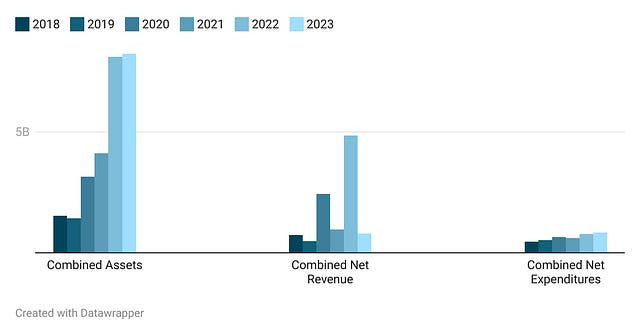
CMD’s analysis is based on the most recent IRS tax filings for 27 nonprofit organizations, in addition to the relevant disclosures of seven political action committees published by the FEC. The data builds upon similar investigations conducted in previous years and makes use of the same methodology previously disclosed.
Koch Begat Koch
While most of these organizations do not reveal their donors, grants that are disclosed show that the Koch fleet is relatively insular:
- Of the $363 million spent by the Stand Together Chamber of Commerce in 2023, over $156 million was sent to Americans for Prosperity (AFP) and its affiliated super PAC. Another $88.8 million was spent on employee salaries and benefits, indicating the scale of the fleet’s internal staffing network. Almost $60 million of the Stand Together Chamber’s spending is ambiguously listed as “other” expenses.
- More than $170 million of AFP’s $185 million budget -– 92% — came from two Koch-controlled organizations, the Stand Together Chamber of Commerce and Stand Together C4 Fund. All three groups operate out of the same office building in Arlington, VA.
- Two more groups operating out of the same office building received a similar proportion of their budgets from within the Koch fleet. The 501(c)(4) Yes Every Kid received 92% of its $8.7 million budget from the Stand Together C4 Fund. Its sister organization, the 501(c)(3) Yes Every Kid Foundation, received 87% of its $4 million budget from the Stand Together Trust.
- The Stand Together C4 Fund received 58% of its revenue from two large grants from other Koch-controlled groups: $213 million from Believe in People and $50 million from Key Change, which was previously named CCKC4.
- Nine Koch-controlled groups disclosed Stand Together Communications, an in-house public relations firm, as a top contractor in 2023, exceeding $107 million in combined contracts. Since 2018, the firm has received over $345 million in contract payments from Koch-controlled organizations.
- Another $20.5 million in 2023 contract payments were disclosed to i360, Koch’s AI-powered voter profiling and data company, which also conducts consulting services for many candidates and organizations outside of the Koch fleet.
On paper, 53% of the Koch fleet’s gross revenue came from other Koch-controlled groups. It is possible that additional funding ultimately came from Koch, Inc., or from wealthy business people and corporate heirs who coordinate their spending with the Koch family. The tax filings of key nonprofits do not disclose their donors, including the Stand Together Chamber of Commerce, which took in over $250 million in 2023, mostly from undisclosed sources.
Dark Money Grants
Koch continued to send millions of dollars to the National Philanthropic Trust (NPT), a multi-billion dollar donor-advised fund that serves to obscure the relationship between specific donors and grantees. A total of $3 million was granted to the trust in 2023 between two separate grants disclosed by the Stand Together Trust and the Knowledge & Progress Fund. Koch organizations have granted a total of $102.1 million to the NPT since 2019, representing 86% of Koch foundation grants to donor-advised funds in that timeframe.
Since 2005, Koch foundations have given a grand total of $138.2 million to donor-advised funds. 2019 was the first year the Koch fleet began passing grants through donor-advised funds like the NPT and the Fidelity Charitable Gift Fund instead of DonorsTrust. Previously, DonorsTrust and Donors Capital Fund received a combined $20.1 million from Koch foundations between 2005 and 2019.
Koch Grants to Universities
As with previous years, one of the larger net spenders within the Koch fleet was the Charles Koch Foundation, which focuses most of its grantmaking on higher education. In 2023 it granted $90.8 million to dozens of universities.
The Koch fleet has granted over $788 million to more than 500 universities since 2005, according to a recent analysis by CMD, in combination with older tax filing data. As CMD has previously reported, universities have long represented the foundation for Charles Koch’s overall policy influence strategy, prompting student and faculty resistance on many campuses.
The Mercatus Center and the Institute for Humane Studies (IHS) at George Mason University -– two organizations that have been controlled for decades by Koch, Inc.’s top executives -– continue to be major spenders within the Koch fleet. Mercatus, founded by Charles Koch and Richard Fink, acts as a strategic bridge between Koch’s university investments and its larger policy influence strategy, often advocating against policies and regulations that Koch, Inc. and other Mercatus sponsors seek to dismantle. The IHS serves as a key recruitment and training hub for the “talent pipeline” that Koch continues to prioritize.
George Mason University, Mercatus, and IHS have received over $305 million from Koch foundations since 2005, in addition to tens of millions in grants to GMU, IHS and Mercatus dating back to the mid 1980s.
Americans for Prosperity Priorities
Koch-controlled organizations were busy advancing a number of priorities in the realms of policy, lawsuits, and social issues in 2023. Much of this was conducted through AFP and its affiliated 501(c)(3) foundation and super PAC, which spent a combined total of $207 million that year:
- AFP Action, an FEC-registered super PAC, spent $30 million in 2023 as it warmed up for the 2024 elections, an effort that ultimately cost over $138 million during the two-year election cycle. The overwhelming majority of these funds were spent supporting Republican candidates and opposing Democrats.
- AFP endorsed staunchly anti-environmental gubernatorial candidates such as West Virginia’s Patrick Morrisey, Indiana’s Mike Braun, and Louisiana’s Jeff Landry, a climate change denier.
- As the fleet’s hub for “grassroots” activism, AFP continually orchestrated statements, reports, petitions, and events blaming then-President Biden for inflation, which many economists dismissed.
- AFP continued a long tradition of attacking worker’s unions. It encouraged Florida’s Republican Governor Ron DeSantis to “hold unions accountable,” fought against a repeal of the decade-old “right-to-work” anti-union law in Michigan, and condemned a strike by the United Auto Workers by unionized employees in Michigan and Ohio.
- 2023 was the busiest year in the anti-ESG (environmental, social, and governance investing) trend in the states, with 26 of the 48 total anti-ESG laws passed that year in 31 states. AFP, along with other heavily Koch-funded groups like the Texas Public Policy Foundation (TPPF), the Heritage Foundation, and the American Legislative Exchange Council, led a state and federal crusade against “ESG” risk assessments in investing as a means of shielding the fossil fuel industry from accountability for the investment risks posed by climate change and pollution.
- AFP celebrated a Supreme Court ruling in favor of a small business that refused to serve gay people. The ruling was opposed by the American Civil Liberties Union (ACLU). The Koch-funded Alliance Defending Freedom -– an extreme Christian hate group known for its discrimination against the LGBTQ population -– represented the plaintiff in the case.
- :{:{AFP released a statement praising Elon Musk’s “3 best changes” at X (Twitter), without noting the platform’s increased use by hate groups and its resulting drop in use and revenue. Koch has financed several organizations that are involved in a lobbying effort to shield big tech companies from antitrust laws.}:
- AFP’s Pennsylvania chapter continued to attack the Regional Greenhouse Gas Initiative (RGGI) -– a regional cap-and-trade partnership designed to reduce carbon emissions -– while Koch Supply and Trading was participating in RGGI trades.
Stand Together Trust Grantmaking in 2023
Koch’s advocacy activity was complemented by grantmaking activity run out of the Stand Together Trust, which has become the fleet’s primary funder of external policy influence groups in recent years. The Stand Together Trust spent $157 million in 2023, most of which was granted to other Koch-controlled organizations, as well as external organizations like the Foundation for Individual Rights and Expression (FIRE), the Cato Institute, and the TPFF. The trust also gave large grants to charitable organizations such as the Edward Charles Foundation -– which is itself a grantmaker -– and The Phoenix, an exercise-based drug rehab charity.
K–12 School Privatization
A combined $11.6 million was spent by Yes Every Kid (YEK) and the Yes Every Kid Foundation. YEK was founded on vague aspirations to “transform public education” by promoting school “choice,” evoking strong skepticism from teachers’ unions. YEK has a notable absence of educational professionals among its leadership, most of whom have backgrounds in politics, lobbying, and public relations.
Charles Koch has opposed unions of all kinds for decades, including teacher’s unions specifically. His fleet of organizations have long supported efforts to funnel money away from public to private schools. Some of Koch’s groups, such as the Bill of Rights Institute and Empowered (formerly “Youth Entrepreneurs”), work to inject controversial material into school curricula such as texts whitewashing the history of slavery in the U.S.
Philanthropy and Stand Together Music
While the fleet continued to focus spending on universities and policy influence groups, Charles and his son Chase Koch also cultivated social capital through their philanthropy in 2023.
Most of this nonpolitical philanthropy dates back to a questionable but successful public relations rebranding effort that began a decade ago and depends on the Stand Together Foundation as the primary grantmaker. The foundation spent over $62 million in 2023, most of which was on grants to organizations involved in relatively noncontroversial causes like youth mentorship and development, drug rehabilitation, and Christian charities.
With the increased leadership of Chase Koch, a guitarist in an active band, much of Koch’s philanthropic activity is focused on garnering partnerships with high-profile artists. Stand Together Music, a project brand operated by the Stand Together Chamber of Commerce, earned favorable media for its partnerships with big-name musicians including Machine Gun Kelly, Darryl “DMC” McDaniels, Pitbull, the Chainsmokers, and Aloe Blacc -– whose new album was named after Koch’s Stand Together brand. Favorable coverage of these collaborations runs in outlets funded by Stand Together, such as *SPIN*magazine.
Koch’s music-centered philanthropy received some critical coverage for its juxtapositional collaborations with politically progressive musicians like Tom Morello of Rage Against the Machine and Killer Mike of Run the Jewels. Killer Mike has continued working with the Koch family after initially signaling he wasn’t aware of who was behind Stand Together Music.
---
EPI
BOGUS STUDY
Stevenson and the Mackinac Center want to repeal Michigan’s landmark clean energy laws
In March, Stevenson delivered testimony in support of Michigan House Energy Committee Chair Pauline Wendzel’s “Project Lighthouse” legislation, House Bills 5710 and 5711, which would repeal Michigan’s landmark [2023 clean energy laws](https://www.michigan.gov/mpsc/commission/workgroups/2023-energy-legislation#::text=The%20laws%20also%20include%20three%20one-time%20proceedings:,Increases%20the%20cap%20from%201%25%20to%li%25).
The legislation approved by Republicans in the Michigan House would slow down the “build-out of the cheapest, fastest energy, limiting Michigan’s ability to leverage federal investments and pushing the state toward more expensive, long-term fossil fuel infrastructure” if it becomes law, according to the Michigan League of Conservation Voters (LCV).
It would also remove “basic planning and reporting requirements, allowing pollution to go unreported and increasing costs as energy demand grows,” Michigan LCV said.
In his testimony in support of the legislation, Stevenson again pointed to a 2025 report prepared for the Mackinac Center by the Center for the American Experiment, a Minnesota-based SPN affiliate, and Always on Energy Research, a SPN partner. The Lignite Energy Council, a coal industry group that’s opposed 100% clean energy legislation in neighboring Minnesota, paid the Center of the American Experiment $115,000 for electrical grid and reliability modeling in 2023.
The 2025 reportclaimed that powering Michigan with coal, gas, large-scale nuclear, and SMR would be cheaper than transitioning to a mix of wind, solar, nuclear, and energy storage. In addition to postponing the closures of the J.H. Campbell and Monroe plants until 2040, the report called for outfitting the state’s existing coal and gas plants with carbon capture and storage (CCS). The report also claimed relying on wind, solar, and energy storage “could lead to numerous blackouts throughout the year.”
“Our study might be contested,” Stevenson acknowledged in his testimony.
SMR projects in the U.S. and globally have run into cost overruns, according to the Institute for Energy Economics and Financial Analysis. Multiple high-profile utility projects aimed at demonstrating the commercial viability of CCS for coal plants have devolved into costly economic boondoggles mired in public scandal.
Always on Energy Research has churned out similar reports for other SPN groups, including two reports focused on New England’s power grid prepared for the Americans for Prosperity Foundation and SPN groups based in Connecticut, Maine, Massachusetts, New Hampshire, and Rhode Island. The Acadia Center, an environmental group working to halve carbon emissions in the Northeast by 2030, has published rebuttals of Always on Energy Research reports on New England.
“Misleading analysis grossly inflates the cost of clean energy, selectively ignores fuel savings, and proposes highly unrealistic alternative scenarios,” the Acadia Center said of Always on Energy Research’s methodology in its latest rebuttalin January.
Stevenson received funding from SPN to lead a nuclear waste discussion group with nuclear industry contacts
an 1 25
A right-wing advocacy group founded by the billionaire Koch brothers announced Monday the launch of a $20 million campaign to promote an extension of the 2017 Trump-GOP tax cuts, which disproportionately benefited the rich and large corporations.
[vid]
But in a that debuted over the weekend, Americans for Prosperity (AFP) characterizes the 2017 Tax Cuts and Jobs Act as a boon to "hardworking Americans" and small businesses—and warns that allowing provisions of the law to expire at the end of this year as scheduled would be disastrous for the working class.
"This year, Congress is facing a countdown to a crisis that threatens family budgets nationwide," Ross Connolly, AFP's regional state director, said in a statement Monday. "We are proud to partner with the incoming Trump administration to protect prosperity and ensure that Congress acts."
AFP is a 501(c)(4) organization that describes itself as a "grassroots" movement despite being launched by Charles Koch and his late brother, David—two of the most notorious right-wing billionaire in U.S. politics.
The group said its new 50-state campaign represents "the largest effort by a conservative organization" to support President-elect Donald Trump's legislative agenda as he prepares to take office next week. The campaign, according to AFP, will include "over 1,000 meetings" at congressional offices, "in-district events" with activists and lawmakers, and "roundtables with job creators."
The campaign aims to "reach millions of voters on the phone and at their doorsteps," AFP said.
"The Trump tax giveaways passed in 2017 did not help working-class Americans. In fact, the top 1% of corporations received almost all of the benefits."
AFP's description of the impacts of the 2017 tax law flies in the face of resounding evidence showing that wealthy Americans—not ordinary workers—were the chief beneficiaries and are poised to reap most of the rewards once again if Trump and the Republican-controlled Congress extend the measure's soon-to-expire provisions.
"Americans for Prosperity is spending $20 million on a new ad campaign that champions the 2017 Trump tax law as a win for working families," Morris Pearl, chair of the Patriotic Millionaires, told Common Dreams. "But don't be fooled: What this Koch-backed group is really only after is protecting tax cuts for wealthy people like me."
"I'm in favor of tax relief for working people, but not yet another huge and unnecessary windfall for America's rich," Pearl added. "If Congress wants to help working families, they should make tax rates on labor income the same as tax rates on profits made by investors."
AFP is one of a number of right-wing, corporate-tied organizations pushing for an extension of the Trump tax cuts, which Republicans are planning to fund by slashing Medicaid, federal nutrition assistance, and other key programs.
The progressive watchdog group Accountable.US noted in a recent analysis that one of the groups pushing for an extension of the 2017 law is Advancing American Freedom, an organization "run by corporate consultants, lobbyists, lawyers, and executives, including former Trump administration officials who were directly responsible for the TCJA."
Accountable also observes that Club for Growth, a group funded by wealthy conservatives, "has pushed a deeper corporate tax cut plan as an 'opening salvo' in the current tax debate."
"The billionaire funders of the group's action arm have benefited enormously from the TCJA, saving hundreds of millions of dollars from a single obscure tax break for pass-through entities," the watchdog added.
In response to AFP's new nationwide campaign, Accountable.US executive director Tony Carrk told Common Dreams that "a glitzy ad campaign from a far-right organization won't change the fact that the Trump administration and Republican-controlled Congress are paying for giveaways to billionaires, wealthy tax cheats, and price-gouging corporations by cutting critical services for working families, like Medicaid and SNAP."
"The Trump tax giveaways passed in 2017 did not help working-class Americans," said Carrk. "In fact, the top 1% of corporations received almost all of the benefits."
Watch the ad below:
10 24 master class scotus? lawsuit camp finance disclose
10 24 master class scotus? CU did not get --> AFP lawsuit camp finance disclosure?
Americans for Prosperity v. Bonta - Ballotpedia
Americans for Prosperity v. Bonta is a case that was argued before the Supreme Court of the United States on April 26, 2021, during the court's October 2020-2021 term. It was consolidated with Thomas More Law Center v. Bonta (formerly Thomas More Law Center v. Becerra).
In a 6-3 opinion, the U.S. Supreme Court reversed the U.S. Court of Appeals for the 9th Circuit's ruling and remanded the case for further proceedings, holding that the district court was correct in entering judgment in favor of the petitioners and permanently enjoining the California Attorney General from collecting their Schedule B forms, and that the Ninth Circuit erred when it vacated those injunctions and directed the entry of judgment for the attorney general. Chief Justice John Roberts delivered the majority opinion of the court. Justice Clarence Thomas filed a concurring opinion. Justice Samuel Alito filed a concurring opinion, joined by Justice Neil Gorsuch. Justice Sonia Sotomayor filed a dissenting opinion, joined by Justices Stephen Breyer and Elena Kagan.[1] Click here for more information about the ruling.
HIGHLIGHTS
- The case: Two conservative advocacy groups, the Thomas More Law Center and Americans for Prosperity, challenged a California policy requirement that tax-exempt §501(c)(3) charitable organizations must disclose the names and addresses of major donors. The groups argued that the policy violated the First Amendment to the U.S. Constitution. On appeal, the U.S. Court of Appeals for the 9th Circuit ruled in favor of the state. Click here to learn more about the cases' background.
- The issues: The cases concerned governmental disclosure requirements for charitable organizations' donor lists and the Supreme Court's decision in NAACP v. Alabama.
- The questions presented: "Whether the exacting scrutiny this Court has long required of laws that abridge the freedoms of speech and association outside the election context—as called for by NAACP v. Alabama, 357 U.S. 449 (1958), and its progeny—can be satisfied absent any showing that a blanket governmental demand for the individual identities and addresses of major donors to private nonprofit organizations is narrowly tailored to an asserted law-enforcement interest."[2]
- The outcome: The U.S. Supreme Court reversed the U.S. Court of Appeals for the 9th Circuit's ruling and remanded the case for further proceedings.
The case came on a writ of certiorari to the United States Court of Appeals for the 9th Circuit. To review the lower court's opinion in the consolidated cases, click here.[3]
Timeline...
---
06/28/24
On June 28, the Supreme Court upended 40 years of precedent by overturning Chevron deference, a decision that will restrict federal agencies' regulatory abilities that will also make it easier for corporations to challenge environmental protections, climate action, and rules that protect workers and regulate drugs and financial practices, among other issues.
Undoing Chevron deference has been a central goal of the conservative legal movement and corporate lobbyists for decades, with right-wing think tank the Heritage Foundation arguing that “the modern administrative state creates a pervasive system of consolidated power that weakens the checks and balances carefully constructed by the United States Constitution.”
Now, Heritage has joined with over 100 other conservative organizations to organize Project 2025, a comprehensive transition plan to guide the next GOP presidential administration with policy proposals and staffing recommendations. In response to the Supreme Court ruling finally overturning Chevron deference, multiple Project 2025 partners joined right-wing media figures and climate deniers in celebrating the decision.
What is Chevron deference and why overturning it matters
- Chevron deference was a legal principle that required courts to defer to federal agencies’ reasonable interpretations of ambiguous statutes they administer. Chevron deference, established in the 1984 decision Chevron U.S.A., Inc. v. Natural Resources Defense Council, Inc., required courts to defer to federal agencies' “reasonable interpretation” of ambiguous statutes they administer when Congress had not directly addressed the issue. It applied to agency interpretations with the force of law, such as those from formal adjudications or notice-and-comment rulemaking. Cornell Legal Information Institute, accessed [6/28/24]
- The overturning of Chevron deference will significantly shift power away from federal agencies to the courts, potentially impacting a wide range of public protections and regulations. This shift could undermine decades of established policies and practices across many areas of governance. Without Chevron deference, courts may now substitute their own interpretations for complex technical and scientific issues ranging from financial regulations to environmental protections. This could reduce agencies’ ability to respond effectively to evolving challenges, such as the climate crisis, and weaken the government’s ability to implement laws as Congress intended. Natural Resources Defense Council, accessed [6/28/24]
- In her dissenting opinion, Justice Elena Kagan argued that the majority decision upends the balance and separation of power and will impact decision-making around all major issues. “It gives courts the power to make all manner of scientific and technical judgments," Kagan wrote. “It gives courts the power to make all manner of policy calls, including about how to weigh competing goods and values. (See Chevron itself.) It puts courts at the apex of the administrative process as to every conceivable subject—because there are always gaps and ambiguities in regulatory statutes, and often of great import. What actions can be taken to address climate change or other environmental challenges? What will the Nation’s health-care system look like in the coming decades? Or the financial or transportation systems? What rules are going to constrain the development of A.I.? In every sphere of current or future federal regulation, expect courts from now on to play a commanding role. It is not a role Congress has given to them, in the APA or any other statute. It is a role this Court has now claimed for itself, as well as for other judges.” Supreme Court, *Loper Bright Enterprises v. Raimondo*, [6/28/24]
- Legal expert Neal Katyal argued on MSNBC that overturning Chevron deference is “going to impact you and me every single day of our lives.” “This is a massive game change to the way our government is going to operate,” Katyal said. “Justice Kagan's dissent at the very last lines say how dangerous this is, how this shows that this court has no respect for the role of precedent, for stare decisis. She points out that the Supreme Court has relied on this principle of deference, Chevron deference, over 70 times since 1984. Lower courts have relied on it more than 18,000 times. And yet the court blew past all that and totally changed the law in a way that's going to impact you and me every single day of our lives.” MSNBC, *Ana Cabrera Reports*, [6/28/24]
Project 2025 partners celebrate court’s decision to overturn Chevron and the demise of the “administrative state”
- Heritage senior legal fellow Sarah Parshall Perry posted on X (formerly Twitter) that “SCOTUS overrules the judicially created Chevron doctrine - which has for years given federal executive agencies authority never congressionally delegated to them. … This is a massive shift in judicial dynamics that will curb the advances of the administrative state.” Twitter/X, [6/28/24]
- The Center for Renewing America, headed by former Trump Cabinet official Russ Vought, posted a clip from War Room with a quote from CRA senior fellow Jeff Clark saying, “The Deep State wanted to create a 4th branch of government who would rule over the American people … the Supreme Court wiped that away today.” Twitter/X, [6/28/24]
- Texas Public Policy Foundation executive Chuck DeVore posted on X that “Chevron Deference is dead. … Now Congress will have to do its job, not simply passing vague laws and then letting unelected bureaucrats do their dirty work.” DeVore also claimed that former President Donald Trump’s Supreme Court appointments “made it happen.” Twitter/X, [6/28/24]
- Moms For Liberty co-founder Tiffany Justice posted: “Today was a good day for limiting the power of the federal bureaucracy. Chevron is overruled. The Supreme Court limits federal agency power. Citizens have rights in court that federal agencies can’t take away.” Twitter/X, [6/28/24]
- The Job Creators Network released a press statement from its CEO saying, “The Supreme Court’s decision to overrule the Chevron precedent is a major victory for American small businesses. It finally reins in out-of-control regulators and bureaucrats who have for too long acted as unelected and unaccountable enemies of Main Street.” The group posted a similar message on X, adding, “Overregulation is one of the biggest challenges small businesses face, and this ruling is transformational in diminishing this threat and regulators’ power.” Job Creators Network, [6/28/24, 6/28/24]
- Competitive Enterprise Institute President Kent Lassman posted: “It’s morning in the Imperial City. Big changes demand long-term vision and a steady application of the correct combination of tools. Today radical and necessary changes to the regulatory state took big steps forward toward the light of liberty.” Twitter/X, [6/28/24]
- Heartland Institute policy adviser Jeff Stier responded, “Don’t believe the headline ‘SCOTUS guts regulators’ power to protect the environment & public health. The end of Chevron Deference is a win for the constitution & We the People. Elected representatives must clearly delegate any power it wants to delegate.” Twitter/X, [6/28/24]
- Former Trump HUD Secretary Ben Carson of the American Cornerstone Institute wrote, “This is a huge victory for limited, constitutional government and reining in the unelected administrative state.” Carson added that his group “urged the Supreme Court to reach just this conclusion in the amicus brief we submitted. We are proud to have played a part in this monumental win.” Twitter/X, [6/28/24]
- Former Trump DHS official and Center for Renewing America senior fellow Ken Cuccinelli wrote that “we have another part of our constitution back … Chevron deference is GONE!”Twitter/X, [6/28/24]
- Horace Cooper of the National Center for Public Policy Research posted that “Supreme Court takes sledgehammer to federal agency power in Chevron case.” He added, “Make no mistake, having a majority of constitutionalists on the Supreme Court ultimately does protect the American people.” Twitter/X, [6/28/24]
- ## Right-wing media figures and climate deniers cheer on the Supreme Court decision overturning 40 years of legal precedent
- Mike Davis, a former law clerk for Justice Neil Gorsch and president of the Article III Project, told Steve Bannon on War Room that the doctrine was unconstitutional and the decision “means a lot for real Americans and real America.” Davis said. “This just shows you how important elections are and how consequential Trump's first term was. He transformed the left-of-center Supreme Court to the Clarence Thomas Supreme Court.” Real America’s Voice, *Steve Bannon’s War Room*, [6/28/24]
- The Federalist CEO and co-founder Sean Davis wrote: “BREAKING: In a major blow to the unelected administrative state, the Supreme Court has overruled the Chevron doctrine, which required courts to defer to the legal interpretations of unelected bureaucrats.” Twitter/X, [6/28/24]
- National Review senior editor Charles C.W. Cooke: “Chevron is overruled. A great day for the Constitution.” Twitter/X, [6/28/24]
- Climate denier and frequent Fox News contributor Steve Milloy wrote on X that the decision was a “HUGE WINNING,” adding that Trump “made this possible!”Twitter/X, [6/28/24, Media Matters, 10/13/21]
- Daily Signal editor Tyler O’Neil posted on X that the ruling is “a huge step forward for holding the administrative state—and the deep state—accountable.” Twitter/X, [6/28/24]
- Cato Institute Senior Vice President Clark Neily wrote that “SCOTUS just withdrew a deep reservoir of power from the administrative state.” Twitter/X, [6/28/24]
- Carrie Severino, a former legal clerk for Justice Clarence Thomas and the president of the Leonard Leo-connected Concord Fund (formerly the Judicial Crisis Network), wrote: “Good riddance to Chevron deference, which put a two-ton judicial thumb on the scale of government bureaucrats against the little guy. This is a big victory for the rule of law.” Twitter/X, [6/28/24; ProPublica, 10/11/23; CNN, 6/13/24]
- Reason Magazine editor Billy Binion wrote: “Congress has ceded its authority to executive agencies & given unelected bureaucrats immense power to interpret vague laws. Today's Chevron decision will force the legislative branch to do its job: Write laws that make sense. That's not a scandal.” Twitter/X, [6/28/24]
- Former GOP candidate and climate denier Vivek Ramaswamy wrote on X that “this is a *seismic* ruling,” claiming Chevron deference “has poisoned our country in recent decades.” He added that “unelected bureaucrats in the administrative state” will no longer make the laws, and “America is better off for it.” Twitter/X, [6/28/24; Rolling Stone, 8/23/23]
- The Daily Wire’s Michael Knowles posted a video about the “Earth-shattering, groundbreaking” decision, saying that the Supreme Court “just gutted the deep state” and that it’s nearly as consequential for the right as Roe v. Wade getting overturned. “Conservatives have considered this a major source of the unaccountability of government, the bloat of government, the capricious rule that we have,” Knowles said in the video. “I’m not saying that it rises to the level of a Dobbs decision overruling Roe,” he concluded, “but in some ways, from a structure of government perspective, it sort of does.” Twitter/X, [6/28/24]
- Far-right influencer Ian Miles Cheong wrote on X that the decision prevents agencies from “coming up with onerous regulations that force companies to pay salaries to government observers whose job is to act like unwanted nannies,” celebrating that it “stops federal agencies from being able to force compliance with mask mandates and COVID vaccines onto companies.” Twitter/X, [6/28/24]
- :{Climate denier:{ Chris Martz}: wrote that the Chevron doctrine “allowed unelected bureaucrats to interpret the law as they pleased and create boundless rules and regulations on businesses,” calling the new ruling overturning it “a major win for the Constitution.”:{ Twitter/X, }:[6/28/24; AFP Fact Check, 5/1/24]}:
- Epoch Times contributor Hans Mahncke wrote: “The invalidation of the Chevron deference, which gave DC bureaucrats largely unchecked authority to create rules and regulations, is arguably the most significant constraint of the administrative state in generations. This is a major victory for rule of law and democracy.” Twitter/X, [6/28/24]
===
see fox
dirty trick pseudo-event
6 24
mma
in the lead-up to the 2024 presidential election, right-wing media are doubling down on deceptive messaging around gas prices to attack President Joe Biden — in part by promoting a campaign launched by Americans for Prosperity, the fossil fuel billionaire Koch brothers' conservative political advocacy group.
- ## Americans for Prosperity has resurrected its nationwide campaign to convince voters that they are “paying more but getting less” because of the Biden administration — specifically when it comes to the gas pump
- Ahead of Memorial Day, Americans for Prosperity launched its cross-country tour partnering with gas stations to offer lower prices, claiming it was combating “Biden’s war on American energy.” From May 20 to June 3, the group pledged to sell gas for a few hours a day at select stations in 16 states for $2.38 — “near the average price per gallon of gas on the day President Biden assumed office” — while the “national average for a gallon of gas hovering near $3.59 thanks to Bidenomics.” The campaign featured an AFP-branded van with a message painted on the side that said, “Bidenomics costing Americans over $11,400 a year.” Fox Business, [5/20/24; Bidenomics.com, 5/20/24; Americans for Prosperity, 5/20/24]
- The group also pulled this stunt in 2022 before the midterm elections to highlight “harmful government economic policies.” In 2022, AFP traveled to “more than 60 cities to connect people to the fact that this is Washington’s price hike: You’re paying more but getting less.” The campaign pushed a nearly identical message to the current, ongoing one, in addition to encouraging “solutions that unleash energy abundance, end wasteful spending, and ignite innovation.” Americans for Prosperity, accessed [5/30/24; Fox Business, 4/6/22]
- In 2022, Time magazine’s Philip Elliott wrote that the AFP campaign signaled a significant strategy shift for Koch organizations from “philosophy texts” to “more direct engagement” to get voters' attention. According to Elliott, going on the road represents “a clear encapsulation of the shifting strategy inside the Koch orbit’s many organizations, led in the political space through Americans For Prosperity. … Now, Koch strategists are starting to pivot to more direct engagement through digital targeting, mail, and some guerilla marketing that even a short time ago would be dismissed as low-brow tactics beneath the dignity of a high-minded network that distributes philosophy texts and disruption manifestos at its conferences.” Time magazine, [8/2/22]
- ## Gas prices have been relatively stable, and are determined by market forces and not presidents
- Finance columnist Rick Newman wrote, “Market forces that no US president can control explain the recent history of oil and gas prices far more than anything Trump or Biden has done,” adding, “ Anybody who thinks Trump would take some kind of decisive action to lower energy prices if he wins a second presidential term is likely to end up deeply disappointed.” The article continues: “Saudi Arabia and other OPEC+ nations have cut production during the last two years to keep prices high. … Russia’s 2022 invasion of Ukraine created other snags in global energy flows, putting upward pressure on prices even now, more than two years later.” Yahoo Finance, [5/2/24]
- The Energy Information Administration says, “The United States produced more crude oil than any nation at any time ... for the past six years in a row,” adding, “The crude oil production record in the United States in 2023 is unlikely to be broken in any other country in the near term.”U.S. Energy Information Administration, [3/11/24]
- Gas prices have been steadily decreasing compared to 2022 and 2023, and this trend is expected to continue barring extreme weather. As of March, the average gas price was about 12 cents lower than it was in 2023, when “prices were $0.43 less … than in 2022 on average.” According to GasBuddy analyst Patrick De Haan, prices should continue to fall “towards what most Americans would consider normal prices at the pump.” However, high summer temperatures and an intense Atlantic hurricane season might negatively impact energy markets. Yahoo Finance, [3/16/24; CNN, 12/27/23; U.S. Energy Information Administration, 5/22/24; Bloomberg, 5/30/24]
- ## Fox News and Fox Business propped up the AFP campaign “to highlight ‘Biden’s war on American energy’”
- Fox Business promoted the PR stunt with the headline: “Conservative group partners with gas stations to highlight ‘Biden’s war on American energy’: Here’s how.” The article quoted Akash Chougule, AFP’s vice president of government affairs, who said, “From shutting down the Keystone Pipeline to banning energy leases on federal land, Joe Biden’s top-down policies have stifled our country’s energy resources and made even the things like a family road trip more expensive. … This week, we are spotlighting what gas prices could be with policies that unleash our country’s energy potential.” FoxBusiness.com, [5/20/24]
- Fox host Lawrence Jones promoted the campaign on Fox & Friends and interviewed AFP’s vice president of government affairs, Akash Chougule. Showing a map of all the cities where AFP is traveling, Lawrence said, “As Americans struggle with high inflation and gas prices, one conservative group [is] reminding them how much cheaper it was to fill up the car before Biden took office.” Chougule then said that “Americans don't need to be told life is expensive. What we’re doing is explaining to them why it’s expensive, and the reason is Bidenomics — the $6 trillion in additional spending, thousands of pages in regulations that are making their life costlier.” Fox News, *Fox & Friends*, [5/21/24]
- Fox Business host Cheryl Casone discussed the campaign and quoted AFP: “Biden’s war on American energy has had disastrous results and Americans are reeling from high gas prices going into the summer.”Casone continued, “From shutting down the Keystone pipeline to banning energy leases on federal land, Joe Biden’s top-down policies have stifled our country’s energy resources and made even things like a family road trip more expensive.” Fox News, *Fox & Friends First*, [5/21/24]
- OnFox & Friends, Jones said that AFP is getting gas prices “back to when Trump was there,” claiming that “it’s all tied to the green energy policy of Joe Biden.” “Yesterday we had AFP on,” Jones said. “They are going to about 30 to 40 different gas stations and they’re paying for the gas to get back to when Trump was there to show Americans what life was about. But they did some analysis on why the gas prices are going up and it’s all tied to the green energy policy of Joe Biden.” Fox News, *Fox & Friends*, [5/22/24]
- On Fox Business’ Cavuto: Coast To Coast, a chyron read, “Americans for Prosperity offers gas at ‘pre-Biden’ prices.” Fox White House correspondent Edward Lawrence asked Sen. Cynthia Lummis (R-WY) about the campaign: “Last week, you pumped gas as the group Americans for Prosperity rolled back prices at [a] station in Wyoming to the levels of when before President Biden took office, when former President Trump was in office. What was that about?” In response, Lummis blamed the Biden administration for “not producing as much as we need to have prices that the American people can afford within their own budgets.” Fox Business, *Cavuto: Coast To Coast*, [5/28/24]
- ## The AFP stunt is just the latest example in a drumbeat of right-wing media coverage trying to pin high gas prices solely on Biden
- On Fox, former Trump economic adviser Stephen Moore dismissed record oil production to claim that the Biden administration is responsible for high gas prices. Moore said that “Biden has massively increased spending on these green energy programs like solar energy, like wind energy, like battery energy, and yet we’re still using record amounts of fossil fuels,” claiming that “the worst way to deal with our high gas prices is to diminish and deplete our Strategic Petroleum Reserve.” Fox News,*America Reports*, [4/22/24]
- After the Biden administration announced last year that it would cancel seven oil and gas leases in Alaska’s Arctic National Wildlife Refuge, Fox Business host Elizabeth MacDonald asked whether Biden “really wants like $10 gas? I mean, who is he president of? Is he president of us or his climate change political donor base, because now we’re going to have to import more oil.”Fox Business, *The Evening Edit*, [9/7/23]
- Fox contributor Tammy Bruce said Biden canceled the leases because “they want people to drive less, and having gas prices be high, they figure, is going to do that.”“When you cut those leases, it signals to everyone that, you know, you are not really serious about making sure we are energy independent,” Bruce said. “You think those polls are bad now? Gasoline will continue and it is going up again. So will home heating oil prices.” Fox News, *The Faulkner Focus*, [9/7/23]
- On America’s Newsroom, Fox anchor Sandra Smith suggested that Biden is blaming oil companies instead of taking responsibility for high gas prices. “It's been OPEC, it's been now the Saudis, it's been Vladimir Putin, and most recently it's also been pinning a lot of blame on the oil companies themselves,” Smith said. “The president has been putting the onus on the oil companies, that he told he was going to bring the end of the fossil fuel industry, to ramp up their production.” Fox News, *America’s Newsroom*, [10/14/22]
- Climate contrarian and frequent Fox News guest Michael Shellenberger claimed that “by working against domestic oil production, it’s Biden who has allowed the Russians & Saudis to raise gas prices.” Twitter/X, [10/7/22]
- ## Right-wing media also recently took aim at Biden’s Energy Department for releasing 1 million barrels of gasoline from reserve sites in New Jersey and Maine, often conflating the temporary Northeast sites with the Strategic Petroleum Reserve
- While the reserve was initially created for emergencies like Superstorm Sandy, Congress mandated the sale in March as part of a spending package to prevent a government shutdown. According to The Washington Post, “A 2022 report by the Government Accountability Office said the gasoline reserve, which has never been tapped, would provide minimal relief during a severe shortage. The reserve costs about $19 million a year to maintain.” The Washington Post, [5/21/24]
- The administration has stated that the release was timed to help lower gas prices, but it will likely only have a minimal impact for most of the country. “The Energy Department said the sale of 1 million barrels, about 42 million gallons, was timed to provide relief for motorists as the summer driving season begins,” according to The Associated Press. But GasBuddy’s Patrick De Haan told The Washington Post that the “sale of the Northeast reserve would have little impact on gasoline prices nationally, although there ‘may be a slight downward pressure on prices’ in the Northeast. The million-barrel reserve only amounts to about 2.7 hours of total U.S. gasoline consumption, he said.” The Associated Press, [5/21/24; The Washington Post, 5/21/24]
- Fox contributor Sean Duffy said that instead of releasing the Northeast reserve, Biden should “just support American oil and gas and their drilling.”“Again, he sees the politics of gas prices, but this is pretty simple, senator,” Duffy said in an interview with Sen. Ron Johnson (R-WI). “Just support American oil and gas and their drilling as opposed to Joe Biden and Democrats attacking American oil and gas. You don't have to release a million barrels from the Strategic Petroleum Reserve, just pump more oil!” Fox News, *Sunday Morning Futures*, [5/26/24]
- Citing gas prices, Fox contributor Jason Chaffetz and former Trump adviser Stephen Moore chastised Biden for not getting inflation under control. Moore said Biden should be increasing “the supply of goods and services” so prices go down. “That's especially true in gas, “ he said. “Why aren’t we producing more oil and gas here at home?” Filling in for host Sean Hannity, Chaffetz claimed, “We were energy independent and made a choice not to and now Joe Biden, in order to bring down the price of gas, is tapping into a strategic petroleum reserve. He's doing it for political purposes.” Fox News,*Hannity*, [5/24/24]
- Fox host Laura Ingraham claimed Biden’s “anti-oil and gas policies” forced him to release the reserve irresponsibly.“Well, Biden is suddenly scrambling to lower gas prices,” Ingraham said. “Unfortunately, because of his administration’s anti-oil and gas policies and domestic drilling off the table, he has only one way of doing this — yeah, by draining our Strategic Petroleum Reserve again,” calling the move “a tool to boost an intellectually and physically sagging incumbent.” Fox News,*The Ingraham Angle*, [5/21/24]
- In an interview with Newsmax host Rob Schmitt, MAGA podcaster Monica Crowley said that the Biden administration “created this crisis” and called the move to release the Northeast Reserve “treasonous behavior.” Crowley claimed the administration is trying to resolve a “political emergency that they themselves created by their war for the last three and a half years on fossil fuels, driving up the cost of energy across the board and helping to drive up inflation.” She continued, “This is actually borderline treasonous behavior, if not straight-up treasonous behavior.” Newsmax, *Rob Schmitt Tonight*, [5/21/24]
//
Right-wing media used OPEC oil cuts to blame Biden for domestic gas price volatility
10/24/22
07/11/22
06/16/22
---
an 12 23 outlier
not all of Americans for Prosperity's (AFP) staff is on board with the group's endorsement of former UN ambassador Nikki Haley in the 2024 Republican presidential primary.
Chris Maidment, who has been AFP's director of grassroots operations in New Hampshire since March of this year according to his LinkedIn profile, blasted the Koch-funded group's announcement that it would be backing Haley in a recent thread on X (formerly Twitter). Maidment indicated he may lose his job over his post, but held fast in his position that the group had lost its "principles" and that he would not be casting his ballot for the former South Carolina governor due to her foreign policy positions.
"I will never vote for Nikki Haley. Not once. My children deserve better than to be drafted in some war overseas," Maidment tweeted. "If it comes down to it, I'll vote for [President Joe] Biden over Haley 10 times out of 10, because he's less of a threat to our country."
"In tweeting this I give up friends, family, and a job. I give up a lot. But for the right reasons," he wrote, clarifying that he still respects his colleagues who choose to vote for Haley. "I need the insurance. I need the pay. I need the benefits. But, more than that, I need to instill in the next generation that we do the right thing, always, despite the pay, benefits, and add-ons."
The endorsement from AFP is a critical boost for Haley's campaign — particularly in New Hampshire, where she has seen her poll numbers surge past all of her non-Trump rivals. According to RealClearPolitics' polling data, Haley was registering 18.7% support among likely Republican primary voters in the Granite State as of November 17, with former New Jersey Governor Chris Christie coming in third with roughly 11% support and Florida Governor Ron DeSantis lagging behind in fourth place with 7.7% support.
In announcing its endorsement of Haley, AFP pledged to lend "the full weight and scope of AFP Action’s unmatched grassroots army and resources to help her earn the support of Americans to become the next President of the United States of America." As director of grassroots operations in a state where Haley is performing her best, Maidment likely would be the group's main facilitator of get-out-the-vote operations for the former UN ambassador in New Hampshire.
Despite Haley's recent polling boost, she still lags far behind former President Donald Trump, who is leading by nearly 30 points in both early state polls and national polls. The Iowa Caucuses take place on January 15, and the New Hampshire primary is slated for January 23.
READ MORE:Koch network pledges 'full support' of 'unmatched grassroots army' to stop Trump in GOP primary
---
50 pt leAD HUBRIS?
11 23
an
ahead of the Iowa caucuses in January, GOP mega donors who are looking to replace ex-President Donald Trump as the leading 2024 GOP nominee are "starting to run out of time" — but not giving up hope, according to a Wednesday Axios report.
Some mega-donors, like Home Depot co-founder Bernie Marcus are certain the MAGA hopeful will prevail, though Trump is not his first choice.
"There are people I've spoken to that are still sitting on the fence, that don't know what to do," Marcus said to ABC News, according to Axios. "They dislike the person Trump, but they recognize that the talent is there."
Additionally, in a recent op-ed for Real Clear Politics, he wrote, "Let's face it: Donald Trump is going to win the nomination."
However, other major Republican donors are looking to help ex-South Carolina Governor Nikki Haley take Trump's place.
Axios points out "Deep-pocketed establishment donors have been lining up behind Haley," such as GOP mega-donor Ken Griffin who said earlier this month that he is "actively contemplating" supporting Haley, and JPMorgan Chase Chief Executive Officer Jamie Dimon, who "has had private conversations with her."
Furthermore, "Americans for Prosperity Action, the leading political arm of the Koch network, said that Haley "will have the full weight and scope of AFP Action's unmatched grassroots army and resources," according to the news outlet.
Narrative Strategies founding partner Ken Spain emphasized, "The hope is this is increasingly becoming a two-person race with [former UN ambassador Nikki Haley] ... as the establishment alternative. It's still long shot, but a bet worth placing if you're an anti-Trump big money donor."
:{READ MORE:'Blatantly unconstitutional': Nikki Haley ripped for 'fascist' proposal to outlaw anonymity on social media
*Axios' full report is available here.
---
---
new 10 23 email
no lnx
‘Get the Right Cases to the Supreme Court’: Inside Charles Koch’s Network
Billionaire’s web of rightwing groups works to bring cases to court that could undermine core functionings of the US government
ED PILKINGTON AND NICK SURGEY
OCT 26
:
This article was produced in partnership with The Guardian
The Koch network, a web of rightwing groups cultivated by billionaire businessman Charles Koch and his late brother David Koch, is spearheading the attack on federal agencies and government regulations that dominates the US supreme court agenda this term.
The network has been working behind the scenes to bring cases before the court that, if successful, could undermine many of the core functionings of the US government. At least two of the biggest cases to be considered by the justices this term have been spurred by groups bankrolled and coordinated within the Koch universe.
Footage of an internal panel discussion between senior operatives from Koch entities held in the summer of 2022 reveals that the network has been quietly planning the current assault on the “administrative state”. The groups are seeking to exploit the supreme court’s new six-to-three rightwing majority secured by Donald Trump to dismantle vital executive powers.
Regulatory controls in their sights include environmental standards to combat pollution and the climate crisis, consumer protections against predatory lenders, and safeguards for workers’ rights. At stake is what the Strict Scrutiny podcast has called “the future of government as we know it”.
The footage, which is made public here for the first time, was obtained by the investigative watchdog Documented and shared with the Guardian. During the 37-minute panel discussion, legal strategists with several Koch-related groups expressed excitement that the new hard-right supreme court supermajority has created the potential for a concerted attack on the functions of federal agencies.
Jorge Lima, an economic policy strategist at the Koch network’s central coordinating group, Stand Together, said that the new composition of the court amounted to a huge “landscape opportunity, particularly on the administrative state. We’re doubling down on this strategy.”
Lima added: “Every dog has its day, and it’s a big day for the administrative state.”
Casey Mattox, a legal strategist at the main Koch advocacy group, Americans for Prosperity, argued that the supreme court was now “primed for a real change in the law” on federal regulations which he said amounted to a “paradigm shift”. Mattox said: “That’s why we are partnering with organizations that can get the right cases to the supreme court.”
The effort appears to have born fruit. Two of the most significant cases before the court in the 2023-24 term, brought with the backing of Koch-linked organizations, attempt to rein back the government’s power to impose regulations on corporations.
The prominence of the cases underlines how the libertarian empire created by the Kochs is still a force to be reckoned with within US politics. Since David Koch’s death in 2019, and the Koch network’s decision to come out in opposition to Trump ahead of next year’s presidential election, the network has receded from public attention.
But the scope of Charles Koch’s reach remains formidable, as was demonstrated earlier this month when the 87-year-old told Forbes that he had given $4.3bn of his Koch Industries stock to Believe in People, a newly-created group named after his book of the same title. He has transferred a further $975m to another new entity, CCKc4, which carries the initials of his son Chase Koch.
The massive combined $5.3bn in donations, one of the largest acts of giving to non-profits in US history, will ensure that the Koch influence will continue to push the US to the right for years to come. Undermining government regulations is central to those ambitions.
Lisa Graves, the executive director of the progressive watchdog True North Research who is a long-time Koch watcher, said that Charles Koch has shown a “fundamental hostility to government regulation” since his early political writings in the 1960s. “This is the through-line of his career. His business operations have a substantial self-interest in assailing regulations that impede his profits.”
Koch Industries is a conglomerate of energy and chemicals companies that stand to benefit if controls on pollution, workers’ rights and other aspects of public governance are rolled back. The firm is the second largest privately-owned company in the US.
Among the big administrative state cases that the justices will be considering this term is Loper Bright Enterprises v Raimondo, which seeks to overturn a 40-year precedent set by the supreme court itself. Known as Chevron, the ruling allows federal agencies the flexibility to reasonably interpret laws without interference from the courts as they regulate critical parts of public life, such as the environment and public safety.
Experts have warned that if Chevron is struck down, it could be a recipe for legal and administrative chaos. “We are talking about rules that protect us in so many ways – truckers who are too tired to drive on the highway, unsafe workplaces, and pollution of our water and the air we breathe,” Graves said.
The case was nominally brought by a New Jersey herring fishing company that objected to being charged by a federal agency that monitors its catch to prevent over-fishing. Behind the challenge is a conservative group called Cause of Action, which is intricately tied to the Koch network.
The chair of Cause of Action’s board, Brian Menckes, is general counsel of the Charles Koch Foundation. Cause of Action’s executive director, James Valvo, who is acting as one of the fishing company’s lawyers in the case, is the former head of policy of Americans for Prosperity.
A second lawyer representing the company, Eric Bolinder, holds dual roles as a counsel for Cause of Action and Americans for Prosperity.
In 2021 Cause of Action’s entire income of $375,000 came from Stand Together, the Koch network’s coordinating group, Bloomberg reported. The groups are also physically close: Cause of Action and Americans for Prosperity not only share the same address in Arlington, Virginia, they occupy the same office – suite 700.
Bolinder was one of the panel speakers at the 2022 Koch discussion on the administrative state. He framed the plan to use the supreme court to launch a legal attack on regulatory government as a states’ rights issue.
“As the federal government grabs more and more power, particularly to the regulatory state, the states become less and less important,” he said.
The Guardian contacted Stand Together and Cause of Action for comment. Cause of Action did not immediately reply.
Gretchen Reiter, Stand Together spokesman, said that the Loper Bright case was seeking “to restore one of the core tenets of our democracy: that Congress, not the administrative agency, makes the laws. Cause of Action Institute – which filed the lawsuit in 2020 – is representing family-run fishing companies that the federal government is forcing to pay a tax that Congress never authorized, and that violates our constitution’s separation of powers.”
Last week, the supreme court accepted a second case also challenging the Chevron precedent, which has now been consolidated with the fishermen’s petition. Relentless v Department of Commerce was also filed by a group with intimate connections to the Koch network, the New Civil Liberties Alliance (NCLA).
The organization, which claims to “protect constitutional freedoms from violations by the administrative state”, was founded in 2017 with seed money from the Charles Koch Foundation. Over five years, it has received more than $5m from the Koch network.
NCLA’s president, Mark Chenoweth, previously served as in-house counsel for Koch Industries.
NCLA submitted an amicus brief last week supporting another major challenge to regulatory agencies that will be heard by the supreme court this term. Securities and Exchange Commission (SEC) v Jarkesy threatens to gut the enforcement power of the SEC by curtailing its ability to fast-track cases of securities fraud through its own in-house administrative law judges.
A ruling against the SEC could drastically reduce the ability of numerous government agencies to enforce environmental and other standards.
The footage of the Koch panel discussion obtained by Documented reveals that the NCLA has been secretly lobbying for the Jarkesy case to reach the supreme court. Mattox said that “NCLA brought a lot of value to that case”.
He went on: “You won’t see them actually directly litigating on that case, but they’ve done a lot of work behind the scenes, and that speaks to the way that our community adds value here, because when we partner with people we look for results, not necessarily for headlines and attention-grabbing.”
There is a further twist to the issue of Koch influence on the supreme court’s docket this term. Last month, ProPublica revealed as part of its expose of ethical breaches by some justices, that the right-leaning Clarence Thomas had attended at least two Koch donor events where funds were raised to forward the Koch network’s mission – which includes bringing cases before the court.
The attack on the administrative state is central to the work of Americans for Prosperity, which boasts of its years-long campaign to challenge what it calls the “out-of-control regulatory environment imposed by Washington”. It organizes bus tours around the country, directly relating “red tape” on energy infrastructure projects to the high cost of fuel at the pump.
This has taken place while oil and gas giants such as Exxon, BP and Shell have posted record profits, and the world has increasingly felt the impact of climate change. Americans for Prosperity calls itself “the nation’s premier grassroots organization”, but according to an independent audit report from 2021, 94% of the $112m in cash it received that year came from just two donors.
---
---
mma 6 23
Right-wing media are attempting to discredit mainstream coverage and reactions around the Supreme Court’s recent decision to limit bodies of water protected under the Clean Water Act.
On May 25, the Supreme Court ruled unanimously in favor of wealthy Idaho couple Michael and Chantell Sackett in Sackett v. Environmental Protection Agency, after a 14-year legal battle in which they fought to do construction near protected wetlands without a permit. All nine justices ultimately agreed they could do so, however, their reasoning differed and concurring opinion on the scope of the case was split 5-4.
Five conservative justices ruling for the majority decided that definitions previously laid out in the 51-year-old Clean Water Act were the problem, considerably narrowing the scope of which bodies of water must be protected. According to the environmental law nonprofit EarthJustice, which filed anamicus brief in the case, the new decision means that “as many as half of the 118 million acres of wetlands in the U.S. are no longer protected by the Clean Water Act, embracing the decades-long demands of mining companies, the fossil fuel industry, reckless developers, and other big polluters.”
Mainstream media coverage of the ruling rightfully highlighted this serious outcome. Democratic lawmakers including Sens. Chuck Schumer (D-NY) and Elizabeth Warren (D-MA) called out the decision’s radical implications and suggested it was driven by a partisan conservative agenda. Other experts pointed out that the majority decision ignores the best available science on how pollutants move through ecosystems.
In response, right-wing media celebrated the decision and slammed its critics, claiming that the unanimous ruling was intentionally being ignored to mislead the public and fit the narrative that conservative, Trump-appointed justices were making controversial decisions. In reality, the outcome of Sackett v. EPA was nothing if not controversial. Even Trump-appointed Justice Brett Kavanaugh opted to side with the court’s three liberal justices, saying the majority’s decision to redefine what is protected under the Clean Water Act went against scientific evidence.
Right-wing media attacks focus on the majority’s decision to gut the Clean Water Act
Right-wing media attempted to expose those who called out the very real impacts of gutting the Clean Water Act and implied that the only decision that mattered — and the only one that should be publicized — was the unanimous ruling in favor of the Sacketts. Suggesting otherwise, according to them, was a gross misrepresentation of the ruling.
These allegations started on May 25 in response to Schumer’s tweet attacking the “MAGA Supreme Court” for the decision to “erode our country’s environmental laws,” adding that “this ruling will mean more polluted water, and more destruction of wetlands.” Twitter users accused Schumer of lying by highlighting the unanimous ruling in favor of the Sacketts, and even added a community note clarifying the decision. Echoing the online backlash, right-wing media including Fox News and Newsmax piled on Schumer as well.
- Trending Politics owner Collin Rugg: “I was today years old when I found out Ketanji Brown Jackson was a MAGA Republican.”Twitter, [5/29/23]
- Conservative precious metals investment influencer account Wall Street Silver pushed back on Schumer’s tweet: “It was a 9-0 unanimous opinion.”Twitter, [5/27/23]
- A Daily Wire op-ed claimed that Schumer labeling the decision as “MAGA” was a “smear” against the Supreme Court:“Democrats attempt to smear anybody who goes against their agenda as a ‘MAGA’ extremist — even if those individuals are liberal members of the United States Supreme Court.” Daily Wire, [5/27/23]
- Right-wing comedian Tom Shillue, filling in for Fox’s Greg Gutfeld, said the decision was “about as MAGA as a tofu hotdog with a Bud Light."“Senate Majority Leader Chuck Schumer took time out from never having a real job and slammed yesterday's Supreme Court ruling,” Shillue said. “Shockingly, Schumer described the decision as the work of a MAGA court. This despite the fact the decision was 9-0. Yeah, that’s MAGA — that’s about as MAGA as a tofu hotdog with a Bud Light.” Fox News, *Gutfeld!*, [5/26/23]
- Shillue later added that “there are plenty of liberals still on the court,” while Fox News contributor Kat Timpf asked if Schumer even bothered to look at the ruling.“It's just ‘MAGA’ and it doesn’t even make any sense,” Timpf said. “I mean, you know that. Did he not even bother to look at the 9-0?" Fox News, *Gutfeld!*, [5/26/23]
- Newsmax co-host Bianca de la Garza dismissed Schumer’s comment and the 5-4 split.“To be very clear, all nine judges unanimously agreed that the EPA overstepped its authorities,” she said. “I guess any reason to throw in MAGA, he’ll take.” Newsmax, *John Bachman Now*, [5/26/23]
- Fox News host Sean Hannity: “*IT WAS UNANIMOUS, CHUCK!* ‘All 9 judges agreed that the EPA overstepped its authority and that the plaintiffs’ property should not be subject to EPA regulation.’”Twitter, [5/26/23]
- Fox Business host Liz MacDonald accused Schumer of politicizing the ruling: “This was a unanimous ruling, so that means Justice Ketanji Brown Jackson, Elena Kagan, Sonya Sotomayor joined in this unanimous ruling. So are they MAGA too? Why is this politicizing everything?” Fox Business, *The Evening Edit*,[5/26/23]
- Townhall accused Democrats of having “grossly misled on the outcome of the case.” “Democrats are not taking the news well, to the point that they've grossly misled on the outcome of the case,” Townhall wrote. “In a tweet from his official account, Senate Majority Leader Chuck Schumer (D-NY) lamented about how the ‘MAGA Supreme Court is continuing to erode our country's environmental laws,’ despite how, again, it was unanimous.” Townhall, [5/25/23]
- National Review senior writer Dan McLaughlin mocked Schumer over the 9-0 decision: “Unanimous SCOTUS decision written by George W. Bush appointee. Outcome joined by GHW Bush appointee, 2d GW Bush appointee, 2 Obama appointees, & a Biden appointee. The 3 Dems joined a concurring opinion written by a Trump appointee. Chuck Schumer: That's so MAGA!” Twitter, [5/25/23]
Right-wing media also attacked The Washington Postand Bloomberg for not highlighting the unanimous decision more prominently, or even falsely stated that this was not even mentioned.
- Radio host Erick Erickson: “You’d never know from Bloomberg that the decision was unanimous.”Twitter, [5/25/23]
- Red State blogger known as Bonchie: “This is the first seven paragraphs of the Post's write-up. Can you tell it was actually a 9-0 unanimous decision?” Twitter, [5/25/23]
- Former New York Post columnist and Daily Wire content creator Frank Fleming: “What the hell is wrong with the Washington Post misleading people like that?” “I have to defend Schumer a bit here,” Fleming wrote. “Everyone is dunking on him for this being a unanimous decision, but the Washington Post article he links doesn't mention that and calls it a 5-4 decision (when actually, it's separate concurring opinions). What the hell is wrong with the Washington Post misleading people like that?” Twitter [5/25/23]
Why the 5-4 split between the concurring justices matters
It’s true that all nine justices ruled in favor of the Sacketts. Specifically, they found that the Army Corps of Engineers and the EPA did not have jurisdiction over this particular property. But despite what right-wing media say, the differences in their reasoning are important.
Initially, the Sacketts filed a lawsuit against the EPA because the agency ordered them to remove sand and gravel fill from the lot where they wanted to build a house, arguing that it was on protected wetlands and they would need to return the area to its natural state. The couple brought the case to the Supreme Court for the first time in2012 after lower courts sided with the EPA, maintaining that the property was subject to the Clean Water Act and the Sacketts did indeed need permits to continue construction. The Supreme Court at the time ruled in favor of the Sacketts’ right to challenge the EPA’s order.
Aided by the Cato Institute and Americans for Prosperity, both of which were founded by the fossil fuel billionaire Koch brothers, as well as other industry groups, the Sacketts managed to get their case in front of the Supreme Court for a second time. They were represented by thePacific Legal Foundation,which has received funding from the fossil fuel industry and its allies and also fought to weaken the Clean Water Act back in 2006.
This time, five far-right justices didn’t just rule in favor of the Sacketts — they went so far as to adopt the narrowest possible definition of which waters are protected by the Clean Water Act, completely changing how the law has functioned for the past 51 years. Kavanaugh, along with three liberal justices, argued that this decision went too far. Though they wrote a concurring opinion, he and three other justices fundamentally disagreed with Justice Samuel Alito’s reading of the law, which would not protect wetlands unless they have a “continuous surface connection” to bodies of water. Kavanaugh explained why that doesn’t make sense in his concurring opinion (citations omitted):
“Because of the movement of water between adjacent wetlands and other waters, pollutants in wetlands often end up in adjacent rivers, lakes, and other waters. Natural barriers such as berms and dunes do not block all water flow and are in fact evidence of a regular connection between a water and a wetland. … The scientific evidence overwhelmingly demonstrates that wetlands separated from covered waters by those kinds of berms or barriers, for example, still play an important role in protecting neighboring and downstream waters, including by filtering pollutants, storing water, and providing flood control. In short, those adjacent wetlands may affect downstream water quality and flood control in many of the same ways that adjoining wetlands can."
Right-wing media’s gripes ignoring the concurring opinion and framing the Supreme Court’s unanimous ruling as key to the case are completely bad-faith attempts to gaslight the public into thinking that the decision was less controversial than it actually was. This narrative directly benefits the industries that were so keen to help gut a bedrock environmental law while refusing to accept clear scientific evidence that is inconvenient to their bottom line. As Earthjustice puts it, the effort was part of “a coordinated push by industry polluters that want to blow a hole in the Clean Water Act, bulldoze cherished wetlands, and contaminate the country’s streams with waste from mining, oil and gas, and agro-industrial operations as they see fit, just to maximize their profits.”
This isn’t the first time this court has delivered a victory to polluters. In June 2022, the court’s conservative majority issued a devastating ruling in West Virginia v. EPA that severely limited the EPA’s power to make power plants cut the toxic pollution that is driving the climate crisis.
---
---
an 2 23 guk
A Koch brother-aligned group has made it clear it will oppose Donald Trump's third attempt to run for president in 2024 because it believes it is time to move after his attempt to steal the 2020 election, but that hasn't stopped it from giving a platform to two other MAGA-inspired election deniers.
According to a report from the Guardian's Adam Gabbatt, last weekend Americans for Prosperity Action, which was founded by conservative billionaires Charles Koch and his late brother David Koch, held a confab in California after stating it was time for the Republican Party to "turn the page" on the Trump years.
However, as Gabbatt wrote, two of the speakers were unabashed proponents of the stolen election conspiracy theory which is at the center of Trump's third run based on his belief the 2020 election was rife with fraud.
According to the report, "In Eric Schmitt, a Missouri senator, and Andrew Ogles, a congressman from Tennessee, AFP Action had invited two newly elected men who tried vigorously to overturn the 2020 presidential election, and seem to have little interest in turning the page on history."
"Schmitt, who has invoked the 'great replacement' conspiracy theory, has already backed Trump for 2024, while Ogles, a culture warrior whose campaign pitch was that the US needs to 'go back to honoring God and country', giddily accepted Trump’s endorsement last year," the report continued with Gabbatt adding, "If, in inviting two politicians who appear to embody the essence of Trumpism, AFP Action exposed a separation between what it says and what does, then it should come as no surprise."
In 2021 AFP Action was critical of conservative lawmakers who embraced the stole election myth, issuing a statement that said, in part, “Lawmakers’ actions leading up to and during last week’s insurrection will weigh heavy in our evaluation of future support."
As the report notes, while disavowing Trump over his election denialism, AFP Action had no problem throwing cash at Republicans in the 2020 midterms to the tune of $63.4 million with 86.7% of that spending going "to candidates who had been endorsed by Trump."
This despite a statement from AFP Action that claimed, “The Republican Party is nominating bad candidates who are advocating for things that go against core American principles," before adding, "So the best thing for the country would be to have a president in 2025 who represents a new chapter. The American people have shown that they’re ready to move on, and so AFP will help them do that.”
The Guardian report added, "But in inviting Schmitt and Ogles – their attendance was first reported by the Washington Post – AFP Action sent a mixed message. Both candidates have tied themselves to a former president that Koch’s network says it is ready to ditch."
---
2 23 no lnx
no pix
Twitter, under the control of DeSantis-supporter Elon Musk, is attempting to undermine Popular Information's reporting. The platform appended a "Community Note" to our viral thread about Florida classroom libraries, indicating that our tweets were "misleading."
The note appended by Twitter was false. The Manatee County School District explicitly instructed its teachers to "[r]emove or cover all classroom libraries" or risk criminal charges. I obtained the document distributed to principals and teachers, which you can read HERE.
This is a big problem: Over the last four years, half of Popular Information's readers found out about this newsletter on Twitter. Now, we can no longer count on Twitter to sustain our growth.
How Koch manipulates the media
JUDD LEGUM, REBECCA CROSBY, AND TESNIM ZEKERIA
FEB 7
On Sunday, Americans for Prosperity Action (AFP Action), one of the principal political organizations controlled by right-wing billionaire Charles Koch, released a memo to the media. The memo claims that the "Republican Party is nominating bad candidates who are advocating for things that go against core American principles." Now, AFP Action "is prepared to support a candidate in the Republican presidential primary who can lead our country forward, and who can win." AFP Action will "invest the necessary resources to empower millions of citizen activists and voters to turn the page on the current political era and help the American people to write a new chapter for our country."
Although the memo doesn't mention Trump's name, the clear intention is to signal a break between the Koch political network and MAGA Republicans, particularly Trump. The media responded with a flood of credulous coverage.
What is not mentioned in any of these stories is that, for years, Koch has repeatedly announced he was reorienting his political strategy away from far-right Republicans, including Trump — with no discernible change in his actual political activity. After each media-assisted rebrand, Koch quietly resumed business as usual.
The reality is that few individuals have spent more money to legitimize Trump and his allies than Charles Koch.
In a November 13, 2020, profile in the Wall Street Journal, Koch claimed that he would no longer engage in partisanship. Instead, he would devote his resources "to building bridges across partisan divides to find answers to sprawling social problems." He described his political network's efforts to elect far-right Republicans as a "screw-up" that created "a mess." Moving forward, Koch said, he would "work together with Democrats and liberals."
After 147 Republican members of Congress voted to overturn the results of the 2020 presidential election, the Koch network announced that the vote would "weigh heavy in our evaluation of future support." And Koch would "support those policymakers who reject the politics of division and work together to move our country forward."
Instead, over the next two years, AFP Action spent $63,401,608 supporting Republican candidates for federal office, $5,576,858 opposing Democratic candidates, and zero dollars supporting Democratic candidates. 86.7% of AFP Action's spending bolstered candidates who were endorsed by Trump, according to a review of campaign finance data by Popular Information.
And almost all Trump-endorsed candidates endorsed Trump's false claims about voter fraud. For example, AFP Action spent $13.5 million supporting Herschel Walker, Trump's hand-picked candidate for Senate in Georgia. Walker called on the Supreme Court to change the results of the 2020 election, pushed for seven states to throw out their results, and argued that "state officials who certified Joe Biden’s election victory over Donald Trump should go to jail."
AFP Action also spent $11.3 million supporting Senator Ron Johnson (R-WI) in his campaign for reelection. Before the January 6 insurrection, Johnson "held a hearing on election fraud in an attempt to legitimize former president Donald Trump’s false allegations of voting irregularities." On January 6, Johnson not only voted to overturn the election but "Johnson’s chief of staff tried to deliver to Vice President Mike Pence a slate of fake electors backing Trump." He has been described as "one of Congress’s most prominent election deniers and [January] 6 apologists."
Overall, AFP Action spent 95% of its money on Republican candidates who were formally endorsed by Trump or who actively campaigned as a Trump supporter. AFP Action spent just $3.5 million on candidates not aligned with Trump. In addition, Koch Industries PAC, which is also controlled by Charles Koch, was the top corporate supporter to members of Congress that voted to overturn the election.
The tens of millions of dollars that AFP Action spent supporting Trump loyalists helped legitimize Trump and sets the table for his 2024 campaign. The House of Representatives, in part due to the Koch network's support, is controlled by Koch acolytes who are using the body's investigative power to advance Trump's conspiracy theories.
Meanwhile, Charles Koch is pushing the narrative that he is the person who will save the party from Trump and other extremists. And the media is amplifying these claims without any context. It's not the first time.
2018: Koch says he is "frustrated" with Trump, open to supporting Democrats
In July 2018, Charles Koch generated extensive media coverage by claiming he was "frustrated" with Trump and expressing an openness to supporting Democrats. "Charles Koch seeks to declare independence from the Republican Party," USA Today reported, reflecting the tenor of the coverage.
Specifically, Koch said he was looking for candidates that promoted free trade and immigration reform. Plenty of Democratic candidates fit that mold. But, in the 2018 cycle, AFP Action spent $3,948,640 supporting Republicans and $2,835,924 opposing Democrats. AFP Action spent zero dollars supporting Democrats.
2016: Koch says he will not support Trump's candidacy
In August 2016, Koch generated headlines for saying he would not financially support Trump, who had secured the Republican nomination. Charles Koch said that he "can't support either candidate." A member of his political network told NBC News that if Charles Koch financially supported Trump he "would never be able to hold any politician accountable."
Charles Koch, however, ended up providing critical financial support to Trump's successful campaign. He spent millions on ads that, while formally opposing Democratic Senate candidates, savaged Trump's opponent Hillary Clinton. In Wisconsin alone, "Koch groups spent $4.3 million… eclipsing the $3 million spent by the Clinton campaign." That pattern was "repeated in other crucial swing states."
---
---
{{promoted to primary: opposed CU
Dissent: Justice Sonia Sotomayor suggested corporate personhood was a mistake. The majority ignored the argument that corporations are already granted a number of privileges (eternal life, ability to sign contracts). Justice Stevens wrote a ninety page dissenting opinion, the longest in his career.
dissent wise latina woman indeed
2018 9th circuit
https://www.politico.com/news/2021/07/01/supreme-court-california-disclosure-law-donors-497554
no lnx
Supreme Court nixes California disclosure law in blow to dark-money opponents
The high court ruled a state law requiring not-for-profit organizations that raise money in California to disclose their donors violated the donors' First Amendment rights.
The Supreme Court has ordered California to stop collecting the names and addresses of top donors to charities, siding with a nonprofit group with links to billionaire Charles Koch.
The Americans for Prosperity Foundation, backed by political megadonors Charles Koch and the late David Koch, brought one of the suits. | David Zalubowski, File/AP Photo
By JOSH GERSTEIN and ZACH MONTELLARO
07/01/2021
The Supreme Court dealt a blow Thursday to efforts to rein in so-called dark money political groups, issuing a ruling striking down California’s policy of demanding donor lists from nonprofit organizations.
The high court split 6-3 along ideological lines in its decision on a pair of cases challenging that California requirement, which forced non-profits raising money in California to give the state copies of federal tax forms containing donor information.
Chief Justice John Roberts, who wrote the majority opinion for the court, ruled that California’s “blanket demand” for that information “is facially unconstitutional.”
“When it comes to the freedom of association, the protections of the First Amendment are triggered not only by actual restrictions on an individual’s ability to join with others to further shared goals. The risk of a chilling effect on association is enough,” Roberts wrote for the court.
The ruling could have a political impact, complicating donor-disclosure requirements for groups that often pour large sums into elections but stop just short of the “express advocacy” for or against candidates that triggers stricter rules on revealing the sources of donations.
The court ruled that the California mandate for groups to turn over donor information to the state, even if kept confidential, was overly broad.
“The point is that a reasonable assessment of the burdens imposed by disclosure should begin with an understanding of the extent to which the burdens are unnecessary, and that requires narrow tailoring,” Roberts wrote.
Roberts’ ruling did not address the federal government’s authority to require the filing of donor information with the Internal Revenue Service. Most charities are still required to file lists of donors giving over $5,000 in a given year, but in 2018 the IRS dropped the requirement for some politically-oriented groups.
The justices’ ruling Thursday addressed lawsuits filed by two politically active, conservative nonprofit organizations in 2015. The Americans for Prosperity Foundation,backed by political megadonors Charles Koch and the late David Koch, brought one of the suits. The other was filed by theThomas More Law Center,a Michigan-based legal organization active on behalf of Catholic causes that was bankrolled by Tom Monaghan, founder of Domino’s Pizza.
Both organizations argued that California rules requiring filing of donor lists with state officials violate the First Amendment by discouraging individuals from giving and by exposing them to threats and harassment.
In 2016, AFP persuaded a federal judge in Los Angeles to issue a permanent injunction against the requirement. The judge said the state rarely used the information, but often disclosed it accidentally with charities’ public tax filings.
However, two years later, a 9th Circuit Court of Appeals panel unanimously reversed that ruling,holding that the state had a legitimate need for the data and that the Koch-founded group had not shown a significant burden on donors.
It’s unclear how the Supreme Court’s conclusions will impact similar donor-disclosure requirements at the federal level. The Internal Revenue Service has generally done a better job of keeping filings it receives confidential.
Part of Roberts’ opinion does, however, open the door to challenges to other disclosure requirements: “While exacting scrutiny does not require that disclosure regimes be the least restrictive means of achieving their ends, it does require that they be narrowly tailored to the government’s asserted interest,” he wrote.
Justice Sonia Sotomayor, writing in dissent and joined by the two other liberal-leaning justices, did however predict that the decision would open the floodgates to weakening disclosure requirements.
“Today’s analysis marks reporting and disclosure requirements with a bull’s-eye,” she wrote. “Regulated entities who wish to avoid their obligations can do so by vaguely waving toward First Amendment ‘privacy concerns.’”
The high court rulings could have a broader impact on efforts by Democrats to broaden and increase disclosure requirements, particularly for groups that run ads that mention federal candidates while stopping short of explicitly endorsing or opposing them.
The For the People Act, congressional Democrats’ massive campaign and ethics reform legislation that is stalled in the Senate amid Democratic infighting and a successful Republican filibuster last week, also contains provisions that would remake campaign finance disclosure law if enacted.
Senate Majority Leader Chuck Schumer stands with Sens. Raphael Warnock and Amy Klobuchar while speaking with reporters before a vote on the For the People Act.
CONGRESS
[Senate Republicans block Dems’ sweeping elections reform bill
BY MARIANNE LEVINE AND ZACH MONTELLARO]
Amid the hundreds of pages of the bill is a long-fought-over proposal that would dramatically expand which organizations are required to disclose donors and expenditures if they spend a nominal amount on communications that broadly mention federal candidates.
Republicans are now broadly opposed to such measures, a turnabout from two decades ago when prominent GOP leaders backed robust disclosure rules as an alternative to attempts to restrict donations to campaigns and outside groups.
“Republicans are in favor of disclosure,” Sen. Mitch McConnell (R-Ky.) said in a 2000 interview. “Why would a little disclosure be better than a lot of disclosure?”
McConnell has said that soon after those comments — and the passage of the Bipartisan Campaign Reform Act despite his opposition in 2002 — he concluded that such rules for groups that don’t engage in express advocacy violate the First Amendment. In the AFP case decided Thursday, he filed an amicus brief saying donor-disclosure requirements should face the “strictest scrutiny” when reviewed in court.
While AFP and the Thomas More Law Center unsurprisingly garnered support for their legal challenges from other conservative organizations, several liberal groups and First Amendment advocates also urged the Supreme Court to rule in favor of donor privacy in the cases.
The NAACP Legal Defense & Educational Fund, the American Civil Liberties Union, the LGBTQ rights advocacy group Human Rights Campaign and others argued that the justices should hold that California’s failure to keep the donor information confidential violated the conservative groups’ rights.
However, the liberal organizations’ brief — which drew significant interest from conservative justices at oral arguments — pushed the court toward a narrow decision that would not upset disclosure requirements for political campaigns or address the rights of regulators with a better track record for confidentiality to gather donor information.
FILED UNDER: CAMPAIGN FINANCE, CALIFORNIA, U.S. SUPREME COURT,}}:
---
---
scotus intercept
A 2016article by Joan Walsh in The Nation describes how IWF and IWV have come to take on a platform increasingly aligned with the Koch brothers. Walsh traces this shift to 2001, whenNancy Pfotenhauer, the former top lobbyist for Koch Industries, became the president of IWF. In 2003, Pfotenhauer also became president ofAmericans for Prosperity, a right-wing political advocacy group founded by the Koch brothers. While Pfotenhauer has since left IWF, the ties remain: Sixteen of the current staff and board members of IWF and IWV have worked for organizations that have received Koch funding, according to an analysis provided to The Intercept by True North Research.
...
Now, IWF and IWV have turned their attention to pushing for the rapid confirmation of Amy Coney Barrett, including staging an “I’m With Her” rally outside of the Supreme Court on October 17, at the same time as a Women’s March. They have been quick to place op-eds in support of Barrett for the Washington Examiner, the Washington Times, and the National Review. On Fox News,where IWF and IWV are regular commentators, Kelsey Bolar, a senior policy analyst at IWF,criticized the Women’s March for “advocating against women, protesting a highly qualified female nominee to the Supreme Court” — part of a broader strategy of casting criticism of Barrett as anti-woman. IWF and IWV did not return a request for comment.
---
---
drilled 6 22
transcript
Amy: Today, another super wonky legal thing that I swear to God is fascinating. Amicus briefs. OrAmicus briefs. It's Latin, and I hear lawyers pronounce it both ways. If you know the correct pronunciation, please just share it with me! At any rate, an Amicus or Amicus is Latin for friend.
So these are also sometimes referred to as friend of the court briefs. And way back before the internet and before large accessible libraries, even judges and their clerks couldn't so easily look up other cases that were relevant to the case at hand. So lawyers or other experts would submit these briefs that would point out similarities between the cases they were hearing and previous cases. It evolved over the years to include expert briefs more generally, but in the last decade or so it has morphed into something else entirely, just a mountain of anonymously funded briefs, pushing particular agendas, especially since the passage of Citizens United in 2010, which enabled endless amounts of anonymous corporate funding.
There's just been an explosion. Now, as you might assume, the Supreme court does have disclosure rules about these things. Of course it does, but they're ridiculous! You only have to disclose funding if it went toward the actual hands-on manual production of the brief. So like if Charles Koch paid someone to type that brief, you have to disclose that. But if he funded an entire Amicus program at your think tank, you don't.
Just to give you a sense of how rapidly this is exploding right now amici filed 781 briefs in the 2014 Supreme court term. That was a more than 800 % increase from the 1950s and a 95% increase from 1995. And the number of filings has just continued to rise since then. In the court's 2019 term, amici filed 911 briefs. The 2020 term featured almost 940.
Some high profile cases will even draw more than a hundred amicus briefs. And there's another disturbing trend: amici showing up at the certiori stage, or cert. That's the phase when the Supreme court is being petitioned to hear a case or reject it. Between 1982 and 2014, the percentage of petitions with at least one cert stage amicus more than doubled.
When I first started looking into this, it really didn't make sense because I thought is any judge really going to be surprised or swayed by a brief from the Cato Institute that says, we don't think you should regulate business? No, but here's the thing they're not swayed by the organization.
They're swayed by the attorney representing them. And any good amicus program worth it's dark money knows which lawyers will get which judges' attention at the cert stage. These connected lawyers can improve the chances of the court viewing the case as cert-worthy. At any stage seasoned members of the Supreme court bar add credibility to Amicus briefs. The late justice, Ruth Ginsburg actually talked about this in a 2008 interview. She said, "clerks often divide the Amicus briefs into three piles. Those that you can skip entirely. Those that should be skimmed. And those that should be read in full. If the attorneys submitting the Amicus brief has significant experience before the court, it would be more likely that their brief would be placed in a higher priority pile."
So it is actually an effective strategy. And more and more Supreme court justices are actually citing Amicus briefs in their rulings. From 2008 to 2013, the Supreme court cited amicus 606 times in 417 opinions. Between the 1994 and 2003 terms, the court's majority opinion referenced an Amicus brief only 38% of the time.
And in earlier terms like 1946 to 1955, it was less than 20% of the time. So it's gone from. 18% in the fifties to more than a hundred percent today. Another tactic folks will use with an Amicus briefs is to gather so many of them that it gives the justices the sense that there's some kind of consensus behind one side or the other.
Of course what all of this points to is the ability of people with deep pockets to tilt the courts in their favor. You would think that the Supreme court would just improve its disclosure requirements and be done with it. But for some reason, it hasn't done that. So in the meantime, Sheldon Whitehouse, the Senator from the great state of Rhode Island has proposed legislation that would force the issue.
He's here today to walk us through that legislation and why the Supreme court resists transparency, and how this whole Amicus thing is really messing with democracy. That's coming up after this quick break,
Senator Whitehouse: You press on the Supreme court to take action. And their first response is to pretend that there's no problem. And then you keep pressing and, um, ultimately within the judiciary, somebody realizes, okay, there actually is a problem. And, um, they'd begin to do some work on it. I don't know whether that's quietly blessed by the Supreme court or despite the Supreme court, but it's happened twice.
It happened first on amicus disclosure where the Supreme court said nothing to see here, not a problem, go away, but then the judicial conference said, okay, this is actually a really serious question. And they set up a special committee to look into it. And judge Mollette, um, as a part of that discussion in the public, uh, meeting, I guess said, Hey, we really got to know who the power is behind the throne on these Amicus briefs.
And she's obviously a respected DC circuit court of appeals judge. So, um, despite the Supreme court's indifference that has been taken up within the federal judiciary. And then recently the, um, peculiar failure of the court to disclose, um, gifts in the form of so-called personal hospitality, which as read by the Supreme court does not require that you even know the person who's giving you personal hospitality, not exactly the customary definition of the word personal.
But again, I wrote a letter asking for an explanation to all the different circuit courts of appeal and after ignoring it for quite a long time on the Eve of our hearing, uh, the circuit court. Sent in a joint response. I think again, through the judicial conference saying, okay, you're right, this is serious.
And we're going to have a group of people look at it once again. I don't know if that is despite the Supreme court or because they got a quiet signal from the Supreme court saying you better, you better look into this. Whitehouse isn't going away. Now that's twice that we've been through the same routine with them, which is they pretend that everything is fine. And it's only when you persist that somebody then acknowledges no, it is not fine. It is really wrong. And now we have these ongoing reviews, but it would be far better if the court from the get go took this seriously and took it up, you know, of its own volition. And didn't put us through all these delays and prevarications.
Amy: Do you think there's a sense that the threat of Congress legislating this versus them setting their own rules kind of drives that along as well? Like makes them take it more seriously?
Senator Whitehouse: Lord knows what, what the reason is for them to be so obtuse about what seemed to be unbelievably obvious ethics and conflicts problems. But I do think that knowing that Congress isn't going away has created some faint with, of accountability, at least in the judicial conference, if not in the Supreme.
It seems to me and please correct me if I'm wrong, but it seems to me like in a lot of these cases, the justices themselves probably do have some inkling of who's funding what, but this would provide more transparency for the public. Is that, is that accurate or do you think that judges themselves are often in the dark too?
To the extent that Supreme Court justices are in the dark about who is behind some of these, that is a case of willful blindness. Because they often, they often go and sit with these groups and with their funders at Federalist society dinner. When all the chums come together. So if, if, if you can't figure that out, as you're sitting at the Federalist society gala at the table with front group organizations and those who fund them, then you have a problem of perspicacity unbecoming of a judge.
The problem is if everybody knew, right then the story would get far worse for the court. Because what we have right now is these little flotillas of right-wing amici show up, they ask the court to do X. The court almost invariably does X or at least some part of X, and there's a stunning win rate.
And if it were public who was behind those briefs, it would make the problem of the win rate look even worse. Right. It would cross reference likely with funders of republican senators who participated in packing the court with these right wing operative judges. And it would trace back to entities funding, the selection of these very justices.
Amy: Right.
Senator Whitehouse: They know enough to know that this is a world in which they don't like, they don't want the information to get out there because of their own problem.
Amy: Right, right. I read your Yale law journal article again this morning. And I know you noted a few different groups that show up a lot. Are there any particular attorneys who, are kind of like popular picks of these groups To be counsel on these briefs?
Senator Whitehouse: Yes, there are. And I just don't have them top of mind, but there are some pretty regular frequent flyers in the legal regime around this, the most obvious one who comes to mind right now in the wake of this wretched Cruz versus federal election commission decision is Don McGahn.
Amy: Right.
Senator Whitehouse: Don McGahn who picked the last three judges or was told who to pick by the Federalist Society, White House counsel during their selection. Let's put it that way. And Mitch McConnell, who orchestrated their confirmation through extraordinary obstacles, like for instance, faking an FBI background investigation. Faking an FBI supplemental background investigation for Kavanaugh. They're on the same brief telling the court what to do, and gee, big surprise the court does as instructed.
But I mean, if you want it, if you want to look at it like quick payback loop, FEC is like the perfect. That case in general is pretty stunning on multiple levels, but also totally predictable because the Federalist society justices are absolutely determined to expand the role of dark money for very obvious, but also very unfortunate political reasons.
Amy: I'm assuming that there are various dark money funded efforts against these disclosures. Have you come up against any, I don't know, obvious kind of, um, dark money funded opposition to improving disclosure and transparency?
Senator Whitehouse: Yes. I mean, there's a whole, Right-wing media operation to try to discredit it right. And to point out that it's, hypocritical of Democrats to play by the rules. And at the same time, want to clean up the rules. That's not an actual hypocrisy, but they frame it as one as part of their narrative. So you certainly see that in action.
And of course, there's this mad rush for the court to build a constitutional right to dark money. We'll get ahead of our legislation requiring disclosure of dark money. And if you want to go to the case in which they did that, I mean, it's just a beauty of a case calledAmericans for prosperity foundation versus Bonta,at the end of the day. We went through a number of respondents as the officials changed in California, but Americans for prosperity foundation, which is the5 0 1 C3, three twin to the Koch brothers' 5 0 1 C4 battleship Americans for prosperity,with massive overlap between the two: same address, overlapping boards, same staff.
You could pierce the corporate veil between the two with a banana, and they pick Americans for prosperity foundation as the petitioner to try to get this dark money constitutional right. To have a foundation. And when they do that, 50, at least 50 it's actually more, but it gets harder and harder to prove as you got into these small groups with no records, but at least 50 dark money, amici showed up at the certiorari stage.
And the cert stage to push the Supreme court to take up this case. And by the way, it lurked for a very long, strange period of time at the Supreme court. And they only took it up oncethey had judge Barrett giving them six and they only took it up literally two days after the attack on the Capitol, when everybody in America was looking elsewhere.
Wow. January 8th, they took the case up. So they've got the case of the twin of the Koch brothers, political battleship supported by 50 dark money front groups that they take onto their docket in the shadow of the attack, on the Capitol. And sure enough, they created a constitutional right to dark money for this group.
Amy: Right. Right. I've been looking at this with respect to the, um, the climate cases, because the very specific argument they're making about political speech in those cases is, um, I dunno, it, it keeps jumping out to me as like a broadening of this stuff. And I think they're going to try to get it to the Supreme court and blur the line between fraud and lying.
Senator Whitehouse: Absolutely. Absolutely. I think if you look at the tobacco fraud case with the department of justice, one, it makes an extremely good template for a climate fraud case. Against the fossil fuel industry, the Supreme court never took it up, but DOJ won big and just devastating decision by the DC district court, which was powerfully upheld in a unanimous decision by the DC circuit court of appeals. And the Supreme court declined to review it. So that's floating out there as a template and a way to end corporate fraud, but just, you wait for these guys to say that, oh, well, when it's a petition in government, right, exactly then there's special protection here. And the government of all people it was in the worst possible position to police fraud against itself because they treat government as an interested party rather than as the popular summation of the public will. Right. So, yeah, you could see that you could see that coming just as clearly as you could see theAFPF case coming.
Amy: Yeah. Thank you so much for your time and I'll keep you guys posted
Senator Whitehouse: Keep on this, there's lots of good material and we haven't been getting anywhere near enough attention. So thank you.
==