muslim bro
==
bogeyman, went out of fashion? REBOOT MAMDANI
prolly neglect but/and originally refers to middle east but note use for islamophobe/scare, presumably the secret threat like commies
ruled a year in eqypt before us backed coup?
---
---
MMA
October 20, 2025, edition of Newsmax's Carl Higbie Frontline
CARL HIGBIE (HOST): Now here's another one. Mamdani. OK, this guy is at it again. I know, right? We got to deal with him here. You're 3000 miles away and probably a worse place -- but campaigning with this imam who turns out this guy -- and people, we've known this for a while. He's got a guy who is linked to the World Trade Center attacks in 93, but he's also got this imam that's like super anti-gay. He's calling him filthy and sick and all this stuff. This is a Democrat?
SAVAGE: I was in a lawsuit many years ago with one of those groups, and it was not very pretty what we found out. I mean, look, I have thought from the beginning, and I certainly don't have the proof, but the earmarks are there, that this Mamdani is a front for the Muslim Brotherhood --
HIGBIE: Could be.
SAVAGE: It's another footstep into America by the Muslim Brotherhood. You face them in Iraq with machine guns or automatic weapons or whatever you had. This guy is going to be much worse than the one who took over London, if this smiling fraud is allowed to win --
HIGBIE: But here's the thing, Michael --
SAVAGE: And he can be stopped.
HIGBIE: You've got Curtis Sliwa, OK, who's a Republican. I'd love him to win. But he gets endorsed by Rudy Giuliani. The problem is you got Cuomo in there. That's like, in a plurality, this guy's going to win, Mamdani.
SAVAGE: There's a good saying that I learned years ago - do you want to be right or do you want to be smart? That's what I try to say online to the supporters of the Sliwa voters. I watched the debate from the beginning to the end I thought Sliwa was great, I thought he did a great job. But he has no management experience. He could never manage a budget of the size of New York. So that leaves us with one choice only, and that is the corrupt old guard Democrat type of machine politician Cuomo. But at least when guys like Cuomo, when his father ran New York, my mother could walk to the corner grocery store, God bless her soul --
HIGBIE: Didn't have to worry.
SAVAGE: At midnight and buy a loaf of bread. We want that old Democrat machine. The Cuomo machine would be safer for women than anyone else in the city, even though he's just a corrupt old Democrat politician.
HIGBIE: Yep.
an 9 25
- Evidence: The government seeks to deport an Ohio chaplain, but its case has come under scrutiny from supporters and legal advocates.
- Support: The U.S. paints the chaplain as a link in terrorist organizations, but in Ohio, families laud his work at a children’s hospital and in the community.
- Test Case: If the government secures its quest for deportation, experts say the case could empower the Trump administration’s mass deportation blueprint.
*These highlights were written by the reporters and editors who worked on this story.
In the weeks leading up to July 9, Ayman Soliman told friends he was terrified of losing the sanctuary he’d found after fleeing Egypt in 2014 and building a new life as a Muslim chaplain at Cincinnati Children’s Hospital.
Soliman, 51, was to show up at 9 a.m. on that date for his first check-in with Immigration and Customs Enforcement since losing his asylum status. He’d been granted the protections in 2018 under the first Trump administration. Then, in the last month of the Biden presidency, immigration authorities moved to revoke them based on sharply disputed claims of fraud and aid to a terrorist group. Once President Donald Trump returned to office weeks later, court records show, immigration officials bumped up the terrorism claims and formalized the asylum termination June 3.
By the time of Soliman’s ICE appointment, friends said, he was distraught over the prospect of being returned to the regime that had jailed him for documenting protests as a journalist. He arrived at the agency’s field office in Blue Ash, Ohio, accompanied by fellow clergy and a couple of Democratic state lawmakers.
“I didn’t come to America seeking a better life. I was escaping death,” he said in a video filmed just before he entered.
Inside, Soliman’s attorneys said, he was shocked to find FBI agents waiting for him. They interrogated him for three hours about his charity work more than a decade ago in Egypt, the basis for the Department of Homeland Security accusations of illegal aid, or “material support,” to Islamist militants.
His lawyer eventually emerged from the ICE office holding a belt and a wallet. Soliman had been swept into custody, joining a record 61,000 people now in ICE detention. As he awaits an immigration court trial Sept. 25, he is being held in a county jail run by a sheriff who posted a sign outside reading, “Illegal Aliens Here.”
Legal observers are watching the chaplain’s case as a bellwether of the Trump administration’s ability to merge the vast federal powers of immigration and counterterrorism. The case is also a reminder, they say, of sweeping post-9/11 statutes that both Republican and Democratic administrations have been accused of abusing, especially in cases involving Muslims.
Material support laws ban almost any type of aid to U.S.-designated foreign terrorist groups, extending far beyond the basics of weapons, personnel and money. Prosecutors describe the laws as an invaluable tool against would-be attackers, but civil liberties groups have long complained of overreach.
Over the years, successive administrations have faced legal challenges over how they wield the power; a milestone Supreme Court decision during the Obama administration upheld the laws as constitutional. Now, however, there are particular fears about the material support “sledgehammer,” as one legal scholar put it, in the hands of Trump, who has been openly hostile toward Muslims and determined to deport a million people who are in the United States without permission.
“These statutes are written extraordinarily broadly with the unstated premise that discretion will be exercised responsibly. And one thing this administration has shown is that it doesn’t understand what it means to exercise discretion responsibly,” said David Cole, a Georgetown Law professor who argued high-profile material support cases and served as national legal director of the American Civil Liberties Union.
At issue are DHS allegations that Soliman’s involvement with an Islamic charity provided material support to the Muslim Brotherhood. But neither the charity nor the Brotherhood is a U.S.-designated terrorist organization, and an Egyptian court found no official ties between the groups.
The Biden-era DHS, which first flagged the issue, said it would revoke Soliman’s asylum if “a preponderance of the evidence supports termination” after a hearing, according to the December notice. At the time, court records show, the material support allegation was listed as a secondary concern after more common asylum questions about the veracity of official documents and his claims of persecution in Egypt.
Once Trump came to power weeks later, Soliman’s attorneys said, the material support claims metastasized, with U.S. authorities declaring the Muslim Brotherhood a Tier III, or undesignated, terrorist group and adding new arguments about ties to Hamas. The Brotherhood, a nearly century-old Islamist political movement, renounced violence in the 1970s, though Hamas and other spinoffs are on the U.S. blacklist. In addition to the Egypt-related concerns, DHS filings about Soliman had noted warrants for “murder and terrorism” in Iraq — a country Soliman says he’s never visited.
By elevating the national security argument, Soliman’s lawyers said, DHS was able to bypass an immigration judge and order the chaplain held without bond as “potentially dangerous.” An established terrorism nexus means less transparency for immigrants — and more power for the authorities.
“DHS is judge, jury and executioner,” said Robert Ratliff, one of Soliman’s attorneys.
The idea of Soliman as a secret militant has outraged residents who know him locally as “the interfaith imam” and the first Muslim on the pastoral care team at Cincinnati Children’s, a top-ranked pediatric hospital. Colleagues described a popular chaplain with nicknames for the tiny patients and soothing words for their bleary-eyed parents.
Judy Ragsdale, the former pastoral care director who hired Soliman in 2021 shortly before retiring, said she wrote a letter to hospital leaders imploring them to speak out against the allegations that could return him to certain persecution in Egypt. He lost authorization to work in June, when his asylum was terminated.
“This is a ‘Schindler’s List’ moment,” Ragsdale said she told hospital leaders. “And if you don’t stand up for Ayman, you’re complicit in what’s happening to him.”
Some fear DHS is parlaying the scope and secrecy of counterterrorism laws into a weapon to boost the president’s mass-deportation mission.
Immigrant rights groups say a sped-up campaign with fewer guardrails for due process is already leading to removals based on evidence that hasn’t been fully vetted. If DHS is successful in test cases like Soliman’s, they say, material support claims could be more easily applied to immigration cases with even tenuous links to militant factions, including newly designated cartels.
The White House referred questions to Homeland Security, which routed a request for comment to U.S. Citizenship and Immigration Services; a spokesperson there said in a statement that the agency generally “does not discuss the details of individual immigration cases and adjudication decisions.”
“An alien — even with a pending application or lawful status — is not shielded from immigration enforcement action,” the statement said. The FBI declined to comment.
Jeffrey Breinholt, an architect of the material support statutes who spent three decades as a federal terrorism prosecutor, defends the laws as crucial to closing loopholes that were exploited by foreign militant groups and their domestic sympathizers.
Breinholt, who retired in 2024, said he has no concerns about the widening scope as it converges with Trump’s deportation push. The designation of cartels, he said, “is a natural outgrowth of the success we have had with ‘material support’ crime.”
To Cole and other critics, however, the Soliman case could be “the canary in the coal mine.”
More Than a Chaplain
Within a few hours of Soliman’s detention, dozens showed up for an impromptu rally and news conference in the ICE center parking lot. That backup has since grown into a hundreds-strong campaign to refute the DHS allegations, which supporters call a resurgence of anti-Muslim fearmongering that has persisted across party lines since the 9/11 attacks 24 years ago this month.
“Any time you have a brown man or a Muslim man and you use the words ‘FBI’ and ‘red flag,’ you don’t have to say any more,” said Tala Ali, a friend of Soliman’s who heads the board of a Cincinnati mosque where he sometimes led prayers.
Voices calling for Soliman’s release include parents who met him in the hospital’s neonatal intensive care unit. The families are in disbelief that the chaplain they’d grown close to is now jailed in a high-stakes international case. They knew he’d fled Egypt but said they were learning details of his ordeal through the campaign to free him.
“It would be very easy to be resentful and be angry with the world when you have to live through that kind of trauma, and he’s not like that at all. He’s taking on other peoples’ trauma,” said Heather Barrow, whose infant daughter, Mya, died in the NICU last year.
She said Soliman stepped in to spare her grieving family the heartache of making funeral arrangements for a 5-month-old. He attended Mya’s celebration of life and, later, a butterfly release on June 7, which would’ve been her first birthday. A month later, he was in an ICE cell.
“I was like, how is this happening? He was just at our house,” Barrow said.
Another couple, Taylor and Bryan McClain, also came to rely on Soliman when their newborn, Violette, arrived at Cincinnati Children’s last year with life-threatening complications. The chaplain steadied them during their 271 days in the NICU, which Taylor said felt like “a roller coaster in a tornado and it’s on fire.” The McClains call him “family.”
“I say with full confidence: Violette is alive because of the advocacy that Ayman gave us,” Taylor said one recent afternoon as she held her daughter, now just over a year old.
Clergy members make up another bloc of support — so many that they built a spreadsheet to divide visiting hours among imams, rabbis and pastors. Immigration advocates and Ohio civil rights leaders have added their names to petitions. So have University of Cincinnati student groups including the Ornithology Club and the Harry Potter Appreciation Club.
More than a dozen people faced criminal charges stemming from a melee after a rally in Soliman’s support; demonstrators and police blame each other for the violence July 17.
Two of Soliman’s fellow chaplains at Cincinnati Children’s, Adam Allen and Elizabeth Diop, said they lost their jobs for refusing to keep quiet about their jailed colleague. Meanwhile, the hospital, a cherished local institution, is taking heat for its silence. Soliman’s supporters launched a letter-writing campaign demanding a response from the hospital, which has said it does not discuss personnel issues.
Signs appeared outside the hospital. “Missing Chaplain,” they said. “Abducted By ICE.”
Cincinnati Children’s Hospital did not return messages seeking comment. In an internal memo published by The Cincinnati Enquirer, hospital CEO Dr. Steve Davis told employees that the lack of response “should not be mistaken for a lack of caring or action.” As a nonprofit, Davis stressed, the hospital has strict rules about “activities that could be characterized as political.”
Soliman’s supporters press on. One recent Sunday evening, about 200 filled a Cincinnati church where preachers from several faith backgrounds urged them to demand his freedom.
“The trial that Imam Ayman is going through is our trial,” Abdulhakim Mohamed, head of the North American Imams Fellowship, told the crowd. “His justice is ours to own. The injustice is also ours to bear.”
Escape From Egypt
Soliman’s entanglement with the Egyptian security apparatus began in 2000 when he joined fellow college students to protest repressive laws, he said in asylum papers.
He was periodically locked up and intimidated after that, he said. The persecution worsened more than a decade ago during uprisings that remade the Middle East by toppling dictators — including Egyptian strongman Hosni Mubarak — but in some places spiraled into civil war.
Soliman worked as a freelance journalist covering pro-democracy revolts in Egypt and neighboring Libya. Friends say he was also studying to become an imam and served on the board of a local chapter of the Islamic charity Al-Gameya al-Shareya, which is known for its network of hospitals and orphan programs throughout Egypt.
The charity, whose name has multiple English spellings, launched in 1912 and is often described as “one of the most established national Islamic organizations.” Scholars have written that early leaders came from the Muslim Brotherhood, archenemy of Egypt’s current military leadership, but that ties ended around 1990 under government pressure.
In the years since, researchers found, the group maintained smooth relations with the government as its more than 1,000 chapters nationwide encompass Egyptians of all political leanings. That delicate balance faltered briefly in 2013 when a military-led counterrevolution quashed the nascent democratic movement and deposed elected leaders who were part of the Muslim Brotherhood.
Egypt’s military rulers declared the Brotherhood a terrorist organization and shuttered any organization it suspected of ties. Al-Gameya Al-Shareya was among more than 1,000 civil society groups blacklisted in the crackdown, court filings say, and chapters suspected of helping the Brotherhood during elections were dissolved. The group resumed operations the next year, when an Egyptian court lifted the ban, ruling that the charity “has no ties to the Muslim Brotherhood,” according to news reports.
Egypt’s return to zero tolerance for dissidents made Soliman’s activism dangerous, he said in court papers. As a journalist and Islamic scholar, he represented two fields the Egyptian government views as existential threats: a free press and religious organizing.
Soliman fled to the United States in 2014 on a visitor visa and later filed a petition for asylum, describing how security forces over the years had locked him up on false charges and tortured him with electrical shocks. In one incident, his attorney said, Egyptian forces with machine guns stormed into an apartment where Soliman was asleep with his wife and young child. (Through attorneys, Soliman asked to withhold details about his family because they remain in Egypt.)
“For me, it’s life or death,” Soliman later told a U.S. immigration officer of his need to escape.
Officials in Cairo referred questions to the Egyptian Embassy in Washington, which did not respond to requests for comment.
The asylum application asked whether Soliman had belonged to political parties or other associations in his home country. Ratliff, the attorney, said Soliman marked “yes” and attached a statement that mentioned Al-Gameya Al-Shareya and his role in fundraising for the local chapter.
Friends said Soliman rejoiced when he was granted asylum in 2018, under the first Trump administration, and sought permanent residency as the next step toward reuniting with his family. But the process stalled. “Bureaucratic hurdle after bureaucratic hurdle,” Ratliff said.
Then came a more serious snag. In 2021, Soliman learned he was on a federal watchlist when a background check for a chaplain job at an Oregon prison showed that the FBI had flagged him, court papers show.
His attorneys said they have no idea why. It could’ve been about a specific piece of intelligence. It could’ve been a misspelling or mistaken identity, simple errors that have landed ordinary Muslims on opaque “war on terror” watchlists that are nearly impossible to get off.
Soliman, friends say, insisted on trying to clear his name. With the help of the Muslim Legal Fund of America, he sued government agencies including the FBI and the Transportation Security Administration. That route led to open-ended legal battles that yielded no clear answers and no green card.
Instead, his place in the country became more vulnerable. In December, the final stretch of the Biden administration, Soliman received notice that the government intended to terminate his asylum based on “inconsistencies” in his claims of persecution and concern that his charity work made him inadmissible based on “possible membership in a terrorist organization.”
Some of his friends are convinced it was payback for the lawsuits, but attorneys say there’s no telling what triggered a review.
“What Ayman has experienced is something that, post-9/11, has been the reality of Muslims in this country,” said Ali, his friend and advocate. “All he did was try to get answers and accountability for what he’d been put through.”
Big Claims, Little Transparency
Contested asylum cases like Soliman’s were prime targets when Trump took office the next month and supercharged deportations, a top campaign pledge. Since his return to office, ICE arrests have doubled.
Soliman was called to an asylum hearing in February, a month into the new administration, for a last shot at defending his eligibility. A DHS officer asked about claims in the Biden-era notice alleging “discrepancies in date and number of times he suffered harm” and raising doubts about a handwritten Egyptian police report and letters authenticating his journalistic work.
A transcript shows Soliman explaining that he sometimes got confused when describing traumatic incidents from years ago in English, his second language. He said the police report was a rough translation included by mistake and submitted statements verifying his journalism.
Then the DHS officer’s questioning took a turn: “When did you start supporting Al-Jameya Al-Shareya?”
For the rest of the meeting, the transcript shows, the officer drilled down on Soliman’s knowledge of the charity: fundraising, chapter size, support for violence and whether he had been aware of a Brotherhood link.
Another of Soliman’s attorneys interrupted when the immigration officer said the Brotherhood had been a Tier III group since 2012. That’s not how it works, the attorney countered — only top-tier terrorist organizations like al-Qaida or the Islamic State are given dates of designation. Tier III, she said, is for undesignated groups and is determined on a case-by-case basis, with the burden of proof on the government.
“Counsel, I’ll give you an opportunity at the end to make a closing,” the DHS officer said.
“I understand,” the attorney replied, “but we’re talking about something factual.”
The next time Soliman heard from DHS was the official termination of his asylum, effective June 3. This time, there was no hedging in language that declared he was ineligible based on “evidence that indicated you provided material support to a Tier III terrorist organization.” A few weeks later, he was taken into custody and notified of his pending removal.
Soliman’s legal team sued, arguing that he was stripped of asylum on illegal grounds because the designations had been made “without proper findings” and based on no new evidence.
Court filings show DHS attorneys introducing, then withdrawing or amending, materials to build a case linking Soliman to the Brotherhood through the charity.
“It looked like, ‘What can we put here to get to there?’” said Ratliff, a former immigration judge.
Among the supporting evidence filed by the government are three academic reports by scholars with deep knowledge of Islamic charities in Egypt. Soliman’s legal team filed statements from all three balking at how DHS had cherry-picked their research.
Steven Brooke at the University of Wisconsin-Madison detailed “important mistakes of fact and interpretation.” Neil Russell, an academic in Scotland, called the U.S. conclusions “a mischaracterization of my findings.” Marie Vannetzel, a French scholar who has conducted field research with Al-Gameya Al-Shareya, rebutted what she called “a dishonest manipulation of my text and my work.”
Vannetzel wrote that she rejects the idea that Soliman, “simply by virtue of his activity in the association, could be accused of providing material support to the Muslim Brotherhood.”
Observers of Cairo’s unsparing campaign to uproot Islamist opposition say the matter is clear-cut: If the charity survived the scrutiny of Egyptian intelligence, then it’s not Muslim Brotherhood. “It’s really striking that this group is not proscribed,” said Michael Hanna, an Egypt specialist and U.S. program director of the nonprofit International Crisis Group.
Soliman’s attorneys also criticized the government’s assertion in court filings that he, as a board member of one local branch, would’ve been aware of any Brotherhood affiliation of chapters nationwide. “If a Rotarian in Seattle commits murder, we don’t go charging Rotarians in Des Moines with conspiracy,” Ratliff said.
Separate from U.S. attempts to tie Soliman to the Brotherhood was a puzzling footnote about Iraq that appeared in a later filing. Without detail, DHS attorneys alluded to warrants for “murder and terrorism activities.” Ratliff said a DHS attorney later confirmed to him in a phone call that it wasn’t about Soliman, but didn’t explain why it was there.
The error remained uncorrected in filings until Sept. 3, when DHS attorney Cheryl Gutridge acknowledged in court that it was an “inadvertent” reference to another case, Ohio news outlets reported. The original wording suggesting that Soliman faced murder charges in Iraq had been included in the government’s successful argument for keeping him in custody.
DHS did not address questions about the Iraq reference.
A close friend, Ahmed Elkady, said Soliman told him on a jail visit he was stunned to be linked to Iraq, a place he’s never been: “He said, ‘How can I become a virtual terrorist?”
A Sheriff’s ICE Fiefdom
As he awaits trial in immigration court, Soliman is in custody at the Butler County Jail, about 30 miles outside of Cincinnati, past cornfields and a German social club and the Town and Country Mobile Home Park.
For more than 20 years, this outpost has been the domain of Sheriff Richard Jones, a cowboy hat-wearing firebrand who keeps a framed photo of Trump in his office. In the run-up to the 2024 election, Jones mused that a Trump victory might put him “back in the deportation business.”
From 2003 to 2021, the jail had been contracted to house immigration detainees until the arrangement dissolved in the Biden era. As predicted, the county entered into a new agreement with ICE in February, after Trump returned to power, to hold around 400 detainees: $68 a day per person, plus $36 an hour for the sheriff’s office toward transportation.
Jones celebrated the restored partnership by posting a fake image showing inflatable gators outside the jail, a nod to ICE’s “Alligator Alcatraz” detention center in Florida. A Black Lives Matter group in Dayton issued a statement calling the sheriff’s post an “egregious act of cruelty and historical mockery.”
As it returns to deportation work, the jail still faces a federal civil rights lawsuit filed in 2020 by two ICE prisoners who said they endured beatings and discrimination. One plaintiff, a Muslim, said a jailer called him a “fucking terrorist” and threatened to throw his prayer rug in the toilet. Jones has disputed the claims.
The sheriff is in the news again because of Soliman. In court filings, the Muslim chaplain says he was denied access to a space where he could lead communal prayers and then placed in “isolation” for nearly a week with only an hour of phone access between midnight and 1 a.m.
Soliman’s attorneys say in court papers that the episode was related to “targeted harassment” over his religion. The sheriff’s office told local outlets that it respects religious freedom and said Soliman was placed in isolation because he was “argumentative” and “threatening.”
After agreeing to an interview with ProPublica, Jones later decided he was “no longer interested,” the sheriff’s spokesperson, Deputy Kim Peters, wrote in a text message.
As he languishes in jail, Soliman’s empty apartment in Cincinnati has become a way station for an inner circle of supporters, who said they felt like “intruders” when they first gathered there. Soliman is known as an elegant dresser, but his apartment was in bachelor-pad disarray, a reflection of his long hours at the hospital and the abruptness of his detention, said his friends, also clerics. The imams laughed when one confessed that he first thought the FBI had ransacked the place.
Over water bottles and energy drinks scavenged from Soliman’s fridge, they talked about the deportation threat. In Egypt, pro-government news outlets already have trumpeted the case as proof that Soliman was leading a secret Brotherhood cell in America.
Despite Soliman’s predicament, they said, being in limbo here is preferable to the alternative.
“You think I’m afraid of being here in jail?” Soliman told fellow imam Ihab Alsaghier during a recent visit. “Every moment I’m alone, I imagine I’m on a flight back to Egypt.”
---
gaffney
energizer bunny of anti-commie islamophobia?
https://www.alternet.org/2020/02/ag-barr-and-betsy-devos-rail-against-secularism-and-a-culture-of-disbelief-at-religious-broadcasters-convention/
no lnx
AG Barr and Betsy DeVos rail against secularism and a ‘culture of disbelief’ at religious broadcasters convention
Image via Screengrab.
Written by Alex Henderson February 27, 2020
President Donald Trump views his alliance with the Christian right as essential to his 2020 campaign, and two Trump loyalists — Attorney General William Barr and Education Secretary Betsy DeVos — were clearly pandering to religious conservatives this week during a speech at the National Religious Broadcasters Convention, which is being held in Nashville, Tennessee and continues through this Friday, February 28.
Barr’s speech was sponsored by the nonprofit group Save the Persecuted Christians, which is headed by Frank J. Gaffney, Jr. — a far-right conspiracy theorist and Islamophobe who has claimed that the Muslim Brotherhood is trying to infiltrate the U.S. government and impose sharia law. Before Barr spoke at the National Religious Broadcasters Convention, Gaffney stressed that he was not sponsoring a panel that would be held later and feature attorney Asma Uddin (who he smeared as a “sharia supremacist”).
During his speech, Barr (who is a Catholic, not a Protestant evangelical) railed against secularism in the United States — telling the crowd, “While most everyone agrees that we must have separation of church and state, this does not require that we drive religion from the public square and affirmatively use government power to promote a culture of disbelief.”
Barr also made the tired claim that liberals and progressives want to encourage dependency on the government — even though, truth to be told, there is a difference between giving someone a hand up (as Sen. Bernie Sanders and Sen. Elizabeth Warren recommend) and giving someone a handout.
“The tacit goal of this project is to convert all of us into 25-year-olds living in the government’s basement,focusing our energies on obtaining a larger allowance rather than getting a job, and moving out and taking responsibility for ourselves,” Barr told the crowd.
DeVos (the sister of Blackwater mercenary Erik Prince) spoke at the convention earlier in the day and called for more government support for religious schools. Attorney Jay Sekulow, who was part of Trump’s defense team during his impeachment trial before the U.S. Senate, was scheduled to appear on the same panel as DeVos but had to cancel his appearance due to illness.
==
In May 2021, SPLC reported on leaked documents appearing to show Gabriel and other Islamophobic figures as being members of the secretive right-wing coalition Council for National Policy.For 40 years, Council for National Policy has brought together influential right-wing leaders, political operatives, conservative media figures, members of the religious right, free-market fundamentalists and donors.
islamophobia has a presence within the Council for National Policy, a secretive and influential right-wing coalition, according to leaked documents reviewed by Hatewatch.
A cache of documents obtained and published by the investigative research organization Documented appears to show anti-Muslim hate group leaders such as Brigitte Gabriel, Frank Gaffney and others who have stoked Islamophobia are involved with the Council for National Policy, or CNP. The documents also reveal that the coalition has promoted policies championed by the broader anti-Muslim network.
Founded in 1981, CNP is a coalition of influential right-wing leaders, political operatives, conservative media figures, members of the religious right, free-market fundamentalists and donors. The coalition operates on multiple fronts and focuses on political strategy, media and grassroots organizing. The goal of the coalition is to advocate for right-wing and anti-rights policies that favor conservatives and the religious right.
CNP has a habit of cozying up to extreme figures, the coalition’s rosters and associations appear to show. This includes figures known for engaging in anti-Muslim hate.
Journalist and author Anne Nelson researches CNP and is the author of “Shadow Network: Media, Money, and the Secret Hub of the Radical Right,” which provides an in-depth look into the coalition and its history.
“The Council for National Policy and its affiliates would be revealed to associate with unsavory characters, and they would be shocked that such nice folk could harbor such nasty ideology,” Nelson writes in the book.
In 2016, Hatewatch published CNP’s 2014 membership directory, a 191-page compendium on its over 400 members, some of whom are deceased, and their interests. The directory shows CNP membership included extremists harboring anti-Muslim and anti-LGBTQ views. It also revealed so-called “Radical Islam” and “Islamic Fascism” to be among the interests identified by several CNP members. “Radical Islam,” a problematic term as detailed later, continues to be a topic among the group.
While the coalition’s existence and some of its officers are public knowledge, CNP works hard to keep its membership and activities shrouded in secrecy, including reportedly encouraging members to keep quiet about the group. The New York Times once described CNP as “a little-known club of a few hundred of the most powerful conservatives in the country.” CNP is invitation-only, with new members being nominated by current ones.
Reports and investigations over the years have sought to expose the coalition’s tactics, membership and influence. The cache of materials obtained by Documented provides further insight into the right-wing coalition’s inner workings in recent years, including its strategies, goals and talking points.
The documents also reveal CNP has only expanded the hate and far-right figures in its ranks. The inclusion of these figures puts Islamophobia among other problematic measures pushed by CNP that pose a threat to inclusive democracy.
CNP did not return Hatewatch’s multiple requests for comment.
Islamophobic figures in the mix
[ pix Brigitte Gabriel, founder and president of ACT for America, speaks at the 2017 Values Voter Summit at the Omni Shoreham Hotel in Washington, D.C. (Photo by Cheriss May/NurPhoto via Getty Images)
One of those listed in CNP’s September 2020 roster is Brigitte Gabriel, an anti-Muslim firebrand who has called Muslims a threat to the civilized world and claimed a practicing Muslim “cannot be a loyal citizen of the United States.” Gabriel is the founder and head of ACT for America, an anti-Muslim hate group that operates a network of chapters across the U.S. that disparage Islam and promote Islamophobic legislation at the state and national level.
Despite Gabriel’s anti-Muslim rhetoric, she operates freely within mainstream conservative circles and maintains allies in Congress such as Sen. Ted Cruz, R-Texas, and Rep. Scott Perry, R-Penn.
According to Documented’s cache, Gabriel first appears in the January 2018 CNP membership roster. The cache spans back to 2017. She is listed as a member in subsequent rosters up to September 2020, the last list obtained by Documented. Documented did not return requests for comment by time of publication.
Regular members pay an annual fee of $1,750, according to CNP nomination documents published by Political Research Associates, an organization that researches the far right. There are other membership levels, and the higher the level, the higher the fees, up to several thousands of dollars.
Gabriel appears to be actively involved with CNP. In February 2020, she gave an “Update on the Middle East” at CNP’s meeting in Dana Point, California, according to a leaked copy of the agenda. Details about the presentation are unknown, however, the many other speeches of hers available on the Internet are often tinged with anti-Islam bias. The presence of anti-Muslim figures within CNP does not surprise Nelson.
“Islamophobia has been a core value of the Council for National Policy for a long time, an outgrowth of the Christian fundamentalist roots of the organization,” Nelson told Hatewatch in an interview. She posits CNP’s hardline Christian theology holds other religions, such as Islam, as “invalid.”
Gabriel’s relationship with CNP seems to be reciprocal, with the coalition promoting her brand and products.
“Brigitte Gabriel has been somebody who has been promoting and disseminating hate speech against Muslims,” Nelson said. “She’s a very fiery speaker and recently joined the roster of the Council for National Policy, whose member organizations also promote her books and her speaking engagements. It is a tragic decision because Muslims in the United States already face a great deal of prejudice and these figures just make their lives that much harder.”
Gabriel held a book signing at the CNP event she spoke at in February 2020. ACT for America and Gabriel did not return requests for comment.
According to a leaked 2016 copy of CNP’s media and confidentiality policy, “CNP members should not answer media inquiries about CNP. Only the CNP president or his or her designee is authorized to speak to the media about CNP.” Violation of this, according to the policy, “could result in sanctions, up to and including removal from CNP membership.”
Gabriel’s listed interests within CNP include “Radical Islam,” “Terrorism” and “Immigration,” among others, as revealed by Documented. CNP members’ interests are often listed with their names and affiliations and range from a variety of issues from “Judeo-Christian Values” to “Tax Reform” to “Regulatory Reform” to “Homosexual Issues.”
The term “radical Islam” is itself problematic because the descriptor “radical” is not used to describe any other religion and is often deployed to soften anti-Muslim bigotry. Gabriel herself has claimed that there is no such thing as radical Islam and that terrorism is associated with the “purest form” of the religion. Other CNP members view Islam in a similar way.
Gabriel and her group were some of former President Donald Trump’s most ardent supporters. CNP also threw its support behind Trump in 2016 after candidates more aligned with its members’ values, such as Ted Cruz and former Arkansas Gov. Mike Huckabee, dropped out. As Nelson details in “Shadow Network,” Trump’s willingness to adopt retrograde policies aligned with CNP and appoint conservative judges earned the backing of the coalition and its networks.
Gabriel – like several other CNP members – enjoyed unprecedented access to the White House under Trump, meeting with his staff on numerous occasions. The Trump administration implemented policies long promoted by the anti-Muslim network, such as the Muslim ban and a low cap on refugees. Tony Perkins, an influential figure among the religious right, is also president of the anti-LGBTQ hate group Family Research Council, which also traffics in anti-Muslim ideology and is currently avidly supporting voter suppression bills.He also enjoyed extensive access to the Trump administration.
As Nelson notes in “Shadow Network,” “Perkins – the man who declared ‘Islam is not a religion … it is a comprehensive system which is incompatible with the Constitution’ – was named to the U.S. Commission on International Freedom [under Trump].” Perkins is a longtime CNP member, having been with the coalition for 25 to 30 years, according to the September 2020 roster. He also served as the CNP’s president from 2012 to 2019, except for 2013 and 2014 where he was listed as vice president.
In 2017, Gabriel met with then-White House staffer and CNP member Paul S. Teller to hand-deliver a petition in support of Trump’s Muslim ban. Teller previously served as Ted Cruz’s chief of staff. He is also active within CNP. In 2020 , The Washington Post reported he held weekly meetings of the CNP-affiliated Conservative Action Project.According to the Post, the Conservative Action Project helped “choose loyalists to run federal agencies and coordinate outside messages with nonprofit organizations to support [Trump] administration policies and leaders.” Pages from Documented reveal Teller’s interests at CNP include “Immigration,” “Foreign policy” and “Religious freedom.” Teller now serves as the executive director of Advancing American Freedom, a group founded by former Vice President Mike Pence.
Another anti-Muslim figurehead involved with CNP is Frank Gaffney. A former Ronald Reagan administration staffer, Gaffney has since become one of the most prolific anti-Muslim propagandists in the country. He is gripped by paranoid fantasies of foreign entities such as the Muslim Brotherhood infiltrating and supplanting the U.S. from within. Gaffney founded the anti-Muslim hate group Center for Security Policy and now serves in an executive chairmanship role at the group.
[pix Frank Gaffney, founder and president of the Center for Security Policy, testifies during a hearing of the Senate Judiciary Committee in 2013 in Washington, D.C. (Photo by Win McNamee/Getty Images)
Hatewatch first reported on Gaffney’s CNP membership in the publication of the group’s 2014 roster. He is listed as a “Gold Circle Member” in CNP’s September 2020 membership roster. Gold Circle Members pay a yearly fee of $10,000, as shown by nomination documents. Like Gabriel, Gaffney’s listed interests at CNP include “Radical Islam.”
Gaffney and the Center for Security Policy did not respond to a request for comment.
In 2016, candidate Trump used data from a shoddy survey commissioned by the Center for Security Policy to justify his call for a “total and complete shutdown of Muslims entering the United States.” The survey was done by The Polling Company, Kellyanne Conway’s company. Conway served as Trump’s senior counselor and was a member of CNP’s executive committee from 2014 to 2015, tax records show.
Like other anti-Muslim and far-right actors, CNP has begun to frame China as a new Cold War-style adversary. Gaffney and his group are active in stoking alarmism about the supposed threat from China. At a CNP conference in August 2020 in Arlington, Virginia, the coalition’s sister lobbying arm CNP Action, Inc., hosted a panel titled “Reckoning with China: Action Steps,” according to a leaked copy of the agenda obtained by the watchdog group Center for Media and Democracy. The panel featured Gaffney as a participant.
Virginia “Ginni” Thomas, a right-wing activist who is married to U.S. Supreme Court Justice Clarence Thomas, is also a CNP member and counts “Radical Islam” among her interests. In 2013, Mother Jones reported Ginni Thomas and Gaffney were part of another right-wing strategy group known as Groundswell.
CNP has also included Islamophobic figures in its orbit and network. Lt. Gen. Michael Flynn,Trump’s former National Security Adviser who was later pardoned by the former president after lying to the FBI, has ties to CNP, though he is not listed as a member. Flynn spoke at a CNP Policy Counsel event in July 2016. His name is also associated with a CNP Zoominfo account, as uncovered by investigative researcher Brent Allpress, suggesting Flynn might be involved more formally with the coalition. Flynn has a history of expressing anti-Islam sentiment, once calling the religion “a cancer.” In 2016, ACT for America advertised Flynn serving on its board of advisers. He was also a keynote speaker at ACT’s 2016 conference in Washington, D.C.
In September 2017, longtime anti-Muslim figurehead David Horowitz (who is not listed as a member) spoke at a CNP conference in Colorado Springs, Colorado. The theme of the event and Horowitz’s presentation was “Mapping the Left.” Horowitz heads the eponymously named David Horowitz Freedom Center, a hate group known for spreading anti-Muslim sentiment and helping fund other Islamophobic projects such as Jihad Watch and FrontPage Magazine. Once a leftist in the 1960s, Horowitz now tries to smear his former political affiliation as being totalitarian.
Dr. Mark Christian is listed as a member of CNP’s Board of Governors, which carries an annual fee of $6,000. Christian runs the anti-Muslim hate group Global Faith Institute, a group that peddles Islamophobic conspiracy theories while claiming to advocate for “the victims of Islam.” Christian is a former Muslim who converted to Christianity. He joins a cottage industry of former Muslims now disparaging their former faith. Christian is willing to associate with extreme figures in the anti-Muslim network, such as the former FBI agent turned anti-Muslim hate figure John Guandolo. Christian subscribes to the conspiracy theory that Islamic Sharia law is slowly “creeping” into American society.
“Islam has infiltrated all aspects of our life: our schools, churches, media, courts, military and our government,” reads a 2017 Global Faith Institute email to supporters. “Every day we are losing more of our freedom because of creeping sharia law.”
Christian did not answer a request for comment.
CNP’s rosters reveal the membership of other figures known for spreading Islamophobic rhetoric. One isfar-right historian William “Bill” Federer,who treads in Islamophobic and anti-LGBTQ conspiracy theories. According to the watchdog and research group Right Wing Watch, Federer once claimed that an “atheist homosexual gay agenda movement” will “open up” the U.S. “to move into an Islamic future.” Federer has been featured at events such as the Values Voter Summit, an annual conference put on by the Family Research Council. Brigitte Gabriel has also spoken at the Values Voter Summit in recent years, including 2018 and 2019. Family Research Council’s executive vice presidentJerry G. Boykin is also a member of CNP.
Boykin has a track record of making anti-Muslim remarks, once claiming Islam should not be protected by the First Amendment. Boykin used similar rhetoric in a 2014 news briefing for Policy Counsel, a CNP publication and speaker series to inform the public on a “wide range of topics” and “variety of opinions.” Boykin goes heavy on the anti-Islam rhetoric in the article, which touches on the rise and activities of the terrorist group ISIS at the time. Boykin took issue with former President Barack Obama’s attempts to not conflate the terrorist group with a religion of around 1.8 billion people.
“I think most Americans have figured this out,” Boykin said. “When you say Isis [sic] is not Islam the rest doesn’t really matter because if you are laying out a strategy that doesn’t start with an understanding of your enemy and who you are up against and what motivates him to do what he does the rest doesn’t matter.”
Boykin adds elsewhere: “One of the mistakes that we make about Islam is that only 16% of Islam is actually a religion.” He claims the rest is a legal, geopolitical and military system. Claiming Islam is not a religion – or only part one – is a well-tread trope deployed by Islamophobic figures. “But only 16% is an actual religion,” he said. “And we make the mistake of thinking that it’s exactly like Christianity. It is not.”
CNP’s Policy Counsel includes a disclaimer that views expressed in the articles are not always representative of the coalition. “These views should not be construed as the views of the Council for National Policy, as an attempt to aid or hinder the enactment of any legislation, or as an intervention in any political campaign for public office,” the disclaimer reads.
However, as CNP papers brought to light by Documented reveal, the coalition has advocated for policies steeped in Islamophobia.
Turning interest into action
It appears stoking fear of Islam goes beyond merely the interests of CNP members and has manifested into policy recommendations. Documented produced a cache of documents attributed to CNP Action, Inc.
According to Documented:
CNP members meet together in-person three times a year and strategize about their collective goals. A number of the sessions at each meeting are action focussed [sic], and the participants collectively agree on a set of ‘action-steps’ that the members and their organizations (including the Heritage Foundation, the Federalist Society, and the American Legislative Exchange Council) will carry out before the next meeting.
An action step from a May 2018 session called to “declare the Muslim Brotherhood a terrorist organization.” The session was facilitated by Jerry Boykin and featured Frank Gaffney as a participant. Designating the Muslim Brotherhood has been a longtime goal of Gaffney and the anti-Muslim network. The designation fits into greater paranoia of Muslims being a fifth-column threat in the U.S., or a group that attempts to undermine the country from within.
Prominent Muslim civil rights and advocacy organizations are often accused by Islamophobia peddlers of having ties to the Muslim Brotherhood. Arjun Sethi, a civil rights lawyer and author, noted in a 2017 column for The Washington Post that such a designation could have knock-on effects. “The result is likely to be intimidation, harassment and smears of Muslim and Arab groups here in the United States,” Sethi wrote.
Trump regularly threatened to designate the Muslim Brotherhood as a terrorist group while in office, but never did. Foreign relations experts and government officials have advised against such a designation. But there are still attempts to do so legislatively.
Bills attempting to designate the Muslim Brotherhood as a foreign terrorist group have been introduced in Congress multiple times in recent years. Sponsors of such bills includeRep. Mario Diaz-Balart, R-Fla., and Ted Cruz. Both members of Congress have ties to Gaffney and the Center for Security Policy. Diaz-Balart joined Gaffney on his radio program “Secure Freedom Radio” in 2016 to promote the Muslim Brotherhood Terrorist Designation bill. Cruz has longstanding ties to the Center for Security Policy and tapped Gaffney to serve as an adviser during his 2016 presidential run. Cruz also has ties to CNP, having given speeches to the coalition.
Brigitte Gabriel’s ACT for America also lobbies for bills to designate the Muslim Brotherhood as a terrorist group, lobbying disclosure forms show. The group also supported Trump to do so. ACT tweeted in 2019: “President Trump should 100% designate the Muslim Brotherhood a terrorist group. Past administrations have promised but failed. MAKE AMERICA SAFE AGAIN!”
CNP supports the effort to halt refugees from Muslim majority countries being resettled in the U.S. Leaked copies of the coalition’s newsletters from 2015 and 2016 reveal this support. Halting refugee resettlement has been a tactic pushed by the anti-Muslim network, since many of those displaced are from Muslim majority countries, with many being ones the U.S. has a presence in. In 2015, ACT for America launched a working group to push back against the resettlement program and “ensure that this broken system is fixed, and that potential terrorists are kept on the outside looking in.”
Gaffney’s Center for Security Policy also launched an anti-refugee project for activists interested in “building resistance” to resettlement programs. The group also published two monographs in 2015 about the program steeped in demographic anxieties about Muslim refugees moving and relocating to the United States.
Anti-refugee sentiment features in a December 2015 newsletter of “Heard Around the Hill,” a publication of CNP Action, Inc. The newsletter promotes legislation aimed at curbing refugee resettlement.
“Intelligence officials have determined that Islamic extremists have explored using the refugee resettlement program to enter the United States,” the newsletter reads. This claim was pushed back on by U.S. officials and refugee advocates at the time.
The newsletter adds that House Republicans introduced H.R. 4218, which would suspend refugees from entering the U.S. The bill was introduced by Rep. Marsha Blackburn, R-Tenn., and did not make it out of committee. Now serving in the U.S. Senate, Blackburn has connections to such anti-Muslim hate groups as ACT for America and Center for Security Policy, having attended ACT’s annual conference and been a guest on Gaffney’s radio program.
The newsletter notes that the anti-LGTBQ hate group Liberty Counsel produced a petition in support of the bill. “If you would like to sign the petition, click here,” it reads with a hyperlink. The newsletter notes, “Mat Staverserves as Chairman of Liberty Counsel Action.” Staver is on CNP’s board of governors and counts “Radical Islam” among his interests.
Another “Heard Around the Hill” newsletter from April 2016 touched on CNP’s opposition to refugees, with the effort being led by Paul Teller.
“At the most recent CNP meeting … CNP member Paul Teller, Chief of Staff for U.S. Senator Ted Cruz (R-Texas), referenced three pieces of immigration-related legislation introduced in the U.S. Congress that conservatives nationwide may want to examine and support,” the newsletter states. “One would suspend the entrance of refugees from terrorist-dominated countries, a second would give states the power to deny the resettling of refugees within their borders, and a third would focus key resources to better enable ICE agents to implement border security.”
The newsletter adds: “Please feel free to contact Paul Teller if you have questions or want to offer support for any or all of these efforts.”
While Islamophobia is at the coalition’s core, its activism and messaging on the issue may ebb and flow with what is politically relevant at the time.
“The political operatives of the Council for National Policy are very strategic,” Nelson said. “They do a great deal of polling, conduct focus groups, and promote inflammatory rhetoric when serves their political purposes. You are likely to see an uptick in their Islamophobic content at moments where the national news environment would favor it, such as periods of tension with Muslim countries or international incidents ascribed to terrorist organizations.”
Nelson says CNP and its network “were instrumental in convincing Trump to institute his infamous Muslim travel ban, which was opposed by foreign policy experts as being counterproductive to our national interests.”
She adds, “But again, this kind of dog whistle is signaling to their base. By lashing out at innocent populations, they are promoting a dangerous form of nationalism.”
‘We could expect a whole raft of measures’
The cache of documents reveals CNP’s willingness to embrace Islamophobic figures, their messaging and policies in its efforts to influence politics in the country. But Islamophobia is only one cog in the CNP machine.
The defeat of Donald Trump and Mike Pence has been a setback for CNP, having lost major allies at the federal level. The coalition continues to operate and reassess its strategy for the future. Nelson notes CNP and its networks will be eyeing the 2022 midterm elections. While the Democrats – who generally lean toward the left – narrowly hold both houses of Congress, Nelson notes trends show the party in White House generally does poorly in the midterms. She says the CNP has been active at the state level helping to promote voter suppression measures aiming to suppress “populations that favor the Democrats starting, but not ending with, African Americans.”
A CNP Action, Inc. action step from February 2020 advocated for “government-issued voter ID, including mail-in ballots and verification for residency and citizenship.” Voter ID measures have been criticized by voting rights advocates for disproportionately affecting black voters and other voters of color.
Nelson says that voter suppression efforts can help tip the midterms in favor of Republicans, some of whom have been known to support CNP affiliates’ access to power. A Republican takeover of Congress would derail the Biden administration’s policies and possibly set up a win for another Republican presidency in 2024.
“If the Radical Right of the Republican Party takes Congress in 2022 and the White House in 2024, there will be very little standing in their [CNP] way from reshaping the United States from the country as we know it,” Nelson says. “We could expect a whole raft of measures that would include not just depriving Muslims of basic rights, but rollbacks of voting rights, LGBT rights, women’s rights – and the list goes on and on.
“They have made no secret of the vision that they have for the United States, which is reminiscent of a 19th-century religious patriarchy. American voters will have to decide what kind of country they want for their children to inherit, and respond accordingly.”
vox zach b
The idea that the Brotherhood dominates Muslim American life serves a critical bridging point in counter-jihadist ideology. It is the only possible explanation for why, despite sharia’s supposed mandate to violence and domination, Muslim Americans are not all that violent. It’s not that they don’t believe in “Islamic supremacism” (a favored counter-jihadist term); it’s that they’re more strategic about it than the dummies in al-Qaeda and ISIS.
Militant groups can be bombed and killed. But stealth jihadists cannot: They wield Western commitments to free speech and political tolerance as a shield, allowing them to build up Muslim strength in the West without meaningful opposition.
Counter-jihadists latch onto any evidence of links between Muslim civic society and the Muslim Brotherhood to buttress this theory, wrenching quotes from Muslim leaders out of context and casting fringe figures as leading Muslim authorities.
Take their strongest and most commonly cited piece of evidence: a 2007 Justice Department case against the Holy Land Foundation, a Muslim charity in the Dallas area that was diverting some of its donations to Hamas, a designated foreign terrorist organization.
This is the most significant and largest case of a terror-funding operation using an American Muslim civic group as a front. The Akram memo was uncovered during the HLF investigation.
But in addition to the five leaders of the HLF who were actually convicted in the case, more than 246 individuals and Muslim groups, including ISNA and CAIR, were named as “unindicted co-conspirators” in the indictment — meaning the prosecutors believed they were linked to HLF’s scheme but couldn’t prove it.
They couldn’t prove it because they had no real evidence for this claim. ISNA and CAIR later filed a suit alleging that the prosecutors had unjustifiably damaged their reputation by mentioning them in the indictment. Their evidence was that counter-jihadists were using it to smear them, and the court agreed.
“There is no real dispute that CAIR suffered injury to its reputational interest by being listed as an unindicted co-conspirator in this terrorism case. Press accounts and blog entries have reported, based on this case, that CAIR is a criminal organization that supports terrorism,”the presiding judge ruled. “The government has not argued or established any legitimate government interest that warrants publicly identifying CAIR and 245 other individuals and entities as unindicted co-conspirators.”
Now a faction in the Trump administration,reportedly led by Flynn, is pushing to do the same thing by executive fiat — to add the Muslim Brotherhood to the State Department’s list of foreign terrorist organizations.But, as with the Akram memo, the counter-jihadists have not stopped using the HLF case as proof that America’s largest Muslim organizations are part of a stealth jihad. Multiple Republican members of Congress have parroted these accusations, most notably when they accused Hillary Clinton aide Huma Abedin of having ties tothe Muslim Brotherhood. Sen. Ted Cruz, a frequent speaker at CSP events, has repeatedly pushed legislation labelingthe Muslim Brotherhood a terrorist group — a key recommendation in both Spencer’s book and the Team B II report.
The State Department reportedly opposes this move as illegal. A new CIA memo, reported by Politico, warns that it would boost ISIS and al-Qaeda recruiting. Virtually every expert on the Muslim Brotherhood thinks it would be unworkable and unwise.
Despite all this, the New York Times reports that the move has broad support in the White House. This should be no surprise: Both Attorney General Sessions and CIA Director Mike Pompeo, while in Congress, co-sponsored Cruz’s bill.
“There are organizations and networks here in the United States tied to radical Islam in deep and fundamental ways,” Pompeo told Gaffney in a February 2015 interview on the latter’s radio program. “They’re not just in places like Libya and Syria and Iraq, but in places like Coldwater, Kansas, and small towns all throughout America.”
Bannon has long been warning of the threat from the Muslim Brotherhood and stealth jihad; in 2007, he wrote a documentary script proposal specifically calling CAIR and ISNA "cultural jihadists" secretly working to build “an Islamic Republic in the United States.” Housing and Urban Development Secretary Ben Carson, in a2016 interview with Bannon, warned of “an explanatory memorandum” uncovered in the Holy Land Foundation trial telling Muslims “to infiltrate, to multiply, to gain positions of power, and to commit what they call ‘civilization jihad.’”
Officially labeling the Brotherhood a terrorist group, an odd step given that the Brotherhood has not been linked to a terrorist attack in decades, takes on much darker tones when viewed through a counter-jihadist light. Remember, counter-jihadists think the majority of Muslim American groups in the United States are Brotherhood fronts. It’s illegal for any American to provide assistance to a designated foreign terrorist organization.
This, then, could set the stage for a massive federal inquisition into America’s major Muslim organizations based on counter-jihadist conspiracy theories. The text of the Cruz-Sessions-Pompeo bill refers to CAIR and ISNA as “United States-Muslim Brotherhood affiliates,” citing the Holy Land case. Gaffney toldBloomberg View’s Eli Lake that "CAIR is one of the organizations [prosecutors] would have to look at” if the Brotherhood were designated a terrorist group.
Spencer told me that the solution to the stealth jihad was to “enforce existing laws regarding sedition and subversion,” adding that “Muslim organizations in the West should be called upon to back up their pro-forma condemnations of al-Qaeda and ISIS with transparent, inspectable, honest programs teaching young Muslims why they should reject the understanding of Islam offered by jihad terror groups.”
==
https://www.theatlantic.com/politics/archive/2018/03/john-bolton-anti-muslim-enabler/556442/
peter b
Since President Trump chose John Bolton as national-security adviser,
the media has focused largely on Bolton’s calls for war with North Korea and Iran.
And for good reason. But there’s another element of Bolton’s record that’s received less scrutiny
but may also illuminate how he’ll approach his new role, and the compromises he may be prepared to make.
In2016, Bolton played a crucial role in Frank Gaffney’s rehabilitation inside the conservative movement. For close to two decades, Gaffney has been Washington’s most dogged peddler of anti-Muslim conspiracy theories. He’s traveled the country testifying against the construction of mosques, arguing that since Islam is a totalitarian political ideology, not a religion, American Muslims don’t deserve the protections of the First Amendment. Bolton’s intervention on his behalf is particularly intriguing because, in his own writing and remarks, he’s largely avoided anti-Muslim bigotry. But in today’s conservative movement, anti-Muslim activists are a legitimate constituency group, like people who support gun rights or oppose abortion. And Bolton has proved, in this case and others, all too willing to empower them.
Gaffney believes in the existence of a vast, secret network, run by the Muslim Brotherhood, to infiltrate the United States government and replace it with Sharia law.At various times, he’s suggested that figures as mainstream as former CIA Director John Brennan, former Director of National Intelligence Jim Clapper, and former Secretary of Homeland Security Janet Napolitano are dupes of—if not active agents in—this plot. And in the late Bush and early Obama years, Gaffney repeatedly insisted that the conspiracy had infiltrated the conservative movement via two men: anti-tax activist Grover Norquist and former Bush administration official Suhail Khan, both board members of the American Conservative Union (ACU). Norquist and Khan, Gaffney claimed in 2011, were running “an influence operation [that] is contributing materially to the defeat of our country, supporting a stealthy effort to bring Shariah here.”
But in 2011, anti-Muslim sentiment was less mainstream on the American right than it is now. And where Gaffney saw secret agents of jihad, the leaders of the ACU saw longtime conservative activists who simply wanted to bring Muslims into the GOP. So that year, the ACU’s board publicly repudiated Gaffney’s charges. It declared his claims that Norquist and Khan “harbor sympathy with Islamic extremists” to be “false and unfounded” and said the ACU “profoundly regrets and rejects as unwarranted the past and ongoing attacks upon their patriotism and character.” Four people who then served on the board told me that the ACU’s then-chairman, David Keene, also made an informal decision to bar Gaffney from speaking on the main stage at the ACU’s signature event, the Conservative Political Action Conference (CPAC). In both 2011 and 2012, the Pledge of Allegiance at CPAC was delivered by Suhail Khan.
But by early 2016, the climate in the conservative movement had changed. Donald Trump—having already called for banning Muslims from entering the U.S.—was leading the Republican presidential field.The ACU had a new chairman, Matt Schlapp. And in this more permissive climate, John Bolton moved to overturn the Gaffney ban. At a February 3, 2016, ACU board meeting, according to notes shared with me by someone in the room—the substance of which has been confirmed by someone else in attendance—“Bolton proposed a motion to rescind and repeal the 2011 resolution, and put the decision of whether to allow Gaffney to speak at CPAC back in the hands of ACU management.” After a contentious debate, Bolton prevailed. The board voted to declare that, “No one has been banned from speaking at CPAC.” (When I asked the ACU about Bolton’s role, the organization emailed a statement from its executive director, Dan Schneider, that said: “It is unfortunate that there has been a breach of board protocol about disclosing confidential discussions. But there was no difference of opinion on the board. All agreed that Frank Gaffney and other conservative voices are allowed to speak at CPAC.”)
A month after the board meeting, CPAC rolled around and, sure enough, Gaffney was on the agenda. He moderated a panel that included the Danish activist Lars Hedegaard, who has claimed that Muslims “rape their own children” and that “as a totalitarian system of thought, Islam has remained unchanged for at least 1,200 years.” Gaffney spoke again at CPAC in 2017. In 2018, he began his remarks at the conference by joking that, “everybody says it’s great to be back at CPAC. But nobody means it like I do.”
The striking thing about Bolton’s push for Gaffney’s reinstatement is that Bolton hasn’t generally echoed Gaffney’s conspiracy theories. In fact, Bolton has largely avoided anti-Muslim bigotry in his own public statements. He even publicly opposed Trump’s 2015 proposal to ban Muslim immigration.
What Bolton has done, again and again, is to elevate the anti-Muslim bigotry of others.In 2010, he wrote the foreword to Pamela Geller and Robert Spencer’s book, The Post-American Presidency: The Obama Administration’s War on America. Bolton’s foreword begins with the words, “Barack Obama is our first post-American president.” But he leaves the meaning of those words vague. It is Geller and Spencer who declare that “Barack Hussein Obama” is pursuing the “implementation of a soft sharia: the quiet and piecemeal implementation of Islamic laws that subjugate non-Muslims.”
In 2010 and 2011, Bolton spoke at rallies against the “Ground Zero” mosquesponsored by Geller and Spencer’s organization, Stop Islamization of America. But Bolton has not echoed Geller’s wilder and uglier theories: among them that Obama is Malcolm X’s love child or that Muslims practice bestiality. He’s never said, as Spencer has, that “there is no distinction in the American Muslim community between peaceful Muslims and jihadists.”
Similarly, Bolton in 2012 defended Michelle Bachmann’s inquiry into whether former Hillary Clinton aide Huma Abedin was an agent of the Muslim Brotherhood. “What is wrong with raising the question?” he declared on Gaffney’s radio show. (John McCain, by contrast, called Bachmann’s inquiries “specious and degrading.”) But, as far as I know, Bolton never questioned Abedin’s loyalty himself. As in his push for Gaffney’s reinstatement at CPAC, Bolton doesn’t preach hatred of Muslims. He just aids those who do.
Once upon a time, the American right made room for conservative Muslims. Now it makes room for people who want to deny them equal rights. And John Bolton, America’s next national-security adviser, is part of the reason why.
==
The U.S. has dusted off plans to add the Muslim Brotherhood to its list of foreign terrorist organizations. Officials said a designation was being prepared after President Donald Trump in April hosted his Egyptian counterpart Abdel-Fattah El-Sisi, who as army chief in 2013 evicted the group from power and then cracked down on Islamists. Listing the loosely-affiliated Brotherhood would bar Americans from providing it with assistance and force U.S. financial institutions to freeze its assets. Political parties inspired by its tenets are in power in several nations, potentially exposing those governments to penalties.
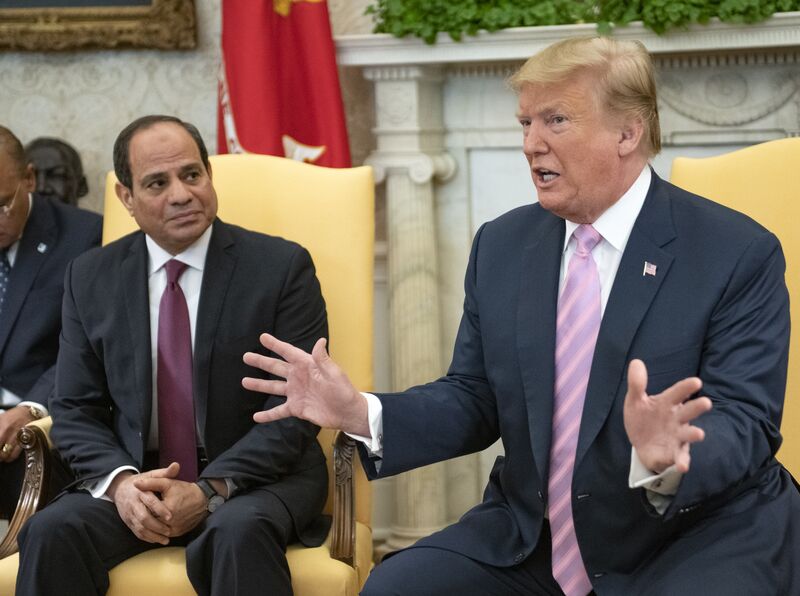
[Donald Trump with Abdel-Fattah El-Sisi at the Oval Office of the White House in Washington, D.C., U.S., on April 9.
Photographer: Ron Sachs/Pool via Bloomberg]
1. What is the Muslim Brotherhood?
The group, called al-Ikhwan al-Muslimun in Arabic, is a 90-year-old movement among members of Islam’s majority Sunni branch that combines political activism with charity work. The Brotherhood and the mainstream Islamist parties it has inspired across the Muslim world believe Islamic law and values should play a central role in public and political life. Its most famous slogan is: “Islam is the solution.” The movement defines itself as non-violent, accepting parliamentary politics and participating in state structures. Its members often disagree on issues like the rights of women and minorities. All that puts it at odds with radical Islamist militants, such as al-Qaeda and Islamic State, which denounced the Brotherhood as a “devastating cancer” that cares more for democracy than faith.
2. Where did it come from?
The Brotherhood was founded in 1928, after the fall of the Ottoman Empire, by Egyptian school teacher Hasan al-Banna to raise “a generation of Muslims who would understand Islam correctly and act according to its teachings.” It gained a political role driven in part by its rejection of colonialism and Zionism. The Brotherhood provided the main opposition to decades of autocratic rule in Egypt, building its strength on a grassroots movement that provided services and support where the government fell short. Offshoots inspired by the Brotherhood took root in many countries, often adapting its ideology to their own local circumstances. In Tunisia, for example, the Islamist Ennahda party played a pragmatic part in the transition to democracy, dropping its push for a reference to Islamic sharia law during the drafting of the 2014 constitution.
3. How did it become associated with violence?
Arguments within the organization arose early on over how to achieve its aims, and in 1954 a group of Brothers attempted to assassinate Egyptian President Gamal Abdel Nasser. Among its early supporters was Sayyid Qutb, whose writings later inspired al-Qaeda and other extremist groups. Outside Egypt, the Syrian Muslim Brotherhood fought against the Syrian government in the 1970s and 1980s. One offshoot, the Palestinian group Hamas, is considered a terrorist entity by Israel, the U.S. and European Union. Two others that emerged in Egypt in 2014 after hundreds of Islamists were jailed and killed have been labeled as terrorists by the U.S.
4. What are Trump’s motivations? ... Many experts say the Brotherhood doesn’t fit the criteria for terrorist activity outlined by U.S. law because there’s no proof it has engaged in violence that threatens the U.S. or its interests. Designation wouldn’t be easy because the Brotherhood itself is deeply fragmented and not monolithic. Aside from the political parties it has inspired, there are charities and mosques all over the world that have links to the group. The move also risks alienating countless Muslims. Even some of those critical of the Brotherhood -- who regard it as illiberal, authoritarian or suspiciously secretive -- say it shouldn’t be banned.
6. What are other ramifications of a designation?
The move risks stoking tension with U.S. allies in the Middle East. The ruling parties in Morocco and Turkey emerged from the Brotherhood, while another spinoff group is a coalition partner in Tunisia. In Algeria and Kuwait, groups close to the Brotherhood are in the official opposition. Jordan has the strongest chapter of the Brotherhood. Labeling it a terrorist group would feed into the propaganda of Islamic State, which says violence is the only way forward because democracy can’t accommodate any kind of Islamism. A designation could radicalize factions within the group that are already disillusioned with its embrace of electoral politics after the experience in Egypt. Critics argue as well that it would divert attention from tackling pressing terrorist threats.
The Reference Shelf
- A feature from Bloomberg on the Muslim Brotherhood and its role in Gulf tensions.
- Brookings Institution briefing: “Islamism, Salafism, and jihadism: A primer,” and a podcast with senior fellow Shadi Hamid.
- Brookings Institution report: “Islamist Parties in North Africa: A Comparative Analysis of Morocco, Tunisia and Egypt.”
- Perspectives on the Muslim Brotherhood from Foreign Policy Research Institute senior fellow Eric Trager.
- Official English-language website of the Muslim Brotherhood.
==
https://en.wikipedia.org/wiki/Muslim_Brotherhood
Society of the Muslim Brothers (Arabic: جماعة الإخوان المسلمينJamāʿat al-Ikhwān al-Muslimīn), better known as the Muslim Brotherhood (الإخوان المسلمون al-Ikhwān al-Muslimūn),is a transnational Sunni Islamist organization founded in Egypt by Islamic scholar and schoolteacher Hassan al-Banna in 1928.[8] Al-Banna's teachings spread far beyond Egypt, influencing today various Islamist movements from charitable organizations to political parties—not all using the same name.[9]
Initially, as a Pan-Islamic, religious, and social movement, it preached Islam in Egypt, taught the illiterate, and set up hospitals and business enterprises. It later advanced into the political arena, aiming to end British colonial control of Egypt. The movement self-stated aim is the establishment of a state ruled by Sharia law–its most famous slogan worldwide being: "Islam is the solution". Charity is a major propellant to its work.[10]
The group spread to other Muslim countries but has its largest, or one of its largest, organizations in Egyptdespite a succession of government crackdowns starting in 1948 up until today, with accusations of planning assassinations and plots.[11] For many years remained a fringe group in politics of the Arab World until the 1967 Six Day War, when Islamism managed to replace popular secular Arab nationalism after a resounding Arab defeat against Israel.[12] The movement was also supported by Saudi Arabia, with which it shared mutual enemies like communism.[13]
The Arab Spring brought it legalization and substantial political power at first, but as of 2013 it has suffered severe reversals.[14] The Egyptian Muslim Brotherhood was legalized in 2011 and won several elections,[15] including the 2012 presidential election when its candidate Mohamed Morsi became Egypt's first president to gain power through an election,[16] though one year later, following massive demonstrations and unrest, he was overthrown by the military and placed under house arrest. The group was then banned in Egypt and declared as a terrorist organization. Persian Gulf monarchies of Saudi Arabia and the United Arab Emirates followed suit, driven by the perception that the Brotherhood is a threat to their authoritarian rule.[17]
The Brotherhood itself claims to be a peaceful, democratic organization, and that its leader "condemns violence and violent acts".
Today, the primary state backers of the Muslim Brotherhood are Qatar and Turkey.[18] But as of 2019 is considered a terrorist organization by the governments of Bahrain,[19] Egypt,[20] Libya,[21] Russia,[22] Syria,[23] Saudi Arabia[24] and the United Arab Emirates.[25]
- :{1:(style="display:table-cell;padding-left:0px;padding-right:0.5em"):}::{Beliefs:(style="display:table-cell"):}:
- :{2:(style="display:table-cell;padding-left:0px;padding-right:0.5em"):}::{Strategy and organization:(style="display:table-cell"):}:
- :{3:(style="display:table-cell;padding-left:0px;padding-right:0.5em"):}::{In Egypt:(style="display:table-cell"):}:
- :{3.1:(style="display:table-cell;padding-left:0px;padding-right:0.5em"):}::{Founding:(style="display:table-cell"):}:
- :{3.2:(style="display:table-cell;padding-left:0px;padding-right:0.5em"):}::{Post–World War II:(style="display:table-cell"):}:
- :{3.3:(style="display:table-cell;padding-left:0px;padding-right:0.5em"):}::{Mubarak era:(style="display:table-cell"):}:
- :{3.4:(style="display:table-cell;padding-left:0px;padding-right:0.5em"):}::{2011 revolution and after:(style="display:table-cell"):}:
- :{3.5:(style="display:table-cell;padding-left:0px;padding-right:0.5em"):}::{Controversy:(style="display:table-cell"):}:
- :{3.6:(style="display:table-cell;padding-left:0px;padding-right:0.5em"):}::{General leaders:(style="display:table-cell"):}:
- :{4:(style="display:table-cell;padding-left:0px;padding-right:0.5em"):}::{In the Middle East:(style="display:table-cell"):}:
- :{4.1:(style="display:table-cell;padding-left:0px;padding-right:0.5em"):}::{Bahrain:(style="display:table-cell"):}:
- :{4.2:(style="display:table-cell;padding-left:0px;padding-right:0.5em"):}::{Iran:(style="display:table-cell"):}:
- :{4.3:(style="display:table-cell;padding-left:0px;padding-right:0.5em"):}::{Turkey:(style="display:table-cell"):}:
- :{4.4:(style="display:table-cell;padding-left:0px;padding-right:0.5em"):}::{Iraq:(style="display:table-cell"):}:
- :{4.5:(style="display:table-cell;padding-left:0px;padding-right:0.5em"):}::{Israel:(style="display:table-cell"):}:
- :{4.6:(style="display:table-cell;padding-left:0px;padding-right:0.5em"):}::{Palestine:(style="display:table-cell"):}:
- :{4.7:(style="display:table-cell;padding-left:0px;padding-right:0.5em"):}::{Jordan:(style="display:table-cell"):}:
- :{4.8:(style="display:table-cell;padding-left:0px;padding-right:0.5em"):}::{Qatar:(style="display:table-cell"):}:
- :{4.9:(style="display:table-cell;padding-left:0px;padding-right:0.5em"):}::{Kuwait:(style="display:table-cell"):}:
- :{4.10:(style="display:table-cell;padding-left:0px;padding-right:0.5em"):}::{Saudi Arabia:(style="display:table-cell"):}:
- :{4.11:(style="display:table-cell;padding-left:0px;padding-right:0.5em"):}::{Syria:(style="display:table-cell"):}:
- :{4.12:(style="display:table-cell;padding-left:0px;padding-right:0.5em"):}::{United Arab Emirates:(style="display:table-cell"):}:
- :{4.13:(style="display:table-cell;padding-left:0px;padding-right:0.5em"):}::{Yemen:(style="display:table-cell"):}:
- :{5:(style="display:table-cell;padding-left:0px;padding-right:0.5em"):}::{Elsewhere in Africa:(style="display:table-cell"):}:
- :{5.1:(style="display:table-cell;padding-left:0px;padding-right:0.5em"):}::{Algeria:(style="display:table-cell"):}:
- :{5.2:(style="display:table-cell;padding-left:0px;padding-right:0.5em"):}::{Libya:(style="display:table-cell"):}:
- :{5.3:(style="display:table-cell;padding-left:0px;padding-right:0.5em"):}::{Mauritania:(style="display:table-cell"):}:
- :{5.4:(style="display:table-cell;padding-left:0px;padding-right:0.5em"):}::{Morocco:(style="display:table-cell"):}:
- :{5.5:(style="display:table-cell;padding-left:0px;padding-right:0.5em"):}::{Somalia:(style="display:table-cell"):}:
- :{5.6:(style="display:table-cell;padding-left:0px;padding-right:0.5em"):}::{Sudan:(style="display:table-cell"):}:
- :{5.7:(style="display:table-cell;padding-left:0px;padding-right:0.5em"):}::{Tunisia:(style="display:table-cell"):}:
- :{6:(style="display:table-cell;padding-left:0px;padding-right:0.5em"):}::{Europe:(style="display:table-cell"):}:
- :{6.1:(style="display:table-cell;padding-left:0px;padding-right:0.5em"):}::{Germany:(style="display:table-cell"):}:
- :{6.2:(style="display:table-cell;padding-left:0px;padding-right:0.5em"):}::{Russia:(style="display:table-cell"):}:
- :{6.3:(style="display:table-cell;padding-left:0px;padding-right:0.5em"):}::{United Kingdom:(style="display:table-cell"):}:
- :{7:(style="display:table-cell;padding-left:0px;padding-right:0.5em"):}::{Other states:(style="display:table-cell"):}:
- :{7.1:(style="display:table-cell;padding-left:0px;padding-right:0.5em"):}::{Indonesia:(style="display:table-cell"):}:
- :{7.2:(style="display:table-cell;padding-left:0px;padding-right:0.5em"):}::{Malaysia:(style="display:table-cell"):}:
- :{7.3:(style="display:table-cell;padding-left:0px;padding-right:0.5em"):}::{United States:(style="display:table-cell"):}:
- :{8:(style="display:table-cell;padding-left:0px;padding-right:0.5em"):}::{Criticism:(style="display:table-cell"):}:
- :{8.1:(style="display:table-cell;padding-left:0px;padding-right:0.5em"):}::{Motives:(style="display:table-cell"):}:
- :{8.2:(style="display:table-cell;padding-left:0px;padding-right:0.5em"):}::{Status of non-Muslims:(style="display:table-cell"):}:
- :{8.3:(style="display:table-cell;padding-left:0px;padding-right:0.5em"):}::{Response to criticisms:(style="display:table-cell"):}:
- :{9:(style="display:table-cell;padding-left:0px;padding-right:0.5em"):}::{Foreign relations:(style="display:table-cell"):}:
- :{10:(style="display:table-cell;padding-left:0px;padding-right:0.5em"):}::{See also:(style="display:table-cell"):}:
- :{11:(style="display:table-cell;padding-left:0px;padding-right:0.5em"):}::{Footnotes:(style="display:table-cell"):}:
- :{12:(style="display:table-cell;padding-left:0px;padding-right:0.5em"):}::{References:(style="display:table-cell"):}:
- :{13:(style="display:table-cell;padding-left:0px;padding-right:0.5em"):}::{External links:(style="display:table-cell"):}:
Beliefs
hidePart of a series on: |
|---|
 |
| Fundamentals[show] |
| Ideology[show] |
| Concepts[show] |
| Influences[show] |
Movements[hide] Scholastic<ul style="margin: 0px; padding: 0px; list-style-image: url(" data:image="data:image" svg="svg" xml="xml" csvg="Csvg" width="%225%22" height="%2213%22%3E" ccircle="Ccircle" cx="%222.5%22" cy="%229%22" r="%222.5%22" fill="%22%23222%22/%3E" c="C" e="E" xmlns="%22http://www.w3.org/2000/svg%22" xmlns:data="data"><font size="4" face="Times New Roman"></font><li style="margin: 0px; display: inline;"><font size="4" face="Times New Roman"><a href="https://en.wikipedia.org/wiki/Ahl-i_Hadith" title="Ahl-i Hadith" style="text-decoration-line: none; background: none; white-space: nowrap;">Ahl-i Hadith</a></font></li><li style="margin: 0px; display: inline;"><a href="https://en.wikipedia.org/wiki/Deobandi" title="Deobandi" style="text-decoration-line: none; background: none; white-space: nowrap;">Deobandi</a></li><li style="margin: 0px; display: inline;"><a href="https://en.wikipedia.org/wiki/Madkhalism" title="Madkhalism" style="text-decoration-line: none; background: none; white-space: nowrap;">Madkhalism</a></li><li style="margin: 0px; display: inline;"><a href="https://en.wikipedia.org/wiki/Sahwa_movement" title="Sahwa movement" style="text-decoration-line: none; background: none; white-space: nowrap;">Sahwa movement</a></li><li style="margin: 0px; display: inline;"><a href="https://en.wikipedia.org/wiki/Wahhabism" title="Wahhabism" style="text-decoration-line: none; background: none; white-space: nowrap;">Wahhabism</a></li></ul> Political <ul style="margin: 0px; padding: 0px; list-style-image: url(" data:image="data:image" svg="svg" xml="xml" csvg="Csvg" width="%225%22" height="%2213%22%3E" ccircle="Ccircle" cx="%222.5%22" cy="%229%22" r="%222.5%22" fill="%22%23222%22/%3E" c="C" e="E" xmlns="%22http://www.w3.org/2000/svg%22" xmlns:data="data"><font size="4" face="Times New Roman"></font><li style="margin: 0px; display: inline;"><font size="4" face="Times New Roman"><a href="https://en.wikipedia.org/wiki/Hizb_ut-Tahrir" title="Hizb ut-Tahrir" style="text-decoration-line: none; background: none; white-space: nowrap;">Hizb ut-Tahrir</a></font></li><li style="margin: 0px; display: inline;"><a href="https://en.wikipedia.org/wiki/Iranian_Revolution" title="Iranian Revolution" style="text-decoration-line: none; background: none; white-space: nowrap;">Iranian Revolution</a></li><li style="margin: 0px; display: inline;"><a href="https://en.wikipedia.org/wiki/Jamaat-e-Islami" title="Jamaat-e-Islami" style="text-decoration-line: none; background: none; white-space: nowrap;">Jamaat-e-Islami</a></li><li style="margin: 0px; display: inline;"><a href="https://en.wikipedia.org/wiki/Mill%C3%AE_G%C3%B6r%C3%BC%C5%9F" title="Millî Görüş" style="text-decoration-line: none; background: none; white-space: nowrap;">Millî Görüş</a></li><li style="margin: 0px; display: inline;"><a class="mw-selflink selflink" style="text-decoration: inherit; background: none; cursor: pointer; font-weight: bold; white-space: nowrap;">Muslim Brotherhood</a></li><li style="margin: 0px; display: inline;"><a href="https://en.wikipedia.org/wiki/List_of_Islamic_political_parties" title="List of Islamic political parties" style="text-decoration-line: none; background: none; white-space: nowrap;">List of Islamic political parties</a></li></ul> Militant <ul style="margin: 0px; padding: 0px; list-style-image: url(" data:image="data:image" svg="svg" xml="xml" csvg="Csvg" width="%225%22" height="%2213%22%3E" ccircle="Ccircle" cx="%222.5%22" cy="%229%22" r="%222.5%22" fill="%22%23222%22/%3E" c="C" e="E" xmlns="%22http://www.w3.org/2000/svg%22" xmlns:data="data"><li style="margin: 0px; display: inline;"><font size="4" face="Times New Roman">Militant Islamism based in </font><ul style="margin: 0px; padding: 0px; list-style-image: url(" data:image="data:image" svg="svg" xml="xml" csvg="Csvg" width="%225%22" height="%2213%22%3E" ccircle="Ccircle" cx="%222.5%22" cy="%229%22" r="%222.5%22" fill="%22%23222%22/%3E" c="C" e="E" display="display" inline="inline" xmlns="%22http://www.w3.org/2000/svg%22" xmlns:data="data"><font size="4" face="Times New Roman"></font><li style="margin: 0px; display: inline;"><font size="4" face="Times New Roman"><a href="https://en.wikipedia.org/wiki/Template:Militant_Islamism_in_the_Middle_East" title="Template:Militant Islamism in the Middle East" style="text-decoration-line: none; background: none; white-space: nowrap;">MENA region</a></font></li><li style="margin: 0px; display: inline;"><a href="https://en.wikipedia.org/wiki/Template:Militant_Islamism_in_South_Asia" title="Template:Militant Islamism in South Asia" style="text-decoration-line: none; background: none; white-space: nowrap;">South Asia</a></li><li style="margin: 0px; display: inline;"><a href="https://en.wikipedia.org/wiki/Template:Militant_Islamism_in_Southeast_Asia" title="Template:Militant Islamism in Southeast Asia" style="text-decoration-line: none; background: none; white-space: nowrap;">Southeast Asia</a></li><li style="margin: 0px; display: inline;"><a href="https://en.wikipedia.org/wiki/Template:Militant_Islamism_in_Sub-Saharan_Africa" title="Template:Militant Islamism in Sub-Saharan Africa" style="text-decoration-line: none; background: none; white-space: nowrap;">Sub-Saharan Africa</a></li></ul></li></ul> |
| Key texts[show] |
| Heads of state[show] |
| Key ideologues[show] |
| Criticism of Islamism[show] |
| Related topics[show] |


The Brotherhood's English-language website describes its principles as including firstly the introduction of the Islamic Sharia as "the basis for controlling the affairs of state and society" and secondly, working to unify "Islamic countries and states, mainly among the Arab states, and liberate them from foreign imperialism".[26]
According to a spokesman on its English-language website, the Muslim Brotherhood believes in reform, democracy, freedom of assembly, press, etc.
We believe that the political reform is the true and natural gateway for all other kinds of reform. We have announced our acceptance of democracy that acknowledges political pluralism, the peaceful rotation of power and the fact that the nation is the source of all powers. As we see it, political reform includes the termination of the state of emergency, restoring public freedoms, including the right to establish political parties, whatever their tendencies may be, and the freedom of the press, freedom of criticism and thought, freedom of peaceful demonstrations, freedom of assembly, etc. It also includes the dismantling of all exceptional courts and the annulment of all exceptional laws, establishing the independence of the judiciary, enabling the judiciary to fully and truly supervise general elections so as to ensure that they authentically express people's will, removing all obstacles that restrict the functioning of civil society organizations, etc.[27]
Its founder, Hassan Al-Banna, was influenced by Islamic modernist reformers Muhammad Abduh and Rashid Rida (who attacked the taqlid of the official `ulama, and he insisted that only the Quran and the best-attested hadiths should be sources of the Sharia),[28] with the group structure and approach being influenced by Sufism.[29][30] Al-Banna avoided controversies over doctrine. It downplayed doctrinal differences between schools (although takfiring Bahais and Ahmadi Muslims) emphasizing the political importance of worldwide unity of the Muslim Nation (umma).[31]
As Islamic Modernist beliefs were co-opted by secularist rulers and official `ulama, the Brotherhood has become traditionalist and conservative, "being the only available outlet for those whose religious and cultural sensibilities had been outraged by the impact of Westernization".[32] Al-Banna believed the Quran and Sunnah constitute a perfect way of life and social and political organization that God has set out for man. Islamic governments must be based on this system and eventually unified in a Caliphate. The Muslim Brotherhood's goal, as stated by its founder al-Banna was to drive out British colonial and other Western influences, reclaim Islam's manifest destiny—an empire, stretching from Spain to Indonesia.[33] The Brotherhood preaches that Islam will bring social justice, the eradication of poverty, corruption and sinful behavior, and political freedom (to the extent allowed by the laws of Islam). Blended with methods of modern social sciences, some key thinkers of Brotherhood have also contemplated the Islamic perspective on bureaucratic effectiveness, mapping out solutions to problems of formalism and irresponsiveness to public concerns in public administration, which pertains to the pro-democratic tenets of Muslim Brotherhood.[34] Such variations of thoughts have also purportedly negated the realities of contemporary Muslim countries as their authors have proclaimed.[35]
On the issue of women and gender the Muslim Brotherhood interprets Islam conservatively. Its founder called for "a campaign against ostentation in dress and loose behavior", "segregation of male and female students", a separate curriculum for girls, and "the prohibition of dancing and other such pastimes ... "[36]
There have been breakaway groups from the movement, including the Al-Gama'a al-Islamiyya and Al Takfir Wal Hijra.[37] Prominent figures of the Brotherhood include Sayyid Qutb, a highly influential thinker of Islamism, and the author of Milestones.[38] Osama bin Laden criticized the Brotherhood, and accused it of betraying jihad and the ideals of Qutb.[39][40]
Mottos
The Brotherhood's "most frequently used slogan" (according to the BBC) is "Islam is the Solution" (الإسلام هو الحل).[41] According to academic Khalil Yusuf, its motto "was traditionally" "Believers are but Brothers."[42]
Strategy and organization
RS andy kroll
https://www.rollingstone.com/politics/politics-features/elliott-broidy-donald-trump-swamp-793159/
no lnx
At 3:45 p.m. on October 6th, 2017, an unassuming man in his early sixties with a low, raspy voice and a thin, wide smile arrived at the White House. He had been here before, in the George W. Bush years, when he was one of the most sought-after fundraisers in the Republican Party. But a scandal had derailed his life, and afterward he had disappeared from politics. In early 2016, the opportunity arose to make his return. The man had helped Donald J. Trump’s long-shot campaign raise millions of dollars, and he could rightly say he played a role in the most improbable presidential victory in American history. Now, Elliott Broidy had come to deliver an urgent message. After a brief visit with Jared Kushner, he was summoned to meet the president in the Oval Office.
SEE ALSO
WASHINGTON, DC - JUNE 18: U.S. President Donald Trump speaks to members of the media prior to a departure from the White House June 18, 2019 in Washington, DC. President Trump and the first lady are traveling to Orlando, Florida for a rally to officially kick off the president’s 2020 re-election campaign. (Photo by Alex Wong/Getty Images)
E. Jean Carroll Alleges President Donald Trump Assaulted Her
Trump Ordered a Military Strike Against Iran ... Then Called It Off at the Last Minute
Trump's Deutsche Bank Problems Are Not Going Away]
Broidy told Trump about a recent trip he’d taken to the United Arab Emirates, the small but wealthy Persian Gulf nation, on behalf of a defense-contracting company he owned. Broidy raved about the crown prince of Abu Dhabi and the UAE’s de facto leader, Sheikh Mohammed bin Zayed Al Nahyan, known as MBZ, whom he had met with while in the Emirates.He said that MBZ and Mohammed bin Salman, the young crown prince of Saudi Arabia, were creating an all-Muslim counterterrorism force made up of 5,000 Arab soldiers to fight against the Taliban and ISIS. With the help of Gen. Stanley McChrystal, the former U.S. commander in Afghanistan, Broidy said, his company would assist the UAE and Saudi Arabia to train and assist those pan-Arab fighters.
Trump loved the idea. As far as he knew, Broidy had business interests in the Middle East and had briefed the president as a courtesy. What Trump didn’t know — and Broidy didn’t disclose, according to his detailed notes about the meeting obtained by Rolling Stone — was that Broidy was also waging a secretive, multimillion-dollar PR and influence campaign in Washington, D.C., to persuade the Trump administration to punish Qatar, an enemy of the UAE and Saudi Arabia — but an ally of the U.S.
Broidy’s operation came with code names (Trump was “Chairman,” MBZ “Friend,” Qatar the “snake”), convoluted money trails and a shadowy liaison to the UAE and Saudi Arabia. The liaison urged Broidy to make the most of his time with Trump (his “priceless asset”) and reiterated MBZ’s wishes in an email sent to Broidy a few days before the Oval Office meeting. “Again, take advantage of it to tell him that Friend would like to come asap to meet you [Trump] SOONEST out of official site,” the go-between wrote in a long email. The two crown princes “are counting on you to relate it blunt and straight as it is!?.?.?.?Tomorrow is a Pivotal and could turn out to be a Historical and milestone meeting!”
Broidy did as he was told, telling Trump that MBZ stood ready to travel to the U.S. for a meeting but would prefer a more private setting than the Oval Office. Broidy recommended New York or New Jersey. When Trump asked Broidy for his thoughts about Qatar, Broidy slammed the Qataris as financial supporters of terrorism and included them with North Korea and Iran in a new “axis of evil.”
Trump smiled and nodded. He had reason to champion Broidy’s cause. Both the UAE and Saudi Arabia had long been loyal customers of his. The Saudis “buy all sorts of my stuff,” Trump said in 2015, and a massive Trump-branded golf course had recently opened in Dubai, in the UAE. The meeting was nearing its end, but the president had one last question for Broidy:What did he think of Secretary of State Rex Tillerson? Tillerson, the former Exxon-Mobil CEO, had shown support for the Qataris. In private, Broidy had seethed at Tillerson, calling him “a tower of Jello.” Broidy told Trump that Tillerson was “performing poorly” and should be fired at a “politically convenient time.”
Broidy then met with H.R. McMaster, Trump’s national security adviser, to push for the private, informal meeting with Trump that MBZ wanted. The sun was starting to set when Broidy left the White House, confident he’d delivered his message. The crown princes were thrilled. Not long after, the liaison emailed him, “You have become a HERO here and at KSA [Kingdom of Saudi -Arabia], to say the least.”
DEPENDING ON where you stood, Trump’s election posed either an existential threat to the American experiment or the business opportunity of a lifetime. The thousands of lawyers, former congressional staffers and retired lawmakers who ply their trade as lobbyists had spent two years preparing for a Clinton administration. “If you went around town and told these lobbying firms you supported Trump, it was like a hate crime,” says Tom Davis, a former lobbyist and onetime Virginia congressman. “Trump threw out the book. He brought in a whole new crowd. The players changed, and the rules changed.”
Overnight, Trump’s small circle of friends and loyalists became extremely valuable. They could speak Trump’s language, explain him, influence him. Or at least that’s what they told the blue-chip corporations and foreign governments scrambling to find someone to help them navigate the new administration. “There’s, like, five people who bet on the long shot and won,” a seasoned GOP operative told me. “The day after the election, those five people all think they’re the biggest fucking swinging dicks in the universe. I’m the guy who can make all your dreams come true now.”
That’s where Elliott Broidy came in. Broidy set out to cash in on his connections to the new administration with breathtaking speed and audacity. In the aftermath of Trump’s win, Broidy, who landed a coveted spot as a vice-chair for Trump’s inauguration committee, used his ties to the president-elect to pitch his defense-contracting company, Circinus LLC, to foreign leaders. He invited two senior Angolan officials to Trump’s inauguration festivities while attaching a proposed contract with Broidy’s firm. He helped secure a brief audience for the Romanians with Trump at a dinner where Broidy was seated next to the president-elect. For a starting rate of $350,000 a month,Broidy offered to help a lawyer based in Moscow remove U.S. sanctions on two Russian companies.(The lawyer recalls Broidy’s proposal but not the suggested fees included in Broidy’s memo, and he says the plan did not go forward.) And in another instance, Broidy and his wife, a lawyer and former entertainment executive, hatched a plan to earn $75 million if they could get the Justice Department to drop an investigation into the multibillion-dollar fraud involving Malaysia’s prime minister and its state investment fund.
The real prize for Broidy, however, was two of the richest countries in the world: Saudi Arabia and the UAE. Contracts with their defense ministries for his security company could be worth hundreds of millions, if not billions. For years, Broidy had tried to win business with the Emirati and Saudi royal families. But that was before Trump came along. “President Trump campaigned on a promise to drain the swamp,” Paul Seamus Ryan, a vice president at Common Cause, tells Rolling Stone. “Instead, he brought a group of swamp creatures with him.”
This story is based on more than 40 interviews, hundreds of pages of legal records as well as private emails and other documents of Broidy’s, which reveal his efforts to shape the Trump administration’s Middle East policy and score foreign contracts for his company. Before publication of this story, a lawyer for Broidy sent a letter to Rolling Stone alleging that “paid agents” of Qatar stole the emails from Broidy as retribution for the “exercise of his First Amendment rights to highlight Qatar’s support for global terrorist organizations.” The lawyer contended that some of the documents were doctored or forged by the alleged hackers. Taken together with Rolling Stone’s reporting, the documents give a rare inside view of how the Trump-era swamp works — and Broidy’s place in it.
ONSTAGE, President Trump and First Lady Melania Trump, joined by members of the new First Family, swayed together to a rendition of Frank Sinatra’s “My Way.” It was January 20th, 2017, a night of parties celebrating the swearing in of the 45th president. At first glance, Trump’s inauguration resembled those that had come before it — the black-tie balls, the speeches and shout-outs to the supporters in attendance. But gaze out into the audience and you saw a motley cast of right-wing conspiracy theorists, overseas real-estate developers and a few Russian oligarchs. By day, they hung out in the lobby of the Trump International Hotel a few blocks from the White House, transforming it into a real-life Mos Eisley cantina, the scene of nonstop scheming and schmoozing by the strange new denizens of Trumpworld.
Larry Mizel, Elliott Broidy, Senator Jeff SessionsChairman's Global Dinner in Washington DC, USA - 17 Jan 2017
Broidy (center) with then Sen. Jeff Sessions and CEO Larry Mizel. After the election, men like Broidy who had backed Trump were very valuable in D.C. “There’s five people out there who bet on a long shot and won,” says one longtime GOP operative. “They could make all your dreams come true now.” Photo credit: Clint Spaulding/WWD/REX/Shutterstock
One person who was in attendance was a Lebanese-American businessman named George Nader. Short and stout, with thinning gray hair, Nader, like Broidy, had once been a player in Washington, and now, years later, the two men met for the first time, at the inauguration. The encounter would prove pivotal.
Nader had run a small but respected magazine in the 1990s called Middle East Insight, and people in the foreign-policy community knew him as a consummate wheeler-dealer, a mediator-for-hire who was always bringing different Middle Eastern delegations — the Israelis, the Syrians, Yasser Arafat — to Washington for conferences and negotiations.
Nader vanished from D.C. in the early 2000s; it later emerged that he’d been convicted in the Czech Republic for sexually abusing minors. He resurfaced in Iraq, working with Erik Prince, the founder of the controversial defense contractor Blackwater. Later, he served as a consultant to two Emirati investment firms and as an adviser to MBZ.
For Nader and MBZ, the Trump presidency was an opportunity for the UAE to assert itself as a greater player in the Middle East. It was also a chance for the Emiratis and Saudis to go on the attack against two of their fiercest rivals, Iran and Qatar. A small monarchy located on a peninsula roughly the size of Connecticut, Qatar has the highest per-capita income in the world, thanks to its vast natural-gas fields shared with Iran.Qatar, some say, is more of a company than a country. The ruling al-Thani family plays an outsize and often provocative — critics say destabilizing — role in the Middle East, funding pro-democracy conferences and using their TV network, Al-Jazeera, to shape public opinion in the region. Qatar’s critics accuse the al-Thanis of allowing terrorists to live in their country and use their financial system.
For years, Saudi Arabia and the UAE had wanted nothing more than to cripple Qatar. In an allegedly leaked email from 2017, the UAE’s ambassador to the U.S. wrote that conquering Qatar would “solve everyone’s problems. Literally,” and that Saudi King Abdullah had considered “doing something in Qatar” before he died in 2015. (Representatives for the Saudi and UAE embassies in Washington did not respond to requests for comment.) Qatar enjoyed a strong relationship with the U.S., hosting one of the most important American air bases in the world, at al-Udeid.
But now, in the chaos of the new administration, the Saudis and Emiratis sought to turn the U.S. against Qatar — and Broidy would convince them that he could make it happen. “The Gulf nations view their wealth as an extension of their power,” says Rep. Adam Schiff, chairman of the House intelligence committee. “When they’ve got a president of questionable ethics and one driven by money, it’s an attractive target.”
Nader and MBZ understood that there were ways to get to Trump that wouldn’t have worked with previous administrations. Trump liked to say that his primary consultant was himself; he trusted few people beyond his own family. Former campaign staffers, Mar-a-Lago members and business partners filled the vacuum where academics, diplomats and other experts would usually be found. The challenge was finding the right acolyte with enough juice to get your message in front of the easily distractible Trump.
For Nader, that man was Elliott Broidy.What they talked about the night of the inauguration isn’t clear. (A lawyer for Nader disputed the reporting about Nader’s pedophilia conviction and claimed that the emails between him and Broidy were “altered or fabricated” but did not give any examples.) But by the time the evening’s festivities were finished, the two men had the makings of a plan.
SOON AFTER the inauguration, a message appeared in Broidy’s inbox from his new friend. “Hi,” Nader wrote. “Here is my private email.” It was one of the first of hundreds of messages Broidy and Nader would exchange over the following year.
Broidy began his work for Nader by designing an extensive PR and influence offensive.The strategy, documents show, involved linking Qatar and the Muslim Brotherhood, the political and social group with millions of followers often accused of fomenting terrorism. In a memo to Nader dated March 15th, 2017, Broidy wrote that theBrotherhood had “infiltrated the Democratic Party” and “almost elected their champion, Keith Ellison, national chairman.” (Ellison, the first Muslim elected to Congress and now Minnesota’s attorney general, has never championed the group.) In another memo, Broidy accused Qatar of funding and hosting members of Hamas and the Taliban. (The State Department’s 2017 terrorism report highlighted Qatar’s participation with the U.S. to combat terrorism financingwhile noting thatterrorist financiers within Qatar are still able to exploit its informal financial system.)
Broidy sought to manufacture a groundswell of activity to demonstrate to Democrats and Republicans that Qatar was not an ally and that the Trump administration should take punitive action in the form of sanctions against Qatari individuals or a foreign-terrorist designation for the entire Muslim Brotherhood. If all went as planned, there would be no public evidence of Broidy and Nader’s efforts behind this covert operation. These activities are common in Washington: For decades, foreign governments have retained pricey law firms and political consulting firms to represent their interests. What made this one so striking was that Broidy and Nader operated outside the usual world of K Street firms and consulting shops.
...
https://www.vox.com/world/2017/2/13/14559822/trump-islam-muslims-islamophobia-sharia
zach b
Last July, a sharply dressed man named Frank Gaffney:{ }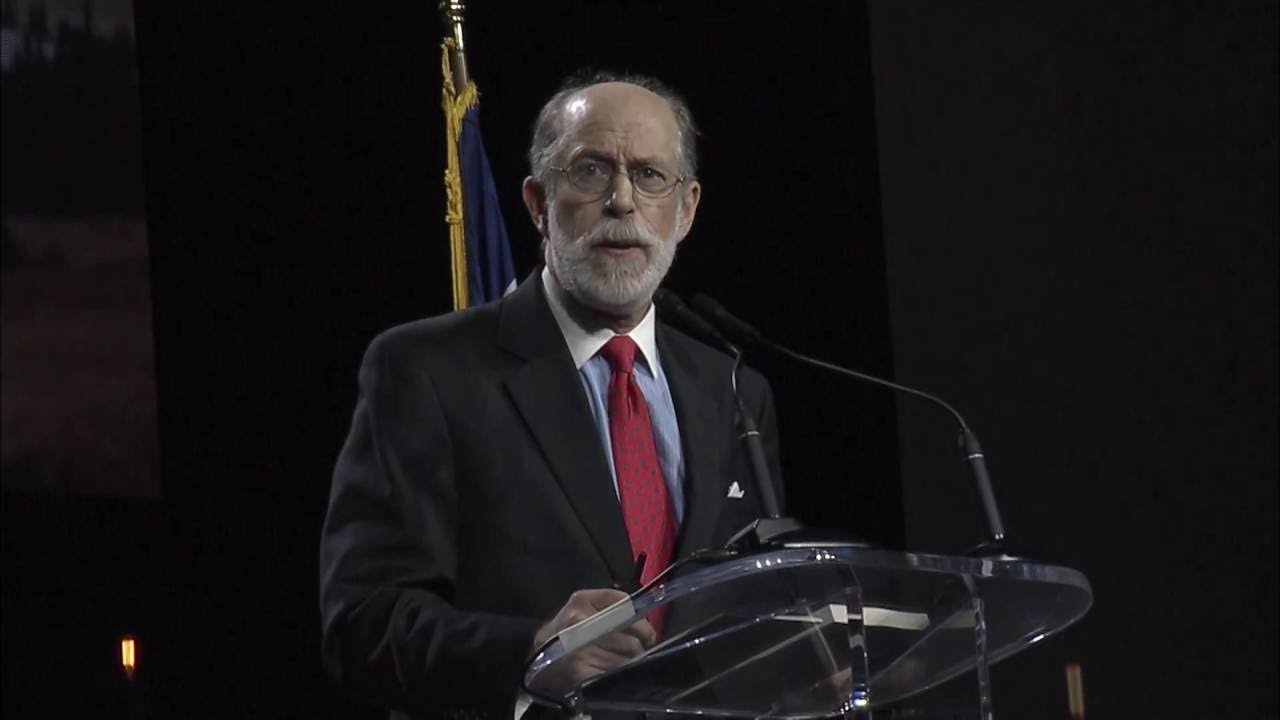 :{ }::{onto the stage of a crowded convention center in downtown Denver and proceeded to calmly warn his audience that Muslims were working to conquer America from the inside.}:
Speaking without notes at a glass lectern, Gaffney — who worked, decades ago, as a Pentagon official in the Reagan administration — told the audience that political leaders from both parties had spent years covering up the true threat to the US. It didn’t come from terrorists acting in the name of Islam. It came from Islam itself.
Gaffney said that sharia, the Arabic term for Islamic law, was a “brutally repressive, totalitarian, political, military, and legal program” for gradually subverting Western governments and replacing them with ones that adhere to harsh Islamic dictates. And in the US, those efforts were already well underway.
“This program of subversive, stealthy penetration and takedown is operating. It’s, in fact, been at work for 50 years,”. “Our government has been subverted.”
Gaffney wasn’t speaking metaphorically. He accused “agents of Hillary Clinton” of shredding files about Muslim radicals living both inside and outside the US and said that then–Homeland Security Secretary Jeh Johnson was surrounded by “a small echo chamber which is filled by Muslim Brotherhood operatives.”
The notion of senior US officials intentionally weakening American national security or appointing advisers who were literal members of a Middle Eastern Islamist movement is preposterous. But it’s important to take Gaffney seriously: He isn’t some little-known crank pumping out Islamophobic literature on the internet, and the event wasn’t a fringe gathering outside the political mainstream.
It was instead the, a major meeting of thousands of Republican activists in Denver billed as “the largest gathering of conservatives outside of Washington, D.C.” Other featured speakers included then-GOP presidential candidate Donald Trump, Sarah Palin, major conservative media figures like Hugh Hewitt and Erick Erickson, and two sitting US senators.
Gaffney is an important cog in a vast and growing ecosystem that exists just out of sight of most Americans— one that has spent years pushing the notion that there is a creeping, quiet plot to take over America from within. It is a plan that springs from Islamic scripture itself, and is supported by most mainstream Muslim organizations, most mosques, and, in all likelihood, your Muslim neighbor.
The only way to be safe from the threat, according to Gaffney and other self-proclaimed "counter-jihadists," is to slash Muslim immigration, arrest key leaders of the Muslim American community, and shut down huge numbers of mosques. They have not gone so far as to propose outright ethnic cleansing; Gaffney, in his speech, says he has Muslim friends. Their dream, instead, is to destroy the Muslim American community without kicking out Muslims.
The dire warnings are spread through an influential lobby, slick documentaries, and best-selling books with titles like The Truth About Muhammad: Founder of the World's Most Intolerant Religion. And now that fearful vision of Islam has found a home in the Trump White House.
[
The Truth About Muhammad - Wikipedia
https://en.wikipedia.org/wiki/The_Truth_About_Muhammad
2.
Publisher: Regnery Publishing
Response · Reviews · References and notes
The Truth About Muhammad: Founder of the World's Most Intolerant ...
https://www.amazon.com/Truth-About-Muhammad-Intolerant-Religion/.../159698528...
2.
:{]]:(style="overflow-wrap:break-word"):}:
That’s because the real motivation was rooted in counter-jihadist logic. The movement’s thinkers have, for years, advocated a similar ban on Muslim immigration. They look to Europe and see Muslim immigrants creating a continentridden with terrorism and nearly lost to Islamist subversion. The Muslim ban only makes sense when seen as part of their plan to prevent America from going down the same path — by keeping out as many Muslims as possible.
The counter-jihadist influence in the Trump administration appears far from exhausted. They have long wanted to designate the Muslim Brotherhood as a foreign terrorist organization, because they see major American Muslim organizations as Brotherhood fronts — and now that’s reportedly a major priority inside the Trump White House.
Trump’s policies reflect an even scarier kind of prejudice than his own: one with a plan.
The theory: ISIS represents the soul of Islam
Gaffney is the president of the Center for Security Policy, or CSP, a right-wing think tank located just blocks from the White House. In 2010, it convened a panel to study the Islamic threat to America. The group — which included former CIA Director R. James Woolsey and former head of the Defense Intelligence Agency Edward Soyster — called itself “Team B II.”
The original Team B was a working group put together in the ’70s as a kind of devil’s advocate in the Gerald Ford administration. Its goal was to provide a hawkish counterpoint to the softer detente policy toward the Soviet Union favored by the White House. Team B argued that communism was an insatiably aggressive doctrine, one that could not be appeased — a conclusion that would influencing Ronald Reagan’s foreign policy ideology.
Team B II aimed to do something similar, but for radical Islamism and today’s Republican Party. They drew on the arguments of a loose intellectual movement that had coalesced on blogs in the years after 9/11, and had come to refer to itself as the “counter-jihad.”
Counter-jihadists believe that mainstream scholars of Islam, and counterterrorism experts in governments the world over, have fundamentally misunderstood the nature of the Islamist threat. Their basic mistake is that they overemphasize differences between Muslims, like the Sunni-Shia split, and assume that ISIS and al-Qaeda are aberrant distortions of Islam.
The truth, counter-jihadists believe, is more like the opposite. They argue that a correct reading of Islamic scripture shows that violence is intrinsic to Islam — that the religious doctrine itself, properly understood, commands Muslims to kill subjugate unbelievers. People who say otherwise — and CSP lumps both George W. Bush and Barack Obama into this category — are either willfully or unintentionally deceiving the American public.
In the years since its publication in 2010, the “Team B II” report — titled “Shariah: The Threat to America” — has become something of a counter-jihadist bible. It’s the clearest and most comprehensive summary of their ideas. To understand what they believe, and why they believe it, you have to understand this report.
The great enemy in the report is something called “sharia.” An Arabic word that literally translates as “law,” it’s the vast body of rules and regulations that guide daily life for believing Muslims — everything from not eating pork to who can lawfully be killed in a time of war to whether to charge interest on bank loans.
“UNDER ISLAMIC LAW, LYING IS NOT ONLY PERMISSIBLE, BUT OBLIGATORY”
But because there is no single authority in Islam (like, say, the pope in the Catholic Church), there is no single, official, agreed-upon interpretation of sharia. The thousands of rules and regulations that collectively make up the body of sharia have been deeply contested among Muslim scholars — and even individual Muslims — since the birth of Islam, with no agreement even on many vital issues.
Team B II argues that sharia is different from similar moral codes in other religions, like the Jewish law that governs the rules for keeping kosher. They argue that sharia is fundamentally political; that its aim is to govern the lives of all people, and not just Muslims, by seizing control of the world’s governments.
“There is ultimately but one sharia,” the report holds. “It is totalitarian in character, incompatible with our Constitution, and a threat to freedom here and around the world. Sharia’s adherents are making a determined, sustained, and well-financed effort to impose it on all Muslims and non-Muslims, alike.”
To make this argument, Team B II’s authors rely heavily on something called “abrogation.” This is a complex concept in Islamic legal theory, but it basically boils down to the idea that when trying to determine the “correct” answer to some legal question — say, whether it’s okay to drink alcohol, for instance — later verses in the Quran carry more weight than earlier ones. That is, the later verses abrogate, or override, the earlier ones.
This stems from the fact that the Quran was revealed to the Prophet Mohammed not all at once, but rather over a period of 23 years. During that time, the circumstances in which Mohammed and the early Muslim community were living changed quite a bit. The earlier verses of the Quran came down while Mohammad was more of an itinerant preacher in Mecca, whereas the later verses came down during a time when Mohammed controlled the city of Medina and commanded a large Muslim army.
The result is that the later verses tend to be more concerned with real-world administrative rules and military doctrine — including verses about conquering unbelievers — while the earlier verses are more focused on broader, more universal concepts of spirituality.
As a result of the doctrine of abrogation, Team B II claims, all Muslims are obligated to conquer the West and replace its governments with an Islamic theocracy called a caliphate. But one would be hard-pressed to find a single credible Islamic scholar who interprets it this way.
For Islamic legal scholars, abrogation is but one tool used to interpret the Quran, and not an ultimate trump card. And the Quran, like the Bible, contains scriptures that both endorse and reject violence. In the full context of Islamic law, the injunctions to kill and conquer are often interpreted as being specific to that time and place in history, and do not necessarily overrule other, more peaceful verses in the Quran (e.g., “let there be no compulsion in religion”).
Team B II dismisses this as a form of tactical, sharia-sanctioned lying. There is an actual Arabic term for permissible lying in sharia, called taqiyya. It’s an obscure medieval ruling that basically permits Muslims to verbally blaspheme God or renounce their religion without incurring God’s wrath if they are under compulsion to do so.
So, for instance, if a Muslim were traveling in a land where being Muslim could get him killed and is captured by the authorities, he is allowed to say he isn’t Muslim — or even do things like praise pagan gods or slander the Prophet Mohammed — if his survival is on the line, without God getting mad. It’s a sort of get-out-of-jail-free card. It’s also a concept generally associated with Shia Islam, as nearly all Sunni Islamic legal scholars reject the concept outright.
But the counter-jihadists have taken this medieval concept and turned it into a devious trick that Muslims are using to hide their true violent intentions.
They assert that the peaceful interpretations of Islam offered by Muslim authorities are a form of taqiyya designed to obscure the true nature of Islam from gullible Westerners. They point to things like the 9/11 hijackers going to strip clubs and drinking alcohol as examples of terrorists using taqiyya to blend in. And while the 9/11 hijackers certainly did those things, and may even have tried to justify their actions by saying they were just trying to blend in, they were all Sunni Muslims and therefore never would’ve used the concept of taqiyya to justify their actions.
“Under Islamic law, lying is not only permissible, but obligatory for Muslims in some situations,” Team B II writes in its report. “What Muslim audiences are required to know about Islam is not the same thing as what non-Muslim Western audiences are allowed to know — or encouraged to think — by Islamic authorities.”
This quickly takes on the character of a conspiracy theory. Any attempt to cite an Islamic authority who takes a different view of the Quran is only proof, to the counter-jihadists, that you are taken in by sharia propaganda. In that sense, arguing with the counter-jihadists is something of an impossible task. It’s a bit like attempting a point-by-point rebuttal of The Protocols of the Elders of Zion.
How a conspiracy theory goes from the fringes to the White House
[vid act for am]
When you ask credentialed experts on Islam and terrorism about counter-jihadist theories today, they usually don’t know whether to laugh or cry.
“It's hard to reply without sounding snooty,” Will McCants, the director of the Brookings Institution’s Project on US Relations with the Islamic World, tells me in response to a question about counter-jihadists. “[They] sell a lot of books and scare the hell out of Americans, but their policy recommendations range from vague to downright harmful.”
McCants is not wrong about the books. America Alone, a 2006 book alleging that ”a large majority of Western Muslims support the terrorists’ strategic goals,” cracked the top five of the New York Times’s best-seller list. Several other counter-jihadist books, including The Politically Correct Guide to Islamand Because They Hate, made the best-seller list around the same time.
What few reviews of these books could be found in mainstream publications were not kind. Yale lecturer Daniel Luban wrote that they “can justly be called the new McCarthyism” in a review of the genre published in the Jewish magazine Tablet.
Regardless, the success of counter-jihadist literature spawned a whole mini industry — what author Nathan Lean termed “the Islamophobia Industry.” In 2008, an organization called theClarion Projectdistributed 28 million copies of a documentary titled , which alleged that more than 100 million Muslims were in thrall to “militant Islam.”
Another Clarion video, The Third Jihad: Radical Islam’s Vision for America, was blurbed by former New York City mayor and current White House cybersecurity adviser Rudy Giuliani and Sen. Jon Kyl (R-AZ). Clarion’s 2015 mini documentary , starring a Muslim woman named Raheel Raza who alleges a majority of her co-religionists want sharia to set national law, has more than 4 million views on YouTube.
These works found a large audience, mostly among conservatives, largely as a result of America’s encounter with Islamic extremism over the course of the 2000s. The 9/11 attacks, interestingly, did not themselves spark an immediate turn against Muslims.
Part of this can be attributed to concerted efforts by the George W. Bush administration to discourage such sentiments. Indeed, just a little over a month after the 9/11 attacks took place, Bush issued a message to commemorate the Muslim holy month of Ramadan, stating, "The Islam that we know is a faith devoted to the worship of one God, as revealed through The Holy Qur'an. It teaches the value and the importance of charity, mercy, and peace."
But as the wars in Afghanistan and Iraq dragged on and more and more American service members died in those countries at the hands of Muslims, and as terrorist attacks in the name of Islam continued to take place around the world, many Americans started to blame Islam in general for the continuing bloodshed.
[graf]
Under the Obama administration, this took on an overtly partisan flavor. When Bush defended Islam, few Republicans were interested in attacking him. Barack Hussein Obama got no such dispensation: Republicans attacked him as soft on ISIS and claimed he was more interested in protecting “the image of Islam” than in protecting America. Influential right-wing pundits suggested he was an Islamist sympathizer or even a secret Muslim himself.
All of this, combined with Trump’s much more overt anti-Islam rhetoric, has helped turn the Muslim religion into a partisan issue:
Right-wing media, recognizing the appeal of the counter-jihadist message among their audience, has embraced this extreme anti-Islam narrative the counter-jihadists are peddling. A study published by UCLA’s Chicano Studies Research Center found that guests with extreme anti-Muslim views made up 11 percent of all guests on prominent conservative talk radio during a period they studied in 2010. Two prominent counter-jihadists appeared on Fox News 15 times between September 2015 and February 2016, according to a count by Media Matters. Prominent televangelists spread the anti-Islam gospel to yet another group of reliable conservatives. Pat Robertson, the host of the widely broadcast 700 Club, once said on air that “Islam is a political system that is bent on world domination.”
All of this is supplemented by a vast grassroots network, centering on a group called ACT for America. Billing itself as the “the NRA of National Security,” it claims to have a membership of 500,000 nationwide, clustered in 1,000 chapters around the country.
Its president, Brigitte Gabriel, is the author of one of those mid-2000s counter-jihadist bestsellers (Because They Hate). A Lebanese Christian immigrant who calls herself “one of the leading terrorism experts in the world,” Gabriel has no formal background in terrorism, either through working in government or academia. According to her book, the highest level of education she received was a one-year course in business administration at a YWCA. Her claim to authority stems, allegedly, from experiences of persecution at the hands of Muslims during the Lebanese civil war in the 1980s — a historically dubious story that Lebanese-American journalist Michael Young once labeled a “con act.”
In a speech in at the Oasis Church in Middletown, Ohio, Gabriel delivered an accessible and entertaining speech on the counter-jihadist view of Islam. In her telling, the history of Islam is a history of bloodshed.Between Islam’s founding in the seventh century and the dissolution of the Ottoman Empire in 1924, she says, “Islam was responsible for 270 million people across the globe — killed by the sword.”
This violence was not accidental, Gabriel told the rapt crowd. It was the core of Islam itself.
Gabriel believes that for 12 years, Mohammed attempted to peacefully proselytize — and failed, miserably. Only when he turned to violence, to conversion at the point of the sword, did he begin to win success.
“Islam went from being strictly a spiritual movement, after 12 years, to becoming a political movement cloaked in religion,” she says. “Jihad is mentioned in the Quran 40 times — 36 times out of 40 as a holy war against the infidels, to either kill them or subjugate them.”
These are all historically inaccurate claims. Haroon Moghul, a fellow at the New America Foundation, writes that they “play loose and fast with very different eras, places and peoples,” in order to put together a narrative of a uniformly aggressive Islam. Yet Gabriel’s group has been profoundly influential.
[twt mar lago sec breifing look who i ran into djt]
Her activists have worked tirelessly to pass legislation, based on a template constructed by Gaffney and CSP in-house counsel David Yerushalmi, that would ban state courts from considering sharia a valid source of law.By 2016, they had succeeded in nine states: Alabama, Kansas, North Carolina, Oklahoma, Louisiana, Arizona, South Dakota, Arizona, and Tennessee.
“No court, administrative agency, or other governmental agency may enforce any provisions of any religious code,” the South Dakota version reads, neutral language obscuring the clear intent.
More alarmingly, the ideas pushed by Gabriel and CSP have been embraced by the most important members of the Trump White House.
“Most people in the Middle East, or at least 50 percent, believe in being sharia-compliant,”Bannon said on theBreitbart Daily News radio show in 2015. “Sharia-compliant” is an innocuous phrase commonly used by Muslims to denote that something is in line with Islamic law: For instance, you can find sharia-compliant home mortgage companies in the US that cater primarily (but not exclusively) to Muslims, because Islamic law forbids Muslims from collecting or paying interest on loans.
The Team B II report’s authors sees things like sharia-compliant financial institutions as an insidious threat to the US Constitution (they never really explain how a home mortgage company that doesn’t charge interest threatens the Constitution).
It’s not just Bannon.But the Team B II report also frequently uses the term “sharia-compliant” to describe not institutions or practices, but people: specifically, Muslims with dangerous, anti-American beliefs, anti-constitutional beliefs. And this is exactly the way Bannon is using the term. “If you're sharia-compliant or want to impose sharia law, the United States is the wrong place for you,” Bannon proclaimed.
In his 2016 book*The Field of Fight*, Trump’s new national security adviser, Michael Flynn, wrote that Islamic scholars are attempting to trick the West to obscure the true nature of sharia.
“These so-called Islamic scholars keep their message so complicated so as to create chaos, to confuse in order to control,” Flynn writes. “Mao, Pol Pot, Stalin, and Mussolini were more transparent. Sharia is a violent law that is buried in barbaric convictions.”
Trump’s new attorney general, Jeff Sessions, said more or less the same thing — in an official Senate press release. “Once again we face a totalitarian threat to the free world. This time it’s from ideological and apocalyptic Islam,” Sessions said.
“Theologically-based sharia law,” Sessions argued, “fundamentally conflicts with our magnificent constitutional order that separates church and state, and that considers free debate and dissent the way to a better world.”
That these individuals all espouse the same weirdly specific interpretation of sharia is not a coincidence. Each one of them is deeply connected to the counter-jihadist world.
Bannon hosted counter-jihadists on his Breitbart radio show 41 times,according to a count by Mother Jones’s Josh Harkinson. Flynn is an adviser to the board of Gabriel’s ACT for America, and local ACT chapters organized many of the stops on the speaking tour for Flynn’s book. In 2015, Sessions received CSP’sKeeper of the Flame award, in honor of “his leadership on issues of great importance to the national security.”
And it goes even deeper than just Trump’s cabinet. Walid Phares, a fringe Lebanese Christian academic who served as Trump’s Middle East policy adviser during the campaign, once said, “It is absolutely constitutional and moral that citizens reject Sharia as a legal system that takes away their rights.”
Sebastian and Katharine Gorka, a married couple who are staples of the counter-jihadist movement, have been given high-level positions on Trump’s staff: Sebastian is now his deputy assistant in the White House, and Katharine was on Trump’s Department of Homeland Security transition team.
Trump himself, at times, has sounded a lot like a counter-jihadist.
“Sharia authorizes such atrocities as murder of non-believers who won’t convert, beheadings, and more unthinkable acts that pose great harm to American — especially women,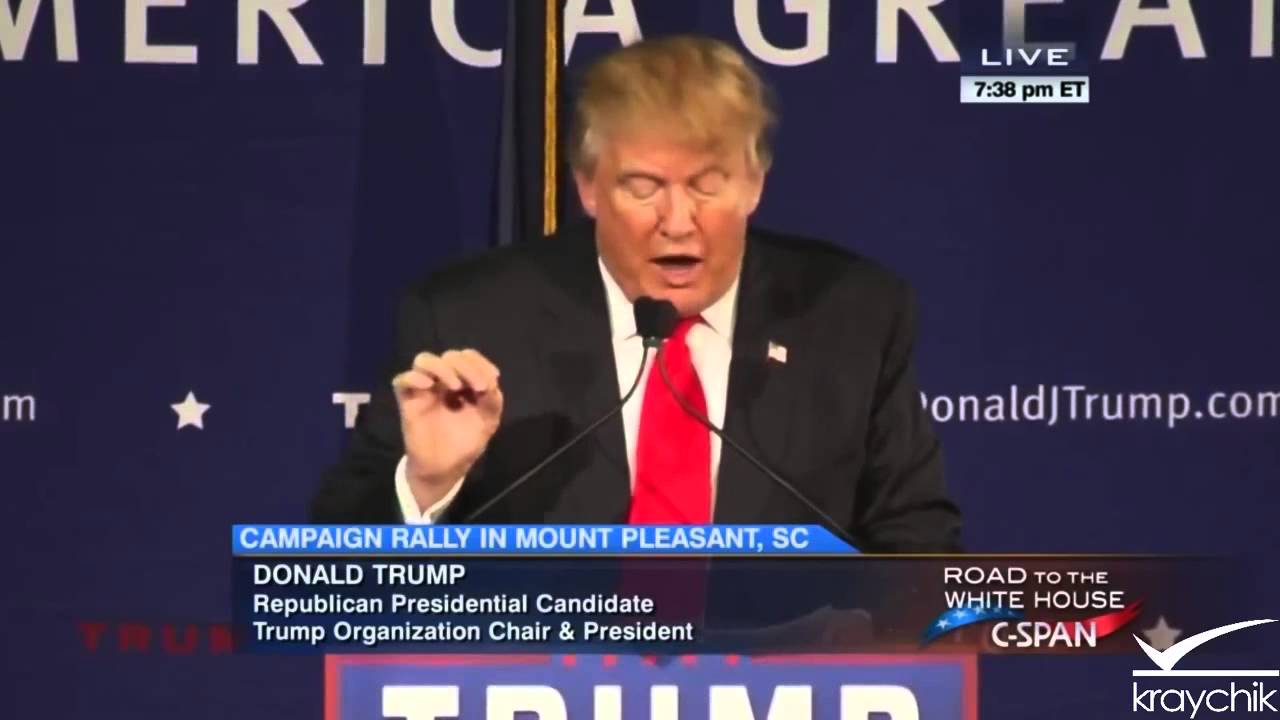 , reading off a prepared statement during a December 2015 televised rally defending his proposal for a Muslim ban. “These are people who believe only in jihad. They don’t want our system.”
Several months prior to the rally, Trump had met with staffers at CSP for an hour-long briefing. The subject was the threat from sharia.
Counter-jihadists see leading American Muslims as part of the problem
The fact that most Muslims are not killers is, for the counter-jihadists, a most inconvenient fact. Over time, counter-jihadists have put less emphasis on the threat from overtly violent groups, like al-Qaeda and ISIS, and focused instead on a more insidious threat: the “stealth” or “civilization jihad.”
The foremost theorist of civilization jihad is a writer named Robert Spencer. “He’s author of so many books, and one of the top two or three experts in the world on this great war we’re fighting against fundamental Islam,” Bannon said, when hosting Spencer onBreitbart Daily News on August 9, 2016. “Trump is listening to people like you,” he told Spencer later in the interview.
Spencer, like Gabriel and Gaffney, has no formal training in Quranic scholarship. He received an MA in 1986 in religious studies from the University of North Carolina Chapel Hill and wrote his master’s thesis on Catholic history.
He’s run the blog Jihad Watch, a near-obsessive tracker of Islamist activity, since 2003. He is also the author of 16 books, with titles like The Complete Infidels' Guide to the Koran. Many of his books have been published by Regnery, the conservative publishing giant that also put out both Trump’s and Mitt Romney’s most recent books. Two of Spencer’s tomes made the New York Times best-seller list; there’s a decent chance you’ve seen him on Fox News in the wake of a terrorist attack.
In person, Spencer is short and portly, with a neatly trimmed black beard. He’s exceptionally confrontational, constantly trumpeting his willingness to debate all comers on Twitter and on Jihad Watch. When I contacted him for this story, his reply attacked the media — like most counter-jihadists, he sees journalists as some of jihad’s most powerful enablers.
“There you go again, Zack,” he wrote in response to one of my questions. “I know you’re a reporter, and a reporter for Vox, so I know where you stand.”
Spencer’s 2008 book, Stealth Jihad: How Radical Islam Is Subverting America Without Guns or Bombs, developed one of the most important ideas of the counter-jihad. Its arguments were cited repeatedly and amplified in the Team B II report and also appear, in a simplified form, in speeches delivered by people like Gabriel in towns around the country. Spencer also regularly gives “counterterrorism” seminars based on these arguments to law enforcement agencies.
The central idea is that terrorists aren’t America’s real Muslim problem.
“Distracted by foreign wars and the prospect of domestic terror attacks, Americans pay little heed to the true agents of intolerance in their midst,” Spencer writes. “The stealth jihad advances largely unopposed because it is largely unrecognized.”
The “agents of intolerance” at the heart of this stealth jihad, Spencer explains, are the Muslim Brotherhood.
It’s a group you’re probably at least passingly familiar with. Founded in Egypt in 1928, the Brotherhood is one of the oldest and most influential Islamist groups in history. The group’s goal has long been the toppling of the Egyptian government and its replacement with a Sunni theocracy.
Its tactics have varied over time, from promoting grassroots social change to fielding candidates for parliament, and some individuals and groups associated with the Brotherhood in the past have advocated violent revolution. The Brotherhood even managed to gain control over the Egyptian government briefly, when Brotherhood candidate Mohammed Morsi won in the country’s first democratic election following the Arab Spring uprising in 2011.
Today, the group’s influence is relatively limited — Egypt’s military dictator, Abdel Fattah el-Sisi, overthrew Morsi in 2013 and since then has viciously suppressed Brotherhood activity. According to Human Rights Watch, he has killed more than 1,000 individuals linked to the Brotherhood and arrested many, many more.
In Spencer’s telling, though, the Brotherhood is not defined by its founding chapter in Egypt, or even its various open branches and offshoots (like the Palestinian militant group Hamas or the moderate Islamist Ennahda party in Tunisia). The hidden history of the 20th century, according to Spencer, is a history of the Brotherhood’s stealth penetration of the West.
“Of course the MB still has the resources to act in the US and Europe,” Spencer tells me. “Its organizations here were well-established and handsomely funded before Sisi came along.”
In Stealth Jihad, Spencer rests this claim on a 1991 memo, written by a Muslim Brother named Mohamed Akram. The memo outlines a plan to establish a “global Islamic state,” starting in the United States. This begins, according to Akram, through a “shift from the collision mentality to the absorption mentality” — to move away from open conflict with Western authorities to suborning them from within.
This might seem like a pathetically impossible task, given the minuscule number of Muslim Brothers in the US. But — and this is the absolutely critical part — Akram thinks the Brotherhood has powerful allies who might successfully and quietly mainstream its radical agenda. In the memo, he writes out “a list of our organizations and the organizations of our friends.”
The Brotherhood, and its present-day allies and friends, [are] really working to forward the ‘grand jihad,’” Spencer writes. “When we scratch the ‘moderate’ surface of groups such as the Council on American-Islamic Relations (CAIR) and the Muslim Public Affairs Council (MPAC), we find links to terrorist organizations and exhortations to Islamic supremacism.”It reads like a who’s who of Muslim civic organizations in the United States, including the Islamic Society of North America (the continent’s largest Muslim civic group) and the Muslim Students’ Association (the organization that represents Muslim students on virtually every college campus in the United States). This one memo, for Spencer and Gaffney, is solid proof that these organizations are Brotherhood fronts.
The Team B II report, two years later, put the point even more clearly.
“The majority of Islamic organizations in America are affiliates of or associated with the Muslim Brotherhood in some way,” its authors explain. “Any organization that does not embrace sharia and the MB line has not been able to gain broad recognition as a Muslim-American force.”
The evidentiary basis for this claim is extremely thin. For one thing, scholars of the Brotherhood have found no evidence that Akram’s memo was an accurate representation of the Brotherhood’s reach.
“Nobody has ever produced any evidence that the document was more than something produced by the daydream of one enthusiast,” Nathan Brown, a George Washington University professor who studies the Brotherhood, told Religion Dispatches’ Sarah Posner in 2011. “Nothing in anything that I have heard has ever struck me as similar in tone or content to the ‘master plan.’”
Beyond that, the organizations themselves flatly deny being agents of the Muslim Brotherhood. Of course, as Spencer and his ilk would say, this could just be taqiyya. Except that the groups don’t just deny these affiliations — they openly advocate policies and interpretations of Islam that directly contradict this supposed grand Muslim Brotherhood plot against American values.
That does not stop Spencer, Team B II, and the rest of the counter-jihadists from citing Akram’s memo as gospel. Gaffney still tells audiences to download it (it’s available for free on CSP’s site).
The idea that the Brotherhood dominates Muslim American life serves a critical bridging point in counter-jihadist ideology. It is the only possible explanation for why, despite sharia’s supposed mandate to violence and domination, Muslim Americans are not all that violent. It’s not that they don’t believe in “Islamic supremacism” (a favored counter-jihadist term); it’s that they’re more strategic about it than the dummies in al-Qaeda and ISIS.
Militant groups can be bombed and killed. But stealth jihadists cannot: They wield Western commitments to free speech and political tolerance as a shield, allowing them to build up Muslim strength in the West without meaningful opposition.
Counter-jihadists latch onto any evidence of links between Muslim civic society and the Muslim Brotherhood to buttress this theory, wrenching quotes from Muslim leaders out of context and casting fringe figures as leading Muslim authorities.
Take their strongest and most commonly cited piece of evidence: a 2007 Justice Department case against the Holy Land Foundation, a Muslim charity in the Dallas area that was diverting some of its donations to Hamas, a designated foreign terrorist organization.
This is the most significant and largest case of a terror-funding operation using an American Muslim civic group as a front. The Akram memo was uncovered during the HLF investigation.
But in addition to the five leaders of the HLF who were actually convicted in the case, more than 246 individuals and Muslim groups, including ISNA and CAIR, were named as “unindicted co-conspirators” in the indictment — meaning the prosecutors believed they were linked to HLF’s scheme but couldn’t prove it.
They couldn’t prove it because they had no real evidence for this claim. ISNA and CAIR later filed a suit alleging that the prosecutors had unjustifiably damaged their reputation by mentioning them in the indictment. Their evidence was that counter-jihadists were using it to smear them, and the court agreed.
“There is no real dispute that CAIR suffered injury to its reputational interest by being listed as an unindicted co-conspirator in this terrorism case. Press accounts and blog entries have reported, based on this case, that CAIR is a criminal organization that supports terrorism,”the presiding judge ruled. “The government has not argued or established any legitimate government interest that warrants publicly identifying CAIR and 245 other individuals and entities as unindicted co-conspirators.”
Now a faction in the Trump administration,reportedly led by Flynn, is pushing to do the same thing by executive fiat — to add the Muslim Brotherhood to the State Department’s list of foreign terrorist organizations.But, as with the Akram memo, the counter-jihadists have not stopped using the HLF case as proof that America’s largest Muslim organizations are part of a stealth jihad. Multiple Republican members of Congress have parroted these accusations, most notably when they accused Hillary Clinton aide Huma Abedin of having ties tothe Muslim Brotherhood. Sen. Ted Cruz, a frequent speaker at CSP events, has repeatedly pushed legislation labelingthe Muslim Brotherhood a terrorist group — a key recommendation in both Spencer’s book and the Team B II report.
The State Department reportedly opposes this move as illegal. A new CIA memo, reported by Politico, warns that it would boost ISIS and al-Qaeda recruiting. Virtually every expert on the Muslim Brotherhood thinks it would be unworkable and unwise.
Despite all this, the New York Times reports that the move has broad support in the White House. This should be no surprise: Both Attorney General Sessions and CIA Director Mike Pompeo, while in Congress, co-sponsored Cruz’s bill.
“There are organizations and networks here in the United States tied to radical Islam in deep and fundamental ways,” Pompeo told Gaffney in a February 2015 interview on the latter’s radio program. “They’re not just in places like Libya and Syria and Iraq, but in places like Coldwater, Kansas, and small towns all throughout America.”
Bannon has long been warning of the threat from the Muslim Brotherhood and stealth jihad; in 2007, he wrote a documentary script proposal specifically calling CAIR and ISNA "cultural jihadists" secretly working to build “an Islamic Republic in the United States.” Housing and Urban Development Secretary Ben Carson, in a2016 interview with Bannon, warned of “an explanatory memorandum” uncovered in the Holy Land Foundation trial telling Muslims “to infiltrate, to multiply, to gain positions of power, and to commit what they call ‘civilization jihad.’”
Officially labeling the Brotherhood a terrorist group, an odd step given that the Brotherhood has not been linked to a terrorist attack in decades, takes on much darker tones when viewed through a counter-jihadist light. Remember, counter-jihadists think the majority of Muslim American groups in the United States are Brotherhood fronts. It’s illegal for any American to provide assistance to a designated foreign terrorist organization.
This, then, could set the stage for a massive federal inquisition into America’s major Muslim organizations based on counter-jihadist conspiracy theories. The text of the Cruz-Sessions-Pompeo bill refers to CAIR and ISNA as “United States-Muslim Brotherhood affiliates,” citing the Holy Land case. Gaffney toldBloomberg View’s Eli Lake that "CAIR is one of the organizations [prosecutors] would have to look at” if the Brotherhood were designated a terrorist group.
Spencer told me that the solution to the stealth jihad was to “enforce existing laws regarding sedition and subversion,” adding that “Muslim organizations in the West should be called upon to back up their pro-forma condemnations of al-Qaeda and ISIS with transparent, inspectable, honest programs teaching young Muslims why they should reject the understanding of Islam offered by jihad terror groups.”
Investigations into, and perhaps prosecutions of, Muslim civic organizations. “Inspectable” programs ensuring that Muslim organizations toe a religious line that counter-jihadists find acceptable. That’s what the counter-jihadists really want from Trump.
Europe will soon be “Eurabia” — a fate America might share
In July of last year, I went to Cleveland to report on the Republican National Convention. It was a weird event by any metric, but the high point of strangeness had to be the evening I spent at a party for queer counter-jihadists.
The event, organized by Breitbart’s gay firebrandMilo Yiannopoulos, was called “Wake Up!” — as in, “wake up” to the threat of jihadism. Held in a dark ballroom adorned with pictures of mostly naked, extremely young-looking men posing in red “Make America Great Again” hats, the party attracted afairly infamous crowd.
I bumped into Pamela Geller, who co-founded (alongside Spencer) a counter-jihadist group calledStop the Islamization of America, since renamed the American Freedom Defense Initiative, wearing a rainbow sequin shirt emblazoned with the slogan “Love Will Win.” Geller is a regular on Fox News and conservative talk radio; she’s one of the most widely known counter-jihadists due to her assuming a leadership role in the fight against the “ground zero mosque” in 2010. She also has a tendency to embrace the most outlandish of conspiracy theories, once publishing a piece on her website suggesting that Barack Obama is the secret love child of Malcolm X.
When I ran into her, she was warning a partygoer of the imminent threat from Syrian refugees.
“ISIS said they were going to send a jihad army into Europe via migration in 2015. Then two months later, the migration started,” Geller said. The implication — that the refugee crisis was an ISIS plot — wasn’t especially subtle.
The ostensibly perilous state of Europe was something of a motif at the party. The featured speaker was Geert Wilders, the virulently anti-Muslim and anti-immigrant leader of the Netherlands’ far-right Party for Freedom (PVV). Wilders, an extremely tall man with slicked-back, Trumpesque hair, gave a fiery speech denouncing the influence of Islam in his homeland.
“There is only one Islam, and that Islam has no place in a free society,” Wilders told the crowd. “We should de-Islamize our societies. It’s a matter of our existence.”
One could not have hoped for a better summary of the counter-jihadist view of Europe. Proponents see the continent as a dark twin of America, a “there but for the grace of God” dystopia the Islamists are on the verge of conquering.
The key culprit, in their minds, is immigration. Prior to World War II, the Muslim population in Europe was negligible. After the war, a need to rebuild the continent led Europe to bring in a lot of people from the nearby Middle East and North Africa as guest workers. Many of these guest workers stayed, and eventually brought over their families. These people formed Muslim communities, which continue to be a draw for new Muslim immigrants today, at the same time that birthrates among white Europeans were slowing down.
The result was a rapidly growing Muslim minority in Western Europe. In 1950, 2 percent of Europeans were Muslim. That figure was 4 percent by 1990, and 6 percent by 2010.
In 2005, a Cairo-born woman named Gisèle Littman published a book warning of the dangers of this demographic shift, titled*Eurabia: The Euro-Arab Axis*. Littman, who publishes under the name Bat Ye’or (Hebrew for “daughter of the Nile”), dropped out of a master’s program at the University of Geneva in the 1960s. Nevertheless, she spent much of her life publishing “academic” tomes on Islam and Europe, arguing that the history of Islam is an unbroken history of theologically driven conquest.
In Eurabia, Ye’or posited that Muslim immigration to Europe was not the benign economic migration it seemed. It was, instead, a dark plot — a plan, dating back to 1973, “superimposed on Europe by powerful governmental lobbies.” The goal was to Islamize Europe, to reduce European whites to “dhimmitude” — a term she uses for second-class citizenship granted to non-Muslims in an Islamic society.
In the pages of Jihad Watch and CSP publications, the notion that Muslim immigrants are imposing their rule on a hapless and clueless European majority is simply common sense. Every crime or terrorist attack committed by a Muslim, every law granting religious accommodations to Muslims, is cast as proof of the coming of Eurabia.Eurabia has gotten scant mention in the American press; mainstream historians have scorned it. Yet the book’s thesis has risen to the level of dogma among American counter-jihadists; Geller has called Ye’or “the world's leading scholar and historian on Islamic expansionism in Europe, the Middle East and the West.”
At the 2015 Values Voter Summit, the big annual gathering for right-wing evangelicals, Bannon sat down with ACT’s Gabriel to talk about the European refugee crisis. He referred to it as a Muslim “invasion,” and asked Gabriel if that was an overstatement.
“It is not,” she replied. “Europe will no longer be Europe by 2050. Europe has already become Eurabia. Europe is Eurabia right now.”
For this reason, immigration occupies a central role in the counter-jihadist imagination. If Muslim immigration turned Europe into a terror-ridden nightmare on the brink of sharia rule, then the first priority in the United States needs to be making sure the same thing can’t happen here. The Muslim Brotherhood is most easily defeated when you deny it foot soldiers.
One of the key recommendations of CSP’s Team B II report is that “immigration of those who adhere to sharia must be precluded.” More recently, CSP and ACT for America have been out front in opposing the resettlement of Syrian refugees. CSP has teamed up with longtime anti-refugee activistAnn Corcoran, who got her start in 2006 opposing the resettlement of African refugees in her area of rural Maryland. A CSP video starring her has racked up nearly 3 million views on YouTube.
“This process of Muslim colonization is called the hijra,” Corcoran says in the video, using the Arabic word for migration. “Mohammed told his followers to migrate and spread Islam, in order to dominate all the lands of the world ... and that’s exactly what they’re doing now.”
The “Muslim ban” and the counter-jihad
When Trump initially announced his plan for a “total and complete shutdown of Muslims entering the United States,” way back in December 2015, his campaign statement cited a poll conducted by CSP as the key piece of justification.
“A poll from the Center for Security Policy released data showing ‘25% of those polled agreed that violence against Americans here in the United States is justified as a part of the global jihad,’”the statement read. “51% of those polled, ‘agreed that Muslims in America should have the choice of being governed according to sharia.’”
This poll was, unsurprisingly, shot full of methodological problems. It was anonline opt-in poll, meaning that it was not a random sample of American Muslims, and several questions were written in such a way that the answers would end up sounding extremist no matter what.
More interestingly, though, is the person who conducted the poll on CSP’s behalf. It was none other than Kellyanne Conway, who would go on to become Trump’s campaign manager and chief press surrogate. According toMother Jones’s Pema Levy, who first reported the link, Conway’s firm had a relationship with CSP that dated back to 1998.
"It's very alarming to me that such a high number of individuals, Muslims living in the US, would say, 'Well, we can have a choice' [to follow sharia]," Conway said during a June 2015 appearance on a CSP podcast. “The Muslims living in the US themselves — 27 percent of them, anyway — say that this is what the purpose of jihad is, to either punish nonbelievers (16 percent) or, the other 11 percent, to undermine non-Muslim states."
This is the way in which the “Muslim ban” makes sense. Not as something Trump dreamed up by accident, but as a direct product of the counter-jihad’s influence on the president of the United States. You can even see the counter-jihadist influence in the text of the executive order itself.
“In order to protect Americans, the United States must ensure that those admitted to this country do not bear hostile attitudes toward it and its founding principles,” the order reads. “The United States cannot, and should not, admit those who do not support the Constitution, or those who would place violent ideologies over American law.”
When the Trump administration talked about the Muslim ban to press, they warned that unfettered Muslim entry into the country would bring about a constant drumbeat of low-level terrorism — a warning that sounded a lot like some counter-jihadists’ descriptions of contemporary Europe.
“We don't want a situation where 20, 30 years from now, it's just like a given thing that on a fairly regular basis that there's domestic terror strikes, that stores are shut up or that airports have explosive devices planted or people are mowed down in the street by cars and automobiles and things of that nature,” an unnamed senior administration official told the Washington Post’s Jenna Johnson. “These are the realities that we're living in today.”
How counter-jihadists want to change America — if Trump will let them
There is a counter-jihadist master plan.
In 2015, CSP issued a follow-up report to the Team B II report. Titled “The Secure Freedom Strategy,” and authored by “the Tiger Team,” it fleshed out a broad slate of specific policy actions that could be taken to act on Team B’s diagnosis of the problem. Something like Trump’s ban on refugees entering the country is in there, as is the Flynn-Sessions-Pompeo plan for listing the Muslim Brotherhood as a terrorist organization.
Those aren’t the only two examples. The report spends a great deal of time lambasting the Obama administration for failing to openly name Islamism as our enemy.
“The Obama administration’s increasingly institutionalized secularist — if not actively pro-Islamic — policies have largely prevented the U.S. government from engaging in strategic information operations aimed at exposing and undermining the supremacist doctrine of shariah and the terrorism it commands,” its authors write. “Public clarity about that threat has also been compromised by the distortion of intelligence analysis and terminology used to describe Islam, jihad, and shariah.”
This has obvious resonances with the Republican attacks on Obama for failing to call terrorists “radical Islamists.” But it also targets, specifically, President Obama’s “Countering Violent Extremism” initiative — a program that focuses on preventing Americans from being attracted to violent political movements, Islamist and non-Islamist alike. This, the Tiger Team argues, is a way of downplaying the threat from the more dangerous stealth jihad.
Now bothReuters andCNN have reported that the Trump team is planning to revamp the CVE program to focus solely on Islamism. Its new name? “Countering Islamic Extremism,” nomenclature that a) is focused exclusively on Islam, and b) deemphasizes the threat from violence specifically.
News of the Trump team’s plans delighted counter-jihadists, who have long attacked US government counterterrorism training for downplaying the threat from sharia. Spencer told me the revamp of the CVE program was the Trump initiative that he was most excited about.
Spencer is being a bit premature — as of right now, the reports about the program still aren’t confirmed. But his glee points to something important, something missed in taking these things in isolation.
The Trump team is incredibly disorganized: According to one New York Times account, Trump staffers still haven’t figured out how to turn on the lights in the White House Cabinet room. They also have an insurgent ideology, one that’s in many ways at odds with what you hear from mainstream Republicans — especially on foreign policy. There just isn’t a clear sense of what they want to do on a lot of issues, or what specific tools they could use to do it.
The counter-jihadists, by contrast, are extremely organized. They have a think tank that has put out detailed policy proposals, intellectuals with fairly large megaphones who can argue for the think tank’s ideas, and a large activist network that’s surprisingly well-connected inside the Republican Party.
And, of course, they have a lot of like-minded sympathizers in the White House. So if the Trump team needs policy ideas on national security and terrorism, it’s entirely likely that they’d turn to CSP for help. Indeed, the explicit point of the Tiger Team’s Secure Freedom Strategy was to provide a comprehensive blueprint for a “war” on sharia to a White House that’s willing to listen.
So what are their actual policy proposals?
The report advocates reorienting training for counterterrorism staff around “the threat doctrine — sharia,” essentially meaning that the US should teach its spies and law enforcement officials that Islam is their enemy. It proposes “rolling up and shutting down [Muslim Brotherhood] front groups in the United States,” by which it means the main Muslim organizations in America. It suggests ending university programs that promote “Muslim-Christian dialogue,” and replacing them with “corresponding educational activities exposing the true nature of sharia and the Muslim Brotherhood’s operations.”
Some recommendations are even more jarring. The report calls on the US government to use “sharia adherent advocacy and practices as legal premises for deportation and stripping of American citizenship” — in other words, kicking out Muslims who publicly announce that they live by Islamic moral codes. Former Speaker of the House and staunch Trump supporter Newt Gingrich has fervently embraced this idea, telling Sean Hannity in June 2016 that the US government should deport all Muslims who believe in sharia.
The CSP report further states that “over eighty percent of U.S. mosques have been shown to be sharia-adherent and promoting jihad,” and that “they are incubators of, at best, subversion and, at worst, violence and should be treated accordingly.” The clear implication is that the US government should shut down 80 percent of American mosques and arrest their imams on charges of promoting terrorism.
This isn’t just a blueprint for war on sharia — it’s a blueprint for war on the Muslim American community. For using the power of the state to shut down Muslim organizations, arrest believing Muslims, and close the vast majority of mosques.
Prominent politicians have endorsed this plan (though it’s not clear if they’ve read it all the way through). At a 2015 CSP conference, the entirety of which is uploaded to YouTube, both Gingrich and Cruz labeled the Secure Freedom plan a sound strategy for fighting jihadism — a move that garnered very little attention at the time. The document is too obscure, and too boring, for most people to root through it.
But these ideas in it cannot be seen as obscure anymore.
“I definitely see individuals with this [counter-jihadist] network having a huge influence within this administration,” Yasmine Taeb, a lobbyist at the Friends Committee on National Legislation who focuses on terrorism and civil liberties, tells me. “[Trump’s] policies are ones that they’ve been advocating for ... which is scary.”
According to McCants, the Brookings scholar on Islam, “national security professionals on both sides of the aisle are freaking out” about the influence of counter-jihadists on Trump.
Would Trump be able to implement all of the policies in the Secure Freedom Strategy by executive fiat? Almost certainly not. More to the point, it’s not clear that he’d want to: Shutting down 80 percent of America’s mosques is extreme even for him, well beyond anything he’s said publicly.
The point, rather, is that this is where the people who are advising the president are coming from. Their repeated public statements, and the administration’s policy alignment with some key counter-jihadist priorities, cannot be ignored. These ideas, ideas which when taken to their logical conclusion end in a mass campaign of persecution targeting Muslim Americans, are now the dominant approach to terrorism among the president’s closest advisers.
Watching the video of Gaffney’s speech at the Western Conservative Summit no longer feels like watching the ramblings of a coot. It feels like peering through a window into the way the Trump White House sees the world.
==
https://www.alternet.org/2019/04/advocacy-groups-warn-against-normalized-hate-speech-after-trump-continues-to-ridicule-rep-omar-despite-death-threats/
Advocacy groups, progressives, and politicians are warning about the dangers of “normalized hate speech” and Islamophobia after the latest round of threats targeting Rep. Ilhan Omar, a Somali refugee and one of the first Muslim congresswomen.
“The political environment, led by an Islamophobe in the White House, has normalized hate speech and emboldened bigots in their actions,” Afaf Nasher, executive director of the New York chapter of the Council on American-Islamic Relations (CAIR-NY), said Saturday.
“The rising threat of Islamophobia and white supremacy must be taken seriously,” he added. CAIR is the nation’s largest Muslim civil rights and advocacy group.
Nasher expressed relief that law enforcement tracked down Patrick Carlineo, of Addison, New York, who was arrested and charged on Friday with threatening to assault and murder Omar, a Democrat who represents Minnesota.
In a phone call to Omar’s office last month, the 55-year-old allegedly told one of her staffers: “Do you work for the Muslim Brotherhood? Why are you working for her, she’s an (expletive) terrorist. I’ll put a bullet in her (expletive) skull.”
While being questioned by the FBI after the incident, “Carlineo told the agents he is a patriot, that he loves President Trump, and hates radical Muslims in government,” the Elmira Star Gazette reported Friday, citing the complaint.
News of Carlineo’s arrest came after The Blast reported Wednesday that, according to court records, Omar was the target of an unrelated bomb threat in mid-March when she was the featured speaker for a CAIR event at a Los Angeles hotel.
A female caller, who dialed from a blocked number, reportedly left a voicemail saying: “What would you do if I told you your hotel was going to be bombed. That is exactly what’s going to happen if you allow the likes of Ilhan Omar into your hotel. She is a danger to American society and your hotel. You are not to allow her foot into there if you value your own safety. Do not allow her in there. Cancel the event.”
The newly reported threats provoked sympathy and support for Omar, including from activist Linda Sarsour and the advocacy group Jewish Voice for Peace:
...
==
muslim brotherhood plan for america duckduck 4/19
snopes 2017?
In early June 2017, conspiracy-oriented web sites began posting stories accompanied by a YouTube claiming that the Federal Bureau of Investigation (FBI) had raided a house in Annandale, Virginia, and foiled a plot by the Muslim Brotherhood to take over the United States:
The Muslim Brotherhood’s strategic 30-year plan for taking over America from within was a closely-guarded secret until the FBI raided a house in Annandale, Virginia, where agents found a disturbing bundle of documents containing a blueprint for the Muslim takeover of our country. Now that the cat is out of the bag, we must do everything in our power to expose what’s going on, as startlingly, these American-hating vermin are in the final phase of their 5-step plan to destroy our country.
Twenty-seven years ago, Muslim Brotherhood leader Yusuf al-Qaradwai traveled to America to organize Muslims across America, educating them with his diabolical plan for the compete Muslim takeover of America that would take 30 years to complete. It included a key tactic known as “Muruna,” where Muslims are able to violate Sharia Law in order to convince Americans that they are just like us. Just like an Ebola virus, Muruna is extremely effective, as Muslims are now able to seamlessly integrate into every facet of our society, as they make their way into our public school systems, our federal and law enforcement agencies, and key positions within our government.
But due to the raid, their game is up. Now that their highly-guarded secrets are out, we as Americans must stand up and expose what’s going on, while doing everything in our power to stop their rapidly approaching plans from coming to fruition.
We contacted the FBI about the alleged activity, but the bureau is unable confirm or deny ongoing investigations. However, Freedom Daily, along with the other sites that posted the story, are all known to regularly post misleading or false stories. Something as significant as an FBI raid to prevent a “takeover” of the United States would have been reported by trusted news outlets as well, if it were real.
Yusuf al-Qaradwai is a Sunni cleric from Egypt who is a well-known in the Arabic-speaking world. He is a controversial figure. Writing for *The National* in 2014, a news outlet in the United Arab Emirates, journalist Hassan Hassan noted:
Perhaps the most dangerous of such fatwas are those issued by influential clerics such as Yusuf Al Qaradawi, one of the Muslim world’s most prominent theologians. Sheikh Al Qaradawi, an Egyptian who heads the International Union of Muslim Scholars, has a rich legacy of advocating for the integration of Muslims into the modern world. He fought against extremist views and wrote several books addressing troubling trends in Muslim societies.
Recently, however, he has dedicated most of his public appearances to making political and religious statements that threaten to entrench radicalism within Muslim societies in the region and beyond. As a result, commentators in sections of the Arabic media started discussing a key part of the cleric’s legacy, namely issuing fatwas that sanction violence and stoke sectarian and religious hatred. Commentators have called on the cleric to consider the impact of his fatwas on the dozens of civilians across the region dying in suicide bombings that occur almost weekly.
In one of his best-known fatwas, issued in the 1990s, Sheikh Al Qaradawi permitted the use of suicide bombing as a defensive tactic against Israel. Since then, instead of retracting the fatwa, he has repeatedly responded by saying that he was not the only cleric to justify suicide operations and that his fatwa was tailored specifically for helpless Palestinians in their fight against the Israeli occupation.
Although Al-Qaradawi is a well-known figure in the Arabic-speaking world, we found no evidence to support the claim that law enforcement, either federal or local, raided a home in Annandale, Virginia in relation to an imminent 30-year plan for the Muslim Brotherhood to take over the United States.
==
https://fanack.com/united-arab-emirates/faces/mohammed-bin-zayed-al-nahyan/
june 2018
Mohammed bin Zayed al-Nahyan, the de facto ruler of the United Arab Emirates (UAE), is highly respected by his fellow Emiratis, extremely well connected on the international stage, yet lately has been putting his fingers in too many pies.
When Bin Zayed was born in the dusty town of Ain in 1961, the UAE was neither a country nor a nation. It was known as the Trucial States, a set of British-ruled protectorates set up in the late 19th century to control piracy in the Persian Gulf.
Bin Zayed was ten years old when his father, Sheikh Zayed, brought together a federation of six other major families to form the United Arab Emirates.
He received his education at local schools in Ain and Abu Dhabi. In 1979, he joined the Royal Military Academy Sandhurst in the United Kingdom – a long-time ally of his family – where he trained in armour, helicopter and tactical flying and as a paratrooper. He graduated a year later and returned home to join the Officers’ Training Course.
He held several roles in the UAE military, from officer in the Amiri Guard (the UAE’s elite security force) and pilot in the air force, to his current role as deputy supreme commander of the armed forces.
Although he put away his uniform some time ago, he remains first and foremost a military man. A look at his biography on the Emirati government website shows the extent of his role in and influence on the army, putting into perspective the expansion of the army’s budget and arsenal since he became the de facto ruler in 2014. It is now one of the best-equipped army’s in the region.
Bin Zayed married Sheikha Salama bint Hamdan bin Mohammed al-Nahyan in 1981 and has nine children with her.
Away from politics, he heads the Mohammed bin Zayed Species Conservation Fund, a philanthropic endowment established to provide targeted grants to individual species conservation initiatives, recognize leaders in the field of species conservation and elevate the importance of species in the broader conservation debate.
Apassionate falconer himself, Bin Zayed is committed to the protection of falcons, as well as other species, including the oryx and houbara from the Arabian Peninsula. In line with his dedication to environmental protection, he has also taken the lead in alternative energy projects in Abu Dhabi, primarily Masdar City.
He is also committed to fighting human trafficking through a 55 million dirham donation to the United Nations Global Initiative to Fight Human Trafficking; and in 2011, he and the Gates Foundation pledged $50 million each to fund the purchase and delivery of vaccines for children in Afghanistan and Pakistan.
Valuable Lessons
Bin Zayed grew up witnessing the rapid transformation of the UAE from huts to Hilton hotels and skyscrapers. Along the way, his father, Sheikh Zayed bin Sultan, elder brother Khalifa and he learned two valuable lessons: the UAE cannot survive without outside protection and they need to remain strategically significant to keep mainly their Western allies interested and on board. Moreover, the country’s geographical location puts it between two regional powers that historically have shown an interest in controlling it.
The shah of Iran had occupied three Persian Gulf islands claimed by the UAE mere days before the country’s declared independence, while Saudi Arabia tried to conquer Bin Zayed’s hometown of Ain in the 1950s but failed. The governments of Saudi Arabia and the UAE signed the Treaty of Jeddah in 1974 to end 40 years of territorial conflict.
Following independence and British decolonization, his father wove a web of alliances mainly rotating around the world’s superpower the United States, offering bases and ports for its growing fleet in the Gulf.
The 1979 revolution in Iran became the main direct threat for the Emirates’ sovereignty.
De-facto Ruler
Sheikh Zayed bin Sultan’s strategy of maintaining the UAE as an oasis of political calm was inherited and upheld by his son and successor Khalifa, until his debilitating stroke in 2014. Bin Zayed then emerged as the de-facto ruler of the country, although he had already been at the helm of its domestic and foreign policy for almost a decade.
Since the Kuwait war, the Gulf states have enjoyed safety and security, provided mostly by their American ally, yet over the year, Iran’s growing influence has raised serious concerns in the region. As the Bush years became the Obama ones, Washington policymakers saw China as an emerging threat and began to shift their focus away from the Middle East towards containing the giant in the Far East.
Beginning in 2010, alarm bells began ringing in Abu Dhabi. Obama was serious about negotiations with Tehran. He also oversaw an oil-dependent American economy shaking off it shackles due to domestic fracking. Subsequently, American interest in and concern about Saudi Arabia dwindled, as did its interest in the UAE.
The fears of Gulf monarchs were aggravated when the Arab Spring engulfed the region and proved that the Obama administration would do little to assist its old allies and friends. More importantly, the rise of the Muslim Brotherhood terrified many Gulf monarchs, who viewed it as a direct threat to their governing models.
Bin Zayed felt the heat when an Emirati opposition group, al-Islah, linked to the Muslim Brotherhood circulated petitions demanding greater representation in the UAE. He responded by arresting the group’s members and forcing them to sign humiliating promises that they would not demand democracy again. He subsequently introduced an anti-terrorism law intended to keep them in prison or in exile. By crushing all opposition, he sent a message that he would do whatever it took to preserve the system at home, and then embarked on a mission to rebalance power in the region.
His fears were amplified when Qatar allegedly supported an array of Arab revolutionaries (liberals, socialists and Islamists) through the state-run broadcaster al-Jazeera, with which Bin Zayed has long clashed over its editorial policies, offering them a platform to speak out.
His response was to try and contain the effects of the Arab Spring immediately and seek all possible avenues to limit its repercussions.
Containment Strategy
He first focused on Egypt as the most significant of the Arab nations where the Muslim Brotherhood had gained a political foothold, allying himself with reactionary forces within the country which it backed diplomatically and financially. After Abdel Fatah al-Sisi seized power in 2013, the UAE flooded Cairo’s coffers with billions of dollars to help stabilize the devastated economy. Al-Sisi’s grip on power tightened, but his biggest threat remained feeding a nation of 90 million people.
With a new leadership installed in Saudi Arabia in January 2015, Bin Zayed moved to strengthen the relationship among both leaders and to align their policies. Indeed, he succeeded by presenting himself as the ‘mentor’ of the young and ambitious Crown Prince Mohammad bin Salman (MBS),Saudi Arabia’s de facto ruler, given his father King Salman’s ailing health and lack of interest in ruling.
The designated enemies then became Qatar and Turkey, who both sympathize with the Muslim Brotherhood and were supporters of the ‘change’ that was occurring in the Arab world.
Leaks of correspondence by the UAE ambassador to Washington, Yousef al-Otaiba, in 2017 revealed the extent of the influence held by the UAE in major political and diplomatic circles in the United States as well as its media. Billions were also spent supporting and enhancing al-Sisi’s regime.
The leaks also revealed how the UAE amassed political loyalty in preparation for the diplomatic battle with Qatar that Saudi Arabia, Bahrain, Egypt and the UAE launched in May 2017.
The final piece of Bin Zayed’s strategy was strengthening ties with the Trump administration, which seemed to use rhetoric that heartened the Emirati.
First came the Russia-Trump spy affair. According to the Washington Post, ‘[T]he United Arab Emirates arranged a secret meeting in January between Blackwater founder Erik Prince and a Russian close to President Vladimir Putin as part of an apparent effort to establish a back-channel line of communication between Moscow and President-elect Donald Trump, according to US, European and Arab officials.’
Bin Zayed then flew to Washington and was among the first heads of state to be hosted by the new president. Ahead of Trump’s visit to Saudi Arabia, Bin Zayed held talks with him at the White House and discussed enhancing cooperation on counterterrorism, confronting Iran and building on the increasingly close relationship.
Bin Zayed and MBS engineered Trump’s visit to the kingdom and talked to the president in the language dearest to his heart: money. An agreement, worth $350 billion over ten years, was signed between the Saudi leadership and the Trump administration.
The strategy behind this back-channel approach was an attempt to neutralize a Russia-US rivalry that had increased under Obama, in an attempt to get Russia to back off Iran, a relationship that had developed after Russia intervened to save the regime in Syria, a common ally for both.
This would give Bin Zayed more leverage to roll back the Iranian threat, which stems mainly from its expansionist Shia supremacist approach.
Moreover, with the coup attempt in Ankara, which Otaiba’s leaked emails alleged had been bankrolled by the UAE,Bin Zayed pushed MBS to a stand-off with the Qataris, the weakest link in the bigger regional chain.
According to the Washington Post, citing US intelligence officials, the UAE arranged for Qatari government social media and news sites to be hacked in late May 2017 in order to post fiery but false statements about Qatar’s emir, prompting a diplomatic crisis that has yet to be resolved.
duck
619
:{Muslim:(style="margin:0px;padding:0px;border:0px;font-style:inherit;font-variant:inherit;font-stretch:inherit;vertical-align:baseline"):}: :{Brotherhood:(style="margin:0px;padding:0px;border:0px;font-style:inherit;font-variant:inherit;font-stretch:inherit;vertical-align:baseline"):}: | Definition, History, Beliefs, & Facts ...
[](https://duckduckgo.com/?q=muslim%20brotherhood+site:www.britannica.com&atb=v31-5__ "Search domain www.britannica.com/topic/Muslim-Brotherhood"):{https://www.britannica.com:(style="margin:0px;padding:0px;border:0px;font-style:inherit;font-variant:inherit;font-weight:inherit;font-stretch:inherit;vertical-align:baseline;display:inline"):}::{/topic/Muslim-Brotherhood:(style="margin:0px;padding:0px;border:0px;font-style:inherit;font-variant:inherit;font-weight:inherit;font-stretch:inherit;vertical-align:baseline;opacity:1;visibility:visible"):}:
Muslim Brotherhood: Muslim Brotherhood, a religiopolitical organization founded in 1928 that advocated the application of Islamic law in all aspects of society. Though militant in its early years, the organization renounced violence in the 1970s. It enjoyed a brief stint in power in Egypt after the uprising of 2011.
History of the :{Muslim:(style="margin:0px;padding:0px;border:0px;font-style:inherit;font-variant:inherit;font-stretch:inherit;vertical-align:baseline"):}: :{Brotherhood:(style="margin:0px;padding:0px;border:0px;font-style:inherit;font-variant:inherit;font-stretch:inherit;vertical-align:baseline"):}: in Egypt - Wikipedia
[ ](https://duckduckgo.com/?q=muslim%20brotherhood+site:en.wikipedia.org&atb=v31-5__ "Search domain en.wikipedia.org/wiki/History_of_the_Muslim_Brotherhood_in_Egypt"):{https://en.wikipedia.org:(style="margin:0px;padding:0px;border:0px;font-style:inherit;font-variant:inherit;font-weight:inherit;font-stretch:inherit;vertical-align:baseline;display:inline"):}::{/wiki/History_of_the_Muslim_Brotherhood_in_Egypt:(style="margin:0px;padding:0px;border:0px;font-style:inherit;font-variant:inherit;font-weight:inherit;font-stretch:inherit;vertical-align:baseline;opacity:1;visibility:visible"):}:
The Muslim Brotherhood is an Islamic organization that was founded in Ismailia, Egypt by Hassan al-Banna in March 1928 as an Islamist religious, political, and social movement.
The :{Muslim:(style="margin:0px;padding:0px;border:0px;font-style:inherit;font-variant:inherit;font-stretch:inherit;vertical-align:baseline"):}: :{Brotherhood:(style="margin:0px;padding:0px;border:0px;font-style:inherit;font-variant:inherit;font-stretch:inherit;vertical-align:baseline"):}: - Jewish Virtual Library
[](https://duckduckgo.com/?q=muslim%20brotherhood+site:www.jewishvirtuallibrary.org&atb=v31-5__ "Search domain www.jewishvirtuallibrary.org/the-muslim-brotherhood"):{https://www.jewishvirtuallibrary.org:(style="margin:0px;padding:0px;border:0px;font-style:inherit;font-variant:inherit;font-weight:inherit;font-stretch:inherit;vertical-align:baseline;display:inline"):}::{/the-muslim-brotherhood:(style="margin:0px;padding:0px;border:0px;font-style:inherit;font-variant:inherit;font-weight:inherit;font-stretch:inherit;vertical-align:baseline;opacity:1;visibility:visible"):}:
The Muslim Brotherhood - also called Muslim Brethren or The Society of the MuslimBrothers (Arabic: جمعية الأخوان المسلمون Jamiat al-Ikhwan al-muslimun) - is an Islamic organization with a political approach to Islam.
Trump Pushes to Designate :{Muslim:(style="margin:0px;padding:0px;border:0px;font-style:inherit;font-variant:inherit;font-stretch:inherit;vertical-align:baseline"):}: :{Brotherhood:(style="margin:0px;padding:0px;border:0px;font-style:inherit;font-variant:inherit;font-stretch:inherit;vertical-align:baseline"):}: a Terrorist ...
[](https://duckduckgo.com/?q=muslim%20brotherhood+site:www.nytimes.com&atb=v31-5__ "Search domain www.nytimes.com/2019/04/30/us/politics/trump-muslim-brotherhood.html"):{https://www.nytimes.com:(style="margin:0px;padding:0px;border:0px;font-style:inherit;font-variant:inherit;font-weight:inherit;font-stretch:inherit;vertical-align:baseline;display:inline"):}::{/2019/04/30/us/politics/trump-muslim-brotherhood.html:(style="margin:0px;padding:0px;border:0px;font-style:inherit;font-variant:inherit;font-weight:inherit;font-stretch:inherit;vertical-align:baseline;opacity:1;visibility:visible"):}:
Apr 30, 2019 · The Trump administration had weighed whether to designate both the Muslim Brotherhood and an arm of Iran's military, the Islamic Revolutionary Guards Corps, as terrorist organizations during its ...
Is the :{Muslim:(style="margin:0px;padding:0px;border:0px;font-style:inherit;font-variant:inherit;font-stretch:inherit;vertical-align:baseline"):}: :{Brotherhood:(style="margin:0px;padding:0px;border:0px;font-style:inherit;font-variant:inherit;font-stretch:inherit;vertical-align:baseline"):}: a Terrorist Group?
[](https://duckduckgo.com/?q=muslim%20brotherhood+site:www.nytimes.com&atb=v31-5__ "Search domain www.nytimes.com/2019/04/30/world/middleeast/is-the-muslim-brotherhood-terrorist.html"):{https://www.nytimes.com:(style="margin:0px;padding:0px;border:0px;font-style:inherit;font-variant:inherit;font-weight:inherit;font-stretch:inherit;vertical-align:baseline;display:inline"):}::{/2019/04/30/world/middleeast/is-the-muslim-brotherhood-terrorist.html:(style="margin:0px;padding:0px;border:0px;font-style:inherit;font-variant:inherit;font-weight:inherit;font-stretch:inherit;vertical-align:baseline;opacity:1;visibility:visible"):}:
Apr 30, 2019 · The Muslim Brotherhood is a missionary movement founded in Egypt in 1928 by Hassan al-Banna, a schoolteacher working in the town of Ismailia, near the Suez Canal.
Is the :{Muslim:(style="margin:0px;padding:0px;border:0px;font-style:inherit;font-variant:inherit;font-stretch:inherit;vertical-align:baseline"):}: :{Brotherhood:(style="margin:0px;padding:0px;border:0px;font-style:inherit;font-variant:inherit;font-stretch:inherit;vertical-align:baseline"):}: a Terrorist Organization? Trump ...
[](https://duckduckgo.com/?q=muslim%20brotherhood+site:fortune.com&atb=v31-5__ "Search domain fortune.com/2019/05/03/muslim-brotherhood-terrorist-designation/"):{fortune.com:(style="margin:0px;padding:0px;border:0px;font-style:inherit;font-variant:inherit;font-weight:inherit;font-stretch:inherit;vertical-align:baseline;display:inline"):}::{/2019/05/03/muslim-brotherhood-terrorist-designation/:(style="margin:0px;padding:0px;border:0px;font-style:inherit;font-variant:inherit;font-weight:inherit;font-stretch:inherit;vertical-align:baseline;opacity:1;visibility:visible"):}:
President Donald Trump wants to designate the Muslim Brotherhood a terrorist organization. The administration had initially considered the designation shortly after inauguration in 2017, but ...
Who Are the :{Muslim:(style="margin:0px;padding:0px;border:0px;font-style:inherit;font-variant:inherit;font-stretch:inherit;vertical-align:baseline"):}: :{Brotherhood:(style="margin:0px;padding:0px;border:0px;font-style:inherit;font-variant:inherit;font-stretch:inherit;vertical-align:baseline"):}:? Are They Terrorists ...
[](https://duckduckgo.com/?q=muslim%20brotherhood+site:www.bloomberg.com&atb=v31-5__ "Search domain www.bloomberg.com/news/articles/2019-05-15/who-are-the-muslim-brotherhood-are-they-terrorists-quicktake"):{https://www.bloomberg.com:(style="margin:0px;padding:0px;border:0px;font-style:inherit;font-variant:inherit;font-weight:inherit;font-stretch:inherit;vertical-align:baseline;display:inline"):}::{/news/articles/2019-05-15/who-are-the-muslim-brotherhood-are-they-terrorists-quicktake:(style="margin:0px;padding:0px;border:0px;font-style:inherit;font-variant:inherit;font-weight:inherit;font-stretch:inherit;vertical-align:baseline;opacity:1;visibility:visible"):}:
May 15, 2019 · 1. What is the Muslim Brotherhood? The group, called al-Ikhwan al-Muslimun in Arabic, is a 90-year-old movement among members of Islam's majority
What is the :{Muslim:(style="margin:0px;padding:0px;border:0px;font-style:inherit;font-variant:inherit;font-stretch:inherit;vertical-align:baseline"):}: :{Brotherhood:(style="margin:0px;padding:0px;border:0px;font-style:inherit;font-variant:inherit;font-stretch:inherit;vertical-align:baseline"):}:? - CNN
[](https://duckduckgo.com/?q=muslim%20brotherhood+site:www.cnn.com&atb=v31-5__ "Search domain www.cnn.com/2013/07/03/world/africa/egypt-muslim-brotherhood-explainer/index.html"):{https://www.cnn.com:(style="margin:0px;padding:0px;border:0px;font-style:inherit;font-variant:inherit;font-weight:inherit;font-stretch:inherit;vertical-align:baseline;display:inline"):}::{/2013/07/03/world/africa/egypt-muslim-brotherhood-explainer/index.html:(style="margin:0px;padding:0px;border:0px;font-style:inherit;font-variant:inherit;font-weight:inherit;font-stretch:inherit;vertical-align:baseline;opacity:1;visibility:visible"):}:
Jul 03, 2013 · A year after Mohamed Morsy became Egypt's first democratically-elected president, millions of Egyptians took to the streets calling for him to step down.
The :{Muslim:(style="margin:0px;padding:0px;border:0px;font-style:inherit;font-variant:inherit;font-stretch:inherit;vertical-align:baseline"):}: :{Brotherhood's:(style="margin:0px;padding:0px;border:0px;font-style:inherit;font-variant:inherit;font-stretch:inherit;vertical-align:baseline"):}: Strategic Plan For America - Court ...
[](https://duckduckgo.com/?q=muslim%20brotherhood+site:clarionproject.org&atb=v31-5__ "Search domain clarionproject.org/Muslim_Brotherhood_Explanatory_Memorandum/"):{https://clarionproject.org:(style="margin:0px;padding:0px;border:0px;font-style:inherit;font-variant:inherit;font-weight:inherit;font-stretch:inherit;vertical-align:baseline;display:inline"):}::{/Muslim_Brotherhood_Explanatory_Memorandum/:(style="margin:0px;padding:0px;border:0px;font-style:inherit;font-variant:inherit;font-weight:inherit;font-stretch:inherit;vertical-align:baseline;opacity:1;visibility:visible"):}:
"Enablement of Islam in North America, meaning: establishing an effective and a stable Islamic Movement led by the Muslim Brotherhood which adopts Muslims' causes domestically and globally, and which works to expand the observant Muslim base, aims at unifying and directing Muslims' efforts, presents Islam as a civilization alternative, and supports the global Islamic State wherever it is."
==