kobach 2
---
POW ON PB PIPES
broke main, renamed 2 1 26
merri ok
SEE TEAM RED RagA
ariz SB 107
climate lawsuits shield law gunsalas
CENSUS Q bs
rww Tags: Kris Kobach Sean Feucht Christian Nationalism
CONVENTION OF STATES
SUED BIDEN ADMIN FOR REPLACING LEAD PIPES
oops, other bak has 9/17 capt
---
gov laura kelly beat him then ag derek schmidt
---
wiki 4 26 not much talk tho 14K words? kolfalge buid the wall grift
Kris William Kobach (/ˈkoʊbɑːk/ KOH-bahk; born March 26, 1966) is an American lawyer and politician who has served as the attorney general of Kansas since 2023. He previously served as the 31st secretary of state of Kansas from 2011 to 2019.
A former chairman of the Kansas Republican Party, Kobach rose to national prominence over his support for anti-immigration advocacy,[1][2][3][4] including his involvement in implementing high-profile anti-undocumented immigration ordinances in various American cities.[5]
Kobach began his political career as a member of the City Council of Overland Park, Kansas. He was later the 2004 Republican nominee in Kansas's 3rd congressional district, losing to Democratic incumbent Dennis Moore.[6] He was elected Secretary of State of Kansas in 2010, winning nearly 60% of the total vote.[7] As Secretary of State, Kobach implemented some of the strictest voter identification laws in the history of the United States, and fought to remove nearly 20,000 registered voters from the state's voter rolls,[8] frequently spreading false claims of widespread election fraud in the U.S.[9][10][11][12][13][14]
Kobach announced in June 2017 that he would run in the 2018 primary for Governor of Kansas against then-Lieutenant Governor Jeff Colyer. Colyer became governor in January 2018 following the resignation of Sam Brownback, but was narrowly defeated by Kobach in the Republican primary by less than 500 votes,[15][16][17][18] Democrat Laura Kelly defeated Kobach in the November general election.[19] In July 2019, Kobach launched his campaign for the open U.S. Senate seat being vacated by retiring Senator Pat Roberts.[20] He was defeated in the Republican primary by 14 percentage points by U.S. Representative Roger Marshall.[21] He became the Republican nominee for Kansas Attorney General in 2022 and was narrowly elected to the post on November 8, 2022.[22][23]
The director of Harvard's Center for International Affairs, Professor Samuel P. Huntington, was Kobach's faculty advisor from 1984 to 1988. Huntington believed that migration, especially from Mexico and Latin America, represented the most perilous threat to what he called the "American identity." When Kobach taught law at the University of Missouri-Kansas City, Huntington's writings were required reading in the course.[29]
Brasenose College, Oxford (MPhil, DPhil)
...
Arizona immigration law
Kobach played a significant role in the drafting of Arizona SB 1070, a state law that attracted national attention as the country's broadest and strictest—at the state level—illegal immigration measure, and has assisted in defending the state during the ongoing legal battle over SB 1070's legality.[47][48][49] On February 7, 2008, Federal Judge Neil V. Wake ruled against a lawsuit filed by construction contractors and immigrant organizations who sought to halt a state law that imposes severe penalties on employers who knowingly hire illegal immigrants.[31][38] The plaintiffs appealed the ruling, but Arizona prevailed (with Kobach's assistance) in the Ninth Circuit Court of Appeals (Chicanos por la Causa v. Arizona, 558 F.3d 856; 2009). The case was further appealed to the Supreme Court of the United States.[50] In June 2012, the U.S. Supreme Court ruled on the case Arizona v. United States, upholding the provision requiring immigration status checks during law enforcement stops but striking down three other provisions as violations of the Supremacy Clause of the United States Constitution.[51]
A 2015 ruling by the United States District Court for the District of Arizona limited the effectiveness of the lone provision of SB 1070 that had been upheld as constitutional. Sheriff Joe Arpaio, who had hired Kobach, lost re-election in 2016.[52] The suit cost the county over $56,000,000 in legal fees and costs.[53] During this litigation, it was revealed that Kobach was paid $300 per hour to train the Maricopa County Sheriff's Office in regard to immigration matters.[54]
alabama immigration law
Kobach was cited as a primary author of Alabama HB 56, passed in 2010, which was described as tougher than Arizona's law.[55] Much of the law was invalidated on appeal at various levels of appeals courts or voluntarily withdrawn or reworded.[56][57][58]
wall
Border security initiatives
Kobach visited Coolidge, Arizona to observe North Dakota's Fisher Industries demonstration of how it would build a border fence. Fisher maintained it could erect 218 miles of the barrier for $3.3 billion and be able to complete it in 13 months. Spin cameras positioned atop the fence would use facial recognition technology. Fiber optic cables buried in the ground could detect and differentiate between human activity, vehicles, tunneling, and animals as distant as 40 feet away. The Arizona barrier would be constructed with 42 miles near Yuma and 91 miles near Tucson, Arizona, plus 69 miles near El Paso, Texas, and 15 more miles near El Centro, California. It would reportedly cost $12.5 million per mile. Louisiana Republican U.S. Senator Bill Cassidy said he traveled with the group of politicians over the Easter recess to Coolidge, which is 120 miles north of the Mexico border, because he felt that not enough barrier and border enhancements had been erected since Donald Trump became president 27 months previously.[59] North Dakota's junior U.S. Senator, Republican Kevin Cramer, was there to promote his state's firm, Fisher Industries, which demonstrated its ability by constructing a 56-foot fence in Coolidge, located 120 miles north of the Mexican border.[60] However, Arizona's then-U.S. Senator, Republican Martha McSally said that a barrier would not resolve the border crisis.[61]
In late 2018, Kobach joined with other right-wing political operatives, including billionaire Erik Prince, Trump's chief political strategist and former Breitbart editor Steve Bannon, Breitbart manager Brandon Darby, former Milwaukee County, Wisconsin Sheriff David Clarke, former Congressman Tom Tancredo and social media "fake news" scion, Brian Kolfage, to form an organization to raise funds ostensibly to facilitate construction of a barrier.[62] Kolfage, a prodigious Internet fundraiser associated with a long history of dubious schemes using Facebook and GoFundMe to collect both money and potential contacts for exploitation,[63] had raised tens of millions of donated dollars and asserted the organization would raise such private funds to construct hundreds of miles of their proposed border wall on private lands in Arizona, New Mexico, and Texas. As its prime organizer, in December 2018, Kolfage launched what he represented as an attempt to raise $1 billion via GoFundMe for the wall's construction.[64][65][66] Kolfage stated that the target figure was achievable, adding "This won't be easy, but it's our duty as citizens".[67]
In December 2018, he emailed the Washington Post, stating that he started the fundraiser because "political games from both parties" had held back funding for the proposed wall.[68] Within three days, over $9 million had been raised.[69] In January 2019, Kolfage posted a message to the GoFundMe page that he had decided raising money instead through a nonprofit would be more productive. His new 501(c)(4) nonprofit was called We Build The Wall Inc. through which he described his plans to have segments of the wall privately erected through negotiations with U.S. landowners along the border.[70] GoFundMe however issued a statement after Kolfage's statement that it would give refunds unless the donor chose to opt into the change to where the donations would go.[71] Kobach said that 94% of the donors agreed to have their contributions disbursed to the 501(c)4.[72]
:{:{By January 2019, Kobach joined Kolfage's advisory board, saying he was currently unpaid, but might take a paid position with Kolfage's organization. Kobach indicated the most substantial problems along the border were "litter and security." Regarding a phone call between him and the president on January 23, 2019, Kobach reported that Trump endorsed the project saying, "...the project has my blessing, and you can tell the media that," though the White House had not independently confirmed that contention.[72][73][20]}:
In addition to Kolfage's history, another basic problem with the scheme was that almost all the land on the border is in the hands of the federal government, border states, and Native American tribes. The small number of privately owned border parcels in proximity to the demarcation are widely dispersed, leaving few opportunities to allow for the construction of any connected barriers. That left open the question, for what purpose would all that money actually be used?[62][74] As the money Kolfage was accumulating was going to a 501(c)4, it could all be spent as "dark money" in political campaigns, with next to no public reporting of expenditures required.[62]}:
However, in May-June 2019, We Build the Wall succeeded in constructing approximately a half mile of border wall in an area that the U.S. Army Corps of Engineers had previously described as too difficult to build wall.[75] It begins at the Texas-New Mexico border and climbs 300 feet in elevation on the side of Mount Cristo Rey in Sunland Park, New Mexico. In completing the section of wall, We Build the Wall closed a major drug and alien smuggling gap on the southern border. The Border Patrol sector chief for the area called the newly constructed wall, "a game changer" in her remarks to the press.[76]
Gloria Chavez, El Paso Sector Chief of the U.S. Border Patrol, said the wall strategy is critical for the safety of her agents and so they can do the job more effectively. chaD WOLF PRAISE
In early June, 2019, at the eastern end of the newly constructed wall, the We Build the Wall constructed an access gate on federal land under the jurisdiction of the United States element of the International Boundary and Water Commission (IBWC). That is the body that, partnered with Mexico, administers control of rivers along the border. The commission noted the gate impermissibly blocked a U.S. Government-owned levee road. "We Build the Wall" kept the gate closed, according to the commission, despite repeated requests to allow access. On June 10, the commission took the step of securing the gate open with a lock and chain in the daytime, only keeping it locked at night.[73]
On August 20, 2020, a federal grand jury indictment was unsealed against We Build the Wall advisory board member Steve Bannon, Kolfage, and two others, charging them with conspiracy to commit wire fraud and money laundering. Each charge has a maximum penalty of 20 years in prison upon conviction.[77][78][79] Federal prosecutors of the U.S. Attorney's Office for the Southern District of New York allege that Bannon, United States Air Force veteran Kolfage, and the two other defendants used funds received from the We Build the Wall fundraising campaign, marketed to support the building of a border wall between the U.S. and Mexico, in a way which was "inconsistent" with how they were advertised for use to the public.[80][81][82]
According to the indictment, donations were collected through a GoFundMe campaign that was launched in December 2018.[83] Bannon promoted the project until the day before the indictment, saying "You've been the leader of this, assisting President Trump in building this wall in these tough areas" in his War Room: Pandemic podcast.[84] On January 20, 2021, eight hours before he left office, Trump issued a pardon for Bannon
...
Early political involvement
Kobach won a seat on the Overland Park City Council, in April 1999. Following the September 11 attacks, Kobach helped construct a program that mandated that men from 24 predominantly Muslim countries and North Korea be fingerprinted, photographed and questioned at government offices. Of the 83,000 plus men who did so, the government moved to deport 13,740 of them for immigration violations.[86]
Kobach ran for Kansas State Senate in 2000, finishing third out of four Republican primary candidates.[87]
In the 2004 election cycle, Kobach was the Republican nominee for Congress in the 3rd District,[88] narrowly besting primary opponent and 2002 party nominee Adam Taff by 207 votes, with state representative Patricia Lightner far behind.[89] He lost to incumbent Dennis Moore, 55%–43%. The victory was the largest of Moore's congressional campaigns. The campaign thrust Kobach onto the national stage, mostly due to his stance on illegal immigration.[38][90][91][92][93] Kobach advocated for the imposition of a national consumption (sales) tax.[89] He was given a speaking role on the opening day of the 2004 Republican National Convention and used his slot to call for the U.S. military to be sent to the Mexican border to block illegal immigration.[94]
Chairman of the Kansas Republican Party
On January 28, 2007, Kobach was elected chairman of the Kansas Republican Party (GOP), serving until January 2009. Kobach's chairmanship was noted for the broad changes he introduced to election efforts. As chairman, he raised money for targeted statewide and legislative races and instituted a direct-role policy for the state party in those races. He also pushed the State Committee to create a "loyalty committee", which was charged with sanctioning Republicans who assisted Democratic candidates in contested races.[95]
This led to several party officers being stripped of voting rights in party matters as punishment for giving campaign contributions to Democratic Candidates. After Kobach left office, a Federal Election Commission (FEC) audit strongly criticized Kobach's financial management of the Kansas GOP. The FEC audit found that when Kobach served as chairman, the state party failed to pay state and federal taxes. It was also discovered that illegal contributions were accepted.[96]
In December 2007, Kobach sent an email saying, "[T]o date, the Kansas GOP has identified and caged more voters in the last 11 months than the previous two years."[97]
...
Critics of Kobach, including the Southern Poverty Law Center, claimed he overreaches on cases that district attorneys deemed not worth prosecuting, and alleged that he was motivated by racism.[161][162] In his 2020 U.S. Senate campaign, Kobach hired a white supremacist who had also backed his 2018 gubernatorial campaign.[163] In 2017, while vetting Kobach as a potential appointee for the administration of Donald Trump, the Republican National Committee raised "White Supremacy" as a possible problem affecting such an action.[163] Ron Weems, intending only to vote in local elections in Kansas and Colorado, paid a $5,000 fine. Sharon Farris pleaded guilty to having voted in Kansas and Colorado, which cost her $3,000 plus $158 in court costs. Lee Orr took an Alford Plea and paid $500 for voting early in Wyandotte County, Kansas and casting a ballot in church across the border in Missouri, as well as $200 in attorney's fees. Preston Christensen voted in both Kansas and Texas which cost him $1,000. David Haddock paid a thousand dollar fine plus $558 more in a lab fee and court costs. Que Fullmer paid the same for false swearing. College student Bailey McCaughey, voting in Kansas for the first time didn't realize her mother had cast a mailed ballot for her in Colorado, an "honest mistake." She paid a $500 fine plus $158 in court costs. Kobach had warned Kansans about swarms of conspirators waiting across the U.S. southern border to vote and a non-citizen, V.D. Garcia Bebeck, voted twice in 2012 and once again in 2014. It cost him $5,000.[160]
Kobach had examined 84 million votes that were cast in 22 states, but referred only 14 cases to be prosecuted.[164] University of Kansas assistant professor of political science Patrick Miller includes voter intimidation as a form of fraud. "The substantially bigger issue with voter fraud has been election fraud being perpetrated by election officials and party officials tampering with votes ... It is not the rampant problem that the public believes that is there. Kris Kobach says it is. Donald Trump says it is. And the data just aren't there to prove it. It's a popular misconception that this is a massive problem."[156]
A Brennan Center for Justice report calculated that rates of actual voter fraud are between 0.00004 percent and 0.0009 percent. The Center calculated that someone is more likely to be struck by lightning than to commit voter fraud.[156]
Crosscheck
In his role as Kansas Secretary of State, Kobach directed the Interstate Voter Registration Crosscheck Program,[165] which compared state records to find people possibly registered to vote in more than one place. The program had been launched in 2005 by a predecessor of Kobach, Republican Ron Thornburgh.[166] From 2011 until the program's temporary suspension in early 2018, Kobach oversaw its rapid expansion to 30 states.
The program was dogged with accusations of voter suppression enabled by its primitive data matching. According to the New York Times, "The program searches for double registrations using only voters' first and last names and date of birth, and it generates thousands of false matches—John Smith in Kansas can easily be confused with John Smith in Iowa."[24][167] Due to its tendency to produce false matches, the program could be implemented to suppress the vote and wrongly remove legitimate voters from voter rolls.[24][168]
...
In January 2018, in the Joyner case the Department of Justice disclosed that the White House would not be turning over any state voter data to the Department of Homeland Security, despite the White House's and Kobach's earlier statements to the contrary.[195]
Fellow Commission member Hans Von Spakovsky of The Heritage Foundation described Kobach's efforts to expose the alleged existence of extensive voter fraud as, "carefully described research".[196] An email sent by Von Spakovsky, the director of the Foundation's Election Law Reform Initiative, on Foundation letterhead, surfaced in September 2017, in which he had also urged United States Attorney General Jeff Sessions to block any Democrats and "moderate Republicans and/or academics," from being appointed to the Commission.[197]
The commission was disbanded by the Trump administration on January 3, 2018 without issuing a report.[198] Richard L. Hasen, an election law expert, described its chairman as "a leader nationally in making irresponsible claims that voter fraud is a major problem in this country."[199]
...
Tenure
In 2024, Kobach sued the Biden administration for its push to replace the 9 million remaining lead pipes in the United States. Kobach asserted that the benefits of replacing lead pipes "may be entirely speculative." However, lead is toxic and the harms of lead exposure, including permanent brain damage to children, are well-established.[238] Secretary of Transportation Pete Buttigieg criticized Kobach's statement, writing, "The benefit of *not being lead poisoned* is not speculative. It is enormous. And because lead poisoning leads to irreversible cognitive harm, massive economic loss, and even higher crime rates, this work represents one of the best returns on public investment ever observed."[239][238]
...
In October 2020, amid the COVID-19 pandemic, Kobach and businessman Daniel Drake pitched a line of products to Kansas legislators, claiming that their Sarus Systems products would "kill COVID" and bring hundreds of jobs to the state. An independent review by the Kansas Reflector and the Journalism school at Columbia University found no evidence to support either claim.[268]
Guns
Kobach identifies himself as a supporter the rights of gun owners including extending concealed carry rights down from age 21 to age 18, and believes school teachers, coaches, and staff should be allowed to carry guns.[269][270] Kobach is against gun control.[271][272] Kobach advocated for the Convention of States, and has frequently voiced his support for states' rights. Kobach supports strict abortion regulations and identifies as pro-life. He has also stated that he "supports mandatory prison sentences for selling illegal drugs."[273]
VIGURIE?
February 7, 2018, the Better Business Bureau (BBB) issued an "F" rating, its lowest possible rating, for a Missouri-based group called Veterans in Defense of Liberty (VIDOL). The BBB found that the 501(c)(4) organization received less than 6% of $1.4 million in donations solicited for the organization. Over 94% of funds went to American Target Advertising (ATA), a Virginia-based company which mailed solicitations for donations.[264] Kobach, who has no military background, said he joined the group's advisory board because he cares "deeply about veterans and veterans' issues" and would review the organization's financial records to determine whether to sever ties with the group.[265] In July 2019, VIDOL said it had revised its previous IRS 990 form to reflect a much lower percentage of its revenues going to Richard Viguerie's conservative fundraising apparatus, ATA. Seventeen months later, on July 12, 2019, it was reported that despite the VIDOL organization's difficulties, Kobach still remained on its board of directors.[266] T
---
Schwab's 10-year-old son, Caleb, died after being decapitated on August 7, 2016 in an accident on the Verrückt water slide at the Schlitterbahn Kansas City waterpark.[16][17]
The family received a reported $20 million settlement.[18]
In March 2018, Schlitterbahn and three current or former employees were indicted by the Kansas Attorney General on charges related to Caleb's death.[19][20] The charges against the defendants were dismissed due to prosecutorial misconduct with the grand jury.[21] After the death of his son, Schwab supported additional government regulations on the inspection of water parks.[22][23] Schwab and his wife, Michele, have three surviving children.
In March 2025, Schwab announced that he had been diagnosed with lung cancer and would be undergoing treatment.[24]
---
icn
As efforts continue to hold some of the world’s largest fossil fuel corporations liable for destructive and deadly climate impacts, backlash from the politically powerful oil and gas industry and its allies in government is on the rise, bolstered by the Trump administration’s allegiance to fossil fuels.
From lobbying Congress for liability protection to suing states over their climate liability laws and lawsuits, attempts to shield Big Oil from potential liability and to shut down climate accountability initiatives are advancing on multiple fronts.
“The effort has escalated dramatically in the past six or seven months,” said Richard Wiles, president of the Center for Climate Integrity, an organization that advocates for holding fossil fuel companies accountable for selling products they knew were dangerously warming the planet.
Pushback to liability initiatives from fossil fuel interests is not new. But the political landscape has shifted dramatically this year as the second Trump administration works to reward loyalists and campaign donors, including fossil fuel interests.
The oil and gas industry spent $445 million during the last election cycle to influence President Donald Trump and Congress, including $96 million on Trump’s re-election campaign, according to the progressive advocacy group Climate Power.
“What has changed is that there is a new administration,” said Lisa Graves, founder and executive director of True North Research, a national investigative watchdog group. And the Trump administration, she said, “is continuing to defend the fossil fuel industry and assail anyone who dares try to hold them accountable.”
Over the past eight years, communities across the country have filed tobacco-style lawsuits targeting ExxonMobil and major players in the fossil fuel industry, seeking to recover damages for localized climate impacts or to force companies to cease greenwashing and other misleading behavior.
More than 30 of these lawsuits brought by municipal, tribal and state governments are working their way through the courts, and several are now closer than ever to reaching trial.
At the same time, some states are enacting or considering so-called climate superfund legislation that would hold large fossil fuel companies strictly liable for climate damages and require them to help pay for a portion of climate change costs incurred by state governments. Vermont and New York both passed climate superfund laws last year, and similar legislation is pending in a handful of other states.
In response to these budding accountability efforts, the fossil fuel industry, the Trump administration, Republicans in Congress and GOP attorneys general are mounting what Wiles describes as a “massive orchestrated campaign” to try to stop climate liability laws and lawsuits in their tracks, and to push for legal immunity akin to what gun manufacturers received two decades ago. Trump’s Department of Justice has even filed highly unusual, if not unprecedented, lawsuits against Vermont and New York seeking to overturn their climate superfund statutes.
“It’s just this superbly choreographed effort on the part of the oil industry and its allies to get gun-industry-style legal immunity for all the damage that they’ve caused,” Wiles told Inside Climate News.
Oil Industry Is Lobbying Congress for a Liability Shield
Among the climate liability lawsuits inching closer to trial: a consumer protection case brought by Massachusetts against ExxonMobil, and suits seeking damages filed by Honolulu, Hawaii, and Boulder, Colorado.
As reported by The Wall Street Journal earlier this year and confirmed by The New York Times last month, industry representatives are lobbying Congress for a liability shield of some kind.
The details remain unclear. But the American Petroleum Institute, a trade group, reports lobbying on “draft legislation related to state efforts to impose liability on the oil and gas industry,” while disclosures from ConocoPhillips show that the company has lobbied on the matter of “state superfund legislation,” including draft legislation in Congress addressing it.
Neither API nor ConocoPhillips responded to requests for comment.
Pat Parenteau, emeritus professor of law at Vermont Law and Graduate School, told Inside Climate News that he thinks immunity provisions for the fossil fuel industry are unlikely to pass the Senate.
But the fact that the fossil fuel industry is lobbying for legal protections suggests to Wiles that the industry realizes it could be facing serious legal jeopardy. “Let’s be clear. You don’t seek a [liability] waiver unless you know you’re guilty,” Wiles said.
Darren Woods, CEO of ExxonMobil, speaks alongside Energy Secretary Chris Wright (left) and Dario Amodei, CEO of Anthropic, at the Pennsylvania Energy and Innovation Summit at Carnegie Mellon University on July 15 in Pittsburgh. Credit: Jeff Swensen/Getty Images
Over the summer, language emerged in a draft House Appropriations Committee spending bill that specifically would prohibit the District of Columbia from using funds to enforce its consumer protection law “against oil and gas companies for environmental claims.” The bill that included this provision passed the committee but was not brought to the full House for a vote.
But climate accountability advocates say the provision was still alarming because it effectively would have shut down D.C.’s ongoing consumer protection lawsuit against Big Oil. That suit, filed in 2020, alleges that several major oil companies lied to consumers about the climate risks of their products and that they continue to mislead consumers through greenwashing campaigns. In April the D.C. Superior Court rejected the companies’ motions to dismiss the suit.
Anne Havemann, deputy director and general counsel at Chesapeake Climate Action Network, said the appropriations provision “is a threat to this ongoing lawsuit.”
“If [D.C.] can’t use any money to prosecute these cases and advance these cases, then it effectively can’t work on them,” she said.
Big Oil Lawyers Seek Supreme Court Intervention
A parallel effort to skirt accountability is playing out in the courts. Fossil fuel companies are vigorously defending themselves in climate liability lawsuits, and they have seen some success in recent months getting cases dismissed by state trial courts.
Now Boulder’s lawsuit is back before the nation’s highest court on a fresh petition from the oil company defendants, after Colorado courts, including the state Supreme Court, refused to dismiss the case. The question posed by the companies in their petition is whether federal law precludes such state law claims.
It is unclear whether the Supreme Court will take up the case this time.
In January the Supreme Court denied a similar petition from oil companies in a case brought by Honolulu. Courts in Hawaii have rejected the companies’ bids to have the case dismissed, and with the Supreme Court declining to intervene, Honolulu’s case is advancing toward a trial.
Parenteau said the prospect of facing a trial and a potential adverse verdict likely has the oil companies extremely worried. “They’re certainly frightened of a trial just from a reputational standpoint,” he said.
The new petition in the Boulder case now offers the Supreme Court another opportunity to step in. Should the justices decide to intervene, legal experts say that it could essentially shut down all climate liability attempts.
“If they do step in, that’s huge. That changes everything,” Parenteau said. “That is the end game.”
“In one fell swoop it could get rid of all of these cases,” said James May, a law professor at Washburn University.
On Oct. 9, over 100 Republican House members submitted an amicus brief to the Supreme Court backing oil companies ExxonMobil and Suncor in their petition to block Boulder’s lawsuit from moving forward. It is the first time that Republicans in Congress have called on the Supreme Court to intervene in this litigation and to shut down not just this one lawsuit but all others like it.
“In recent years, multiple state and local governments have launched a courtroom war against the American energy industry,” the brief asserts in its opening. “It must stop now.”
The 103 Republican House members who signed onto the brief argue that the municipal and state lawsuits against oil and gas companies are trying to “dictate national energy policy” and that only the federal government has the authority to regulate transboundary greenhouse gas emissions.
“They are arguing that it’s solely EPA’s role to regulate greenhouse gases, but the Trump administration is attempting to eliminate that role by revoking the Endangerment Finding. If that revocation goes through and survives in the courts, it will greatly weaken the oil companies’ preemption defense,” Michael Gerrard, founder and faculty director of the Sabin Center for Climate Change Law at Columbia University, told Inside Climate News.
“This full-court press to block these lawsuits shows that the oil companies and their allies in Congress are really nervous about what would come out if any of these cases actually went to trial,” Gerrard added.
Trump Administration on the Offensive
The Trump administration, through its Department of Justice, is fully backing the fossil fuel industry in climate liability litigation, filing amicus briefs, for example, in cases now pending before the U.S. Supreme Court and the Maryland Supreme Court.
But its efforts to shield the industry from accountability extend beyond friend-of-the-court briefs.
Following a White House meeting where oil company executives raised concerns about state climate laws and lawsuits, Trump issued an executive order in April directing Attorney General Pam Bondi to try to put a stop to these legal initiatives.
In response, the DOJ then sued four states, including preemptive suits brought against Hawaii and Michigan before either state had filed such a lawsuit (Hawaii sued major oil companies the next day). The DOJ’s other lawsuits targeted Vermont and New York to try to strike down their climate superfund laws, which are based on the “polluter pays” logic of the Environmental Protection Agency’s Superfund program aimed at forcing polluting companies to remediate damage from toxic waste sites.
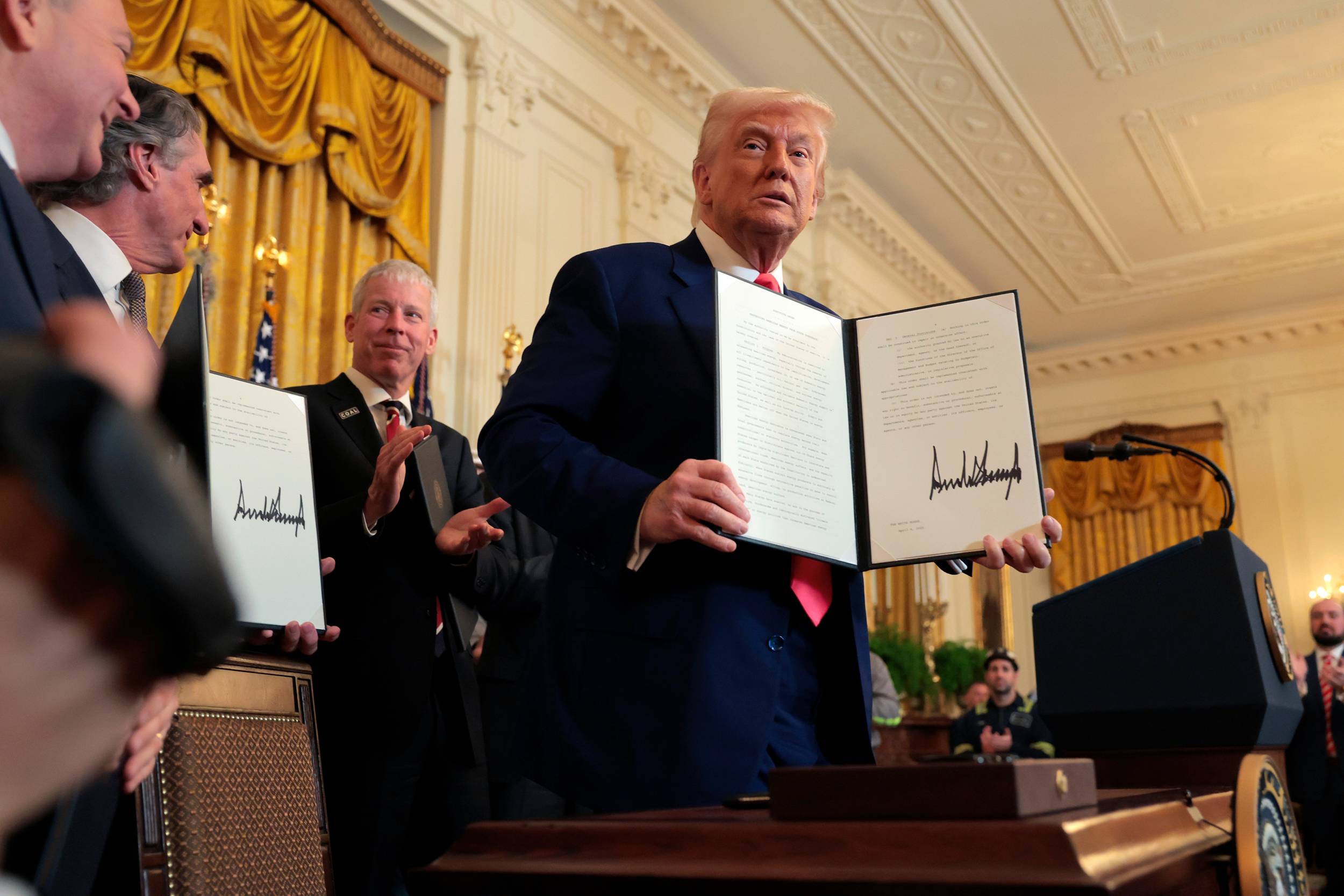 President Donald Trump poses for photos after signing a series of executive orders on American energy production during a ceremony in the East Room of the White House on April 8. Trump was joined by (from left) EPA Administrator Lee Zeldin, Interior Secretary Doug Bergum and Energy Secretary Chris Wright. Credit: Anna Moneymaker/Getty Images
Advances in a field known as climate attribution science have made the “polluter pays” aspect of the superfund laws possible, enabling scientists to quantify the individual contributions of major fossil fuel producers to climate impacts such as sea level rise and heat waves.
The DOJ has now filed motions for summary judgment in both of these lawsuits, asking federal courts to permanently block the states’ climate superfund laws.
“Vermont’s flagrantly unconstitutional statute threatens to throttle energy production, despite this Administration’s efforts to unleash American energy. It’s high time for the courts to put a stop to this crippling state overreach,” Acting Assistant Attorney General Adam Gustafson said in a statement issued by the DOJ on Sept. 16.
Havemann, with the Chesapeake Climate Action Network, told Inside Climate News that the current Trump administration seems to be taking a more aggressive approach to protecting the fossil fuel industry and to fighting attempts to hold it accountable.
“The Trump administration has come in and used many different tools in its toolbox to go after these accountability lawsuits and the laws that also seek to hold the biggest polluters accountable for climate damages,” she said. “It’s very much on the radar of the Trump administration in a way that it has not been in the past.”
The White House did not immediately respond to a request for comment.
“Enter the Dragon”
With U.S. Sen. Ted Cruz (R-Texas) holding the gavel, climate litigation came up as the subject of a Republican-led congressional hearing this summer before a Judiciary Committee subcommittee.
The hearing’s provocative title: “Enter the Dragon—China and the Left’s Lawfare Against American Energy Dominance.”
Cruz used the hearing to attack climate liability lawsuits and claim that they are a nefarious left-wing plot that is in part funded by, and that benefits, the Chinese Communist Party. “Both China and the Democrats want to bankrupt the American energy industry,” Cruz said during the hearing.
NPR’s Michael Copley reported last month that “Cruz’s office has not offered evidence that China or a China-linked nonprofit that Cruz identified by name has funded climate lawsuits in the United States.”
In response to that reporting, Cruz told Inside Climate News that “NPR deliberately ignored objective facts.”
“The Chinese Communist Party uses cut-outs and ‘nonprofits’ to shape U.S. energy policy, funding propaganda, advocacy, and litigation that harm American workers,” Cruz said in an emailed statement, which was also included in the NPR story after it was published. The “China-linked nonprofit” referenced in the NPR story, Energy Foundation China, does fund some climate initiatives, Cruz said in his statement.
“In January 2024, three House committee chairs opened an investigation into Chinese influence, citing EFC’s ties and funding of groups like [the Natural Resources Defense Council] and RMI,” he added.
A spokesperson for RMI, a nonprofit group working on the global energy transition, said that the organization “does not participate in litigation.” RMI’s “work supported by Energy Foundation China, which is a U.S. based charitable organization, is focused squarely on the energy transition inside of China,” the spokesperson added.
The Natural Resources Defense Council (NRDC), a nonprofit group that works to protect public health and the environment, does some “work in China for one reason: there’s not a single global environmental problem that can be fixed unless China is part of the solution,” NRDC spokesperson Josh Mogerman said. He added that the organization “does not fundraise in China” and that “money from China does not fund NRDC litigation in the United States, period.”
Cruz, who represents the country’s biggest oil and gas producing state, did not respond to Inside Climate News’ question about whether he supports immunizing oil companies from liability.
GOP Attorneys General Enter the Fray
During the Cruz-led hearing, the Republican attorney general for the state of Kansas, Kris Kobach, testified as one of the majority witnesses. He referenced the New York and Vermont climate superfund laws, claiming these statutes impose extraterritorial regulation on energy companies, and mentioned that his state and other Republican-led states are suing to try to overturn these state laws.
“We will continue these fights in court as state attorneys general. But we do need some help from Congress,” Kobach said. He suggested that Congress could legislate to expressly preempt state climate laws like the climate superfund laws.
Kobach and 15 other Republican state attorneys general also made this suggestion, along with several other recommendations for congressional action, in a letter addressed to Bondi, the U.S. attorney general.
The June 12 letter references Trump’s executive orders to “unleash” fossil fuels and protect the fossil fuel industry from “state overreach.” The letter says its purpose is to “suggest additional steps” the Department of Justice could take to effectuate these orders and assist in the “fight against anti-energy interests.”
Specifically, the Republican AGs suggest the DOJ could recommend legislation to reinforce federal preemption of state climate liability laws or lawsuits; restrict federal funding for states seeking to impose liability on energy companies; create a right of removal to federal district court for climate suits; and, among other items, stop “activist-funded climate lawsuits” with a liability shield, similar to the law that granted immunity for gun manufacturers.
Wiles, with the Center for Climate Integrity, said it is especially striking to see Republican attorneys general explicitly recommend a similar liability shield for fossil fuel companies. “The attorneys general actually called for Congress to enact a gun-style liability waiver for the oil industry,” he said. “We saw how that [gun industry immunity] ended up. It certainly was not helpful in curbing gun violence or in serving any public interest objective.”
The coordinated litigation strategies and actions of Republican state attorneys general in defense of fossil fuel and other industries stem from an organization called the Republican Attorneys General Association (RAGA), which Graves said was created in the wake of the tobacco industry being held accountable through the 1998 Master Settlement Agreement.
The organization, which currently lists 29 Republican state attorneys general as members, has been funded through donations from conservative judicial activists like Leonard Leo as well as from corporate interests including those in the fossil fuel industry. The American Petroleum Institute gave over $125,000 to RAGA in 2024, and in the first six months of this year Chevron’s Policy, Government and Public Affairs division donated $25,000 to the organization, for example.
Graves describes RAGA as a “pay-to-play organization.”
“It has a pay sheet listing what kind of access you get to attorneys general based on how much you give,” she told Inside Climate News.
“These attorneys general use the prestige of their office and their power and the resources that their taxpayers are providing to serve the interests of industry, select industries that they are most tied to, and that certainly includes the fossil fuel industry,” Graves added.
The Republican Attorneys General Association did not respond to a request for comment.
“A Perilous Moment”
The intensifying backlash to climate accountability efforts coming from the fossil fuel industry and its political defenders is happening at a time when some political scholars warn that the U.S. is sliding into some form of authoritarianism, which advocates say magnifies the challenges of holding powerful interests to account writ large.
“It’s a perilous moment for democratic norms and institutions,” said Kathy Mulvey, accountability campaign director for the climate and energy program at the Union of Concerned Scientists.
“Anybody who is pursuing policy change or litigation for accountability or enforcement is counting on the courts to be a real backstop for democratic institutions,” Mulvey told Inside Climate News.
Should the fossil fuel industry somehow succeed in securing legal immunity, Wiles said it “would be consistent with the erosion of the rule of law that we’re seeing.”
“No industry should be above the law,” he added.
---
---
— Republican attorneys general go to court to demand more pregnant 15-year-olds. This story sounds too bizarre to be true, but Missouri Republican Attorney General Andrew Bailey, Kansas Republican Attorney General Kris Kobach, and Idaho Republican Attorney General Raúl Labrador have filed a lawsuit in federal court — presumably aiming for an eventual hearing before the Supreme Court — claiming that their states are being harmed, population-wise, by the availability of abortion drugs that can be shipped into their states by mail.
They want shipping Mifepristone outlawed nationwide. The proof of the harm, they say, is that they are not seeing enough pregnant teenagers. The lawsuit is explicit (page 190): “Defendants’ efforts enabling the remote dispensing of abortion drugs has caused abortions for women in Plaintiff States and decreased births in Plaintiff States. This is a sovereign injury to the State in itself. … When data is examined in a way that reflects sensitivity to expected birth rates, these estimates strikingly ‘do not show evidence of an increase in births to teenagers aged 15-19,’ even in states with long driving distances despite the fact that ‘women aged 15-19 … are more responsive to driving distances to abortion facilities than older women.’”
They then claim that this “proof” that availability of mailed abortion pills are causing the drop in pregnancies among girls 15-19 years old is an “injury” to their states because it lowers their potential population. This is getting wild, but wait until the Supreme Court authorizes Red states to begin monitoring the menstrual periods of fertile girls and women; Alabama Republican Senator Katie Britt has already introduced federal legislation requiring companies selling devices that track ovulation to report their results to state agencies or a federal database, including police agencies nationwide, so pregnancies can be caught and tracked. Republicans won’t be happy until every girl in America grows up the way Amy Coney Barrett did in her People of Praise Catholic cult where she was referred to as a “Handmaiden.”
— And now, to the delight of Republican lawmakers and police the US government has bought a tool that can track you by your cellphone to abortion clinics anywhere in the country. Locate X is a product from Babel Street which our government has been using since the Trump administration; it’s capable of tracking every cellphone in the country with remarkable location accuracy. The folks at 404 Media did a trial run of it focused on tracking people to and from abortion clinics, and the process was startlingly easy. When Ted Cruz, JD Vance, and the rest of the GOP forced-birth crowd again gain control of the federal government, get ready. They’re chomping at the bit…
---
---
rww 4 23
Tags: Doug Blex Jason Goetz Ken Rahjes Kevin Stitt Kris Kobach Rick Kloos Sean Feucht Tracey Mann Virgil Peck Christian Nationalism
https://www.rightwingwatch.org/post/christian-nationalist-sean-feucht-prayed-over-multiple-elected-officials-nothing-can-stop-the-kingdom-of-god/
no lnx vid
Christian Nationalist Sean Feucht Prayed Over Multiple Elected Officials: ‘Nothing Can Stop the Kingdom of God’
Kyle MantylaBy Kyle Mantyla | April 26, 2023 3:12 pm
Christian musician turned right-wing political activist Sean Feucht made a stop at MAGA pastor Jackson Lahmeyer’s church in Tulsa, Oklahoma, last Thursday, where he proudly declared himself a Christian nationalist.
Christian nationalists believe the U.S. and state governments should operate and legislate according to their interpretation of the Bible, and that only Christians who share their political and religious worldview should control the reins of power. While many right-wing activists seek to downplay or obfuscate their Christian nationalist agenda, Feucht was very open about his intentions.
“We want God to be in control of everything,” he declared. “We want believers to be the ones writing the laws. Yes. Guilty as charged.”
Feucht was in Oklahoma last week because it was the latest stop on the“Kingdom to the Capitol” tour,a joint project he launched with right-wing youth organization Turning Point USA to bring Feucht’s mix of worship and hard-right politics to every state capitol in the nation.
Last Friday, Feucht and his “Kingdom to the Capitol” tour set up shop on the grounds of the Oklahoma capitol, where Feucht was welcomed by Gov. Kevin Stitt, who last year dedicated “every square inch” of the state to Jesus.
Following brief remarks from Stitt, Feucht laid hands upon the governor and led the audience in praying over him.
“This is so biblical, and it’s so appropriate for us to come as the people of God and release a blessing over this building, over this man, over the government,” Feucht proclaimed. “This is really Davidic what we’re doing here, it’s like David bringing an offering to the Lord at the most important governmental building in the state, and we’re just so honored to have the governor here with us.”
“Lord, we just thank you for this man of God,” Feucht continued. “We thank you for the state of Oklahoma. God, we thank you for what you’re doing here. We thank you, God, how you’re raising up this state to be a model state for America. God, we thank you that you’ve put a mantle of leadership on Gov. Kevin and you put a mantle of leadership on the legislature of this state. God, we need godly leaders in America, and we thank you that you have them in Oklahoma. Lord, we pray God that you would take the pattern of what you’re doing here and that you would duplicate it across the land.”
:{:{}:
}:
Two days later, Feucht and his tour stopped at the capitol in Topeka, Kansas, where multiple members of the state legislature, Rep. Tracey Mann, and far-right state Attorney General Kris Kobach all prayed and were then prayed over by Feucht in return.
“No longer can the church afford to vacate the political realm,” Feucht declared. “Lord, we thank you, God, that you have raised up men and women to stand as watchmen on the wall for the state of Kansas. Lord, we commit as the Church of Jesus Christ to pray for them. Lord, we thank you that you’ve put them in positions of authority. … We just declare over this capitol building: Nothing can stop the kingdom of God. Nothing can stop the plans of God.”
Among the Kansas legislators who appeared on stage with Feucht were state Reps. Doug Blex, Jason Goetz, and Ken Rahjes, and state Sens. Virgil Peck and Rick Kloos.
Tags: Doug Blex Jason Goetz Ken Rahjes Kevin Stitt Kris Kobach Rick Kloos Sean Feucht Tracey Mann Virgil Peck Christian Nationalism
---
---
---
ap 2020
kANSAS CITY, Mo. (AP) — A super PAC supporting conservative Kris Kobach’s campaign for an open U.S. Senate seat from Kansas has sent out a maileraccusing his chief rival in the Republican primary of performing abortions.
The claim against Rep. Roger Marshall, an OB-GYN endorsed by major anti-abortion groups, is based on a tweet by a Kansas woman whose social media posts have often accused the congressman of hypocrisy on abortion rights, the Kansas City Star reported.
Free Forever PAC, a group almost entirely funded by California billionaire Peter Thiel, paid for the mailer sent out just days before the Aug. 4 primary in Kansas. Thiel is a longtime Kobach ally who has steered $850,000 to the PAC.
Marshall’s campaign and Kansans for Life, the state’s leading anti-abortion group, decried the mailer as a smear. The medical procedure that Shonita Swank of Hoisington claims she underwent to remove an ectopic pregnancy does not constitute an abortion, they said.
An ectopic pregnancy, which occurs when a fertilized egg implants outside the uterus, can be life-threatening to the woman if not treated. Many anti-abortion groups, including National Right to Life and the U.S. Conference of Catholic Bishops, draw a distinction between the procedure and abortion.
“This is, without question, the most pathetic and low political lie we have ever seen. This patient, by her own public admission, had a tragic ectopic pregnancy, and Dr. Marshall literally saved her life. Dr. Marshall has never participated in an abortion,” said Eric Pahls, Marshall’s campaign manager.
Kobach’s campaign said it had no involvement with the mailers, but it called Swank’s claims in the tweet a “troubling accusation against Roger Marshall that needs to be answered.”
Swank said she doesn’t like the super PAC using her tweet in the mailer, but she doesn’t feel there is anything she can do about it. Swank said her criticism stems from frustration about her treatment and what she views as Marshall’s hypocrisy on abortion.
The mailers attacking Marshall follow ads from Plains PAC that attacked Kobach for his support of abortion rights in 2000 when he was a candidate for the Legislature. Kobach has said he changed his position after becoming a father.
The Plains PAC is run by C.J. Grover, a former staffer of Kansas Attorney General Derek Schmidt. The group has also launched attack ads targeting Kobach’s campaign for paying a white nationalist last year.
The GOP hasn’t lost a Senate race in Kansas since 1932, but Republicans are worried that could change if Kobach wins the nomination because it could turn off party moderates and independents. The Democratic nominee likely will be state Sen. Barbara Bollier, a retired Kansas City anesthesiologist and former moderate Republican who switched parties at the end of 2018.
---
521
https://www.rightwingwatch.org/post/far-right-kris-kobach-aims-for-political-comeback-announces-run-for-ag-in-kansas/
---
https://www.alternet.org/2020/08/trump-says-he-didnt-approve-of-border-wall-project-but-these-key-players-bragged-of-his-approval
After Steve Bannon’s arrest on Thursday, Donald Trump tried to put a Grand Canyon-sized gap between himself and the “We Build The Wall” border scheme. Bannon, Brian Kolfage, Andrew Badolato, and Timothy Shea were indicted on counts of conspiracy to commit wire fraud and conspiracy to commit money laundering. The federal indictment says the crew pilfered “hundreds of thousands of dollars” and a Bannon-controlled nonprofit received more than $1 million in funds.
The federal government is seeking to take possession of the fraudulently purchased items, like the flashy boat Kolfage purchased and used in recent “Trumptilla” boat parades. Incredibly enough, Bannon and Kolfage recorded a video promoting their scam fund and folks, you are not going to believe this—Bannon actually jokes they are filming in Saint-Tropez in southern France before adding: “We are on the million dollar yacht of Brian Kolfage. Brian Kolfage, he took all that money from Build The Wall.” Kolfage then lets out an awkward laugh. Watch them joke about the fraud below. You cannot make this up.
[twt mma] after you collect yourself, watch the video below this because it just keeps getting better. First up, let’s revisit Trump’s statement trying to put daylight between himself and the We Build The Wall project. He repeatedly says he “didn’t like it” and thought it was “showboating and maybe looking for funds.” In a stumbling response, he repeatedly said he never approved of the project and Bannon aside, that he didn’t know anyone involved. As you’ll see below, most of the folks involved in the project said otherwise.
Let’s listen to former Kansas Secretary of State Kris Kobach, who has been described as a “racist traveling con man” because of his history of helping cities enact racist laws and then billing them to represent them in court cases they inevitably lose.
[vid: t i feel bad about bannon charges]
kobach is legal counsel for We Build The Wall, because of course he is, and he recorded an “interview” with Jennifer Lawrence, who is also listed on the We Build The Wall website as the communications director for the organization. Listen to Kobach describe his conversation with Donald Trump and brag that Trump said: “I want the media to know this project has my blessing.”
It should be noted that just before Bannon’s arrest on Thursday morning byfederal postal inspectors on a yacht off the coast of Connecticut, federal investigators were also serving a warrant on Lawrence and another associate, Dustin Stockton. The pair told CNN that “heavily armed federal agents” served the warrant and confiscated their cell phones.
No doubt, Kobach must be sweating. Going after lower-level employees is a sure sign they’re angling for bigger fish. And while Kobach bragged about Trump’s full-throated approval, he wasn’t alone. Lexi Churchill of ProPublica found other examples claiming Trump’s full endorsement. Amanda Shea, wife of the recently indicted Timothy Shea, shared a photo of the crew with Donald Trump in August 2019, with a caption saying: “A summer of winning came to a high note in the Hamptons. I had the absolute pleasure and honor of spending time with President Trump who had a lot of questions about the wall We The People built through We Build The Wall. He was impressed, but more importantly, incredibly personable and easy to talk to. I forgot that I was speaking with one of the most powerful men in the world.”
Shea also touted the meeting on Twitter.
Churchill also found an interview Kolfage did with The Gateway Pundit in which Kolfage bragged of Trump’s support, saying: “President Trump loves what we are doing.”
And wherever a right-wing grift exists, you knowJunior isn’t far behind. Of course he promoted the wall and congratulated Kolfage on “[t]his is private enterprise at its finest. Doing it better, faster, cheaper than anything else. What you guys are doing is amazing.”
Trump’s Acting Homeland Security Director Chad Wolf, who a federal court ruled is illegally serving in the role, called the group’s work a “game changer” and said he “welcomed” their efforts.
So it would seem this is another in a long list of lies from Donald Trump. He welcomed this group’s efforts right up until ProPublica reported on the shoddy construction of the privately built wall, which was in danger of falling over. Nevertheless, the contractor, Fisher Industries, was awarded a massive government contract to build Trump’s wall and Trump reportedly “personally and repeatedly” intervened to make sure Fisher was awarded the project.
---
==
https://www.alternet.org/2020/08/gop-strategists-fear-a-kris-kobach-nomination-could-cost-republicans-greatly-the-senate-majority-runs-through-kansas/
https://www.alternet.org/2020/08/here-are-13-ways-a-democratic-wave-pickup-of-double-digit-senate-seats-is-a-real-possibility/
==
https://www.alternet.org/2020/07/senate-hopeful-kris-kobach-bankrolled-by-billionaire-peter-thiel-says-coronavirus-numbers-are-being-cooked-to-hurt-trump/
no lnx
Senate hopeful Kris Kobach — bankrolled by billionaire Peter Thiel — says coronavirus numbers are ‘being cooked’ to hurt Trump
Written by Alex Henderson July 28, 2020
With Republicans in fear of losing the U.S. Senate in November, the last thing they need is for far-right extremist Kris Kobach to win the state’s GOP senatorial primary this summer and put the seat in play for Democrats. And Kobach’s recent comments on COVID-19 are a prime example of why Democrats believe they could defeat him in the general election: Kobach is claiming that the coronavirus death count is being exaggerated as part of a conspiracy to hurt President Donald Trump. Regardless, Kansas’ former secretary of state continues to pursue the nomination, and he has a major ally in tech billionaire and venture capitalist Peter Thiel.
On the YouTube program “National File,” Kobach said of the pandemic, “I believe that the numbers are being cooked.”
According to researchers at Johns Hopkins University in Baltimore, the COVID-19 pandemic has killed more than 654,300 people worldwide and over 148,000 in the United States. Truth be told, that 148,000+ figure is probably too low — as the death count in the U.S. focuses on hospital deaths and doesn’t take into account all of the Americans who have died from COVID-19 in their homes and were never hospitalized. But Kobach nonetheless insists that the pandemic isn’t as deadly as Trump’s critics are making it out to be.
On the July 13 edition of K-File, Kobach claimed, “The books are being cooked, and the purpose, at least on the political left, is to use those numbers to scare the public and to scare the political leadership into shutting down. Now, they want to continue the government shutdown for — the business shutdown — with government pressure, for as long as they can. If they can slow it down by using masks as a signal that things are not back to normal— and therefore, you should not go out, you should not buy, you shouldn’t open up your business yet — whatever, but the reason is obvious.”
Such claims are a prime example of why Democrats believe they could defeat Kobach if he wins the Republican senatorial primary in Kansas and makes it to the general election — especially in light of the fact that Democrats defeated him once before. In Kansas’ gubernatorial election in 2018, Kobach (who served as chairman of the Kansas Republican Party from 2007-2009 and as Kansas’ secretary of state from 2011-2019) lost to a Democrat: centrist Laura Kelly, now Kansas’ governor. And as deep red as Kansas is, Kobach’s defeat in 2018 demonstrated that a Democrat can win a statewide race in that state if the GOP nominee is extreme enough.
But as extreme as Kobach is, he has found a major ally in Thiel. According to Vox’s Theodore Schleifer, Thiel held a fundraiser for the Republican in Manhattan and has since “pumped $850,000 into a super PAC behind Kobach.”
Schleifer reports, “If Kobach is elected, it could give Thiel a loyal ally in the Senate because of how powerful he is proving to be in the race. That alliance becomes all the more key if Trump loses this fall, which would weaken the Washington influence of Thiel — a board member at Facebook and a founder of Palantir, which has deep ties to the government.”
Patrick Miller, who teaches political science at the University of Kansas, believes that Thiel has become indispensable to Kobach’s Senate campaign. Miller told Vox, “I don’t want to overstate it and say that Kobach wouldn’t have a campaign without him. But I think the money that that super PAC is putting into the race — primarily through this one rich guy — is absolutely the lifeblood of the pro-Kobach campaign at this moment. You take that money away, and Kobach doesn’t have a lot of campaign left.”
Kobach is running for the U.S. Senate seat being vacated by Republican Sen. Pat Roberts, who is retiring. In the primary, he is up against Rep. Roger Marshall — and the GOP strategists who fear that Kobach, if nominated, would lose to a Democrat are rallying around Marshall aggressively and hoping to God he becomes the nominee. Scott Reed, a political strategist for the U.S. Chamber of Commerce, told Politico, “A Kobach victory would definitely put the Republican majority in jeopardy because it would add another state that would need serious resources.”
According to Steven Law, president of the Senate Leadership Fund, Senate Minority Leader Chuck Schumer is hoping that Kobach becomes the nominee because he believes that Kobach would be easier to defeat than Marshall. Law told Politico, “The latest ad from Schumer’s Kansas pop-up PAC shows that they want to start the general election early by going after Marshall, and we aren’t going to let them get the jump on us.”
==
Kobach: Migrant Kids Are in Cages 'For Their Own Protection'
==
new 819
https://www.alternet.org/2019/08/it-looks-like-kansas-kris-kobach-is-illegally-using-nonprofit-border-group-to-raise-campaign-funds/
no lnx
It looks like Kansas’ Kris Kobach is illegally using nonprofit border group to raise campaign funds
Written by Jen Hayden / Daily Kos August 2, 2019
Former (hallelujah!) Kansas Secretary of State Kris Kobach may have run afoul of the law in his latest bid to attain higher office. Kobach suffered a humiliating defeat in November 2018’s gubernatorial race in Kansas, losing to Democrat Laura Kelly. He’s back, and although nobody asked him to run again, with the possible exception of Trump’s white nationalist advisor Stephen Miller, he’s inserted himself as a candidate in the race for Sen. Pat Roberts’ seat after the longtime senator announced he would be retiring in 2020. You know it’s bad when Republicans are desperate to recruit someone, anyone other than Kobach to run.
Secretary of State Mike Pompeo is rumored to be considering it. He may want to give it more thought if federal prosecutors begin looking into Kobach’s fundraising. The Daily Beast reports Kobach sent out a fundraising email for his senate campaign to the nonprofit group We Build The Wall. Kobach sits on the board of the group and acts as its legal counsel.
“As a donor to WeBuildTheWall, I humbly ask you to support my run for the Senate,” Kobach’s email pleaded. The email provided links to the campaign’s official fundraising page and asked for “a financial contribution of $50, $100, $250, $500, or any amount up to the maximum of $2,800 per individual.”
The solicitation likely violated federal campaign finance laws, according to Paul S. Ryan, the vice president for policy and litigation at the group Common Cause
“At a minimum, this Kobach for Senate fundraising solicitation email appears to violate the ‘paid for by’ disclaimer requirement” for official campaign communications, Ryan said in an email, referencing the requirement that campaigns clearly disclose the financial sponsors—generally the campaigns themselves—behind official political communications.
The We Build The Wall organization has faced significant legal challenges. Its goal is to use private funds to build a wall along the southern border. Its fundraiser for the purpose went viral among MAGA types, and it raised $22 million. Since then, it claims to have built a half-mile of border wall on private land in New Mexico, but it’s since gotten a cease-and-desist letter from the city because the wall violates city code.
The barrier also surpasses the city ordinance’s maximum allowed height of six feet, Perea added, meaning [fundraiser Brian] Kolfage’s wall is “not in compliance.”
City officials issued a cease-and-desist order Tuesday as lawmakers condemned construction efforts. In a statement to the Silver City Sun News, El-Paso-based Democrat Rep. Veronica Escobar took particular aim at Kobach and Bannon.
“It’s deeply disturbing when outsiders, like Kris Kobach and Steve Bannon, come in and use our community and people as a backdrop to further their racist agenda,” Escobar said. “It’s even more disturbing that a business in our community is furthering this xenophobic narrative. While this wall may be necessary fuel for the president’s political campaign, it will not prevent people from seeking asylum.”
In neighboring Missouri, former Gov. Eric Greitens was indicted for similar use of an email list from a nonprofit organization he ran.
Missouri Gov. Eric Greitens was indicted Friday on suspicion of stealing an electronic list of donors to the pro-veterans charity he founded in order to raise money for his political career, prosecutors say.
The new charge against the Republican governor comes at the tail end of the three-year statute of limitations, St. Louis Circuit Attorney Kim Gardner said in a news release.
According to a probable cause statement, Greitens instructed the April 22, 2015, disclosure of a donor list owned by the Mission Continues, a nonprofit Greitens founded, without the charity’s permission.
That charge was dismissed when Greitens resigned. He also stood accused of blackmailing a woman he’d had an affair with after he took nude photos of her without her permission and threatened to release them publicly if she ever told anyone of the affair.
Needless to say, prosecutors should be looking at Kobach’s fundraising through the nonprofit. Based on the reporting from the Daily Beast, it seems clear that the blurring of the lines between Kobach’s campaign and the nonprofit are at a minimum worth more scrutiny, possibly rising to the level of a felony.
“You’ll sometimes see a campaign paying to rent a c4’s list, but that’s clearly not what’s happening here,” said Brendan Fischer, the director of federal reforms at the Campaign Legal Center. “[T]he content of the message describing a We Build the Wall event and the logo at top make clear it is an official communication from the c4 itself.”
In the email, Kobach even compares his role as the nonprofit’s top lawyer to the one he hopes to play in the upper chamber of America’s legislature, writing, “I’m [sic] want to represent you in the United States States [sic] the same way I’m going to continue to represent WeBuildTheWall as General Counsel.”
Kansans were already tired of Kobach embarrassing the state with one legal misfire after another. As secretary of state, Kobach worked tirelessly to make sure as many people as possible lost the right to vote. He used his Crosscheck voter system, which flagged allegedly questionable voter registrations, to systematically kick voters off the voter rolls by demanding they present proof of citizenship, voters who happened to have names like Garcia and Jackson.
He also tried to create a two-tier voting system, one that would allow people to vote in federal elections (because of the constitutional right to vote), but not in state elections if they didn’t jump through his citizenship hoops. He was essentially laughed out of court. Again. His performance in court defending these laws was so bad, and his paperwork filled with so many errors, that a federal judge ordered Kobach to take remedial legal classes.
He is also the man who was the architect of the most racist law in modern American history, Arizona’s S.B. 1070, which allowed law enforcement officers to stop anyone they pleased to demand citizenship paperwork on the spot and indefinitely detain them if they didn’t carry their birth certificate or citizenship paperwork with them. Nicknamed “Papers Please,” the law meant that officers could detain an entire family. Kobach hoped to take it nationwide. Indeed, it does seem similar to what ICE and Trump are now doing, doesn’t it?
And with all of that, please enjoy this just-released video from Kris Kobach in which he spends five full minutes waving around an empty coffee mug while helpfully explaining that all the articles about him being a super-duper racist are wrong.
==
https://www.alternet.org/2019/07/here-are-5-reasons-republicans-are-terrified-that-toxic-trump-ally-kris-kobach-could-lead-the-party-to-a-historic-defeat/
no lnx
5 reasons Republicans are terrified that toxic Trump ally Kris Kobach could lead the party to a historic defeat
Fox Business screenshot
written by Alex Henderson July 12, 2019
Former Kansas Secretary of State officially announced on Monday that he will be seeking the Republican nomination for the U.S. Senate seat presently held by Republican Pat Roberts, who is retiring. If Kobach receives the nomination and defeats a Democratic nominee in 2020, he would hardly be the first Republican to win that seat — Kansas hasn’t elected a Democrat to the U.S. Senate since 1930. In other words, Kansas is a very red state. And yet, some GOP strategists are imploring Kobach not to run and fear that if he does receive his party’s nomination, he could become the first Republican to lose a U.S. Senate race in Kansas in 90 years.
Kobach isn’t just any Republican: he is extreme even by modern-day GOP standards. And he comes with a lot of baggage. Here are some of the reasons why various Republican strategists would love to see Kobach drop out of the race.
- Kobach lost Kansas’ gubernatorial race to a Democrat in 2018
Texas is often described as a red state, but compared to Kansas, Texas is light red rather than deep red. In 2018, according to U.S. News and World Report, voter registration in Kansas was a paltry 24% Democratic — whereas Pew Research found that among Texans, the political makeup was 39% “Republican/lean Republican,” 40% “Democrat/lean Democrat” and 21% “no lean.” Democrats have more reason to feel depressed in Kansas than they do in Texas. And yet, in 2018, the unthinkable happened in Kansas: a centrist Democrat, Laura Kelly, won the gubernatorial race, defeating Kobach by 5%.
Granted, 5% isn’t a landslide, but this is Kansas we’re talking about — not California, Massachusetts or even a swing state like Florida or Pennsylvania. In 2016, President Donald Trump won Kansas by 21%. And GOP strategists fear that if Kobach could lose one statewide race in Kansas, he could lose another.
Joanna Rodriquez, press secretary for the National Republican Senatorial Committee, complained to The Hill, “Just last year, Kris Kobach ran and lost to a Democrat. Now, he wants to do the same and simultaneously put President Trump’s presidency and Senate Majority at risk.”
- Kobach lost a House race to a Democrat in 2004
The 2018 election wasn’t the only time Kobach lost to a Democrat. In 2004, he ran for the U.S. House of Representatives in Kansas’ 3rd Congressional District and was defeated by former Rep. Dennis Moore by 11% in a district that is 82% white. Kobach has held some major positions (chairman of the Kansas Republican Party, Kansas secretary of state), but GOP strategists believe that he has suffered too many losses to Democrats in a state where Republicans have a huge advantage.
A GOP strategist who spoke to The Hill on condition of anonymity fears that if Kobach stays in the Senate race and Democrats win enough Senate races in red states, they might regain control of the Senate in 2020. “You can see a real scenario where President Trump is reelected and the U.S. Senate falls to the Democrats if Kobach puts Kansas in play,” that strategist warned.
- Kobach is an unapologetic birther
When Barack Obama was president, Kobach enthusiastically promoted the racist and idiotic birther conspiracy theory — which claimed that Obama wasn’t really a U.S. citizen and was born in Kenya. Obama’s birth certificate proves, beyond a shadow of a doubt, that he was born in Honolulu, Hawaii on August 4, 1961. Yet even when MSNBC’s Chris Matthews was holding Obama’s birth certificate right up to the camera in order to show how ridiculous birthers were, Kobach persisted in his birtherism.
- Kobach falsely accused the Human Rights Campaign of promoting ‘pedophilia’
Kobach, a far-right Christian fundamentalist, is notoriously anti-gay. When he ran against Moore in 2004, he accused his Democratic opponent of associating with a group that promoted “homosexual pedophilia.” That group was the Human Rights Campaign, a mainstream gay rights organization that has never condoned or promoted pedophilia in any way. But in his effort to smear Moore, Kobach reflexively associated a gay rights group with pedophilia.
- Kobach has worked for the racist Federation for American Immigration
Kobach has not only been an avid proponent of voter suppression; he has also been deeply anti-immigrant and worked for the Immigration Reform Law Institute, the legal division of the Federation for American Immigration Reform (FAIR) — which the Southern Poverty Law Center considers a hate group. The Federation, founded by eugenics proponent John Tanton in 1979, has a long history of calling for a moratorium on immigration and claiming that Latinos don’t fully assimilate into U.S. culture.
==
719
Kobach files for Kansas Senate run in blow to GOP groups
Former Kansas Secretary of State Kris Kobach launched a run for U.S. Senate in Kansas Monday. Kobach will likely face opposition from GOP-aligned outside groups in the Republican primary race for the seat held by retiring Sen. Pat Roberts. Read More
---
https://www.alternet.org/2019/06/john-roberts-will-wreck-democracy-if-trump-gets-out-of-his-way/
no lnx
John Roberts will wreck democracy — if Trump gets out of his way
written by Sophia Tesfaye / Salon June 28, 2019
A pair of rulings handed down by the Supreme Court on the last day of its current session shows just how muchChief Justice John Roberts has overseen the slow destruction of the democratic process in this country over the last decade.
Since assuming the center seat on the nation’s highest court in 2005, Roberts has ruled in favor of unlimited corporate spending in political elections and against enforcement of the Voting Rights Act. This week he added allowing partisan gerrymandering to continue and at least a potential citizenship question on the census, an obvious attempt to intimidate non-citizens and immigrants out of participating.
Yes, technically Roberts joined with the court’s four “liberal” justices in a complex 5-4 decision on whether the Trump administration can ask all recipients a citizenship question on the 2020 census for the first time since 1950. But his ruling isn’t anything to get excited about. Quite the contrary.
The question, which critics say would further reduce the already low Hispanic participation rate, had been blocked by numerous federal courts. The Trump administration had claimed it was necessary to better comply with federal voting rights law.
“There’s no evidence in this record that the secretary [of Commerce] would have asked this question had the Department of Justice not requested it,” Solicitor General Noel Francisco argued in court.
But there was plenty of evidence to suggest that this question was fed to the Trump campaign team around the time of the election by former Kansas Secretary of State Kris Kobach, a notorious advocate of voter suppression tactics. It likely came through former Trump campaign CEO and White House adviser Steve Bannon, before landing in the lap of Commerce Secretary Wilbur Ross, who oversees the census. The administration simply lied about all that.
Rep. Grace Meng, D-N.Y., asked Ross during a House Appropriations subcommittee hearing last year, “Has the president or anyone in the White House discussed with you or anyone on your team about adding the citizenship question?”
Ross replied: “I am not aware of any such.”
His lawyers later admitted, however, that “Secretary Ross recalls that[Steve] Bannon called Secretary Ross in the Spring of 2017 to ask Secretary Ross if he would be willing to speak to then-Kansas Secretary of State Kris Kobachabout Secretary Kobach’s ideas about a possible citizenship question on the decennial census,” despite initial claims that Ross could not “confirm that the Secretary spoke to Steve Bannon regarding the Citizenship Question.”
In a July 2017 email to Ross, Kobach proposed wording for a citizenship question. He complained that “aliens who do not actually ‘reside’ in the United States are still counted” in the census numbers used to determine how many seats in Congress each state gets. This is ludicrous on its face: You do not have to be a citizen of a given country to “reside” within it.
The evidence is damning and difficult to ignore — but if the Trump administration had not blatantly lied to Roberts’ face, they probably would have gotten away with it.
“The sole stated reason” for the citizenship question, Roberts wrote in his opinion, “seems to have been contrived. We are presented, in other words, with an explanation for agency action that is incongruent with what the record reveals about the agency’s priorities and decisionmaking process.”
The decision remands the case to lower courts to be reconsidered. The census wasn’t saved by the Supreme Court, but by Trump’s incompetence. Roberts essentially stated that the citizenship question was legitimate — but that the government had to come up with a better excuse for it.
The U.S. census has never been about how many people are citizens or eligible voters in a given area. It’s about a much simpler question: How many people live there. Adding the citizenship question, in light of the evidence that it would depress response rates, only serves as a direct contradiction of the census’ principal purpose. Congress has directed the Census Bureau to spend no more on the 2020 Census than it did in 2010 when, according to the government’s reports, Latinos were undercounted by 1.5 percent and African-Americans by nearly 2 percent.
The Trump administration argued in court that there was not enough evidence that the question would decrease the response rate to block the question. (Research from the Census Bureau itself strongly suggests otherwise.) The administration also previously told the court that the questionnaire needed to be printed by the end of June — which you will notice is upon us. No doubt the government will now concede that the real deadline is October, as the challengers to the question have long argued. Roberts is merely inviting the administration to come back with a better lie.
Under Roberts’ tenure, the court’s conservative justices have previously provided free legal advice to favor certain outcomes. For instances, they asked the Trump administration come back several times with modifications to its so-called travel ban, so that the court could pretend it was something other than a “Muslim ban.” In the infamous Citizens United case, the Roberts court had the plaintiff reframe demands in order for the conservatives to rule on the case they wanted, rather than the one actually in front of them.
Unfortunately for the Trump administration, even with a second bite of the apple on the census question, this case is likely to face even more scrutiny.
As a federal trial judge in Maryland ruled earlier this month, new evidence presented after oral arguments had been heard by the Supreme Court had raised “a substantial issue.” The recently revealed evidence shows just how racist the basis for this entire question actually was.
The late GOP redistricting strategist Thomas Hofeller played a substantial role in adding the citizenship question, according to documents uncovered after his death. Hofeller argued that adding a citizenship question would depress Hispanic response rates, thereby allowing states to redraw districts that boosted “Republicans and non-Hispanic whites” to an unfair electoral advantage for years to come.
The Supreme Court did not initially consider the Hofeller evidence, which did not emerge until the case had been argued, but the evidence of racial bias will indisputably be part of the record the second time around. In a blatant attempt to stop congressional oversight on this front, the Justice Department on recently threatened to invoke presidential powers to withhold the documents on its efforts to add the citizenship question, unless House Democrats backed off their threats to hold Ross in contempt of Congress. So far, Democrats haven’t blink.
In light of an earlier ruling by Roberts, the census case is merely a temporary failure and another example of a rookie mistake by Trump.
Before handing down his surprise decision in the census case, Roberts ruled alongside the other four justices appointed by Republicans to allow partisan gerrymandering to go unchallenged in federal court. This essentially guarantees that the political party that controls a statehouse can draw voting districts however it wishes, without intervention.
“For the first time ever, this Court refuses to remedy a constitutional violation because it thinks the task beyond judicial capabilities,” Justice Elena Kagan wrote in dissent. “Of all times to abandon the Court’s duty to declare the law, this was not the one. The practices challenged in these cases imperil our system of government. Part of the Court’s role in that system is to defend its foundations. None is more important than free and fair elections.”
The ramifications of this decision will be felt for decades to come all over the country. There’s ample evidence that Republicans in office have pursued gerrymandered maps to shut out people of color or other groups likely to vote Democratic — either by carving them up and dispersing them, or by concentrating them into as few districts as possible.
John Roberts, who gave Republicans a green light to install legislative majorities against the will of the people — and may yet allow them yet another tool to keep power through the census — seeks to convey a sense of consensus, as biographer Joan Biskupic notes. Supreme Court justices “do not sit on opposite sides of an aisle, we do not caucus in separate rooms, and we do not serve one party or one interest. We serve one nation,” Roberts insisted last October.
But as Nse Ufot, the executive director of New Georgia Project, the nonprofit voter engagement group founded by Stacey Abrams, notes: “Justice Roberts is hiding behind the concept of federalism. They’re using the separation of powers and branches of government as a pretext for attacking civil rights. They have a sacred duty to uphold the Constitution. [The 2013 decision to overturn parts of the Voting Rights Act] told us everything we needed to know about the Roberts Court and their hostility toward civil rights and voting rights.”
Roberts wrote both of Thursday’s majority opinions. This is his project, and it’s not over.
==
==
new 619
Ocasio-Cortez blasts Kris Kobach for history of ‘racism’ and ‘voter suppression’ during epic statement at House Oversight hearing
==
palast https://kpfa.org/episode/talkies-october-17-2018/
kobach stole primary from gov, same techs used by kemp in GA
challenged a million signatures?! canceled ballots, 10k provisional/placebo ballot
nevada
https://kpfa.org/episode/talkies-october-17-2018/
---
---
exact match BS
---
==
https://www.motherjones.com/politics/2018/09/new-documents-undercut-commerce-secretarys-claims-about-origins-of-census-citizenship-question/
In March, Commerce Secretary Wilbur Ross, who oversees the Census Bureau, approved a controversial question about US citizenship on the 2020 census, claiming that the Justice Department needed it for “more effective enforcement” of the Voting Rights Act. Ross said at the time and in subsequent testimony before Congress that he approved the question after the Justice Department requested in December 2017 that it be added.
However, new documents released as part of a lawsuit by New York state against the Trump administration directly contradict Ross’s public comments, showing that the commerce secretary repeatedly lobbied the Justice Department to add the citizenship question after consulting with anti-immigration hardliners. On September 8, 2017, Earl Comstock, a top official in the Commerce Department, wrote to Ross, “Justice staff did not want to raise the [citizenship] question given the difficulties Justice was encountering in the press at the time (the whole Comey matter)." [doc]
twit: In our Census case, we just got this email to Wilbur Ross that the court ordered the Govt to unredact. It shows that when Commerce first asked DOJ to come up w/a pretext for adding the citizenship q, DOJ balked b/c it was already getting bad press with "the whole Comey matter"... The email, released Monday, is part of a series of internal memoranda that refute Ross’ public rationale for the citizenship question. As Mother Jones previously reported, Ross stated in a memo he filed to the court on June 21 that he first considered adding a citizenship question after he was confirmed as commerce secretary in February 2017, months before the Justice Department requested the question at Ross’s urging. He wrote that he had approached the Justice Department about the question, not the other way around, after consulting with “other senior Administration officials” who had “previously raised” the citizenship question. Ross said he had “inquired whether the Department of Justice would support, and if so would request, inclusion of a citizenship question.”
One of the senior administration officials who lobbied Ross to add the question was former White House chief strategist Steve Bannon.In July 2017, Kansas Secretary of State Kris Kobach—at the time the vice chair of President Donald Trump’s now-defunct Election Integrity Commission—wrote to Ross “at the direction of Steve Bannon”and said it was “essential” that the citizenship question be added to the census. Kobach wrote that the absence of a citizenship question “leads to the problem that aliens who do not actually ‘reside’ in the United States are still counted for congressional apportionment purposes.”
Kobach’s correspondence with Ross contradicted the Trump administration’s stated rationale for the question—Kobach never mentioned the Voting Rights Act in his letter—and suggested the question was added to reduce the political clout of areas with many immigrants and boost Republicans. The Justice Department said in court that Kobach, Bannon, and Attorney General Jeff Sessions, who have all advocated aggressive crackdowns on immigration, were among those involved in pushing for the citizenship question.
The census has not asked respondents about their citizenship status since 1950. Civil rights groups say the citizenship question will depress response rates from immigrants, imperil the accuracy of the census, and shift political power to areas with fewer immigrants. The census determines how $675 billion in federal funding is allocated, how much representation states receive, and how political districts are drawn.
In July, Judge Jesse Furman of the Southern District of New Yorkruled that a lawsuit against the Trump administration filed by New York and 16 other states challenging the citizenship question should go to a full trial. While noting that Ross had “broad authority over the census,” Furman said his decision to add the citizenship question may have been “motivated at least in part by discriminatory animus and will result in a discriminatory effect.”
Furman questioned Ross’s truthfulness and the administration’s motives in adding the question. “Secretary Ross’s sole proffered rationale for the decision, that the citizenship question is necessary for litigation of Voting Rights Act claims, may have been pretextual,” he wrote. “For one thing, there is no indication in the record that the Department of Justice and civil rights groups have ever, in the fifty-three years since the Voting Rights Act was enacted, suggested that citizenship data collected as part of the decennial census would be helpful, let alone necessary, to litigate such claims. For another, while Secretary Ross initially (and repeatedly) suggested that the Department of Justice’s request triggered his consideration of the issue, it now appears that the sequence of events was exactly opposite.”
Indeed, in a May 2017 email to Ross, Comstock wrote, “We need to work with Justice to get them to request that citizenship be added back as a census question.” Ross responded to Comstock in August 2017, “Where is the DoJ in their analysis? If they still have not come to a conclusion please let me know your contact person and I will call the AG.” (These emails were first reportedby Hansi Lo Wang of NPR.)
Plaintiffs in the New York lawsuit, which include the New York attorney general’s office and the ACLU, have filed a motion to depose Ross, claiming he repeatedly misled the public about the origins of citizenship question and why it was needed, including under oath during testimony to Congress in March 2018 when he claimed that the Department of Justice had  ” the request. “This is astonishing, unprecedented conduct from a Cabinet member,” they wrote in a filing on Monday night. “It has consequences not for some minor or ministerial matter, but for the accuracy of the decennial census—which the Secretary agrees will affect ‘foundational elements of our democracy.'”
Six major lawsuits, including the one from New York and 16 other states, are currently challenging the citizenship question. The first trial begins in New York City on November 5, one day before the midterms.
:{:{}:
https://www.alternet.org/heres-how-kris-kobachs-anti-immigration-crusade-cost-kansans-money-while-simultaneously-lining-his
Kobach likes to tout his work for Valley Park, Mo. He has boasted on cable TV about crafting and defending the town’s hardline anti-immigration ordinance. He discussed his “victory” there at length on his old radio show. He still lists it on his resume.
But “victory” isn’t the word most Valley Park residents would use to describe the results of Kobach’s work. With his help, the town of 7,000 passed an ordinance in 2006 that punished employers for hiring illegal immigrants and landlords for renting to them. But after two years of litigation and nearly $300,000 in expenses, the ordinance was largely gutted. Now, it is illegal only to “knowingly” hire illegal immigrants there — something that was already illegal under federal law. The town’s attorney can’t recall a single case brought under the ordinance. "Ambulance chasing” is how Grant Young, a former mayor of Valley Park, describes Kobach’s role. Young characterized Kobach’s attitude as, “Let’s find a town that’s got some issues or pretends to have some issues, let’s drum up an immigration problem and maybe I can advance my political position, my political thinking and maybe make some money at the same time.”
Kobach used his work in Valley Park to attract other clients, with sometimes disastrous effects on the municipalities. The towns — some with budgets in the single-digit-millions — ran up hefty legal costs after hiring him to defend similar ordinances. Farmers Branch, Texas, wound up owing $7 million in legal bills. Hazleton, Penn., took on debt to pay $1.4 million and eventually had to file for a state bailout. In Fremont, Neb., the city raised property taxes to pay for Kobach’s services. None of the towns are currently enforcing the laws he helped craft.
“This sounds a little bit to me like Harold Hill in ‘The Music Man,’ “ said Larry Dessem, a law professor at the University of Missouri who focuses on legal ethics. “Got a problem here in River City and we can solve it if you buy the band instruments from me. He is selling something that goes well beyond legal services.”
Kobach rode the attention the cases generated to political prominence, first as Kansas secretary of state, and now as a candidate for governor in the Republican primary on Aug. 7. He also earned more than $800,000 for his immigration work, paid by both towns and an advocacy group, over 13 years.
Kobach’s recent legal struggles have been widely reported. In June, a federal judge handed him a sweeping courtroom defeat, overturning a Kansas law that required proof of citizenship to register to vote. Thejudge went so far as to order him to attend six hours of continuing legal education after he repeatedly botched basic courtroom procedure. Another recent Kobach endeavor, a federal commission aimed at combating voter fraud, which he co-chaired, shut down after a bevy of lawsuits challenged it.
When Kobach was hired by Farmers Branch in 2007, then-Mayor Bob Phelps said Kobach cited his anticipated victory in Valley Park as a selling point. The city council, Phelps said, “bought it hook, line and sinker.”But Kobach’s failures in the courtroom date back far longer. An investigation by ProPublica and the Kansas City Star shows that the towns Kobach represented — small, largely white municipalities overwhelmed by real or perceived demographic shifts — were swayed by Kobach’s message: An ordinance would solve their problem and could be easily defended in court. Based on public records requests, filed in June with the towns that Kobach represented, this article for the first time details the costs to municipalities and the payments to Kobach for his lengthy local legal campaigns.
In Hazleton, Valley Park’s results were cited as a reason for optimism. Both Kobach and Lou Barletta — then mayor of Hazleton and now the area’s congressman — used the town as a reason to press on with their costly litigation. “Valley Park has a similar ordinance that was modeled after ours,” Barletta told a local reporter at the time. “They were also sued. They went to federal court and won.” Neither he nor Kobach mentioned in the interview that Valley Park’s ordinance, ultimately, looked very little like Hazleton’s.
Albertville,Ala. chose to do a bit of homework on Kobach, and it paid off. When Kobach arrived in the town in March 2010, he painted a bleak picture of its future: He said he’d been all over the country helping towns that were suffering from an influx of illegal immigrants. Albertville, he continued, was more afflicted than any he’d seen. He predicted it would collapse under the weight of the influx. Kobach said he could help them.
As he’d done in Valley Park, Kobach said, he would write an ordinance that would force the illegal immigrants to leave. “There are certain things that cities can do to deal with the burden that illegal immigration imposes on the taxpayers,” Kobach told municipal officials at a public meeting, a local paper reported. He dismissed concerns over potential legal challenges and their high costs. The American Civil Liberties Union, he said, had a track record of losing cases like these.
Kobach says he warned the towns what they were getting into. “The elected representatives of the people made a decision with full awareness that fighting the ACLU costs money, that yeah, it was worth it to fight the ACLU and worth it to get these ordinances in place,” he said. “I believe in these cities and these ordinances and what they’re doing. And so if there was some way I could help them, I did.” Some of Kobach’s former clients — typically those most zealously opposed to immigration — speak highly of the work he did for them. “It was honestly an honor to work with the guy,” said former Valley Park city attorney Eric Martin.”He knew his subject matter and was very driven to get something passed.”Albertville’s government was poised to hire Kobach until a city councilmember made a call to Valley Park. After hearing first-hand about the town’s experience, Albertville’s city council voted against bringing him on. “The advice I have gotten from towns which passed similar resolutions said they would not do it again,” councilman Randy Amos said after the vote.
Phelps has a different view. “It was a sham,” he said of Kobach’s pitch, which ultimately ended in a resounding defeat for Farmers Branch. He “kept telling us, ‘We can win this. We’ll just keep appealing it,’ which I felt was very misleading,” said Phelps. “It was just a sad situation that we had to go through, and everybody now regrets it.”
In 2006, Hazleton’s then-mayor, Barletta (now a candidate for U.S. Senate) proclaimed that his town was facing a crisis. Hispanic residents had ballooned from 5 percent of the population in 2000 to 30 percent in 2006, and the town’s employees were struggling to serve a Spanish-speaking community.
Scouring the internet for a solution, Barletta happened on a failed city ordinance in San Bernardino, Calif. He largely copied it and proposed a law that would require employers to verify the citizenship of all employees and for landlords to do the same for renters. It also made English the official language of the town.
National media flocked, and in one of the articles Barletta read, he saw the name of Kobach, whom he had never heard of. “It was in USA Today,” Barletta said in a recent interview. “I think he said something like, ‘The law is on their side.’ That was really the first time that I heard anybody say that I could actually do what I was doing.” He brought on Kobach to refine the Hazleton ordinance and defend it in court.
This would turn out to be a break for Kobach, who was then a law professor at the University of Missouri-Kansas City. At that point he was a little-known anti-immigration crusader whose modest press coverage had come largely during a failed congressional bid in 2004.
Kobach’s profile began to rise with the headlines sparked by the ordinances. Other municipalities called upon his expertise after seeing his name associated with Hazleton. He was even brought in to help Arizona craft SB 1070, the “show me your papers” law, which passed in 2010 before being largely overturned by the Supreme Court. He consulted with Sheriff Joe Arpaioin Maricopa County, Ariz., on best practices for enforcing the law.
Kobach became a regular presence on conservative TV and talk radio, and in 2010, he bundled all of this into his first successful run for office, as Kansas’ secretary of state.
Two years later, while simultaneously defending cities and serving as an elected official, Kobach assumed his most prominent role yet: immigration adviser to presidential candidate Mitt Romney. His main contribution was the notion that immigrants should “self-deport.” The idea was so widely panned that the Romney campaign distanced itself, labeling Kobach a supporter, not an adviser.
But the election of Donald Trump gave traction to Kobach’s immigration ideas and he quickly became a favored expert, advising the White House on illegal immigration, non-citizen voter registration and the 2020 Census.
Kobach’s work for small cities was part of a mission he believed in, he said, and one that remains a top priority as he runs for governor. “I go around the state. I perceive a lot of people want Kansas to stop giving handouts to illegal aliens,” he said. “So that’s something I have expertise in and that is an issue on which I will deliver for the people.”
But in addition to his growing name recognition, Kobach’s bank account also benefited from his immigration work. Records obtained by ProPublica and the Kansas City Star show that since 2005 Kobach has made at least $800,000 through this advocacy. At least $150,000 of that was paid during Kobach’s time as secretary of state. (Kansas law permits government officials to moonlight.)
Those dollar amounts are almost certainly an undercount. Valley Park, Farmers Branch, Fremont and Hazleton provided financial documentation, but Maricopa County did not. Given the minimum fees stipulated in his contract with Maricopa County, Kobach made at least $12,600. It’s likely that he was paid far more. (Both Hazleton and Valley Park said the cost of the trial was defrayed by donations.)
Kobach was also paid by the Immigration Reform Law Institute and the Federation for American Immigration Reform, two arms of the same organization, from 2005 to 2018.Federal forms show the organization paid Kobach a total of just over $125,000 in 2005 and 2007. Such organizations are not required to disclose annual payments of $50,000 or less, suggesting he received smaller amounts in other years.
Kobach declined to estimate how much money he has made doing immigration work, but said $150,000 during his time in office sounds “probably pretty close.”
Kansas law requires elected officials to disclose their business interests, but not the total dollar amounts they’ve earned.
In 2014, when Kobach ran for reelection as secretary of state, both his democratic and republican challengers needled him about his outside consulting and attorney gigs, arguing the state deserved a full-time secretary of state for the $86,000-a-year salary he is paid. Around that time, Kobach’s disclosure forms began showing fewer and fewer clients.
The form filed in the spring of 2014, at the height of the campaign, listed only Fremont, though other records show he was paid more than $40,000 by the city of Hazleton and more than $12,000 by Farmers Branch. The next year, he again disclosed only Fremont, despite being paid $5,500 by Hazleton and $3,650 by Farmers Branch. The forms filed in 2017 and 2018include none of these clients, though each year he was paid a $10,000 retainer by Fremont.
Kobach defended the change in disclosure, saying how he listed the work “depends on whether the check was written to me personally or written to Kobach Law LLC. If it goes to the Kobach Law LLC then the source of income is Kobach Law LLC. If it’s written to me personally then it would be listed as a separate line item.”
Kansas’ rules do allow the apparent loophole: Attorneys do not have to disclose any clients who pay them through an LLC, according to the Kansas Governmental Ethics Commission. But Carol Williams, who led the agency from 1981 to 2017, said officials have an obligation to disclose money they receive directly from municipalities.
Kobach’s municipal clients all paid him personally, with the exception of Hazleton, which directed checks to his LLC. Kobach did not say why he stopped disclosing the payments from Hazleton.
Valley Park had hardly any immigrants to speak of at the time Kobach was called in. The town’s Hispanic population had ticked up from 2 percent of the population to around 3 percent in 2006. That amounted to an increase of about 50 people in a town of 7,000.
That was enough for the town’s then mayor, Jeff Whitteaker. He took to local media to fulminate about overcrowding. “You got one guy and his wife that settle down here, have a couple kids, and before long you have Cousin Puerto Rico and Taco Whoever moving in,” Whitteaker told the Riverfront Times.
He championed an immigration ordinance and advocated hiring Kobach. Valley Park and Hazleton both passed ordinances within days of each other in July 2006.
The ACLU had warned both towns that they’d face lawsuits if the ordinances passed, and the organization quickly followed through on the threat.
Hazleton lost decisively. The city of fewer than 30,000 people was defeated both at the trial court level and on appeal. Its ordinance never went into effect.
Even then, Kobach maintained a serene confidence. By 2013, seven years into the litigation, a privately raised legal defense fund that had paid Hazleton’s bills (including $250,000 for Kobach’s fees) had run dry. The U.S. Supreme Court had declined to hear the city’s case. The ACLU had asked an appeals court to order Hazleton to reimburse it for $2.4 million in attorneys fees.
Despite that, Kobach told the Hazleton paper, the Standard Speaker, that the city shouldn’t expect many more substantial legal bills. “At this stage of the game, costs are much lower for both sides,” he said, adding that “they are minuscule costs as opposed to costs at the front end of a lawsuit.”
That may have been true to the extent that he was describing his own fees. But a year later, Hazleton was ordered to pay the ACLU $1.4 million to cover its attorneys’ fees. At the time, the town was already $6 million in debt. It was forced to take on additional loans to pay the bills.
By the end, in March 2015, Kobach acknowledged that Hazleton was in financial distress. In a court filing, he told the judge the city simply could not afford to pay the ACLU’s fees.
“An award of the full amount of fees and costs sought by the Plaintiffs, or even half that amount, in one lump sum would likely be the straw that breaks the camel’s back and drives the city into bankruptcy and Act 47 receivership,” he wrote, mentioning the process in Pennsylvania that allows the state to take over the finances of insolvent towns.
The judge rejected the plea. “Municipalities, regardless of their fiscal health, have no discretion to enact improper laws,” he wrote.
Hazleton was declared financially distressed in September 2017 by the Pennsylvania Department of Community and Economic Development and entered into a recovery plan with the state.
City officials deny that the $1.4 million payment to the ACLU forced their hand, but it was a significant sum for a municipality that in 2017 took in $9.5 million in revenue.
The legal process would have been far shorter and less costly if Kobach hadn’t insisted on rewriting the ordinances during the litigation, said Omar Jadwat, who heads the ACLU’s immigration project.
It confused the parties and slowed the process, Jadwat said, asserting that the purpose was to “iterate through different versions and try and find something that could stick.” Kobach, he contended, “was looking at these municipalities as kind of laboratories for his experiments in policy making, and he ran up a lot of bills in the process.”
Kobach oversaw two revisions of the law in Hazleton while the suit was pending. In Valley Park, too, Kobach overhauled the ordinance during litigation. The once-broad measure was narrowed to prohibit knowingly hiring illegal immigrants — something that was already banned by federal law.
Tim Engelmeyer, who became Valley Park’s city prosecutor in 2006, said he doesn’t remember anyone ever being charged even after the statute was pared back. “I’m not sure if anybody was even cited,” said Engelmeyer, who is now also the city attorney.
Kobach says the decision to jettison part of the ordinance was a tactical decision and he claims that the case was a win. “It was a David and Goliath fight, and that’s never pleasant if you’re on the side that doesn’t have as many resources. But we won and it was a great victory for the city of Valley Park,” he said.
Kobach said the lack of citations isn’t proof that the fight was fruitless. “Quite the contrary, it means that the ordinance is working because people are complying with it,” he said.
Like Hazleton, Farmers Branch also lost in trial court and on appeal.The process took nearly seven years and the city spent almost $7 million. It hired an expensive Dallas-based litigation firm, which then hired Kobach as a contractor, paying him nearly $190,000 — more than $44,000 of it after he became Kansas secretary of state. Its ordinance was never enacted.
“We didn’t have seven million dollars sitting around to just blow. We had to take it out of our budget,” said Phelps. “We were doing streets, we were doing parks, we were doing infrastructure for commercial properties, and we just had to cease all of that and cut it back.”
On the surface, Kobach’s results appear better in Fremont, Neb. The city council there had rejected a similar ordinance in 2008 over fear of litigation. But the idea of an anti-immigration law was revived in 2010 and 57 percent of the town voted it in as a ballot measure.
The town banned landlords from renting to anyone in the country illegally and required renters to provide specific information to the police and obtain $5 occupancy licenses. The ordinance also forced city businesses to use a federal database to check the immigration status of all employees.
The town hired Kobach to defend the new law, which he’d had a hand in writing. “He was the author … Who better?” said Mayor Scott Getzschman, who had opposed the ordinance as a member of the city council.
Fremont won the right to ban undocumented immigrants from rental housing, although the provisions requiring employers to verify the status of employees were removed from the law.
But shortly after the city’s victory in 2014, officials realized the law was toothless: The rental application wording written by Kobach and approved by the court did not require the necessary information to determine citizenship status. The law remains unenforceable.
Fremont continues to retain Kobach in case new litigation arises. He has been paid more than $100,000 so far and, per his contract, will continue to be paid a $10,000 annual retainer. Getzschman says the town will reconsider its agreement if Kobach is elected governor in the fall.
Kobach himself said he has not yet decided what he’ll do if elected. “I don’t know, we’ll have to weigh it then,” he said. “Obviously as governor I would not have the same number of hours of free time that I do as secretary of state. I’ll be reducing my lawyer work, the law work, considerably.”
Kobach dismissed the idea that the heavy spending conflicted with his campaign stance as a small government conservative. “If you are a small government conservative, you have to acknowledge the fact that illegal immigration results in a burden on taxpayers,” Kobach said. “So it is entirely consistent, in fact. If you weren’t concerned about illegal immigration then I would say you are not a particularly effective small government conservative because illegal immigration adds a massive burden to government.”
Former Valley Park Mayor Whitteaker said Kobach was “worth every penny.”
Others in town disagreed. Whitteaker was voted out of office in 2008, a year before the lawsuit was finalized, amid controversy over the city’s spending on this lawsuit.
He sees Valley Park as ahead of its time. “Where was Donald Trump 10 years ago?” Whitteaker said. “I think Valley Park was 10 years ahead of its time on that issue.”
Barletta, Hazleton’s mayor-turned-congressman, said the city was facing a crisis at the time, and though the litigation was ultimately unsuccessful, desperate times called for desperate measures.
Tom Gabos, a former Hazleton City Council member, thinks that Kobach and Barletta took advantage of the town’s tenuous position for their own gain.
“The whole thing just strikes me now, I realize, as a stepping stone for Lou Barletta to better himself,” Gabos said. “And probably for Kobach, too.”
==
https://www.propublica.org/article/kris-kobach-voter-fraud-kansas-trial
In the end, the decision seemed inevitable. After a seven-day trial in Kansas City federal court in March, in which Kansas Secretary of State Kris Kobach needed to be tutored on basic trial procedure by the judge and was found in contempt for his “willful failure” to obey a ruling, even he knew his chances were slim. Kobach told The Kansas City Star at the time that he expected the judge would rule against him (though he expressed optimism in his chances on appeal).
Sure enough, yesterday federal Judge Julie Robinson overturned the law that Kobach was defending as lead counsel for the state, dealing him an unalloyed defeat. The statute, championed by Kobach and signed into law in 2013, required Kansans to present proof of citizenship in order to register to vote. The American Civil Liberties Union sued, contending that the law violated the National Voter Registration Act (AKA the “motor voter” law), which was designed to make it easy to register.
The trial had a significance that extends far beyond the Jayhawk state. One of the fundamental questions in the debate over alleged voter fraud — whether a substantial number of non-citizens are in fact registering to vote — was one of two issues to be determined in the Kansas proceedings. (The second was whether there was a less burdensome solution than what Kansas had adopted.) That made the trial a telling opportunity to remove the voter fraud claims from the charged, and largely proof-free, realms of political campaigns and cable news shoutfests and examine them under the exacting strictures of the rules of evidence.
That’s precisely what occurred and according to Robinson, an appointee of George W. Bush, the proof that voter fraud is widespread was utterly lacking. As the judge put it, “the court finds no credible evidence that a substantial number of noncitizens registered to vote” even under the previous law, which Kobach had claimed was weak.
Read More
Trump’s Voter Fraud Commission Is Gone, But Scrutiny Will Continue
The president dissolved the commission and indicated that the Department of Homeland Security will continue its mission. Experts say DHS won’t achieve the results he wants — and critics won’t back down.
A Short History of the Brief and Bumpy Life of the Voting Fraud Commission
It never made it to its third meeting, but the friction — and the lawsuits — live on.
For Kobach, the trial should’ve been a moment of glory. He’s been arguing for a decade that voter fraud is a national calamity. Much of his career has been built on this issue, along with his fervent opposition to illegal immigration. (His claim is that unlawful immigrants are precisely the ones voting illegally.) Kobach, who also co-chaired the Trump administration’s short-lived commission on voter fraud, is perhaps the individual most identified with the cause of sniffing out and eradicating phony voter registration. He’s got a gilded resume, with degrees from Harvard University, Yale Law School and the University of Oxford, and is seen as both the intellect behind the cause and its prime advocate. Kobach has written voter laws in other jurisdictions and defended them in court. If anybody ever had time to marshal facts and arguments before a trial, it was Kobach.
But things didn’t go well for him in the Kansas City courtroom, as Robinson’s opinion made clear. Kobach’s strongest evidence of non-citizen registration was anemic at best: Over a 20-year period, fewer than 40 non-citizens had attempted to register in one Kansas county that had 130,000 voters. Most of those 40 improper registrations were the result of mistakes or confusion rather than intentional attempts to mislead, and only five of the 40 managed to cast a vote.
One of Kobach’s own experts even rebutted arguments made by both Kobach and President Donald Trump. The expert testified that a handful of improper registrations could not be extrapolated to conclude that 2.8 million fraudulent votes — roughly, the gap between Hillary Clinton and Trump in the popular vote tally — had been cast in the 2016 presidential election. Testimony from a second key expert for Kobach also fizzled.
As the judge’s opinion noted, Kobach insisted the meager instances of cheating revealed at trial are just “the tip of the iceberg.” As she explained, “This trial was his opportunity to produce credible evidence of that iceberg, but he failed to do so.” Dismissing the testimony by Kobach’s witnesses as unpersuasive, Robinson drew what she called “the more obvious conclusion that there is no iceberg; only an icicle largely created by confusion and administrative error.”
By the time the trial was over, Kobach, a charismatic 52-year-old whose broad shoulders and imposing height make him resemble an aging quarterback, seemed to have shrunk inside his chair at the defense table.
But despite his defeat, Kobach’s causes — restricting immigration and tightening voting requirements — seem to be enjoying favorable tides elsewhere. Recent press accounts noted Kobach’s role in restoring a question about citizenship, abandoned since 1950, to U.S. Census forms for 2020. And the Supreme Court ruled on June 11 that the state of Ohio can purge voters from its rolls when they fail to vote even a single time and don’t return a mailing verifying their address, a provision that means more voters will need to re-register and prove their eligibility again.
For his own part, Kobach is now a candidate for governor of Kansas, running neck and neck with the incumbent in polls for the Republican primary on Aug. 7.It’s not clear whether the verdict will affect his chances — or whether it will lead him and others to quietly retreat from claims of voter fraud. But the judge’s opinion and expert interviews reveal that Kobach effectively put the concept of mass voter fraud to the test — and the evidence crumbled.
Perhaps it was an omen. Before Kobach could enter the courtroom inside the Robert J. Dole U.S. Courthouse each day, he had to pass through a hallway whose walls featured a celebratory display entitled “Americans by Choice: The Story of Immigration and Citizenship in Kansas.” Photographs of people who’d been sworn in as citizens in that very courthouse were superimposed on the translucent window shades.
Public interest in the trial was high. The seating area quickly filled to capacity on the first day of trial on the frigid morning of March 6. The jury box was opened to spectators; it wouldn’t be needed, as this was a bench trial. Those who couldn’t squeeze in were sent to a lower floor, where a live feed had been prepared in a spillover room.
From the moment the trial opened, Kobach and his co-counsels in the Kansas secretary of state’s office, Sue Becker and Garrett Roe, stumbled over the most basic trial procedures. Their mistakes antagonized the judge. “Evidence 101,” Robinson snapped, only minutes into the day, after Kobach’s team attempted to improperly introduce evidence. “I’m not going to do it.”
Matters didn’t improve for Kobach from there.
Throughout the trial, his team’s repeated mishaps and botched cross examinations cost hours of the court’s time. Robinson was repeatedly forced to step into the role of law professor, guiding Kobach, Becker and Roe through courtroom procedure. “Do you know how to do the next step, if that’s what you’re going to do?” the judge asked Becker at one point, as she helped her through the steps of impeaching a witness. “We’re going to follow the rules of evidence here.”
Becker often seemed nervous. She took her bright red glasses off and on. At times she burst into nervous chuckles after a misstep. She laughed at witnesses, skirmished with the judge and even taunted the lawyers for the ACLU. “I can’t wait to ask my questions on Monday!” she shouted at the end of the first week, jabbing a finger in the direction of Dale Ho, the lead attorney for the plaintiffs. Ho rolled his eyes.
Roe was gentler — deferential, even. He often admitted he didn’t know what step came next, asking the judge for help. “I don’t — I don’t know if this one is objectionable. I hope it’s not,” he offered at one point, as he prepared to ask a question following a torrent of sustained objections. “I’ll let you know,” an attorney for the plaintiffs responded, to a wave of giggles in the courtroom. On the final day of trial, as Becker engaged in yet another dispute with the judge, Roe slapped a binder to his forehead and audibly whispered, “Stop talking. Stop talking.”
Kobach’s cross examinations were smoother and better organized, but he regularly attempted to introduce exhibits — for example, updated state statistics that he had failed to provide the ACLU in advance to vet — that Robinson ruled were inadmissible. As the trial wore on, she became increasingly irritated. She implored Kobach to “please read” the rules on which she based her rulings, saying his team had repeated these errors “ad nauseum.”
Kobach seemed unruffled. Instead of heeding her advice, he’d proffer the evidence for the record, a practice that allows the evidence to be preserved for appeal even if the trial judge refuses to admit it. Over the course of the trial, Kobach and his team would do this nearly a dozen times.
Eventually, Robinson got fed up. She asked Kobach to justify his use of proffers. Kobach, seemingly alarmed, grabbed a copy of the Federal Rules of Civil Procedure — to which he had attached a growing number of Post-it notes — and quickly flipped through it, trying to find the relevant rule.
The judge tried to help. “It’s Rule 26, of course, that’s been the basis for my rulings,” she told Kobach. “I think it would be helpful if you would just articulate under what provision of Rule 26 you think this is permissible.” Kobach seemed to play for time, asking clarifying questions rather than articulating a rationale. Finally, the judge offered mercy: a 15-minute break. Kobach’s team rushed from the courtroom.
...
It wasn’t enough to save him. In her opinion, Robinson described “a pattern and practice by Defendant [Kobach] of flaunting disclosure and discovery rules.” As she put it, “it is not clear to the Court whether Defendant repeatedly failed to meet his disclosure obligations intentionally or due to his unfamiliarity with the federal rules.” She ordered Kobach to attend the equivalent of after-school tutoring: six hours of extra legal education on the rules of civil procedure or the rules of evidence (and to present the court with a certificate of completion).
It’s always a bad idea for a lawyer to try the patience of a judge — and that’s doubly true during a bench trial, when the judge will decide not only the law, but also the facts. Kobach repeatedly annoyed Robinson with his procedural mistakes. But that was nothing next to what the judge viewed as Kobach’s intentional bad faith.
This view emerged in writing right after the trial — that’s when Robinson issued her ruling finding Kobach in contempt — but before the verdict. And the conduct that inspired the contempt finding had persisted over several years. Robinson concluded that Kobach had intentionally failed to follow a ruling she issued in 2016 that ordered him to restore the privileges of 17,000 suspended Kansas voters.
In her contempt ruling, the judge cited Kobach’s “history of noncompliance” with the order and characterized his explanations for not abiding by it as “nonsensical” and “disingenuous.” She wrote that she was “troubled” by Kobach’s “failure to take responsibility for violating this Court’s orders, and for failing to ensure compliance over an issue that he explicitly represented to the Court had been accomplished.” Robinson ordered Kobach to pay the ACLU’s legal fees for the contempt proceeding.
That contempt ruling was actually the second time Kobach was singled out for punishment in the case. Before the trial, a federal magistrate judge deputized to oversee the discovery portion of the suit fined him $1,000 for making “patently misleading representations” about a voting fraud document Kobach had prepared for Trump. Kobach paid the fine with a state credit card.
More than any procedural bumbling, the collapse of Kobach’s case traced back to the disintegration of a single witness.
The witness was Jesse Richman, a political scientist from Old Dominion University, who has written studies on voter fraud. For this trial, Richman was paid $5,000 by the taxpayers of Kansas to measure non-citizen registration in the state. Richman was the man who had to deliver the goods for Kobach.
With his gray-flecked beard and mustache, Richman looked the part of an academic, albeit one who seemed a bit too tall for his suit and who showed his discomfort in a series of awkward, sudden movements on the witness stand. At moments, Richman’s testimony turned combative, devolving into something resembling an episode of The Jerry Springer Show. By the time he left the stand, Richman had testified for more than five punishing hours. He’d bickered with the ACLU’s lawyer, raised his voice as he defended his studies and repeatedly sparred with the judge.
“Wait, wait, wait!” shouted Robinson at one point, silencing a verbal free-for-all that had erupted among Richman, the ACLU’s Ho, and Kobach, who were all speaking at the same time. “Especially you,” she said, turning her stare to Richman. “You are not here to be an advocate. You are not here to trash the plaintiff. And you are not here to argue with me.”
Richman had played a small but significant part in the 2016 presidential campaign. Trump and others had cited his work to claim that illegal votes had robbed Trump of the popular vote. At an October 2016 rally in Wisconsin, the candidate cited Richman’s work to bolster his predictions that the election would be rigged. “You don’t read about this, right?” Trump told the crowd, before reading from an op-ed Richman had written for The Washington Post: “‘We find that this participation was large enough to plausibly account for Democratic victories in various close elections.’ Okay? All right?”
Richman’s 2014 study of non-citizen registration used data from the Cooperative Congressional Election Study — an online survey of more than 32,000 people. Of those, fewer than 40 individuals indicated they were non-citizens registered to vote. Based on that sample, Richman concluded that up to 2.8 million illegal votes had been cast in 2008 by non-citizens. In fact, he put the illegal votes at somewhere between 38,000 and 2.8 million — a preposterously large range — and then Trump and others simply used the highest figure.
Academics pilloried Richman’s conclusions. Two hundred political scientists signed an open letter criticizing the study, saying it should “not be cited or used in any debate over fraudulent voting.” Harvard’s Stephen Ansolabehere, who administered the CCES, published his own peer-reviewed paper lambasting Richman’s work. Indeed, by the time Trump read Richman’s article onstage in 2016, The Washington Post had already appended a note to the op-ed linking to three rebuttals and a peer-reviewed study debunking the research.
None of that discouraged Kobach or Trump from repeating Richman’s conclusions. They then went a few steps further. They took the top end of the range for the 2008 election, assumed that it applied to the 2016 election, too, and further assumed that all of the fraudulent ballots had been cast for Clinton.
Some of those statements found their way into the courtroom, when Ho pressed play on a video shot by The Kansas City Star on Nov. 30, 2016. Kobach had met with Trump 10 days earlier and had brought with him a paper decrying non-citizen registration and voter fraud. Two days later, Trump tweeted that he would have won the popular vote if not for “millions of people who voted illegally.”
...
no lnx
On the courtroom’s televisions, Kobach appeared, saying Trump’s tweet was “absolutely correct.” Without naming Richman, Kobach referred to his study: The number of non-citizens who said they’d voted in 2008 was far larger than the popular vote margin, Kobach said on the video. The same number likely voted again in 2016.
In the courtroom, Ho asked Richman if he believed his research supported such a claim. Richman stammered. He repeatedly looked at Kobach, seemingly searching for a way out. Ho persisted and finally, Richman gave his answer: “I do not believe my study provides strong support for that notion.”
To estimate the number of non-citizens voting in Kansas, Richman had used the same methodology he employed in his much-criticized 2014 study. Using samples as small as a single voter, he’d produced surveys with wildly different estimates of non-citizen registration in the state. The multiple iterations confused everyone in the courtroom.
“For the record, how many different data sources have you provided?” Robinson interjected in the middle of one Richman answer. “You provide a range of, like, zero to 18,000 or more.”
“I sense the frustration,” Richman responded, before offering a winding explanation of the multiple data sources and surveys he’d used to arrive at a half-dozen different estimates. Robinson cut him off. “Maybe we need to stop here,” she said.
“Your honor, let me finish answering your question,” he said.
“No, no. I’m done,” she responded, as he continued to protest. “No. Dr. Richman, I’m done.”
To refute Richman’s numbers, the ACLU called on Harvard’s Ansolabehere, whose data Richman had relied on in the past. Ansolabehere testified that Richman’s sample sizes were so small that it was just as possible that there were no non-citizens registered to vote in Kansas as 18,000. “There’s just a great deal of uncertainty with these estimates,” he said.
Ho asked if it would be accurate to say that Richman’s data “shows a rate of non-citizen registration in Kansas that is not statistically distinct from zero?”
“Correct.”
The judge was harsher than Ansolabehere in her description of Richman’s testimony. In her opinion, Robinson unloaded a fusillade of dismissive adjectives, calling Richman’s conclusions “confusing, inconsistent and methodologically flawed,” and adding that they were “credibly dismantled” by Ansolabehere. She labeled elements of Richman’s testimony “disingenuous” and “misleading,” and stated that she gave his research “no weight” in her decision.
One of the paradoxes of Kobach is that he has become a star in circles that focus on illegal immigration and voting fraud despite poor results in the courtroom. By ProPublica’s count, Kobach chalked up a 2–6 won-lost record in federal cases in which he was played a major role, and which reached a final disposition before the Kansas case.
Those results occurred when Kobach was an attorney for the legal arm of the Federation for American Immigration Reform from 2004 to 2011, when he became secretary of state in Kansas. In his FAIR role (in which he continued to moonlight till about 2014), Kobach traveled to places like Fremont, Nebraska, Hazleton, Pennsylvania, Farmers Branch, Texas, and Valley Park, Missouri, to help local governments write laws that attempted to hamper illegal immigration, and then defend them in court. Kobach won in Nebraska, but lost in Texas and Pennsylvania, and only a watered down version of the law remains in Missouri.
The best-known law that Kobach helped shape before joining the Kansas government in 2011 was Arizona’s “show me your papers” law. That statute allowed police to demand citizenship documents for any reason from anyone they thought might be in the country illegally. After it passed, the state paid Kobach $300 an hour to train law enforcement on how to legally arrest suspected illegal immigrants. The Supreme Court gutted key provisions of the law in 2012.
Kobach also struggled in two forays into political campaigning. In 2004, he lost a race for Congress. He also drew criticism for his stint as an informal adviser to Mitt Romney’s 2012 presidential campaign. Kobach was the man responsible for Romney’s much-maligned proposal that illegal immigrants “self-deport,” one reason Romney attracted little support among Latinos. Romney disavowed Kobach even before the campaign was over, telling media outlets that he was a “supporter,” not an adviser.
Trump’s election meant Kobach’s positions on immigration would be welcome in the White House. Kobach lobbied for, but didn’t receive, an appointment as Secretary of Homeland Security. He was, however, placed in charge of the voter fraud commission, a pet project of Trump’s. Facing a raft of lawsuits and bad publicity, the commission was disbanded little more than six months after it formally launched.
Back at home, Kobach expanded his power as secretary of state. Boasting of his experience as a law professor and scholar, Kobach convinced the state legislature to give him the authority to prosecute election crimes himself, a power wielded by no other secretary of state. In that role, he has obtained nine guilty pleas against individuals for election-related misdemeanors. Only one of those who pleaded guilty, as it happens, was a non-citizen.
Kansas Gov. Sam Brownback signs a bill granting prosecuting power to the secretary of state for cases of voter fraud in Topeka, Kansas, on June 8, 2015, as Kris Kobach, back center, looks on. (Chris Neal/The Topeka Capital-Journal via AP)
He also persuaded Kansas’ attorney general to allow Kobach to represent the state in the trial of Kansas’ voting law. Kobach argued it was a bargain. As he told The Wichita Eagle at the time, “The advantage is the state gets an experienced appellate litigator who is a specialist in this field and in constitutional law for the cost the state is already paying, which is my salary.”
Kobach fared no better in the second main area of the Kansas City trial than he had in the first. This part explored whether there is a less burdensome way of identifying non-citizens than forcing everyone to show proof of citizenship upon registration. Judge Robinson would conclude that there were many alternatives that were less intrusive.
In his opening, Ho of the ACLU spotlighted a potentially less intrusive approach. Why not use the Department of Homeland Security’s Systematic Alien Verification for Entitlements System list, and compare the names on it to the Kansas voter rolls? That, Ho argued, could efficiently suss out illegal registrations.
Kobach told the judge that simply wasn’t feasible. The list, he explained, doesn’t contain all non-citizens in the country illegally — it contains only non-citizens legally present and those here illegally who register in some way with the federal government. Plus, he told Robinson, in order to really match the SAVE list against a voter roll, both datasets would have to contain alien registration numbers, the identifier given to non-citizens living in the U.S. “Those are things that a voter registration system doesn’t have,” he said. “So, the SAVE system does not work.”
But Kobach had made the opposite argument when he headed the voter fraud commission. There, he’d repeatedly advocated the use of the SAVE database. Appearing on Fox News in May 2017, shortly after the commission was established, Kobach said, “The Department of Homeland Security knows of the millions of aliens who are in the United States legally and that data that’s never been bounced against the state’s voter rolls to see whether these people are registered.” He said the federal databases “can be very valuable.”
A month later, as chief of the voting fraud commission, Kobach took steps to compare state information to the SAVE database. He sent a letter to all 50 secretaries of state requesting their voter rolls. Bipartisan outrage ensued. Democrats feared he would use the rolls to encourage states to purge legitimately registered voters. Republicans labelled the request federal overreach.
At trial, Kobach’s main expert on this point was Hans von Spakovsky, another member of the voter fraud commission. He, too, had been eager in commission meetings to match state voter rolls to the SAVE database.
But like Kobach, von Spakovsky took a different tack at trial. He testified that this database was unusable by elections offices. “In your experience and expertise as an election administrator and one who studies elections,” Kobach asked, “is [the alien registration number] a practical or even possible thing for a state to do in its voter registration database?” Von Spakovsky answered, “No, it is not.”
Von Spakovsky and Kobach have been friends for more than a decade. They worked together at the Department of Justice under George W. Bush. Kobach focused on immigration issues — helping create a database to register visitors to the U.S. from countries associated with terrorism — while von Spakovsky specialized in voting issues; he had opposed the renewal of the Voting Rights Act.
Hans von Spakovsky, a member of the voter fraud commission (Douglas Graham/Roll Call/Getty Images)
Von Spakovsky’s history as a local elections administrator in Fairfax County, Va., qualified him as an expert on voting fraud. Between 2010 and 2012, while serving as vice chairman of the county’s three-member electoral board, he’d examined the voter rolls and found what he said were 300 registered non-citizens. He’d pressed for action against them, but none came. Von Spakovsky later joined the Heritage Foundation, where he remains today, generating research that underpins the arguments of those who claim mass voter fraud.
Like Richman, von Spakovsky seemed nervous on the stand, albeit not combative. He wore wire-rimmed glasses and a severe, immovable expression. Immigration is a not-so-distant feature of his family history: His parents — Russian and German immigrants — met in a refugee camp in American-occupied Germany after World War II before moving to the U.S.
Von Spakovsky had the task of testifying about what was intended to be a key piece of evidence for Kobach’s case: a spreadsheet of 38 non-citizens who had registered to vote, or attempted to register, in a 20-year period in Sedgwick County, Kansas.
But the 38 non-citizens turned out to be something less than an electoral crime wave. For starters, some of the 38 had informed Sedgwick County that they were non-citizens. One woman had sent her registration postcard back to the county with an explanation that it was a “mistake” and that she was not a citizen. Another listed an alien registration number — which tellingly begins with an “A” — instead of a Social Security number on the voter registration form. The county registered her anyway.
When von Spakovsky took the stand, he had to contend with questions that suggested he had cherry-picked his data. (The judge would find he had.) In his expert report, von Spakovsky had referenced a 2005 report by the Government Accountability Office that polled federal courts to see how many non-citizens had been excused from jury duty for being non-citizens — a sign of fraud, because jurors are selected from voter rolls. The GAO report mentioned eight courts. Only one said it had a meaningful number of jury candidates who claimed to be non-citizens: “between 1 and 3 percent” had been dismissed on these grounds. This was the only court von Spakovsky mentioned in his expert report.
His report also cited a 2012 TV news segment from an NBC station in Fort Myers, Fla. Reporters claimed to have discovered more than 100 non-citizens on the local voter roll.
“Now, you know, Mr. von Spakovsky, don’t you, that after this NBC report there was a follow-up by the same NBC station that determined that at least 35 of those 100 individuals had documentation to prove they were, in fact, United States citizens. Correct?” Ho asked. “I am aware of that now, yes,” von Spakovsky replied.
That correction had been online since 2012 and Ho had asked von Spakovsky the same question almost two years before in a deposition before the trial. But von Spakovsky never corrected his expert report.
Under Ho’s questioning, von Spakovsky also acknowledged a false assertion he made in 2011. In a nationally syndicated column for McClatchy, von Spakovsky claimed a tight race in Missouri had been decided by the illegal votes of 50 Somali nationals. A month before the column was published, a Missouri state judge ruled that no such thing had happened.
On the stand, von Spakovsky claimed he had no knowledge of the ruling when he published the piece. He conceded that he never retracted the assertion.
Kobach, who watched the exchange without objection, had repeatedly made the same claim — even after the judge ruled it was false. In 2011, Kobach wrote a series of columns using the example as proof of the need for voter ID, publishing them in outlets ranging from the Topeka Capital-Journal to the Wall Street Journal and the Washington Post. In 2012, he made the claim in an article published in the Syracuse Law Review. In 2013, he wrote an op-ed for the Kansas City Star with the same example: “The election was stolen when Rizzo received about 50 votes illegally cast by citizens of Somalia.” None of those articles have ever been corrected.
Ultimately, Robinson would lacerate von Spakovsky’s testimony, much as she had Richman’s. Von Spakovsky’s statements, the judge wrote, were “premised on several misleading and unsupported examples” and included “false assertions.” As she put it, “His generalized opinions about the rates of noncitizen registration were likewise based on misleading evidence, and largely based on his preconceived beliefs about this issue, which has led to his aggressive public advocacy of stricter proof of citizenship laws.”
There was one other wobbly leg holding up the argument that voter fraud is rampant: the very meaning of the word “fraud.”
Kobach’s case, and the broader claim, rely on an extremely generous definition. Legal definitions of fraud require a person to knowingly be deceptive. But both Kobach and von Spakovsky characterized illegal ballots as “fraud” regardless of the intention of the voter.
Indeed, the nine convictions Kobach has obtained in Kansas are almost entirely made up of individuals who didn’t realize they were doing something wrong. For example, there were older voters who didn’t understand the restrictions and voted in multiple places they owned property. There was also a college student who’d forgotten she’d filled out an absentee ballot in her home state before voting months later in Kansas. (She voted for Trump both times.)
Late in the trial, the ACLU presented Lorraine Minnite, a professor at Rutgers who has written extensively about voter fraud, as a rebuttal witness. Her book, “The Myth of Voter Fraud,” concluded that almost all instances of illegal votes can be chalked up to misunderstandings and administrative error.
Kobach sent his co-counsel, Garrett Roe, to cross-examine her. “It’s your view that what matters is the voter’s knowledge that his or her action is unlawful?” Roe asked. “In a definition of fraud, yes,” said Minnite. Roe pressed her about this for several questions, seemingly surprised that she wouldn’t refer to all illegal voting as fraud.
Minnite stopped him. “The word ‘fraud’ has meaning, and that meaning is that there’s intent behind it. And that’s actually what Kansas laws are with respect to illegal voting,” she said. “You keep saying my definition” she said, putting finger quotes around “my.” “But, you know, it’s not like it’s a freak definition.”
Kobach had explored a similar line of inquiry with von Spakovsky, asking him if the list of 38 non-citizens he’d reviewed could be absolved of “fraud” because they may have lacked intent.
“No,” von Spakovsky replied, “I think any time a non-citizen registers, any time a non-citizen votes, they are — whether intentionally or by accident, I mean — they are defrauding legitimate citizens from a fair election.”
After Kobach concluded his questions, the judge began her own examination of von Spakovsky.
“I think it’s fair to say there’s a pretty good distinction in terms of how the two of you define fraud,” the judge said, explaining that Minnite focused on intent, while she understood von Spakovsky’s definition to include any time someone who wasn’t supposed to vote did so, regardless of reason. “Would that be a fair characterization?” she asked.
“Yes ma’am,” von Spakovsky replied.
The judge asked whether a greater number of legitimate voters would be barred from casting ballots under the law than fraudulent votes prevented. In that scenario, she asked, “Would that not also be defrauding the electoral process?” Von Spakovsky danced around the answer, asserting that one would need to answer that question in the context of the registration requirements, which he deemed reasonable.
The judge cut him off. “Well that doesn’t really answer my question,” she said, saying that she found it contradictory that he wanted to consider context when examining the burden of registration requirements, but not when examining the circumstances in which fraud was committed.
“When you’re talking about … non-citizen voting, you don’t want to consider that in context of whether that person made a mistake, whether a DMV person convinced them they should vote,” she said. Von Spakovsky allowed that not every improper voter should be prosecuted, but insisted that “each ballot they cast takes away the vote of and dilutes the vote of actual citizens who are voting. And that’s —”
The judge interrupted again. “So, the thousands of actual citizens that should be able to vote but who are not because of the system, because of this law, that’s not diluting the vote and that’s not impairing the integrity of the electoral process, I take it?” she said.
Von Spakovsky didn’t engage with the hypothetical. He simply didn’t believe it was happening. “I don’t believe that this requirement prevents individuals who are eligible to register and vote from doing so.” Later, on the stand, he’d tell Ho he couldn’t think of a single law in the country that he felt negatively impacted anyone’s ability to register or vote.
Robinson, in the end, strongly disagreed. As she wrote in her opinion, “the Court finds that the burden imposed on Kansans by this law outweighs the state’s interest in preventing noncitizen voter fraud, keeping accurate voter rolls, and maintaining confidence in elections. The burden is not just on a ‘few voters,’ but on tens of thousands of voters, many of whom were disenfranchised” by Kobach’s law. The law, she concluded, was a bigger problem than the one it set out to solve, acting as a “deterrent to registration and voting for substantially more eligible Kansans than it has prevented ineligible voters from registering to vote.”
==
https://www.alternet.org/election-03918/trumps-vote-suppression-team-doing-gops-dirty-work
Anyone who favors expanding voting rights should be relieved by Wednesday’s demise of President Trump’s so-called Election Integrity Commission.But the panel’s right-wing agenda to rig the voting process to benefit the GOP will continue.
There’s plenty to cheer about when white nationalists like Kansas Secretary of State Kris Kobach, the vice-chair, and voter suppressors like the Heritage Foundation’s Hans von Spakovsky were discredited by a panel run in a secretive, conspiratorial and clownish manner. But these Republicans are not giving up on their plan to create new barriers to eligible voters.
“Amid many challenges for the institutions of American democracy, this was a rousing win,” said Michael Waldman, president of the Brennan Center for Justice. “No doubt, there is fallout to come… The commission has vanished, but its pernicious objectives persist. The White House has asked the Department of Homeland Security to take up the commission’s work—a dangerous and appalling idea. Earlier this morning, the president took to Twitter to renew calls for voting restrictions.”
Indeed, Kobach signaled his next move to Politico, which noted, “The Kansas official said he expects officials from Immigration and Customs Enforcement and political appointees overseeing that agency to take over the commission’s work and begin efforts to match state voter rolls to federal databases of noncitizens. He insisted he was not disappointed with the president’s decision.”
“It’s the right move,” Kobach said. “It’s a shifting in tactics from having the investigation be done by a federal commission to having it be done by a federal agency. The agency has a greater ability to move quickly to get the investigation done.”
The GOP Strategy Unmasked
Kobach’s is referring to a strategy employed by the most fervent partisan Republicans to position red-run states to keep new registrants from voting and do mass purges of infrequent but otherwise legal voters from their rolls. In short, it draws on intentionally sloppy data-mining to creates thousands of false positives that are then used to stymie voters. That porous data has been used in recent cycles in Georgia to delay approving new registrations and to accelerate mass purges of voter rolls. But it's not just Georgia.
In 2014, Florida’s top election official proposed using DHS’s problematic citizenship data to purge voter rolls. In response, county election supervisors rebelled and blocked it—because they still felt the sting of the 2000 election, when Secretary of State Katherine Harris used sloppy data-mining (seeking former felons who could not vote under that state's laws) to purge tens of thousands of eligible voters before that year's presidential election.
If Kobach has his way, the contours of that sordid history will repeat itself, including using a DHS database that was never designed to be an authoritative list of every U.S. citizen. But in the years since Harris’ Florida purge, the right-wing strategy has become clear.
Republicans like Kobach strategically target weak points in the voting process. They pinpoint areas in the process that are ambiguous, or where there’s no authoritative national data to counter their claims of purported illegal activity.
For example, there is no federal agency that tracks so-called voter fraud, which these right-wingers define as someone impersonating someone else at the polls to vote more than once, and has become the go-to justificatiom for red-run states to erect new barriers to voting century. Since there’s no single federal agency that tracks so-called voter fraud, it becomes a useful propaganda tool for Republicans because it's left to acacdemics and the media to debunk it, which these partisans routinely ignore.
The latest high-profile example of this narrative is Trump's thoroughly debunked claim that millions of Democrats illegally voted more than once to deprive him of 2016’s popular vote majority.But that lie, recited again by Trump’s press office when announcing the commission’s demise, resonates among supporters who want to believe all Democrats are crooks despite vast documentation by academics and the press that voter fraud barely exists. In the absence of an authoritative federal accounting, it becomes an easy pretext for red states to pass laws to, as they purport, police the process’ integrity. In reality, they thwart Democratic voters.
Not surprisingly, on Thursday, Kobach spewed that same line to—where else?—Steve Bannon’s Breitbart News. “They [Democrats] have absolutely no interest in stopping voter fraud,” Kobach told Breitbart. “It’s truly extraordinary that one party in our system has made clear that they don’t care… Some people on the Left were getting uncomfortable about how much we were finding out.”
What's wrong with these figures? Beyond the fact that some of these numbers, like his Kansas statistics, have been debunked, what’s missing is the context or the larger number, the denominator if you will: that is, how many people voted legally in all the years cited? In other words, how pervasive is this problem? What is its real magnitude in the real world of voting?Kobach, pretending to be authoritative, then cited figures that also have been pedaled by the Heritage Foundation's von Spakovsky. “The voter fraud commission has revealed: 938 convictions for voter fraud since the year 2000,” he said. “Fewer than 1 in 100 cases ends in a conviction. In Kansas, alone, there are 127 known cases of non-citizen aliens registering to vote. In 21 states, there were 8,471 cases of double voting discovered.”
The answer is it is a trifle. That's because that well over half a billion people have voted in federal elections alone since 2000, which means the 938 figure is close to a once-in-a-million occurrence. Nonetheless, the absence of an authoritative federal agency tracking this activity and issuing authoritative reports that are respected by legislatures and the courts, perpetuates Kobach’s propaganda. Its absence continues to serve as a red-state pretext to overly police voting—as seen in Trump’s Thursday tweets.
Kobach Wants ICE to Vet New Voters?
That fabricated backdrop for imposing new restrictions on voting takes us to what’s new and potentially insidious about Kobach’s latest gambit. He wants the Department of Homeland Security to take responsibility for preventing “non-citizen aliens” from voting. Just like voter fraud, there is no authoritative federal database—even at DHS—listing every American citizen. Their database is designed to ensure welfare recipients are entitles to their benefits; but it is not a list of every U.S. citizen.
That deficiency creates an opening which right-wingers like Kobach, Georgia Secretary of State Brian Kemp and Florida Secretary of State Ken Detzner have sought to exploit—and have exploited—to game the process of voting to up the GOP’s chances of winning. Because DHS’s citizenship database is incomplete, it cannot confirm the citizenship of every new person registering to vote. That omission was exploited by Kemp to delay processing tens of thousands of new voter registrations in 2014. After that November, almost all of those registrations were approved; but not for the election those Georgians wanted to vote in.
When Detzner tried to force Florida county election offices to use DHS’s citizenship data to purge voter rolls—initially claiming, like Kobach, that there were hundreds of thousands of illegally registered voters—local officials balked and forced him to back down. Later, it was revealed that there were fewer than 100 questionable registrants among Florida's 10 million-plus registered voters.
Why would Republicans focus on proof of citizenship in order to vote? Because, as the Brennan Center reported in 2006 and updated in a report last summer, an estimated 7 percent of eligible voters don’t have such documentation, typically a birth certificate or passport. In other words, adding proof of citizenship to register will reduce participation in elections. (Think of it as a barrier at the starting line of the process, just as stricter state voter ID requirements is a barrier at the finish line.)
“A nationwide survey by the Brennan Center in November 2006 found that 7 percent of the citizen voting age population, or 13 million people, did not possess documents that would prove their citizenship,” the Center’s July 2017 reportsaid. “The rate is twice as high among citizens earning less than $25,000 per year. Women who changed their name upon getting married are especially likely to lack the relevant documents: A third of voting-age women don’t have proof of citizenship that reflects their current name.”
In other words, making proof of citizenship a new requirement before getting a ballot will mostly hurt likely Democrats.
Bad Data as a Partisan Tool
Republicans also know that the use of incomplete citizenship data can be used to stymie voters on Election Day. That's because it is a tool to do pre-emptive voter roll purges, in which inactive voters, especially in blue epicenters, can be disproportionately purged or removed from voting in the next election without reregistering.
That’s not a paranoid scenario. The Supreme Court will later this month hear a case over that very issue from Ohio, where GOP Secretary of State Jon Husted took advantage of two contradictory sentences in the National Voter Registration Act of 1993 to purge tens of thousands of mostly Democratic voters from his state’s three biggest cities. Reuters' reporters analyzed the purge and found it was mostly aimed at Democrats. Here again, the GOP saw and seized on a legal ambiguity and used data to tilt the process.
The reason Kobach and Trump’s commission was so bent on adding a new proof of citizenship standard is it benefits the GOP in many ways. First, as the Brennan Center noted, 7 percent of otherwise eligible voters don’t have the paper documentation.(Today people sign their name on registration forms as an oath under penalty of perjury; these Republicans say that's not good enough.) Beyond that, knowingly turning to sloppy data-mining to additionally delay new registrants further helps the GOP by thwarting grassroots registration drives. And using bad data to imprecisely target infrequent voters for selective purges also helps them.
The Voting Wars Continue
It’s a good thing that media scrutiny and public criticism of Trump’s election commission shut down that sham panel. But it was only one means to an end that is still in the GOP’s sights. Indeed, just this week it was revealed thst the Justice Department asked the U.S. Census to include a question on citizenship, citing a need to use that information to better enforce the Voting Rights Act.
Kobach and his ilk will do anything to subvert the process of voting for Democrats and non-whites. They’ve burrowed into the nooks and crannies of the law and process to exploit ambiguities and contradictions. Just watch what they will try to do in the months ahead—not just with baseless voter fraud accusation, but with screening for citizenship. As they wrap themselves in the flag, look at their data-mining. They know it’s shoddy and going to yield huge numbers of false positives, and that’s just what they want.
Steven Rosenfeld
==
---
http://www.alternet.org/activism/trump-has-whos-who-vote-suppressors-working-keep-gop-majority-2018
On Wednesday, some of the most notorious Republican voter suppressors will be sworn in by Vice President Mike Pence for the White House’s ludicrously named Presidential Advisory Commission on Election Integrity.
“It is hard to imagine a list of people less credible on the issue of the extent of voter fraud in the United States, and who have done more to raise the scourge of voter fraud as a means to advocate for laws to make it harder for people to register and to vote,” wrote Rick Hasen on ElectionLawBlog.org on July 10. “This is not a list meant to inspire bipartisan cooperation on fixing election administration. It is assembling a rogues’ gallery of vote suppression.”
This gallery begin with the panel’s vice-chair, Kansas Secretary of State Kris Kobach, who has worked on limiting voting rights of non-whites almost as long as he has helped white supremacists draft anti-immigrant laws, starting a decade ago in Arizona. His anti-voter obsessions include pushing states to require new voters to submit paper documents proving U.S. citizenship when registering, as opposed to signing an oath under penalty of perjury. The Brennan Center for Justice at New York University School of Law estimates 7 percent of the electorate doesn’t readily have such paper proof. (In Kansas, he passed this law, disenfranchising tens of thousands.)
Kobach also specializes in using shoddy data mining to try to identify people illegally voting more than once. Actual occurrences of this are so rare—less than one in a million voters—and infinitesimally small compared to the margins that determine who wins and loses. But Kobach’s operations, called the Interstate Crosscheck program, have identified hundreds of thousands of false positives in states like Georgia and North Carolina. That’s allowed Republicans to launch fabricated-but-hyped “voter fraud” investigations, and to not expeditiously process registrations from voter drives from groups tied to known Democratic constituencies.
He’s joined by Hans von Spakovsky, who recently was Heritage Foundation fellow but is most notoriously known for being a Justice Department appointee in the George W. Bush administration who was part of the cabal that fired seven federal prosecutors for failing to prosecute voter fraud. (They didn’t prosecute cases because what they found was so small time it wasn’t worth the government’s while.) Nonetheless, Heritage keeps producing its reports pretending voter fraud is a national scourge, such as this one, which lists 492 cases and 733 convictions of false voter registrations, non-citizen voting, fraudulent use of absentee ballots and duplicate voting from 1984 through 2017. What’s omitted in those fulminations is that’s one case for every 2 million presidential election voters, if you add up the numbers from 1984 to 2016 (approximately 980,000,000 votes).
Then there’s Ohio Republican ex-Secretary of State, Kenneth Blackwell,who did everything possible in 2004 in Ohio to disadvantage Democrats and ensure Bush’s re-election. Blackwell issued dozens of directives aimed at the fine print of election law to disenfranchise anyone not voting Republican, from requiring voter registration forms be printed on a certain weight paper stock—which was not what grassroots new voter drives were using—to disqualifying ballots if they were turned in at the wrong table in polling places—the so-called right church, wrong pew problem. He also disqualified multi-thousands of ballots and aggressively purged voters in blue epicenters.
There’s also J. Christian Adams, who left the Justice Department early in the Obama years because he said higher-ups would not allow him to go after voter fraud and Black Panthers in Philadelphia who were intimidating white voters. He has been a fixture on the right-wing talk circuit encouraging Tea Party spinoffs like True the Vote to try to recruit polling place vigilantes to challenge the credentials of suspicious-looking voters. He’s also made a career out of suing small counties for failing to maintain their voter lists—saying such bloated and outdated directories could become a conduit for illegal voting.
Now, there are some sober-minded and clear-eyed people on Trump’s commission, such as New Hampshire Secretary of State Bill Gardner—who has had that job since the late 1970s, and scoffed when top White House aides like Stephen Miller last winter said the president lost in New Hampshire because busloads of illegal voters came into the state. Former Maine Secretary of State Matt Dunlap is another reasonable longtime official.
However, nobody should have any illusions about what the Pence-Kobach crew is up to. In a March 28 letter to Attorney General Jeff Sessions signed by two-dozen GOP anti-voter activists, including Kobach, Spakovsky and Adams, they laid out the classic Republican agenda of seeking to shrink the electorate outside the GOP’s aging white wealthy base, and make voting harder not easier.
Using the bland language of election lawyers, they sought an end to enforcing civil rights laws and want the federal government to allow states to add additional requirements to receiving a ballot—such as specific state-issued photo ID cards, even though not one state election laws lists such pieces of plastic as a requirement to be an eligible voter. Numerous studies have found restrictive voter ID laws shave two-to-three points off Democratic turnout, with even higher percentages among non-whites. Ending early voting option also reduced turnout.
Their March letter urged a “return to race-neutral Voting Rights Act enforcement,” “an end to politically-driven pursuits against state photo voter identification requirements, citizenship verification in voter registration, and common-sense adjustments to early voting periods,” and “return to enforcing Section 8” of the National Voter Registration Act (or Motor Voter law), which governs voter purges. They ended hyperbolically, declaring, “The American electorate is crying out to see protections against political enforcement of the law.” (As if these suggestions were not political.)
Already, Kobach’s commission—Pence is the titular head—has gotten into hot water by demanding states turn over their statewide voter files within two weeks, including private data that states do not routinely share or in some cases need legislative authority to do so. Dozens of states have balked, but that allowed Trump to tweet that states must be hiding something—these are the same states where he lied that millions voted illegally to yield Hillary Clinton a 2.9 million popular vote majority. They are not hiding anything, but Kobach knows that. It’s all a setup to create a pretext to newly police the process.
While presidential commissions had a long record of producing reports that are put on shelves and only gather dust, this commission could do great harm. That’s because even if Congress fails to adopt anything it suggests, elections are primarily run by the states. There are now red super-majority legislatures in Michigan, Wisconsin, North Carolina, Georgia, Florida, Ohio—all states that could rubber stamp anything Kobach suggests to further suppress Democratic voters and preserve their party’s power.
==
DN-->
https://www.nytimes.com/2017/06/13/magazine/the-man-behind-trumps-voter-fraud-obsession.html
no link
Kobach likes to bill himself as “the A.C.L.U.’s worst nightmare.” The Kansas secretary of state, who was a champion debater in high school, speaks quickly for a rural Midwesterner, with the confidence of a man who holds degrees from Harvard, Oxford and Yale Law School, and until January he hosted his own local radio show, which used that line about the A.C.L.U. to introduce each episode. On March 3 he strode into the Robert J. Dole Federal Courthouse in Kansas City, Kan., to face the latest lawsuit filed against him by the civil-liberties organization. In an unusual arrangement for a secretary of state, Kobach, 51, personally argues all of his cases. He seems to see it as a perk of the job — and a mission.
The A.C.L.U. has filed four suits against Kobach since he was elected in 2010. All of them challenge some aspect of his signature piece of legislation, the Secure and Fair Elections Act, or SAFE Act, a 2011 state law that requires people to show a birth certificate, passport or naturalization papers to register to vote. Kobach has long argued that such a law is necessary to prevent noncitizens from registering to vote, a phenomenon that he has repeatedly claimed is both pervasive and a threat to democracy. The A.C.L.U. has countered that the real purpose of the law is not to prevent fraud but to stop the existing electorate from expanding and shifting demographically. The same principle informed the “grandfather clauses” of the Jim Crow era, which exempted most white voters from literacy tests and poll taxes designed to disenfranchise black voters. Even a seemingly small impediment to registration, like a new ID requirement, favors the status quo, and in Kansas, and indeed nationally, the status quo favors the Republican Party.
The Voting Rights Act of 1965 outlawed tactics that prevented blacks, Hispanics and other minority groups from voting. But for decades, Republicans have fought to circumvent the law by describing their proposed restrictions — requiring specific forms of identification to vote, preventing early voting, purging voting rolls — as colorblind security measures, even though there is little evidence of any individual voter fraud in the United States. The A.C.L.U. has repeatedly argued that the Kansas law discriminated against minorities, young people and low-income people, all of whom are more likely to be registering for the first time and less likely to have immediate access to citizenship papers, because they can’t afford them or were more transient and don’t have copies of their documents at hand. No state has been as aggressive as Kansas in restricting ballot access, and no elected official has been as dogged as Kobach.
Standing before Judge Julie Robinson in Kansas City, Orion Danjuma, one of the A.C.L.U. lawyers, noted that Kansas’s proof-of-citizenship law applied only to people registering or updating their registrations after 2013. “Tens of thousands of Kansans have already been prevented from registering to vote because of this requirement,” Danjuma said — one in seven new registrants. Close to half of those were under 30.
Today the A.C.L.U. was arguing that a new program called Birth Link — which crosschecked flagged names on the list of voter registrations with Kansas state birth records, conveniently automating the proof-of-citizenship process — discriminated against Kansas residents who were born outside the state. “The Birth Link policy is, in our view, a constitutional smoking gun,” Danjuma said. “There’s nothing wrong at all with the fact that the Kansas Department of Vital Records records people who were born in the state. The problem is when the state starts to distribute benefits — like the right to vote — based on whether or not you’re in that database.”
Photo
Linda Borror, an administrative assistant in Kobach’s election office. Her duties include delivering the oath of office. Credit Jonno Rattman for The New York Times
:{:{For Kobach, the question of citizenship, and who has a rightful claim to it, is at the heart of his lawsuits and legislation. Years before Donald Trump began talking about building a wall, the fate of America’s white majority was a matter of considerable interest to Kobach, who once agreed with a caller to his radio show that a rise in Latino immigration could lead to the “ethnic cleansing” of whites and has written scores of laws across the country to crack down on undocumented immigration.}:
He told The Associated Press in May that he met Trump through his son Donald Trump Jr., with whom he has a mutual friend. Kobach has since become close to the White House inner circle, including the president and his chief strategist, Steve Bannon. Two weeks after the election, Kobach met with Trump at his golf club in Bedminster, N.J., where the president-elect was auditioning potential members of his cabinet before the press, and was photographed holding a white paper outlining a “Kobach Strategic Plan for First 365 Days.” Though partly obscured, what could be read of the document was a bullet-pointed wish-list of right-wing policies that included “extreme vetting” and tracking of “all aliens from high-risk areas,” reducing “intake of Syrian refugees to zero,” deporting a “record number of criminal aliens in the first year” and the “rapid build” of a wall along the U.S.-Mexico border.}:
Kobach did not go to work in the Trump administration: He said in May that he had turned down two offered positions, one in the White House and the other at the Department of Homeland Security, although The Wall Street Journal reported in January that John Kelly, the secretary of the Department of Homeland Security, had balked at making Kobach his deputy. But on May 11 Trump named him vice chairman of a new Presidential Advisory Commission on Election Integrity to be led by Vice President Mike Pence. The commission will examine “improper voter registrations and improper voting” — issues that Kobach, with his high-profile efforts in Kansas, almost single-handedly put on the Trump administration’s radar.
Kobach’s plans represent a radical reordering of American priorities. They would help preserve Republican majorities. But they could also reduce the size and influence of the country’s nonwhite population. For years, Republicans have used racially coded appeals to white voters as a means to win elections. Kobach has inverted the priorities, using elections, and advocating voting restrictions that make it easier for Republicans to win them, as the vehicle for implementing policies that protect the interests and aims of a shrinking white majority. This has made him one of the leading intellectual architects of a new nativist movement that is rapidly gaining influence not just in the United States but across the globe.
On June 8, Kobach announced his candidacy in the 2018 Kansas gubernatorial race, telling a room full of supporters in the Kansas City suburb of Lenexa that he had “the honor of personally advising President Trump, both before the election and after the election, on how to reduce illegal immigration. And is he doing a good job?” The crowd cheered. If Kobach wins, he could be positioned to run for president as the legal mind who can deliver the promise of Trumpism without the baggage of Trump himself.
At the A.C.L.U. hearing, Kobach argued that his restrictive measures were justified by the high stakes. “We are preventing noncitizens from voting in elections,” he said. “And when a few noncitizens vote, those can swing a close election.” Afterward, sipping a Diet Coke at the restaurant in the Hilton Garden Inn across the street from the courthouse, Kobach told me he wants his work in Kansas to become a model for the rest of the country. Other state and federal laws would follow, if only he could create “the absolute best legal framework,” he said. “That’s what I set out to do.”
No one better represents the kind of America that Kobach is promoting than Kobach himself. He is tall and broad-shouldered and looks like John Wayne. He was born in Wisconsin and moved to Topeka, Kan., when he was 7. In high school, he mowed lawns and worked at his father’s Buick dealership. After becoming class president, he went on to Harvard.
It was at Harvard that Kobach became a protégé of Prof. Samuel Huntington, then the director of Harvard’s Center for International Affairs. Huntington had worked in the National Security Council under President Jimmy Carter, but he is now best known for his dire warnings about an inevitable “clash of civilizations” between various regional and religious groups, including Islam and the West. Under Huntington’s guidance, Kobach wrote his senior thesis on how the movement to divest from South Africa was misguided because international businesses were already leading the way against apartheid. (Huntington, who had advised South Africa’s government, argued that a transition away from white minority rule might require a period of “enlightened despotism.”)
Kobach says Huntington “touched on a lot of themes I’ve worked on with immigration law,” but he distances himself from some of Huntington’s more radical ideas. Two of those ideas, however, have played an important role in the direction of the larger reactionary movement that Kobach leads.
The first was that broad-based participation in a democracy was not always a good thing. “Some of the problems of governance in the United States today stem from an excess of democracy,” Huntington wrote in a 1975 report called “The Crisis of Democracy,” and there are “potentially desirable limits to the indefinite extension of political democracy.”
Huntington warned of the dangers of expanding the franchise to previously disenfranchised and marginalized groups of voters. “In itself, this marginality on the part of some groups is inherently undemocratic, but it has also been one of the factors which has enabled democracy to function effectively,” Huntington wrote. “Marginal social groups, as in the case of the blacks, are now becoming full participants in the political system. Yet the danger of overloading the political system with demands which extend its functions and undermine its authority still remains.”
The second idea was that the changing demographics of the United States would lead to a culture war between Anglo-Protestants and newer immigrant groups, particularly Latinos.“While Muslims pose the immediate problem to Europe,” Huntington wrote in his 1996 book “The Clash of Civilizations,” “Mexicans pose the problem for the United States.”
He expanded on this view in his 2004 book “Who Are We? The Challenges to America’s National Identity,” denouncing the “Hispanization” of the United States and claiming that many Mexican-American immigrants “do not appear to identify primarily with the United States” and were “often contemptuous of American culture.”
Photo
Bills that Kobach helped write or helped get passed in the State Legislature. Credit Jonno Rattman for The New York Times
Huntington’s central thesis was that the country’s “Anglo-Protestant culture” was under siege: He warned that “the large and continuing influx of Hispanics threatens the pre-eminence of white Anglo-Protestant culture and the place of English as the only national language. White nativist movements are a possible and plausible response to these trends.” Five years later, in an essay in Foreign Policy, he amplified the point: “Demographically, socially and culturally, the reconquista (reconquest) of the Southwest United States by Mexican immigrants is well underway.”
Kobach enrolled at Yale Law School in 1992. In his final year, California voters approved Prop. 187, a sweeping law, also known as the Save Our State initiative, that for the first time restricted public benefits, including education and health care, for undocumented immigrants. The federal courts ultimately blocked the law, on the grounds that California was overstepping federal immigration authority, and it is now largely remembered as a political debacle. California had been predominately Republican for decades, but a backlash from the state’s growing Hispanic population pushed Gov. Pete Wilson out of office and flipped the state from more-or-less red to permanently blue.
Kobach says that it was not Huntington so much as Prop. 187 that sparked his interest in immigration law. “It was not popular at Yale Law School, but I defended it,” he said. “It just struck me as obvious that a state has the right to restrict its welfare benefits only to those people who are U.S. citizens or are visiting the state legally.”
Jed Shugerman, a legal historian at Fordham Law School, attended a debate at Yale as an undergraduate in which Kobach defended Prop. 187. “While the other pro-187 debaters were careful to distinguish between the ‘legal’ and ‘illegal’ process, Kobach struck me even then as far more xenophobic than other Yale conservatives,” Shugerman wrote on his personal blog in May. “His image at that moment is seared into my memory, because I remember thinking, This dude is really smart and really scary. Remember his name, because he’ll be back with a vengeance.”
In 2001, Kobach took a leave of absence from his job as a law professor at the University of Missouri-Kansas City to become a White House fellow in the George W. Bush administration. He was assigned to the Justice Department a week before Sept. 11. While much of the national-security establishment regarded the attacks as an intelligence failure, Kobach viewed them as a failure of border security. Mark Johnson, a partner at Dentons law firm in Kansas City who has known Kobach for 25 years, says, “It radicalized him on the issue of immigration.”
Kobach grew close to Attorney General John Ashcroft, and when the fellowship ended a year later, he stayed on as his chief adviser on immigration and border-security issues. One of his first tasks was to implement the National Security Entry-Exit Registration System, or Nseers, a program he designed that required all male visa holders over the age of 16 from 24 predominantly Muslim countries (and North Korea) to be fingerprinted, photographed and interviewed by immigration authorities. The program was controversial inside and outside the government. The A.C.L.U. said in a statement that it “mandated ethnic profiling on a scale not seen in the United States since Japanese-American internment during World War II and the ‘Operation Wetback’ deportations to Mexico of 1954.” The Obama administration halted the program in 2011. Nseers did not result in a single known conviction on terrorism charges, but it did result in deportation proceedings for nearly 14,000 Muslim men, many for minor immigration violations. Today Kobach recalls it as a “great success.”
In 2003, Kobach returned to Kansas to challenge Dennis Moore, a Democrat, for his seat in Congress. The following year, he also represented students in a lawsuit sponsored by the Federation for American Immigration Reform, or FAIR, a far-right advocacy group, in a lawsuit challenging a provision that allowed public universities to charge undocumented residents of Kansas in-state tuition rates. (The suit was unsuccessful.)
FAIR was founded in 1978 by John Tanton, an ophthalmologist in rural Michigan. Tanton was initially concerned about how human population growth was harming the environment, but increasingly embraced nativist arguments that demonized all kinds of immigration, illegal and legal. He was especially struck by a brazenly racist 1973 novel called “The Camp of the Saints,” by a French author, Jean Raspail, depicting “the end of the white world” after a fleet of savage refugees, led by an Indian called “the turd eater,” overwhelm Europe. Tanton republished the book in English, and it attracted some influential American readers, including Steve Bannon, who has cited the book frequently.
Tanton argued that white people needed to take action against the country’s demographic changes. Tanton outlined his concerns in a 1986 memo, now available from The Southern Poverty Law Center, which labeled FAIR a “hate group.” “Will Latin American migrants bring with them the tradition of the mordida (bribe), the lack of involvement in public affairs, etc.?” he asked in the memo addressed to colleagues at a retreat of anti-immigration activists in 1986. “As Whites see their power and control over their lives declining, will they simply go quietly into the night? Or will there be an explosion?” The Los Angeles Times studied FAIR’s tax returns and found that it had received at least $600,000 in grants from the Pioneer Fund, a nonprofit foundation that subsidizes research that claims to prove blacks and other minorities are genetically inferior to whites.
Kobach’s connection to Tanton — in addition to representing FAIR in court, he received contributions totaling $10,000 from a political-action committee run by Tanton’s wife — became an issue in his congressional run. “People and groups tied to white supremacists gave Kobach thousands,” said a TV ad run by Moore. “One even hired Kobach.” But Kobach refused to return the donations or disavow Tanton or FAIR. Instead, he made opposition to undocumented immigration the centerpiece of his campaign, criticizing Moore for supporting what Kobach described as “amnesty” and calling for the National Guard to patrol the Mexican border.
Kobach lost the race by 11 points but earned national headlines for his outspoken nativism. “I want to just applaud you for your courage,” Bill O’Reilly told him that year, during Kobach’s first of many appearances on O’Reilly’s show. “You’re the first former administration official to come up and really tell the folks what’s going on.” Kobach became counsel to the Immigration Reform Law Institute, the legal arm of FAIR, and began drafting a series of ordinances for cities around the country, preventing landlords from knowingly renting to undocumented immigrants or employers from hiring them. Most of the laws were defeated in court because the federal government had the exclusive power to enforce immigration laws. But Kobach’s co-counsel, Michael Hethmon, recognized their real purpose. He told the filmmakers of the 2009 documentary “9500 Liberty,” that the effort to institute one of Kobach’s model ordinances in Prince William County, Virginia, might best be understood as “a field study.”
In 2006, Kobach received a call from the Maricopa County Attorney’s office in Phoenix. Andrew Thomas, the county attorney, wanted Kobach to defend his interpretation of the state’s “coyote law,” which in his view should allow undocumented immigrants to be charged as co-conspirators when they were caught illegally crossing the border. Kobach agreed.
‘We are preventing noncitizens from voting in elections. And when a few noncitizens vote, those can swing a close election.’
Even as he remained active in his own state’s politics, serving as chairman of the Kansas Republican Party from 2007 to 2009, Kobach began spending more time in Arizona. He struck up a friendship with Joe Arpaio, the Maricopa County sheriff, who dubbed himself “America’s toughest sheriff.” Arpaio, one of the first local sheriffs who took it upon himself to enforce federal immigration law, was also a flamboyantly authoritarian figure who drew national attention for requiring his inmates to wear pink underwear, work on chain gangs and live outdoors in tents where temperatures reached 130 degrees. At the Justice Department, Kobach had promoted an effort to deputize local police departments with immigration-enforcement authority from Immigration and Customs Enforcement. In 2007, Arpaio received such a deputization, and his office within two years had arrested 33,000 undocumented immigrants, many of them in highly publicized “crime suppression” sweeps.
In 2009, after Barack Obama took office, the Department of Homeland Security rescinded Arpaio’s immigration-enforcement powers. That same year, the Justice Department began an investigation into Arpaio’s “discriminatory police practices and unconstitutional searches and seizures.” Not long after that, Arpaio hired Kobach to train all of his deputies on how to comply with federal immigration law. “I really want to applaud what Maricopa County is doing,” Kobach said in a video for the trainings, calling the county a model for the nation. Despite the federal government’s jurisdiction over immigration, Kobach told Arpaio’s deputies they had “inherent authority” to enforce immigration laws, based on a 2002 memo Kobach had requested from the Justice Department. He listed several of the dozens of federal crimes undocumented immigrants could be arrested for, including “failure to carry an alien registration card” and “failure to notify the federal government of a change of address.”
Kobach also helped State Senator Russell Pearce, the foremost opponent of undocumented immigration in the State Legislature, draft SB 1070, a 2010 bill that required the Arizona police to ask for citizenship papers from anyone they had “reasonable suspicion” of being in the state illegally.
Kobach counseled Pearce on how to make the bill even more sweeping. In an email to Pearce before the law’s final passage, Kobach said that a person’s violation of “any county or municipal ordinance” could lead to an immigration query: “This will allow police to use violations of property codes (i.e., cars on blocks in the yard) or rental codes (too many occupants of a rental accommodation) to initiate queries as well.” After filing a lawsuit against SB 1070, the A.C.L.U. referred to it on its website as the Show Me Your Papers law.
Arizona became the first state to act on another of Kobach’s theories: attrition through enforcement. Make life miserable enough for immigrants, and they will leave of their own volition. As Pearce told The Arizona Republic newspaper, “Disneyland taught us that if you shut down the rides, people leave the amusement park.” Mitt Romney was widely mocked when he used the word “self-deportation” during the 2012 election, but that was exactly what Kobach was trying to achieve in Arizona.
The Arizona experiment didn’t end well for the state or its principal actors. The interpretation of the “coyote law” that Kobach came to Arizona to defend was blocked in 2013. The Supreme Court struck down three of four sections of SB 1070 and narrowed enforcement of the “show me your papers” provision. The Justice Department sued Arpaio in 2012, and the following year a federal court ruled that his immigration stops violated federal law, including the Civil Rights Act of 1964, for discriminating against Latinos. Arpaio was ultimately charged with criminal contempt of court; he failed to be re-elected in November 2016. Andrew Thomas, the county attorney, was disbarred by the Arizona Supreme Court in 2012 for what it called an “unholy collaboration” with Arpaio. Russell Pearce was recalled from the Senate in 2011 and then resigned as vice chairman from the Arizona Republican Party after saying on his radio show that Medicaid recipients should be sterilized, which led to a public outcry.
But Kobach continued to thrive. In 2010, the same year SB 1070 passed in Arizona, he ran for secretary of state in Kansas. “My hope is that Kansas will be to stopping election fraud what Arizona is to stopping illegal immigration,” he told The Kansas City Star. The position of secretary of state was not an especially glamorous one, but it offered an enormous amount of power by virtue of its authority to enforce state voting laws, particularly as American elections were being decided by increasingly narrow margins. During the 2000 election in Florida and the 2004 election in Ohio, Republican secretaries of state were at the center of hotly disputed elections.
Kobach had not been a particularly popular figure in Kansas. When he was chairman of the Kansas Republican Party, he introduced what he described as a “loyalty rule” to expel moderate Republican party leaders, an episode The Kansas City Star likened to the “Kansas G.O.P.’s version of Stalin’s purges.” But Kobach also had a growing constituency. “He should be running for president,” Arpaio said when he came to Kansas to campaign for Kobach, “but we’ll take secretary of state.”
Just a few days before Election Day in 2010, Kobach held a news conference and announced that nearly 2,000 dead voters in the state were still registered to vote. “Every one of those 1,966 identities is an opportunity for voter fraud waiting to happen,” he said. Kobach singled out one name, Alfred K. Brewer, who was born in 1900 and died in 1996, but was in fact listed as having voted just that year. “An Alfred K. Brewer voted in the 2010 primary election,” Kobach said. “Is it the same one? We are still trying to achieve confirmation of this, but it certainly seems like a very real possibility.”
A reporter from The Wichita Eagle found Alfred K. Brewer very much alive; he was in his front yard doing chores. “I don’t think this is heaven, not when I’m raking leaves,” Brewer said. He was 78 and had been listed as being born in 1900 because Kansas didn’t record birth dates on voter registration forms back when he first registered. The date of death was his father’s, who had the same name but was born in 1904. Kobach could have avoided the embarrassing mix-up if he had called Brewer before singling him out.
But Kansas voters, in the age of Obama, demonstrated an appetite for Kobach’s nativist brew of anti-immigration sentiment and voting restrictions. He won handily and quickly set about turning a once-sleepy office into a kind of laboratory for limiting access to the ballot.
In 2005, Kansas joined with three other Midwestern states in a regional compact called the Interstate Voter Registration Crosscheck Program. The program compared state records to find people registered to vote in more than one place. On taking office, Kobach, recognizing the program’s potential, championed it to election officials around the country, rapidly expanding its reach. The program now includes more than 30 states.
‘This dude is really smart and really scary. Remember his name, because he’ll be back with a vengeance.’
Crosscheck appeared to offer an appealing scientific certainty to the hunt for fraud. But it could also be used to suppress the vote. The program searches for double registrations using only voters’ first and last names and date of birth, and it generates thousands of false matches — John Smith in Kansas can easily be confused with John Smith in Iowa. These false matches have in several instances led to people being wrongly removed from voter rolls. In 2013, after Virginia joined Crosscheck, and in the midst of a hotly contested governor’s race, the state board of elections sent counties a list of more than 57,000 voters to purge because they were supposedly registered in other states. The data was littered with errors: Lawrence Haake, then the registrar in Chesterfield County, told The Richmond Times-Dispatch, “We do need an interstate checking mechanism, but I’m not real impressed with this one.”
Crosscheck has led to outrageous headlines that make double voting seem far more common than it is. In 2014, after North Carolina joined Crosscheck, the head of the state board of elections reported that in the 2012 general election, there were 35,750 voters in the state whose first and last names and dates of birth matched those of individuals who voted in the same election in a different state. Republican leaders of the North Carolina Legislature called it “alarming evidence of voter fraud,” and the conservative political strategist Dick Morris told Sean Hannity on Fox News, “It’s the most important data I’ve read in a year,” adding that it was “the first concrete evidence we’ve ever had of massive voter fraud.” But when North Carolina investigated the numbers using additional data like the last four digits of voters’ Social Security numbers, eight cases of potential double voting were referred to prosecutors and two people were convicted.
Some states, including Florida and Oregon, have withdrawn from Crosscheck over concerns about its accuracy. In a 2016 paper, researchers at Stanford, Harvard, Yale and the University of Pennsylvania analyzed the lists of potential duplicate voter registrations that Crosscheck sent to the state of Iowa before the 2012 and 2014 elections and found that “200 legitimate voters may be impeded from voting for every double vote stopped.”
Kobach’s other major project was making the SAFE Act into a sustainable model of election legislation, one that would stand up to scrutiny in the courts. When it was made into law in April 2011, Kobach compared it to the 19th Amendment, which gave women the right to vote. But the A.C.L.U. immediately began to file legal challenges claiming that rather than expand access to the ballot, the law was making it harder to vote.
One of the most significant challenges to the SAFE Act came from a lawsuit in a different state. In June 2013, the Supreme Court ruled that Arizona could not require proof of citizenship for those who registered to vote using a federal registration form, which had the effect of nullifying part of the SAFE Act. Justice Antonin Scalia, however, in writing the majority opinion, noted that states like Arizona and Kansas that wanted to implement proof-of-citizenship laws could petition the Election Assistance Commission, which is a little-known federal agency created after the 2000 presidential-election recount. Its approval, he said, would be sufficient to make the laws constitutional. Kobach, who filed just such a petition in 2012, promptly sent another request two months later, but the acting executive director of the E.A.C. denied it.
A finalist for the permanent position of executive director at the E.A.C. happened to be one of Kobach’s own election commissioners in Kansas, Brian Newby of Johnson County. Kobach was informed in April 2015 by staff at the Johnson County Election Office that Newby was being audited for misusing county funds, but instead of admonishing Newby, Kobach recommended him for a top federal job. The E.A.C., which was made up of three commissioners, two of whom were Republicans, took Kobach’s advice, and Newby got the job in November 2015. Three months after Newby took office, he unexpectedly changed the E.A.C.’s rules in Kobach’s favor.
The League of Women Voters sued the E.A.C. two weeks later. “If the Newby decision stands, then every state in the nation will be able to require documentary proof of citizenship,” the group’s advocacy director, Lloyd Leonard, told The New York Times. “Citizenship documents,” like birth certificates and passports, are not things most Americans carry around with them. That makes it impossible for groups like the League of Women Voters to register voters at farmers markets or public marches and demonstrations. When the SAFE Act went into effect, eight of nine chapters of the Kansas League of Women Voters suspended voter-registration activities; the Wichita chapter went from registering 4,000 voters in 2012 to just 465 in 2014.
The Obama Justice Department took the extraordinary step of refusing to defend Newby’s directive in federal court, so Kobach defended it himself. The 10th Circuit Court of Appeals ruled against him, finding that Newby, as executive director, did not have the authority to make the decision without the consent of his commissioners.
In 2015, Kobach persuaded the Kansas Legislature to make him the only secretary of state in the country with the power to independently prosecute voter-fraud cases. He told The Kansas City Star that this was “the final piece in the puzzle in terms of preventing voter fraud.” Betty and Steven Gaedtke were two of the first people Kobach charged. After retiring, the Gaedtkes left Olathe, Kan., to build their dream house in the woods of the Arkansas Ozarks. Betty is a member of the Quapaw Tribe of Oklahoma, which was based in Arkansas before being forcefully relocated to Oklahoma in the 1800s, and she felt as if she were returning home. She was elected to the tribal council and became an advocate against sexual assault. “She’s very, very civic-minded,” her lawyer, Trey Pettlon, said.
Betty became an Arkansas resident and voted there in 2010. Her husband moved down after her and, before he left, filled out absentee ballots for each of them in Kansas. Then he settled in Arkansas before the 2010 election and voted there too, believing he had lawfully established residency. County attorneys in Kansas declined to prosecute the Gaedtkes, seeing the double voting as an honest mistake. But in October 2015, a month before the five-year statute of limitations expired, Kobach charged them each with three misdemeanor counts of “voting without being qualified.” The evidence was “very strong that the individuals in question intentionally voted multiple times in the same election,” he said.
“If I was convicted of that, I would’ve had to step down from my tribe,” Betty recalls. “The whole experience was such a nightmare.” Five days before the trial was set to begin, Kobach’s office dropped the charges against Betty. Steven pleaded guilty to one of the misdemeanors and received a $500 fine. “I didn’t even get to tell him: ‘This is what I look like. I’m a good person,’?” Betty says of Kobach. “I feel like I was just a pawn for him.”
Though Kobach received the authority to prosecute fraud cases after warning that voting by “aliens” was rampant, the nine convictions he has won since 2015 have primarily been citizens 60 and over who own property in two states and were confused about voting requirements. Only one noncitizen has been convicted. A state representative, John Carmichael, a Democrat from Wichita, told me these cases were “show trials to try and justify his prosecutorial authority,” and he has introduced a bill to repeal Kobach’s prosecutorial power.
While Kobach searched for fraud cases, his SAFE Act had blocked the registrations of 35,000 Kansans by September 2015. Then Kobach started removing anyone from the rolls who didn’t provide citizenship documents within 90 days. “It’s no big deal,” he told Fox News. “Nobody’s being disenfranchised.” In February 2016, the A.C.L.U. sued Kobach on behalf of more than 18,000 Kansas voters who had unsuccessfully tried to register at the Department of Motor Vehicles. A federal court found that the SAFE Act violated the 1993 National Voter Registration Act, which allowed voters to register at many government agencies. In response, Kobach had an administrative rule passed which said that any Kansan who registered at the D.M.V. but didn’t show proof of citizenship could vote in federal but not state elections. In July 2016, while Kobach was at the Republican National Convention helping to draft the G.O.P. platform, the A.C.L.U. sued him again. “It seemed bonkers that someone would be able to vote for president but not school board or City Council or secretary of state,” said Dale Ho, director of the A.C.L.U.’s Voting Rights Project.
Marvin Brown, a 91-year-old World War II veteran, became the lead plaintiff. Brown was the first person Kobach ever met who had paid a poll tax. He paid $2 to register on his 21st birthday in Arkansas in 1946, after returning from flying bomber planes over Germany during World War II. “I learned in civics it was your reasonable and honorable duty to vote,” he told me. He added that Sevier County was deciding whether to allow alcohol sales and “the main reason I registered was cause they were voting for the sale of beer.”
Brown moved to Kansas in 1948 and worked as an electrician, ran a marina in Arkansas and then moved back to the Kansas City suburbs to be closer to his family. In 2015, he went down to the county government building with his wife to register to vote in Kansas. “We did everything we did before,” he said. “Then we got this precious letter that said you have to prove your citizenship. I got a little upset.” Brown’s ancestors had fought for the Union in the Civil War and settled in Kansas afterward. He flew so many bombing missions in World War II that the Air Force lost count. “I grew up in this country,” he said. “I’m 91 years old, and this son of a buck is telling me I might not be a citizen. I told Kobach, ‘That hurts me inside real deep.’?”
In court, Kobach questioned Brown’s citizenship and said he didn’t have standing to sue. “At this point, we don’t even know that these individuals are citizens,” he said. “We know that they are asserting that Mr. Brown fought in the war and, of course, even that doesn’t prove your citizenship.” A state court struck down the two-tiered election system 10 days after the case was filed. “The number of noncitizen registrations are minuscule,” the judge wrote, “compared to the number of voters that potentially will be unable to vote.”
“I won the popular vote if you deduct the millions of people who voted illegally,” Donald Trump tweeted on Nov. 27. When asked in an ABC interview where Trump got that information, the president-elect’s adviser Kellyanne Conway named Kobach as a source of the claim. Three days later, after Kobach certified the results of the 2016 election in Kansas at the Capitol in Topeka, he told reporters, “I think the president-elect is absolutely correct when he says the number of illegal votes cast exceeds the popular-vote margin between him and Hillary Clinton.”
As evidence, Kobach pointed to a 2014 study whose lead author was an Old Dominion University political scientist, Jesse Richman. It estimated that “6.4 percent of noncitizens voted in 2008.” That finding was quickly picked up by Breitbart (“Study: Voting by Non-Citizens Tips Balance for Democrats”) and National Review (“Jaw-Dropping Study Claims Large Numbers of Non-Citizens Vote in U.S.”) and was also cited directly by Trump on the campaign trail.
Yet Richman’s study was soon contested by other political scientists. Richman had found 489 noncitizens in a much larger 2010 Harvard survey of 55,400 American adults called the Cooperative Congressional Election Study. In 2012, three political scientists who coordinated the original C.C.E.S. study went back and re-interviewed 19,000 of the respondents. They found only 85 who said they were noncitizens in the survey — and none of them could be matched to a valid voting record. “Thus the best estimate of the percentage of noncitizens who vote is zero,” they wrote.
In January 2017, nearly 200 leading political scientists signed an open letter criticizing Richman’s study. Kobach nevertheless recently retained Richman as an expert witness in his ongoing battle with the A.C.L.U., and Richman produced another eye-popping claim: 18,000 noncitizens were registered to vote in Kansas. To reach that number, Richman identified 37 noncitizens on a list of temporary driver’s licenses in Kansas and found six who, he wrote in an expert report that Kobach filed in court, “had either registered to vote or attempted to register to vote.” He then divided those six people, representing 16 percent of a total of 37 people, by Kansas’s estimated noncitizen population of 114,000 and concluded that “a very substantial number and portion of noncitizens in Kansas have registered to vote or attempted to register to vote — more than 18,000.”
Brian Schaffner, a professor of political science at the University of Massachusetts-Amherst who helped conduct the original C.C.E.S. study, said that going from six people who may have registered to 18,000 noncitizens actually registering or trying to register was a huge leap. “We don’t know that any of them actually registered,” Schaffner told me. “None of them are matched to a valid vote record.” When Kobach told the Kansas Legislature in February that “18,000 aliens may be on the Kansas voting rolls,” the gallery erupted in laughter. Kobach threw up his hands, looked back directly at the chamber and said, “You can perhaps do your own statistical analysis and submit it to the court.”
Kobach’s chilling narrative of deceitful foreigners subverting democracy has served him well. Making people believe that voter fraud is rampant builds public support for policies that restrict access to the ballot. And claims of illegal voting by noncitizens help justify Kobach’s hard-line anti-immigration agenda. This has given Kobach a powerful political constituency, not least of which is the president himself. The story Kobach tells about voter fraud is what persuaded Trump to create a presidential commission on “election integrity” and name Kobach its vice chairman. “He’s stated his own view publicly, which is consistent with what he’s told me privately,” Kobach says of Trump’s views on voter fraud. “He believes that it’s a significant problem.”
The Trump commission marks a major step forward in Kobach’s efforts to nationalize his restrictions on voting. He’ll have a presidential bully pulpit and access to government resources that weren’t previously available, such as a nationwide database that includes noncitizens that could be run against state voter rolls to generate new allegations. But that Systematic Alien Verification for Entitlements database does not automatically reveal the status of immigrants who become U.S. citizens, which means thousands of noncitizens who are subsequently naturalized could mistakenly be tagged as illegal voters. The commission will also make policy recommendations at the federal and state level, which could include support for suppressive policies like strict voter-ID laws and voter-rolls purges.
Kobach says the National Voter Registration Act and the Voting Rights Act, the country’s cornerstone voting-rights laws, are being misinterpreted. “The N.V.R.A. has been abused by organizations like the A.C.L.U.,” Kobach told me. “They’ve twisted the words to try and say it prevents proof-of-citizenship laws.” The Voting Rights Act is also “being abused by the A.C.L.U.,” he says. “Now they’re trying to attack photo-ID laws using the Voting Rights Act by claiming, using very flimsy evidence, that photo-ID laws disproportionately affect minority populations more than others.” Kobach wants proof-of-citizenship laws to be adopted in every state.
In 2006, when he was still a law professor, Kobach spoke at a candlelight gathering to oppose federal immigration reform, billed as a Vigil to Save the American Worker, in Kansas City. The event was sparsely attended, but Kobach spoke pessimistically to those who had come with passion. He cited a line often attributed to Winston Churchill. “He said that his definition of a fanatic is ‘someone who can’t change his mind and won’t change the subject,’?” Kobach said, standing in the candlelight. “And friends, if that’s what a fanatic is, then I guess I’m a fanatic. Because, when it comes to restoring the rule of law, I can’t change my mind and I won’t change the subject.”
ari b
==
https://www.nytimes.com/2017/05/14/us/kris-kobach-voter-fraud.html
Kobach, the Kansas secretary of state, oversees an office whose clerical and regulatory work costs the state’s taxpayers barely $5.5 million a year. But he has parlayed that modest post into a national platform for tough restrictions on voting rights and immigration, becoming both a celebrated voice within the Republican Party and a regular target of lawsuits by civil rights advocates.
Now, as vice chairman of the new Advisory Commission on Election Integrity announced by the White House on Thursday (Vice President Mike Pence is the titular chairman), Mr. Kobach has a far bigger soapbox for his views on voter fraud — which Republicans, including President Trump, call a cancer on democracy. Others say it is a pretense for discouraging the poor, minorities and other typically Democratic-leaning voters from casting ballots.
Academic studies regularly show — and most state election officials agree — that fraud is rare, and that the kind of fraud Republicans seek to address with voter ID laws is minuscule.
Mr. Kobach promised an impartial inquiry into election vulnerabilities during an interview on Friday, saying the commission would “go where the facts take us.” But in Kansas, the facts appear at best mixed, and critics say he is one of the most partisan and polarizing figures imaginable to preside over a fair inquiry on voter fraud.... Since taking office in 2011, he has persuaded the Kansas Legislature to enact some of the nation’s most rigorous voting restrictions and to give him special authority to enforce them. The result has been a campaign against supposedly unchecked voting fraud, particularly by immigrants.
Most fraud claims, however, have proved vaporous, and convictions are sparse — nine since 2015 and only one of them a foreigner— and placed a heavy burden on ordinary citizens. In striking down some of Kansas’ voting rules in 2016, a federal court said restrictive registration requirements had denied more than 18,000 Kansans their constitutional right to cast ballots.
In an editorial this month, The Kansas City Star mockingly called Mr. Kobach “the Javert of voter fraud,” after the ham-handed detective in “Les Miserables,” wasting tax dollars on “his own single-minded pursuit.”
Mr. Kobach is undeterred. In November, he echoed President Trump’s baseless claim that he would have won the popular vote but for ballots cast by millions of illegal voters. And he has said that the few illegally registered foreigners he claims to have identified in Kansas are but the “tip of the iceberg” of fraudulent votes by immigrants.
“We’ve had substantial numbers of noncitizens getting on our voter rolls,” he said recently. “If other states are experiencing the same problem, then I think it would be appropriate for them to consider what Kansas has done.”
Kansas Republicans see Mr. Kobach as a rising star, and he is said to be preparing for a gubernatorial campaign in 2018. “Very smart guy, very passionate about his beliefs,” said Clayton Barker, the executive director of the Kansas Republican Party. “He has a very strong core group of supporters.’’
His critics are contemptuous. “He’s a person who has built a political career on xenophobia,” said Dale Ho, director of the Voting Rights Project at the American Civil Liberties Union. “It’s worked great for him, but not for the people he has disenfranchised.”
Mr. Kobach called the xenophobia charge outrageous.
At 51, Mr. Kobach is building a political career for which he has meticulously prepared. He was a state champion debater in high school and class valedictorian. He made summa cum laude studying government (and heading the Republican Club) at Harvard, earned a Ph.D. in political science (and a place on the rowing team) at the University of Oxford and in 1995 earned a law degree (and was a law review editor) at Yale.
Yale colleagues called him a fish-out-of-water conservative in a decidedly liberal law school, but also a pleasant colleague. “Kris was totally opposite on the political spectrum from me,” said Jesselyn Radack, now director of the whistle-blower protection program at ExposeFacts, an advocacy group in Washington. “But at the same time, it was a ‘let me give you a ride to the airport’ sort of thing.”
After missionary work in Africa, a stint teaching law and a City Council seat in Overland Park, Kan., Mr. Kobach was named a White House fellow in 2001, and worked on immigration issues after the Sept. 11 attacks.
This proved a seminal experience for Mr. Kobach. He helped design the National Security Entry-Exit Registration System, an antiterror effort that flagged supposedly high-risk young men entering the United States from 25 mostly Muslim nations, diverting them for interrogation, limits on their travel and, at one point, fingerprinting. Of the 85,000 men who were entered into the so-called Muslim registry before it was discontinued, none were charged with terrorism-related crimes.
Mr. Kobach’s views on immigration now are decidedly hard-line. He has long advised the legal affiliate of the Federation for American Immigration Reform, a powerful anti-immigration lobby denounced by some civil liberty advocates for its past ties to white nationalism.
Mr. Kobach has drafted strict immigration legislation in states and towns nationwide and pressed lawsuits to make life more difficult for undocumented immigrants, such as an effort to deny in-state college tuition rates to undocumented students in California.
He also was the author of the proposal by the 2012 Republican presidential nominee, Mitt Romney, to make undocumented immigrants “self-deport” by cutting off government support.
Mr. Kobach has said he is working to preserve the nation’s “sovereignty,” telling Newsweek in 2011 that “you can’t have open immigration and a welfare state.” But opponents have used some of his actions to brand him a nativist and even a racist.
Mr. Kobach was widely criticized in 2015 after speaking at a writers workshop of The Social Contract Press, a publisher of white nationalist tracts. And he has been denounced for appearing on a weekly talk-radio program in which he has lent credence to some callers’ racial and religious conspiracy theories. He has questioned whether President Barack Obama might call for an end to prosecuting black criminal suspects and whether his support of the Arab Spring uprising was a pretext for “opening the door to radical Islamism.”
Only in 2009, when he decided to run for secretary of state, did Mr. Kobach begin a sustained attack on voter fraud, warning that fraud proponents “have burrowed into every corner of our country” and that illegal registration of immigrants was “pervasive.” Weeks after he took office in 2011, the Kansas Legislature adopted his proposal to require anyone registering to vote to prove citizenship, and to require an approved photo ID card at the polls.
Mr. Kobach has since declared victory in the fraud wars, claiming on Friday to have uncovered 125 illegally registered noncitizens out of 1.8 million Kansans on the voting rolls. But court documents filed in one Kansas lawsuit suggested that confusion, not fraud, was at issue in many cases. In one county where Mr. Kobach found 17 noncitizen voters, only one had cast a ballot, and five had actually self-reported their mistake to election officials. Most of Mr. Kobach’s nine fraud convictions involve people who voted in two states. Neither a citizenship requirement nor an ID would have prevented those offenses.
Representative Jim Ward, a Democrat and Kansas House minority leader who has known Mr. Kobach for 10 years, said Mr. Kobach’s efforts mainly had made it harder for eligible people to vote. Federal courts appear to agree: Last year, judges barred Kansas from requiring citizenship proof from people registering at drivers’ licensing offices and other places covered under the federal “motor voter” law. The requirement, which one Republican-appointed judge called a “mass denial of a fundamental constitutional right,” had prevented one in seven new registrants from casting ballots.
Mr. Kobach then declared a two-tier registration system, saying that voters who did not prove their citizenship could vote only in federal elections. An appeals court overruled that as well.
Mr. Kobach said he was mystified by his critics’ opposition to the new electoral integrity commission. Those who say fraud is almost nonexistent “should be glad that this commission is being formed,” he said, “because then the commission would confirm their predictions.”
Critics say his selection as leader almost guarantees a different conclusion. “Whenever I hear Kris Kobach use the words ‘voter fraud,’ what that means in English for regular old folks is voter suppression,” Mr. Ward said. “Most secretaries of state see their job to be a fair arbiter of elections. Kris has believed that the secretary of state is a partisan tool to affect the results of elections.”
---
5/17 capt
declared himself of trans team, walked back by trump ppl to cya?
he's back b/c supports bs on hillary voter fraud popular vote
trump must have evidence for loss of pop vote
==
https://www.nytimes.com/2017/05/11/us/politics/trump-voter-fraud.html
President Trump on Thursday named Kris W. Kobach, the Kansas secretary of state who has pressed for aggressive measures to crack down on undocumented immigrants, to a commission investigating vote fraud,following through on his unsubstantiated claim that millions of “illegals” voted for his Democratic rival and robbed him of victory in the national popular vote.
Mr. Kobach, who has championed the strictest voter identification laws in the country, will be the vice chairman of the commission, which will be led by Vice President Mike Pence and is expected to include about a dozen others, including state officials from both political parties, said Sarah Huckabee Sanders, the deputy White House press secretary.
Mr. Trump signed an executive order on Thursday creating the commission, which Ms. Sanders said would have a broad mandate to review policies and practices that affect Americans’ confidence in the integrity of federal elections. Marc E. Lotter, Mr. Pence’s spokesman, said that voter suppression would be among the topics studied by the commission, which he said would take a wide-ranging look at problems at the state and national levels. But the order makes no mention of suppression or voting restrictions, specifying only “improper” or “fraudulent” registration and voting as issues to be explored.
Democrats and civil rights groups condemned the panel as a taxpayer-funded witch hunt, and the American Civil Liberties Union filed a legal request to the White House for records showing “concrete evidence” of fraudulent voting that would warrant the creation of such a commission.
“President Trump is attempting to spread his own fake news about election integrity,” said Dale Ho, the director of the A.C.L.U.’s Voting Rights Project. “If the Trump administration really cares about election integrity, it will divulge its supposed evidence before embarking on this commission boondoggle.”
The commission was created at a tumultuous time in the White House, after Mr. Trump’s abrupt firing on Tuesday of James B. Comey, the F.B.I. director, who had been leading an investigation into possible ties between the Trump campaign and Russia. United States intelligence agencies have concluded that Russia worked to sway the election to Mr. Trump.
Ms. Sanders said the group would produce a report for Mr. Trump next year on “system vulnerabilities that lead to improper registrations and voting.” Its roots lie in Mr. Trump’s own long-festering grievances and his conviction that illegal voting — including ballots cast by people who were registered to vote in multiple states, were not citizens, or were impersonating people whose names had remained on voting rolls after they died — reduced his margin of victory.
There is no evidence to support Mr. Trump’s claims, which have been discredited repeatedly by fact-checkers, that millions of people voted illegally in 2016.
As a candidate, Mr. Trump repeatedly raised doubts about the integrity of the American voting system. After winning the election, he told members of Congress privately that three million to five million undocumented immigrants had voted illegally for Hillary Clinton, costing him the popular vote. And he promised to begin a major investigation.
Voting officials in both parties and academics across the country have long rejected the notion that fraudulent voting is widespread, finding instead that it is a sporadic and uncommon occurrence that has had no discernible effect on election outcomes. Mr. Trump’s own lawyers concluded as much about the 2016 contest, asserting in legal filings that it was “not tainted” as they sought to block recounts in Michigan, Pennsylvania and Wisconsin.
“There are problems in the registration system that don’t translate into fraud, there are sporadic and very rare instances of fraud, and voter impersonation fraud is the rarest of all,” said Nathaniel Persily, a professor of political science at Stanford who served as the research director of the bipartisan Presidential Commission on Election Administration in 2012.
“The notion that there is widespread voting by undocumented immigrants or other ineligible voters has been studied repeatedly and found to be false,” he said.
Mr. Kobach’s influential position on the panel intensified the controversy over its creation, particularly among immigration advocacy and civil rights groups, as well as Democrats who said they feared he would use the perch to try to prevent minority voters from casting ballots.
“Selecting Kris Kobach as vice chair reveals exactly the kind of discriminatory witch hunt the American people can expect from this commission,” said Representative Nancy Pelosi, Democrat of California and the House minority leader. “The president’s ‘election integrity’ commission is clearly intended to accelerate the vile voter suppression efforts in states across the nation.”
Mr. Kobach was the driving force behind a Kansas law requiring new voters to produce a passport, a birth certificate or naturalization papers as proof of citizenship. He worked last year to disqualify the state and local votes of thousands of people who did not meet those criteria. He has advocated the proof-of-citizenship requirement at the federal level as well, alleging rampant voter fraud without producing proof of a widespread problem.
Mr. Kobach dismissed the criticism of him as a “silly reaction” and said he had no preconceived ideas of what the commission would find. He argued that there had been no previous national effort to gather “hard data,” rather than survey-based research, to quantify voting problems.
“If there’s no such thing as voter fraud, or voter fraud is insignificant, then the commission will be able to confirm that,” Mr. Kobach said in an interview. “What are they afraid of? Why do they not want to know these numbers?”
Ms. Sanders said the commission would also include the Republicans Connie Lawson, the secretary of state of Indiana, and Kenneth Blackwell, who formerly held that post in Ohio, as well as two top Democratic election officials: William M. Gardner of New Hampshire and Matthew Dunlap of Maine. Christy McCormick, a Republican member of the nonpartisan U.S. Election Assistance Commission appointed by President Barack Obama, has also been selected to serve on the panel.
“The president’s committed to the thorough review of registration and voting issues in federal elections, and that’s exactly what this commission is tasked with doing,” Ms. Sanders said. “The commission will review policies and practices that enhance or undermine the American people’s confidence in the integrity of federal elections and provide the president with a report that identifies system vulnerabilities that lead to improper registrations and voting.”
Civil rights groups reacted with alarm to the creation of the task force, arguing that Mr. Trump’s own claims of illegal voting by immigrants suggested that his intent was to work to restrict the voting rights of minorities.
Sherrilyn Ifill, the president of the NAACP Legal Defense and Educational Fund, called the commission “a thinly veiled voter suppression task force,” adding that it was “designed to impugn the integrity of African-American and Latino participation in the political process.”
Democratic lawmakers said the commission was ill-conceived at best and a potential front for discriminatory policies at worst.
“Instead of focusing on the myth of voter fraud, the president should be looking at ways to make it easier for eligible Americans to vote, given how difficult it is for some individuals to vote in this country,” said Senator Benjamin A. Cardin, Democrat of Maryland.
Senator Chuck Schumer of New York, the minority leader, said the president was “chasing a unicorn” with taxpayer money and “perpetuating the dangerous myth that widespread voter fraud exists.”
==
http://www2.ljworld.com/news/2013/jun/17/kobach-says-he-considering-filing-charges-against-/
cf youtube
TOPEKA — Kansas Secretary of State Kris Kobach said today he is considering filing criminal charges against immigration reform advocates who protested on his home's porch over the weekend. Those who helped organize and participated in the protest said nothing improper happened.
Reports indicated that anywhere from 100 to 300 people participated in the protest at Kobach's home in western Wyandotte County on Saturday. Video of the event showed people standing on Kobach's porch and in the driveway chanting pro-immigration slogans and leaving pairs of shoes that they said represented the shoes of fathers who have been deported because of Kobach's anti-immigration policies.
Kobach, a Republican who has built a national profile pushing tough illegal immigration laws, called the protesters a mob and said they were trying to intimidate him.
Kobach, his wife and their young daughters were not home at the time. "If my daughters had seen 200 people coming up the driveway, it would have been very scary for them," Kobach said.
"We are looking into what charges will be filed," he said. "There are a variety of charges, a number of statutes that apply," he said, mentioning criminal threat, criminal terrorism, and littering.
He said neighbors called police, who arrived and were on the scene when the protesters dispersed.
But Louis Goseland, of Sunflower Community Action, which organized the protest, said the Wichita-based group did nothing illegal. He said police who were there gave no warnings but just wanted to make sure no one was blocking the street.
Goseland said the protesters weren't trying to intimidate Kobach and no angry rhetoric was used. He said they were making a statement in opposition to his policies.
In November, about 50 people rallied outside Kobach's secretary of state office in Topeka. Several tried to meet with Kobach, but Kobach's spokeswoman met them downstairs from his office and told them that Kobach wouldn't meet with them because his schedule was full and he didn't conduct immigration-related business in his state office. Kobach has often said he works on anti-illegal-immigration issues, often for other states, on his own time.
Goseland said Kobach lists his law office address as his home address, so the group decided to protest outside his home.
But Kobach said that didn't give protesters the right to come onto his porch.
In an interview with Fox News today, Kobach said the incident should serve as a reminder of the need for Second Amendment gun rights. But Kobach told the Lawrence Journal-World he was not implying he would have used a gun against the protesters.
---
see palast best democ
==
KANSAS CITY, Mo. — Donald Trump’s campaign manager said Friday that a source of the Republican’s unfounded allegation that millions voted illegally in the 2016 presidential election is Kansas Secretary of State Kris Kobach.
Kellyanne Conway, the Trump-Pence campaign manager who has continued to help the president-elect during the transition, made the comment on ABC’s “Good Morning America.”
“The president-elect has been talking to different people, including Kris Kobach of Kansas, about voting irregularities or the number of illegal votes that may have been cast,” Conway told ABC’s George Stephanopoulos. “And I believe that he bases his information on that.”
“There is no evidence that there were millions of illegal votes. Zero,” Stephanopoulos replied.
“There’s also no evidence that a recount is going to change the results in Wisconsin, Michigan and Pennsylvania,” Conway said, referring to Green Party candidate Jill Stein’s recount efforts in those states.
Democrat Hillary Clinton leads Trump by more than 2 million in the nationwide popular vote.
But Trump won the presidency with more than 300 projected Electoral College votes. The Electoral College is the state-by-state tally used to determine who wins the presidency.
“I won the popular vote if you deduct the millions of people who voted illegally,” Trump wrote in a tweet Sunday.
Kobach, a vocal supporter of the president-elect, said Wednesday that he supports Trump’s claim, despite offering no evidence of mass voter fraud happening in the 2016 election.
“I think the president-elect is absolutely correct when he says the number of illegal votes cast exceeds the popular-vote margin between him and Hillary Clinton at this point,” Kobach said.
Kobach then tried to back up his claim by citing a survey of the 2008 presidential election. The analysis he cited Wednesday has been widely criticized and debunked by both political scientists and the Harvard-run group that collected the data used in the analysis.
==
rnla off bs:
...5/4/2016:Kobach gets another conviciton.
Secretary of State Kris Kobach on Wednesday secured his fourth voter fraud conviction in a case against a Wichita man accused of double voting in Kansas and Colorado at least twice – and Kobach said he plans to file more cases soon. Wichita man pleads guilty in Kansas voter fraud case The Wichita Eagle, May 4, 2016
4/28/2016: Another double voter.
According to a news release, Michael L. Hannum received the maximum fines for violation of Kansas voting laws. Hannum pleaded guilty on Thursday to one count of advance voting unlawful acts and two counts of voting without being qualified. He was fined a total of $5,500 for the misdemeanor violations. Kansas Man Convicted for Double Voting WIBW News Now, Apr 28, 2016
4/27/2016: School board election fraud.
Two people face voter fraud charges stemming from the Elizabeth school election last fall in which they allegedly filled out applications for absentee ballots for voters who did not exist or for people who were not eligible to vote, authorities said today. 2 charged with voter fraud in Elizabeth school board election Newark 35, Apr 27,2016
4/22/2016: Another Vote Fraud Conviction in Kansas.
Randal Kilian, 62, pleaded guilty Thursday in Ellis County District Court to a misdemeanor for illegally voting in both Kansas and Colorado and agreed to pay a $2,500 fine, The Wichita Eagle reported. As part of the plea, two companion charges were dropped. Kobach wins 2nd conviction in double-voting prosecution Lawrence Journal-World, Apr 22,2016...
==
ref
Secretary of State Kris Kobach on Wednesday secured his fourth voter fraud conviction in a case against a Wichita man accused of double voting in Kansas and Colorado at least twice – and Kobach said he plans to file more cases soon.
“Stay tuned. We expect that we will be filing some additional cases in the very near future,” Kobach said in an interview after Ron Weems pleaded guilty to three misdemeanor counts in Sedgwick County District Court and agreed to pay $5,500 in fines.
Weems, 77, is the latest Kansan to be convicted of election crimes since the Legislature granted Kobach’s office prosecutorial authority over such allegations last July.
Weems was registered to vote in Wichita and Teller County, Colo., and did so in both states in the 2012 and 2014 general elections, leading to his criminal charges.
Cases of three other Kansans accused of double voting have reached similar conclusions – with misdemeanor convictions agreed to in plea deals and fines ranging from $500 to $5,500.
As of Wednesday, a fifth case, filed in Sherman County against Lincoln Wilson, was headed to trial, Kobach said. Charges against a sixth Kansan were dropped last month.
“Double voting is likely to remain the … most frequent form of voter fraud that we prosecute going forward because it occurs with regularity and because it’s one of the kinds of fraud we can’t prevent with proof of citizenship and photo ID,” Kobach said.
The fines are “exactly what I wanted to see in cases like this when I made the case before Kansas Legislature that this authority was needed,” he said.
“A $5,000 fine is very significant, and hopefully something no one would want to have to pay.”
Weems on Wednesday morning pleaded guilty to two counts of voting without being qualified and one count of knowingly marking or transmitting more than one advance ballot. In return, Kobach’s office dismissed the two most serious charges against him – both election perjury, which are felonies – involving accusations that he unlawfully signed a Kansas poll book affidavit in the November 2012 and 2014 general elections.
Wichita attorney Jim McIntyre, after Weems’ plea hearing, called his client’s double voting “inadvertent.” He said Weems opted to end the case with a plea rather than continue with what might have been a lengthy prosecution, in part, because of his age.
Weems won’t face jail time or probation, McIntyre said, but agreed to pay a total fine of $5,500 – $2,500 each for two of the counts and $500 for the third. And he can seek expungement of the convictions after three years, he said.
Weems’ voting registration address in Kansas and the mailing address on his Colorado registration match up to a small industrial building near the Intrust Bank Arena. He registered to vote in Sedgwick County in 1980 and in Colorado in 2003, records show.
His guilty plea came prior to his scheduled preliminary hearing in case.
Kobach, in an e-mailed statement after Weems’ plea, said the voter fraud prosecutions “demonstrate our commitment to ensuring that Kansas has the most secure elections in the country.”
The three other Kansans convicted under his prosecutorial authority are:
? Steven K. Gaedtke, 60, who in December agreed to pay a $500 fine after pleading guilty to one misdemeanor count alleging he voted in both Johnson County and in Arkansas in 2010; charges against his wife, Betty, were dropped because the signature on her absentee ballot and her actual signature didn’t match.
? Randall Kilian, 62, who last month agreed to pay a $2,500 fine after pleading guilty to one misdemeanor count alleging he voted in both Ellis County and in Colorado in 2012.
? Michael L. Hannum, 64, who last week agreed to pay a total of $5,500 in fines after pleading guilty to three misdemeanor counts alleging he voted in both Johnson County and in Nebraska in 2012.
Amy Renee Leiker: 316-268-6644, @amyreneeleiker
Read more here: http://www.kansas.com/news/local/crime/article75545277.html#storylink=cpy
==
Rumor has it that even though he seemed to be reacting in response to questions from the press this week, Donald Trump has wanted to launch his “voter fraud” investigation ever since he realized he lost the popular vote by a huge margin — and people inside the administration were desperately trying to talk him out of it. I have no way of knowing whether this is true, but Trump has made it clear since the election that he believes there was massive fraud in November:
Donald J. Trump ? @realDonaldTrump
In addition to winning the Electoral College in a landslide, I won the popular vote if you deduct the millions of people who voted illegally
12:30 PM - 27 Nov 2016
53,946 53,946 Retweets 163,627 163,627 likes
For the record, there’s no evidence that systematic voter fraud exists. None. Nonetheless, Trump repeatedly made the claim the election was “rigged” during the campaign, eventually saying that he would accept the election results — if he won. He even lied about that. He won, but he still won’t accept the results.
It's obvious that this obsession with voter fraud in the face of winning an election is another aspect of Trump’s bottomless narcissism. From what he said in his interview with David Muir on ABC, he believes that the problem only exists in places he didn’t win. He told Muir that every one of the alleged 2 million to 3 million illegal votes went to Hillary Clinton. But it’s important to recognize that Trump is felicitously playing into the hands of right-wing operatives who have been working to suppress the votes of Democratic constituencies for years. And they are very excited about this new “investigation.”
One of Trump’s advisers on immigration, Kansas Secretary of State Kris Kobach, has reportedly been encouraging Trump to initiate this investigation. He told the Wichita Eagle on Wednesday:
I’ve advised [Trump] on the issue of voter fraud in multiple forms. I’m not the only one, but he’s been very interested in finding ways to reduce voter fraud.
I know that he is interested in investigating the issue on a national scale, but I also know that he would like to see the Justice Department launch specific investigations where there is real serious, specific evidence of voter fraud.
There seems to be a plan to focus this “voter fraud” investigation on the big liberal states and urban areas that do not vote for Republicans. Indeed, this is something the right wing has been trying to do for years and it was that effort that led to one of the greatest political scandals of the George W. Bush administration: the U.S. attorney scandal. You may recall that this was all about trying to force federal prosecutors to pursue phony voter fraud cases in Democratic states, often against Democratic officials. When these prosecutors refused, they were fired and replaced.
I’ve written about Kobach for Salon before, both when he was a somewhat obscure figure in the conservative movement and again when he ascended to the highest levels of national politics. He has two missions in life, and they’re tied together. The first is to suppress the votes of Democrats and the second is to curb immigration. The Republicans see both of these goals as essential to their ability to win in the future since their base of white conservative voters is shrinking. Trump’s motives are simpler, as are his supporters': They believe immigrants and American-born people of color are cheating at the ballot box in order to gain “goodies” from the federal government, at the expense of hardworking real Americans.
But Kobach is not the only person pushing these two interconnected issues. There is an entire political industry devoted to it, from sophisticated election attorney networks like the Republican National Lawyers Association to grassroots organizations like True the Vote. And there are certain “experts” who have been around for a long while, pushing the issue whenever the opportunity presents itself.
One of them is a man with the striking name of Hans von Spakovsky. Those who follow voting issues are very familiar with him from his time in the Bush administration’s Department of Justice voting section, where he worked to undermine the Voting Rights Act and played fast and loose with ethical rules, as amply documented in a piece by Dahlia Lithwick at Slate. Von Spakovsky was serving as a recess appointment to the Federal Election Commission at the time and up for consideration as a permanent member. The Democratic Senate refused to confirm him, and not just because of his ethical lapses. He is a zealous activist for vote suppression all over the country.
He, too, has an attitude that often reveals his underlying motivations. He recently spoke with Breitbart News:
“Their attitude towards any voter fraud prosecutions has always been: if the defendants are black, well, you must be doing it for racist reasons,” he noted. “Remember, we saw that in the New Black Panther story out of Philly in 2008, when Eric Holder came in and immediately dismissed the voter intimidation case against them, despite the overwhelming evidence that the Black Panthers had been intimidating voters and poll watchers. It was dismissed by the Obama Justice Department because they didn’t believe that black defendants should be prosecuted. They don’t believe in the race-neutral enforcement of the voting and election law.”
The New Black Panther case was another cynical attempt by the right wing to turn the tables on Democrats and the Obama administration to show that African-Americans are the real racists. It was absurd but made for good copy and continued to provide cover for conservatives who seemed to see vote fraud in every urban neighborhood where black or brown people lived.
This week von Spakovsky wrote an op-ed for Fox News with fellow voter-fraud obsessive John Fund of the National Review, lauding President Trump for his decision to investigate. They relitigated the tiresome New Black Panther story and accused the Obama-Holder Justice Department of encouraging nonexistent systematic voter fraud by refusing to force states to purge voters from the rolls, quoting the same Pew study that Donald Trump cites as his expert source on the subject. (The author of the study has repeatedly made it clear that he did not find evidence of voter fraud. They keep citing it anyway.) In particular, they cited California as being a hive of fraudulent voter activity that requires federal intervention.
It’s unknown at this point who will be heading Trump’s “investigation” or what form it’s likely to take. (It’s always possible that more rational White House aides can talk the president out of this foolhardy and wasteful boondoggle.) But Kobach is definitely advising him informally and you can be sure von Spakovsky stands ready to help in any way he can, along with dozens of others who have been working on this so-called issue for many years. Their calling is keeping people from voting, and Donald Trump has given these zealots a new lease on life.
Heather Digby Parton
---
http://www.alternet.org/news-amp-politics/inside-trumps-bogus-investigation-voter-fraud-lies-gops-long-crusade-keep-people
Rumor has it that even though he seemed to be reacting in response to questions from the press this week, Donald Trump has wanted to launch his “voter fraud” investigation ever since he realized he lost the popular vote by a huge margin — and people inside the administration were desperately trying to talk him out of it. I have no way of knowing whether this is true, but Trump has made it clear since the election that he believes there was massive fraud in November: >For the record, there’s no evidence that systematic voter fraud exists. None. Nonetheless, Trump repeatedly made the claim the election was “rigged” during the campaign, eventually saying that he would accept the election results — if he won. He even lied about that. He won, but he still won’t accept the results.
It's obvious that this obsession with voter fraud in the face of winning an election is another aspect of Trump’s bottomless narcissism. From what he said in his interview with David Muir on ABC, he believes that the problem only exists in places he didn’t win. He told Muir that every one of the alleged 2 million to 3 million illegal votes went to Hillary Clinton. But it’s important to recognize that Trump is felicitously playing into the hands of right-wing operatives who have been working to suppress the votes of Democratic constituencies for years. And they are very excited about this new “investigation.”
One of Trump’s advisers on immigration, Kansas Secretary of State Kris Kobach, has reportedly been encouraging Trump to initiate this investigation. He told the Wichita Eagle on Wednesday:
I’ve advised [Trump] on the issue of voter fraud in multiple forms. I’m not the only one, but he’s been very interested in finding ways to reduce voter fraud.
I know that he is interested in investigating the issue on a national scale, but I also know that he would like to see the Justice Department launch specific investigations where there is real serious, specific evidence of voter fraud.
There seems to be a plan to focus this “voter fraud” investigation on the big liberal states and urban areas that do not vote for Republicans. Indeed, this is something the right wing has been trying to do for years and it was that effort that led to one of the greatest political scandals of the George W. Bush administration: the U.S. attorney scandal. You may recall that this was all about trying to force federal prosecutors to pursue phony voter fraud cases in Democratic states, often against Democratic officials. When these prosecutors refused, they were fired and replaced.
I’ve written about Kobach for Salon before, both when he was a somewhat obscure figure in the conservative movement and again when he ascended to the highest levels of national politics. He has two missions in life, and they’re tied together. The first is to suppress the votes of Democrats and the second is to curb immigration. The Republicans see both of these goals as essential to their ability to win in the future since their base of white conservative voters is shrinking. Trump’s motives are simpler, as are his supporters': They believe immigrants and American-born people of color are cheating at the ballot box in order to gain “goodies” from the federal government, at the expense of hardworking real Americans.
But Kobach is not the only person pushing these two interconnected issues. There is an entire political industry devoted to it, from sophisticated election attorney networks like the Republican National Lawyers Association to grassroots organizations like True the Vote. And there are certain “experts” who have been around for a long while, pushing the issue whenever the opportunity presents itself.
One of them is a man with the striking name of Hans von Spakovsky. Those who follow voting issues are very familiar with him from his time in the Bush administration’s Department of Justice voting section, where he worked to undermine the Voting Rights Act and played fast and loose with ethical rules, as amply documented in a piece by Dahlia Lithwick at Slate. Von Spakovsky was serving as a recess appointment to the Federal Election Commission at the time and up for consideration as a permanent member. The Democratic Senate refused to confirm him, and not just because of his ethical lapses. He is a zealous activist for vote suppression all over the country.
He, too, has an attitude that often reveals his underlying motivations. He recently spoke with Breitbart News:
“Their attitude towards any voter fraud prosecutions has always been: if the defendants are black, well, you must be doing it for racist reasons,” he noted. “Remember, we saw that in the New Black Panther story out of Philly in 2008, when Eric Holder came in and immediately dismissed the voter intimidation case against them, despite the overwhelming evidence that the Black Panthers had been intimidating voters and poll watchers. It was dismissed by the Obama Justice Department because they didn’t believe that black defendants should be prosecuted. They don’t believe in the race-neutral enforcement of the voting and election law.”
The New Black Panther case was another cynical attempt by the right wing to turn the tables on Democrats and the Obama administration to show that African-Americans are the real racists. It was absurd but made for good copy and continued to provide cover for conservatives who seemed to see vote fraud in every urban neighborhood where black or brown people lived.
This week von Spakovsky wrote an op-ed for Fox News with fellow voter-fraud obsessive John Fund of the National Review, lauding President Trump for his decision to investigate. They relitigated the tiresome New Black Panther story and accused the Obama-Holder Justice Department of encouraging nonexistent systematic voter fraud by refusing to force states to purge voters from the rolls, quoting the same Pew study that Donald Trump cites as his expert source on the subject. (The author of the study has repeatedly made it clear that he did not find evidence of voter fraud. They keep citing it anyway.) In particular, they cited California as being a hive of fraudulent voter activity that requires federal intervention.
It’s unknown at this point who will be heading Trump’s “investigation” or what form it’s likely to take. (It’s always possible that more rational White House aides can talk the president out of this foolhardy and wasteful boondoggle.) But Kobach is definitely advising him informally and you can be sure von Spakovsky stands ready to help in any way he can, along with dozens of others who have been working on this so-called issue for many years. Their calling is keeping people from voting, and Donald Trump has given these zealots a new lease on life.
Heather Digby Parton
---
---
http://readersupportednews.org/news-section2/318-66/36760-focus-greg-palast-with-dennis-bernstein-trumps-gop-hitman-whos-stealing-your-vote
Dennis Bernstein: Welcome back to our weekly Election Protection Bulletin with best-selling author Greg Palast. Let's start in Topeka, Kansas with its Secretary of State Kris Kobach. He's definitely going head to head with the ACLU there.
Greg Palast: Kris Kobach is spelled like Koch with a BA in the middle. He's the most influential Republican secretary of state in America - the Katherine Harris of 2016.
He's one of the very first governmental Republican supporters of Donald Trump. Anne Coulter has
said Trump should pick him as his running mate. This guy is an important cat.
What's he up to? He's “saving” America from an invasion of aliens - not from outer space, but from other nations, wading the Rio Grande to vote in American elections. He claims there is a mass incursion of illegal aliens coming to the US to vote for Hillary.
The federal government, despite a massive and costly hunt, has found almost no non-citizen has voted. (Florida’s campaign to stop alien voters netted a single conviction—an Austrian who registered Republican, while threatening the votes of 181,000.) Yet, Kobach’s envisioning the alien ships are there. To prevent this crime that doesn't happen, he's required anyone registering to vote in Kansas to prove their citizenship.
This is not as easy as it sounds. A driver’s license doesn't count. A social security card doesn't count. Only naturalization papers, a passport, or an original birth certificate count. As a result, the state of Kansas has suspended the registration of 36,000 young people. [This doesn’t affect Kobach’s voters who have an average age of 115.]
This is very effective at keeping out voters of color and young people. Not many poor Americans or people of color have passports. They have not just returned from their vacation in the Alps with their
passport in hand. Many people, including those who were born at home, cannot find their original birth certificate. This is crushing the voter rolls of the state of Kansas. Now it’s in Georgia as well.
DB: This has become a model for many states.
GP: Kris Koback wrote SB 1070 for the state of Arizona, which was mostly thrown out by the courts as racist and unconstitutional. This guy is no foolish redneck bigot. He's a graduate of Harvard, Yale and Oxford.
A few years ago, Indiana was the first state to require a photo voter ID to vote. There was only that one state in 2006, and now 23 states require it. If Kobach gets away with requiring citizenship proof in Alabama, Kansas and Georgia, you can bet that coming soon will be North Carolina, Arizona, Florida and many others. They know what they are doing.
And dig this: It’s quite unusual that Kobach, as Secretary of State of Kansas, is still counsel, a lawyer, for a group IRLI, the Immigration Reform Law Institute, which is the legal arm of two allied groups called Numbers USA and FAIR. FAIR is the Federation for American Immigration Reform, which the Southern Poverty Law Center has called a hate group. It was founded by John Tanton, who says
the purpose of the group is to maintain a "European American majority."
Kobach - while a lawyer for the hate group and Secretary of State of Kansas at the same time - has also been the lawyer for Arizona Sheriff Joe Arpaio. (Arpaio was officially charged with racism by the US Justice Department.)
As Secretary of State of Kansas, Kobach is in charge of voting in Kansas— and the most influential Republican voting official in the US.
Kobach has mounted a frontal assault on the federal voter protection, starting with the Motor Voter law.
Under Bill Clinton, the US made a huge leap in the voter franchise - the biggest since the Voting Rights Act of 1965 - by enacting the Motor Voter Law. Now, when you get a driver's license, you fill out the attached form and you become a voter. Adding voter registration forms to the driver’s license
application has massively increased the reach of voter registration in America.
The Republicans, especially Kobach, really hate it. They say the federal motor voter form does not require that you prove your citizenship. You need to be a citizen, sign a box saying you are a citizen and sign it.
So Kobach said that if you register on the federal form, YOU CAN’T VOTE IN STATE ELECTIONS unless you register separately with your proof of citizenship.
The result: There are 36,000 young people in Kansas , especially young voters of color, whose state voting rights have been suspended. So Kansas literally has an official apartheid voting system.
DB: The ACLU filed a motion for summary judgment seeking to declare this as an illegal system based on dual registration. Where is this case going?
GP: There’s a terrible new twist.
Kobach asked the federal government to make a special voter form for his state, and other white Republican-controlled states of Alabama and Georgia. The federal government and courts turned him down.
But then, one of his acolytes became the chief of the federal Elections Assistance Commission. Kobach’s man Brian Newby is now the Executive Director of the agency that’s supposed to protect our vote!
Newby’s first act in office was to allow Kansas, Georgia and Alabama to have their own special voter
registration form—allowing those states to require proof of citizenship to vote. This may moot the ACLU's complaint because the federal form now includes this special extra hurdle for voters in those state to prove citizenship.
This is a devastatingly effective means to suppress the registration of new, young, minorities and low-income voters. So, the ACLU has sued the US agency as well. Weirdly (and thankfully), the US Justice Dept. is backing the ACLU against the federal government.
Then the League of Women Voters joined the ACLU to sue the federal agency. Kobach's response was to call the League of Women Voters the "Communist League of Women Voters." Reporters couldn't believe their ears, so he repeated, "The Communist League of Women Voters."
Is there really a danger non-citizens will flood the polling stations? The reason folks who are not citizens never vote is that the Motor Voter Form asks you to state if you’re a citizen — and makes it
perfectly clear that if you lie, you can go to prison for five years. People aren't going to risk going to prison for five years just to vote for school board, or even for president. There’s been no problem with this. Why would an alien without documents sign a form with their address? To make it easier for ICE to snap them up? It’s nuts. But Kobach won’t accept this. He demands a passport or original birth certificate or you don't get to register.
Consider the implications of this new voter form for November.
Georgia will be a swing state in 2016 and Alabama has a crucial Senate race this year. Blocking voters who can't easily prove they are citizens has killed registrations among young voters in these states.
Guess which way young people vote?
As an investigative reporter I follow the money. Who is behind this latest suppression tactic, the attack on voters as potential aliens?. Who is paying for Kobach?
A group called Numbers USA gave $100,000 to a little town called Farmers Branch, Texas. The town gave that $100,000 to Kobach to defend a racist law that was immediately thrown out by the courts. Numbers USA is funded by something called Donors’ Trust—which, in turn, is the funnel for the funds from the Charles and David Koch. So, where does Kris Kobach get his pin money? He gets it from the brothers Koch, through a chain of front organizations.
DB: The Koch brothers say publicly they are stepping out of this election because they don't support Trump, so don't want any part of this. We assume they are not controlling the structure of the
election. But they are only talking about one candidate. Their hands are all over everything - who has the control, the power, and who has the right to vote in the future of this country, which is now a whiteminority.
GP: Let's not fall for the jive. It's not whether they support Trump or not. The Koch brothers are putting $900 million - just short of a billion dollars - into this election. If it's not for the presidency, what is it for? It's very clear: If the Republicans lose just four senate seats - and they've got 24 seats up for grabs - the control of the Senate flips to the Democrats.
...
==
http://www.alternet.org/right-wing/kris-kobach-architect-draconian-anti-immigrant-policies-joining-trumps-transition-team
http://www.alternet.org/election-2016/architect-most-racist-law-modern-american-history-has-been-named-trumps-team
FAIR
==
https://www.splcenter.org/20161118/kris-kobach-lawyer-americas-nativist-movement
no link
Kris Kobach has been a central figure in the nativist movement for more than a decade and is the architect of Arizona’s notorious “papers please” law as well as a series of other anti-immigrant statutes enacted by states and municipalities in the past decade.
He also has close ties to white nationalist leaders.
A Yale-trained lawyer, Kobach has served as counsel to the Immigration Reform Law Institute (IRLI) since 2004. IRLI is the legal arm of the Federation for American Immigration Reform (FAIR), a group whose leaders have historical ties to white supremacists and eugenicists and who have made numerous racist statements.[1] He joined IRLI after a two-year stint as a White House fellow working in the U.S. Justice Department under Attorney General John Ashcroft during the Bush administration.
In consultation with former Arizona state Sen. Russell Pearce in 2010, Kobach authored the infamous SB 1070 in Arizona, which the Supreme Court found largely unconstitutional in 2012. He was also instrumental in the passage of similar laws in other towns and states, including Alabama, Georgia and South Carolina. The laws varied in scope but generally encouraged racial profiling of Latinos by local and state law enforcement and criminalized many aspects of undocumented immigrants’ lives. Most provisions of those laws have been overturned by federal courts or gutted by settlements in lawsuits filed by civil rights groups, including the Southern Poverty Law Center.
For nearly 15 years, Kobach has worked to enact a nativist agenda, often from within the government. As secretary of state in Kansas since 2010, he has continued to serve as legal counsel to IRLI. Here are highlights of his anti-immigrant activism:
As a White House fellow working in the Justice Department beginning in 2001, Kobach shepherded a program requiring tens of thousands of Muslim and Middle Eastern visa holders to register with the government and be fingerprinted. The program, the National Security Entry-Exit Registration System (NSEERS) was operational until 2011, when it was shut down after drawing broad criticism for its racial profiling.
In 2002, Kobach wrote a memo for Ashcroft essentially outlining the policies that would become Arizona’s SB 1070. He argued that local and state police have the power to arrest undocumented immigrants for civil violations of immigration law.
The Justice Department in 2002 reduced the number of Board of Immigration Appeals judges from 19 to 11, creating a backlog of cases that had disastrous consequences for immigrants. Kobach took credit.
Kobach ran for Congress in Kansas in 2004, receiving $10,000 in campaign contributions from U.S. Immigration PAC, which was operated by FAIR founder John Tanton’s wife. Kobach had joined IRLI, FAIR’s legal arm, that year. Kobach lost the election in part because his opponent attacked him for his ties to FAIR, calling him a racist.
As senior counsel to the IRLI, Kobach sued the state of Kansas in 2004 over a law passed that year granting in-state tuition to high school graduates born to undocumented immigrant parents. The court rejected Kobach’s claims in 2006.
Kobach co-wrote Arizona’s SB 1070 with former Arizona Senate leader Russell Pearce. The law passed in 2010 and, like bills in other places also drafted by Kobach, cost those states and cities millions in taxpayer funds and lost revenue. Arizona voters recalled Pearce, not only because of SB 1070’s failures but also for circulating racist emails among legislators.
Kobach embraced birtherism in 2010 while campaigning for secretary of state in Kansas. Questions about President Obama’s birthplace are fair, he said at a rally, as long as Obama failed to release his “long-form” birth certificate.
In 2012, Kobach proposed banning “foreign law” as a policy position for the Republican National Convention, which adopted the language into its platform. As justification, Kobach claimed that “in cases involving either spousal abuse or assault or other crimes against persons, sometimes defenses are raised that are based in Shariah law."
In 2014, Kobach spearheaded a program to purge voter rolls. The program, called Interstate Crosscheck, compiled a master list that included the names of one-seventh of all African-American voters in 27 states, whom officials alleged were under suspicion for voting twice in the same election, according to Al Jazeera America. Millions of the names were mismatched and the program ignored discrepancies.
Kobach lobbied the Kansas Legislature in 2015 to give his office the power to prosecute voter fraud, making Kansas the only state in the U.S. to grant its secretary of state such powers. Kobach promised to stop “illegal” voters; after originally claiming he knew of 100 cases of double voting, he filed only six cases as of May 2016. Regardless, he told the Washington Post: “The reason we have to do this is a significant problem in Kansas and in the rest of the country of aliens getting on our voting rolls.”
In October 2015, Kobach was a featured speaker at a “writers’ workshop” put on by The Social Contract Press, a racist publishing house that regularly publishes the writings of white nationalists. TSCP is a project of another foundation, U.S. Inc., created by FAIR’s Tanton.
In 2012, Kobach claimed he had not done any legal work for any organization that “expresses or supports racial discrimination.” However, FAIR has received $1.2 million from the Pioneer Fund, an organization founded in 1937 by Nazi sympathizers. FAIR’s current president, Dan Stein, said in 1994 that immigration reform in the 1960s was “revengism” against whites and that its supporters wanted to “retaliate against Anglo-Saxon dominance.” He has claimed immigrants are “getting into competitive breeding.”
[1] The SPLC has listed FAIR as a hate group since 2007. It was founded by Michigan ophthalmologist John Tanton, the founder and principal ideologue of the modern anti-immigrant movement in the United States. Tanton spent decades at the heart of the white nationalist movement and corresponded with former Klan lawyers, Holocaust deniers and leading white nationalist intellectuals. He also founded and operated The Social Contract Press, a racist publishing company. FAIR has accepted more than $1 million from the Pioneer Fund, a foundation devoted to proving a connection between race and intelligence. FAIR also has hired as key officials men who were active in white supremacist groups
---
==
http://www.mediamatters.org/shows-and-publications/fox-friends
11/16 partial grab; no link img:
Media Should Not Sanitize Trump Immigration Adviser Kris Kobach’s Extremism, Ties To White Supremacists
Kobach “Wrote The Book” On Muslim Registry And Was Behind Anti-Immigrant SB 1070
Research ››› November 21, 2016 4:30 PM EST ››› DINA RADTK
A reported architect behind President-elect Donald Trump’s extreme immigration proposals, radio host and Kansas Secretary of State Kris Kobach has received significant media attention following the announcement that he was joining Trump’s transition team. However, media outlets are failing to note his ties to hate groups and nativist organizations and his attacks on immigrants and LGBTQ people.
==
Kris Kobach, Architect Of Draconian Anti-Immigrant Policies, Joining ...
www.rightwingwatch.org/.../kris-kobach-architect-of-draconian-anti-immigrant-polici...
1 day ago - Kris Kobach, the secretary of state of Kansas and a leading architect of ... As the Wall Street Journal notes, Trump “has vowed to cancel ...
Meet the anti-immigrant zealot who told Donald Trump how to pay for ...
www.salon.com/.../meet-kris-kobach-the-zealot-behind-donald-trumps-anti-immigran...
Oct 27, 2016 - Meet the anti-immigrant zealot who told Donald Trump how to pay for ... might be the secretary of state of Kansas, a guy named Kris Kobach.
An immigration hard-liner is joining Donald Trump's transition team ...
www.latimes.com/.../la-na-updates-trail-guide-he-s-an-immigration-hard-liner-and-is-...
20 hours ago - Update on 'Trump and Obama meet at the White House' ... Kansas Secretary of State Kris Kobach said Thursday that he planned to help Trump ...
Anti-Immigration Hero Kris Kobach Joins Trump Transition Team
talkingpointsmemo.com/livewire/kris-kobach-joins-trump-immigration-team
1 day ago - Kansas Secretary of State and anti-immigration hardliner Kris Kobach says he was officially named to serve on President-elect Donald Trump's ...
Kris Kobach - Wikipedia
==
...
New movie and book by Greg Palast, the investigative reporter who first uncovered the way Florida Republicans intentionally purged tens of thousands of voters before the 2000 presidential election (followed by officials in the state’s black belt counties disqualifying more than 100,000 “spoiled” ballots), raises new threats to what we’re told is a democratic process. In The Best Democracy Money Can Buy: A Tale of Billionaires and Ballot Bandits, Palast, with equal parts humor and indignation, calls the 2016 election “a crime still in progress and a hunt for the guys who will do it.”
Though Palast shrewdly follows up, saying, “I don’t have a clue” as to the shape 2016’s assault on popular democracy will assume, he has some good ideas about where to start looking. His onscreen trek takes viewers on a two-hour journey in which he cleverly shows the pattern that has dominated American presidential elections since 2000. What is different about this Palast film is that he connects dots to explain why this is happening, who is benefiting, how the dirty business is done, and who the likely villains in 2016 are.
Half of the the film contains entertaining scenes of Palast preparing to chase down and ambush elected Republicans like Kansas Secretary of State Kris Kobach, who built his political career by defending the rights of white people and vilifying immigrants. Kobach now runs an exceptionally flawed interstate computer operation that tries to track down people who are registered to vote in more than one state. His operation, called Interstate Crosscheck, assumes that any two people with the same name—or similar enough sounding names even if a middle initial varies—are readymade voting criminals who need to be purged from voter rolls. That sounds almost comical except this operation is taken seriously in states like Georgia, where the secretary of state hands a list to the attorney general, who in turn hands a list to lowly county officials and then begins the process of targeting and removing legal voters. As Palast’s onscreen data analysts note, a disproportionate number of people with similar sounding names happen to be non-white, which correlates with likely Democratic voters.
Crosscheck’s data is so blurry and the election officials who defend it are so opaque that Palast raises a point that is easily lost in the details and weeds of trying to understand why America’s system of voting isn’t more simple and straightforward. He posits that it is intentionally designed to be sloppy so it victimizes more likely minority and low-income voters. A variation on this political tactic is the intentional complexity many red states are imposing on these very same populations. Newly adopted legal technicalities, such as not having proper state ID, not properly filling out ballots and having ballots that are disqualified for “spoilage,” are wielded by white Republicans who fear an epidemic of double voting, voter fraud and other imagined ballot security nightmares that never seem to materialize on Election Day.
Why don’t Republicans want people of color and poor people voting? That becomes clear as Palast chases after billionaires who made fortunes in 2008’s global financial meltdown, such as hedge fund manager John Paulson and international vulture capitalist John Singer. There is no such thing as a billionaire whose fortune hasn’t left a trail of pain, Palast notes as he visits their victims and gets stone-faced answers when confronting these men at high society gatherings. Palast's point is the only way that billionaires can get away with their obscene profiteering is by taking away the voting rights of the people they prey on.
The film shows how the nation’s most notorious and rapacious libertarians, the Koch brothers of Kansas, are bankrolling many of the front groups and elected Republicans who have shredded voting rights. The Kochs were behind the Texas-based group whose lawsuit successfully gutted the Voting Rights Act. (In Alabama, where that suit was filed, right after the ruling came down in 2013 the state quickly passed a law requiring voters have a new ID that can be obtained at the state motor vehicle agency, but then closed those DMVs across their black belt counties.) The Kochs also bankrolled one of Kobach’s pro-white, anti-immigrant lawsuits in which he personally pocketed tens of thousands of dollars, Palast reports.
...
http://www.alternet.org/election-2016/greg-palasts-new-film-exposes-how-republican-oligarchs-are-crusading-stop-people-color
==
2012 Arizona 3,545,891 Michigan 7,337,846
Arkansas 1,528,458 Mississippi 2,002,406
Colorado 3,375,891 Missouri 4,069,576
Illinois 8,248,736 Nebraska 1,129,943
Iowa 2,113,199 Oklahoma 2,000,767
Kansas 1,702,495 South Dakota 560,147
Kentucky 1,303,684 Tennessee 3,468,503
Louisiana 2,860,281
later oregon?!
==
ref
https://www.splcenter.org/hatewatch/2015/11/02/what%E2%80%99s-matter-kansas%E2%80%99-kris-kobach
The Social Contract Press is a Michigan-based publishing house that routinely puts out race-baiting articles penned by well known white nationalists. The press is a program of U.S., Inc., the foundation created by John Tanton, the racist founder and principal ideologue of the modern nativist movement and TSCP’s publisher. Tanton has assiduously cultivated relationships with Holocaust deniers, eugenicists and various other extremists over the years. And he’s clear about his racism: “I’ve come to the point of view that for European-American society and culture to persist requires a European-American majority, and a clear one at that.”
Given TSCP’s publisher, it’s not surprising that articles from their eponymous journal The Social Contract have propagated the myth that Latino activists want to occupy and "reclaim" the American Southwest, argued that no Muslim immigrants should be allowed into the United States and claimed that multiculturalists are trying to replace “successful Euro-American culture” with “dysfunctional Third World cultures.”
Nor should we be surprised that the journal is edited by Wayne Lutton, a longtime member of the white supremacist Council of Conservative Citizens, the hate group that inspired the Charleston mass shooter Dylann Roof. Also on staff is well known white supremacist Kevin Lamb, who was fired in 2005 by Human Events and the Evans-Novak Political Report over his extremist activities.
Kobach’s closeness to hate groups runs far deeper than speaking to TSCP. For years, Kobach has worked as a lawyer for the legal arm of the Federation for American Immigration Reform (FAIR). The Southern Poverty Law Center has listed FAIR as a hate group since 2007—and for good reason.
Tanton founded FAIR, and its current President Dan Stein has said, among other things, “Immigrants don’t come all church-loving, freedom-loving, God-fearing … Many of them hate America, hate everything that the United States stands for.” In another instance, Stein said that the 1965 Immigration Act, which undid four decades of explicitly racist immigration policy in the United States, “was a great way to retaliate against Anglo-Saxon dominance and hubris…and it’s a form of revengism, or revenge, that these forces continue to push the immigration policy that they know full well are [sic] creating chaos and will continue to create chaos down the line.”
One has to wonder if Kobach will be held to the same standard by his fellow Republicans as Rep. Steve Scalise (R-La.) was last December, when it came to light that he had attended a dozen years earlier an event put on by former Klansman David Duke’s European Unity and Rights Organization. Scalise ultimately apologized.
Kobach was at a hate group event last week—not a decade ago.
Of course, Kobach has been working with FAIR for almost decade and no one has held him to account. Worse, in 2012, he dissimulated about his relationship to FAIR and Tanton. In a piece published by Salon, Kobach was quoted claiming that he is “not familiar with [Tanton’s] writings or his views.” He also said: “I have not done any legal work for any organization that expresses or supports racial discrimination, nor will I ever do so in the future.” Just the year before, the New York Times ran a front-page storylaying out Tanton’s racism at length.
So what is Kobach’s excuse now? It’s been three years since he was last asked about Tanton by Salon. Surely by now Kobach can no longer play dumb. After all, Tanton is the publisher of TSCP. That’s where Kobach went to speak last week.
Given Kobach’s racially charged main efforts of recent years—working to restrict voting rights and curtail immigration—his relationship with racist groups isn’t too difficult to understand. Maybe it’s time to question Kobach’s claims that he is simply pursuing these issues to enforce the law. His strange bedfellows in the white nationalist movement would certainly agree that fewer immigrants and stricter voting procedures are a good thing, because, well, that would stop brown and black people from being empowered.
It’s time for Kobach, too, to be asked if that’s what drives him.
==
http://www.dailykos.com/story/2014/09/23/1331799/-Kansas-Supreme-Court-deals-another-blow-to-the-worst-secretary-of-state-in-the-nation
==
http://www.rightwingwatch.org/category/people/kris-kobach
- Kris Kobach. Kris Kobach wants to be your president one day; until now, he has gotten as far as Kansas Secretary of State. He may be best known as the brains behind Arizona’s “show me your papers” law, and he successfully pushed for anti-immigrant language in the platform, including a call for the federal government to deny funds to universities that allow illegal immigrants to pay in-state tuition – a plank that puts Kobach and the platform at odds with Kansas law. Immigration is not Kobach’s only issue. He is an energizing force behind the Republican Party’s massive push for voter suppression laws around the country, and he led the effort to get language inserted into the platform calling on states to pass laws requiring proof of citizenship for voter registration. He also pushed language aimed at the supposed threat to the Constitution and laws of the US from “Sharia law”; getting this language into the platform puts the GOP in position of endorsing a ludicrous far-right conspiracy theory. Kobach hopes that will give activists a tool for pressuring more states to pass their own anti-Sharia laws. In the platform committee, he backed Perkins’ efforts to maintain the strongest language against marriage equality. Even an amendment to the marriage section saying that everyone should be treated “equally under the law” as long as they are not hurting anyone else, was shot down by Kobach. Kobach also claims he won support for a provision to oppose any effort to limit how many bullets can go into a gun’s magazine.
---
Hodai ITT:
One of the “brightest minds” that Pearce sought out was Kris Kobach. Kobach served as an advisor to former Attorney General John Ashcroft in the aftermath of the September 11, 2001 terrorist attacks, helping to implement the National Security Entry-Exit Registration System that called for the monitoring of individuals from Middle Eastern nations. Kobach is currently running for Kansas secretary of state and proudly bills himself on his campaign website as an attorney who “litigates against the ACLU in courts across the country.”
Kobach is also the “national expert on constitutional law” at the Immigration Reform Law Institute (IRLI), a subsidiary organization of the Federation for American Immigration Reform (FAIR). IRLI and FAIR are both funded in part by the Pioneer Fund, an organization that unabashedly studies the ‘science’ of eugenics. Consequently, the Southern Poverty Law Center has designated both IRLI and FAIR “nativist hate groups”—a designation that Pearce has no qualms in dismissing.
“The Center for Poverty [sic] is the closest thing you can get to a Communist organization in America,” says Pearce. “They are absolutely a hate-based organization that hates Americans who stand up for the rule of law.” For his part, Kobach says that being labeled as a racist, a nativist or a member of any hate group is “absurd and hurtful.”
---
Five Things to Know About the Romney Advisor Responsible for Arizona’s Illegal Attack on Immigrants
By Ian Millhiser
It’s time to get to know Kris Kobach, the author of Arizona’s SB1070 law and Romney immigration advisor, whose work was largely gutted by the Supreme Court on Monday. Unfortunately the one portion upheld by the Court may still encourage racial profiling by Arizona police during traffic stops and other minor infractions. Codifying racial profiling is essential to Kobach’s long-term strategy of “attrition through enforcement”. But just who is Kris Kobach and what does he really believe?
Here are the top five things you should really know about Kobach,
- He works for an arm of a racist hate group whose stated purpose is to reduce the number of people of color in the United States. Kris Kobach is of counsel for the Immigration Reform Law Institute, which is the legal arm of the Federation for American Immigration Reform, which the Southern Poverty Law Center labels a hate group. Kobach’s boss at the Immigration Reform Law Institute, Michael Hethmon, openly argues that the United States’s transition to a country where the majority of its citizens are people of color will lead to violence. And the founder of Federation for American Immigration Reform, John Tanton wrote, “I‘ve come to the point of view that for European-American society and culture to persist requires a European-American majority and a clear one at that.”
- He is virulently anti-gay. Kobach uses divisive politics and has grouped gays and lesbians together with pedophiles. During his 2004 run for Congress, Kobach accused the a leading gay rights group, the Human Rights Campaign, of promoting “homosexual pedophilia” in an attempt to smear his opponent.
- He’s birther-curious. In his run for Kansas Secretary of State, Kobach raised the question of whether President Barack Obama’s “short-form” birth certificate was sufficient to prove his citizenship. Later, when called on it, Kobach backtracked and said that he believed in the president’s citizenship but still maintained that questioning his birth certificate was valid.
- He’s cashing in. When Kobach takes his anti-immigrant show on the road, he makes a pile of money representing local communities, often running up huge bills. Kobach co-wrote anti-immigrant laws across the country from Farmer’s Branch, Texas to Fremont, Nebraska to Prince William County, Virginia toHazelton, Pennsylvania to Valley Park, Missouri to Arizona and Alabama. Kobach’s efforts have netted him more than $6.6 million in legal fees. And while serving as Kansas Secretary of State, Kobach appeared on out-of-state media at least 101 times in just one year, with an astonishing 31 appearances just on Lou Dobbs’ shows.
- He’s anti-democracy. Kobach ran for Kansas chief elections officer on a flimsy voter fraud platform. Using non-existent cases of alleged voter fraud as an excuse, Kobach pushed a law that will disenfranchise thousands of Kansans. He claimed that his voter ID law does not suppress the vote of citizens and especially minority citizens when in reality the opposite is true. After getting this law passed, Kobach resisted efforts necessary to make it possible for citizens who lacked an ID to get one for free, as the law required.
---
“I live in Farmers Branch, Texas. As a former city council person, I have closely followed our city’s anti-immigration fight since the beginning.
I have researched Kris Kobach, who was mentioned the first time this issue came up. Our mayor said he was an expert in immigration law who would help the city on a pro bono basis. I have requested copies of all the legal bills the city has accrued since the start of litigation in 2007. We will have paid almost $4 million in legal fees at the end of this fiscal year (Sept 30, 2010).
Mr. Kobach was paid $100,000 of that. So much for pro bono. Kobach is closely connected with the Federation for American Immigration Reform (FAIR), whose agenda is to use cities and states to test out their immigration legislation to see if it is constitutional.
Both of our city’s ordinances were written by Kobach and both were ruled unconstitutional. I believe our city’s taxpayers are being asked to foot the bill for the benefit of a national organization that is never mentioned in any discussion of the issue.
… What is really frustrating…is that this fight has really changed the atmosphere of our town. We’ve always had a small-town feel and this issue has destroyed it. It has ruined our reputation. I’ve never seen such hateful rhetoric. We are now known worldwide as a racist city and it has effected our economic development. I’m embarrassed to say I’m from Farmers Branch.”
(Email unchanged from publication here.)
Unlike Russell Pearce and State Legislators for Legal Immigration (SLLI), unlike FAIR and its racist founder John Tanton, and unlike the whole of the John Tanton Network, it would seem that some of those who’ve seen Kobach’s work up close are less than impressed.
---
---