Immune System
Return to Immune System Menu
VIDEOS

Overview

How Does Our Immune System Protect Us?

Want to Know your Real Immune System Age? Here You Go!
Bacterial Infections
Elements of the Immune System and Their Roles in Defense - Part 1 (2023 Update)
Elements of the Immune System and Their Roles in Defense - Part 2 (2023 Update)
Immune System Overview (video)
Cells and Tissues of the Immune System
Sensing from within: how the immune system discriminates friend from foe
The Necessity of the Immune System
How the immune system recognize foreign substances
The Immune System: Science Isn't Always Wise
The Social Life of Your Immune System
A Deeper Insight into the Immune System: Why it Matters (video)
Second & Third Line of Defense (Non-Specific)
Little Known Jobs of the Immune System
Biological sex influences peripheral blood immune cells
Defining Trained Immunity and its Role in Health and Disease
Does Your Immune System Listen to Your Thoughts? (video)
How Degenerative Diseases Weaken Your Immune System (video)
Tuning the metabolic drivers of immune cells
"These scientists have figured out how to block the brakes of the immune system."
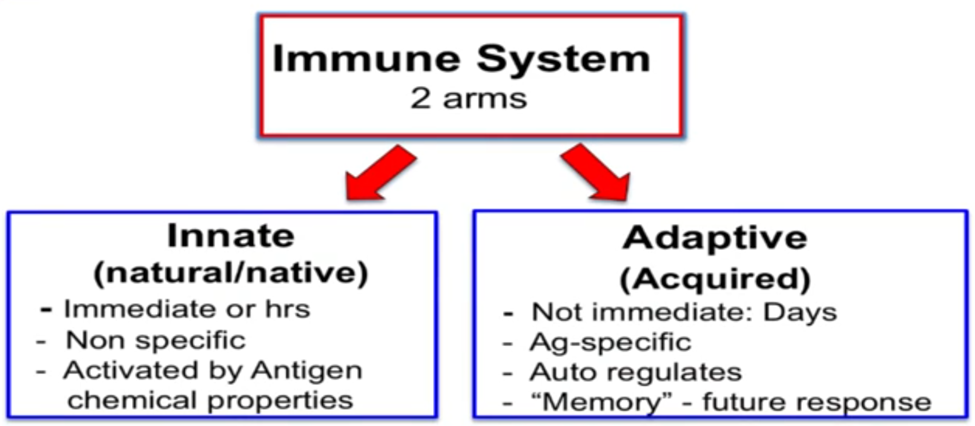
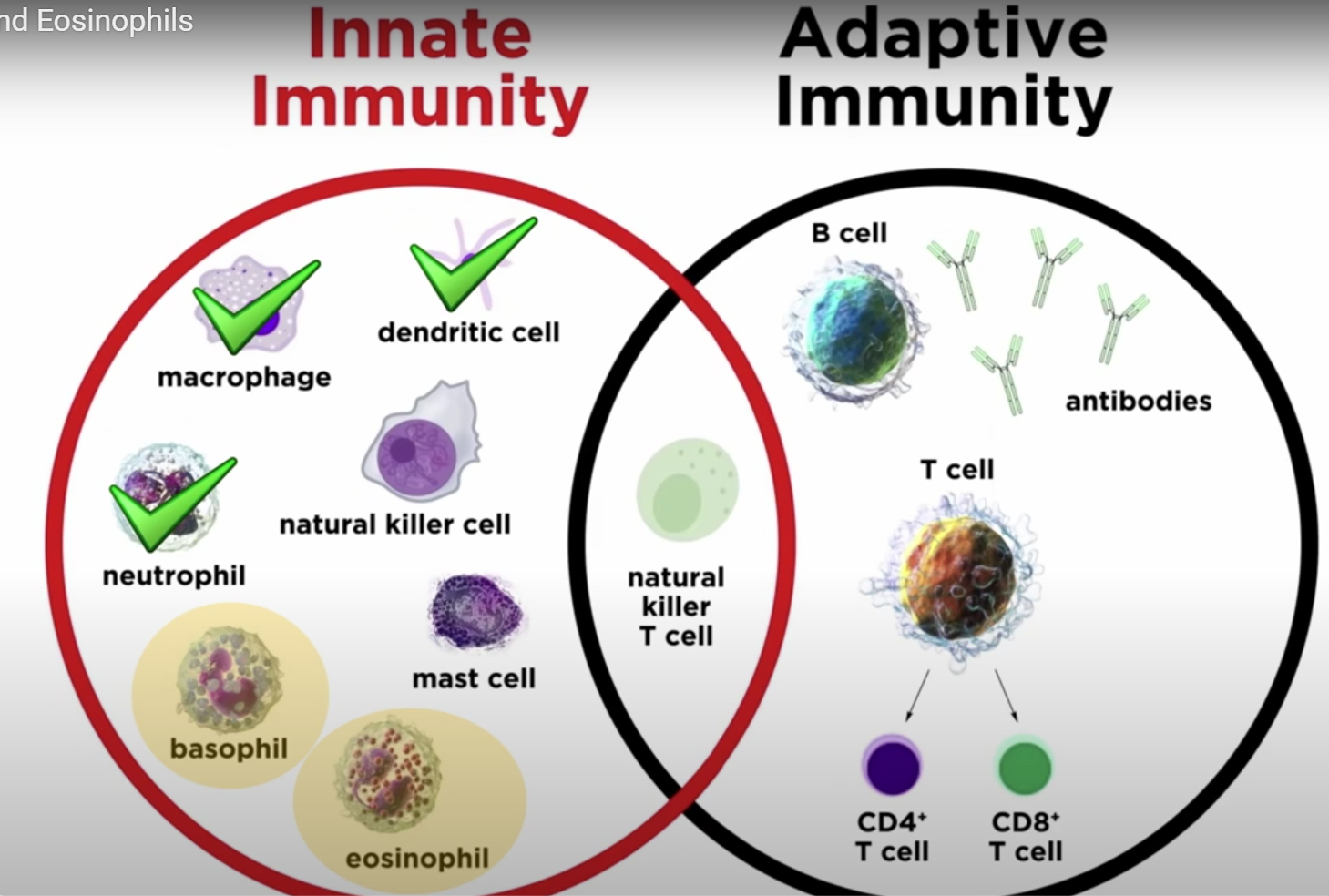
Cells of the immune response differ from cells of the inflammatory response in 3 ways:
- Specificity (adaptive immune system)
- "lasting memory" (adaptive immune system)
- Antigens trigger the immune response
The colon wall is the largest immune organ in the body. The intestinal mucosa is the battlefield on which friends and foes need to be recognized and properly managed to find the ideal balance between tolerance (a state of health) and immune response (a state of inflammation). Despite it's complexity, mistakes are rarely made, but when they are, we pay a high price. See Intestinal Mucosal Barrier
Several cells play a role in maintaining gut immune homeostasis:
- A single layer of epithelial cells (protect us from passage of "enemies" from environment). Not only are these cells forming a wall, they have sensors that understand the contents of the lumen through "cognition receptors". If they feel danger they communicate to the immune cells there's something in the lumen that can eventually give us trouble, "get ready". The language they use is via secreting specific chemokines to attract the soldiers on the battlefield.
- Immediately under the layer of epithelial cells are the dendridic cells - these can defend us and also understand what's going on in the gut lumen, they have "periscopes" to extend into the lumen to see who is here. Based on what they detect, they prepare the rest of the army for peace or war;
- B cells, which have the best initial weaponry - antibodies- hover behind dendridic cells. They have Ig antibodies that can be secreted into the lumen such as "secreted IgA";
- Finally, T cells, these are the most powerful. These are also the cells that destroy the intestine in celiac disease in an autoimmune process.
- These "soldiers" are not there just to fight, but to understand and eventually write peace treaties with the enemy if necessary.
The vagus nerve's regulation of inflammation is involved in immune system activity. During infection or injury, sensory input triggered by inflammation travels through the afferent vagus nerve to the brainstem, from which efferent nerves send signals that terminate in the spleen and other tissues. This assists in communication between immune cells, indicating that the vagus nerve is important for optimal functioning of the immune system.
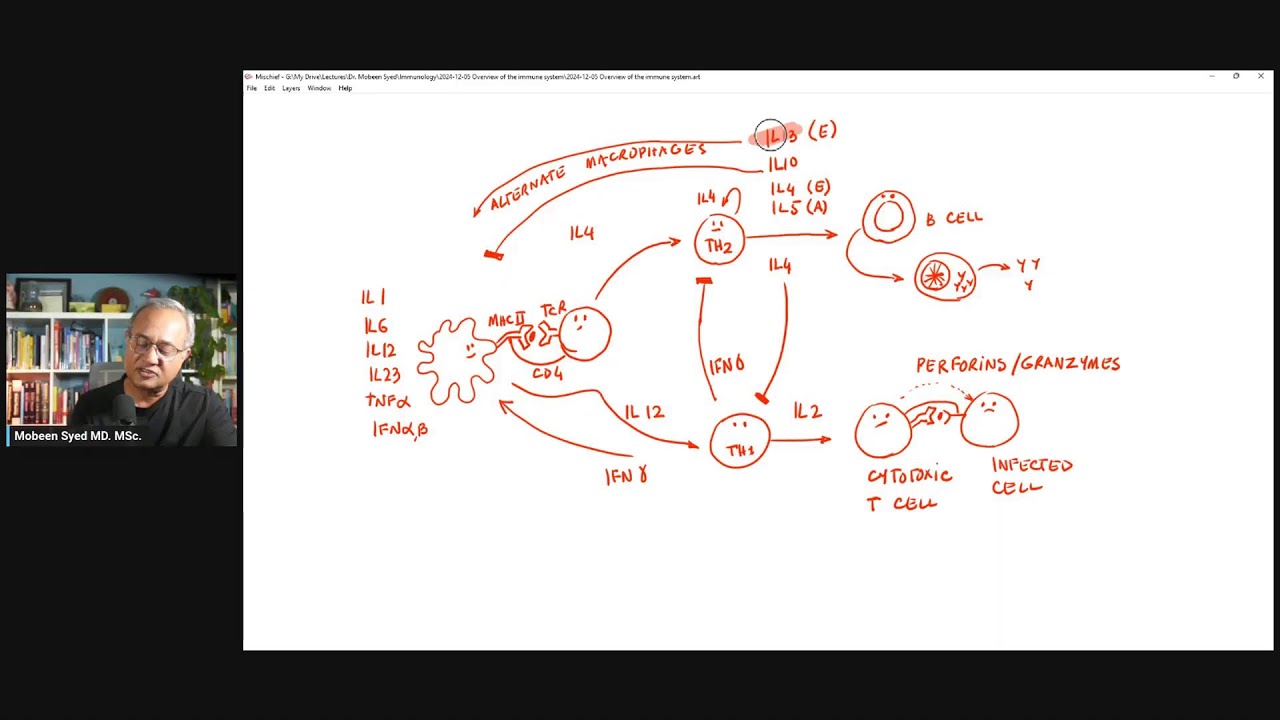
Diagram of Immune Cells in Lymph Nodes:
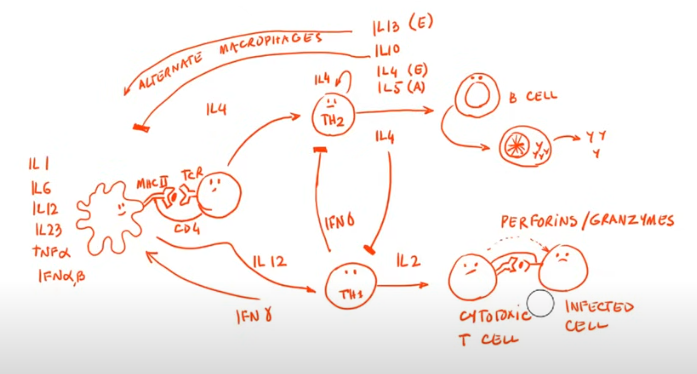
On the left, the dendritic cell arrives in the lymph node and releases:
IL-1 (its job is to introduce fever and activate the inflammatory system;
IL6 - its job is to kick the liver into making acute phase proteins which are part of the innate arm and help with inflammation, it also causes fever by going to the hypothalamus and changing our temperature set point;
IL-12 helps transform naive T cells into TH1 cells;
IL-23 helps activate TH17 cells;
If the naive T cell is showered by IL-4 it will transform into a TH2 cell provided the naive T cells was primed first by multiple connections to the dendritic cell forming a synapse (see B-Cells), The TH2 cell will release IL-13, IL-10, IL-4 and IL-5.
IL-13 has an interesting behavior. First, it acts on a B cell to perform a class switching and can help it class switch to IgE. It can also act on the innate arm to change the behavior. IL-13 can transform the macrophage into an alternate macrophage called an M2 macropage. (see M1 and M2 Macrophage)
Similarly IL-4 can act on a B-cell to class switch it to IgE. . Both Il-4 and IL-5 help the B-cell proliferate and become differentiated.
IL-5 can help a B-cell class switch to IgA as well as help activate eosinophils and other cells.
IL-10 is interesting, it acts on the innate arm and helps tone down the activity of the innate arm. It reduces the activity of macrophages, it is anti-inflammatory.
On the lower part of the diagram we see how TH1 becomes activated when the naive T cell gets showered with IL-12 after it has has bound in a synapse with the dendritic cell. The TH1 cell releases interferon gamma back to the dendritic cell which is a potent magnifier of macrophages and dendritic cells.
TH2 reduces the activity of the macrophages and dendritic cells, TH1 amplies them.
The IL-4 produced by TH2 can act on TH1 to tame them down. When a pathogen arrives in our body, its possible the immune system would activate both arms (innate and acquired) but one arm will become dominant so either the humoral arm (the B-cell antibody arm) or the cytotoxic T-cell arm. When one arm becomes dominant it releases interleukins to suppress the other arm. We don’t want both arms to be active at the same time with the same potency. When IL-4 suppresses TH1 it suppressed the cytotoxic T-Cell side.
Note that in the activation stage, TH2 is bound to the B-cell through the synapse, then the TH2 cell releases IL-4 and IL-5 to make the B-cell active. The activated B-cell becomes a plasma cell with a very unique nucleus under the microscope, the nucleus looks like a sailor’s wheel. Because it is active producing a lot of antibodies (proteins) it’s genes are open to continuously make antibodies.
In our body the circulating proteins such as albumin, globulins, complement system , haptoglobins, ferritins, are produced by the liver. The liver is the largest contributor of proteins circulating in us. The secondary largest contributor are B-Cells which make antibodies that are circulating in us and antibodies will help clear out pathogens.
If we look at the route shown on the lower part of the diagram where cytotoxic T-cells are produced, the humoral route, the dendritic cell or macrophage presents the antigen to naive T-cells, in the presence of IL-12 which comes from the macrophage or dendritic cell. Then the naive T-cell actually becomes a TH1 cell. The TH1 cell releases interferon gamma to help boost the dendritic cell or macrophage. It would also release IL-2 to activate a cytotoxic T-cell (it does not need a synapse) that is bound to an infected or cancerous cell it will become angry and pump out perforins and granzymes that kill this cell. They are also called “killer T-cells”.
The acquired arm has many interleukins that would affect the innate arm and vice versa.
Articles/Studies
Imprinting of the immune system by the microbiota early in life
Study ties recently discovered immune cell to disease
Ancient gene influences immunity of First Nations Peoples of Oceania
The gut microbiota, its relationship to the immune system, and possibilities of its modulation.
Diverse Roles of Mitochondria in Immune Responses: Novel Insights Into Immuno-Metabolism
Atossa -- The protein queen commanding cell invasion Immune cells are our body's police force, but how can they reach the crime scene fast? Researchers have now discovered a new protein that boosts energy production inside immune cells and thus increases their power to invade. Apart from improving immune responses, the results could revolutionize our understanding of energy regulation in cells throughout the human body.
The immune system is very complicated, but now, it's on a chip
The intestinal neuro-immune axis: crosstalk between neurons, immune cells, and microbes
Immune cells forget (cell) culture shock A recent study shows that certain immune cells can restore their normal functions when introduced back into the body, even after being multiplied in the laboratory to large numbers -- the results pave the way to new cell therapies.
The immune system also helps a healthy body Were you also under the impression that the immune system only kicks in when you get sick? In fact, new research shows the immune system is also busy when you're perfectly healthy. For instance, it helps you convert fat into energy when you're fasting. Until recently, it was believed that the immune system was mostly dormant unless the body was under attack in connection with infections. However, it now turns out that the immune system most likely also plays an important role for perfectly healthy people and can affect the body's production of vital energy sources.Specifically, the immune system causes the liver of the healthy body to produce an energy source called ketone bodies. This takes place by letting the liver burn fat during fasting.
Energy for the brain
"When we're fasting -- that is, we haven't eaten anything for maybe half a day or a full day -- we start drawing on our fat deposits, but not all of our body cells are capable of burning fat. This applies, among other things, to the brain, which instead depends on the production of ketone bodies, which the liver forms by metabolising fats. The ketone bodies thereby energise the body, allowing us to function even if we don't eat anything, explains another lead author of the study," Søren Fisker Schmidt, Assistant Professor at the Department of Biochemistry and Molecular Biology.
Ketone bodies are also the focal point of many popular weight loss diets focusing on cutting carbohydrates from our food, so the body begins burning fat instead. Other research also suggests that the ketone bodies may have a positive impact on, among other things, risk factors for the development of cardiovascular disease.
"We now believe that the immune system affects the production of ketone bodies in fit and healthy individuals and given the beneficial effects of ketone bodies in various common metabolic disorders, this knowledge can hopefully also be applied to understand how the immune system is trying to keep the body in equilibrium when we're sick," Anne Loft explains
- Decoding the human immune system
- Human immune system uses ancient family of cell death proteins also found in bacteria
- Scientists discover how key protein drives our immune response against viruses
- A brief review of the basics of immunology: The innate and adaptive response
- How the Gut Microbiome Programs the Immune System
- A small switch with a big impact - T cells play a key role in the human immune system. They are capable of distinguishing diseased or foreign tissue from the body's own, healthy tissue with great accuracy; they are capable of triggering the actions necessary to fight off the troublemakers. The details of this immune response are manifold and the individual steps are not yet fully understood.
- Giant nanomachine aids the immune system In order to kill diseased cells, our immune system must first identify them. The so-called peptide-loading complex plays a key role in this process. A research team has analyzed this nanomachine in atomic detail.
- How the immune system identifies invading bacteria
- Scientists discover the 'adrenaline' of the immune system
- Sunlight effects on immune system: Is there something else in addition to UV-induced immunosuppression?
- New type of immune cell discovered in breast ducts
- Immune system maintains a memory of past infections by priming genes for future encounters
- Key differences in young, older people's immune cells attributed to environment
- See how immune cells break through blood vessel walls
- Immune system, brain structure and memory linked
- An immunological memory in the brain
- Cellular Chaos Keeps Your Immune System Running
- Cell cycle proteins help immune cells trap microbes with nets made of DNA
- Effects of flavonoids and Its derivatives on immune cell responses.
- Experience matters for immune cells
- Diet supplementation with higher than usual levels of vitamin E appears to be beneficial for the immune system.
- How Our Immune System Drives Social Preferences
- Understanding the GI and Brain Microbiome and the Role of GcMAF in Harmonizing the Immune System with the Microbiome Populations
- Diversity of energy metabolism in immune responses regulated by microorganisms and dietary nutrition.
- The role of gut microbiota in the regulation of the immune response.
- Vitamin effects on the immune system: vitamins A and D take centre stage.
- Lactoferrin, a key molecule in immune and inflammatory processes.
- Nutritional modulation of immune function: analysis of evidence, mechanisms, and clinical relevance.
- How cells use ‘tentacles’ to move around our bodies New findings clarify how cells use octopus-like tentacles called filopodia to move around in our bodies. “While the cell doesn’t have eyes or a sense of smell, its surface is equipped with ultra-slim filopodia that resemble entangled octopus tentacles. These filopodia help a cell move towards a bacterium, and at the same time, act as sensory feelers that identify the bacterium as a prey,”