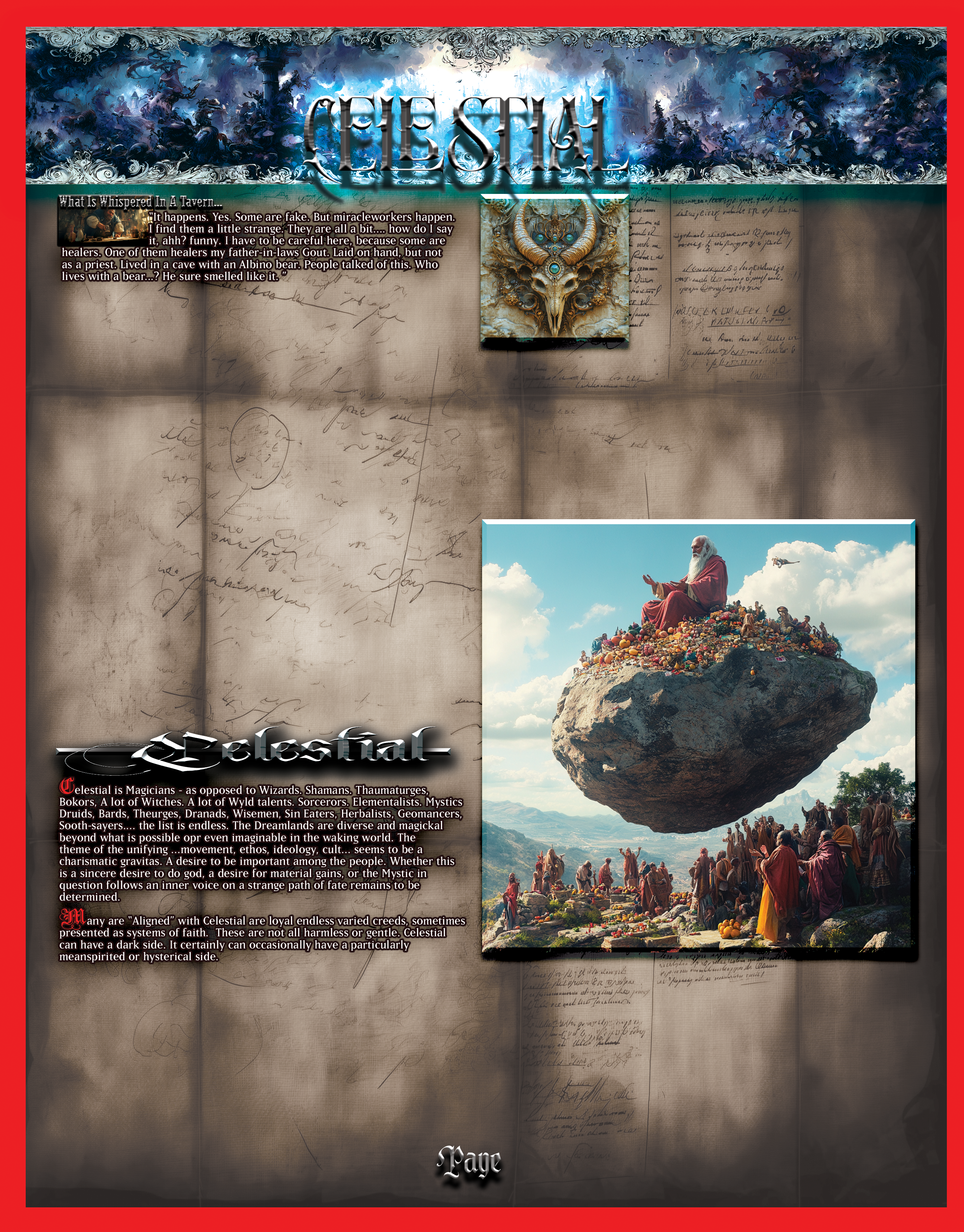
The Celestial Alignment
There are those within the Kingdom who insist, with serene conviction or irritated patience, that the visible world is only the thinnest rind of a far greater structure. These are the Celestials. They are not a unified order, nor a sanctioned college, nor even a coherent movement that might be mapped neatly onto parchment. They are a temperament more than an institution, a drift of like-minded souls who have turned their attention slightly away from the market square and slightly toward the sky. They are found in hilltop hermitages, in cramped city attics hung with charts of obscure constellations, in forest clearings where the wind seems to pause to listen, and occasionally at the very edge of a lord’s garden, lecturing disinterested guards about patterns in the rain. They will tell you, sometimes loudly, that they stand at the center of the Kingdom’s true destiny. The Kingdom, in turn, often blinks and continues about its business.
A Celestial is rarely defined by rank or by formal recognition. Unlike the Wizards of the Magisteriums, whose towers and syllabi command visible respect, Celestials tend to arise from apprenticeship, intuition, or private revelation. A village herbalist who studies the movement of starlight upon her drying racks, a geomancer who spends years tracing fault lines in chalk across barn floors, a mystic who listens to the murmuring of bees as though they were reciting scripture—all may fall beneath the Celestial inclination. What binds them is not shared doctrine but shared orientation. They look for correspondences. They ask what lies behind the obvious. They suspect that events rhyme with one another across distance and time, and they take seriously the possibility that meaning has weight and geometry.
This orientation places them at a curious angle to power. Celestials are neither openly rebellious nor reliably obedient. They do not hunger, as some do, to command legions or codify law. Yet they are not content to be dismissed as harmless eccentrics. Many among them carry a quiet or not-so-quiet insistence that the Kingdom rests upon deeper foundations than its kings and councils comprehend. They will argue that a field of strange flowers is not merely a field, but a convergence of unseen currents; that a run of ill fortune in a mining town reflects not incompetence but imbalance; that ten days of unseasonal rain might signify a dispute in higher registers rather than simple weather. Such claims can unsettle those tasked with maintaining order, particularly when villagers begin to listen.
Celestials are frequently found in dispute with one another. The same flower field that one Celestial declares to be a site of convergence another may denounce as a distortion. They gather in taverns, in glades, in borrowed chambers, and engage in long, winding arguments about alignments of influence and the ethics of intervention. Their speech is seldom hurried. They qualify, revise, and circle back. They prefer to say, “Yes, but however,” rather than to pronounce finalities. To an outsider this may appear indecisive. To them it is a form of fidelity, a refusal to flatten what is inherently layered. It is not uncommon for two Celestials to disagree for years over the interpretation of a single omen, neither conceding, both convinced that the dispute itself refines the pattern.
In matters of practice, Celestials range widely. Some command subtle arts: coaxing health from soil, easing fevers with whispered adjustments of unseen currents, or reading the mood of a season before it turns. Others exhibit flashes of startling potency, acts that seem miraculous yet resist replication. A Celestial may warn a village of impending misfortune and be ignored nine times out of ten; on the tenth, a flood may arrive precisely as described, and for a brief season their name will be spoken with awe. Such moments are both blessing and burden. Recognition draws expectation, and expectation weighs heavily upon those who were content to study the angle of light through leaves.
It must be said that Celestial communities can become insular. Their shared language of correspondences and veiled references can harden into a barrier. Outsiders may be regarded with polite curiosity at best, suspicion at worst. Some Celestials cultivate an air of serene detachment, claiming that their work transcends the trivialities of commerce and politics. Others, stung by irrelevance, overreach and attempt to insert themselves into crises beyond their depth. In either case, they risk estrangement. The Kingdom has patience for holy figures and learned scholars; it has less patience for those who speak in riddles while harvests fail.
And yet the Celestial inclination persists, generation after generation. It persists because there is something undeniably compelling about the sense that the world is patterned. Even those who mock Celestials may find themselves glancing at the sky during an eclipse or hesitating before disturbing an old stone whose placement seems deliberate. Celestials give language to that hesitation. They dignify it. They insist that such instincts are not superstition but perception awaiting refinement.
For players who walk the Celestial path, the alignment offers both gift and challenge. You are not the master of institutions, nor the brute force of conquest. You are the interpreter of currents, the observer of correspondences, the one who senses that a seemingly trivial dispute may echo something larger. You may be ignored, underestimated, or dismissed as obscure. You may also be the first to recognize when disparate threads are converging toward consequence. Your strength lies not in spectacle but in attunement. Your weakness lies in drifting too far from the tangible world that must still be inhabited.
The Celestial alignment does not demand sanctity, nor does it promise acclaim. It asks instead for sustained attention to the subtle, for patience in the face of mockery, and for the discipline to discern when to speak and when to remain silent. Some Celestials age into quiet wisdom, their insights woven gently into the fabric of their communities. Others burn brightly and briefly, consumed by the strain of bridging worlds that do not easily align. In every case, the path is one of orientation rather than domination. The Kingdom may or may not acknowledge you. The patterns, however, remain, and those who are attuned to them will always find one another, even if only to argue beneath a sky that refuses to explain itself.