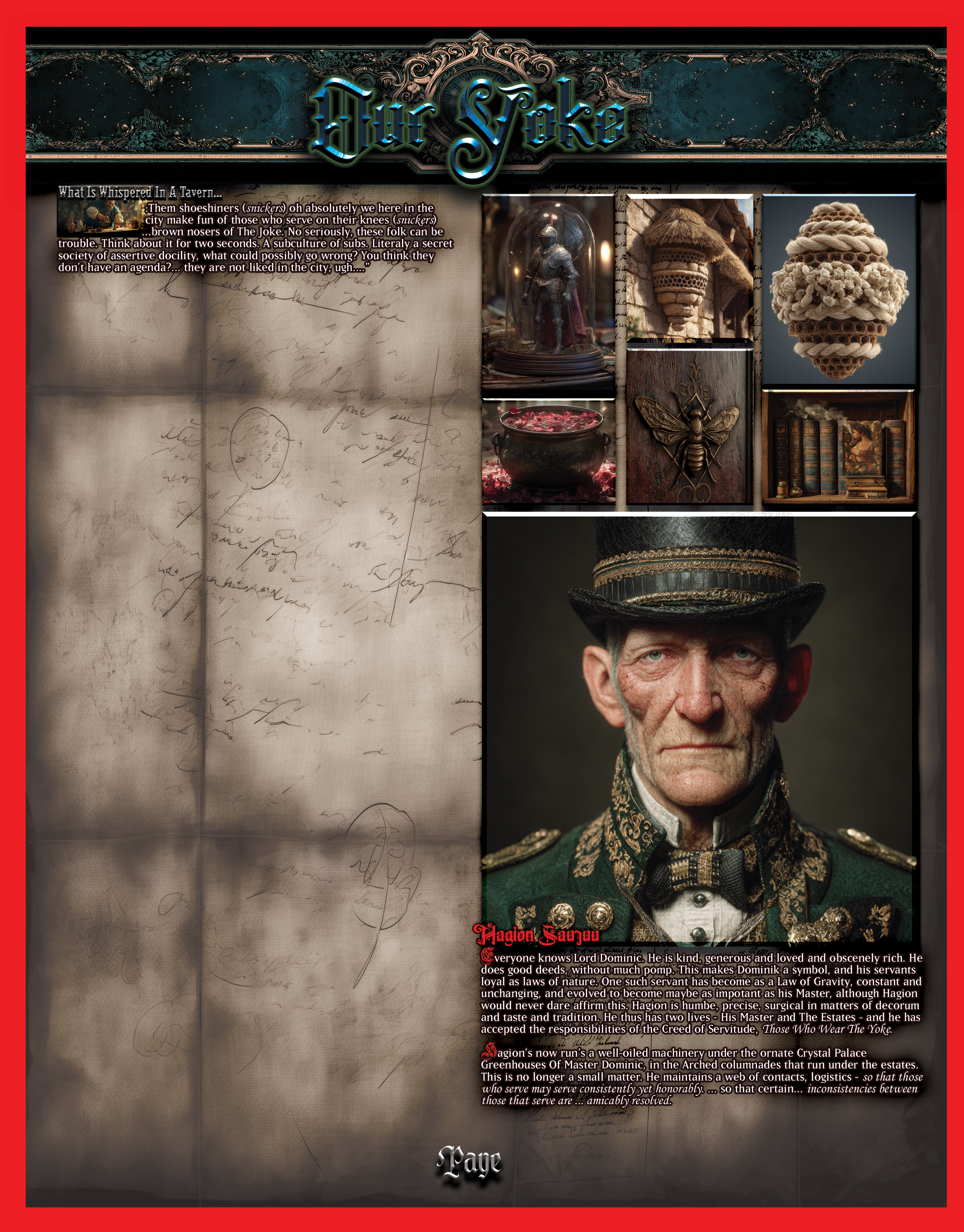
The Yoke Alignment
There are those in every Duchy who command, and there are those who contend, and there are those who scheme, raid, preach, bargain, or rebel. The Yoke is none of these, though it touches all of them. It is not a faction, not a guild, not a conspiracy in the manner whispered by bored courtiers who mistake competence for intrigue. The Yoke is a posture toward the world, a discipline of service so exacting that it becomes a craft in its own right. Those who wear its sign do not proclaim it. They do not advertise allegiance. Yet in certain halls, in certain kitchens, in certain libraries where letters are sorted by hand and histories are copied by lamplight, there is an awareness that the smooth turning of events does not happen by accident. It happens because someone chose to notice what others did not.
The Yoke begins with an oath, though the oath is not always spoken aloud. It is the recognition that civilization is fragile, that lords are human, that luck is uneven, and that the consequences of pride or misjudgment can spill far beyond the chamber in which they originate. The Master may be brave, or divinely favored, or possessed of uncanny fortune, yet even the most remarkable sovereign cannot attend to every subtlety of trade, rumor, insult, logistics, or phrasing. The Yoke exists in that margin. It exists in the quiet correction of a letter before it is sealed, in the careful timing of a messenger’s departure, in the gentle steering of a conversation so that a spark does not become flame. It does not usurp authority; it refines it.
To serve under the Yoke is not to abase oneself. Dignity is the foundation of the discipline. A true bearer of the Yoke understands that loyalty is not flattery and obedience is not blindness. The manuals—those dense and venerable compilations studied by generations of servants, scribes, stewards, and envoys—do not teach submission as weakness. They teach attentiveness, foresight, and the art of carrying responsibility without spectacle. One serves not because one is lesser, but because one recognizes the necessity of structure. A realm without scaffolding collapses under its own weight, and the Yoke is that scaffolding, invisible from a distance yet indispensable when storms gather.
Merit governs the internal recognition among those aligned with the Yoke. Birth does not grant it, nor title, nor wealth. It is earned through reliability under pressure, discretion in the face of gossip, and the ability to anticipate outcomes several steps beyond the obvious. A bearer of the Yoke may be a chamberlain, a stablemaster, a tutor, a ship’s purser, or a humble clerk who understands that a ledger is as political as a sword. Their shared discipline is not uniformity of role but constancy of method. They exchange insights carefully, often indirectly, sometimes across borders where their respective Masters stand at odds. They do so not to betray their oaths, but to prevent the escalation of conflicts that would harm all parties involved. To smooth an insult into a misunderstanding, to convert rivalry into managed competition, to delay a rash decision until tempers cool—these are victories seldom recorded in ballads, yet they preserve more lives than triumphal charges.
The sign of the Yoke, where it is worn at all, is subtle. Recognition depends on education and experience rather than heraldry. Those trained to see it may notice patterns: a consistency of bearing, a particular courtesy extended at the correct moment, a quiet competence that radiates from an otherwise unremarkable figure. In great households it is sometimes said, half in jest and half in respect, that when matters proceed with uncanny smoothness there are “Yoke hands” at work. Such comments are rarely elaborated upon. The Yoke does not seek credit, for credit invites scrutiny, and scrutiny invites misinterpretation. Its influence is measured in the absence of disasters that might otherwise have occurred.
Rebellion against the Yoke is possible, though rarely dramatic. Some find the discipline constraining and prefer a life of visible ambition or defiant independence. The Yoke does not compel adherence; it demands suitability. Not all temperaments thrive within it. Those who chafe at invisibility or resent the labor of maintaining equilibrium often depart quickly. Yet for those who remain, there is a profound satisfaction in continuity. To know that one’s efforts prevented a feud from igniting, or ensured that harvests reached market despite political friction, is a reward sufficient unto itself. The Yoke sanctifies steadiness over spectacle, patience over glory.
Critics, when they perceive the Yoke at all, sometimes accuse it of enabling stagnation. They argue that by correcting the errors of the powerful, it shields them from the consequences that might otherwise force reform. Such critiques are not entirely without merit, and thoughtful bearers of the Yoke consider them carefully. Yet the counterargument is pragmatic: collapse benefits no one, and even flawed authority is preferable to chaos. The Yoke does not claim perfection; it claims necessity. Where others see manipulation, it sees maintenance. Where others see hidden hands, it sees responsible ones.
In times of prosperity, the Yoke is nearly invisible. In times of crisis, it becomes indispensable. Plagues, famines, succession disputes, and border tensions test the discipline more severely than any banquet or council session. It is then that the manuals are consulted with particular fervor, that correspondence is handled with extraordinary care, and that alliances are reinforced through channels not always recognized by those outside the craft. The Yoke thrives on preparation, on contingency, on the quiet assumption that what can go wrong eventually will unless guided gently away from catastrophe.
For players encountering this Alignment, understand that to walk the path of the Yoke is to accept responsibility beyond personal advancement. It is to value cohesion over conquest, continuity over spectacle, and the long arc of stability over the short thrill of upheaval. You may find yourself advising rulers who do not fully grasp your foresight, coordinating with counterparts in rival courts to avert mutual ruin, or studying ancient treatises that distill centuries of accumulated insight into precise, demanding principles. Your victories will rarely be celebrated publicly, but the world will endure more smoothly because of them.
The Yoke is not for all. It is for those who recognize that power is rarely singular and that influence can be exercised most effectively from positions that appear modest. It is for those who believe that service, when undertaken with intelligence and integrity, is neither humiliation nor weakness but a form of guardianship. In a realm where ambition, prophecy, and conflict dominate the narratives of heroes and villains alike, the Yoke stands as a quieter alignment: the alignment of those who keep the wheels turning, who hold threads together, and who ensure that when history moves forward, it does so without tearing the fabric beyond repair.