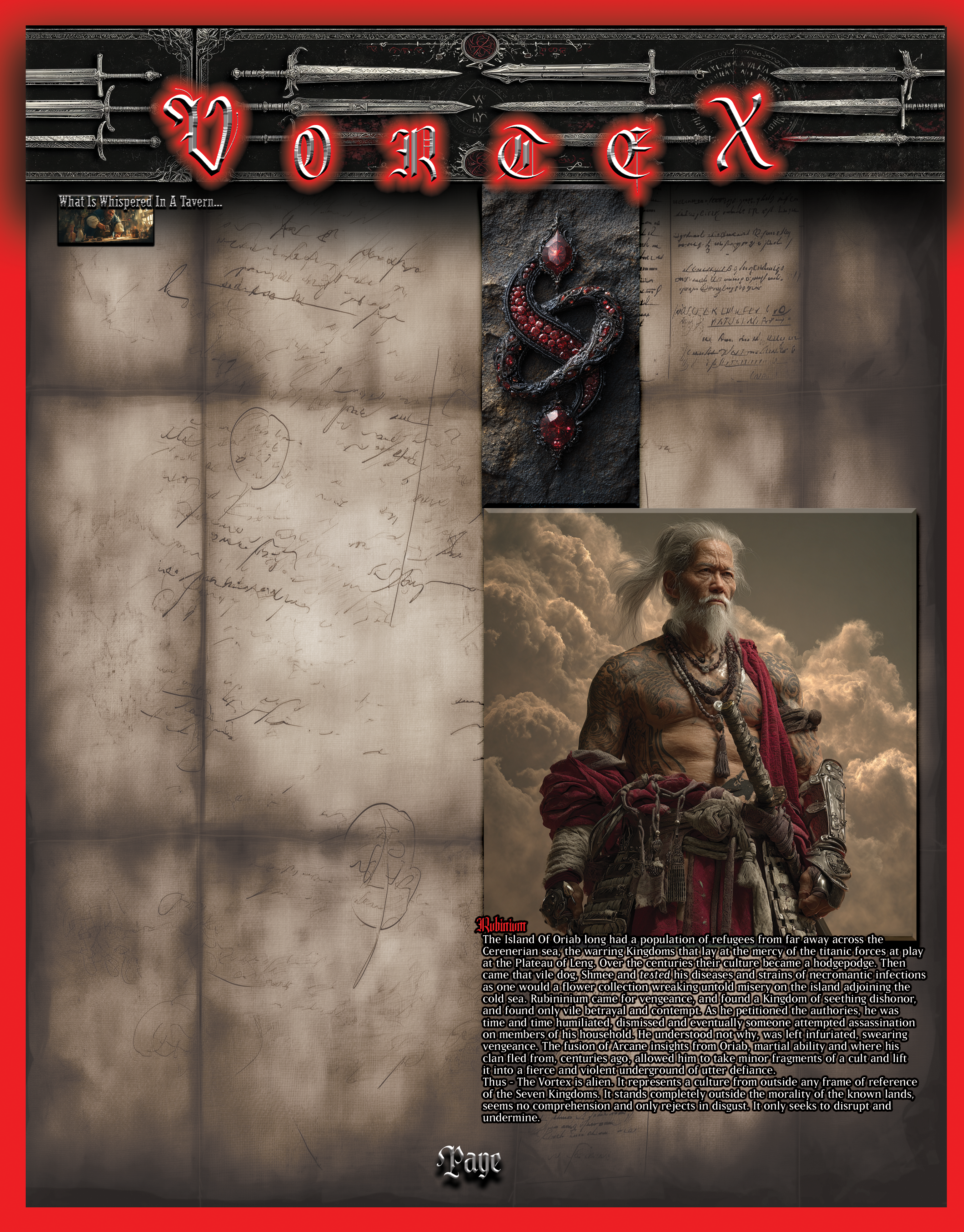
The Vortex Alignment
A Whispered Entry from the Margins of the Seven Kingdoms
Among the alignments acknowledged by the learned and the devout, there exists one that is seldom named openly and never codified without hesitation. It does not arise from covenant, nor from shared doctrine, nor from inherited tradition. It is not passed from master to student in cloistered halls, nor sworn before crowned authority beneath vaulted stone. The Vortex is encountered rather than joined, recognized only in retrospect, and rarely admitted even by those who walk within its current. Where other alignments offer belonging, continuity, and moral grammar, the Vortex offers velocity.
Its origins are most often traced to grievance, though grievance alone does not summon it. Many suffer injustice; few become conduits for something that answers injustice with acceleration. The Vortex gathers around those who have sought redress within existing structures and found those structures not merely resistant but contemptuous. It is not humiliation alone that draws its attention, but the moment when humiliation hardens into refusal, when a person ceases to petition and instead resolves to rewrite the terms of their existence. At that inflection point, where the world’s refusal meets the individual’s escalation, the current begins to form.
The Vortex is not a culture imported from distant shores, nor a foreign philosophy clothed in exotic ornament. Those who attempt to describe it in such terms mistake surface effects for cause. It does not belong to any land, though it often manifests in borderlands where customs overlap and identities strain against one another. It does not require particular garb, discipline, or ancestry, though it is frequently associated with techniques that appear to have been learned elsewhere, accelerated beyond customary limits, or combined in ways that unsettle orthodox teachers. What distinguishes a Vortex-aligned individual is not the origin of their skills, but the manner in which those skills cohere without lineage.
To observers, such individuals often seem preternaturally adaptive. They adopt disciplines that would normally demand decades of apprenticeship and integrate them with alarming efficiency. Forms that elsewhere remain discrete—martial, mystical, philosophical—are in them braided into something difficult to categorize. This synthesis is neither harmonious nor chaotic in the ordinary sense. It is driven by an interior momentum that resists stasis. Where others seek mastery in order to arrive at equilibrium, the Vortex-aligned seek mastery as a means of maintaining motion. Stopping feels to them like erosion; rest resembles surrender.
Institutions respond to such figures with ambivalence. On the one hand, their effectiveness is undeniable. They accomplish tasks that others cannot, cross boundaries others hesitate to approach, and display a resilience that borders on the unnatural. On the other hand, they do not root easily within hierarchies. Their loyalties are precise but conditional, their obedience pragmatic rather than devotional. They accept instruction when it serves their trajectory and discard it when it constrains it. This unsettles mentors who expect gratitude, commanders who expect predictability, and priests who expect submission. The Vortex does not breed treachery for its own sake, but it renders permanent subordination improbable.
It would be an error to assume that those aligned with the Vortex lack moral structure. On the contrary, many possess codes of conduct that are exacting, even austere. What differentiates them is not amorality but orientation. Their ethics are often forged in reaction to betrayal or exclusion, and thus carry within them a memory of fracture. Justice, to them, is not an abstract principle but a lived correction. When they speak of balance, they mean redress; when they speak of honor, they mean refusal to be diminished again. This intensity can inspire fierce loyalty among companions who recognize sincerity, yet it can also estrange those who perceive in it a readiness to escalate beyond proportion.
Scholars who attempt to classify the Vortex frequently encounter difficulty. Some describe it as parasitic upon other alignments, borrowing their techniques while refusing their metaphysics. Others propose that it is not an alignment at all but a pressure differential within the soul, a turbulence created when personal will outpaces communal frameworks. A minority argue that it is an emergent property of the age itself, a symptom of increasing contact between realms, cultures, and systems once held apart. None of these explanations fully capture it. The Vortex resists containment in theory just as it resists containment in practice.
What, then, does it offer to those who find themselves drawn into its current? It offers potency, though not without cost. It offers the capacity to transcend traditional limits of role and training, to weave disparate disciplines into singular effect, to answer injury with competence rather than despair. It offers, above all, the refusal to remain defined by exclusion. Yet this refusal extracts its own toll. The Vortex rarely permits its adherents the comfort of simple belonging. They are often regarded as outsiders even where they serve faithfully, and as rivals even where they seek collaboration. Their presence exerts a subtle centrifugal force, revealing fractures in systems that prefer to imagine themselves seamless.
Over time, the central tension of the Vortex becomes clear. It sustains those who cannot accept stasis, yet it complicates any final arrival. Achievements that would satisfy others become, for them, provisional. Mastery achieved invites new synthesis; equilibrium attained invites new motion. Companions may misinterpret this as restlessness or ambition without end, but to the Vortex-aligned it is coherence. To cease moving would be to return to the condition from which they emerged: constrained, dismissed, defined by others’ limits. Thus they advance, not always upward, but always forward.
There are whispers that the Vortex touches forces beyond mortal comprehension, that its currents brush against intelligences older than kingdoms and less invested in human categories. Such speculations remain unproven and are best approached with caution. What can be observed without recourse to myth is that those aligned with the Vortex exhibit a capacity to draw upon energies that feel adjacent to the unknown, as though their refusal to remain bounded has thinned certain veils. Whether this is cause or consequence is a matter of debate. In practical terms, it manifests as access to combinations of discipline and insight that others find improbable.
For players considering this alignment, it is important to understand that the Vortex is not a banner under which one shelters but a current one chooses to ride. It does not absolve past grievance; it amplifies resolve. It does not guarantee vindication; it guarantees motion. It does not promise harmony with established orders; it promises the strength to survive their resistance. Those who walk this path should expect to be effective, to be challenged, and to be regarded with a mixture of admiration and unease. They will find doors open that remain closed to others, but they will also discover that thresholds crossed are seldom crossed back.
In the annals of the Seven Kingdoms, the Vortex is recorded less as a chapter and more as a marginal note, a pattern discerned only when disparate events are laid side by side. A warrior who mastered three traditions in half the expected years. A scholar who integrated forbidden fragments into coherent doctrine. An envoy who returned from humiliation not broken but transformed. Each instance appears singular until viewed in aggregate. Then the curve becomes visible, and the current can no longer be ignored.
To align with the Vortex is to accept that one’s story will not follow the gentle arcs favored by poets of stability. It is to step into acceleration with clear eyes, aware that the same force that propels may also estrange. It is not an easy path, nor is it inherently dark. It is a path for those who, having been pressed against the margins, choose not to disappear there but to redraw the map through motion itself. Whether history will judge them as innovators, disruptors, or necessary fractures depends less on their power than on what the world becomes in their wake.