Pope, Alexander
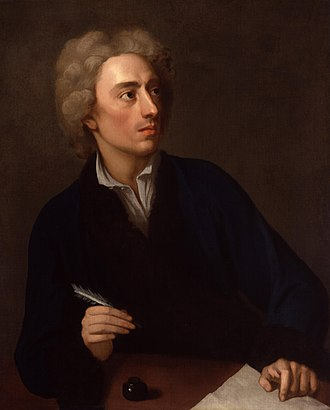
Achievements: Augustan period satirist poet
Born: May 21, 1688, London, England
Died: May 30, 1744, Twickenham, England. Aged 56
Field & Discipline: Literature; Poet
Language: English
Education: Catholic schools; School at Hyde Park Corner, London
Major Works:
"The Rape of the Lock"
"The Dunciad"
"An Essay on Criticism"
"An Essay on Man"
"Horace" Imitations
Life & Times:
At 16, Pope became the protege of former Oxford teacher, Sir William Trumbull, and soon met the members of the late John Dryden's circle, notably William Wycherley, William Walsh, and Henry Cromwell, who acted as his literary mentors. By 1705, Pope's four "Pastorals" were in draft and circulating among the best literary judges of the day, before being published in 1709.
In 1711, at 23, he scored his first great success with "An Essay on Criticism", a poem summarizing all past wisdom on poetry and criticism. It abounds with much-quoted epigrams: "A little learning is a dangerous thing," "To err is human, to forgive, divine," and "For fools rush in where angels fear to tread". Impressed by the work, [collaborated with] Steele* and [collaborated with] Joseph Addison* invited Pope to contribute to their journal "The Spectator", and in 1712, published the most original of Pope's pastorals, "The Messiah". Also in 1712, Pope began to write his best-known satire, the mock-heroic "Rape of the Lock", which was published to great acclaim two years later.
Pope found himself increasingly drawn to writers who supported the Tory government, and his poem, "Windsor-Forest"(1713), which celebrated the Treaty of Utrecht, was taken by many, despite Pope's denials, to be a commitment to the Tories. He became one of six members of the Scriblerus Club, which met over dinner once a week to talk about literature and write satirically about those in the news. (The other five members were [club member with] Swift*, Thomas Parnell, [club member with] Gay*, [club member with] Arbuthnot*, and Robert Harley [Lord Oxford])
In 1714, Pope began translating Homer's "Iliad" into English, using rhyming couplets. The monumental task took six years, but he came out in 1715 with the first four books, and published four books a year until the work was finished. During his "Iliad" work, he also published a volume of his collected "Works", adding "Eloise to Abelard", "Verses to the Memory of an Unfortunate Lady", and two poems in the style of Ovid. After the huge success of the "Iliad", Pope began to translate Homer's "Odyssey", and asked Elijah Fenton and William Broome to help him. Pope revised their contributions, then passed them off as his own, a questionable act that caused him some embarrassment when it became known, but the venture was enormously successful. It earned Pope so much money that he proudly became the first known English author to live off his writings without the assistance of a patron.
In 1723, Pope turned to editing and by 1725 had produced a six-volume edition of Shakespeare. A rival editor, Lewis Theobald, took exception to Pope's work and ridiculed him in a 200-page volume, "Shakespeare Restored". Theobald's attack spurred Pope to write his first major satire, the three-volume "The Dunciad" (1728), another mock-heroic epic, which focused on the pretentiousness and dullness of contemporary writers. Thinly disguised, Theobald appeared as the "Prince of Dulness", and other Pope rivals were portrayed equally as brutally. In an impish reissue of the poem in 1729, Pope included an elaborate array of mock prefaces, notes, appendixes, indexes, and errata, whimsically giving the impression that "The Dunciad" had fallen victim to the idiocy of the times and had been re-edited by a moron (Just before he died, Pope took the joke further, publishing a major reworking of the poem, replacing the Theobald character with a burlesque of dramatist/poet laureate [satirized] Cibber*, and bemoaning the triumph of chaos and dullness).
In his mid-40s, Pope began to suffer ill health and he divided his time between health resorts and his villa on the Thames at Twickenham. Most of his friends shared his passion for gardening, and he celebrated this affinity in "Epistle to the Right Honourable Richard Earl of Burlington" in 1731. The man of the title, Lord Burlington (an architect reformer and husband of caricaturist and arts patron Lady Dorothy [knew] Savile*) was delighted with the poem, which Pope published with three other poems in the "Moral Essays".
In 1733, Pope published his "First Satire Of the Second Book Of Horace, Imitated," a defense of satire and an attack on corrupt politics. Like many of his earlier works, the work provoked bitter and personal attacks against him, many of which he answered in his autobiographical poem, "Epistle to Arbuthnot", (1735).
He feuded with Lord Hervey (whom he addressed as "Lord Fanny") and his ex-love [had affair with] Lady Mary Wortley Montagu* (he called her "Lewd Lesbia"). To escape possible attacks, In 1734 Pope published perhaps his most ambitious work, the philosophical "An Essay on Man", anonymously.
The success of his "Horace" imitation led to 13 more paraphrases of Horace themes between 1734 and 1738. Through these imitations Pope commented on the contemporary social and political scene. The series concluded with two dialogues in verse, republished as the "Epilogue to the Satires" (1738). Two major projects of his last years were "Letters" and a reworking of "The Dunciad", published in 1742.
Extra Connections: Knew [knew] Hogarth*; met [met] Voltaire* and [met] Algarotti*.
Dedicated his “Iliad” translation to [dedicated work to] Congreve*.
Was influenced by [influenced by] Boileau*.
Friend of [a pal of] Frederick Prince of Wales*, and [a pal of] Cheselden*.
Admired [admired] Gainsborough*.
Knew [knew] Kent* and [knew] Bridgeman*.
He attacked the work of Eliza [attacked work of] Haywood*
Assessment: The first English poet to enjoy contemporary fame in Europe; his poems were translated into French and Italian
Oneliner: Alexander Pope, major English Augustan poet
Bibliography:
- Collier’s Encyclopedia.
- Encyclopedia Britannica.
- Gordon, I.R.F.,A Preface to Pope, London & New York: Longman, 1976.
Father: Alexander Pope
Mother: Edith Turner
Siblings: Half-sister: Magdalen
Spouse: None
Children: None