Duse E
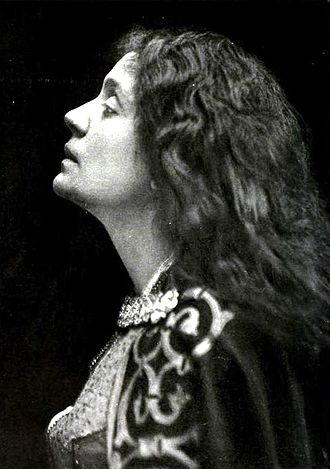
NAME: Duse, Eleonora
ACHIEVEMENTS: Famous Italian actor.
NICKNAME/ALIAS:
DATE AND PLACE OF BIRTH: October 3, 1858. Near Vigevano, Lombardy, Austrian Empire (now in Italy)
DATE/PLACE OF DEATH/AGE AT DEATH: April 21, 1924. Pittsburgh, PA. Age 65
DISCIPLINE: Theater
FIELD: Actor
LANGUAGE: Italian
PARENTS: Father: Vincenzo Alessandro Duse. Mother: Angelica Capelletto
SIBLINGS: None
SPOUSE: Tebaldo Checchi (married 1881)
CHILDREN: Enrichetta (1882)
EDUCATION: Traveled with acting troupe; sent to school when run of play permitted.
MAJOR WORK: Ibsen’s “A Doll’s House” and “Hedda Gabler.” Formed the Compagnia Drammatica della Città di Roma (the Drama Company of Rome).
LIFE AND TIMES:
Eleonora Duse is considered by many to be the best Italian actor of her time. She was renowned for her passionate and natural acting style, as well as her sympathetic portrayal of the pain of others.
One story says she was born in a railroad car; another that Austrian soldiers mistook her christening procession as the passage of holy relics and gave a full military salute, thereby guaranteeing her good luck for life. Because Duse traveled with her family (a troupe of actors) and they toured continuously, regular schooling was nearly impossible.
Duse made her first stage appearance in 1864 in Victor Hugo’s Les Miserables. At fourteen she was the star of Shakespeare’s Romeo and Juliet. By the 1880s most of her family had died and she had moved from one acting company to the next; then, in the late 1870s, she joined Cesare Rossi’s company and got better and more publicized roles.
Recognition came in 1878 when she acted in French dramatist Emile Augier’s Les Fourchambault (The House of Fourchambault), and again in 1879 when she performed in Emile Zola’s Therese Raquin. Critics reported that they had never seen a woman perform on stage with such honesty and act with such anguish.
In 1879 Duse saw the French actor Bernhardt* perform in Turin. Though she greatly admired the famous actor she developed a style of acting that was totally different. When Bernhardt traveled to Italy in 1882 when Rossi renovated Duse’s dressing room, he allowed Bernhardt to take it over.
Watching Bernhardt inspired Duse to explore the modern French dramatists, which led her to Alexandre Dumas fils*. For the next three years she acted in a series of plays by the young Dumas, including La Princesse de Bagdad, La Femme de Claude, and Denise. Her success as Marguerite Gautier in Dumas’ La Dame aux Camelias, a role made famous by Bernhardt, was the beginning of a lifelong comparison between the two women. This was not the only time the two acted in the same role; they both acted in the play Adrienne Lecouvreur by Scribe*.
Bernhardt was, on a technical level, a fabulous actor, yet she always projected her own personality from the stage; Duse, on the other hand, wanted to portray the essence of her character, not of herself.
Eleonora met and had a child by Martino Cafiero in 1879; their relationship ended shortly after their child’s death. In 1881 Duse married fellow actor Tebaldo Checchi and they had a child a year later. Duse loved her daughter, Enrichetta, though she and Checchi divorced in 1885. This was due in part to Duse’s relationship with Arrigo Boito, whom she had met in May 1884 during a tremendous theatrical season in Milan. The two began a relationship that would last for ten years.
In 1885 Duse toured South America with Rossi’s company; by the end she was dissatisfied and unhappy. When she returned to Italy she established her own company with Flavio Ando, which was called Compagnia Drammatica della Città di Roma (the Drama Company of Rome). With their troupe she toured throughout Europe, Egypt, Russia, and the United States. Her first appearance in New York was in 1893 at the Fifth Avenue Theater, playing in Dumas’ La Dame aux camellias.
In 1894 she met and fell in love with the Italian poet, novelist, and playwright D’Annunzio*.
The relationship provided inspiration for his writing and a vehicle for her acting. He wrote a number of plays for her, including La Giaconda and Francesca, and used their relationship for the plot of his 1900 novel The Flame of Life. While Duse found success with D’Annunzio’s plays, her greatest roles came from the Norwegian playwright Ibsen*.
She triumphed in roles such as Nora in A Doll’s House, Rebecca West in Rosmersholm, Ella Rentheim in John Gabriel Borkman, and Ellida in The Lady from the Sea. Ibsen claimed that she brought such realism to the title role in Hedda Gablerthat he was troubled and alarmed. Duse’s last role before her twelve year retirement in 1909 was in Ibsen’s Frau von Meere.
Like Bernhardt and Duse, the playwrights Ibsen and Shaw* were frequently contrasted. Both men had different styles, had plays produced by American companies, and admired Duse’s vast range and ability to personalize each character. Shaw claimed to have never seen Duse at an awkward angle and that Duse’s wrinkled skin showed her “credentials of humanity.” His critical admiration of her work reflected the high regard her “naturalistic” form of acting.
This genuine form was what had attracted the Russian director, actor, and producer Stanislavsky* to Duse. His insisted that his actors identify wholly with a role and become totally involved with the inner life of the character.
When she retired in 1909 she intended to get away from the rigors of the stage and take care of her poor health. In 1916 she returned to acting to co-star with Febo Mauri in her only film, Cenere, a work adapted from Grazia Deledda's novel. Financial losses from WW II meant she had to emerge from retirement and return to the stage in 1921.
She was still a powerful performer, but ultimately her health limited and interfered with her acting. She toured London and Vienna in 1923, and then began a United States tour later that year. The tour and her life ended in Pittsburgh, PA when she collapsed. She was flown back to Italy and was buried in Asolo.
ASSESSMENT: Duse is considered one of the greatest Italian actors; her emotional performance of tragic heroines was due in large part to her natural expressiveness and grace.
EXTRA CONNECTIONS: She attended the jubilee of Ellen Terry*
Among diverse artistic geniuses who acknowledged being inspired by Duse are modern dance pioneer Martha Graham and Imagist poetry pioneer Amy Lowell. She was great friends with actress Eva Le Gallienne, who wrote her biography.
There was a certain amount of professional correspondence between Duse and D. W. Griffith, though ultimately nothing came of this.
ONELINER: Eleonora Duse, great Italian actor
BIBLIOGRAPHY:
Pontiero, Giovanni, Duse on Tour: Guido Noccioli’s Diaries 1906-07, Amherst: The University of Massachusetts Press, 1982.
Rheinhardt, E.A., The Life of Eleonora Duse, London: Martin Secker, 1930.
Encyclopædia Britannica
<http://search.eb.com/eb/article?eu=32132>
[Accessed July 13, 2002].
Microsoft® Encarta® Encyclopedia 2002. [Accessed July 23, 2002].
Duse, Eleonora
http://www.xs4all.nl/~androom/biography/p003202.htm
[Accessed July 4, 2002]
Annunzio, Gabriele d’
http://www.xs4all.nl/~androom/biography/p002374.htm
[Accessed July 4, 2002]
OperaResource: Francesco Cilea and Adriana Lecouvreur
http://www.r-ds.com/opera/resource/adriana.htm
[Accessed July 4, 2002]
Manuscripts Catalog- Documents
http://special.lib.gla.ac.uk/manuscripts/search/resultsda.cfm?AID=4664
[Accessed July 4, 2002]
Talkin’ Broadway
http://www.talkinbroadway.com/bway101/2.html
[Accessed July 4, 2002]
Sarah Bernhardt
http://alightonthearts.tripod.com/theatre/bernhardt.html
[Accessed July 4, 2002]
Konstantin Stanislavsky" Britannica Student Encyclopedia
<http://search.eb.com/ebi/article?eu=299341&query=stanislavsky>
[Accessed July 5, 2002]
Eleonora Duse: la vita e le opere
http://www.cini.it/english/foundation/07.perf/mostre/duse/crono.htm