Bernhardt, Sarah
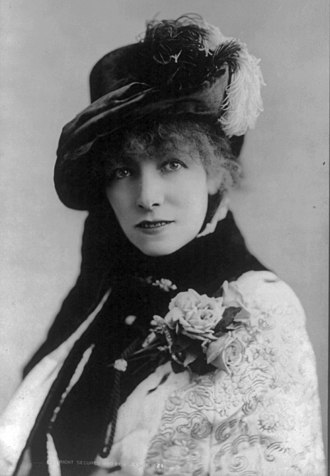
ACHIEVEMENTS: Great actress
NICKNAME/ALIAS: Original name: Bernard, Henriette-Rosine. Alias: La Divine Sarah.
DATE AND PLACE OF BIRTH: 22nd or 23rd October 1844, Paris.
DATE/PLACE OF DEATH/AGE AT DEATH: 26th March, 1923, Paris. Aged 78.
DISCIPLINE: Acting.
FIELD: Drama
LANGUAGE: French.
EDUCATION: 1851: Institution Fressard, a fashionable boarding school in Auteuil.
1853: Grandchamp, an Augustine convent school near Versailles
MAJOR WORK: her performance in Hugo’s “Phedre”
LIFE AND TIMES:
The illegitimate Sarah was an inconvenience to her mother, to whose salon came Alexander Dumas Pere*, Rossini* and others, all of which were useful to Sarah in the future. The Duc de Mornay, her mother's lover, arranged for Sarah to see a Moliere play at the Comedie-Francaise. Following this, she agreed to try for the stage, but she found it hard to enter the Conservatoire. Dumas Pere took her through a reading of “Phedre” and Bernhardt read the part of the virgin Princess, which inspired her and filled her with a passion to act. Later in life, she acted in Dumas' plays, and also in his son's, Alexander Dumas fils* play “La Dame aux Camelias”, with which she was, later, most closely identified.
Bernhardt was hired by the Theatre du Gymnase Dramatique to play small parts and to understudy. As the most fashionable theatre in Paris, it gave her a chance to find her feet. Bernhardt left the theatre a year later, in 1864, after finding herself pregnant by the Belgian prince, Henri de Ligne. Following the birth of her son Maurice, in December, Henri de Ligne refused to support her or to acknowledge his paternity and between this time and 1866 she appeared only once on stage.
In 1868, Bernhardt enjoyed success as Anna Damby in “Kean” by Alexander Dumas Pere and as Cordelia in “Lear”. Audiences took to her and she went on to appear as Zanetto, the minstrel, in “Le Passant” by Francois Coppee, in 1869, aged 24, for which Napoleon III* attended a command performance. In 1870, Bernhardt landed the leading role in a new play, written and directed by George Sand*, "The Plum of the Season". However, her career was put on hold due to the start of the Franco-Prussian War, during which Bernhardt set up a military hospital at the Theatre de L'Odeon.
After the war, in 1872, Bernhardt was chosen to play Dona Maria in a revival of Victor Hugo's play “Ruy Blas”, in which she conquered her audience and critics, prompting Hugo* to come backstage and kneel at her feet.This began a sporadic affair, lasting several years. She then joined The Comedie Francaise on their visit to London, where, when disembarking the boat, a pale young man from the delirious crowd laid down a path of white lilies for her to walk on. That man later became famous as Wilde*.
Following her performance in Hugo’s “Phedre”, the English audience idolized her. This gave her the opportunity to exhibit her paintings and sculptures, having been taught by Gustave Dore. This showing was attended by the Prince of Wales, with whom she later slept, his wife Princess Alexandra, Gladstone*, and the painter Millais*.
The rest of the company were jealous of Bernhardt's success and the French press, with the exception of Zola,* were critical. In 1880 she formed her own travelling company and appeared in England, Europe, the United States and Canada, gaining fame and international success. In America, her tour took in twenty-five cities in twenty-eight days, and included both “Phedre” and “Hernani”. Bernhardt played her American debut in New York, in Booth's “Temple of Dramatic Art”, after which she received twenty-seven curtain calls.
Bernhardt went on to meet Jacques Damal, a bisexual morphine addict who was twelve years her junior and working at the Greek Embassy in Paris. She immediately fell in love with him, proposed to him in Naples, and they married in London where they were able to get a license for both a Catholic and a Greek Orthodox marriage. Back in Paris, Damala acted opposite Bernhardt in "La Dame aux Camelias", however, he soon left her to return to army life in Algeria.
In 1882, Victorien Sardou wrote “Fedora” for Bernhardt to play the leading role, and again in 1884 with “Theodora”, which she performed in Paris more than three hundred times, guaranteeing ovations every time. Following another tour in through North and South America, Bernhardt returned to Paris in 1887 as a millionaire. Her son then married Princess Marie-Therese Jablonowska and Bernhardt looked after her estranged husband Damala until his death in 1889.
1891-93 saw Bernhardt's world tour, which included performances in Australia. Everyone wanted to see her in “Phedre” and as Marguerite Gautier in “La Dame aux Camelias”. In the Autumn 1894, Bernhardt appeared in Sardou's “Gismonda” in Paris, for which Mucha* had designed an advertising poster. On seeing this, Bernhardt gave him a five-year contract to help design posters, sets, costumes and jewellery.
Life was settled for Bernhardt, but during her South American tour in 1905, much to her embarrassment, she fell in the last scene of “La Tosca” and while nursing her leg, she wrote her memoirs, which were published in 1907. By 1915, she had contracted gangrene in her injured leg, and had to have it amputated. Despite this enormous setback, she toured Europe in 1919, when Louis Verneuil, Maurice Rostand and Sacha Guitry wrote roles for her that could be performed sitting down.
Bernhardt completed her last work in 1923 as author of a treatise on acting, “L'Art de Theatre”, in which she discusses the importance of voice training in great depth. By 1926, Bernhardt had become extremely ill and crowds gathered under the windows of her Paris home, where she died in the arms of her son. A continuous stream of mourners took flowers and filed past her open coffin at the house. She had been dressed in white with her head resting on a pillow of violets. She held a silver cross in her hand, and wore the ribbon of the Legion d'Honneur. Thousands lined the streets to see her funeral procession, after which she was buried in Pere-Lanchaise cemetery.
ASSESSMENT: "There are five kinds of actresses: bad actresses, fair actresses, good actresses, great actresses. And then there is Sarah Bernhardt" (Mark Twain).
EXTRA CONNECTIONS: Met Henry James* and actress Duse*
One of her fans was Twain*.
She played in vaudeville*
ONELINER: Sarah Bernhardt, the dazzling actress of her age.
BIBLIOGRAPHY
Gold, Arthur and Fizdale, Robert, The Divine Sarah, Harper Collins, London, 1992
PARENTS: Father unknown. Mother, Julie Bernard, Dutch courtesan.
SIBLINGS: Two younger sisters: Jeanne and Regine.
SPOUSE: Jacques Damala, actor.
CHILDREN: Son, Maurice Bernhardt.