Diderot, Denis
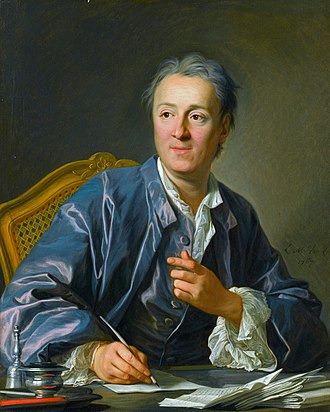
Name: Denis Diderot
Achievements: The “Encyclopedie”
Born: October 5, 1713; Langres, France
Died: July 31, 1784; Paris, France (Aged 71)
Field & Discipline: Literature; Editor; Writer
Language: French
Father: Didier Diderot
Mother: Unknown
Siblings: 1 brother: Didier-Pierre; 3 sisters: Denise; Catherine; Unknown
Spouse: Antoinette Champion
Children: Angelique
Education: Jesuit School, Langres; College d'Harcourt, Paris and/or Lycee Louis-le-Grand, Paris
Major Work:
"Encyclopedie" (1751-72)
Life & Times:
Diderot graduated from the University of Paris in 1732 and then began to study law while working as an articled clerk.
In 1741 he met the philosopher [a pal of] Rousseau* with whom he became close friends. In 1745 he published his translation of the "Inquiry Concerning Virtue" by the third Earl of Shaftesbury. In the same year, at the request of the publisher Andre le Breton, Diderot began a translation of (translated the work of] Ephraim Chambers's* English "Cyclopaedia". It was a mammoth task on which two other translators had already given up.
Diderot's co-editor was the eminent mathematician [collaborated with] d'Alembert* but it was Diderot who extended the project from a simple translation of Chambers's work to a radical new approach to learning.
Diderot collected a group of contributors including men of letters, scientists and priests, all of whom were dedicated to the pursuit of knowledge and its popular dissemination. Their philosophy was founded in rationalism, and the presentation of the "encylopedie" was designed to demonstrate the true nature and useful application of all science and art. The authors were radicals who believed in the progress of the human intellect and saw the "encyclopedie" as a weapon against the authoritarianism of the Roman Catholic church and the monarchy.
One of Diderot's closest friends, [a pal of] d'Holbach*, not only wrote almost 400 articles for the work but was also a generous financial contributor. Rousseau was persuaded to write on music and [hired] Daubenton* agreed to cover natural history subjects.
While planning for the "Encyclopedie" continued, Diderot produced his own work. In 1746 he published "Philosophic Thoughts", a book greatly influenced by Shaftesbury and which revealed Diderot's anti-Christian beliefs. Two years later he wrote a novel, “Small indiscretions", which was denounced as indecent.
In his "An Essay on Blindness" (1749), he suggested a method of reading through touch for the blind which similar to the system later developed by Louis Braille, and also discussed an evolutionary theory of survival by adaptation. This blatant expression of atheism was too much for the authorities and Diderot was imprisoned at Vincennes for three months. In 1751, the first volume of the "Encylopedie" came out.
Over the next twenty years, sixteen more volumes of text, and eleven volumes of illustrations were published. In addition to supervising the illustrations and editing the text, Diderot wrote articles on the history of philosophy, social theory, esthetics, and the industries and crafts of France.
In the same year, he brought out "Letter on the Deaf and Dumb" which discussed the function of language, and in 1754 he published a treatise on the new experimental methods in science: "Thoughts on the Interpretation of Nature".
On drama, as on every important subject, Diderot had strong views. He wrote two major plays in 1757 and '58 ("The Illegitimate Son", and "The Father of the Family.” His theories on drama, in: "Discussion on the Illegitimate Son" and "Discourse on Dramatic Poetry" were in line with his rational outlook. He was in favour of realism and making plays morally and socially relevant.
The "Encylopedie" caused a predictable hostility from the authorities. In 1758, d'Alembert resigned after the publication of the seventh volume. Eventually, the "Encylopedie" was withdrawn by the government. [a pal of] Voltaire* offered to arrange publication outside France but Diderot went on publishing the remaining volumes in secret.
The encylopedists were now the focus of liberal thought in Paris and beyond. When the English radical [a pal of] Wilkes* fled from London in 1764 he went to Paris and was warmly received by Diderot and d'Holbach.
However, when [disliked by] Burke* came to France, he took a dislike to the encyclopedists and strongly criticized their rationalism.
Diderot is regarded as the first major French art critic. He wrote articles on the annual exhibitions in the Paris salons for a private journal, the "Correspondance litteraire", which was circulated among friends in manuscript form. His "Essay on Painting" (1765) was not published until after his death. His views on art, artists and artistic technique were admired by [admired by] Goethe* and [admired by] Baudelaire*.
He also wrote novels, four of which written in the 1760's and early '70's were published posthumously. Diderot had praised the work of the English novelist [admired work of] Samuel Richardson* and like Richardson, Diderot novels criticized the hypocrisy and dogmatism of contemporary society.
In his posthumously published philosophical works "Conversation Between d'Alembert and Diderot" (1769), "D'Alembert's Dream" (1769) and "Elements of physiology" (1774-80) Diderot anticipated Darwinian evolutionary theories and the cellular structure of matter.
When the "Encylopedie" was completed in 1772, Diderot had no income. He was rescued by [financially saved by] Catherine II* of Russia who bought his library with the proviso that he keep hold of it, and then made him her librarian. In 1773 Diderot went to St Petersburg to thank her in person and wrote "Plan of a University for the Government of Russia" for her.
Catherine was highly intelligent but also highly autocratic and by the time he left Russia five months later, Diderot had decided that enlightened despotism was not the answer for society's problems. He returned to a house in the rue de Richelieu for the remaining decade of his life lived quietly.
It is alleged that his last words were: "The first step towards philosophy is incredulity".
Extra Connections: Corresponded with [corresponded with] CPE Bach*. Attended the salon of [attended salon of] Mme Necker* and met her daughter [met] De Stael* .
He met the philosopher [met] Helvetius*
Assessment: A polymath remembered as the force behind one of the major works of the European
Enlightenment.
Oneliner: Denis Diderot, French editor of the ‘Encyclopedie’
Bibliography:
- Furbank, P.N., Diderot, A Critical Biography, Secker & Warburg, London, 1992.