Aquinas
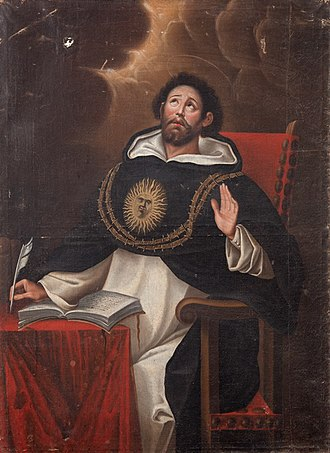
Thomas Aquinas
Nickname/Alias: Doctor Communis; Doctor Angelicus; many other titles
Achievements: 13th-century major Catholic intellectual authority.
Born: c. 1225; Roccasecca, near Aquino, Naples, Kingdom of Sicily (now Italy)
Died: March 7, 1274; Fossanuova, near Faenza, Italy (Aged around 49)
Field & Discipline: Religion; Philosophy; Theologian
Language: Latin; Italian
Father: Landolfo of Aquino (c. 1163-1243)
Mother: Teodora of Chieti (d. 1255)
Siblings: Three older brothers: Aimone; Rinaldo; Landolfo. five sisters: Marotta; Teodora; Maria; Adelasia; name unknown (killed by lightning c. 1230). at least three half-brothers: Giacomo; Filippo; Adenolfo
Spouse: None
Children: None
Education: Abbey of Monte Cassino (1231-39); University of Naples (1239-44);
University of Paris (1245-48); University of Cologne (1248-52)
Major Work:
“Summa Theologica” (“Synopsis of Theology” 1266-68 & 1271-73)
Life & Times:
In 1231 Aquinas was placed in the great Benedictine abbey of Monte Cassino near his home as an oblate (i.e. as a prospective monk) for his elementary education. He remained there until the spring of 1239 when, the abbey being occupied by Frederick II as a fortress, he was sent to finish his studies at the recently-founded University of Naples. There he studied logic and grammar under Master Martin and natural science under Peter of Ireland, and was first introduced to [influenced by] Aristotle* and the recently translated commentaries and interpretations of the Arab scholars [influenced by] Avicenna* and [influenced by] Averroes*.
In 1244, Aquinas joined the Dominican mendicant friars at the priory of San Domenico in Naples, a relatively new religious order (founded by [in Order of] St. Dominic* in 1220-21) devoted to study and preaching. This was expressly against the wishes of his family, which appears to have been counting on his becoming abbot of Monte Cassino. When the Dominicans ordered Aquinas to go to Paris for further study, his family had him abducted en route by his brother Rinaldo and brought home, where he was kept captive for a year.
However, having finally convinced his parents of his determination to remain a humble friar, he was allowed to rejoin the Dominicans in Naples in the summer of 1245, and from there proceeded to the convent of Saint-Jacques in Paris, the great university centre of the Dominicans.
At Saint-Jacques, Aquinas studied under [taught by] Albertus Magnus*, the great scholar who was currently paraphrasing in Latin all of the (Greek) works of Aristotle that had reached the West, and who quickly became his most influential teacher and eventually his friend and supporter.
When Albertus moved on to the Dominican convent at Cologne in 1248, Aquinas followed him and became his assistant. During these years, he studied intensively, and was soon abreast of the most advanced scholarship of his time, including the major Greek, Arab and Latin sources that would restore the intellectual life of the Middle Ages.
In 1252, Aquinas returned to the University of Paris in order to prepare for the degree of master in theology.
During his first academic year he studied and lectured on the Bible, while the final three years were devoted to delivering in lecture form a commentary on [commented on] Peter Lombard's* “Sentences” (now often referred to as his “Commentary on the Sentences,” the first of his four theological syntheses).
During this four-year period (1252-56), Aquinas also produced his “On Being and Essence,” a short philosophical treatise written for his fellow Dominicans on many of the concepts and theses that would remain fundamental to his thinking throughout his career.
In the spring of 1256 Aquinas was appointed regent master (professor) in theology at Paris, and taught in one of the two Dominican schools incorporated in the University of Paris for the next three years.
During this period he wrote commentaries on Boethius' “On the Trinity” and “How Substances are Good,” and the first of his sets of disputed questions, (based on the method of teaching in the form of "questions," in which critical research is presented by pro and con arguments).
His “Argued Questions on Truth” consists of 29 wide-ranging questions, each devoted to some general topic like conscience, faith, goodness, free will, human emotions and truth, and are then divided into articles (253 in all) reflecting the scholastic method of dialectics.
He also began work on the “Summa contra gentiles” (“Synopsis [of Christian Doctrine] Directed Against Unbelievers”), which was intended as a kind of textbook for missionaries and was especially important for its evaluation of Arab thought.
In 1259 Thomas returned to Italy, where he spent two years at a Dominican priory in Naples working on his “Summa contra gentiles,” and in 1261 he moved to Orvieto where, as lector, he was in charge of studies at the Dominican priory until 1265.
At Orvieto he completed the “Summa contra gentiles,” in which he fully developed a natural theology (i.e. dependent on natural reason) before proceeding to revealed theology, and “Literal Commentary on Job,” one of the most fully developed and philosophical of his biblical commentaries.
In 1265, Aquinas was ordered to establish a Dominican “studium” at Rome, and to serve there as regent master. During his three-year stay in Rome, he produced some of his most important works, including three sets of argued questions “Argued Questions on [God's] Power,” “Argued Questions on the Soul,” “Argued Question on Spiritual Creatures,” and his incomplete “Compendium of Theology,” which (like the “Summa contra gentiles”) is written in prose, and is centred around the "theological virtues" of faith, hope and charity.
At Rome, Aquinas also produced the first of his twelve commentaries on works by Aristotle, and the first part of his “Summa theologiae” (“Synopsis of Theology”), his greatest work.
Aquinas considered his “Summa theologiae” (left incomplete at his death) as a new kind of theological textbook. It consists of three large sections: the first part (Questions 1-43) is concerned with the existence and nature of God, creation (44-49), angels (50-64), the six days of creation (65-74), human nature (75-102), and divine government (103-19); the first section of the second part (written 1271-72) deals with human happiness (Questions
1-5), human action (6-17), the morality of human actions (18-21), the passions (22-48), and the sources of human acts, intrinsic (49-89) and extrinsic (90-114); the second section of the second part begins with the three theological virtues and vices (Questions 1-46), moves on to the four "cardinal virtues" and corresponding vices (47-170), and ends with special issues associated with the religious life (171-89); the third part (written
1272-73) deals with the incarnation (Questions 1-59) and the sacraments (60-90), breaking off in the middle of his discussion of penance.
In November 1268, the Dominican order again called Aquinas to Paris as regent master, in response to a crisis at the university provoked by the rise of Latin Averroism (or radical Aristotelianism as presented by the great Arab commentator and interpreter of Aristotle, Averroes), led by [a colleague of] Siger of Brabant*.
During the following four years, while disputing frequently with Siger, Aquinas continued to lecture while also producing an astonishing number of works, including the massive second part of the “Summa theologiae,” nine Aristotelian commentaries, a commentary on the pseudo-Aristotelian “Liber de causis,” sixteen biblical commentaries, and seven sets of disputed questions.
He also wrote two works concerned with the Averroist controversy, “On [the Theory of] the Unicity of Intellect, against the Averroists” and “On the Eternity of the World, against Grumblers,” over which he came into conflict with not only the Averroists but also the leader of the Franciscans, Bonaventura.
In June 1272, Aquinas was ordered by the Dominicans to leave Paris for Naples in order to establish another “studium” for the order and to serve as its regent master. On his way to Naples, he participated in a general chapter (i.e. meeting) of the Dominicans held in Florence during Pentecost week and, having settled some family affairs, he then resumed his university teaching at Naples in October, which he continued until the end of the
following year.
Although still only in his forties, his health was now failing and, except for a collection of sermons (originally preached in his native Italian dialect), the works dating from this period – two Aristotelian commentaries and the third part of the “Summa theologiae” - were left unfinished.
In January 1274 Aquinas was personally summoned by Gregory X to the second Council of Lyons, which was attempting to repair the schism between the Latin and Greek churches, but on his way he became seriously ill. He stopped to rest at the Cistercian abbey of Fossanova, where he died.
Three years later, in 1277, much to the alarm of his followers, several propositions from his writings were condemned by the masters of Paris, the highest theological jurisdiction in the Church.
However, in 1278 the Dominican General Chapter officially imposed his teaching in the order, in 1323 he was canonized a saint, in 1567 officially named doctor of the church, and finally proclaimed the protagonist of orthodoxy by the Church during the modernist crisis at the end of the 19th century.
Extra Connections: His work related to that of [work related to] William of Ockham*
Assessment: His influence on the theological thought of succeeding ages was immense, and Thomism now represents, with few exceptions, the general teaching of the Catholic Church.
Oneliner: Saint Thomas Aquinas, major medieval philosopher
Bibliography:
- Dictionary of Scientific Biography.
- Encyclopedia Britannica.
- New Catholic Encyclopedia (1967).
- Tugwell, S., “Albert and Thomas: Selected Writings,” Mahwah, N.J.: Paulist
- Press, 1988.
Wikipedia