Duncan, Isadora 2
(see main node)
Angela Isadora Duncan (May 26, 1877 or May 27, 1878[a] – September 14, 1927) was an American dancer and choreographer, who was a pioneer of modern contemporary dance, who performed to great acclaim throughout Europe and the US. Born and raised in California, she lived and danced in Western Europe, the US and Soviet Russia from the age of 22 until her death at age 50 when her scarf became entangled in the wheel and axle of the car in which she was travelling in Nice, France.[1]
Early life
Angela Isadora Duncan was born in San Francisco, the youngest of the four children of Joseph Charles Duncan (1819–1898), a banker, mining engineer and connoisseur of the arts, and Mary Isadora Gray (1849–1922). Her brothers were Augustin Duncan and Raymond Duncan;[2] her sister, Elizabeth Duncan, was also a dancer.[3][4] Soon after Isadora's birth, her father was found to have been using funds from two banks he had helped set up to finance his private stock speculations. Although he avoided prison time, Isadora's mother (angered over his infidelities as well as the financial scandal) divorced him and from then on, the family struggled with poverty.[2] Joseph Duncan, along with his third wife and their daughter, died in 1898 when the British passenger steamer SS *Mohegan* ran aground off the coast of Cornwall.[5]
After her parents' divorce,[6] Isadora's mother moved with her family to Oakland, California, where she worked as a seamstress and piano teacher. Isadora attended school from the ages of six to ten, but she dropped out, having found it constricting. She and her three siblings earned money by teaching dance to local children.[2]
In 1896, Duncan became part of Augustin Daly's theater company in New York, but she soon became disillusioned with the form and craved a different environment with less of a hierarchy.[7]
Work
Photo by Arnold Genthe of Duncan performing barefoot during her 1915–1918 American tour
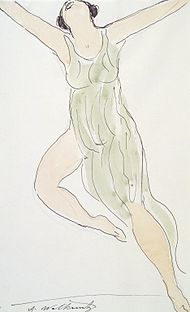
Abraham Walkowitz's Isadora Duncan #29, one of many works of art she inspired
Duncan's novel approach to dance had been evident since the classes she had taught as a teenager, where she "followed [her] fantasy and improvised, teaching any pretty thing that came into [her] head".[8] A desire to travel brought her to Chicago, where she auditioned for many theater companies, finally finding a place in Augustin Daly's company. This took her to New York City where her unique vision of dance clashed with the popular pantomimes of theater companies.[9] While in New York, Duncan also took some classes with Marie Bonfanti but was quickly disappointed in ballet routine.
Feeling unhappy and unappreciated in America, Duncan moved to London in 1898. She performed in the drawing rooms of the wealthy, taking inspiration from the Greek vases and bas-reliefs in the British Museum.[10][11] The earnings from these engagements enabled her to rent a studio, allowing her to develop her work and create larger performances for the stage.[12] From London, she traveled to Paris, where she was inspired by the Louvre and the Exposition Universelle of 1900.[13] In France, as elsewhere, Duncan delighted her audience.[14]
In 1902, Loie Fuller invited Duncan to tour with her. This took Duncan all over Europe as she created new works using her innovative technique,[15] which emphasized natural movement in contrast to the rigidity of traditional ballet.[16] She spent most of the rest of her life touring Europe and the Americas in this fashion.[17] Despite mixed reaction from critics, Duncan became quite popular for her distinctive style and inspired many visual artists, such as Antoine Bourdelle, Dame Laura Knight, Auguste Rodin, Arnold Rönnebeck, André Dunoyer de Segonzac, and Abraham Walkowitz, to create works based on her.[18]
In 1910, Duncan met the occultist Aleister Crowley at a party, an episode recounted by Crowley in his Confessions.[19] He refers to Duncan as "Lavinia King", and used the same invented name for her in his 1929 novel Moonchild (written in 1917). Crowley wrote of Duncan that she "has this gift of gesture in a very high degree. Let the reader study her dancing, if possible in private than in public, and learn the superb 'unconsciousness' – which is magical consciousness – with which she suits the action to the melody."[20] Crowley was, in fact, more attracted to Duncan's bohemian companion Mary Dempsey (a.k.a. Mary D'Este or Desti), with whom he had an affair. Desti had come to Paris in 1901 where she soon met Duncan, and the two became inseparable. Desti, who also appeared in Moonchild (as "Lisa la Giuffria") and became a member of Crowley's occult order,[b] later wrote a memoir of her experiences with Duncan.[21]
In 1911, the French fashion designer Paul Poiret rented a mansion – Pavillon du Butard in La Celle-Saint-Cloud – and threw lavish parties, including one of the more famous grandes fêtes, La fête de Bacchus on June 20, 1912, re-creating the Bacchanalia hosted by Louis XIV at Versailles. Isadora Duncan, wearing a Greek evening gown designed by Poiret,[22] danced on tables among 300 guests; 900 bottles of champagne were consumed until the first light of day.[22]

Duncan c. 1916–1918
Opening schools of dance
Duncan disliked the commercial aspects of public performance, such as touring and contracts, because she felt they distracted her from her real mission, namely the creation of beauty and the education of the young.[citation needed] To achieve her mission, she opened schools to teach young women her philosophy of dance. The first was established in 1904 in Berlin-Grunewald, Germany. This institution was the birthplace of the "Isadorables" (Anna, Maria-Theresa, Irma, Liesel, Gretel, and Erika[23]), Duncan's protégées who would continue her legacy.[24] Duncan legally adopted all six girls in 1919, and they took her last name.[25] After about a decade in Berlin, Duncan established a school in Paris that soon closed because of the outbreak of World War I.[26]

A portrait of Duncan in 1922 by dancer Paul Swan.
In 1914, Duncan moved to the United States and transferred her school there. A townhouse on Gramercy Park was provided for its use, and its studio was nearby, on the northeast corner of 23rd Street and Fourth Avenue (now Park Avenue South).[27] Otto Kahn, the head of Kuhn, Loeb & Co., gave Duncan use of the very modern Century Theatre at West 60th Street and Central Park West for her performances and productions, which included a staging of Oedipus Rex that involved almost all of Duncan's extended entourage and friends.[28] During her time in New York, Duncan posed for studies by the photographer Arnold Genthe.
Duncan had planned to leave the United States in 1915 aboard the RMS *Lusitania* on its ill-fated voyage, but historians believe her financial situation at the time drove her to choose a more modest crossing.[29] In 1921, Duncan's leftist sympathies took her to the Soviet Union, where she founded a school in Moscow. However, the Soviet government's failure to follow through on promises to support her work caused her to return[when?] to the West and leave the school to her protégée Irma.[30] In 1924, Duncan composed a dance routine called Varshavianka to the tune of the Polish revolutionary song known in English as Whirlwinds of Danger.[31]
Philosophy and technique

Duncan in a Greek-inspired pose and wearing her signature Greek tunic. She took inspiration from the classical Greek arts and combined them with an American athleticism to form a new philosophy of dance, in opposition to the rigidity of traditional ballet.
Breaking with convention, Duncan imagined she had traced dance to its roots as a sacred art.[32] She developed from this notion a style of free and natural movements inspired by the classical Greek arts, folk dances, social dances, nature, and natural forces, as well as an approach to the new American athleticism which included skipping, running, jumping, leaping, and tossing.[citation needed] Duncan wrote of American dancing: "let them come forth with great strides, leaps and bounds, with lifted forehead and far-spread arms, to dance."[33] Her focus on natural movement emphasized steps, such as skipping, outside of codified ballet technique.
Duncan also cited the sea as an early inspiration for her movement,[34] and she believed movement originated from the solar plexus.[35] Duncan placed an emphasis on "evolutionary" dance motion, insisting that each movement was born from the one that preceded it, that each movement gave rise to the next, and so on in organic succession. It is this philosophy and new dance technique that garnered Duncan the title of the creator of modern dance.

Isadora Duncan, by Arnold Genthe
Duncan's philosophy of dance moved away from rigid ballet technique and towards what she perceived as natural movement. She said that in order to restore dance to a high art form instead of merely entertainment, she strove to connect emotions and movement: "I spent long days and nights in the studio seeking that dance which might be the divine expression of the human spirit through the medium of the body's movement."[35]
She believed dance was meant to encircle all that life had to offer—joy and sadness. Duncan took inspiration from ancient Greece and combined it with a passion for freedom of movement. This is exemplified in her revolutionary costume of a white Greek tunic and bare feet. Inspired by Greek forms, her tunics also allowed a freedom of movement that corseted ballet costumes and pointe shoes did not.[36] Costumes were not the only inspiration Duncan took from Greece: she was also inspired by ancient Greek art, and utilized some of its forms in her movement (as shown on photos).[37]
Personal life

Duncan with her children Deirdre and Patrick, in 1913
In both professional and private life, Duncan flouted traditional cultural standards.
Children
Duncan bore three children, all out of wedlock. The first two, Deirdre Beatrice (born September 24, 1906), whose father was theatre designer Gordon Craig; and Patrick Augustus (born May 1, 1910),[38] by Paris Singer, one of the many sons of sewing machine magnate Isaac Singer, drowned in the care of their nanny in 1913 when their car went into the River Seine.[38] Following the accident, Duncan spent several months recuperating in Corfu with her brother and sister, then several weeks at the Viareggio seaside resort with the actress Eleonora Duse.
In her autobiography, Duncan relates that in her deep despair over the deaths of her children, she begged a young Italian stranger, the sculptor Romano Romanelli, to sleep with her because she was desperate for another child.[39] She became pregnant and gave birth to a son on August 13, 1914, but he died shortly after birth.[40][41]
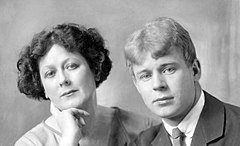
Duncan and Sergei Yesenin in 1923
Relationships
When Duncan stayed at the Viareggio seaside resort with Eleonora Duse, Duse had just left a relationship with the rebellious and epicene young feminist Lina Poletti. This fueled speculation as to the nature of Duncan and Duse's relationship, but there has never been any indication that the two were involved romantically.
Duncan was loving by nature and was close to her mother, siblings and all of her male and female friends. [42] Later on, in 1921, after the end of the Russian Revolution, Duncan moved to Moscow where she met the poet Sergei Yesenin, who was eighteen years her junior. On May 2, 1922, they married, and Yesenin accompanied her on a tour of Europe and the United States. However, the marriage was brief as they grew apart while getting to know each other. In May 1923, Yesenin returned to Moscow. Two years later, on December 28, 1925, he was found dead in his room in the Hotel Angleterre in Leningrad (formerly St Petersburg and Petrograd), in an apparent suicide.[43]
Duncan also had a relationship with the poet and playwright Mercedes de Acosta, as documented in numerous revealing letters they wrote to each other.[44] In one, Duncan wrote, "Mercedes, lead me with your little strong hands and I will follow you – to the top of a mountain. To the end of the world. Wherever you wish."[45]
Later years
By the late 1920s, Duncan was so extremely depressed by the deaths of her three young children that her performing career had dwindled. She was also distraught by feeling that she had lost her daughters, some of the Adorables whom she had adopted, to the greedy wiles of the older men they had encountered while touring in the US. She became notorious for her financial woes, scandalous love life and public drunkenness.
She spent her final years moving between Paris and the Mediterranean, running up debts at hotels. She spent short periods in apartments rented on her behalf by a decreasing number of friends and supporters, many of whom attempted to assist her in writing an autobiography. They hoped it might be successful enough to support her.[citation needed] Her autobiography My Life was published in 1927 shortly after her death. The Australian composer Percy Grainger called it a "life-enriching masterpiece."[46]
In his book Isadora, An Intimate Portrait, Sewell Stokes, who met Duncan in the last years of her life, described her extravagant waywardness. In a reminiscent sketch, Zelda Fitzgerald wrote how she and her husband, author F. Scott Fitzgerald, sat in a Paris cafe watching a somewhat drunken Duncan. He would speak of how memorable it was, but all that Zelda recalled was that while all eyes were watching Duncan, she was able to steal the salt and pepper shakers from the table.[47]
Death

Duncan's tomb at Père Lachaise Cemetery
On September 14, 1927, in Nice, France, Duncan was a passenger in an Amilcar CGSS automobile owned by Benoît Falchetto [fr], a French-Italian mechanic. She wore a long, flowing, hand-painted silk scarf, created by the Russian-born artist Roman Chatov, a gift from her friend Mary Desti, the mother of American filmmaker, Preston Sturges. Desti, who saw Duncan off, had asked her to wear a cape in the open-air vehicle because of the cold weather, but she would agree to wear only the scarf.[48]
As they departed, she reportedly said to Desti and some companions, "Adieu, mes amis. Je vais à la gloire !" ("Farewell, my friends. I go to glory!"); but according to the American novelist Glenway Wescott, Desti later told him that Duncan's actual parting words were, "Je vais à l'amour" ("I am off to love"). Desti considered this embarrassing, as it suggested that she and Falchetto were going to her hotel for a tryst.[49][50][51]
Her silk scarf, draped around her neck, became entangled around the open-spoked wheels and rear axle, pulling her from the open car and breaking her neck.[1] Desti said she called out to warn Duncan about the scarf almost immediately after the car left. Desti took Duncan to the hospital, where she was pronounced dead.[48]
As The New York Times noted in its obituary, Duncan "met a tragic death at Nice on the Riviera". "According to dispatches from Nice, Duncan was hurled in an extraordinary manner from an open automobile in which she was riding and instantly killed by the force of her fall to the stone pavement."[52] Other sources noted that she was almost decapitated by the sudden tightening of the scarf around her neck.[53] The accident gave rise to Gertrude Stein's mordant remark that "affectations can be dangerous".[54] At the time of her death, Duncan was a Soviet citizen. Her will was the first of a Soviet citizen to undergo probate in the U.S.[55]
Duncan was cremated, and her ashes were placed next to those of her children[56] in the columbarium at Père Lachaise Cemetery in Paris.[57] On the headstone of her grave is inscribed École du Ballet de l'Opéra de Paris ("Ballet School of the Opera of Paris").
Works
- Duncan, Isadora (1927) "My Life" New York City: Boni & Liveright OCLC 738636
- Project Gutenberg Canada #941 HTML HTML zipped Text Text zipped EPUB
- *My Life* at Faded Page (Canada) : text, HTML, EPUB, .mobi, PDF, HTML .zip
- Duncan, Isadora; Cheney, Sheldon (ed.) The Art of the Dance. New York: Theater Arts, 1928. ISBN 0-87830-005-8
- Works by Isadora Duncan at Faded Page (Canada)
- Works by Isadora Duncan at Open Library
Legacy
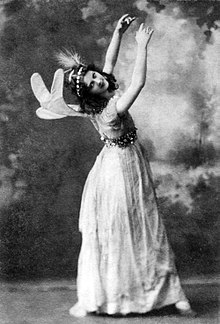
Duncan as a fairy in A Midsummer Night's Dream, 1896
Duncan is known as "The Mother of Dance". While her schools in Europe did not last long, Duncan's work had an impact on the art and her style is still danced based upon the instruction of Maria-Theresa Duncan,[58] Anna Duncan,[59] and Irma Duncan,[60] three of her six adopted daughters. The adoption process was never verified, but all six of Isadora's dancers did change their last name to Duncan.
Through her sister, Elizabeth, Duncan's approach was adopted by Jarmila Jeřábková from Prague where her legacy persists.[61] By 1913 she was already being celebrated. When the Théâtre des Champs-Élysées was built, Duncan's likeness was carved in its bas-relief over the entrance by sculptor Antoine Bourdelle and included in painted murals of the nine muses by Maurice Denis in the auditorium. In 1987, she was inducted into the National Museum of Dance and Hall of Fame.
Anna, Lisa,[62] Theresa and Irma, pupils of Isadora Duncan's first school, carried on the aesthetic and pedagogical principles of Isadora's work in New York and Paris. Choreographer and dancer Julia Levien was also instrumental in furthering Duncan's work through the formation of the Duncan Dance Guild in the 1950s and the establishment of the Duncan Centenary Company in 1977.[63]
Another means by which Duncan's dance techniques were carried forth was in the formation of the Isadora Duncan Heritage Society, by Mignon Garland, who had been taught dance by two of Duncan's key students. Garland was such a fan that she later lived in a building erected at the same site and address as Duncan, attached a commemorative plaque near the entrance, which is still there as of 2016. Garland also succeeded in having San Francisco rename an alley on the same block from Adelaide Place to Isadora Duncan Lane.[64][65]
In medicine, the Isadora Duncan Syndrome refers to injury or death consequent to entanglement of neckwear with a wheel or other machinery.[66]
Photo gallery...
In popular culture
Duncan has attracted literary and artistic attention from the 1920s to the present, in novels, film, ballet, theatre, music, and poetry.
In literature, Duncan is portrayed in:
- Aleister Crowley's Moonchild (as 'Lavinia King'), published in 1923.[67]
- Upton Sinclair's *World's End* (1940) and *Between Two Worlds* (1941), the first two novels in his Pulitzer Prize winning Lanny Budd series.[68]
- Amelia Gray's novel Isadora (2017).[69]
- A Series of Unfortunate Events, in which two characters are named after her, Isadora Quagmire and Duncan Quagmire.[70]
- The poem Fever 103 by Sylvia Plath, in which the speaker alludes to Isadora's scarves.[71]
Among the films featuring Duncan are:
- The 1966 BBC biopic by Kenneth Russell, Isadora Duncan, the Biggest Dancer in the World, which was introduced by Duncan's biographer, Sewell Stokes, Duncan was played by Vivian Pickles.[72]
- The 1968 film Isadora, nominated for the Palme d'Or at Cannes, stars Vanessa Redgrave as Duncan. The film was based in part of Duncan's autobiography. Redgrave was nominated for the Academy Award for Best Actress for her performance as Duncan.[72][73]
- Archival footage of Duncan was used in the 1985 popular documentary That's Dancing!.[74][75]
- A 1989 documentary, Isadora Duncan: Movement from the Soul, was nominated for the Grand Jury Prize at the 1989 Sundance Film Festival.[76]
- In 2016, Lily-Rose Depp portrayed Duncan in The Dancer, a French biographical musical drama of dancer Loie Fuller.[77]
Ballets based on Duncan include:
- In 1976 Frederick Ashton created a short ballet entitled Five Brahms Waltzes in the Manner of Isadora Duncan on Lynn Seymour, in which "Ashton fused Duncan's style with an imprint of his own"; Marie Rambert claimed after seeing it that it was exactly as she remembered Duncan dancing.[78]
- In 1981, she was the subject of a ballet, Isadora, written and choreographed by the Royal Ballet's Kenneth MacMillan, and performed at Covent Garden.[79]
On the theatre stage, Duncan is portrayed in:
- A 1991 stage play When She Danced by Martin Sherman about Duncan's later years, won the Evening Standard Award for Vanessa Redgrave as Best Actress.[80]
Duncan is featured in music in:
- Celia Cruz recorded a track titled Isadora Duncan with the Fania All-Stars for the album Cross Over released in 1979.[81]
- Rock musician Vic Chesnutt included a song about Duncan on his debut album Little.[82]
See also
- List of dancers
- Women in dance
- Dancer in a café
- Isidora, sometimes spelled Isadora
Knowledge Web Content (see main node)
NAME: Duncan, Isadora
ACHIEVEMENT(S): Influential in raising interpretive dance to the status
of creative art
NAME: Duncan, Angela
DATE AND PLACE OF BIRTH: May 26, 1877, San Francisco, CA
DATE/PLACE OF DEATH/AGE AT DEATH: September 14, 1927, Nice, France.
Aged 50 (accident)
DISCIPLINE: Dancer
FIELD: Theater
LANGUAGE: English
PARENTS: Joseph Charles Duncan; Mary Isadora Gray
SIBLINGS: Mary Elizabeth; Augustin; Raymond
SPOUSE: Sergey Aleksandrovich Yesenin
CHILDREN: Deidre (died at seven in car accident, father Gordon Craig);
Patrick Augustus (died at three in same car accident, father Paris Singer)
EDUCATION: Little formal education
MAJOR WORK: "The Art of the Dance"
LIFE AND TIMES:
Duncan's early dance training seems to have been gymnastics lessons at the Oakland "Turnverein" (see Jahn*) and the occasional ballet lesson. But early on, she rejected the rigidity of classical ballet and preferred more natural rhythms and movements. She learned the popular dances of the day -- the polka, waltz, and schottische -- and elaborated upon them.
Her mind already set on a career in dance, Duncan achieved modest success as a dance
teacher, but no success as a performer. In 1895, Duncan moved with her mother to Chicago, where she met a theatrical producer, Augustin Daly, who offered her a place in a New York show. She enthusiastically accepted, and from 1895 to 1897 danced in such shows as Daly's "Miss Pygmalion" and "A Midsummer Night's Dream", and even toured briefly in England.
Seeking more recognition, Duncan decided to give private dance performances in New York and Newport, and to give dance classes and lectures. Her highly personal program "Done into Dance", featured her dance interpretations of poetry (such as Omar Khayyam's "Rubaiyat") and music (such as Ethelbert Nevin's "Water Scenes" and "Shepherd's Tale").
In 1899, Duncan moved to London, where she studied the sculptures at the British Museum and incorporated the gestures of the ancient Greece statues into her classical dance movements. Through the patronage of actress Mrs. Patrick Campbell, Duncan was invited to appear at high class private receptions. Her fame grew. The phenomenon of a young woman dancing barefoot and scantily clad brought crowds of admirers. She began to perform in small theaters and concert halls.
After a series of performances at the New Gallery in London, where her dances included interpretations of paintings by Botticelli ("Primavera") and Titian ("Bacchus and Ariadne"), Duncan went to Paris in 1901, where she achieved the same success. In 1902, she danced in Berlin, Vienna, and in Budapest, where she was hailed as a genius of interpretive dance.
In Berlin, Duncan's performances raised eyebrows. Invited to speak at the Berlin Press Club in 1903, she lectured on "The Dance of the Future", delivering a cogent explanation of her theory of dance, stating that its purpose was to "express what is the most moral, healthful and beautiful in art."
In 1904, Duncan was invited by Cosima Von Bulow*, the wife of composer
Wagner*, to dance to Wagner's music at the Bayreuth Festival. In Russia, in 1905, her performance caught the eye of Russian art critic Diaghilev*, who in a few years as an impresario was to lead a resurgence of ballet throughout western Europe.
The next eight years saw Duncan at the apex of her artistic fame. She choreographed music by Schubert*, Wagner, Tchaikovsky*, Brahms* and Beethoven*, but was at her best in her interpretations of Polish composer Chopin*.
Duncan's personal life, as well as her art, kept her in the public eye. In 1906, she gave birth to her first child, Deirdre, the daughter of stage designer Gordon Craig*, who shared her resistance to marriage. In 1910, she had a second child, Patrick Augustus, with art patron Paris Singer, heir to the sewing-machine fortune of his grandfather, Singer*. In 1913, both children died when the car they and their governess were in accidentally rolled into the Seine. Duncan never fully recovered from the tragedy.
In early 1914, after the death of a third newborn (father unknown), Duncan opened a dancing school in Bellevue, outside Paris, but when the First World War broke out, she donated the school as a hospital and returned to the United States.
After the War, she returned to France, where she supervised dance courses and choreographed Hungarian composer Franz Liszt*'s "Les Funerailles" and "Benediction de Dieu dans la solitude".From Chopin's works, she created the trilogy "Poland Tragic", "Poland Heroic" and "Poland Languorous and Gay". In 1920, she was invited to establish a dancing school in Moscow, and was promised an enrolment of 1,000 children. Shortly afterwards, the school opened and then closed when the New Economic Policy cancelled funding.
Duncan married poet Sergei Aleksandrovich Yesenin in 1922. Fear of the "Red Menace" was at its height in the U.S., and on her next tour of the US she and her husband were unjustly labeled as Bolshevik agents. The tour ended prematurely, and the couple left America in February, 1923. Her citizenship was revoked, technically for having married a Soviet citizen.
Duncan returned briefly to the Soviet Union. She choreographed a number of
group works and several solos by Russian composer Alexander Scriabin, but
her relationship with Yesenin was fast deteriorating. He was becoming
mentally unstable, (and committed suicide in Moscow in 1925).
Duncan fled to Berlin, then settled again in Paris in 1924. Now well into her forties
and dogged by bad luck and scandal, Duncan was in much less demand and in constant debt. Her last public performance was on July 8, 1927, at the Theatre Mogador in Paris.
Duncan died tragically in Nice, when a shawl she had wrapped around her neck became caught in a wheel of a sports car, and she was strangled.
ASSESSMENT: Duncan remains a key figure in the history of American modern
dance.
EXTRA CONNECTIONS: She influenced Ashton*
She knew explorer RF Scott*
ONELINER: Isadora Duncan, one of the first interpretative dancers
BIBLIOGRAPHY:
EB
Blair, Frederika, Isadora: Portrait of the Artist as a Woman, Wellingborough: Equation, 1986.
ANB