Volta, Alessandro
Achievements: Invented the battery
Born: February 18, 1745; Como, Italy
Died: March 5, 1827 (Aged 82)
Field & Discipline: Science; Physics; Electricity; Invention
Language: Italian
Education: Benzi Seminary, Como
Major Work:
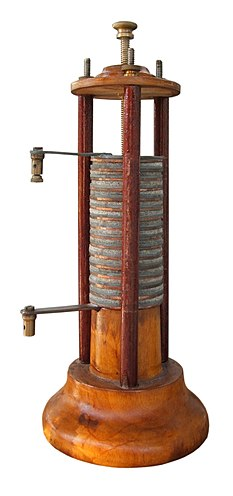
Invented the battery (Voltaic Pile)
Life & Times:
Volta taught himself physics, taking a particular interest in electrical phenomena, and at 18, began corresponding with eminent men in the field of electricity, such as [corresponded with] Spallanzani*.
Volta's first scientific paper, "De vir attractiva ignis electrici, ac phaenomenis independentibus", published in 1769, was presented to Beccaria, a noted astronomer and student of electricity. In a paper on Beccaria's theory of "vengeful electricity", Volta wrote about the action at a distance of electric charge. For example, in the case of a piece of metal foil adhering to a pane of glass, he demonstrated that the insulating surface neither lost nor recovered its own charge, but conserved it permanently.
In 1771, Volta wrote a paper on insulating materials and sent it to Spallanzani as part of his suggestion for a new electrical machine. He pointed out how the electrical charge in bodies varies according to the material with which they are covered, their elasticity and their temperature, as well as to the type of electricity applied. In 1775, he became professor of experimental physics at the Como high school. In 1778, he took the position of professor of physics at the University of Pavia, and in 1795, was made University rector.
Volta accepted the evidence of attractive forces between the different particles of the "electric fluid" (electricity was believed to be a fluid). He believed that attractive forces existed between a body and the electric fluid contained in it. This force was dependent on the position of the particles making up the body. When the particles were excited by friction they changed places, and the balance of attractive forces was upset, which resulted in the body becoming electrified. To restore balance it was necessary for electric fluid to be removed or added.
In 1775, while investigating the existence of [believed theory of] miasma* (a mystery gas said to cause disease) Volta discovered flammable "marsh gas" in Lake Maggiore in northern Italy and developed the "eudiometer" to investigate it. A graduated glass tube in which a mixture of hydrogen gas and air was ignited by an electrical spark, the eudiometer was used to measure the level of oxygen in air. The quantity of oxygen was calculated by the decrease in volume following combustion. The device eventually led to the spark plug for the [developed spark plug for] internal-combustion engine*.
From 1776, Volta traveled through Europe conducting experiments and meeting other scientists. His work influenced such eminent men of science as [influenced] Franklin*, [influenced] Joseph Priestley*, [influenced] Lavoisier*, [influenced] Saussure*, [influenced] Dalton*, [influenced] Davy* and [influenced] Gay-Lussac*.
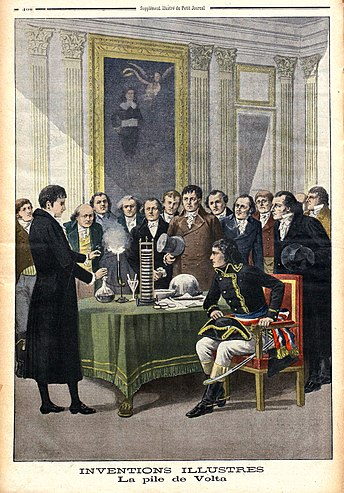
Demonstration for Napoleon
Volta developed a simple electrostatic generator -- now called an electrophore. The device was made of two tin disks, each coated on one side with a smooth layer of wax or resin. One was placed on top of the other, and a wooden handle turned one disc. The apparatus, acquiring a charge through the friction between the discs, could produce sparks and other electrical phenomena.
In 1780, he converted his electrophore into a condenser, by making it semi-insulating and increasing its capacity. It could be charged either from a Leyden jar or directly from an electrical machine. With the condenser, Volta was able to identify the existence of negative electricity in: water vapor, in the gas obtained by dissolving iron in a weak solution of sulfuric acid, and in the smoke of burning coal.
In 1788, Volta revealed that evaporating water was electropositive, in accordance with the positive charge of the sky. Using the results of one of Saussure's experiments, Volta found that a flame at the top of a conductor linked to an electroscope provided a highly effective method for analyzing the charge of the atmosphere.
Volta investigated [disagreed with] Galvani*'s work on the effect of electricity on nerve endings in frogs' legs, and came to disagree with him. Though other scientists confirmed Galvani's theory that animals made electricity, Volta realized that the movement in the frogs' legs was caused by an external electrical force, with the flesh acting as an agent to stimulate the nerves. He published these findings in "Memoria seconda sull'elettricit… animale (Second study on animal electricity)", in 1792.
In 1791, Volta began experiments that led to the invention of the battery. He discovered that if silver and tin were put into contact with each other, electricity passed from the silver to the tin, but not vice versa. He also discovered that in a closed circuit the electrical current flowed in the same unchanging direction. He also found that if certain pairs of metal were used in one circuit, all forces moving in the same direction were enhanced.
He concluded that the greater the dissimilarity between two metals through which a current was passed, the more electric current was produced. Volta proved this theory in 1800. He connected a pile of metal pairs through a liquid conductor. The instrument consisted of a series discs of silver and zinc disks, each pair of discs with a layer of damp material separating them. He used his hands to make contact across the poles and knew he had been successful when he felt an electric shock. With further research he proved that the current was increased by the number of metal disc pairs in the series. Volta had invented the battery (known as the Voltaic Pile).
Volta immediately made his invention of the electric pile public by communicating it to [corresponded with] Banks, president of the Royal Society FRS in London. He went to Paris to demonstrate his invention before the Academie de France, in the presence of [demonstrated battery to] Napoleon*, who ordered that a Gold Medal be given Volta.
Extra Connections:
His work related to that of [work related to] Brugnatelli*, [work related to] Gorrie* and in his interest in the miasma theory, to [work related to] Schonlein*, [work related to] Avogadro 2*, [work related to] Faraday* and [work related to] Schelling*
Assessment: Volta's battery represents a seminal moment in the history of physics
Oneliner: Alessandro Volta, inventor of the battery
Bibliography:
- Soresino, Franco, Alessandro Volta, BE-ME Editrice, Milano, 1988.
Father: Don Filippo Volta
Mother: Donna Maddelena Inzaghi
Siblings: Unknown
Spouse: Unknown
Children: Unknown