Keller, Helen
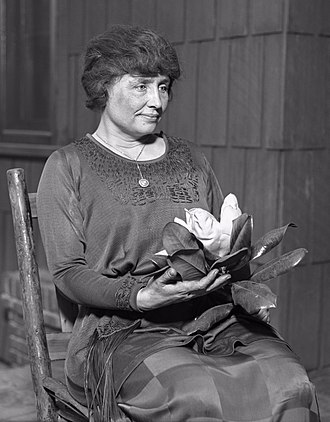
Achievements: Work for the deaf and blind
Born: June 27, 1880; Tuscumbia, Alabama
Died: June 1, 1968; Westport, Connecticut (Aged 88)
Field & Discipline: Education; Educational Reformer; Social Reformer
Language: English
Father: Arthur H Heller
Mother: Kate Adams
Siblings: James (half-brother); Simpson (half-brother)
Spouse: None
Children: None
Education: Private tutor; Perkins Institute for the Blind, Boston; Horace Mann School for the Deaf, Boston; Wright-Humason Oral School, New York City; Cambridge School for Young Ladies, Cambridge; Radcliffe College, Cambridge
Major Work:
"The Story of My Life" (1902)
"Teacher" (1936)
Life & Times:
Keller's father had served as a captain in the Confederate Army during the American civil war and the Confederate general [descendant of] Robert E Lee* was among her paternal ancestors.
At the age of nineteen months, Keller became deaf and blind after suffering from a fever. Her parents could find no medical or educational help for her condition and she grew into an unruly and often violent child, with whom there was apparently no hope of communicating.
When Keller was six her mother remembered reading an account by the English novelist [mother had read report by] Dickens* of his visit to the Perkins Institute for the Blind in Boston and his meeting with a deaf and blind girl ([influenced by case of] Laura Bridgeman*) who had been taught to communicate by touch.
Following this up, they were advised to contact [advised by] Alexander Graham Bell* who spent much of his time promoting his father's method of teaching deaf people to speak through hand signals. Bell met Helen and realised she was intelligent and could be helped.
He advised the Keller’s to ask the Perkins Institute to find a teacher for her. On 3 March 1887, a young woman called Anne Sullivan arrived at the Keller's home to be her teacher. Helen Keller later described this date as the most important in her life. Sullivan, the daughter of poor Irish immigrants, had been half-blind before having an eye operation and she was an expert in using the manual alphabet developed at the Institute.
She taught Keller to communicate by tapping the letters of the manual alphabet onto her palm and naming objects. Within three months, she knew the whole alphabet and had begun to learn to spell. She learned to read Braille at the Perkins Institute and at the age of ten she could read aloud, “hear” music through the vibrations of the instruments and “see” sculpture by touching it.
She first learned to speak by holding her hand over Sullivan's larynx as she spoke and later learned to lip read and improve her own speech by holding her fingers over the mouth of a person as they spoke. She was ten when she spoke the sentence, "I am not dumb now.”
Her speech did remain indistinct and in her later public life she was accompanied by an interpreter. As she grew out of childhood she was given a little more privacy and confounded all her critics when she took and passed exactly the same entrance examinations as other students for entrance to Radcliffe College. The questions were tapped into her hand and she typed the answers.
While still at Radcliffe Keller published "The Story of My Life" (1902) which immediately became a classic. It has been translated into fifty languages and never been out of print. Keller graduated with honors in German and French in 1904.
Sullivan married the editor John Macy shortly afterwards but remained as Helen's companion. Macy's radical social views influenced Helen and she began to write about wider issues. In 1909 she joined the Socialist Party but resigned in 1914 after saying they were too cautious.
Keller was engaged to be married in 1916 to a young man who was acting as her temporary secretary, but when her mother found out she persuaded Keller to break the engagement, fearing her daughter would be exploited. Keller later regretted that she had never married.
She opposed America's entry into the war in 1917 on the grounds that it was a capitalist war and she attacked militarism. She supported and campaigned for votes for women.
In 1919 she agreed to appear in a film of her life, "Deliverance,” as part of an attempt to bring the cause of the handicapped to public attention.
From this time until the end of her life, Keller gave her time and effort to educating the public the blind and about their needs. In 1924 she was asked by the American Foundation for the Blind to undertake fundraising tours on their behalf.
She wrote "My Religion" in 1927, explaining the [a follower of] Swedenborg* religion she observed, and "Midstream My Later Life" in 1929 - books which were much more successful than her political writings.
She was an international figure and travelled all over the world to promote education for people like herself. She lobbied Congress to support a bill for provision of talking books for the blind. She wrote a paper on education for the blind for the Encylopedia of Education and she served on the Massachusetts Commission for the Blind.
As World War II approached she spoke out against the racism of Hitler's Germany and supported America's entry into the war. During the war she toured hospitals.
Her last and most popular book, "Teacher" (1955), described her life with Sullivan who died in 1936. In 1959, a play by William Gibson entitled "The Miracle Worker" won the Pulitzer prize and was later made into a film. Keller remained a world-wide figure and continued to campaign for education for the handicapped until her death.
Extra Connections: She met [met] William James* and choreographer [met] Martha Graham*
Assessment: Helen Keller brought to public attention the needs of the blind, deaf and dumb and helped to remove the prejudice which existed against them. Her story still inspires people all over the world.
Oneliner: Helen Keller, famous deaf person
Bibliography:
- Harrity, Richard and Martin, Ralph G, The Three Lives of Helen Keller, Hodder and Stoughton, London, 1962.