Avicenna
Full Name: Abu Ali al-Hussain Ibn Abdallah Ibn Sina (or simply Ibn Sina)
Nickname/Alias: Avicenna
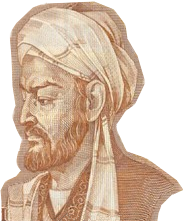
Achievements: The most famous and influential of the philosopher-scientists of Islam.
Born: 980; Afshana, near Bukhara, Central Asia (now Uzbekistan)
Died: 1037; Hamadan, Persia (now Iran, Aged 57).
Field & Discipline: Medicine; Philosophy
Language: Arabic
Education: Some private tutors, mainly self-taught
Major Work:
"Kitab ash-shifa (The Book of Healing")
"Al-Qanun fi al-Tibb (The Canon of Medicine")
Life & Times:
By the time he was 10, Avicenna had memorized the Koran and much Arabic poetry. At 13 he began studying medicine, and three years later was treating patients. As a youth, he learned Islamic law, logic and metaphysics, but soon advanced beyond the intellectual capacity of his teachers. After the death of his father in 1005, he became a wanderer, going from town to town, acting as a doctor by day and leading philosophical and scientific discussions by night.
Avicenna served as a jurist in Jurjan, then as an administrator in Khwarazm, and then as a teacher of science in Gorgan. He next joined the court of the Buyid princes, the rulers in central Iran, first working as an administrator in Rayy (near modern Tehran), and as a physician in Qazvin. Avicenna settled for a while in Hamadan, in west-central Iran, where he became court physician and began his two most important works: "The Book of Healing", an immense four-part scientific and philosophical encyclopedia; and "The Canon of Medicine."
The "Book of Healing" (in Arabic, "Kitab al-Shifa", sometimes translated as "The Cure of Ignorance"), dealt with: a) logic, closely resembling [influenced by] Aristotle*'s "Organon"; b) physics; c) the quadrivium (geometry, arithmetic, music and astronomy); and d) metaphysics. Greatly inspired by Aristotle, Avicenna sometimes gave the Greek philosopher more credit for being a systematic and coherent thinker than he was due.
Problems and solutions that were, at best, hinted at by Aristotle (e.g., the distinction between essence and existence, or the relation between possible and necessary existence) were turned into givens, and figured distinctively in Avicenna's work.
The "Book of Healing" was translated partially into Latin in the 12th century, Avicenna's "The Canon of Medicine" was the major authority in both European and Asian medical schools for centuries after he died. The work was another systematic encyclopedia based mainly on: 1) the achievements of Greek physicians during the Roman imperial age; 2) other Arabic works; and 3) (to a lesser extent) his own experience. The book dealt with general medicine, drugs (760 of them), pathology and pharmacopeia. Although a great deal of this enormous work was borrowed from the earlier physician-philosopher al-Razi, much of it was Avicenna's own.
For instance, he described the contagious nature of phthisis and tuberculosis and how to recognize it, the spreading of disease through water and soil, and the interaction between psychology and health. He was the first to describe meningitis, and to give a minute and graphic description of different parts of the eye. The complete "Canon of Medicine" was translated into Latin by [translated by]Gerard of Cremona* in the 12th century, and was in circulation well into the 17th century.
Avicenna developed a theory of knowledge based on sense perception, retention, imagination and estimation. He declared that imagination was principal, because it could compare and construct images and, through that, gain access to “universals.” To Avicenna, the ultimate object of knowledge was God, the pure intellect.In his physics research, Avicenna studied heat, light and motion and analyzed the concepts of force, vacuum and infinity. He suggested that if the perception of light was due to the emission of some sort of particles by the luminous source, the speed of light had to be finite.
He saw a connection between time and motion, investigated specific gravity, and devised an air thermometer. His treatise on minerals was one of the main sources of geology for Christian encyclopedists in the 13th century. Turning to music, he discussed tonic intervals, rhythmic patterns, and musical instruments.
In the field of astronomy, Avicenna correctly deduced that Venus must be closer to the Earth than the Sun. He also invented an instrument for observing the coordinates of a star. The instrument had two legs, pivoted at one end. The lower leg rotated about a horizontal protractor to show a star’s azimuth (degrees to one side or other of the sky); the upper leg was marked with a scale and was raised in the plane vertical to the lower leg, to give altitude (degrees up in the sky).
In 1022, Avicenna moved to Esfahan, about 250 miles south of Tehran, where he spent the last 14 years of his life in relative peace. He completed his two major works ("Healing" and "Medicine") and wrote most of his almost 200 treatises on philosophy, medicine and the Arabic language. He wrote a summary of his "Book of Healing", called "Kitab an-najat (Book of Salvation").
Of Avicenna's approximately 450 works, about 240 survive, including 150 on philosophy and 40 on medicine, the two fields to which he contributed most. His books influenced the 12th-century Jewish philosopher [influenced] Maimonides*. His thought also blended with that of Christian theologian St. Augustine and was a basic ingredient in the writings of many of medieval Scholastics -- most notably [influenced] Aquinas* and [influenced] Albertus Magnus*.
Extra Connections:
Critiqued by Arabian philosopher [critiqued by] Averroes*
He was studied by [studied by] Siger of Brabant*
He influenced the work of [influenced] Duns Scotus*
Assessment: Created a comprehensive, detailed and rationalistic account of the nature of God and Being. His work still influences Islamic thought.
Oneliner: Averroes, major medieval Arabic philosopher
Father: Unknown
Mother: Unknown
Siblings: Unknown
Spouse: Unknown
Children: Unknown
Bibliography:
- Dictionary of Scientific Biography.
- Encyclopedia Britannica.
- Routledge History of Islamic Philosophy , 2 vols., London & New York: Routledge, 2000.
- Goodman, Lenn E., Avicenna, London & New York: Routledge, 1992.