UC univ CaliF
divest coal and oil
also tag?
2 25 sue doge?! over dept of ed
---
gmail 6 25
---
ANOTHER GOOD OLE BOY AUBRUN WIFE --> ROSEVILLE
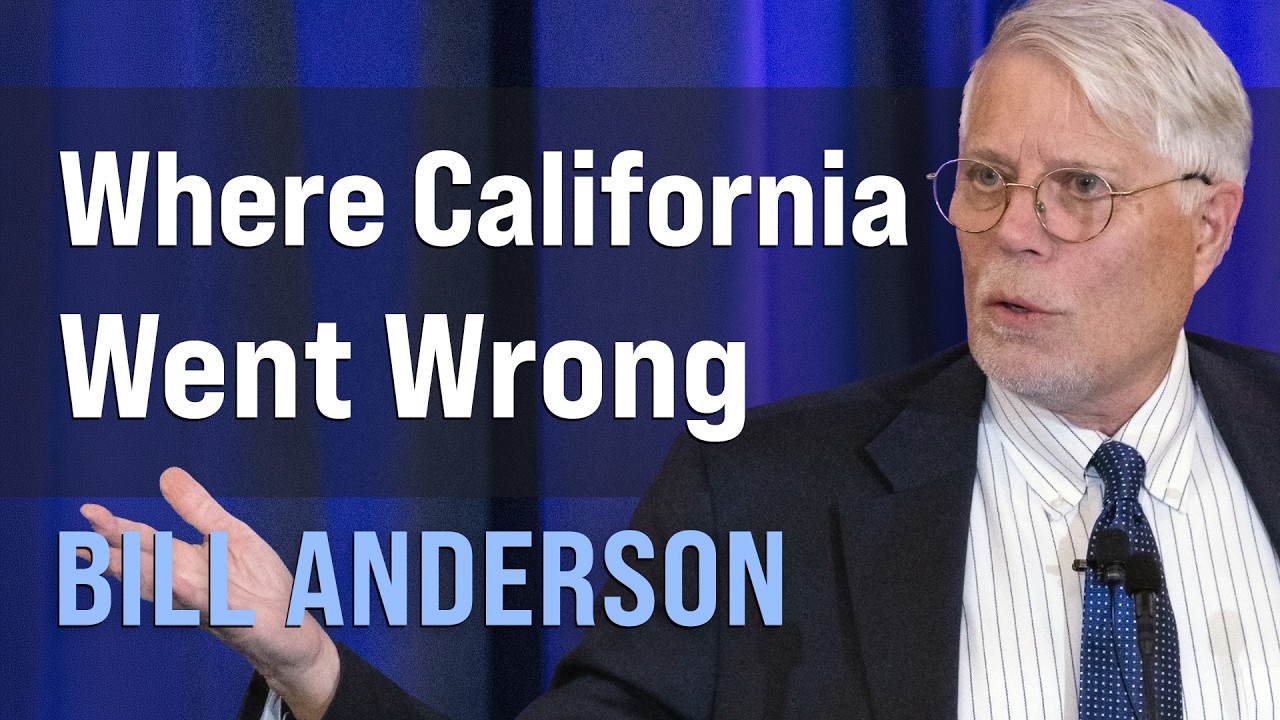
Where California Went Wrong | William Anderson
May 8, 2026
Bill Anderson offers a ground-level view of California's decline, arguing that the state's deep entanglement of government with water, energy, housing, and transportation has created a self-reinforcing system where every new crisis produces more regulation, more spending, and fewer productive citizens. Recorded in San Diego, California, on April 25, 2026.
---
1,216 views May 7, 2026
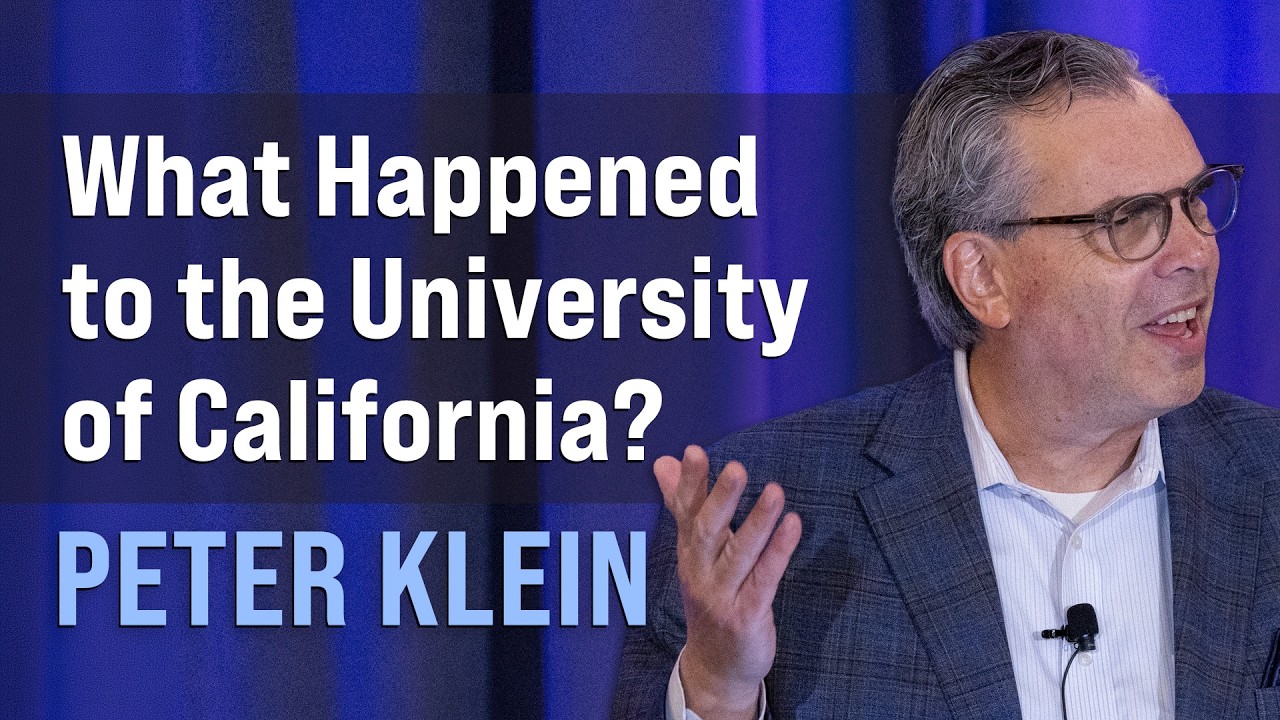
Peter Klein traces the ideological transformation of the UC system from a world-class research institution to a cautionary tale of government-subsidized capture, arguing that the real culprit isn't California's culture but the funding, ownership, and governance structure that insulates universities from market accountability and rewards ideological conformity. Recorded in San Diego, California, on April 25, 2026. The Mises Institute is giving away 100,000 copies of Hayek for the 21st Century. Get your free copy at https://Mises.org/Hayek21Find free books, daily articles, podcasts, lecture series, and everything about the Austrian School of Economics, at https://Mises.org.
---
How Democratic Socialism Created California’s Housing Crisis | Chris Calton
May 7, 2026
Chris Calton links California's housing crisis to three books published in the 1960s that spawned three ideological movements — the democratization of urban planning, the politicization of environmentalism, and the no-growth movement — each of which handed activists and bureaucrats new tools to block development and destroy private property rights one permit hearing at a time. Recorded in San Diego, California, on April 25, 2026. The Mises Institute is giving away 100,000 copies of Hayek for the 21st Century. Get your free copy at https://Mises.org/Hayek21Find free books, daily articles, podcasts, lecture series, and everything about the Austrian School of Economics, at https://Mises.org.
---
an 11 25
Seven states are one flood away from a toxic sludge site spilling into the community.
Mother Jones reported Friday, "Florida, New Jersey, California, Louisiana, New York, Massachusetts, and Texas account for 80 percent" of the sites. "Most of this risk is already locked in."
More than 5,500 toxic sites across the U.S. could face coastal flooding by 2100, threatening to spill contaminants into surrounding neighborhoods within the lifetimes of Generations Alpha and Beta, new research warns.
Scientists at the University of California found that a wide range of hazardous facilities are vulnerable, including sites handling sewage, toxic waste, oil, gas and other pollutants that are not fully protected from sea level rise and severe flooding.
"After examining 23 coastal states and Puerto Rico, scientists found that flood risk is far from evenly distributed. Florida, New Jersey, California, Louisiana, New York, Massachusetts, and Texas account for nearly 80 percent of the hazardous sites expected to be at risk by 2100," the report said.
The project examined 47,600 coastal facilities in the U.S., finding that about 5,500 are at risk of frequent flooding that could send toxic materials into nearby communities.
Current environmental safeguards do little more than delay the danger. Future generations will be forced either to build stronger containment systems that can withstand flooding or face the consequences.
“Restricting greenhouse gas emissions to the low emissions scenario makes little difference in terms of the number of projected sites at risk in the near term (2050) but would reduce the number of at-risk sites from 5,500 to 5,138 (a reduction of 362 or 7 percent of sites) in the long term," the scientists found.
Read the full study at Nature Communications.
---
---
AN 10 25
The 27-page settlement proposal of demands sent by President Donald Trump to UCLA in exchange or $1.2 billion in funding, made public Friday, is being called a "gross federal overreach," according to anew report in Cal Matters.
The document was made public after public after the UCLA Faculty Association and the Council of University of California Faculty Associations sued the public university to disclose the information under the California Public Records Act.
The proposal outlines the administration’s vision for higher education that is free from efforts to promote diversity and transgender inclusion, according to Cal Matters.
While the university system argued that making the proposal public would cause it “irreparable harm” during ongoing negotiations with the Trump administration, it was released after a California superior court judge ordered it to do so, and the state Supreme Court rejected its appeal.
The list of demands was the result of the U.S. Department of Justice in July accusing the university of not doing enough to combat antisemitism during last year’s pro-Palestine protests, and for allegedly violating federal civil rights law.
Governor Gavin Newsom has characterized the fine as “extortion,” and UC President James Milliken said that paying the settlement would “completely devastate” the university system.
So far, Brown University, Dartmouth College, Massachusetts Institute of Technology (MIT), University of Arizona, University of Pennsylvania, University of Southern California (USC) and University of Virginia (UVA) have rejected Trump's compact due to concerns over academic freedom and institutional independence.
"In issuing the demands, the Trump administration initially withheld more than $500 million in research grants to UCLA. But its leverage remains unclear now after a federal judge ordered the administration to restore nearly all those grants in August and September," Cal Matters reports.
Among Trump's demands of UCLA:
*Hire a senior administrator to review UCLA’s policies related to diversity, equity and inclusion efforts, and eliminate “identity-based preferences” in faculty hiring and scholarship programs.
Prohibit the use of “personal statements, diversity narratives, or any applicant reference to racial identity as a means to introduce or justify discrimination” in its admissions process. (A 2023 U.S. Supreme Court ruling already prohibits race-based admissions, though students are free to submit essays that detail how race affected their lives.)
Prohibit the UCLA School of Medicine and its affiliated hospitals from performing gender affirming surgeries or hormone therapy for patients under 18.
Issue a public statement saying that it will comply with Trump’s executive order that recognizes male and female as the only two sexes.
Ban female transgender student athletes from participating in women’s sports.
Establish a process so that “foreign students likely to engage in anti-Western, anti-American, or antisemitic disruptions or harassment” are not admitted to UCLA. (That seems to be at odds with the letter’s goal of protecting UCLA “faculty and students from retaliation for expressing minority opinions or engaging in free expression.”)
Develop training materials to “socialize international students to the norms of a campus dedicated to free inquiry and open debate.”*
Cal Matters notes that some of these, including the elimination of diversity statements in faculty hiring and banning overnight demonstrations, are already UC policy.
In regards to the Trump administration's use of "antisemitism" as an impetus for these demands, over 600 Jewish students, faculty and alumni publicly opposed the settlement in an open letter published in August titled, "Jews in defense of UC."
The UCLA Faculty Association agrees.
“It is not just today’s students and workers who will be harmed by this gross federal overreach — but generations of Californians," said association president Anna Markowitz.
---
---
AN 9 25
The Los Angeles Times has reviewed a previously unreleased 28-page letter from the Trump administration to UCLA demanding an overhaul to adhere to a more conservative agenda and it's littered with grammatical and factual errors.
These demands, which include $1.2 billion fine over allegations of antisemitism and civil rights violations, also calls on the California university "to make public declarations that it has agreed to significant elements of President Trump’s vision of higher education."
The president, who has previously said he "loves the poorly educated," doubled down on that sentiment Sunday, saying, "smart people don't like me."
READ MORE:UK TV to air entire night dedicated to Trump's 'untruths' and 'distortions' ahead of visit
Adding fuel to that fire is the UCLA document, which, the LAT reports, "shows signs of being hastily put together."
Some of the more egregious errors besides the grammatical ones in which "nouns and verbs occasionally do not match in tense," are more factual, or, rather, lack thereof.
"There are references to the “president” of UCLA, but the top campus administrator, Julio Frenk, is a “chancellor," the LAT notes.
"A sentence about medical facilities references the “Feinberg School of Medicine,” which is at Northwestern University", not UCLA.
This isn't the first time the administration has shown why grammar and fact-checking matter.
In letters posted to his Truth Social account in July demanding world leaders sign on to his tariffs, Trump made an embarrassing error, according to the Daily Beast.
" Despite correctly referring to Željka Cvijanović, the Chairwoman of the Presidency of Bosnia and Herzegovina as “Her Excellency,” the letter to her begins with “Dear Mr President.”
In another Truth Social post in which he thanked the B-2 pilots who took part in the attack on Iran, Trump, in all caps, misspelled his own name as, " “DONAKD J. TRUMP, PRESIDENT OF THE UNITED STATES!”
More concerning that garden variety typos, however, is what The Guardiancalls "governing by mistake."
"Have we ever seen a more error-prone, incompetent and fumbling presidency? In their rush to implement a barely concealed authoritarian agenda, this administration is producing a litany of blunders, gaffes and slip-ups. At times, they’ll seek to hide those mistakes by projecting a shield of authoritarianism. At other times, they’ll claim the mistake as a method of walking back an unpopular authoritarian agenda item. Either way, it’s a unique style of rule, one that I call “rule by error," says The Guardian'sMoustafa Bayoumi.
---
---
Trump escalates confrontation with Harvard by moving to cut all federal ties; University of California next in crosshairs as McMahon issues warning to higher education.
Harvard University held its commencement this week under a ‘cloud of fear and uncertainty’ following new attacks from the Trump Administration. After last week’s legal setback in the Administration’s attempt to purge Harvard of international students, Trump stepped up his confrontation with the Ivy League university this week by directing federal agencies to cancel all contracts with the institution, totaling around $100 million. The State Department also announced this week that it will be reviewing all Harvard-affiliated visa holders, not just students but also visiting scholars, faculty, and all foreign nationals working at the institution. In a court filing this week, Harvard’s counsel warned that some international students were afraid of attending commencement due to deportation threats. On Monday, May 26, Trump announced on Truth Social that he is considering taking $3 billion of grant money awarded to Harvard for scientific and engineering research and redirecting it to trade schools. During an interview with CNBC on Wednesday, May 28, Secretary of Education Linda McMahon stated that “Universities should continue to be able to do research as long as they’re abiding by the laws and are in sync, I think, with the administration and what the administration is trying to accomplish.” This week, the Department of Justice announced that it would extend its ‘antisemitism probe’ beyond the Ivy League, targeting the 10-campus University of California system; task force leader Leo Terrell warned that the UC system should expect “massive lawsuits” and that other universities “on the East Coast, the West Coast, and the Midwest” could be similarly targeted. Jason Stanley, a fascism scholar who left Yale for Canada in March over Trump policies, said in a new interview with MSNBC this week that Trump’s attacks on the ‘crown jewel’ of U.S. higher education will ‘go from bad to worse’ and that ‘all dictators smash universities’. The Atlantic considers the attack on universities in the context of Trump Administration’s other cuts in public health, science, libraries and arts as an ‘attack on knowledge itself’ threatening to plunge the U.S. into a ‘new dark age’.
---
Big news in one of the six lawsuits Public Citizen has filed so far against the Trump regime.
We’re so busy suing Trump that we haven’t even had time to tell you much about this particular case.
Here are the basics:
- In order to apply for and participate in federal financial aid programs, students must submit sensitive personal information to the Department of Education and authorize the Department to access their tax records.
- The Department of Education retains this information for millions of current and former students and their family members.
- Under the federal Privacy Act, the Internal Revenue Code, and the Department of Education’s own regulations, access to these records is strictly controlled, and these records may be used only for specified purposes.
- Yet Elon Musk’s “DOGE” squad got access to the computer systems that house this data.
- Last Friday, Public Citizen — representing the University of California Student Association, with co-counsel at Student Defense — sued to block “DOGE” from perpetrating this massive, dangerous, and unprecedented invasion of privacy.
- “DOGE” has also infiltrated other federal agencies, including the Treasury Department. After we sued to stop that, the judge restricted “DOGE” access at least until a hearing in two weeks.
On Monday, we asked the judge to issue a temporary restraining order against what “DOGE” is attempting at the Department of Education.
Then — just yesterday afternoon — the judge issued an order restricting “DOGE” access at the Department of Education at least until February 17 while our lawsuit goes forward.
We will be back in court this Friday to make the case that “DOGE” should be locked out of the Department of Education permanently.
---
the hill
the Department of Government Efficiency (DOGE) will be kept out of the Department of Education’s systems until Feb. 17, in an agreement reached in a lawsuit brought by the University of California student government.}:
In a filing Tuesday, the student government and Education Department came to an agreement to keep all DOGE personnel out of the databases in order to obtain an extended briefing and hearing schedule.
U.S. District Judge Randolph Moss, an Obama-era appointee, approved the agreement between the two sides and the first hearing will be on Friday.
The students, represented by Public Citizen, a left-leaning consumer advocacy group, sued the federal agency Friday, arguing that allowing DOGE employees into the department’s database would violate federal privacy law and the Internal Revenue Code.
The Department of Education has sensitive information on millions of Americans and students.
“Defendants’ action granting DOGE-affiliated individuals continuous and ongoing access to that information for an unspecified period of time means that millions of Americans from all walks of life have no assurance that their sensitive information — and that of their parents and/or spouses — will receive the protection that federal law affords,” the lawsuit states.
Trump stopping Penny production; Obama supported initiative. Coin org fights Back
“And because Defendants’ actions and decisions are shrouded in secrecy, individuals do not have even basic information about what personal or financial information Defendants are sharing with outside parties or how their information is being used,” it continues.
By signing up, I agree to the Terms of Use, have reviewed the Privacy Policy, and to receive personalized offers and communications via email, on-site notifications, and targeted advertising using my email address from The Hill, Nexstar Media Inc., and its affiliates
The Hill has reached out to the Department of Education for comment.
The first target since DOGE gained access seems to be the Institute of Education Sciences, which has canceled 169 government contracts. DOGE also posted on social platform X that the Department of Education canceled “89 contracts worth $881mm” and “29 DEI training grants totaling $101mm,” referring to diversity, equity and inclusion (DEI).
Similar deals to keep some DOGE employees out of agencies for a limited time have occurred in other lawsuits against federal departments such as the Treasury Department.
---
---
---
horner cruz comer?:
Jean-Paul P. Cart Antonia I. Stabile Venable LLP 101 California Street, Suite 3800 San Francisco, CA 94111 Email: JPCart@Venable.com AIStabile@Venable.com Attys for Respondent, The Regents of the University of California
HORNER DECLARATION IN SUPPORT OF PETITION DOCS_LA:351773.1 38333/008 1 James K.T. Hunter (State Bar No. 73369) 10100 Santa Monica Boulevard, 13th Floor Los Angeles, California 90067 Telephone: (310) 277-6910 Facsimile: (310) 201-0760 E-mail: jhunter@pszjlaw.com Attorney for Petitioner Energy Policy Advocates SUPERIOR COURT OF THE STATE OF CALIFORNIA FOR THE COUNTY OF LOS ANGELES – CENTRAL DISTRICT ENERGY POLICY ADVOCATES, Petitioner, v. THE REGENTS OF THE UNIVERSITY OF CALIFORNIA, Respondent. ) ) ) ) ) ) ) ) ) ) ) ) ) ) ) Case No. 22STCP03214 DECLARATION OF CHRISTOPHER HORNER IN SUPPORT OF PETITION FOR WRIT Trial Date: December 14, 2023 (Reserved) Time: 9:30 a.m. Place: Dept. 85 Petition filed: August 30, 2022 I, Christopher Horner, declare: INTRODUCTION 1. I make this declaration in support of the Petition for Writ filed by Petitioner Energy Policy Advocates (“EPA”) in the above-captioned proceeding against Respondent The Regents of the University of California (“Regents”). In this Declaration, I address the Regents’ response to the California Public Records Act (“CPRA”) request at issue in this matter dated August 2, 2021 (the “8/2/21 CPRA Request”)1 , and also set forth my opinions based on my experience with open records requests in California and nationwide, particularly as they relate to energy, environmental policy, and the global warming debate
...
- Please describe the nature of UCLA’s Environmental Law Clinic’s work for Sher Edling,
the years during which that assistance was provided, and the specific cases that members of
that clinic worked on. Please also identify any expenses for that work that Sher Edling
reimbursed and any donations the firm or its partners have made to UCLA School of Law
since 2017.
- Please provide a list of every person and entity, excluding clients and vendors, that
provided Sher Edling with any amount of money. For each person or entity listed, please
include the following information: (a) the amount of the money provided; (b) the date the
money was provided; (c) the purpose for which the money was directed to be used; and (d)
the manner in which that money was provided, i.e., through a grant, litigation funding
agreement, or some other contract or agreement. If the funding was provided pursuant to a
written agreement, please provide a copy of that agreement.
Sincerely,
---
Ted Cruz James Comer
Ranking Member Chairman
Committee on Commerce, Science, Committee on Oversight and
and Transportation Accountability
---
https://www.alternet.org/university-california-employ-undocumented-students/
==
ref
Industries Turn Freedom of Information Requests on Their Critics

Image
{Nov. 5, 2018}:
WASHINGTON — Dennis J. Ventry Jr., a law professor at the University of California, Davis, drew the ire of tax preparation companies like Intuit and H&R Block this summer by criticizing a deal they have to provide a free tax filing service through the Internal Revenue Service.
The companies promptly hit back with a tactic that corporations, lobbyists and interest groups are increasingly using against academic researchers: Their trade coalition filed a public records request with the university in July seeking everything Mr. Ventry had written or said about the companies this year, including emails, text messages, voice mail messages and hand-jotted notes.
Theuniversity estimated that it spent 80 to 100 hours complying with the request, filed under the California Public Records Act, which requires employees of any state agency or institution to produce, upon request from any member of the public, any record that relates to “the conduct of the public’s business” that is “prepared, owned, used or retained” by the university.
The request generated 1,189 pages of documents, university officials said. And it was just one example of how both state-level public records laws and the federal Freedom of Information Act, written to ensure transparency and accountability in government, have morphed into potent weapons in legal and business disputes, raising questions about the chilling effects — and costs — they impose on targets who are doing research in controversial or sensitive fields.
A 2017 analysis of requests filed under the Freedom of Information Act found that “public-oriented inquiries by concerned citizens and their advocates” account for “only a small fraction of the 700,000-plus FOIA requests submitted each year,” wrote David Pozen, a law professor at Columbia University, whose paper reviewed studies on the issue. “The bulk of requests come from businesses seeking to further their own commercial interests by learning about competitors, litigation opponents or the regulatory environment.”
Public records requests have long been an important tool for a wide variety of groups, like journalists, political opposition researchers, climate-science skeptics, animal rights advocates and anti-abortion activists keen to dig into research and the work of people in the government.
But the sheer scale of the requests in recent years, and their growing use by advocacy groups and business interests to challenge academic work at public universities, has alarmed some experts, who say the commitment to openness embodied by freedom of information laws could be tested.
The weaponization of such requests poses “a real danger that we’ll hit a tipping point, where the cost and burden of open records laws will overcome the benefits and we’ll have a retrenchment of transparency rights,” said Margaret Kwoka, a University of Denver professor with expertise in government transparency litigation. “This kind of abuse fuels the political will to do that.”
The University of California system, with nearly 45,000 faculty and academic appointees on its campuses and in its laboratories and medical centers, sits at the center of this trend.
In 2009, the system received a total of 3,266 public records requests. In 2017, it received 16,921, an increase of 418 percent.
A significant portion of the requests are from activists and industry groups “using public records requests as one part of a strategy to undermine the work of researchers in controversial fields,” Maria Shanle, managing counsel for education affairs and governance at the University of California, said in an interview.
These have included a 2011 request for every document a visiting scholar produced related to “chemical substances, includingflame retardants”; a 2012 demand by an anti-abortiongroup for the names of researchers working on an abortion safety study; and a 2015 request for every email to and from a journalism professor that contained words like “biotech” and “Monsanto.”
:{:{}:
}:

Image
“What we need is a dividing line between financial and ministerial accountability, and the university’s function as an intellectual and teaching institution,” Claudia Polsky, an assistant law professor who directs the Environmental Law Clinic at the University of California in Berkeley, said in an interview.
In a paper titled “Open Records, Shuttered Labs: Ending Political Harassment of Public University Researchers,” Ms. Polsky argued for legislative protections, already offered in some states, for unpublished emails and other personal records that can be used to stymie research.
“Digging into professors’ email inboxes has nothing to do with democratic accountability or fiscal transparency,” she said, “and everything to do with creating ideologically based mischief.”
:{:{}:
}:
In Mr. Ventry’s case, he said he did not have anything to hide — he has been a critic of the tax preparation program, Free File, and an outspoken advocate for no-cost, simplified, government-provided tax preparation for years. But he said that the request had made collaborators in his research wary of communicating with him and amounted to intimidation by the industry.
“They are trying to bully me,” Mr. Ventry said of the industry group. “More importantly, they are trying to chill my research and scholarship, whether it has to do with tax law reform or not.”
The industry group, the Free File Alliance, whose legal name is Free File Inc., defended the request as a proper use of public records law.
Mr. Ventry, the group said, had a conflict of interest because he also serves as the chairman of an outside advisory group to the I.R.S. and was intent on promoting an alternative plan under which the government would offer its own tax preparation service through the I.R.S. The alliance defends its program as benefiting low- and middle-income Americans who would otherwise have to pay for tax preparation services.
Freedom of information requests “are a legitimate, legal method to determine what public officials are doing and saying in their official capacity,” the alliance said in an emailed statement. “Professor Ventry holds a strong preconceived bias against the I.R.S. Free File program.”
Mr. Ventry is not employed by the I.R.S. He is the chairman of the Internal Revenue Service Advisory Council, a public forum on tax administration issues that advises the I.R.S. commissioner and is composed of outside experts who volunteer their time. He was a published critic of Free File for years before joining the council.
Mr. Ventry; Joseph Bankman, a tax law professor at Stanford University; and others have worked over the years to create a model for free tax-filing programs administered by a half-dozen states, while advocating a free, streamlined federal e-filing system.
:{:{}:
}:
In July, Mr. Ventry, Mr. Bankman and other colleagues wrote op-eds taking aim at Free File, which the I.R.S. offers to many taxpayers through an agreement with the Free File Alliance, which includes Intuit, makers of TurboTax and other software; H&R Block; and 10 additional commercial tax preparation companies.
After the House passed a bill that included a provision making the Free File agreement permanent, the academics raised alarms. Citing research, I.R.S. statistics and investigations by ProPublica, The Wall Street Journal and others, Mr. Ventry wrote that Free File is a “failed program” that “inflicts substantial harm on taxpayers” by confusing them, pushing them toward paid products and failing to fully protect their personal data.
The companies in the Free File program are not compensated by the I.R.S. for providing their services. But ending the program and replacing it with a government-run electronic filing service for all taxpayers would threaten the industry.
:{:{}:
}:

Image
In a July opinion piece in The Hill titled “Free File Providers Scam Taxpayers; Congress Shouldn’t Be Fooled,” Mr. Ventry originally included his affiliation as chairman of the tax agency’s advisory council as well as his academic post. (After a complaint from the industry group, he removed the affiliation to the council.)
In a subsequent commentary, the academics criticized the I.R.S. for poor oversight of the industry agreement, saying that Free File “puts tax preparation companies first and taxpayers last.” Some of the criticism echoed the I.R.S.’s independent taxpayer advocate, Nina E. Olson, who said in an interview that Free File was a “poorly designed” program that only 3 percent of eligible taxpayers used after 15 years in existence.
Days later, the University of California received the request for all of Mr. Ventry’s communications about the op-eds, including his contacts with the I.R.S. taxpayer advocate’s office.
In addition to its public records requests, the alliance wrote directly to the I.R.S. about Mr. Ventry in July, saying he “improperly used his I.R.S. affiliation to lend credibility to this attack.” The alliance questioned whether Mr. Ventry should be able to speak out publicly on the issue given his role on the I.R.S. advisory council.
Mr. Ventry said that role was strictly advisory and that he received no compensation aside from his university salary. After the industry alliance leveled the complaint, he says he voluntarily recused himself from the council’s analysis of the Free File program, due out in November.
Responding to the academics’ criticism in a letter to the editor published in the policy journal Tax Notes, Tim Hugo, a Republican member of the Virginia House of Delegates who serves as the alliance’s executive director, wrote that the partnership between the I.R.S. and Free File had saved taxpayers “an estimated $1.6 billion in tax preparation and filing fees” since its inception in 2003.
The program was under attack, he wrote, “by a handful of ideologues” who “want a centralized system of direct government tax preparation.”
Representatives for Intuit and H&R Block said the companies did not participate in the records requests by the industry group, but the alliance confirmed that the member companies received the documents produced by the university.
Stanford is a private institution not subject to public records requests under the California law, but the alliance’s lawyers used the University of California request to obtain Mr. Ventry’s communications with Mr. Bankman, too.
“There’s nothing really that interesting in my emails,” Mr. Bankman said in an interview. But worries about such requests, he said, stifle the peer review process, a freewheeling exchange of views, often by email, in which academics around the world evaluate one another’s work.
Companies often request such emails “to intimidate people like us, because it really raises the ante and makes it very scary just to email stuff,” he added. For the industry, “it’s a freebie,” he said. “But imagine you’re some young professor somewhere — you don’t know what hit you.”
Mr. Ventry said he was more worried that Mr. Bankman and other colleagues would shy away from collaborating with him.
“We went from emailing multiple times a day over the course of a couple months to not emailing at all,” he said. The request “stifled not just academic freedom but the deliberative and beneficial process of thinking through problems with others.”
If that constitutes winning for the tax industry, he said, “they won.”
---
==
University of California CRISPR researchers form drug discovery alliance with pharma giant
BY JON COHENJUN. 13, 2019
==
scandal bribe
https://www.latimes.com/politics/la-pol-ca-college-admissions-scandal-california-legislature-20190319-story.html
==
https://www.alternet.org/news-amp-politics/steve-mnuchin-heckled-ucla-students
Treasury Secretary and former Goldman Sachs banker Steve Mnuchin isn't accustomed to facing direct challenges to his wild economic claims or protests over the GOP tax plan he helped craft, and after experiencing both during an event at UCLA's Burkle Center on Monday, Mnuchin demanded that video of his appearance be suppressed.
According to the Wall Street Journal, Mnuchin complained to the audience that he usually only talks to "people who wanna listen to me speak" after students yelled out "I think you're full of shit" and denounced the Republican tax bill as an attack on "people who are in poverty."
After noting that it was his first time speaking at a university, an increasingly "agitated" Mnuchin "stopped the conversation several times, asking the hecklers either to identify themselves or explain what they were protesting," the Journalreported on Wednesday.
UCLA initially planned to post a full video of the event to its website later this week, but a university spokeswoman told the Journal that Mnuchin "retracted his permission for the Burkle Center to post its video and podcast of yesterday’s event on its website."
But thanks to students and reporters who were in attendance, a few short videos of the event ultimately emerged on social media.
"Steve Mnuchin being called on his plutocratic BS at UCLA," student Jacob Woocher wrote on Twitter, attaching a short video of a protester yelling at Mnuchin for working to take Americans' healthcare. "Enemy of the people! Foreclosed on 36,000 people and helped pass the biggest corporate tax cut in history."
Watch:
==
==
After the Enron scandal, Gramm and the other directors of the energy company were named in several investor lawsuits, many of which have been settled. In particular,Gramm and other Enron directors agreed to a 168 million dollar settlement in a suit led by the University of California. As part of that settlement, the directors agreed to collectively pay $13 million to settle claims of insider trading. The remainder of the settlement was to be paid by insurance.
==
mixed record: plus oreskes (--> harv?)
did not support hayes?
enstrom
Entine
==
http://articles.latimes.com/2011/sep/29/local/la-me-0929-irvine-eleven-evidence-20110929
ange County Dist. Atty. Tony Rackauckas on Wednesday released emails and court documents used in the trial to convict 10 Muslim students on criminal charges of disrupting a speech.
The so-called Irvine 11 were each convicted of two misdemeanors Fridayfor disrupting aUC Irvine event featuring Israeli Ambassador Michael Oren in February 2010.
The students face fines, probation and 56 hours of community service. Defense attorneys say they will appeal. Charges against an 11th defendant were dropped pending completion of community service.
The evidence includes two videos from the event, multiple email chains from the students who planned the disruption and minutes from meetings of the Muslim Student Union, an organization that has denied planning the protest but whose members were involved.

One email from a student summarizing the event said, "It is our duty to show the people who are going to listen that this man is a war criminal, and we will not allow a platform for him to spread lies on our campus, whether it be at UCI or any other campus around the nation."
In May, Orange County Superior Court Judge Peter J. Wilson issued a gag order preventing anyone involved from talking about the case publicly.
Dist. Atty. spokeswoman Susan Kang Schroeder said the office was unable to respond to criticism contending racism and religious bias because of the gag order.
"We felt it was important for the public to examine it for themselves," she said.
She said she felt that the defense supporters acted in an intimidating manner during the trial and that the students on trial were defiant after the verdict.
"They've shown absolutely no remorse for the fact that they committed a crime," she said.
Jacqueline Goodman, one of the defense attorneys in the case, said it'srare to devote so much energy to a misdemeanor, especially after a conviction. She added that the D.A.'s office is publicizing only a small portion of the evidence, which included thousands of pages of documents.
"They are only releasing the ones that look bad," she said.
nicole.santacruz@latimes.com
==
a Santa Ana courtroom Monday, closing arguments will be heard in a case involving Muslim students and the right to free speech. But the so-called Irvine 11 trial, the issues of which are deeply rooted at UC Irvine, has not quite resonated on campus -- yet.
The jury's verdict is what could matter, said David Snow, co-director of the school's Center for Citizen Peacebuilding, a group that promotes reconciliation. "The hammer hasn't really fallen yet."
There is no doubt that the shouting down of Israeli Ambassador Michael Oren by students at UC Irvine last year was raucous and reignited Israeli-Arab tensions on campus. The defense says the students had the right to yell in protest. Prosecutors say the students went too far.
Aminah Galal, a UC Irvine senior involved with the Muslim Student Union, the campus group that organized the protest, is preparing for the fall quarter, which begins Thursday. She expects the Irvine 11 trial will have a chilling effect on free speech, no matter the outcome.
For The Record
Los Angeles Times Wednesday, September 21, 2011 Home Edition Main News Part A Page 4 News Desk 2 inches; 91 words Type of Material: Correction
Irvine 11 trial: In the LATExtra section on Sept. 19, an article about the Irvine 11 case said that the UC Irvine Muslim Student Union was suspended for a year. The group was originally suspended for a year, but upon appeal, the sanction was reduced to a quarter and 100 hours of community service. The group remains on probation through Dec. 31, 2012. The story also said that the group planned the protest. Though the university punished the group as a whole, members have denied planning the protest as a group.
The case creates a "fear of student activism," she said. "Now, students think twice" about something that she considers a valuable aspect of campus life.
It was on Feb. 8 of last year when Oren, at the invitation of several UC Irvine organizations and academic departments, came to give a speech about U.S.-Israeli relations. One student after another stood and shouted at the stage, accusing Israel of oppressing Palestinians.
"Michael Oren, propagating murder is not an expression of free speech," one student said.
"You, sir, are an accomplice to genocide," another yelled.
In the end, there were 10 interruptions and a shortened speech. The protesters were peacefully escorted out by police, and 11 were cited for disrupting a public event.
UC Irvine quickly punished the Muslim Student Union, suspending it for a year and placing it on disciplinary probation for another year.
Then, seven months ago, the Orange County district attorney's office filed criminal charges.
The students, seven of them from UC Irvine and three from UC Riverside, are each charged with a misdemeanor forconspiring to disrupt Oren's speech and a misdemeanor for disrupting his speech. Charges against an 11th defendant were dropped pending completion of community service.
The students face up to six months in jail if convicted.
A gag order imposed by Superior Court Judge Peter Wilson prevented those involved in the trial from being interviewed. But the day charges were filed,Dist. Atty. Tony Rackauckas released a statement in which he said, "We must decide if we are a country of laws or a country of anarchy."
Erwin Chemerinsky, the dean of UC Irvine's law school, has said that "freedom of speech never has been regarded as an absolute right to speak out at any time and in any manner," but he made clear in an interview last week that university sanctions were enough.
"It makes no sense here to use these resources," he said of Rackauckas' decision. "It's so minor."
Don Will, director of the peace studies program at Chapman University, agreed and said the trial only makes the Muslim community feel "victimized."
"There's a political component by the D.A.'s office," he said. "This is not some serious crime. Protests are protests."
About 100 UC Irvine faculty members, including five deans, asked Rackauckas to drop the charges. A group of faculty members from across the UC system, many of whom teach Jewish studies, did the same.
UC Irvine is no stranger to the Israeli-Arab conflict. Authors Norman Finkelstein, who wrote "The Holocaust Industry," and Alan Dershowitz, who wrote "The Case for Israel," have spoken on campus, but each proved to "generate more heat than light," Will said.

One speech that surfaced in the Irvine 11 testimony involved Amir Abdel Malik Ali, an Islamic activist who in 2001 visited UC Irvine to preach what many saw as anti-Semitism. He was interrupted by students in much the same way Oren was. Malik Ali returned in 2006 amid more protests. No prosecutions resulted either time.
There were other incidents as well. In 2003, a Holocaust memorial was vandalized. The next year, an anti-Zionist mural by the Society of Arab Students was burned down. No arrests were made in either case. In 2006, UC Irvine housing was defaced by a swastika and profanity. Last May, after posters on campus equated the Star of David with a swastika, dozens of outraged UC Irvine faculty members issued a call for civility.
Snow, however, said things were better on campus and cited the Olive Tree Initiative, which sends students of different faiths to the Middle East to explore peaceful resolution.
At UC Irvine on Friday, the campus bookstore was busy as students prepared for the next quarter. Edith Ruiz, 24, said that only those directly involved in the debate were following the trial. "I had completely forgotten about it," she said.
Ryan Jenner, president of the campus group Anteaters for Israel, said any changes in campus climate would have come when the district attorney pressed charges. So far, the case hasn't influenced programming for the group.
"Jewish student life is unaffected by this case whatsoever," Jenner, 20, said. "We continue to thrive and grow as a community."
Outside court last Thursday, Erum Siddiqui, 19, a UC Irvine sophomore, said the Irvine 11 case is about human rights.
==
http://articles.latimes.com/2011/feb/05/local/la-me-0205-uci-protesters-20110205
Orange County district attorney's office charged 11 students on Friday with conspiring to disrupt a meeting and speech at UC Irvine last year by the Israeli ambassador to the United States.
In a statement, Dist. Atty. Tony Rackauckas said charges were filed because of an "organized attempt to squelch the speaker." He said the students "meant to stop this speech and stop anyone else from hearing his ideas, and they did so by disrupting a lawful meeting."
"We must decide whether we are a country of laws or a country of anarchy," Rackauckas said. "We cannot tolerate a preplanned violation of the law, even if the crime takes place on a school campus and even if the defendants are college students. In our democratic society, we cannot tolerate a deliberate, organized, repetitive and collective effort to significantly disrupt a speaker who hundreds assembled to hear."
The Muslim Student Union at UC Irvine has denied planning to obstruct the event on Feb. 8, 2010. The so-called Irvine 11 are accused of disrupting a speech by Michael Oren, the Israeli ambassador to the U.S. Oren was shouted down repeatedly, and supporters cheered as students were escorted away by police. About 500 to 700 people attended the meeting, authorities said.

The Muslim Student Union was suspended by the university last year, and those involved in the disruptions were also disciplined by the university. It was one of the few recent instances in which the school recommended the ban of a student group for an action other than hazing or alcohol abuse. The incident and its aftermath sparked wide debate about free speech on campus.
Rackauckas' decision was announced just days after about 50 protesters rallied Tuesday in front of his office against possible charges. Though some inside and outside UC Irvine have criticized the students' method of protest, many said university sanctions were sufficient punishment.
Erwin Chemerinsky, dean of UC Irvine's law school, said that he didn't think criminal charges were warranted and that he hopes the charges can be dealt with simply.
"I think that university discipline was sufficient," he said.
The defendants are accused of meeting with other members of the Muslim Student Union six days before the event to discuss options to respond to Oren's speech.
According to prosecutors, students circulated e-mails and held multiple meetings to plan the disruption. Mohamed Mohy-Eldeen Abdelgany, 23, a defendant in the case and the president of the Muslim Student Union at the time, is accused of sending an e-mail Feb. 3 to the organization's message board announcing: "We will be staging a University of Chicago Style disruption of the Ambassador's speech."
Abdelgany is accused of sending an e-mail on Feb. 7 to the same message board advising "nondisruptors" to cheer after each "disruptor" finished.
The other defendants are Khalid Bahgat Akari, 19; Aslam Abbasi Akhtar, 23; Joseph Tamim Haider, 23; Taher Mutaz Herzallah, 21; Hakim Nasreddine Kebir, 20; Shaheen Waleed Nassar, 21; Mohammad Uns Qureashi, 19; Ali Mohammad Sayeed, 23; Osama Ahmen Shabaik, 22; and Asaad Mohamedidris Traina, 19.
Jesse Rosenblum, president of the Zionist Organization of America's Orange County chapter, said he attended the event and called the students "unruly."
"It is only appropriate that violations of our valuable 1st Amendment protections should be prosecuted," he said in a statement.
Eight of the defendants are students at UC Irvine; the other three were students at UC Riverside. Each is charged with one misdemeanor count of conspiracy to disturb a meeting and one misdemeanor count of disturbance of the meeting. If convicted, they face possible fines, probation, community service or jail time.
Jacqueline Goodman, a criminal defense attorney representing some of the students, said Rackauckas' actions are "dangerous to a democracy."
"The last thing we want to do is inhibit the free exchange of ideas, and that's the only thing that prosecuting these students can achieve," she said.
The students will be arraigned March 11 in Santa Ana. Goodman said late Friday that all 11 plan to plead not guilty.
nicole.santacruz@latimes.com
==
http://articles.latimes.com/2010/jun/15/local/la-me-0615-uci-muslim-20100615
Irvine officials have recommended the suspension of the university's Muslim student group whose members disrupted a speech by the Israeli ambassador earlier this year, heightening a debate about free speech that has roiled the campus.
The decision appears to be the first in recent memory at UC recommending the ban of a student group for something other than hazing or alcohol abuse.
In making the suspension recommendation, Lisa Cornish, UC Irvine's director of student housing, found that the Muslim Student Union had "planned, orchestrated and coordinated in advance" an effort to disrupt a speech by Israeli Ambassador Michael Oren on Feb. 8 about U.S.-Israeli relations. The recommendation was made in late May but not made public at that time.
Oren was shouted down repeatedly by Muslim students who stood up and delivered statements such as "Michael Oren, propagating murder is not an expression of free speech." Supporters cheered as the students were escorted away by police, and each time Oren attempted to resume his speech, another student jumped up with another outburst.

Eleven UC Irvine and UC Riverside students were arrested and cited for disturbing a public event, but none have been criminally charged. The Muslim Student Union claimed the disruptions were caused by individuals and were not organized by their group.
In a report detailing the findings of its investigation, Cornish cited e-mails between members of the student union and detailed minutes from a Feb. 3 meeting.
According to the report, the group's goal was to "send the speaker a message" and to develop a "game plan" to disrupt Oren's speech.
The plan included identifying students willing to participate, drafting scripted statements and urging supporters to attend and cheer each disruption. The plan also instructed students to deny that the Muslim Student Union organized the protest, according to the report.
The group violated university policies prohibiting "fabricating information (or) furnishing false information," "obstruction or disruption of teaching, research, administration … or other University activities," "disorderly or lewd conduct" and "participation in a disturbance of the peace or unlawful assembly," according to the report.
Along with a one-year suspension, which would begin in September, the report requires members of the student union to complete 50 hours of community service. If the group is suspended, its current officers could not act as "authorized signers" for any other student organization.
UC President Mark G. Yudof said Monday he had no role in the decision to recommend the suspension, although he was told of the decision a few days ago, according to Lynn Tierney, the UC system's associate vice president for communications.
"It was a process handled completely locally," Tierney said.
Erwin Chemerinsky, dean of UC Irvine's law school, said the ban was appropriate punishment and stressed it stemmed not from the students' speech but for misrepresenting their role in the incident. "Given the seriousness of the offense, I think it's completely appropriate to suspend them for a year," he said.
Reem Salahi, the students' attorney, described the suspension recommendation as "excessive" and "draconian." She said it is not final and that her clients have appealed the decision.
UC Irvine has long been a flashpoint of tensions between Muslim and Jewish groups. In 2005, the U.S. Department of Education's Office of Civil Rights investigated whether the university discriminated against Jews. That probe found that although Muslim students had engaged in offensive behavior, their actions stemmed from opposition to the policies of Israel rather than to Jewish students themselves.

Monday, Jewish groups praised the recommended ban of the student union and called it a victory against hate speech. Muslim activists said the suspension amounts to "collective punishment" that targets a whole group for the actions of a few.
Salahi said she worried the recommendation could jeopardize Muslim life on campus. Victor Sanchez, president of the systemwide UC Student Assn., said he was outraged. "It's almost impossible not to interpret this as a means of the university to silence dissent," he said.
Isaac Yerushalmi, former president of Anteaters for Israel, which sponsored Oren's appearance in February, said the Muslim Student Union has been "involved in repeated attempts to silence Jewish voices on campus."
Israeli Consul General Jacob Dayan, who was with the Israeli ambassador during his speech, accused the Muslim Student Union of "spreading hate" and stifling "free discussion and open debate."
Mark Petracca, a UC Irvine professor who helped sponsor Oren's address and who tried to quell the disruptions by urging Muslim students to respect their guest, said after the speech that he received e-mails from around the world, including one from a friend alerting him that the controversy had made the news in Tel Aviv.
After the Oren incident, the New York-based Zionist Organization of America urged college-bound students, as well as financial donors, to avoid UCI as a campus that permitted bigotry.
Jewish groups cite several incidents of perceived anti-Semitism on campus, including the defacing of an Israeli flag in a dorm room, the display of a poster equating the Star of David with a swastika, the vandalizing of a Holocaust memorial, and a 2006 program sponsored by the Muslim Student Union titled "Holocaust in the Holy Land" and "Israel: The Fourth Reich."
raja.abdulrahim@latimes.com
christopher.goffard@latimes.com
larry.gordon@latimes.com
Anna Gorman and Tony Barboza contributed to this report.
==
aug 2014
The California State Senate confirmed four nominees for the University of California’s Board of Regents Friday, despite student and faculty concerns about the appointment process and the nominees’ qualifications.
With a 29–3 vote, the senate confirmed existing regents Richard Blum and Norman Pattiz to another 12-year term on the board. Richard Sherman, who joined the board in March, was also confirmed with the same vote. Regent Monica Lozano, who completed a 12-year term in 2013, was confirmed in a separate 31–0 vote.
The confirmed board members all have a background in business. Blum is the chairman of his own business firm named Blum Capital Partners and Sherman is a chief executive at the David Geffen Company, an investment management firm.
Lozano is chair of U.S. Hispanic Media, Inc., which includes numerous Hispanic media companies, and Pattiz is a founder of radio network Westwood One and CEO of Courtside Entertainment Group, a sports and entertainment marketing business.
The confirmation came after a tense hearing by the Senate Rules Committee on Wednesday, in which students and faculty voiced their opposition to nominees because of concerns about the appointment process.
Before appointing an individual to the UC Board of Regents, the California constitution requires the governor to consult a 12-member advisory committee composed of leaders from the state legislature and four members of the UC, including one student and one faculty member. After the governor chooses appointments for the regents board, the state senate must confirm them. Despite the rule, there is no mechanism to ensure that a governor consults the advisory group, Senate Rules Committee members said in emails sent after the hearing.
Evan Westrup, spokesman for Gov. Jerry Brown, said in an email that Brown consulted the advisory committee more than six months before the confirmation hearing. Brown announced his appointments in mid-January, about seven months before the confirmation.
But in a letter sent to senators prior to the hearing on Wednesday, the Council of University of California Faculty Associations said it does not think Brown adequately consulted with the committee before the appointments.
Joe Kiskis, vice president for external relations for the council and a physics professor at UC Davis, said he thinks the confirmation shows that legislators pay little attention to the voices of students and faculty.
“(Politicians) are expecting that if (the) regents are confirmed again, they will act differently,” Kiskis said.
At the hearing, students, faculty and some legislators were unhappy that all the nominees had backgrounds in business, saying they are not representative of California’s population.
“We need business leaders in the board, but not exclusively,” California Senate President Pro Tem Darrell Steinberg said at the hearing.
More than 85 percent of currently appointed regents are former or current business executives.
Kevin Sabo, chair of the UC Student Association Board of Directors and a UC Berkeley student, said the nominees are of the “business elite,” with many who have contributed to Brown’s campaign for governor. Sabo said he thinks regents should come from more diverse backgrounds.
According to an L.A. Times article published in January, Sherman has donated $7,500 to Brown since 2009, while Blum donated $51,800 and Pattiz donated $15,000 to Brown in the same time period.
“We need more people who reflect the population of California, not just the 1 percent of the state,” Sabo said.
Lozano said while she would like to see a more diverse regents board, the board already brings diverse perspectives by having a sitting student regent as well as having student advocates and Academic Senate members speak at the board’s bimonthly meetings.
Students said they think that the three of four regent nominees who already served a term have not led the University effectively.
“They had 12 years to discuss diversity and outreach … but there has been no action,” said Jefferson Kuoch-Seng, UCSA president and an external vice president of the Associated Students of UC Merced. “In 12 years, nothing has changed.”
On Wednesday, nominees also addressed questions from legislators related to the UC’s ad
===
http://www.fossilfreeuc.org/
Contacts:
Spokesperson: Celeste Argueta, 559-901-1328, celiarg@sbcglobal.net
Spokesperson: Cassie Macy, 714-813-5437, cassiemacyy@gmail.com
Media coordinator: Emily Williams, 408-318-4356, emilylynnwilliams@gmail.com
UC Santa Barbara’s Chancellor Yang Becomes First UC Chancellor to Call for UC’s Divestment from Fossil Fuels
Student Sit-In Results in Bold Action on Eve of Next UC Regent’s Meeting
SANTA BARBARA, Ca.- May 11 at noon in Cheadle Hall, the UCSB campus administration building, Vice Chancellor of Student Affairs Margaret Klawunn issued a statement on behalf of Chancellor Henry T. Yang both endorsing the fossil fuel divestment campaign, Fossil Free UC, and pledging to collaborate on the issue with fellow chancellors across the UC system. The public endorsement comes after 350 students maintained a 3 day sit-in inside the administration building, with the endorsement by over 25 faculty members of the action, calling upon UC Regent Richard Sherman to divest the university’s $2.8 billion currently invested in fossil fuel companies. The endorsement is the first of its kind from a UC chancellor on the issue of fossil fuel divestment and students expect it will help push the UC towards accomplishing the campaign’s goal of full divestment from the fossil fuel industry.
The chancellor’s full statement said the following: “I stand by our students who have been sitting in calling for fossil fuel divestment this past week and support their aims. I furthermore wish to acknowledge the professors and staff at this campus and across the University who deeply care about the moral, political, economic, and scientific imperative of moving away from fossil fuel dependency. Finally, I am pleased to support the incredible efforts the UC has already made toward tackling climate change and providing leadership and solutions that we will all depend on. In the coming week, I look forward to working with my fellow chancellors in support of a thorough and transparent discussion on divestment from fossil fuels as part of the UC’s approach to combating the climate crisis.”
Fossil Free UCSB spokeswoman and UCSB first year, Celeste Argueta, said “Chancellor Yang’s endorsement of our campaign is a historic victory for all the students who have taken part in the sit in and for the UCSB student community more broadly, making it clear that our campus will stand on the right side of history. Remaining neutral is simply not an option, it is high time Regent Sherman joined us too.” Richard Sherman chairs the UC’s investment committee.
On Monday, May 8, 38 UCSB students walked into Cheadle Hall and began a sit-in to pressure UC Regent Sherman and the broader UC Board of Regents. Over the following three days, Chancellor Yang met with campaign negotiators and together they agreed on the terms of endorsement. Students at UCSB have been campaigning on fossil fuel divestment since 2012 and the Fossil Free UCSB group is part of a larger coalition of students across the UC. The campaigns at UC Davis and UC Berkeley held similar sit ins last week. The rolling sit ins come during a wave of global action for fossil fuel divestment.
UCSB political science major and fossil free campaigner, Cassie Macy, said “Students showed up and showed their power this week because the fossil fuel industry intends to burn five times more coal, oil, and gas than is safe for a stable climate. Eighty percent of fossil fuels must remain below ground to avoid climate catastrophe but the UC continues to invest in companies whose business plan depends upon destabilizing the future safety and security of its students.” These numbers have motivated Fossil Free campaigns across the globe and led them to point to the 200 most polluting fossil fuel companies as those most responsible for climate change and pollution linked to cancers and respiratory diseases that impact society’s most marginalized communities first and hardest.
Chancellor Yang’s endorsement comes just four days before the UC Regents will meet at UC San Francisco, where students from across the UC will converge once again to take bold action and urge Regent Sherman to stand with students and commit to divestment. After four years, Fossil Free campaigners across the UC have become wary of such meetings but next week they will be eager to capitalize on the support of their new found ally.
---
http://www.fossilfreeuc.org/divest/uc-santa-barbara
As determined in her senior thesis, now-alumni Emily Williams found that UCSB’s own investments in just the 15 most polluting coal companies is responsible for nearly $200,000 of external costs–in the form of health burdens, climate change-related costs, ecosystem services, etc–pushed off onto society and the environment. If UCSB’s own investments have such a large impact on society and the environment, what about the greater University of California’s investments?
Fossil Free UCSB started up in Fall 2012 through Associated Students Environmental Affairs Board. Since then, our team passed a unanimous reolution through the Associated Students Senate on Valentines Day, 2013; a resolution through the UCSB Academic Senate; and a resolution through the Chancellor’s Sustainability Committee. We have also held actions including a teach-In, featuring keynote speaker, Jill Stein of the Green Party;marches; and rallies.
We are currently working with the larger Fossil Free UC team and the UCSB campus to spark a rich and insightful dialogue around our university’s investments in fossil fuels, in addition to coordinating with our alumni and faculty on ways to strengthen our outreach, and build power.
==
https://www.nas.org/images/documents/A_Crisis_of_Competence.pdf
2012
bs
...The condition we investigate is now a welldocumented pathology of the modern university, but the fact that this problem is not confined to the University of California does not lessen the need to deal with it forthrightly here. If it is a problem everywhere, it is certainly a problem here. If it is something that needs to be dealt with everywhere, it surely needs to be dealt with in the nation’s foremost system of public higher education. According to a recent (2007) Zogby poll, a majority (58%) of the public now believes that the problem of faculty political bias is a very serious one.5 Yet our concern is not with political opinions or bias per se, but rather with the associated question of competence and quality of education. When individual faculty members and sometimes even whole departments decide that their aim is to advance social justice as they understand it rather than to teach the subject that they were hired to teach with all the analytical skill that they can muster, the quality of teaching and research is compromised. This is an inevitable result because, as we shall show, these two aims are incompatible with each other, so that the one must undermine the other. The loss of public confidence is especially significant for an institution which relies on taxpayer funding for its support. Nobody who cares about higher education can be indifferent to a serious decline in the 4
The California Association of Scholars (CAS) is the California state affiliate of the National Association of Scholars. The Board of Directors of the CAS includes: Leila Beckwith, Pediatrics, UCLA; Glynn Custred, Anthropology, CSU East Bay; John Ellis, German Literature, UC Santa Cruz (President); Charles Geshekter, History, CSU Chico (Chairman of the Board); Gerald Gillespie, Comparative Literature, Stanford University (Treasurer); Gail Heriot, Law, University of San Diego; Charles Kesler, Government, Claremont McKenna College; Matthew Malkan, Astronomy, UCLA (Secretary); Harold Pashler, Psychology, UC San Diego; Sylvia Wasson, German, Santa Rosa Community College. 5 See, for example, “Skepticism of Faculty
...
Our report proceeds as follows: 1. Rationale: We set out and explain the reasons why the university must never be used for political purposes, or as an instrument of social change or social justice as defined by particular social and political philosophies. These reasons are of two kinds. The first are akin to moral objections, an example being that the very idea of a democracy is injured when public funds are used for partisan political purposes. The second set of considerations concern the quality of teaching and research. Political purposes are so radically different from academic ones that the former will always corrupt the latter. 2. Rules: We review and explain the rationale of the many rules, regulations, and policy statements of the University of California and of the State of California which prohibit the use of the University for political purposes. 3. Rebuttal: We set out and rebut some common defenses of the current politicized state of the university. In particular, we deal with the mistaken notion that academic freedom is injured if we object to politicized education, and the equally mistaken notion (which both contradicts and is contradicted by the first) that if most teachers are not abusing their classroom, the problem cannot be serious. 4. Evidence: We set out evidence of many different kinds from the campuses which shows both that politicization is a serious problem that now compromises the quality of education and research, and that university regulations which ought to prevent this abuse are no longer being enforced by campus administrations. 5. Consequences: We discuss the many serious consequences of the University’s failure to maintain itself free of politicization. These include, for example: a college-educated generation poorly prepared for citizenship with respect to writing and reasoning skills, and to knowledge of the history and institutions of its own society; a sharp decline in the quality of high school teaching; and seriously compromised upward mobility for minorities. 6. Responsibility: We discuss the origin of the problem, and the responsibility of the Regents to take corrective action. We also make some practical suggestions for Regental action.
...
4.1 The Political Orientation of the Faculty
American university faculties have, at least since the mid-twentieth century, leaned to the political left, and if recent surveys of faculty only found that this continues to be the case, there would be no need for concern. However, a great deal of recent empirical work has shown that what is now happening goes well beyond that traditional pattern in a number of ways. Some of the relevant studies have been of college and university faculty nationwide, but others have been devoted specifically to the University of California. We cite both, since the findings of the nationwide studies are virtually identical to those that are specific to UC; the two sets of studies thus confirm each other. There are six major findings of these studies that show something far more disturbing than the traditional preponderance of liberals among university faculty: 1. The extent of the tilt to the left has been growing and has now reached a magnitude not remotely matched in the past. In some areas it is so extreme that it amounts to virtual exclusion of any but left-of-center faculty members. 2. The kind of leftism has also become considerably more extreme. 3. The more that politics is relevant to a field of study (the most obvious cases being those of political science and sociology) the greater the preponderance of left-of-center faculty members and the more complete the exclusion of any but left-of-center faculty members. The point is worth emphasis: exactly where programmatic concerns would most suggest a need for a wider range of voices, that range is most likely to be absent. This pattern is strongly suggestive of a conscious intent in the hiring process. 4. Younger faculty members are more solidly left-oriented than older faculty members, which means that the extent of the tilt continues to grow as retirements replaced by new appointments increase the imbalance.
A CRISIS OF COMPETENCE | 19 NAS 5.
College faculty members have become far more likely to admit that activism is a goal of their teaching. 6. The public is alarmed about the professoriate’s radical leftism to a degree that has not been true in the past.14 If we were to take these findings individually, each one would suggest that an important change in the place of politics on campus has occurred during the last forty years. But taken together, they indicate a huge transformation in faculty attitudes, tolerance of politicization, and the entire intellectual quality of academic life. We now take a closer look at the studies that reach these conclusions. A Sharp Shift to the Left Still Increasing A study done in 1999 by the political scientist Stanley Rothman found a decisive shift from historical patterns.15 According to Rothman and his co-authors Robert Lichterand Neil Nevitte: “The results indicate that a sharp shift to the left has taken place among college faculty in recent years.” In 1969, the Carnegie Commission on Higher Education’s survey had found that 45 percent of faculty had political views that were left or liberal, while 27 percent were middle of the road, and 28 percent either moderately or strongly conservative. By contrast, Rothman now found margins that were much more extreme. Whether the question was posed in terms of liberals versus conservatives or Democrats versus Republicans, the margins favored the former by nearly 5:1 in each case, and in some departments the results were overwhelming. For example, in English departments the margin was 88:3, and in Politics 81:2. A more recent study by Neil Gross and Solon Simmons (2007)16 showed that the situation had continued to deteriorate in the years since Rothman’s 1999 study, as the lop-sidedness became even more extreme. Rothman’s 5:1 had now become 8:1. This result was all the more convincing since Gross and Simmons clearly wanted the reverse to be true and even claimed that what they had found was greater moderation; but they hadn’t. Gross and Simmons asked a large sample of faculty (from 927 different institutions) to self-identify as very liberal, liberal, slightly liberal, middle of the road, slightly conservative, conservative, or very conservative. The results in percentages were 9.4, 34.7, and 18.1 for liberals, and 1.2, 8, and 10.5 for conservatives, going from “very” to “slightly” in each case. Eighteen percent self-identified as middle of the road. Gross and Simmons then collapsed these seven categories into three (liberal, moderate
...
Democrat/Republican: UCB Sociology* 17:0 UCB Political Science* 28:2 UCB English* 29:1 UCB History* 31:1 UCB Psychology* 26:1 UCLA History 53:3 UCLA English 29:2 UCSD Politics 27:0 UCSD History 26:1 UCSB English 21:0 UCSB History 28:1 These are astonishing, and astonishingly consistent margins; yet they are consistent with national data, for even Gross and Simmons found that in the2004 presidential election the overall margin favoring John Kerry over George Bush was 19:1 among professors of history, as it also was among professors of political science and of sociology. These figures confirm yet again both that the shift to the left of recent years has been striking, and that in those departments where it matters most to be able to draw on a spectrum of political and social views (that is, where such concerns are central to a department’s work)
==
BS
http://junkscience.com/2017/01/ucalifornia-profs-warned-not-to-use-school-resources-for-personal-attacks-on-president-trump/#more-91079
Wanna-be political activists masquerading as professors should not be using their taxpayer-funded day jobs as a perch from which to spout their politics.

The letter is below.
For more on liberal political activism at the University of California, read the April 2, 2012 report from the National Association of Scholars, “NAS Report “A Crisis of Competence: The Corrupting Effect of Political Activism in the University of California.”
###
January 25, 2017
Professor Eric L. Russell
UC Davis French
https://frenchanditalian.ucdavis.edu/people/profile/96
erussell@ucdavis.edu
Professor Dennis J. Silverman
UC Irvine Physics and Astronomy
http://www.physics.uci.edu/silverma/
dennis.silverman@uci.edu
Dear Professors Russell and Silverman,
UC professors must not misuse UC resources for political attacks on President Donald J. Trump and his advisors. UC must adhere to underlying state law and must not engage in activities that might violate its 501(c)(3) tax-exempt status. You can make your political attacks using your own personal resources. Please read the four articles below and realize that you are being watched by those of us who want UC to adhere to its original mission and to not engage in political activism.
Thank you very much for your consideration of my request.
Sincerely yours,
James E. Enstrom, Ph.D.,M.P.H.
UCLA and Scientific Integrity Institute
jenstrom@ucla.edu
January 23, 2017 California Political Review “UC Davis Professors STEAL From Students/Taxpayers”
http://www.capoliticalreview.com/capoliticalnewsandviews/uc-davis-professors-steal-from-studentstaxpayers/
January 16, 2017 UCI Energy Observer “Trump Advisor Will Happer is Not a Climate Scientist”
http://sites.uci.edu/energyobserver/2017/01/16/trump-advisor-will-happer-is-not-a-climate-scientist/
January 18, 2017 UCI Energy Observer “Update on the Climate Science Denier’s Praise of Increasing CO2”
http://sites.uci.edu/energyobserver/2017/01/18/update-on-the-climate-science-deniers-praise-of-increasing-co2/
January 18, 2017 UCI Energy Observer “Trump’s Cabinet: Make America Dumber, Sicker, Smoggier, and Thirstier Again”
http://sites.uci.edu/energyobserver/2017/01/18/trumps-cabinet-make-america-dumber-sicker-smoggier-and-thirstier-again/
==
ref
UC Davis Professors STEAL From Students/Taxpayers
January 23, 2017 By Stephen Frank
UC professors are above the law. They have been using government email to promote anti-President Trump political action. If a conservative professor did this, to delegitimize Obama, they would be fired. The Janet Napolitano double standard is at work again—pay your taxes to promote an anti-freedom, political agenda of the Far Left.
“Professors at the University of California, Davis are encouraging their colleagues to spread “as widely as possible” a list of anti-Trump teach-ins on Inauguration Day using university list servs.
In fact, Campus Reform recently obtained a copy of an email, sent by out by UC-Davis professor Eric Louis Russell, explicitly calling for the circulation of the list of anti-Trump protests.
“A number of faculty have organized a Teach-In to coincide with…the planned Walk-Out by UAW 2865.”
You reads that right—government employees, UC professors, are using taxpayer’s resources to work in conjunction with an extortionist cabal, to politically oppose a President. Illegal on so many levels—and Guv Brown allows this—is he a co-conspirator for these criminal acts? Yup.
Hillary email cartoon
UC Davis profs promote anti-Trump teach-ins with school email
Anthony Gockowski, Campus Reform, 1/21/17
? Professors at the University of California, Davis are encouraging their colleagues to spread “as widely as possible” a list of anti-Trump teach-ins on Inauguration Day using university list servs.
? According to IRS guidelines, using public resources such as internal email list servs could be considered a violation of the school’s tax-exempt status.
Professors at the University of California, Davis are encouraging their colleagues to spread “as widely as possible” a list of anti-Trump teach-ins on Inauguration Day using university list servs.
In fact, Campus Reform recently obtained a copy of an email, sent by out by UC-Davis professor Eric Louis Russell, explicitly calling for the circulation of the list of anti-Trump protests.
“A number of faculty have organized a Teach-In to coincide with…the planned Walk-Out by UAW 2865.”
“As some of you are aware, a number of faculty have organized a Teach-In to coincide with and in support of the planned Walk-Out by UAW 2865 (a local teacher’s union), as well as political events in Washington and locally,” Russell writes in his email, before encouraging his colleagues forward the email “as widely as possible” to any interested “faculty, staff, and students, as well as to all others [who] might be interested.”
Indeed, the email was eventually passed to all those in the school’s International Studies Department, as an email obtained by Campus Reform shows that the list of teach-ins was sent to the department’s list serv, potentially violating the school’s 501(c)(3) tax-exempt status, according to IRS guidelines.
The day of teach-ins, set to last well into the evening of Inauguration Day, kicked off with a panel of faculty members reflecting on their reactions to a Trump presidency, called “Faculty Responses to Trump.”
Other teach-ins will discuss the “challenges and opportunities for American Muslims in a post-Trump world,” with another focusing on “LGBTQA rights under Trump,” and yet another looking at “the sciences under Trump.”
Campus Reform reached out Russell for comment on the propriety of using public resources to promote a partisan political platform, but did not receive a response in time or publication.
==
Enstrom advises:
10/31/14 aside from singer libel suit discussion, ORESKES
morano, michaels, schnare, horner, s kazman. monckton go after UC, harvard and stanford, w/ glantz at ucsf and 2 unnamed stanford profs; in part b/c alums, so presumably defective education?!
http://www.desmogblog.com/sites/beta.desmogblog.com/files/Fred%20Singer%20emails%20re%20Merchants%20of%20Doubt.pdf
==
---
8/16
http://ww2.kqed.org/forum/2016/07/12/one-in-five-uc-students-struggles-to-pay-for-food-study-finds/
==
==