Glantz, S UCSF
INCLUDES GENERIC UCSF
oops 2 nodes, copy
capt 917
this is main
note color below
New Center to End Corporate Harm launches – Program on Reproductive Health and the Environment
:{:{In January, Woodruff and others affiliated with UCSF launched the Center to End Corporate Harm, to develop strategies to “counter the destructive influence of polluters and poisoners.”}:}
JAN 2025
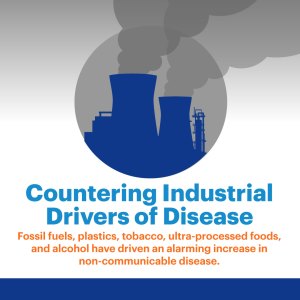
Health-harming products including fossil fuels, plastics, petrochemicals, tobacco, alcohol and ultra-processed foods are contributing to a rise in chronic disease
Industries that produce health-harming products have waged a decades-long assault on science and regulations designed to protect health, ultimately rigging rules in their favor, say scientists behind a new Center to End Corporate Harm at UC San Francisco.
Products, including fossil fuels, chemicals, alcohol, tobacco and ultra-processed foods are now responsible for approximately one in three deaths worldwide. In the US a rise in chronic diseases including cancer (175%), diabetes (283%), Parkinson’s (133%), and dementias (75%) have led to what the scientists say is an “industrial epidemic” of disease.
The Center to End Corporate Harm brings together scientists who study various health-harming industries, and, in collaboration with the UCSF Industry Documents Library, are working to identify, analyze, and prevent industry-driven disease and develop strategies to counter the destructive influence of polluters and poisoners.
 “
The increase in many chronic diseases is the manifestation of a global economic system that prioritizes products and profit over health, and it is producing an industrial epidemic of disease,” said Tracey J. Woodruff, PhD, director of the new Center to End Corporate Harm.
“Health-harming industries such as fossil fuels, plastics, chemicals, tobacco, and ultra-processed foods have rigged the regulatory and political systems in their favor and it’s critical to public health to hold these industries accountable,” she said.
“Most health-harming industries have taken a page from Big Tobacco’s playbook – deny health harms, manipulate science and regulatory bodies, and lie to the public about the real risks and costs,” said Pamela Ling, MD, MPH, who leads the UCSF Center for Tobacco Control Research & Education. “The 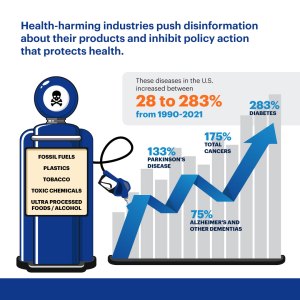 good news is that when the public health community pushed back on tobacco, it worked; although the work continues as tobacco companies move into e-cigarettes, vaping and ultra-processed food.”
“Time and again health-harming industries have lied about their products, hiding the harms from the public and regulators and now many of these industries are, collectively, the leading cause of death and disease globally,” said Nicholas Chartres, PhD, lead scientific advisor to the new center who specializes in researching industry influence and the role of corporate conflict of interest in science.
Prior to its launch, researchers behind the new center hosted or sponsored scientific symposiums at UC San Francisco and at the University of Sydney with a combined more than 100 scientists who follow trends and tactics by corporate actors to manipulate science and regulation. They include Lisa Bero, PhD, University of Colorado, who studies how industry-funded science 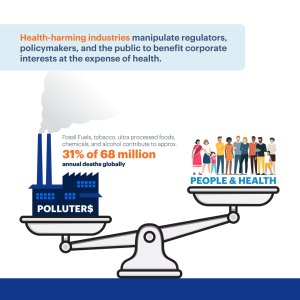 can skew an entire body of evidence and Laura Schmidt, PhD, UC San Francisco, who has documented how the tobacco industry influenced the food industry by developing products with highly processed (and addictive) flavorings like Hi-C, Lunchables, and Oreo cookies.
“Research tracking health-harming industries has proven critical for understanding why people overeat ultra-processed foods, leading to rising rates of obesity and cardiometabolic disease globally,” said Schmidt. “I look forward to continuing this work through the Center to better understand how corporate tactics undermine health.”
The new Center includes scientists, researchers, and physicians from all five UCSF schools, UCSF Industry Documents Library, as well as the Center for Climate Health & Equity, Center for Tobacco Control Research and Education, 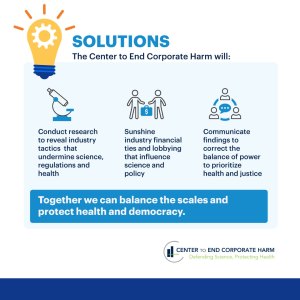 Institute for Health Policy Studies, and the Program on Reproductive Health and the Environment, all based at UCSF, as well as researchers from University of Colorado, University of Sydney, and more.
Learn more about the Center here:
https://prhe.ucsf.edu/center-end-corporate-harm:
2x?
{{Glantz has done as much as anyone to put smoking on the public agenda. His landmark work on the dangers of secondhand smoke launched smoking bans in public places from restaurants to airplanes. Dubbed a "pain in the butt," he was one of Newsweek's 100 newsmakers of 1995. In a recent book, Smokescreen , New York Times tobacco writer Philip Hilts calls him one of the Seven Samurai of the anti-tobacco movement. Glantz showed up on an ABC News special in July to analyze the industry's political clout and called tobacco executives "cockroaches." His office phone rarely stops ringing. Last summer, he went all the way to Australia for vacation just to get away from the hubbub.}} called tobacco CEO’s cockroaches [bromberger hilton Tilting at Tobacco
==
A new academic study confirms that front groups with longstanding ties to the tobacco industry and the billionaire Koch brothers planned the formation of the Tea Party movement more than a decade before it exploded onto the U.S. political scene.
Far from a genuine grassroots uprising, this astroturf effort was curated by wealthy industrialists years in advance. Many of the anti-science operatives who defended cigarettes are currently deploying their tobacco-inspired playbook internationally to evade accountability for the fossil fuel industry's role in driving climate disruption.
The study, funded by the National Cancer Institute of the National Institute of Health, traces the roots of the Tea Party's anti-tax movement back to the early 1980s when tobacco companies began to invest in third party groups to fight excise taxes on cigarettes, as well as health studies finding a link between cancer and secondhand cigarette smoke.
Published in the peer-reviewed academic journal, Tobacco Control, the study titled, *'To quarterback behind the scenes, third party efforts': the tobacco industry and the Tea Party,* is not just an historical account of activities in a bygone era. As senior author, Stanton Glantz, a University of California, San Francisco (UCSF) professor of medicine, writes:
“Nonprofit organizations associated with the Tea Party have longstanding ties to tobacco companies, and continue to advocate on behalf of the tobacco industry's anti-tax, anti-regulation agenda.”
The two main organizations identified in the UCSF Quarterback study are Americans for Prosperity and Freedomworks.Both groups are now “supporting the tobacco companies' political agenda by mobilizing local Tea Party opposition to tobacco taxes and smoke-free laws.” Freedomworks and Americans for Prosperity were once a single organization called Citizens for a Sound Economy (CSE). CSE was founded in 1984 by the infamous Koch Brothers, David and Charles Koch, and received over $5.3 million from tobacco companies, mainly Philip Morris, between 1991 and 2004.
In 1990, Tim Hyde, RJR Tobacco's head of national field operations, in an eerily similar description of the Tea Party today, explained why groups like CSE were important to the tobacco industry's fight against government regulation. Hyde wrote:
“… coalition building should proceed along two tracks: a) a grassroots organizational and largely local track,; b) and a national, intellectual track within the DC-New York corridor. Ultimately, we are talking about a “movement,” a national effort to change the way people think about government's (and big business) role in our lives. Any such effort requires an intellectual foundation - a set of theoretical and ideological arguments on its behalf.”
The common public understanding of the origins of the Tea Partyis that it is a popular grassroots uprising that began with anti-tax protests in 2009.
However, the Quarterback study reveals that in 2002, the Kochs and tobacco-backed CSE designed and made public the first Tea Party Movement website under the web address www.usteaparty.com. Here's a screenshot of the archived U.S. Tea Party site, as it appeared online on Sept. 13, 2002:[screenshot]
C:{SE:(style="text-decoration-line:none"):}: describes the :{U.S.:(style="text-decoration-line:none"):}: Tea Party site, “In 2002, our U.S. Tea Party is a national event, hosted continuously online, and open to all Americans who feel our taxes are too high and the tax code is too complicated.” The site features a “Patriot Guest book” where supporters can write a message of support for CSE and the U.S. Tea Party movement.
Sometime around September 2011, the U.S. Tea Party site was taken offline. According to the DNS registry, the web address www.usteaparty.com is currently owned by Freedomworks.
The implications of the UCSF Quarterbackreport are widespread. The main concern expressed by the authors lies in what they see happening overseas as the Tea Party movement expands internationally, training activists in 30 countries including Israel, Georgia, Japan and Serbia.
As the authors explain:
“This international expansion makes it likely that Tea Party organizations will be mounting opposition to tobacco control (and other health) policies as they have done in the USA.”
Freedomworks and Americans for Prosperity are both multi-issue organizations that have expanded their battles to include other policies they see as threats to the free market principles they claim to defend, namely fighting health care reform and regulations on global warming pollution. The report's warning about overseas expansion efforts by Freedomworks should therefore also be heeded by groups in the health and environment arenas.
Finally, this report might serve as a wake-up call to some people in the Tea Party itself, who would find it a little disturbing that the “grassroots” movement they are so emotionally attached to, is in fact a pawn created by billionaires and large corporations with little interest in fighting for the rights of the common person, but instead using the common person to fight for their own unfettered profits.
==
unclear if funding cut successful, tho done deal? did it affect future grants?
Legislator Grills NIH Over Tobacco Grant – NIH director, Francis Collins, recently attended a hearing regarding how different Health and Human Services agencies are dealing with reduced budgets. While at the meeting, Representative Andy Harris (R-MD) questioned Collins about a grant to investigate tobacco control funded by the NCI. The PI on the grant, Stanton Glantz, was investigating the influence of “third parties” funded by the tobacco industry. The study, published in *Tobacco Control*, uncovered a link between the tobacco industry and formation of the Tea Party. Harris, a member of the Tea Party, opposes this finding and would prefer that money from tax payers does not cover such research. Collins was also alarmed by the finding and hopes to strike a balance between not funding an “unfortunate outcome” and not micromanaging all NIH-funded research. (Jocelyn Kaiser)
==
==
lustig sugar kpfa ends w/ scotus 3x CU above my pay grade.
new bk
https://kpfa.org/episode/upfront-july-27-2018/
Dr. Robert Lustig is Professor Emeritus of Pediatrics, Division of Endocrinology at the University of California, San Francisco (UCSF). He specializes in the field of neuroendocrinology, childhood obesity and diabetes. His latest book is Hacking the American Mind: The Science of the Corporate Takeover of Our Bodies and Brains.
- $135 for Hacking the American Mind: The Science of the Corporate Takeover of Our Bodies and Brains by Robert Lustig
==
https://movetoamend.org/sugar-industry-withheld-possible-evidence-cancer-link-50-years-ago-researchers-say
November 22, 2017
Teresa Carey
Scientists at the University of California, San Francisco, said they have uncovered documents demonstrating that members of the sugar industry called off a study, named Project 259, in the 1960s because it linked sucrose — a common sugar — to heart disease and bladder cancer in preliminary experiments.
In 2016, the same researchers discovered a separate, undisclosed document that showed the sugar industry funded a report that downplayed links between sugar and coronary heart disease.
But a trade group argues the sugar industry was always transparent about Project 259 and that it supports science-based evidence even if the results are unfavorable. Here’s a breakdown of what UCSF researchers found.
How the researchers spotted Project 259
UCSF dentist Cristin Kearns started digging into the sugar industry 10 years ago, after representatives at a conference said there is “no scientific consensus” that sugar is linked to chronic illnesses. She combed through library archives across the nation and eventually stumbled across a box containing “confidential” documents on “Project 259.”
In 1968, the Sugar Research Foundation launched a rodent study, which measured the nutritional products of gut bacteria after rats consumed sucrose compared to starch. Project 259’s early results showed that sucrose caused gut microbes to throw off the rodents’ metabolisms, increasing their levels of triglycerides. Triglycerides are fatty molecules, which when elevated, can clog arteries and predispose a person for cardiovascular disease. In a preliminary experiment, Project 259 also found a high-sugar diet boosts the activity of beta-glucuronidase, an enzyme linked to bladder cancer, when compared to a starch diet. The second half of the study, which would have taken a deeper look at starch, was never finished.
After reporting this discovery in August 1970 to the International Sugar Research Foundation, Project 259 scientists requested an additional 12 weeks of funding to continue the research, according to internal documents. One month later, Sugar Research Foundation’s Vice President of Research John Hickson described the value of Project 259 as “nil,” Glantz and Kearns state. The funding request was denied, and the project was abandoned in 1971.
Kearns and UCSF cardiologist Stanton Glantz, who revealed the project’s details in an analysis published Tuesday in PLOS Biology, argue that the sugar industry buried the evidence and stopped funding due to the negative findings.
==
ac suppression
10/31/14 aside from singer libel suit discussion, ORESKES
morano, michaels, schnare, horner, s kazman. monckton go after UC, harvard and stanford,w/ glantz at ucsf and 2 unnamed stanford profs; in part b/c alums, so presumably defective education?!
http://www.desmogblog.com/sites/beta.desmogblog.com/files/Fred%20Singer%20emails%20re%20Merchants%20of%20Doubt.pdf
==
http://www.desmogblog.com/sites/beta.desmogblog.com/files/Fred%20Singer%20emails%20re%20Merchants%20of%20Doubt.pdf
enstrom: complain to UC and harvard, both oreskes andglantz; o got all info for smears on you hacks from tobacco library[he's in there too?] cf tilting at tobacco and Combatting lysenko pseudoscience" get salary from sacbee db; 2 others phd's unnamed; hennessey smart and principled prez; singer notes she got cal pay while promoting bk
==
http://www.tobacco.ucsf.edu/users/sglantz
http://en.wikipedia.org/wiki/Stanton_Glantz
Stanton Arnold Glantz, Ph.D. (born 1946) is a professor of medicine (cardiology), American Legacy Foundation Distinguished Professor of Tobacco Control, and director of the Center for Tobacco Control Research and Education at the University of California, San Francisco (UCSF) School of Medicine. Glantz's research focuses on the health effects of tobacco smoking. Glantz is active in the nonsmokers' rights movement and has advocated for public health policies to reduce smoking. He is the author of four books, including The Cigarette Papers[1] and Primer of Biostatistics.[2] Glantz is also a member of the UC San Francisco Cardiovascular Research Institute and Institute for Health Policy Studies and co-director of the UCSF Comprehensive Cancer Center Tobacco Program. He is the father of journalist Aaron Glantz and tobacco control leader Frieda Glantz.
Biography
After initially training as an aerospace engineer, Glantz took up postdoctoral positions in cardiology at Stanford University and then in cardiovascular research at the University of California, San Francisco, where he has worked since 1977.[3]
He served for 10 years as an Associate Editor of the Journal of the American College of Cardiology and is a member of the California State Scientific Review Panel on Toxic Air Contaminants of the California Air Resources Board. He was elected to the Institute of Medicine in 2005.
Research
Glantz conducts research on a wide range of issues including the effects of secondhand smoke on the heart by studying reductions in heart attacks observed whensmoke-free policies are enacted, and how the tobacco industry fights tobacco control programs. His research on the effects of secondhand smoke on blood and blood vessels concludes that, in terms of heart disease, the effects of secondhand smoke are nearly as large as those of smoking. One such study demonstrated a large and rapid reduction in the number of people admitted to the hospital with heart attacks in Helena, Montana,[4] after that community made all workplaces and public places smokefree.
His work in this area was identified as one of the "top research advances for 2005" by the American Heart Association. He was one of the people who first argued that controlling youth access to tobacco products was not an effective tobacco control strategy and was one of the first people to identify the importance of young adults (not just teens) as targets of the tobacco industry and efforts at smoking cessation and tobacco use prevention.
Glantz is author or coauthor of numerous publications related to secondhand smoke and tobacco control, as well as many papers on cardiovascular function and biostatistics. He has written several books, including the widely used Primer of Biostatistics (which has been translated into Japanese, French, Russian, German, Italian, Japanese and Spanish), and Primer of Applied Regression and Analysis of Variance. In total, he is the author of 4 books and over 200 scientific papers, including the first major review (published in Circulation) which identified secondhand smoke as a cause of heart disease and the landmark 1995 Journal of the American Medical Association summary of the Brown & Williamson documents, which showed that the tobacco industry knew nicotine was addictive and that smoking caused cancer 30 years ago.[5] This publication was followed up with his book, The Cigarette Papers,[1] which has played a key role in the ongoing litigation surrounding the tobacco industry.
His book Tobacco Wars: Inside the California Battles[6] chronicles the last quarter century of battles against the tobacco industry in California. He also wroteTobacco: Biology and Politics[7] for high school students and The Uninvited Guest, a story about secondhand smoke, for second graders. He is now running two educational projects, SmokeFreeMovies, which is working to end use of movies to promote tobacco, and TobaccoScam, which is countering tobacco industry efforts to coopt the hospitality industry.
Working with the UCSF Library, Glantz has taken the lead in making nearly 50 million pages of previously secret tobacco industry documentsavailable to the entire world via the internet on the Legacy Tobacco Documents Library and British American Tobacco Documents Archive.[8] This effort has helped create a whole new area of scientific investigation based on tobacco industry documents.
In February 2013, a paper co-authored by Glantz was published in the journal Tobacco Control. Entitled "‘To quarterback behind the scenes, third-party efforts’: the tobacco industry and the Tea Party", the paper detailed how the Tea Party political movement was funded and organized by organizations which were created by tobacco companies.[9]
Activism
Glantz has been a leading researcher and activist in the nonsmokers' rights movement since 1978, when he helped lead an unsuccessful state initiative campaign to enact a nonsmokers' rights law by popular vote. In 1983, he helped successfully defend the San Francisco Workplace Smoking Ordinance against a tobacco industry supported attempt to repeal it by referendum. The San Francisco victory represented the first electoral defeat of such a tobacco industry sponsored referendum, and is now viewed as a major turning point in the battle for nonsmokers' rights. He is one of the founders of Americans for Nonsmokers' Rights.
In 1982 he was part of a group of health activists who resurrected the last remaining copy of the film "Death in the West," suppressed by Philip Morris, and developed an accompanying curriculum that has been used by an estimated 1,000,000 students. He helped write and produce the films "Secondhand Smoke," which concerns the health effects of involuntary smoking, and "120,000 Lives," which presents evidence that smoking in the movies recruits adolescent smokers and proposes solutions for reducing this effect.
Glantz was also an opponent[10] of the "global settlement" of tobacco litigation proposed in 1996, in which the tobacco industry was to be granted de facto immunity from further litigation in exchange for payments to the states and acceptance of weak regulation by the U.S. Food and Drug Administration.[11] The tobacco industry turned against and defeated this compromise, and defeated legislation introduced in Congress by Senator John McCain (R-AZ), after some public health advocates succeeded in getting the immunity provisions removed. Many of the provisions of the "global settlement"—but not the immunity or FDA provisions—were implemented by the Tobacco Master Settlement Agreement (MSA) between the attorneys general of 46 states and the large tobacco companies.
Glantz' analysis of the two agreements concluded that the MSA included most of the desirable provisions of the global settlement without the immunity provisions. In particular, the immunity provisions in the global settlement would have prevented the massive (and successful) federal Racketeer Influenced and Corrupt Organizations Act (RICO) lawsuit that the US Department of Justice won against the tobacco industry in 2007 and probably avoided release of most of the tobacco industry documents on the internet.
References
- ^ :{Jump up to::(style="top:-99999px;clip:rect(1px 1px 1px 1px);overflow:hidden;position:absolute !important;padding:0px !important;border:0px !important;height:1px !important;width:1px !important"):}:^a b(http://en.wikipedia.org/wiki/Stanton_Glantz#cite_ref-cigpapers_1-1) S. Glantz, et al., "*The Cigarette Papers*", University of California Press, 1996
- :{Jump up:(style="top:-99999px;clip:rect(1px 1px 1px 1px);overflow:hidden;position:absolute !important;padding:0px !important;border:0px !important;height:1px !important;width:1px !important"):}:^ S. Glantz, *Primer of Biostatistics* (6 ed), McGraw-Hill, 2005
- :{Jump up:(style="top:-99999px;clip:rect(1px 1px 1px 1px);overflow:hidden;position:absolute !important;padding:0px !important;border:0px !important;height:1px !important;width:1px !important"):}:^ "UCSF Helen Diller Family Comprehensive Cancer Center - People - Stanton A. Glantz, PhD".
- :{Jump up:(style="top:-99999px;clip:rect(1px 1px 1px 1px);overflow:hidden;position:absolute !important;padding:0px !important;border:0px !important;height:1px !important;width:1px !important"):}:^ "The Helena Study *(Abstract)*". Retrieved 2007-05-01.
- :{Jump up:(style="top:-99999px;clip:rect(1px 1px 1px 1px);overflow:hidden;position:absolute !important;padding:0px !important;border:0px !important;height:1px !important;width:1px !important"):}:^ Glantz SA, Barnes DE, Bero L, Hanauer P, Slade J. Looking through a keyhole at the tobacco industry. The Brown and Williamson documents. JAMA. 1995 Jul 19;274(3):219-24. PMID 7609230
- :{Jump up:(style="top:-99999px;clip:rect(1px 1px 1px 1px);overflow:hidden;position:absolute !important;padding:0px !important;border:0px !important;height:1px !important;width:1px !important"):}:^ S. Glantz and E. Balbach. "Tobacco War: Inside the California Battles", University of California Press, 2000
- :{Jump up:(style="top:-99999px;clip:rect(1px 1px 1px 1px);overflow:hidden;position:absolute !important;padding:0px !important;border:0px !important;height:1px !important;width:1px !important"):}:^ S. Glantz, *Tobacco: Biology and Politics*, WRS HealthEdCo
- :{Jump up:(style="top:-99999px;clip:rect(1px 1px 1px 1px);overflow:hidden;position:absolute !important;padding:0px !important;border:0px !important;height:1px !important;width:1px !important"):}:^ PBS Frontline, Interview with Stanton Glantz for *Smoke in the Eye*, 1999.
- :{Jump up:(style="top:-99999px;clip:rect(1px 1px 1px 1px);overflow:hidden;position:absolute !important;padding:0px !important;border:0px !important;height:1px !important;width:1px !important"):}:^ [[1]](http://www.huffingtonpost.com/brendan-demelle/study-confirms-tea-party-_b_2663125.html)
- :{Jump up:(style="top:-99999px;clip:rect(1px 1px 1px 1px);overflow:hidden;position:absolute !important;padding:0px !important;border:0px !important;height:1px !important;width:1px !important"):}:^ PBS Frontline, Interview with Stanton Glantz for *Inside the Tobacco Deal*, 1997
- :{Jump up:(style="top:-99999px;clip:rect(1px 1px 1px 1px);overflow:hidden;position:absolute !important;padding:0px !important;border:0px !important;height:1px !important;width:1px !important"):}:^ Brion J. Fox J.D., James M. Lightwood Ph.D., and Stanton A. Glantz Ph.D., "A Public Health Analysis of the Proposed Resolution of [the 1997 United States] Tobacco Litigation" (February 1, 1998). Center for Tobacco Control Research and Education. Tobacco Control Policy Making: United States. Paper US1998.http://repositories.cdlib.org/ctcre/tcpmus/US1998
External links
http://en.wikipedia.org/wiki/Legacy_Tobacco_Documents_Library
RICO
In 1994, the Attorneys General of four states—Mississippi, Minnesota, Florida, and Texas—separately filed lawsuits against the tobacco industry in an effort to secure reimbursement for health care expenditures arising from tobacco-related illnesses. During the course of this litigation, 42 other states joined in similar legal actions.
In 1998, a Master Settlement Agreement (MSA) was signed by the Attorneys General of 46 states and the nation's five major tobacco companies: Philip Morris, R. J. Reynolds, Lorillard, Brown & Williamson, and the American Tobacco Company. The MSA effectively settled the outstanding lawsuits by requiring yearly payments by the tobacco companies to the states and placing restrictions on the advertising and marketing of tobacco products. The MSA provisions also created and currently fund theAmerican Legacy Foundation, an anti-smoking advocacy group, which in turn funded the creation of the Legacy Tobacco Documents Library as well as its ongoing maintenance and collection activities.
As part of this Master Settlement Agreement, the U.S. tobacco companies were ordered to release the internal documents produced for the case for public access in both a physical depository in Minnesota and on their own document websites. The international tobacco company, British American Tobacco, was not mandated to provide a document website but they were required to deposit documents into a physical depository in Guildford, England. The National Association of Attorneys General(NAAG) provides oversight and enforcement of this operation. In 2006, U.S. District Judge Gladys Kessler ruled in a separate case that the nation's top tobacco companies violated racketeering laws, misleading the public for years about the health hazards of smoking. These companies were convicted under the Racketeer Influenced and Corrupt Organizations Act (RICO Act). Philip Morris and R.J. Reynolds filed an appeal but Judge Kessler's ruling was upheld. As a result of this case and its appeals, the companies are now obliged to make available any documents produced for litigation on smoking and health until 2021.[2]
Legislator Grills NIH Over Tobacco Grant
2013-03-06 11:10
A research grant sometimes can lead a scientist in a new direction. But a shift into politically sensitive territory can put the federal funding agency in hot water with Congress.
That's what happened yesterday toFrancis Collins, director of the National Institutes of Health (NIH),at a hearing on how agencies within the Department of Health and Human Services are dealing with tight budgets. One legislator wanted to know why an NIH grantee's research on tobacco control delved into the origins of the Tea Party. Although conservative lawmakers often take issue with certain NIH grants, what was surprising was that Collins said he was troubled by it as well.
The U.S. House of Representatives appropriations subcommittee on health and human services, labor, and education met to ask the directors of five agencies about ways to avoid duplicating research in a tight budget environment. Toward the end of the 2-hour hearing, Representative Andy Harris (R-MD) asked about a specific National Cancer Institute (NCI)-funded study tracing Tea Party's origins to groups supported by tobacco companies (video around 1:51 here). "They allege that somehow the Tea Party had its origin in the 1980s with tobacco funding, which is pretty incredible," Harris said. "Because I mean, I'm a Tea Party guy. I was there when it was established in 2009. I know the origins. I find it incredible that NIH funding is funding this," Harris said, adding that the study reflects "a partisan political agenda.
"I, too, am quite troubled about this particular circumstance," Collins replied. He pointed out that the lead author, University of California, San Francisco, researcher Stanton Glantz, has been an NCI grantee for 14 years and is considered a leading researcher on tobacco control. The paper, which listed support from an NCI training grant and an NCI research grant, also included a disclaimer that the NCI played no role in choosing the topic of the study. But, Collins added, "We thought we were funding a different kind of research when those grants were awarded.
Harris fired back: "What is within the NIH's abilities to, shall we say, make sure that thisresearcher or this institution doesn't play fast and loose with taxpayer money in this kind of research?"
"It's a very appropriate question and I'm struggling with it, to be honest," Collins replied. "The tension here is both to recognize that [the paper] is an unfortunate outcome, but also not to put NIH in a position of basically playing ananny over top of everything our grantees do."
The study, published last month in Tobacco Control, received coverage in both the liberal and conservative press. In it, Glantz and co-authors make the case that two nonprofit groups funded by tobacco companies to fight tobacco taxes and no-smoking laws were among the earliest supporters of what became the Tea Party.
Glantz said he is "very troubled" by Collins's remarks. His grant proposal didn't hide anything, he says. Written several years ago, it discussed his plan to study the influence on policymaking of "third parties" funded by the tobacco industry. "We didn't go looking for the Tea Party. It emerged naturally in the course of the research," he says, just as a cell biologist's research grant might lead in an unexpected direction.
It's not the first time Glantz's research has drawn hostility from Congress. In 1995, House appropriators voted to defund his NCI grant, but their recommendation was stripped from the final spending bill that year. "This is déjà vu all over again," Glantz says.
http://news.sciencemag.org/2013/03/legislator-grills-nih-over-tobacco-grant
==
note recent attacks as well:
At a congressional hearing on Tuesday, Francis Collins, director of the National Institutes of Health, said he was "quite troubled" by a taxpayer-funded study that tarred the Tea Party movement as a pawn of Big Tobacco. Collins called the study, led by anti-smoking activist Stanton Glantz, "an unfortunate outcome," saying, "We thought we were funding a different kind of research when those grants were awarded." Science Insider reports that Collins was responding to concerns raised byRep. Andy Harris (R-Md.) at a hearing before a subcommittee of the House Appropriations Committee:
"They allege that somehow the Tea Party had its origin in the 1980s with tobacco funding, which is pretty incredible," Harris said. "Because I mean, I'm a Tea Party guy. I was there when it was established in 2009. I know the origins. I find it incredible that NIH funding is funding this," Harris said, adding that the study reflects "a partisan political agenda."
When the study was published in the journal Tobacco Control last month, one of Glantz's co-authors declared, "The records indicate that the Tea Party has been shaped by the tobacco industry and is not a spontaneous grassroots movement at all." As I noted at the time, Glantz et al. tried to make the case that the Tea Party was funded and largely created by Philip Morris but ended up arguing that anyone who disagrees with them on issues such as ObamaCare, smoking bans, and cigarette taxes is carrying water for Big Tobacco, even if he does not realize it.
Glantz told Science Insider he was "very troubled" by Collins' comments. After all, when Glantz said in his grant proposal that he planned to study the influence of "third parties" funded by cigarette manufacturers, the NIH should have realized that included political hatchet jobs aimed at discrediting supporters of limited government as shills or dupes of Big Tobacco. It's not his fault that the people he attacked happen to be critics of the current president, which makes it look like the Obama administration is using taxpayer money to pay for opposition research.
[Thanks to Christopher Snowdon for the tip.]
==
- FinamdLaw
- Caselaw
- California
- CA Ct. App.
- CALIFORNIANS FOR SCIENTIFIC INTEGRITY v. REGENTS OF THE UNIVERSITY OF CALIFORNIA
Court of Appeal, Third District, California.
:{
}:
CALIFORNIANS FOR SCIENTIFIC INTEGRITY v. REGENTS OF THE UNIVERSITY OF CALIFORNIA
CALIFORNIANS FOR SCIENTIFIC INTEGRITY, Plaintiff and Appellant, v. The REGENTS OF THE UNIVERSITY OF CALIFORNIA, Defendant and Respondent.
No. C028522.
-- July 06, 2000
Gibson, Dunn & Crutcher, Theodore B. Olson, Los Angeles, Mark A. Perry, Thomas G. Hungar, Washington, DC, John C. Yoo, and Zumbrun & Findley, Ronald A. Zumbrun, Sacramento, John H. Findley, and Jeffrey H. Speich for Plaintiff and Appellant.Law Office of Eric G. Scheie, for TheClaremont Institute, Amicus Curiae on behalf of Plaintiff and Appellant.
Christopher M. Patti, James E. Holst, John F. Lundberg and Eric K. Behrens, Oakland, for Defendant and Respondent.
Plaintiff Californians for Scientific Integrity filed suit against defendant Regents of the University of California (the University), alleging the University had improperly permitted a professor to use public funds and resources to advance anti-smoking efforts. The trial court granted the University's demurrer and entered judgment in its favor.
Plaintiff appeals, reiterating that the use of public funds and resources for these purposes is impermissible and a violation of the First Amendment. We disagree and shall affirm.
standard of Review
“In reviewing the sufficiency of a complaint against a general demurrer, we are guided by long-settled rules. ‘We treat the demurrer as admitting all material facts properly pleaded, but not contentions, deductions or conclusions of fact or law․ We also consider matters which may be judicially noticed.’ [Citation.] Further, we give the complaint a reasonable interpretation, reading it as a whole and its parts in their context. [Citation.] When a demurrer is sustained, we determine whether the complaint states facts sufficient to constitute a cause of action. [Citation.] And when it is sustained without leave to amend, we decide whether there is a reasonable possibility that the defect can be cured by amendment: if it can be, the trial court has abused its discretion and we reverse; if not, there has been no abuse of discretion and we affirm. [Citations.] The burden of proving such reasonable possibility is squarely on the plaintiff.” (Blank v. Kirwan (1985) 39 Cal.3d 311, 318, 216 Cal.Rptr. 718, 703 P.2d 58; see also CAMSI IV v. Hunter Technology Corp. (1991) 230 Cal.App.3d 1525, 1538-1539, 282 Cal.Rptr. 80.)
http://elr.info/sites/default/files/articles/35.10857.pdf
Scientific Speech: Protecting the Right of Environmental Scientists to **...**
elr.info/sites/default/files/articles/35.10857.pdf
by RR Kuehn - 2005 - Cited by 1 - Related articles
were allegedly fired or otherwise attacked because employers or others were disturbed by.... (ISEE) defines research suppression or oppression as ob- structing ...
The threat of litigation, even where the likelihood of success by the plaintiff is doubtful, can dissuade companies
from publishing scientific research. When Dr. Stanton
Glantzand associates wrote a book analyzing secret tobacco
industry documents on the health effects of smoking, publisher after publisher turned down the opportunity to publish
the book.
As one publisher explained:
At serious big-league law firms, the consensus was that,
although we could probably ultimately show that we
have a right to publish, financially we’d be out of business before we had a chance to show anybody anything.
If you anger a tobacco company and get into what
amounts to a financial war with it—where the issue is
who can afford better attorneys for longer—you’re going to lose.91
The court in Immuno AG.observed that the chilling effect
of threatened litigation “can be especially severe for scholarly journals, such as defendant’s, whose editors will likely
have more than a passing familiarity with the subject matter
of the specialized materials they publish.”92 Prof. Michael
Curtis warns that the current pesticide dialogue is seriously
distorted by threats of defamation, which are insufficiently
deterred by existing legal rules on defamation.93 He argues
that a scientist who believes the safety of pesticides is little
cause for concern is comparatively safe in making unequivocal and bland assurances of safety, while scientists who
think pesticides in food expose the public to unreasonable
risks must express themselves in a much more guarded fash...
==
Am J Public Health. 2009 January; 99(1): 45–58.
PMCID: PMC2600597
NIHMSID: NIHMS75206
Tobacco Industry Efforts to Undermine Policy-Relevant Research
Anne Landman, BA and Stanton A. Glantz, PhD
Author information ► Article notes ► Copyright and License information ►
This article has been cited by other articles in PMC.
Abstract
The tobacco industry, working through third parties to prevent policy-relevant research that adversely affected it between 1988 and 1998, used coordinated, well-funded strategies in repeated attempts to silence tobacco researcher Stanton A. Glantz. Tactics included advertising, litigation, and attempts to have the US Congress cut off the researcher's National Cancer Institute funding. Efforts like these can influence the policymaking process by silencing opposing voices and discouraging other scientists from doing work that may expose them to tobacco industry attacks. The support of highly credible public health organizations and of researchers’ employers is crucial to the continued advancement of public health.
Public policy intervention—e.g., aggressive public-education campaigns, mandated smoke-free environments, and high cigarette taxes—is the most effective way to reduce tobacco-caused disease.1,2 The prosperity of the tobacco industry depends on prevention of these policies and maintenance of a supportive policy environment. Among other strategies for safeguarding its interests,3–10 the tobacco industry attempts to counteract or obstruct the work of researchers whose work may be detrimental to tobacco industry interests.11,12 To that end, the industry has portrayed targeted researchers as extremist, unqualified, or politically motivated; denigrated researchers to superiors, publishers, and the public; sued researchers; and worked to cut off researchers’ funding. The industry pursues these strategies through allied elected officials, front groups, and other third parties. These efforts can influence the policymaking process by silencing voices critical of tobacco industry interests and discouraging other scientists from doing research that may expose them to industry attacks.
The case of tobacco control researcher Stanton Glantz, an author of this paper, illustrates the full range of strategies used by the tobacco industry to attack scientists whose work supports tobacco control.
Documentation of these events is based on searches between February and November 2006 of the Legacy Tobacco Documents Library (http://legacy.library.ucsf.edu), which located approximately 500 documents that described tobacco industry activities pertaining to Glantz's research and funding.
Initial search terms included “Glantz [including misspellings] and funding” and “Glantz and NCI [National Cancer Institute],” followed by searches for specific individuals and groups. We also examined documents from Glantz's own files pertaining to tobacco industry lawsuits against the University of California, San Francisco (where Glantz is a faculty member), media articles concerning Glantz's tobacco-related research, relevant correspondence, and other pertinent materials.
DEATHS FROM SECONDHAND TOBACCO SMOKE
The tobacco industry's monitoring of Glantz's early tobacco-related research appears in a 1990 dossier prepared by law firm Shook Hardy and Bacon in 1990.13 The dossier describes Glantz's May 21, 1990, presentation of research (with coauthor William Parmley) at the World Conference on Lung Health, which concluded that secondhand tobacco smoke (SHS) caused approximately 53 000 nonsmoker deaths a year, including 37 000 from heart disease.14 This presentation led to a full-page New York Times story covering the research,15 which provoked the Tobacco Institute, the tobacco industry's lobbying and public relations arm, to send the New York Times a 2-page letter to the editor that read, in part: “The discussion of Glantz's theories as if they were accepted scientific thinking is an error that one does not expect from the New York Times… . The reporting was uncritical, unsupportable and unbalanced.”16 After the New York Times failed to publish the letter, a number of people wrote letters to the New York Times protesting the paper's failure to publish a response to Glantz and Parmley's conclusions.17 None of these letter-writers revealed that they were actually members of the Tobacco Institute's secret Scientific Witness Program18 (Table 1).
Known Tobacco Industry Consultants and Associates Who Publicly Criticized Glantz and His Tobacco-Related Work, 1990–1997
The figure of 37 000 cardiac deaths per year from SHS was featured prominently in a US Environmental Protection Agency (EPA) technical compendium69 on SHS published as a supplement to an EPA risk assessment of passive smoking, lung cancer, and respiratory disease.70 When a draft of the compendium was released 5 months after the New York Times story, tobacco companies raised a furor11,71 and the EPA distanced itself from the figures.72,73 On June 6, 1990, tobacco industry ally Representative Thomas Bliley (R, VA) wrote the following to the administrator of the EPA:
“Stanton Glantz … advanced the outlandish claim, which is plainly unsupported by credible scientific evidence, that 30 000 non-smoking Americans die of heart disease each year as a result of exposure to ETS [environmental tobacco smoke, the industry's term for secondhand smoke]. Such activity makes a mockery of EPA's procedures.”71 Bliley subsequently helped implement political and administrative tactics designed by tobacco company Philip Morris USA—its “sand in the gears” strategy11,74(p6011)—that delayed EPA's risk assessment for 2.5 years, until December 1992.11 The EPA never published the technical compendium.
In January 1991, Glantz and Parmley published the research they presented at the 1990 Conference on Lung Health in the journal Circulation.14 The article generated another wave of news coverage75 and provoked another round of industry damage control. Initially, industry spokespeople openly challenged Glantz and Parmley in the popular press.76,77 The director of smoking and health for tobacco company RJ Reynolds sent a letter to the editor of many newspapers78 calling Glantz a “back door prohibitionist” who was “scaring the American public with outlandish claims that are simply not supported by scientific fact.”
(RJ Reynolds' public relations agency, Hill & Knowlton, had found the “back door prohibition” message to be most effective with the public.79) After 1991, the industry moved from direct criticism to using third parties (Table 1).
Tobacco Institute consultant Joseph Wu, PhD, a professor of biochemistry and molecular biology at New York Medical College, drafted 3 versions of a letter to submit to Circulationthat were critical of Glantz's work and faxed them totobacco industry law firm Covington & Burling, seeking suggestions.80–84 Wu submitted his letter to Circulation without disclosing his role as a tobacco industry consultant,85 and even though Circulation rejected Wu's letter, the Institute still paid him $3867 for writing it86 (out of $20 000 the Institute had budgeted to pay Wu in 1991 to criticize Glantz's work87). The Institute continued to pay consulting fees to Wu, including $72 275 during the 1995–1996 fiscal year88 (the only year for which a record of Wu's total payments were available).
Consultant Larry Holcomb, PhD, billed the Institute $3825 ($225 per hour) to produce a response to the Circulation paper.30 Holcomb argued that Glantz and Parmley drew stronger conclusions than were warranted and that the studies failed to control for confounding variables like diet. Another Institute consultant, Walter Decker, PhD, wroteCirculation a letter arguing that the studies Glantz and Parmley examined were methodologically flawed, and he criticized Glantz and Parmley for including studies published in foreign languages. Decker billed Holcomb $175 per hour for writing his letter,89 which Holcomb then billed to the Tobacco Institute.89 (Chemist and biologist Joe Pedelty, MSc, also billed Holcomb $2975 for writing a letter, although we could not determine whether that letter was submitted to Circulation.) In all, 3 letters19,90,91appeared in Circulation criticizing Glantz and Parmley's work. All 3 were generated by the tobacco industry, but only 1 disclosed that fact.91
In August 1992, American University biostatistician Nathan Mantel, PhD, published an article in the Journal of Clinical Epidemiology54 that criticized the Circulation paper. (The editor of the Journal of Clinical Epidemiology, Alvan Feinstein, MD, was a long-time recipient of tobacco industry funds through its secret lawyer-managed “special accounts.”31[p330],92) In 1991, Mantel invoiced Philip Morris $135 065 for work on SHS. A Philip Morris attorney later reported to Philip Morris' Scientific Affairs Department that “Mantel offered [to write] a response to Glantz and Parmley for approximately $60 000. We have declined the offer for budgetary reasons.”93
The industry also funded statistical consultant Peter Lee,94 MA, to criticize published studies linking smoking, SHS, and disease.31,95 Over the years, Lee wrote editorials, articles, and letters to the editor criticizing Glantz and other researchers who published epidemiological studies on the health effects of SHS.48,50,51,96,97 Lee billed Covington & Burling from $750 to $4000 per piece for criticizing Glantz's work,50,51,97 and he made at least $7750 between 1992 and 1993 doing so.
THE PHILIP MORRIS PLAN TO ATTACK FUNDING FOR TOBACCO RESEARCH
In 1994, Glantz won a 3-year, $598 686 (total costs) grant from the NCI to evaluate the effects of state and local advocacy on tobacco-control policy.98 Glantz designed these activities to address needs identified in the 1989 US Surgeon General's report,99 which called for research on tobacco industry lobbying activities and their effects on public health policy. One of the 5 project areas included in this grant involved tracking tobacco industry campaign contributions to state legislators and correlating them with legislators’ behavior on tobacco issues.
A Philip Morris plan, written after the NCI grant was awarded, discussed Philip Morris' concern with researchers “who are … conducting research which is faulty” and who “generate considerable media coverage of these studies.”100 It noted that “the lack of rigorous challenge” to this research “creates an on-going problem for PM and the industry,” and it stated, “We must change the environment.”100
The plan specifically focused on Glantz (the only researcher mentioned in the plan) and his NCI grant, saying that his grant “does nothing to advance the common goal of finding cures for cancer” and “it is anti-business and anti-jobs.” Philip Morris proposed100 to alter what it perceived as a troublesome scientific environment by “raising the issue of [scientists’] credibility and their integrity.”The plan, titled “Action Plan: Scientists,” proposed “exposing … scientists who engage in shoddy research to their peers and in the media,” and it noted that “scientists are very concerned about the opinions their peers hold of them and their research.”100 The plan proposed “elevat[ing] the issue of public funding (primarily federal) to conduct anti-tobacco … research”100 and using third parties to run advertisements attacking scientists:
First, we cantake out ads in appropriate scientific journals that point out the flaw(s) in the study in question. While the issue of whose name appears in the ad's disclaimer is a subject for future discussion, there is no doubt that the careful use of these ads would be extremely embarrassing to those scientists whose methodology, data and conclusions are demonstrably wrong.100 (Emphasis added.)
Philip Morris' action plan also proposed writing to “the [scientists’] appropriate dean or department head raising questions about the validity of a scientists’ work.”100 The plan repeatedly emphasized the need to “become more proactive, utilizing credible third parties more effectively … [and] encourage more participation by credible, third parties… . [W]e must use credible third-parties more effectively and more creatively to help carry our messages.”100 Activities were to be carried out quietly to avoid drawing attention to Philip Morris:
We can and should reach out to our allies on Capitol Hill, particularly those serving on authorizing and appropriations committees. With the Republican takeover of the House and Senate, the message to the [government public health] agencies must be: “funding sloppy tobacco research is no longer ‘cost-free.’” … Strategically, however, we must always be careful of the danger of raising tobacco's profile on Capitol Hill.100(Emphasis added.)
Philip Morris' actions, taken in concert with those of RJ Reynolds and others, indicate that the Philip Morris plan was implemented. Table 2 indicates the correlation between Philip Morris' Action Plan and events that actually occurred.
Strategies Listed in Philip Morris' Draft “Action Plan: Scientists” and Events Involving Glantz, 1991–1997
In February 1995, Marty Ronhovdee,38 a researcher for the American Smokers Alliance, compiled and circulated a report critical of Glantz and his grant, portraying NCI as misusing taxpayers’ money to fund a “witch hunt” and diverting funds away from its “primary obligation” to conduct cancer research.105
(The American Smokers Alliance was formed when Philip Morris spent $10 000 to bring 40 smokers to an initial meeting in Atlanta, Georgia.28 After the organization was formed, Philip Morris provided it with a 10 000-name mailing list106 and at least $35 000 in 1994 and 1995 for “grassroots mobilization.”107,108) As an example of NCI's so-called misuse of taxpayers’ money, Ronhovdee cited Glantz's research on the influence that tobacco industry campaign contributions might have on state legislators’ policymaking behavior. (Subsequent research established that this influence existed.109–112) The Ronhovdee report conformed to the strategy Philip Morris explicated in its action plan to generate opposition to public funding of tobacco-control research.100
Ronhovdee circulated her report to other smokers’ rights activists, including Martha Perske and Jackie Miller.113 Nominally an independent smokers’ rights advocate, Perske completed media training at RJ Reynolds57and was in direct contact with RJ Reynolds employees and representatives.59,60,114–118 Perske wrote letters to academic journals, newspapers, and legislators to advance industry views on SHS and forwarded any replies she received to RJ Reynolds.119,120 When Glantz and Parmley121 responded to Nathan Mantel's 1992 paper in the Journal of Clinical Epidemiology by pointing out Mantel's relationship with the tobacco industry, the journal's editor published a personal defense of Mantel written by Perske.58 Perske also forwarded information to public-relations firm Walt Klein & Associates of Winston-Salem, North Carolina,122 who contracted with RJ Reynolds and Philip Morris to organize grassroots opposition to smoking restrictions,3promote industry “youth smoking prevention” programs,123 and organize front groups like the Coalition for Responsible Retailing to fight cigarette tax increases.124–126 Miller was vice president of the Florida Smokers Rights Association, a group managed by an RJ Reynolds public-issues field coordinator.127 The Ronhovdee report was also sent to an RJ Reynolds employee who was president of the North Carolina Smokers Rights Association,128 who circulated it within RJ Reynolds.129
Shortly after Ronhovdee circulated her report, an ad101 appeared in the Washington Timeson March 14, 1995, attacking Glantz and his NCI grant (Figure 1). The ad reflected Philip Morris' strategy, outlined in its action plan, to have third parties run ads to embarrass scientists.100 The ad copy asked readers to clip the ad from the newspaper, write a short personal note at the bottom of it, and mail it to their congressperson. The ad copy identified the ad's sponsor as “the 130/10 Club, a group of citizens who chip in $10 a month to expose government wasteand express our opinions to the government.”101 The ad gave no other information about the 130/10 Club, which was operated by Steve Handman, president of the Philip Morris–supported American Smokers Alliance. A Philip Morris representative denied any involvement in “this Glantz effort” to USA Today.130
Advertisement in the Washington Times, March 14, 1995.101
On April 11, 1995 (3.5 weeks after the 130/10 Club ad appeared), the Washington Times ran an article attacking Glantz's NCI grant, calling it overly political and inappropriate for the NCI.65 The article quoted a spokesman for Representative John Porter (R, IL), chair of the House Appropriations subcommittee responsible for the NCI's budget, who said, “NCI has gone beyond its mandate to conduct clinical and behavioral research regarding cancer” and should not have funded the grant. (The global headquarters of Kraft Foods, then a Philip Morris subsidiary, is located in Porter's congressional district.) The Washington Times also quoted theNational Taxpayers Union's criticism of the grant. (Philip Morris supported the National Taxpayers Union131,132 as part of a strategy to enlist antitax groups as third-party allies to carry out letter-writing campaigns that would “raise havoc” and “generate some real heat in the field.”133) A headline in the American Smokers Alliance's spring 1995 newsletter56 boasted that “ASA Letters and Ads [from the 130/10 Club] Ignite Federal Action on NCI” and included a reprint of the Times article.
On
April 12, 1995, the day after the Washington Times article ran, Senator Wendell Ford (R, KY), a strong tobacco industry supporter,134 wrote a harsh letter to Secretary of Health and Human Services Donna Shalala, whose department includes the NCI, protesting Glantz's grant. Ford called the grant “an extravagant handout” and asked Shalala to halt the spending of the remainder of the grant that had “not already been wasted.”135 Shalala responded by defending Glantz's NCI grant,136 stating that it was well within NCI's mandate.
INDUSTRY ATTACKS SPREAD TO MAGAZINES, BOOKS, TELEVISION
In late 1994, an employee of the Missouri Department of Agriculture and researcher for the American Smokers Alliance, whom Philip Morris considered to be a “grower ally,”36 sent a Freedom of Information Act request to the NCI for information about Glantz's grant application.
(The American Smokers Alliance encouraged members to act as researchers, specifically instructing them to use the Freedom of Information Act.38) The employee obtained Glantz's NCI grant information and forwarded it to Walt Klein & Associates, who in turn sent it to RJ Reynolds' external relations office.137 In March 1995, RJ Reynolds enlisted Walt Klein & Associates to foster and augment the appearance of a public clamor to remove Glantz's funding. The public relations firm drafted several op-ed pieces criticizing Glantz's work as “bogus” and “deeply flawed” and demanding that the NCI terminate his funding.138–140 We were unable to determine whether any of these op-ed pieces were published.
On August 28, 1995, an article titled “Policing P[olitical] C[orrectness]: How the government is stacking the deck in the debate over smoking”141 was published in the National Review, a magazine of conservative opinion.142 The article attacked Glantz and his NCI funding, portraying him as a prohibitionist and calling his NCI funding a “gross abuse of bureaucratic authority.”
A short biosketch of the author, Thomas DiLorenzo, PhD, described him only as “a professor of economics at Loyola College in Maryland.”141 Prior to publishing “Policing PC,” DiLorenzo had worked on a number of tobacco industry projects, including a Philip Morris and RJ Reynolds–funded project at the Independent Institute (a tobacco industry–funded think tank143), and contributed to publications by the Capital Research Center (another think tank, described as a “long-time friend of PM” in a 1998 internal Philip Morris e-mail:{1:(style="background-color:#ffff66;"):}::{44:(style="background-color:#ffffff;"):}:).
The same month that the “Policing PC” article was published, James Bennett of George Mason University billed RJ Reynolds $150 000 for work he and DiLorenzo were doing on a book titled CancerScam: The Diversion of Federal Cancer Funds to Politics.22
This book, published in 1997, attacked government-funded health agencies and health charities, charging that they were deviating from their missions and using donated funds irresponsibly by engaging in excessive political and lobbying activity.145 The book specifically attacked Glantz, claiming he was “getting rich” by using tax funds for lobbying.145 CancerScam conformed to Philip Morris' action plan by “elevating the issue of public funding (primarily federal) to conduct anti-tobacco … research”100 and accusing government agencies and health charities of diverting funding away from “the common goal of finding a cure for cancer.”100 DiLorenzo also made a Freedom of Information Act request for information about Glantz's NCI grant, and he forwarded the information received from NCI to Philip Morris' law firm Arnold and Porter in 1995. The firm forwarded the information to the director of Philip Morris' Washington relations office.:{1:(style="background-color:#ffff66;"):}::{46:(style="background-color:#ffffff;"):}:
On July 15, 1995, a few weeks before his National Review article was published, DiLorenzo appeared on the Philip Morris–supported147–149 PBS television program Technopolitics,hosted by James Glassman. (Philip Morris had liaisons assigned to Technopolitics andNational Review as part of its “Managing the Message—Conservative Media Cultivation” effort.150) The single topic of the half-hour Technopolitics show was Glantz's NCI grant. On the show, DiLorenzo described Glantz's NCI grant as the “government paying citizens to spy on other citizens” and called it “atrocious.” He concluded, “Every dollar that is spent on these political gadflies is not spent on basic cancer research,”23 yet another statement that reflected Philip Morris' plan to claim that Glantz's NCI research “does nothing to advance the common goal of finding cures for cancer.”100 From 1993 to 1995 Philip Morris donated $630 000147–149 to South Carolina Educational Television to support Technopolitics. The 1994 contribution was one of Philip Morris' largest “charitable contributions” that year.151
LEGISLATIVE APPROPRIATIONS
While laying the groundwork to create the appearance of a grassroots demand to cut Glantz's NCI funding, the tobacco industry was also working to influence the federal budget appropriations mechanism to terminate Glantz's funding.152 In July 1995, language appeared in a House Appropriations Committee report that set the scene for eliminating Glantz's project in the upcoming NCI appropriations bill. The language focused on a relatively small part of Glantz's overall project (albeit the part to which legislators were likely to be particularly sensitive). It said:
The Committee was disturbed to learn that NCI had funded a research grant studying tobacco industry campaign contributions to State legislators and voting records by those individuals on tobacco control initiatives. While the Committee is not rendering judgment on the merits of the grant proposal, it feels strongly that such research projects do not properly fall within the boundaries of the NCI portfolio.153
The only grant the language could have possibly referred to was Glantz's NCI grant.
When the appropriations bill containing NCI's funding for the next fiscal year came to a vote in the House of Representatives on August 4, 1995, it included language (inserted into a subcommittee report) that would specifically strip Glantz of his NCI funding. The legislative affairs manager at the Tobacco Institute described the event in a memo she sent to RJ Reynolds' public affairs divisions the same day:
Early this morning the House passed HR 2127, the Fiscal Year 1996 Appropriations [bill] for the Departments of Labor, Health and Human Services, and Education [including NCI]… . Several items of interest to the industry are included in the bill. Funding for the Office of the Surgeon General would be eliminated… . In the House Appropriations Committee Report is language withholding further funding for the National Cancer Institute's grant to Stanton Glantz for an investigation of the tobacco voting records of, and campaign contributions to state legislators.154
Glantz learned of the attack on his NCI funding from a member of his research staff, whose sister was interning for a member of the House Appropriations subcommittee. On August 2, 1995, Glantz sent a letter to colleagues alerting them about the ongoing political effort to halt his project. He pointed out that, if allowed to continue, this kind of legislative action would have the potential to cut off all future research that the tobacco industry considered threatening.155 Word spread about the highly specific amendment to kill Glantz's project, and news media began reporting on it, including a Chicago Sun-Times article on August 9, 1995, which read, “In a rare intervention, Rep. John Porter (R-Ill.) directed the National Cancer Institute to halt funding of research on how the tobacco industry helps shape the law.”103
Three days after the Sun-Times article appeared, Philip Morris' Washington relations office was planning its next step:pushing the attack on Glantz's NCI funding through the Senate. An internal Philip Morris memo reads, “What are [our] prospects for … eliminating funding for Glantz's NCI political study, etc.? Who is the industry's horse in the Senate, if anyone, to push what we got in the House [emphasis added]?”156 Another note sent to high-level officials in Philip Morris—including the senior vice president and associate general counsel (Charles Wall); Philip Morris' Worldwide Regulatory Affairs office; the senior vice president of executive affairs (Steve Parrish); secretary and general counsel and members of Philip Morris' board of directors, vice president and associate general counsel; vice president of Philip Morris' State Government Affairs office; and staff in Philip Morris' Washington Relations office—indicates that the industry worked cooperatively to have Glantz's funding removed: “Attached is a status report on industry efforts concerning the NCI grant to Glantz… . We will keep you posted as this develops [emphasis added].”157
As the industry's attention shifted to the Senate, a memo titled “National Cancer Institute Grant to Stanton Glantz” was sent within Philip Morris' Washington relations office in December 1995. The memo reads, in part: “I sent copies of [Glantz's NCI grant application] to Brad Edwards [legislative assistant to Senator Jesse Helms (R, NC)] and Matt Rapp [of the public relations firm Burson Marstellar]. I plan to discuss with them a strategy to deal with a motion to strike the Porter language in the Senate.”104 A 1995 outline describing Tobacco Institute committees and projects shows that the Institute formed a multicompany “Appropriations Working Group” to find ways to manipulate the legislative appropriations process to stop a wide range of federal tobacco control–related activities, including Glantz's grant.158 Core members of the Group were RJ Reynolds' vice president of federal government affairs; Philip Morris Management Corporation's director of federal tobacco issues; the vice president of federal government relations in the public affairs department of US Tobacco Company; a partner and member of an industry legislative team at tobacco industry law firm Dickstein, Shapiro, Morin and Oshinsky; and lobbying firm Hecht, Spencer & Oglesby.
In December 1995, Philip Morris law firm Arnold and Portersent a “privileged and confidential” letter to Philip Morris reporting that it was “preparing a memorandum identifying options for challenging the award of the …Glantz grant.”159 The firm also sent the letter to a Philip Morris corporate attorney in January 1996.160 The options Arnold and Porter identified are not public because the memorandum containing the options remains privileged, but from the activities that ensued during 1995–1996 legislative appropriations process, it appears that the companies pursued Philip Morris' “Action Plan,” especially the strategy to “reach out to our allies on Capitol Hill, particularly those serving on authorizing and appropriations committees.”100
The potential ramifications of the legislators’ actions—i.e., the inhibition of publicly funded research opposed by the tobacco industry—troubled many in the public health community and in the broader academic community. The American Cancer Society, the American Heart Association, the American Lung Association, the San Francisco Medical Society, tobacco-prevention coalitions, doctors, attorneys, medical clinic employees, researchers, public health advocates, and prominent academics across the country generated letters and petitions to House and Senate members supporting Glantzand expressing outrage at the federal legislature's interference in NCI's peer-review process. Under the guidance of the Public Media Center, a nonprofit public interest advertising firm in San Francisco, a group of 29 prominent physicians and academics (including former US Surgeon General C. Everett Koop) signed an opinion page advertisement161 that ran in the October 16, 1995,New York Times defending Glantz and decrying Representative Porter's actions on behalf of the tobacco industry (Figure 2). The president of the American Cancer Society, John Seffrin, personally intervened in the matter of Glantz's NCI grant by mobilizing pressure on Porter in his home district to abandon the effort to target the grant.
Opinion-page advertisement in the New York Times, October 16, 1995.161
On April 24, 1996, the House Appropriations subcommittee held formal hearings on the issue, and Richard Klausner, the new NCI director, told the subcommittee that NCI had ceased funding the portion of Glantz's grant involving campaign contributions.162 (The grant was not cut; these funds were shifted to the grant's other aims.) This action appeared to satisfy the subcommittee. The American Cancer Society made a $74 000 grant to Glantz to fund the aim dropped from the NCI grant, and the work continued.
Industry attempts to end Glantz's funding did not stop. An August 7, 1996, e-mail from Philip Morris' director of federal tobacco issues to Charles Wall, the company's vice president and associate general counsel, reveals that the industry continued pushing to stop NCI funds from going to Glantz, using the same “report language” strategy:
[An RJ Reynolds lobbyist] and I contacted CongressmanHenry Bonilla's staffer today about the Glantz grant. She was surprised, especially since she was in the meeting between the head of NCI and Bonilla when it was agreed that NCI would not be funding these type of projects… . Bonilla's staffer will communicate with Labor/HHS appropriations subcommittee Chairman John Porter and his staff to express their concern and discuss a recommended plan of attack… . Have Porter's subcommittee staff investigate whether it would be more prudent to push for report language which would restrict NCI's ability to use funds for these types of grants in the Senate… . Bottom line: determine if report language at Senate or conference level is a viable option. I will meet with Congressman … Hoyer's [a friendly Democrat on the subcommittee] staff to solicit his support for a report language strategy that Bonilla and Porter have signed off on.163
CALIFORNIANS FOR SCIENTIFIC INTEGRITY
In 1994, Glantz and Smith published in the American Journal of Public Health (AJPH) the first comprehensive study of the economic effects of banning smoking inrestaurants.164The study showed that there was no significant change in restaurant revenues associated with smoke-free environment ordinances. This result directly contradicted the tobacco industry's claim that these laws hurt the hospitality business, an argument they used to frighten members of the hospitality industry into fighting local smoke-free environment ordinances.165–167
Philip Morris viewed the 1994 restaurant study as a threat. A 1994 Philip Morris internal report discussing how to spread Philip Morris' “Accommodation Program” (a program to stave off smoking restrictions165) lists a number of difficulties Philip Morris faced at the time, among them the fact that “Stanton Glantz [is] using funding to distribute research stating that there is no negative impact of smoking bans on restaurant sales… . Research widely distributed and viewed as credible.”168 In February 1994, a firm called Ferret Research of Auburn, California, produced a report declaring that Glantz and Smith's 1994 study was “empirically false … misleading and potentially harmful to businesses.”66 The Ferret report was not published in a journal, but it was promoted through a press release that also objected to the fact that the restaurant study had been partly funded by the California Tobacco Related Diseases Research Program.67 (This grant laid the foundation for Glantz's later grant from NCI.)
After the Ferret report, attacks on Glantz’ work quieted until 1997, when Glantz and Smith updated their 1994 study to include communities with laws requiring smoke-free bars.169,170 They reported that, similar to smoke-free restaurant ordinances, smoke-free bar ordinances had no detectable effect on bar revenues. The findings were published in the July 1997 issue of AJPH and received wide press coverage.171 That same year, Glantz and Smith's 1994 study suddenly began drawing harsh criticism from the National Smokers Alliance, a smokers’-rights group created by the public relations firm Burson Marsteller for Philip Morris.172,173 In March 1997, the National Smokers Alliance paid Chicago economic consultant Michael Evans $10 00024 to critique Glantz and Smith's 1994 study.25 Evans said that Glantz and Smith's conclusions were “unwarranted” and “based on faulty assumptions in methodology.”25 Rather than submitting his critique to AJPH, Evans's critique was presented at a National Smokers Alliance press conference on April 24, 1997.
Soon after the press conference, Thomas Humber, president of the National Smokers Alliance and a former senior vice president of Burson Marsteller, wrote a letter to the president of the University of California citing Evans's critique and complaining that Glantz and Smith's 1994 restaurant study “has been used as a major lobbying tool throughout the United States to convince government officials that they can enact restaurant smoking bans with no adverse economic consequences… . [Q]uestions have been raised by Dr. Evans’ review that are serious enough to warrant seeking the return of taxpayer dollars [from California's Tobacco Related Disease Research Program] from the authors of the study.”43At the same time, Humber sent a letter to AJPH editor Mervyn Susser complaining that Glantz and Smith had “misrepresented the premises for the study” and used “flawed methodology” to reach their conclusions. Humber asked AJPH to “reopen the Glantz/Smith study for editorial review.”44 Susser responded by sending Evans’ critique out for peer review. After considering the reviewers’ responses, Susser answered Humber with an editorial in the October 1997 issue of AJPH:
Evans makes a show of reexamining the available data in much detail. Instead of a compelling critique, however, we find a mélange of scientifically inadmissible manipulations of data to obtain a desired result. These are conflated with a flurry of suppositions as to what could be. Suppositions are then translated by mere assertion into factual “serious” flaws. Even if the Evans critique can pass in the field of economics for legitimate science—something I do not credit—it cannot pass in this Journal. Certainly, no economist has submitted so tendentious and meretricious an argument during my tenure.174
Glantz and Smith published minor corrections to their article (which did not affect their conclusions) in an erratum in AJPH.170
Despite Susser's editorial and the erratum, Humber started laying groundwork for a lawsuit against Glantz, alleging misuse of tax revenues. Humber sent a letter to California members of the National Smokers Alliance, asking them to join the newly created Californians for Scientific Integrity.45 The letter stated that Glantz had conducted a “particularly offensive” research project “paid for with your tax dollars” that “totally misrepresents the economic losses suffered by restaurants when they are forced by governments to restrict smoking.”45 Humber invited readers to “force Dr. Glantz to return all the misspent money to the fund” and said law firm Zumbrun and Findley would handle “all the appropriate actions.” Zumbrun and Findley principal Ronald Zumbrun was the founder of the Sacramento-based conservative Pacific Legal Foundation, which Philip Morris External Affairs listed as a “strategic key ally”175 that received money from both Philip Morris and RJ Reynolds.176,177 Participants who joined the effort “won't have to write letters, make phone calls, or attend meetings” or incur any financial cost or legal liability to “focus attention on the abuses of anti-smoking zealots who are living off your money,” the letter said.45
Concurrently, the National Smokers Alliance petitioned the US Occupational Safety and Health Administration (OSHA) to cancel its consulting contract with Glantz,who was assisting with efforts to restrict smoking in the workplace.178 The Alliance cited Evans's critique and called for an investigation into work Glantz had done for OSHA.179 OSHA did not cancel its contract with Glantz or investigate his work.
On July 1, 1997, Californians for Scientific Integrity sued the University of California, the California Department of Health Services, and the California Department of Education in California Superior Court, charging Glantz with engaging in scientific misconduct at taxpayer expense by intentionally misrepresenting the data in his 1994 restaurant study.179The University's response brief argued, in part:
The true agenda of this action was patently obvious—to muzzle scientists whose research publications and speech on subjects relating to tobacco, tobacco control and the politics of tobacco have been a thorn in the side of the industry for decades. The danger of this type of lawsuit cannot be overestimated. It is an obvious attempt to intimidate and silence a bothersome critic of a wealthy and powerful industry. The University of California should be a place where such controversial figures, whatever their views, may research, publish and speak, free from intimidation and harassment of the type this lawsuit represents.180
On November 20, 1997, the Courtdismissed the suit on the grounds that there was no legal basis for a claim against the University.181 Californians for Scientific Integrity unsuccessfully appealed to the Court of Appeals and the California Supreme Court. While the University prevailed in the lawsuit and on subsequent appeals, University personnel had to invest substantial time and effort fending off aggressive discovery, preparing for and giving depositions, and preparing court filings.
PHILIP MORRIS' “ROAD MAP” FOR THE TOBACCO INDUSTRY
Philip Morris' draft document titled “Action Plan: Scientists”100 was a road map to guide efforts to shut down public policy–oriented research. Actions subsequently taken by the tobacco industry and its agents and affiliates followed the plan: distribution of an inflammatory “report” asserting Glantz's supposed misuse of taxpayer funds; use of smokers’-rights and antitax groups to create the appearance of a public clamor against the research; a third party taking out an attack ad in an influential newspaper; tobacco industry third-party allies criticizing the research; news articles and a television show attacking Glantz and his research; letters critical of Glantz being sent to legislators and government officials; and manipulation of the legislative appropriations system to stop his funding.
A December 2003 article in Washington Monthly182 credited Technopolitics host Jim Glassman with developing a new public relations technique called “journo-lobbying,” in which slightly different versions of an industry's preferred message are repeatedly broadcast at legislators from a range of influential sources and through a variety of media to dominate the intellectual environment in which officials make policy decisions. A 1998 Philip Morris memo titled “The Echo Chamber Approach to Advocacy” describes Philip Morris' Washington relations office's use of a similar technique183:
Members of Congress are impacted by multiple “influentials.” … A rough hierarchy has been established as follows, from most influential to least influential: Constituents (unaided), Major Fundraisers, Local Media, Colleagues, National Media, Advertising, Lobbyists. The more a particular view or piece of information “echoes” or resonates through this group, the greater the impact. Grassroots efforts are so effective … because they cause many constituents to repeat the same message to the target Member … You will note that the echo chamber effect can work in two different ways: First, the same message can reverberate among multiple sources toward the target Members… . Second, similar but complementary messages can be repeated by a single source. …Either the repetition or “piling on” approach provide the same result: enhanced credibility and influence of the essential message.183 (Emphasis in original.)
Philip Morris “reached out” to Technopolitics150 and provided significant money to the show.147–149 A similar financial relationship existed between Philip Morris and theNational Review,184–187 which published DiLorenzo's “Policing PC.” Legislators, other policymakers, and public health advocates need to be aware of the “echo chamber” technique and take all possible steps to verify the sources of what may seem at first to be a widely held opinion about an issue.
Many of the strategies that the tobacco industry used to combat Glantz's work mimic the strategies the industry has used to attack other scientists and influence public perceptions.11,12,188,189 For instance, the industry has repeatedly used secretly paid consultants to cast doubt upon the scientific evidence that SHS is dangerous, as happened with the Whitecoat project,190 the Asian ETS Consultants Project,190,191 the Latin project,5 and the ARISE Project10 and in Germany.192,193 Philip Morris also worked through the National Journalism School in Washington, DC, to develop formal programs supporting the training of sympathetic journalists.8 Philip Morris has also used lawsuits to silence and intimidate a number of other critics, as when the company sued Thames Television to prevent distribution of Death in the West194; when the company filed a $10 billion lawsuit against ABC News over a 1994 documentary about nicotine manipulation in cigarettes195; and when the company pursued litigation against people working on the American Stop Smoking Intervention Study (ASSIST), a large-scale, NCI-supported smoking intervention trial, and other tobacco-control programs for “illegal lobbying.”196
Unfortunately, tobacco industry documents are frequently the only source of information about how the industry addresses what it perceives as the “problem” of scientists who publish research it disagrees with, and the ability to verify information in the documents through other sources is limited. The industry's tendencies toward document destruction may also have left gaps in information.197 Because an author of this paper was the subject of the activities described, our description is open to accusations of bias; however, the author's experience also provides crucial first-hand information.
People who publish research that threatens the tobacco industry's interests and who advocate improved public health policies based on that research may draw intense attention and opposition from the industry. Widespread criticism of a researcher that seems to emanate from a variety of non–tobacco industry sources does not necessarily indicate a lack of tobacco industry involvement, because the industry works to hide its involvement.
The techniques described in this paper were used by the tobacco industry and easily can be used by other industries confronted with issues, including environmental health198and global warming.199 Knowledge of systematic industry harassment of scientists working in a particular field could have a chilling effect on the work of researchers in that field, particularly those who work for smaller institutions or who give a high priority to attracting funding from private industry.200 Support from researchers’ employers and from credible public health organizations (in this instance, the American Cancer Society)—including a willingness to support researchers in fighting litigation and withstanding attacks from political figures and media outlets—is crucial to the continued advancement of science in general and public health in particular.
Acknowledgments
analysis of archives
http://publishing.cdlib.org/ucpressebooks/view?docId=ft8489p25j;chunk.id=0;doc.view=print
Wikipedia, the free encyclopedia

Stanton Arnold Glantz, Ph.D. (born 1946) is Professor of Medicine (Cardiology), American Legacy Foundation Distinguished Professor of Tobacco Control, and Director of the Center for Tobacco Control Research and Education at the University of California, San Francisco (UCSF) School of Medicine. Glantz's research focuses on the health effects of tobacco smoking. Glantz is active in the nonsmokers' rights movement and has advocated forpublic health policies to reduce smoking. He is the author of four books, including The Cigarette Papers[1] and Primer of Biostatistics.[2] Glantz is also a member of the UC San Francisco Cardiovascular Research Institute and Institute for Health Policy Studies and co-director of the UCSF Comprehensive Cancer Center Tobacco Program. He is the father of journalist Aaron Glantz and tobacco control leader Frieda Glantz.
Biography
After initially training as an aerospace engineer, Glantz took up postdoctoral positions in cardiology at**Stanford Universit**y and then in cardiovascular research at the University of California, San Francisco, where he has worked since 1977.[3]
He served for 10 years as an Associate Editor of the Journal of the American College of Cardiology and is a member of the California State Scientific Review Panel on Toxic Air Contaminants of the California Air Resources Board. He was elected to the Institute of Medicine in 2005.
Research
Glantz conducts research on a wide range of issues including the effects of secondhand smoke on the heart by studying reductions in heart attacks observed when smoke-free policies are enacted, and how the tobacco industry fights tobacco control programs. His research on the effects of secondhand smoke on blood and blood vessels concludes that, in terms of heart disease, the effects of secondhand smoke are nearly as large as those of smoking. One such study demonstrated a large and rapid reduction in the number of people admitted to the hospital with heart attacks in Helena, Montana,[4] after that community made all workplaces and public places smokefree.
His work in this area was identified as one of the "top research advances for 2005" by the American Heart Association. He was one of the people who first argued that controlling youth access to tobacco products was not an effective tobacco control strategy and was one of the first people to identify the importance of young adults (not just teens) as targets of the tobacco industry and efforts at smoking cessation and tobacco use prevention.
Glantz is author or coauthor of numerous publications related to secondhand smoke and tobacco control, as well as many papers on cardiovascular function and biostatistics. He has written several books, including the widely used Primer of Biostatistics (which has been translated into Japanese, French, Russian, German, Italian, Japanese and Spanish), and Primer of Applied Regression and Analysis of Variance. In total, he is the author of 4 books and over 200 scientific papers, including the first major review (published in Circulation) which identified secondhand smoke as a cause of heart disease and the landmark 1995 Journal of the American Medical Association summary of the Brown & Williamson documents, which showed that the tobacco industry knew nicotine was addictive and that smoking caused cancer 30 years ago.[5] This publication was followed up with his book, The Cigarette Papers,[1]which has played a key role in the ongoing litigation surrounding the tobacco industry. His bookTobacco Wars: Inside the California Battles[6] chronicles the last quarter century of battles against the tobacco industry in California. He also wrote Tobacco: Biology and Politics[7] for high school students and The Uninvited Guest, a story about secondhand smoke, for second graders. He is now running two educational projects, SmokeFreeMovies, which is working to end use of movies to promote tobacco, and TobaccoScam, which is countering tobacco industry efforts to coopt the hospitality industry.
Working with the UCSF Library, Glantz has taken the lead in making nearly 50 million pages of previously secret tobacco industry documents available to the entire world via the internet on the Legacy Tobacco Documents Library and British American Tobacco Documents Archive.[8] This effort has helped create a whole new area of scientific investigation based on tobacco industry documents.
In February 2013, a paper co-authored by Glantz was published in the journal Tobacco Control. Entitled "‘To quarterback behind the scenes, third-party efforts’: the tobacco industry and the Tea Party", the paper detailed how the Tea Party political movement was funded and organized by organizations which were created by tobacco companies.[9]
Activism
Glantz has been a leading researcher and activist in the nonsmokers' rights movement since 1978, when he helped lead an unsuccessful state initiative campaign to enact a nonsmokers' rights law by popular vote. In 1983, he helped successfully defend the San Francisco Workplace Smoking Ordinance against a tobacco industry supported attempt to repeal it by referendum. The San Francisco victory represented the first electoral defeat of such a tobacco industry sponsored referendum, and is now viewed as a major turning point in the battle for nonsmokers' rights. He is one of the founders of Americans for Nonsmokers' Rights.
In 1982 he was part of a group of health activists who resurrected the last remaining copy of the film "Death in the West," suppressed by Philip Morris, and developed an accompanying curriculumthat has been used by an estimated 1,000,000 students. He helped write and produce the films "Secondhand Smoke," which concerns the health effects of involuntary smoking, and "120,000 Lives," which presents evidence that smoking in the movies recruits adolescent smokers and proposes solutions for reducing this effect.
Glantz was also an opponent[10] of the "global settlement" of tobacco litigation proposed in 1996, in which the tobacco industry was to be granted de factoimmunity from further litigation in exchange for payments to the states and acceptance of weak regulation by the U.S. Food and Drug Administration.[11] The tobacco industry turned against and defeated this compromise, and defeated legislation introduced in Congress by Senator John McCain (R-AZ), after some public health advocates succeeded in getting the immunity provisions removed. Many of the provisions of the "global settlement"—but not the immunity or FDA provisions—were implemented by the Tobacco Master Settlement Agreement (MSA) between the attorneys general of 46 states and the large tobacco companies. Glantz' analysis of the two agreements concluded that the MSA included most of the desirable provisions of the global settlement without the immunity provisions. In particular, the immunity provisions in the global settlement would have prevented the massive (and successful) federalRacketeer Influenced and Corrupt Organizations Act (RICO) lawsuit that the US Department of Justice won against the tobacco industry in 2007 and probably avoided release of most of the tobacco industry documents on the internet.
References
- ^ a(http://en.wikipedia.org/wiki/Stanton_Glantz#cite_ref-cigpapers_1-0) b(http://en.wikipedia.org/wiki/Stanton_Glantz#cite_ref-cigpapers_1-1) S. Glantz, et al., "*The Cigarette Papers*", University of California Press, 1996
- ^ S. Glantz, *Primer of Biostatistics* (6 ed), McGraw-Hill, 2005
- ^ "UCSF Helen Diller Family Comprehensive Cancer Center - People - Stanton A. Glantz, PhD".
- ^ "The Helena Study *(Abstract)*". Retrieved 2007-05-01.
- ^ Glantz SA, Barnes DE, Bero L, Hanauer P, Slade J. Looking through a keyhole at the tobacco industry. The Brown and Williamson documents. JAMA. 1995 Jul 19;274(3):219-24. PMID 7609230
- ^ S. Glantz and E. Balbach. "Tobacco War: Inside the California Battles", University of California Press, 2000
- ^ S. Glantz, *Tobacco: Biology and Politics*, WRS HealthEdCo
- ^ PBS Frontline, Interview with Stanton Glantz for *Smoke in the Eye*, 1999.
- ^ [[1]](http://www.huffingtonpost.com/brendan-demelle/study-confirms-tea-party-_b_2663125.html)
- ^ PBS Frontline, Interview with Stanton Glantz for *Inside the Tobacco Deal*, 1997
- ^ Brion J. Fox J.D., James M. Lightwood Ph.D., and Stanton A. Glantz Ph.D., "A Public Health Analysis of the Proposed Resolution of [the 1997 United States] Tobacco Litigation" (February 1, 1998). Center for Tobacco Control Research and Education. Tobacco Control Policy Making: United States. Paper US1998.http://repositories.cdlib.org/ctcre/tcpmus/US1998
| Authority control |