Move to Amend MTA 1
---
---
8 28 26 EMAIL
A new class of political kingmakers is emerging in the 2026 elections—and they are not voters.
Artificial-intelligence, cryptocurrency and online-gambling corporations have poured approximately $344 million into efforts to influence the 2026 federal elections. Overall, corporations contributed a record $646 million to Super PACs and other political committees during the 18 months ending in June 2026—already 40 percent more than the $461 million disclosed during the entire 2024 election cycle. These totals exclude undisclosed contributions to dark-money organizations, meaning the true level of corporate political spending is likely even higher.
Companies including Coinbase, Ripple, OpenAI, Anthropic and DraftKings are helping build political operations designed to shape congressional races and the regulations governing their industries
-=-=
no merri
4 26 In March, we welcomed two new Congressional cosponsors to the We the People Amendment (H.J.Res. 54): Rep. Mike Levin (CA-49) and Rep. Lori Trahan (MA-03)!
10 25 66 cosponsors, 2 new - Rep. Robin Kelly (IL-2) and Adriano Espaillat (NY-13). Espaillat hasn’t been added to _Congress.gov_ list due to govt shutdown : SIGNATURES –> 525,150 = 929 new this month (goal: 600,000)
staff laid off wait for will 50K $ contractors no unemployment, no vol
87 co spon 90 last session
58 6/25 swalwell met w/
8 25
523,842 SIGNATURES – 406 new
FB page 8 25 Move2Amend
---
cole@movetoamend.org bennet sp
Katie Krasinski (she/her) to Everyone:I walked into Occupy and never left
---
pledge2025 - 2026 - Move to Amend
new page
movie nite 5 26
wilpf iowa
Marybeth Gardam
Elijah Meason to Everyone:Next they start using the NSPM-7 task force against anyone who isn’t willing to tow the line. new mexico?
11 25 zoom on plan
sue kirchmeyer mont
---
MTA GMAIL 8 26
The Trump regime is paying German energy giant RWE $1.22 billion not to build offshore wind farms. It is the fifth such deal this year, pushing the public cost of dismantling clean-power projects toward $4 billion.
This is not an isolated decision. This administration has attacked pollution limits for power plants, sought exemptions allowing industrial facilities to release more toxic chemicals, weakened methane controls, and moved to erase the scientific foundation for regulating greenhouse gases. Trump officials proudly call this the largest deregulatory campaign in American history.
They're not stopping there, the 2027 fiscal budget proposal, is signaling a catastrophic shift that would reduce National Park Service funding by over 25% percent. The proposal slashes $736 million from national park operations while simultaneously allocating $10 billion for “Presidential Capital Stewardship Program” focused on vanity projects in Washington, D.C. Compounding these cuts, Secretary of the Interior Doug Burgum has introduced another deferred resignation program and voluntary early retirement to further decimate the workforce on our public lands.
The beneficiaries are no mystery: oil, gas, coal, and other corporate polluters and extractors. Neither is the political bargain. During his campaign, Trump reportedly told oil executives that if they raised $1 billion to return him to the White House, they would receive a lucrative policy payoff. Now our tax payer dollars are paying companies to abandon clean energy while major polluters receive weaker rules and fewer consequences.
...
-=-=
-=-=
9 25
- Rep. Robin L. Kelly (IL-02) – joined 9/17/2025
- Rep. Andé Carson (IN-7) - joined 9/11/2025
- Rep. Valerie Foushee (NC-04)- joined 9/08/2025
---
mike T from nat’l came to 925 scc socal regional nat’l bd? anne knows him
ella koran july leg asst sam licARDO 8 25
---
lawrence ca clean money bill passed/ 8 25
---
Move to Amend Statement onPersonhood for Artificial Intelligence April 16, 2026 Every day we hear about how artificial intelligence systems (AI) are becoming more powerful: eliminating manufacturing jobs, guiding driverless cars, disapproving loan applications, making medical decisions, and writing legal briefs. Some academics and technologists even claim that AI systems could someday warrant constitutional rights (constitutional personhood for AI), arguing that AI is, or could become, sentient. Move to Amend rejects this idea in the strongest possible terms. Constitutional rights are fundamental protections and liberties guaranteed exclusively to human persons by the U.S. Constitution, primarily through the Bill of Rights (the first ten amendments) and the 14th Amendment. They are also instruments of power. Constitutional rights limit government action and block regulation. Corporate entities are legal creations of government. The incremental attribution of constitutional rights to corporations by the Supreme Court has enabled corporations to expand their power until today corporations govern nearly every aspect of our lives. All types of AI are products of corporations; created, trained and deployed by corporations for the sole purpose of increasing corporate profits. We don’t give constitutional rights to software, machines, tools, or any other products or tools made for profit. AI is simply an instrument of its corporate owners. Granting AI constitutional rights would protect and expand corporate power, not democracy. |
AI must be regulated, and ultimately defined, democratically by our elected representatives, not by nine unelected Supreme Court justices applying 18th century concepts of rights to an entity that was literally unimaginable in 1787. In fact, corporations already argue that regulating AI in some way violates the constitutional rights of the corporations. For example, corporations argue that regulating AI outputs violates the corporations’ First Amendment rights of free speech, or that transparency into how AI systems are “trained” to respond or not respond in certain ways, or to certain kinds of prompts, is an unconstitutional search. Even if AI is never declared a constitutional “person,” corporations will increasingly argue that regulating AI is unconstitutional. The deregulation of AI, and corresponding increase in corporate power is already happening, and we must fight against it. In March 2026, the White House released its nationalframework for artificial intelligence, which urges Congress to preempt state laws, avoid any new regulatory body, and shield developers from liability. It was accompanied by a nearly 300-page draft bill from Sen. Marsha Blackburn (R-Tenn.) and expected legislation from Rep. Jay Obernolte (R Calif.), chair of the House AI Task Force, who has said he is working on a bill on preemption. This is about who has power in this country.Move to Amend stands for the proposition that all human beings, and human beings only, should have power. Not corporations. Not AI. And not expanded corporate power through AI. |
The monthly series of articles explored the cultural take-a-ways from significant U.S. social movements over the last two and one-half centuries that are applicable for Move to Amend’s effort to enact the We the People Amendment.
- January - Introduction
- February - Abolition of Slavery
- March - Women's Suffrage Movement
- April - Environmental Movement - including rights of nature
- May - Labor Movement
- June - LGTBQ+ Movement
- July - Colonial Revolution
- August - Peace / Anti-Nuclear Movement
- September - Civil Rights Movement
- October - Populist Movement of the 19th Century
- November - Direct Election of Senators
- December - Conclusion: Lessons Learned / It’s Up to Us (forthcoming)
jan 2025 greg
By Guest Columnist, cleveland.com
CLEVELAND HEIGHTS, Ohio -- January 21 was the 15th anniversary of the Citizens United v. FEC Supreme Court decision. The ruling has resulted in a dramatic increase in the amount of money spent by corporations and the super-rich in political elections. Citizens United expanded the legal doctrines that “money equals free speech” and “a corporation is a person.”
The Supreme Court decision of “money equals free speech” predates Citizens United by more than four decades (i.e., the 1976 Buckley v. Valeo decision) and “corporate constitutional rights” (i.e., the 1886 Santa Clara v. Southern Pacific Railroad decision) by more than a century.
There was no democratic paradise before Citizens United. Corporations and the super-rich had much greater political power than the average person prior to 2010. Think of the failed efforts to hold banking corporations accountable for making risky loans and misrepresenting the quality of loans that led to the 2007-09 Great Recession, the ongoing decades-long failure to convert to renewable energy sources to ensure a livable world in the face of political pressure from fossil fuel corporations, and the never-ending quest to counter the power of insurance corporations opposed to creating an affordable, comprehensive and universal health care system.
Money as free speech means those with most money have the most political influence and those with little money have the least influence. Citizens United only reduced some of the legal hurdles for the super wealthy and corporate entities to gain greater political influence.
Citizens United expanded only one corporate constitutional right – the corporate constitutional right to spend/invest money in elections. There are numerous other never-intended Court-granted rights to corporations that continue to threaten the health, safety, welfare and self-rule of people and communities. These include the First Amendment right not to speak, Fourth Amendment search and seizure, Fifth Amendment takings and 14th Amendment due process and equal protection rights.
Corporations are not mentioned in the U.S. Constitution. While imperfect on many other issues, the Founders understood that corporate entities were artificial legal creations of the state and needed to be publicly defined and controlled, originally at the state level. They were meant to be tools of We the People and our elected representatives to provide goods and services.
As the Ohio Supreme Court stated in a case dissolving a corporation for violating the terms of its charter, “The time has not yet arrived when the created is greater than their creator.”
---
greg 2024 vid why support $ pitch
---
2 25
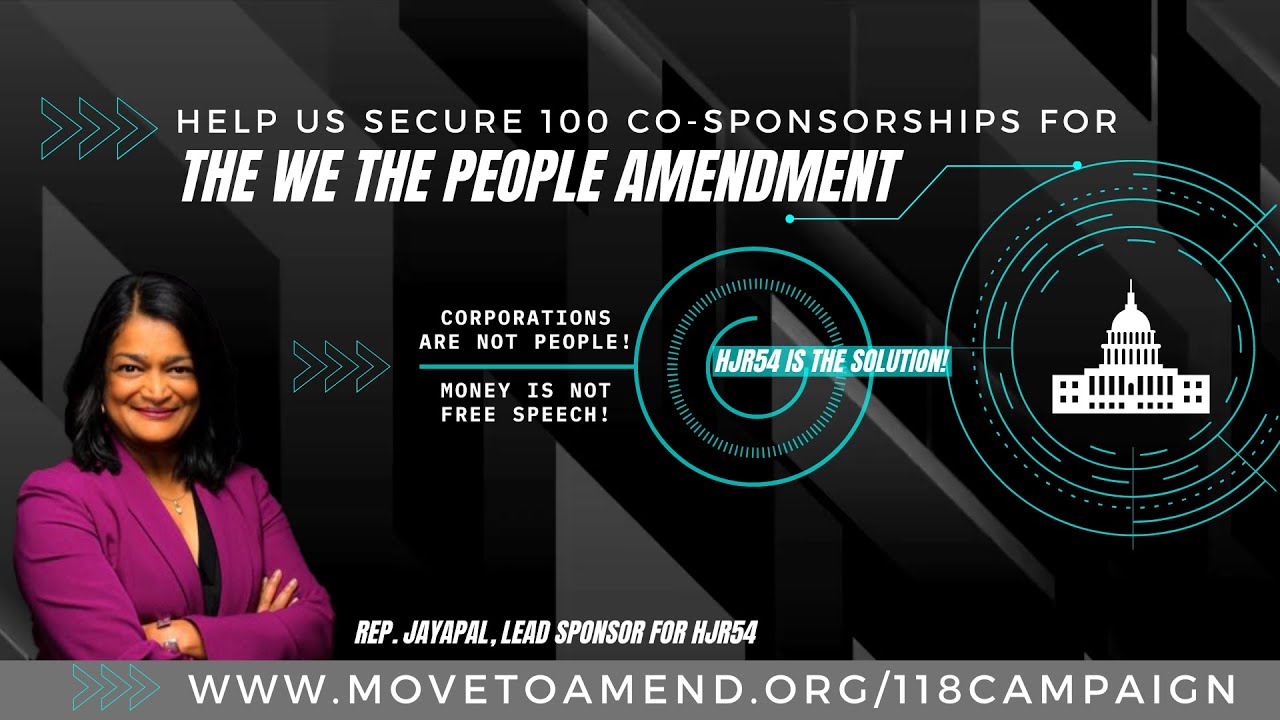
WASHINGTON — U.S. Representative Pramila Jayapal (WA-07) introduced an amendment to the U.S. Constitution that would end corporate personhood, reverse Citizens United, put power back into the hands of people, and make it clear that money does not equal speech.
“Corporations are not people and money is not speech,” said Jayapal. “In every election cycle since the disastrous Citizens United decision, we have seen more and more special interest dark money poured into campaigns across the country — this year, with a billionaire paying millions to buy a seat as Shadow President. My We the People Amendment hands power back to the people by finally ending corporate constitutional rights, reversing Citizens United, and ensuring that our democracy is truly of the people, by the people, and for the people – not corporations.”
“We applaud Rep. Pramila Jayapal for her leadership in sponsoring HJR54, the We the People Amendment. Rep Jayapal clearly understands that the changes she and many of her colleagues support to advance health care, expand economic justice, ensure a livable world, and promote real democracy are incredibly difficult but necessary. This is especially true given the unjustifiable Supreme Court decisions declaring corporations as entities with many of the same constitutional rights as human persons and that money spent in elections is equivalent to First Amendment-protected free speech,”said Cole Bennett, Legislative Co-Director with Move to Amend. “The exponential growth of corporate power and corrupting political influence from huge sums of money flooding elections can only be solved with a systemic solution that is equivalent in scale to these systemic problems — the We the People Amendment, which will end all corporate constitutional rights and money as free speech.”
The We the People Amendment specifies that the rights provided by the Constitution are for people, not corporations and that artificial entities have no Constitutional rights, ending the 2010 Citizens United decision. The amendment also works to get big money out of politics after the most expensive campaign in American history. Additionally, the joint resolution mandates that Federal, state, and local governments require that all political contributions and expenditures be publicly disclosed.
In the election cycle immediately following Citizens United decision, independent spending increased by more than 600 percent compared to the previous election cycle. This spending created an enormous imbalance in power, dramatically limiting the average American’s ability to influence elected officials. The ruling also enabled corporate personhood, granting the freedom of expression to corporations.
The We the People Amendment is co-sponsored by Alma Adams (NC-12), Shontel Brown (OH-11), Salud Carbajal (CA-24), Joaquin Castro (TX-20), Judy Chu (CA-28), Yvette Clarke (NY-9), Rosa L. DeLauro (CT-3), Lloyd Doggett (TX-37), Maxwell Frost (FL-10), Raúl M. Grijalva (AZ-7), Henry C. “Hank” Johnson, Jr. (GA-4), Ro Khanna (CA-17), Summer Lee (PA-12), Seth Magaziner (RI-2), Betty McCollum (MN-4), Seth Moulton (MA-6), Jerrold Nadler (NY-12), Eleanor Holmes Norton (DC-AL), Alexandria Ocasio-Cortez (NY-14), Jimmy Panetta (CA-19), Scott Peters (CA-50), Delia Ramirez (IL-3), Andrea Salinas (OR-6), Rashida Tlaib (MI-12), Paul Tonko (NY-20), Juan Vargas (CA-52), Nydia M. Velázquez (NY-7), and Nikema Williams (GA-5).
KATIE SOC MED
Katie Krasinski, Co-Director KATIEat
YMAIL 12 25
We need to dramatically expand our Corporate Rule Stories
Move to Amend has begun collecting examples of literature, music, films and poems on our Creative Resistance page.
| Cultural Change for the We the People Amendmenttenth in the***series*** |
The Populist movement of the late 19th century was the largest democratic mass movement in U.S. history. The movement included several parallel but independent organizations of farmers in the South, Midwest and High Plains. The movement later included urban working people across the country Among the social movements covered in this series, the Populist movement is the least recognized (dare I say “popular”) and understood. Few can name any of its organizers, strategists or speakers (William Jennings Bryan doesn’t count, as explained below). There are no Populist movement holidays, postage stamps, detailed descriptions of its activities in high school history books, or even legitimate recognition of its lessons (positive or negative) incorporated in democratic activist organizations. The movement’s relative invisibility can be explained by several factors. First, it was largely a rural movement that was the most active in a part of the country (i.e. the Midwest and South) not associated with the mass social movements. Second, it occurred during a period of U.S. history that was dominated by the rapid rise of industrialization and urbanization. And maybe, most significantly, its goals of creating an authentic bottom up democracy and bringing the corporate state under popular control through democratic politics, a democratic society grounded in mass dignity, was not going to see the light of day in our dominant corporate culture, which includes reformist non-profit democracy organizations. Farmers were experiencing extremely hard times in the 1870’s. This was the age of growing economic and political power of corporations (railroads and banks in particular), trusts and capitalist Robber Barons. The ownership of both industrial and agricultural land was being increasingly centralized. The dominant American cultural narrative of perpetual progress wasn’t being felt by millions of farmers, especially in the South, who were either in severe debt or foreclosed on their mortgages and became tenant farmers due to the furnishing merchants of the crop-lien system. When the “money power” (i.e. banks) successfully removed federal Greenbacks from federal circulation, deflation resulted in falling agricultural prices. Extreme drought and the poor quality of land for farming were additional factors. The cultural message conveyed by the power elite to Farmers was that they were “lazy,” inherently inferior,” or in other ways at fault for their conditions. Ingraining indignity and inferiority was the deliberate aim to ensure passivity, resignation, deference, and social control; to erode any aspirations for significant democratic change; and to preserve the growing corporate culture that was projected as “democratic.” Some farmers who had personally experienced or witnessed economic hard times and wanted to be politically active began to educate themselves and come together. A group gathered in 1877 in Texas and formed an organization that would a year later become the Grand State Farmer’s Alliance. Its county and state structure was to be a rural organization of self-help. S.O. Daws, considered the “First Populist,” had developed a high degree of political self-respect. He believed the crop-lien system was oppressive and that those who experienced it had a right to speak out and seek change. To attain a mass democratic “insurgent movement,” Daws, William Lamb and other leaders in what became the national Southern Farmer’s Alliance felt an “insurgent culture” must be created. To combat the demoralization of the hard times, individuals needed to acquire a new way of looking at themselves -- a personal self-respect and collective confidence and hope that fundamental chance was achievable. Cultural change was just as important as economic and political change. Populist strategy and work attempted to proceed sequentially – that is, stages that occur in an order that maximized the chances of creating a powerful democratic mass movement. The four stages for any democratic mass movement to be successful, as Lawrence Goodwyn in The Populist Moment describes, are: “(1) the creation of an autonomous institution where new interpretations can materialize that run counter to those of prevailing authority -- a development which, for the sake of simplicity, we may describe as ‘the movement forming’; (2) the creation of a tactical means to attract masses of people -- ‘the movement recruiting’; (3) the achievement of a heretofore culturally unsanctioned level of social analysis -- ‘the movement educating’; and (4) the creation of an institutional means whereby the new ideas, shared now by the rank and file of the mass movement, can be expressed in an autonomous political way -- ‘the movement politicized.’” The degree of success of each stage is directly tied to the success of the previous ones. The growth of the movement is severely limited if any single stage is not fully developed. Each of these stages create formal structures, programs and strategies seeking structural democratic change. For the Populists, each stage also provided the opportunity to create or affirm “insurgent culture.” Here are examples of the accomplishments of each stage in the Populist’s effort to build a democratic mass movement, including how each contributed to an “insurgent culture.” Movement formation - The initial Texas (Grand State) Farmers Alliance was the first of several southern and a few western state Alliances that made up the National Farmers Alliance and Cooperative Union (also known as the Southern Farmer’s Alliance) of white farmers. An equivalent Northern Alliance of white and black farmers existed in the upper Midwest and High Plains states. There was also a separate Colored Farmers' National Alliance and Cooperative Union, consisting of black farmers of the South. National alliances, especially the Southern Alliance, organized state alliances, which organized town or county-based suballiances. These numbered in the thousands. The Movement involved 2.5 million people. The Alliancescreated separate organizations to address the economic needs, such as National Farmer’s Alliance Exchange Organization. These organizations offered members who had always been told they were inferior and powerless the democratic infrastructure to talk, learn, plan, decide and build relationships, as well as to work in solidarity for democratic change. They provided the insulation from the dominant hierarchical culture to overcome deference and gain self-respect. They were acting individually, but collectively with others. Movement recruitment - A mass movement needs masses of people. Sloganeering or pointing out problems is insufficient compared to meeting people’s immediate needs. The Populists produced programs and several radical plans to attract members.The Alliance created the world’s first large scale worker’s cooperatives, organizations to collectively buy supplies and market their crops. Cooperatives included retail stores, mills, and storehouses, which lowered costs and increased profits to members by cutting out middlemen. This attracted farmers by the millions who had previously had to negotiate on their own with bankers and companies they bought from and sold to. Cooperatives were a way for farmers to gain more economic and political power through collective action. They believed they could become free individually by working together. Cooperatives allowed farmers to experience an autonomous democratic culture in their daily lives through their own direct involvement, in opposition to the dominant hierarchical structure of society. It also demonstrated who their enemies were when they negotiated with bankers and merchants. The Alliances also supported the Greenback movement in calling for democratic money creation that would, if implemented, reduce their own debt, as well as the power of banking corporations. They also developed their own financial alternative, the Subtreasury Plan, which called for the federal government to build warehouses where farmers could store crops and receive low-interest loans against them. The goal was to help farmers hold onto their crops when prices were low after harvest, allowing them to wait for better market conditions and receive cash immediately to pay debts. The Plan was proposed by Charles Macune, a brilliant Southern Alliance leader. Subtreasury was an empowering idea that gave farmers a cultural sense that their movement was more capable of addressing poverty, indebtedness and the financial power of the financial system. It increased their confidence and self-identity. Movement education – Establishing organizations from the national to local levels and using those structures to recruit people by addressing their immediate economic needs are important sequential steps, but by themselves do not dismantle economic and political structures of society that remain oppressing and undemocratic. The next step for the Populists, interconnected to some extent with recruitment, was internal economic and political education that went beyond the learnings of farmers within their cooperative about the corporate system of economic power and privilege. This was achieved through traveling lecturers – individuals who either came into the movement with a high degree of self-respect and awareness/personal experience of the dominant economic and political system, or who were recruited from existing Alliance members and trained. Lecturers would speak on the backs of wagons or halls as they traveled from town to town. They large numbers of people who were inspired and gained confidence and a collective desire to seek political change not only from what they heard, but from being in the presence, often, of thousands of others who attended. There were 40,000 lecturers in the Alliance lecturing system. Newspapers were published in all the branches of the Alliance – especially in the Northern Alliance. Examples included the American Nonconformist (Iowa) Kansas Farmer, Western Rural and Family Farm Paper (Chicago), Progressive Farmer (N. Carolina), and Alliance Vindicator (Texas). In addition, there was the National Economist, Washington, D.C. The National Reform Press Association united 1000 populist newspapers across the nation. Traveling lecturers and newspapers served as critical internal communication methods for the movement to insulate and defend itself from the external propaganda of the corporate culture about what was possible and who was worthy to participate. This resulted in enhanced individual self-respect, collective self-confidence and a dramatic increase in political awareness, which helped crystallize the necessity to become directly involved in electoral politics. This included reaching out and forming alliances with working people and national labor organizations. Movement politicized – The cooperative movement of the Alliance branches were aggressively opposed by corporations. Bankers, commodities brokers, and railroads retaliated by boycotting the Alliance. This eventually undermined the cooperatives' effectiveness. Farmers realized the current corporate-dominated economic system made their efforts impossible. It pushed farmers to form the People’s Party to pursue political solutions to their economic problems. They also developed political demands and statements.The most notable were the Ocala Platform and Omaha Platform. The latter, adopted by the People’s Party at their 1892 convention, called for a graduated income tax; the Subtreasury Plan; the direct election of senators, government ownership of railroads, telegraph lines and other key industries; the eight hour workday; postal savings banks; and the secret ballot. Populists ran candidates at all levels of government, electing two U.S. Senators, 45 U.S. Representatives and numerous governors. However, following the defeat of their Presidential candidate, James Weaver, in 1892, they decided to “fuse” with the Democratic Party and support William Jennings Bryan in the 1896 Presidential election. This split the movement, since Bryan did not support many of the items of the Omaha Platform. The party and movement never recovered. Some of its individual proposals were adopted by the new “Progressive” movement of the early 20th century and passed into law, including the graduated income tax, postal savings banks, and eventually the eight hour workday. The direct election of U.S. Senators became the 17th Amendment to the U.S. Constitution. The Populist Party served as a critical cultural “bridge” for farmers who had previously been loyal (yet ignored) by one or the other of the major parties: poor white farmers by Democrats and by poor black farmers by Republicans. It was an important awakening. They saw politics as a cultural struggle to create humane ways to relate to one another, to be ideologically free from the defined limitations of possibilities, and to aspire for a new democratic culture and democratic institutions. Cultural Lessons for Move to Amend
Move to Amend supporters face many of the same forces today, but are more powerful, polished, well funded, and culturally ingrained. MTA leadership continuously reinforces the messages that citizens and residents have the right and duty to amend the U.S. Constitutiongiven its serious flaws and that the elements to be abolished in the We the People Amendment – “a corporation is a person” and “money equals speech” – are illogical and absurd. We emphasize that individuals who support us in any way – educating, advocating, organizing or contributing – are leaders who, when grounded in the knowledge of the history of corporate constitutional rights and money as speech, often know more on the subjects than the public officials, political aides, journalists and educators who they encounter. This helps build self-confidence and respect, as well as the commitment to educate and organize others.
We’ve worked in our own way to build an “insurgent culture” of probably several thousand self-respecting and confident supporters over our history through our national, affiliate, and partner networks. We’ve produced an impressive array of educational materials on corporate constitutional rights, the We the People Amendment and social change in general – including our Movement Education Program, videos, on-line presentations, and printed material. We’re active on social media and even organized for many years our populist-branded “Barnstorm” speaking tours in cities and towns in almost every state. But it's not been sequential and its effectiveness has been limited by the incomplete efforts of building and maintaining local, state and regional organizations; as well as the inability to recruit masses of people by programmatically addressing their immediate felt needs. And of course, we don’t have a political party to independently drive our democratic goals through the electoral area. A mass democratic movement is needed. It will have to be larger than any single organization – more like a coalition. Move to Amend and the We the People Amendment must be included. The coalition will need to include all four sequential stages. It will have to break free from the current dominant narrative that we live in an authentic democratic republic, which we’ve never had. It will need to be psychologically committed to fundamental change – legislative, but also constitutional. It will need to include a recruitment component – something that can help people who are increasingly hurting due to the growing economic crisis. Times have changed. We need to change with them. This very well may need to include a new grassroots, democratically based political party that hasn’t been captured by billionaires and corporate entities or defers to the leadership of any single political candidate. It’s a big agenda, but like the Populists, there must be a new way to look at ourselves and a new way to envision the future.
Racism was used by white Southern Democrats party officials to divide lower-class white farmers from black farmers to undermine the movement. Democrats in some cases divided farmers by supporting some Populist proposals while at the same time supporting plans to disenfranchise Blacks. Move to Amend leaders need to continue to consciously and persistently declare and demonstrate through our actions that the attainment of an equitable democracy is unattainable if the power elite can effectively play the “race card.” Race and gender justice are not “side issues” or unrelated to the issues of corporate rule and the corruption of big money in political elections. We are currently witnessing the continued effectiveness of how race and nationality around immigration are being used to divide people from seeing their common interests to fundamentally challenge growing authoritarianism. We need to publicly condemn and oppose ongoing oppression of people of color and all those who are currently being exploited to justify authoritarian measures.
The same urge exists among many working on democracy issues currently to simply (1) elect more Democrats, (2) pass better democratic laws, and/or, if at all focused on constitutional change, to (3) simply overturn the Citizens United decision. Call it a brand new, same old story. Let corporate constitutional rights for the most part remain. Don’t touch the constitutional decision that equates money as free speech. Support an alternative loophole-laced amendment that isn’t as comprehensive as the We the People Amendment. Nothing could be further from what’s needed. In reality, given the flagrant broken political system we’re facing in which the Trump Regime is exploiting, undermining or simply ignoring the Constitution, it’s clear that fundamental constitutional renewal is urgent. It requires more than what democratic improvements can be achieved through any single amendment. There must be an entire package. The We the People Amendment must be included. ___ The most important take-a-way of the 19th century Populist Movement is the realization that the only means to create a genuinely equitable democracy society is to create a genuinely equitable democracy mass movement. Participants of that movement must not only support candidates and platforms calling for democratic change, but must actively and consistently be meaningfully engaged in the structures, plans and programs of that movement that provides direct assistance to those in need and works for fundamental structural political and economic change. This is how a democratic “insurgent culture” will be created and sustained. In solidarity Greg Coleridge National Co-Director |
fs4ppl
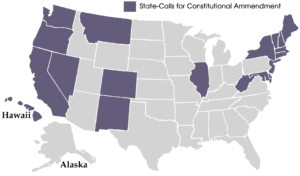
Across the country, sixteen states have passed resolutions calling for a constitutional amendment to overturn Citizens United.
Passed Resolutions
California
AJR 22. Assembly members Weickowski and Allen. Passed on July 7, 2012. Expresses disagreement with the Citizens United ruling and calls on the United States Congress to pass a constitutional amendment. Click here for the full text of the resolution.
Colorado
Amendment 65. On November 6, 2012, Colorado became one of the first two states to endorse an amendment through a statewide vote. I-82 was passed by over 74% of voters in Colorado. Click here to view the initiative text.
Connecticut
On May 1, 2012, Senator Slossberg and Representative Morin presented a letter signed by a majority of Connecticut House and Senate members calling on Congress to pass an amendment to overturn the U.S. Supreme Court’s Citizens United v. Federal Election Commission and related decisions. Click here to read the letter.
Delaware
On June 10, 2013, a bipartisan majority of both houses of Delaware’s General Assembly Members signed a letter calling on Congress to pass a constitutional amendment reversing the U.S. Supreme Court’s ruling in Citizens United v. Federal Election Commission. Click here to read the letter.
Hawaii
HCR 282. Representative Herkes. Resolution passed on April 28, 2010. Expresses disagreement with the Citizens United ruling and calls on the United States Congress to pass a constitutional amendment barring the use of “person” when defining “corporate entity.” Click here to read the text of the resolution.
Illinois
SJR 27. Senators McConnaughay and Althoff. Introduced March 13, 2013. Urges Congress to adopt a constitutional amendment reversing the Citizens United v. FEC ruling and related cases by clarifying that corporations and other artificial entities are not people with constitutional rights, and that money is property, not speech, and therefore can be regulated. Passed Senate on 5/14/2013. Placed on Calendar Order of Resolutions in House on 5/23/13. Passed the house on 5/31/13. Click here to read the text of the resolution.
Maine
SP 548. Senator Woodbury. Resolution passed on April 30, 2013. Joint resolution memorializing the United States Congress to pass a constitutional amendment to reverse the ruling of the United States Supreme Court in Citizens United v. Federal Election Commission. Click here to read the press release.
Maryland
Senator Raskin presented a letter to the Maryland General Assembly on January 19, 2012. The letter expresses the Maryland legislature’s opposition to the Supreme Court’s decision on Citizens United and calls for a constitutional amendment. A majority of members in the House and Senate have signed the letter. Click here to read the letter.
Massachusetts
S 772. Senator Eldridge. Resolution passed on July 26, 2012. Free Speech For People resolution calling on the United States Congress to pass and send to the states for ratification a constitutional amendment to restore the First Amendment and fair elections to the people. Click here to read the text of the resolution.
Montana
I-166. On November 6, 2012, Montana became one of the first two states to endorse an amendment through a statewide vote. I-166, the Prohibition on Corporate Contributions and Expenditures in Montana Elections Act, was passed by 75% of voters in Montana. Click here to view the initiative text.
New Jersey
SR 47. Senator Van Drew and Senator Stack. Resolution passed on October 4, 2012. Resolution expressing strong opposition to the U.S. Supreme Court’s decision in Citizens United v. Federal Elections Commission, and calling upon Congress to propose amending the U.S. Constitution. Click here to read the text of the resolution.
New Mexico
HM 4. Representative Stewart. Passed on January 13, 2012. House Memorial calling on the US Congress to pass and send to the states for ratification a constitutional amendment to overturn the US Supreme Court’s ruling in Citizens United v. FEC and to restore republican democracy to the people. Click here to read the text of HM4.
SM 3. Senator Fischmann. Passed on February 11, 2012. Senate Memorial calling on the US Congress to pass and send to the states for ratification a constitutional amendment to overturn the US Supreme Court’s ruling in Citizens United v. FEC and to restore republican democracy to the people. Click here to read the text of SM3.
Oregon
HJM 6. Representatives Clem and Holvey. Passed July 1, 2013. Joint memorial urging Congress to pass and send to the state a Constitutional amendment clarifying the distinction between the rights of natural persons and the rights of corporations and other legal entities; and clarifying that Congress and state legislatures may regulate all moneys raised and spent for political purposes. Click here to read the text of HJM6.
Rhode Island
S 2656. Senator Paiva Weed. Passed May 21, 2012. Joint resolution urging Congress to pass and send to the states a Constitutional amendment permitting state and federal regulation and restriction of independent political expenditures. Click here to read the text of S2656.
H 7899. Representative Fox. Passed in the House on May 30, 2012. Joint resolution urging Congress to pass and send to the states a Constitutional Amendment permitting state and federal regulation and restriction of independent political expenditures.Click here to read the text of H7899.
Vermont
JRS 11. Senator Lyons. Passed on April 19, 2012. Joint resolution urging the United States Congress to propose amendments to the United States Constitution for the states’ consideration relating to contributions and expenditures intended to affect elections and relating to the rights of corporations. Click here for additional information, including the full text of the resolution.
West Virginia
SR 24. Senators Snyder and Kessler. Passed on April 13, 2013. Opposing the United States Supreme Court’s interpretation of the Constitution in Citizens United v. Federal Election Commission regarding the constitutional rights of corporations; supporting an amendment to the Constitution to provide that corporations are not entitled to the entirety of protections or rights of natural persons, specifically so that the expenditure of corporate money to influence the electoral process is no longer a form of constitutionally protected speech; and calling on Congress to begin the process of amending the Constitution. Click here to read the text of S.R. 24.
---
Citizens United: People Power Pushes to Amend
reclaim
20 States, 800 Localities Vote to Roll Back ‘Citizens United’
Twenty states from coast to coast, reacting against the Citizens United decision, have gone on record in favor of a U.S. constitutional amendment to restore the power of Congress and the states to put some limits on campaign spending. At the local level, too, there’s a crescendo in the call for reform. Roughly 800 local governments from Sarasota, FL to Midway City, KY, and Conway, Arkansas to Salt Lake City, Utah and San Luis Obispo, California have also demanded constitutional action to reinstitute controls on campaign spending.
State actions have come either through popular referendums, legislative resolutions, or collective letters from state legislators to Congress. Among cities, the Los Angeles referendum in May 2013 is fairly typical. Passed by a 77% majority vote, it instructed elected officials to press for an amendment, stating that “there should be limits on political campaign spending and that corporations should not have the constitutional rights of human beings.”
Check our state-by-state rundown below to find out where your state stands or whether actions have been taken by major cities near you. The states that have taken action include California, Colorado, Connecticut, Delaware, Hawaii, Illinois, Maine, Maryland, Massachusetts, Montana, Nevada. New Hampshire, New Jersey, New Mexico, New York, Oregon, Rhode Island, Vermont Washington, and West Virginia, plus the District of Columbia. There have been other movements to join that list in Arkansas, Florida, Iowa, and Minnesota.
The Push for Reform Came Fast
Grassroots reaction came swiftly against the Supreme Court’s ruling in January 2010 in Citizens United that authorized unlimited spending by corporations and unions from their general treasuries.
:{
Just three months later, the state legislature in Hawaii passed a resolution calling on Congress to propose and send to the states a Constitutional Amendment restoring to Congress and the states the power to regulate corporate campaign donations.}:
In 2012, legislatures in Vermont, Massachusetts, New Jersey, and California, passed similar resolutions. In 2013, legislative action for a constitutional amendment was taken by Illinois, Maine, New Mexico, Oregon, and West Virginia.
As the movement spread, some states took a different approach. In Delaware and Maryland, a majority of the state’s Senate and House of Delegates signed a letter to Congress calling for a Constitutional amendment. In Connecticut, a majority of the state’s senators and representatives signed a similar letter. In New York, majorities of lawmakers in both houses of the state legislature signed five different letters from different party caucuses, all calling for a constitutional amendment to reverse the impact of the Citizens United ruling and restore legislative power to regulate campaign finance.
Groundswell from the Grass Roots
But the most striking show of popular discontent and the most visible popular groundswell for campaign reform came in in the November 2012 elections in the states of Colorado and Montana. The votes in those two states demonstrated that at the grassroots, the drive to control the rising tide of Mega Money in elections draws support from across the political spectrum – from Republicans, independents, and Democrats
In Colorado, every single county in the state had a majority in favor of reform – those that are predominantly Republican as well as those dominated by Democrats or counties that are a mix of D’s, R’s, and independents. The reform measure was backed by more than 1,650,000 voters or roughly 73% of the total vote. the margin of victory was similar in Montana.
In the November 2016 elections, ballot initiatives for an anti-Citizens United constitutional amendment won solid majorities in popular vote referendums in California and Washington State.
Congress Is Out of Step with Voters
Even so, Congress still resists what opinion polls show to be the demand of a large majority of voters for reform on campaign finance. In September 2014, a majority of U.S. Senators voted in favor of a constitutional amendment but their 54-42 majority fell short of the 60 votes needed to overcome the threat of an opposition filibuster. It was a partisan clash: All 42 “No” votes came from Republicans and all 54 “Yes” votes came from Democrats.
But solid Republican opposition to systemic reforms is splintering. During the 2016 presidential primary campaign,GOP presidential contenders. Sen. Lindsay Graham of South Carolina and former Florida Governor Jeb Bush came out in favor of a constitutional amendment. In various states, some Republican legislators support reforms to curb runaway campaign spending as does U.S. Rep. Walter Jones, a North Carolina Tea Party Republican. “If we want to change Washington and return power to the citizens of this nation, we have to change the way campaigns are financed,” Jones asserts. “The status quo is dominated by deep-pocketed special interests, and that’s simply unacceptable to the American people.”
New Hampshire Towns Vote Yes
New Hampshire is typical of states where a constitutional amendment on MoneyPolitics has generated a clash between elected lawmakers and grassroots opinion. New Hampshire still uses traditional town meetings and local petitions to let voters take a stand on issues. Since 2014, voters in 69 towns have passed local ballot initiatives calling for a constitutional amendmentto reverse the Citizens United decision and to limit campaign spending.
In May 2014, heeding the town votes, a solid majority of the New Hampshire House of Representatives – 154 Democrats joined by 29 Republicans – voted in favor of a constitutional amendment resolution. But ten days later, the Republican majority in the state senate voted 12-11 to block the proposal.
In 2015, campaign reform was back on the legislature’s agenda, with Republicans controlling both houses. The Senate gave unanimous bipartisan approval to a bill “recognizing the need” for a U.S. constitutional amendment and tasking a study committee to analyze the options. But the house did a zig-zag dance. A strong resolution endorsing a constitutional amendment narrowly passed, but minutes later, with the electronic voting machines malfunctioning, that vote was reversed. Vote switching by 13 house Republicans killed the bill, setting up constitutional reform as a campaign issue in 2016.
Taking Voter Protest to the U.S.Capitol Steps
Even with all the popular backing already generated, any effort to amend the U.S. Constitution entails a sustained popular campaign for passage. As polls indicate, so many Americans are angry about skyrocketing campaign spending by corporations and the super-rich that the issue keeps gaining momentum around the country.
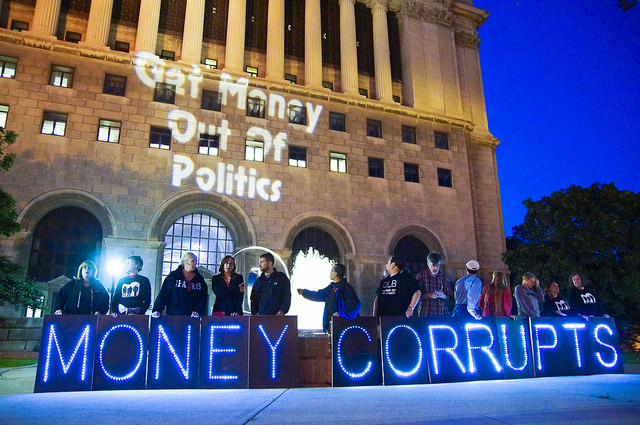
Protestors on U.S. Capitol steps demand MegaMoney out of politics. (Hedrick Smith)
Average Americans say they don’t want to see American democracy on the auction block, sold to the highest bidder. Popular grassroots pressures have caused hundreds of city councils, county commissions, and state legislators to endorse a constitutional amendment.
In April 2016, several thousand Americans took a week of protest marches to the U.S. Capitol steps to underscore public anger at Congress for ignoring popular demands for constitutional reforms to restore controls on campaign spending. In an echo of the civil rights protests of the 1960s, demonstrators who came from as far away as Guam and Presque Isle, Maine and some of whom marched by foot 140 miles from Philadelphia, engaged in civil disobedience, deliberately inviting arrest to try to force Congress to take notice.
In all, 1,300 people were arrested, including such leaders as Kai Newkirk of 99Rise, Robert Weissman of Public Citizen, Larry Cohen, former president of the Communications Workers of America, Cornell Brooks of the NAACP, Rev. William Barber, leader of North Carolina’s Moral Monday movement, and Ben Cohen and Jerry Greenfield of Ben & Jerry’s ice cream. Several thousands more marchers and activists cheered those who dared arrest.
“I believe that courage is contagious,” said demonstrator Frances Moore Lappe of Boston.”If other people see us taking action, then I think they’ll have the courage to join in.” Newkirk said it was crucial to move beyond emails and tweeting to direct action to show politicians how strongly Americans feel about the money corrupting our democracy. Weissman asserted that the protest week organized by the Democracy Spring and Democracy Awakening signaled that the reform movement is stepping up its militancy.
A Legal Move to Undercut SuperPAC Funding
Three months later, in July, a bipartisan group of six members and candidates for Congress made a direct challenge to the funding of SuperPACs in a formal complaint to the Federal Election Commission. With a high profile bipartisan Legal team drawn from Harvard and the Bush Administration, they argued that the D.C. Circuit Court of Appeals, in theSpeechNow.org case, had stretched the Supreme Court’s Citizens United decision in a way that left a ceiling on contributions to candidates but no limits on funding for SuperPACs.
“The situation … is one that Congress never enacted and people would never support,” said Laurence Tribe, professor of constitutional law at Harvard. “The law permits a very severe limit on the amount an individual can give to someone’s campaign, but at the same time that could be evaded by giving millions to SuperPACs….The Supreme Court never approved anything like that.”
But with the FEC paralyzed for years by a three-to-three Republican-Democratic split, analysts were dubious about the prospects for the complaint. In a comment to The Washington Post, conservative election law attorney James Bopp Jr. dismissed it as “a case going nowhere.”
Check Your State in Our 50-state Rundown:
Alabama:
- No State Action taken.
Alaska:
- Feb. 8, 2013- Legislation is introduced for Constitutional amendment to reverse Citizens United decision and restore the power of Congress and states to regulate campaign spending. No decisive legislative action is taken.
Arizona:
- Jan. 29, 2014 – Bill introduced for Constitutional amendment to reverse Citizens United decision and restore the power of Congress and states to regulate campaign spending. No decisive legislative action is taken.
California:
- June 23, 2014 – California State Senate, on a party-line vote of 23-11, passed a legislative resolution asking Congress to call a constitutional convention that would draft an amendment allowing limits on corporate campaign financing.
- California’s Assembly, or lower house, had previously approved the measure, meaning that the Senate vote cleared the resolution for submission to Congress. The governor’s approval was not needed. California thus became the second state after Vermont to formally call for a constitutional convention.
- California’s proposal declared, among other things, that money is not speech and that corporations do not have the same scope of political rights as human beings. “I doubt our founding fathers had the free-speech rights of multinational and foreign corporations in mind when they drafted the First Amendment,” said Assemblyman Gary Gatto D-Los Angeles, author of the resolution.
- June 8, 2016 – Broad reform coalition wins green light from Governor Jerry Brown for California popular vote in November on a referendum calling for an amendment to U.S. Constitution,revoking Supreme Court’s Citizens United decision and restoring power of Congress and states to regulate campaign funding and spending. In late May, the California legislature voted to put the issue on the ballot, saying the Supreme Court decision had allowed unlimited corporate spending – what some lawmakers called “a destructive force” – in political campaigns. Brown gave a green light for the popular vote. In 2012, similar measures won sweeping public majorities in Colorado and Montana.
- Nov. 8, 2016 – With a 52% majority and a positive vote by 4.4 million voters, California passes proposition 59 calling for the California delegation to take action in Congress to work for passage of an amendment to the U.S. Constitution, overturning the Supreme Court’s Citizens United decision and restoring the power of Congress and the states to regulate campaign donations and spending. Similar resolutions have passed by popular vote in Colorado, Montana, and Washington State. Thirty-two Democrats in California’s 53-member House delegation already co-sponsor legislation to start ratification of a constitutional amendment. But some House members, such as Republican Doug La Malfa, say they do not feel bound by the voters’ referendum, and others such as Republicans Dana Rohrbacher and Ken Calvert declined to take a position.
Colorado:
- Nov. 6, 2012 – Colorado voters pass ballot referendum, called state Amendment 65, by a 73.8% popular majority instructing Colorado’s Congressional delegation to support and promote “an amendment to the U.S. Constitution that allows Congress and the states to limit campaign contributions and spending that allow all citizens, regardless of wealth, to express their views to one another on a level playing field.”
Connecticut:
- May 1, 2012 –Majority of both of houses of Connecticut legislature – 88 Democratic state representatives and 22 democratic state senators, including house speaker, senate president, and majority leaders of both houses – sign a letter to five of Connecticut representatives in Congress calling for action to overturn Supreme Court’s *Citizens United* decision. The letter states that it is “written in support of the Constitutional Amendment to overturn Citizens United vs. FEC and restore elections to the people.”
- Jan. 2013 – A state senator and state representative introduce bills calling for increased transparency of corporate political spending and a congress to initiate action on a constitutional amendment limiting the first amendment’s personhood to individuals. Both bills are referred to committee and no further action is taken.
Delaware:
- June 10, 2013 – A majority of both houses of Delaware legislature – 11 state senators and 24 representatives – sign a letter calling to Delaware’s congressional delegation calling for Congress to take action to pass a constitutional amendment reversing the Citizens United ruling. The group letter was signed by 32 Democrats and 3 Republicans.
District of Columbia:
- Feb. 5, 2013 – DC City Council unanimously passes a resolution characterizing Citizens United ruling as “a serious and direct threat to our democracy” and calling upon Congress to propose a constitutional amendment overturning Citizens United.
Florida:
- October-November 2011 – South Miami and Orlando City Councils pass resolutions calling for a constitutional amendment to reject Supreme Court rulings that recognize “corporate personhood” and “money is speech” in election campaigns.
- Jan. 5, 2012 – Members of Florida House and Senate introduce “The People’s Rights Amendment’ resolution urging Congress to pass a constitutional amendment to overturn the Citizens United decision. Bills are referred to committee and no further legislative action is taken.
- March 2012 – City Councils in Tampa Bay and Key West adopt resolutions “condemning” the Citizens United decision and calling for a constitutional amendment to “rectify” Supreme Court rulings on campaign spending.
- January-August 2013 –Gainesville City Commission and Sarasota County Council pass resolutions calling for a constitutional amendment stating that corporations are not people and money is not speech.
Georgia:
- Feb. 15, 2013 -Legislation is introduced for Constitutional amendment to reverse Citizens United decision and restore the power of Congress and states to regulate campaign spending. No decisive legislative action taken.
- Feb. 28, 2013 – second bill introduced. No decisive legislative action taken.
- Sept. 15, 2014 – Atlanta City Council votes 12-2 in favor of Constitutional amendment to restore power of Congress to regulate campaign spending, joining 550 other U.S. cities that have taken similar action.
Hawaii:
- April 28, 2010 – Hawaii’s state House and Senate pass a resolution requesting that “the U.S. Congress propose and send to the states for ratification a constitutional amendment to clarify the distinction between the rights of natural persons and the rights of corporations,”
- March 19, 2014, a bill introduced by Hawaii’s House Judiciary Committee chairman Rep. Karl Rhoades dies in Hawaii’s Senate Judiciary Committee.
Idaho:
- Feb. 24, 2010 – Legislation introduced for Constitutional amendment to reverse Citizens United decision and restore the power of Congress and states to regulate campaign spending. No decisive legislative action is taken.
Illinois:
- July 25, 2012 -Chicago Board of Aldermen passed a resolution calling for a constitutional amendment that would provide that “the rights protected by the Constitution are the rights of natural persons,” and that “Congress and the States shall have the power to regulate and set limits on all election contributions and expenditures.”
- Nov. 2012 – 74% majority of Chicago voters backed a Take Back Our Vote measure asking Congress to pass a resolution setting in motion the process of “adopting an amendment to the U.S. Constitution, empowering the federal government and the states to regulate and limit political contributions from corporations?”
- May 31, 2013 – Illinois House of Representatives passes resolution, previously passed by state senate on May 14, calling on Congress to move to amend the Constitution, asserting“that such an amendment should make clear that the rights of persons protected by the Constitution are the rights of natural persons and not those of corporations or other artificial entities.”
Indiana:
- No state action on issue.
Iowa:
- March 13, 2012 – Iowa senate passes a resolution by voice vote condemning the Supreme Court’s decision in Citizens United case, asserting that First Amendments rights of free speech are intended for people and not corporations, andcalling on Congress to pass legislation to “regulate and restrict corporate participation in election campaigns.“
- No parallel action is taken by the Iowa house of representatives.
Kansas:
- Jan. 28, 2013 – Bill is introduced for Constitutional amendment to reverse Citizens United decision and restore power of Congress and states to regulate campaign spending. No decisive legislative action taken.
Kentucky:
- Jan. 8, 2013 – Bill introduced for Constitutional amendment to reverse Citizens United decision and restore power of Congress and states to regulate campaign spending. No decisive legislative action taken.
Louisiana:
- No state action is taken on this issue.
Maine:
- April 30, 2013 – Maine’s Senate and House pass joint resolution calling on the state’s Congressional delegation to support and promote a constitutional amendment in Congress reaffirming the “the power of citizens through their government to regulate the raising and spending of money in elections.”
Massachusetts:
- July 2012 – Massachusetts Senate and House pass a resolution characterizing the Citizens United ruling as a “threat to our democracy” and calling for the U.S. Congress to “restore the First Amendment and fair elections to the people.”
Maryland:
- April 2012 – A majority of Maryland’s House of Delegates and State Senate sign a letter calling on Congress to pass and send to the states for ratification “as soon as is practicable” a constitutional amendment revoking the Supreme Court’s Citizens United decision and restoring fair elections.
- In their collective letter, state’s legislators note that “Article V of the United States Constitution empowers the people, the states and the Congress to use the constitutional amending process to protect republican self-government,: and go onto state: “As Members of the Maryland General Assembly, we sharply disagree with the majority decision in Citizens United v. Federal Election Commission and call upon the United States Congress to propose and send to the states for ratification as soon as is practicable a constitutional amendment to reverse this decision and restore fair elections and democratic sovereignty to the states and to the people.”
Michigan:
- Aug. to Oct. 2012 – City councils in Ann Arbor, Grand Rapids, Lansing, and Ypsilanti pass resolutions calling for a constitutional amendment to overturn Citizens United, abolished “corporate personhood” and overturned Supreme Court rulings that “money is speech.”
Minnesota:
- Jan. 13, 2013 – Legislation is introduced for Constitutional amendment to reverse Citizens United decision and restore power of Congress and states to regulate campaign spending. No decisive legislative action taken.
Mississippi:
- Jan. 11, 2013 – Legislation is introduced for Constitutional amendment to reverse Citizens United decision and restore power of Congress and states to regulate campaign spending. No decisive legislative action taken.
Missouri:
- Feb. 14, 2012 – Bill is introduced for Constitutional amendment to reverse Citizens United decision and restore power of Congress and states to regulate campaign spending. No decisive legislative action taken.
Volunteers gather signatures to put gerrymandering reform on Missouri’s 2018 ballot. image source CLEAN Missouri
May 19, 2017 – Defying the Supreme Court’s “Citizens United” Decision, the Clean Missouri reform coalition launches petition drive to put on 2018 election ballot a measure to impose lower limits on contributions to legislature candidates. The Clean Missouri coalition, with financial backing from the Missouri teachers union, is also pushing for a popular vote on a constitutional amendment to achieve a non-partisan system for mapping state legislative districts by using a non-partisan expert to draw the maps and mandating the use of specific statistical data.
- The ballot measure, approved for circulation by the Secretary of State, would impose a new $2,500 limit on campaign contributions by individuals or groups to candidates for the state legislature with a maximum donation of $5 by paid lobbyists;establish a two-year cooling-off period before former members of the legislature could become lobbyists; and would prohibit fundraising by candidates or members of the state legislature on state property.
- May 3, 2018 – The Clean Missouri reform movement submitted 346,956 signatures to the Secretary of State’s office in Jefferson City, more than enough to qualify its initiative petition for the November 2018 ballot. State law requires at least 160,199 signatures to qualify.The Clean Elections proposal would lower campaign contribution limits for state legislative candidates to no more than $2,500 from any individual or group, bar lobbyist gifts of more than $5 to legislative candidates, require former public officials to wait two years before becoming lobbyists, and require that legislative records be open to the public. A key provision of its reform package is aimed at ensuring that neither political party could gain an unfair advantage by stacking the maps of election districts in its own favor by requiring that maps be drawn by a nonpartisan expert using very specific data to ensure fairness.
- The petition drive stirred wide public support. “We’re not waiting on the politicians and lobbyists to fix themselves,” said Jeff Jones, a fourth-generation farmer in Callaway County. “We can all see how big money drives the agenda in Jefferson City, and we’ve had enough.” Not only Democrats and independents, but some Republican officeholders back the reform.“The Clean Missouri amendment will make sure legislators focus on important priorities, not what special interests and extremists want,” said former Republican state senator and current Lee’s Summit Councilmember Bob Johnson. “Voters should be able to hold politicians accountable in fair and competitive general elections.”
Montana:
- Nov. 6, 2012 –Montana voter referendum passes Ballot Initiative 166, “Stand with Montanans” by a 75% majority, declaring as “state policy that corporations are not entitled to constitutional rights because they are not human beings, and charges Montana elected and appointed officials, state and federal, to implement that policy.”
- “With this policy,” the initiative asserts, “the people of Montana establish that there should be a level playing field in campaign spending, in part by prohibiting corporate campaign contributions and expenditures and by limiting political spending in elections. Further, Montana’s congressional delegation is charged with proposing a joint resolution offering an amendment to the United States Constitution establishing that corporations are not human beings entitled to constitutional rights.”
Nebraska:
- Jan. 17, 2013 – Legislation introduced for Constitutional amendment to reverse Citizens United decision and restore power of Congress and states to regulate campaign spending. No decisive legislative action taken.
Nevada:
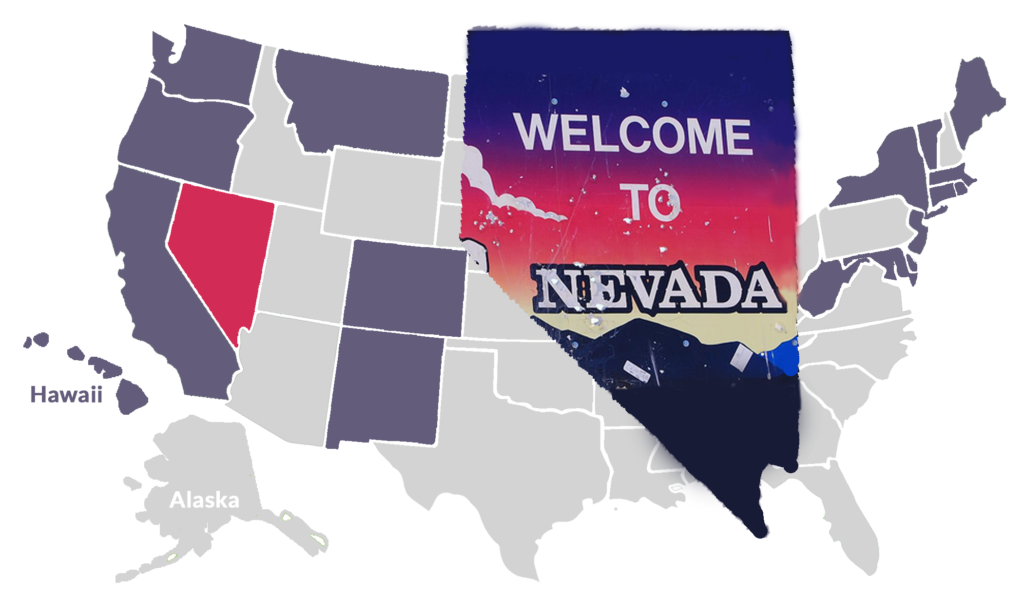 March 18, 2013 -Legislation introduced for Constitutional amendment to reverse Citizens United decision and restore power of Congress and states to regulate campaign spending. Voted down in Senate April 15, 2013.
- May 25, 2017- Nevada becomes 19th state to call upon Congress to pass amendment to U.S. Constitution to roll back Citizens United decision and give Congress and the state’s power to regulate the financing of political campaigns. the state assembly votes 26-14 in favor of reform amendment after state senate voted 12-9. In the assembly, it was a party-line vote with Democrats in favor and Republicans opposed. In the Senate, one independent joined 11 Democrats in the pro-reform vote.,
- both houses
New Hampshire:
- March and April 2014 – 53 New Hampshire towns pass resolutions calling for a constitutional amendment to overturn the Citizens United decision and empower Congress and state legislatures to regulate campaign expenditures.
- May 15, 2014 –With bipartisan support, the New Hampshire House passes a resolution for a constitutional amendment with 29 Republicans joining 154 Democrats in favor, but the Senate blocks measure by 12-11 vote referring the question to a study committee.
- March 2015 – With 67 New Hampshire towns on record favoring a U.S. Constitutional amendment to overturn the Citizens United decision and restore the power of Congress to regulate campaign finance, the state senate unanimously adopts a resolution “recognizing the need for a constitutional amendment” and votes to set up a study committee to review amendments proposed in Congress.
- January 2016 – New Hampshire House kills Senate-passed study committee proposal and then, in confusing turmoil, votes first to pass and then to reject a resolution for a U.S. constitutional amendment to restore power of Congress to regulate campaign spending. The first vote in favor was 156-152, but minutes later voting on a “motion to reconsider,” with the electronic voting machine broken, the House reverses and rejects the measure by 159-144, with 12 Republican members in the GOP-dominated assembly switching from Yea to Nay.
- June 6, 2019- New Hampshire becomes the 20th state to call for overturning the Supreme Court’s “Citizens United” decision and restoring the power of Congress and the states to regulate campaign funding. With a 14-10 vote, New Hampshire Senate passes adopted by House on March 7, calling for Congress to initiate the process of amending U.S. Constitution. “Everyone, of every political stripe, agrees that our elections are bought and paid for,” said Rep. Ellen Read (D-Newmarket), sponsor of the House bill’. “Today, New Hampshire has made a giant bipartisan statement that we won’t stand for corruption. ” The state’s action was also cheered by John Pudner, veteran Republican campaign strategist and leader of conservative group, Take Back Our Republic. “A constitutional amendment is everyone’s best interests,” said Pudner. “It’s good for voters, it’s good for candidates, and it’s good for elected officials who want to be able to focus on their constituents rather than Big Money donors.”
New Jersey:
- Oct. 2012 – New Jersey’s State Assembly Senate and House pass identical resolutions expressing opposition to the Supreme Court’s *Citizens United* ruling and calling for Congress to initiate action for a constitutional amendment limiting First Amendment protection of free speech to natural persons.
New Mexico:
- Jan. and Feb. 2010 – One year after house defeats a similar bill failed, both chambers of New Mexico legislature pass companion bills expressing opposition to the *Citizens United* ruling and calling on Congress to pass a constitutional amendment to “restore republican democracy to the people of the United States.”The measure passes by 20-9 vote in New Mexico Senate after previously being adopted by the house by 38-29 vote.
New York:
- March 27, 2012 – a memorialization urging Congress to pass a constitutional amendment overturning Citizens United passes the New York Assembly’s Election Law Committee. No further action is taken.
- Jan. 11, 2012 – Buffalo City Council passes a resolution calling for a Congressional clarification of natural personhood and a constitutional amendment overturning Citizens United.
- June 13, 2016 – A majority of New York State Assembly – 71 Democrats, four Republicans and one independent – sign a joint letter calling on Congress to approve an amendment to the U.S. Constitution that would reverse the impact of Citizens United ruling, by restoring the power of federal, state and local governments “to limit, regulate and require full source disclosure of all money spent to influence elections.” The letter to Congress also urges that the amendment establish that “artificial entities” such as corporations and unions “are not entitled to same rights and protections as natural persons under the Constitution.”
- June 15, 2016 – A majority of New York State Senate – 25 Democrats, two Republicans, and five independents – disclose they have written four separate letters deploring the Citizens United decision and the flood of new money in American election campaigns, and calling upon Congress to initiate action for a constitutional amendment to restore the power of Congress and the states to regulate campaign funding and to differentiate between the free speech rights of individuals and corporations.
North Carolina:
- Feb. 19, 2013, and Feb. 27, 2013 – Bills introduced for Constitutional amendment to reverse Citizens United decision and restore power of Congress and states to regulate campaign spending, but no decisive legislative action taken.
North Dakota:
- No state action on the issue.
Ohio:
- Dec. 10, 2012 -Akron City Council passes resolution calling for a constitutional amendment overturning Citizens United. The resolution is “declared to be an emergency measure necessary for the immediate preservation of public peace, health, safety and welfare… to defend democracy from effects of undue corporate power…” Similar resolutions are passed by city councils in Athens, Oberlin, Cleveland Heights, and Barberton City.
Oklahoma:
- No state action on the issue.
Oregon:
- July 1, 2013 –Oregon’s state Senate passes a Joint Memorial, previously adopted by the state’s House on June 21, urging the U.S. Congress to propose a Constitutional amendment “clarifying the distinction between the rights of natural persons and the rights of corporations and other legal entities,” and restoring the right of the Congress and state legislatures to regulate money “raised and spent for political purposes.”
Pennsylvania:
- May 6, 2013 – Fifteen state representatives in Pennsylvania’s General Assembly introduce a resolution petitioning Congress to call a constitutional convention to consider an amendment empowering Congress and the states to regulate political spending. It is referred to the Committee on State Government and has seen no further action.
- June 21, 2012 – Philadelphia’s City Council passes a resolution calling on Congress to pass a constitutional amendment overturning the Citizens United.
- June 25, 2012 -Reading City Council approves similar measure, joining the action of several other local governments, including Pittsburgh, Allegheny County, and Lehman.
Rhode Island:
- May 2012- Rhode Island Senate and House pass joint resolutions characterizing the Citizens Unitedruling as a “dramatic reversal of established” precedent and calling for the U.S. Congress to pass a constitutional amendment “effectively overturn[ing]” the ruling. Governor Lincoln Chafee subsequently signed the joint resolution.
South Carolina:
- No state action on the issue.
South Dakota:
- March 9, 2010 – Bill introduced Constitutional amendment to reverse Citizens United decision and restore power of Congress and states to regulate campaign spending, but fails to pass House of Representatives.
Tennessee:
- No state action on the issue.
Texas:
- Nov. 12, 2012 –Three Texas state senators introduce a resolution calling for a vote urging Congress to submit an amendment to the states for ratification, reversing Citizens United. The bill is referred Committee. No action taken.
- Jan. 8, 2013 –Similar measure calling for a constitutional amendment is introduced in state House and referred to committee. No action taken.
- Jan. 17, 2013 – Austin City Council passes a resolution urging Congress to amend the Constitution in reversal of Citizens United.
Utah:
- No state action on the issue.
Vermont:
- May 2, 2014 – Vermont, citing the failure of Congress to act, becomes the first state to formally petition Congress to convene a constitutional convention to reverse the Supreme Court’s Citizens United decision and restore legal limits on campaign funding.
- In passing Joint Senate Resolution 27, the Vermont legislature said it “hereby petitions the U.S. Congress to call a convention for the sole purpose of proposing amendments to the Constitution of the United States of America that would limit the corrupting influence of money in our electoral process, including, inter alia, by overturning the Citizens United decision.”
- This action, declared Rep. Mike Yantachka, Democrat from Charlotte, was intended “to kick-start a movement that I hope will spread throughout the country and let people become aware of the real problems we have with the influence of money on elections and on our public policy.”
Virginia:
- Dec. 9, 2013 – City Council of Falls Church, northern Virginia suburb of Washington, DC, passes a resolution calling for the formal support for a constitutional amendment reversing Citizens United from Virginia General Assembly and the U.S. Congress.
- Sept. 10, 2013 – City Council of Alexandria, another Northern Virginian suburb of Washington, passes a similar resolution supporting an amendment reversing Citizens United, delineating the rights of corporations and natural persons, the difference between money and speech, and establishing the regulation of political expenditures.
Washington State:
- March 7, 2013 – Washington State House of Representatives passed by 55-42 a resolution requesting that Congress pass and send to the states a constitutional amendment reversing Citizens United decision and restoring the power of federal and state governments to regulate campaign finance. A similar measure is introduced in state senate by ten co-sponsors in June 2013, but not acted upon by Senate.
- Feb. 2014 – Washington Amend, a grassroots coalition nicknamed WAmend, charges that “unlimited and anonymous money has corrupted our political system” and launches a petition drive to put on November 2014 ballot a citizens’ initiative on a U.S. constitutional amendment to curb campaign spending. On June 30, 2014 deadline, the campaign has 171,667 signatures, falling 75,000 signatures short of the required minimum.
- April 25, 2015 – New petition drive is launched by a more broadly based WAmend coalition aimed at putting I-735, a citizens initiative for a U.S. constitutional amendment to reverse Supreme Court’s Citizens United decision and to curb campaign spending, on the 2016 election ballot.
- Dec. 9, 2015 – WAmend announces “We Made It” – exceeding the required 250,000 signatures needed to put state initiative I-735 on 2016 election ballot. With 333,040 signatures in hand, the petition movement triggers the mechanism for a statewide vote on a U.S. constitutional amendment in November.
- Jan. 28, 2016 – After random sampling of petitions, Secretary of State Kim Wyman verifies that petition drive got enough signers to put the issue of a constitutional amendment on the November ballot.
- Nov. 8, 2016 – By a 62.7% majority, Washington voters (1,847,419 in favor) approve initiative for an amendment to U.S. Constitution that would overturn Supreme Court’s *Citizens United* decision sanctioning unlimited corporate contributions to election campaigns and that would empower Congress and the states to regulate campaign funding and spending. Washington thus becomes 18th state to call for rollback of Citizens United and the 4th to do so by popular vote, along with California, Colorado, and Montana. Although the popular vote is not legally binding on the state’s congressional delegation, Cindy Black, executive director of WaMend, the main citizens group promoting the amendment, said the citizen movement would keep pressure on the state’s two senators and ten members of the House (6 Democrats and 4 Republicans) to work actively for a constitutional amendment.
West Virginia:
- March 28, 2013 – West Virginia’s House passes resolution calling upon Congress “to propose a constitutional amendment overturning the United States Supreme Court’s Citizens United” ruling.
- April 10, 2013 – West Virginia’s Senate passes resolution calling upon Congress to propose a constitutional amendment overturning the Citizens United.
Wisconsin:
- Jan. 21, 2013 – A Wisconsin movement to amend the U.S. Constitution and overturn the Supreme Court’s *Citizens United* decision delivers petitions with 24,000 signatures to the Wisconsin General Assembly. Petitions called on legislators to take action on their petition.
- Aug. 27, 2013 – Twenty-four state representatives and eight senators introduce resolution calling for a public referendum instructing Wisconsin’s congressional delegation to support an amendment to the U.S.Constitution stating that only human beings, not corporations, unions, or non-profits are endowed with constitutional rights and that money is not speech and therefore Congress has the power to regulate campaign spending. Democratic legislators tried to force a vote on this measure, but Republicans successfully blocked it by a solid 60-29 majority.
- April 1, 2014 – Thirteen Wisconsin cities pass referendums by margins of between 22% and 74% calling for a constitutional amendment limiting personhood to natural persons and eliminating the first amendment protection of monetary expenditures.
- January 2015 – Rep. Lisa Subeck and Sen. Dave Hansen once again introduce resolution calling for popular referendum on rolling back principles of Citizens United decision but their resolution is referred to legislature’s Constitution and Ethics Committee and dies there.
Wyoming:
- Feb 6, 2019 – By a 37-20 majority, the heavily Republican Wyoming House of Representatives votes to overturn the Supreme Court’s*Citizen United* decision and restore the power of Congress and the states to regulate campaign funding and spending. The resoloution which now goes to the state senate, was backed by the Republican leadership, House Speaker Steve Harsham and Majority Leader Eric Barlow.
- Feb. 20, 2019 –In a 3-2 committee vote, three Republican state senators block a move to make Wyoming the 20th state to call on Congress to amend the US Constitution and overturn the *Citizens United* decision. The committee vote killed a resolution that would have put Wyoming in the camp of states seeking once again to empower Congress and the states to regulate campaign finances.
Issue BriefSuccess StoryAdditional ReadingsOrganizations
More Resources to Help You Amend the Constitution
---
thom david cobb video 2011

---
# MTA VOL
---
13-24 Thom Hartmann on Judicial Review and the 28th Constitutional Amendment
---
10 yrs ago
12 ppl in liv room thom there
win every city scot wALKER , MONTANA 75% POLL
ECONOMIC ROYALISTS WE WANT OUR CTY BACK
DO GROVER POLS PLEDGE
NON VOL CIVIL DISOBEDIANCE
---
EMAIL 4 25
51 co spon
Cole Bennett, Co-Director cole-bennett-b09110199 acs russ f cop city
National Team and local affiliates also held meetings with the judiciary staff of Senators Whitehouse (RI), Ossoff (GA), and Smith (MN) regarding introduction into the Senate in the 119th Congress.
Lobbying for the WTP Amendment
- Spoke with Garamendi (CA-08), Jayapal (WA-07), Beyer (VA-08), Pocan (WI-2), Titus (NV-1), Hoyle (OR-04), Cuellar (TX-12), Gonzales (TX-34), Escobar (TX-16), and more
- Next Systems Studies Convergence - April 3rd
- MTA co-directors present at George Mason University as part of Ben Manski’s Next Systems course.
Ben Manski is Assistant Professor of Public Sociology at George Mason University where he serves as director of Next System Studies and of the Democratizing NOVA project at Mason's Center for Social Science Research. He studies the participation of ordinary people in the deliberate constitution of their societies. His work takes in social movements, law, politics, climate and ecology, political economy and the corporation, focusing on democracy, democratization, and constitutionalism, and he has published widely on these themes. In the past, Manski practiced public interest law for eight years and managed national non-profit organizations, direct action campaigns, and political campaigns and parties for 25 years. He is an Institute for Policy Studies Associate Fellow, Next System Project Research Fellow, Liberty Tree Foundation Fellow, and a Critical Realism Network Associated Fellow. Manski is a University of Wisconsin JD (2005) and University of California Santa Barbara PhD (2000).
---
sprr saldano says use moveon.org for soc media? 3 24
---
Corporate Coup Report #4 - Move to Amend
musk geo gp vid 
11 24
- Rep. Andrea Salinas (D-OR-6) on October 18, 2024
- Rep. Gwen Moore (D-WI-4) on October 29, 2024
==
6 24
DC TRIP
- Monday, June 17: Kicked off with an engaging meeting with Rep. Jared Moskowitz (FL-23), followed by strategic visits to priority offices.
- Tuesday: Illuminating meeting with Congresswoman Robin Kelly’s office (IL-2), where staffer Earl Floor provided invaluable insights.
- Wednesday: Immersed in the vibrant Juneteenth celebrations in Anacostia, gathering petition signatures and connecting with the community.
- Thursday: Jennie delivered a powerful speech at the Supreme Court, followed by an encouraging meeting with Ben Owens from Rep. Andrea Salinas’s office (OR-6) and Ryan Hedgepeth from Rep. Carter's Office (LA-02).
- Friday: Concluded with a determined push, visiting the remaining priority offices and beyond.
We still have one of our national co-directors in DC, ready to meet with more offices and follow up with those we engaged last week. Now is the perfect time to amplify our voice. We had an initial meeting with Representative Schrier's office and are looking forward to an official meeting next week. It would be incredibly impactful if her constituents called this week to voice their support for HJR 54.
11 23
brian says public citizen has signed on a supporter
---
11 23 moveon.org endorse
movi holly moser
ab 83 foreign $
Bill Text: CA AB83 | 2023-2024 | Regular Session | Introduced | LegiScan
| Name | Type | Sponsorship | District | Financial | Encyclopedia | Biography |
|---|---|---|---|---|---|---|
| Assemblymember Alex Lee [D] | Primary | Sponsored Bills | HD-024 | FollowTheMoney | Ballotpedia | VoteSmart |
| Assemblymember Ash Kalra [D] | Cosponsor | Sponsored Bills | HD-025 | HD-025 | HD-025 | HD-025 |
10 23 EMAIL
There were two main reasons why Move to Amend held a vigil and rally at the U.S. Chamber of Commerce during our recent trip to Washington, D.C. to lobby for HJR54, the We the People Amendment.
The two reasons were to highlight what the Chamber represents and what the Chamber does.
What the U.S. Chamber represents
The Chamber typifies the political power of large business corporations. Despite its claim of “representing the interests of more than 3 million businesses of all sizes, sectors, and regions,” a sizable majority of its board of directors are heads of larger corporate entities while its agenda overwhelmingly reflects the interests of large corporations, especially those of its major donors.
Only 18 donors contributed more than one-quarter of its 2021 revenue, 97% of its revenue came from just 1300 donations of at least $5000. The fact that the Chamber doesn’t legitimately represent small business interests and even local chambers of commerce led a decade ago to the "U.S. Chamber of Commerce Doesn't Speak for Me" campaign, supported by over 6,000 businesses signed on to the campaign and 32 local chambers of commerce.
Nevertheless, the Chamber is politically potent. They are the nation’s largest lobbying organization, having spent$1.85 billion between 1998 and 2023, $81 million alone in 2022. Their political campaign contributions in the 2022 election cycle totaled $3.5 million and outside spending on electioneering communication an additional 1.8 million. Their political investments have yielded significant returns, as the next section describes.
The Chamber also represents an aggressive promotion of big business as a political force to promote their legitimacy and interests over the last half-century, due to the Chamber’s role in implementing the “Powell memo.” Lewis Powell, a corporate lawyer and a board member of Phillip Morris Corporation, wrote a confidential memo for the U.S. Chamber of Commerce in response to the “American economic system [being] under broad attack.” coming from, among others, “perfectly respectable elements of society,” including “college campus, the pulpit, the media, the intellectual and literary journals, the arts and sciences, and from politicians.”
Lewis called for a corporate coordinated and well-funded campaign to influence the public on behalf of the role of corporate America by assertively opposing regulations, but also by infiltrating societal institutions (i.e. publishers, TV networks, universities, event courts). “The role of the National Chamber of Commerce is therefore vital,” Powell wrote.
The Chamber remains part of a broad pro-corporate institutional movement that seeks to change the culture, law and constitution that began in the early 1970’s with the Powell memo.
FYI, Powell was appointed to the Supreme Court in 1972 by Richard Nixon and ruled in favor of both the First National Bank v. Bellotti(that permitted corporations for the first time to donate to political campaigns) and Buckley v. Valeo (that equated money as free speech) decisions.
What the U.S. Chamber does
The Chamber promotes major corporate interests. If the interests of individuals, communities, smaller businesses, larger businesses that don’t donate to the Chamber or the environment get in the way, so be it.
A selection of many examples:
- The Chamber actively supports virtually all environmental deregulation, including those of the Trump administration. They opposed the climate provisions of the more recent Build Back Better and Inflation Reduction Act. InfluenceMap, a think tank that monitors corporate climate lobbying, gave the Chamber an “E-” grade for 25 out of 39 policy positions they took since 2017 being harmful to the climate.
- The Chamber fiercely opposed the Protecting the Right to Organize (PRO) Act, a “landmark worker empowerment, civil rights and economic stimulus legislation” promoted by the AFL-CIO. A Chamber lobbyist said there would be a "political price" to payfor any lawmakers who supported the bill, which the Chamber called a "litany of almost every failed idea from the past 30 years of labor policy." The bill never passed the Senate.
- The Chamber spent millions of dollars to defeat expanding the child tax credit (CTC) for one year under the Build Back Better bill in 2022. The anti-poverty measure was responsible in 2021 for reducing childhood poverty to its lowest level since 2009. A critical buffer to food insecurity, childhood poverty more than doubled in 2022 when the payments expired.
- The Chamber has lobbied against the Forced Arbitration Injustice Repeal Act — which would end compelled arbitration outside of a company (i.e. public courts and juries) on disputes related to employment, consumers, civil rights etc. They actively oppose legislation to break up alleged monopolies, calling it “penalizing success” (watch the 60 second video). They also organized a well-funded campaign against the Consumer Financial Protection Bureau, claiming that the new director is trying to “radically reshape ” financial regulation without proper jurisdiction.
- The Chamber opposed For the People Act, the most comprehensive democracy reform proposed legislation in several decades. They oppose campaign finance reform measures, even the past modest DISCLOSE Act that would have simply required any group that spends more than a certain amount on political campaigns to disclose its donors.
---
evil but
2023
What does the proposed 28th amendment have to do with Climate Change?
Drawing Down to reverse global warming requires leaving lots of oil, gas and coal in the ground. This will be met with corporate pushback, led by the fossil fuel industry and its funded think tanks and corporate-connected environmental groups.
The political power of fossil fuel corporations is rooted in their Supreme Court-granted constitutional First Amendment "free speech" rights that has defined corporations as "persons" for purposes of spending money to influence elections. Corporations have also been granted First Amendment "commercial speech" rights by the courts. One can only imagine the millions, if not billions, of dollars fossil fuel corporations will spend "educating" the public on the pitfalls of the virtually eliminating the use of fossil fuels by 2030. So long as corporations continue to have First Amendment "corporate personhood" rights, they will continue to disproportionately influence legislators and legislation.
The political power from their First Amendment "free speech" and "commercial speech" granted rights is only one of several ways fossil fuel corporations can oppose the massive energy and behavioral changes we need to put in place by 2030. If, despite this enormous political influence, laws are passed to (for example) tax carbon, fossil fuel corporations can also run to the courts claiming that these laws violate other Supreme Court granted constitutional rights.
Corporations could conceivably try to claim, for example, that government subsidies of renewable energy corporations or any number of prohibitions of fossil fuel companies “discriminates" against fossil fuel corporations under the 14th Amendment, which was intended solely to protect freed slaves from racial discrimination. (Don't laugh - they've made the same argument and won for government support to small businesses over chain stores).
More likely, fossil fuel corporations will assert that by forcing the end of carbon-producing, climate-destroying fossil fuels, their claims on coal and oil in the ground or at sea -- worth tens, if not hundreds, of billions of dollars -- are "takings" without just compensation under the 5th Amendment -- a constitutional "right" intended solely for human beings but granted to corporations nearly a century ago. This, too, is not theoretical. Corporations have deterred the passage of laws preventing the extraction of natural resources based on the threats of lawsuits under the 5th Amendment.
Ending the use of fossil fuels can only happen by ending the abuse of “fossil” constitutional rules -- rules that have permitted corporate entities to hijack the constitution to protect their property rights over human rights...and the right to a sustainable environment.
A parallel path to ending the use of fossil fuels is promotion of the trans-partisan We the People Amendment (H.J.R. 48), a Constitutional Amendment that would end all forms of corporate constitutional rights and the constitutional doctrine that money is equal to First Amendment-protected "free speech."
Hundreds of communities have passed either municipal resolutions or passed citizen-driven ballot initiatives calling for such an amendment. Hundreds of organizations have endorsed *Move to Amend*, the organization behind the Amendment -- believing that whatever different issues these organizations work on, the same, identical strategy of legalizing democracy by ending “corporate personhood” and “money as speech” will make it easier for all of these organization to achieve their respective goals.
Move to Amend highlighted the political power of the U.S. Chamber of Commerce while in D.C. and even more now to underline the reality that organized vast economic power that has the legal and constitutional right to be converted to vast political power to influence public policies does not serve the common good. It’s unaccountable. It serves their interests, rather than those of individuals without political money to invest in the political system, of communities and of a natural world that is livable.
The only way to hold corporate entities like the Chamber accountable is constitutionally – to ensure that we have laws and regulations to protest people, communities and the natural world from private corporate decisions.
That’s why HJR54, the We the People Amendment, is so important. And that’s why we were in D.C. to lobby for it and why we protested at the U.S. Chamber of Commerce.
12 21 keyan mtg
particularly productive conversations with the offices of Representatives Bonnie Watson Coleman, Nikema Williams, Marilyn Strickland, and Veronica Escobar
pramila
---
mta nat’l 1 24
today marks the 14th Anniversary of the Citizens United v. Federal Election CommissionSupreme Court decision. The ruling permitted corporations and labor unions to make unlimited “independent” political contributions (i.e. spending for or against candidates that are not made in consultation or cooperation with them, their campaigns or any political party).
The super rich could also shield their political “donations” (more like political “investments”) in “dark money” organizations, nonprofits not required to disclose their donors.
- In the 2010 midterm election, the first after Citizens United, total spending on all federal elections was over $4.9 billion. It rose to more than $8.9 billion in 2022, a 181 percent increase.
- For the 20 years preceding Citizens United, non-party independent groups spent $750,000,000. In the 10 years afterwards they spent $4.5 billion, a six-fold increase.
- During the decade before Citizens United,dark money groups contributed $129,000,000. In the decade following they gave $963,000,000, over seven times more.
The political voices of the super rich and corporate entities were further heard and heeded following Citizens United, while the political voices of those without money who didn’t or couldn’t afford to make political contributions were further drowned out. Citizens United further corrupted our “democracy.”
Further is the key word.
The “corruption of democracy” goes way beyond Citizens United and political elections.
Citizens United needs to be reversed, no doubt about it.
But it’s a constitutional myth to believe that the following originated with Citizens United:
- The constitutional doctrine that “political money equals speech.” That began with the 1976 Buckley v. Valeo Supreme Court ruling.
- The corporate “right” to spend money in elections. That started with the 1978 First National Bank of Boston v. Bellotti Supreme Court case.
- ”Corporate personhood.” That began in the 1880s with the Santa Clara County v. Southern Pacific Railroad Company and Minneapolis & St. Louis Railroad Co. v. BeckwithSupreme Court decisions establishing corporate due process and equal protection “rights.” Corporate constitutional rights now includes the First Amendment “right” not to speak, Fourth Amendment search and seizure “rights,” Fifth Amendment takings “rights,” among others. These hijacked corporate constitutional rights have resulted in massive and forever-increasing harms to people, communities and the natural world.
If nine of us for a day became Supreme Court Justices and (following the return from various junkets around the world) were able to simply reverse Citizens United, _none of the above would change. _
If we don’t correctly understand the problem, we’ll never correctly solve it.
Ask yourself as you think back to 2009 before Citizens United. Did you feel your voices were politically heard? That the political influence of the super rich was the same as yours? That major corporations were unable to steer laws, regulations, tax breaks, bailouts, etc in their favor?
The day Citizens United was decided was the day Move to Amend was launched. For the past 14 years, we have been educating, advocating and organizing to correct the myth that Citizens United birthed “money is speech” and “corporate personhood.”
Spend a few minutes reviewing any of the items on our Corporate Constitutional Rights Resources webpage to learn how corporate entities have hijacked existing Constitutional Amendments, using them as both shields from democratic accountability and swords to overturn democratically passed laws protecting the health, safety and welfare of people, communities and the natural world.
There is no question that “simply” reversing Citizens United, as some national groups promote, is much easier than enacting the We the People Amendment (HJR54) that calls for the abolition of money as speech and all forms of corporate constitutional rights. Who doesn’t want to take an easier path?
But we must be honest and accurate with ourselves and others. It’s fine to rail against Citizens United for its role in the “corruption of democracy” as far as it goes. The anti-democratic train of the corruption of big money in elections and corporate rule, however, left the station decades and a century ago, respectfully. If we don’t derail it and all we do is “End Citizens United,” we’ll still be democratically crushed.
We must end all forms of corporate constitutional rights and money as free speech, as the We the People Amendment demands.
Thank you for being part of this challenging, but essential ride to take on the growing multiple crises we face and can overcome.
Onwards for the democracy and world we all deserve,
---
9/21
H.J.Res.48 - Proposing an amendment to the Constitution of the United States providing that the rights extended by the Constitution are the rights of natural persons only.
https://en.wikipedia.org/wiki/Move_to_Amend
Move to Amend is a national, non-partisan, grassroots organization that seeks to blunt corporate power by amending the United States Constitution to end corporate personhood and state that money is not speech.[1] The group was created in response to the Supreme Court ruling Citizens United v. Federal Election Commission, which held that corporations have a First Amendment right to make expenditures from their general treasuries supporting or opposing candidates for political office, arguing that the Court's decision disrupts the democratic process by granting disproportionate influence to the wealthy.[2] Move to Amend advocates for the "We the People" Amendment, currently in Congress as H.J.Res. 48, to establish that constitutional rights are reserved for natural persons only and require the regulation and disclosure of spending in U.S. elections.[3]
Background
In 2009, several national organizations including the Women's International League for Peace and Freedom, the Program on Corporations, and Democracy (POCLAD) and Democracy Unlimited of Humboldt County (DUHC) submitted an amicus curiae authored by former Massachusetts assistant attorney general Jeff Clements to the Supreme Court in Citizens United v. Federal Election Commission, a U.S. constitutional law case concerning the regulation of independent political expenditures by corporations, which the non-profit organization Citizens United challenged on the grounds of violating the First Amendment’s freedom of speech. The brief argued against Citizens United and called for the court to reverse its precedents on corporate personhood, citing the 1886 case of Santa Clara County v. Southern Pacific Railroad Co. that preceded the extension of constitutional protections to corporations under the Fourteenth Amendment.[4]
When the Court ruled to allow for corporations to make political expenditures from their general treasuries under the First Amendment's free speech rights in January 2010, several organizers and attorneys from those organizations behind the brief launched Move to Amend as a national campaign to overturn the Citizens United ruling, arguing that the Court’s decision disrupts the democratic process by granting disproportionate influence to the wealthy with the intent of promoting corporate power at the expense of ordinary citizens.[5][6][7][8]
Resolutions and Ballot Campaigns
Move to Amend's strategy has included grassroots organizing to lobby elected officials and candidates to pass local resolutions and ordinances through municipalities, which call on state and federal representatives to support a 28th Amendment and may include holding a "Democracy Day" public hearing. As of July 2019, over 800 local governments and 20 states have passed resolutions and ordinances supporting a constitutional amendment to address the Citizens United ruling.[9] Over 300 resolutions were passed by voters via ballot initiatives, including statewide initiatives in Colorado, Montana, California and Washington.[10][11][12]
Local affiliates of Move to Amend have helped pass many such resolutions supporting the language of the We the People Amendment, including the Los Angeles City Council which voted unanimously to end constitutional rights for corporations in 2011.[13] In Ohio, local ordinances supporting the amendment and creating a "Democracy Day" public hearing to examine the local impact of political influence by corporations have been passed by municipal governments and voters via ballot initiatives, including Cleveland and Toledo.[14][15][16] In Wisconsin, over 100 municipalities have passed resolutions, comprising 55% of Wisconsin residents.[17][18]
Leadership
The group has included organizers and attorneys from several national organizations among its leadership, including:
- Kaitlin Sopoci-Belknap, Move to Amend’s national director and director of Democracy Unlimited of Humboldt County[19][20]
- David Cobb, 2004 Green Party presidential candidate and principal of POCLAD[21][22]
- Riki Ott, a co-director of Ultimate Civics, is a co-founder[23]
- Ben Manski, an executive director of the Liberty Tree Foundation[24][25]
- George Friday, national steering committee member of the Independent Progressive Politics Network[26][27]
- Lisa Graves, executive director for the Center for Media and Democracy[28]
- Nancy Price, co-chair of the Alliance for Democracy and committee chair for Women’s International League for Peace & Freedom[29][30]
- Jerome Scott, a member of the League of Revolutionary Black Workers and founding director of Project South[31]
- Laura Bonham, a co-founder of Progressive Democrats of America and co-chair of the Justice Party[32]
- Maria Agosto, a member of the Poor People's Economic Human Rights Campaign (PPEHRC)[33]
https://www.movetoamend.org/staff
Kaitlin Sopoci-Belknap is National Director of Move to Amend, President of the Board of Directors of Democracy Unlimited, and a Local Democracy Fellow for the Liberty Tree Foundation.
----
Greg Coleridge is Outreach Director of Move to Amend. He previously worked for more than three decades with the American Friends Service Committee in Ohio where he educated, advocated and organized on a range of justice, peace, environmental and democracy issues -- including helping coordinate Move to Amend activities in the Buckeye state.
He is the author of Citizens over Corporations: A Brief History of Democracy in Ohio and Challenges to Freedom in the Future (2003), writer of the documentary CorpOrNation: The Story of Citizens and Corporations in Ohio (2003)inspire by richard grossman poclad] and contributed several articles to the anthology Defying Corporations, Defining Democracy - A Book of History and Strategy (2001).He currently maintains and distributes via email a weekly REAL Democracy History Calendar and Monetary History Calendar.
Greg is a Principal with the Program on Corporations, Law & Democracy (POCLAD) and Board Member of the Alliance for Just Money (AFJM). He previously served an elected term on the national governing board of Common Cause.
He loves camping, hiking, walking and swimming – especially with his wife, daughter and son-in-law -- and almost everything else outdoors!
Keyan Bliss is Move to Amend's Grassroots Director. He currently serves on the Media & Communications, Grassroots Movement, and Political Organizing Committees.
Inspired to join Move to Amend by his brother’s participation within the Occupy movement and student power movement, Keyan first joined Move to Amend in 2013 as an Intern.
The Case Against Corporate Constitutional Rights three-part series is at
https://www.movetoamend.org/corporate-constitutional-rights
Move to Amend is the main organizational catalyst of the We the People Amendment (H.J.R. 48),
richard hobbs on wolff
https://kpfa.org/episode/economic-update-november-1-2019/
Ben Field labor Tahiya labor caucus mta
Search Results
Web results
www.southbaylabor.org › board_and_staff
Board and Staff - South Bay AFL-CIO Labor Council
1.
http://scc-mta.org/sites/default/files/MTA_IRATE_Doc_Version_02_04_13.pdf==
https://www.youtube.com/watch?v=BHOy9hni3ZE
tedx humboldt
David Keith Cobbis an American attorney, liberal political activist, campaign manager, and politician. He was the Green Party presidential candidate for the 2004 presidential general election. David is the co-founder of Move to Amend. He later became the campaign manager for fellow Green Party candidate Jill Stein during her presidential run in 2016. This talk submits a new idea for communities to work together for success. David Keith Cobb is an American attorney, liberal political activist, campaign manager, and politician. He was the Green Party presidential candidate for the 2004 presidential general election. David is the co-founder of Move to Amend. He later became the campaign manager for fellow Green Party candidate Jill Stein during her presidential run in 2016. This talk was given at a TEDx event using the TED conference format but independently organized by a local community
:{
}:
revol crisis, close to collapse, chinese; imagine restuct soc so all have enough; radical honesty, looking for other revo; def is those who can envision different way
:{
}:
dff narrative: patriarchy...... repeated stories become narrative: selfish, exploitive, dominate power over...bio says no; chalice and blade bk; bad behaviors are incentivized to act that way; exploitation, commodification, love...mama's boy; argue bro over toy car; lots of toys, all you have to share to create a new world; transition solidarity economics model w/o explot or oppress, eco sustainable = cooperatin humbolt .org ID and inventory art culture, child care etc already happening: amplify v compete w/ that; tell others about it; but many gaps eg food CSA, co-op, no food forest;
:{
}:
metaphor of butterfly; caterpillar: in dna is a new recipe, imaginal cell; find each other, cohere, wing cells over there; birthright stolen by wht supreme capitalists;
share power with, make decisions together
==
A teach-in was held in Burlington with David Cobb, lawyer and spokes person for Move To Amend. "Move To Amend" says Cobb, "is the multiracial, multiethnic coalition of over several hundred groups that have come together, representing several hundred thousand people who are calling for a constitutional amendment to abolish in its entirety the ridiculous judicial created legal doctrine that says a corporation is a person with inherent constitutional rights and the equally ridiculous court created doctrine that money equals speech; This therefore it makes it virtually impossible for local, state, and federal governments to regulate campaign financing. These two legal doctrines put together are part of the linchpin for how the ruling elite has hijacked our country and the decision making process in this country." | movetoamend.org | Burlington Vermont Fletcher Free Library | March 15 2012
16 min
corp ceo make law/decisions unelected
doc
chart: Am Pol Theory) we should try it sometime]
all power resides in ppl GOV'T depends on ppl
FREE AND SOVEREIGN (authority to rule) GOV'T subordinate
free b/c we have RIGHTS (0 req permission) V GOV'T HAS DUTIES
if law infringes on ppl rights, it is unconstitutional
MTG of all citizens unwieldy, so we delegate power to make law/decisions
PRIVATE REALM V PUBLIC (LAWS in our interests)
PROBLEM IS IMPLEMENTATION: founding flaw: violence to nat am, AA, women = property
zinn: hist req a lens to look back
our history is struggle for these gps to be defined as persons w/ rights protected by const; most white men oppressed as workers;
how form corp: file doc, 25$, rubber stamp, issue charter; last forever; do anything [VT]"all lawful things"; why do they have so much power; 1st 75 yrs: ID need not met by govt or biz; lower house maj, senate by maj, governor signed; 3-5 yrs, no longer than 20; lim liability dissolved; if do anything other than state purpose, revoked; if violate public interest, revoke; revoke keeps it subordinate and accountable; but corp person is ct-created (not in const); if state, local or fed law oppose corp const rights
worker, public health, ecol; camp finance law; we don't need a good policy/law, we need democ movement that asserts our sovereignty, exercise the right to protect, elections, ... protect from a ruling elite, hijacked our constitution to abuse us, using the legal system to do it; so we need 28th corp not ppl, $ not speech;
states, cities stats of resolutions
==
==
history of oppression/ political/social change
https://movetoamend.org/social-change-study-group
- After Downing Street
- Alliance for Democracy*
- American Friends Service Committee
- American Friends Service Committee - NE Ohio*
- Backbone Campaign
- Black Agenda Report*
- BuzzFlash
- Center for Corporate Policy
- Center for Media and Democracy*
- Code Pink
- Coffee Party USA
- Democracy Unlimited*
- Detroit Women of Color
- Family Farm Defenders
- Friends of the Earth
- Global Exchange
- Independent Progressive Politics Network*
- Liberty Tree Foundation*
- National Lawyers Guild*
- North Carolina AFL-CIO
- Organic Consumers Association
- Peace Action
- Peace and Freedom Party of California
- Peaceful Uprising
- People-Centered Development Forum
- Portland Jobs with Justice
- Program on Corporations Law and Democracy*
- Progressive Democrats of America*
- Reclaim Democracy*
- Ruckus Society
- Sebastopol Grange
- Shays 2
- Sierra Club
- smartMeme
- The Pachamama Alliance
- Ultimate Civics*
- Unitarian Universalists for a Just Economic Community
- Velvet Revolution
- Vermont for Single Payer
- Veterans For Peace
- Women's International League for Peace and Freedom*
And Hundreds of Other Organizations...
- Oak Ridge Unitarian Universalist Church
- 1% A Peace Army
- 19 Organizations
- 2013 National OCCUPY Gathering
- A New Way Forward
- Abolish Corporate Personhood Now
- Abolish Corporate Personhood Now
- Advocacy and Education Committee of Community Action Partnership of Greater Dayton Area
- Agricultural Permitting Services, LLC
- Alachua County Democratic Executive Committee
- Alachua County Democratic Party
- Alachua County Green Party
- Alaska Public Interest Research Group (AkPIRG)
- Alaska Women for Political Action (AWPA)
- Alliance for Progressive Values
- Americans for Healthcare
- Americans Who Tell The Truth
- Anchorage Unitarian Universalist Fellowship
- Animal Medical, Inc.
- Anti-War Committee
- APS, LLC
- Association of Federal, State, County & Municipal Employees (AFSCME) Local 1684
- AWAKE Palm Beach County
- Banner Grange 627
- Barbour County Democratic Women
- Berkeley Fellowship of Universalist Unitarians, Social Justice Committee
- Berks Gas Truth
- BitJazz Inc.
- Blue Mountains Biodiversity Project
- Bullfrog Communities
- Bus For Progress
- California State Grange
- Campaign for a Commercial-Free Childhood
- Center for Corporate Policy
- Center for Justice, Peace and the Environment/Fort Collins Community Action Network
- Central Labor Council of Humboldt & Del Norte Counties (CA)
- Central Ohio Green Education Fund
- CGR Consulting
- CirclesWork!
- CirclesWork!
- CitizenControl.org
- Citizens for Legitimate Government
- Citizens for Peaceful Resolutions
- Citizens Institute for Public Policy
- City Lights Books in San Francisco
- Civic Satisfaction
- Clay Street Counseling and Consulting
- Clifton Citizens to End Corporate Rule
- Clove Valley CSA at Outback Farm
- Coal Moratorium Now!
- Coalition of Concerned Patriots
- CoalSwarm
- Columbus Free Press
- Committees of Correspondence for Democracy and Socialism
- Commonweal Institute
- Community Democracy Project
- Community Organizing Center
- Community Unitarian Universalist Church
- Compassion dba Small Change
- Concerned Citizens of Tioga County
- Conejo Valley Unitarian Universalist Fellowship
- Connect The Dots For Democracy
- Constitution Restoration Cooperative Association
- Cook Inletkeeper
- Corporation Separation Movement
- Counter Culture Frozen Yogurt Mansfield Road
- CounterCorp
- Culver City Democratic Club
- Dave Swager Photography
- Declaration of Reindependence
- Declaration of Reindependence
- Defiance Citizens For Change
- Democracy Amendment Coalition of Massachusetts-West
- Democracy for America (DFA) Palm Beach County
- Democracy for America of Fairfield County, Connecticut
- Democracy for Missouri
- Democracy for Montgomery County
- Democracy for Pittsburgh
- Democratic Committee of Essex County, NY
- Democratic Socialists of Central Ohio
- Democrats United for Progress
- DGC Press
- Dick Eiden for Congress 2012
- District 7 West Move On Council
- Divide Democrats
- DocExamPro LLC
- DuPage County Green Party
- East Bay Peace Action
- Eastern Washington Voters
- Eat Drink Politics
- Eco-Eating
- EcoBirth-Women for Earth and Birth
- EcoJive
- Economic Justice Action Group of the First Unitarian Church
- Essex County, New York, Democratic Committee
- Ethical Business Society
- First Unitarian Universalist Church of Columbus, OH
- First Unitarian Universalist Congregation of the Palm Beaches - Social Action Committee
- Florida Immigrant Coalition
- Florida Initiative for Electoral Reform (FLIER)
- Florida Voters Coalition
- Food & Water Watch
- Free Speech For People
- Friends for a Nonviolent World
- Full Moon Sanctuary Church
- GlobalSolutionsMN.org
- Grace Productions, Inc.
- Greater Peoria Progressive Coalition
- Green Democratic Club of Sacramento County
- Green Party of Dallas County
- Green Party of Florida
- Green Party of Hamilton County Ohio
- Green Party of Humboldt County
- Green Party of Minnesota
- Green Party of Monroe County, NY
- Green Party of Monterey County
- Green Party of Ohio
- Green Party of San Mateo County
- Green Party of Santa Fe
- Green Party of Skagit County
- Green Party of Suffolk
- Green Party of Tennessee
- Green Party of Washington State
- Green Sanctuary Task Force, Unitarian-Universalist Church of Bloomington, INdiana
- Green Sanctuary Task Force, Unitarian-Universalist Church of Bloomington, Indiana
- Greenway Flooring, LLC
- Hands Across the River Coalition, Inc. - Greater New Bedford, Massachusetts
- HEAL Utah
- Health Care for All Oregon
- Heartwood
- Hip Hop Congress
- Human Agenda
- Humanist Community of Central Ohio
- Humanist Community of Central Ohio
- Humboldt Bay Veterans for Peace
- Information Press
- Inner Works Acupuncture and Physical Therapy
- International Association of Theatrical Stage Employees, Local 60 Pensacola, FL
- International Longshore and Warehouse Union
- Iowa Sierra Club
- Jackson County Democrats/ Occupy Ashland
- Justice Through Music
- Kentucky Education Association
- Kitchel Family Organic Farm
- Klamath Sustainable Communities
- Lake County Democratic Club
- Lake County Democratic Club
- Larry Packwood Builder
- Las Vegas (NM) Peace and Justice Center
- Lawmaker Ethics.org
- Leftist Marching Band
- Local 20/20 - A Transition Town Initiative
- Lompoc Democratic Club
- Lompoc Films endorsed petition to Lompoc City Council
- Lotus Tribe
- lowercase d
- Macrocosm USA
- Main Street Alliance of Oregon
- Main Street Alliance of Oregon
- Maine Citizens for Clean Elections
- Mainstreet Moms
- Manatee Unitarian Universalist Fellowship
- Media Action Center
- Metro Justice, Inc.
- Michael Cavlan US Senate Campaign
- Middle Class Clout
- Miniprotests.com
- Minnesota AFL-CIO
- Minnesota Alliance of Peacemakers
- MN Citizens Federation N.E.
- Montgomery County Progressive Alliance
- Mountain Vista Unitarian Universalist
- Move On - Vancouver Washington Chapter
- MoveOn Council of South Palm Beach/ North Broward Counties
- MoveOn metro Denver council
- MoveOn.org Southern Alameda County Council
- National Consortium of What's Happening Now
- Nature Coast Unitarian Universalists Inc. of Citrus Springs FL
- Needs of the People Foundation
- Network for Environmental and Economic Responsibility of United Church of Christ
- New Harmony Watch
- New Progressive Alliance
- New York Democracy Group
- New York Occupy Wall Street Restore Democracy Working Group
- No Money Congress
- No More Stolen Elections!*
- No More Victims
- North Shore Labor Council
- North Shore Labor Council
- Northeast Philly for Peace and Justice
- NY Against Fracking
- Occidental Arts and Ecology Center
- Occupy Amherst
- Occupy Baltimore
- Occupy Berkshires
- Occupy COMO - Columbia, MO
- Occupy Danbury
- Occupy Falmouth
- Occupy Hendersonville (NC)
- Occupy Houston
- Occupy Merced
- Occupy Moab
- Occupy Mountain View
- Occupy Mountain View
- Occupy Naperville
- Occupy Newport Corporate Personhood Group
- Occupy North Palm Beach
- Occupy Oakland Local Business Liaison Committee
- Occupy Oceanside
- Occupy Our Home
- Occupy Palm Beach County, Florida
- Occupy Port Townsend
- Occupy Rockford
- Occupy Sacramento
- Occupy Saint Paul
- Occupy Salem Oregon
- Occupy San Fernando Valley
- Occupy Santa Rosa
- Occupy Seattle's Get Money Out of Politics workgroup
- Occupy Space Coast
- Occupy Springfield Missouri
- Occupy Springfield Missouri
- Occupy Tucson
- OccupyKst
- OccupyWNC
- Ohio Alliance for Retired Americans
- Ohio Conference on Fair Trade
- Oil Change International
- One Goal Campaign
- Opednews.com
- Orange County Peace Coalition
- Our Voice Matters
- Oxford Citizens for Peace and Justice
- Pacific Green Party of Oregon
- Palm Beach County Chapter of the Network of Spiritual Progressives
- Palm Beach County Environmental Coalition
- Palm Desert Greens Democratic Club
- Palomar Unitarian Universalist Peace and Justice Ministry
- Patriots for Change
- Patriots Grow Alliance
- Peace & Justice Center of Nevada County
- Peace Action of San Mateo County
- Peace Education and Action Center
- Peace Education Center of Greater Lansing
- Peace Network of the Ozarks
- Peace Network of the Ozarks
- PeaceWorks KC
- PeaceWorks KC
- Pediatric Psychology of Connecticut, LLC
- Pediatric Psychology of New York, PLLC
- Peninsula Peace and Justice Center
- PennVentures, Inc.
- Pensacola Patriots for Peace
- Pensacola Solutions Project
- People Against Chemical Tresspass
- People For A New Society
- People for Peace and Justice Sandusky County
- People's Democratic Club of Santa Cruz County
- Permaculture Activist Magazine
- Petaluma Grange
- Point Nine Nine, .99 Advocacy Fund
- Porterhouse LTD
- Proaction Associates
- Progpen Consulting, Inc.
- Progressive Coalition of Northern New York
- Progressive Democrats of America (PDA) - Palm Beach County, Florida
- Progressive Democrats of America - Arizona
- Progressive Democrats of America, Ohio Chapter
- Progressive Party of Oregon
- Progressive Peace Coalition
- Progressive Push
- Prosperity Agenda
- Public Banking Institute
- Raleigh-Wake MoveOn Council
- Re-Employ America
- Reasonable Solutions OWS Philadelphia
- Reclaiming the American Dream team
- Redwood Alliance
- Refuge Ministries of Tampa Bay
- Restore Sanity and Take Back America
- River of Grass Unitarian Universalist Congregation
- Rogue Valley Unitarian Universalist Fellowship
- RTSV United
- Sacramento for Democracy
- Saint Paul Regional Labor Federation AFL-CIO
- San Diego Clean Elections
- San Diego Computer Consulting
- Santa Monica City Council
- Sarasota Alliance for Fair Elections (SAFE)
- Sarasota County Council Of Neighborhood Associations
- Second Sister Solutions
- SEIU Local 503, Oregon Public Employees Union
- Sentient Times
- Service and Social Justice Committee, River of Grass Unitarian Universalist Congregation
- Sierra Club, Manatee Sarasota Group
- Sierra Club, Osage group of the Missouri Chapter
- Sierra Club, Thomas Hart Benton group of the Missouri Chapter
- Siskiyou Progressive Alliance
- Smiling Bear Woodcrafts
- Social Action Committee UU Church of Brevard Melbourne FL
- Social Action Committee, UU church, Newburyport MA
- Social Justice Committee of Unitarian Universalist Fellowship of Marion Co.
- Social Justice Council of the Unitarian Universalist Church of Tarpon Springs
- Social Justice Council, Unitarian Universalists of Clearwater, FL
- Solano Peace, Justice & Freedom Coalition
- South Carolina Progressive Network
- South Country Peace Group
- South Florida Interfaith Worker Justice
- South West Florida Coalition for Peace and Justice
- Southern Illinois People for Progress
- Southwest Ohio Green PAC
- Split This Rock Poetry Festival
- Squadron 13 Aviation Museum
- St Petersburg Greens
- Suffolk Peace Network
- Surf Dog Enterprises LLC
- Sustainable Living Systems
- Syracuse Peace Council
- Take Back America for the People
- Tao Sun Promotions
- Texas Democratic Women
- Texas Democratic Women of Ellis County
- The 28ers
- The 28ers
- The 99% of Newark and East Central Ohio
- The Ahimsa Store
- The American Institute for Progressive Democracy (TAIPD)
- The Canary Coalition
- The City Council of Oberlin, Ohio
- The City of Silverton Oregon
- The Climate Crisis Coalition of the Twin Cities (3CTC)
- The Cooperative Food Empowerment Directive
- The David and Goliath Project
- The Enviro Show
- The Hampton Institute
- The Impartial Review, LLC
- The Interfaith Alliance of Rochester
- The Link
- The Main Street Alliance
- The Missouri Chapter of the Sierra Club
- The Ohio Farmers Union
- The Pachamama Alliance
- The Pacific Green Party
- The People For Peace Project
- The People's Congress
- The Taos Group
- The Universal Center for Peace and Development.
- The Women's Network, Advocates for Democratic Principles
- The Women's Network, Advocates for Democratic Principles
- theRevolutionCenter
- Thwink.org
- Time to Amend
- Tioga Peace and Justice
- Tom Dwyer Automotive Services
- Treasure Coast Progressive Alliance
- Treasure Coast Progressive Alliance
- TriLibrium
- Triple L, Ink Graphic Design
- Twin Cities Peace Campaign
- Umpqua Chapter of the Pacific Green Party
- Unitarian Fellowship of South Florida
- Unitarian Universalist Association of Congregations
- Unitarian Universalist Church of Brevard
- Unitarian Universalist Church of Corpus Christi, TX
- Unitarian Universalist Church of Delaware County
- Unitarian Universalist Church of Tarpon Springs
- Unitarian Universalist Congregation East
- Unitarian Universalist Congregation of Duluth
- Unitarian Universalist Congregation of Salem Oregon
- Unitarian Universalist Congregation of Salem Oregon
- Unitarian Universalist Congregation of Tuscaloosa, Alabama
- Unitarian Universalist Congregation of Tuscaloosa, Alabama, Social Justice Team
- Unitarian Universalist Congregation of Venice, Florida - Social Justice Committee
- Unitarian Universalist Fellowship at Stony Brook
- Unitarian Universalist Fellowship of Gainesville, FL
- Unitarian Universalist Fellowship of St Augustine, FL
- Unitarian Universalist Fellowship Vero Beach, FL - Social Justice Committee
- Unitarian Universalist Legislative Ministry of Florida (UULMF)
- Unitarian Universalist Parish of Monson - Social Action Committee
- Unitarian Universalist Service Committee
- Unitarian Universalist Social Justice Committee of Fresno
- Unitarian Universalist Society of the Daytona Beach Area, Inc.
- Unitarian Universalists of Grants Pass fellowship
- Unitarian Universalists of Pensacola
- Unitarian Universalitst Church of Sarasota - Social Justice Committee
- United for a Fair Economy
- United Progressives
- United to Save Our Democracy
- United Wisconsin
- Upper Arlington Progressive Action
- Upright U.S.A.
- US Day of Rage
- US Uncut
- Vermont for Single Payer
- Veterans For Peace Chapter 27
- Victoria Armigo, EA
- Video Rodeo, Inc.
- Voting Matters
- We Are One, Inc.
- WELL Willits Economic LocaLization
- Wendler Law, PC
- West Virginia Highlands Conservancy
- West Yolo Democratic Club
- Western New York Peace Center, Inc.
- WildWood Productions
- Wisconsin Democracy Campaign
- WMNF 88.5 FM Community Radio in Tampa, FL
- Women Against Military Madness
- Women Occupy San Diego
- Worcester (MA) Democratic Committee
- WSLR, Inc.
- Wunderman Comics
==