Paul SINGER 2
---
poster boy for? what is his strategy? // rebecca mercer? player?
MERRI OK
SEE SINGER THREE ELLIOT MGMT
RETALIATE B3 MASSIE PRIMARIED 7 25
FUNDED STEELE DOSSIER?!
see vultr tag, also co elliot
VENEZ
HESS OIL?
new node 12/15 see main
capt bak format 1/20
---
===
this fucking guy 10 25 fail up, slept to top; 5 affairs w 1st of 3 wives, 2nd ultimate
singer alito astroturf vet orgs and koch, 1st 3
not spec ops 101st? ; war crimes in his unit;
10 25
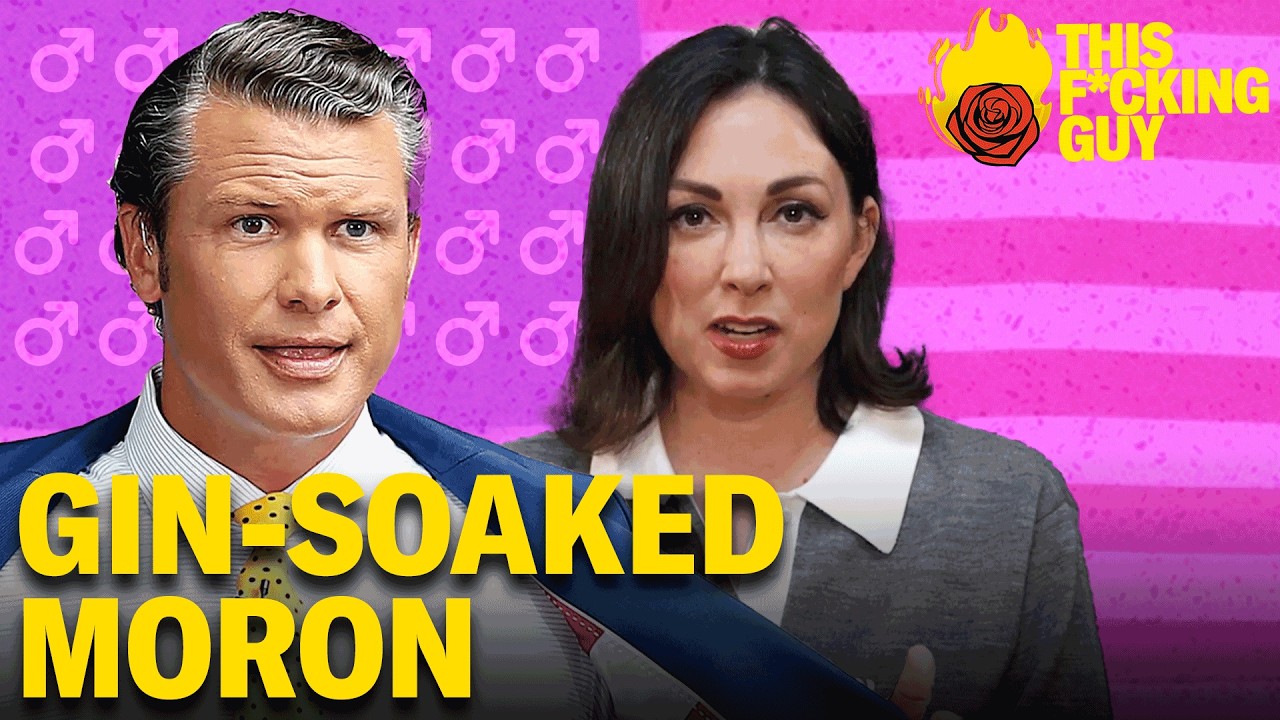
43:37
Now playing
Pete Hegseth: Everything You Didn't Know About His Sh*tty Past
Hysteria
•
:{:{75K views}:
Oct 12, 2025
In our 26th episode of This F*cking Guy, Erin and Alyssa dive deep into the past of United States Secretary of War, Pete Hegseth. From his sexist ideologies, drunken antics, cheating scandals and Fox News career to his embarrassing failures to incompetent leadership, this is definitely our most inebriated and moronic fcking guy of all time.
Sources: https://docs.google.com/document/d/1b...
CHAPTERS
0:00 - Intro
1:10 - Pete's childhood
3:38 - Pete's early bad ideas
6:38 - Pete's first marriage and military career
15:45 - Pete on Fox News and drinking problems
21:00 - Ad break
22:54 - Pete gets into politics (and more drinking)
32:49 - Trump picks Pete for Secretary of Defense
harv ret to sender
princeton tory funder?
...
3:41
the Tories March 2002 issue that the reason that some Americans sympathized with the Taliban was because they lacked
3:47
a male disciplinary figure. Later in that article, Hexath advocated parental discipline that included spanking and
3:54
shoving soap in children's mouths. Hot take for the ages. Of course, there was
3:59
the requisite railing against DEI. Back then, it was just called diversity. Here's what Hegsth wrote about that.
4:06
Quote, "Race can be a legitimate part of what makes up a diverse campus, but it also doesn't define anyone. Allan Keys
...
them. So theatrical. He loves drama. Hexath also got himself into some hot water over publishing
5:19
claims that having sex with an unconscious woman was not rape. I'm sorry, what? Here's the exact quote
5:25
from an opinion column that ran in the Tory. The columnist is describing a session he had to attend during college
5:30
orientation where attendees had to determine whether a sketch mentioning a man having sex with a passed out woman
5:36
counted as rape. Quote, "The actual instance portrayed in the skit was in fact not a clear case of rape, at least
5:42
not in my home state. In short, though intercourse was not consented to, there was no duress because the girl drank
...
7:27
questioning the value in offering up human lives in defense of American business interests, he found meaning
7:32
again in advocating for more war. In 2006, he started working with a pro-war veterans organization called Veterans
7:39
for Freedom. VFF was meant to appear like it was a grassroots movement for pro-war American troops who just wanted
7:45
to get themselves and all their friends and colleagues blown up in the Middle East as soon as possible. But it was actually what's known as an astroturf
7:52
organization. Oh, Alyssa. Astroturf fake grass. I just got that like right now.
7:59
VF was actually founded with money from three conservative billionaires who are
8:04
now dead. Bernard Marcus, the founder of Home Depot. Jerry Parentio, a longtime Univision executive who lived in the
8:11
mansion from the Beverly Hillbillies, and businessman and former neighbor of Oprah Winfrey, Harold Simmons. Between
8:17
the three of them, they've been married a total of eight times. Just a fun fact about these boosters of conservative
8:22
family values. Journalist Jane Mayer also found ties between the organization and other shadowy right-wing moneymen
8:28
like Paul Singer. You might remember Paul Singer as the guy standing to the left of Supreme Court Justice Samuel
8:33
Alto wearing pristine waiters and holding a giant salmon in this photo which is from a ProPublica story about
8:39
how Paul Singer paid for Samuel Alito to go on a luxury Alaskan fishing trip.
8:44
Alto did not disclose it and later did not recuse himself from Supreme Court cases directly involving Paul Singer's
8:50
companies. These [ __ ] guys. In 2007, Hegth became the leader of VFF. He was a
---
---
AN 1 26
One of President Donald Trump's billionaire pals is about to score huge profits thanks to the ousting of Venezuela's Nicolás Maduro.
Writing on Monday, "Public Info" reporter Judd Legum revealed that Paul Singer, who has a net worth of about $6.7 billion, donated $5 million to Trump's super PAC and to Trump's political allies. He was also a major donor to Trump's transition team, where contributions don't have to be disclosed.
In November, Singer bought Citgo, a U.S.-based subsidiary of Venezuela's state-run oil for $5.9 billion. It was a "bargain price," said Legum, because at the time there was an embargo on Venezuela's oil exports. In the past, Citgo has been forced to get its oil from Columbia or Canada, which offer more expensive sources than oil produced in the United States. So, profits were down.
"Citgo owns three major refineries on the Gulf Coast, 43 oil terminals, and a network of over 4,000 independently owned gas stations," wrote Legum. "By all accounts, Singer acquired these assets at a major discount. Advisors to the court that oversaw the sale valued Citgo at $13 billion, while Venezuelan officials said the assets were worth as much as $18 billion."
Singer's private investment firm, Elliott Investment Management, is called a “vulture” fund because it swoops in to buy up distressed assets for pennies on the dollar.
Trump has tried to tie the fentanyl crisis to Venezuela, but the country doesn't make it. Instead, the drug cartels are focused more on cocaine.
That said, Trump has been saying for years that he wants Venezuela's oil. He has also been spreading rumors that the country was was on the brink of "collapse."
When he left office in 2021, Trump claimed that if he remained in office, he would have taken over Venezuela and “gotten all that oil.”
As Legum closed, 'Paul Singer, thanks to a well-timed transaction, will be one of the largest beneficiaries."
---
AN 7 25
President Donald Trump has openly declared war on Rep. Thomas Massie (R-Ky.), who has been a consistent thorn in his side throughout his second term. Now, the billionaires funding Trump's primary campaign against Massie are being unmasked.
In a Thursday report for Politico, journalist Jessica Piper identified the three Republican megadonors behind the effort to oust Massie out of his northern Kentucky congressional district. According to Federal Election Commission (FEC) filings, hedge fund billionaire Paul Singer (known for taking Supreme Court Justice Samuel Alito on a luxury fishing trip) has so far contributed $1 million to the MAGA KY Political Action Committee (PAC), making him the leading funder of the anti-Massie effort.
In addition to Singer, hedge fund manager John Paulson has ponied up $250,000 to MAGA KY. And a super PAC tied to Miriam Adelson — the widow of Las Vegas casino magnate Sheldon Adelson — has so far donated $750,000 to the effort. Singer, Paulson and Adelson have net worths of $6.2 billion, $3.8 billion and $33.5 billion, respectively.
READ MORE:'You're paying that!' Michael Steele says Trump 'taking money out of Americans' pockets'
The $2 million from Singer, Paulson and Adelson has so far more than paid for the $1.2 million that MAGA KY has spent so far on the 2026 race in Kentucky's 4th Congressional District, which Massie has represented since 2012. But the Kentucky Republican has a sizable war chest of his own, with Politico reporting that he ended June with $1.7 million in his campaign account.
Trump singled out Massie after the six-term lawmaker joined all Democrats in voting against his "One Big Beautiful Bill Act" this summer. While Democrats opposed the legislation over its $1 trillion in cuts to Medicaid and more than $100 billion in cuts to food stamps, Massie railed against the bill for its gargantuan deficit spending — most of which went toward extending Trump's tax cuts that disproportionately benefit the wealthiest Americans.
Even though Trump has significant financial resources at his disposal to deploy against Massie, the Kentuckian is not likely to be an easy opponent for the president. Sen. Rand Paul (R-Ky.) called himself a "big supporter" of Massie, and said he would be campaigning with him across the Bluegrass State in 10 different cities across Massie's district. And anti-Massie Republicans have yet to coalesce around a single challenger. According to Ballotpedia, the only Republican who has formally declared her candidacy in the district is Nicole Lee Ethington, who is a registered nurse with no prior experience in elected office.
"They are wasting millions of dollars against me, and they are gonna lose the [House] majority because of that," Massie told NBC earlier this month.
---
---
an 10 22
Sen. Rick Scott of Florida, who chairs the National Republican Senatorial Committee (NRSC), was deeply offended when Senate Minority Leader Mitch McConnell — during an event in Kentucky in August — told a crowd that he considers control of the U.S. Senate a toss-up in the 2024 midterms and cited “candidate quality” as a factor. McConnell expressed confidence that Republicans will “flip” the U.S. House of Representatives, but wasn’t nearly as bullish on the Senate. And his “candidate quality” comment was taken as a criticism of the MAGA candidates Trump has pushed.
McConnell, however, isn’t the only Republican who is concerned about the quality of U.S. Senate candidates who former President Donald Trump has been pushing. In an article published by CNBC’s website on September 30, reporter Brian Schwartz takes a look at Republican donors who are reluctant to get out their wallets for Trump-backed Senate hopefuls who have been underperforming in polls.
“Republican megadonors want the GOP to take back the Senate, but they don’t have confidence that some of former President Donald Trump’s top picks can catapult their party to a victory in November,” Schwartz explains. “Billionaire financiers Paul Singer, Dan Loeb and Larry Ellison have so far avoided donating directly to some or all of Trump’s staunchest allies running for Senate in the midterms: J.D. Vance in Ohio, Blake Masters in Arizona, Herschel Walker in Georgia, Adam Laxalt in Nevada and Dr. Mehmet Oz in Pennsylvania, according to Federal Election Commission records and people familiar with the billionaires’ donations.”
READ MORE: 'A harsh reality': Dr. Oz bombards Republican voters with panicked fundraising pleas
The CNBC reporter adds, “All of those candidates have been endorsed by Trump. And many of them have previously sided with the former president on the false claims that the 2020 presidential election had widespread voter fraud — an accusation that’s been debunked by Trump’s former attorney general, Bill Barr, federal courts and several other top Republicans who served in Trump’s administration.”
A Republican strategist, quoted anonymously, told CNBC that those megadonors would “would be lighting their money on fire if they got totally swayed by these candidates.” And that strategist is advising donors to give their money to the Senate Leadership Fund, a political action committee run by McConnell’s former chief of staff Steven Law. That strategist said of the Senate Leadership Fund, “They have the best polls, and they won’t sink money into races they know they can’t win.”
Schwartz notes, “The campaign poll tracking website FiveThirtyEight shows Masters trailing (incumbent Sen. Mark) Kelly by more than seven percentage points…. FiveThirtyEight shows Oz trailing his Democratic rival John Fetterman by more than six percentage points and Walker trailing his competitor, (Sen. Raphael) Warnock, by more than two percentage points. Vance and Laxalt are both in statistical dead heats with their Democratic rivals; both GOP candidates are down by an average of less than a percentage point.”
Schwartz points out that megadonor and real estate mogul Stephen Ross “hasn’t given a penny yet to Vance, Walker, Masters, Laxalt or Oz, according to FEC filings.”
“Ross was criticized for hosting a fundraiser for Trump and the Republican National Committee at his Hamptons home in 2019, but has distanced himself from some of Trump’s favorite candidates this election cycle,” Schwartz observes. “He’s donated over $685,000 to a mix of Republicans, Democrats and their affiliated outside groups this cycle. His biggest checks so far have gone to GOP organizations tied to Republican leadership, such as House GOP campaign arm, the National Republican Congressional Committee and a joint fundraising committee called Take Back the House 2022, federal election records show.”
---
==
wtf?
From Fox News: The influence of political donations on policy decisions—and the subsequent effect on everyday citizens—is the subject of a new “Tucker Carlson Tonight” investigation. This episode examines the influence of major Republican donor Paul Singer through his investment in sporting goods retailer Cabela’s, a subsequent merger and the company’s sale that led to the loss of 2,000 jobs in Sidney, Nebraska. Read and watch more.
==
https://littlesis.org/person/52680-Paul_Singer
NO LNX
Leadership & Staff
Annie Dickerson Director, Singer Family Foundation
• philanthropic adviser
Business Positions
Donaldson Lufkin & Jenrette Investment banking firm
• Attorney ('74→'77)
Board Memberships
Manhattan Institute conservative think tank
• Chairman of the Board
Paul Singer Family Foundation
• president
Republican Jewish Coalition
• Director
Committee on Capital Markets Regulation The Committee on Capital Markets Regulation is an independent and nonpartisan 501(c)(3) research organization
• Committee Member
Elliott Management Vulture hedge fund managed by Paul Singer
• CEO
Harvard Medical School Harvard's med school
• member, board of fellows
Commentary Inc Neoconservative 501c3 that publishes Commentary magazine
• Board Member (past)
Positions
Start-Up Nation Central Non-profit dedicated to promoting Israel's high tech economy, inspired by the book, Start-Up Nation
• Co-founder
Paul E Singer Foundation Billionaire Paul Singer's personal foundation
• Director
In the office of
Marco Rubio US Senator from Florida; (2011-present); 2016 GOP Presidential candidate
• National Finance Chairman, 2016 presidential campaign
Donors
Washington Free Beacon Right-wing website, funded by New York hedge fund billionaire Paul Singer
• Donation/Grant
Donations
1 / 8
New Yorkers for a Balanced Albany Pro-charter independent expenditure group
• 4 contributions · 3,500,000 USD (Oct 2 '14→Jul 12 '18)
Friends of The Israel Defense Forces Initiates and helps support educational, social, cultural, and recreational programs & facilities for the young men and women soldiers of Israel who defend the Jewish homeland.
• Donation/Grant · 1,040,000 USD ('14)
58th Presidential Inaugural Committee Fundraising committee for Trump inauguration
• Donation/Grant · 1,000,000 USD ('17)
Restore Our Future PAC Super PAC tied to Mitt Romney
• Donation · 1,000,000 USD
Fighting for Ohio Single candidate super PAC in support of Ohio Republican Senator Rob Portman
• Donation · 750,000 USD (Dec 10 '15→Jun 23 '16)
Balance New York
• 1 contribution · 500,000 USD (Oct 3 '14)
NYS Senate Republican Campaign Committee
• 5 contributions · 311,900 USD (Jun 26 '08→Sep 14 '16)
America Rising PAC Unofficial oppo-research affiliate of the Republican Party
• Donation · 250,000 USD ('16)
Bruce Rauner Former Governor, Illinois | former Chairman, GTCR Golder Rauner, LLC
• Donation · 250,000 USD ('13→'14)
Republican Governors Association
• Donation · 250,000 USD
Federal Election Campaign Contributions
1 / 54
Senate Leadership Fund (Super PAC) SuperPAC aiming to build Republican majority in the US Senate
• 5 contributions · 6,500,000 USD (Mar 27 '19→Nov 25 '20)
Conservative Solutions PAC
• 2 contributions · 5,000,000 USD (Nov 25 '15→Feb 16 '16)
Congressional Leadership Fund Republican super PAC
• 5 contributions · 4,005,000 USD (Apr 4 '19→Jun 17 '21)
American Crossroads Super PAC that raises funds from donors to advocate for certain candidates of the Republican Party.
• 4 contributions · 2,600,000 USD (Mar 17 '14→Sep 26 '14)
Our Principles PAC
• 4 contributions · 2,500,000 USD (Feb 29 '16→Apr 27 '16)
Progress for America Voter Fund 527supporting George W Bush re-election
• 4 contributions · 1,500,000 USD ('04)
Ending Spending Action Fund
• 2 contributions · 1,250,000 USD (Oct 9 '20→Nov 25 '20)
Wfw Action Fund, Inc.
• 3 contributions · 1,250,000 USD (Apr 4 '19→Dec 1 '20)
Republican National Committee U.S. political committee that leads the Republican Party of the U.S., a/k/a The Grand Ol' Party/GOP
• 22 contributions · 1,243,470 USD ('95→Mar 29 '18)
American Patriots PAC
• 4 contributions · 1,050,000 USD (Feb 11 '20→Jun 16 '21)
Holdings
American Opportunity Alliance Paul Singer's megadonor GOP club
• Founder ('13→?)
Elliott Management Vulture hedge fund managed by Paul Singer
• Founder ('77→?)
Family
Lindsey Singer
• niece
Andrew Morris-Singer
• son
Gordon Singer Son of Paul Singer; Partner and Head of Elliott Mangement's office in London
• son
Bonnie Loeb Retired Administrative Assistant, Elliott Management
• girlfriend
Services & Transactions
Myron Kaplan
• Attorney
Marco Rubio US Senator from Florida; (2011-present); 2016 GOP Presidential candidate
• a political ally*
Schools
Harvard Law School
• JD
University of Rochester Private, coeducational, nonsectarian, nonprofit research university
• BS, Psychology
Social
Myron Kaplan PAL
---
Donors to Common Recipients
Recipients of donations from Caroline Wren also received donations from these orgs and people
Donor Common Recipients
Paul Singer Lindsey Graham, Mark Steven Kirk, Mike Coffman, Kelly Ayotte, Brian Fitzpatrick, Carlos Curbelo, John Katko, Team Graham, Americans United for Freedom
Charles R Schwab Lindsey Graham, Mark Steven Kirk, Mike Coffman, Kelly Ayotte, Brian Fitzpatrick, Carlos Curbelo, John Katko, Team Graham
Helen Schwab Lindsey Graham, Mark Steven Kirk, Mike Coffman, Kelly Ayotte, Josh Mandel, Carlos Curbelo, John Katko, Team Graham
John Catsimatidis Lindsey Graham, Kelly Ayotte, Josh Mandel, Brian Fitzpatrick, Carlos Curbelo, John Katko, Team Graham, Team Josh
Ron Cameron Lindsey Graham, Mark Steven Kirk, Mike Coffman, Kelly Ayotte, Josh Mandel, Brian Fitzpatrick, Carlos Curbelo, John Katko
Jay Faison Lindsey Graham, Mark Steven Kirk, Kelly Ayotte, Brian Fitzpatrick, Carlos Curbelo, John Katko, Team Graham
Duane R Roberts Lindsey Graham, Mark Steven Kirk, Mike Coffman, Kelly Ayotte, Brian Fitzpatrick, Carlos Curbelo, John Katko
William EOberndorf Lindsey Graham, Mark Steven Kirk, Mike Coffman, Kelly Ayotte, Josh Mandel, Carlos Curbelo, John Katko
Lothar L Mayer Mark Steven Kirk, Mike Coffman, Kelly Ayotte, Josh Mandel, Brian Fitzpatrick, Carlos Curbelo, Team Josh
Marlene M Ricketts Lindsey Graham, Mark Steven Kirk, Kelly Ayotte, Josh Mandel, Brian Fitzpatrick, John Katko, Team Graham
Roy H Hinman II Lindsey Graham, Mike Coffman, Kelly Ayotte, Josh Mandel, Carlos Curbelo, John Katko, Team Graham
Richard Horvitz Lindsey Graham, Mark Steven Kirk, Mike Coffman, Kelly Ayotte, Josh Mandel, Carlos Curbelo, Team Josh
C Boyden Gray Lindsey Graham, Mark Steven Kirk, Kelly Ayotte, Josh Mandel, Brian Fitzpatrick, John Katko, Team Josh
Kelly Roberts Mark Steven Kirk, Mike Coffman, Kelly Ayotte, Josh Mandel, Brian Fitzpatrick, Carlos Curbelo, John Katko
Giuseppe Cecchi Lindsey Graham, Mark Steven Kirk, Mike Coffman, Kelly Ayotte, Josh Mandel, John Katko, Team Graham
Thomas W Smith Lindsey Graham, Mark Steven Kirk, Kelly Ayotte, Josh Mandel, Brian Fitzpatrick, John Katko, Team Josh
Robert Ziff Lindsey Graham, Mark Steven Kirk, Doug Jones, Brian Fitzpatrick, Carlos Curbelo, John Katko
James E Stephenson Lindsey Graham, Mike Coffman, Kelly Ayotte, Brian Fitzpatrick, Carlos Curbelo, John Katko
Marilyn Hayden Lindsey Graham, Mark Steven Kirk, Mike Coffman, Kelly Ayotte, Josh Mandel, Team Graham
Seth Klarman Lindsey Graham, Mark Steven Kirk, Doug Jones, Kelly Ayotte, Carlos Curbelo, John Katko
---
inst invest oct
hedge fund billionaire Paul Singer, a major Republican Party donor, tried to keep Donald Trump from getting into the White House, going so far as financing opposition research on the now-president.< As a major funder of the #neverTrump campaign, Singer – the CEO of $34 billion hedge fund firm Elliott Management – left no stone unturned in an effort to stop Trump from gaining the Republican nomination last year. One example: The Washington Free Beacon, a conservative website backed by Singer, was the first to engage Fusion GPS, a political research firm, to do opposition research on Trump and other Republicans Fusion GPS’s work for Free Beacon ended in May of 2016, but by April Fusion GPS was also working for Democratic presidential candidate Hillary Clinton, according to the Times.
Fusion GPS eventually hired former British spy Christopher Steele, leading to the infamous dossier alleging Trump’s ties to Russia and claiming a conspiracy between the campaign and Russia to influence the presidential election. Those allegations are part of a wide-ranging investigation by special counsel Robert Mueller, who will reportedly unveil the investigation’s first indictment Monday. Singer – who supported Florida Republican Senator Marco Rubio for president in 2016 – and the Free Beacon had nothing to do with financing the dossier, the publication told the Times. After the election, he made peace with Trump, gave $1 million to the inaugural, and visited with Trump at the White House in February. He also supported Trump’s appointment of Neil Gorsuch to the U.S. Supreme Court, making substantial contributions to outside groups lobbying for his appointment, according to a source close to Singer.
After Trump’s election, Singer said at a Bloomberg event in June, “I became optimistic about some of the opportunities in economic growth and regulatory reform, tax reform.” Singer said he and Trump “chatted a bit about taxes and economic policy” when he visited the White House.
Singer, a fiscal conservative, declined through a spokesman to comment on his views on the current Republican Senate tax proposal.
A stalwart Republican, Singer has spent tens of millions of dollars in recent years on Republican candidates and causes. He donated $24 million to outside Republican and conservative groups in the 2016 election, in addition to $10.6 million in 2014 and $2.8 million in 2012, according to the Center for Responsive Politics.
Those dollars don’t include Singer’s contributions to individual Republican candidates. Nor do they include his efforts to shape conservative thought: In addition to his support of the Free Beacon, Singer is also chairman of the conservative Manhattan Institute for Policy Research and a major financier of Commentary magazine.
II Deep Dive: [The Last Hedge Fund Pit Bull]
A Hedge Fund Manager at Odds
But Singer’s establishment Republican credentials are at odds with the party’s base – one that elected Trump and which appears to be gaining power. One example: Singer spent millions of dollars on efforts to legalize gay marriage and helped launch a political action committee to promote gay rights within the Republican Party.
Singer is also a major donor to numerous Jewish causes, including the Republican Jewish Coalition, which was critical of Trump’s response to the mid-August far-right protest in Charlottesville, Virginia, saying Trump should have been more vocal in condemning neo-Nazis and white supremacists who organized the event.
While some Republican financiers have since denounced Trump, Singer has not done so.
Thus far this cycle, Singer has given approximately $1.5 million to Republican candidates and political action committees, more than $1 million of which is going to the Senate Leadership Fund, which works to get Republicans elected – Republicans who are often at odds with candidates backed by former White House chief strategist and Breitbart executive chairman Steve Bannon, who is backing insurgent Republicans who want to oust more traditional candidates.
Bannon has recently won at least one victory, with establishment-backed Senator Luther Strange of Alabama losing the Republican primary to Bannon-backed candidate Roy Moore.
Two establishment Republicans, Sen. Bob Corker of Tennessee and Sen. Jeff Flake of Arizona, have criticized Trump and say they will not run again rather than face ugly primaries.
===
:{:{}:
---
beware bs
October 28, 2017
NEW YORK (AP) — A conservative website with strong ties to the Republican establishment triggered the investigation into Donald Trump’s past that ultimately produced the dossier that alleged a compromised relationship between the president and the Kremlin.
The Washington Free Beacon on Friday confirmed it originally retained the political research firm Fusion GPS to scour then-candidate Trump’s background for negative information, a common practice known as “opposition research” in politics. Leaders from the Free Beacon, which is funded largely by Republican billionaire Paul Singer, insisted none of the early material it collected appeared in the dossier released later in the year detailing explosive allegations, many uncorroborated, about Trump compiled by a former British spy.
“During the 2016 election cycle we retained Fusion GPS to provide research on multiple candidates in the Republican presidential primary, just as we retained other firms to assist in our research into Hillary Clinton,” wrote the site’s editor-in-chief, Matthew Continetti, and chairman Michael Goldfarb. They continued: “The Free Beacon had no knowledge of or connection to the Steele dossier, did not pay for the dossier, and never had contact with, knowledge of, or provided payment for any work performed by Christopher Steele.”
Earlier in the week, reports revealed that the Clinton campaign and the Democratic National Committee continued funding Fusion’s work after the original GOP source lost interest.
Trump this week called it a “disgrace” that Democrats had helped pay for research that produced the document. But the original source of the research remained a secret.
The president himself hinted that he knew the Republican source earlier in the week, but he refused to share it. The White House had no immediate comment Friday night about the Free Beacon’s involvement.
The Washington Free Beacon was initially founded as a project of the conservative nonprofit group Center for American Freedom, as an alternative to liberal news sites run by progressive nonprofits. The Center for American Freedom was organized as a 501(c)4 and did not reveal its donors, but Singer was the sole funder of the site as recently as 2014, according to a Republican political veteran familiar with the site. The veteran spoke on condition of anonymity to detail the newspaper’s financial background.
The Free Beacon first retained Fusion to investigate Trump in the fall of 2015 and ended its relationship after Trump secured the Republican presidential nomination in late spring of 2016, according to a person close to Goldfarb, who spoke on the condition of anonymity to share private discussions.
The website and its leaders have strong ties throughout the Republican establishment. Goldfarb was deputy communications director on John McCain’s presidential campaign. Singer was backing Florida Sen. Marco Rubio’s presidential bid at the time of the Free Beacon’s involvement. And one of Singer’s closest associates, Republican operative Dan Senor, served as Speaker Ryan’s chief adviser during the 2012 president campaign.
A representative to Singer did not immediately respond to a request for comment.
Rubio denied any knowledge of the Fusion research or the dossier this week.
“As far as whether it was my campaign, it wasn’t and I’ll tell you why,” he told CNN. “I was running for president. I was trying to win. If I had anything against Donald Trump that was relevant and credible and politically damaging, I would’ve used it. I didn’t have it.”
The document, compiled by former British spy Christopher Steele, emerged this year as a political flashpoint in the broader debate over Trump’s ties to Russia.
A person close to Singer said the billionaire was not aware of Steele’s involvement or the dossier until earlier this year when it was published. The person was not authorized to share internal discussions.
Law enforcement officials have worked to corroborate the dossier’s claims. James Comey, FBI director at the time, advised Trump about the existence of the allegations, and Steele has been questioned as part of an ongoing probe into possible coordination between Russia and the Trump camp.
The U.S. intelligence community has determined that Russia meddled in the 2016 U.S. election. Special counsel Robert Mueller is investigating the Russian interference and whether it was tied to Trump’s campaign.
The House Intelligence Committee will help verify whether the Free Beacon had any involvement with Steele or his dossier, according to Jack Langer, a spokesman for House Intelligence Committee Chairman Devin Nunes.
“The Beacon has agreed to cooperate with the House Intelligence Committee to help the Committee verify this assertion,” Langer said.
Miller reported from Washington. Associated Press writers Chad Day, Mary Clare Jalonick, Stephen Braun and Tom LoBianco in Washington contributed to this report.
Related Topics:Fusion GPS, Media, Donald Trump
---
}:
===
...
...dismissed as a tissue of fabrications by allies of President Donald Trump after its publication in January, but the infamous Trump-Russia dossier continues to generate controversy.
In recent weeks, the dossier containing lurid claims about the president's alleged ensnarement by Russian intelligence has again become the subject of fierce contention between Democrats and the GOP.
Republicans have claimed the document, compiled by former British spy Christopher Steele, had been exposed as a partisan smear after evidence emerged that the Clinton campaign had funded its research by Washington, D.C., firm Fusion GPS. But on Friday, The New York Times reported that GOP super donor Paul Singer's Washington Free Beacon website was the first to engage Fusion GPS to probe Trump's background.
Singer's involvement has reportedly enraged Trump. Populist firebrand and former White House chief strategist Steve Bannon promised the president in a telephone conversation that he was going "off the chain" to attack Singer, Axios reported Sunday.
The development lays bare the conflict at the heart of the Republican Party, with Singer one of several establishment party figures Bannon has pledged to wage war against in his capacity as Trump's enforcer. GOP opponents of Trump were the earliest funders of the research behind the dossier, Mother Jones reported in October, 2016, and renegadeSenator John McCain has confirmed in a January statement that he passed a copy of the dossier to the FBI.
Billionaire hedge fund manager Singer is a longtime GOP activist and has donated tens of millions to Republican groups, candidates and causes. He donated $24 million to Republican and conservative groups in the 2016 election alone, with $10.6 million donated in 2014 and $2.8 million in 2012, according to the Center for Responsive Politics.
Singer backed MarcoRubio in the 2015 Republican primaries, and after Trump's election he made peace with the president, donating $1 million to the inaugural committee and significant sums to groups lobbying for Trump's Supreme Court nominee Neil Gorsuch.
At a Bloomberg event in June, Singer enthused about the president's fiscal policies and saidhe and Trump "chatted a bit about taxes and economic policy" during a White House visit.
The Free Beacon denies funding research that contributed to the Russia dossier and said it told Fusion GPS to stop researching Trump when he clinched the Republican nomination in May 2016.
Friday's report, however, may mean that he is now in the crosshairs of Steve Bannon, as back at the helm of the Breitbart news network he wages "war" on the establishment GOP he accuses of being out to derail the president's populist agenda.
:{:{}:
}:
===
HUH?! verify
:{:{}:
}:
www.newyorker.com › news › our-columnists › the-digger-who-commi...
:{:{}:
The Digger Who Commissioned the Trump-Russia Dossier ...
Jan 10, 2018 - However, we have also learned that the F.B.I. took Steele's work ... the hedge-fund billionaire Paul Singer, has acknowledged hiring Fusion ...
}:
:{:{}:
www.nytimes.com › 2017/10/27 › politics › trump-dossier-paul-singer
:{:{}:
Conservative Website First Funded Anti-Trump Research by ...
Oct 27, 2017 - Paul Singer in June at an event for investors in New York. ... product that The Free Beacon received appears in the Steele dossier,” they said.
}:}:
:{:{:{}:
www.politico.com › russia-steele-dossier-democrats-republicans-216921
:{:{}:
Democrats Embraced a Flawed Dossier—And Gave ... - Politico
1.
}:}:}:
:{:{:{}:
www.rollcall.com › news › politics › paul-ryan-aide-rep-adam-kinzin...
:{:{}:
Paul Ryan Aide, Rep. Adam Kinzinger Received Steele ...
1.
}:}:}:
:{:{:{}:
www.newsweek.com › ... › GOP › Funding › Trump › Russia › Dossier
:{:{}:
Paul Singer: Who Is the Billionaire Republican Donor at the ...
1.
}:}:}:
:{:{:{}:
www.timesofisrael.com › trump-dossier-triggered-by-website-funded-...
:{:{}:
Trump dossier triggered by website funded by Jewish GOP ...
1.
}:}:}:
:{:{:{}:
www.npr.org › 2018/03/06 › journalist-charts-the-bizarre-twists-and-tur...
:{:{}:
Of The Trump-Russia Dossier - NPR
Mar 6, 2018 - Firm That Contracted Steele Dossier Says It Was 'Shocked' By Findings on ... But when it becomes clear to Paul Singer, who is paying them ...
}:}:}:
:{:{:{}:
www.institutionalinvestor.com › article › paul-singers-fight-for-the-soul-...
:{:{}:
Paul Singer's Fight for the Soul of the GOP | Institutional Investor
Oct 30, 2017 - Hedge fund billionaire Paul Singer, a major Republican Party donor, ... Christopher Steele, leading to the infamous dossier alleging Trump's ...
}:}:}:
:{:{:{}:
en.wikipedia.org › wiki › Steele_dossier
:{:{}:
Steele dossier - Wikipedia
The Steele dossier, also known as the Trump–Russia dossier, is a private intelligence report ... It is primarily funded by Republican donor Paul Singer. The Free ...
}:}:}:
:{:{:{}:
www.washingtonpost.com › world › national-security › 2017/10/27
:{:{}:
Conservative website first paid Fusion GPS for Trump research
Oct 27, 2017 - The website is supported by billionaire GOP donor Paul Singer, ... received appears in the Steele dossier,'' said the statement from Free ...
}:}:}:
===
:{:{:{:{}:
}:}:}:
ref
:{:{:{:{}:
}:}:}:
https://www.emptywheel.net/2019/11/14/devin-nunes-calls-an-experienced-organized-crime-researcher-funded-by-paul-singer-a-democratic-operative/
:{:{:{:{}:
}:}:}:
blog?
:{:{:{:{}:
}:}:}:
NUNES CALLS AN EXPERIENCED ORGANIZED CRIME RESEARCHER FUNDED BY PAUL SINGER A DEMOCRATIC OPERATIVE
November 14, 2019/64 Comments/in 2016 Presidential Election, 2020 Presidential Election, Impeachment, Mueller Probe /by emptywheel
There’s a key part of Devin Nunes and Mark Meadows’ defense of the President yesterday that deserves far more attention, both for the way it distorts the factual record and how it suggests that simply being an expert on Russian and Ukrainian organized crime makes one a Democratic operative.
At issue is their bid to make the impeachment inquiry about Nellie Ohr, whom they’ve past falsely suggested had a role in mainlining the Steele dossier into DOJ and FBI. They’ve brought Nellie, the spouse of a key DOJ expert on organized crime, Bruce Ohr, back into their narrative by claiming she testified to Congress that Fusion GPS relied on Ukrainian sources. The idea is that Ohr’s testimony would prove that Trump had good reason to think Ukraine had it in for him in 2016, so could rightly ask Ukraine to investigate whether that amounted to tampering in the election.
Here’s how Nunes laid it out in his demand that Ohr be called to testify:
Nellie Ohr, former contractor for opposition research firm Fusion GPS. In a 2018 interview with the House Judiciary and Oversight Committees, Ms. Ohr stated that, during her work with Fusion GPS that ultimately assisted in the production of the Steele dossier–comprising false allegations against then-candidate Trump–Fusion GPS used information from sources in Ukraine, including Serhiy Leshchenko who recently lost his post from the Ukrainian parliament. Given President Trump’s documented belief that the Ukrainian government meddled in the 2016 election to oppose his candidacy, which forms the basis for a reasonable desire for Ukraine to investigate the circumstances surrounding the election and any potential Ukrainian involvement, Ms. Ohr is a prime fact witness who can assist Congress and the American public in better understanding the facts and circumstances surrounding Ukrainian involvement in the 2016 election.
In his demand, Nunes helpfully provides a footnote, to make it easy to see how many errors he makes in this paragraph. Here’s the passage of Ohr’s testimony before Congress that, Nunes falsely claims, backs his insinuations that Ohr tampered in the 2016 campaign.
GOP counsel Ryan Breitenbach is questioning her.
Q Was there indication from [her boss at Fusion GPS, Jake] Berkowitz or [Glenn] Simpson that they had any inside information as to whether there were suspicious connections with any of President Trump’s orbit of individuals including his family?
A What do you mean by “inside information”?
Q I would say any information that they specifically gave you, in terms of your employment with Fusion GPS, that would indicate that there were some level of connections with President Trump’s family and Russia?
A They would give me leads based on their open-source research and, you know, legal documents and other things.
Q Did they ever indicate that any of their leads were based off of sources of theirs?
A I don’t remember get- — regarding the Trump family, no.
Q Regarding any of the research during this year, 10-, 11-month period, was any — was any research based off of sources of theirs that you were aware of?
A Yes.
Q And who were the sources?
A I recall a — they were mentioning someone named Serhiy Leshchenko, a Ukrainian.
Q And did they give you any indication as to Leshchenko’s connections with them, how they got to know him? Were they doing work for him?
A With Fusion GPS?
Q Correct.
A I am not aware of how they —
Q Were you aware of how they had a connection with him?
A I am not aware.
Q But you were aware that he was a source of information that was leading to information that they had, that they were then presenting to you as reasons for following up on opposition research or what research —
A Yes.
Q — that is, on President Trump or his family?
A My understanding is that some — yes. And — yes, it was not necessarily on his family that Leshchenko’s research was on.
Q Are you aware of what his research, or what his source information included?
A His source information, I am not aware.
Q You are just aware that he was a source of —
A Yes.
Q — Glenn Simpson? Or was it a source of Mr. Berkowitz? Or both?
A I am not aware of a differentiation between them. Just a source for Fusion GPS.
Q That is one source. Were there any other sources that you were aware of?
A I don’t think so. I don’t recall that there were.
Q And were you aware of Mr. Leshchenko prior to him being mentioned to you as a potential source of their information?
A Yes.
Q In what way?
A He is very well-known, Ukrainian, anti-corruption activist. So I had read about him in the press.
Q Had you studied him before?
A What do you mean by “studied”?
Q Performed independent research for any prior employer.
A No. I followed him in the — you know, if I saw him mentioned in the press, I read — I read about it.
Q And previous to this particular incoming knowledge from Mr. Simpson or just from Fusion GPS, were you aware of any connections between Mr. Leshchenko — am I saying that name, by the way?
A Yes.
Q — Mr. Leshchenko and President Trump, or anyone in President Trump’s familial orbit or even friendly orbit?
A I was unaware of any connections before that. [my emphasis]
Before this colloquy, Ohr had already testified that she had “no reason to believe” that her work was integrated into the Steele dossier at all. Democratic staffers walked her through passage after passage in the Steele dossier and asked her if her work had provided background for it, which she said it did not. She also had already explained (to both Jim Jordan and Mark Meadows in separate interactions directly) that she, “did online open source research using Russian sources, media, social media, government, you know, business registers, legal databases, all kinds of things.” Ohr’s testimony was backed by Glenn Simpson’s earlier appearances before Congress — including an appearance before HPSCI that Nunes attended; Simpson also said his own research was based off open source research.
Moreover, both the reports Nellie did (PDF 216 to 299) and a table she put together on Trump and his flunkies’ ties to suspect Russians show that the bulk of her research for Fusion preceded the time when Christopher Steele was working on the dossier. Significantly, that means much of Nellie Ohr’s work was paid by GOP billionaire Paul Singer, not the DNC.
So in this passage, Nellie Ohr is talking leads she got from her boss at Fusion, Jake Berkowitz, based off open source research he had done, that she would use to do more open source research, for a project mostly paid for by a Republican billionaire interested in the ties between Trump and Russian organized crime.
And what the passage shows is that:
- Ohr said the information from Berkowitz came from open source reporting
- She described herself getting information on Serhiy Leshchenko’s efforts, because he was a very well-known anti-corruption activist who was covered in the press
- She twice said she was not aware of how Berkowitz and Simpson got their information from Leshchenko
- She also said she didn’t know where Leshchenko got his information
- Ohr said that Leshchenko’s reporting wasn’t focused on the Trump family (it almost certainly was focused on Paul Manafort, about whom Ohr wrote a detailed timeline)
In short, the transcript Nunes says supports a demand that Ohr testify does no such thing. Instead, it shows that this side of Fusion’s work relied on open source reporting, and that information on Leshchenko’s efforts was available via open sources. It also shows that Ohr repeatedly denied knowing whether the Fusion focus on Leshchenko was based on anything but open source reporting.
This transcript also shows that if Republicans really wanted to know about how Leshchenko’s work informed Fusion’s work, they should ask Simpson or Berkowitz to testify, because Ohr was only ever working from open sources — that is, doing research, mostly paid for by a Republican billionaire.
That background is all critically important for how Nunes ended yesterday’s testimony. In his closing statement at the hearing, Nunes restated his demand that Schiff permit Republicans to call their chosen witnesses, which he listed as:
- The whistleblower
- The folks that he spoke to
- Numerous Democratic operatives who worked with Ukraine to meddle in the election
Obviously, Nellie Ohr — an experienced researcher on Ukrainian and Russian organized crime — must fall into the latter category.
So on top of all the ways Nunes misrepresented the Ohr’s testimony (or her ability to testify on the issues he claims to want to hear), there’s this. The Ranking Member of the House Intelligence Committee, Devin Nunes, believes that an expert on Ukrainian and Russian organized crime being paid to do open source research by a Republican billionaire must be a Democratic operative.
Tags: Bruce Ohr, Christopher Steele, Devin Nunes, Glenn Simpson, Jim Jordan, Mark Meadows, Nellie Ohr, Paul Manafort, Paul Singer, Serhiy Leshchenko
===
==
1119
https://theintercept.com/2019/11/12/elizabeth-warren-pregnancy-fired-america-rising/
in oct documents surfaced that appeared to contradict a key story told by Sen. Elizabeth Warren on the campaign trail. In her telling, Warren’s “dream job” as a public school teacher ended in 1971 when the school principal noticed she was “visibly pregnant,” a form of employment discrimination that was legal and common during that era. On October 7, a conservative website presented archived documents that appeared to challenge that narrative, including the minutes of a meeting in which the school board had voted to extend Warren’s tenure and another in which the board notes that Warren herself resigned from the job.
The story spread like wildfire, moving from conservative publications to major newspapers. Even Kellyanne Conway, a counselor to President Donald Trump, weighed in on the controversy to suggest that the Democratic candidate had lied about her life story. More records seeming to challenge Warren’s narrative emerged, including a 2007 interview in Berkeley, California, in which Warren appeared to say that she left teaching on her own accord to raise her child and seek additional education credentials, as well as a contemporaneous newspaper story about Warren leaving the school “to raise a family.”
Warren has stood by her story that she was “shown the door” because of her pregnancy. “When I was 22 and finishing my first year of teaching, I had an experience millions of women will recognize. By June I was visibly pregnant — and the principal told me the job I’d already been promised for the next year would go to someone else,” Warren said on Twitter last month.
But how did these documents surface in the first place? According to the results of an open records request, an opposition research group known as America Rising had requested documents from the Riverdale Board of Education in New Jersey just weeks before the news appeared. It asked for “Warren’s employment records,” as well copies of other records requested from the school board from the previous two years.
In response to the request, a school official provided America Rising with the school board minutes that became the basis for the story that erupted the following month, along with emails from a Wall Street Journal reporter, who had requested similar records in April.
America Rising — which is affiliated with a political action committee, a public relations firm, and a for-profit research company, as well as several news websites — has been backed over the years by Republican donors, including hedge-fund billionaires Paul Singer and Ken Griffin, private equity investor John Childs, and banker Andrew Beal.
America Rising did not respond to a request for comment. The organization did not claim direct responsibility for the Warren story, but touted the documents as soon asthey appeared online via an allied conservative website called the Washington Free Beacon. Free Beacon is also funded by Singer.
America Rising is known for attempting to dig up dirt on politicians, journalists, and activists on behalf of donors’ interests. The group went after journalist Jane Mayer, shopping negative information about the New Yorker writer following the publication of her book “Dark Money.” In 2016, America Rising focused on environmentalist Bill McKibben, dispatching its team to obtain thousands of documents from McKibben’s past and to follow the Vermont-based writer, filming him at public events, as well as while grocery shopping and sitting in a church pew. This year, Definers Public Affairs, an affiliate of America Rising that shares the same staff, decided to rebrand following revelations that the company had been retained by Facebook to orchestrate a campaign to smear its critics....
==
:{:{:{:{}:
}:}:}:
https://YYY.theguardian.com/news/2017/nov/07/us-republican-donors-offshore-paradise-papers
:{:{:{:{}:
}:}:}:
...TheParadise Papers show the lengths to which the major Republican donor, hedge fund manager and “vulture capitalist” will go to extract debt from one of the world’s poorer countries.
The leaked documents contain a paper trail relating to one of Singer’s subsidiaries as it pursued entities in Congo-Brazzaville to try to retrieve debt it had bought at a knockdown price.
The practice of distressed-debt acquisitions is a Singer speciality. The leaked documents add new texture to the pursuit of the Republic of the Congo by the hedge fund manager, who gave $1m to Trump’s inaugural fund.
Kensington International Ltd, a Cayman-Islands-based subsidiary of Singer’s Elliott Management, had bought $57m of debts owed by the Congo-Brazzaville government after it borrowed money in the 1980s.
The debt was to be repaid at 8% interest – a good deal as long as the company could eventually retrieve the money. When it failed to do so, Kensington secured a ruling from a court in London in 2003 that increased the amount Congo-Brazzaville owed it to about $100m.
When the government of Denis Sassou Nguesso did not pay up, Kensington pursued the case in the British Virgin Islands, to the bemusement of a judge who wondered why a Cayman Islands company was pursuing the debt through a different jurisdiction.
In the course of fierce courtroom struggles, representatives of the Republic of the Congo government accused Singer’s company of hiding behind a small offshore subsidiary to shield itself from criticism of its relentless pursuit of one of the world’s poorer nations. Singer’s executives countered that oil was being spirited out of the country illegally to enrich members of Sassou Nguesso’s family.
Congo-Brazzaville agreed to settle its debt in November 2007 for an undisclosed sum. Singer’s company did not respond to specific questions on its activities, though it did point to positive media reports on its work in Africa.
===
2014 politico 2x?
:{:{:{:{}:
}:}:}:
group of major GOP donors, led by New York billionaire Paul Singer, is quietly expanding its political footprint ahead of the midterm elections in an increasingly assertive effort to shape the direction of the Republican Party.
The operation was launched discreetly last year, with the previously unreported formation of a club called the American Opportunity Alliance to bring together some of the richest pro-business GOP donors in the country, several of whom share Singer’s support for gay rights, immigration reform and the state of Israel. Around the same time, Singer and his allies also formed a federal fundraising committee called Friends for an American Majority that raised big checks for a select list of the GOP’s most highly touted 2014 Senate hopefuls. ....Those candidates are among the big names expected at a two-day retreat organized by the American Opportunity Alliance set for the last week of February at a swanky Colorado resort. The closed-door event — which is also expected to draw House Speaker John Boehner and New Hampshire Sen. Kelly Ayotte, according to Republicans familiar with the plans — is seen in GOP finance circles as a grand debut of sorts for Singer’s still-amorphous club.
( POLITICO's full coverage of political fundraising)
On its face, it in some ways resembles a much smaller-scale version of Charles and David Koch’s fabled network, which brings together hand-picked operatives and politicians twice a year at tony resorts to make presentations to dozens of rich conservatives. At the conclusion of the Kochseminars, as they’re called, donors commit massive sums into a pool of cash disseminated to various Koch-backed groups for seven- and eight-figure advertising and organizing campaigns that have made them a force in Republican politics rivaling the official party.
That doesn’t appear to be the goal of Singer and his donors. While many of them — including Singer himself — have attended the Koch seminars and also maintain their own independent spending groups, their approach with the American Opportunity Alliance is more donor-centric, focusing on comparing notes about one another’s political projects and funneling limited hard-money contributions effectively.
Still, the list of big-name pols expected at the American Opportunity Alliance’s upcomingColoradogathering highlights the influence that only a few big donors can command in the post- Citizens United era, when a small group of wealthy individuals can reorder elections with just a few huge checks. That new reality has shifted some of the power and control once maintained by the parties and their candidates to factions of major donors, like the libertarian-infused Koch network on the right or the Democracy Alliance club of major liberal donors on the left.
( Also on POLITICO: Barack Obama fundraisers add up)
The ideological and tactical contours of Singer’s plans remain somewhat unclear, as does the membership of the American Opportunity Alliance, which is registered as a for-profit corporation in Delaware. If nothing else, though, the group appears to represent a new center of gravity in the world of GOP money, anchored by a famously prolific Republican bundler with a distinct ideological agenda.
Singer, who founded the hedge fund Elliott Management, has long been a key player in GOP money circles, espousing a nontraditional brand of conservatism that includes aggressive backing for gay marriage and immigration reform, as well as more traditional GOP stances like lower taxes and less government regulation. Contributors to the joint fundraising account for Senate candidates — a list that likely dovetails at least partially with the American Opportunity Alliance’s member rolls — include a mix of gay marriage supporters like Todd Ricketts and billionaire investor Cliff Asness, as well as more conventional fiscal conservatives like brokerage titan Charles Schwab and real estate developer Harlan Crow.
The Colorado summit appears to be the first organized under the American Opportunity Alliance banner, but it comes after a series of other political gatherings organized by Singer and his cohort that paved the way for it. At the 2012 Republican National Convention in Tampa, Singer put together an economics panel featuring at least one congressman, plus he teamed with fellow hedge funder Dan Loeb — another prominent gay rights supporter — to host a dinner at the Hyatt Regency headlined by New Jersey Gov. Chris Christie.
===
wow they eat their own: mebbe predictable?
:{:{:{:{}:
}:}:}:
https://www.breitbart.com/the-media/2017/10/27/report-paul-singer-funded-washington-free-beacon-behind-initial-fusion-gps-trump-effort/
:{:{:{:{}:
}:}:}:
:{:{:{}:
The Washington Free Beacon, funded by GOP mega-donor Paul Singer, was the original funder of Fusion GPS’ research project that attempted to dig up dirt on then-candidate Donald Trump — a project that would later be funded by the Democratic National Committee and Hillary Clinton’s campaign.
:{:{}:
The Washington Examiner first reported Friday that lawyers for the Free Beacon — a conservative outlet based in the nation’s capital — funded the project from fall 2015 to spring 2016, when it pulled its funding as Trump looked set to clinch the nomination.
Lawyers for the Free Beacon informed the House Intelligence Committee of its role in the funding on Friday. The outlet issued a statement standing by its decision to fund the project:
Since its launch in February of 2012, the Washington Free Beacon has retained third party firms to conduct research on many individuals and institutions of interest to us and our readers. In that capacity, during the 2016 election cycle we retained Fusion GPS to provide research on multiple candidates in the Republican presidential primary, just as we retained other firms to assist in our research into Hillary Clinton.
After the Democrats took over funding of the operation in mid-2016, Fusion GPS would hire former British spy Christopher Steele and would lead to the production of the so-called “Trump dossier,” filled with salacious but unconfirmed claims about how Trump was compromised by the Russians.
Fusion has come under scrutiny for its alleged ties to Russia, including the fact that many of the claims originate from Kremlin sources — meaning that the information came from inside the Russian government.
The Free Beacon noted in its statement that it had “no knowledge of or connection to the Steele dossier, did not pay for the dossier, and never had contact with, knowledge of, or provided payment for any work performed by Christopher Steele.”
“The Washington Free Beacon has issued a statement asserting that it had no involvement with Christopher Steele or the dossier he compiled from Russian sources,” Jack Langer, spokesman for the House Permanent Select Committee on Intelligence, told Breitbart News. “The Beacon has agreed to cooperate with the House Intelligence Committee to help the Committee verify this assertion.”
Yet, the revelation is likely to fuel questions about the role the so-called “Never Trump” movement played in an effort that would eventually inflict damage on President Trump, and that was possibly part of a Russian misinformation scheme.
The Free Beacon is funded in large part by the New York hedge fund billionaire and major GOP donor Paul Singer. The New York Times reports that Singer initially supported Sen. Marco Rubio (R-FL) for the Republican nomination, but later spearheaded a campaign to deny Trump the nomination even after Rubio dropped out of the race.
While supporting Republican establishment favorites such as Rubio and 2012 presidential candidate Mitt Romney, Singer was a major backer of Common Core and was the founderof a super-PAC that has the express purpose of turning the GOP pro-gay marriage.
The Examiner reports that the Free Beacon was originally part of the 501(c)(4) tax-exempt organization — the Center for American Freedom — but in 2014 became a for-profit organization. The Center’s original board of directors includes William Kristol, a prominent “Never Trump” activist.
Kristol is also the founder of the Weekly Standard, which like the Free Beacon has a neoconservative foreign policy outlook. The Free Beacon was co-founded by two former Weekly Standard writers, chairman Michael Goldfarb and editor-in-chief Matthew Continetti.
***Update***
“The Washington Free Beacon has issued a statement asserting that it had no involvement with Christopher Steele or the dossier he compiled from Russian sources,” Jack Langer, spokesman for the House Permanent Select Committee on Intelligence, told Breitbart News. “The Beacon has agreed to cooperate with the House Intelligence Committee to help the Committee verify this assertion.”
Breitbart News’s Matthew Boyle contributed to this report.
Adam Shaw is a Breitbart News politics reporter based in New York. Follow Adam on Twitter: @AdamShawNY
}:}:}:
:{:{:{:{}:
}:}:}:
===
===
https://www.newyorker.com/magazine/2018/08/27/paul-singer-doomsday-investor
:{:{:{:{}:
}:}:}:
no lnx
:{:{:{}:
August 27, 2018 Issue
Paul Singer, Doomsday Investor
The head of Elliott Management has developed a uniquely adversarial, and immensely profitable, way of doing business.
By Sheelah Kolhatkar
Singer, through his hedge fund, Elliott Management, has developed a unique, and profitable, brand of adversarial investing.
On May 18, 2017, Jonathan Bush was standing at the stern of his luxury catamaran, the Zenyatta, named for a champion Thoroughbred racehorse, when he received a text message from a colleague warning him not to answer calls from phone numbers he didn’t recognize. Bush, the co-founder and C.E.O. of the health-care technology company Athenahealth, had just finished a three-day race with his company’s sailing team, going from the Bahamas to Bermuda. Bush is the nephew of one former President, George H. W., and the cousin of another, George W., and his professional and personal lives were intertwined. He socialized with members of Athena’s staff as if they were college friends. (“We have a drinking team that has a sailing problem,” he said, half-jokingly, of the Bermuda group.) On social media, he documented nights spent partying with employees alongside his family visits to Kennebunkport and his kids’ soccer games. That day, as the Zenyatta sat in the Bermuda harbor, Bush’s phone rang. He answered it.
On the line was a man named Jesse Cohn, who worked for the hedge fund Elliott Management. Cohn said that he was calling as a courtesy, to give Bush a “heads-up” that Elliott had amassed a 9.2-per-cent holding in Athenahealth and was now one of its largest shareholders. It wasn’t unusual for a major shareholder to talk with the C.E.O., but this interaction, Bush thought, had a menacing tone. Although he wasn’t familiar with Elliott Management, an unsettled feeling came over him.
Bush had co-founded Athenahealth, a platform that digitizes patient medical records and billing claims for hospitals and health-care providers, in 1999, and he had built it into an enterprise with more than a billion dollars in revenue. One of the firm’s marketing taglines was that it freed doctors and nurses to spend more time doing what they loved—practicing medicine—and less time on paperwork. Athena served more than a hundred thousand health-care providers.
Cohn told Bush that Athenahealth was a great business, and that he should be proud of it. Still, Cohn went on, there were problems. Athena’s stock price had recently declined, which he said was hurting morale and affecting the company’s ability to recruit employees. Cohn said that he had spoken with Athena’s other investors, who were also unhappy. Bush had the impression that Cohn was making his way through a script, repeating familiar talking points.
Bush was planning to take one of his daughters to Europe, and he asked Cohn whether he should cancel the trip and hurry back to the U.S. Cohn replied, “No, I’d never ask you to do that.” Bush told me that Cohn also said something he found curious: “Don’t worry, I’ve told my P.R. people to stand down for now.” (Cohn, who does follow a script, which he has taped next to his desk, told me that this would not have been part of the exchange.)
Cohn, Bush soon discovered, was the thirty-seven-year-old protégé of Paul Singer, the founder of Elliott Management and one of the most powerful, and most unyielding, investors in the world. Singer, who is seventy-three, with a trim white beard and oval spectacles, is deeply involved in everything Elliott does. The firm has many kinds of investments, but Singer is best known as an “activist” investor, using his fund’s resources—about thirty-five billion dollars—to buy stock in companies in which it detects weaknesses.Elliott then pressures the company to make changes to its business, with the goal of improving the stock price. Elliott’s executives say that most of their investment campaigns proceed without significant conflict, but a noticeable number seem to end up mired in drama. A signature Elliott tactic is the release of a letter harshly criticizing the target company’s C.E.O., which is often followed by the executive’s resignation or the sale of the company. One of Singer’s few unsuccessful campaigns, to block a merger within Samsung, eventually led to the impeachment and imprisonment of the South Korean President after Singer’s opponents became so desperate to fend off his attack that they allegedly began bribing government officials. From the outside, it can seem as if Elliott is causing the drama, but the firm argues that it simply identifies preëxisting problems and acts as a check on the system.
Activist investing is controversial: critics believe that it can force companies to lay off workers and curtail investment in new products in favor of schemes that boost short-term profits, while proponents view it as a useful source of pressure on C.E.O.s to reduce waste and manage their companies more effectively. In the press, Singer and similar investors have been compared to vultures, wolves, and hyenas. Bloomberg has called Singer “aggressive, tenacious and litigious to a fault,” anointing him “The World’s Most Feared Investor.” Singer’s ventures have been consistently successful, with average annual returns of almost fourteen per cent, making him and his employees enormously wealthy. The mere news that Elliott has invested in a company often causes its stock price to go up—creating even more wealth for Elliott. Singer has been deploying his riches in Republican politics, where he is one of the G.O.P.’s top donors and a powerful influence on the Party and its President. According to those who know Singer, in politics, as in business, he is intent on doing whatever it takes to win.
Bush told me that, when he began to research Elliott online, the experience was like “Googling this thing on your arm and it says, ‘You’re going to die.’ ” Shortly after Bush’s call with Cohn ended, Elliott’s stake in Athena became public, and Bush’s phone was deluged with messages from friends and colleagues expressing panicky concern. Some sent pledges of support; others offered advice. Many asked him not to tell anyone that they had been in touch. Bush recalled that one of Athena’s longtime investors simply wrote, “They’re going to ask for your head.”
Gradually, Bush diverted his attention from running Athena to focus on repelling, or appeasing, the hedge fund. He was surprised to learn that an entire industry of crisis-communication firms, investment banks, corporate-law firms, and management consultants had sprung up to defend companies against investors like Singer. For fees reaching into millions of dollars, these advisers would counsel Bush about ways to keep the stock price up and what to say, and not say, to Elliott. If Athena was ultimately broken into pieces or sold, they would advise on that, too. Some of these companies also worked with activist investors; the whole ecosystem, Bush thought, added little value to the economy.
“I liked the old you better.”
Still, Bush decided to view Elliott’s investment as an opportunity for self-reflection. The hedge fund’s tactics seemed thuggish, but he had probably become negligent about addressing certain issues. He was a firm believer in the virtues of free-market capitalism, and, he reasoned, here it was at work. “Nobody likes to hear your baby is fat,” he told me. “But maybe we needed to hear that.” He was reminded of a scene in “The Poisonwood Bible,” a novel by Barbara Kingsolver about a missionary family that moves from Georgia to the Belgian Congo in 1959. The family settles in a rural village, which is struggling with a dysentery epidemic until an army of flesh-eating ants invades and starts devouring everything in sight. The villagers—or the ones who are strong enough—run to the river, where boats transport them to safety. “A baby left behind, a dog no one untied—they just get picked clean, there is nothing left,” Bush said. “But when they come back to the village there’s no more dysentery. The ants ate everything, even if there was some collateral damage. That’s sort of a metaphor for markets. Sometimes a crisis wipes the slate clean.” In Bush’s analogy, Paul Singer and his hedge fund were the ants. All Bush had to do was make it across the river in time.
Singer grew up in Tenafly, New Jersey, one of three children of a pharmacist father and a homemaker mother. He graduated from the University of Rochester with a degree in psychology in 1966, and from Harvard Law School three years later. He began his career trading with his father, but lost most of their money. Singer still cites those losses as a reason for his preoccupation with managing risk. He started Elliott Management in 1977, after a brief stint in corporate law, with $1.3 million. Singer’s educational background—in psychology and law—has served him well in his unique, and immensely profitable, brand of adversarial investing. Elliott has lost money in only two of its forty-one years of existence, and one dollar invested in the fund at its inception would now be worth a hundred and seventy-nine dollars. In a 2017 interview, Singer was asked to describe what he wanted the “headline” of his life to be. He paused for several moments before saying, “He tried to make a difference. He protected a lot of people’s capital over a long period of time. He was steady, reliable.”
Singer never had much interest in being just a “trader,” buying stock and waiting for it to go up. He wanted to be far more interventionist. In the nineteen-eighties, several years into the junk-bond buyout boom, Elliott began focussing on “distressed” investing: purchasing the debt of companies in financial crisis, and unable to make their debt payments, for low rates. To be profitable, this strategy requires patience and significant capital. It also requires negotiation and, often, a methodical use of the legal system, filing suits to obtain payments, or a long journey through bankruptcy court, where creditors fight over who gets paid back first. At a conference in 2016, Singer described his approach as “buying a bond in a company and being in a multi-year struggle where we say, ‘Our bonds are senior to yours.’ And they say, ‘No, you’re not.’ And we go back and forth yelling about that for a few years.”
Elliott has invested in the distressed debt of dozens of companies, including Trans World Airlines, the Euro Tunnel, Lehman Brothers, and the casino company Caesars Entertainment, whose bankruptcy process was referred to in the Financial Times as one of the “nastiest corporate brawls in recent memory.”
Singer has excelled in this field in part because of a canny ability to discern his opponents’ weaknesses and a seeming imperviousness to public disapproval. He chooses his words with care and precision, and speaks in a mild, even voice. “What I came to feel relatively early on in my career is that manual effort—making something happen, getting on the committee, becoming part of the process, try to control your own destiny, not just riding up and down with the waves of the financial markets—was actually not only a driver, an important driver, of value and profitability but an important way to control risk, dig yourself out of holes when you slip into a ravine,” he has said. “These things don’t arise out of my desire to fight with people.” Like many financiers who have achieved his level of success, Singer sees himself as more than a skillful player in the markets; he conducts himself like a public intellectual whose ideas on policy—on everything from taxation to regulation, education, and foreign affairs—should be heeded by politicians and other decision-makers on both a national and a local level. He is more than happy to pick a fight.
In 1995, Singer started working with a trader named Jay Newman, who specialized in the government—or sovereign—debt of developing countries. The collaboration led to the legal battle that would publicly define Singer: his fourteen-year fight with the government of Argentina. Like Singer, Newman was a lawyer by training, and, also like Singer, he had no problem making money using methods that others might find distasteful. For many years, sovereign loans were treated by banks and other lenders much the way that subprime mortgages were prior to 2008—as highly desirable, relatively low-risk investments. But many countries, particularly poorer ones with fragile economies or corrupt governments, borrowed far more than they could realistically repay, and, during the nineteen-eighties, approximately fifty countries defaulted or had to restructure their debt, including Mexico, most of Latin America, Poland, the Philippines, Vietnam, and South Africa. In most cases, the International Monetary Fund would come in, impose budget cuts and other austerity measures, and help the governments renegotiate what they owed. The countries’ debt holders generally traded their old bonds for new ones under reduced terms, which allowed the country to exit default.
Newman saw an opportunity in these financial crises: purchase the defaulted debt at a very low price and then try to negotiate for, or sue the country for, full repayment on the original terms. An investor who pursued this strategy came to be known as a “rogue creditor.” The tactic could prove extremely profitable—as long as you had the stomach for it. Newman said that he never sued a country that couldn’t afford to pay, but critics argue that rogue creditors interfere with a country’s ability to return to the financial markets, exacerbating the poverty and suffering of its citizens.
Singer hired Newman, initially offering him thirty thousand dollars a month and twenty per cent of the profits on investments he recommended. The Republic of Peru had defaulted on its debt in 1984; in 1996, the government initiated a debt exchange, and more than ninety per cent of Peruvian debt holders traded in their old bonds for new ones, taking a fifty-per-cent discount on the original value. Singer purchased eleven million dollars of defaulted Peruvian bonds, and then began a protracted legal battle to force the government to pay back the full value. In 1998, after a trial, a federal court found Elliott to be in violation of the Dickensian-sounding Champerty laws, which prohibit buying debt with the sole purpose of bringing legal action. Elliott appealed the case and won. The company later engaged in an intense lobbying campaign to change the Champerty laws in New York State. It also filed a lawsuit in Brussels, attempting to prevent Peru from paying interest on any of its new bonds until it had paid Elliott. Peru was left with an unpalatable choice: default, again, on its new bonds, or pay what it viewed as a ransom to a New York hedge fund. Peru finally paid Elliott the original value of the bonds plus interest, almost sixty million dollars. The victory set a precedent that had global implications: one wealthy foreign investor could potentially determine whether or not a troubled country would be able to borrow money.
Mark Cymrot, a partner at the law firm BakerHostetler who defended the Republic of Peru in the Elliott case, said that Singer exploited a loophole in the market. But, he told me, “it’s a problem with the system. They are acting within the system as it exists.” Sovereign-debt experts have long argued that the international financial system needs a version of bankruptcy court, where countries could work out debts they were no longer able to pay.
Singer had stress-tested his strategy in Peru, and it had proved successful. He decided to make a much bigger bet, buying, according to one analysis, six hundred million dollars’ worth of Argentine bonds for about a hundred million dollars. A year after Elliott won its final judgment on the Peruvian bonds, Argentina defaulted. The country was experiencing a severe economic depression. There was widespread unemployment, and seven out of ten children lived in poverty. In December of 2001, citizens’ bank accounts were frozen, and violent protests erupted in the streets. Five different Presidents cycled in and out of office within a matter of months; one had to be airlifted out of the country for his own safety. In 2003, the socialist-leaning populist Néstor Kirchner was elected. He and his wife, Cristina Fernández de Kirchner, who succeeded Néstor in 2007, pledged to fend off foreign capitalists. Néstor and his successors undertook multiple restructurings of the outstanding bonds, telling bondholders that their best hope of getting repaid was to accept Argentina’s terms. Eventually, holders of ninety-two per cent of the debt complied. That left Elliott and a handful of others as the primary holdouts. Elliott’s strategy was a form of the prisoner’s dilemma: if the company could be patient, and wait as the other bondholders lost their resolve and traded in, the holdout pool would become smaller, increasing the likelihood that Argentina could actually afford to pay them in full. One person involved in the litigation told me that Singer “did something that nobody had done quite as well, which was to say, ‘I’m going to buy this debt really cheap, and I’m willing to hold it forever and spend a lot of money litigating to get a possible recovery.’ ”
The fight played out primarily in federal court in New York, where Elliott had sued Argentina for repayment. On one side of the conflict was a hedge-fund billionaire who many observers thought was exploiting poor nations to make a profit. On the other side were the Kirchners, who were intractable in their refusal even to consider negotiating. They were facing mounting corruption allegations in their home country, and were using Singer and his demands to generate political support. The judge in the case, Thomas Griesa, spent more than a decade presiding over the litigation, and grew increasingly irritated with both sides as he aged into his eighties. In one aspect of the case, someone involved in the litigation told me, Singer was “unbelievably creative”: his attempts to seize Argentinean government assets. Most government assets are protected by sovereign-immunity laws, but Elliott zigzagged around the globe, trying to find local courts that would grant orders for it to take possession of property as collateral for the country’s unpaid debts. Elliott tried to seize Argentina’s central bank reserves, its pension-fund assets, and a satellite launch slot in California. Each time Singer took one of these seemingly outrageous steps, Argentina’s lawyers would race to get a court order to block the seizure. The seizures gradually began to look like stunts, but they had the effect of consuming resources and infuriating the Argentines.
The most dramatic moment in the dispute came in 2012, when Elliott made international headlines by attempting to take possession of an Argentine Navy vessel. The three-hundred-and-thirty-eight-foot ship, the Fragata Libertad, was reportedly hosting a hundred and ten naval cadets from several countries, sixty-nine members of the Argentine Navy, and a crew of two hundred and twenty. As the ship settled into the largest berth in the Port of Tema, in Ghana, a man appeared onshore wielding an order for the ship to be impounded. Argentina’s lawyers rushed to hire the best Ghanaian lawyer, Ace Ankomah, only to discover that he had already been retained by Elliott.
Most of the cadets left the ship, but the Argentine soldiers remained on board while the two sides bickered in court. At one point, according to someone involved in the case, a Ghanaian policeman arrived with a hydraulic crane and announced that he was going to board the ship. Weapons were drawn, and he backed down. Eventually, the International Tribunal of the Law of the Sea invalidated Elliott’s court order, and the ship sailed away. Two years later, after failing to reach an agreement with Elliott before a crucial deadline, Argentina defaulted on its debt once again. The country was already in a recession, but the default likely made things worse, contributing to layoffs, rising unemployment, and skyrocketing inflation. Average Argentines had difficulty paying for basic expenses.
Elliott pursued a similar investment strategy in other countries, including the Republic of the Congo, an impoverished nation that had been ravaged by a civil war in the late nineties. Half the population still lacked access to clean drinking water, even though the country was producing two hundred and sixty thousand barrels of oil a day. As part of the campaign to get repayment on its defaulted bonds, Elliott and other hedge funds became crusaders against government corruption; their litigation helped expose malfeasance by Congolese leaders, including the European shopping sprees and the extravagant New York hotel bills of the President and his family. At the same time, human-rights groups accused the hedge funds of siphoning money out of the country that could have gone to hospitals and schools. “The poor in developing countries are poor because the political and economic systems in their countries have failed them,” Elliott responded at the time.
The Argentina conflict dragged on far longer than Singer probably anticipated. By 2015, there had been little progress. He was at risk of suffering an embarrassing public loss when external events suddenly unfolded to his advantage. Kirchner left office and was replaced by a much more business-friendly President, a civil engineer named Mauricio Macri, who made negotiating with the holdout hedge funds a priority. (Kirchner was later indicted on corruption-related charges.) The two sides began talks in New York on January 13, 2016, but quickly reached an impasse over several demands, including the hedge funds’ insistence that Argentina sign a nondisclosure agreement. After the second meeting, Singer, frustrated with the lack of headway, sent an e-mail to Daniel Pollack, an attorney overseeing the negotiations between the two sides, telling him that he wanted to meet in person. Pollack told me, “It quickly became clear to me that Singer had completely supplanted his subordinates and he was going to take over the negotiations.” Before the meeting, Singer’s personal security detail arrived at Pollack’s office to conduct a sweep, checking the exits and making sure that the premises were secure. The “single most intense demand” Singer made, Pollack said, was a request for most-favored-nation status, which would have required Argentina to promise that no other bondholder would ever get a higher payout. Singer was an “intense and demanding” negotiator, according to Pollack, but also, ultimately, a practical one. He dropped the demand for most-favored-nation status. “His subordinates were very much into the details and into the weeds,” Pollack said, “whereas Singer was fundamentally concerned with money and pride.”
Elliott had spent fourteen years on the legal fight, but in the end it was worth it. Argentina agreed to pay the company $2.4 billion, a 1,270-per-cent return on its initial investment, according to one analysis. The result sent a strong message: Singer always wins.
Jonathan Bush has the tanned, weathered face of someone who spends a lot of time on the water, with blue eyes and an asymmetrical smile. He’s prone to say whatever comes into his head, alternating between bracing honesty and complete outrageousness. Growing up, he struggled with dyslexia and felt that he wasn’t a strong enough student to pursue his interest in medicine. Instead, in 1990, while still in college, he began working as an ambulance driver in New Orleans. In 1997, he started a maternity center in San Diego with a friend named Todd Park. The center, which aimed to make childbirth more cost-effective and humane for mothers by integrating midwives into the process, proved not to be financially viable. But the software that had been developed to manage patient records and collect insurance reimbursements became the basis of Athenahealth. (Park later served as a chief technology officer in the Obama Administration.)
Athenahealth now occupies a large, airy campus that features, in Bush’s words, “good food, good beer, and entrepreneurs.” Bush regarded himself as an unconventional C.E.O., and he told me that he had tried to create a culture reminiscent more of a young tech company than of a traditional health-care business. He could be goofy or ribald at times. He was known to play drinking games shirtless with employees and investors. He took venture capitalists for moonlight swims and showed up at corporate events dressed as pop-culture figures such as Ali G.
After Elliott’s investment in Athena became public, Bush began to hear from other C.E.O.s who had been in the same situation. Many were deeply embittered. They formed an unofficial support group, offering Bush their private cell-phone numbers and expressing sympathy while unburdening themselves of their horror stories. Bush recalled that one C.E.O., whom he described as “tough as nails,” said he feared that Elliott would publicly release a compendium of his board’s mistakes unless he did what the hedge fund wanted. Another felt that he had been pressured into putting his company up for sale even though he didn’t think a sale was in the best interest of the business. Another, Klaus Kleinfeld, the former C.E.O. of the metal-parts manufacturer Arconic, had taken the rare approach of engaging in a prolonged public battle with Elliott, which he ultimately lost. Jeffrey Immelt, the former C.E.O. of General Electric, who had had a nasty tangle with the activist hedge fund Trian Partners, spoke of activists most bluntly. Bush paraphrased Immelt as saying, “They go around with their false nobility and their big donations and their wine tastings. And then, in the evenings, they kill guys and shove rats in their mouths.” (Immelt denies making the statement.)
Most of Bush’s initial interactions with Jesse Cohn, who ran activist investments in the U.S. for Singer, were cordial. At the end of May, 2017, Bush travelled to New York for his first in-person meeting with Cohn. He spent the morning preparing with his lawyers, rehearsing possible questions and responses as if he were practicing for an interrogation. “The whole thrust was don’t engage, don’t get argumentative, don’t counter any of the observations he makes about the company,” Bush said. “His objective will be to get as much information as possible out of the meeting, to learn things they don’t know. And to test their theses through your reactions. To find your soft spots.”
Bush and two Athena employees attended the meeting at the Elliott offices, in Manhattan, overlooking Central Park. Cohn, who is trim, with a neat dark beard reminiscent of Singer’s, listed his credentials and presented Bush with thirty-four pages of research and analysis. According to Bush, Cohn said, “Don’t believe everything you read about me—I’m highly collaborative, I’m not a slasher-and-burner. I don’t want things to be highly personal.” Cohn denied saying this, and instead recalled offering a substantive business analysis, arguing that the company needed to hire more experienced executives, address weaknesses with its products and its sales force, and stop the decline in the stock price.
Bush had made an effort to encourage experimentation at the company, investing in health-care startups and constantly launching new products. He interpreted Cohn’s comments to mean that there were too many “science projects, side businesses, and offshoot ideas.” (In fact, Cohn felt that most of these projects had been failures.) Cohn wanted Bush to behave more like other C.E.O.s, and to cut a hundred million dollars in costs from the company. Finally, Cohn said, “We think it’s a remarkable thing to be a C.E.O. for twenty years. It’s probably time for you to take a step back.” Bush had heard from his advisers that, when Elliott wanted a C.E.O. to leave, the hedge fund would create a Web site that criticized him and would encourage negative press about him. (Elliott denied creating such Web sites.) Cohn told Bush that Elliott wanted to collaborate—at least for now. But the suggested changes had to happen soon.
Later, Cohn met separately with Athena’s board of directors and presented a forty-five-page critique of Bush’s leadership, much of it centered on his behavior. Cohn highlighted Bush’s irreverent tone when speaking about business matters, as well as the heavy drinking that occurred at company events. The presentation included anonymous comments from current and former employees complaining about Bush’s antics. “This isn’t a frat house, it’s a corporation,” a comment read. One slide juxtaposed a time line of Athena’s financial results with images from Bush’s Instagram account. Interspersed with drops in Athena’s stock price were pictures of Bush sailing to the Bahamas five times in three months; Athena employees on a party bus just before the company announced disappointing earnings; and Bush wearing a ridiculous costume. There was nothing sordid, exactly, but some photographs on the account—such as one not included in the presentation, which showed Bush at a resort in the Bahamas looking hungover in front of a sign that read “Exercise makes you look better naked, so does Tequila. Your choice.”—were publicly available and painted a picture of a less than responsible C.E.O. (Cohn said that an investor had initially directed him to the Instagram account.) At one point, Cohn told the board that, “while it was none of his business,” it seemed that Bush had been “taking a female Athena employee on his boat.” (Bush acknowledged that the woman had been on the boat, as a member of the corporate sailing team.) Bush told me that he had expected Elliott to engage in “character assassination,” but hearing that his personal life was being used as a weapon against him was upsetting. Cohn, on the other hand, felt that he had made a compelling argument that Bush should no longer be running the company.
Bush had repeatedly been told that the best defense against an activist hedge fund was to get Athena’s stock price up. He started working to cut a hundred million dollars in costs from the company.
Elliott has made activist investments in around a hundred companies, and, according to Cohn, the majority of the campaigns have proceeded smoothly. Elliott generally researches these businesses—interviewing customers, competitors, and dozens of former employees—for months, or even years, before launching an investment. “Our process is very similar each time,” Cohn told me. “We show up, we make operational suggestions, and, in an overwhelming majority of cases, the company says, ‘O.K., that’s thoughtful, we’ll look into that.’ We work collaboratively. We’ve done that with dozens of companies.” Cohn cited Elliott’s work with businesses like Cognizant, Citrix, and Akamai as examples of “wonderful partnerships” that had made the companies stronger. At Athena, Cohn said, the situation played out differently. “We came with recommendations, we laid them out to the board,” he said. “They were not particularly interested in most of the recommendations. It was a case where we had uniquely limited traction.” Cohn told me that many of the arguments he made to Athena were based on feedback from investors and employees who were frustrated by Bush’s lack of seriousness. Cohn was surprised by the board’s response to his suggestion that Bush’s habit of socializing with female employees might be inappropriate. Instead of promising to look into the matter, Cohn said, a board member asked if he had proof of wrongdoing. When he replied that he didn’t—he had only heard stories—the conversation moved on. (An Athenahealth spokesperson said that the board takes seriously all input it receives from shareholders.)
Although Cohn insists that most C.E.O.s welcome Elliott’s involvement, a remarkable number of the activist campaigns have become ugly. Theoil-and-gas company Hess, and its C.E.O., John Hess, have been embroiled in an acrimonious struggle with Elliott off and on since 2013. Elliott felt that some of Hess’s board members had a conflict of interest, and eventually pressed for the sale of the company. Hess attempted to deflect Elliott by selling parts of the business, including the company’s gas stations, and by buying back stock.
The pressure that Elliott exerts, combined with its fearsome reputation, can make even benign-sounding statements seem sinister. In 2012, Elliott made an investment in Compuware, a software company based in Detroit. Arbitration testimony by former Compuware board members hints at just how negatively they interpreted some of Elliott’s actions. During an early meeting, one of them testified, Cohn presented folders containing embarrassing personal information about board members, which they saw as a threat to publicize the contents. Cohn allegedly mentioned the daughter of one board member, and commented disapprovingly on the C.E.O.’s vintage Aston Martin, a car that few people knew he owned. The company’s co-founder, Peter Karmanos, accused Elliott of “blackmailing” Compuware’s board, and reportedly remarked that the fund “can come in, rip apart the pieces” of a company, and “try to have a fire sale and maybe make twenty per cent on their money, and they look like heroes.”
}:}:
==
:{:{:{}:
evil triple whammy CU CFG,
https://insideclimatenews.org/news/05122017/lamar-smith-congress-climate-change-fossil-fuel-industry-house-science-committee
no link pix grafic
FREDERICKSBURG, Texas—It's midway through fall, and cold has yet to settle over the Eckhardt family orchard. So, Diane Eckhardt waits with rising apprehension.
Cold is the switch that triggers the growing sequence that by summer has limbs sagging with ripe, juicy peaches. The reliable chill season in Texas Hill Country allowed Eckhardt's grandfather, Otto, to start the family business here in the 1930s.
But last year, with temperatures the warmest since 1939, Eckhardt's trees produced just 10 percent of their usual yield. And the year before, warm weather reduced production between 60 and 70 percent. Now, Eckhardt worries not only about the next crop, but about the future of a business she hopes will be passed on to her niece and nephews.
"We know climate change is happening," she said.
But while the Eckhardts face that certainty, their congressman sows uncertainty, casting doubt on the consensus science that greenhouse gases are the dominant cause of rising global temperatures, and opposing government action to curb them.
Sixteen-term Republican Lamar Smith has used his power as chairman of the House Science, Space and Technology Committee for the past five years to do battle on behalf of the fossil fuel industry.Embracing the arguments of a small group of climate contrarians, Smith acknowledges that warming is happening but says more research is needed to determine the amount and causes, and whether it does more good than harm.
Smith's critics say he misrepresents facts, cleverly casts doubt on legitimate studies by claiming they are based on "secret data" and uses his subpoena power to help industry battle state and federal regulators and environmental groups. The result is that a panel with vast jurisdiction over all government non-military science, research and development has become an instrument of attack on mainstream climate science.
"Anyone stating what the climate will be in 500 years or even at the end of the century is not credible," Smith said at a hearing he chaired in March. "In the field of climate science, there is legitimate concern that scientists are biased in favor of reaching predetermined conclusions. This invariably leads to alarmist findings that are wrongly reported as facts."
Things weren't always this way. Under both Democratic and moderate Republican leadership, the science committee since the late 1970s had educated lawmakers and the public about the threats posed by rising temperatures caused by human activity and the need for decisive action.
But in a case study of the power of fossil fuel interests to shape government policy, the industry's money and alliances with conservative think tanks and advocacy groups transformed the committee's membership and supported the rise of Smith, son of an old oil and ranching family in South Texas.
Choke Hold: House Science
Today, "we're in total denial," says the highest-ranking Democrat on the panel, fellow Texan Eddie Bernice Johnson. Instead of looking at the evidence and making policy recommendations on climate—as once happened—the committee is "pretending to be oblivious."
"When you look at the [campaign] contribution list, it becomes very clear" that the forces that oppose regulation are calling the shots, she said.
Smith, 70, has announced he will retire after his term as chairman ends next year. But many believe his legacy will be lasting.The committee under Smith has "contributed to the sort of diminishment of science in public policy," said Andrew Rosenberg, of the Union of Concerned Scientists, an organization that has been one of Smith's targets. "It has reinforced the view that everything must be partisan, and you've got to choose sides. It sends a message that science is partisan, too."
The Science Committee Transformed
:{:{}:
}:
The House Science Committee held Congress' first hearings on climate science in 1976, and it resulted in passage of bipartisan legislation to establish a National Climate Program Office. Five years later, Al Gore, then a congressman and committee member, co-chaired another set of hearings on "Carbon Dioxide and Climate: The Greenhouse Effect."
With fidelity to its nonpartisan tradition, the committee championed scientists who found themselves under fire during President George W. Bush's administration. The Republican chairman at the time, Sherwood Boehlert of New York, faced off against Bush officials and GOP colleagues on Capitol Hill, armed, he says now, with what he learned about global warming during 24 years on the committee. "I [witnessed] a parade of some of the most distinguished scientists...from around the world testify that climate change is for real, it has serious and negative consequences, and we damn well better do something about it," Boehlert said.
:{:{}:
}:
But by 2013, Republican moderates like Boehlert who accepted climate science were eliminated. Redistricting by both parties—to make red districts redder and blue districts bluer—was partly to blame. But much of the change was due to a systematic effort by conservatives, with significant help from fossil fuel interests that were seeking to stave off policies that might cut into their profits.
The Senate Science Committee's Disappearing Center
Helping the effort was the 2010 Supreme Court decision in Citizens United v. the Federal Election Commission, which opened the door to unlimited political spending. The decision empowered hugely wealthy donors like the oil billionaire Koch brothers seeking to shape politics in America. Between 2010 and 2012 alone, individuals and companies in the fossil fuel industry spent an unprecedented $90.5 million to elect friendly Republicans, an increase of 66 percent over the previous two election cycles (compared with $15.7 million they gave to Democrats), according to Center for Responsive Politics data.
Sherwood Boehlert
In the end, nearly a third of the Republicans who sat on the committee in 2006—seven of 24, including Boehlert—were defeated or retired over the next six years in the wake of primary challenges from the right.
The conservative advocacy group, the Club for Growth,financed many of the challenges. The group has a broad low-tax, less-government agenda, but its victims saw the hand of fossil fuel interests at work.
"My most enduring heresy was saying that climate change was real," said Bob Inglis of South Carolina, who became convinced of climate reality on a science committee trip to Antarctica. He lost in 2010 to Rep. Trey Gowdy, who was endorsed by the Club for Growth. "It had appeared that I had crossed to the other side and had become unfaithful to the tribe."
:{:{}:
}:
Wayne Gilchrestof Maryland, a science committee Republican defeated in the 2008 primary, believed the conservative activists had a deeper objection than his stand on climate issues. "The foundation upon which their enterprise was built was to select members of Congress that could be told what to do," Gilchrest said. "They wanted a puppet."
The Club for Growth, which spent between $6 million and $22 million each election cycle between 2004 and 2016, did not have to disclose its donors until it established a Super PAC in 2010. But at least$3 million came into the club from the labyrinth Kochnetwork between 2009 and 2015, according to the tax returns of their various nonprofit advocacy groups. And the club's Super PAC disclosures show that its wealthy donors include some heavily invested in the fossil fuel industry and connected to the Koch brothers, like hedge fund manager Paul Singer of Elliott Management, and Quantum Energy, a Houston private equity and venture capital firm specializing in oil and gas.
Meanwhile, the fossil fuel industry became the biggest contributor to science committee members, according to Center for Responsive Politics data.
House Science Committee: Follow the Money
---
The 20 Biggest Donors of the 2012 Election [2]
RGA:
[Read more of our coverage of political dark money. [3]
Created in December 2009 and shut down shortly after the election, RGA Michigan 2010 had come out of nowhere to spend [4] nearly $8.4 million—54 percent more than any other PAC had poured into any election in Michigan history. Ninety-six percent of the group's donors lived outside the state, and its top three funders included Texas homebuilder Bob Perry, Koch Industries' David Koch, and New York City hedge fund CEO Paul Singer. On the other side of the ledger, RGA Michigan 2010 had given $5.2 million to the Michigan Republican Party—no surprise there—but, mysteriously, it had also funneled $3 million into the campaign coffers of Texas Gov. Rick Perry.
---
gabe s
Kushner has tapped his network in an attempt to help his father-in-law. He reached out to hedge-fund billionaire Paul Singerto introduce him to Trump (Singer declined), and during Trump’s feud with Fox, he called Rupert Murdoch to try to make peace (Murdoch told him to deal directly with Roger Ailes). But this is where Kushner’s involvement makes for the strangest of bedfellows. One of Trump’s most prominent endorsers, Chris Christie, happens to be the man who, as U.S. attorney, sent Jared’s father, Charles Kushner, to federal prison for tax fraud, among other felonies, in 2004.
---
---
http://www.politico.com/story/2017/03/trump-donors-2020-235632
==
Billionaire Paul Singer just visited the White House, President Donald Trump said during a Thursday news conference.
"As you know, Paul was very much involved with the anti-Trump or as they say 'Never Trump' and Paul just left and he's given us his total support and it's all about unification ... So, I want to thank Paul Singer for being here and coming up to the office. He was a very strong opponent and now he's a very strong ally and I appreciate that," Trump said.
A spokesman for Elliott Management confirmed to CNBC that the two met on Thursday " to discuss policies to advance a pro-growth agenda and the President's success on behalf of our country." Singer and Trump had "a good exchange of ideas," the spokesman said.
Singer had been a fierce critic of Trump during the election. During a panel discussion last summer, the hedge fund manager said Trump's policies, if implemented, would be "close to a guarantee of a global depression, widespread global depression."
The Elliott Management founder's Thursday visit is the latest instance of the two mending fences. A source familiar with the matter told CNBC that Thursday's conversation focused on economic policy.
Sources previously told CNBC that Singer and Trump have been in contact since the election. Singer ended up donating a sizeable sum of money to Trump's inauguration, sources said.
The opportunity to implement economic policy with Trump's White House and a Republican-controlled Congress appealed to Singer, sources said.
==
forture mag
Hedge fund billionaire Paul Singer was no fan of Donald Trump, but he has the President-elect to thank for a big payoff on one recent trade.
Last quarter, Singer's firm Elliott Management placed bets worth approximately $100 million on two private prison stocks, GEO Group (GEO, -1.28%) and CoreCivic (CXW, +1.47%), the company formerly known as Corrections Corporation of America. Today, Singer's holdings in the jail operators are worth more than $150 million—a profit of more than $42 million and a return of almost 40% in less than two months.
Prison stocks broke out of their funk after the presidential election last week, as Trump's victory assuaged fears that Hillary Clinton would shut down private prisons, something she'd suggested during her campaign out of public safety concerns. CoreCivic, then still called Corrections Corp., was the top-performing stock the day after the election, up nearly 50%, while GEO Group stock rose 21%. (The company since then has implemented a name change that it announced in October.)
Still, Singer was not necessarily hoping Trump would win, even if he stood to benefit from that outcome. In June, the hedge fund manager predicted that Trump's trade policies would cause a "widespread global depression," and said that he might not vote for either Trump or Clinton.
During the campaign season, Singer gave millions of dollars to Republican groups promoting GOP candidate Marco Rubio and opposing Donald Trump. Singer additionally donated more than $2 million to a political action committee supporting Republican politicians who are committed to equal rights for gay and transgender Americans.
GEO Group stock, Elliott's larger holding of the jail stock pair, has soared 36% since it showed up in the hedge fund's portfolio at the end of September, according to securities disclosures released Monday. CoreCivic's shares have risen more than 40% over the same time period.
Before the election, Elliott was already leading its hedge fund peers, returning 8% year to date, according to a person familiar with its performance.Singer wasn't alone in betting on for-profit prison companies ahead of last week's vote. Other hedge funds that added the stocks to their portfolios in the third quarter include Bloom Tree Partners, a so-called Tiger Cub hedge fund seeded by Tiger Management founder Julian Robertson, which made $24 million on CoreCivic and GEO Group stock since then. David Einhorn's Greenlight Capital has also gained more than $2 million on its GEO Group shares since investing in the company last quarter.
http://fortune.com/2016/11/15/trump-prison-stocks-cca-elliott-paul-singer/
==
A billionaire “vulture capitalist” and major backer of the US Republican Party is a major funder of the think tank of Danish climate science contrarian and fossil fuels advocate Bjørn Lomborg, DeSmogBlog has found.
New York-based hedge fund manager Paul Singer’s charitable foundation gave $200,000 to Lomborg’s Copenhagen Consensus Center (CCC) in 2013, latest US tax disclosures reveal.
The grant to Lomborg’s think tank is revealed in the tax form of the Paul E. Singer Foundation covering that foundation’s activities between December 2012 and November 2013.
Singer, described as a “passionate defender of the 1%”, has emerged as a major force in the Republican party in recent years and was a key backer and influencer during Mitt Romney’s failed tilt at the Presidency.
The $200,000 grant represented almost one third of the $621,057 in donations declared by the Copenhagen Consensus Center in 2013.
A spokesperson for the think tank told DeSmogBlog that “not one dollar” of the Singer grant had been spent.
Lomborg, a Danish political scientist, is often cited on lists of the world’s most influential people.
He writes extensively on climate change and energy issues with his columns appearing in many of the world’s biggest news outlets.
The CCC think tank produces reports that consistently argue that cutting greenhouse gas emissions and increasing the roll-out of current renewable energy technologies should be low priorities for policy makers.
Most recently, Lomborg wrote a column for the Wall Street Journal arguing climate change was not the urgent problem that many thought.
He wrote that “the narrative that the world’s climate is changing from bad to worse is unhelpful alarmism”.
Lomborg argues the poorest countries need fossil fuels to lift themselves out of poverty – a position that gained support from the world’s richest man, Bill Gates.
At a G20 side event in Brisbane last year, Lomborg appeared at an event sponsored by the world’s largest private coal company, **Peabody Energy, where he again argued that the world’s poor needed fossil fuels.
The CCC’s keystone project is the Post 2015 Consensus that is trying to influence the formulation of the next set of global development goals being discussed by the United Nations. Those goals will replace the millennium development goals.
Lomborg’s CCC think tank was registered as a not-for-profit in the US in 2008 and has attracted almost $5 million in donations since then. In 2013, the CCC paid Lomborg, its founder and president, $200,484 for his work. The previous year Lomborg was paid $775,000.
The think tank has insisted that its funders, most of which are anonymous, do not influence its research. The think tank says it does not accept funding from the fossil fuel industry.
Despite being registered in the US, Lomborg has admitted that all but one of the think tank’s seven staff are based elsewhere. The think tank’s address is a parcel service in Lowell, Massachusetts.
The discovery of support from Paul Singer comes after a DeSmogBlog investigation last year found that CCC’s early funders included conservative think tanks with links to the network of organisations funded by the Koch brothers, who have pushed millions into organisations denying climate science and blocking action to cut fossil fuel emissions.
In the 2014 US political spending cycle, data presented by OpenSecrets shows Singer spent $9.4 million influencing Republicans – the biggest disclosed individual spender on the conservative side of US politics.
Singer, whose Elliott Management hedge fund manages about $25 billion in assets, has been branded a “vulture capitalist” enterprise due to investment strategies employed by his firm that targets foreign economies in trouble.
A 2011 summary of “vulture funds” in The Guardian said Elliott Management’s “principal investment strategy” was “buying distressed debt cheaply and selling it at a profit or suing for full payment”.
Greg Palast, the author of Vulture’s Picnic, documented in The Guardian how Singer’s firm had managed to pocket $1.29 billion from the US Treasury after a “brilliantly complex” financial manoeuvre in 2009 that saw Singer lead a consortium to buy the parts supplier of General Motors and Chrysler before claiming cash from a government bailout of the struggling auto industry.
Singer, who according to Forbes is personally worth $1.8 billion, remains in conflict with the Argentinian government over debt bought by an Elliott affiliate and other investors.
As well as the generosity shown to Bjorn Lomborg’s think tank, Singer’s foundation gave $500,000 to the Manhattan Institute for Policy Research, where Singer is chairman of the board of trustees.
The Manhattan Institute is also known for downplaying the impacts of climate change while promoting fossil fuels.
In October 2014, Manhattan senior fellow Robert Bryce wrote a report Not Beyond Coal arguing that the future for the coal industry was bright and the fossil fuel was “essential” for addressing poverty in developing countries — a position identical to that pushed by Lomborg.
Bryce also attacks the wind industry claiming it cannot cut emissions, describing wind turbines as “climate change scarecrows”. :{In testimony to the } :{ Bryce said wind turbines were “slaughtering wildlife” and killed 600,000 birds every year in the US.}:
A review of studies and data into US bird deaths has found about 600 million birds are killed annually in collisions with windows and buildings, but even this high number was only a quarter of the birds killed annually in the US by feral cats.
Another large donation from Singer’s foundation went to the Moving Picture Institute – an organisation that says it produces films that promote understanding of “individual rights, limited government, and free markets”.
The MPI helped fund the 2004 pro-mining documentary Mine Your Own Business by Irish filmmakers Phelim McAleer and Ann McElhinney.
The two would go on to make the 2009 climate science denial film Not Evil Just Wrong, which was partly funded through a grant from DonorsTrust – a fund which stockpiles cash from conservative philanthropists and that has pushed millions into organisations promoting climate science denial while fighting action to cut emissions.
Roland Mathiasson, Executive Vice President at the Copenhagen Consensus Center, told DeSmogBlog: “Not one dollar of this grant has been spent. It's for a potential future project, pending support from a broad range of political perspectives to underline the non-political nature of the project.
“It is a project for the public conversation, so obviously there will be a lot of communication once broad support is secured, and the project is launched.”
Mathiasson declined to provide further details.
DeSmogBlog attempted to contact the Paul E Singer Foundation to ask about their donation to CCC, but email requests went unanswered.
---
---
$25,386,167 from Koch foundations, 1997-2014
The Institute for Humane Studies at George Mason University offers scholarships and career training to libertarian students. Charles Koch is the Chairman of the IHS board of directors.
IHS is a member of the [State Policy Network](http://www.greenpeace.org/usa/en/campaigns/global-warming-and-energy/polluterwatch/koch-industries/state-policy-network-spn/?utma=1.834972712.1309880319.1345146585.1345148660.342&utmb=1.1.10.1345148660&utmc=1&utmx=-&utmz=1.1345137232.339.249.utmcsr=google|utmccn=%28organic%29|utmcmd=organic|utmctr=%28not%20provided%29&utmv=-&__utmk=254992904).
In a recent article, Mother Jones called the Institute for Human Studies a “haven for climate change deniers.” Several climate deniers have prominent positions at IHS, including: Robert Bradley, member of the Academic Review Committee and author of Climate Alarmism Reconsidered (2003); and Fred Singer, Research Professor at IHS.
A number of climate deniers who share affiliation with other Koch-funded organizations are guest lecturers for IHS. Examples include Bruce Yandle of Clemson University, among Charles Koch’s most-funded universities, who also serves as Senior Associate with the Property and Environment Research Center (PERC). Another example is Kenneth Green, Resident Scholar with the American Enterprise Institute (AEI) and the defunct Environmental Literacy Council, a group that pushed for teachers to present climate science as controversial.
http://www.greenpeace.org/usa/global-warming/climate-deniers/front-groups/institute-for-humane-studies-ihs/
==
corkery backer, snyder recount
==
trashed trump, backed ribio, then backed trump
http://www.cnbc.com/2016/12/07/billionaire-paul-singer-moves-to-make-nice-with-donald-trump.html
Hedge funder manager Paul Singer, once one of Donald Trump's harshest critics, is making up with the president-elect.
:{:{}:
}:
Singer attended a fundraising breakfast that Trump held Wednesday at Cipriani in New York, CNBC has learned.
:{:{}:
}:
The two are mending fences so thoroughly that sources say Singer is giving a substantial amount of money to Trump's inauguration next month.
The Elliott Management founder was a noted critic of Trump and told a conference last summer in Aspen that Trump's policies, if he stuck to them, were — "close to a guarantee of a global depression, widespread global depression."
Sources told CNBC that Singer and Trump have been in touch since the election and thatSinger is encouraged by the team Trump is putting together. He is also enticed by the opportunity to get things done on the economic front with Trump in the White House and Republicans controlling Congress, sources said.
==
Rubio’s Billionaire wins ransom from Argentina
Monday, February 29, 2016
[Greg Palast has investigated Paul "The Vulture" Singer for BBC TV and The Guardian for the last 9 years.]
Paul Singer, known as The Vulture, won a $4.65 billion payment from Argentina — nearly ONE HUNDRED TIMES his "investment" of $50 million in old Argentina bonds. It was, in finance speak, the most successful "vulture attack" ever.Singer’s actions are outlawed in most of the civilized world. Hillary Clinton, as Secretary of State, attempted to stop Singer’s predatory act, but Singer did a brilliant end-run: he used his cash to help elect a new President in Argentina that would jump to his tune and pay him billions.
Now, he’s attempting to do the same to the USA: pick a president for us who will feather his vulture's nest. He’s the number one donor sugar daddy for Marco Rubio’s candidacy See, "[Who Hatched Rubio"]. Singer is also the big bankroller of Karl Rove, to make sure that, even if he can’t sell Rubio to the GOP base, at least The Vulture can use "Turdblossom" Rove to ensure that Hillary won’t become President and put him out the of vulture business.
Rubio, in fact, skirted some ethical lines in his attempts to pressure the State Department to side with his corpse-chewing donor against Argentina.
As I’ve said, Singer directs his fellow billionaires’ investments in candidates. So, it is not surprising to see The Koch's lend their top political operative, Marc Short, to Singer's man, Rubio.
Rubio’s affection for carrion-eating birds has no decent bounds. While Clinton and Sen. Bernie Sanders are currently siding with Puerto Rico against a whole flock of vulture financiers. Sanders and Clinton support Rico’s plea for the same bankruptcy protections afforded the 50 states (and afforded to Donald Trump).
 But Rubio has actually switched positions. The Senator, who originally supported bankruptcy rights for Puerto Ricans, turned on a dime the moment Vulture financier Andrew Herenstein of Monarch Capital announced he would hold a big fundraiser for Marco in the Hamptons.
Rubio now is calling for Puerto Rico to lay off teachers and sanitation workers to pay more to Herenstein and his fellow vultures–financiers already cranking profits on Puerto Rico bonds.
Watching Rubio flip his positions to his donors’ wishes is like watching one of those little doggies glued to the top of an old mechanical piggy bank who jump through a clown’s hoop when you put a coin in their snout.
Well, God bless America
__
Help me finish my film on Paul Singer and the other billionaires seizing the last frail pieces of our democracy and get your name in the screen credits.
==
no links img
http://www.huffingtonpost.com/entry/vulture-fund-lobbying_us_57350001e4b077d4d6f2a374
Harvard-trained political economist, Shapiro is the head of a consulting firm called Sonecon. That business card doesn’t do it for you? He’s got a few more in his wallet:
Senior fellow at the Georgetown University School of Business.
Adviser to the International Monetary Fund.
Director of the Globalization Initiative at NDN, a progressive think tank.
Shapiro, a Democrat, has advised presidents and presidential candidates, and has held powerful government posts. It stands to reason, then, that when he has thoughts on public policy, he can find an outlet ready to publish them.
Recently, he’s had ideas on how the government can address the debt crisis in Puerto Rico and how it can end the conservatorship of Fannie Mae and Freddie Mac by moving them into the private market. Before that, he had a take on how to deal with Argentina’s debt crisis. For all three, he produced academic-looking papers, complete with footnotes and charts.
All three situations have one thing in common: If they were resolved the way Shapiro suggested, a variety of bets placed by a select group of the most politically powerful hedge funds would pay off in a huge way. In the case of Argentina, they mostly have. Fights over how to resolve the other two issues are still raging in Washington.
For this article, we called Shapiro to ask on whose behalf he has been waging these intellectual battles. His answer was surprising in its honesty: He’s working with DCI Group, a political dark arts master known to be advocating on behalf of a group of powerful hedge funds that are changing how Washington works.
Shapiro, it turns out, is but one foot soldier in the hedge fund infantry. A review of public documents, tax filings and interviews with people involved finds that in each of the three campaigns, hedge funds have enlisted the same set of lobbyists, political operatives, dark money groups and think-tank experts spanning the political spectrum.
No single document or set of disclosures ties all of these groups together. They don’t put out joint press releases, parade themselves around Washington as part of a coalition, or chat together on conference calls. Finding the players in this game, instead, is more a process of deduction. For a group of firms and experts to be working for vulture funds on the issue of Argentine debt is normal Washington practice. (Vulture’s meaning here isn’t pejorative: it refers to an investment strategy that feeds off of assets the market has left for dead.)
For the exact same people and groups to be working on the next big issue that these funds care about — the Puerto Rican debt crisis — could be a coincidence. But now, the hedge funds are focused on a third issue — government-sponsored enterprise reform, which refers to the effort to establish new housing finance policy in the wake of the federal takeover of lenders Fannie Mae and Freddie Mac. And it’s the same political firms and the same independent experts that are once again weighing in — coincidentally, all on the side of the hedge funds.
Maybe it’s all coincidence, but let’s run the traps either way.
The band that has gotten together for the big three hedge fund jam sessions includes some unlikely allies: There’sDCI Group, the powerhouse lobbying firm. Then there’s theRaben Group, operatives whose specialty is working in the progressive space and lobbying Democrats. There’s the American Continental Group, a bipartisan lobbying firm. There’s 60 Plus and the Center for Individual Freedom, two groups that call themselves part of the conservative movement, but in reality are dark money groups known to run whatever campaign they’re paid to run, and that are happy to conceal the source of the funding. All these groups have roughly nothing in common, other than that they all have united in advocacy campaigns that alternately go up against the Argentinian people, Puerto Ricans and the rest of the American public.
Each of these campaigns appears to have been run by or aided by the DCI Group. We say “appears” because DCI is one of Washington’s great black boxes — news articles that involve DCI routinely include a line informing readers that the organization did not respond to a request for comment. This article is no different.
Old Washington hands involved in these particular fights say that nothing they’ve seen before in politics has prepared them for the mercenary campaigns the hedge funds are now waging.
“There’s something about this that’s almost more disturbing, because you get an issue that’s not particularly a big public issue and people can spend and spend and spend,” said a veteran policymaker who found himself on the wrong end of the hedge funds. “And I don’t know how anybody can compete with it. And then you start losing the narrative and you see groups on the left get bought out and corrupted — really corrupted. I don’t know what to do about it.”
What is being done only exacerbates the situation. Current tax policy allows hedge fund managers to pay billions less every year than competitors who don’t get the same advantage. And tax-exempt pension funds — teachers, nurses, firefighters — invest heavily in hedge funds, hoping to make up big shortfalls with risky investments. The generous tax policy leaves hedge funds flush with cash. What money they’re not stashing off shore, they’ve been spreading freely around Washington.
They may have finally gone too far. A backlash is brewing, threatening not just their current bets, but their various tax benefits too. One senior House Republican aide who’s worked closely with the hedge funds says that members of Congress have seen enough. “I think on the Fannie stuff, they’ve hurt themselves,” he said. “We’re like, fuck em. If they’re not your friends, they’re your enemies.”
And the hedge funds may be losing a crucial progressive ally. Responding to concerns from the Hispanic advocacy community, the Raben Group dropped its work on Puerto Rico two weeks ago.
***
When big banks squared off against merchants such as Walmart in 2011 over the cost of debit card and credit card swipe fees, Washington saw a spending spree and a dirty campaign the likes of which it hasn’t seen since. But at least the arguments on both sides of the swipe fees issue made some rational sense.
“This one, I feel just disgusted by it,” said one GOP Senate aide who witnessed both.
With the hedge fund battles, a group of rich investors simply picks a side and then spends endlessly to tilt the battlefield to make sure that side wins. And in true Washington fashion, people are annoyed that the sellouts have sold low. As the same Senate GOP aide put it: “Sure, I’ll go after a few individuals, and help make Congress dysfunctional, so we can have Donald fucking Trump as our nominee, just so I can make $25,000. That’s just sad for our country.”
JONATHAN ERNST / REUTERS
John Paulson, billionaire head of Paulson & Co., stands to make massive profits if lobbying campaigns on Puerto Rican debt and Fannie Mae and Freddie Mac go his way.
Not everybody sells out that cheaply. The Wall Street Journal on Thursday ran a piece on the hedge-fund lobbying around reform of government-sponsored entities, or GSEs.
Last year, The Raben Group, a Washington lobbying firm, offered a minority trade association $25,000 contingent on the association signing its name to an editorial arguing that Fannie and Freddie should be recapitalized and returned to private hands, said Gary Acosta, chief executive of the National Association of Hispanic Real Estate Professionals.
“They said, ‘If you won’t say exactly what you need to say, we’re not going to sponsor you,’” Mr. Acosta said. He said the association declined the offer.
Raben Group founder Robert Raben said the firm frequently matches funding from corporations with nonprofits that share a position but doesn’t ask them to change their stance. He declined to disclose the source of the money offered to the association.
What makes the hedge fund pressure campaign distinctive is the ambivalence, or even nihilism, that lies behind the public policy suggestions. Hedge funds want whatever policy outcome will make their leveraged bet pay off. It makes gauging the merits of a particular policy extraordinarily difficult. The targets of the campaign are largely beside the point: It’s not personal, it’s just business. Hedge funder Bill Ackman’s very public lobbying and PR campaign against Herbalife serves as the clearest example of the influence strategy deployed by hedge funds. But in that case, Ackman was only taking on a single company, so the damage to potential bystanders was limited. The same playbook applied to entire countries, a commonwealth or the housing industry itself amplifies the threat exponentially.
This one, I feel just disgusted by it.
And it’s not ideological, either. If a big group of hedge funds decided to short the health insurance industry, it could easily be in their interests to fund a dark money campaign on behalf of single-payer health care. If they short the big banks, they’ve now become allies with Sen. Elizabeth Warren (D-Mass.).
It’s less far-fetched than it might seem. Today, billionaire hedge fund managers are working the halls of Congress with civil rights groups and affordable housing advocates. The progressive groups have long wanted any GSE reform to include big money to make housing more affordable for the working class. Now that the hedge funds are in the game, the groups suddenly have an additional demand: Make sure any final plan pays out the shareholders (i.e., the hedge funds) handsomely.
The hedge funds bought a mountain of Fannie Mae stock after the government took it over and declared it worthless. The funds are trying to revive the share price by pressuring the government to let Fannie keep its profit and ultimately re-privatize the company. The alliance is understandable: For years, the progressive groups have been outmatched and out-funded, and along come some billionaires willing to back their effort. All these new advocates want is for their property rights to be protected. Why not?
“We knew we were getting in bed with people who wanted to see [Fannie Mae] pay them off,” Potomac Coalition founder Larry Parks told The Wall Street Journal for Thursday’s article. “It wasn’t anything we were so ideologically against.”
In Argentina, things didn’t work out so well for the folks on the other side of the hedge funds. In 2002, Argentina bucked years of social pressure from the International Monetary Fund and defaulted on its debt. No longer would it have its public policy dictated by international lenders backed by what became known as the Washington consensus — the notion that the best way for countries to grow was to slash spending, privatize whatever they could, cut taxes and make way for business investment. After defaulting, Argentina negotiated with lenders to resolve the debt, making deals with 93 percent of its creditors. A few American hedge funds held out, and waged a guerrilla campaign to recoup 100 percent of the value of their bonds, even though they bought them for pennies.
It took 15 years, and a pressure campaign against Argentina that linked it to terrorism and other atrocities, but the hedge funds could eventually land a $5 billion-$10 billion payout. It’s even reasonable to say the hedge funds helped bring down the Argentine government. Along the way, they blew up the international system of credit, as negotiations between sovereign borrowers and their creditors are no longer possible without 100 percent buy-in from creditors.
In Puerto Rico, the group of hedge funds waging the biggest lobbying campaign own debt that is first in line to be paid off in case of any calamity. (That’s not to say there aren’t other hedge funds that own different sets of Puerto Rican debt lobbying so that they’re the first to be paid; more on them later.) They’re now betting that they can stop Congress from rescuing Puerto Rico by amending bankruptcy laws to allow Puerto Rico to cover its basic expenses before paying out the hedge funds.
Betting that Congress does nothing is often a smart wager. If the island government is forced to pay off creditors first, it will have to take those funds from vital programs threatening the livelihoods of people who live there.
In a trip to the commonwealth this week, Treasury Secretary Jack Lew emphasized the human impact that the hedge fund lobbying campaign is already having on Puerto Ricans. “The financial crisis is not just a question of bondholders, but a question of the lives that are being led by 3.5 million Americans who live on Puerto Rico,” Lew said during a visit to an elementary school in the heart of San Juan.
The school, Eleanor Roosevelt Elementary, looked like something out of a Third World country. Children studied in crumbling classrooms with termite-ridden walls, no air conditioning, and inadequate lighting. The only source of cooling from the 80-degree weather outside was fans and open windows. The TVs, laptops, desktop computers all appeared pointless. Teachers said that if they tried to run more than one simultaneously with another classroom, the electricity would go out. Faulty circuit breakers also mean the classroom lights stay off whenever it rains, and since it was drizzling that day, the students sat in the dark.
On the next stop, Lew saw Centro Medico, the primary medical center for the commonwealth and the Caribbean region, and home to the third-largest Level 1 trauma center in the U.S. and its territories. The center is preparing to reduce services by July if no relief comes. Already, a lack of personnel makes it nearly impossible to keep accurate supply inventory for children being treated for cancer or receiving dialysis. “We are hanging by a thread,” explained Dr. Juan Nazario, the hospital’s executive director.
LAURA BARRON-LOPEZ
The walls in this kindergarten classroom at Eleanor Roosevelt Elementary in San Juan, Puerto Rico are crumbling due to termite infestation.
That’s not to say that there isn’t lobbying on the other side of these issues. An entirely different group of hedge funds and investment firms want relief for Puerto Rico so that the bonds that they’ve purchased will be paid in full. Legislation that they support has received the backing of House Speaker Paul Ryan (R-Wis.) and has moved through a favorable committee. On GSE reform, big banks like Bank of America and Citigroup have lobbied for legislation that would eliminate Fannie Mae and Freddie Mac and replace them with a system of government insurance for bank loans. The banks employ dozens of lobbyists, but do not appear to be engaging in the kind of surreptitious campaign the hedge funds are conducting on the other side.
***
Corporate lobbying is often constrained by the need to play the long game. Sometimes a company, or an entire industry, realizes it needs to take a loss today, but will be back tomorrow to fight again. That can encourage corporate actors to rely more on carrots: Campaign contributions and cushy jobs are in store for staffers and members of Congress who play nice.
But because the hedge funds are fighting over a different bet each time — Argentina today, Fannie and Freddie tomorrow — the most bang for the buck may come from a run ofnegative TV ads in key congressional districts, or targeted campaigns against leading members of Congress on the wrong side.
Or even against staffers. In the midst of the debate over how to restructure Fannie Mae and Freddie Mac in early 2014, Jim Millstein was sitting down on Capitol Hill with Michael Bright, an aide to Sen. Bob Corker (R-Tenn.), who was working on the legislation. Millstein, like other hedge-fund titans lobbying on the bill, had a set of structural recommendations he thought the Senate should take up.
Millstein was worth listening to: While a top Treasury Department official, he had overseen the successful restructuring of AIG after the government bailout. But Millstein had an extra recommendation: The Fannie Mae shareholders needed to be paid out — shareholders like Millstein.
The aide told Millstein he didn’t see why shareholders, who bought Fannie stock for pennies when the government had already bailed it out, needed a windfall. The meeting turned tense.“Don’t worry kid, you’re about to get yours,” Millstein said, according to a Democratic committee staffer later briefed on the episode. Bright, reached for comment, declined to speak for this article.
A week or so later, the conservative Free Beacon dropped a story headlined, “Banker Who Helped Crash Housing Market Helped Crafting Mortgage Reform.”
The headline was absurd — Bright had been a low-level trader at Countrywide Financial Corp. right out of college, hardly in a position to blow up the housing market. But the facts didn’t matter. With the story in print, political operatives could now put the claim on the airwaves, and for cover source it back to the Free Beacon, a neat trick since the same operatives may well have been the ones who fed it to the Beacon. Two weeks later, the 60 Plus Association, a conservative dark money group, put out an attack ad repeating the allegation that “a former Countrywide financial executive is even helping craft the legislation.” The ad ran in North Carolina, Virginia and Idaho, targeting specific lawmakers involved in the legislation.
The aggressive tactics appear to have included ethics complaints, too. Campaign for Accountability, a watchdog founded by former employees of Citizens for Responsibility and Ethics in Washington, filed complaints against Corker, the leading Republican sponsor of housing reform legislation with Sen. Mark Warner (D-Va.). The complaints, filed in November, allege Corker engaged in suspicious stock trades.
The next month, Campaign for Accountability called for a Department of Justice probe of former Obama administration officials David Stevens, Michael Berman and Jim Parrott for allegedly breaking revolving-door laws banning them from lobbying their former offices. Stevens is the former Federal Housing Administration official under Obama who left to head the Mortgage Bankers Association. Berman and Parrott both worked at the Department of Housing and Urban Development as it shaped housing policy before leaving for the private sector.
Sen. Bob Corker (R-Tenn.) was the leading Republican proponent of legislation to reform Fannie Mae and Freddie Mac that was opposed by the hedge funds.
In February, National Legal and Policy Center, a conservative ethics watchdog group, filed a complaint against Stevens over the same revolving-door laws. Stevens is a leading proponent of the Warner-Corker legislation.
Then, in March, Campaign for Accountability filed another complaint against Corker over omissions of large assets from his financial disclosure reports.
It’s not possible to prove that hedge fund money is driving these complaints. But let’s work backward again. Campaign for Accountability is run by operatives from the group Citizens for Responsibility and Ethics in Washington, or CREW. Last year, CREW took $40,000 from Herbalife, which was under assault from hedge funder Ackman. CREW pushed back, filing an ethics complaint against Ackman. When the $40,000 donation came to light, CREW promised to return it, citing the appearance of a conflict of interest.
CFA doesn’t release information on its donors. Former CREW honcho Melanie Sloan, who now does some work with CFA, said the group doesn’t take hedge fund money. But CFA itself might not even know if it takes hedge fund money: If a hedge fund gives to a foundation, which gives to a civil rights group, which then gives to CFA, it can be hard to track.
Either way, the Raben Group immediately circulated the complaints against Corker and Stevens around Washington by email. People close to Corker said they believe the ethics complaints were motivated by the hedge fund lobbying campaign. (Of course, the complaints might also have merit; in fact, both things could be true at the same time.)
When he was on the Hill pushing for GSE reform, Millstein had company. Michael Waldorf, with Paulson & Co., has been in the Senate to lobby on the GSE bill, as has Chris Katopis of the Association of Mortgage Investors, and Shawn Smeallie of American Continental Group, which works for DCI and Paulson, according to congressional sources.
Julie Chon, a former Democratic Banking Committee staffer, a top aide to Chairman Chris Dodd (D-Conn.), left the committee for Perry Capital Management, run by big-time Hillary Clinton donor Richard Perry. In early April, Chon organized a Clinton fundraiser that Senate banking staffers co-hosted. But at the height of the battle over Corker-Warner, she was a fixture on Capitol Hill — though she does not appear to have registered as a lobbyist.
“She wasn’t even shy that she was advocating for a payout,” said one of the former colleagues Chon lobbied in the Senate. As she’d roam the Senate halls, she’d cheerily greet staffers with a line that is such a perfect combination of talking point, banality and sarcasm that it could have been written by the creators of HBO’s “Veep.” “Just here trying to defend our property rights,” she’d repeat.
***
The American people, of course, are endowed by their creator with certain inalienable rights. Political hedge funds, though, aren’t leaving things in God’s hands alone. For that, there’s the DCI Group.
The DCI Group most famously built its reputation doing the dirty work of the tobacco industry. That long-running operation involved funding “experts” who would question the medical science around smoking, and targeting individual advocates and lawmakers. It pioneered the use of shadow groups that concealed the true source of funding for the campaign, and can be seen as a blueprint for the hedge fund campaigns.
According to the lobbying disclosure records that do exist, DCI Group hired the Raben Group, American Continental Group and others to lobby on the Puerto Rico issue. American Continental Group is Paulson’s personal lobby shop, and also has a political intelligence arm heavily active in Argentina. Political intelligence differs from traditional lobbying in that its practitioners are not required to register their activities (thanks Eric Cantor) and it is not focused on influencing policy, but rather on learning in advance about upcoming policy changes or investigations, so that companies or hedge funds can get a jump on trades and business decisions.
DCI also ran a lobbying campaign against the Puerto Rican government on behalf of Doral Financial, a now-bankrupt Puerto Rican bank, and BlueMountain Capital. They brought Shapiro on board and hired Liberty International Group, a lobbying firm of former Rep. Connie Mack (R-Fla.).
Back in 2007, DCI was instrumental in killing legislation that would have regulated Fannie Mae and Freddie Mac, a doomed effort that may have prevented the lenders from melting down. It earned $2 million from Freddie Mac for its work.
DCI was also part of American Task Force Argentina, the hedge-fund backed effort that battled Argentina over its default. Raben Group’s Robert Raben and Shapiro led the task force, and Shapiro’s consulting firm was paid at least $450,000. While there are no public filings today, the group is helping run the Fannie hedge-fund operation, according to DCI managing partner Justin Peterson, who has privately talked about DCI’s work. Shapiro, too, said he was working with DCI for his housing policy work.
All that work, even if it’s behind the scenes and unregistered, has to leave a trace. Here are two Facebook posts, one from late 2014 and another from early 2015, that have DCI organizing Fannie-related press events on the Hill for Investors Unite, a group of investors united to get a payout.
FACEBOOK.COM
A Facebook post by Wirestream Media shows that DCI Group is working with Investors Unite, an investment fund backed group lobbying on Fannie Mae and Freddie Mac reform.
FACEBOOK.COM
A second Facebook post by Wirestream Media shows DCI Group’s involvement with Investors Unite.
Former DCI lobbyist Douglas Davenportis also on the hedge fund payroll, registered on behalf of both American Task Force Argentina and the Puerto Rican bondholders.
The same lawyer has suited up for all three causes, too. Matthew McGill represents the hedge fund BlueMountain, which owns some $400 million worth of Puerto Rico debt. He successfully persuaded a judge to throw out a Puerto Rico law that stood in the way of the hedge funds. “Now we have a real negotiation where the bargaining power is essentially even,” McGill said afterward. BlueMountain also employed DCI Group in 2014 and 2015 on the Puerto Rico debt fight.
McGill represents Perry Capitalin its shareholder lawsuit related to Fannie and Freddie. He participated in at least one PR event with Investors Unite, a Fannie-fighting group that DCI also represents.
And finally — or, firstly — McGill represented NML Capital, a subsidiary of Elliott Management, the hedge fund connected with GOP megadonor Paul Singer, in the lawsuit against Argentina, along with Aurelius Capital Management. That lawsuit allowed the hedge funds to extract billions from the Argentinian people. It came after the years-long slash-and-burn campaign run from the American Task Force Argentina — a lobbying coalition of Covington & Burling, DCI Groupand the Raben Group.
Rob Shapiro, meanwhile, doesn’t appear on any lobbying reports or disclosures, but he was publicly attached to a pressure campaign that DCI Group ran on behalf of Doral Financial. The bank, which the Federal Deposit Insurance Corp. took into receivership on Feb. 27, 2015, was suing the island government over a disputed $229 million tax refund. A website DCI Group created — Doral Puerto Rico Facts — promoted Shapiro’s study on the island’s debt problems. But it wasn’t just the bank that wanted to get the money back. Its hedge fund creditors wanted to get paid.
Who is paying who isn’t always easy to tell. Take the paper by Shapiro and Elaine Kamarck, touted as the independent views of officials from both the Obama and Clinton administrations, that comes to the conclusion that the hedge funds ought to be paid dollars for the shares of Fannie Mae they bought for pennies.
Neither Shapiro nor Kamarck are housing finance analysts or experts. Kamarck isn’t even an economist — her work is in the field of political science, studying election and turnout trends. The paper itself offers a rather stunning giveaway: The three pillars of housing finance have long been Fannie Mae, Freddie Mac and Ginnie Mae. In the Shapiro-Kamarck paper, Ginnie Mae is twice referred to as “Ginny Mae.” Anybody can make a mistake. But nobody with a housing policy background would do that twice.
“It would be like somebody claiming to be writing as a progressive journalist and calling it The Huffington Globe. It just gives away the game,” said one policymaker who read the paper.
When we asked Shapiro who was funding his work on the GSEs, he said it “was sponsored by a low-income housing coalition.” The report thanks The Potomac Coalition, an African-American business and advocacy group. The Potomac Coalition’s Parks told The Wall Street Journal that his group indeed did pay for the paper, but that “Fannie and Freddie shareholders suggested the authors.” Parks added, in the Journal’s paraphrase, “the contents of the paper were drafted and negotiated by the authors, his group, shareholders and their lobbyists.”
Shapiro said he hasn’t been otherwise very active in the housing policy fight. “That’s all I did, and I haven’t taken any other role and I’m very proud of that analysis because it would provide more funding for low-income housing than any program in American history,” he said.
But what about the Fix Fannie & Freddie website, which exists to promote the study?
“I don’t have a website about fix Fannie and Freddie,” Shapiro said. “It’s not my website. That’s not true.”
The website specifically says it is “sponsored by Sonecon,” which is Shapiro’s consulting firm. Just above that, it says, “About Dr. Shapiro.”
FIXFANNIEFREDDIE.COM
The top of the Fix Fannie & Freddie website promoting Dr. Robert Shapiro’s paper on the subject.
FIXFANNIEFREDDIE.COM
The bottom of the Fix Fannie & Freddie website indicates it was sponsored by Dr. Robert Shapiro’s consulting firm Sonecon LLC.
Shapiro asked for the web address so he could check it out himself. But he was having a hard time finding it, so he read it back. “F-A-N-N-Y ...”
“No, F-A-N-N-I-E,” we told him, which unlocked his path to the site with his company’s name on it.
“Well, I will tell you it is not sponsored by me,” Shapiro said when he found it. He then added a new admission about the link to DCI. “But, I have worked with DCI on this. I’m not surprised that they’re promoting the study and myself and Dr. Kamarck.”
==
---
Rubio’s Billionaire wins ransom
from Argentina
Monday, February 29, 2016
[Greg Palast has investigated Paul "The Vulture" Singer for BBC TV and The Guardian for the last 9 years.]
Paul Singer, known as The Vulture, won a $4.65 billion payment from Argentina — nearly ONE HUNDRED TIMES his "investment" of $50 million in old Argentina bonds. It was, in finance speak, the most successful "vulture attack" ever. Singer’s actions are outlawed in most of the civilized world. Hillary Clinton, as Secretary of State, attempted to stop Singer’s predatory act, but Singer did a brilliant end-run: he used his cash to help elect a new President in Argentina that would jump to his tune and pay him billions.
Now, he’s attempting to do the same to the USA: pick a president for us who will feather his vulture's nest. He’s the number one donor sugar daddy for Marco Rubio’s candidacy [See, "Who Hatched Rubio"]. Singer is also the big bankroller of Karl Rove, to make sure that, even if he can’t sell Rubio to the GOP base, at least The Vulture can use "Turdblossom" Rove to ensure that Hillary won’t become President and put him out the of vulture business.
Rubio, in fact, skirted some ethical lines in his attempts to pressure the State Department to side with his corpse-chewing donor against Argentina.
As I’ve said, Singer directs his fellow billionaires’ investments in candidates. So, it is not surprising to see The Koch's lend their top political operative, Marc Short, to Singer's man, Rubio.
Rubio’s affection for carrion-eating birds has no decent bounds. While Clinton and Sen. Bernie Sanders are currently siding with Puerto Rico against a whole flock of vulture financiers. Sanders and Clinton support Rico’s plea for the same bankruptcy protections afforded the 50 states (and afforded to Donald Trump).
But Rubio has actually switched positions. The Senator, who originally supported bankruptcy rights for Puerto Ricans, turned on a dime the moment Vulture financier Andrew Herenstein of Monarch Capital announced he would hold a big fundraiser for Marco in the Hamptons.
Rubio now is calling for Puerto Rico to lay off teachers and sanitation workers to pay more to Herenstein and his fellow vultures–financiers already cranking profits on Puerto Rico bonds.
Watching Rubio flip his positions to his donors’ wishes is like watching one of those little doggies glued to the top of an old mechanical piggy bank who jump through a clown’s hoop when you put a coin in their snout.
Well,...
==
http://nymag.com/daily/intelligencer/2015/12/gop-billionaires-cant-seem-to-buy-this-election.html
...
Rove’s 2012 crash is having profound effects on the 2016 Republican primary. To begin with, George W. Bush’s Brain is no longer considered much of a brain. “I gave Rove $500,000. What did I get for it? Nothing!” Langone told me. Two of Rove’s most generous 2012 funders, Texas billionaires Bob Perry and Harold Simmons, have since passed away, and their heirs have turned off the cash spigot. “Everyone is still shocked Romney lost,” says Simmons’s widow, Annette. “I haven’t committed at all.” So far this year, Crossroads has raised just $784,000, according to the Center for Responsive Politics. Rove insists he’s still a player. “We’ll be involved in the Senate races,” he told me. “Depending on who the presidential nominee is, we may be involved in that, but that’s a long way off.” What Rove is not is anywhere near the center of the Republican Party. “But for his perch on Fox News, Karl would be in political Siberia,” says a top Republican strategist. “The going joke is that he must have a picture of Roger Ailes in his underwear to keep his contract.”
It’s not just that Rove is personally marginalized. Donors have awakened to the realization that topflight consultants can earn millions from campaigns regardless of whether they win. “It bothers a lot of people that politics has become a cottage industry. Everyone is taking a piece of this and a slice of that,” says California winemaker John Jordan, a former Rove donor. “Crossroads treated me like a child with these investor conference calls where they wouldn’t tell you what was really going on. They offered platitudes and a newsletter.”
Working under the assumption that they can support a campaign better themselves, donors are building their own organizations, staffed by operatives who report to them. “A lot of people who felt betrayed in 2012 set out to build political structures,” says Kellyanne Conway, president of the pro–Ted Cruz super-pac Keep the Promise I, which is backed by hedge-fund billionaire Robert Mercer. Mercer is a prime example of the new breed of activist donor. This presidential cycle, he has donated more than $30 million to a quartet of pro-Cruz super-pacs. A computer scientist by training, Mercer is also part owner of a political data firm called Cambridge Analytica, which boasts on its website that it employs “psychographic profiling” to recruit voters. As a result, Mercer’s pacs have shunned the traditional strategy of saturation TV coverage. Instead, Mercer is focused on targeted radio buys, digital outreach, and field organizing.
The savviest GOP candidates have capitalized on this shift. In fact, Cruz’s campaign fund-raising apparatus seems designed to let donors roll up their sleeves. Cruz contributors can specify how they want their money spent, much in the way universities allow benefactors to earmark their donations for a new science wing or aquatics center. “If you’re a donor, you can say, ‘I want to see this money used for Iowa,’ ” one strategist told me. “It’s a way to entice donors. They look at it like fantasy football.”
The new billionaire-backed operations style themselves as models of superior sophistication. During the last Republican primary, Sheldon Adelson bankrolled Newt Gingrich’s campaign essentially by writing blank checks with little or no oversight. Compare that to the super-pac funded by Chicago Cubs owner Joe Ricketts, who has his own political staff and demands accountability. “I’m used to saying the Ricketts’ spend their super-pac money like it’s their own money — because it is,” the family’s political adviser, Brian Baker, told me.
Or look at the network being built byElliott Management founder Paul Singer. In 2014, Singer created the American Opportunity Alliance, a group of roughly 40 Republican financiers who gather regularly for secret meetings with candidates. This fall, Singer threw his weight behind Marco Rubioand urged his members to do the same. In the general election, Singer will be a player with America Rising, the opposition-research firm headed by Romney’s dark-arts wizard Matt Rhoades. Instead of funding TV ads, Rhoades’s group offers Singer more predictable returns: It is narrowly focused on digging up dirt on Democrats, for example by sending video trackers to events in order to build a library of unflattering material.
It’s all about retaining control. In October, billionaire investor Carl Icahn announced he was launching a $150 million super-pac to lobby for corporate tax reform. “At the risk of being immodest, we have one of the best records on Wall Street. And I like doing things myself,” he told me. “Too many cooks spoil the soup.”
John Jordan now supports Republican candidates through his own super-pac, which applies the lessons he’s learned from winemaking. He, too, is backing Marco Rubio. “I know really well how to sell things. I make my own ads,” Jordan said. “The quality of ads produced by most of the ad-makers is just so bad that they’re ineffective. Have you looked at Jeb’s ads? They’re terrible! It’s unforgivable.”
Perhaps Bush is the perfect case study: The candidate who has underperformed the most is the one with a 2012-style campaign, who steered all his major donors into one super-pac. That organization,Right to Rise USA, is run by the grizzled strategist Mike Murphy, who succeeded in bundling a $100 million war chest and is now finding himself on the receiving end of donor backlash. Last month, for instance, a group of major Bush supporters held a conference call to vent about Murphy after he outlined his strategy in an interview to Bloomberg Politics. “These guys got rip-shit,” said one person briefed on the call.
--
Rubio's main backer, Paul Singer, uses his American Opportunity Alliance super PAC to fund "digging up dirt on Democrats, for example by sending video trackers to events in order to build a library of unflattering material."[rhoades Am rising]
Perhaps Bush is the perfect case study: The candidate who has underperformed the most is the one with a 2012-style campaign, who steered all his major donors into one super-pac. That organization, Right to Rise USA, is run by the grizzled strategist Mike Murphy, who succeeded in bundling a $100 million war chest and is now finding himself on the receiving end of donor backlash. Last month, for instance, a group of major Bush supporters held a conference call to vent about Murphy after he outlined his strategy in an interview to Bloomberg Politics. “These guys got rip-shit,” said one person briefed on the call.
But the most important lesson the billionaires are learning this year is that they aren’t much better at politics than Karl Rove. Well, not true. There is one billionaire who seems to have contemporary Republican politics figured out. “This is no longer a meteor going through the sky,” Langone told me, observing Donald Trump’s dominance over the race and sounding just shy of panicked. “He’s been in the lead 116 of 120 days.”
--
---
}:}: