Craft, Joe $
===
NTBCW ROBERT NFL NY
congrats, crony cap'l
SEE HORNER 3 NOT GAO ~ CLIMATE LAWSUITS
PLUM KELLY?
crypto?
l pruitt multiple contrib diff name, wife
http://oklahomawatch.org/2015/11/30/pacs-tied-to-pruitt-reach-out-nationally-for-donors/
---
see kelly wife plum amb
https://www.vox.com/2019/5/2/18514139/kelly-craft-un-ambassador-trump-haley
---
---
---
NYT
NO LNX
She Inspired Laws to Hold the Fossil Fuel Industry Accountable. Now She’s a Target.
A conservative group is suing for emails of a law professor who helped create legislation to force oil, gas and coal companies to pay for climate damage.
By Coral Davenport
March 27, 2025
Fresh out of law school in 2022, Rachel Rothschild wrote a memo laying out the legal justification for a new strategy to fight climate change: States could force oil and gas companies to pay for the damage caused by extreme floods and wildfires that are made worse by the use of their products.
Ms. Rothschild’s work was foundational. It provided the basis for the nation’s first “climate superfund” laws, which were passed in New York and Vermont last year and could be adopted by as many as six more states as soon as this year. If implemented, they could cost oil companies billions of dollars.
Her work made Ms. Rothschild a target. She is one of a number of lawyers, law professors and judges who have been the focus of a campaign to discredit them led by a conservative group with ties to the fossil fuel industry and the Trump administration.
Shortly after the passage of the Vermont law last June, the group sued the University of Michigan, where Ms. Rothschild now teaches, after the university refused its request for Ms. Rothschild’s emails related to “climate superfunds.” As a public institution, the university is subject to the state’s public records law. The group, called Government Accountability and Oversight, has also sought to have Ms. Rothschild undergo a deposition.
The university, which has filed a motion to dismiss the lawsuit, maintains Ms. Rothschild’s communications are not subject to public records requests because they were written on her private email account. Still, the university told Ms. Rothschild that she must comply with the request for a deposition.
Experts said the actions against Ms. Rothschild seemed designed to discourage her or others from similar work.
“Legal actions and public records requests may be used in a manner that can intimidate or silence scholars, and when that happens, it threatens not only the targeted individuals but also the progress of knowledge and informed debate,” Kyle Logue, the interim dean of the University of Michigan Law School, said in a statement.
The actions regarding Ms. Rothschild appear to be part of a campaign by the fossil fuel industry to quash new legal tools for holding companies accountable for climate pollution. As President Trump moves to end federal efforts to fight climate change, the new state-level “polluter-pays” laws and lawsuits are seen as the next frontier in the battle over global warming.
Image
Protesters unfurl a banner sign outside an office building that shows the Statue of Liberty partially submerged in rising waters. The sign says, "Gov. Hochul: Sign or Sink! Make Polluters Pay!"
Climate activists held a rally outside New York Gov. Kathy Hochul’s office in Manhattan to deliver thousands of petitions asking her to sign the Climate Change Superfund Act last year.Credit...Erik McGregor/Sipa USA, via Reuters Connect
Executives from nearly two dozen oil and gas companies raised their concerns about the climate superfund laws at a meeting last week with President Trump at the White House. They want the Justice Department to file briefs in support of their litigation against the state laws, said two people familiar with the matter who spoke on the condition of anonymity because they were not authorized to publicly discuss the private meeting.
The campaign is being waged by a group that has largely been funded by the foundation created by Joseph Craft III, chief executive of the nation’s third largest coal company and an ally of and campaign donor to President Trump.
Ms. Rothschild’s initial memo — now making its way through statehouses — laid out the case for states to use the model of the 1980 Superfund law, which requires polluters to pay to clean abandoned toxic waste sites, and apply it to the climate damage caused by emissions from the burning of oil, gas and coal. Lawmakers in California, Maryland, Massachusetts, New Jersey, Oregon, Rhode Island and Connecticut are now considering climate superfund legislation.
In addition, more than 30 lawsuits have been filed by states and municipalities aimed at forcing oil and gas companies to pay for repairs or adaptations linked to damage from climate change. Many of those cases, some of which could end up before the Supreme Court, argue that the companies knew for years about the dangers of climate change linked to their products but concealed that information.
The approach is similar to those of past lawsuits that led to landmark settlements with the tobacco industry and opioid manufacturers.
The fossil fuel industry counters that climate change is a global problem and that individual state laws are an unconstitutional attempt to assert control over the nation’s energy system.
“These extraordinary, unprecedented laws impose massive retroactive penalties going back decades for lawful, out-of-state conduct that was regulated by Congress,” said Daryl Joseffer, executive vice president and chief counsel for the litigation arm of the United States Chamber of Commerce, which has sued both New York and Vermont to overturn the climate superfund laws.
Twenty-two other states, led by their Republican attorneys general, are challenging the New York law in federal court.
Ryan Meyers, senior vice president and general counsel at the American Petroleum Institute, an industry group that is also fighting to overturn the climate superfund laws in New York and Vermont, said they were part of “a coordinated campaign against an industry that is vital to everyday life and serves as the engine of America’s economy.”
A key player in the campaign to stop the effort to hold fossil fuel companies financially accountable for damages is Christopher Horner, a lawyer and conservative activist who served on the transition team for the Environmental Protection Agency during Mr. Trump’s first term.
For years, Mr. Horner has used public records laws to unearth emails of climate scientists and disseminate them in ways that aim to undermine their work.
“Chris Horner is the nation’s most prolific user of FOIA and its state equivalents to go after anyone fighting climate change who works for a public entity,” said Michael Gerrard, an expert in climate law at Columbia University.
In 2011, the board of the American Association for the Advancement of Science complained that Mr. Horner was making “unreasonable, excessive Freedom of Information Act requests for personal information and voluminous data that are then used to harass and intimidate scientists.”
When President Barack Obama tried to pass a climate law, allies of Mr. Horner worked to spread the emails of climate scientists, gathered by Mr. Horner, to Republicans in Congress.
In a 2017 interview with The New York Times, Mr. Horner said that had helped kill the bill.
Now, Mr. Horner and his allies are focused on the architects behind the “polluter pays” laws.
Mr. Horner did not respond to several requests for comment.
From 2018 to 2021, Mr. Horner served as a board member for Government Accountability and Oversight, the group that filed suit against Ms. Rothschild. As recently as January, Mr. Horner wrote an article for The Washington Reporter, a conservative media website, in which he said he represented the Government Accountability and Oversight group in federal and state open records matters.
According to public records, a major donor to the group is a nonprofit foundation formed by Mr. Craft, the chief executive of Alliance Resource Partners, the country’s third largest coal company. The Joseph Craft III Foundation contributed $300,000 a year to the Government Accountability and Oversight group from 2020 to 2023, for a total of $1.2 million, according to its public tax filings. That appears to make it a major funder of the group’s activities: During those years, G.A.O.’s total annual revenue averaged $576,172.
Mr. Craft and his wife, Kelly, who served as ambassador to the United Nations in the first Trump administration, have given nearly $3 million to Mr. Trump’s presidential campaigns, the Republican Party and a Republican super PAC.
Image
Joseph Craft III, dressed in a dark sports jacket, white shirt, dark pants and sunglasses, walks on a brick sidewalk next to Kelly Craft, who is wearing a white blouse, a black and white polka-dot skirt and pointy shoes.
Joseph Craft III with his wife, Kelly, in Washington in 2018.Credit...Brendan Smialowski/Agence France-Presse — Getty Images
The Craft foundation and Alliance Resource Partners did not respond to requests for comment.
Matthew Hardin, who serves on the board of Government Accountability and Oversight, wrote in a statement, “Like all nonprofits, G.A.O. relies on contributions from donors to fulfill its independent, charitable mission of seeking transparency in public institutions and educating the public.”
The group’s interest in Ms. Rothschild appears focused on her communications with Lee Wasserman, the director of the Rockefeller Family Fund, a philanthropy that has supported efforts to sue oil companies over what it calls climate deception.
It was Mr. Wasserman who first wondered if lawmakers could combine the old Superfund law with new penalties for climate polluters.
Mr. Wasserman brought the idea to the Institute for Policy Integrity, a nonprofit research organization that is housed in New York University’s law school, where Ms. Rothschild was then working as a fellow. She researched whether the idea could stand up legally. The Rockefeller Family Fund donated $50,000 to the Institute for Policy Integrity to fund her research, which led New York and Vermont lawmakers to propose legislation.
When it comes to climate and environmental matters, states often rely on academics for legal advice because many private law firms represent fossil fuel companies, which can create a conflict of interest.
After writing her memo, Ms. Rothschild joined the faculty at the University of Michigan, where she continued to work on climate superfund legislation in her free time, briefing lawmakers and testifying before legislative committees.
“I’m proud of the fact that I do a lot of pro bono work in areas where I have particular expertise, and I was glad I could help states like Vermont and New York draft these laws,” she said in a statement.
Ms. Rothschild’s pro bono work was “critical” to passage of the law in New York, said Justin Flagg, director of environmental policy for Liz Krueger, a Democratic New York state senator who sponsored the legislation. “This was something that had not yet been tested in court,” he added. “So we really hung our hat on her analysis.”
Environmental law professors at other public universities have been targets of similar campaigns. During the Biden administration, Mr. Horner used the state public records law to obtain the emails of Ann Carlson, who teaches at the University of California, Los Angeles.
Ms. Carlson, who had consulted on climate damage lawsuits, was nominated by President Joseph R. Biden Jr. to run a federal agency that writes rules aimed at reducing climate-warming tailpipe pollution — a position requiring Senate confirmation.
Government Accountability and Oversight gave Ms. Carlson’s emails to Fox News, which published stories about her on its website including one titled, “Biden nominee coordinated dark money climate nuisance lawsuits involving Leonardo DiCaprio.”
Image
Ann Carlson, who has shoulder-length wavy brown hair and large glasses, looks into the distance.
Professor Ann Carlson at the University of California, Los Angeles.Credit...Joyce Kim for The New York Times
Senator Ted Cruz, Republican of Texas, used the emails to fight Ms. Carlson’s confirmation, at one point calling her an “ethically challenged, environmental zealot.” He introduced an amendment on the Senate floor to strip the salary from her position.
While the amendment failed, she ultimately withdrew her nomination, although she did end up serving in the role in an acting capacity.
“It was ruthless, relentless and baseless,” Ms. Carlson said of the experience of having her emails used against her. “This is a tactic designed to dissuade people from working on important climate policies.”
The campaign has extended to at least one judge. In 2023, Mark Recktenwald, the chief justice of the Hawaii Supreme Court, wrote a unanimous decision that the local government in Honolulu could move forward with a climate liability lawsuit against major oil companies.
Justice Recktenwald gave a remote presentation to the Environmental Law Institute, a Washington, D.C.-based nonprofit group that runs seminars on environmental litigation.
Conservative media outlets including as The Daily Caller and Fox News ran stories noting that a member of the institute’s board had worked at a law firm that defended the climate law in the Honolulu case. The stories did not mention that oil executives also serve on the institute’s board. Justice Recktenwald had also asked both parties in the Honolulu lawsuit for any concerns about his plans to speak at the seminar, and neither side had objected.
But in virtually every story, a group called Energy Policy Advocates, which has named Mr. Horner as its lawyer, charged that Justice Recktenwald’s participation showed improper bias.
Justice Recktenwald declined to comment. The effort to devalue the legal scholars involved in the climate cases reflects the potential impact of the new laws and litigation, experts said.
“These new state laws and this avalanche of lawsuits are threatening the survival of these fossil fuel companies,” said Patrick Parenteau, an emeritus professor at the Vermont Law and Graduate School.
Karen Zraick contributed reporting.
Coral Davenport covers energy and environment policy, with a focus on climate change, for The Times.
A version of this article appears in print on March 29, 2025, Section A, Page 11 of the New York edition with the headline: Her Work Inspired Climate Superfund Laws. Now She’s a Target..
---}:
11 24
Over the weekend, HEATED reported on one of the stranger bedfellowships of the 2024 election: Elon Musk, clean tech billionaire, and Joe Craft, coal billionaire.
ICYMI: Craft is one of the largest donors to Elon Musk’s America PAC. The coal baron made a one-time $1 million donation in June, marking his single-largest-ever campaign contribution.
That Craft would fork over $1 million to a pro-Trump effort is not surprising. What’s surprising is that the money would go to Musk, who once helped South Australia quit coal, and whose business plan for Tesla literally proposes to “eliminate fossil fuels.”
So why would Craft throw his weight behind Musk, of all people? My theory is that it has less to do with Musk’s vision for the future of energy, and more so his vision for the future of cryptocurrency.
Because Craft, like Musk, is a certified crypto bro.And if cryptocurrency soars in the near-term future, then Craft is betting that coal will, too.
The coal company mining Bitcoin
Cryptocurrency mining requires an enormous amount of electricity—so much that in 2020, a coal plant slated for retirement was revived because of Bitcoin mining. This has been great news for Craft’s coal company, Alliance Resource Partners.
In an April earnings call, Craft said that cryptocurrency and artificial intelligence is “driving significant growth in anticipated electricity demand over the next several years.” This increase in demand has “given us some more optimism that our coal operations will continue longer than when we started looking at some of this diversification,” Craft said.
And Craft isn’t just waiting for Bitcoin miners to create demand for coal. He’s creating the demand himself. Over the last four years, Alliance Resource Partners has mined a whopping $30 million worth of Bitcoin, Alliance CFO Cary Marshall said on the April earnings call. “We're not actually out there buying Bitcoin or anything of that nature,” Marshall said. “We're mining the Bitcoin associated with these miners that we have.
Craft went on to explain that Alliance has "effectively built” a data center for Bitcoin mining, and is using the excess electricity from its coal facilities to power the energy-intensive Bitcoin mining process.
In addition, Craft said Alliance is renting its excess data processing capacity to other Bitcoin miners, “to take advantage of the low energy costs we have.”
The extra income from Alliance’s Bitcoin mining operations are helping the coal company remain financially stable, Marshall added. “We're mining the Bitcoin, and we're selling generally on a monthly basis to cover our operating costs,” he said. He added that the company currently owns about 425 Bitcoin and expects to mine between 175 to 190 more this year.
Meanwhile, Forbes has called Musk “one of the biggest Bitcoin and crypto price influencers”—which could extend to the government level if Trump is re-elected. If re-elected, Trump has promised to appoint Musk the head of a new department to oversee and mitigate government spending: The Department of Government Efficiency, or DOGE—a reference to Musk’s favorite cryptocurrency, Dogecoin. (Trump has also pledged to create a bitcoin strategic reserve if elected, as well as form a crypto advisory council).
Musk, for what it’s worth, used to be concerned about the potential negative impacts of cryptocurrency on climate change, particularly with regard to coal. In 2021, just weeks after Tesla announced it hadinvested $1.5 billion in Bitcoin, Musk announced that Tesla would no longer accept car purchases via Bitcoin. "We are concerned about rapidly increasing use of fossil fuels for Bitcoin mining and transactions, especially coal, which has the worst emissions of any fuel," he said. "Cryptocurrency is a good idea... but this cannot come at great cost to the environment."
But like all things related to climate change, Musk seems to have abandoned that concern. Today, Tesla is the third-largest Bitcoin holder among public companies, Yahoo reported, and SpaceX “is said to be holding around 8,285 coins.”
Anyway, just thought that was interesting. What do y’all think?
---
===
heated pod 11 24
Elon Musk, the erstwhile “climate hero” who built his name and fortune on clean technology, has an unexpected partner in his bid to re-elect Donald Trump: Big Coal.
Joe Craft, the billionaire CEO of coal mining company Alliance Resource Partners, is one of the top donors to Elon Musk’s America PAC, according to campaign finance disclosures reviewed by HEATED. Craft made a one-time donation of $1 million to Musk’s PAC in June, marking the coal magnate’s single-largest campaign contribution to date.
Craft, who has deep ties to the Republican Party and Trump, is America PAC’s only fossil fuel funder. All other large donations have come from people with ties to Musk and the tech industry, including SpaceX board director Antonio Gracias, PayPal former executive Ken Howery, and Palantir co-founder Joe Lonsdale.
America PAC has made headlines this election season due to its $75 million contribution from Musk; its highly sexist advertising; and its potentially illegal million-dollar giveaways. But its previously unreported fellowship with Craft is also "hugely significant,” said Dave Anderson, policy and communications manager at the watchdog and clean energy advocate the Energy and Policy Institute (EPI).
“It’s just surprising to me that a super PAC led by Elon Musk of all people would be taking money from a coal baron who is so anti-climate science and anti-clean tech, given that Musk has built his wealth and prestige in American industry by investing in clean tech and electric vehicles,” Anderson said.
But Musk has more in common with the coal executive than one might think.
HEATED’s original climate journalism is funded entirely by readers. To receive new posts and support our work, consider becoming a free or paid subscriber.
Coal-powered clean tech
At first glance, Craft and Musk would appear to be on opposite ends of the energy spectrum. One has made billions by selling the world’s dirtiest fossil fuel; the other has put coal plants out of business by selling solar panels and electric vehicles. Craft funds climate deniers, while Musk has called climate change “the biggest threat that humanity faces this century.”
But both men share an ambitious vision to eliminate environmental regulations, which are cutting into their companies’ respective bottom lines. Musk currently faces at least 20 federal investigations, including a review of SpaceX’s environmental impact, according to an analysis by*The New York Times*. Environmental regulations, as well as competition from cheaper gas, have likewise battered the coal industry.
The coal industry also stands to benefit from the rise of electric vehicles—so long as the energy that powers those vehicles continues to come from coal. In a recent earnings call, Craft noted that his company was doing better than expected due to heightened electricity demand fueled by EVs. “Data center growth driven by artificial intelligence and industrial load led by electric vehicles and battery manufacturing are driving significant growth in anticipated electricity demand over the next several years,” he said.
This perhaps explains Musk’s recent departure from climate advocacy. After years of professing deep concern about the climate crisis, Musk this year declared that he doesn’t think the risk of global warming is “as high as a lot of people say,” and that he doesn’t think people should “vilify the oil and gas industry.”
America PAC has subtly followed suit, with one of its Facebook ads warning voters that “crazy liberals” would take away their gas-fueled trucks and meat, a common Republican rallying cry to kill support for climate regulation. It’s a surprising choice for the clean tech mogul, who only two years ago posted on his platform X that drilling for more oil and gas “Obviously…would negatively affect Tesla.”
But Musk’s potential return for supporting Trump is far too good to pass up. If re-elected, Trump has promised that Musk will lead a new “government efficiency commission” overseeing the same regulatory agencies scrutinizing his business practices.
And Craft, a longtime Trump supporter, stands to get a great return on his investment, |
Joe Craft, CEO of Alliance Resource Partners, walks with wife Kelly Craft in 2018. Source: Brendan Smialowski/AFP via Getty Images
The coal billionaire running the GOP’s fundraising
During his first presidency, Trump vowed to end “the war on beautiful, clean coal” and pledged to “put miners back to work.” But he didn’t fulfill those promises. Despite weakening limits on coal plant emissions and requirements for storing toxic coal ash, coal continued its steady decline during Trump’s first term. Seventy-five coal power plants closed and 13,000 coal workers lost their jobs.
It is perhaps because of this that the coal industry has donated far less in 2024 than to previous Trump campaigns, reaching a new low of $7.9 million this election compared to $18.7 million in 2016.
But while other coal executives have stepped back from campaign financing, Joe Craft has bet nearly $3 million on Trump’s campaigns over the past decade. That investment has paid off personally and professionally—Trump appointed Craft’s wife, Kelly Craft, as ambassador to Canada in 2017, and the United Nations in 2019.
During Trump’s first administration, Craft’s deep pockets and connections also bought access to the Environmental Protection Agency and Trump himself. Internal documents obtained by the EPI show that Craft and other coal and utility executives petitioned Trump to launch a failed attempt to bail out the coal industry in 2018, along with nuclear power plants. The move was so wildly unpopular that even the American Petroleum Institute, a fossil fuel lobbying group notorious for funding climate denial, called the idea “unprecedented and misguided.”
Craft maintained a close relationship with Trump’s first EPA chief Scott Pruitt, meeting him seven times during his first 14 months, and wooing him with gifts like courtside seats at the University of Kentucky’s basketball games.
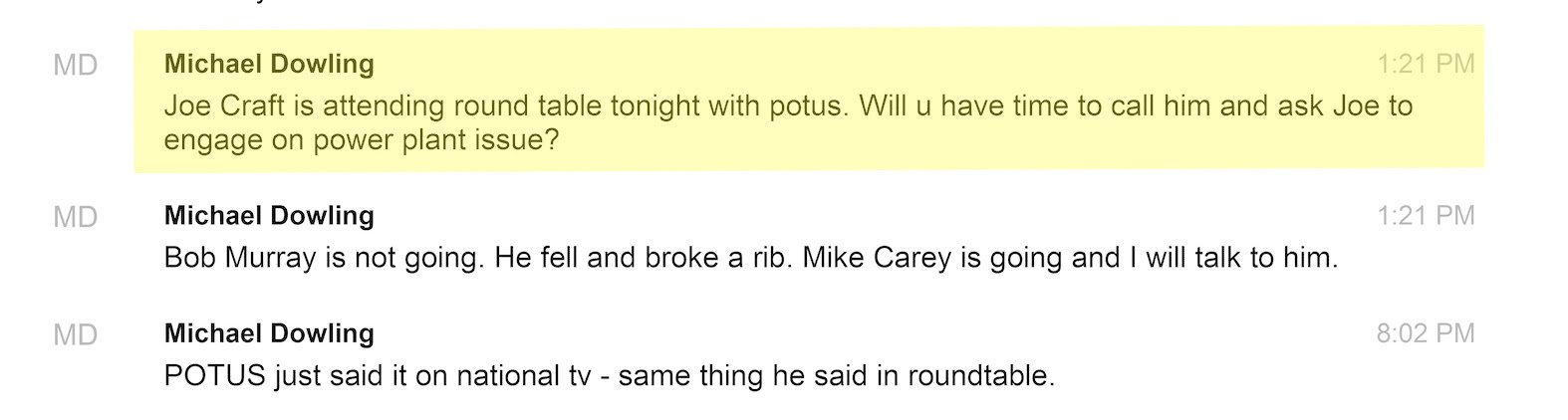 ||
Text messages from Michael Dowling, a lobbyist for utility FirstEnergy, in 2018 show that Craft was part of the effort to persuade Trump to save the coal industry. Source: Energy and Policy Institute
In addition to claiming falsely that American coal doesn’t drive climate change, Craft has made significant donations to climate denial groups. Through his personal foundation, Craft gave more $900,000 to the Texas Public Policy Institute from 2020 to 2022, according to tax records. He also gave $750,000 over the same period to Government Accountability and Oversight—a group that fights back against climate litigation and includes a lawyer who harasses climate scientists.
And while ambassador to Canada, Kelly Craft faced public backlash after saying she wasn’t sure she believed in climate change because “there are scientists on both sides that are accurate.” Her email signature included "sent from my coal powered iPad."
The Crafts have continued to be influential during Trump’s 2024 campaign. Joe and Kelly Craft were also appointed to lead the Republican National Committee’s campaign finance arm, despite the fact that Craft’s contribution is small in comparison to other fossil fuel executives. The Crafts also hosted a Trump fundraiser at their home in Kentucky in May, a dinner that cost $25,000 per couple.
Craft is hoping that coal will stage a comeback as the enormous energy demands of AI and data centers exceeds the amount of electricity currently on the grid. Already, coal power plants that were scheduled to go offline have remained online as states try to meet their energy demands.
On a recent earnings call, Craft chafed at the grid’s growing reliance on renewable power sources like wind and solar.
“This unexpected new demand is set to ramp up,” he said, “even as the nation's power portfolio continues to be hamstrung by politically motivated regulatory-driven forced premature closures of coal fired and other fossil fuel generating sources.”
The billionaire thinks Trump will be the quiet comeback coal needs. “Our coal miners love Donald Trump. They still love Donald Trump because they know Donald Trump cared about them,” Craft said on a podcast in February.
Trump has also promised to end federal support for wind power, which he’s falsely claimed are “killing all our eagles and our birds" and “driving whales crazy.” In the first presidential debate, Trump called clean energy the “green new scam.” And two of Trump’s most likely picks to lead the EPA include Andrew Wheeler, a former coal lobbyist, and Mandy Gunasekara, an author of Project 2025 who claims that coal is “inherently more reliable and resilient” than renewable energy.
“They’re basically attempting to defend the energy sources that make their funders the most money from competition from renewables,” said Anderson.
Electric vehicles are part of the demand on the grid, making Musk an inadvertent ally in some ways to the coal industry. But Tesla’s business plan depends on making coal power obsolete. Last year, Musk helped accelerate Australia’s grid transition from coal power to clean power using Tesla batteries, and is working on doing the same in Hawaii. In 2023, Musk also put out a three-part Tesla “Master Plan” to accelerate the transition to sustainable energy, which started with a chapter on how to “eliminate fossil fuels”.
“It just reiterates, why is he siding politically with these people who would probably like to dismantle his entire industry given the chance?” said Anderson. “It’s not super surprising that Joe Craft is giving money to Trump again, but rather surprising that the money is arriving from America PAC.”
Further reading:
- U.S. Agencies Fund, and Fight With, Elon Musk. A Trump Presidency Could Give Him Power Over Them. The New York Times, October 2024.
Already, Mr. Musk has discussed how he would use the new position to help his own companies. He has questioned a rule that required SpaceX to obtain a permit for discharging large amounts of potentially polluted water from its launchpad in Texas. He also said that limiting this kind of oversight could help SpaceX reach Mars sooner — “so long as it is not smothered by bureaucracy,” he wrote on X, his social-media platform. “The Department of Government Efficiency is the only path to extending life beyond Earth.”
- Race for presidency has no time for old 'King Coal'. S&P Global, October 2024.
Despite fading from the national stage, the stakes remain high for the coal sector. The outcome of the election could affect the pace of federal approvals for coal mine expansions and have an impact on a proposal to stop leasing federal property in the Powder River Basin, the nation's most productive coal region.
- Elon Musk was once an environmental hero: is he still a rare green billionaire? The Guardian, November 2023.
But the climate credentials of the world’s richest person have become clouded by his embrace of rightwing politicians, some of whom dismiss global heating, as well as by his management of X, formerly known as Twitter, during which many climate scientists have fled the platform amid a proliferation of misinformation about the climate crisis.
- A Courtside View of Scott Pruitt’s Cozy Ties With a Billionaire Coal Baron. The New York Times, June 2018.
Mr. Pruitt’s attendance at the game … followed a year of regulatory victories for Mr. Craft, who maintains close ties to Mr. Pruitt even as he has lobbied the E.P.A. on issues important to his company, Alliance Resource Partners. And unlike other executives with whom Mr. Pruitt is known to have close ties — like the oilman Harold Hamm or the coal mogul Robert E. Murray — Mr. Craft has stayed relatively under the radar.
===
https://www.alternet.org/2019/05/theres-a-new-fbi-probe-of-foreign-ties-to-trumps-campaign-but-this-time-it-isnt-about-russia-report
There’s a new FBI probe of foreign ties to Trump’s campaign — but this time, it isn’t about Russia: report
written by Jen Hayden / Daily Kos May 10, 2019
Who could’ve ever guessed New England Patriots owner Robert Kraft getting arrested for soliciting prostitution would lead to the FBI investigating whether the Chinese have been funneling money to the Trump re-election campaign? But, here we are.
To recap, after Kraft was arrested, the Miami Herald noted the spa’s founder, Cindy Yang, was a frequent guest at Mar-a-Lago and had been photographed with Donald Trump at the private club on several occasions. She used these photos to prove she had access to the president and others could as well, for a price. The grift began from the moment Donald Trump took office. Yang hosted an event at Trump’s inauguration in Washington, D.C., and those funds have never been accounted for to this day. From The Palm Beach Post:
But there’s no trace of the money raised that night, as required by law, The Palm Beach Post has found.
That includes donations by their biggest listed sponsors. Among them: an embattled Saipan-based casino later raided by the FBI, a Guam-based shipyard and a handful of Pacific Island hotel operators, all of which benefited from a foreign labor bill signed into law by Trump a year later.
Yang pivoted out of the spa business and into the influence business, also known as the business of corruption. Taking money, promising access … and getting access through events at Donald Trump’s private club, Mar-a-Lago. Not just to Donald Trump, Yang peddled access to his children, cabinet members and other influential deplorables hanging around the scene. This is precisely what national security experts repeatedly sounded the alarm about when Trump announced he would still be a frequent guest at his private club. The Trump Organization even doubled the club fee after he won. It’s shockingly blatant corruption.
But who was buying access from Yang? The FBI is now taking a look. From the Miami Herald:
Investigators obtained a federal grand jury subpoena Tuesday seeking records from Bing Bing Peranio, an employee of Yang’s family’s spa business who last year contributed a maximum $5,400 to President Donald Trump’s re-election effort, according to a source familiar with the probe. Yang came to Peranio’s workplace and helped her write the check, Peranio told reporters from The New York Times, who first reported the contribution. Peranio told The Times she didn’t “say no.”
The subpoena asked for any records related to that March 5, 2018, donation and possibly other contributions between 2014 and the present, said the source, who asked for anonymity to discuss an ongoing federal investigation.
Does a spa employee donating the maximum to a presidential re-election committee sound suspicious? The FBI is investigating whether that employee was reimbursed.
FBI agents based in West Palm Beach are trying to determine if Yang reimbursed Peranio for that contribution or delivered “anything of value” to her over that period to benefit the Trump campaign. Reimbursing someone for a political contribution without disclosing the original source is illegal, as is making a contribution in someone else’s name.
Agents are seeking records from Peranio, a potential witness in the investigation, that are linked to Yang, Yang’s husband, their businesses, as well as Trump campaign entities and the Republican National Committee.
“… as well as Trump campaign entities and the Republican National Committee.” Sounds like this investigation is just getting started and may widen significantly.
It is absolutely shocking this story isn’t front page headlines in every major newspaper in this country. These allegations and investigations would sink any other president before Trump. Today, it’s barely moving the news needle. Just one more data point showing how far we’ve strayed from normative behavior and press coverage.
==
Two coal companies just became even more influential over the Trump administration.
A new report reveals that Murray Energy andAlliance Resource Partners successfully lobbied to have a conservative nominee to the government’s energy regulator thrown out — simply because he opposed a plan to force taxpayers to bail out money-losing coal plants.
As Politico reported, the two coal companies — owned by two major Republican donors and Trump allies, Bob Murray and Joe Craft — teamed up with Energy Secretary Rick Perry to pressure the White House to drop the nomination of David Hill to the Federal Energy Regulatory Commission (FERC). Hill had served as the Energy Department’s general counsel under President George W. Bush.
What was Hill’s undoing? He had previously said that Perry’s costly plan to raise consumer energy bills in order to subsidize uneconomic coal plants was “absolutely not the solution."
Last January, FERC unanimously rejected the coal bailout proposal.
Rick Perry’s plan to make taxpayers bail out coal and nuclear rejected by federal agency
Since then, Perry and Big Coal have been working overtime to stack FERC, which oversees the U.S. grid and regulates interstate electricity transmission, with cronies who will force Americans to buy costly coal and nuclear power. This vision would amount to a multi-billion dollar taxpayer bailout at the expense of cheaper renewable sources and natural gas.
The revelation also serves to further cement the relationship between the coal industry and the Trump administration. Not only has President Donald Trump tapped Craft’s wife as the next U.N. ambassador but under former Environmental Protection Agency (EPA) Administrator Scott Pruitt, Craft often met with the agency and he even gave Pruitt basketball tickets. Pruitt is reportedly now consulting for Craft’s coal company.
Meanwhile, Murray is well-known for his wish list of policy demands delivered during Trump’s first year in office; current EPA Administrator Andrew Wheeler also used to lobby on behalf of Murray Energy.
All of this is to say that we now have the staggering hypocrisy of a Republican administration seeking to force American ratepayers to pay billions of dollars a year more in energy bills to prop up dirty energy — even as Trump and GOP leaders have been characterizing Democratic efforts to speed up clean energy deployment to save a livable climate as “socialism.”
Wyoming’s coal plants are so unprofitable Republicans turned to a ‘socialist program’ to save them
Indeed, when FERC killed Perry’s plan last year, they explained it would be unduly discriminatory against cheaper renewable energy sources. As Commissioner Cheryl LaFleur explained at the time in a concurring opinion, subsidizing the electricity dinosaurs was not FERC’s job: “I believe the Commission should continue to focus its efforts not on slowing the transition from the past but on easing the transition to the future.”
But in the past year, Big Coal has already succeeded in replacing one anti-bailout FERC commissioner, Robert Powelson, with a pro-coal crony, Bernard McNamee.
Former FERC Chairman Kevin McIntyre’s untimely death in January means Perry and the coal industry will have a second pro-bailout commissioner if they can keep thwarting candidates who are more supportive of the cheap, clean energy of the future rather than the costly, dirty energy sources of the past. Those in favor of forcing taxpayers to prop up the coal industry would need only one more vote on FERC to pass Perry’s plan.
So it still remains possible that the Trump administration will be able to achieve its dream of a centrally-planned economy where consumers are forced to pay billions to keep coal plants running and spewing their toxic and climate-destroying pollution.
==
OMFG
https://thinkprogress.org/kelly-knight-craft-trump-un-coal-climate-change-ambassador-pruitt-joe-d7ea40a1bac4/
no lnx
President Donald Trump’s pick for ambassador to the United Nations, Kelly Knight Craft, is a major supporter with deep ties to the coal industry who has argued that “both sides” of the climate science debate are equally valid.
In two tweets late Friday, Trump announced his nomination of Craft, currently Washington’s ambassador to Canada, whom he praised and congratulated.
“I am pleased to announce that Kelly Knight Craft, our current Ambassador to Canada, is being nominated to be United States Ambassador to the United Nations,” the president wrote.
“Kelly has done an outstanding job representing our Nation and I have no doubt that, under her leadership, our Country will be represented at the highest level. Congratulations to Kelly and her entire family!”
Donald J. Trump
?
@realDonaldTrump
- Feb 22, 2019
I am pleased to announce that Kelly Knight Craft, our current Ambassador to Canada, is being nominated to be United States Ambassador to the United Nations....
Donald J. Trump
?
@realDonaldTrump
....Kelly has done an outstanding job representing our Nation and I have no doubt that, under her leadership, our Country will be represented at the highest level. Congratulations to Kelly and her entire family!
93.2K
3:02 PM - Feb 22, 2019
Twitter Ads info and privacy
22.7K people are talking about this
Pending a Senate confirmation vote, Craft is now in line to succeed former U.N. ambassador Nikki Haley. Her selection comes after State Department spokeswoman Heather Nauert withdrew her name from consideration, apparently over concerns that she would not be able to clear a confirmation process.
In the Republican-controlled Senate, Craft may not see much of a confirmation hurdle, but she is likely to face scrutiny from Democrats over both her ties to Trump and her past comments on climate change.
U.S. Ambassador to Canada Kelly Knight Craft stands during her swearing in ceremony in the Indian Treaty Room in the Eisenhower Executive Office Building on the White House grounds, Tuesday, Sept. 26, 2017, in Washington. CREDIT: (AP Photo/Alex Brandon
‘Both sides’ of climate change debate are valid, argues new U.S. ambassador to Canada
Craft, a businesswoman, is a longtime Republican donor and the wife of a Kentucky coal magnate. Joe Craft is the CEO of Alliance Resource Partners, the third-largest coal producer in the eastern United States. In a 2010 interview, he argued there is “significant debate” over climate change and downplayed the impacts of global warming.
Collectively, the Crafts donated more than $1.5 million to the president and other Republicans in 2016, in addition to being repeat customers at the Trump International Hotel in Washington, D.C. They are listed as gold-level members at the establishment and have stayed at least 20 times.
They have also remained close to the administration. Joe Craft, who railed against the Obama administration’s environmental efforts, cultivated a close relationship with former Environmental Protection Agency (EPA) head Scott Pruitt, whom he met with often. Pruitt notably initiated the mass rollback of numerous Obama-era environmental protections.
Like her husband, Kelly Craft has courted controversy over her climate change skepticism. She has defended Trump’s decision to withdraw the United States from the landmark Paris climate agreement and largely aligned herself with the administration’s approach to climate policy. In a controversial interview with the CBC in October 2017, Craft said she felt both climate scientists and skeptics alike have presented “accurate” data pertaining to human-driven global warming.
“I think that both sides have their own results, from their studies, and I appreciate and I respect both sides of the science,” she said, declining to give her own views on climate science.
That stance is increasingly at odds with national sentiment. Recent polling has shown that seven out of 10 Americans believe global warming is happening; meanwhile, the number of lawmakers in office who deny climate change is steadily decreasing. And proposals like the Green New Deal resolution pushed by progressive lawmakers like Rep. Alexandria Ocasio-Cortez (D-NY) contain suggestions that poll well with the U.S. public.
But Craft has notable support in the Senate from Republicans and from the administration — Sec. of State Mike Pompeo has expressed enthusiasm for Craft, as has Majority Leader Mitch McConnell (KY). The senior lawmaker recommended Craft for the U.N. position and called her a “strong advocate for American interests” in a statement backing her candidacy.
“She has a long record of service to her state and the nation and I’m confident she will continue to serve with distinction as America’s voice to the world at the United Nations,” said McConnell.
Lawmakers showed Craft solid support for her nomination as ambassador to Ottawa, confirming her by a unanimous vote in August 2017.
==
https://www.alternet.org/2019/02/meet-the-new-un-ambassador-nominee-a-billionaire-gop-donor-and-science-denier-who-gave-trump-millions/
prez **Donald Trump** promised he’d always hire the “best people” during his presidential campaign, but not only has that turned out to be false, he’s had more turnover than any president in modern history, if not ever.
The president is fond of playing “whack-a-mole” with his personnel problems, by shuffling the players around instead of actually looking for, as he put it, the “best people.”
For example, Mick Mulvaney joined the Trump administration after serving as a U.S Republican Congressman. He served as Trump’s Director of the Office of Management and Budget, then added to his resume the title of Acting Director of the Consumer Financial Protection Bureau. Mulvaney then became Trump’s Acting White House Chief of Staff, replacing embattled and disgraced John Kelly – while giving up his CFPB job but still retaining the role of Director of the Office of Management and Budget.
Fast forward to Friday evening.
President Trump has just announced his latest nominee to become Ambassador to the United Nations, after his earlier nominee, who would have replaced Nikki Haley, was forced to withdraw her nomination after illegally hiring as a nanny an immigrant unauthorized to work in the U.S.
“I am pleased to announce that Kelly Knight Craft, our current Ambassador to Canada, is being nominated to be United States Ambassador to the United Nations,” Trump announced via tweet. No formal White House announcement has been made yet. “Kelly has done an outstanding job representing our Nation and I have no doubt that, under her leadership, our Country will be represented at the highest level. Congratulations to Kelly and her entire family!”
Trump neglected to mention that Knight Craft is Trump’s current Ambassador to Canada, so he’s just shuffling the players around again.
Knight Craft is perhaps best known for her science-denying remarks, saying she believes in “both sides” of climate change. (There are not two sides.
[vid]
Meanwhile, the President also neglected to mention Knight Craft, along with her billionaire coal baron husband, donated millions of dollars to Trump’s presidential campaign.
Ambassador to the United Nations is not the same as Ambassador to Canada. There are few national security issues America’s Ambassador to Canada would be relied upon to keep Americans safe.
But the U.S. Ambassador to the United Nations holds a key national security role. They sit on the UN Security Council and represent the U.S. to the rest of the world.
There is no indication Knight Craft is qualified for the role.
Knight Craft does hail from Kentucky, where she has also been a major GOP donor, or, as one Canadian news publication described it, “Knight Craft is well known among Republicans, to whom she has donated piles of money.”
Senate Majority Leader Mitch McConnell, also of Kentucky, reportedly recommended her for the role of UN Ambassador.
McConnell is not the only member of his family greasing the wheels. This week Trump Transportation SecretaryElaine Chao, who happens to be married to the Senate Majority Leader, was embroiled in scandal.
Secretary Chao “has met at least 10 times with Kentucky business leaders or politicians after email requests made by her husband, Senate Majority Leader Mitch McConnell (R-KY),” The Daily Beast reports.
“A cache of more than 800 emails—obtained under the Freedom of Information Act by the watchdog group American Oversight—shows that some of those meetings led to McConnell’s associates being granted their wishes by the powerful Transportation Secretary—from infrastructure grants to highway project funding. In at least one example, the lobbyist had donated to McConnell’s re-election campaign.”
==
trump victory $
==
https://www.nytimes.com/2018/09/12/climate/pruitt-coal-consulting.html
:{
}:
no lnx
wASHINGTON — Scott Pruitt, the former head of the Environmental Protection Agency who championed deregulation of the fossil fuel industry, is in discussions to work as a consultant to the Kentucky coal mining tycoon Joseph W. Craft III.
Mr. Pruitt has remained largely out of the public eye since parting ways with the Trump administration in July under a cloud of ethics investigations into matters including his ties to fossil fuel industry executives with business before the agency.
Mr. Craft, the chief executive of Alliance Resource Partners and a major Republican donor, enjoyed a close relationship with the E.P.A. during Mr. Pruitt’s tenure. Mr. Craft met with Mr. Pruitt at least seven times in Mr. Pruitt’s first 14 months at the agency and in December provided him with courtside seats at a University of Kentucky basketball game, a school where Mr. Craft is a prominent supporter.
The former E.P.A. chief laid out his plans to develop a new consulting firm in one-on-one discussions with several executives during a Kentucky Coal Association meeting last week, according to industry officials familiar with Mr. Pruitt’s appearance and activities there. An executive with Mr. Craft’s company, Alliance Resources, confirmed the discussions in a statement Wednesday.
“Any discussions that occurred between Mr. Craft and Mr. Pruitt are preliminary, and do not involve him becoming an employee of Alliance Resource Partners,” said Heath Lovell, vice president for public affairs at Alliance, in the statement. “Obviously, any discussions would not involve lobbying the federal government.”
Under an ethics pledge imposed by President Trump, Mr. Pruitt would be barred from directly lobbying the E.P.A. for five years in any new role, but he would not be restricted from working as a private consultant advising the company on E.P.A. related matters or working on the state level to influence regulatory policy.
One of the two executives familiar with Mr. Pruitt’s plans said that he would not be lobbying the federal government and would “not do anything inconsistent with his legal and ethical requirements.”
Mr. Pruitt, whose tenure at E.P.A. was marked by secrecy and security, did not publicize his speech to the Kentucky Coal Association, and the trade organization did not list him on its website among its featured speakers. Tyler White, the president of the association, acknowledged Mr. Pruitt’s presence at the event after it was pointed out that he was photographed sitting with Gov. Matt Bevin of Kentucky.
The association invited Mr. Pruitt “because we strive to provide our membership with high quality speakers who have unique experience, knowledge or expertise on issues impacting our industry,” Mr. White said in a statement. “Also, as a native Kentuckian, we were especially proud to have him speak,” he said. Mr. White said Mr. Pruitt had not been paid to address the meeting.
His remarks there were among the first public comments Mr. Pruitt has made since leaving the Trump administration. Coal industry officials as well as some Oklahoma political leaders said they welcomed his re-entry into the regulatory arena.
“It makes sense,” said Dewey F. Bartlett Jr., an oil executive and former mayor of Tulsa. “I know Joe Craft and the coal industry feel that they’ve been unfairly targeted by the E.P.A. and the various regulators, either state or federal, that oversee the coal mining industry. So working with a person like Scott Pruitt — who has given them, from their perspective, a fairer regulatory environment than the previous administration — would be a good fit.”
Democrats and environmentalists criticized Mr. Pruitt’s new role, while saying they weren’t surprised.
“Scott Pruitt has always been doing the dirty work for coal millionaires,” said Michael Brune, executive director of the Sierra Club. “The only difference is now he’ll be paid by them directly rather than ripping off the taxpayer.”
Cleta Mitchell, an attorney who represented Mr. Pruitt while he was at the E.P.A., did not return emails or phone calls seeking comment.
Both Mr. Craft and Mr. Pruitt are originally from Kentucky and later moved to Oklahoma, where Mr. Pruitt served in the state legislature and then as the state attorney general before he was nominated to take over the E.P.A. Alliance Resources is based in Tulsa, Okla.
As attorney general, Mr. Pruitt sought to protect the coal industry and coal-burning power plants from federal regulation. Mr. Craft was a financial supporter of Mr. Pruitt’s political causes. After Mr. Pruitt joined the E.P.A., he continued to advance policies that benefited the coal industry.
Separately on Wednesday, the E.P.A. made public a long-delayed financial disclosure report for Mr. Pruitt covering 2017. That period includes the time when Mr. Pruitt was living in a Capitol Hill condominium that he was renting from the spouse of an energy lobbyist for $50 a night, an arrangement that triggered one of several investigations into his actions and oversight at the agency.
The 2017 financial disclosure form does not list the Capitol Hill condo as a gift, a step that some suggested Mr. Pruitt might take, based on the widely held view that he was paying below market value for the unit. (Previously, Mr. Pruitt has denied that it was a below-market-value arrangement.)
At the time of the rental, Mr. Pruitt was the target of lobbying by the spouse of the condo’s co-owner, J. Steven Hart. Until earlier this year, Mr. Hart was the chairman of the Williams & Jensen lobbying firm.
The form does appear to address the condo question indirectly. The document states that Mr. Pruitt was aware of allegations that “certain actions or activities during 2017” may constitute gifts that require inclusion in the disclosure report. “To the extent that I am aware of specific allegations, I dispute the facts asserted and, accordingly, am not aware of reportable gifts,” the document says. “In the event that there are any future findings to the contrary, I will address the issue at that time and amend this report as directed and/or as necessary.”
Mr. Pruitt could not be reached for comment and Ms. Mitchell did not respond to questions about the former administrator’s financial report.
The 2017 financial disclosure report (which covers only last year, not the part of 2018 when Mr. Pruitt still led the E.P.A.) also shows that Mr. Pruitt’s wife, Marlyn Pruitt, earned between $15,000 and $50,000 over that time working as a consultant. During his time at the agency, Mr. Pruitt had asked senior aides to help his wife find employment as a consultant, which they did, helping her secure paid work for a conservative judicial group and New York nonprofit organization.
Mr. Pruitt’s requests to staff members to help his wife find work are the subject of investigations into his management of the E.P.A.; asking federal government aides to help with personal financial matters may be a violation of federal rules.
The 2017 financial disclosure also lists as much as $300,000 in legal fees from two law firms, debts Mr. Pruitt did not have previously, and that likely reflect his need to hire legal assistance after he became the subject of investigations into his oversight and actions at the E.P.A.
Mr. Pruitt in the past has denied allegations of any wrongdoing. In his resignation letter to Mr. Trump he wrote, “the unrelenting attacks on me personally, my family, are unprecedented and have taken a sizable toll on all of us.”
The former E.P.A. administrator’s next career steps have been the source of interest particularly in Oklahoma, where he is seen as a potential candidate for the United States Senate or to be governor.
==
COAL
Okla. firm tops midterm donations
E&E Daily: Thursday, August 23, 2018
:{:(style="background-color:#ffffff;"):}:
Incumbents on Capitol Hill have gotten more money from magnate Joe Craft and his coal company than any one else in the industry, the Center for Responsive Politics found.
cult corrup window --> smash and grab?
https://www.ecowatch.com/scott-pruitt-epa-industry-2575035190.html
see below
New Reports Highlight Industry Influence on EPA Head Pruitt
New evidence emerged Friday and Saturday revealing how U.S. Environmental Protection Agency (EPA) Administrator Scott Pruitt's close relationships with industry leaders and lobbyists might impact his environmental decisions.
On Friday, the lobbying firm Williams & Jensen disclosed evidence that its former chairman J. Steven Hart, whose wife rented a Washington, DC condo to Pruitt, did in fact lobby the EPA on behalf of three clients during Pruitt's tenure despite his denials, The Hill reported. Then, on Saturday, The New York Times broke the news that Pruitt had attended a University of Kentucky basketball game in December in special, front-and-center seats belonging to coal billionaire Joseph W. Craft III, whose close relationship with Pruitt had not been previously examined.
Hart, who stepped down from Williams & Jensen in April, told E&E news in March that he did not lobby the EPA in 2017 or 2018. But lobbying disclosures released hours after his departure revealed he did contact the EPA to lobby for Smithfield Foods during that period.
In Friday's disclosures to the Senate, the firm revealed further that Hart did more for Smithfield Foods that previously believed and also contacted the EPA on behalf of Coca-Cola and the Financial Oversight and Management Control Board of Puerto Rico.
The new information turned up after Williams & Jensen hired Jan Baran atWiley Rein to review Hart's schedule and communications, as well as the firm's disclosure filings, from 2017 and the first three months of 2018, to make sure the firm was accurately disclosing Hart's activity.
Hart and others lobbied the EPA for Coca-Cola on "environmental issues impacting the beverage industry; clean water supply and water conservation," according to the updated disclosures.
The EPA told The Hill that the inclusion of Coca-Cola was an error.
"This meeting involving Coca-Cola and their clean water steward did not occur," EPA spokesman Jahan Wilcox said in a statement. "The request was submitted and it went unfilled."
The disclosures said that lobbying by Hart and others for Coca-Cola to the EPA and other government agencies and Capital Hill also included "general market access issues in foreign countries; Commerce 232 investigations, including re: aluminum" and "[e]nvironmental issues impacting the beverage industry, including hydroflourocarbon replacement; commodity pricing legislation."
In 2017, Hart also lobbied the EPA for more potable water for Puerto Rico following Hurricane Maria, on behalf of the Financial Oversight and Management Control Board of Puerto Rico.
Even if he wasn't an official lobbyist, coal executive Craft's close ties to Pruitt suggest fossil-fuel industry influence on key deregulatory moves such as October's repeal of the Obama-era Clean Power Plan, which Pruitt announced in Craft's hometown of Hazard, Kentucky with Craft in the audience. Craft also served on the board of an industry group that urged the EPA to postpone enforcement of a rule preventing coal plants from dumping toxic metals into rivers, a request Pruitt honored in September, The New York Times reported.
The New York Times further uncovered the fact that Pruitt had met with Craft at least seven times during the first 14 months of his tenure at the EPA, more than he met with any environmental advocate. The two are close enough to be on texting basis, and their relationship has deep roots: Craft was a major donor to Pruitt's state government campaigns in Oklahoma.
Heath Lovell, vice president for public affairs at Craft's company Alliance Resource Partners, told The New York Times that Pruitt paid "market value" for the basketball tickets.
The game was not included on Pruitt's official calendar, but was videotaped and mentioned in university communications requested by The New York Times through public records requests. According to those communications, Kentucky state police provided additional security for Pruitt during the trip, backing up his own detail.
==
RAFT, JOE TULSA, OK | $1,250,000 | 05/31/12 | American Crossroads |
|---|---|---|---|
CRAFT, JOSEPH W III TULSA, OK | $500,000 | 09/07/12 | Restore Our Future |
CRAFT, JOSEPH W III TULSA, OK | $500,000 | 01/17/12 | Restore Our Future |
JWC III REVOCABLE TRUST TULSA, OK | $1,250,000 | 09/07/12 | American Crossroads |
==
Joseph Craft and his holding company, Alliance Management Holdings, gave $4.35 million to super PACs. Craft is ranked 331 on the Forbes list of richest Americans, with a net worth of $1.3 billion. Alliance Management Holdings is a privately held company run by Craft with significant shares in the managing partner of Alliance Resource Partners.
Craft and his company gave $3.35 million to American Crossroads and $1 million to Restore Our Future (supporting Romney).
Ranking: 21
Total contributions to super PACs: $4.4 million*
- $3.4 million to American Crossroads (pro-Republican), including $850,000 from his company, Alliance Management Holdings
- $1 million to Restore Our Future (pro-Mitt Romney)
Federal hard money contributions:
Not including his super PAC contributions, Craft, along with his ex-wife, Kathy, has donated more than $800,000 to federal candidates, party committees, business PACs and other political committees since the 1998 election cycle, according to the Center for Responsive Politics, including:
- $170,700 to the National Republican Senatorial Committee
- $79,500 to the Republican Party of Kentucky
- $71,600 to the National Republican Congressional Committee
- $59,500 to the National Mining Association PAC
- $57,000 to the Democratic National Committee
- $50,000 to the Democratic Party of Kentucky
- $50,000 to Alliance Resource Partners’ corporate PAC
- $31,950 to the Republican National Committee
Corporate names: Alliance Holdings GP, L.P.; Alliance Resource Partners, L.P.; Alliance Resource GP, LLC; Alliance Management Holdings; Alliance Management Holdings III LLC; MAPCO Coal Inc.
Total spent on federal lobbying (2007-2012): No record of corporate spending at the federal level, but the company has lobbied in the states and is a member of trade organizations that lobby.
Lobbying issues: N/A
Biography:
Wealthy coal executive Joseph W. Craft III was one of Republican presidential candidate Mitt Romney’s finance co-chairmen in Kentucky, Craft’s home state.
Craft’s Alliance Resource Partners, L.P. operates 11 mining complexes in five states — Illinois, Indiana, Kentucky, West Virginia and Maryland. The company also operates a coal-loading terminal on the Ohio River in Indiana.
In 2011, it produced more than 30 million tons of coal, ranking it the third largest coal producer in the eastern United States. Its revenues exceeded $1.8 billion, up 14.5 percent from 2010, a year that saw two miners die after a roof collapsed in one of the company’s Kentucky mines. (The Associated Press noted at the time that the mine had been cited for 840 safety violations since January 2009.)
Craft, who has expressed doubts about whether humans are causing climate change, is also a board member of the National Mining Association, a director of the Tulsa-based BOK Financial Corp., a director of the American Coalition for Clean Coal Electricity and a former chairman of the National Coal Council.
In a , Craft said the future of the coal industry depends on “what happens in elections,” adding that the only thing that impedes the industry’s growth was “bad public policy.”
Craft, who resides in Tulsa, Okla., got his start in the coal business with a company called MAPCO Coal Inc., which was the predecessor of Alliance Resource Partners, L.P.
At MAPCO, Craft rose through the ranks serving in roles including general counsel, chief financial officer and, ultimately, president. Since August 1999, he has been the president, chief executive officer and a director of ARLP.
ARLP’s structure is unusual. It is what’s known as a publicly traded “master limited partnership,” and consists of several interlocking corporate entities.
Records show that Craft owns 43 percent of ARLP, as well as 72 percent of Alliance Holdings GP, L.P., the limited partnership formed to own and control Alliance Resource Management GP, LLC, which is the managing general partner of ARLP.
In March, Forbes estimated Craft’s net worth to be $1.4 billion, including the assets of his ex-wife, Kathy. They divorced in late 2011.
Over the years, Craft has been a prolific political and philanthropic donor, particularly to his alma mater, the University of Kentucky.
“I’ve been fortunate to have been able to have the ability to give,” Craft said in an interview with Kentucky’s PBS affiliate that aired in 2010. “I want the state of Kentucky to be the best it can be. I want America to be the best it can be.”
Last updated: Jan. 30, 2013
*2011-2012 election cycle. Source: Center for Responsive Politics and Center for Public Integrity analysis of Federal Election Commission records. Totals include contributions from individuals, family members and corporations that are controlled by the individual super donor.
More stories about
Business and Finance, Politics, Chemistry, Energy, Coal, Clean coal, Year of birth missing, Political action committee, West Virginia, AT&T, Climate change mitigation, Joe Craft