social welfare 501 (c) 4
see campaign coordination
SEE SHUFFLE SHELL
$ mostly goes to NEG ATTACK ADS
erik o'keefe, rivkin John Doe WI ?!
MI state sup ct
see CREW watchdog
LEO PASSTHRU? SHUFFLE?
SLUDGE
Former law professor Neomi Rao is facing headwinds in her judicial nomination, so Charles Koch’s Americans for Prosperity is stepping in.
:{:{Billionaire manufacturing magnate Charles Koch has for decades used his enormous wealth and political power to install elected officials (https://readsludge.com/2018/10/19/koch-and-adelson-come-to-the-rescue-of-trump-devotee-ron-desantis-in-florida/),}:
government administrators (https://www.salon.com/2016/06/19/big_men_on_campus_the_koch_brothers_university_donations_are_a_veiled_political_weapon/), and regulators (https://readsludge.com/2018/10/04/koch-backed-sec-commissioner-claims-corporate-law-is-in-the-public-interest/) who will keep the business interests of Koch Industries and other giant, heavily polluting companies in mind.}:
But Koch is also dipping into the judicial arena. One of his protegés has been nominated by President Trump and is poised to join the second-most powerful court in the United States, and Koch’s premier political spending group wants to make sure it happens.
In 2016, the Charles Koch Foundation (CKF) and a mystery donor combined to give $30 million to the George Mason University (GMU) law school, renaming it after the late, conservative Supreme Court Justice Antonin Scalia. Koch’s foundation put in $10 million, and the remaining $20 million, it was later discovered, was administered by Federalist Society officials through a 501(c)(4) nonprofit, BH Fund.
:{:{The grant established 12 new law professorships—nearly all the hires had ties to the conservative Federalist Society (https://legacy.tyt.com/2018/05/18/after-donation-administered-by-federalist-society-leaders-gmu-hired-professors-tied-to-the-federalist-society/)—}:
and founded two ideological law school centers (https://ia601201.us.archive.org/24/items/GMUASSLawMOU2016/GMU%20ASSLaw%20MOU%202016.pdf#page=6),
the Center for Liberty and Law and the Center for the Study of the Administrative State. The founder and director of the latter center was Neomi Rao (https://www.law.gmu.edu/assets/files/faculty/cv/rao.pdf), who had been a law professor at GMU since 2012. She previously clerked for the most conservative Supreme Court justice, Clarence Thomas, and was associate counsel and special advisor to President George W. Bush. She has never been a judge.}:
Rao took a leave of absence from George Mason in 2017 when President Donald Trump appointed her as director of the White House Office of Information and Regulatory Affairs (OIRA), Trump’s “regulation czar.”
:{:{The dean of the GMU law school told another donor to her center, corporate lobbyist and longtime Koch ally C. Boyden Gray (https://www.desmogblog.com/c-boyden-gray), that he hoped to lure her back to GMU with a $1.5-million professorship, funded by Gray, according to an email unearthed by GMU alumna Allison Pienta (}:
:{:{http://www.unkochmycampus.org/dec-20-2018-donor-control-at-gmu-update?rq=boyden%20gray).}:
“This chair would help me to entice Neomi to return home to Scalia Law after she dismantles the administrative state (https://www.documentcloud.org/documents/5750669-Antonin-Scalia-Law-School-Grant-Agreement.html#document/p2/a484188)
while serving at OIRA,” he wrote in a May 2017 letter to Gray. Gray gave another $3 million to the center, and it was renamed in his honor.}:}:
Dismantling the administrative state (p. 2) (https://www.documentcloud.org/documents/5750669-Antonin-Scalia-Law-School-Grant-Agreement.html#document/p2/a484234)
IFrame Content (https://www.documentcloud.org/documents/5750669-Antonin-Scalia-Law-School-Grant-Agreement/annotations/484234.html?embed=true&maxheight=750&maxwidth=500)
View entire document on DocumentCloud (https://www.documentcloud.org/documents/5750669-Antonin-Scalia-Law-School-Grant-Agreement.html#document/p2/a484234)
But instead of returning to the law school, Rao may be headed to the powerful D.C. Circuit Court of Appeals to fill the seat vacated by the newest Trump-appointed Supreme Court justice, Brett Kavanaugh. Rao’s GMU center hosted a conference (https://administrativestate.gmu.edu/rethinking-judicial-deference/) in 2016 that featured Kavanaugh, a fellow Federalist Society member, as keynote speaker.
Rao’s judgeship nomination is perhaps the crowning achievement of the Antonin Scalia Law School’s initiative to reshape the federal judiciary. In 2017, the law school’s Law and Economics Center, which CKF had been funding for years, drew up a funding proposal (https://www.documentcloud.org/documents/5751080-GMU-Law-and-Economics-Center-Federal-Judges-and.html) for the center’s “Federal Judges and Attorneys General Initiatives.”
‘Reshaping’ the Federal Bench
“The election of Donald Trump presents a historic opportunity for a new president to reshape the federal judiciary, reform the regulatory state, promote economic growth, and restore constitutional federalism,” reads the proposal.
The program educates newly appointed judges on economics and other issues so they will “be more likely to make sound decisions that support the rule of law and the free enterprise system.” The new Federal Judges Initiative will “cover topics expected to be highly relevant to the current presidential administration’s policy agenda, such as the economics of health care and health financing, financial services regulation, environmental and energy regulation, health and safety regulation, privacy, labor and employment law, and telecommunications regulation.”
As of 2017, over 5,000 judges and 700 state attorneys general had participated in at least one Law and Economics Center program. In the 2018 fiscal year, the Law and Economic Center requested over $1.7 million for its Judicial Education Budget.
“Rao’s transition from the Koch-funded Antonin Scalia School of Law to her nomination to the second-highest court in the country is exemplary of Koch’s successful strategy of leveraging George Mason University to exert influence on the judicial branch for decades to come,” Samantha Parsons, a GMU graduate and director of campaigns at the activist group UnKoch My Campus, told Sludge. “Her nomination should serve as a warning of the anti-democratic agenda we can expect throughout our nation’s judicial system should George Mason University succeed in its goals to facilitate the education and placement of hundreds of new federal judges under Trump’s presidency.”
:{:{In December, when Trump nominated Rao, Koch’s most prominent political advocacy organization, Americans for Prosperity, endorsed (https://americansforprosperity.org/afp-endorses-slate-of-highly-qualified-judicial-nominees/) her for the judgeship.}:
But Rao has since encountered some bumps in the road. Republican Missouri Sen. Josh Hawley said he has “deep concerns (https://www.axios.com/neomi-rao-dc-circuit-nominee-josh-hawley-concerns-228fe428-7944-430a-bc5c-71a50278ec38.html?utm_source=twitter&utm_medium=twsocialshare&utm_campaign=organic),” telling Axios that she may not be sufficiently anti-abortion.}:
At a recent Senate committee hearing, Iowa Republican Sen. Joni Ernst expressed concerns over Rao’s 1994 essay on date rape (https://www.washingtonpost.com/local/legal-issues/neomi-rao-pressed-on-past-writings-on-date-rape-at-hearing-on-her-judicial-nomination/2019/02/05/156b4784-28b4-11e9-b2fc-721718903bfc_story.html?utm_term=.e68dab1a1db9), which alleged that women who are raped while drunk are partially to blame for being raped. Rao’s OIRA has stalled issuing an employer guidance on sexual harassment for 15 months (https://theintercept.com/2019/02/04/neomi-rao-hearing-oira-brett-kavanaugh/), a process that normally takes no longer than 90 days, as David Dayen reported for The Intercept.
:{:{Americans for Prosperity will fund digital advertising and grassroots efforts (https://www.axios.com/neomi-rao-dc-circuit-nominee-josh-hawley-concerns-228fe428-7944-430a-bc5c-71a50278ec38.html?utm_source=twitter&utm_medium=twsocialshare&utm_campaign=organic)}:
in an attempt to sway public opinion in favor of Rao this week, according to Axios. On Tuesday morning, the Facebook ad archive (https://www.facebook.com/ads/archive/?active_status=all&ad_type=political_and_issue_ads&country=US&q=americans%20for%20prosperity) listed six AFP ads in favor of Rao, which began running on Monday. Each ad targets one Republican senator, including Ernst and Hawley, urgin Facebook users to tell their senator to vote for Rao’s D.C. Circuit Court nomination. Additional targeted senators are Ted Cruz (Texas), Marsha Blackburn (Tenn.), James Lankford (Okla.), and Ben Sasse (Neb.). The Google ad archive did not list any recent AFP purchases.}:
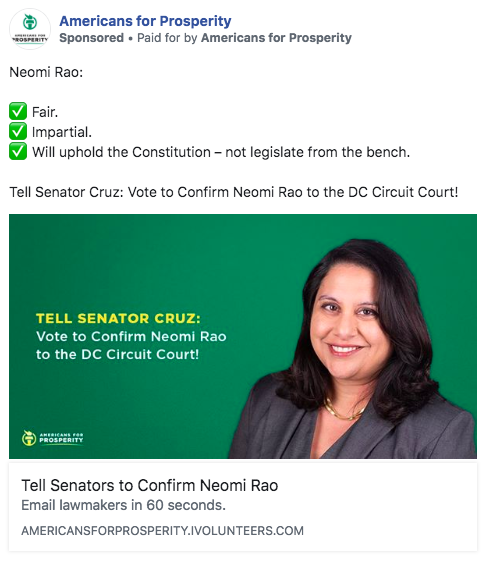 One of Americans for Prosperity’s Facebook ads supporting Neomi RaoFacebook Ad Archive
Americans for Prosperity did not reply to Sludge’s request for comment.
‘Regulatory Obstruction’
The American Constitution Society says OIRA, which is part of the Office of Management and Budget, “has embraced politicized regulatory obstruction (https://www.acslaw.org/acsblog/a-lesson-in-failure-oira-neomi-rao-and-deregulation-at-any-cost/) as its raison dêtre” under Rao. In OIRA’s 2018 report (https://www.whitehouse.gov/wp-content/uploads/2018/10/2018-Unified-Agenda-Cutting-the-Red-Tape.pdf), entitled “Cutting the Red Tape,” Rao writes, “we are working to push back the expansion of the administrative state, which has placed undue burdens on the public and impeded economic growth.”
Under Rao’s leadership, OIRA, has approved sweeping environmental deregulation by the EPA. Koch Industries, which Charles Koch runs, is a giant manufacturing conglomerate with subsidiaries that refine and transport oil, create paper products, and produce chemicals. The company is among the country’s biggest air and water polluters and has paid hundreds of millions of dollars for environmental violations. Koch and his brother David are lifelong libertarians who have fought taxes and regulations for decades.
“Rao has never seen a regulation she didn’t hate, and as a judge would dismantle 40 years of environmental and social progress,” Brett Hartl, government affairs director at the Center for Biological Diversity, said (https://www.buzzfeednews.com/article/zoetillman/trump-nominates-neomi-rao-brett-kavanaugh-seat) in a statement to Buzzfeed News. “Her confirmation would be the most damaging and regressive yet by Trump after Kavanaugh and Gorsuch.”
GMU is by far the biggest recipient of grants from the Charles Koch Foundation (CKF), which gives tens of millions of dollars each year to free-market higher education programs. Since 2005, CKF and the Charles Koch Institute have donated nearly $129 million to GMU, including over $34 million for the free-market Mercatus Center, according to Sludge’s analysis. Another free-market-focused GMU center, the Institute for Human Studies, has received $8.7 million.
The university has come under fire for allowing the CKF to impact hiring decisions (https://www.insidehighered.com/news/2018/05/01/koch-agreements-george-mason-gave-foundation-role-faculty-hiring-and-oversight). In the case of Florida State University, CKF was even allowed to control economics curricula (https://publicintegrity.org/federal-politics/koch-foundation-proposal-to-college-teach-our-curriculum-get-millions/).
AFP isn’t the only Koch-linked group to spend money to influence the judiciary. The Center for Media and Democracy reports that Donors Trust, a donor-advised fund that wealthy conservatives including Koch use to score tax deductions and potentially anonymize their donations to nonprofits, has bankrolled right-wing groups (https://www.prwatch.org/news/2019/02/13449/donorstrust-bankrolled-right-wing-judicial-appointments-trumps-acting-ag-and) such as the Judicial Crisis Network and its sister organization, the Judicial Education Project, which spent millions of dollars on ads supporting the Supreme Court confirmation of Neil Gorsuch. Donors Trust also funds the Federalist Society and, as Sludge recently reported, several Southern Poverty Law Center-designated hate groups (https://readsludge.com/2019/02/19/americas-biggest-charities-are-funneling-millions-to-hate-groups-from-anonymous-donors/).
Related:
Charles Koch Is Funding Rightwing, Pro-Trump Media, New Disclosure Reveals (https://readsludge.com/2018/11/21/charles-koch-is-funding-rightwing-pro-trump-media-new-disclosure-reveals/)
Koch Brothers Continue to Influence Tax Policy After Huge Cuts Last Year (https://readsludge.com/2018/06/18/koch-brothers-continue-to-influence-tax-policy-after-huge-cuts-last-year/)
Koch-Backed SEC Commissioner Claims Corporate Law is in the Public Interest (https://readsludge.com/2018/10/04/koch-backed-sec-commissioner-claims-corporate-law-is-in-the-public-interest/)
Author profile](https://readsludge.com/author/alex/)
Alex Kotch (https://readsludge.com/author/alex/)
Alex is a reporter at Sludge and a contributor to The Young Turks. He was previously part of the award-winning investigative team at International Business Times, and his other work has appeared in T
---
grassrootsbeer...Koch-Controlled Organizations Spent More Than $1.1 Billion During the 2020 Election Cycle
Center for Media and Democracy (CMD) series,Part 1 of 4!
Connor Gibson
Sep 7
I recently wrote a four-part barrage of articles on Charles Koch’s advocacy network for the Center for Media and Democracy (CMD). I’m crossposting them here, with CMD’s permission: see part 2.
Part 1: Koch-Controlled Organizations Spent More Than $1.1 Billion During the 2020 Election Cycle
In the 2020 election cycle, 28 organizations controlled by Charles Koch, his family, and Koch Industries executives spent a combined $1.1 billion, primarily to influence public policy and politics in the U.S., and had net revenues of $2.7 billion.
By the end of 2020, the combined assets of these nonprofits totaled $2.8 billion, an increase of $1.5 billion from the beginning of the year.
Other comparably large conservative financiers such as the Bradley, Scaife and Searle foundations show significantly less in net revenue, expenditures, and assets.
Click image to open the interactive table!
These latest figures eclipse the political spending disclosed by Koch Industries, the company that serves as the engine for all Koch-controlled nonprofits. In comparison, Koch Industries spent only $22.4 million on federal lobbying and campaign contributions in the 2020 election cycle.
But Charles Koch's organizations regularly spend over half a billion dollars annually, with a total of $607.9 million in expenses in 2019, and $638.6 million in 2020.
In 2020 alone, Koch-controlled organizations raised over $2.2 billion dollars—more than four times what they collectively raised the previous year. Before 2020, the combined revenue of Koch-controlled nonprofit organizations never reached the $1-billion threshold, with $501.1 million in net revenue in 2019, and approximately $650 million in 2018.
In order to avoid any double-counting, these net revenue and net expense totals account for all grants and expenses exchanged between Koch-controlled organizations. Those payments can be viewed here:
Click image to open interactive table!
These calculations likely fail to account for the total policy and political spending overseen by Charles Koch since Koch Industries and a fleet of Koch-controlled limited liability companies (LLCs) do not disclose similar finances. In rare instances of disclosure, Koch Industries and members of the Koch family have been known to invest millions more in policy-influencing organizations.
Charles Koch's Return on Political Investments
Despite waning news coverage, Charles Koch’s donor network remains unique in terms of its size and its top-down control by executives of a single company.
Unlike large donor-advised funds that finance a wide array of charities and nonpolitical causes, the bulk of Koch's "Stand Together" cluster of groups has coordinated around election and policy priorities.
Charles Koch's political fleet played a significant role in steering the policy priorities of the Trump administration, due in part to its influence in staffing the former president's cabinet.Even though Koch told reporters he was so displeased with Trump that he might even support Democrats—a rhetorical trick he pulls every few years—the tens of millions of dollars his organizations invested in U.S. Senate and House races went almost exclusively to Republicans.
In addition to showing obvious partisan preferences, Koch has financed groups involved in extremist activity, including the 2021 attack on the U.S. Capitol. In 2022, Koch Industries is still financing many politicians who worked to invalidate the results of the 2020 presidential election, despite signaling to Politico that it would discontinue such support.
This political spending continues to pay off during the Biden presidency. Last year Koch exploited the Democrats' weak majority by undermining the comprehensive climate and infrastructure legislative package known as Build Back Better. The Koch machine also spent heavily to tank the voting and election reform policy known as the For the People Act, despite knowing full well that doing so went against popular sentiment across the political spectrum.
Each of these counterattacks fed into another major priority for Koch: installing radical judges to the U.S. Supreme Court who are willing to do the bidding of the wealthiest people and corporations in the country. His astroturf organization Americans for Prosperity (AFP) spent "seven figures" on efforts to support the confirmations of Trump nominees Neil Gorsuch, Brett Kavanaugh, and Amy Coney-Barrett—for a total price tag of between $3 and $10 million.
This corporate-captured Supreme Court is already delivering victories to the Koch network. The Court supported an attack on IRS donor disclosure rules advanced by the AFP Foundation—the sister group of the organization that supported the confirmations of Gorsuch, Kavanaugh, and Coney-Barrett. Most recently, at the behest of a number of Koch-controlled or Koch-funded organizations and attorneys general, the Court struck down key aspects of the Environmental Protection Agency's climate change mitigation regulations.
The next two articles in this series will explore more about the rapid growth and evolution of Charles Koch's powerful political machine.
Methodology notes:
...
connor g email CMD
pt 1 https://substack.com/redirect/4dc75e64-2da4-4533-a381-7a9ba81848d5?r=1n6e6
...a previously unreported 501(c)(4) “social welfare” political nonprofit called CCKC4 received a giant cash injection of $1.2 billion in 2020, making it a potentially formidable political player.
CCKC4 is controlled by Charles Koch’s son, Chase Koch. Chase Koch is the president of Koch Disruptive Technologies (KDT), the venture capital subsidiary of Koch Industries.
The cash transfer increased CCKC4’s assets from $37 million in 2019 to $1.3 billion at the close of 2020, significantly exceeding the value of the other largest Koch-controlled nonprofits like the Charles Koch Foundation ($462 million) and Charles Koch Institute ($364 million).
The $1.2 billion received by CCKC4 represents over half of the $2.7 billion in combined net revenue received by 28 Koch-controlled nonprofit organizations from 2019-2020. Most of the organization’s massive cash injection appears to have been invested as a basis for the organization’s endowment.
CCKC4 presumably stands for “Charles Chase Koch 501(c)(4).” It has no website nor public presence. CCKC4 filed IRS 990s in 2018 and 2019, and received its determination letter confirming its tax-exempt status in May of 2020.
The group lists its purpose simply as “grant-making,” but it has only made two grants since coming into existence. In 2019, CCKC4 gave $10 million to the Charles Koch Foundation, of which Chase is a board member.
Unlike the majority of Koch-controlled 501(c)(3) nonprofits that cannot primarily engage in political activity, CCKC4 is a dark money 501(c)(4) “social welfare” organization that can legally funnel up to half of its spending into political races. This indicates Chase Koch’s continued interest in political influence, contradicting his public relations push as he took on a prominent role at Koch Industries.
The group’s IRS tax filings list the $1.2 billion infusion as unspecified payments from individuals, $953 million of which was in the form of stock and other securities.
“The $1.2 billion funding of CCKC4 makes it one of the largest section 501(c)(4) social welfare organizations and a potential major player in political and policy circles,” said Lloyd Hitoshi Mayer in an email to the Center for Media and Democracy (CMD). Mayer is a law professor at the University of Notre Dame Law School.
The scale of the organization is unusual for a 501(c)(4) organization, but not unprecedented. Professor Mayer compared the organization’s sizable assets to $3.4 billion reported by Fund for Policy Reform in 2019. The Fund is one of many organizations linked to the liberal political financier George Soros.
“The decision by the Koch family and these other billionaires to fund 501(c)(4)s at this level demonstrates the important role that 501(c)(4)s serve as philanthropic and policy vehicles that are not subject to the limits on political activity faced by 501(c)(3) charities,” said Mayer, whose research expertise relates to politically active nonprofit organizations.
“It also demonstrates the importance of an obscure tax law change in 2015 that exempted gifts to 501(c)(4)s from the federal gift tax. Before that statutory change, it was uncertain whether the gift tax applied to such gifts,” Mayer said. “Gifts that exceed the annual gift tax exclusion ($16,000 per recipient as of 2022) generally count toward the exemption amount, and most very wealthy individuals use up the lifetime exemption through gifts to their children and other family members.”
CMD contacted a Koch Industries executive who serves as director of several Koch-controlled nonprofits for comment, but received no response.
CCKC4 routed $125 million to a Koch-owned LLC
IRS disclosures show that Chase Koch’s nonprofit circulates substantial amounts of dark money between limited liability companies (LLC) controlled by the Koch family.
CCKC4 paid $125 million to the Non-Profit 1888 Feeder Fund, LLC in 2020.
Securities and Exchange Commission (SEC) filings indicate the Non-Profit 1888 Feeder-Fund has gross assets exceeding $2.1 billion as of May 2022. It is an asset allocation fund that manages diversified portfolios of investments, registered to operate in the states of Colorado, Delaware, and Kansas.
Professor Mayer noted the possibility that the $125 million sent from CCKC4 to the Nonprofit 1888 Feeder Fund could reflect the value of a specific investment the LLC is managing for CCKC4. “It is common for large investors to make their investments through LLCs that pool funds from multiple investors,” Mayer said.
The Non-Profit 1888 Feeder-Fund is one of several subsidiaries of 1888 Investments, LLC, which reported several key facts in recent SEC filings:
- It manages over $16.5 billion in assets for 60 clients.
- Its clients include 41 “high net wealth individuals.” It is unclear if these wealthy individuals include donors to Charles Koch’s political network.
- Its clients include 13 nonprofits, which are not specified. It’s unclear if these are only Koch family trusts, or if they include Koch’s politically oriented organizations like the Stand Together Chamber of Commerce or Americans for Prosperity.
- It has 11 employees. Its employees and board overlap significantly with Koch Industries.
- Its most recent SEC investment disclosures show a total of $78.3 million invested in four publicly traded companies. $72 million of that total is invested in Blue Owl Capital.
Both 1888 Investments and the Non-Profit 1888 Feeder-Fund are subsidiaries of 1888 Management Fund.
1888 is the year that Charles Koch’s grandfather, Harry Koch, immigrated to the United States.Bloomberg was first to report on the company in 2016:
With little fanfare, the Kochs are building an operation called 1888 Management LLC to manage part of their personal wealth. Initially tucked inside the private Koch Industries Inc.,1888 has been quietly scouting for personal investments for the Kochs, whose money and influence have helped shape the modern conservative movement in the U.S.
The ultimate size of the parent LLC, 1888 Management, is unclear. Bloomberg reported that someone familiar with 1888 Management claimed it was managing over $2 billion in investments.
CCKC4 received $30 million from another Koch-controlled LLC, EFPRP Investments, LLC. The purpose of this transaction is not clear, and little public information exists regarding EFPRP Investments.
The arrangement between nonprofits and LLC’s allows donors to skirt nonprofit disclosure laws and spend more dark money on political causes, both domestic and international. The Koch-funded Philanthropy Roundtable advocates this strategy:
LLCs are not subject to annual distribution requirements; they give donors the latitude to invest in domestic and foreign for-profit ventures; they can be used to fund ballot initiatives, direct lobbying, political campaigns, and individual candidates; and they can be used to support foreign charities without the requirement imposed on private foundations to determine that prospective foreign grantees are the equivalents of Section 501c3 public charities.
The next article in this series will examine one large grant that CCKC4 made to an independent donor advised fund, which the Koch network appears to be using to further obscure its spending.
YIKES SEE AMICUS
:{
}:
attempt to use NAACP v Ala/14th to make corp dark $ CONST PROTECTED?!
...
The negative effects that these new amicus campaigns have on our democ-
racy are twofold. The wealthy few fund the campaigns, excluding the majority
of Americans from the process and exacerbating preexisting countermajoritarian
and inequality concerns. And without a mechanism for disclosure, the general
public currently does not, and cannot, know how judicial reasoning is influenced
by masked private actors.
...
Donors have reaped enormous returns on their investments. As I have doc-
umented, the :{Roberts Court has handed down over eighty partisan Republican
5-4 decisions}: 87 that benefit an easily identifiable Republican Party-donor inter-
est.88
:{:{These include decisions that remove constraints on anonymous giving
(e.g., Citizens United v. FEC, 89 Americans for Prosperity Foundation v. Bonta 90}:), as
well as decisions that weaken the power of countervailing institutions like labor
unions}: (e.g., Janus v. American Federation of State, City & Municipal Employees,
158:{
Council 3191), regulatory agencies (}:e.g., Seila Law v. Consumer Financial Protection
Bureau92), and the civil jury (e.g., Epic Systems Corp. v. Lewis93).
The effects of this litigation strategy on our democracy are frightening: the
courts are becoming an arena for enacting policies by judicial decree that are too
unpopular to pass through democratically elected legislatures. These coordi-
nated efforts warp the judiciary toward anonymous, ultrawealthy donor inter-
ests, all without the public ever learning about the role of dark-money interests
in shaping the law. The Supreme Court was already, by its nature, an avenue for
countermajoritarian ideas and policies to prosper.
But as Barry Friedman ex-
plains, especially when the Court is acting during a period of judicial suprem-
acy—as it arguably is now—the countermajoritarian aspect of the institution will
flourish.94 Alongside those concerns, the emergence of the dark-money amicus
machine increases the probability that the Court’s rulings will run counter to the
will of the American people (i.e., counter to democracy), and instead for the
benefit of the hidden interests that had a secret hand in putting Justices on the
Court and then filed masked amicus briefs...
151
:{Sure enough,:{ Chief Justice Roberts’s}: ruling in favor of the Koch network—a:{6-3 decision with all Republican-appointed Justices in the majority—cast doubt}:
on the constitutionality of disclosure requirements of any kind, turbocharging
the kind of secretive influence through which the Koch operation and its allies
already dominate the public sphere.}:56
:{
}:
:{:{Significantly, many of the donors behind these amici lobbied for the confir-}:
mation of the Justices hearing the case. For instance, Americans for Prosperity,
the 501(c)(4) group directly affiliated with the plaintiff Foundation, spent “mil-
lions” of dollars on a “Full Scale Campaign” to confirm Justice Barrett to the
bench while AFPF’s cert petition was pending before the Court.}:57
Yet, in spite of all this lobbying on her behalf by an affiliate of one of the parties, Justice Barrett
rebuffed calls for her recusal in this matter by me and others—a recusal seem-
ingly required under the Court’s own due-process precedent58—and heard the
case anyway.59
:{
}:
D. Amicus Briefs and Dark-Money Influence on the Courts
:{
}:
Amicus briefs play an important role in the appellate process. Indeed, I have
filed many myself.60 Interested parties should be able to use amicus briefs to ad-
vance their view of the law or their conception of the public interest or to educate
...
https://www.yalelawjournal.org/pdf/F7.WhitehouseFinalDraftWeb_v4zwakx5.pdf
drilled 6 22
transcript
Amy: Today, another super wonky legal thing that I swear to God is fascinating. Amicus briefs. OrAmicus briefs. It's Latin, and I hear lawyers pronounce it both ways. If you know the correct pronunciation, please just share it with me! At any rate, an Amicus or Amicus is Latin for friend.
So these are also sometimes referred to as friend of the court briefs. And way back before the internet and before large accessible libraries, even judges and their clerks couldn't so easily look up other cases that were relevant to the case at hand. So lawyers or other experts would submit these briefs that would point out similarities between the cases they were hearing and previous cases. It evolved over the years to include expert briefs more generally, but in the last decade or so it has morphed into something else entirely, just a mountain of anonymously funded briefs, pushing particular agendas, especially since the passage of Citizens United in 2010, which enabled endless amounts of anonymous corporate funding.
There's just been an explosion. Now, as you might assume, the Supreme court does have disclosure rules about these things. Of course it does, but they're ridiculous! You only have to disclose funding if it went toward the actual hands-on manual production of the brief. So like if Charles Koch paid someone to type that brief, you have to disclose that. But if he funded an entire Amicus program at your think tank, you don't.
Just to give you a sense of how rapidly this is exploding right now amici filed 781 briefs in the 2014 Supreme court term. That was a more than 800 % increase from the 1950s and a 95% increase from 1995. And the number of filings has just continued to rise since then. In the court's 2019 term, amici filed 911 briefs. The 2020 term featured almost 940.
Some high profile cases will even draw more than a hundred amicus briefs. And there's another disturbing trend: amici showing up at the certiori stage, or cert. That's the phase when the Supreme court is being petitioned to hear a case or reject it. Between 1982 and 2014, the percentage of petitions with at least one cert stage amicus more than doubled.
When I first started looking into this, it really didn't make sense because I thought is any judge really going to be surprised or swayed by a brief from the Cato Institute that says, we don't think you should regulate business? No, but here's the thing they're not swayed by the organization.
They're swayed by the attorney representing them. And any good amicus program worth it's dark money knows which lawyers will get which judges' attention at the cert stage. These connected lawyers can improve the chances of the court viewing the case as cert-worthy. At any stage seasoned members of the Supreme court bar add credibility to Amicus briefs. The late justice, Ruth Ginsburg actually talked about this in a 2008 interview. She said, "clerks often divide the Amicus briefs into three piles. Those that you can skip entirely. Those that should be skimmed. And those that should be read in full. If the attorneys submitting the Amicus brief has significant experience before the court, it would be more likely that their brief would be placed in a higher priority pile."
So it is actually an effective strategy. And more and more Supreme court justices are actually citing Amicus briefs in their rulings. From 2008 to 2013, the Supreme court cited amicus 606 times in 417 opinions. Between the 1994 and 2003 terms, the court's majority opinion referenced an Amicus brief only 38% of the time.
And in earlier terms like 1946 to 1955, it was less than 20% of the time. So it's gone from. 18% in the fifties to more than a hundred percent today. Another tactic folks will use with an Amicus briefs is to gather so many of them that it gives the justices the sense that there's some kind of consensus behind one side or the other.
Of course what all of this points to is the ability of people with deep pockets to tilt the courts in their favor. You would think that the Supreme court would just improve its disclosure requirements and be done with it. But for some reason, it hasn't done that. So in the meantime, Sheldon Whitehouse, the Senator from the great state of Rhode Island has proposed legislation that would force the issue.
He's here today to walk us through that legislation and why the Supreme court resists transparency, and how this whole Amicus thing is really messing with democracy. That's coming up after this quick break,
Senator Whitehouse: You press on the Supreme court to take action. And their first response is to pretend that there's no problem. And then you keep pressing and, um, ultimately within the judiciary, somebody realizes, okay, there actually is a problem. And, um, they'd begin to do some work on it. I don't know whether that's quietly blessed by the Supreme court or despite the Supreme court, but it's happened twice.
It happened first on amicus disclosure where the Supreme court said nothing to see here, not a problem, go away, but then the judicial conference said, okay, this is actually a really serious question. And they set up a special committee to look into it. And judge Mollette, um, as a part of that discussion in the public, uh, meeting, I guess said, Hey, we really got to know who the power is behind the throne on these Amicus briefs.
And she's obviously a respected DC circuit court of appeals judge. So, um, despite the Supreme court's indifference that has been taken up within the federal judiciary. And then recently the, um, peculiar failure of the court to disclose, um, gifts in the form of so-called personal hospitality, which as read by the Supreme court does not require that you even know the person who's giving you personal hospitality, not exactly the customary definition of the word personal.
But again, I wrote a letter asking for an explanation to all the different circuit courts of appeal and after ignoring it for quite a long time on the Eve of our hearing, uh, the circuit court. Sent in a joint response. I think again, through the judicial conference saying, okay, you're right, this is serious.
And we're going to have a group of people look at it once again. I don't know if that is despite the Supreme court or because they got a quiet signal from the Supreme court saying you better, you better look into this. Whitehouse isn't going away. Now that's twice that we've been through the same routine with them, which is they pretend that everything is fine. And it's only when you persist that somebody then acknowledges no, it is not fine. It is really wrong. And now we have these ongoing reviews, but it would be far better if the court from the get go took this seriously and took it up, you know, of its own volition. And didn't put us through all these delays and prevarications.
Amy: Do you think there's a sense that the threat of Congress legislating this versus them setting their own rules kind of drives that along as well? Like makes them take it more seriously?
Senator Whitehouse: Lord knows what, what the reason is for them to be so obtuse about what seemed to be unbelievably obvious ethics and conflicts problems. But I do think that knowing that Congress isn't going away has created some faint with, of accountability, at least in the judicial conference, if not in the Supreme.
It seems to me and please correct me if I'm wrong, but it seems to me like in a lot of these cases, the justices themselves probably do have some inkling of who's funding what, but this would provide more transparency for the public. Is that, is that accurate or do you think that judges themselves are often in the dark too?
To the extent that Supreme Court justices are in the dark about who is behind some of these, that is a case of willful blindness. Because they often, they often go and sit with these groups and with their funders at Federalist society dinner. When all the chums come together. So if, if, if you can't figure that out, as you're sitting at the Federalist society gala at the table with front group organizations and those who fund them, then you have a problem of perspicacity unbecoming of a judge.
The problem is if everybody knew, right then the story would get far worse for the court. Because what we have right now is these little flotillas of right-wing amici show up, they ask the court to do X. The court almost invariably does X or at least some part of X, and there's a stunning win rate.
And if it were public who was behind those briefs, it would make the problem of the win rate look even worse. Right. It would cross reference likely with funders of republican senators who participated in packing the court with these right wing operative judges. And it would trace back to entities funding, the selection of these very justices.
Amy: Right.
Senator Whitehouse: They know enough to know that this is a world in which they don't like, they don't want the information to get out there because of their own problem.
Amy: Right, right. I read your Yale law journal article again this morning. And I know you noted a few different groups that show up a lot. Are there any particular attorneys who, are kind of like popular picks of these groups To be counsel on these briefs?
Senator Whitehouse: Yes, there are. And I just don't have them top of mind, but there are some pretty regular frequent flyers in the legal regime around this, the most obvious one who comes to mind right now in the wake of this wretched Cruz versus federal election commission decision is Don McGahn.
Amy: Right.
Senator Whitehouse: Don McGahn who picked the last three judges or was told who to pick by the Federalist Society, White House counsel during their selection. Let's put it that way. And Mitch McConnell, who orchestrated their confirmation through extraordinary obstacles, like for instance, faking an FBI background investigation. Faking an FBI supplemental background investigation for Kavanaugh. They're on the same brief telling the court what to do, and gee, big surprise the court does as instructed.
But I mean, if you want it, if you want to look at it like quick payback loop, FEC is like the perfect. That case in general is pretty stunning on multiple levels, but also totally predictable because the Federalist society justices are absolutely determined to expand the role of dark money for very obvious, but also very unfortunate political reasons.
Amy: I'm assuming that there are various dark money funded efforts against these disclosures. Have you come up against any, I don't know, obvious kind of, um, dark money funded opposition to improving disclosure and transparency?
Senator Whitehouse: Yes. I mean, there's a whole, Right-wing media operation to try to discredit it right. And to point out that it's, hypocritical of Democrats to play by the rules. And at the same time, want to clean up the rules. That's not an actual hypocrisy, but they frame it as one as part of their narrative. So you certainly see that in action.
And of course, there's this mad rush for the court to build a constitutional right to dark money. We'll get ahead of our legislation requiring disclosure of dark money. And if you want to go to the case in which they did that, I mean, it's just a beauty of a case calledAmericans for prosperity foundation versus Bonta,at the end of the day. We went through a number of respondents as the officials changed in California, but Americans for prosperity foundation, which is the5 0 1 C3, three twin to the Koch brothers' 5 0 1 C4 battleship Americans for prosperity,with massive overlap between the two: same address, overlapping boards, same staff.
You could pierce the corporate veil between the two with a banana, and they pick Americans for prosperity foundation as the petitioner to try to get this dark money constitutional right. To have a foundation. And when they do that, 50, at least 50 it's actually more, but it gets harder and harder to prove as you got into these small groups with no records, but at least 50 dark money, amici showed up at the certiorari stage.
And the cert stage to push the Supreme court to take up this case. And by the way, it lurked for a very long, strange period of time at the Supreme court. And they only took it up oncethey had judge Barrett giving them six and they only took it up literally two days after the attack on the Capitol, when everybody in America was looking elsewhere.
Wow. January 8th, they took the case up. So they've got the case of the twin of the Koch brothers, political battleship supported by 50 dark money front groups that they take onto their docket in the shadow of the attack, on the Capitol. And sure enough, they created a constitutional right to dark money for this group.
Amy: Right. Right. I've been looking at this with respect to the, um, the climate cases, because the very specific argument they're making about political speech in those cases is, um, I dunno, it, it keeps jumping out to me as like a broadening of this stuff. And I think they're going to try to get it to the Supreme court and blur the line between fraud and lying.
Senator Whitehouse: Absolutely. Absolutely. I think if you look at the tobacco fraud case with the department of justice, one, it makes an extremely good template for a climate fraud case. Against the fossil fuel industry, the Supreme court never took it up, but DOJ won big and just devastating decision by the DC district court, which was powerfully upheld in a unanimous decision by the DC circuit court of appeals. And the Supreme court declined to review it. So that's floating out there as a template and a way to end corporate fraud, but just, you wait for these guys to say that, oh, well, when it's a petition in government, right, exactly then there's special protection here. And the government of all people it was in the worst possible position to police fraud against itself because they treat government as an interested party rather than as the popular summation of the public will. Right. So, yeah, you could see that you could see that coming just as clearly as you could see theAFPF case coming.
Amy: Yeah. Thank you so much for your time and I'll keep you guys posted
Senator Whitehouse: Keep on this, there's lots of good material and we haven't been getting anywhere near enough attention. So thank you.
==
an 6 22 kickass
On September 2020, a dark-money group called the Rule of Law Defense Fund convened a meeting in Atlanta of staffers from the fund's corporate sibling, the Republican Attorneys General Association (RAGA). Their purpose was to run "war games," to be ready in the event Donald Trump lost reelection in November. A little over three months later, the same group would help to assemble the mob before the White House on Jan. 6, 2021.
This wasn't an isolated incident. Shadowy preparations like these began long before the violence of Jan. 6. As the House Select Committee investigating those events begins hearings this week, we may learn much more about those preparations and the people behind them.
But it will be difficult to see the full picture, because much of the preparation is shrouded in dark-money secrecy, with funds channeled through front groups that don't have to disclose who controls them.
For now, we're left with mysteries, like Georgia. It was Georgia Secretary of State Brad Raffensperger whom Trump personally pressured to "find" the 11,779 votes necessary to flip the state in Trump's favor. Georgia was ground zero for some of Trump's lawyers' most desperate and ridiculous legal claims about the election results — like the "Kraken" suit alleging a role by the deceased Venezuelan dictator Hugo Chávez in rigging Dominion voting machines. Georgia is where the Rule of Law Defense Fund hatched its scheme. Georgia also saw efforts to create an alternative slate of Trump electors.
Then came the attempt to wield the power of the Justice Department to attack Georgia's election results. For this mission, someone cranked up Jeffrey Clark, a relative unknown who was acting chief of the Department's Civil Division as a result of pre-election DOJ vacancies. Clark prepared a draft letter alleging, falsely, that the department was investigating accusations of voter fraud in Georgia. Of course, we don't know if Clark actually wrote that letter himself; he had no expertise in this area, and evidence suggests the White House communications office was involved. Either way, on New Year's Eve 2020, Trump tried to install Clark as acting attorney general, until then-acting Attorney General Jeffrey Rosen and his deputies threatened mass resignation.
As the Georgia maneuvers foundered, the effort shifted to Washington. The Rule of Law Defense Fund — the same group convened in Atlanta months earlier — made robocalls hours before Jan. 6 urging followers to "march to the Capitol building and call on Congress to stop the steal." President Trump whipped up insurrectionists at the rally and sent them down Pennsylvania Avenue to the Capitol. Violence ensued.
In the aftermath, many of these actors were quick to close ranks. RAGA's leader, Alabama Attorney General Steve Marshall, claims to have had no knowledge of the robocall, but he also refuses — to this day — to admit that Joe Biden is the "duly elected and lawfully serving" president of the United States. At the end of the Trump administration, Clark landed a job at a right-wing dark money group.
Given the anonymity dark money affords, we likely cannot connect all the dots between these dark-money groups, Trump's Georgia obsession and the Jan. 6 riots. We don't know who paid for the planning of the Rule of Law Defense Fund's "war games"; we don't know how Jeffrey Clark nearly vaulted into the attorney general's office to attack Georgia's election results, where his letter came from or who paid his salary when he was gone; we don't know who was behind groups like Women for America First, which footed much of the bill for the Jan. 6 rally.
Successful investigations often "follow the money." But when the money flows through anonymizing channels, investigators hit impenetrable dead ends. The select committee must rely instead on texts, emails, testimony and other documents to make its case. It doesn't have to be this way. Our political system doesn't need to aid and abet the destruction of our democracy.
For starters, we could enforce the rules on the books. Groups like the Rule of Law Defense Fund and Women for America First are 501(c)(4) nonprofit organizations. As such, they do not have to disclose their donors, but they are also not allowed to spend more than half their funds on political activity. Is anyone checking compliance with those rules?
Spending reports from 501(c)(4) groups to the IRS can differ markedly from what they report to the Federal Elections Commission. Filing conflicting reports to two federal agencies meets the prima facie definition of a criminal false statement. There is adequate predication for the Treasury Department, the FEC and the Department of Justice to take a look. Have they?
Although dark-money groups can hide their influence apparatus from the IRS and the public, nothing says that grand juries can't get access to that information. In the Watergate investigation, courts decided that even executive privilege had to yield to grand jury investigative subpoenas. But investigators won't get what they don't ask for — or don't subpoena.
The strongest solution is to require disclosure of who spends to influence our politics. My DISCLOSE Act would require groups that spend money in elections — including super PACs and 501(c)(4) dark-money groups — to disclose donors who gave $10,000 or more during an election cycle. Pass this law and the American people might find out who funded the Jan. 6 insurrection.
The dark channels of influence that have corrupted our politics for years were used to plan and execute the Jan. 6 coup attempt. The American people ought to know who the planners are and what they wanted — and we ought to help them find out.
https://www.skadden.com/insights/publications/**2020/**08/2020-election-year-issues
with the 2020 election campaign in full swing despite the COVID-19 pandemic, companies are facing a variety of both typical and unique challenges regarding political law compliance. This is the third in a series of mailings discussing political law issues that take on greater importance during a presidential election year.
In the decade since the Supreme Court’s Citizens United decision, politically active nonprofits organized under Section 501(c)(4) of the Internal Revenue Code (IRC) have played an ever-increasing role in politics. 501(c)(4) organizations may accept unlimited corporate and personal donations and engage in political activity, such as by making independent expenditures, doing so in most jurisdictions without disclosing their donors.
These organizations are common and can be aligned with either party, certain interest groups and even government officials or candidates at the federal level and in many states. Although the lack of donor disclosure can make this organizational structure appealing to many donors, 501(c)(4)s also can present significant legal and compliance risk, as recently seen in the indictment of the speaker of the Ohio House of Representatives, certain of his associates and the 501(c)(4) organization they controlled.
Under the IRC, a 501(c)(4) is a nonprofit organization that must be primarily engaged in “social welfare” activities, and also may engage in political activity, as long as such political activity is not the organization’s primary activity.However, the Internal Revenue Service has not clarified how to determine whether political activity is an organization’s primary activity, making it common for 501(c)(4) organizations to engage in significant political activity. As such, beyond the tax status, one must take a holistic approach when considering other laws that may apply to such organizations.
Donations to a 501(c)(4) can present legal risk primarily in five areas for the donor:
- Linkage: A donation to a 501(c)(4) that is linked with a government action may form the basis of a federal prosecution under the “honest services fraud” provision of the federal mail and wire fraud statute. As we have seen in previous applications by prosecutors and courts, an honest services fraud violation can result even if there is no express quid pro quo agreement, but merely evidence suggesting that there is a link between a benefit, such as a donation, and the public official performing an official act.
- Illegal Dark Money: If, for the purpose of obscuring the source of a contribution, a donor to a 501(c)(4) donates with the intent or understanding that the organization then will contribute to another organization, there is a potential dark money legal issue. Generally, political contributions must be made in the name of the true source of the funds and not obscured by a conduit.
- Campaign Finance: Although 501(c)(4) organizations that only make independent expenditures are not subject to contribution limits, a 501(c)(4) that coordinates its activities with candidates or parties, or otherwise contributes to campaigns and parties, will generally be subject to contribution limits as a PAC. In federal and certain state elections, corporate contributions also would be impermissible. Thus, the organization’s failure to comply with campaign finance coordination rules may cause a donation to the organization to be viewed as an impermissible contribution.
- Misuse of Funds: As with any organization that is not transparent in its spending, there is a risk of 501(c)(4) organization funds being misused. In addition, as a tax exempt organization, a 501(c)(4) may not be used for the benefit of any one individual or a particular business interest. For example, the use of funds for gifts and entertainment benefitting public officials or other individuals controlling the organization may be improper
- Pay-to-Play: Although 501(c)(4) organizations are generally not covered under state and local pay-to-play rules, they could be a vehicle for an indirect violation of a federal pay-to-play rule.
One can see most of the above elements in the recent indictment of Ohio House Speaker Larry Householder,as well as several consultants and lobbyists, and the 501(c)(4) organization with which they were involved. The indictment alleged a link between $60 million in donations and legislation pushed by Mr. Householder that benefitted the donor. It also noted that the 501(c)(4) organization secretly donated to another 501(c)(4), which then made a reportable contribution to a super PAC. Moreover, the indictment suggested that certain spending by Ohio campaigns funded by the 501(c)(4) was coordinated. Finally, the indictment alleged that more than $400,000 from the 501(c)(4) also was used to provide a personal benefit to Mr. Householder, including payment of his debts and vacation home expenses.
Given this indictment and other cases involving these organizations, companies and individuals considering donations to politically active 501(c)(4) organizations in the 2020 cycle should evaluate the circumstances of the donation and organization in light of these risk areas.
This memorandum is provided by Skadden, Arps, Slate, Meagher & Flom LLP and its affiliates for educational and informational purposes only and is not intended and should not be construed as legal advice. This memorandum is considered advertising under applicable state laws.
tool:
https://www.propublica.org/nerds/shedding-some-light-on-dark-money-political-donors
pro publ
Wednesday we added details to our FEC Itemizer database on nearly $763 million in contributions to the political nonprofit organizations — also known as 501(c)(4) groups— that have spent the most money on federal elections during the past eight years. The data is courtesy of Issue One, a nonpartisan, nonprofit advocacy organization that is dedicated to political reform and government ethics.
These contributions often are called “dark money” because political nonprofits are not required to disclose their donors and can spend money supporting or opposing political candidates. By using government records and other publicly available sources, Issue One has compiled the most comprehensive accounting of such contributions to date.
To compile the data, Issue One identified the 15 political nonprofits that reported spending the most money in federal elections since the Supreme Court decision in Citizens United v. FEC in early 2010. It then found contributions using corporate filings, nonprofit reports and documents from the Internal Revenue Service, Department of Labor and Federal Election Commission. One of the top-spending political nonprofits, the National Association of Realtors, is almost entirely funded by its membership and has no records in this data.
For each contribution, you can see the source document detailing the transaction in FEC Itemizer.
The recipients are a who’s who of national political groups: Americans for Prosperity, the National Rifle Association Institute for Legislative Action, the U.S. Chamber of Commerce and Planned Parenthood Action Fund Inc. account for more than half of the $763 million in contributions in the data. There’s also American Encore, formerly the Center to Protect Patient Rights, one of the main conduits for the conservative financial network created by Charles and David Koch.
The largest donor is the Freedom Partners Chamber of Commerce, a Koch-organized business associationthat has contributed at least $181 million to the leading political nonprofits. Other donors include the Susan Thompson Buffett Foundation, which has given at least $25 million to the Planned Parenthood Action Fund, and major labor unions like the American Federation of State, County and Municipal Employees, or AFSCME, which has given at least $2.8 million to Democratic political nonprofit organizations.
Also among the donors are major corporations like Dow Chemical (mostly giving to the U.S. Chamber of Commerce), gun manufacturers (to the NRA), 501(c)(3) charities and individuals.
You can read Issue One’s report on its work as well as its methodology for discovering the contribution records. Because many of the sources are documents that are filed annually, this data won’t be updated the same way that FEC Itemizer is for campaign finance filings, but it represents the most comprehensive collection of dark money contributions to date.
See the Project https://projects.propublica.org/itemizer/
FEC Itemizer: Browse Federal Campaign Finance Filings
Itemizer allows you to browse electronic campaign finance filings from the Federal Election Commission and to see individual contributions and expenditures reported by committees raising money for federal elections.
DAF $ c3 c4 shuffle?
FTM$
The favorite DAF sponsor of the Right is DonorsTrust. Used heavily by Charles Koch,**Robert Mercer**, and Adolph Coors, it pours money into a network of right-wing charities and social welfare nonprofits. DonorsTrust gave more than $8.4 million to Project Veritas from 2014-18, or nearly one-third of the group’s contribution revenue. DonorsTrust’s yearly contribution rose from $607,000 in 2014 to a high of $2.4 million in 2017. Several members and staff of DonorsTrust have close ties to Koch-backed operations. The related Donors Capital Fund gave $20,000 to Project Veritas from 2014-15.
Project Veritas has a 501(c)(4)political arm, Project Veritas Action Fund, to which the billionaire, Trump-supporting Mercer family has steered funds. In 2018, a nonprofit called Making America Great, chaired by Rebekah Mercer, the daughter of former Renaissance Technologies co-CEO and Breitbart News funder Robert Mercer, donated $750,000 to the action fund. The Mercer Family Foundation has not donated directly to Project Veritas in recent years, but it’s possible it has used DonorsTrust to do so. From 2014-18, the foundation gave $10.9 million to DonorsTrust, including nearly $8.2 million in 2018, a big increase from previous years. By shifting more of its charitable dollars through DonorsTrust, the family is effectively hiding its donations from the public. In 2012, Robert Mercer donated $25,000 to Project Veritas through his LLC Gravitas Maximus.
ref no pix twt
https://www.buzzfeednews.com/article/sarahmimms/arizona-election-results-oan-reporters-fundraising
two reporters at One America News, a far-right TV station, are running a dark money organization that they say is helping fund a counter-reality “audit” that former president Donald Trump and his supporters believe will overturn Arizona’s 2020 election results in his favor.
What’s more, one of those reporters, Christina Bobb, is the network’s most visible correspondent covering the very “audit” that she is helping scare up money for on OAN’s airwaves, while she and the network enjoy unique access to the process where private contractors and volunteers are searching for fraud and have examined ballots for nonexistent watermarks and “bamboo fibers.” OAN has a deal as the exclusive livestream partner for the audit.
:{
Christina Bobb hosting her show Weekly Briefing on OAN pix
}:
Bobb has not made a secret of her work to keep that audit going. On April 9, she tweeted that she’d founded a group called Voices and Votes to help the Republican-led Arizona Senate complete its audit of the vote in Maricopa County. The group reached its $150,000 fundraising goal that same day,according to Bobb, and she’s continued soliciting money for the audit since, both on Twitter and on air.
According to its website, Voices and Votes is run by Bobb as the CEO and president, as well as OAN’s White House correspondent Chanel Rion, who is listed as the chief marketing officer, and Courtland Sykes, Rion’s fiancé, who is listed as the group’s chief operations officer. The group’s website also says that Voices and Votes is registered as a 501(c)(4) organization, meaning its donors will never be made public.
That also means that the group will never have to give an accounting of how much money it has raised or where that money actually went. Bobb did not respond when BuzzFeed News asked how much Voices and Votes has brought in, but insisted that all of the money raised “has gone to the auditors.”Cyber Ninjas, the firm leading the audit, and its CEO did not respond to multiple requests for comment on whether it had received money from Voices and Votes.
twt]
it’s important to pause here and note that the audit itself is not really an audit at all. What happened is the Arizona Senate, which is controlled by 16 Republicans (to 14 Democrats) sent a subpoena to Maricopa County, which was upheld by a judge, forcing the county to hand over 2.1 million ballots, as well as vote tabulators and a bunch of election data. The “audit,” which is being run by outside contractors hired by the Senate, will have no force or effect on the 2020 election results; Joe Biden is president, and Arizona already did an audit of Maricopa County in the presidential race and didn’t find a single ballot discrepancy. The county itself, which is not involved in the current Senate audit either, also hired two independent firms to review its elections equipment in February, which came back clean as well.
On Monday, Maricopa County’s Board of Supervisors, which is majority Republican, wrote a scathing letter to Arizona Senate President Karen Fann, calling the audit a threat to democracy and telling her to end it. “The Arizona Senate is not acting in good faith, has no intention of learning anything about the November 2020 General Election, but is only interested in feeding the various festering conspiracy theories that fuel the fundraising schemes of those pulling your strings. ... The result is that the Arizona Senate is held up to ridicule in every corner of the globe and our democracy is imperiled,” the board wrote.
But, as Bobb told her OAN audience a few weeks ago, the new Senate audit will “unravel the Democrats' schemes from 2020” and Trump “will determine our next House and Senate” — whatever that means. In the same segment, she backtracked slightly, saying that “maybe” the audit would show there was no fraud. “Maybe,” she said, laughing, “Biden legitimately won Arizona.”
Needless to say, no legitimate newsroom would allow its reporters to fundraise for an actual news event they’re covering. Nonetheless, Bobb has continued soliciting donations for Voices and Votes, actively fundraising to keep the story she is covering going. Bobb tweeted as recently as April 28 that the audit isn’t “fully funded yet” and asked followers to “please help get this audit across the finish line!” That weekend she dedicated segments of her Weekly Briefing show to her reporting from the audit and an interview with the Arizona Republican Party chair.
[twt]
after reaching her $150,000 goal, Bobb announced the group’s “second pledge,” this time without naming a monetary goal, tweeting, “Let’s get this audit funded!” with a donation link.
Just a week later, the Arizona Republican Party tweeted that OAN would be the exclusive livestreamer of the audit. The network now runs nine cameras 24/7 showing contractors examining the 2.1 million ballots. And Bobb herself has been there reporting on it for OAN the whole time, posting photos of herself alongside some of the architects of the audit and thanking those “true Patriots” for making it happen.
Bobb and OAN are getting access to the audit that no other news outlets have, reporters on the ground say. While reporters at other Arizona and national media outlets have had to rotate through a few select spots to cover the audit, Bobb and a writer with the Gateway Pundit, another pro-Trump outlet, are exempted from that pool. She reported live from the coliseum where the audit is taking place every day last week.
Bobb disputed that she and OAN had received any “special treatment” in an email to BuzzFeed News on behalf of Voices and Votes. While she acknowledged that she had different access than members of the Arizona press corps, she said her access to cover the audit depended on “availability.” “I have been denied access at certain times and had to go on different days or at different times,” she wrote. “I am not permitted to attend whenever I want.”
Bobb also noted that OAN is not “in any way” affiliated with her fundraising group “other than allowing me to mention my efforts on air” and said the network “has not received anything as a result of Voices and Votes' donations.”
“I have openly and honestly disclosed all my efforts on air, and have handled the funds exactly as I said that I would,” she said.
Rion did not respond to requests for comment. Fann, the Senate president, deferred questions about OAN’s access to former Arizona secretary of state Ken Bennett, who is serving as an audit liaison. Bennett did not respond to multiple requests.
OAN correspondent Chanel Rion asks then-president Donald Trump a question during a White House press briefing on April 6, 2020. pix ]
Bobb noted last week that Arizona senators won’t say what would happen if the audit does find “some type of fraud” — which won’t happen, because legitimate audits have already been conducted — and that senators have said this audit is about promoting trust in future elections, not about 2020. “They would not commit to saying that they would overturn anything, but they did say they were certainly taking a look at it,” she said, citing anonymous Arizona legislators.
OAN did not respond to requests for comment on the conflict between Bobb and Rion’s work for their network and their affiliation with Voices and Votes or whether the network has a conflict-of-interest policy.
The audit itself has so far been a farce, enough so that one of the Republican state senators who voted for it told the New York Times that in practice the audit is “ridiculous” and “makes us look like idiots.” At one point, workers were checking for any traces of bamboo in the ballot paper in a frankly stupid and racist attempt to test a conspiracy theory that thousands of illegal ballots were shipped in from Asia. They were shining UV lights on ballots for reasons that weren’t really explained by officials at the time but seemed to line up with a QAnon-adjacent theory that Trump’s Department of Homeland Security had watermarked real ballots so the Democrats’ fraudulent ones could be easily found. That prompted the Maricopa County Elections Department to publicly post a fact check: “There are NO watermarks on Maricopa County ballots.”
Then there’s the firm that the Arizona Senate hired to run the whole thing, Cyber Ninjas, owned by Doug Logan. As the Arizona Mirror reported, Logan repeatedly posted conspiracies about the election being stolen and falsehoods about Dominion Voting Systems on his since-deleted Twitter account. Logan is also the author of a three-page document of “election fraud facts” posted to former Trump lawyer Sidney Powell’s website intended for senators to use in explaining why they would object to the election results and try to give the White House back to Trump, the Mirror also reported. Logan, it's worth noting, stood behind the document in a statement to the Mirror.
His firm and three others are now paying contractors $15 an hour and bringing in volunteers to examine the ballots — among them was a former state representative who lost his 2020 race and was also filmed on the Capitol steps during the Jan. 6 insurrection. With the process taking way longer than expected, a big bill is coming and it’s unclear who is paying it.
The Arizona Senate only gave $150,000 in taxpayer money to the project, which they knew was a laughable sum for an election audit of this size, and is allowing Cyber Ninjas to raise the rest from whoever. And several prominent Trump supporters have stepped up. Former Overstock CEO Patrick Byrne, who has peddled some of the more out-there election conspiracy theories, kicked in $1 million and has his own dark money group raising funds, per the Arizona Republic. MyPillow CEO Mike Lindell told the Daily Beast that he had donated. And Lin Wood, an attorney who filed a bunch of lawsuits trying to overturn the election, told Talking Points Memo and confirmed to BuzzFeed News that his 501(c)(4) #FightBack had donated to Bobb’s Voices and Votes.
Meanwhile, reporters at other outlets who are not paying for the audit had to fight to cover it at all. At one point, the Arizona Senate told media that they could only have access to the audit if they signed up for at least five six-hour shifts as volunteer observers. To be clear, they wouldn’t then get to report on the audit, their only access under this plan was as workers for the audit they were trying to cover. And, the Senate said, they could not bring laptops or cellphones or even a paper and pen with them. “People observing even executions are allowed to bring their notebooks in with them,” Arizona Capitol Times reporter Julia Shumway, who has since covered the audit, told BuzzFeed News.
Shumway and her colleagues eventually did get press access to the audit, but only after the Arizona Mirror, the Arizona Republic, and the Arizona Broadcasters Association got lawyers involved. Now, reporters have to pool their resources with one print journalist, one videographer, and one photographer allowed into the audit at any given time, and they must be escorted, even to the bathroom, Shumway said. Meanwhile, Bobb and a reporter for the Gateway Pundit can report outside of the pool.
When asked about the discrepancy in treatment for OAN and the Gateway Pundit and every other news outlet, Fann told PBS that OAN was given livestreaming rights to the audit because “they have covered this from the beginning. They are one of the firms that came in right off the bat and said we will help do all the 24-hour video so everybody has access to this 24/7, that they wanted to be a part of it. So I don’t think that’s a bad idea. If there was another network had come up and said that first, we would have went with them probably.”
She later accused other, unnamed reporters of trespassing and said they had worried about too many members of the media “walk[ing] all over the place and tak[ing] pictures.” Asked if she had any similar concerns about OAN, she responded simply, “No, huh-uh. Nope.”
UPDATE
May 18, 2021, at 2:13 p.m.
The Arizona Mirror, the Arizona Republic, and the Arizona Broadcasters Association brought the legal fight to get reporters access to the audit. A previous version of this story was unclear on who led the legal effort.
https://www.alternet.org/2020/12/florida-voter-registration/
broken promises 501c4
https://www.citizensforethics.org/legal-action/legal-complaints/crew-florida-dark-money-group-violated-federal-law/
no lnx
Washington—The Internal Revenue Service should investigate a dark money group that appears to have violated its tax-exempt status by spending 99.6% of its funds on political expenses, mostly to support a suspected spoiler candidate running for state office, despite being registered as a social welfare organization, according to a complaint sent today by Citizens for Responsibility and Ethics in Washington to the IRS. It is apparent from its tax documents that the appropriately named Broken Promises failed to properly disclose its political contributions and served to primarily influence political campaigns.
Documents show that in 2018, Broken Promises made seven political contributions to political committees in Florida. According to its 2018 tax year documents, the dark money group spent a total of $161,010, though it failed to disclose that $160,470 of it went towards political activity. Most of the money was in-kind contributions of advertising or direct mail provided to the political committee Friends of Charles Goston, which supported an independent candidate whose state Senate race candidacy was directly backed by donations from Republican lobbyists, raising suspicions that it was part of a spoiler effort “to split the Democratic vote to help Republicans.”
Rather than disclosing this spending, Broken Promises told the IRS that it did not engage in any “direct or indirect political campaign activities on behalf of or in opposition to candidates for public office” and failed to file relevant documents related to its political expenditures and grants. With more than 99 percent of the group’s total spending going toward political activity, Broken Promises is in clear violation of its tax-exempt status.
“Broken Promises blatantly misled the IRS about its primary activities and exploited our federal tax laws to get the benefits nonprofits are entitled to while secretly acting as a political organization,” said CREW Executive Director Noah Bookbinder. “The law is clear that tax-exempt organizations that receive tax benefits and do not disclose donors cannot spend the majority of their money on politics, but that is exactly what Broken Promises did.”
Nonprofits like Broken Promises are allowed to spend money on elections, though it cannot be their primary activity, which is commonly understood to be more than 50 percent of its total spending. Tax-exempt organizations like Broken Promises also must report information about their political campaign activity for or against candidates to the IRS. Contributions to political action committees, like the ones Broken Promises made in 2018, clearly meet the IRS’ definition of political expenditures, which includes “[a]ll activities that support or oppose candidates for elective federal, state, or local public office.”
CREW has previously filed complaints against other 501(c)(4) organizations for failing to report political activity and providing misleading information about their operations to the IRS. In 2019, dark money group Freedom Vote, Inc. paid a penalty to the IRS following a complaint CREW filed in June 2018 alleging that the group was primarily operating in violation of its tax-exempt status to influence political campaigns.
“For far too long, dark money groups have secretly wielded their influence to overshadow the voices and interests of the American public, and it is past time for the IRS to ensure that nonprofit groups do not abuse their tax status to improperly influence politics,” said Bookbinder. “The IRS should open an investigation into Broken Promises’ behavior and should they be found in violation of the law, act swiftly to reconsider their tax status.”
Read the complaint here.
==
OMG
https://www.propublica.org/article/big-corporations-put-up-seed-money-for-republican-nonprofit
justin elliot 2013
BUYING YOUR VOTE
Big Corporations Put Up Seed Funding for Republican Dark Money Group
IRS files show that some of the biggest companies in the country provided more than a million dollars a decade ago to launch a Republican dark money group.
Feb. 14, 2013, 8 a.m. EST
Some of the nation’s biggest corporations donated more than a million dollars to launch a Republican nonprofit that went on to play a key role in recent political fights.
Like the nonprofit groups that poured money into last year’s elections, the decade-old **State Government Leadership Foundation** has been able to keep the identities of its funders secret. Until now.
A records request by ProPublica to the IRS turned up a list of the original funders of the group: Exxon, Pfizer, Time Warner, and other corporations put up at least 85 percent of the $1.3 million the foundation raised in the first year and a half of its existence, starting in 2003.
The donor list is stamped “not for public disclosure,” and was submitted to the IRS as part of the foundation’s application for recognition of tax-exempt status. If approved, such applications are public records.
The foundation and other similar nonprofits are allowed to take anonymous and unlimited donations from individuals or corporations. That’s because they are classified as “social welfare” nonprofits, which are supposed to benefit the community at large, and not just one group or political party.
Last year, we reported how the State Government Leadership Foundation paid for Republican redistricting consultants to draw new congressional district maps in North Carolina. The resulting gerrymander helped flip the state’s congressional delegation to Republicans.
In recent years, the foundation has also funded TV ads targeting Democrats during the 2011 Wisconsin showdown over collective bargaining rights; attacking President Obama in Virginia over his energy policy; and accusing teachers unions of “destroying our children’s future.”
The foundation also gave $1.25 million in 2011 to the Indiana Opportunity Fund, a state-level nonprofit that ran anti-union ads featuring Republican Gov. Mitch Daniels. (That group was founded by attorney Jim Bopp, who has long fought against campaign finance regulation.)
The foundation’s single-biggest early donor was the now-defunct mortgage lender Ameriquest,which gave more than $260,000. (We contacted a number of the companies on the list; they did not respond to requests for comment.) Corporate trade associations including the Pharmaceutical Research and Manufacturers of America, the Edison Electric Institute, and the American Tort Reform Association also pitched in, each giving between $50,000 and $100,000.
The foundation’s affiliated organization, the Republican State Leadership Committee, focuses on winning state-level elections for the GOP and also gets corporate money, including fromtobacco and insurance giants. As an explicitly political organization, the committee has to disclose its donors.
By contrast, the recent funders of the foundation, which took in $2.5 million in 2011 including a single donation of $1 million, are still secret.
The foundation applied for IRS recognition as a social welfare group in late 2003 but was initially rejected. The IRS concluded the foundation was “a partisan organization” that “operated primarily for the benefit of a select group” – the GOP. Social welfare groups, the IRS’ rejection letter noted, must promote the “general welfare of the whole community” — not a particular group.
The foundation’s lawyers from the firm Arent Fox fired back in an appeal, arguing that the foundation was not a partisan outfit.
The foundation, according to the 2005 appeal, “was created to promote public debate” about issues including pharmaceuticals, securities regulation, and asbestos litigation.
“It may be useful to describe what the SGLF is not,” the appeal says. “The SGLF:
• Is not affiliated with the Republican Party in any way;
• Does not meet with or coordinate its activities with the Republican Party;
• Does not make contributions to, or accept contributions from, the Republican Party;
• Does not participate in political campaigns, elections or publish electioneering messages on behalf of any candidate or party;
• Does not invite Representatives of the Republican Party to speak at its events, and
• Does not participate in the Republican Party platform, does not recruit or train Republican candidates, does not fundraise for Republican candidates, and does not coordinate its issue selection or policy positions with the Republican Party.
In 2007, more than three years after the foundation’s application, the IRS ultimately recognized it as a tax-exempt social welfare group.
But the group’s protestations that it has nothing to do with the GOP seems at odds with its recent activities. Besides running ads attacking Democrats, the foundation was involved in redistricting in several states to, as the foundation put it in a letter to Republican legislators, draw “legislative lines that we will have to defend in 2012 and beyond.”
Foundation spokesperson Jill Bader told ProPublica that since its creation the foundation’s “activities have evolvedin some ways from those that were originally contemplated and conducted by the organization.”
Bader continued: “SGLF’s present activities are in strict compliancewith the requirements of the Internal Revenue Code and all future SGLF activities will be in strict compliance as well.”
==
https://www.telegraph.co.uk/news/2016/10/24/exclusive-investigation-donald-trump-faces-foreign-donor-fundrai/
no links
Telegraph News
Exclusive investigation: Donald Trump faces foreign donor fundraising scandal
Investigations team
24 OCTOBER 2016• 8:10PM
Donald Trump’s presidential campaign is facing a fundraising scandal after a Telegraph investigation exposed how key supporters were prepared to accept illicit donations from foreign backers.
Senior figures involved with the Great America PAC, one of the leading "independent" groups organising television advertisements and grassroots support for the Republican nominee, sought to channel $2 million from a Chinese donor into the campaign to elect the billionaire despite laws prohibiting donations from foreigners.
In return, undercover reporters purporting to represent the fictitious donor were assured that he would obtain “influence” if Mr Trump made it to the White House.
Last week Eric Beach, the PAC’s co-chairman, confirmed to the reporters at an event in Las Vegas that their client's support would be "remembered" if Mr Trump became president.
Eric Beach, co-chair of Great America PAC told undercover reporters that a fictitious Chinese donor would be "remembered" by Donald Trump CREDIT: THE TELEGRAPH
The disclosure raises questions about the origins of money being ploughed into supporting Mr Trump’s candidacy.
The PAC “consultant” who brokered the deal proposed using as a conduit a type of organisation he admitted is seen as being responsible for the “’dark money’ in politics”.
The revelations also highlight the apparent desperation of Mr Trump's supporters to finance the final weeks of his campaign amid a series of controversies and polls showing him losing in key states.
:{
}:
Mr Trump once labelled Super PACs a “disaster” that have “total control of the candidates”, and has criticised Mrs Clinton for relying on outside groups.
:{
}:
Undercover reporters posing as consultants acting for a Chinese benefactor approached specific pro-Trump and pro-Clinton fundraisers and groups after receiving information that individuals were involved in hiding foreign donations.
Sources also said PACs, “independent” organisations that can raise unlimited sums of money to lobby for or against particular candidates, were being used to circumvent rules.
The pro-Clinton organisations did not respond to initial approaches. But earlier this month an undercover reporter spoke by telephone to Eric Beach, co-chairman of the pro-Trump Great America PAC, which has the backing of Rudy Giuliani, one of Mr Trump’s most senior advisers, as well as the billionaire's son Eric.
Undercover reporters were invited to a Great America PAC event at Stoney's Rockin Country bar in Las Vegas
The reporter said a Chinese client wished to donate to the PAC to support Mr Trump's campaign.
Mr Beach appeared interested despite raising concerns about his nationality and saying he would need to know the donor’s identity.
He suggested the donation could be put through a social welfare organisation called a 501(c)(4) - or C4 - , which unlike a PAC is not subject to a blanket ban on receiving foreign money, and not required to name donors. He stressed in an email that "any path we recommend is legal".
The reporter then received an email from Jesse Benton, a senior figure at the PAC until being convicted in May in connection with buying a senator’s endorsement on a prior campaign. He said he was a “consultant” and that Mr Beach had not wanted a “paper trail” of contact. He and the PAC later denied that he had worked for it at all since May.
Mr Benton proposed channelling the donation through his own company to mask its origin. It would then be passed on to two C4s before being donated by them to the PAC, or simply used to fund projects the PAC had already planned.
Jesse Benton described himself as a "consultant" for Great America PAC CREDIT: THE TELEGRAPH
Mr Benton said the $2 million, for which he would submit an invoice for “appearances” would “definitely allow us to spend two million more dollars on digital and television advertising for Trump.” The Chinese benefactor's generosity would be “whispered into Mr Trump’s ear.” He said he had previously helped US donors conceal donations.
Mr Beach then said at the Vegas event last Wednesday: "Trump knows that you know, people have stuck with him … I’m not gonna twist your arm or anything, I just think that there’s no way that this group, and you guys have been participating indirectly or directly, won’t be remembered."
Eric Beach with Donald Trump in December 2015 CREDIT: FACEBOOK
Mr Benton denied any “unethical” behaviour. He claimed he spoke to the reporters after a “business referral” from Mr Beach and proposed a “public affairs contract” with his firm “having determined money could not go into a501(c)4”.
:{
}:
Dan Backer, counsel to the PAC, denied that Mr Beach asked Mr Benton to act for him and said Mr Benton “has not had a role with the PAC since May and does not speak for it”. The "professional referral" for "Mr Benton's own benefit" was so that "Mr Benton could explore legal options for your reporters' alleged client".
He continued: “Mr Benton has not solicited any contributions to the PAC that I am aware of, nor has he been asked to do so.”
He suggested Mr Benton had simply engaged in “puffery and self-promotion”, adding that “the conduct of the PAC and Mr. Beach’s conduct was appropriate, ethical and legal at all times.”
Mr Backer added that "The PAC has never ... solicited or accepted contributions from a foreign national or entity" and said Mr Beach had been suggesting how "a US company with a foreign parent company could potentially engage in legal political activity".
Asked if Mr Trump's campaign was aware of the scheme suggested by Mr Benton, his spokeswoman said: " We publicly disavowed this group back in April. This is public via Federal Election Commission filings.
How it unfolded: Pro-Trump fundraisers agree to accept illicit foreign donation
Taking to a podium in Colorado last week, Donald Trump resumed a line of attack he had long used against his opponent: “Her international donors control her every move”.
Yet fundraisers supporting his bid for the White House were in the process of finalising the details of a $2 million donation from a Chinese benefactor seeking unspecified future “influence” under a Trump presidency. Under US law it is illegal for a foreign national to make any contribution in connection with an election.
But when an undercover reporter telephoned Eric Beach, the co-chairman of the Great America PAC, one of the leading “independent” groups financing campaign work for Mr Trump, to convey his fictitious Chinese client’s desire to make such a donation, his approach did not appear unwelcome.
Eric Beach spoke to undercover reporters at a Great America PAC event in Las Vegas
In an initial call on October 4 the reporter explained that the benefactor wanted to donate to support Mr Trump’s campaign, “but he’s not a US national.”
Mr Beach agreed that making such a donation to the PAC could be difficult. But he did, however, have a suggestion involving a 501(c)(4) – a tax-exempt “social welfare organisation” – which he described as a “non-disclose entity” through which the client could make a contribution for a “specific purpose”.
You shouldn’t put any of this on paper
Jesse Benton
Mr Beach’s response, along with his later statements on the matter, appeared ambivalent for someone who was clearly aware of the ban on foreign nationals making donations in connection with US elections.
Despite warning about the need to know the origins of the money, he was already aware that the donor was a foreign national who would naturally be banned from donating for his stated purpose.
Political observers and campaign groups have raised concerns about 501(c)(4)s, labelling them “dark money” groups because, unlike PACs, they are not required to name donors.
A PAC with a “sister” 501(c)(4) could therefore encourage donors to give to that body. The 501(c)(4) could then contribute to the PAC, or simply spend the money on a project that the group would otherwise have funded.
That scheme was subsequently laid out to two reporters at a meeting in a New York hotel by Jesse Benton, a long-time Republican strategist, who emailed the reporter with the subject “From Eric Beach” and the opening line: “Eric Beach asked me to reach out”.
Great America PAC is a Donald Trump supporting super PAC CREDIT: REUTERS
Mr Benton was a senior figure at the PAC until he was convicted in May in connection with buying a senator’s endorsement for Ron Paul’s presidential campaign in 2012.
:{
}:
At the meeting on October 13, he explained that Mr Beach, 38, needed to maintain a “deliberate disengagement”.
Mr Benton's proposal was for the Chinese client to pay his $2 million, via the reporters’ Singapore-based communications consultancy, to Mr Benton’s own public affairs firm, Titan Strategies LLC, in order to mask the fact that the money was coming from abroad.
He set out the scheme in writing in an email on October 5 in which he said he had “checked with our attorney, and there is no prohibition on what I propose”, although “he is giving one final review for full legal vetting.”
At the meeting more than a week later, he explained how he would direct the funds evenly to two 501(c)(4)s which could donate the money to the Great America PAC in their name, or spend it on activities the PAC would otherwise have funded. One of the organisations was Vision for America, which is run by Mr Beach.
“I’ll send money from my company to both,” Mr Benton said.
:{
}:
Undercover reporters met Eric Beach at a Great America PAC event held at Stoney's Rockin' Country bar in Las Vegas
Mr Benton said: “I don’t know if you ever hear journalists wring their hands about ‘dark money’ in politics - they’re talking about 501(c)(4)s.”
:{
}:
He told the reporters: “There’s no prohibition against what we’re doing, but you could argue that the letter of the law says that it is originating from a foreign source and even though it can legally go into a 501(c)(4) then it shouldn’t be done”.
Discussing how the money would be spent on pro-Trump grassroots campaigning as well as television advertising, he warned: “You shouldn’t put any of this on paper.”
He suggested that the $2 million paid to his firm could be billed simply as “a large retainer” for consulting work. He then sent a $2 million invoice, for the sake of “appearances”, for his services providing “analysis of the American political and business landscape”.
In one of a series of telephone conversations over a two-week period, he explained that the work, which “doesn’t cost any money” apart from a “couple hours of my time” would be reports on the spending of the 501(c)(4)s and PAC.
“It would be one more way … for your client to have an assurance that quality work’s being done with his money. You know, it would give you a window into what the c4s and the super PAC are doing.”
Republican U.S. presidential nominee Donald Trump at the final debate in Las Vegas CREDIT: POOL
And the fictitious Chinese benefactor’s generosity would not go unrewarded should the donor a require a line of communication to Mr Trump if he became president.
“We can have that whispered into Mr Trump’s ear whenever your client feels it’s appropriate,” he said. After a telephone conversation with Mr Beach, Mr Benton said that the PAC wished to invite the reporters to a party the group was hosting in Vegas on October 19, the night of the final presidential debate.
He later passed on a briefing on the event prepared by Mr Beach. Mr Benton warned that he would have to stay away from Vegas because “everything that we’re doing is legal by the book but there’s perceptions and some grey areas.”
Jesse Benton speaking to undercover reporters in New York CREDIT: TELEGRAPH
Mr Beach also needed to be kept “deliberately ignorant” of the “exact arrangements”. But at the event the PAC's co-chairman clearly understood their client’s apparent request for an assurance that Mr Trump would remember his contribution.
“One thing he has to understand is, what you guys have to understand is: you can get credit, but don’t overdo it with the influence,” he said. The particular sticking point was the highly discreet method by which the client would be donating.
You’re going to get credit but your ‘non-disclosed’ [donation] is not disclosed. Not just for your benefit, but for everyone’s benefit.
Eric Beach, Great America PAC co-chair
“I would just manage your expectations, say: ‘you’re going to get credit but your ‘non-disclosed’ [donation] is not disclosed. Not just for your benefit, but for everyone’s benefit.’”
Then Mr Beach’s ambivalence, or possibly confusion, about the proposal appeared to return. “I would never let you guys give to the PAC, to give to the C4, because that’s illegal,” he added. “See the C4 is technically not illegal, but it’s not – it’s just not the best way to go.”
Lawrence Noble, who was general counsel at the US Federal Election Commission for 13 years and is now at the Campaign Legal Centre, a DC-based advocacy group, said: "If there is evidence that representatives of a super PAC were soliciting or knowingly accepting foreign national money and helping arrange for it to get into the super PAC through a 501(c)(4) organisation, then it should be investigated by the FEC and by the Department of Justice as a criminal violation."
Mr Benton denied any “unethical” behaviour and said he was not “an agent of Great America PAC”, while Dan Backer, counsel to the PAC said Mr Benton “has not had a role with the PAC since May and does not speak for it”. Mr Backer added that “the conduct of the PAC and Mr. Beach’s conduct was appropriate, ethical and legal at all times.”
==
I.R.S. Will No Longer Force Kochs and Other Groups to Disclose Donors
The Internal Revenue Service will no longer require labor unions, social clubs and many political groups, like Americans for Prosperity, financed by David Koch, left, and Charles Koch, to disclose their large donors
By Patricia Cohen, Kenneth P. Vogel and Jim Tankersley
July 17, 2018
The Trump administration will end a longstanding requirement that certain nonprofit organizations disclose the names of large donors to the Internal Revenue Service, a move that will allow some political groups to shield their sources of funding from government scrutiny.
The change, which has long been sought by conservatives and Republicans in Congress, will affect thousands of labor unions, social clubs and political groups as varied as arms of the AARP, the United States Chamber of Commerce, the National Rifle Association and Americans for Prosperity, which is funded partly by the billionaire brothers Charles and David Koch.
Such groups have played an increasingly prominent role in American politics in the wake of the Supreme Court’s 2010 ruling in a case brought by the nonprofit group Citizens United, which empowered them to spend unlimited money on campaign ads.
Treasury officials said the reporting change — which affects contributions known as dark money because their source is hidden — would protect privacy and reduce compliance costs for nonprofit organizations. The I.R.S. could still request donor information from groups in the rare event that it was needed for tax scrutiny.
“Americans shouldn’t be required to send the I.R.S. information that it doesn’t need to effectively enforce our tax laws, and the I.R.S. simply does not need tax returns with donor names and addresses to do its job in this area,” Steven Mnuchin, the Treasury secretary, said in a statement on Monday evening.
But critics denounced the measure, saying it would encourage political donations from both domestic and foreign contributors who want to skirt the law or keep their influence secret.
“It’s a clear signal that the I.R.S. and now the Treasury Department are not interested in any significant oversight of nonprofits,” said Marcus S. Owens, a Washington lawyer and former director of the I.R.S. division for tax-exempt organizations. “What they’re doing is excusing them from filing information that is of material importance for determining whether organizations are operating appropriately and within the boundaries of the rules.”
Lloyd Hitoshi Mayer, a law professor at Notre Dame Law School, said it would further diminish reporting requirements for the groups. “This will make so-called dark money a bit darker,” he said.
Previously, nonprofit organizations like unions and organizations registered under section 501(c)(4) of the tax code were required to report to the government the names of donors who contributed more than $5,000 in the span of a year. That information was redacted on the publicly viewable forms the groups file annually, though amounts of donations remain visible.
Nonprofit groups that exist primarily to influence political campaigns, including so-called 527 organizations, will still be required to report the names of large donors, as will charities that accept tax-deductible contributions.
Conservative groups and donors had been lobbying the Trump administration to make the change, partly by arguing that the reporting requirement made their funders vulnerable to exposure by the I.R.S. and state regulators.
“Transparency is meant for the government, not for private individuals,” said Philip Ellender, the head lobbyist for Koch Industries, the international conglomerate owned by the Koch brothers. Koch Industries began lobbying the White House on the issue after President Trump’s election, according to lobbying filings.
:{
}:
Additionally, Americans for Prosperity and other 501(c)(4) organizations in the Koch brothers’ network of advocacy groups were among dozens of such nonprofit groups to sign onto a letter sent in May to Mr. Trump and Mr. Mnuchin declaring a policy change “an issue of utmost importance.” The letter accused the I.R.S. of “targeting of nonprofit organizations on the basis of ideology.”
Officials with the Treasury Department largely echoed that reasoning, explaining that the move was driven in part by the I.R.S.’s inappropriate targeting of political groups during the administrations of Presidents George W. Bush and Barack Obama. The I.R.S. inspector general found that both conservative and progressive groups were targeted and that I.R.S. officials inappropriately sought information on donors to Tea Party groups as well as to liberal groups.
In guidance issued by the I.R.S. late on Monday, administration officials said that the agency did not need personally identifiable donor information “in order for it to carry out its responsibilities.”
“The requirement to report such information increases compliance costs for some private parties, consumes I.R.S. resources in connection with the redaction of such information, and poses a risk of inadvertent disclosure of information that is not open to public inspection,” the guidance said.
There are many examples of inadvertent disclosureof donor information from federal forms in recent years. In 2013, the I.R.S. posted a list of donors to an arm of the Republican Governors Association. In 2016, a federal judge cited a pattern of such disclosures when ruling against the State of California’s request for donor information from Americans for Prosperity.
The ruling noted that the state had posted more than 1,700 confidential donor lists on the internet, including the names and addresses of hundreds of donors to Planned Parenthood.
The I.R.S. will now be able to see those groups’ lists of big donors only if it specifically requests them. Those lists are not open to the public under existing rules.
Steven M. Rosenthal of the nonpartisan Tax Policy Center said the change effectively ends the agency’s oversight. “The I.R.S. audits tax-exempt organizations once in a blue moon and only after many years,” said Mr. Rosenthal, noting that the agency has been starved for resources and has had to cut back enforcement. “It’s an impossible challenge” to follow the money trail at that point.
Republicans hailed the move, with Mitch McConnell, the Senate majority leader, on Tuesday calling the decision “particularly welcome news to those of us who intently are focused on defending the First Amendment, for those of us who over the years have raised concerns during the last administration about activist regulators punishing free speech and free association. It’s a straightforward, common sense policy decision.”
Democrats shot back, with Senator Ron Wyden, an Oregon Democrat and the ranking member on the Finance Committee, saying the decision would allow “anonymous foreign donors to funnel dark money into nonprofits.”
ref below
https://www.propublica.org/article/why-the-irs-recent-dark-money-decision-may-be-less-dire-than-it-seems
Starting next year, the Internal Revenue Service will no longer collect the names of major donors to thousands of nonprofit organizations, from the National Rifle Association to the American Civil Liberties Union to the AARP. Democratic members of Congress and critics of money in politics blasted the move, announced last week by the Treasury Department, the IRS’ parent agency. The Democrats claim the new policy will expand the flow of so-called dark money — contributions from undisclosed donors used to fund election activities — in American politics. For their part, Republicans and conservative groups praised the decision as a much-needed step to avoid chilling the First Amendment rights of private citizens.
The Supreme Court’s decision in Citizens United unleashed these groups, typically organized as 501(c)(4)nonprofits, to spend unlimited amounts of money on campaign ads. Their role in American politics has grown increasingly central. In theory, the new IRS policy could have a significant impact on the tax agency’s ability to detect improper contributions — and thereby curb illegal campaign spending.
But in practice, even critics acknowledge that the IRS very rarely audits nonprofits. In other words, the IRS will no longer receive information that it was seemingly making little use of. And the information in question was already shielded from the public’s view.
Up to now, IRS regulations have required all types of nonprofits to report the names and addresses of each major donor, as well as the dollar amount the donor contributed that year, on their tax returns. But the IRS can override this reporting requirement in certain cases when it finds that the information is “not necessary for the efficient administration of the internal revenue laws.”
That’s what the IRS did last week — relieving most nonprofits, excluding 501(c)(3) charities and]
The Treasury Department pointed to 2015 changes to the tax code that exempted from taxation many gifts or contributions to nonprofits. Without the need to ensure that donors were paying taxes on their contributions, the department reasoned, there was no need for the identities of the donors. foundations, of the need to report the names and addresses of major donors. “The IRS simply does not need tax returns with donor names and addresses to do its job in this area,” Treasury Secretary Steven Mnuchin said in a press release.
Critics of the move, however, question the sincerity of that rationale. They note that a number of largely conservative organizations, like those affiliated with billionaire brothers Charles and David Koch, have lobbied Congress and the Trump administration to eliminate this reporting requirement since 2017. Treasury’s “narrow argument that the gift tax has been eliminated so they don’t need this for the specific purpose of enforcing tax law — given the timing, that’s problematic,” said Brendan Fischer of the watchdog group Campaign Legal Center.
The Treasury also cited a more partisan reason for the decision: “Conservative tax-exempt groups were disproportionately impacted by improper screening in the previous Administration.” Allegations during the Obama administration that IRS officials had subjected Tea Party groups seeking tax-exempt status to improper scrutiny touched off a political firestorm that led several senior IRS officials to resign.
But a Treasury Department inspector general report ultimately found that both conservative and liberal groups had been subject to such IRS scrutiny and that it had occurred during both the Bush and Obama administrations.
It remains unclear the extent to which the IRS’ decision will reduce oversight of election spending. As ProPublica and others have documented, nonprofits have become a common vehicle for election spending while shielding their donors from public view.
...
https://www.exposedbycmd.org/2018/07/11/democrats-reintroduce-disclose-act-combat-dark-money-poison/
On June 27, Democrats in both chambers of Congress reintroduced the DISCLOSE Act to provide what the lead Senate sponsor, Sheldon Whitehouse (RI-D), calls “a commonsense solution to restore transparency and accountability in our political system.”
The DISCLOSE Act of 2018 is the most recent iteration of a bill that Democrats have pushed since the Supreme Court’s ruling in Citizens United v. FEC, which eliminated a century-old federal ban on political spending by corporations.
The “Democracy Is Strengthened by Casting Light On Spending in Elections Act” (DISCLOSE) was first introduced in 2010 by Representative Chris Van Hollen and Senator Chuck Schumer. DISCLOSE passed in the House that year but a Republican filibuster threat doomed it in the Senate, despite support from 59 senators.
DISCLOSE ACT WOULD SHINE A LIGHT ON DARK MONEY
The 2018 Senate bill comes out of the gate with all Senate Democrats and both Independents supporting it. The companion legislation in the House, introduced by Congressman David Cicilline (D-RI), already has 159 cosponsors.
As things stand today, corporations and wealthy donors can make unlimited expenditures to support or oppose political candidates through super PACs, independent expenditures, and dark money groups, with much of it hidden from the public. The result is a system where billionaires and large corporations dominate the political landscape with little or no accountability. As two Princeton political scientists put it in a recent study of influence in American politics, “economic elites and organized interest groups play a substantial part in affecting public policy, but the general public has little or no independent influence.”
The Brennan Center for Justice released a report in 2016 that found that “dark money sources often hold direct economic interests in the election outcome.” In the absence of effective disclosure laws, special interests are able to launch campaigns on policy issues and influence how people vote while hiding their stake in the outcome. “When viewers learn more about an ad’s sponsor — for instance, that it’s an out-of-state group or a group that does not report its donors — they may become not only more skeptical about the ad’s message but also more critical of the ad’s intended beneficiary,” the report concluded.
In a recent interview, Rep. Cicilline and Sen. Whitehouse spoke about the importance of the DISCLOSE Act in restoring the integrity of our democracy. “Eight out of ten” Americans do not have faith in our democratic institutions due to the influence of money-in-politics, Whitehouse said. He emphasized that Americans want to have a government that “works for the benefit of the many.”
According to Sen. Whitehouse, dark money “has been poisonous to the American democracy we cherish.” Whitehouse believes that increased transparency would encourage congressional debate about the “merits of clearing dark money out of our political system.”
“The cockroaches are everywhere. I say let’s turn on the lights,” Whitehouse said.
Common Cause, a leading nonpartisan group fighting for campaign reform, praised the proposed law as “grounded in the principle expressed by the late Supreme Court Justice Louis Brandeis that ‘sunshine is the best disinfectant.'”
The DISCLOSE Act of 2018 would mandate that organizations spending money in elections —including super PACs and tax-exempt 501(c)(4) groups — must promptly disclose their donors who have given $10,000 or more during an election cycle, and report expenditures of $10,000 or more on election ads within 24 hours. In addition, the bill includes provisions to prevent complex money webs from shielding the identities of donors.
Like the 2017 version of the bill, the 2018 DISCLOSE Act would also “ban campaign contributions and expenditures by corporations that are controlled, influenced, or owned by foreign nationals.”
In a new provision, the bill would repeal controversial riders the Republicans forced through on spending bills that prevent the Security and Exchange Commission (SEC) from requiring public companies to disclose their political spending to shareholders,bar the IRS from developing post-Citizens United regulations on political spending by 501(c)(4) organizations, and block the government from requiring federal contractors to disclose their political donations.
Lastly, the bill contains a “Stand by Your Ad” provision, authored by Sen. Wyden (D-OR), requiring corporations, unions, and other organizations paying for political ads to disclose their top five funders. A similar proposal earned the support of 59 senators in 2010 but was filibustered by the Republicans.
The 2018 DISCLOSE Act is supported by numerous reform groups, including Americans for Campaign Reform, Brennan Center for Justice, Campaign Legal Center, Citizens for Responsibility and Ethics in Washington, Common Cause, Democracy 21, Demos, League of Women Voters, People For the American Way, Public Citizen, and the Sunlight Foundation.
VIGOROUS OPPOSITION FROM THE RIGHT
Opponents of the DISCLOSE Act include the Institute for Free Speech (formerly known as the Center for Competitive Politics), The Heritage Foundation, Americans for Tax Reform, The American Conservative Union, CatholicVote.org, and Citizens Against Government Waste.
These groups argue that the act violates the First Amendment, but a Brennan Center analysis found that “there can be no credible doubt” that a similar 2012 version of the DISCLOSE Act was fully constitutional. As Common Cause points out, “the Supreme Court has repeatedly rejected any arguments that disclosure requirements silence speech” and has continually upheld their constitutionality on the grounds that the public has a right to know who is influencing an election. Even the late Justice Antonin Scalia supported disclosure, writing in Doe v. Reed that “[r]equiring people to stand up in public for their political acts fosters civic courage, without which democracy is doomed.”
Senator Elizabeth Warren said in an April speech that the DISCLOSE Act would expose the “billionaires [who] have been pouring unlimited, secret money into the hands of carefully picked candidates who will do their bidding.”
Those billionaires fund many of the organizations that oppose the DISCLOSE Act. The Institute for Free Speech (IFS), for example, is funded by conservative donors — such as Richard Uihlein and the Koch brothers — who support Republican candidates and may not want their donations made public.
In 2016, The Bradley Foundation gave IFS $125,000 to fight those calling for greater disclosure rules, something the Bradley Foundation claims will “chill speech,”according to documents acquired by the Center for Media and Democracy.
Rep. Cicilline argues that the lack of disclosure after Citizens United has led to more business-friendly legislation and that dark money in politics leads to “bad public policy.” “The DISCLOSE Act will bring a new level of transparency to our elections. It will ensure the American people know who is really fighting for them. It will restore public faith in our government. It will mark a major step towards fixing what’s broken in Washington,” Cicilline said.
The DISCLOSE Act is part of the Democrats’ broader plan, called “A Better Deal for Our Democracy,” aimed at fixing the federal campaign finance system, improving elections, and strengthening ethics laws.
==
==
omg
vox
United States government is making it easier for “dark money” donors to keep their contributions, well, in the dark. The Treasury Department on Monday said it planned to end requirements that certain tax-exempt organizations identify their financial contributors on their tax returns.
The decision means groups such as the National Rifle Association, Planned Parenthood, and the AARP will no longer have to tell the IRS who’s giving them money.
The decision landed the same day as the Justice Department announced the arrest of Maria Butina, a Russian national with NRA ties who is accused of trying to influence US politics. Ethics experts say Treasury’s maneuver will make identifying activities like those Butina has been accused of even harder to track.
Labor unions, volunteer fire departments, issue advocacy groups, local chambers of commerce, veterans groups, community service clubs, and other so-called social welfare 501(c)(4) groups or those that don’t generally get tax-deductible contributions will be freed of requirements that they list the names or addresses of their donors on their annual returns with the IRS.
Since the *Citizens United* Supreme Court decision in 2010 that held political spending is a form of protected speech under the First Amendment, the IRS has been flooded with applications from groups seeking 501(c)(4) status. A number of well-known organizations have it, including the Democratic Socialists of America, Americans for Prosperity, and the NRA.
Before this change, such groups had to report to the government the names of donors who gave them more than $5,000 a year. The names of donors weren’t revealed to the public, but the amounts were, and government officials were able to see where money was coming from. After the new reporting requirements kick in, even the IRS won’t know.
“It is quite clear that what they want is to not enable enforcement that is actually part of the law by the IRS on issues of whether or not some of these groups are actually political committees,” Ann Ravel, a former Democratic commissioner on the Federal Election Commission (FEC), told me. “That’s the whole purpose of this.”
Dark money is about to get a little darker
Dark money is political spending meant to influence voter decisions and politics where the source of funds is undisclosed. Donors can give thousands or millions of dollars to push issues and wield influence through groups like 501(c)(4)s without ever having their identities revealed — although 501(c)(4) groups can only take in “dark money” as long as political activities aren’t their primary purpose. The Center for Responsive Politics notes that political organizations spent more than $15 million in 2015 to influence the 2016 elections outside of party or official campaign structures; only $5 million of that was reported to the FEC.
The revised requirements will go into effect for taxable years ending on or after December 31, 2018, meaning the reporting requirements will kick in for returns due after May 15, 2019. Tax-exempt charitable organizations, those listed under section 501(c)(3) of the IRS code, will still have to say who’s giving them money.
Paul S. Ryan, vice president at the watchdog group Common Cause, said Americans for Prosperity, the advocacy group founded by the Koch brothers, has been fighting for the IRS change for years and has actively opposed state efforts to expand donor disclosure requirements for political spending. “AFP has been the most active, open, and visible advocate for reducing and preventing disclosure of donors to 501(c)(4) organizations,” he said.
Senate Majority Leader Mitch McConnell applauded the IRS’s decision and said it was “a move in the right direction to end activist regulators’ culture of intimidation to silence political speech.”
Treasury Secretary Steven Mnuchin said in a statement announcing the decision that Americans “shouldn’t be required to send the IRS information that it doesn’t need to effectively enforce our tax laws,” adding that the IRS “simply does not need tax returns with donor names and addresses” to do its job.
Mnuchin also said that the decision will not limit transparency. That’s true in the case of tax-exempt charitable organizations, which will still have to disclose donors. But other groups will be able to keep even more information from the public and from the government. They can still engage in politics, and as long as they don’t spend more than half of their money on campaign ads or election-influencing activities, the organizations don’t have to say who’s funding them, even just to the IRS.
“They say if they need it, they can request it. But there’s no way that they would have any reason to request it if they don’t have the information to begin with,” Ravel, the former FEC commissioner, said.
The timing of the rule change and the Maria Butina charges is ... not ideal
The Justice Department on Monday charged Maria Butina, a Russian national, with conspiring against the US as a foreign agent. One of the elements under scrutiny is Butina’s ties to the NRA, which she courted in her attempt to establish a “back channel” of communications between the US and Russia. There have also been reports that the FBI is investigating whether Russian money went to the NRA during the 2016 election to help Donald Trump.
Ethics experts say the Treasury Department’s announcement on Monday regarding donor disclosures will make deciphering the murkiness surrounding the NRA more difficult because it undermines the federal government’s ability to detect illegal activities by nonprofit groups.
It’s still illegal for groups such as the NRA to spend contributions from foreign nationals to influence US elections, said Ryan, but because donations don’t have to be listed, it will be harder for the authorities to identify malicious activity.
“Large amounts of foreign national donations to a politically active nonprofit could be a red flag to IRS staff that could trigger greater scrutiny,” Ryan said. “But such red flags will no longer be visible to IRS staff.President Trump’s Treasury Department has struck a blow to US democracy with this rule change.”
Sen. Ron Wyden (D-OR), the ranking member of the Senate Finance Committee, sounded the alarm bells in a statement on Monday. “Trump’s Treasury Department made it easier for anonymous foreign donors to funnel dark money into nonprofits the same day a Russian national linked to the NRA was arrested for attempting to influence our elections,” he said.
The Campaign Legal Center, an election spending watchdog, estimates the NRA’s 501(c)(4) arm spent $35 million in dark money in the 2016 election.
...
Goldstone, a spokesperson for CLC, called the Treasury Department’s Monday decision “shocking” in an email.
“The requirement that 501(c)(4)s report their top donors to the IRS was one of the few ways that the government could identify illegal foreign money in elections,” he said. “Now that this requirement has been tossed aside, dark money will be much harder to trace.”
The Treasury Department’s announcement also came the same day of President Trump’s summit with Russian President Vladimir Putin in Helsinki, during which both leaders refused to acknowledge Russian meddling in the 2016 election. The timing is “perfectly fitting,” said Kathleen Clark, a law professor and ethics expert at Washington University.
“This change will make it easier for 501(c)(4) groups to hide their use of money from foreign donors in order to influence US elections,” she said. “Putin would approve of this change.”
https://www.vox.com/policy-and-politics/2018/7/17/17581384/irs-dark-money-nra-maria-butina-donors
no lnx
https://www.alternet.org/irs-just-made-it-easier-powerful-political-nonprofits-conceal-who-donates-them
Trump has just removed an old IRS rule that required specific types of nonprofit organizations to disclose the identities of their large donors.
As the Department of Treasury explained on its website:
The Treasury Department and IRS announced today that the IRS will no longer require certain tax-exempt organizations to file personally-identifiable information about their donors as part of their annual return. The revenue procedure released today does not affect the statutory reporting requirements that apply to tax-exempt groups organized under section 501(c)(3) or section 527, but it relieves other tax-exempt organizations of an unnecessary reporting requirement that was previously added by the IRS. Nearly fifty years ago, Congress directed the IRS to collect donor information from charities that accept tax-deductible contributions. That statutory requirement applies to the majority of tax-exempt organizations, known as section 501(c)(3) organizations, receiving contributions that can be claimed by donors as charitable deductions. This policy provided the IRS information that could be used to confirm contributions to those organizations.
By regulation, however, the IRS extended the donor reporting requirement to all other tax-exempt organizations—labor unions and volunteer fire departments, issue-advocacy groups and local chambers of commerce, veterans groups and community service clubs. These groups do not generally receive tax deductible contributions, yet they have been required to list the names and addresses of their donors on Schedule B of their annual returns (Form 990).
As The New York Times reported, "the change, which has been long sought by conservatives and Republicans in Congress, will affect labor unions, social clubs and, most notably, many political groups like the National Rifle Association and the Koch network’s Americans for Prosperity, which collect what is known as 'dark money."' Treasury officials said the reporting change would protect privacy and reduce compliance costs for nonprofits, and that the IRS could still request donor information from groups in the rare event that it was needed for tax scrutiny.
“Americans shouldn’t be required to send the I.R.S. information that it doesn’t need to effectively enforce our tax laws, and the IRS simply does not need tax returns with donor names and addresses to do its job in this area,” Steven Mnuchin, the Treasury secretary, said in a statement on Monday evening.
Noti's concerns were echoed by Steven Rosenthal from the nonpartisan Tax Policy Center."Treasury Secretary Mnuchin’s announcement is a thinly-veiled attack on transparency in political campaigns," Adav Noti, senior director at the Campaign Legal Center and a former associate general at the Federal Election Commission (FEC), told Salon by email. "The information that he is allowing organizations to withhold from the IRS was one of the very few remaining protections for voters against the influence of foreign dark money in elections. So the administration has made a choice to deprive law enforcement agencies of the information they need to detect and deter illegal campaign spending by foreign powers."
"There’s a lot to this administrative rule under the semblance of reducing paperwork," Rosenthal told the Times. "It adds another layer of opaqueness to the tax-exempt funding."
By contrast, Republican lawmakers — many of whom claimed that the existing laws had allowed the IRS to inappropriately target various political groups during the administrations of President George W. Bush and Barack Obama — celebrated the new policy.
Senate Majority Leader Mitch McConnell declared that it was "particularly welcome news to those of us who intently are focused on defending the First Amendment, for those of us who over the years have raised concerns during the last administration about activist regulators punishing free speech and free association. It’s a straightforward, common sense policy decision."
Similarly, Rep. Kevin Brady of Texas, chairman of the Ways and Means Committee, declared that "for years, Members of the Ways and Means Committee have fought for an I.R.S. that is accountable to the taxpayer and does not target or single-out any person or entity based on their political beliefs."THE WALL STREET JOURNAL ALSO LAUDED THE DECISION IN AN EDITORIAL ON TUESDAY:
PRESIDENTS SWEAR AN OATH TO “PROTECT AND DEFEND THE CONSTITUTION,” AND THAT INCLUDES GUARDING AGAINST RESTRICTIONS ON POLITICAL SPEECH. SO CONGRATULATIONS TO TREASURY SECRETARY STEVEN MNUCHIN AND ACTING IRS COMMISSIONER DAVID KAUTTER FOR ADVANCING THAT CAUSE ON THE CONTROVERSIAL ISSUE OF DONOR PRIVACY.
Treasury announced Monday evening that the Internal Revenue Service will no longer require most 501(c) organizations to include donor names and addresses on their tax Form 990 Schedule B. Nonprofits have had to divulge those sensitive details for donations above $5,000. From now on, only 501(c)(3)s that receive a tax deductible benefit will have to provide such donor information. This new IRS revenue procedure will exempt some 45,000 nonprofits from the reporting rule, including unions and social-welfare groups.
Donor names are supposed to remain private, but the government has inadvertently revealed donor lists. IRS employees also used donor-information demands as part of their harassment of Tea Party organizations during the Obama Administration. State Attorneys General have even sought to require nonprofits to release Schedule B details to state regulators, with a goal of requiring public disclosure that could tee up donors for political harassment—a threat to free speech. The new IRS policy means states won’t be able to exploit this donor information as easily.
By contrast, Democrats condemned the decision as one that would only help the rich continue to remain unaccountable, with Sen. Jon Tester of Montana describing it as "the swampiest, darkest, dirtiest decision."
This doesn't mean that nonprofits are completely off the hook.
"Organizations still need to keep the identities of donors on file, and the IRS has the power to request that information," Noti told Salon by email. "If there is reason to believe that an organization is illegally funneling foreign funds into U.S. elections, the Department of Justice or the Federal Election Commission could open an investigation."
==
==
After the tweet, Joe Ricketts donated another $1 million to Our Principles, and Trump upped the ante. In an interview with The Washington Post’s editorial board, Trump threatened to fund ads attacking the family, telling the public “what a **rotten job they’re doing with the Chicago Cubs**.” (Seven months later, the Cubs won the World Series for the first time in more than 100 years).
As it became clearer that Trump would become the Republican nominee, both 45-branded groups went largely silent.But in the final months of the election, Ricketts made good with Trump, took over the groups and rebranded them as pro-Trump vehicles.
It was at this point that the 45Committee’s role became crucial because as a 501(c)(4) social welfare organization, it doesn’t have to disclose its donors. One fundraiser familiar with the Ricketts’ operation put it bluntly to Politico, saying “There is a substantial appetite for a nondisclosing vehicle, because it’s embarrassing to support Trump.”
Together, the two groups spent more than $45.6 million in 2016, 98 percent of which came in the final two months of the election, helping Trump squeak out a historic victory. Nearly half of the total spending, $21.3 million, came from the nominally apolitical 45Committee.
IRS accounting magic
The new 45Committee tax filing is a case study in how politically active nonprofits spend millions to influence politics, without disclosing their donors, while maintaining the illusion that they are a 501(c)(4) social welfare organization.
The key, when it comes to filing a return with the IRS is not necessarily what a group spends on direct political activity; it’s what it does to make sure that that spending is less than half of its overall outlays.So to avoid raising alarm bells at the IRS, most groups spend heavily on grants to other politically active nonprofits and on “educational” or “issue” ads that have some vague attachment to the group’s stated mission.
The 45Committee did both. It gave out more than $3.6 million in grants to other nonprofits, the largest of which was a $2 million grant that went to Secure America Now, which spent $1 million in 2016. It also gave to the National Rifle Association and the U.S. Chamber of Commerce, both of which were very active in the 2016 elections.
And then there are the ads. While 45Committee only reported $21.3 million to the FEC, the filing shows that it paid $38.3 million — more than84 percent of its overall outlays — to media firms providing “media ad services.”
Aside from ads the group ran in the 2016 election aimed at hobbling Trump’s opponent, 45Committee spent at least $4 million supporting Trump’s cabinet nominees after the election.This is important because it establishes that the group has little-to-no mission beyond supporting Trump in one way or another. It does not have major initiatives beyond running ads, and all of the group’s ads benefit Trump in some way.
If the IRS were to look at this activity, it may decide that the 45Committee provided excessive benefit to a single person — a big no-no for nonprofits. That person of course is Donald Trump. But for the IRS to rule on something like this, it would have to audit the 45Committee and conduct a “facts and circumstances” analysis of the groups activities, which is a longshot: The IRS only audits seven out of every 1,000 returns it receives from nonprofits every year.
==
from RIVKIN:
boston globe
MADISON, Wis. (AP) — A leading lead manufacturer was among a host of corporate leaders who donated to a conservative group that helped Gov. Scott Walker and Republican legislators fend off recall challenges, a newspaper reported Wednesday.
The Guardian obtained more than 1,000 pages of leaked documents from a secret investigation into whether Walker’s recall campaign illegally coordinated with outside conservative groups. That investigation was halted in 2015 by the Wisconsin Supreme Court.[previously stacked? prosser?]
The documents show Walker was interested in getting Harold Simmons, the billionaire owner of NL Industries, which was a major producer of leadthat was used in paint before such practices were banned, to donate to the conservative Wisconsin Club for Growth. Simmons gave the group $750,000 in 2011 and 2012, the height of the recalls.
Walker and his fundraisers also solicited money from hedge-fund billionaire Stephen Cohen, who gave the club $1 million; Home Depot co-founder Ken Langone, who gave $25,000; and hedge-fund manager and Manhattan Institute for Policy Research Chairman Paul Singer, who gave $250,000.
such donations are legal under the U.S. Supreme Court’s 2010 Citizens United decision,which said restrictions on corporations’ political spending were unconstitutional.
Prosecutors had alleged Walker and his fundraising team asked potential contributors to donate to Wisconsin Club for Growth and other groups so they could run ads supporting him in the recalls, which stemmed from Walker’s signature law that stripped public unions of nearly all of their bargaining rights. But the state’s high court said Walker had done nothing illegal because coordination between candidates and outside groups on so-called issue advertising — ads that don’t expressly call for a candidate’s election or defeat — is permissible.[what did the ads actually say? TV? direct mail?]
Prosecutors have asked the U.S. Supreme Court to let them re-start the investigation. Justices will consider that request on Sept. 26.
Walker campaign spokesman Joe Fadness issued a statement Wednesday calling the investigation ‘‘baseless’’ and that there is ‘‘no evidence of any wrongdoing. He didn’t comment on the documents.
Club For Growth attorney David Rivkin said in an email that prosecutors made up crimes that don’t exist and called their appeal ‘‘legally frivolous and just another publicity stunt intended to tarnish their targets’ reputations and salvage their own.’’
Walker signed a measure in January 2011, before Simmons made his donations, that made lead paint manufacturers immune from lead-poisoning liability lawsuits goingforward. The recalls took place later that year. And after Simmons’ last donation, the Wisconsin Legislature’s finance committee tucked language into the 2013-15 state budget making manufacturers immune from pending lawsuits.
Staff members for three Republicans on that committee who faced recall in 2011 didn’t immediately respond to email messages from The Associated Press inquiring about whether the lawsuit immunity was in return for the Club for Growth donations. One of them, Sen. Luther Olsen of Ripon, told the Cap Times of Madison it was not.
‘‘I think that’s quite a jump,’’ he said. ‘‘I voted for something in the budget and somebody else got some money ... that’s not pay-to-play.’’
Previously released documents show iron mining company Gogebic Taconite gave the club $700,000. Walker later signed a bill easing regulations to help clear the path for the company’s mine near Lake Superior. The company ultimately gave up plans for the mine, however.
Minority Democrats said during a news conference that the documents raise more questions about what other legislation may have been passed in exchange for donations to outside groups.
‘‘It appears we have more payback than policy,’’ Rep. Dana Wachs of Eau Claire said.
Spokeswomen for Republican Senate and Assembly leaders didn’t immediately respond to emails.
Milwaukee County District Attorney John Chisholm said in a statement that whoever leaked the documents committed a crime because the investigation is a John Doe probe — equivalent to a grand jury investigation.
https://www.bostonglobe.com/news/politics/2016/09/15/wis-governor-sought-corporate-donations-recall/qMt4DpRkWC5OqoHULJdg0H/story.html
==
http://www.progressive.org/news/2016/01/188520/dark-money%E2%80%99s-front-man
In November 2013, a little-known conservative activist named Eric O’Keefe brazenly disobeyed a court order and leaked information to The Wall Street Journaleditorial page about a secret “John Doe” investigation involving campaign finance violations by political operatives surrounding Wisconsin Governor Scott Walker. O’Keefe’s group, the conservative Wisconsin Club for Growth, was among the parties being investigated.
It was the beginning of an extraordinary scorched-earth campaign by O’Keefe to harass and undermine the John Doe investigators, who had targeted alleged illegal coordination between Walker and conservative groups including Club for Growth and Wisconsin Manufacturers and Commerce. But O’Keefe had a bigger goal in mind: overturning decades of established law in America saying that independent advocacy groups could not coordinate with political campaigns.
O’Keefe launched a series of suits against the prosecutors leading the investigation, continued to leak information about the probe, and publicly denounced it as a “partisan” attack on free speech. He went on conservative talk radio to accuse prosecutors of imposing “a traumatic, unconstitutional abuse on people” and compared those being investigated to “a rape victim”—adding, “I am saying this deliberately.”
Together with his lawyer, David Rivkin, O’Keefe pushed the idea that the John Doe investigators conducted early morning “paramilitary raids” violating the constitutional rights of those being investigated, and which resulted in stories in conservative publications like National Review. Stories of these abuses were discredited by an audiotape in which investigators treated their alleged victim politely. Yet a majority of the Wisconsin Supreme Court in July released an extraordinary ruling that shut down the John Doe probe, with three of the four-member majority citing unproven violations of constitutional rights.
The Club for Growth and Wisconsin Manufacturers and Commerce had together provided more than $8 million supporting these four justices in their last elections, accounting for anywhere from 48 percent to 76 percent of the total spent on each justice’s behalf.The justices returned the favor, writing a decision that seemed to ignore Wisconsin law and decades of U.S. Supreme Court decisions holding that independent advocacy groups cannot coordinate with political campaigns, since that would make them no longer independent.
It was a huge victory for O’Keefe and for Walker, one that has legalized the unlimited use of dark money in campaigns in Wisconsin and could influence how such cases are handled in other jurisdictions. Long after the end of Walker’s 2016 Republican presidential campaign, O’Keefe’s national aspirations still have legs.
“Wisconsin has sort of become ground zero for the testing of how far outside groups could coordinate with candidates,” says Tara Malloy, senior counsel for the Campaign Legal Center, a nonprofit advocacy group that has closely followed the Wisconsin fight. But she notes that what is happening here is part of a much larger conservative agenda. Across the country, Malloy says, “The envelope is being pushed on coordination in all areas.”
All of which has made O’Keefe a public figure, despite a long history of quietly effective conservative advocacy. He has been dubbed the “third Koch brother” for his efforts to lead and recruit donors to numerous advocacy groups connected to billionaire industrialists David and Charles Koch.
O’Keefe founded the Sam Adams Alliance, which has trained Tea Party activists. He helped establish a network of rightwing journalistic publications, hired lawyers who are gradually chipping away at legal restrictions on independent advocacy groups, and created groups to challenge Obamacare. Though poorer than the Kochs, he is arguably just as indispensable to the rightwing agenda.
O’Keefe, sixty-one, was born in Grosse Pointe, Michigan, a suburb of Detroit known as a wealthy community for auto executives. His father was an investor and Eric did well in the stock market, telling friends he was independently wealthy by age twenty-five. When David Koch ran as a Libertarian for vice president in 1980, O’Keefe served as the party’s national field coordinator. As The Washington Post reported, he “became friendly with the Koch brothers, with whom he has joined in many battles.”
O’Keefe has been at the center of a series of national rightwing policy efforts, including the fight for term limits and a so-called taxpayer bill of rights. Paul Jacob, executive director of U.S. Term Limits, has written that O’Keefe “should be known, but isn’t, as the man who came up with the plan to blitz the country with statewide ballot initiatives aimed at limiting the terms of politicians.”
O’Keefe was a founding board member of U.S. Term Limits, and also served as president of Americans for Limited Terms, which during the 1994, 1996, and 1998 congressional election cycles ran ads bashing candidates who opposed term limits. The movement also pushed twenty-three states to put congressional term limit initiatives in front of voters. The Koch brothers were “the main financial backers” of the effort, The New York Times reported.
Some $300,000 went into a series of attack ads targeting House Speaker Tom Foley, Democrat of Washington, for attempting to overturn the term limits law voters in his state had approved in 1992. The TV ads, relates O’Keefe on his website, “showed a tear rolling down the cheek of the George Washington face” on Mount Rushmore.Foley became the first Speaker to lose re-election since the Civil War.
O’Keefe also served on the board of Americans for Limited Government, founded in 1996 and funded by the Koch brothers.The group has backed “taxpayer bill of rights” ballot initiatives in Colorado and other states, with a goal of slashing state government spending. The group systematically savaged President Obama, calling him “‘the biggest liar of all” and comparing his vision of a national volunteer service agency to the Hitler Youth.
A fierce opponent of the McCain-Feingold law’s campaign finance restrictions, O’Keefe helped create theCenter for Competitive Politics in 2005. The group filed briefs in Citizens United, the 2010 Supreme Court case that allows unlimited campaign donations by corporations and unions to the kind of independent advocacy groups O’Keefe has used to target incumbents for defeat. This greatly expanded the political might of these groups, many of which do not disclose their donors. OpenSecrets.org found that 72 percent of all such spending in 2014 was by conservative groups.
O’Keefe also launched the Health Care Compact Alliance to combat Obamacare and undermine Medicare and Medicaid by letting states use the funding as they wished. The group’s approach reinforced the anti-Obamacare ads by Americans for Prosperity.
The Sam Adams Alliance, which O’Keefe created in 2006, helped train citizen activists and bloggers and provided key support to the Tea Party, as did the Koch-funded Americans for Prosperity. In 2009, the group provided the seed money to create the Franklin Center for Government and Public Integrity, which has bankrolled a huge new network of conservative news publications. By 2012, Media Matters reported,there were “fifty-five news sites covering state government in thirty-nine states that have ties to the Franklin Center.”
The total amount of spending by the vast network of rightwing advocacy groups O’Keefe has helped create is unknown but formidable indeed. While much of the money came from the Kochs, O’Keefe has also “created a network of uber donors and of fundraisers,” says an O’Keefe sympathist who declined to speak on the record.
But when asked about concerns over wealthy donors spending fortunes to influence elections and government policy, O’Keefe told The Washington Post that voters don’t care. “That’s inside baseball,” he said.
R. J. Johnson, a longtime Republican operative, was likely the person who connected O’Keefe to Scott Walker, first elected governor in 2010. Walker’s campaign paid Johnson’s consulting firm more than $130,000 between July 2009 and January 2012. Johnson also worked as a top adviser to Wisconsin Club for Growth.
Justthree days after Walker introduced his bill gutting collective bargaining for public employees in February 2011, the Center for Media and Democracy reported, “Wisconsin Club for Growth began running slick ads accusing state workers of not having to sacrifice, and urging support for the legislation to make state workers ‘pay their fair share.’ ”
When the bill passed, and opponents tried to recall a group of state senators and Walker himself, Club for Growth spent an estimated $9 million on the recalls, according to the Wisconsin Democracy Campaign. Johnson served as a key consultant to both Club for Growth and Walker’s campaign in his 2012 recall election.
That would seem to make it impossible for coordination not to have occurred between the two groups, and such coordination was then considered illegal in Wisconsin. Emails later showed that Walker secretly fundraised for the Club for Growth; his staff advised the governor to “stress that donations to [Club for Growth] are not disclosed.” Walker met with donors who soon contributed to Club for Growth.
There was every reason to believe the John Doe might succeed. It was actually the second probe involving Walker launched byMilwaukee County District Attorney John Chisholm, a reputed straight arrow who had previously angered Democrats by prosecuting several Democratic politicians.The first probe, which concerned Walker’s tenure as the Milwaukee County executive, led to the convictions of six people, including three members of his staff, for campaigning on government time.
While Chisholm was a Democrat, the special prosecutor he chose was Francis Schmitz, a longtime Republican who revealed that he voted for Walker in the recall election. Two Republican district attorneys and three chief judges of circuit courts with Republican credentials also took part in the multicounty, bipartisan investigation.
Yet Walker supporters condemned the probe as a “partisan witch hunt,” and this became a conservative mantra on talk radio and at WisconsinWatchdog.org, one of the rightwing news sites funded by the Franklin Center. To date, it has published more than 300 stories condemning the probe and repeating O’Keefe’s criticisms of it. Those criticisms have been echoed by The Wall Street Journal and National Review.
O’Keefe went on the offensive right away. He hiredRivkin,a top attorney in Washington, D.C., tosue Chisholm and all the prosecutors involved in the John Doe probe, accusing them of violating the civil rightsof those under investigation and demanding personal damages from the prosecutors. A WisconsinWatchdog story cheered this, warning that Chisholm and company are “in for a very unpleasant time. He’s got a tiger by the tail, and he’s not up to it.”
O’Keefe and Rivkin launched a barrage of suits, tied the investigation in legal knots, and eventually brought it to a halt. Frank Gimbel, a top Milwaukee defense attorney for more than five decades who represented one of the Walker aides convicted in the first John Doe probe, marvels at what O’Keefe has done.
“I have not ever seen an individual being investigated who has gone on the offensive like this,” Gimbel says in an interview. “Most of the time it’s an uneven battle with the police and prosecutors. But he has gone on the offensive with very high quality lawyering.”
Malloy of the Campaign Legal Center agrees. “It’s definitely become a bit of an ugly personal fight,” she says of O’Keefe’s effort “to hold the prosecutors personally liable.” A federal appeals court rejected this line of contention, and the U.S. Supreme Court denied a petition for review.
To further frighten Chisholm, O’Keefe and other conservatives threatened to bankroll a recall effort against him. It never materialized, but the threat hung over his head for a year or so.
O’Keefe also put a scare into Walker. In June 2014, as news surfaced that the governor was seeking an out-of-court settlement to the Doe probe, The Wall Street Journal editorial page excoriated Walker, charging that while O’Keefe’s group “fights for its First Amendment rights to speak out on the issue, the Walker campaign apparently seeks to negotiate a settlement with the prosecutors that will keep the issue out of the spotlight.” It concluded: “Mr. Walker has to decide whose side he’s on—his own, or the larger principles he claims to represent.”
or O’Keefe and other conservative activists, Walker’s re-
Walker’s collapse as a presidential candidatedoes not mean much to O’Keefe and company either. They have a loftier goal: doing away with campaign finance limits and other regulations that keep the wealthy from swaying elections.
Rivkin is probably the foremost proponent of the view that the First Amendment prohibits coordination between political campaigns and independent advocacy groups only when the groups expressly advocate for someone’s election, rather than simply running ads condemning or praising a candidate.
The U.S. Supreme Court, since the *Buckley v. Valeo* case of 1976, has repeatedly ruled that once groups have coordinated with campaigns the money they spend becomes subject to campaign finance disclosure laws. Yet the Wisconsin Supreme Court decision bought Rivkin’s argument and ignored both Buckley v. Valeo and a recent Seventh Circuit Federal Court of Appeals ruling on the John Doe which found that “no opinion issued by the [U.S.] Supreme Court, or by any court of appeals, establishes. . . that the First Amendment forbids regulation of coordination between campaign committees and issue-advocacy groups—let alone that the First Amendment forbids even an inquiry into that topic.”
Wisconsin Supreme Court Justice Patrick Crooks, who died suddenly in September, dissented in part from the court’s decision, calling it “erroneous” and “unprecedented.” As for O’Keefe’s complaint that the John Doe infringed on his First Amendment rights, Crooks wrote, “There is a simple solution to that problem: stop coordinating. In the absence of coordination, the contributor is free to discuss candidates and issues.” Crooks said the John Doe probe “should not be terminated.”
The ruling was a tremendous victory for O’Keefe, but there were more to come. In the fall of 2015, the Wisconsin legislature passed a law ending the use of John Doe probes into political corruption, a measure The New York Times dubbed “The Revenge of Scott Walker.” Another law dismantled the Government Accountability Board, a nationally praised nonpartisan watchdog of ethics and elections,which had been involved in the John Doe probe, replacing it with two toothless boards whose funding to pursue cases must be approved by the Republican-controlled legislature.
A third law lets independent advocacy groups coordinate with candidates they favor, clearly violating past U.S. Supreme Court decisions, and even opens the door toexpress advocacy groups (which openly tell people how to vote) to coordinate with candidates, so long as the candidate doesn’t specifically ask that the groups spend campaign money in a certain way.
“This is a loophole large enough to drive a Koch Industries truck through,” declared Matt Rothschild, executive director of the Wisconsin Democracy Campaign. Another longtime observer of state politics, Jay Heck of the group Common Cause in Wisconsin, said the new laws, all of which Walker signed, were products of “the Eric O’Keefe session of the Wisconsin legislature.”
Malloy thinks the U.S. Supreme Court might consider a review of the case, seeing it as an opportunity to rethink its past positions and open the floodgates to new kinds of campaign activity. And, she says, “Walker’s departure from the presidential race can only improve slightly the case’s chance of being heard, because the issues are at least somewhat less politically ‘hot.’ ”
O’Keefe’s many legal and legislative victories will allow the nation’s wealthiest people and corporations to secretly bankroll the candidates and political outcomes they favor in Wisconsin. But his long-term goal is to achieve a similar victory in other jurisdictions and, ultimately, turn the entire country into a land where dark money rules all politics. ω
==
==
At the heart of the John Doe files is Scott Walker, the governor who shot to national prominence – a hero for conservatives, pariah for liberals – soon after taking office in February 2011 when he introduced thehyper-partisanAct10. The legislation instantly made Wisconsin the battleground state in the fight between boardroom might and union muscle.
The state capital Madison erupted in weeks of protests in which the legislative building was overrun with thousands of protesters. Democratic lawmakers fled the state and took up residence in neighboring Illinois in a failed attempt to foil Walker's plans.
In the fallout of Act 10, progressive groups retaliated by dragging Walker and several other Republicans through a series of bitter recall elections. Six GOP senators were forced to defend their seats in 2011, and Walker himself was put through the recall furnace in 2012.
Those recall elections, and the question of whether Walker flouted campaign finance regulations in order that he and other Republican politicians could stay in office and preserve their anti-union legislation, were the focus of the investigation that generated the files now leaked to the Guardian. It was run by five Wisconsin prosecutors, led by Francis Schmitz, a former federal counter-terrorism expert.
It was known as a John Doe investigation because, much like a grand jury, its subjects were kept anonymous while officials weighed whether or not to press charges. In this case, prosecutors alleged that there was evidence to indicate that Walker and his team of advisers and associates had set up a coordinated effort with lobbyists and major donors to swing elections by secretly pouring huge amounts of corporate cash into the races.
The money was channeled through a third-party group, the DAs alleged, in order to circumvent state and federal rules that set limits on political contributions and require them to be publicly revealed.
The documents show the governor and his fundraising team going after, and receiving cash from, many of the most prominent rightwing donors in the country. In addition to Adelson, there was business magnate Carl Icahn who was approachedfor $100,000 though nothing in the files indicates that he donated; the hedge-fund billionaire Stephen Cohen, whoarrangeda wire transfer of $1m; and Home Depot co-founder Ken Langone who gave $25,000.
Paul Singer, hedge-fund manager and chairman of the Manhattan Institute, also crops up in the documents. Three months before Walker's recall election, Singer attended a forum of business leaders held by the American Enterprise Institute in a luxury resort off the coast of Georgia.
Walker was also there, arriving at the resort armed with a to-do list from his chief fundraiser Kate Doner. It bore thepithy command: “Paul Singer: Grab him”.
img
The governor presumably did as he was told. Two months later a check from Singer was banked for $250,000.
What particularly caught the attention of the prosecutors was that when the money came in it did not go directly to Walker's personal campaign committee, Friends of Scott Walker. To do so would have been problematic, as any campaign committee directly linked to a candidate is limited in Wisconsin to accepting contributions of up to $43,000 that have to be fully disclosed.
The prosecutors alleged in court filings published here for the first time that Walker's campaign found a way around these restrictions by banking the corporate cash through the third-party group, Wisconsin Club for Growth. WCfG describes itself as a “pro-liberty, pro-fiscal restraint” organisation, sharing the same small government and anti-union ideology as Walker. It is a tax-exempt group, or 501 (c) (4), that is supposed to be primarily concerned with “social welfare” rather than partisan politics and as such is not obliged to reveal its donors.
In court submissions, the prosecutors alleged that Walker's campaign used WCfG as a shadow committee that allowed him to solicit large sums of corporate cash without scrutiny or accountability. “Contributions were personally solicited by Governor Scott Walker to WCfG ... in order to circumvent the reporting and contributions provisions of Wisconsin statutes,” an investigator working for the prosecutors in the John Doe investigation, Robert Stelter, alleged.
A good example of the way things worked was the donation made by Donald Trump. On 3 April 2012, two months before the governor faced the electorate, Walker flew to New York for a rapid-fire string of fundraising meetings with big money interests.
He travelled the length of Fifth Avenue in Manhattan, making stops at the investment bank Morgan Stanley, a hedge fund, a corporate law firm, and the residence of publishing tycoon Steve Forbes. He also enjoyed a 45-minute audience with Trump in his Fifth Avenue lair.

There is no record of the conversation between the two men. But it appears to have been a warm encounter, as the John Doe files show that Trump wrote a check for $15,000 on the same day. Who was the beneficiary of Trump's generosity? Wisconsin Club for Growth.
Another example of the pattern is the casual comment Walker dropped into an email to his fundraiser dated 14 June 2011:“Also, I got $1m from John Menard today”. Eight days later a check for $1m is cut on a corporate check of Menard Inc, the billionaire John Menard's home improvement chain Menards, and made out not to the governor's campaign committee but to Wisconsin Club for Growth. There the donation remained a secret until the publication of the Guardian's leaked files.
img
Friends of Scott Walker, Wisconsin Club for Growth and other parties named in the John Doe investigation have all vigorously denied any legal violations. They point out that no charges have been brought against any subject of the inquiries.
John Fadness, spokesman for the Scott Walker campaign, told the Guardian: “As widely reported two years ago, the prosecutor’s attorney stated that Governor Walker was not a target. Several courts shut down the baseless investigation on multiple occasions, and there is absolutely no evidence of any wrongdoing.”
In June 2014, the special prosecutor Schmitz said through a lawyer that Walker was not a target of his John Doe investigation. Yet legal documents contained in the John Doe files identify as the anonymous “Movant No. 1” of the investigation “Friends of Scott Walker, the personal campaign committee of Scott Walker.”
David Rivkin, the attorney representing Wisconsin Club for Growth and its director Eric O'Keefe, said in a statement to the Guardian: “As the Wisconsin Supreme Court explained, theJohn Doe prosecutors made up crimes 'that do not exist' under Wisconsin law in order to target 'citizens who were wholly innocent of any wrongdoing.' Because the U.S. Supreme Court does not review matters of state law, it should be obvious that the John Doe prosecutors' appeal is legally frivolous and just another publicity stunt intended to tarnish their targets' reputations and salvage their own.”
Further insight into the position of the subjects of the investigation – the “movants” as they are technically known – is given in court papers including in the Guardian's John Doe Files.[x link] They criticise the prosecutors for making fundamental mistakes in their reading of campaign finance law. They said that regulatory restrictions on the size and source of donations only applied to groups that were expressly advocating for or against a named political candidate.
WCfG's director Eric O'Keefe said in an affidavit that the club's involvement had stemmed purely from its commitment to “advancing liberty and fiscal responsibility”. Its role in the recall elections was “to educate Wisconsin citizens ... The Club paid for advertisements that advanced its pro-liberty, fiscal responsibility, pro-Act 10 beliefs. None of the advertisements expressly urged voters to vote for or against any candidate.”
The movants also complained that in issuing over-broad subpoenas for evidence and conducting pre-dawn raids on the homes of some individuals, the prosecutors strayed well beyond their legitimate powers and into the realm of governmental abuse.
In the course of the John Doe investigation, the prosecutors obtained hundreds of emails and bank records under subpoena. An email sent by Kate Doner, Walker’s fundraiser, in April 2011, summed up the strategy.She said the aim was to raise $9m in six weeks, to pay for political advertising – she called it “issue advocacy efforts” – in the senatorial recall races.
Walker, she said, wants all the ads “run thru one group to ensure correct messaging”, [aka COORDINATION? ]and that group, the governor declared, should be Wisconsin Club for Growth. “The Governor is encouraging all to invest in the Wisconsin Club for Growth [which] can accept Corporate and Personal donations without limitations and no donors disclosure.”
The email trail shows a pattern of behavior developing: Walker meets up with big corporate donors and encourages them to contribute unlimited sums of money through WCfG in secret, then shortly after the checks start to flow. In June 2011, the emails show, the governor had dinner with the CEO of the largest privately owned trucking company in the US, Schneider National, in the hope of getting him and his peers to donate $250,000.
“Stress the donations to WiCFG are not disclosed and can accept Corporate donations without limits,” Walker's talking points said....
==
==
The Times also revealed that the RSLCcreated tiered sponsorship packages that rewarded its largest donors with “private briefings with Secretaries of State,” and with regular ballot initiative briefings led by the Center for Conservative Initiatives, a project of theState Government Leadership Foundation, a “dark money” social welfare organizationoriginally seed-funded by Exxon, Pfizer, and Time Warner, among other corporations.
==
"The American Justice Partnership states it is a national organization dedicated to promoting free enterprise and winning legal reform in the states." AJP is an affiliate of the National Association of Manufacturers.[1]
The AJP is a conservative legal organization based not in Maine, but in Michigan. On their website, the group states they are fighting against "the scheming George Soros money machine," which is "trying to sabotage your right to vote," a claim apparently made without a hint of irony. Though the AJP doesn't disclose where its funding comes from, the Bangor Daily News notes that it has partnered with the American Legislative Exchange Council (ALEC) in the past, a group that has been instrumental in the proliferation of voter ID laws across the country.[2]
Leadership
- Dan Pero, President
Contact Details
American Justice Parternship
600 South Walnut Street
Lansing, MI 48933
Phone: 517-371-7276
Fax 517-371-7277
URL: http://www.americanjusticepartnership.org
References
- :{Jump up:(style="user-select:none;top:-99999px;clip:rect(1px, 1px, 1px, 1px);overflow:hidden;position:absolute !important;padding:0px !important;border:0px !important;height:1px !important;width:1px !important"):}:↑ American Justice Partnership About, organizational webpage, accessed December 31, 2011
- :{Jump up:(style="user-select:none;top:-99999px;clip:rect(1px, 1px, 1px, 1px);overflow:hidden;position:absolute !important;padding:0px !important;border:0px !important;height:1px !important;width:1px !important"):}:↑ Scott Keyes ALEC-Linked Group Revealed As Major Secret Donor In Referendum On Maine Voting Rights, published blog/article, ThinkProgress.org, December 28, 2011
==
Southeastern Legal Foundation
Southeastern Legal Foundation is a constitutional public interest law firm and policy center founded in Atlanta, Georgia in 1976. The Foundation advocates constitutional liberties, free enterprise, and limited government in the courts of law and public opinion. The Foundation has litigated more than two dozen times in the Supreme Court of the United States.
For more information, visit www.southeasternlegal.org.
American Justice Partnership
LESS A LEGAL ORG THAN A ONE MAN PR SHOP?
The American Justice Partnership is a national nonprofit coalition of leading corporations, think tanks, foundations, trade associations, individuals and organizations advocating for legal reform at the state level. AJP is an affiliate of the National Association of Manufacturers.
For more information, visit www.AmericanJusticePartnership.org.
http://www.npr.org/2013/11/05/242354030/from-social-welfare-groups-a-river-of-political-influence
Part one of the two-part "Secret Persuasion" investigation, reported with the Center for Responsive Politics.
Bruce Pregler, a lawyer in the Detroit suburbs, is president of the Anglers of the Au Sable.Enlarge image
Bruce Pregler, a lawyer in the Detroit suburbs, is president of the Anglers of the Au Sable.
Christine Arrasmith/NPR
Bruce Pregler walks down the slope from his cabin, eases into the Au Sable River and casts his line; fishing takes his thoughts away from his downstate law practice.
He stands in the flowing water, holding his fishing rod, and gazes at the river around him. "You can't look at it from the bridge or a lodge," he says of the Au Sable, one of Michigan's prime spots for trout fishing. "You need to float it, walk it, wade it, fish it, enjoy it. And my wife and I thought so highly of it, we had our daughter baptized right here at this spot."
But the Au Sable represents more than just Michigan fly-fishing at its best. As Pregler knows, it's also a setting that reveals powerful and secretive new influence in American political campaigns.
Three years ago the river was caught in an environmental battle, and a local conservation group called theAnglers of the Au Sable sued Michigan's environmental agency.Pregler, president of the Anglers, watched as the case became subsumed in a state supreme court election financed in large part by nationally funded advocacy groups. Money came from unions, corporations and tax-exempt social welfare organizations.
Social welfare groups — known as 501(c)(4)s,after their designation in tax law — are becoming a vehicle of choice for big donors to hide large donations in politics. Unlike donors to political committees, those who give to social welfare groups can give unlimited amounts while remaining private and bypassing public disclosure laws.
NPR and the Center for Responsive Politics investigated the world of these secretive social welfare groups, using tax records to track money not otherwise reported and found that millions of dollars is traded between groups. CRP data show that their federal political spending increased more than 80-fold between the 2004 and 2012 election cycles. It's an abrupt swing in campaign financing.
We also found that significant sums of money are moved around within networks of social welfare groups, as some organizations finance others. Overall, transfers among the groups have exceeded $386 million since 2008.
Conservative groups are better financed and more numerous than liberal groups — at least so far. For example, CRP data show that in the 2012 presidential, Senate and House campaigns, conservative groups constitute five of the six 501(c)(4)s that spent more than $10 million in explicitly political advertising.
But none of this affected the Au Sable until the 2010 elections.
The Appointment Of Alton Davis
Back in 2005, an energy company wanted to pump treated — but still polluted — water into the Au Sable watershed. When the state approved the plan, Pregler says the Anglers "looked at this and said, 'Why are you transferring contaminated water from one watershed to a clean, pure water?' " And they sued.
The case wound up at the Michigan State Supreme Court, where, as Pregler says, it took some real twists. The first twist: One justice abruptly resigned, and Democratic Gov. Jennifer Granholm appointed a new one. Incoming Justice Alton Davis tipped the court's balance from conservative to liberal, and he sympathized with the Anglers' arguments.
About This Investigation
In partnership: NPR and the Center for Responsive Politics
NPR's Power, Money and Influence Correspondent Peter Overby reported this story with Viveca Novak, editorial director, and Robert Maguire, political nonprofits investigator, from the Center for Responsive Politics. For this investigation, they used tax records to map out the relationships between social welfare organizations. To dive deeper into this story, you can explore CRP's database tracking political nonprofit spending since 2008.
A composite image shows part of the NPR/Center for Responsive Politics reporting team's whiteboard at NPR headquarters that was used to map out how Wellspring connects to other social welfare groups. (Click the enlarge button to see a full-size image.)
NPR News Investigations
Part 2: How Big Campaign Donors Stay Anonymous
But even as Davis was taking his seat, he had to run in an election to stay there. The race became a magnet for out-of-state ideological money.
That November, Davis lost. In 2011, with Davis off the bench, the court reconsidered his decision and reversed it, ruling against the Anglers.
Davis had run for judgeships before, usually unopposed, and hardly ever having to raise serious money. This time was different."I was well behind the curve," he said in an interview on his pontoon boat at Lake Margarethe, near the Au Sable. Outside money was pouring in, mostly against him.
Right off, an attack ad started running on radio stations in Detroit and Grand Rapids, Michigan's two dominant media markets. It said the resignation of Davis' predecessor and his appointment were a "sleazy deal" that was "designed to pack Alton Davis on to the Supreme Court."
The ad came from a social welfare group called the American Justice Partnership.
Davis didn't pay much attention. He had a campaign to run — "such as it was," he says ruefully — and he was on the road, driving himself from one campaign event to the next. "I just plugged the iPod in," he recalls. "I didn't want to hear all that stuff."
And now, three years later, he says of the 2010 supreme court election, "When I look back at the whole deal, I think it was a disgusting exercise."
After the election, the new court's conservative majority took charge.
A New Way Of Doing Politics
Was this something the American Justice Partnership had in mind when it ran the attack ads against Davis?
Alton Davis lost his seat on the Michigan State Supreme Court after an attack ad — funded by the American Justice Partnership — influenced his re-election.
Christine Arrasmith/NPR
It wasn't on the group's radar, says Dan Pero, president of AJP. "My brother didn't like that decision either, actually, because he fishes the Au Sable," Pero says, referring to the reversal of Davis' decision. But Pero then adds: "The law's the law. So change the law. And don't ask the court to do it for you."
AJP's slogan is "Tipping the scales for legal reform." In practice over the years, that has meant targeting liberal judges for defeat.
Pero says AJP's donors are mainly corporations and businesspeople.
"Business, frankly, got tired of getting slapped around on these activist courts and decided to support candidates that they thought were more rule of law and they started contributing to those endeavors." he says.
And not just in Michigan, where Pero lives and works. "People who support us don't give for a specific state. You really can't target your contributions that way anyway. You believe in our goals and where we want to play." In 2010, Pero's list of states to play in included Ohio, Georgia, Oklahoma, Wisconsin, Alabama and Michigan.
"We were involved in all of those areas," he says.
But what is the "we" in the American Justice Partnership? As a social welfare group, it doesn't have to say who gives it money.
When other social welfare groups donate money to one another, however, the donor groups must disclose that information to the IRS. So CRP and NPR used those IRS records to map out the finances of AJP and more than 100 other social welfare organizations.
We traced nearly $2.5 million going to AJP in 2010 alone, coming from largely invisible groups seeking to influence political issues around the nation. Among them: theWellspring Committee, based in the Washington, D.C., suburbs.
Asked about Wellspring, AJP's Pero says he doesn't remember them."I mean, it's been three years," he says. "If they support us, thank God. God bless them if they supported us, because it means they support our agenda."
Pero is describing a new way of doing politics.
Donors give to groups like Wellspring because they believe in an ideology. Wellspring gives to groups like the American Justice Partnership because its ads can sway voters. Candidates like Alton Davis win or lose at the hands of funders who might not even know who they are.
It's all invisible to voters. And it happens far away from places like the Au Sable River.
This story was reported by NPR's Peter Overby, together with Viveca Novak and Robert Maguire from the Center for Responsive Politics. Read part two here.
https://www.washingtonpost.com/news/the-fix/wp/2013/05/13/what-is-a-501c4-anyway
What is a 501(c)(4), anyway?
By Sean Sullivan
May 13, 2013
The news that the Internal Revenue Service flagged conservative groups for extra scrutiny has drawn renewed public attention to 501(c)(4) organizations, which play a very influential role in politics. So, what the heck is a 501(c)(4), and why do such groups matter in electoral politics? If you're curious, keep reading.
What is a 501(c)(4)?
Typically referred to as "social welfare" groups, these are nonprofit organizations including civic leagues or local volunteer fire departments, for example, that in theory are designed to promote, well, social welfare causes. "501(c)" is just the IRS's designation in the tax code for nonprofit groups, and (4) is the subsection of groups we are concerned with here. There are other types of nonprofits that fall under the "501(c)" umbrella, but they are subject to different requirements.
Here's the official IRS definition, if you're interested in reading more.
So where is the connection to electoral politics? Aren't we talking about social welfare advocacy?
These groups are allowed to to participate in politics, so long as politics do not become their primary focus. What that means in practice is that they must spend less than 50 percent of their money on politics. So long as they don't run afoul of that threshold, the groups can influence elections, which they typically do through advertising. The above "Colbert Report" segment sheds some more light on the nature 501(c)(4)s.
Give me some examples of 501(c)(4)s.
GOP strategist Karl Rove, at center. (Charles Dharapak/AP)
Crossroads GPS, the conservative group co-founded by Karl Rove is one well-known example. On the other end of the political spectrum is Organizing for Action, which is what President Obama's campaign operation turned into after the 2012 election. Often, organizations will have multiple arms, including a nonprofit and a super PAC. American Crossroads, for example, is a super PAC affiliated with Crossroads GPS.
How much money are they spending?
A lot. And much of is being dished out by conservative groups. According to the Center for Responsive Politics, conservative nonprofits spent more than $263 million during the 2012 campaign, while liberal counterparts spent close to $35 million. A separate Center For Responsive Politics/Center for Public Integrity study found that in 2010, the social welfare nonprofits outspent super PACs by a 3-2 margin.
You mentioned super PACs? What's the difference?
Here's the key difference: Super PACs must disclose their donors while 501(c)(4)s do not. If you are a donor looking to influence election but do not want to reveal your identity, the 501(c)(4) is an attractive option through which to send your cash.
Why has the IRS gotten so many 501(c)(4) applications in recent years?
In 2010, the Supreme Court's landmark "Citizens United" decision cleared the way for corporations and labor unions to raise and spend unlimited sums of money, and register for tax-exempt status under section 501(c)(4). So what happened next is not surprising. The IRS was flooded with applications from groups seeking the special 501(c)(4) designation. Applications more than doubled following the High Court's ruling.
So which groups did the IRS single out?
In short, conservative ones. The IRS says it flagged groups with "tea party" and "patriot" in their names for extra scrutiny. The agency apologized and said partisanship did not motivate the tactics; rather, it was a misguided effort to come up with an efficient way to deal with the influx of applications. In addition, an inspector general's report set to be released this week says the agency also gave extra scrutiny to groups that criticized the government and sought to educate Americans about the U.S. Constitution.
http://www.washingtonpost.com/blogs/the-fix/wp/2013/05/13/benghazi-irs-immigration-and-repealing-obamacare-again-the-week-to-come-in-congress/
What's next?
House Oversight Committee Chair Darrell Issa (R-Calif.) (J. Scott Applewhite/AP)
A lot more questions are going to be asked. Two congressional committees — the House Oversight and Government Reform Committee and the House Ways and Means Committee — are planning further investigations. The IG's report will be released on Wednesday, which will shed more light on who in the IRS knew what and when they knew it.
Congressional Republicans and even some Democrats are up in arms. President Obama called it "outrageous." After a lot of review, look for officials and lawmakers to propose remedies to prevent this kind of thing from happening again.
wiki
501(c)(4)
See also: Citizens United v. Federal Election Commission
A 501(c)(4) organization is a social welfare organization, such as a civic organization or a neighborhood association. An organization is considered by the IRS to be operated exclusively for the promotion of social welfare if it is primarily engaged in promoting the common good and general welfare of the people of the community.[49][50] Net earnings must be exclusively used for charitable, educational, or recreational purposes.[51]
According to The Washington Post:[52]
These groups are allowed to participate in politics, so long as politics do not become their primary focus. What that means in practice is that they must spend less than 50 percent of their money on politics. So long as they don't run afoul of that threshold, the groups can influence elections, which they typically do through advertising.
Allowed activities
501(c)(4) are similar to 501(c)(5) and 501(c)(6) in that the organizations may inform the public on controversial subjects and attempt to influence legislation relevant to its program[53] and, unlike 501(c)(3) organizations, they may also participate in political campaigns and elections, as long as their primary activity is the promotion of social welfare and related to the organization's purpose.[54][55]
The income tax exemption for 501(c)(4) organizations applies to most of their operations, but income spent on political activities—generally the advocacy of a particular candidate in an election—is taxable.[56] An "action" organization generally qualifies as a 501(c)(4) organization.[57] An "action" organization is one whose activities substantially include, or are exclusively,[58] direct or grassroots lobbying related to advocacy for or against legislation or proposing, supporting, or opposing legislation that is related to its purpose.[59]
A 501(c)(4) organization may directly or indirectly support or oppose a candidate for public office as long as such activities are not a substantial amount of its activities.[49][60]
A 501(c)(4) organization that lobbies must register with the Clerk of the House if it lobbies members of the House or their staff.[55] Likewise, a 501(c)(4) organization must register with the Secretary of the Senate if it lobbies members of the Senate or their staff.[55] In addition, the 501(c)(4) organization must either inform its members the amount it spends on lobbying or pay a proxy tax to the Internal Revenue Service.[55] Lobbying expenses and political expenses are not deductible as business expenses.[55]
Electioneering communications
The use of 501(c)(4), 501(c)(5), and 501(c)(6) organizations has been affected by the 2007 FEC v. Wisconsin Right to Life, Inc., in which the Supreme Court struck the part of the McCain-Feingold Act that prohibited 501(c)(4), 501(c)(5), and 501(c)(6) from broadcasting electioneering communications. The Act defined an electioneering communication as a communication that mentions a candidate's name 60 days before a primary or 30 days before a general election.
Contributions
Contributions to 501(c)(4) organizations are not tax-deductible as charitable donations unless the organization is either a volunteer fire department or a veterans organization.[61][62] Dues or contributions to 501(c)(4) organizations may be deductible as a business expense under IRC 162, although amounts paid for intervention or participation in any political campaign, direct lobbying, grass roots lobbying, and contact with certain federal officials are not deductible.[63] If a 501(c)(4) engages in a substantial number of these activities, then only the amount of dues or contributions that can be attributed to other activities may be deductible as a business expense.[64]
The organization must provide a notice to its members containing a reasonable estimate of the amount related to lobbying and political campaign expenditures, or else it is subject to a proxy tax on its lobbying and political campaign expenditures. It must also state that contributions to the organization are not deductible as charitable contributions during fundraising.[63]
501(c)(4) organizations are not required to disclose their donors publicly.[65] The lack of disclosure has led to extensive use of the 501(c)(4) provisions for organizations that are actively involved in lobbying, and has become controversial.[66][67] Criticized as "dark money", spending from these organizations on political TV ads has exceeded spending from Super PACs.[68][69] Spending by organizations that do not disclose their donors has increased from less than $5.2 million in 2006 to well over $300 million in the 2012 election.[70]
History
The origins of 501(c)(4) organizations date back to the Revenue Act of 1913, which created a new group of tax-exempt organizations dedicated to social welfare in a precursor to what is now Internal Revenue Code Section 501(c)(4).[71]
The Protecting Americans from Tax Hikes Act of 2015 introduced a new requirement on 501(c)(4) organizations.[72] Within 60 days of the organization's formation, a 501(c)(4) organization is required to file Form 8976 with the Internal Revenue Service as notification that it is operating as a section 501(c)(4) organization.[73][74] The Internal Revenue Service will acknowledge receipt of the notification, but the acknowledgment is not a determination that the organization qualifies for section 501(c)(4) tax-exempt status.[74] A 501(c)(4) organization is not required to send the notification if the organization was formed on or before July 8, 2016, and it either applied for a determination letter using Form 1024 or filed a Form 990 between December 19, 2015 and July 8, 2016.[74]
==