Cory Doctorow
---
jb fan?
amazing talk, i have notes
aaron s wrote pol plan, published year he died 2013?
(2014). Information Doesn't Want to Be Free: Laws for the Internet Age
https://www.c-span.org/video/?448143-1/depth-cory-doctorow
---
dl vimeo: 
4k video downloader
---
---
6 26
"How to Think About AI": Cory Doctorow on Big Tech, Understanding AI, Labor Automation & More
accountability sink = scapegoat patsy
Jun 25, 2026 Latest Shows
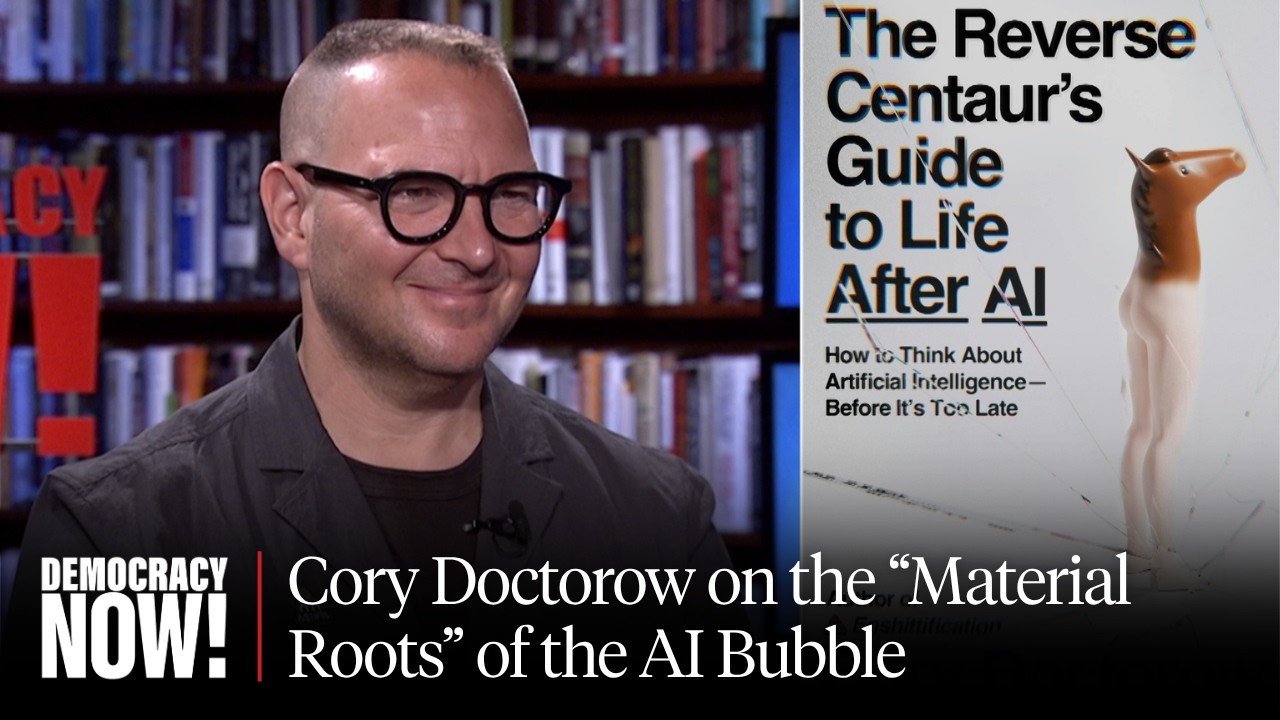
Democracy Now! speaks with science fiction author, activist and journalist Cory Doctorow about AI and his latest book, "The Reverse Centaur's Guide to Life After AI: How to Think About Artificial Intelligence — Before It's Too Late." Doctorow comments on AI's "bad unit economics" and the connection between automation and labor. "When labor drives automation, it's usually in service to making the product better, and when capital drives automation, it's usually in service to making more of the product," says Doctorow.
---

Jun 19, 2026 Galaxy Brain with Charlie Warzel
reverse centaur ATL MO
Cory Doctorow has a refrain: “The most important thing about a gadget isn’t what it does; it’s who it does it for and what it does it to.” In this episode of “Galaxy Brain,” he sits down with Charlie Warzel to talk about the AI boom, making the case that the hype, vision, and dreams of endless growth are unsustainable. Doctorow expands on his viral “enshittification” thesis: a critique of AI based around power and whether we are using AI tools or being used by them. This episode of "Galaxy Brain" was produced by Renee Klahr and engineered by Miguel Carrascal. Our theme is by Rob Smierciak. Hadley Robinson is our senior supervising producer. Claudine Ebeid is the executive producer of Atlantic audio, and Andrea Valdez is our managing editor. Subscribe to the “Galaxy Brain” newsletter: https://www.theatlantic.com/newslette...Subscribe to the “Galaxy Brain” podcast on Apple Podcasts: https://podcasts.apple.com/us/podcast...Subscribe to the “Galaxy Brain” podcast on Spotify: https://open.spotify.com/show/542WHgd...Follow The Atlantic on Instagram: https://www.instagram.com/theatlantic...
Intro Interview with Cory Doctoro
 What Is a Reverse Centaur
 Why the AI Bubble Is Bigge
 Boss Psychology and Powe
 Is AI Actually Profitable
 Air Canada and the AI Accountability Sin
 Puncturing the AI Bubbl
 Material Limits to AI Hyp
 AI, Oligarchy, and Democrac
 Closing Thoughts and Credits
ollama model typos
---
PLURALISTIC WWW?
JOE
CORY DOcTOROW
one of the smartest on tech recently said of ai: We have become slaves to Silicon Valley | Cory Doctorow Interview
https://www.youtube.com/watch?v=JzEUvh1r5-w
:{...Well, you know what's going to cause the collapse of the stock market? The two most boring initials in the world, AI.0:05Everything about this is uh nightmarish. And the tools don't do anything like what the manufacturers claim they do,0:11and they won't. It's like saying, you know, if we keep breeding these horses to run faster and faster, we're pretty sure one day one of them will give birth to a0:17locomotive. Ronald Reagan signed a bill that prohibited video store clerks from disclosing your VHS rentals. Every other0:23form of privacy invasion is now lawful. And so, why do they spine you? Same reason your dog licks its balls, right?0:29because they can't. When you allow a sector to dwindle to just five companies, they capture their regulators because five companies can agree on what0:36the regulation should be.
And they've got so much money because they don't compete, right? They divide up the0:41market like the Pope dividing up the new world. Although they're terrible people, they're just fulfilling the incentives0:46set by the policy environment. We have an inshitenic policy environment that guarantees that whoever is running those0:53companies will act like this. If Elon Musk pops his clogs from too much ketamine tonight, there will be a0:58succession battle overnight between 10 horrible big balls and whoever emerges victorious will be indistinguishable1:05from him.}:
AND HE CONCLUDES WITH A VERY SMART ENDORSEMENT OF MTA MISSION:
:{. We've traveled all the way from the theory of ENSHITification, the pre-insitified world to the possible disinitified future. For45:27our audience at home, could you perhaps summize in around one sentence why they should prioritize disinitification?45:34
Well, you don't have to prioritize disinitification, but you do have to prioritize fighting corporate power45:39because it is at the root of our misery. The creation of a new guilded age and45:44a new oligarchy is the reason we can't do evidence-based politics. It's the reason we can't stop uh supporting45:50genocide.
It's the reason we can't do anything meaningful about the climate emergency. It's the reason that your wages are being uh eroded. And it's the45:57reason that uh ideologues and demagogues like Nigel Farage can get 100,00046:03fascists into uh Trafalgar Square. Uh and so distantification46:08writtly about society is just about a world in which you have a fair shake.46:14And without that um we're not just at risk of having our pockets PICKed. We're we're at risk of of rising fascism, being46:21wiped out by the climate emergency by a parade of horribles that makes Dickens46:27look like an optimist. }:
A WHILE BACK w
---
---
Cory Doctorow at CF 25: How Enshittification Conquered the 21st Century and How We Can Overthrow It
caused by policy choices; crimogenic environment; 1890 sherman act, not endure king over necessaries of life ... autocrat of trade”
biden lawsuit revealed, 90% no more growth possible, so just make search worse so we do it more
doordash hid tip from drivers, so 3rd party paris? felony clinton 1998? dig mil c act?
Digital_Millennium_Copyright_Act
zuck said better to buy than compete; inst 12 employees
apple spy on users, no tell us, no opt out
KICK MUSK IN DONGLE ~ monop
ggl and --- collude jedi blue?
cloudfest
r. We are entering a period of omnishambolic poly-crisis. The long
30:33
ominous rumble of climate change, authoritarianism, genocide, xenophobia, and transphobia turned into an
avalanche. The perpetrators of these crimes against humanity have weaponized the internet, colonizing the 21st

---
3 24
cory doc new bk tech monopoly
*The Internet Con: How to Seize the Means of Computation.
UpFront - March 7, 2024 | KPFA
text interview
---
---
uber1 stub
https://webbrain.com/brainpage/brain/6950F840-FB80-FCB0-D505-8AB1FA685F08#-6344
---
red green & blue?
cory d
@Doctorow: Fight inflation with a windfall profits tax - "Corporate profiteering has costs the average American household $276/month, with the majority of it coming from the energy sector."@RepRoKhanna
@SenWhitehouse
https://redgreenandblue.org/…/cory-doctorow-fight-inflatio…/
---
Cory Doctorow describes what's wrong about "Surveillance Capitalism"
Cory Doctorow's new short book, How to Destroy Surveillance Capitalism, was just published in its entirety on OneZero. Below is Cory's Twitter thread that summarizes his argument that the problem with surveillance capitalism isn't that it big tech has AI-enhanced power to brainwash people, the problem is that big tech uses its monopoly power in ways that lead to totalitarian control over our lives. — Read the rest
MARK FRAUENFELDER 8:00 AM FRI AUG 14, 2020
Cory Doctorow experiments with AI writing partner Sudowrite
GPT-3 is a machine-learning trained language model that generates text based on a text prompt. Cory Doctorow has been playing around with a closed-beta implementation of Sudowrite, which he describes as a "GPT3-based text generator for fiction writers. You give it characters, plot summaries, dialogue, or twist endings," and Sudowrite generates one of more paragraphs of text based on that. — Read the rest
---
https://onezero.medium.com/how-to-destroy-surveillance-capitalism-8135e6744d59?
...The arguments for ridiculous beliefs in odious conspiracies like anti-vaccination, climate denial, a flat Earth, and eugenics are no better than they were a generation ago. Indeed, they’re worse because they are being pitched to people who have at least a background awareness of the refuting facts.
Anti-vax has been around since the first vaccines, but the early anti-vaxxers were pitching people who were less equipped to understand even the most basic ideas from microbiology, and moreover, those people had not witnessed the extermination of mass-murdering diseases like polio, smallpox, and measles. Today’s anti-vaxxers are no more eloquent than their forebears, and they have a much harder job.
So can these far-fetched conspiracy theorists really be succeeding on the basis of superior arguments?
Some people think so. Today, there is a widespread belief that machine learning and commercial surveillance can turn even the most fumble-tongued conspiracy theorist into a svengali who can warp your perceptions and win your belief by locating vulnerable people and then pitching them with A.I.-refined arguments that bypass their rational faculties and turn everyday people into flat Earthers, anti-vaxxers, or even Nazis. When the RAND Corporation blames Facebook for “radicalization” and when Facebook’s role in spreading coronavirus misinformation is blamed on its algorithm, the implicit message is that machine learning and surveillance are causing the changes in our consensus about what’s true.
After all, in a world where sprawling and incoherent conspiracy theories like Pizzagate and its successor, QAnon, have widespread followings, something must be afoot.
But what if there’s another explanation? What if it’s the material circumstances, and not the arguments, that are making the difference for these conspiracy pitchmen? What if the trauma of living through real conspiracies all around us — conspiracies among wealthy people, their lobbyists, and lawmakers to bury inconvenient facts and evidence of wrongdoing (these conspiracies are commonly known as “corruption”) — is making people vulnerable to conspiracy theories?
If it’s trauma and not contagion — material conditions and not ideology — that is making the difference today and enabling a rise of repulsive misinformation in the face of easily observed facts, that doesn’t mean our computer networks are blameless. They’re still doing the heavy work of locating vulnerable people and guiding them through a series of ever-more-extreme ideas and communities.
Belief in conspiracy is a raging fire that has done real damage and poses real danger to our planet and species, from epidemics kicked off by vaccine denial to genocides kicked off by racist conspiracies to planetary meltdown caused by denial-inspired climate inaction. Our world is on fire, and so we have to put the fires out — to figure out how to help people see the truth of the world through the conspiracies they’ve been confused by.
But firefighting is reactive. We need fire prevention. We need to strike at the traumatic material conditions that make people vulnerable to the contagion of conspiracy. Here, too, tech has a role to play.
There’s no shortage of proposals to address this. From the EU’s Terrorist Content Regulation, which requires platforms to police and remove “extremist” content, to the U.S. proposals to force tech companies to spy on their users and hold them liable for their users’ bad speech, there’s a lot of energy to force tech companies to solve the problems they created.
There’s a critical piece missing from the debate, though. All these solutions assume that tech companies are a fixture, that their dominance over the internet is a permanent fact. Proposals to replace Big Tech with a more diffused, pluralistic internet are nowhere to be found. Worse: The “solutions” on the table today require Big Tech to stay big because only the very largest companies can afford to implement the systems these laws demand.
...
Being watched changes your behavior, and not for the better. It creates risks for our social progress. Zuboff’s book features beautifully wrought explanations of these phenomena. But Zuboff also claims that surveillance literally robs us of our free will — that when our personal data is mixed with machine learning, it creates a system of persuasion so devastating that we are helpless before it. That is, Facebook uses an algorithm to analyze the data it nonconsensually extracts from your daily life and uses it to customize your feed in ways that get you to buy stuff. It is a mind-control ray out of a 1950s comic book, wielded by mad scientists whose supercomputers guarantee them perpetual and total world domination.
What is persuasion?
To understand why you shouldn’t worry about mind-control rays — but why you should worry about surveillance and Big Tech — we must start by unpacking what we mean by “persuasion.”
Google, Facebook, and other surveillance capitalists promise their customers (the advertisers) that if they use machine-learning tools trained on unimaginably large data sets of nonconsensually harvested personal information, they will be able to uncover ways to bypass the rational faculties of the public and direct their behavior, creating a stream of purchases, votes, and other desired outcomes.
[The impact of dominance far exceeds the impact of manipulation and should be central to our analysis and any remedies we seek.
But there’s little evidence that this is happening. Instead, the predictions that surveillance capitalism delivers to its customers are much less impressive. Rather than finding ways to bypass our rational faculties, surveillance capitalists like Mark Zuckerberg mostly do one or more of three things:
1. Segmenting
If you’re selling diapers, you have better luck if you pitch them to people in maternity wards. Not everyone who enters or leaves a maternity ward just had a baby, and not everyone who just had a baby is in the market for diapers. But having a baby is a really reliable correlate of being in the market for diapers, and being in a maternity ward is highly correlated with having a baby. Hence diaper ads around maternity wards (and even pitchmen for baby products, who haunt maternity wards with baskets full of freebies).
Surveillance capitalism is segmenting times a billion. Diaper vendors can go way beyond people in maternity wards (though they can do that, too, with things like location-based mobile ads). They can target you based on whether you’re reading articles about child-rearing, diapers, or a host of other subjects, and data mining can suggest unobvious keywords to advertise against. They can target you based on the articles you’ve recently read. They can target you based on what you’ve recently purchased. They can target you based on whether you receive emails or private messages about these subjects — or even if you speak aloud about them (though Facebook and the like convincingly claim that’s not happening — yet).
This is seriously creepy.
But it’s not mind control.
It doesn’t deprive you of your free will. It doesn’t trick you.
Think of how surveillance capitalism works in politics. Surveillance capitalist companies sell political operatives the power to locate people who might be receptive to their pitch. Candidates campaigning on finance industry corruption seek people struggling with debt; candidates campaigning on xenophobia seek out racists. Political operatives have always targeted their message whether their intentions were honorable or not: Union organizers set up pitches at factory gates, and white supremacists hand out fliers at John Birch Society meetings.
But this is an inexact and thus wasteful practice. The union organizer can’t know which worker to approach on the way out of the factory gates and may waste their time on a covert John Birch Society member; the white supremacist doesn’t know which of the Birchers are so delusional that making it to a meeting is as much as they can manage and which ones might be convinced to cross the country to carry a tiki torch through the streets of Charlottesville, Virginia.
Because targeting improves the yields on political pitches, it can accelerate the pace of political upheaval by making it possible for everyone who has secretly wished for the toppling of an autocrat— or just an 11-term incumbent politician — to find everyone else who feels the same way at very low cost. This has been critical to the rapid crystallization of recent political movements including Black Lives Matter and Occupy Wall Street as well as less savory players like the far-right white nationalist movements that marched in Charlottesville.
It’s important to differentiate this kind of political organizing from influence campaigns; finding people who secretly agree with you isn’t the same as convincing people to agree with you. [RIGHT BUT FAcebook trump kenosha guard are persuading ppl to act on RACIST IDEAS?] The rise of phenomena like nonbinary or otherwise nonconforming gender identities is often characterized by reactionaries as the result of online brainwashing campaigns that convince impressionable people that they have been secretly queer all along.
But the personal accounts of those who have come out tell a different story where people who long harbored a secret about their gender were emboldened by others coming forward and where people who knew that they were different but lacked a vocabulary for discussing that difference learned the right words from these low-cost means of finding people and learning about their ideas.
2. Deception
Lies and fraud are pernicious, and surveillance capitalism supercharges them through targeting. If you want to sell a fraudulent payday loan or subprime mortgage, surveillance capitalism can help you find people who are both desperate and unsophisticated and thus receptive to your pitch. This accounts for the rise of many phenomena, like multilevel marketing schemes, in which deceptive claims about potential earnings and the efficacy of sales techniques are targeted at desperate people by advertising against search queries that indicate, for example, someone struggling with ill-advised loans.
Surveillance capitalism also abets fraud by making it easy to locate other people who have been similarly deceived, forming a community of people who reinforce one another’s false beliefs. Think of the forums where people who are being victimized by multilevel marketing frauds gather to trade tips on how to improve their luck in peddling the product.
Sometimes, online deception involves replacing someone’s correct beliefs with incorrect ones, as it does in the anti-vaccination movement, whose victims are often people who start out believing in vaccines but are convinced by seemingly plausible evidence that leads them into the false belief that vaccines are harmful.
But it’s much more common for fraud to succeed when it doesn’t have to displace a true belief.When my daughter contracted head lice at daycare, one of the daycare workers told me I could get rid of them by treating her hair and scalp with olive oil. I didn’t know anything about head lice, and I assumed that the daycare worker did, so I tried it (it didn’t work, and it doesn’t work). It’s easy to end up with false beliefs when you simply don’t know any better and when those beliefs are conveyed by someone who seems to know what they’re doing.
This is pernicious and difficult — and it’s also the kind of thing the internet can help guard against by making true information available, especially in a form that exposes the underlying deliberations among parties with sharply divergent views, such as Wikipedia. But it’s not brainwashing; it’s fraud. In the majority of cases, the victims of these fraud campaigns have an informational void filled in the customary way, by consulting a seemingly reliable source. If I look up the length of the Brooklyn Bridge and learn that it is 5,800 feet long, but in reality, it is 5,989 feet long, the underlying deception is a problem, but it’s a problem with a simple remedy. It’s a very different problem from the anti-vax issue in which someone’s true belief is displaced by a false one by means of sophisticated persuasion.
3. Domination
Surveillance capitalism is the result of monopoly. Monopoly is the cause, and surveillance capitalism and its negative outcomes are the effects of monopoly. I’ll get into this in depth later, but for now, suffice it to say that the tech industry has grown up with a radical theory of antitrust that has allowed companies to grow by merging with their rivals, buying up their nascent competitors, and expanding to control whole market verticals.
One example of how monopolism aids in persuasion is through dominance: Google makes editorial decisions about its algorithms that determine the sort order of the responses to our queries. If a cabal of fraudsters have set out to trick the world into thinking that the Brooklyn Bridge is 5,800 feet long, and if Google gives a high search rank to this group in response to queries like “How long is the Brooklyn Bridge?” then the first eight or 10 screens’ worth of Google results could be wrong. And since most people don’t go beyond the first couple of results — let alone the first page of results — Google’s choice means that many people will be deceived.
Google’s dominance over search — more than 86% of web searches are performed through Google — means that the way it orders its search results has an outsized effect on public beliefs. Ironically, Google claims this is why it can’t afford to have any transparency in its algorithm design: Google’s search dominance makes the results of its sorting too important to risk telling the world how it arrives at those results lest some bad actor discover a flaw in the ranking system and exploit it to push its point of view to the top of the search results. There’s an obvious remedy to a company that is too big to audit: break it up into smaller pieces.
Zuboff calls surveillance capitalism a “rogue capitalism” whose data-hoarding and machine-learning techniques rob us of our free will. But influence campaigns that seek to displace existing, correct beliefs with false ones have an effect that is small and temporary while monopolistic dominance over informational systems has massive, enduring effects. Controlling the results to the world’s search queries means controlling access both to arguments and their rebuttals and, thus, control over much of the world’s beliefs. If our concern is how corporations are foreclosing on our ability to make up our own minds and determine our own futures, the impact of dominance far exceeds the impact of manipulation and should be central to our analysis and any remedies we seek.
4. Bypassing our rational faculties
This is the good stuff: using machine learning, “dark patterns,” engagement hacking, and other techniques to get us to do things that run counter to our better judgment. This is mind control.
Some of these techniques have proven devastatingly effective (if only in the short term). The use of countdown timers on a purchase completion page can create a sense of urgency that causes you to ignore the nagging internal voice suggesting that you should shop around or sleep on your decision. The use of people from your social graph in ads can provide “social proof” that a purchase is worth making. Even the auction system pioneered by eBay is calculated to play on our cognitive blind spots, letting us feel like we “own” something because we bid on it, thus encouraging us to bid again when we are outbid to ensure that “our” things stay ours.
Games are extraordinarily good at this. “Free to play” games manipulate us through many techniques, such as presenting players with a series of smoothly escalating challenges that create a sense of mastery and accomplishment but which sharply transition into a set of challenges that are impossible to overcome without paid upgrades. Add some social proof to the mix — a stream of notifications about how well your friends are faring — and before you know it, you’re buying virtual power-ups to get to the next level.
Companies have risen and fallen on these techniques, and the “fallen” part is worth paying attention to. In general, living things adapt to stimulus: Something that is very compelling or noteworthy when you first encounter it fades with repetition until you stop noticing it altogether. Consider the refrigerator hum that irritates you when it starts up but disappears into the background so thoroughly that you only notice it when it stops again.
That’s why behavioral conditioning uses “intermittent reinforcement schedules.” Instead of giving you a steady drip of encouragement or setbacks, games and gamified services scatter rewards on a randomized schedule — often enough to keep you interested and random enough that you can never quite find the pattern that would make it boring.
Intermittent reinforcement is a powerful behavioral tool, but it also represents a collective action problem for surveillance capitalism. The “engagement techniques” invented by the behaviorists of surveillance capitalist companies are quickly copied across the whole sector so that what starts as a mysteriously compelling fillip in the design of a service—like “pull to refresh” or alerts when someone likes your posts or side quests that your characters get invited to while in the midst of main quests—quickly becomes dully ubiquitous. The impossible-to-nail-down nonpattern of randomized drips from your phone becomes a grey-noise wall of sound as every single app and site starts to make use of whatever seems to be working at the time.
From the surveillance capitalist’s point of view, our adaptive capacity is like a harmful bacterium that deprives it of its food source — our attention — and novel techniques for snagging that attention are like new antibiotics that can be used to breach our defenses and destroy our self-determination. And there are techniques like that. Who can forget the Great Zynga Epidemic, when all of our friends were caught in FarmVille’s endless, mindless dopamine loops? But every new attention-commanding technique is jumped on by the whole industry and used so indiscriminately that antibiotic resistance sets in. Given enough repetition, almost all of us develop immunity to even the most powerful techniques — by 2013, two years after Zynga’s peak, its user base had halved.
Not everyone, of course. Some people never adapt to stimulus, just as some people never stop hearing the hum of the refrigerator. This is why most people who are exposed to slot machines play them for a while and then move on while a small and tragic minority liquidate their kids’ college funds, buy adult diapers, and position themselves in front of a machine until they collapse.
But surveillance capitalism’s margins on behavioral modification suck. Tripling the rate at which someone buys a widget sounds great unless the base rate is way less than 1% with an improved rate of… still less than 1%. Even penny slot machines pull down pennies for every spin while surveillance capitalism rakes in infinitesimal penny fractions.
Slot machines’ high returns mean that they can be profitable just by draining the fortunes of the small rump of people who are pathologically vulnerable to them and unable to adapt to their tricks. But surveillance capitalism can’t survive on the fractional pennies it brings down from that vulnerable sliver — that’s why, after the Great Zynga Epidemic had finally burned itself out, the small number of still-addicted players left behind couldn’t sustain it as a global phenomenon. And new powerful attention weapons aren’t easy to find, as is evidenced by the long years since the last time Zynga had a hit. Despite the hundreds of millions of dollars that Zynga has to spend on developing new tools to blast through our adaptation, it has never managed to repeat the lucky accident that let it snag so much of our attention for a brief moment in 2009. Powerhouses like Supercell have fared a little better, but they are rare and throw away many failures for every success.
The vulnerability of small segments of the population to dramatic, efficient corporate manipulation is a real concern that’s worthy of our attention and energy. But it’s not an existential threat to society....
==
Kevin Kelly and I interviewed Cory for our Cool Tools podcast. He talked about his four favorite tools as well as his latest writing projects and various other topics. Find out more in the show notes.
3/20
---
jamie Dimon is a (highly selective) socialist
Jamie Dimon (previously) is the Jpmorganchase CEO who committed a $13b mortgage fraud and whose company received $25B in TARP bailout money, $500B in low-cost federal loans, and billions more through the bailout of their insurer, AIG. Read the rest
---
==
privacy-invading, junk science "home DNA test" industry is cratering
Home genetics tests purport to tell you what percentage of your ancestry comes from which places, an incoherent, unscientific fraud that perpetuates ridiculous eugenic myths. But that's not all: when you take one of these tests, you nonconsensually opt your family into perpetual, global genetic surveillance (and it's not like they can opt out afterwards by changing their DNA). Read the rest
---
---
https://boingboing.net/2020/01/27/podcast-the-case-for-citi.html
For my latest podcast, I read my Guardian Cities column, "The case for ... cities that aren't dystopian surveillance states," which was the last piece ever commissioned for the section.
The Guardian commissioned the piece after reading my Toronto Life blurb about how a "smart city" could be focused on enabling its residents, rather than tracking and manipulating them.
In the article, I revisit my 2015 Locus column on the idea of an Internet of Things that treats people "as sensors, not things to be sensed" -- a world where your devices never share your data with anyone else to get recommendations or advice, but rather, where all the inanimate objects stream data about how busy they are and whether they're in good repair, and your device taps into those streams and makes private recommendations, without relaying anything about you or your choices to anyone else.
As I've often written, the most important thing about technology isn't what it does, but who it does it to, and who it does it for. The sizzle-reels for "smart cities" always feature a control room where wise technocrats monitor the city and everyone in it -- all I'm asking is that we all get a seat in that control room.
It’s a safe bet that the people who make those videos imagine themselves as one of the controllers watching the monitors – not as one of the plebs whose movements are being fed to the cameras that feed the monitors. It’s a safe bet that most of us would like that kind of god’s-eye view into our cities, and with a little tweaking, we could have it.
If we decide to treat people as sensors, and not as things to be sensed – if we observe Kant’s injunction that humans should be “treated as an end in themselves and not as a means to something else” – then we can modify the smart city to gather information about the things and share that information with the people.
Imagine a human-centred smart city that knows everything it can about things. It knows how many seats are free on every bus, it knows how busy every road is, it knows where there are short-hire bikes available and where there are potholes. It knows how much footfall every metre of pavement receives, and which public loos are busiest.
==
==
cory bb
one of the CIA's waterboarding torturers called himself "The Preacher" and shouted religious nonsense while performing executions
More word from the ongoing attempt to bring the people responsible for years of CIA torture to justice: one of the three waterboarding specialists at Guantanamo was called "The Preacher" because while he was drowning suspects to the point of near death, he "would at random times put one hand on the forehead of a detainee, raise the other high in the air, and in a deep Southern drawl say things like, 'Can you feel it, son? Can you feel the spirit moving down my arm, into your body?'" Read the rest
==
==
320 bb
Ajit Pai promised that killing net neutrality would spur network investment, but instead Comcast cut spending by 10.5%
When Trump FCC Chairman Ajit Pai used fraud and skullduggery to kill net neutrality, he promised that clearing away the allegedly burdensome regulation of delivering the data your customers request would finally spur investment in America's worst-of-bread, ancient network infrastructure. Read the rest
==
==
Radicalized
Radicalized [Amazon]
==
CORY DOCTOROW / 4:26 AM MON, AUG 12, 2019
Rule of Capture: Inside the martial law tribunals that will come when climate deniers become climate looters and start rendering environmentalists for offshore torture
In 2017, science fiction author Christopher Brown burst on the scene with Tropic of Kansas, an apocalyptic pageturner about martial law in climate-wracked America; now, with his second novel, Rule of Capture, Brown turns everything up to 11 in a militarized, oil-saturated, uninhabitable Texas where private mercs, good ole boys, and climate looters have plans to deliver a stolen election to a hyper-authoritarian president. Read the rest
/ / 9 COMMENTS
BOOKS / CLIMATE / DISASTER CAPITALISM / GIFT GUIDE / GRIFTER CAPITALISM/ GUILLOTINE WATCH / HAPPY MUTANTS / MESS WITH TEXAS / REVIEWS / SCIENCE FICTION / ZEITGEISTY AF
---
cory d
Manhattan DA served Google with a "reverse search warrant" in a bid to prosecute antifa protesters
In October 2018, Proud Boys founder Gavin McInnes was invited to speak at the Manhattan Republican club, drawing neo-Nazi supporters and antifa protesters; Proud Boy thugs waded into the protest and began indiscriminately attacking the protesters. Read the rest
...This marks the first known instance in which the Manhattan DA has used the controversial "reverse search warrant."
The Manhattan District Attorney's Office admitted it demanded Google hand over account information for all devices used in parts of the Upper East Side. They didn’t do this to find the Proud Boys; they did it to find Antifa members.
Manhattan DA Made Google Give Up Information on Everyone in Area as They Hunted for Antifa [Albert Fox Cahn/The Daily Beast]
==
==
https://boingboing.net/2019/08/11/price-of-progress.html
Between 2010 and 2016, the FDA approved 210 new medicines and every single one was produced at public expense, part of a $1T US government investment project in medical research. Despite this massive public subsidy, the pharma industry has only grown more concentrated and rapacious, raising prices and diverting the profits to their execs and investors, who now pocket 99% of industry profits: the industry made $500B in profits between 2006 and 2015, and during that time, the US government pumped $33b/year into pharma research.
The history of Big Pharma's big business is beautifully told in a long piece by Alexander Zaitchik in the New Republic. Zaitchik describes how the NIH changed its policies in 1968, ending the rule that forced publicly subsidized researchers to assign their patents to the federal government and allowing them instead to flog them on the open market. This created a new kind of academic research program, focused on using public money to develop patented products that would be exclusively assigned to pharma companies who'd be guaranteed monopolies over life-saving medicines.
That's when the Chicago School -- the origin node of neoliberalism and the worship of markets as self-correcting, self-optimizing systems that cannot and should not be regulated -- got involved, seeding a network of think-tanks and journal articles that decried competition as "wasteful duplication" and celebrated monopolies for their efficiency.
These articles created the fiction of mass private-sector investment in pharma, downplaying the taxpayer's role in subsidizing the industry and lionizing the few pennies that escaped the grasp of execs and shareholders. This mythology gave the pharma industry a rhetorical stick to beat dying customers with whenever they complained about skyrocketing prices, so the answer to these complaints was ever, "This is the price of progress." High prices may make access to medicine difficult, but without them, there'd be no medicine at all. In the early 2000s, pharma liked to talk about "the $800m pill" and today they talk about "the $2.6b pill."
It's only gotten worse under Trump, whose policies have been a bonanza for the shkreli-alike sociopaths who target monopolist pharma companies for private equity takeovers followed by mass price-hikes. When Trump allowed corporate America to repatriate the billions they'd stashed offshore at sweetheart tax rates, drug makers brought home $175b, which they primarily spent on stock buybacks and dividends that were primarily paid to hedge fund investors. Pfizer alone cashed out $10b in buybacks.
But despite this massive cash infusion, R&D spending has been flat.
Here's the hilarious part: most of this transfer of public research into private hands is undertaken through the provisions of the Bayh-Dole act. That same act imposes a duty on the US government to ensure that the "utilization and benefits" of that research should be "made available to the public on reasonable terms." In other words, the state is legally obliged to seize these drugs, price them at a reasonable level, and make them available to the public. What's a reasonable price? Well, during the Vietnam war, the Pentagon used this rule to seize key antibiotics and reimbursed the pharma companies involved at 2% of the retail price.
Today, pharma is overseen in America by Health and Human Services chief Alex Azar, who used to be CEO of Eli Lily. This swamp-gator has made a few promising noises about patent abuse, and he certainly knows where the bodies are buried, but literally betting the nation's lives on this dingo babysitter deciding not to eat the kids is pretty damned optimistic.
In 1972, Stigler organized a two-day event, “The Conference on the Regulation of the Introduction of New Pharmaceuticals.” Major drug makers like Pfizer and Upjohn pledged funds and sent delegates to the conference—a first and fateful point of contact between Pharma and the organized movement to undo the New Deal and radically remake the U.S. economy to serve an ideology of unfettered corporate power.
Born of this meeting was the echo chamber of ideas, studies, and surveys that the pharmaceutical industry has used to buffer an increasingly indefensible system against regular episodes of public outrage and political challenge. Organized and initially staffed by alumni of the Chicago conference, its hubs are the American Enterprise Institute’s Center for Health Policy Research, founded 1974, and the Center for the Study of Drug Development, founded in 1976 at the University of Rochester and later moved to Tufts. Their research has succeeded in producing and policing the boundaries of the drug pricing debate, most successfully propagating the myth that high drug prices are simply the “price of progress”—carrots that drug manufacturers need to entice them to sink hundreds of millions into research and development, because drugs cannot be developed or tested any other way. In the early 2000s, these think tanks gave us the deceptive meme of the “$800 Million Pill,” a dubious claim about the “real” cost of developing a single drug, which has provided cover for, among other things, George W. Bush to sign away the government’s right to negotiate drug prices in 2004. (The same think tanks now talk about the “$2.6 Billion Pill.”)
“The point of pharma’s echo chamber was never to get the public to support monopolistic pricing,” says Nik-Khah. “As with global warming denialism, which involves many of the same institutions, the goal is to forestall regulation, in this case by sowing confusion and casting doubt about the relationship among prices, profits, innovation and patents.”
How Big Pharma Was Captured by the One Percent [Alexander Zaitchik/New Republic]
(via Naked Capitalism)
/ / 3 COMMENTS
CHICAGO SCHOOL / CORPORATISM / HAYEK / HEALTH / LATE STAGE CAPITALISM / MEDICINE / MILTON FRIEDMAN IS MARTIN SHKRELI'S SPIRITUAL FATHER / MONOPOLISM / PHARMA / SOCIOPATHS / THE ENTREPRENEURIAL STATE
---
12/18 cory
third annual AI Now report: 10 more ways to make AI safe for human flourishing
https://boingboing.net/2018/12/06/no-more-black-boxes.html
==
==
Even before the election of Donald Trump, America's pearl-clutching class has been invoking James Madison and his fear of "impetuous majorities" and his desire for "majority rule based on reason rather than passion," worried that the "adults" in the political halls were losing their grip and being forced into "extremism" by mob rule.
:{:{}:
This concern is on full display in Jeffrey Rosen's latest Atlantic piece, and masterfully rebutted by Slate's Jamelle Bouie.
Bouie points out that the extremist evils of our age are the result of anti-democratic action from the very institutions created to preserve the elite veto over "mob rule."
* The Electoral College -- an anti-majoritarian institution -- put Donald Trump in the White House, trumping the majority vote.
* The Civil War -- driven by the narrow, parochial priorities of elite enslavers -- killed more Americans than any of the "populist" parties since.
* The Senate -- Congress's anti-majoritarian upper house -- is the home of the filibuster, dominated by politicians elected by a minority of the population, pursuing policies that gridlock Washington and preclude compromise on urgent issues like background checks for gun purchases, funding for public services, or immigration reform.
Yet we continue to misdiagnose America's political disease as "mob rule" rather than "elite rule." This misdiagnosis matters, because it leads to prescriptions that merely heighten the grip by elites: rather than reforming the electoral college or campaign finance, DC elites want to regulate social media and fund "civic education provided by wealthy citizens with a vested interest in defending existing institutions."
An honest examination of democratic decline would look at the ways in which our counter-majoritarian institutions are thwarting the public will—as expressed through its elected representatives—and how that can create support for truly destabilizing forces. It would account for how the Republican Party itself has made Madisonian institutions unworkable by abandoning the commitment to compromise and fair play that makes them work. The transformation of the GOP into a parliamentary-style party primarily responsive to donors, right-wing activists, and conservative media is arguably the central problem for American governance.
What declinist arguments like Rosen’s actually fear is the waning influence of elites. And what these arguments seem to seek—in voicing nostalgia for early American politics—is an era where elites could steer governance with only the cursory affirmation of a narrow and exclusive public. But if political and economic elites have lost their stature in American life, it’s only after a generation of profound mismanagement, from misguided foreign adventures to wage stagnation and broad economic collapse. Their failure, and the extent to which they’ve never been held accountable, is the shadow looming over our politics. And if we’ve seen light, it’s in those places where ordinary people have organized and begun to build new movements and new ways of democratic living, like Occupy, Black Lives Matter, Fight for 15, the immigrant rights movement, and the massive mobilization of women that followed the inauguration of Donald Trump.
Democracy didn’t create our problems, but it may solve them.
The Threat to Democracy Isn’t Coming From Its People [Jamelle Bouie/Slate]
}:
==
https://www.huffingtonpost.com/2013/01/29/aaron-swartz-cory-doctorow-homeland_n_2568774.html
Doctorow’s new book Homeland is the sequel to his popular YA bookLittle Brother, which again features teenage activist Marcus Yallow, this time in a WikiLeaks-like plot as he is pursued by government agents and tries to find the courage to match his convictions.
For an afterword, bringing the fictional events of the book into their real world contexts, Doctorow turned to his friend, the activist Aaron Swartz. As has been heavily reported elsewhere, Swartz committed suicide earlier this month.
Below, we reprint Swartz’s powerful afterword in its entirety. First, we asked Doctorow about what it is like to read the stirring words of his late friend - especially its painful last line.
Why did you ask Aaron to write an afterword for Homeland?
When I finished the sequel to Little Brother, I knew right away that I wanted an afterword from Jake Appelbaum, who is one of the unsung heroes of government transparency and personal anonymity and who has been victimized by the US government for his work on WikiLeaks.
And I knew I wanted an afterword from Aaron Swartz, who had the best techno-activist instincts of anyone I knew, and who I’d know since he was a little kid, and who was also being savagely victimized by the US government for his principled work.
I’m devastated about what happened with Aaron. I asked him to write me a afterword in the form of a letter to a kid like himself, but who was 14 in the year 2013. What he gave me was a call-to-arms that made me want to rush to a barricade, and left no doubt that we both hoped for the same thing from this book: that it would inspire a generation of activists who wouldn’t take ‘no’ for an answer when it came to freedom in the information age.
How important are the philosophies of his actions for the intended audience of your book? How would you summarize those philosophies?
Aaron didn’t care about the freedom of information. He cared — and I care — about the freedom of people. I don’t give a damn if ‘information wants to be free’ — but I’ll go to the wall for the people who use information to demand their freedom.
Aaron’s work — and the words he wrote for me — are clear on this.
The scientific documents he allegedly took from JSTOR were public knowledge in every sense but one. They were publicly funded, produced for public benefit, and were critical to the informed choice of the public. But they were not *accessible* to the public. It’s easy to understand why this offended Aaron. It offends the hell out of me.
Homeland is a book that is meant to give kids a sense of the wider questions of technology, one that gets them to understand that architecture is politics: the design of the technology they use constrains or enables the future they can build with it. Unless they seize the means of information, they will be penned in by it.
In my ideal world, the kid who closes the cover on Homeland will rush to a search engine and figure out proxies, free/open operating systems, freedom of information requests, local makerspaces, campaigns for political accountability like Rootstrikers — the whole package.
When I was a kid, you needed to know stuff to do stuff. You had to have the facts in order to act on them. Now all the facts are one search-engine query away, but unless you know that they’re there, you’ll never search for them. And unless you know how to think critically about the process by which those documents are indexed and ranked, you won’t be able to turn them into action.
The first step to seizing the means of information is to know that there is a means of information, that it matters, and that it can be yours.
How does it feel for you to read his afterword now?
It’s brutal.
I can’t read it without crying.
It fills me with dread and sorrow and hopelessness.
I’ve re-read it dozens of times since Aaron died, and every time I read it, I have to deliberately, through an act of will, recommit myself to the principles he sets out in it. And then I do, and I resolve to talk about Aaron and what he did and believed in, and never forget it.
*HOMELAND
Afterword by Aaron Swartz*
Hi there, I’m Aaron. I’ve been given this little space here at the end of the book because I’m a flesh-and-blood human and, as such, I can tell you something you wouldn’t believe if it came out of the mouth of any of those fictional characters:
This stuff is real.
Sure, there isn’t anyone actually named Marcus or Ange, at least not that I know, but I do know real people just like them. If you want, you can go to San Francisco and meet them. And while you’re there, you can play D&D with John Gilmore or build a rocket ship at Noisebridge or work with some hippies on an art project for Burning Man.
And if some of the more conspiracy-minded stuff in the book seems too wild to be true, well, just google Blackwater, Xe, or BlueCoat. (I myself have an FOIA request in to learn more about “persona management software,” but the Feds say it’ll take three more yearsto redact all the relevant documents.)
Now I hope you had fun staying up all night reading about these things, but this next part is important, so pay attention: what’s going on now isn’t some reality TV show you can just sit at home and watch. This is your life, this is your country — and if you want to keep it safe, you need to get involved.
I know it’s easy to feel like you’re powerless, like there’s nothing you can do to slow down or stop “the system.” Like all the calls are made by shadowy and powerful forces far outside your control. I feel that way, too, sometimes. But it just isn’t true.
A little over a year ago, a friend called to tell me about an obscure bill he’d heard of called the Combatting Online Infringement and Counterfeit Act, or COICA. As I read the bill, I started to get more and more worried: under its provisions, the government would be allowed to censor websites it didn’t like without so much as a trial. It would be the first time the U.S. government was given the power to censor its citizens’ access to the net.
The bill had just been introduced a day or two ago, but it already had a couple dozen senators cosponsoring it. And, despite there never being any debate, it was already scheduled for a vote in just a couple days. Nobody had ever reported on it, and that was just the point: they wanted to rush this thing through before anyone noticed.
Luckily, my friend noticed. We stayed up all weekend and launched a website explaining what the bill did, with a petition you could sign opposing it that would look up the phone numbers for your representatives. We told a few friends about it and they told a few friends and within a couple days we had over 200,000 people on our petition. It was incredible.
Well, the people pushing this bill didn’t stop. They spent literally tens of millions of dollars lobbying for it. The head of every major media company flew out to Washington, DC, and met with the president’s chief of staff to politely remind him of the millions of dollars they’d donated to the president’s campaign and explain how what they wanted — the only thing they wanted — was for this bill to pass.
But the public pressure kept building. To try to throw people off the trail, they kept changing the name of the bill — calling it PIPA and SOPA and even the E-PARASITES Act — but no matter what they called it, more and more people kept telling their friends about it and getting more and more people opposed. Soon, the signers on our petition stretched into the millions.
We managed to stall them for over a year through various tactics, but they realized if they waited much longer they might never get their chance to pass this bill. So they scheduled it for a vote first thing after they got back from winter break.
But while members of Congress were off on winter break, holding town halls and public meetings back home, people started visiting them. Across the country, members started getting asked by their constituents why they were supporting that nasty Internet censorship bill. And members started getting scared — some going so far as to respond by attacking me.
But it wasn’t about me anymore — it was never about me. From the beginning, it was about citizens taking things into their own hands: making YouTube videos and writing songs opposing the bill, making graphs showing how much money the bill’s cosponsors had received from the industries pushing it, and organizing boycotts putting pressure on the companies who’d endorsed the bill.
And it worked — it took the bill from a political nonissue that was poised to pass unanimously to a toxic football no one wanted to touch. Even the bill’s cosponsors started rushing to issue statements opposing it! Boy, were those media moguls pissed...
This is not howthe system is supposed to work. A ragtag bunch of kids doesn’t stop one of the most powerful forces in Washington just by typing on their laptops!
But it did happen. And you can make it happen again.
The system is changing. Thanks to the Internet, everyday people can learn about and organize around an issue even if the system is determined to ignore it. Now, maybe we won’t win every time — this is real life, after all — but we finally have a chance.
But it only works if you take part. And now that you’ve read this book and learned how to do it, you’re perfectly suited to make it happen again. That’s right: now it’s up to you to change the system.
Let me know if I can help.
Aaron Swartz
==
http://locusmag.com/2017/09/cory-doctorow-demon-haunted-world/
...The cheating can be closer to home than that.
:{:{}:
}:
You’ve probably heard stories of inkjet cartridges that under-report their fill-levels, demanding that you throw them away and replace them while there’s still plenty of (precious and overpriced) ink inside of them. But that’s just for starters. In 2015, HP pushed a fake security update to millions of Officejet owners, which showed up as a routine, ‘‘You must update your software’’ notification on their printers’ screens. Running that update installed a new, secret feature in your printer, with a long fuse. After six months’ wait, the infected printers all checked to see whether their ink cartridges had been refilled, or manufactured by third parties, and to refuse to print with any ink that HP hadn’t given its corporate blessing to.
HP is an egregious cheater, and this kind of cheating is in the DNA of any company that makes its living selling consumables or service at extremely high markups – they do their business at war with their customers. The better the deal their customers get, the worse the deal is for the manufacturer, and so these products treat customers as enemies, untrusted parties who must be tricked or coerced into installing new versions of the manufacturer’s software (like the iTunes and Kindle ‘‘updates’’ that have removed features the products were sold with) and using only the manufacturer’s chosen consumables.
The mobile phone industry has long been at war with its customers. When phones were controlled primarily by carriers, they were designed to prevent customers from changing networks without buying a new phone, raising the cost on taking your business elsewhere. Apple wrested control back to itself, producing a phone that was locked primarily to its app store, so that the only way to sell software to an iPhone user was to give up 30% of the lifetime revenue that customer generated through the app. Carriers adapted custom versions of Android to lock customers to their networks with shovelware apps that couldn’t be removed from the home-screen and app store lock-in that forced customers to buy apps through their phone company.
What began with printers and spread to phones is coming to everything: this kind of technology has proliferated to smart thermostats (no apps that let you turn your AC cooler when the power company dials it up a couple degrees), tractors (no buying your parts from third-party companies), cars (no taking your GM to an independent mechanic), and many categories besides.
All these forms of cheating treat the owner of the device as an enemy of the company that made or sold it, to be thwarted, tricked, or forced into conducting their affairs in the best interest of the company’s shareholders. To do this, they run programs and processes that attempt to hide themselves and their nature from their owners, and proxies for their owners (like reviewers and researchers).
Increasingly, cheating devices behave differently depending on who is looking at them. When they believe themselves to be under close scrutiny, their behavior reverts to a more respectable, less egregious standard.
This is a shocking and ghastly turn of affairs, one that takes us back to the dark ages. Before the Englightenment, before the scientific method and its peer review, science was done by alchemists, who worked in secret.
Alchemists – like all humans – are mediocre lab-technicians. Without peer reviewers around to point out the flaws in their experiments, alchemists compounded their human frailty with bad experimental design. As a result, an alchemist might find that the same experiment would produce a ‘‘different outcome’’ every time.
In reality, the experiments lacked sufficient controls. But again, in the absence of a peer reviewer, alchemists were doomed to think up their own explanations for this mysterious variability in the natural world, and doomed again to have the self-serving logic of hubris infect these explanations.
That’s how alchemists came to believe that the world was haunted, that God, or the Devil, didn’t want them to understand the world. That the world actually rearranged itselfwhen they weren’t looking to hide its workings from them. Angels punished them for trying to fly to the Sun. Devils tricked them when they tried to know the glory of God – indeed, Marcelo Rinesi from The Institute for Ethics and Emerging Technologies called modern computer science ‘‘applied demonology.’’
In the 21st century, we have come full circle. Non-human life forms – limited liability corporations – are infecting the underpinnings of our ‘‘smart’’ homes and cities with devices that obey a different physics depending on who is using them and what they believe to be true about their surroundings.
What’s worse, 20th century law puts its thumb on the scales for these 21st century demons. The Computer Fraud and Abuse Act (1986) makes it a crime, with jail-time, to violate a company’s terms of service. Logging into a website under a fake ID to see if it behaves differently depending on who it is talking to is thus a potential felony, provided that doing so is banned in the small-print clickthrough agreement when you sign up.
Then there’s section 1201 of the Digital Millennium Copyright Act (1998), which makes it a felony to bypass the software controls access to a copyrighted work. Since all software is copyrightable, and since every smart gadget contains software, this allows manufacturers to threaten jail-terms for anyone who modifies their tractors to accept third-party carburetors (just add a software-based check to ensure that the part came from John Deere and not a rival), or changes their phone to accept an independent app store, or downloads some code to let them choose generic insulin for their implanted insulin pump.
The software in gadgets makes it very tempting indeed to fill them with pernicious demons, but these laws criminalize trying to exorcise those demons.
There’s some movement on this. A suit brought by the ACLU attempts to carve some legal exemptions for researchers out of the Computer Fraud and Abuse Act. Another suit brought by the Electronic Frontier Foundation seeks to invalidate Section 1201 of the Digital Millennium Copyright Act.
Getting rid of these laws is the first step towards restoring the order in which things you own treat you as their master, but it’s just the start. There must be anti-trust enforcement with the death penalty – corporate dissolution – for companies that are caught cheating. When the risk of getting caught is low, then increasing penalties are the best hedge against bad action. The alternative is toasters that won’t accept third-party bread and dishwashers that won’t wash unauthorized dishes.
...
==
https://en.wikipedia.org/wiki/Cory_Doctorow
==
https://boingboing.net/author/cory_doctorow_1
---