GRAY CB 2
notorious CBG 7/18 tag
NO MERRI
law firm? lobby?
see jon berry fedsoc mofo liar 2025 pjt
see ESG legal suppression
cboydengray
gave us rt majority scotus CLARENCE IWF LEO RAGA GMU KAVANAUGH
NEOMI RAO
JOHN EASTMAN
AM 1ST ACTION MCMAHON
CSE KOCH EXXON FIRST ENERGY COAL
~CFPB AND ESG
LOMBORG
JOHN GRAHAM OMB OIRA
HAMM
---
---
---
SEE LEVER
mp BK SHOCK AND AWE PROGRESS FOR AM CBG
BRIAN MCCABE B43 JUD NOMS, GANG 14 AGREED T END FILIBUSTER, ADS
---
===
9 24 the lever podcast series rise of the mach
CBG comm for justice 2002 rove trent lott attack ads
trailer: Master Plan | Listen Now
---
---
Clarence Ginni IWF: KOCH
SNIP
His selection was considered a tactical masterstroke by C. Boyden Gray,President Bush’s White House Counsel, who had been criticized for letting the first vacancy in Bush’s term go to New Hampshire Justice David Souter, who was considered by the far right to be not “conservative” or activist enough to deliver judicial votes to change the law in the ways they wanted.
By putting forward an African American with right-wing bona fides, at Gray’s urging the Bush White House sought to mute Democratic objections for fear of offending a major constituency over fighting a nominee with a rags-to-riches life story.
:{:{(Gray is the grandson and also the nephew of three presidents of R.J. Reynolds Tobacco. After President George H.W. Bush lost his bid for another term in the 1992 “Year of the Woman” election, Gray became chairman of David}: :{Koch’s Citizens for a Sound Economy,}: :{which would later officially join forces with IWF.)}:}
SNIP:
https://truthout.org/articles/the-not-so-independent-women-s-forum-was-born-in-defense-of-clarence-thomas-and-the-far-right/
hBO’s new film on demand, Confirmation, revisits the painful battle over the appointment of Clarence Thomas to the US Supreme Court in spite of the testimony of Anita Hill that he sexually harassed her.
Some pundits have attempted to the film, even though it has several scenes that portray Thomas and his wife Ginny as quiet, sympathetic figures and not as the outspoken right-wing political activists that they were and are.
One of the harshest critics of the film is a group that calls itself the “Independent Women’s Forum” (IWF).
IWF is hardly independent though, despite its name.}:
It is deeply imbedded in the right-wing political infrastructure.
In fact, IWF began as part of the coordinated effort to get Thomas confirmed so he could advance the right-wing’s legal agenda on the courts, in the face of deep fears by many that he would limit individual rights as a judge—fears later validated by his rulings and extreme dissents as a Justice.
As Jane Mayer and Jill Abramson wrote in their book Strange Justice: “the falsehoods and distortions involved in the selling of Clarence Thomas to the American people neither started nor ended with the treatment of Anita Hill’s accusations. From the beginning, the placement of Thomas on the high court was seen as a political end justifying almost any means.”
Central to the efforts to get Thomas confirmed were not only the attacks on Hill by GOP Senators but also press outreach used to discredit her that was orchestrated by a small group of powerful right-wing women.
That confirmation battle put one of the most reactionary judges in modern history on the Court, and it also led to the creation of IWF, an ultra reactionary women’s group opposing women’s rights in numerous ways.
IWF’s creators defended Thomas, despite the detailed evidence against him, and the organization they founded has defended him and continued to attack Hill since 1991.
The Thomas hearings also led to a backlash from voters to a US Senate that had 98 men and only two women as Senators.
In spite of a temporary majority supporting the confirmation of Thomas based on the incomplete information provided in the Senate hearings, American voters resoundingly rejected the idea of an all-white male Senate Judiciary Committee examining a woman’s testimony about sexual harassment.
The 1992 election that followed swept out President George H.W. Bush and swept in four women as new Senators and more women in other offices, making that election “the Year of the Woman.”
Today, 20 US Senators are women; and IWF leaders and alums have regularly attacked the most powerful woman elected Senator since the Thomas hearings, Hillary Clinton.
IWF — which has had close ties to the billionaire Koch Brothers, before they were infamous, and to other rightwing donors — has used its well-funded platform to secure numerous press appearances without much scrutiny of its record and sometimes because of its reactionary positions.
That’s in part because media outlets have defaulted to point-counterpoint “reporting” that gives equal weight both to facts IWF opposes and to outlier claims that are IWF’s stock in trade.
Part of the playbook was set as IWF came into being, as its founders deployed women in the press to counter a fellow woman whose testimony threatened their political agenda and ally.
Much of that claim boiled down to denying her experience as inauthentic and deceitful because Thomas had not sexually harassed them. It was a brutally effective tactic.
This is the story of IWF’s roots.
IWF: Born to Give a Woman’s Voice to Defending Clarence Thomas
On June 28, 1991, the first black man to serve on the US Supreme Court, Associate Justice Thurgood Marshall — an icon to the civil rights community — announced his retirement.
Ten days later, President Bush nominated Clarence Thomas, a 43-year old African American judge who had a controversial tenure as President Reagan’s Chairman of the Equal Opportunity Commission (EEOC), where he challenged core ideas about equal economic opportunity for women, such as equal pay andcomparable worth.
Although it was only 16 months before the next presidential election and even though the choice of a young right-winger like Thomas to fill the beloved Justice Marshall’s seat was a lightening rod for controversy, the Democratic-led Senate Judiciary Committee scheduled hearings on his nomination for September.
As the controversy over Thomas’ nomination grew, a small group of right-wing women began meeting for lunch to discuss the nomination at the offices ofTed Olson in the law firm of Gibson, Dunn & Crutcher.
One of the women at those lunch meetings was Barbara Kay Bracher, a lawyer who married Olson in 1996.
Following the Thomas confirmation, she would go on to staff investigations of the Clinton Administration as a congressional aide and to write a diatribe called “Hell to Pay: the Unfolding Story of Hillary Rodham Clinton,” which was published by the right-wing bookseller Regnery shortly before Olson perished on a plane in the 9/11 attacks on her way to a taping for Bill Maher’s “Politically Incorrect” TV show.
(Ted Olson became famous for taking the Bush v. Gore case to the US Supreme Court, where Justice Clarence Thomas sided with him and four other GOP Justices in stopping the Florida recount in 2000, making Republican George W. Bush president despite Democrat Al Gore winning the popular vote. Bush then named Ted Olson Solicitor General of the United States.)
The driving force at those pro-Thomas strategy sessions in Olson’s office back in 1991 was Rosalie “Ricky” Silberman, who had worked with Thomas as Vice-Chair of the EEOC and was one of his confidantes.
Before that, Silberman had worked as the press secretary for GOP SenatorBob Packwood, who later resigned in 1995 in the wake allegations that he harassed and assaulted numerous women he worked with.
(Ricky Silberman was also married to Thomas’ mentor from Thomas’ brief time as a judge on the DC Circuit: Judge Laurence Silberman, a very political judge who among other things later tried to clear George W. Bush of culpability for lying about Iraq’s weapons and was later given the Presidential Medal of Freedom, by Bush.)
The third major figure in these lunches was Anita K. Blair, who was a lawyer who became General Counsel for IWF. President George W. Bush made her Deputy Assistant Secretary of the Navy, and in 2011 she was hired as Deputy Assistant Secretary of the Treasury Department on human resources in the Obama Administration.
In the later 1990s during the Republican effort to impeach Democratic President Bill Clinton, Blair claimed on behalf of IWF that:
“nothing ever did more to trivialize sexual harassment than the sorry spectacle surrounding Anita Hill … Given prime-time exposure on national television Hill told a bizarre, uncorroborated story about Thomas, her boss at two federal agencies. Hearing her belated complaints about off-color jokes allegedly told about 10 years before, millions of Americans wondered, ‘What on earth does this have to do with sexual harassment?’ Americans learned the answer from Hill and her supporters: ‘Sexual harassment isn’t about sex, it’s about power.’ The Anita Hill spectacle wasn’t about sexual harassment; it was about the exercise of pure partisan political power. The media circus surrounding Hill and Thomas was produced and directed by liberal operatives, includingfifth-columnistslike NPR’s Nina Totenberg.” [jewish?]
Those three right-wing politicos—Silberman, Olson, and Blair—formed an ad hoc committee called “Women for Judge Thomas,” which ultimately became a non-profit group dubbed the “Independent Women’s Forum.”
The Clarence Thomas Nomination Begins and IWF’s Founders Step Forward
But even before Anita Hill was in the picture — discovered by Senate Judiciary Committee staffers vetting the Bush nominee — allies of Thomas knew his controversial record as President Reagan’s chairman of the Equal Employment Opportunities Commission (EEOC) could play poorly with many women and others concerned about equality.
The Women for Judge Thomas committee began holding press conferences the month President Bush announced Thomas’ nomination to a lifetime position on the Court in July.
Thomas was in his early 40s and had never argued a case before the US Supreme Court, and he had only had 16 months of experience as a sitting judge on any court.
His selection was considered a tactical masterstroke by C. Boyden Gray,President Bush’s White House Counsel, who had been criticized for letting the first vacancy in Bush’s term go to New Hampshire Justice David Souter, who was considered by the far right to be not “conservative” or activist enough to deliver judicial votes to change the law in the ways they wanted.
By putting forward an African American with right-wing bona fides, at Gray’s urging the Bush White House sought to mute Democratic objections for fear of offending a major constituency over fighting a nominee with a rags-to-riches life story.
(Gray is the grandson and also the nephew of three presidents of R.J. Reynolds Tobacco. After President George H.W. Bush lost his bid for another term in the 1992 “Year of the Woman” election, Gray became chairman of David Koch’s Citizens for a Sound Economy, which would later officially join forces with IWF.)
But Thomas’ limited judicial experience and the hearings on his nomination deepened concerns of the Democrats on the Senate Judiciary Committee.
As the New York Times reported: “‘Judge Thomas lacks the experience and qualifications that a Supreme Court Justice ought to have,’ said Senator Patrick J. Leahy, Democrat of Vermont. ‘He fled from his record and he refused to answer legitimate questions.'”
Leahy also noted: “‘Nothing in Judge Thomas’s record or testimony suggests the level of professional distinction or constitutional grounding appropriate for a Supreme Court nominee. His legal and judicial experiences are limited. His speeches and writings have shown little in the way of analysis or scholarship.'”
So, when his nomination was considered, the Committee deadlocked 7-7 on his nomination but then voted to send the nomination to the full Senate for a vote without a recommendation for or against confirmation. Although the Democrats had a 57-43 majority, a number of Southern Democrats had already pledged to vote for Thomas to be confirmed.
Hill Comes Forward and IWF’s Founders Step Up to Counter Her in the Press
Before the Senate vote could be held, however,National Public Radio’s Nina Totenberg broke the story that the Senate investigation had uncovered allegations that Thomas had made unwanted advances toward some of his subordinates in his leadership positions in the Reagan Administration.
Totenberg received a tip that Professor Anita Hill, a conservative black law professor, had told the Senate that Thomas had made sexual comments to her when he was her supervisor when they both worked for the Reagan Administration.
This shocking development increased the volume of concern about confirming Thomas to a lifetime job on the highest court in the land, and the Senate Judiciary Committee scheduled another round of hearings to examine the allegations.
Under the guidance of Ricky Silberman, the Women for Judge Thomas Committee identified women who worked with Thomas who said they had not been sexually harassed by him and that he had behaved professionally toward them.
Meanwhile, the Senate Judiciary Committee’s investigators—including a Democrat named Ricki Seidman—identified another staffer who said she had been subject to sexual advances in the workplace by Thomas and also interviewed colleagues of Professor Hill, whom she confided in about the inappropriate things she said Thomas said.
As Steve Kornacki noted in Salon:
“Three Hill friends — Susan Hoerchner, Ellen Wells and John Carr — testified under oath that she had told them about Thomas’ conduct as it happened between 1981 and 1983. ‘Anita said that Clarence Thomas had repeatedly asked her out … that he wouldn’t seem to take ‘no’ for an answer,’ Hoerchner told senators. ‘The thing Anita told me that struck me particularly and that I remember almost verbatim was thatMr. Thomas had said to her, “You know, if you had witnesses, you’d have a perfect case against me.”‘”
On October 11, 1991, in nationally televised hearings, Hill testified in detail about things Thomas had said to her when she worked for him. While many observers were shocked by the graphic details, the Republicans on the Committee and other Thomas proxies strongly attacked Hill’s character and her decision to continue working for Thomas rather than file a legal complaint, despite her concerns that doing so would destroy her career and her future.
Hill had explained on NPR that her decision to testify was a difficult one, and was made on moral grounds because Thomas, as Chair of the EEOC, the agency that enforces federal workplace discrimination laws, had been “in charge of protecting rights of women and other groups in the workplace” but instead was “using his position of power for personal gain.”
Simply put, by sexually harassing her as she described, Thomas was alleged to be engaging in the kind of workplace discrimination that his agency was tasked with stopping.
Many women believed that such behavior demonstrated that Thomas was unfit for a position of power and a lifetime position on the nation’s highest court.
But the Senate’s hearing about her allegations morphed into an inquisition of her, much like how criminal defense attorneys attempt to discredit rape victims in order to prevent the conviction of their clients.
What people saw on TV was an all-white Senate Judiciary Committee filled with several men who impugned Hill’s character, doubted her intelligence, and attacked her motives — despite her conservative credentials — instead of treating her with respect and giving any credit to her eye-witness accounts of Thomas’ behavior. The attack on Hill was led by Republican Senators Arlen Specter, Orrin Hatch, and Alan Simpson on the Committee, and by Missouri’s John Danforth, Thomas’ champion in the Senate.
More than 20 million American households tuned in to watch Hill testify at hearings chaired by then-Senator Joe Biden, who is now Vice President.
As Politico noted last fall when Vice President Biden was considering running for president: “Biden’s done a lot over the past 24 years, including authoring the landmark Violence Against Women Act … But that hasn’t erased the memories of how Biden presided over those hearings … blamed for doing little to stop the attacks on Hill.”
He has also been criticized for opting not to call Angela Wright, an African American who worked in the press office at the EEOC, whose testimony would have echoed Hill’s charges of sexual harassment.
Wright had “detailed a pattern of harassing behavior, including an instance in which Thomas asked her what her bra size was.” Wright had also told her colleague, Rose Jourdain, at the time that Thomas made comments about “her figure, her body, her breasts, her legs, how she looked in certain suits and dresses.”
Wright’s statement was allowed to go into the official hearing record but she was not allowed to testify to help rebut Thomas’ denial.
In a letter to the Senate Judiciary Committee, another Thomas aide “Sukari Hardnett wrote that many black women at the agency felt they were ‘an object of special interest’ to their boss. ‘If you were young, black, female and reasonably attractive,’ her letter read, ‘you knew full well you were being inspected and auditioned as a female,'” as noted by Kornacke.
But the Senate and the country did not get to hear from these women.
When Mayer and Abrahamson conducted a full investigation for their book, rather than the rushed examination that occurred in the Senate, they also discovered that classmates of Thomas reported:
“that he often recounted sexually explicit films in lurid detail. Kaye Savage, a former colleague, reports that the walls of his bachelor apartment were covered with Playboy nude centerfolds. The owner of a video store near the EEOC [called Graffiti] said Thomas was a regular customer for pornographic movies.”
This evidence would have corroborated Hill's testimony and refuted Thomas’ denial, but none of this was part of the Senate’s hearings.
Years later, another woman “Lillian McEwen, who had dated Thomas in the 1980s and who was promoted by Thomas backers as something of an alibi during his confirmation hearings, spoke publicly about her relationship with him for the first time [in 2010]. Now retired, McEwen said that ‘Hill’s allegations that Thomas had pressed her for dates and made lurid sexual references rang familiar,’ as the [Washington] Post put it—as detailed by Kornacke in Salon.
Kornacke added: “McEwen said that Thomas had been ‘obsessed with porn’ and ‘would talk about what he had seen in magazines and films, if there was something worth noting.’ She also said that Thomas would tell her about the women he worked with — even commenting to her about one’s bra size. ‘He was always actively watching the women he worked with to see if they could be potential partners,’ McEwen told the Post. ‘It was a hobby of his.'”
That information was not known to the Senate at the time Clarence Thomas’ nomination was being considered, but none of that has changed IWF’s line of attack against Hill.
Thomas Fires Back
In response to Hill’s testimony, Thomas attacked the Senate for what he flamboyantly described as a “high-tech lynching” of an “uppity” black man who dared to be conservative.
He used the televised broadcast of the hearings to portray the Senate’s consideration of Hill’s allegations against him as racist and as promoting racial stereotypes—even though his accuser was also a conservative African American.
GOP senators like Arlen Specter were given wide leeway to attack Hill with incredibly derogatory and personal claims such as suggesting she had “fantasies about sexual interest in her” and that she “was having a problem being rejected by men she was attracted to.”
Hill took and passed a lie detector test, but Republican Senators smeared her further claiming she passed because she believed her “fantasies” about Thomas pursuing her.
Many women were disgusted by the way the Senate treated Hill and by the words and actions of Thomas, but not Silberman and her committee of Women for Judge Thomas, which held press conferences and other outreach buttressing the Republican attacks on Hill.
The IWF predecessor did so by pressing the claim that because he had not harassed the women they assembled he could not have harassed Hill and by arguing that she had “other” motives, which fueled the right-wing narrative that she had made up the allegations supposedly because she wanted to be with Thomas.
Meanwhile, the Judiciary Committee hearings ended by effectively giving Clarence Thomas the last word, as Hill did not testify again to rebut Thomas’ denial of her allegations.
Thomas Was Confirmed in One of the Closest Votes in History
Given how forcefully the GOP Senators sought to discredit Hill and the deployment of women in defense of Thomas, perhaps it should come as no surprise that the public remained divided over Thomas’ confirmation. Several polls indicated that a majority favored his confirmation, while the remainder were split between opposing and being undecided.
In a contest of he-said-she-said, it appeared that a majority of those polled believed Thomas, who had so evocatively taken umbrage at the allegations against him. Having other women, like Ricky Silberman, defend him certainly helped his case.
And, at the same time, the public was denied the chance to hear from another woman willing to testify that she had also been sexually harassed by Thomas.
Also lost in the hot-button national conversation was the message that no one is entitled to a lifelong job on the US Supreme Court.
So, on October 15, 1991, the Senate handed Thomas a lifetime job on the Court, with narrow 52-48 vote (with 11 Democrats joining 41 Republicans and 2 Republicans — Senator Jeffords (R-VT) and Senator Packwood (R-OR) — joining the Democrats).
Hill was home in Oklahoma, and Thomas, after he was confirmed for the lifetime post at the youthful age of 43, reportedly swore he would stay on the Court for 43 years to get his revenge on his enemies.
It was out of the ugliness of the Clarence Thomas nomination fight that the “Independent Women’s Forum” was born.
IWF Continued to Fight Hill Even After Thomas Was Confirmed
If the Republicans on the Senate Judiciary Committee had sought to incapacitate Anita Hill with an array of punches at her reputation, Ricky Silberman seemed determined to throw the knockout blow.
A year to the day after her senate testimony, Hill returned to Washington DC to recount her experience. At a conference at Georgetown Law, she spoke in academic terms while analyzing the structures that had colluded against her, and received a standing ovation for her bravery.
Across the city on that same day, Ricky Silberman held a counter-conference at the Federalist Society.
Speaking to that audience, Silberman accused Hill of being a liar, labeled the assembled group of academics at Georgetown “the extreminists,” and proclaimed that Hill’s “unsubstantiated charge of sexual harassment launched the mother of all gender wars.”
Later that year, in 1992, Silberman formally founded IWF with Barbara Bracher (Olson), Anita Blair and Lynn Cheney to fight that so-called “gender war.”
However neither Silberman nor IWF would let the Anita Hill testimony rest.
In 1993, David Brock published the book “The Real Anita Hill,” an alleged investigation into the “true motives” of Hill’s testimony.
Silberman helped Brock edit, assemble, and advertise the book, which by all accounts was an orchestrated hit piece.
Brock, who had repeatedly referred to Hill in the media as “a little bit nutty and a little bit slutty,” would later apologize for his actions, and label himself as a “witting cog in the Republican sleaze machine.” (Brock has disavowed his past as a political hit man for the right-wing and now leads groups challenging the right-wing and is also now aligned with Hillary Clinton.)
Silberman, who passed away in 2007, never apologized. The IWF tribute to her included a tribute from her memorial by Clarence Thomas.
Beyond Attacking Anita Hill, IWF Routinely Peddles Reactionary Claims
As documented by Barbara Spindel in Slate, five years after Hill’s testimony, IWF ran a cover-story in its 1996 “Women’s Quarterly” magazine where Elizabeth Larson, an IWF staffer, speculated that women were “spurred on by Anita Hill’s example” and now found “it more profitable to litigate than to work.”
In that article, Larson also suggested that women should simply “deal with” sexual harassment, a position the organization would advocate for in the 1990s time and again.
As detailed by researcher Lee Cokorinos in his book, “The Assault on Diversity: An Organized Challenge to Racial and Gender Justice,”IWF received substantial financial underwriting by right-wing funders like the Scaife Foundation and the John M. Olin Foundation to focus many of its efforts on Silberman’s “gender war.”
In the words of Anita Blair, who served as an IWF leader from 1992 until 2000, “it was in 1977 or 1978 that feminism should have declared victory and gone home… All that was needing to be done had been done.”
In keeping with this fictitious worldview, IWF opposed a host of women equality initiatives throughout the 1990s using misleading data and taking some extreme positions:
- when lobbying against the Senator Biden’s “Violence Against Women Act,” IWF claimed “wives instigate violence, including severe violence, against husbands more often than husbands do against wives.”
- IWF argued that gender integration of the Virginia Military Institute would cripple national defense,
- IWF asserted that the problem of sexual assault on college campuses was overblown, since it is “inherently incredible” that female college students “are unable to report assaults to authorities,”
- and much more, including assailing key Title IX protections for female athletes.
Like every GOP-aligned group in the 1990s, IWF also supported efforts to impeach President Clinton, reaching out to Kenneth Starr for legal assistance as early as 1994. Barbara Olson and other IWF-ers helped carry the torch against Bill and Hillary Clinton.
IWF also provided Republicans in Congress with women’s voices to testify against affirmative action, social safety net programs, and gun violence mitigation measures.
As a whole, IWF was focused on combatting a caricature of what it described as “radical feminism.” [strict fr vs nurture mo?]
Over the past 25 years since the Clarence Thomas hearings, IWF has given a female face and voice to opposing almost every mainstream and common sense protection for equality that’s been advanced — opposing equal pay, paid sick leave, increasing the minimum wage, and protecting women’s reproductive privacy and freedom, and much more —many of which Thomas has also sought to weaken or strike down from the Supreme Court.
Over the years, IWF has not lost its interest in attacking Hill, even though its latest spin is about its supposedly “family-friendly” policies that put Wall Street in the driver’s seat and would take away responsibilities from employers regarding maternity leave, despite overwhelming business support for expanding employer-paid maternity and family leave, as the Center for Media and Democracy recently documented in a story broken by Lydia DiPillis in The Washington Post.
IWF’s kind of outlier, free-market fundamentalist approach should come as no surprise since IWF and David Koch’s Americans for Prosperity have been close partners—even sharing space and leadership for a number of years—and because the Koch network of billionaires uses an array of vehicles to push an anti-government, anti-science, anti-worker agenda.
But the claim that IWF is merely a “right-leaning think tank,” given its legacy and extreme positions, ignores the history of a group that began with efforts to discredit Anita Hill and that continues to traffic in denial and disdain, despite the evidence that has mounted against so many of its claims.
---
---
Alexander Hamilton Fellow
The C. Boyden Gray Center for the Study of the Administrative State
Aug 2019 - May 2021 · 1 yr 10 mos
Arlington, Virginia baker h endangerment 6 26
---
sludge
Former law professor Neomi Rao is facing headwinds in her judicial nomination, so Charles Koch’s Americans for Prosperity is stepping in.
Billionaire manufacturing magnate Charles Koch has for decades used his enormous wealth and political power to install elected officials, government administrators, and regulators who will keep the business interests of Koch Industries and other giant, heavily polluting companies in mind.
But Koch is also dipping into the judicial arena. One of his protegés has been nominated by President Trump and is poised to join the second-most powerful court in the United States, and Koch’s premier political spending group wants to make sure it happens.
In 2016, the Charles Koch Foundation (CKF) and a mystery donor combined to give $30 million to the George Mason University (GMU) law school, renaming it after the late, conservative Supreme Court Justice Antonin Scalia. Koch’s foundation put in $10 million, and the remaining $20 million, it was later discovered, was administered by Federalist Society officials through a 501(c)(4) nonprofit, BH Fund.
The grant established 12 new law professorships—nearly all the hires had ties to the conservative Federalist Society—and founded two ideological law school centers, the Center for Liberty and Law and the Center for the Study of the Administrative State. The founder and director of the latter center was Neomi Rao, who had been a law professor at GMU since 2012. She previously clerked for the most conservative Supreme Court justice, Clarence Thomas, and was associate counsel and special advisor to President George W. Bush. She has never been a judge.
Rao took a leave of absence from George Mason in 2017 when President Donald Trump appointed her as director of the White House Office of Information and Regulatory Affairs (OIRA), Trump’s “regulation czar.”
The dean of the GMU law school told another donor to her center, corporate lobbyist and longtime Koch ally C. Boyden Gray, that he hoped to lure her back to GMU with a $1.5-million professorship, funded by Gray, according to an email unearthed by GMU alumna Allison Pienta. “This chair would help me to entice Neomi to return home to Scalia Law after she dismantles the administrative state while serving at OIRA,” he wrote in a May 2017 letter to Gray. Gray gave another $3 million to the center, and it was renamed in his honor.
Dismantling the administrative state (p. 2)
View entire document on DocumentCloud
But instead of returning to the law school, Rao may be headed to the powerful D.C. Circuit Court of Appeals to fill the seat vacated by the newest Trump-appointed Supreme Court justice, Brett Kavanaugh. Rao’s GMU center hosted a conference in 2016 that featured Kavanaugh, a fellow Federalist Society member, as keynote speaker.
Rao’s judgeship nomination is perhaps the crowning achievement of the Antonin Scalia Law School’s initiative to reshape the federal judiciary. In 2017, the law school’s Law and Economics Center, which CKF had been funding for years, drew up a funding proposal for the center’s “Federal Judges and Attorneys General Initiatives.”
‘Reshaping’ the Federal Bench
“The election of Donald Trump presents a historic opportunity for a new president to reshape the federal judiciary, reform the regulatory state, promote economic growth, and restore constitutional federalism,” reads the proposal.
The program educates newly appointed judges on economics and other issues so they will “be more likely to make sound decisions that support the rule of law and the free enterprise system.” The new Federal Judges Initiative will “cover topics expected to be highly relevant to the current presidential administration’s policy agenda, such as the economics of health care and health financing, financial services regulation, environmental and energy regulation, health and safety regulation, privacy, labor and employment law, and telecommunications regulation.”
As of 2017, over 5,000 judges and 700 state attorneys general had participated in at least one Law and Economics Center program. In the 2018 fiscal year, the Law and Economic Center requested over $1.7 million for its Judicial Education Budget.
“Rao’s transition from the Koch-funded Antonin Scalia School of Law to her nomination to the second-highest court in the country is exemplary of Koch’s successful strategy of leveraging George Mason University to exert influence on the judicial branch for decades to come,” Samantha Parsons, a GMU graduate and director of campaigns at the activist group UnKoch My Campus, told Sludge. “Her nomination should serve as a warning of the anti-democratic agenda we can expect throughout our nation’s judicial system should George Mason University succeed in its goals to facilitate the education and placement of hundreds of new federal judges under Trump’s presidency.”
In December, when Trump nominated Rao, Koch’s most prominent political advocacy organization, Americans for Prosperity, endorsed her for the judgeship. But Rao has since encountered some bumps in the road. Republican Missouri Sen. Josh Hawley said he has “deep concerns,” telling Axios that she may not be sufficiently anti-abortion.
At a recent Senate committee hearing, Iowa Republican Sen. Joni Ernst expressed concerns over Rao’s 1994 essay on date rape, which alleged that women who are raped while drunk are partially to blame for being raped. Rao’s OIRA has stalled issuing an employer guidance on sexual harassment for 15 months, a process that normally takes no longer than 90 days, as David Dayen reported for The Intercept.
Americans for Prosperity will fund digital advertising and grassroots efforts in an attempt to sway public opinion in favor of Rao this week, according to Axios. On Tuesday morning, the Facebook ad archive listed six AFP ads in favor of Rao, which began running on Monday. Each ad targets one Republican senator, including Ernst and Hawley, urgin Facebook users to tell their senator to vote for Rao’s D.C. Circuit Court nomination. Additional targeted senators are Ted Cruz (Texas), Marsha Blackburn (Tenn.), James Lankford (Okla.), and Ben Sasse (Neb.). The Google ad archive did not list any recent AFP purchases.
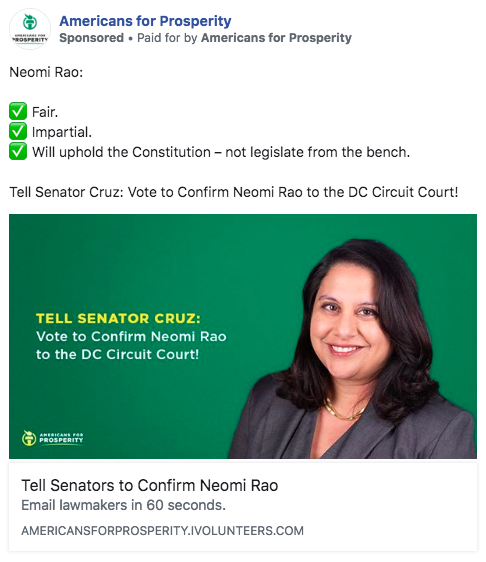 One of Americans for Prosperity’s Facebook ads supporting Neomi RaoFacebook Ad Archive
Americans for Prosperity did not reply to Sludge’s request for comment.
‘Regulatory Obstruction’
The American Constitution Society says OIRA, which is part of the Office of Management and Budget, “has embraced politicized regulatory obstruction as its raison dêtre” under Rao. In OIRA’s 2018 report, entitled “Cutting the Red Tape,” Rao writes, “we are working to push back the expansion of the administrative state, which has placed undue burdens on the public and impeded economic growth.”
Under Rao’s leadership, OIRA, has approved sweeping environmental deregulation by the EPA. Koch Industries, which Charles Koch runs, is a giant manufacturing conglomerate with subsidiaries that refine and transport oil, create paper products, and produce chemicals. The company is among the country’s biggest air and water polluters and has paid hundreds of millions of dollars for environmental violations. Koch and his brother David are lifelong libertarians who have fought taxes and regulations for decades.
“Rao has never seen a regulation she didn’t hate, and as a judge would dismantle 40 years of environmental and social progress,” Brett Hartl, government affairs director at the Center for Biological Diversity, said in a statement to Buzzfeed News. “Her confirmation would be the most damaging and regressive yet by Trump after Kavanaugh and Gorsuch.”
GMU is by far the biggest recipient of grants from the Charles Koch Foundation (CKF), which gives tens of millions of dollars each year to free-market higher education programs. Since 2005, CKF and the Charles Koch Institute have donated nearly $129 million to GMU, including over $34 million for the free-market Mercatus Center, according to Sludge’s analysis. Another free-market-focused GMU center, the Institute for Human Studies, has received $8.7 million.
The university has come under fire for allowing the CKF to impact hiring decisions. In the case of Florida State University, CKF was even allowed to control economics curricula.
AFP isn’t the only Koch-linked group to spend money to influence the judiciary. The Center for Media and Democracy reports that Donors Trust, a donor-advised fund that wealthy conservatives including Koch use to score tax deductions and potentially anonymize their donations to nonprofits, has bankrolled right-wing groups such as the Judicial Crisis Network and its sister organization, the Judicial Education Project, which spent millions of dollars on ads supporting the Supreme Court confirmation of Neil Gorsuch. Donors Trust also funds the Federalist Society and, as Sludge recently reported, several Southern Poverty Law Center-designated hate groups.
Related:
Charles Koch Is Funding Rightwing, Pro-Trump Media, New Disclosure Reveals
Koch Brothers Continue to Influence Tax Policy After Huge Cuts Last Year
Koch-Backed SEC Commissioner Claims Corporate Law is in the Public Interest
Author profile](https://readsludge.com/author/alex/)
Alex Kotch
Alex is a reporter at Sludge and a contributor to The Young Turks. He was previously part of the award-winning investigative team at International Business Times, and his other work has appeared in T...
---
why cbg? no real $ in it?
BRIEF OF ECONOMISTS AS AMICI CURIAE
IN SUPPORT OF PETITIONERS ___ C. BOYDEN GRAY Counsel of Record
JONATHAN BERRY MICHAEL B. BUSCHBACHER JAMES R. CONDE T. ELLIOT GAISER JORDAN E. SMITH
BOYDEN GRAY & ASSOCIATES 801 17th Street NW, #350 Washington, DC 20006 (202) 955-0620 info@boydengrayassociates.com
iNTEREST OF AMICI CURIAE1
Amici Michael P. Keane, Hanming Fang, Christopher J. Flinn, Stefan Hoderlein, Yingyao Hu, Joseph P. Kaboski, Glenn C. Loury, Thomas A. Mroz, and Matthew S. Shum
are distinguished economists who have extensively studied the kind of statistical and econometrics tools used by the experts in this case. Indeed, Harvard’s statistician admitted that he assigns writings from amicus Dr. Keane to explain to his students the very tools used in this case. JA3232:23–3234:1.
The institutional affiliations of amici are listed for identification purposes only in Appendix A. Amici agree that the statistical evidence in this case shows that Harvard discriminates based on race in admissions.
INTRODUCTION For the first time, extensive discovery into Harvard’s admissions process has allowed expert statisticians under the hood, so to speak, to examine the extent to which Harvard discriminates based on race. The dataset in this case is comprehensive, including hundreds of applicant characteristics for the approximately 150,000 people who applied to Harvard over six years of admissions. This extensive dataset...
APPENDIX A: AFFILIATIONS OF AMICI CURIAE Michael P. Keane, Professor of Economics and at the University of New South Wales. Hanming Fang, Professor of Economics at the University of Pennsylvania. Christopher J. Flinn, Professor of Economics at New York University. Stefan Hoderlein, Professor of Economics at Boston College. Yingyao Hu, Professor and Chair of Economics at Johns Hopkins University. Joseph P. Kaboski, Professor of Economics at the University of Notre Dame. Glenn C. Loury, Professor of Economics at Brown University. Thomas A. Mroz, Professor in the Department of Economics at Georgia State University. Matthew S. Shum, Professor of Economics at the California Institute of Technology
...
A. The court below erred when it suggested the statistical evidence of an Asian American “penalty” was not significant
"Green 20" AGs: What is it REALLY about? | The Federalist Society
Ben Massey
Debra Ann Livingston
Devin Allan DeBacker
C. Boyden Gray
May 13 2016
Blog Post
"Green 20" AGs: What is it REALLY about?
| Topics: | Federalism & Separation of Powers |
Last year the New York Times won a Pulitzer for reporting critically on the unsurprising and perfectly legal efforts of private businesses to encourage Republican state Attorneys General to combat federal regulations harmful to their State economies.[1] Compare that to the mainstream media’s silence about the forces behind a much less conventional group of Democratic Attorneys General who have teamed up with former Vice President Al Gore to intimidate their opponents and to suppress any dissent from the orthodoxy of the Obama Administration’s climate change strategy.
Calling themselves “AGs United for Clean Power,” this group has instigated wide-ranging investigations into the private communications of businesses and non-profit organizations, backed up by the threat of criminal prosecution.[2]
As part of this witch-hunt, the Attorney General of the Virgin Islands sent subpoenas to conservative groups like the Competitive Enterprise Institute, seeking ten years of private communication (for years 1997 to 2007) related to ExxonMobil and climate change.[3] This follows earlier subpoenas to Exxon covering more than 40 years—all part of a curious effort to prove that the petroleum giant somehow knew and covered up the supposed risks of climate change before they were known to the rest of the scientific community.
This is likely to be a fool’s errand, because Exxon’s knowledge about the state of the science was far from secret. The company published a wide array of mainstream, peer-reviewed climate science articles during the time period in question—a time well before the emergence of any “consensus” on the science of man-made climate change.
More fundamentally, this fishing expedition blatantly violates the First Amendment rights of the targeted organizations with no legitimate law enforcement objective in sight. The subpoenas are in reality part of a broader, systematic attempt by the Left to suppress dissent, by cutting off corporate funding to political advocacy groups they disfavor.
This is amply illustrated by the recent CEI subpoena. The subpoena rests on Exxon’s purported violation of the Criminally Influenced and Corrupt Organizations Act (CICO), which has a five year statute of limitations.[4] Yet the subpoena improperly seeks to compel CEI to produce a decade’s worth of documents that fall completely outside the statute of limitations. Exxon decided to cut ties with CEI and other dissenting groups in 2007, but this has not stopped the AG from harassing CEI. [5]
These actions will have the intended effect of discouraging not only scientific dissent, but also political dissent, over the costs and benefits of mitigating the risk of climate change.[6] But there are good reasons not to credit unblinkingly all of the accepted wisdom of current climate change policy. Despite a staggering price tag, current national and international climate policy has very little to show for itself in terms of projected carbon emission reductions, much less any actual change to the temperature of the globe.
At base, changing global temperatures may not be the point. When Congressman David McKinley asked U.S. Environmental Protection Agency Administrator Gina McCarthy whether the cost of President Obama’s Clean Power Plan—$64 billion annually by one measure[7]—is worthwhile “[i]f it doesn’t have an impact on climate change around the world,” her answer was that the rule has “had enormous benefit in showing sort of domestic leadership as well as garnering support around the country for the agreement we reached in Paris.”[8] As strange as it may seem for the head of EPA to admit our nation’s climate change policy is one big PR strategy, that response was consistent with what McCarthy said about the rule when it was first proposed: “This is not about pollution control,” she said in another congressional hearing. “[I]t really is an investment opportunity.”[9]
The Paris agreement that McCarthy referred to will do little more. Even if every nation fulfilled every promise in the treaty between now and 2030, it would reduce the global temperature by less than a tenth of a degree by 2100.[10] If those promises are extended to 2100, the resulting temperature effect will still be only three tenths of a degree.
The projected costs of the Paris agreement—at least $154 billion per year in lost GDP in the United States alone[11]—would be much better spent on research and development, the kind of work that ExxonMobil has been doing for decades without any government mandate.[12] Indeed, it would be interesting to know what portion of the enormous public expenditure on climate change “policy”—direct budget outlays and indirect regulatory costs—has actually funded practical research with the potential to solve the problem at hand. What the public sees, by contrast, is a magnificent PR machine, but few if any answers.
Setting aside the Left’s failure to offer any viable affirmative-climate change strategy of its own, the Democratic-Attorney-General-led witch hunt against Exxon is terribly counterproductive. It discourages companies from the kind of pioneering research that Exxon undertook before climate change was a household term, and it penalizes a company that has been more engaged than most in promoting efficient carbon reduction policies. Since 2007, Exxon has advocated a revenue-neutral carbon tax, which even the Sierra Club’s chief climate counsel agreed was “the best approach to climate policy,” and which would be best implemented at a time of low energy prices.
At bottom, this program of intimidation is not really about climate change. It is about using a hot-button political issue to exert speech control over as wide a swath of the economy as possible. It bears a troubling similarity to recent attempts to monopolize speech and association in other fields, as well as in academia where much of speech suppression started. There was a time when the United States could justifiably criticize China and its ilk for stamping out dissent. These days, centralized government authorities in both countries seem to be converging on a strangely similar method of suppressing freedom of speech and association.
[1] http://www.nytimes.com/2014/12/07/us/politics/energy-firms-in-secretive-alliance-with-attorneys-general.html
[2] http://cleantechnica.com/2016/04/02/al-gore-ny-attorney-general-launch-ags-united-for-clean-power-coalition/
[3] http://www.nationalreview.com/article/434167/competitive-enterprise-institute-subpoena-attack-exxon-us-all
[4] http://www.nationalreview.com/article/434167/competitive-enterprise-institute-subpoena-attack-exxon-us-all
[5] http://www.nbcnews.com/id/16593606/ns/us_news-environment/t/exxon-cuts-tiesglobal-warming-skeptics/
[6] http://www.bloomberg.com/view/articles/2015-11-10/schneiderman-s-dangerous-crusade-against-exxon-mobil
[7] http://www.americaspower.org/wp-content/uploads/2015/11/NERA-CPP-Final-Nov-7.pdf.
[8] http://dailycaller.com/2016/03/23/epa-chief-climate-regs-meant-to-show-leadership-not-fight-global-warming/#ixzz45Y4p43k7
[9] http://www.cnsnews.com/news/article/susan-jones/epa-chief-not-about-pollution-controlits-investment-strategy (“And the great thing about this proposal is it really is an investment opportunity. This is not about pollution control. It’s about increased efficiency at our plants . . . . It’s about investments in renewables and clean energy. It’s about investments in people’s ability to lower their electricity bills by getting good, clean, efficient appliances, homes, rental units.”).
[10] http://docs.house.gov/meetings/SY/SY00/20151201/104257/HHRG-114-SY00-Wstate-LomborgB-20151201.pdf.
[11] http://docs.house.gov/meetings/SY/SY00/20151201/104257/HHRG-114-SY00-Wstate-LomborgB-20151201.pdf.
[12] http://www.usatoday.com/story/opinion/2016/04/21/climate-change-real-paris-treaty-costly-few-benefits-research-green-energy-column/83292440/.
===
https://podtail.com/en/podcast/drilled/the-anti-esg-campaign-gets-a-boost-from-raga/
no lnx
The Anti-ESG Campaign Gets a Boost from RAGA - Transcripts
June 13, 2023
Ever since the Securities and Exchange Commission announced its intention to make Environmental Social and Governance metrics actually mean something to investors, polluting industries have suddenly turned on ESG. Now that fight has a legal strategy, being carried out by the Republican Attorneys General Association.
Transcript: https://www.steno.ai/drilled/the-anti-esg-campaign-gets-a-boost-from-raga
Hello and welcome back to Drilled, I'm Amy Westervelt. We've talked before on this show about the growing backlash against taking environmental, social, and governance, or ESG, factors into consideration when it comes to investing. The watchdog group Documented first revealed last year that state treasurers were getting in on the action, kicking woke investment firms likeBlackRock out of their states. Back then I wondered when the attorneys general would show up to join the fray, and now sure enough, they are here. The Republican Attorneys General Association, RAGA, our old favorite, has come to play in the anti-ESG space. But first, a quick reminder, why all this upset about ESG all of a sudden in the first place? Good question. For a really long time, oil companies actually kind of loved ESG. It was all very loose and self-reported, and it gave them a way to unlock so-called green capital. But in 2021, the Securities and Exchange Commission, the SEC, looked around and went, huh, there are all these different SEG ratings, and some of them seem a little scammy, and no one knows what these disclosures even really mean. These are the kinds of things it's our job to clean up. So we are going to provide formal guidance on climate risk disclosure.
And that is when you start to see corporate interests, fossil fuel companies, and right-wing politicians lose their minds over ESG. Because all of a sudden, they couldn't just write whatever they wanted to in a report, they might have to actually disclose what their real climate risks are.
Speaker 5 00:02:16
Here is Jesse Coleman withDocumented. I think that a lot of this, both the legislative side, this legal strategy, the strategy of using state treasurers to pressure asset managers into attack climate disclosure, all of this is really mostly aimed at SEC scope three emissions disclosure requirements coming, you know, supposedly coming soon
Speaker 4 00:02:43
in the next couple of months, even. Wait, sorry, I'm gonna pause to define scope three. That means how your product's actually being used, not how you're making it, which is a big deal for especially heavy polluting industries
Speaker 5 00:02:58
like oil and gas companies, for example. Yeah, yeah, it's a really big deal. Whereas ESG, having a non-standardized ESG disclosure is no big deal to a major company. The SEC coming and saying, how much carbon emissions are you really responsible for? Not just, you know, what you're claiming you're responsible for, but if you're an oil company, for example, how much carbon are you actually putting in the atmosphere from everything that you've gotten from underground? What is your real impact? And that is a really big deal. It's probably one of the biggest climate policy issues in play right now. So, you know, in my opinion, a lot of this anti-ESG stuff, which doesn't make a lot of sense on its face, you know, these state bills that have passed in some states and been introduced in a ton of states, the actual thing that those bills are gonna do, they're not gonna have a really big impact. And sort of this antitrust stuff is very similar in the sense that, you know, the claims are kind of weak and it's hard to say exactly what the impact is gonna be specifically. But at the same time, it's building up all of this pressure and it's building up all of this political inertia that is all aimed at opposing, disclosing climate emissions. And that's what this SEC rule would do when it comes out, is that it would require publicly traded companies to disclose those emissions.
So, you know, in my opinion,
that's the real goal, is to keep that from happening. You may have heard Jesse mention there the words antitrust. That is where the Republican Attorney's General Association comes into the picture. Back in June, 2021, a guy named Jason Isaac, who spearheads the Texas Public Policy Foundation's work on energy, went to a meeting of theAmerican Legislative Exchange Council, ALEC, with an idea for a legal strategy that he thought could take ESG down.
Speaker 7 00:05:04
Documented shared audio from that meeting with us.:
Yes, so earlier, a couple months ago,our state affairs committee voted nine to nothing. So, broad bipartisan support, every single member voted in support to give the committee subpoena authority.
So, they have sent out a couple months ago,
our state some paper documents to find out where this collusion is happening. We anticipate truckloads of documents being delivered. And so, we look forward to the Texas Public Policy Foundation to going through those meticulously, because we believe that there is, and we actually partner withC. Boyden Gray, Boyden Gray Associateslaw firm out of Washington, D.C.
Corporate collusion, liability risk for the ESG agenda to charge higher fees and rig the market. We believe that there's antitrust violations. This is really kind of geared towards our attorneys generalto lay the foundation for antitrust violations on this corporate collusion. Find out the connections with the Glasgow Financial Alliance for net zero, which has over, I think, $100 trillion under managed assets in there. And there are the connections with the glad zero, this Paris Accord, which is net zero. So, I hope our committee gets a ton of paper bac
from these large financial institutions.
Hope our committee gets in the courts and our attorneys generalaround the country filed antitrust violations.
So, yeah, cartels colluding for decarbonization.What the hell is he talking about here?We're gonna try to answer that question right after this quick break. And we're back. So, after COP26 in Glasgow, insurers and asset managers, both formed groups focused on ESG. In both cases, these firms were saying, look, all sorts of environmental and social factors can impact our bottom line, and we would like to know what those risks might be so we can factor that into our decision-making around what to ensure and what to invest in. But according to Isaac, these firms talking to each other, issuing joint statements about what kind of information they'd like to see from companies, that's colluding to rig the market. In the wake of that 2021 ALEC meeting you heard Isaac talking at before, not only did Texas continue with the investigation Isaac mentioned, but Arizona Attorney General, Mark Bernovich, opened an investigation into ESG investing. And Raga coordinated a letter to various asset managers and politicians with more than a dozen attorneys general signed on, stating their concern that ESG investing might actually be an antitrust violation.
Speaker 5 00:08:13
Here's Jesse Coleman again. We started to see some of the bright lights of the Republican Attorneys General Association file various kinds of legal attacks on ESG issues, whether that's going directly after asset managers and asking them questions about their net zero commitments, or that's going directly after ratings agencies
Speaker 4 00:08:38
and saying that you're boycotting fossil fuels. And they seem to have coalesced around this idea of painting ESG as some sort of corporate collusion, you know, building an antitrust case. Can you explain what the thinking is there,
what they're trying to prove?
The allegation is that a lot of large asset managers get together in a shadowy cabal and they plan to collude to reduce carbon emissions. The reason these groups are alleging antitrust violations is that antitrust violations are very scary to companies. If a jury finds you guilty of an antitrust violation, it's very expensive. And it's a pretty hard bar to meet. And most experts are saying that the antitrust allegations that are coming from these people that are opposing climate policy, they probably don't have a leg to stand on, but a lot like slap suits and other kinds of legal tools that are used to silence people, just defending against the antitrust allegation is very, very expensive. So, you know, you see companies really backing away from participation in these kind of global groups that are trying to address climate emissions and trying to address investment
10:08
in the fossil fuel industry by large asset managers. In 2022, Alec once again held a meeting with a session on how to handle ESG at the state level. And again, the antitrust strategy was front and center. This time, Isaac was in the room cheering on new proponents of the strategy, including Will Hild with Consumers Research, which is funded by former Federalist Society President Leonard Leo, Paul Watkins, who used to work in the Arizona Attorney General's office and now runs an outfit called Fusion Law, advising on these sorts of strategies. Andy Puzder, former CEO of the Food Conglomerate that is home to Wendy's and Hardee's, and Catherine Gonzalez with the Heritage Foundation. Puzder kicked things off by comparing ESG investors
11:03
to, not kidding here, the Nazis. I wanna tell you, ESG investing is socialism in sheep's clothing. I mean, this is the challenge of your generation. My father's generation's challenge was the Nazis, who, by the way, were, of course, very proud socialists. The challenge of my generation was the communists, who were, of course, very committed socialists. The challenge of your generation is ESG investing, and it's more insidious than communism or the Nazis. It's the thing they're doing it. So ESG, Environmental Social and Governance. Like, how bad could that be, right? It sounds so innocuous, but it's a ruse. It's a ruse to conceal the fact that it's a direct threat to our founding principles.
11:53
It's a threat to our democracy. How bad could that be, right?
Speaker 4 00:11:55
It's a threat to our democracy.
Speaker 6 00:12:02
Hild and Watkins kept it focused on the litigation strategy. They get in rooms and they talk about they're gonna set a policy across the market. Now, it's been a while since I was in law school,
but when I was there, that was antitrust 101. And that's why you see U.S. senators saying this is potentially criminal antitrust liability.
Speaker 4 00:12:22
You see AG saying that they're going to investigate. And again,I have yet to speak with a single legal expert who thinks that this strategy could actually win in court. But like we said before, that is not necessarily the point. It's already having a chilling effect on investment firms and insurance companies in these net zero groups. And now that Republicans have control of the House, it's the focus of a series of oversight committee hearings too. The first one happened back in May and featured the attorneys general of Utah and Alabama as witnesses.
Speaker 1 00:13:00
Here'sSean Reyes, attorney general of Utah. But ever since the signing of the Paris Agreement, there's been anopen conspiracy to bypass Congress using the power of horizontal agreements by key players in our financial system. Some of these groups are Climate Action 100, the Glasgow Alliance for Net Zero, which include the largest asset managers, banks and insurance companies globally. These horizontal organizations seek to use their collective market power over tens of trillions in assets
to force burdensome changes on American companies.
amy: The Democrats witnessed during this hearing, Illinois State Treasurer Michael Frerichs gave a great and completely non-climate related example
of where ESG can safeguard profits. The more data we as investors have, the better informed our decisions are when selecting investments over the long term. ESG is about looking at a wider range of risks and value opportunities that could have a material financial impact on investment performance. For example, if you're investing in apharmaceutical company, it's thinking about whether that company has exposure to massive lawsuits because of its role in the opioid epidemic. Our approach is to integrate material ESG factors into investment decisions along with many other considerations. We are not ignoring traditional financial factors like profitability and credit worthiness. We are integrating more data into our decisions
to give us a better idea of risk and growth prospects. Frerichs also pointed out that limiting the information investors can get about the companies they're investing in
is the exact opposite of a free market idea. This pushback is anti-free market and anti-investor. It is misleading and it is harmful. It harms retirement savers, pensioners, working people, businesses, and it harms America. This coordinated campaign is focused on ESG investing. Most people don't know what ESG is. ESG is data. ESG is simply additional information that investment professionals use to assess risk and return prospects. It is about value, not about values. In order to maximize returns, an investor must be able to manage and mitigate risk. The more data we as investors have, the better informed our decisions are when selecting investments over the long term. ESG is about looking at a wider range of risks and value opportunities.
It could have a material financial impact
on investment performance. Last week, the House Oversight Committee held its second hearing on this subject,
calling on none other than Jason Isaac himself to testify. I'm Jason Isaac. I'm the director of LifePowered, a national initiative of the Texas Public Policy Foundation to raise America's energy IQ. And I live a high carbon lifestyle. And I think the rest of the world should too. That's why I refer to the ESG agenda as the China ESG agenda. It does very little to help Americans. It does everything to help the Chinese Communist Party. And again, making energy expensive, scarce and government controlled. This body, the United States Congress has not ratified the Paris Treaty. It is not the law of the land here in the United States, butto force an American entrepreneur to admit that his company will comply with that
is just mind blowing to me.
Whether the committee will hold a third hearing remains to be seen. I'm not sure the anti-ESG bench of experts rolls that deep. Plus, while these ideas might get folks at an ALEC meeting riled up, they're remarkably unpopular with American voters, including the majority of Republican voters. New Mexico rep Melanie Stansberry
made that point at last week's hearing. What I find particularly strange about this conversation is that over 63% of American voters actually oppose, directly oppose, any kind of government interference in investing strategies. And the vast majority of Republicans oppose it as well. And when you look at the bigger picture, when you look at what the American people are actually asking Congress to do, asking businesses in the private sector to do, almost 70% of Americans are in support of actions to address climate change,
to transition to a clean energy economy. Whether the SEC will be swayed by the antitrust argument remains to be seen.
That's it for this week. Thanks for listening, and we'll see you next time. Drilled is an original critical frequency production. Our producer is Sarah Ventre. Sound design, mixing, and mastering are by Peter Duff, who also wrote our original score. Our first amendment attorney is James Wheatman at the First Amendment Project. And the show is reported, written, and hosted by me, Amy Westervelt.
==
===
4 24
Joseph Barisas
Research Assistant
Joseph Barisas is a research assistant and paralegal at Boyden Gray PLLC. He supports the firm’s attorneys with research, writing, and assisting with court filings.
Jonathan Berry
Managing Partner
A former law clerk to Supreme Court Justice Samuel Alito, Mr. Berry is an experienced regulatory litigator, counselor, and federal executive.
Michael Buschbacher
Partner
Mr. Buschbacher represents public and private companies, trade associations, nonprofits, and individuals in high-stakes litigation and administrative proceedings, with a particular focus on environmental and energy matters.
James R Conde
Counsel
Jimmy Conde is counsel at Boyden Gray PLLC, specializing in energy, environmental, and administrative law, with particular expertise in the Clean Air Act. He has protected clients against agency overreach in numerous cutting-edge and complex legal proceedings, including challenges to EPA’s Clean Power Plan, the FCC’s Net Neutrality rule, and the constitutionality of the Consumer Financial Protection Bureau.
Emily Correia
Chief of Staff
Emily Correia is Chief of Staff of Boyden Gray PLLC. With nearly a decade of experience in C-level support and law firm administration, she is an invaluable asset in strategic collaboration and managing confidential matters.
Leslie Hughes
Administrative Assistant
Leslie Hughes previously worked for nearly a decade as a legal secretary for the late Ambassador C. Boyden Gray. She now provides administrative support for Boyden Gray PLLC.
Jared Kelson
Counsel
With experience as an attorney-adviser in the Office of Legal Counsel at the U.S. Department of Justice, Mr. Kelson has significant expertise in administrative law, regulatory process, executive authority, and the constitutional separation of powers.
Trent McCotter
Partner
Having served as Deputy Associate Attorney General of the United States and as an Assistant U.S. Attorney, Mr. McCotter has deep experience at every level of federal litigation and with every major federal agency.
Taylor Myers, Ph.D.
Research Fellow
A former researcher and instructor with the University of Maryland, Dr. Myers specializes in fuel and energy law and policy. He is the author or co-auther of more than ten scientific publications and proceedings and is the inventor of two issued patents.
Caleb Orr
Research Fellow
Mr. Orr is an experienced policy advisor, specializing in financial matters such as the effect of environmental, social, and governance (ESG) requirements on businesses and the regulation of investment in small entities.
Laura Ruppalt
Associate
Laura Ruppalt is an associate at Boyden Gray PLLC, where her practice focuses on administrative and environmental law. She previously clerked for Associate Justice Samuel A. Alito, Jr. of the Supreme Court of the United States and for Judge Thomas Hardiman of the U.S. Court of Appeals for the Third Circuit.
Andrew Smith
Associate
Andrew Smith is an associate at Boyden Gray PLLC. He served previously as a law clerk to Judge Gregory G. Katsas of the U.S. Court of Appeals for the D.C. Circuit and to Chief Judge Jeffrey S. Sutton of the U.S. Court of Appeals for the Sixth Circuit.
===
OMFG
How does your Center intersect with the federal government and/or the private sector?
CPIP interacts with the federal government through our events, clinics, and policy work. We co-host conferences and educational programs with the U.S. Patent and Trademark Office, the U.S. Copyright Office, and the Smithsonian's Lemelson Center for the Study on Invention and Innovation. CPIP’s staff and network of scholars also regularly participate in Hill briefings and panels, help inform policy makers and staffers, and testify before Congress on a number of IP issues....
founded in 2015 by Professor (now Judge) Neomi Rao, the C. Boyden Gray Center is dedicated to exploring the foundational concepts and actual practices of the administrative state. The Gray Center sponsors an interesting range of research and public policy conferences for academics and the Washington public policy community.
How does your Center intersect with the federal government and/or the private sector?
The C. Boyden Gray Center for the Administrative State was founded to promote scholarship and debate on the modern administrative state. In other words, we exist to study the modern federal government’s most significant lawmaking engine, and the ways in which it affects all Americans. Our research roundtables and public conferences bring together diverse mixes of policymakers, scholars, judges, and practitioners.
===
===
WEST VA V EPA AMICUS
Nos. 20-1530, 20-1531, 20-1778, 20-1780
In the
Supreme Court of the United States ___
STATE OF WEST VIRGINIA, et al.,
Petitioners,
v.
U.S. ENVIRONMENTAL PROTECTION AGENCY, et al.,
Respondents.
---
On Writs of Certiorari to the
United States Court of Appeals for the District
of Columbia Circuit
---
BRIEF OF THE AMERICA FIRST POLICY
INSTITUTE AS AMICUS CURIAE IN SUPPORT
OF PETITIONERS
---
JESSICA HART
STEINMANN
CRAIG TRAINOR
JOSHUA J. CAMPBELL
RACHEL JAG
AMERICA FIRST POLICY
INSTITUTE
1001 Penn. Ave. NW,
#530
Washington, DC 20004
(571) 348-1802
jsteinmann
@americafirstpolicy.com
C. BOYDEN GRAY
JONATHAN BERRY
Counsel of Record
MICHAEL BUSCHBACHER
JARED KELSON
BOYDEN GRAY
& ASSOCIATES PLLC
801 17th St. NW, #350
Washington, DC 20006
(202) 955-0620
berry
@boydengrayassociates.com
ABLE OF AUTHORITIES ....................................... ii
INTEREST OF AMICI CURIAE ............................... 1
INTRODUCTION AND BACKGROUND ................. 2
SUMMARY OF ARGUMENT .................................... 6
ARGUMENT .............................................................. 8
I. This Court Should Take This Opportunity to
Develop Its Major Questions Jurisprudence. .... 8
II. Unless Cabined by the Major Questions
Doctrine, Statutory Ambiguity Threatens the
Separation of Powers. ....................................... 17
A. The Major Questions Doctrine Avoids NonDelegation Issues... 17
B. The Constitution Gives the President the
Power to “Recommend” Major Policy
Changes to Congress, Not Make Such
Changes Alone. .......................................... 22
III. The D.C. Circuit’s Expansive Reading of Section
111 is Wrong. .................................................... 25
CONCLUSION ......................................................... 31
1996 aus site
Cato credits him thus: "Gough's goals include:
- exposing questionable or 'junk' science;
- illuminating the opportunity costs of resulting regulations; and
- combating the public's fear of chemicals.
This is the position that Milloy and Gough both take. But now let me tell you what Milloy doesn't reveal about himself in his C/V at the junkscience site.
Filling In The Gaps In Milloy's C/V
Until a few years ago Milloy was the director of science policy studies at NEPI, the **National Environmental Policy Institute** (a part of The Center for Strategic and International Studies).
This is supposedly, a public policy research institution "dedicated to analysis and policy impact"), but actually it is just another anti-science organisation funded by both the oil industry and Phillip Morris (a so-called "coalition" of companies with a common interest).
It was founded by a well-known "anti-smoking" Republican Representative, Don Ritter, with money channeled from a large oil company, and then later the tobacco industry. It supposedly operates through through the Center for Strategic and International Studies (CSIS), while likely gets some of its direction and funding from Philip Morris board member, Harold Brown who lists this organisation on his C/V. Brown probably had a hand in recruiting Milloy also, since they both have a common association with John Hopkins University.
The CSIS appears to have two divisions: one a legitimate right-wing think-tank with genuine scholars, housed on the John Hopkins campus at Baltimore, and the other a public-relations/lobby operation in Washington DC.
This "public-policy" organisation appears to be dedicated to transforming (or destroying) both the EPA and the FDA, and challenging the Superfund clean-ups of toxic chemical locations. I guess, this is because the EPA had been far too active in promoting the Clean Air Act and opposing ETS (Environmental Tobacco Smoke), and because the FDA had been too restrictive on tobacco additives, and nicotine itself.
The mission statement of the NEPI says it has a "commitment to providing a substantive framework for improving environmental policy and management. It draws upon the collective skill, experience and knowledge of elected officials, industry representatives, government policy makers, academics and members of the environmental and scientific communities.
"NEPI is dedicated to establishing realistic environmental priorities and helping to focus the national environmental debate," they say. And one of the ways they focus the debate is to have on-staff those members of the Reagan Administration who didn't get jobs with the Cato Institute.
They bill themselves as "a non-profit, bipartisan organization of environmental leaders." and, to prove they have environmental credentials, they have on-board Timothy K. Judge, who is the "founder and former president of Bio-Safe Incorporated, a medical waste disposal company, [who] is currently a consultant on environmental management systems and brownfield restoration."
Milloy frequently appeared on radio and television programs for the NEPI, and has testified on risk assessment and the Superfund before the American Congress. One report of such testimonial states:
"Clearly, any meaningful reform of Superfund must address risk assessments and remediation technologies required by the EPA. Costly decisions have been made in the past because Superfund has been viewed as a cleanup program, not a risk reduction program." The NEPI's publication, Science-Based Risk Assessment: A Key to the Superfund Puzzle, says:
"Sound science and more accurate risk assessments can significantly reduce the costs of remediation, while reducing real health risks when they are found. Steven J. Milloy of the NEPI suggests that the costs of cleanups would fall by 60 percent if the program focused more directly on risk when identifying the appropriate remedies." NEPI is also associated with The Air Quality Standards Coalition (AQSC) which represent an industry viewpoint that current clean-air regulations are adequate, and that more stringent regulations would harm business. This is actually an ad hoc coalition created by the National Association of Manufacturers, the American Petroleum Institute, the American Automobile Manufacturers Association, the National Mining Association, and others for the express purpose of fighting the EPA's proposed clean air standards.
While Milloy was involved, the AQSC held numerous news "briefings", launched its own Internet web sites, and paid PR companies to place news stories proclaiming that the EPA's data is "junk science."In addition, the Coalition retained the services of political adviser to Vice President Al Gore, Carter Eskew, for a contract that is estimated at over $5 million.
C Boyden Gray, an outspoken critic of the EPA's standards and a lobbyist for Wilmer, Cutler & Pickering, a firm specialising in environmental and regulatory risk management, is the principle spokesman and organiser of the AQSC. He was once White House legal counsel for President Bush, and he claims to have ghostwritten the weakened Clean Water Act for Senator Bob Dole.
His grandfather Bowman Gray, was the principal owner of the R.J. Reynolds Tobacco Co. and his father, Gordon Gray, founded the Bowman Gray (memorial) Medical School in Winston-Salem and was actively involved in the 1940s national eugenical sterilisation movement along with other Clay relatives.
C. Boyden Gray is also chairman of Citizens for a Sound Economy (CSE -- a national free-market think-tank and public policy organization), which is yet another major players in the anti-clean air debate. This is another group working with the National Association of Manufacturers.
The CSE appears also to be directly involved in anti-regulatory strategy planning with AQSC and they get their funding from the American Petroleum Institute, the American Plastics Council, and the Chemical Manufacturers Association. The CSE's budget quadrupled from $4 million in 1991 to $17.6 million in 1995 and the organisation claims that its cash comes equally from industry, foundations and individuals.
Milloy's Own Astroturf
Steve Milloy also runs an organisation called Citizens For The Integrity of Science, which he claims on his junkscience.com web site to be the funder and copyright owner of the site. Its registered address is at his home: 12309 Briarbush Lane, Potomac, MD 20854 -- which is also the location of his software company, Simusoft Inc.
2015 e&e George W. Bush's energy allies prepping for another Bush run<...Some familiar faces from the George W. Bush administration energy circles are eager to help their former boss's brother clinch the White House.
As Jeb Bush tests the waters for a 2016 presidential run, top energy officials from the last Bush administration are ready to pitch in if they can. Some have already offered to help, others say they'll be there if they're asked, and many others are expected to jump on board to offer their expertise during a possible campaign or administration.
"It'll be a unitary thing. Every former Bush energy environment person is going to wind up signing up for that campaign," said Mike McKenna, a GOP energy strategist. "They're just waiting to be asked."
The former Florida governor -- who hasn't yet officially launched a campaign for the White House -- is also expected to draw upon some energy allies from his own political career. But when it comes to getting help on nitty-gritty energy policy issues, ranging from air pollution regulations to international energy policy, many of the best-known GOP experts are people who already worked for Bush's brother in the last Republican presidential administration, and Jeb Bush is widely expected to capitalize on those family ties.
Bush has already reached out to C. Boyden Gray, an energy and environment expert who held top posts in both the George W. Bush and George H.W. Bush administrations.
"I've talked to people in his campaign, and I've talked to him," said Gray. "I think he's made phone calls -- hundreds, probably -- to tell people that he is thinking seriously about running and would they be willing to help."
Bush asked Gray to advise him, but not on energy issues specifically, Gray said. "He hasn't announced, so there's really nothing on the screen yet."
Bud Albright, a top Energy Department official during the George W. Bush administration, said, "Jeb Bush would make an excellent president, and should he need my help, I'll be there." Albright, who is now a lobbyist at Ogilvy Government Relations, added that he hasn't "really engaged yet in the presidential race" and isn't sure where other former officials from the Bush 43 energy team might end up.
When rounding up energy allies in Washington, D.C., it might be tough for Bush to avoid turning to experts who worked for his brother or his father, even if he wanted to. When Bush unveiled his list of 21 foreign policy advisers last month, 19 of them had worked in a previous Bush administration, The Washington Post reported.
But while there may be an early groundswell for Bush among former GOP administration officials, they're not necessarily ruling out supporting other candidates.
There's "a certain amount of loyalty to the Bush family," said a former George W. Bush administration senior energy official.
"Ultimately, I think if you asked me now, would I be a Jeb Bush guy, I'd be a Jeb Bush guy," the former official said. But when it comes to the rest of the GOP field, "There are a lot of smart guys out there that I have a lot of respect for. ... You want all those guys to have good policy platforms.
"If someone picked up the phone and called, I would be happy to give policy advice to any of the reasonable candidates."
'He's basically conservative'
Energy insiders say it's still early to gauge how the former Florida governor's environmental policies would shape up if he became a presidential candidate.
"His general philosophy is he's a conservative; he's basically conservative, and his message is basically conservative," said Gray. "And he hasn't been more specific really than that."
When it comes to being pragmatic on environmental issues, "I don't know that I would distinguish that much between the father, the brother and Jeb," said the former George W. Bush administration energy official. "I don't think that there would be enough distinction on those issues that would cause people not to be interested in Jeb."
Bush's views on climate change haven't been particularly clear in recent years. "I think global warming may be real," he told Fox News in a 2011 interview. "It is not unanimous among scientists that it is disproportionately man-made."
Asked in 2009 whether he believes global warming is primarily man-made, Bush told Esquire, "I'm a skeptic. I'm not a scientist.
"I think the science has been politicized. I would be very wary of hollowing out our industrial base even further ... I think we need to be very cautious before we dramatically alter who we are as a nation because of it."
Still, Bush built up fairly good rapport with at least some environmentalists during his time as Florida's governor, and some expect him to take a moderate stance on energy and environmental issues if he wins the presidency.
Said GOP energy strategist McKenna, "If there was ever a Republican president who would sign a climate bill, it would be Jeb."
Some greens who were active in Florida during Bush's tenure lauded his efforts on Everglades restoration, habitat preservation and other priorities for environmentalists in the Sunshine State.
"I think you would say he had a pretty strong record," said Stuart Stahl, former president and CEO of the Audubon Society of Florida. "I think he is very upfront with the press and with people about what his values are. He believes that the environment is a conservative ideal."
If elected, Bush "may help us to end this ridiculous conflict we have between the business community and environmental protection," said Eric Draper, the current executive director of Audubon Florida.
"It could be that to deal with a complicated issue like climate change, we need a pro-growth, business-oriented tough guy," Draper added. "No one's going to think that if Jeb Bush is solving our energy and climate problems, he was doing it just because it felt good."
But not all Florida greens have a positive impression of Bush's legacy leading the state.
"Like many Republicans, he had kind of an anti-tax, anti-regulatory view of the world and certainly was a pro-growth booster," Draper said.
Names in the mix
Here are some of the former Bush administration energy insiders seen as likely candidates to be tapped for campaign advice or even as contenders for posts in a possible Jeb Bush administration:
C. Boyden Gray: Under the George W. Bush administration, Gray held top international posts; he was the U.S. representative to the European Union and special envoy for Eurasian energy. He was also counsel to George H.W. Bush during both his presidency and vice presidency. He's now a founding partner at D.C.-based Boyden Gray & Associates, a law and regulatory strategy firm.
"I suppose you could say I'm a Bush supporter," Gray said, noting that it's still very early in the campaign cycle. "A lot of people have very open minds, and I hope and think that those who haven't made up their minds will gravitate toward Bush."
Jim Connaughton: George W. Bush's longtime top environmental adviser is widely cited as a possible key energy ally for Jeb Bush. Connaughton from 2001 to 2009 was chairman of the White House Council on Environmental Quality, where he had a big influence over the administration's energy and environmental policies. He has since worked as an executive at Baltimore-based Constellation Energy, at Exelon and at C3 Energy in Redwood City, Calif. Connaughton advised Mitt Romney's 2012 presidential campaign and was thought to have had the inside track for a top administration position if Romney had won.
Jeff Holmstead: The former Bush-era EPA air official could be another important confidant to a 2016 Bush campaign. Holmstead headed U.S. EPA's Office of Air and Radiation from 2001 until 2005 and served as associate counsel to the president during the George H.W. Bush administration. Holmstead now leads Bracewell & Giuliani's environmental strategies group, where he lobbies on behalf of heavyweight energy firms. Holmstead was also rumored to be in the running for a top environmental post under Romney (*Greenwire*, Oct. 18, 2012).
Roger Martella: Former EPA top attorney Martella could also be called upon for his expertise. He was EPA's general counsel from 2006 until 2008, after almost seven years in the Justice Department's Environment and Natural Resources Division. He now helps lead Sidley Austin's environmental practice, where he counsels a range of companies on energy and environmental issues.
Marcus Peacock: Peacock held top posts at EPA and the White House budget office during the George W. Bush administration. He was EPA's deputy administrator from 2005 until 2009, and was previously associate director of natural resource programs at the Office of Management and Budget from 2001 until 2005. He stepped back from government work in 2013 after working as GOP staff director for the Senate Budget Committee, but energy insiders say he's someone who could return to federal service to advise or work for another Bush administration.
Bud Albright: Albright was a George W. Bush administration undersecretary at the Energy Department from 2007 until 2009, after working for several years as staff director to the House Energy and Commerce Committee under then-Chairman Joe Barton (R-Texas). After the Bush administration, Albright was senior vice president for policy and government relations at CenterPoint Energy; he signed on last year with D.C. lobbying firm Ogilvy Government Relations.
Kevin O'Donovan: The former domestic policy adviser to then-Vice President Dick Cheney worked on climate change and energy policy issues during the Bush administration. He went on to work as a lobbyist for Shell Oil Co. and now runs his own firm, O'Donovan Strategies LLC, where he has lobbied on energy and conservation issues.
F. Chase Hutto: Hutto got his start in the Bush administration as a senior policy adviser to then-Energy Secretary Spencer Abraham. He later worked as director for international and energy security on the White House National Security Council and went on to become a senior aide to then-Vice President Cheney. He has been managing director at ClearView Energy Partners LLC since 2009.
Marty Hall: The former CEQ chief of staff worked under Connaughton in the White House environmental shop. He had previously been a top staffer on the Senate Environment and Public Works Committee under then-Chairman James Inhofe (R-Okla.). Hall joined FirstEnergy Corp. in 2009 as vice president of federal affairs and energy policy.
Karen Knutson: Another former energy policy aide to then-Vice President Cheney, Knutson was deputy director of Cheney's energy task force. She was chief of staff to Sen. Lisa Murkowski (R-Alaska) from 2007 until 2011, and was a lobbyist at the William Koch-owned company Oxbow Corp. until earlier this year. She's now government affairs and policy leader at GE Oil & Gas, according to her LinkedIn profile.
Karen Harbert: The former Bush-era Energy Department aide is now heading up the U.S. Chamber of Commerce's energy policy shop, the Institute for 21st Century Energy. Harbert was assistant secretary for policy and international affairs at DOE from 2004 until 2008 before moving to the chamber.
Mike Catanzaro: Catanzaro was deputy policy director for the 2004 Bush-Cheney re-election campaign before working at CEQ as associate director for policy and as EPA associate deputy administrator during the Bush administration. He was later the deputy GOP staff director on the Environment and Public Works Committee under Inhofe, a policy adviser to House Speaker John Boehner (R-Ohio) and a managing director at FTI Consulting. He's now an energy lobbyist at Clark, Geduldig, Cranford & Nielsen.
https://www.republicreport.org/2018/who-kavanaugh-is-really-for-big-corporations/
ref
Brett Kavanaugh now faces a credible charge of sexual assault, as well as powerful evidence that he repeatedly lied to the Senate to conceal, among other bad deeds, his improper use of stolen documents as a Bush White House aide. Even religious conservatives and others at the grassroots who have supported Kavanaugh should take this moment to reconsider whether this particularly nominee is worth fighting for. Because, although as a Supreme Court justice Kavanaugh might well vote to advance the social conservative agenda, his real specialty as a judge has been supporting large corporations and harming the interests of American workers and consumers. And the millions of dollars supporting his candidacy are coming from a network of Washington lobbyists and big business interests.
Here are some of the key figures in the corporate special interest network that’s aiming to put Brett Kavanaugh on the Supreme Court:
— C. Boyden Gray is the D.C. swamp personified. He’s a corporate lobbyist who was the White House counsel under President George H.W. Bush. He has been a central player in pushing GOP judicial nominees for decades, while also serving the interests of some of America’s wealthiest corporations. Gray published an essay this month arguing that Kavanaugh should be confirmed in part because he will protect the rights of small businesses over those of big business and big government. But the argument hardly seems credible coming from Gray, whose own business is based on trading on the relationships he developed as a top Washington insider to advance the interests of clients in the oil and chemical industries and other monied special interests.
Gray, a wealthy heir to the R.J. Reynolds tobacco fortune, has served on the board of the corporate-backed legal group the Federalist Society as well as of Citizens for a Sound Economy, a business group that was founded by the billionaire oil and chemical industry Koch brothers and later morphed into the Koch advocacy mega-operation Americans for Prosperity. Gray invited President Trump to his fancy Georgetown home earlier this year for a dinner with wealthy Republican donors, including other lobbyists and oil and banking executives, as part of efforts to raise $100 million this year, mostly in big donations, to support Trump and GOP candidates.
—The Judicial Crisis Network (JCN) is the conservative advocacy group that is leading a multi-million dollar public campaign, with heavy TV advertising, to confirm Kavanaugh. JCN is guided by Leonard Leo, who is also the executive vice president of the Federalist Society, and the man who has Trump’s ear when it comes to picking judges. The “dark money” JCN doesn’t reveal its donors, but it’s tied to the political network of the Koch brothers, Boyden Gray, and mysterious wealthy contributors. JCN was launched with seed money from real estate magnate Robin Arkley II — who has made big money foreclosing on the homes of working people.
— Jon Kyl was, until recently, a lobbyist at the DC mega law firm Covington & Burling, which has represented big tobacco’s Philip Morris, oil giant BP, retailer Wal-mart, energy and construction titan Halliburton, and other big corporations. Last year, the Judicial Crisis Network paid Kyl, who had been a U.S. senator from Arizona, to push the nomination of Trump’s previous Supreme Court pick, Neil Gorsuch. The Trump administration this year hired Kyl to shepherd the Kavanaugh nomination, a role that ended when Arizona’s governor tapped Kyl to return to the Senate to take John McCain’s seat and, presumably, to vote to confirm Kavanaugh for the high court.
— Lisa Blatt wrote an article last month entitled, “I’m a Liberal Feminist Lawyer. Here’s Why Democrats Should Support Judge Kavanaugh,” and she introduced Kavanaugh at his Senate hearing. Each time, in vouching for Kavanaugh as a person of integrity and empathy, Blatt stressed her liberal credentials as well as her impressive background as a lawyer who has argued before the Supreme Court more times than any other woman. What Blatt failed to explain is that she’s a partner at the big DC corporate law firm Arnold & Porter, where she represents giant tobacco and pharmaceutical interests seeking to defeat claims by workers and consumers.
We haven’t heard from the feminist Blatt in the wake of Christine Blasey Ford’s allegation that Kavanaugh sexually assaulted her during high school, but a group of D.C. Republican women have spoken out on his behalf. As Politico reports, there are a lot of lobbyists for big corporations, like Dow Chemical and Citigroup, in this band of women for Kavanaugh.
—The Republican Attorneys General Association (RAGA) is running a “Confirm Judge Brett Kavanaugh!” campaign on its website. State attorneys general frequently represent their states before the U.S. Supreme Court, and the concept of a group of them lobbying for their own Supreme Court justice is ethically concerning. But it’s worse when you consider that RAGA’s activities are funded by big corporations. RAGA’s biggest donor — providing $2.9 million in 2017 and $1.7 million already in 2018 — is the Judicial Crisis Network. It also gets money from numerous large corporations including Koch Industries, ExxonMobil, Monsanto, Facebook, Altria, Coca Cola, Wal-Mart, Mastercard, Johnson and Johnson, UPS, and Murray Energy, as well as the U.S. Chamber of Commerce and the National Rifle Association (RAGA’s second largest donor in 2017).
— The Ethics and Public Policy Center is a Washington think tank whose president, Edward Whelan, briefly shook up the Kavanaugh debate Thursday night when he played Twitter Sherlock Holmes and accused a Kavanaugh classmate by name as the possible assaulter — only to delete his thread and apologize the next morning for “an appalling and inexcusable mistake of judgment.” Whelan is a close friend of Leonard Leo and of Brett Kavanaugh, with whom he worked in the George W. Bush White House. In devising this Twitter rollout, Whelan was advised by the big DC PR firm CRC Public Relations; CRC’s clients include the Judicial Crisis Network ($3 million from JCN to CRC in 2016), the Federalist Society, and the Kochs’ Americans for Prosperity, as well as corporations:{ including Chevron, Visa, and Microsoft. UPDATE 09-22-18 11:30 am: Garrett Ventry, a Grassley Judiciary Committee communications aide on leave from CRC, :(style="background-color:#ffffff;"):}:[resigned this morning:{ after it was reported that he left his previous job amid a charge of sexual harassment.] The Ethics and Public Policy Center has received }:funding:{ from the family foundations of the billionaire industrialist Koch brothers as well as other wealthy interests.}:
Why are all these corporations and swampy DC lobbyists fighting so hard for Brett Kavanaugh? They have important interests, every year, in cases before the U.S. Supreme Court — cases that decide whether companies can bust unions and discriminate against workers, whether banks must treat customers honestly, whether companies must treat investors fairly, whether big tech companies can charge tolls to use the Internet and can spy on customers, whether predatory for-profit colleges can get away with deceiving students, whether makers of defective products and dangerous pharmaceutical can get away with harming consumers, and whether companies can create monopolies that allow them to control markets and jack up prices.
While a range of Americans are focused on the impact of a five-justice conservative bloc on issues like civil rights, reproductive choice, and other political values, perhaps the most powerful and unifying feature of such a bloc would be its deference to the interests of big business over workers and consumers.
Brett Kavanaugh’s record as a judge on the U.S. Court of Appeals for the District of Columbia Circuit shows that he has usually sided with big business interests — like the U.S. Chamber of Commerce, National Association of Manufacturers, the American Petroleum Institute — in cases involving protection of labor, consumers, health, safety, and the environment.
That’s why big money and big corporations want so badly to confirm Brett Kavanaugh, despite enormous questions about his honesty and integrity.
accord to AN going down flailing, but with $?
https://www.alternet.org/2020/07/major-donors-to-pro-life-federalist-society-are-plowing-money-into-susan-collins-senate-campaign-report/
Sen. Susan Collins, R-Maine, may have risked her political career on a pivotal vote to confirm Supreme Court Justice Brett Kavanaugh. While recent polls show the move has cost Collins critical support, especially among women voters, the vote has benefited her in another regard.
Since Collins cast her vote in 2018, she has raised about $200,000 from major donors to the Federalist Society, many of whom had never given to Collins before, according to The Daily Beast.
Collins, who for years appealed to women voters by stylizing herself as that rarest of all political birds — a pro-choice Republican — received the contributions to her campaign and two affiliated political action committees from 39 donors connected to the vehemently pro-life Federalist Society, including its former executive vice president Leonard Leo.
Leo, along with Senate Majority Leader Mitch McConnell, is one of the main drivers behind the GOP’s historic streak of stacking federal courts over the course of Trump’s term with conservative judges who oppose women’s reproductive rights.
though Leo had never given money directly to Collins before, he and his wife, Sally each made a maximum $5,600 contribution to Collins’ campaign last year.
Leo’s value to the Federalist Society lies in his ability to connect and woo individuals. In an interview with Vox, Amanda Hollis-Brusky, a political scientist at Pomona College who wrote a book about the Federalist Society, said that Leo runs two massive annual events for the Society: the National Lawyers Convention, “which is like a ball for the who’s who in the conservative legal movement,” as well as an annual law student convention, which connects students with academics and, yes, judges.
“Where the funding has made the most difference is in the kinds of events that you see in the law schools,” she said. “Students tell me and faculty tell me, no matter what side of the political spectrum they come from, they’ll always attend the Federal Society events, because they have the best food and the best alcohol.”
Collins attended a fundraiser Leo threw for her last August at his $4 million summer mansion in her home state of Maine. Leo purchased the home the same month in which Kavanuagh was confirmed.
That event seems to have connected the pro-choice Republican to a number of new Federalist Society backers, a notion Collins scoffed at to Bloomberg reporter Steven Dennis.
“So I went to a 20-person fundraiser,” Collins said. “It’s just ridiculous, absolutely ridiculous.”
The senator suggested that such criticism was hypocritical, because her opponents were using her vote to confirm Kavanaugh to raise money for her general election opponent, a line which she has tossed out before when denouncing the crowdfunding campaign.
Other Society-connected first-time donors included Daniel Casey — president of the Judicial Crisis Network, which threw millions behind nominations of Kavanaugh and Neil Gorsuch — and Philip Anschutz,the Colorado billionaire philanthropist who owns conservative publications The Weekly Standard and the Washington Examiner and whose foundation has supported the Federalist Society. Both gave Collins $5600, the maximum for the election cycle, according to The Beast.
Following Collins’ 2018 vote, Casey’s Judicial Crisis Network reportedly announced a six-figure TV and digital ad campaign in Maine thanking her for supporting Kavanaugh.
“Thank you Susan Collins for thoughtfully reviewing Judge Kavanaugh’s judicial record and weighing the evidence, and for being a reasonable voice during this incredibly divisive time,” Carrie Severino, the group’s chief counsel and policy director, wrote. “You put Maine and our country first – thank you.”
Many Society donors who had previously given to Collins reportedly ramped up their spending.
Bernard Marcus, co-founder of Home Depot, and wife Billi Wilma reportedly gave a combined total of $20,800 to Collins’ campaign and an affiliated PAC. Marcus is a Platinum member of the Federalist Society’s Madison Club, an echelon reserved for members who give $100,000 or more. The conservative power couple donated $3,000 total to Collins’ two previous campaigns.
C. Boyden Gray,Society board member and former counsel to President George H.W. Bush, ran incendiary ads pressuring Collins and other Senators to confirm conservative nominee William Pryor, Jr. Collins was one of two Republican senators to vote Pryor down — among her earliest pro-choice bona fides. Gray reportedly gave Collins $3,600 in 2014, but contributed nearly $8,000 to since her Kavanaugh vote.
But it was also Collins’ pivotal vote Kavanaugh — combined with her votes on Obamacare and impeachment — which appears to have spurred progressive activists to raise more than $4 million to unseat her. This took place before her chief Democratic opponent, Maine Speaker of the House Sara Gideon, declared her candidacy.
Though Collins has raised $10.3 million over the same period of time, Gideon has significantly outpaced her, hauling in $14.8 million.
“Bribery doesn’t work on Senator Collins,” Kevin Kelley, a Collins campaign spokesperson, claimed to The Beast. “She made up her mind based on the merits of [Kavanaugh’s] nomination. It’s laughable that the same people who tried to buy Senator Collins’ vote for more than $4 million now appear to be suggesting that she sold her vote for far less.”
==
ggl doc
2015
==
new page looks at recent RAGA ROLP
==
https://www.nytimes.com/2018/03/08/us/politics/trump-donor-dinner-georgetown.html
- March 8, 2018
- WASHINGTON — President Trump dined at the ornate Georgetown home of a prominent Washington lawyer on Wednesday night with wealthy donors who are expected to play crucial roles in financing his re-election campaign.
The dinner was the latest in a series of donor events associated with a pair of independent groups — America First Policies and America First Action— that are aiming to raise $100 million this year, mostly in large donations, to support Mr. Trump’s agenda and the election campaigns of allied congressional candidates.
Attendees included donors and operatives who are working to raise money for the America First groups, such as the Dallas financial executive Roy W. Bailey and the Oklahoma oil billionaire Harold Hamm, as well as the president’s eldest son, Donald Trump Jr., according to someone briefed on the list of attendees and published reports.
Mr. Hamm and Mr. Bailey are on the board of America First Policies, a nonprofit group that was created to advocate Mr. Trump’s agenda and that has paid for a series of polls and strategy memos about the political effects of the Trump administration’s efforts. America First Action, on the other hand, is a “super PAC” that is raising money to air advertisements in support of Republican congressional candidates allied with the president.
The two groups are headed by the veteran Republican operative Brian O. Walsh, who also attended Wednesday’s dinner.
The gathering was hosted by C. Boyden Gray, a Washington lawyer who served in top positions in both George Bush’s and George W. Bush’s presidential administrations, and who is known for hosting gatherings of the capital’s Republican elite.
It was a rare night on the town for a president who mostly remains cloistered in the White House when he is in Washington, and who, when he does dine out, usually goes to the steakhouse in the hotel he owns five blocks away.
The evening also highlights the extent to which Mr. Trump has embraced features of Washington politics that he denounced on the campaign trail. He had pledged to “drain the swamp” of the city’s permanent political class and to forsake the contributions of wealthy donors, who he said had too much power.
Mr. Gray could not be reached for comment. Mr. Walsh and Donald Trump Jr. did not respond to requests for comment.
Lindsay Walters, a deputy White House press secretary, stressed that the dinner was not a fund-raiser.
“Tonight the president had dinner with a small group of supporters at the private residence of C. Boyden Gray,” she said on Wednesday night.

Image
[Mr. Gray at his home in 2005. He is known for hosting gatherings of Washington’s Republican elite.CreditStephen Crowley/The New York Times
Even if no money was collected Wednesday night, the gathering was part of a fund-raising campaign by the two groups that has ramped up in recent weeks with assistance from Mr. Trump, his family and top officials in his administration.
Vice President Mike Pence spoke last month at an America First round table in Dallas, and Donald Trump Jr. has attended events for the groups, as well.
Secretary of Energy Rick Perry spoke Tuesday afternoon at a round table in Houston, which was attended by Mr. Bailey and a number of prominent Texas donors, including the Dallas investor Doug Deason.
“They’re making a pretty serious push,” said Mr. Deason, who is on the finance committee of the America First groups. “It’s an all-out effort to knock it out of the park with this super PAC.”
Mr. Deason explained that the groups are careful not to ask for contributions, or to discuss spending strategies, in the presence of administration officials.
That is because officials are barred by campaign finance rules from coordinating spending strategies with — or raising large sums for — entities like the America First groups, which, unlike campaign and party committees, are not subject to federal contribution limits.
Instead, Mr. Deason said, the administration officials have generally discussed Mr. Trump’s agenda and answered questions from the assembled donors. Mr. Perry, for instance, was asked about the president’s proposed tariffs on steel and aluminum by donors who were concerned about them.
After such events, representatives from the America First groups will follow up with donors to solicit contributions — a common fund-raising strategy for super PACs and other unlimited-money political groups.
Someone with direct knowledge of the America First groups said they had been telling donors that they had already raised $40 million and intended to raise another $60 million for their 2018 efforts.
A majority of the funds raised so far have been collected by America First Policies, a nonprofit group registered under a section of the tax code — 501(c)(4) — that allows it to shield most information about its finances, including the identity of its donors.
America First Action, on the other hand, is required to disclose its donors and expenditures on a periodic basis to the Federal Election Commission.
The group’s most recent report revealed that it raised $4 million last year, with half of that coming from the Los Angeles developer Geoffrey H. Palmer. An additional $1 million came from the Murray Energy Corporation, a coal company based in Ohio that has assiduously courted Mr. Trump as it pressed the new administrationto repeal President Barack Obama’s climate change policies intended to shut down old coal-burning power plants.
America First Action spent tens of thousands of dollars at the Trump International Hotel on events for donors, and also paid tens of thousands of dollars each to firms associated with Mr. Trump’s first campaign manager, Corey Lewandowski, and his newly named re-election campaign manager, Brad Parscale, among other loyalists.
==
thehill op ed punked? is he serious? anti frack = pro putin?!
http://thehill.com/opinion/energy-environment/371223-time-to-end-quixotic-opposition-to-american-energy
1/18
continued assault on the U.S. energy sector by certain deep-pocketed environmentalists, plaintiffs’ lawyers, and some (but not all) Democratic allies poses a number of perplexing questions. One might ask, for example, why they have waged this particular campaign with such ferocity and single-mindedness: The United States generally enjoys :{among the lowest:(style="box-sizing:border-box"):}: levels of traditional pollution in the developed world. Moreover, the United States has been a principal global leader in reducing and controlling greenhouse gas emissions over the last decade, in part because of the new abundance of U.S. natural gas and its leadership on the Montreal Protocol (implemented in Title VI of the Clean Air Act Amendment of 1990).
But perhaps the most puzzling question is why the opponents of U.S. energy are so eager to please Russian Federation President Vladimir Putinand Russia itself, in light of the favor they are doing Putin and Russia by helping keep energy prices high — thus financing what some see as our most dangerous enemy.
In this context, it is critical to remember what helped break up the old Soviet Union in the early 1990s: the flooding of the :{oil market in the mid-1980s by the Saudis:(style="box-sizing:border-box"):}: (responding in part to our request) to lower oil prices, which in turn helped bankrupt the Soviet Union, whose budget was deeply dependent on high oil and gas revenues.
The same dynamic is playing out today with such force that :{Saudi Arabia and Russia:(style="box-sizing:border-box"):}: have joined forces to keep oil prices high, notwithstanding their mutual differences over the ambitions of Iran, which is also dependent on high energy prices. There is, of course, a difference between now and the 1980s, in that Russia’s economy is more resilient today than it was then. But high prices are nevertheless a great boon for Putin. Low prices are not. Indeed, thanks to domestic shale gas, the U.S. :{surpassed:(style="box-sizing:border-box"):}: Russia as the largest natural gas producer in the world in 2009 and has now become a net exporter of natural gas, keeping global natural gas prices low. Much of Russia’s past political leverage over Europe has been exercised mainly through Russia’s control over conventional natural gas supplies.
The U.S. anti-energy campaign is all the more puzzling since it so starkly highlights how much the campaigners’ bête noire — U.S. President Donald Trump — is doing to increase energy production in the United States, to increase our prosperity, and to fortify our influence in world affairs. Witness the recent growth in our oil and gas production, our emergence as the largest energy producer in the world, and the commitment made by the president in his :{recently-unveiled:(style="box-sizing:border-box"):}: :{National Security Strategy:(style="box-sizing:border-box"):}: to prioritize energy as one of the United States’ highest goals.
Notably, according to :{the Energy Information Administration:(style="box-sizing:border-box"):}:’s newest short-term energy outlook (released Jan. 9, 2018), U.S. crude oil production is now forecast to average 10.3 million barrels per day in 2018, “the highest annual average production in U.S. history,” breaking the 1970 record. This is simply astounding.
Instead of applauding the administration’s approach (in part because of its challenge to Russia), the energy opponents ridicule it. Consider a prominent opponent of the Keystone Pipeline and oil drilling in Alaska, who :{said:(style="box-sizing:border-box"):}: that allowing the latter “trades away a national treasure — for what — oil we don’t need.” So — give Russia a free hand?
All of the foregoing invites one final question: If Mr. Putin really colluded with Mr. Trump’s campaign to help Mr. Trump defeat Hillary Clinton, then why is the president so actively and successfully pursuing the most effective weapon we have against Russia, namely, our growing dominance over world energy markets made possible by our sustained and growing capacity to out-produce both Russia and Saudi Arabia at low prices that they cannot long tolerate?
Needless to say, the United States is not energy independent in the sense that we do not need to import oil. But the North American continent, including both Canada and Mexico, is becoming :{largely:(style="box-sizing:border-box"):}: :{energy independent:(style="box-sizing:border-box"):}: — a point that is abundantly emphasized in the administration’s new National Security Strategy. One cannot read that document and think that the Administration will fragment this continent’s integrated energy market.
By the same token, it is impossible to survey the United States’ emphasis on and success in energy production of all kinds, specifically including renewables, and conclude that the administration is not maximizing the greatest threat to Russia’s long-term ambitions. It was not so long ago that European references to the “Red Army” meant Gazprom and not the military. In more recent years, Russia may have improved its military position, but not its energy power.
Many environmentalists will no doubt continue their seemingly parochial and quixotic opposition to American energy. But they should remember that some of the biggest U.S. oil producers have long supported market-oriented climate change policies, such as carbon taxes or cap-and-trade systems. And they should likewise remember how well our technology has worked in recent years to reduce both our greenhouse gas output and our energy intensity.
C. Boyden Gray served as U.S. Ambassador to the EU from 2006-2007 and U.S. Special Envoy to Europe for Eurasian Energy.
==
https://www.desmogblog.com/c-boyden-gray
- A.B. magna cum laude from Harvard and J.D. with high honors from the University of North Carolina at Chapel Hill. [1]
Background
C. Boyden Gray (Clayland Boyden Gray) is an attorney and lobbyist and founding partner at the lobbying firm Boyden Gray & Associatesin Washington, DC. He has been a lobbyistfor a variety of corporations, including Exelon, First Energy Corporation, Amgen, Geneva Steel, Genzyme, New England Electric System, the Swiss Bankers Association, and Tiger Management. [1], [2]
Gray is the grandson of Bowman Gray, a president of R.J. Reynolds Tobacco Company, and son of Gordon Gray who served as Secretary of the Army for President Truman and national security adviser to President Eisenhower. Gray has been described as a multimillionaire who has had numerous investments in oil partnerships according to disclosure forms from his days of service in government. [2]
According to his profile at Boyden Gray & Associates, Gray worked in the White House for twelve years, first as counsel to the Vice President during the Reagan administration and then as White House Counsel to President George H.W. Bush where he was “instrumental in the enactment of the Clean Air Act Amendments of 1990 and the Energy Policy Act of 1992, as well as the development of a cap-and-trade system for acid rain emissions.” [1]
While working on Clean Air Act revisions in the Bush administration, Gray touted the goal of a “free market” strategy – “the emphasis will be on market incentives to achieve results, getting away from command and control so there is more flexibility, more efficiency” in meeting clean air goals. [2], [3]
C. Boyen Gray was chair of the Environmental Resources Trust (ERT), created in 1997 by the Environmental Defense Fund (EDF). A June, 1999 report by the NonProfit Accountability Project (PDF)detailed Boyden's role at ERT, and critically examines both ERT and the EDF's role in climate change policy. The report comments that “It is disconcerting that Gray chairs ERT while simultaneously chairing Citizen's for a Sound Economy (CSE), an anti-environmental think tank.” [2]
Koch Connection & Citizens for a Sound Economy
In 1993, C. Boyden Gray became the Chairman of Citizens for a Sound Economy (CSE), a group created by Richard Fink and founded in part by David H. Koch. CSEreceived $7.9 million between 1986 and 1993 from the Kochs. [5], [6]
At the time, CSE led a public relations campaign against the Clinton administration's 1993 energy tax proposal. *The Nation* reported: “While the Koch Foundations could not legally lobby against the tax, CSE rallied public opposition, especially in Oklahoma, where then-Senator David Boren agreed to help kill the tax.”[7]
In 1995, the Kochs hired Gray to write federal legislation titled the Comprehensive Regulatory Reform Act of 1995 after the Environmental Protection Agency (EPA) had filed a lawsuit against the Kochs over oil spills at Koch-owned refineries. [4]
In 1999, Boyden Gray prepared a CSE-funded amicus brief key to a decision by a U.S. Court of Appeals in Washington that suspended air quality regulations issued by the Clinton-Gore administration in July 1997. CSE said it helped fund Gray's brief. [4]
Stance on Climate Change
At the 1992 Earth Summit in Rio, Gray wrote that he believed more research was needed before action should be taken on climate change:
“[I]t may be that vigorous scientific research into global warming will soon demonstrate the need to act more drastically on greenhouse gases, but this has not happened yet … the immediate need is not climate change.” [2]
Key Quotes
October, 2014
:{“If policymakers are serious about cutting carbon emissions, they should give up heavy-handed mandates and empty promises in favor of policies that promote competition in the energy sector. Alternative fuels like natural gas have already reduced carbon emissions in electricity generation and could do the same in transportation. […]
Consider also nuclear power, which is much less carbon-intensive than coal and fossil fuel}:s.” [8]
Key Deeds
February, 2016
C. Boyden Gray defended ExxonMobil in the media after the publication of documents showing that Exxon knew about climate change in the early 1980s while promoting climate denial for the next 27 years. [9]
“The decision to single out Exxon is especially ill conceived, because when it comes to actual proposals for real legislative action on climate change, Exxon’s advocacy has been indistinguishable from some of the leading environmental organizations,” C. Boyden Gray writes in *Forbes* magazine.[10]
June, 2006
C. Boyden Gray was part of the lobbying effort against REACH (Registration, Evaluation, and Authorization of Chemicals), a bill put before the European Union which would equire “manufacturers to test industrial chemicals used in the manufacturing process to gather health and safety data,” reported the Wall Street Journal. [11]
1999
Boyden Gray prepared a CSE-funded amicus brief key to a decision by a U.S. Court of Appeals in Washington that suspended air quality regulations issued by the Clinton-Gore administration in July 1997. CSE said it helped fund Gray's brief. [4]
1996
Writing at The New Republic,Hanna Rosin reported that Gray was a “natural leader” for a new group titled the Air Quality Standards Coalition (AQSC). The group,formed in 1996, came to represent more than 500 members including Texaco, Teneco, Philip Morris, Chevron, and Monsanto. In 1997, AQSC spent $100 million in attempts to combat rules that theEPA estimated would save 15,000 lives a year. [51], [52]
Rosin also noted a relationship between the AQSC and Citizens for Sound Economy (CSE), anther of Gray's groups, which it used “to carry out the 'grass-roots' campaign.” However, the CSE kept a “virtuous distance from AQSC: “We are not a part of the coalition; we do not receive funding from them, and we do not work together,” said Brent Bahler, a CSE spokesman. [51]
Rosin reported that, despite this, “CSE footprints show up all over the coalition agenda.” For example, she notes that “CSEofficials met with coalition members last April to brief them on their $5 million educational campaign on the EPA rules. They got the American Petroleum Institute to agree to match all donations up to $600,000. Keeping up the appearance of a grass-roots effort by employing CSE is in fact crucial to the coalition. 'NAM has recognized that re environmental issues, while the war will be won or lost in Washington, the battles will take place out there,' says one member, according to the notes.” [51]
1995
The Kochs hired Gray to write federal legislation titled the Comprehensive Regulatory Reform Act of 1995. [4]
1992
At the 1992 Earth Summit in Rio, Gray wrote that he believed more research was needed before action should be taken on climate change:
“[I]t may be that vigorous scientific research into global warming will soon demonstrate the need to act more drastically on greenhouse gases, but this has not happened yet … the immediate need is not climate change.”[2]
1992
As a Counsel to President Bush, Gray lobbied against the U.S. support for binding targets in the global warming treaty at the 1992 Earth Summit in Rio. Gray also opposed the President's attendance at the event. [2], [12]
During the Earth Summit at Rio, Gray opposed the views of many environmentalists and scientists when he said that “it may be that vigorous scientific research into global warming will soon demonstrate the need to act more drastically on greenhouse gases, but this has not happened yet … the immediate need is not climate change.” [13]
1986
Gray denounced CAFE (Corporate Average Fuel Economy) standards that would improve the overall efficiency of vehicles on the road: “automobile companies cannot produce the kinds of cars that a portion of the public wants – big station wagons, for instance,” he said. He blamed U.S. job losses to the shift of production of large cars abroad, which allowed manufacturers to bypass CAFE standards. [2], [14]
Gray was a member of Reagan's Presidential Task Force on Regulatory Relief, which made repealing CAFE standards one of its priorities. Citizens for a Sound Economy was also in opposition to CAFE standards. [2], [15]
Affiliations
- :{American Enterprise Institute (AEI) :(style="font-weight:700"):}:— Member, “National Council” [16]
- Atlantic Council of the United States — Co-Chair(as of 2002) [17]
- Environmental Resources Trust, Inc. (1996) — Former Chairman [18]
- FreedomWorksFoundation — Board Member (as of 2013) [19]
- Friends of Choice in Public Schools — Former Trustee (as of 2005) [20]
- Citizens for A Sound Economy (CSE) — Former Chair. [7], [21]
- George C. Marshall Foundation — Trustee [22]
- The Campaign Finance Institute — Former Board Member (as of 2005) [23]
- :{Reason Foundation :(style="font-weight:700"):}:— Trustee. [24]
- Center for the Study of the Presidency — Trustee (As of 2006) [25]
- Center for Global Development — FormerDirector. Member, President's Circle. [26], [27]
- :{Resources for the Future :(style="font-weight:700"):}:— Director. [28]
- :{Federalist Society for Law and Public Policy Studies:(style="font-weight:700"):}: — Trustee [2]
- :{Get America Working!:(style="font-weight:700"):}: — Director. [29]
- :{Media General :(style="font-weight:700"):}:— Director, 2003 to 2006. [30], [31]
- :{Progress and Freedom Foundation (PFF) :(style="font-weight:700"):}:— Director, (2000). [32]
- Climate Institute — Former Director. [33]
- American Council for Renewable Energy — Advisor. [34]
- National Conservative Campaign Fund — Former National Advisor. [35]
- :{National Legal Center for the Public Interest :(style="font-weight:700"):}:— Director.[36]
- :{New Uses Council :(style="font-weight:700"):}:— Former Member, Advisory Committee. [37]
- Mercatus Center at George Mason University — Former Advisor, Regulatory Studies Program. [38]
- World Agricultural Forum — Advisor.[39]
- :{Committee for the Public :(style="font-weight:700"):}:— Member. [40]
- DataPharm Foundation — Former Outside Counsel. [41]
- :{Energy Future Coalition :(style="font-weight:700"):}:— Member, Steering Committee. [42]
- Center for Strategic and International Studies (CSIS) — Participant, Enterprise for the Environment. [43] Member, U.S. Nuclear Energy Project Commission.[44]
- Progress for America Voter Fund — [33]
- Harvard Center for Risk Analysis — Group Chair[45]
- :{First Energy:(style="font-weight:700"):}: — Lobbyist[46]
- Boyden Gray & Associates — Founding partner [1]
- George Mason University (GMU) — Distinguished Adjunct Professor. [47]
- Alliance for Reasonable Regulation — Chairman [33]
- Air Quality Standards Coalition — Co-Chairman [2]
Lobbying History
BothOpenSecrets.org and the U.S. Senate Lobbying Disclosure Acts Database have records of Boyden C. Gray's lobbying history. [48], [50]
View the attached spreadsheet for additional details on :{C. Boyden Gray's lobbying by year and lobbying firm (.xlsx):(style="font-weight:700"):}:.
| Client | 2012 | 2011 | 2010 | 2006 | 2005 | 2004 | 2003 | 2002 | 2001 | 2000 | 1999 | Grand Total |
|---|---|---|---|---|---|---|---|---|---|---|---|---|
| AMGEN INC | $0 | $60,000 | $120,000 | $140,000 | $40,000 | $140,000 | $20,000 | $520,000 | ||||
| CITIBANK | $0 | $20,000 | $80,000 | $100,000 | ||||||||
| Constellation Energy | $45,000 | $45,000 | ||||||||||
| DEUTSCHETELEKOM AG | $560,000 | $840,000 | $1,400,000 | |||||||||
| Exelon | $0 | $5,000 | $5,000 | |||||||||
| First Energy Corporation | $30,000 | $60,000 | $90,000 | |||||||||
| FiTeq, Inc. | $0 | |||||||||||
| GENZYMECORP | $0 | $0 | $20,000 | $20,000 | $40,000 | |||||||
| LYONDELLCHEMICAL CO | $20,000 | $20,000 | $40,000 | |||||||||
| NETWORKSOLUTIONS | $20,000 | $20,000 | ||||||||||
| SINCLAIRBROADCASTING | $0 | $0 | ||||||||||
| SWISS BANKERSASSN | $20,000 | $20,000 | $40,000 | |||||||||
| TIGERMANAGEMENTCORP | $30,000 | $30,000 | ||||||||||
| WYETH | $140,000 | $160,000 | $300,000 | |||||||||
| Grand Total | $30,000 | $65,000 | $45,000 | $20,000 | $20,000 | $60,000 | $260,000 | $300,000 | $600,000 | $1,060,000 | $170,000 | $2,630,000 |
Publications
Below are some sample publications and speeches from Boyden Gray's profile at the Federalist Society. [49]
25 Years of Justice Clarence Thomas - Podcast
Resources
==
sw
C. Boyden Gray (Clayland Boyden Gray), is a lawyer and lobbyist associated both with the conservative wing of the Republican Party in the USA, and with support of the tobacco industry. His family, for a couple of generations, have controlled the RJ Reynolds Tobacco Company. His legal training has gained him positions of trust and influence in the George HW Bush White House and priof to that he served as a legal aide to Ronald Reagan., And his general lobbying ability has been expressed both through think-tanks; Citizens for a Sound Economy and Citizens for a Sound Environment; Institutions like the Harvard Center for Risk Analysis; and through his own lobbying firm Boyden Gray & Associates in Washington.
| This is a split entry |
|---|
| For his dealings with the Tobacco Industry see Boyden Gray (Doc. Index) |
Gray has also been instrumental in funding and directing the development of the pseudo-scientific discipline of Risk Analysis (which is little more than cost-benefit analysis with the cloak of confused terminology). He was behind the creation of the Harvard Center for Risk Analysis by John D Graham which, in turn. created a raft of Risk Analysis societies and institutes, all run by lobbyists for various industries. Backing for many of these activities appear to have come from the Koch Brothers who had funded Gray to create the federal legislation called the Comprehensive Regulatory Reform Act of 1995. This was an attempt to attack the Environmental Protection Agency (EPA), the U.S. Coast Guard, and the Justice Department which had filed a multi-million dollar lawsuit over oil spills at Koch-owned refineries.
Gray worked closely with the Koch's when he was on the board of Citizens for Sound Economy, which was founded in 1984 by Charles and David Koch. [11] and David Koch currently chairs the Americans for Prosperity Foundation (AFPF). This was formerly known as the Citizens for a Sound Economy Educational Foundation, a prominent contributor to the American Legislative Exchange Council (ALEC), which is, itself, largely funded by CKF and Koch Industries. [12]
Contents
[hide]
- :{1:(style="display:table-cell;padding-left:0px;padding-right:0.5em"):}::{Republican services and favors:(style="display:table-cell"):}:
- :{2:(style="display:table-cell;padding-left:0px;padding-right:0.5em"):}::{Freedomworks:(style="display:table-cell"):}:
- :{3:(style="display:table-cell;padding-left:0px;padding-right:0.5em"):}::{Political Contributions:(style="display:table-cell"):}:
- :{3.1:(style="display:table-cell;padding-left:0px;padding-right:0.5em"):}::{Jon Huntsman:(style="display:table-cell"):}:
- :{3.2:(style="display:table-cell;padding-left:0px;padding-right:0.5em"):}::{Scott Walker:(style="display:table-cell"):}:
- :{3.3:(style="display:table-cell;padding-left:0px;padding-right:0.5em"):}::{John Boehner:(style="display:table-cell"):}:
- :{3.4:(style="display:table-cell;padding-left:0px;padding-right:0.5em"):}::{Mitt Romney:(style="display:table-cell"):}:
- :{4:(style="display:table-cell;padding-left:0px;padding-right:0.5em"):}::{Koch Connection:(style="display:table-cell"):}:
- :{5:(style="display:table-cell;padding-left:0px;padding-right:0.5em"):}::{Lobbying against REACH:(style="display:table-cell"):}:
- :{6:(style="display:table-cell;padding-left:0px;padding-right:0.5em"):}::{Harvard Center for Risk Analysis:(style="display:table-cell"):}:
- :{7:(style="display:table-cell;padding-left:0px;padding-right:0.5em"):}::{Profiles:(style="display:table-cell"):}:
- :{8:(style="display:table-cell;padding-left:0px;padding-right:0.5em"):}::{Affiliations:(style="display:table-cell"):}:
- :{9:(style="display:table-cell;padding-left:0px;padding-right:0.5em"):}::{SourceWatch Resources:(style="display:table-cell"):}:
- :{10:(style="display:table-cell;padding-left:0px;padding-right:0.5em"):}::{External Articles:(style="display:table-cell"):}:
- :{11:(style="display:table-cell;padding-left:0px;padding-right:0.5em"):}::{References:(style="display:table-cell"):}:
Republican services and favors
In the District of Columbia, he is best known as a longtime DC lobbyist, a partner at Boyden Gray & Associates in Washington. He was also the former Ambassador to the European Union (2006-2007) and former Special Envoy for Eurasian Energy Diplomacy (2008-2009). He also served as former Special Envoy for European Union Affairs (2008-2009) and as White House Counsel in the administration of President George H.W. Bush (1989-1993). [1]
He was nominated February 10, 2006, by President George W. Bush to be Representative of the United States of America to the EU, with the rank and status of Ambassador Extraordinary and Plenipotentiary. Gray replaced Rockwell A. Schnabel, who resigned. Mr. Gray served as U.S. Ambassador to the European Union in Brussels from 2006 to 2007.
Gray was last appointed January 17, 2006, to the same position by President Bush in a recess appointment. Previously, on July 25, 2005, Gray was nominated by President Bush to the same position. Gray's nomination was sent to the Senate July 25, 2005, and the status of his nomination remained pending.
Freedomworks
Boyden co-chairs and serves on the board of FreedomWorks Foundation, that has close ties with the Tea Party Movement, which is led by Gray and former Majority Leader Dick Armey. [2]
Gray served as the Co-Chairman for Citizens for a Sound Economy which would later become Freedomworks and Americans for Prosperity. [3] Citizens for a Sound Economy (CSE) was a powerful industry-funded think tank, promoting deregulation. It was founded by Koch Industries interests and continues to maintain strong links. In 2003, an internal rift between CSE and its affiliated Citizens for a Sound Economy Foundation led to a split in which CSEF was renamed as a separate organization, called Americans For Prosperity. In July 2004, CSE announced it was merging with Empower America to create FreedomWorks.
Gray formed the Committee for Justice in 2004 to push George W. Bush's judicial nominees. [4]
Political Contributions
Jon Huntsman
Gray donated $50,000 to Our Destiny PAC, a multimillion-dollar super PAC supporting 2012 Republican presidential candidate Jon Huntsman. [5] Gray directly donated $2,500 to Huntsman's campaign with another $2,500 from his family members. [6] Huntsman has since withdrawn from the race and endorsed Mitt Romney. [7]
Scott Walker
Gray donated $25,000 to Scott Walker to fight an expected recall election in Wisconsin. Mike McCabe, executive director of the Wisconsin Democracy Campaign, said Walker had raised more money from donors than any other candidate in state history. Walker raised an astounding $5,749,926.26 from out-of-state donors within five weeks. [8]
John Boehner
In 2011 Gray gave $7,400 (split between personal and family donation), to Boehner's Freedom Project, and $5,000 (split between a personal and family donation) directly to Boehner. [9]
Mitt Romney
In January 2012 Gray donated 2,500 to Romey after Jon Huntsman dropped out of the 2012 U.S. presidential race. [10]
Koch Connection
In 1995 the Kochs hired Gray, who had been counsel to George H.W. Bush and had worked in the Ronald Reagan administration before that, to write federal legislation called the Comprehensive Regulatory Reform Act of 1995. This came after the Environmental Protection Agency and the U.S. Coast Guard and Janet Reno's Justice Department filed a $54 million lawsuit against the Kochs over oil spills at Koch-owned refineries.
Gray worked closely with the Koch's when he was on the board of Citizens for Sound Economy, which was founded in 1984 by Charles and David Koch. [11] David Koch currently chairs the Americans for Prosperity Foundation (AFPF), formerly known as the Citizens for a Sound Economy Educational Foundation, a prominent ALEC-contributor, largely funded by CKF and Koch Industries. [12]
Lobbying against REACH
In June 2006, the Wall Street Journal reported that a bill before the European Union that would require "manufacturers to test industrial chemicals used in the manufacturing process to gather health and safety data" had prompted an international lobbying effort, led by the U.S., "to make the final measure more amenable to industry." The legislation, which is expected to be finalized by the end of 2006, is called REACH, for "Registration, Evaluation and Authorization of Chemicals." [1]
Referring to REACH, Ambassador Gray told the American Chamber of Commerce in Brussels, "We should not regulate if there is no harm to address and there is no benefit of safety to confer." Gray also complained to the Wall Street Journal that European policymakers "never did a proper impact assessment to evaluate the risk-versus-benefit status of this legislation." [2]
Harvard Center for Risk Analysis
The Harvard Group on Risk Management Reform (HGRMR)) was established in 1992. C. Boyden Gray, as Counsel in the Bush I Administration, began developing a presidential executive order (used to bypass Congress) to impose risk assessment requirements on the government regulatory agencies, thereby making it more difficult and costly to regulate against unsafe or environmentally unsound practices. He enlists John D. Graham as advisor. Action was defered until after the election campaign.
The Harvard Center for Risk Analysis (HCRA) was founded by John D. Graham in 1994 at request of Gray while Counsel to President to help developent of a new presidential order (in 1992), it aimed at bringing more scientific rigor and political accountability to the process of health, safety and environmental regulation.
With the assistance of Mr. Gray, HCRA received a grant from the Lynde and Harry Bradley Foundation to convene the group. The goal of the HCRA was to devise a concrete set of recommendations that Congress and the President might consider in their deliberations about regulatory reform. [13]
Profiles
"In a lengthy profile of Gray in 1997, The New Republic magazine wrote "So many different money trails lead to, by and through Gray it is bewildering." There is Gray the lobbyist, Gray the lawyer, Gray the former White House Counsel, Gray the chairman of Citizens for a Sound Economy (CSE), Gray the head of the Alliance for Reasonable Regulation, Gray the co-chair of the Air Quality Standards Coalition, Gray the board member of Federalist Society for Law and Public Policy Studies, Gray the major soft money contributor to the Republican Party, Gray the friend of judges and justices (many of whom owe their jobs to him), to name but a few." [3]
Add to this the most recent of Gray's "organizations" and you come up with (see other links below) Gray, John D. Podesta and Timothy E. Wirth, connected by funding provided by R. E. Ted Turner in both the Energy Coalition Foundation (June 2003) and Energy Future Coalition (2002-3), Gray's newest media connection to Media General (May 2003), the Committee for the Republic (July 2003), and a continuous link to all things "Bush" and "corporate."
Nancy Cerrulo, Ocean Ridge, Florida, posted the following in the August 5, 2003, OPINION section of the *Palm Beach Post*:
"'Note Cohen's exposure of Gray, one to be feared': Richard Cohen's column about federal appellate judge nominee [to the 11th U.S. Circuit Court of Appeals] [Alabama Attorney General] William H. Pryor, Jr.('Advertising in bad faith,' Wednesday) mentioned the ubiquitous C. Boyden Gray, the corporate lobbyist, who has been very active in pushing President [George Walker] Bush's judicial nominees. Readers may remember him from the 2000 presidential brouhaha in this state."He was behind the recent ad that attempted to smear Democratic senators with the anti-Catholic brush. He was financially aided in that attempt by the first President Bush and the royal grandson, George P. Bush. They both helped raise money for this campaign."Mr. Gray has been extremely active in anti-environmental causes, was active in the anti-Clinton movement, and much more can be found if you do a Google search online for his name. He and Sen. Orrin G. Hatch, R-Utah, have teamed up against American citizens' well-being. This man should be feared; learn his name and remember it."
The March 13, 2000 issue of Business Week online provided an insight via a book review of John B. Judis's "The Paradox of American Democracy. Elites, Special Interests, and the Betrayal of Public Trust.":
"Even natural-born policy aristocrats such as former Secretary of State Henry Kissinger and former White House counsel C. Boyden Gray, heir to the Reynolds tobacco fortune, have been co-opted, the author charges, presenting themselves as disinterested public servants while shilling for corporate clients. But Americans, who once trusted the elites to do right by them, have gotten wise to such shenanigans. The result: Public cynicism is at an all-time high."So when self-proclaimed visionaries such as liberal elitist Bill Clinton and conservative elitist Newt Gingrich arrive on the scene, their calls for revolution end in nothing gained. Voters no longer listen. Congress is paralyzed by special interests. The '90s will be remembered as 'a decade...in which the historical pretensions of political leaders far outweighed their actual achievements.'"
According to the Citizens for a Sound Economy web site, C. Boyden Gray, Chairman of CSE, "is a partner at the Washington, D.C. law firm of Wilmer, Cutler and Pickering where he focuses on a range of regulatory matters including, environmental, biotechnology, trade, clean air, and risk management. Gray served as counsel to George Herbert Walker Bush, during his terms as president and vice president. Gray also clerked for U.S. Supreme Court Justice Earl Warren. He graduated magna cum laude from Harvard University and earned his law degree from the University of North Carolina Law School."
A very interesting article ran in a July 1995 issue of The New York Times -- "On My Mind - $20 Billion Thriller - a limited hangout" by Council on Foreign Relations Member A.M. Rosenthal, which included the following:
"Members of the Council on Foreign Relations in the State Department and National Security Council planned a carefully prepared psycho-political operation to defraud the American public and enrich themselves and other Council on Foreign Relations members. It was planned and scripted by members of the Council on Foreign Relations in the state department, and on the National Security Council. This group has been carrying out similar psycho-political operations aimed at the American public since World War I."C. Boyden Gray is the son of Gordon Gray, a powerful Council of Foreign Relations member, now deceased. Upon graduating law school C. Boyden Gray joined Wilmer, Cutler & Pickering. Many of the firms associates counsel different Government departments including the FBI and CIA. Lloyd N. Cutler counseled President James Earl Carter, Jr.; C. Boyden Gray counseled President Bush. Cutler, Carter, and Bush belong to the CFR. The OIC Iran-Contra report tells us about the character of Presidential Counsel Gray -- Gray and his colleagues advised Bush to lie."In 1993 Environmental Organizations sued to compel production of an environmental impact statement on NAFTA before it was submitted to Congress. William Jefferson Clinton sided with the Environmental Organizations. A law called The National Environmental Policy Act required an environmental impact study in major Federal Actions. The Environmental Organization won. The judge ordered the study."The group that lost was the Office of the U.S. Trade Representative (OTR), an executive agency that advises the president. The OTR appealed. The Automobile Manufactures Association, had C. Boyden Gray file a friend of the court brief in behalf of the OTR. Gray used political connections, legal chicanery, weasel words and double talk. The OTR won the appeal. President Clinton and the American Citizen lost. NAFTA was 'fast-tracked' through congress, there was no impact study."
Mother Jones 400 Bio of C. Boyden Gray, April 1996:
"C. Boyden Gray ... Age: 53 State and Town Washington, D.C. ... Total Donated $98,044 ... Party R ... Lobbyist for Wilmer, Cutler & Pickering, a firm specializing in environmental and regulatory risk management. He was White House counsel for President Bush, 1989-93. Critics claim he ghostwrote the weakened Clean Water Act for Sen. Bob Dole."
The following is a cache file from the George Bush Presidential Library Foundation web site (2001):
"Mr. Gray advises clients on all aspects of air pollution and was one of the principal architects of the 1991 Clean Air Act Amendments. In addition to his long involvement with clean fuels and reformulated gasoline, he has extensive experience with the use of market incentives to achieve environmental goals, and he is widely credited with having triggered the Clean Air Act acid rain emissions trading system and the use of market incentives in connection with the phaseout of CFCs under the Montreal Protocol. He has had extensive experience with new drug approval procedures at the FDA. He represents clients in connection with EPA, FDA, SEC, and other regulatory agencies and Congressional legislation affecting these organic statutes. He also has had extensive experience with legislative struggles at the federal level."Mr. Gray is a graduate of Harvard University (A.B. 1964, magna cum laude) and the University of North Carolina (J.D. 1968, first in class), where he served as Editor-in-Chief of the UNC Law Review. Following graduation from law school, he clerked for Chief Justice Earl Warren of the U.S. Supreme Court for a year. Mr. Gray joined WCP in 1969 and became a partner in 1976. In 1981, he left the firm to serve as Legal Counsel to Vice President George Bush. He also served as Counsel to the Presidential Task Force on Regulatory Relief, chaired by Vice President Bush. Mr. Gray later served as Director of the Office of Transition Counsel for the Bush transition team, and as Counsel to President Bush from 1989-1993. He returned to WCP in 1993."Mr. Gray currently served as Chairman of Citizens for a Sound Economy. In addition, he is a member of Harvard University's Committee on University Development, the Board of Trustees of the Washington Scholarship Fund, St. Mark's School, and National Cathedral School. He recently served on the Bush-Cheney Transition Department of Justice Advisory Committee. Mr. Gray is the recipient of the Presidential Citizens Medal and the Distinguished Alumnus Award of the University of North Carolina Law School."
The Harvard Center for Risk Analysis. Executive Council's Corporate Connections: C. Boyden Gray
- Professional
- Wilmer, Cutler and Pickering, Partner
- Citizens for a Sound Economy, Board Member
- Clerk to Justice Earl Warren, U.S. Supreme Court, October Term, 1968
- Council Member, Administrative Conference of the United States, 1993-1996
- Counsel to the President of the United States, 1989-1993
- Counsel to the Vice-President of the United States, 1981-1989
- Business Profile
- I. Wilmer, Cutler and Pickering
- Defended a metals reclamation company in one of the federal government's first "multi-media" suits (RCRA, Clean Air Act, Clean Water Act).
- Represented clients in several significant federal criminal prosecutions under RCRA and the Clean Water Act.
- Defended chemical manufacturers in administrative enforcement actions under TSCA.
- Served as counsel to the Trans-Alaska Pipeline Liability Fund in class action litigation arising out of the Exxon Valdez and American Trader oil spills.
- Other principle areas include products liability, regulatory Law and toxic torts.
- II. Counsel to the President of the United States
- Gray was the chief architect of Bush Administration policies concerning regulatory issues.
- III. Counsel to the Vice-President of the United States
- Actively involved within the Administration on regulatory concerns.
- IV. Citizens for a Sound Economy
- "Think tank" that serves corporate lobbying interests though advertising, polling and research studies while maintaining the anonymity of its industry sponsors.
Affiliations
- Chairman, Citizens for a Sound Economy (CSE)
- Chairman, Alliance for Reasonable Regulation
- Chairman, Environmental Resources Trust, Inc. (1996)[4]
- Co-Chairman, Air Quality Standards Coalition
- Co-Chairman, Atlantic Council of the United States, Risk and Reward: U.S.-EU Regulatory Cooperation on Food Safety and the Environment (November 2002) with (Co-Chair, David L. Aaron[5]
- Trustee, The Campaign Finance Institute[6]
- Trustee, Friends of Choice in Public Schools[7]
- Trustee, George C. Marshall Foundation[8]
- Trustee, Reason Foundation
- Trustee, Center for the Study of the Presidency[9]
- Director, Center for Global Development
- Director, Resources for the Future [14]
- Director, Federalist Society for Law and Public Policy Studies: "Also on the Board is C. Boyden Gray, who is a partner of a Washington law firm active in environmental and regulatory matters (on the side of business not Greenpeace), former Counsel to George Bush Snr, and a board member of Citizens for a Sound Economy (another neoconservative pressure group) together with David H. Koch of the Koch Foundation one of the prime funders of the neoconservatives."[10]
- Director, Get America Working![11]
- Director, Media General (May 2003)[12]
- Director, Progress and Freedom Foundation (PFF) (2000)[13]
- Former Director, Climate Institute [14]
- Advisor, American Council for Renewable Energy[15]
- Advisor, National Conservative Campaign Fund[16]
- Advisor, National Legal Center for the Public Interest[17]
- Advisor, New Uses Council[18]
- Advisor, Regulatory Studies Program, Mercatus Center, George Mason University[19]
- Advisor, World Agricultural Forum[20]
- Scholar, American Enterprise Institute (1988-89)[21]
- Sponsor, Committee for the Republic
- Outside Counsel/Board of Directors, DataPharm Foundation[22]
- Steering Committee, Energy Future Coalition[23]
- Senior Review Committee Member, Presidental Appointee Initiative (PAI) at the Brookings Institute[24]
- Member, Committee for Justice
- Member, Energy Coalition Foundation
- Participant, Enterprise for the Environment, Center for Strategic and International Studies (CSIS)[25]
- Advisory Board, Progress for America Voter Fund
Note: Among the other members of the Atlantic Council Working Group (part of the ATUS "Program on Transatlantic Relations") for "Risk and Reward: U.S.-EU Regulatory Cooperation on Food Safety and the Environment" (November 2002) was William A. Nitze, of the Gemstar Group.
SourceWatch Resources
External Articles
==
no irony in above the law?
real estate porn?
https://abovethelaw.com/2012/05/lawyerly-lairs-the-five-most-expensive-attorney-abodes-in-washington-d-c/
What can we say? We can’t get enough of Washington real estate. And neither can you, judging from the traffic generated by our recent look at some million-dollar homes in the D.C. area. So let’s return to that well.
Our last story was about homes in the $1 million to $3 million range. Let’s class it up a bit and look at Lawyerly Lairs ranging in value from $7 million to $10 million….
We turn, once again, to the pages of Washingtonian. This delightful magazine — to which I still subscribe, even though I no longer live in D.C. — recently issued a list of Washington’s 50 most expensive homes. And guess what? At least five of the 50 residences are owned by attorneys!
...
information about it, from Washingtonian:
Known as the Robert P. Dodge house, this pale-yellow Italianate home was built in 1853 by Dodge, the son of a wealthy shipping merchant. During World War I it housed a nightclub, and in 1920 it was bought by Warren Delano Robbins, a cousin of Franklin D. Roosevelt. In 1987, lawyer C. Boyden Gray paid $4.1 million for it — a jaw-dropping sum at the time.
A former partner at the law firm WilmerHale, Gray was White House counsel under George H.W. Bush and later US ambassador to the European Union. Gray’s place isn’t far from the late Washington Post publisher Katharine Graham’s former home — the two used to be tennis partners.
Ambassador Gray is a major D.C. power broker, as you would expect of a former White House counsel and Wilmer partner. He has been involved in numerous Supreme Court confirmation battles — sometimes behind the scenes, and sometimes on the front lines. He received his law degree from UNC Law, where he served as editor-in-chief of the law review.
(Boyden Gray’s fabulous daughter, Eliza Gray, is an assistant editor of The New Republic. As longtime readers of Above the Law may recall, prior to joining TNR, she wrote for ATL. How neat is that?)
Boyden Gray earned his fame — and some of his fortune, although he also enjoys significant family money — through the practice of law. Our next two lawyer-homeowners, in contrast, are lawyers by training — i.e., rich people who happen to have law degrees…
#1 for liars:
home of Robert Hacker, currently of counsel at K&L Gates, and a graduate of the University of Illinois College of Law. The house, located in tony Georgetown, is worth an estimated $10.4 million:
==
hunch --> aha
https://www.jstor.org/stable/1148717?seq=1#page_scan_tab_contents
1991
- Foreign Policy
- No. 83, Summer, 1991
- A "No Regrets" Envir...
JOURNAL ARTICLE
A "No Regrets" Environmental Policy
C. Boyden Gray and David B. Rivkin, Jr.
Foreign Policy
No. 83 (Summer, 1991), pp. 47-65
Published by: Washingtonpost.Newsweek Interactive, LLC
DOI: 10.2307/1148717
Stable URL: https://www.jstor.org/stable/1148717
Page Count: 19
Topics: Global warming, Climate change policy, Green economics, Water pollution, Pollutant emissions,Environmentalism, Carbon dioxide emissions,Renewable energy
==
11/16
bak:
he's a hub and wears many hats, serves on many boards on orgs, plethora of fronts
idea for and funded JG HCRA
engineered Cl Thomas scotus, anita hill hit (brock), also roberts and alito?
==
bs
Mr. Gray worked in the White House for twelve years, first as counsel to the Vice President during the Reagan administration and then as White House Counsel to President George H.W. Bush. In this capacity, he was counsel to the Presidential Task Force on Regulatory Relief, and was instrumental in the enactment of the Clean Air Act Amendments of 1990 and the Energy Policy Act of 1992, as well as the development of a cap-and-trade system for acid rain emissions. In 1993, he received the Presidential Citizens Medal. Under President George W. Bush, Mr. Gray was U.S. Ambassador to the European Union and U.S. Special Envoy to Europe for Eurasian Energy.
[elsewhere ref to congr testimony and dep schmidtz sp
==
1992
-Oct. 24 - President Bush signs the Energy Policy Act of 1992, which, among other things, forces utilities to allow upstart power marketers like Enron access to the utilities' transmission grids. Enron lobbied heavily for this provision, which allowed it to gain a foothold in wholesale markets. The law paves the way for the Federal Energy Regulatory Commission's 1996 Order 888.
http://www.citizen.org/cmep/article_redirect.cfm?ID=7101
==
aka signed by b1
Coal Industry Retiree Health Benefit Act of 1992
The Energy Policy Act (102nd Congress H.R.776.ENR, abbreviated as EPACT92) is a United States government act. It was passed by Congress and set goals, created mandates, and amended utility laws to increase clean energy use and improve overall energy efficiency in the United States. The Act consists of twenty-seven titles detailing various measures designed to lessen the nation's dependence on imported energy, provide incentives for clean and renewable energy, and promote energy conservation in buildings.
It reformed the Public Utility Holding Company Act of 1935 and amended the Public Utility Regulatory Policies Act of 1978, broadening the range of resource choices for utility companies and outlined new rate-making standards.
Contents [hide]
1 The titles
2 TITLE III--Alternative Fuels
3 TITLE VI--Electric Motor Vehicles
4 Energy Efficiency Provisions
5 Amendment of prior energy acts
6 Impact
7 See also
8 References
9 External links
The titles[edit]
The act addressed:
energy efficiency, energy conservation and energy management (Title I),
natural gas imports and exports (Title II),
alternative fuels and requiring certain fleets to acquire alternative fuel vehicles, which are capable of operating on nonpetroleum fuels (Title III-V),
electric motor vehicles (Title VI),
radioactive waste (Title VIII),
coal power and clean coal (Title XIII),
renewable energy (Title XII),
and other issues.[1]
Among the provisions of Energy Policy Act (EPAct) of 1992 is Section 801, which directed the United States Environmental Protection Agency to promulgate radiation protection standards for the Yucca Mountain nuclear waste repository, which had been designated by the Federal government to serve as the permanent disposal site for used nuclear fuel and other radioactive materials from commercial nuclear power plants and U.S. Department of Defense activities.
The EPAct directed the federal government to decrease energy consumption in federal buildings when feasible, and to integrate the use of alternative fuel vehicles in federal and state fleets. Title XXII in the EPAct authorized tax incentives and marketing strategies for renewable energy technologies in an effort to encourage commercial sales and production.
Title I established a comprehensive energy efficiency program that included incentives for energy conservation in buildings and created efficiency standards for appliances.
There are separate sections dedicated to coal, oil, natural gas, and nuclear energy detailing clean energy incentives, research & development strategies, conservation goals, and responsible management practices.
TITLE III--Alternative Fuels[edit]
Title III of the 1992 Energy Policy Act addresses alternative fuels. It gave the U.S. Department of Energy administrative power to regulate the minimum number of light duty alternative fuel vehicles required in certain federal fleets beginning in fiscal year 1993. Title III includes:
Federal Fleet Requirements.
State and Alternative Fuel Provider Rule.
Private and Local Government Fleet Rule.
Alternative Fuel Designation Authority.
TITLE VI--Electric Motor Vehicles[edit]
The United States Department of Energy, which has EPACT92 implementation authority, ruled that diesel-electric or gasoline-electric hybrids are not "alternative fuel vehicles." [2]
Energy Efficiency Provisions[edit]
Buildings - Requires states to establish minimum commercial building energy codes and to consider minimum residential codes based on current voluntary codes. This gave impetus to the creation and modification of ASHRAE 90.1/1999, 2001, ASHRAE 90.2, the Model Energy Code etc.
Utilities - Requires states to consider new regulatory standards that would require utilities to undertake integrated resource planning; allow the energy efficiency programs to be at least as profitable as new supply options; and encourage improvements in supply system efficiency.
Equipment Standards - Establishes efficiency standards for: Commercial heating and air-conditioning equipment; electric motors; and lamps.
Renewable Energy - Establishes a program for providing federal support on a competitive basis for renewable energy technologies
Alternative Fuels
Electric Vehicles
Electricity - Removes obstacles to wholesale power competition in the Public Utilities Holding Company Act (PUHCA).
Amendment of prior energy acts[edit]
The Act amended the Public Utility Holding Company Act of 1935 to help small utility companies stay competitive with larger utilities. It amended parts of the Federal Power Act of 1935 (Title VII). It also amended the Public Utility Regulatory Policies Act of 1978 and broadened the range of resource choices for utility companies and outlined new rate-making standards.
Impact[edit]
EPACT92 was far reaching in the impacting electric power deregulation, building codes and new energy efficient products.
The act was also responsible for the mandate of low flush toilets and outlawing the installation of toilets that flushed more than 1.6 gallons (6 liters) of water.
See also[edit]
United States Enrichment Corporation
Public Utility Holding Company Act of 1935
Public Utility Regulatory Policies Act of 1978
References[edit]
Jump up^ "Senate passage of H.R. 6" (PDF). US Government Printing office. 28 Jun 2005. Retrieved 12 Apr 2014.
Jump up http://www.eia.doe.gov/cneaf/alternate/page/datatables/atf14-20_05.html
External links[edit]
Thomas (Library of Congress) - Energy Policy Act (1992)
U.S. Department of Energy - Yucca Mountain Project site
http://ipl.unm.edu/cwl/fedbook/energypo.html
Categories: 1992 in the environment1992 in law102nd United States CongressUnited States federal energy legislation
==
ark pjt Hunt of Pres 3 mentions
==
not dead yet; plum ambassador b2
http://www.wsj.com/articles/SB10001424052702304765304577480451892603234
Why Dodd-Frank Is Unconstitutional
The financial regulations signed into law in 2010 do not honor checks and balances. They eliminate them.
By C. BOYDEN GRAY AND JIM R. PURCELL
June 21, 2012 6:41 p.m. ET
When President Obama signed the Dodd-Frank Wall Street Reform and Consumer Protection Act into law nearly two years ago, he stated that "our financial system only works—our market is only free—when there are clear rules and basic safeguards that prevent abuse, that check excess, that ensure that it is more profitable to play by the rules than to game the system.
We completely agree. Which is why we filed a lawsuit on Thursday asking a federal court to declare that two parts of Dodd-Frank violate a bedrock rule of law: the Constitution's separation of powers, which the Founders designed specifically to limit the growth of government...
==
http://www.prwatch.org/news/2014/10/12649/dirty-energy-barons-go-bat-wi-ag-candidate-schimel
Wisconsin AG Candidate Brad Schimel has said he wants to sue the EPA to stop new rules limiting coal fired emissions, citing "federal overreach."
Now those who want him to do that are pouring on cash. With polls showing Schimel and his challenger Susan Happ neck and neck, new ads have popped up in Wisconsin from a mystery group called the "Rule of Law Project".
The ads specifically laud Schimel for asserting that he would sue the EPA over the emissions standards.
The ad buy is likely to be large, $180,000 in Green Bay alone.
The ads credit an unknown group called "The Rule of Law Project." The gentleman listed on the ad buy as the group's treasurer is Adam J. White. Mr. White an attorney for the law firm of Boyden Gray and Associates, whose chief counsel is former White House counsel to George H.W. Bush and C. Boyden Gray. The address on the ad buy is the same address as Boyden Gray and Associates.
A key founder of the Federalist Society and a current board member, C. Boyden Gray is the chief architect of the 30 year attack on regulations protecting public health and the environment. As science shows increasingly alarming signs that catastrophic climate change is around the corner, Gray's firm represents clients like First Energy Corp., one of America's top polluters according to a UMass Amherst study.
As our Sourcewatch profile documents, Gray has long been tied to the Koch Brothers' anti-regulatory crusades going back decades to when Gray served as the Co-Chairman for Citizens for a Sound Economy which would later split to become Freedomworks and Americans for Prosperity. Citizens for a Sound Economy (CSE) was a powerful industry-funded think tank, promoting deregulation of all stripes
While on the board for Citizens for Sound Economy, Gray worked with Charles and David Koch. He continues to serve on the board of FreedomWorks and continues to represent the fossil fuel industry in cases against the EPA. Including a failed effort to represented several states challenging EPA's greenhouse gas permits in the Supreme Court.
ALEC Has Urged State AGs to Sue the EPA
And naturally ALEC has a role in all this too. Schimel is taking a leaf right out of the American Legislative Exchange Council playbook. As CMD research director Nick Surgey uncovered, ALEC -- bankrolled by big fossil fuel interests like Koch Industries and Peabody coal -- have been coordinating efforts to get state AGs to sue the federal government over the emissions standards.
"Alec has become quite well known and notorious for promoting model legislation. This is different," Surgey told the Guardian. "Alec is engaging much more broadly in the campaign against the EPA regulations, and they are doing so by asking their members to advocate for the coal industry with attorney generals. That is very unusual for them."
Unfortunately for Mr. Gray and the Kochs, limiting carbon pollution is actually quite popular with the American public. Two polls this year found that 70 percent of Americans approve of establishing carbon pollution limits.
- See more at: http://www.prwatch.org/news/2014/10/12649/dirty-energy-barons-go-bat-wi-ag-candidate-schimel#sthash.VJCt04O6.dpuf
==
While Schimel says he is protecting Wisconsin businesses and rate payers, the lawsuits are a strategy in a national playbook written by the fossil fuel industry and anti-government ideologues like the Koch's Americans for Prosperity and the Koch-funded American Legislative Exchange Council (ALEC). In addition to urging the AGs to sue, ALEC is pushing one cookie-cutter "model" bill designed to block implementation of the power plan and another to allow industry to bankroll the state litigation. Apparently, ALEC is worried that state taxpayers might get riled when they learn about their AG's efforts to attack the CPP.
Schimel's decision to go to bat for polluters comes as no surprise. While running for office in 2014, Schimel said he would sue and was promptly backed by a mysterious group called the "Rule of Law Project." CMD traced the group to the law firm of C. Boyden Gray. A key founder of the Federalist Society and former White House Counsel, Gray is the chief architect of the 40-year attack on regulations protecting public health and the environment. Gray's firm has been representing big business and utility coalition in the fight against the CPP.
Now Schimel is bringing in a compatriot of Gray's straight out of coal country. He announced that Misha Tseytlin was to serve as Wisconsin's first "Solicitor General" with a $1 million dollar budget.
Tseytlin is a key player in the national game plan to derail the effort to rein in carbon emissions. Tseytlin may not have yet taken the Wisconsin bar, but he is listed as General Counsel on the West Virginia lawsuit challenging the CPP. He also battled an EPA rule which restored Clean Water Act protections to wetlands and streams. In private practice, he worked for Gibson, Dunn & Crutcher, a major law firm representing energy clients like Chevron in its fight against a $19 billion dollar judgement for polluting the Ecuadorian rainforest. Tseytlin is a "proud member" of the Koch-funded Federalist Society.
For Schimel and Tseytlin apparently, clean air and clean water are not something to celebrate, but a regulatory burden for polluters.
Schimel argues that the CPP will hit Wisconsin harder because it is more reliant than other states on coal, but the argument relies on smoke and mirrors say utility and energy experts.
"Wisconsin is in a relatively good position to meet CPP standards compared to states like West Virginia and North Dakota," said Keith Reopelle Senior Policy Director for Wisconsin Environment. "But we would be in an even better position had the state revisited renewable portfolio standards or invested more in energy efficiency as neighboring states have done."
Wisconsin utilities have met renewable portfolio standards two years ahead of schedule, but no effort has gone into expanding them and setting new targets.
Schimel also argues that the CPP will cost the state $13 billion, but that number is bunk, reports Reopelle, who says that was based on incorrect assumptions regarding the proposed rule and never adjusted for the final published rule.
Schimel once voted to bar state employees from talking about and working on climate change. Now he claims "this is not about pollution" and carbon "isn't the traditional thing that most people think about as pollution." This leaves Reopelle shaking his head. "Carbon dioxide is certainly a pollutant, accumulating in our atmosphere and causing global warming," he said. It was found to be a pollutant actionable under the Clean Air Act by the U.S. Supreme Court in 2007.
"The Clean Power Plan is a commonsense approach that will reduce carbon pollution, lower health risks, and create countless clean energy jobs in Wisconsin," says Kerry Schumann of the Wisconsin League of Conservation Voters. The administration is "wasting taxpayer dollars and valuable time by joining this suit."
Even though nations in Paris are closer to an accord to rein in carbon pollution than ever before, it is likely to be non-binding and well short of what is needed to prevent super droughts, rising seas, and mass extinctions.
Schimel and the other AGs are hoping that they can blow enough smoke to convince negotiators that the Obama administration cannot deliver on any climate commitment. But in doing so they find themselves on the wrong side of public opinion, the law, and of history.
- See more at: http://www.prwatch.org/news/2015/12/12995/brad-schimels-dirty-power-play#sthash.Byr5sGZu.dpuf
==
rough writeup from riskasses:
C Boyden Gray: I sort of forgot about him (three way race for Zelig: Forest Gump: Meese, CBG or Khadoggi]
clerked for Earl Waren Ch Justice
["Gray was born May 1, 1874 in Forsyth County. He began working with R.J. Reynolds Tobacco Company in 1895 at a salary of $5.75 per week. In 1931, he became chairman of the company and remained in that position until his death in 1935."[2] ] very successful: Gray died of a heart attack on a cruise ship off the coast of Norway and was buried at sea off North Cape above the Arctic Circle."
{{In 1921, following World War I, Reynolds came under the control of the Gray family then headed by Bowman Gray I (aka Sr.). He made the company's fortune by introducing a pre-rolled American cigarette at a time when Egyptian tobacco was considered the best available. The cigarettes were sold under the "Camel " brand using Egyptian symbolism on the packet even though only a fraction of the tobacco actually came from the Middle East.
Bowman Gray II (aka Jr.) took over the company a decade after World War II (He only became president in 1957). By then it was the top American cigarette company, but his tenure came at the time the smoking-health (S&H) controversy was just getting underway. Bowman Jr. lacked the entrepreneurial abilities of his father, and, during his time at the head of the company, Philip Morris (denigrated by the Southerners as an "upstart New York firm run by Jews" ) took the lead both in sales and in organising the combined industry's political and public-relations counter-measures to growing anti-smoking activism. }} both PM and RJR? Moved into food KKR sold Nabisco?
Gordon Gray Sr (1909- 1982: A lawyer, Gray's service to the federal government began with his appointment as President Harry S. Truman's assistant secretary of the war in 1947; two years later, he was appointed to secretary of the Army. President Dwight D. Eisenhower appointed him his national security adviser in 1958. He served on the President's Foreign Intelligence Advisory Board under Presidents John F. Kennedy, Lyndon B. Johnson, Richard M. Nixon and Gerald R. Ford.
Son is C Boyden
…
In the late-1990s the European Union filed a lawsuit in a US Federal District Court alleging that RJR Nabisco had engaged in global money laundering for various mafia and organized crime groups. The statement of claims says: ??
[“ Prominent recent members of the Gray family were:
Second Generation
Alice Shellton Gray; who founded the Human Betterment League (an organisation promoting eugenics)
Gordon Gray; a businessman, newspaper-owner, radio network owner, and Secretary of War, who also established the Bowman Gray Medical School and donated heavily to Wake Field and Duke Universities (both of which had long links to RJ Reynolds). He was also associated with the eugenics movement (Birthright Inc, and Sterilization League of America), and he was a member of the powerful Council of Foreign Relations, and politically involved with the Republican Party.
Third Generation
Lyons Gray: RJ Reynold Tobaco's international trade manager. He later became a Republican member of the North Carolina General Assembly, then from 2003, he was the chairman of the Environmental Protection Agency's finance board. In 2005 he was nominated by President GW Bush to become the chief financial officer of the US Environmental Protection Agency.
Burton C Gray: radio and television station owner/executive; He was a trustee of the Philadelphia Society (the foundation supporting the Heritage Society, and various other right-wing think-tanks - all closely associated with Richard Mellon Scaife), and he was a board member of the Reason Foundation, Federalist Society, Libertarian Party, etc..
C Boyden Gray: Lawyer lobbyist and think-tank operator:
White House legal counsel for President Reagan and Bush I
Adviser to Bush II.
Key member of the Federalist Society
partner and corporation lobbyist through Wilmer Cutler & Pickering,
key figure in the Arkansas Project to dig out scandal on the Clintons.
chairman/CEO of the Citizens for a Sound Economy and a number of associated think-tanks, policy institutes and pseudo-grassroots organisations.
He is also highly influential at the top levels of the Republican Party, and he provided political connections and support for the tobacco industry both in the party and in the White House. As a lobbyist, he had been a vigorous defender of other large industry groups in promoting small-government and unfettered free-enterprise, and is a recognised climate denier/lobbyist on behalf of major energy companies.]”
{“In 1995, CSE's budget hit $10 million and its "research" - funded entirely by corporations, conservative foundations, and wealthy businessmen -- is tailored to ensure results favorable to its patrons. Hence, a recent CSE study found that the American people were furious with the Food and Drug Administration. The CSE discovered this by asking respondents if they agreed with rigged statements such as, "The additional years it takes for the FDA to approve products costs lives by forcing people, including those with incurable diseases, to go without potentially beneficial drugs." Sixty-eight per cent agreed.[citation needed]
Armed with this information, Gray went before a House subcommittee in early 1995 and demanded "reform" of the FDA. Gray told members of Congress that as a result of FDA dawdling, tens of thousands of Americans die annually. One particularly absurd case was that of the miracle drug nitrazepam. Deprived by FDA bureaucrats of the right to take this drug, some 4,000 people had perished. Or so Gray claimed.[citation needed]
Questioned by committee members, CSE's head conceded that he wasn't sure what nitrazepam was used for. Rep. Richard Durbin informed him: insomnia.[citation needed]
Chairs Freedomworks (ties to TP) before co-chair CSE (Dick Armey; Kibbe coup post mortem?)
1992? B1 Counsel risk assessment, bring in John Graham; asks him to set up HCRA?! Got him Bradley $
Florida 2000
B2 (recess? Never confirmed?) appoints amb to EU; 2004: Gray formed the Committee for Justice in 2004 to push George W. Bush's judicial nominees .Owen, Pryor, Miers? Alito Roberts; Cl Th 1991
He lobbies against chemical testing in EU while ambasador?! Miscrosoft client
Harv Risk Analysis
Cap and Trade? Acid rain? Bs?
WT column?
Law firm beats Clean Air and Water Act, rep Exxon valdez
bewildering orwellian affiliations
lead out of gas? Ethanol car?
END ASSESS chunk
==
sci corruption:
RJR and the Bowman Gray family
(History of RJ Reynolds Tobacco)
Three generations of the Bowman Gray family have been involved with the tobacco industry mainly through the family control over RJ Reynolds tobacco, but also through their influence in the Republican party.
Early History
RJ Reynolds Tobacco Company was one of the original competitive companies formed by the judicial split up of the old tobacco trust (monopoly) which operated in the 1890s and early 1900s. For many years the company was headed by RJ Reynolds himself, but it gradually changed and became an old Southern family concern controlled by various lines of the family, and based in Winston-Salem, North Carolina.
In 1921, following World War I, Reynolds came under the control of the Gray family then headed by Bowman Gray I (aka Sr.). He made the company's fortune by introducing a pre-rolled American cigarette at a time when Egyptian tobacco was considered the best available. The cigarettes were sold under the "Camel " brand using Egyptian symbolism on the packet even though only a fraction of the tobacco actually came from the Middle East.
He was also the first to introduce mass advertising and aggressive marketing techniques, and by the time he died of a heart attack in 1935 the company was spending $200 million a year on advertising Camels alone.
Bowman Gray II (aka Jr.) took over the company a decade after World War II (He only became president in 1957). By then it was the top American cigarette company, but his tenure came at the time the smoking-health (S&H) controversy was just getting underway. Bowman Jr. lacked the entrepreneurial abilities of his father, and, during his time at the head of the company, Philip Morris (denigrated by the Southerners as an "upstart New York firm run by Jews" ) took the lead both in sales and in organising the combined industry's political and public-relations counter-measures to growing anti-smoking activism.
More than the managers of Philip Morris, Bowman Gray II became increasingly concerned about the health issues and began to move RJR into other businesses, both to decrease its reliance on cigarette sales and also to utilize the extraordinary profits generated by cigarettes. [Back in 1963 the RJR Tobacco company had had revenues of $117 million, while 20 years later it was a conglomerate with $14 billion in annual revenues.]
Bowman Gray Jr died in 1969 without designating an established successor or family succession path — which left Reynolds subject to constant managerial in-fighting and it became vulnerable to take-overs. These new managers were not confirmed tobacco executives like the members of the Bowman Gray family, so they focussed on the non-tobacco business, acquiring Del Monte (canned fruit) and Nabisco (biscuits etc.) and venturing into quite alien industries, including Sea-Land, the world's largest container shipping and transport company (1969) and Burmah Oil (in 1976).
The Junk-bond buyout
Ross Johnson, the CEO of Nabisco, eventually took control of the combined entity, and in 1988 he tried to organise an executive buyout of the company. RJR Nabisco (as it was then known) then became caught up in a complex leverage buyout by junk-bond dealers, Kohlberg, Kravis and Roberts (KKR) who split up the conglomerate and sold off constituent parts to finance their junk-bond purchase. barbarians at the gate?
This left the tobacco company loaded with debt to the point where it couldn't expand internationally. So effectively it began to drop out of international competition after about 1995, leaving most of the running to Philip Morris and British-American Tobacco.
At about this time the company came under attack again from corporate raider Bennett LeBow who had purchased the smallest of the six US tobacco companies Liggett & Myers in 1986. He wanted to merge Reynolds with his own smaller L&M operation, then spin off Nabisco under his own control. LeBow was only really interested in the non-tobacco businesses, and he thought that this reverse-acquisition of the two tobacco companies would be highly profitable.
He was rebuffed, but in Mar-Apr 1996, LeBow took what he saw was defensive action for L&M's survival by initiating a private legal settlement with the Attorneys-General which guaranteed his small company would not be destroyed by successful State suits over Medicaid costs. This effectively destroyed the long-standing unity and collaboration within the industry over Smoking & Health issues.
LeBow's agreement with the Attorneys-General involved the release of what were confidential insider documents which contained information about industry lobbying, bribery and corruption. This left RJ Reynolds, Brown & Williamson, Lorillard, and Philip Morris high and dry, and they were forced to settle with the AGs and the Clinton Administration.
Post-Master Settlement Agreement
In the late-1990s the European Union filed a lawsuit in a US Federal District Court alleging that RJR Nabisco had engaged in global money laundering for various mafia and organized crime groups. The statement of claims says:
"The RJR DEFENDANTS have engaged in and facilitated organized crime by laundering the proceeds of narcotics trafficking and other crimes.
The DEFENDANTS knowingly sell their products to organized crime, arrange for secret payments from organized crime, and launder such proceeds in the United States or offshore venues known for bank secrecy.
The RJR DEFENDANTS have, at the highest corporate level, determined that it will be a part of their operating business plan to sell cigarettes to and through criminal organizations and to accept criminal proceeds in payment for cigarettes by secret and surreptitious means,.
The Gray family
RJ Reynolds Tobacco owed much of its early success to a large network of family members in influential position, and to its long associations with the commercial/conservative faction of the Republican Party,
Prominent recent members of the Gray family were:
Second Generation
Alice Shellton Gray; who founded the Human Betterment League (an organisation promoting eugenics)
Gordon Gray; a businessman, newspaper-owner, radio network owner, and Secretary of War, who also established the Bowman Gray Medical School and donated heavily to Wake Field and Duke Universities (both of which had long links to RJ Reynolds). He was also associated with the eugenics movement (Birthright Inc, and Sterilization League of America), and he was a member of the powerful Council of Foreign Relations, and politically involved with the Republican Party.
Third Generation
Lyons Gray: RJ Reynold Tobaco's international trade manager. He later became a Republican member of the North Carolina General Assembly, then from 2003, he was the chairman of the Environmental Protection Agency's finance board. In 2005 he was nominated by President GW Bush to become the chief financial officer of the US Environmental Protection Agency.
Burton C Gray: radio and television station owner/executive; He was a trustee of the Philadelphia Society (the foundation supporting the Heritage Society, and various other right-wing think-tanks - all closely associated with Richard Mellon Scaife), and he was a board member of the Reason Foundation, Federalist Society, Libertarian Party, etc..
C Boyden Gray: Lawyer lobbyist and think-tank operator:
White House legal counsel for President Reagan and Bush I
Adviser to Bush II.
Key member of the Federalist Society
partner and corporation lobbyist through Wilmer Cutler & Pickering,
key figure in the Arkansas Project to dig out scandal on the Clintons.
chairman/CEO of the Citizens for a Sound Economy and a number of associated think-tanks, policy institutes and pseudo-grassroots organisations.
He is also highly influential at the top levels of the Republican Party, and he provided political connections and support for the tobacco industry both in the party and in the White House. As a lobbyist, he had been a vigorous defender of other large industry groups in promoting small-government and unfettered free-enterprise, and is a recognised climate denier/lobbyist on behalf of major energy companies.
still kickin
On April 26, Judge Douglas Ginsburg of the U.S. Court of Appeals for the D.C. Circuit will accept the 8th annual Georgetown Federalist Society Lifetime Service Award. Judge Ginsburg will be introduced by the Hon. C. Boyden Gray and deliver an address entitled "An Accidental Life Servant."
http://www.sourcewatch.org/index.php?title=C._Boyden_Gray
C. Boyden Gray (Clayland Boyden Gray), of the District of Columbia, is a longtime DC lobbyist, a partner at Boyden Gray & Associates in Washington, the former Ambassador to the European Union (2006-2007) and former Special Envoy for Eurasian Energy Diplomacy (2008-2009). He also served as former Special Envoy for European Union Affairs (2008-2009) and as White House Counsel in the administration of President George H.W. Bush (1989-1993). [1]
He was nominated February 10, 2006, by President George W. Bush to be Representative of the United States of America to the EU, with the rank and status of Ambassador Extraordinary and Plenipotentiary. Gray replaced Rockwell A. Schnabel, who resigned. Mr. Gray served as U.S. Ambassador to the European Union in Brussels from 2006 to 2007.
Gray was last appointed January 17, 2006, to the same position by President Bush in a recess appointment. Previously, on July 25, 2005, Gray was nominated by President Bush to the same position. Gray's nomination was sent to the Senate July 25, 2005, and the status of his nomination remained pending.
Contents
[hide]
1 Freedomworks
2 Political Contributions
2.1 Jon Huntsman
2.2 Scott Walker
2.3 John Boehner
2.4 Mitt Romney
3 Koch Connection
4 Lobbying against REACH
5 Harvard Center for Risk Analysis
6 Profiles
7 Affiliations
8 SourceWatch Resources
9 External Articles
10 References
Freedomworks
Boyden co-chairs and serves on the board of FreedomWorks Foundation, that has close ties with the Tea Party Movement, which is led by Gray and former Majority Leader Dick Armey. [2]
Gray served as the Co-Chairman for Citizens for a Sound Economy which would later become Freedomworks and Americans for Prosperity. [3] Citizens for a Sound Economy (CSE) was a powerful industry-funded think tank, promoting deregulation. It was founded by Koch Industries interests and continues to maintain strong links. In 2003, an internal rift between CSE and its affiliated Citizens for a Sound Economy Foundation led to a split in which CSEF was renamed as a separate organization, called Americans For Prosperity. In July 2004, CSE announced it was merging with Empower America to create FreedomWorks.
Gray formed the Committee for Justice in 2004 to push George W. Bush's judicial nominees. [4][[During the 108th Congress in which the Republicans regained control of the Senate by a 51-49 margin, the nominees that the Senate Democrats had blocked in the 107th Congress began to be moved through the now Republican Senate Judiciary Committee.[10] Subsequently Senate Democrats started to filibuster judicial nominees. On February 12, 2003, Miguel Estrada, a nominee for the D.C. Circuit, became the first court of appeals nominee ever to be successfully filibustered.[citation needed] Later, nine other conservative court of appeals nominees were also filibustered. These nine were Priscilla Owen, Charles W. Pickering, Carolyn Kuhl, David W. McKeague, Henry Saad,Richard Allen Griffin, William H. Pryor, William Gerry Myers III and Janice Rogers Brown.[11] Three of the nominees (Estrada, Pickering and Kuhl) withdrew their nominations before the end of the 108th Congress.]] end insert 109th 2005: Gang of 14, in a deal to avoid the use of the "nuclear option", agreed to drop the filibuster against three of the seven remaining affected court of appeals nominees (Priscilla Owen, Janice Rogers Brown, and William Pryor) but not two others (Henry Saad and William Myers).[13] In addition, the senators in the group agreed not to block future judicial nominees with filibusters except in cases involving "extraordinary circumstances".]]alito roberts, miers?
Political Contributions
Jon Huntsman
Gray donated $50,000 to Our Destiny PAC, a multimillion-dollar super PAC supporting 2012 Republican presidential candidate Jon Huntsman. [5] Gray directly donated $2,500 to Huntsman's campaign with another $2,500 from his family members. [6] Huntsman has since withdrawn from the race and endorsed Mitt Romney. [7]
Scott Walker
Gray donated $25,000 to Scott Walker to fight an expected recall election in Wisconsin. Mike McCabe, executive director of the Wisconsin Democracy Campaign, said Walker had raised more money from donors than any other candidate in state history. Walker raised an astounding $5,749,926.26 from out-of-state donors within five weeks. [8]
John Boehner
In 2011 Gray gave $7,400 (split between personal and family donation), to Boehner's Freedom Project, and $5,000 (split between a personal and family donation) directly to Boehner. [9]
Mitt Romney
In January 2012 Gray donated 2,500 to Romey after Jon Huntsman dropped out of the 2012 U.S. presidential race. [10]
Koch Connection
In 1995 the Kochs hired Gray, who had been counsel to George H.W. Bush and had worked in the Ronald Reagan administration before that, to write federal legislation called the Comprehensive Regulatory Reform Act of 1995. This came after the Environmental Protection Agency and the U.S. Coast Guard and Janet Reno's Justice Department filed a $54 million lawsuit against the Kochs over oil spills at Koch-owned refineries.
Gray worked closely with the Koch's when he was on the board of Citizens for Sound Economy, which was founded in 1984 by Charles and David Koch. [11] David Koch currently chairs the Americans for Prosperity Foundation (AFPF), formerly known as the Citizens for a Sound Economy Educational Foundation, a prominent ALEC-contributor, largely funded by CKF and Koch Industries. [12]
Lobbying against REACH
In June 2006, the Wall Street Journal reported that a bill before the European Union that would require "manufacturers to test industrial chemicals used in the manufacturing process to gather health and safety data" had prompted an international lobbying effort, led by the U.S., "to make the final measure more amenable to industry." The legislation, which is expected to be finalized by the end of 2006, is called REACH, for "Registration, Evaluation and Authorization of Chemicals." [1]
Referring to REACH, Ambassador Gray told the American Chamber of Commerce in Brussels, "We should not regulate if there is no harm to address and there is no benefit of safety to confer." Gray also complained to the Wall Street Journal that European policymakers "never did a proper impact assessment to evaluate the risk-versus-benefit status of this legislation." [2]
Harvard Center for Risk Analysis
The Harvard Group on Risk Management Reform (HGRMR)) was established in 1992. C. Boyden Gray, as Counsel in the Bush I Administration, began developing a presidential executive order (used to bypass Congress) to impose risk assessment requirements on the government regulatory agencies, thereby making it more difficult and costly to regulate against unsafe or environmentally unsound practices. He enlists John D. Graham as advisor. Action was defered until after the election campaign.
The Harvard Center for Risk Analysis (HCRA) was founded by John D. Graham in 1994 at request of Gray while Counsel to President to help developent of a new presidential order (in 1992), it aimed at bringing more scientific rigor and political accountability to the process of health, safety and environmental regulation.
With the assistance of Mr. Gray, HCRA received a grant from the Lynde and Harry Bradley Foundation to convene the group. The goal of the HCRA was to devise a concrete set of recommendations that Congress and the President might consider in their deliberations about regulatory reform. [13]
Profiles
"In a lengthy profile of Gray in 1997, The New Republic magazine wrote "So many different money trails lead to, by and through Gray it is bewildering." There is Gray the lobbyist, Gray the lawyer, Gray the former White House Counsel, Gray the chairman of Citizens for a Sound Economy (CSE), Gray the head of the Alliance for Reasonable Regulation, Gray the co-chair of the Air Quality Standards Coalition, Gray the board member of Federalist Society for Law and Public Policy Studies, Gray the major soft money contributor to the Republican Party, Gray the friend of judges and justices (many of whom owe their jobs to him), to name but a few." [3]
Add to this the most recent of Gray's "organizations" and you come up with (see other links below) Gray, John D. Podesta and Timothy E. Wirth, connected by funding provided by R. E. Ted Turner in both the Energy Coalition Foundation (June 2003) and Energy Future Coalition (2002-3), Gray's newest media connection to Media General (May 2003), the Committee for the Republic (July 2003), and a continuous link to all things "Bush" and "corporate."
Nancy Cerrulo, Ocean Ridge, Florida, posted the following in the August 5, 2003, OPINION section of the Palm Beach Post:
"'Note Cohen's exposure of Gray, one to be feared': Richard Cohen's column about federal appellate judge nominee [to the 11th U.S. Circuit Court of Appeals] [Alabama Attorney General] William H. Pryor, Jr. ('Advertising in bad faith,' Wednesday) mentioned the ubiquitous C. Boyden Gray, the corporate lobbyist, who has been very active in pushing President [George Walker] Bush's judicial nominees. Readers may remember him from the 2000 presidential brouhaha in this state.
"He was behind the recent ad that attempted to smear Democratic senators with the anti-Catholic brush. He was financially aided in that attempt by the first President Bush and the royal grandson, George P. Bush. They both helped raise money for this campaign.
"Mr. Gray has been extremely active in anti-environmental causes, was active in the anti-Clinton movement, and much more can be found if you do a Google search online for his name. He and Sen. Orrin G. Hatch, R-Utah, have teamed up against American citizens' well-being. This man should be feared; learn his name and remember it."
The March 13, 2000 issue of Business Week online provided an insight via a book review of John B. Judis's "The Paradox of American Democracy. Elites, Special Interests, and the Betrayal of Public Trust.":
"Even natural-born policy aristocrats such as former Secretary of State Henry Kissinger and former White House counsel C. Boyden Gray, heir to the Reynolds tobacco fortune, have been co-opted, the author charges, presenting themselves as disinterested public servants while shilling for corporate clients. But Americans, who once trusted the elites to do right by them, have gotten wise to such shenanigans. The result: Public cynicism is at an all-time high.
"So when self-proclaimed visionaries such as liberal elitist Bill Clinton and conservative elitist Newt Gingrich arrive on the scene, their calls for revolution end in nothing gained. Voters no longer listen. Congress is paralyzed by special interests. The '90s will be remembered as 'a decade...in which the historical pretensions of political leaders far outweighed their actual achievements.'"
According to the Citizens for a Sound Economy web site, C. Boyden Gray, Chairman of CSE, "is a partner at the Washington, D.C. law firm of Wilmer, Cutler and Pickering where he focuses on a range of regulatory matters including, environmental, biotechnology, trade, clean air, and risk management. Gray served as counsel to George Herbert Walker Bush, during his terms as president and vice president. Gray also clerked for U.S. Supreme Court Justice Earl Warren. He graduated magna cum laude from Harvard University and earned his law degree from the University of North Carolina Law School."
A very interesting article ran in a July 1995 issue of The New York Times -- "On My Mind - $20 Billion Thriller - a limited hangout" by Council on Foreign Relations Member A.M. Rosenthal, which included the following:
"Members of the Council on Foreign Relations in the State Department and National Security Council planned a carefully prepared psycho-political operation to defraud the American public and enrich themselves and other Council on Foreign Relations members. It was planned and scripted by members of the Council on Foreign Relations in the state department, and on the National Security Council. This group has been carrying out similar psycho-political operations aimed at the American public since World War I.
"C. Boyden Gray is the son of Gordon Gray, a powerful Council of Foreign Relations member, now deceased. Upon graduating law school C. Boyden Gray joined Wilmer, Cutler & Pickering. Many of the firms associates counsel different Government departments including the FBI and CIA. Lloyd N. Cutler counseled President James Earl Carter, Jr.; C. Boyden Gray counseled President Bush. Cutler, Carter, and Bush belong to the CFR. The OIC Iran-Contra report tells us about the character of Presidential Counsel Gray -- Gray and his colleagues advised Bush to lie.
"In 1993 Environmental Organizations sued to compel production of an environmental impact statement on NAFTA before it was submitted to Congress. William Jefferson Clinton sided with the Environmental Organizations. A law called The National Environmental Policy Act required an environmental impact study in major Federal Actions. The Environmental Organization won. The judge ordered the study.
"The group that lost was the Office of the U.S. Trade Representative (OTR), an executive agency that advises the president. The OTR appealed. The Automobile Manufactures Association, had C. Boyden Gray file a friend of the court brief in behalf of the OTR. Gray used political connections, legal chicanery, weasel words and double talk. The OTR won the appeal. President Clinton and the American Citizen lost. NAFTA was 'fast-tracked' through congress, there was no impact study."
Mother Jones 400 Bio of C. Boyden Gray, April 1996:
"C. Boyden Gray ... Age: 53 State and Town Washington, D.C. ... Total Donated $98,044 ... Party R ... Lobbyist for Wilmer, Cutler & Pickering, a firm specializing in environmental and regulatory risk management. He was White House counsel for President Bush, 1989-93. Critics claim he ghostwrote the weakened Clean Water Act for Sen. Bob Dole."
The following is a cache file from the George Bush Presidential Library Foundation web site (2001):
"Mr. Gray advises clients on all aspects of air pollution and was one of the principal architects of the 1991 Clean Air Act Amendments. In addition to his long involvement with clean fuels and reformulated gasoline, he has extensive experience with the use of market incentives to achieve environmental goals, and he is widely credited with having triggered the Clean Air Act acid rain emissions trading system and the use of market incentives in connection with the phaseout of CFCs under the Montreal Protocol. He has had extensive experience with new drug approval procedures at the FDA. He represents clients in connection with EPA, FDA, SEC, and other regulatory agencies and Congressional legislation affecting these organic statutes. He also has had extensive experience with legislative struggles at the federal level.
"Mr. Gray is a graduate of Harvard University (A.B. 1964, magna cum laude) and the University of North Carolina (J.D. 1968, first in class), where he served as Editor-in-Chief of the UNC Law Review. Following graduation from law school, he clerked for Chief Justice Earl Warren of the U.S. Supreme Court for a year. Mr. Gray joined WCP in 1969 and became a partner in 1976. In 1981, he left the firm to serve as Legal Counsel to Vice President George Bush. He also served as Counsel to the Presidential Task Force on Regulatory Relief, chaired by Vice President Bush.[wendy gramm?] Mr. Gray later served as Director of the Office of Transition Counsel for the Bush transition team, and as Counsel to President Bush from 1989-1993. He returned to WCP in 1993.
"Mr. Gray currently served as Chairman of Citizens for a Sound Economy. In addition, he is a member of Harvard University's Committee on University Development, the Board of Trustees of the Washington Scholarship Fund, St. Mark's School, and National Cathedral School. He recently served on the Bush-Cheney Transition Department of Justice Advisory Committee. Mr. Gray is the recipient of the Presidential Citizens Medal and the Distinguished Alumnus Award of the University of North Carolina Law School."
The Harvard Center for Risk Analysis. Executive Council's Corporate Connections: C. Boyden Gray
Professional
Wilmer, Cutler and Pickering, Partner
Citizens for a Sound Economy, Board Member
Clerk to Justice Earl Warren, U.S. Supreme Court, October Term, 1968
Council Member, Administrative Conference of the United States, 1993-1996
Counsel to the President of the United States, 1989-1993
Counsel to the Vice-President of the United States, 1981-1989
Business Profile
I. Wilmer, Cutler and Pickering
Defended a metals reclamation company in one of the federal government's first "multi-media" suits (RCRA, Clean Air Act, Clean Water Act).
Represented clients in several significant federal criminal prosecutions under RCRA and the Clean Water Act.
Defended chemical manufacturers in administrative enforcement actions under TSCA.
Served as counsel to the Trans-Alaska Pipeline Liability Fund in class action litigation arising out of the Exxon Valdez and American Trader oil spills.
Other principle areas include products liability, regulatory Law and toxic torts.
II. Counsel to the President of the United States
Gray was the chief architect of Bush Administration policies concerning regulatory issues.
III. Counsel to the Vice-President of the United States
Actively involved within the Administration on regulatory concerns.
IV. Citizens for a Sound Economy
"Think tank" that serves corporate lobbying interests though advertising, polling and research studies while maintaining the anonymity of its industry sponsors.
Affiliations
Chairman, Citizens for a Sound Economy (CSE)
Chairman, Alliance for Reasonable Regulation
Chairman, Environmental Resources Trust, Inc. (1996)[4]
Co-Chairman, Air Quality Standards Coalition
Co-Chairman, Atlantic Council of the United States, Risk and Reward: U.S.-EU Regulatory Cooperation on Food Safety and the Environment (November 2002) with (Co-Chair, David L. Aaron[5]
Trustee, The Campaign Finance Institute[6]
Trustee, Friends of Choice in Public Schools[7]
Trustee, George C. Marshall Foundation[8]
Trustee, Reason Foundation
Trustee, Center for the Study of the Presidency[9]
Director, Center for Global Development
Director, Resources for the Future [14]
Director, Federalist Society for Law and Public Policy Studies: "Also on the Board is C. Boyden Gray, who is a partner of a Washington law firm active in environmental and regulatory matters (on the side of business not Greenpeace), former Counsel to George Bush Snr, and a board member of Citizens for a Sound Economy (another neoconservative pressure group) together with David H. Koch of the Koch Foundation one of the prime funders of the neoconservatives."[10]
Director, Get America Working![11]
Director, Media General (May 2003)[12]
Director, Progress and Freedom Foundation (PFF) (2000)[13]
Former Director, Climate Institute [14]
Advisor, American Council for Renewable Energy[15]
Advisor, National Conservative Campaign Fund[16]
Advisor, National Legal Center for the Public Interest[17]
Advisor, New Uses Council[18]
Advisor, Regulatory Studies Program, Mercatus Center, George Mason University[19]
Advisor, World Agricultural Forum[20]
Scholar, American Enterprise Institute (1988-89)[21]
Sponsor, Committee for the Republic
Outside Counsel/Board of Directors, DataPharm Foundation[22]
Steering Committee, Energy Future Coalition[23]
Senior Review Committee Member, Presidental Appointee Initiative (PAI) at the Brookings Institute[24]
Member, Committee for Justice
Member, Energy Coalition Foundation
Participant, Enterprise for the Environment, Center for Strategic and International Studies (CSIS)[25]
Advisory Board, Progress for America Voter Fund
Note: Among the other members of the Atlantic Council Working Group (part of the ATUS "Program on Transatlantic Relations") for "Risk and Reward: U.S.-EU Regulatory Cooperation on Food Safety and the Environment" (November 2002) was William A. Nitze, of the Gemstar Group.
SourceWatch Resources
Gordon Gray, Sr.
FreedomWorks
Citizens for a Sound Economy
European Union
External Articles
C. Boyden Gray Biography at Wilmer, Cutler and Pickering web site.
Photo of C. Boyden Gray.
Clayland Boyden Gray, NameBase.org. Note that Gray is not credited with membership with the Council on Foreign Relations, Bilderberg, or Trilateral Commission.
C. Boyden Gray articles, NonProfitWatch.org.
Lobbyists Push Bush Judicial Nominees
http://www.public-i.org/commentary_01_082900.htm
http://www.tnr.com/archive/04/041497/rosin041497.html [link deadends]
http://www.mediatransparency.org/story.php?storyID=15 Media Transparency article on American Trucking
Obituary of Burton C. Gray, brother to C. Boyden Gray, October 27, 1989.
Crony Environmentalism. Report Challenges Integrity of the Environmental Defense Fund on Global Warming!, Sierra Club, September/October 1999: The Environmental Defense Fund/(EDF)'s "Environmental Resources Trust (ERT) is chaired by C. Boyden Gray, a longtime opponent of global warming treaties and of environmentalists and chair of Citizens for a Sound Economy, an industry front group that has pressured Congress not to support the Kyoto Treaty. C. Boyden Gray also has recently been a lobbyist for an electric utility that will benefit from the Chafee bill."
Frank O'Donnell, SPECIAL REPORT: CLEAN AIR ACT UNDER SIEGE, Clean Air Trust, September 18, 2000. Timeline re role of C. Boyden Gray.
Mollie Dickenson, HOW WHITEWATER STARTED: A Political Witchhunt the Media Misunderstood. The Whitewater Charges Originated in the Bush White House, Tom Paine, September 29, 2000: "In the final weeks of the 1992 election when the polls showed President Bush losing to Governor Clinton, the Bush White House, including White House counsel C. Boyden Gray, colluded with banking investigator L. Jean Lewis to make public a criminal referral that named the Clintons as potential 'witnesses to' and 'beneficiaries of' criminal wrongdoing in the failure of an Arkansas savings and loan."
Note: An internet search on C. Boyden Gray brings up an endless number of Clinton White House related articles in which Gray is the source for inuendo and rumors, most totally unfounded but provided nonetheless.
October Surprise Conspirator in Bush Jr.'s Camp, PRWeb.com, December 15, 2000: "Writing in his column, 'Behind the Scenes in the Beltway,' government whistle-blower Al Martin reminds his readers that an old October Surprise operative, C. Boyden Gray, has become part of the Bush-Cheney team in the Florida Election Fraud Fiasco.... 'Bush-Cheney's attorney and George Bush Sr.'s personal attorney, as well as presidential attorney C. Boyden Gray is the famous 'Charles Smith' of the October Surprise scandal...."
John Hendren, Working the Microsoft wait: Partisans woo public in advance of court word, Seattle Times, June 5, 2001: "The partisans, though not Microsoft itself, have held dueling teleconferences for reporters in recent days. Microsoft opponents featured former D.C. appeals judge and Whitewater prosecutor Kenneth Starr. Microsoft's friends offered former White House counsel C. Boyden Gray. Both are paid consultants." See UNITED STATES OF AMERICA, Plaintiff, vs. MICROSOFT CORPORATION, Defendant. Civil Action No. 98-1232 (TPJ), May 16, 2000.
Virginia Foxx (N.C.) for U.S. Congress, June 2003: "A big unknown is whether other candidates may join the race. The two biggest names are ex-state Rep. Lyons Gray, a cousin of former White House Counsel C. Boyden Gray..."
Robin Toner and Neil A. Lewis, Lobbying Starts as Groups Foresee Supreme Court Vacancy, The New York Times, June 7, 2003.
Abortion to be key for justices, The Daily Star, June 11, 2003: "Republicans, according to The New York Times, have been raising money and going over their options under the direction of former White House counsel C. Boyden Gray, the principal strategist behind Clarence Thomas' successful nomination fight in 1991."
C. Boyden Gray, A Filibuster Without Precedent. Abe Fortas was nothing like this, Wall Street Journal Opinion, June 15, 2003.
Ian McKinnon, Gas Industry Needs to Join Conservation Push, Oil & Gas Advisory.com, June 27, 2003. Re C. Boyden Gray and the Energy Coalition Foundation (ECF).
The Misrepresentations of Boyden Gray and the Committee for Justice, People for the American Way, July 2003.
Alan Murray, Manifesto Warns of Dangers Associated With an Empire, The Wall Street Journal, 15 July 2003. "An unusual manifesto is circulating through the e-mail boxes of prominent Washingtonians from an ad hoc group calling itself the Committee for the Republic." Introduction links to three other articles which include C. Boyden Gray misrepresentations.
"A partial transcript from Hannity & Colmes, July, 29 2003", FOXNews.com: "Alan Colmes, Co-Host: 'Are some judicial nominees failing to pass the Senate because of their religious beliefs? The Committee for Justice has started an advertising campaign suggesting just that. But isn't political reality more complicated than Catholics need not apply, which is what they say in this campaign? We're joined by the chairman of the Committee for Justice, former White House counsel C. Boyden Gray. And by the president of the People for the American Way, Ralph Neas.'"
Timothy E. Wirth, C. Boyden Gray, and John D. Podesta, The Future of Energy Policy, Foreign Affairs, July/August 2003.
Alexander Bolton, "Conservative groups to spend over $20M on Supreme Court," The Hill, June 16, 2005: "When first founded in 2002 by former White House counsel Boyden Gray, the Committee for Justice was expected to lead other conservative groups in an anticipated battle over the next Supreme Court vacancy. It was expected to be the main repository of money raised from business groups and other Republican allies for that effort. But yesterday’s revelation of PFA’s plans makes clear that it will spend the bulk of conservative money on the Supreme Court. That is largely because Gray has raised much of the money that PFA has collected for a court showdown. Gray’s role indicates how closely the groups are working together."
Mary Jacoby, "EU Chemicals Proposal Prompts Global Mobilization Led by U.S.," Wall Street Journal (sub req'd), June 27, 2006.
b2 made him EU ambassador (microsoft)
http://en.wikipedia.org/wiki/C._Boyden_Gray
Clayland Boyden Gray (born February 6, 1943) is an attorney and former American diplomat and public servant. He is a member of the board of directors at the Atlantic Council, The European Institute and FreedomWorks.
He served most recently as the Special Envoy for European Affairs and Special Envoy for Eurasian Energy at the Mission of the United States to the European Union. He was previously United States Ambassador to the European Union. He was appointed Special Envoy for European Affairs by United States Secretary of State Condoleezza Rice on January 11, 2008. On March 31, the White House announced his appointment to the additional post of Special Envoy for Eurasian Energy.[4]
He took up the post of Ambassador to the EU on 17 January 2006, when US President George W. Bush granted him a recess appointment to the post.[5] Prior to that, he was a partner with the law firm Wilmer Cutler Pickering Hale and Dorr. He served as White House Counsel to President George H. W. Bush.
He is a member of the Federalist Society[6] and on the board of FreedomWorks.[7] He was presented with the Presidential Citizens Medal in 1993 by President H. W. Bush.[8]
Contents
1 Education and career
2 Family
3 References
4 External links
Education and career
C. Boyden Gray attended Fay School and St. Mark's School in Southborough, Massachusetts, and graduated from Harvard University in 1964. He also served as a sergeant in the United States Marine Corps Reserve from 1965-1970. He attended law school at the University of North Carolina, where he served as Editor-in-Chief of the UNC law review. He graduated in 1968.
After graduation he clerked for Chief Justice Earl Warren for one term. He joined the firm of Wilmer Cutler & Pickering in 1969, becoming partner in 1976. He left the firm in 1981 to serve as legal counsel for Vice President George Bush. He also served as Counsel to the Presidential Task Force on Regulatory Relief, chaired by Vice President Bush. Gray later served as Director of the Office of Transition Counsel for the Bush transition team, and as Counsel to President Bush from 1989-1993. During this time he became one of the main architects of the 1990 Clean Air Act Amendments that suggested market solutions for environmental problems.
He returned to Wilmer Cutler & Pickering in 1993 where his practice focused on a range of regulatory matters with emphasis on environmental issues, including those relating to biotechnology, trade, clean air, and the management of risk. He also served as Chairman of the section of Administrative Law and Regulatory Practice of the American Bar Association.
Prior to his appointment as ambassador, Gray also served as Co-chairman with former majority leader Dick Armey of FreedomWorks. In addition, he is or was a member of Harvard University's Committee on University Development, the Board of Trustees of the Washington Scholarship Fund, St. Mark's School, and National Cathedral School. He recently served on the Bush-Cheney Transition Department of Justice Advisory Committee.
When he emerged as George W. Bush's preferred candidate for the post of the US's ambassador to the European Union in July 2005,[9] that potential nomination deeply perturbed open source advocates who viewed his ties to Microsoft with suspicion.[10]
This latest tale of the war at FreedomWorks is an indication of how bad the blood has become. This man-with-a-gun story, which would seem to benefit Kibbe's side, comes after Mother Jones revealed that board members C. Boyden Gray and James Burnley IV recently initiated a legal investigation of alleged wrongdoing at FreedomWorks and that Kibbe, in response, drafted a memo accusing Armey, Gray, and Burnley of mounting a "hostile takeover" of the group in order to make it part of the Republican establishment. There's no telling if FreedomWorks, an important outfit for the tea party, can survive this civil war. But there probably are more leaks to come.
B1 counsel see
http://www.amazon.com/Who-Will-Tell-The-People/dp/0671867407#reader_0671867407
Who Will Tell The People? : The Betrayal Of A…
by William Greider
ch 6 on gray and RR OMB
fox effect:
sev fox shows called for ira audit,led by CG Gray of FW, ex fox contrib 258 col in Wa Times
-> gray interview and 35 segs on MM link to online petition
conservative green"? CB Gray read krupp, drove ethanol car, helped get lead out of gas war
http://en.wikipedia.org/wiki/C._Boyden_Gray
http://www.sourcewatch.org/index.php?title=C._Boyden_Gray
former bush2? White House counsel C. Boyden Gray, heir to the Reynolds tobacco fortune, have been co-opted, the author charges, presenting themselves as disinterested public servants while shilling for corporate clients.
http://www.muckety.com/C-Boyden-Gray/167.muckety
Citizens for a Sound Economy
After graduation he clerked for Chief Justice Earl Warren for one term.
==
http://www.prospect.org/cs/articles?article=deregulation_run_riot
Deregulation Run Riot
John B. Judis | September 1, 1999
...
Nonetheless, lobbyists C. Boyden Gray and Alan Charles Raul used Cato's non-delegation argument before the Court of Appeals to argue that the EPA ruling should be overturned. Gray, the former counsel to President George Bush, represents a Utah steel company and heads the euphemistically named Air Quality Standards Coalition, the main anti-EPA lobbying group, which is made up of over 700 companies and is housed at the National Association of Manufacturers. Gray is also chairman of Citizens for a Sound Economy, a business-backed lobby that masquerades as a policy organization and that funded his brief.
The two corporate lobbyists began by arguing that the EPA had failed to prove scientifically that new standards were needed to protect public health. "No one knows whether [fine particulate matter] poses any kind of health hazard," they asserted. But since there are a host of scientists who would contest this ridiculous assertion, they introduced a stiffer test, based on the Cato argument, that the EPA had to pass. According to Gray and Raul, Congress had to provide "intelligible principles" for an agency to follow (a phrase borrowed from a 1928 Court ruling) and the agency had to "apply those intelligible principles to known scientific fact." If an agency acts without establishing "scientific fact," it is violating the delegation of powers by making policy and usurping the authority of Congress.
hmmn:wacko?
http://tarpley.net/online-books/george-bush-the-unauthorized-biography/chapter-3-race-hygiene-three-bush-family-alliances/
In this matter the President has expert advice. Mr. (Clayland) Boyden Gray has been counsel to George Bush since the 1980 election. As chief legal officer in the White House, Boyden Gray can walk the President through the dangers and complexities of waging such unusual warfare against Third World populations. Gray knows how these things are done.
When Boyden Gray was four and five years old, his father organized the pilot project for the present worldwide sterilization program, from the Gray family household in North Carolina.
It started in 1946. The eugenics movement was looking for a way to begin again in America.
Nazi death camps such as Auschwitz had just then seared the conscience of the world. The Sterilization League of America, which had changed its name during the war to “ Birthright, Inc., ” wanted to start up again. First they had to overcome public nervousness about crackpots proposing to eliminate “ inferior ” and “ defective ” people. The League tried to surface in Iowa, but had to back off because of negative publicity: A little boy had recently been sterilized there and had died from the operation.
They decided on North Carolina, where the Gray family could play the perfect host. Through British imperial contacts, Boyden Gray’s grandfather, Bowman Gray, had become principal owner of the R.J. Reynolds Tobacco Co. Boyden’s father, Gordon Gray, had recently founded the Bowman Gray (memorial) Medical School in Winston-Salem, using his inherited cigarette stock shares. The medical school was already a eugenics center.
As the experiment began, Gordon Gray’s great aunt, Alice Shelton Gray, who had raised him from childhood, was living in his household. Aunt Alice had founded the “ Human Betterment League, ” the North Carolina branch of the national eugenical sterilization movement.
Aunt Alice was the official supervisor of the 1946-47 experiment. Working under Miss Gray was Dr. Claude Nash Herndon, whom Gordon Gray had made assistant professor of “ medical genetics ” at Bowman Gray Medical School.
Dr. Clarence Gamble, heir to the Proctor and Gamble soap fortune, was the sterilizers’ national field operations chief.
The experiment worked as follows. All children enrolled in the school district of Winston-Salem, N.C., were given a special “ intelligence test. ” Those children who scored below a certain arbitrary low mark were then cut open and surgically sterilized.
We quote now from the official story of the project@s3@s7:
In Winston-Salem and in [nearby] Orange County, North Carolina, the [Sterilization League's] field committee had participated in testing projects to identify school age children who should be considered for sterilization. The project in Orange County was conducted by the University of North Carolina and was financed by a Mr. Hanes,’ a friend of Clarence Gamble and supporter of the field work project in North Carolina. The Winston-Salem project was also financed by Hanes. ” [` Hanes '' was underwear mogul James Gordon Hanes, a trustee of Bowman Gray Medical School and treasurer of Alice Gray's group]…
The medical school had a long history of interest in eugenics and had compiled extensive histories of families carrying inheritable disease. In 1946, Dr. C. Nash Herndon … made a statement to the press on the use of sterilization to prevent the spread of inheritable diseases….
The first step after giving the mental tests to grade school children was to interpret and make public the results. In Orange County the results indicated that three percent of the school age children were either insane or feebleminded…. [Then] the field committee hired a social worker to review each case … and to present any cases in which sterilization was indicated to the State Eugenics Board, which under North Carolina law had the authority to order sterilization….
Race science experimenter Dr. Claude Nash Herndon provided more details in an interview in 1990.@s3@s8
Alice Gray was the general supervisor of the project. She and Hanes sent out letters promoting the program to the commissioners of all 100 counties in North Carolina…. What did I do? Nothing besides riding herd on the whole thing! The social workers operated out of my office. I was at the time also director of outpatient services at North Carolina Baptist Hospital. We would see the [targeted] parents and children there…. I.Q. tests were run on all the children in the Winston-Salem public school system. Only the ones who scored really low [were targeted for sterilization], the real bottom of the barrel, like below 70.
...
Did we do sterilizations on young children? Yes. This was a relatively minor operation…. It was usually not until the child was eight or ten years old. For the boys, you just make an incision and tie the tube…. We more often performed the operation on girls than with boys. Of course, you have to cut open the abdomen, but again, it is relatively minor.
Dr. Herndon remarked coolly that “ we had a very good relationship with the press ” for the project. This is not surprising, since Gordon Gray owned the Winston-Salem Journal, the Twin City Sentinel and radio station WSJS.
In 1950 and 1951, John Foster Dulles, then chairman of the Rockefeller Foundation, led John D. Rockefeller III on a series of world tours, focusing on the need to stop the expansion of the non-white populations. In November 1952, Dulles and Rockefeller set up the Population Council, with tens of millions of dollars from the Rockefeller family.
At that point, the American Eugenics Society, still cautious from the recent bad publicity vis-a-vis Hitler, left its old headquarters at Yale University. The Society moved its headquarters into the office of the Population Council, and the two groups melded together. The long-time secretary of the American Eugenics Society, Frederick Osborne, became the first president of the Population Council. The Gray family’s child-sterilizer, Dr. Claude Nash Herndon, became president of the American Eugenics Society in 1953, as its work expanded under Rockefeller patronage.
Meanwhile, the International Planned Parenthood Federation was founded in London, in the offices of the British Eugenics Society.
The undead enemy from World War II, renamed “ Population Control, ” had now been revived.
hmmn: George Bush was U.S. ambassador to the United Nations in 1972, when with prodding from Bush and his friends, the U.S. Agency for International Development first made an official contract with the old Sterilization League of America. The League had changed its name twice again, and was now called the “ Association for Voluntary Surgical Contraception. ” The U.S. government began paying the old fascist group to sterilize non-whites in foreign countries.
The Gray family experiment had succeeded.
In 1988, the U.S. Agency for International Development signed its latest contract with the old Sterilization League (a.k.a. Association for Voluntary Surgical Contraception), committing the U.S. government to spend $80 million over five years.
Having gotten away with sterilizing several hundred North Carolina school children, “ not usually less than eight to ten years old, ” the identical group is now authorized by President Bush to do it to 58 countries in Asia, Africa and Ibero-America. The group modestly claims it has directly sterilized “ only ” two million people, with 87 percent of the bill paid by U.S. taxpayers.
Meanwhile, Dr. Clarence Gamble, Boyden Gray’s favorite soap manufacturer, formed his own “ Pathfinder Fund ” as a split-off from the Sterilization League. Gamble’s Pathfinder Fund, with additional millions from USAID, concentrates on penetration of local social groups in the non-white countries, to break down psychological resistance to the surgical sterilization teams.
http://tarpley.net/online-books/george-bush-the-unauthorized-biography/chapter-3-race-hygiene-three-bush-family-alliances/
http://tarpley.net/online-books/george-bush-the-unauthorized-biography/chapter-4-the-center-of-power-is-in-washington/
During 1956, Senator Prescott Bush’s value to the Harriman-Dulles political group increased when he was put on the Senate Armed Services Committee. Bush toured U.S. and allied military bases throughout the world, and had increased access to the national security decision-making process.
In the later years of the Eisenhower presidency, Gordon Gray rejoined the government. As an intimate friend and golfing partner of Prescott Bush, Gray complemented the Bush influence on Ike. The Bush-Gray family partnership in the “ secret government ” continues up through the George Bush presidency.
Gordon Gray had been appointed head of the new Psychological Strategy Board in 1951 under Averell Harriman’s rule as assistant to President Truman for national security affairs. From 1958 to 1961, Gordon Gray was national security chief under President Eisenhower. Gray acted as Ike’s intermediary, strategist and hand-holder, in the President’s relations with the CIA and the U.S. and allied military forces.
Eisenhower did not oppose the CIA’s covert action projects; he only wanted to be protected from the consequences of their failure or exposure. Gray’s primary task, in the guise of “ oversight ” on all U.S. covert action, was to protect and hide the growing mass of CIA and related secret government activities.
It was not only covert projects which were developed by the Gray-Bush-Dulles combination; it was also new, hidden structures of the United States government.
Senator Henry Jackson challenged these arrangements in 1959 and 1960. Jackson created a Subcommittee on National Policy Machinery of the Senate Committee on Governmental Operations, which investigated Gordon Gray’s reign at the National Security Council. On January 26, 1960, Gordon Gray warned President Eisenhower that a document revealing the existence of a secret part of the U.S. government had somehow gotten into the bibliography being used by Senator Jackson. The unit was Gray’s “ 5412 Group ” within the administration, officially but secretly in charge of approving covert action. Under Gray’s guidance, Ike “ |`was clear and firm in his response’ that Jackson’s staff not be informed of the existence of this unit [emphasis in the original]. ”@s1@s7
Several figures of the Eisenhower administration must be considered the fathers of this permanent covert action monolith, men who continued shepherding the monster after its birth in the Eisenhower era:
Gordon Gray, the shadowy assistant to the President for national security affairs, Prescott Bush’s closest executive branch crony and golf partner along with Eisenhower. By 1959-60, Gray had Ike’s total confidence and served as the Harrimanites’ monitor on all U.S. military and non-military projects.British intelligence agent Kim Philby defected to the Russians in 1963. Philby had gained virtually total access to U.S. intelligence activities beginning in 1949, as the British secret services’ liaison to the Harriman-dominated CIA. After Philby’s defection, it seemed obvious that the aristocratic British intelligence service was in fact a menace to the western cause. In the 1960s, a small team of U.S. counterintelligence specialists went to England to investigate the situation. They reported back that the British secret service could be thoroughly trusted. The leader of this “ expert ” team, Gordon Gray, was the head of the counterespionage section of the President’s Foreign Intelligence Advisory Board for Presidents John Kennedy through Gerald Ford.
Robert Lovett, Bush’s Jupiter Island neighbor and Brown Brothers Harriman partner, from 1956 on a member of the President’s Foreign Intelligence Advisory Board. Lovett later claimed to have criticized–from the “ inside ”–the plan to invade Cuba at the Bay of Pigs. Lovett was asked to choose the cabinet for John Kennedy in 1961.
CIA Director Allen Dulles, Bush’s former international attorney. Kennedy fired Dulles after the Bay of Pigs invasion, but Dulles served on the Warren Commission, which whitewashed President Kennedy’s murder.
C. Douglas Dillon, neighbor of Bush on Jupiter Island, became Undersecretary of State in 1958 after the death of John Foster Dulles. Dillon had been John Foster Dulles’s ambassador to France (1953-57), coordinating the original U.S. covert backing for the French imperial effort in Vietnam, with catastrophic results for the world. Dillon was Treasury Secretary for both John Kennedy and Lyndon Johnson.
Ambassador to Britain Jock Whitney, extended family member of the Harrimans and neighbor of Prescott Bush on Jupiter Island. Whitney set up a press service in London called Forum World Features, which published propaganda furnished directly by the CIA and the British intelligence services. Beginning in 1961, Whitney was chairman of the British Empire’s “ English Speaking Union. ”
Senator Prescott Bush, friend and counselor of President Eisenhower.Bush’s term continued on in the Senate after the Eisenhower years, throughout most of the aborted Kennedy presidency. In 1962, the National Strategy Information Center was founded by Prescott Bush and his son Prescott, Jr., William Casey (the future CIA chief) and Leo Cherne. The center came to be directed by Frank Barnett, former program officer of the Bush family’s H. Smith Richardson Foundation. The center conduited funds to the London-Based Forum World Features, for the circulation of CIA-authored “ news stories ” to some 300 newspapers internationally.@s1@s8“
Democrat ” Averell Harriman rotated back into official government in the Kennedy administration. As Assistant Secretary and Undersecretary of State, Harriman helped push the United States into the Vietnam War. Harriman had no post in the Eisenhower administration. Yet he was perhaps more than anyone the leader and the glue for the incredible evil that was hatched by the CIA in the final Eisenhower years: a half-public, half-private Harrimanite army, never since demobilized, and increasingly associated with the name of Bush.Following the rise of Castro, the U.S. Central Intelligence Agency contracted with the organization of Mafia boss Meyer Lansky to organize and train assassination squads for use against the Cuban government. Among those employed were John Rosselli, Santos Trafficante and Sam Giancana. Uncontested public documentation of these facts has been published by congressional bodies and by leading Establishment academics.@s1@s9But the disturbing implications and later consequences of this engagement are a crucial matter for further study by the citizens of every nation. This much is established:
On Aug. 18, 1960, President Eisenhower approved a $13 million official budget for a secret CIA-run guerrilla war against Castro. It is known that Vice President Richard M. Nixon took a hand in the promotion of this initiative. The U.S. military was kept out of the covert action plans until very late in the game.
The first of eight admitted assassination attempts against Castro took place in 1960.
The program was, of course, a failure, if not a circus. The invasion of Cuba by the CIA’s anti-Castro exiles was put off until after John Kennedy took over the presidency. The invasion at the Bay of Pigs was a fiasco, and Castro’s forces easily prevailed. But the program continued.
In 1960, Felix Rodriguez, Luis Posada Carriles, Rafael “ Chi Chi ” Quintero, Frank Sturgis (or “ Frank Fiorini ”) and other Florida-based Cuban exiles were trained as killers and drug-traffickers in the Cuban initiative; their supervisor was E. Howard Hunt. Their overall CIA boss was Miami station chief Theodore G. Shackley, seconded by Thomas Clines. In later chapters we will follow the subsequent careers of these characters–increasingly identified with George Bush–through the Watergate coup, and the Iran-Contra scandal.
http://www.sourcewatch.org/index.php?title=Progress_for_America Progress for America 527 astroturf
* C. Boyden Gray, heir to the R.J. Reynolds Tobacco Company fortune. Boyden has played a key role in most of the well-financed right-wing groups like Citizens for a Sound Economy, founded by the Koch Brothers and related to the beltway gang behind the Tea Party, FreedomWorks. Gray has helped orchestrate everything from the big business attack on the EPA's regulation of air quality standards to the effort to pack the courts with right-wing ideologues through his attack machine, the "Committee for Justice." When I worked as a staffer in the Senate, I helped fight Gray's efforts to use smear campaigns to pack the courts; and Gray's group was one of the recipients of files of mine and my colleagues taken by Republican political operatives. If you're disgusted with the Supreme Court decisions of right-wing ideologues like John Roberts and Clarence Thomas, you can thank Gray for helping them secure lifetime jobs as judges.
http://www.prwatch.org/node/9407
Bowman Gray, Sr. "was the benefactor whose bequest made possible the medical school's (Wake Forest University School of Medicine) move from the town of Wake Forest to Winston-Salem and its expansion to a four-year program."[1]
Biography
"Gray was born May 1, 1874 in Forsyth County. He began working with R.J. Reynolds Tobacco Company in 1895 at a salary of $5.75 per week. In 1931, he became chairman of the company and remained in that position until his death in 1935."[2]
"Gray, Bowman (1 May 1874-7 July 1935), tobacco executive, was born in Winston, the son of James Alexander Gray and Aurelia Bowman. He attended local schools and was enrolled in The University of North Carolina for the year 1890-91. Withdrawing, he became a clerk in the Wachovia National Bank of which his father was cashier and one of the founders. He joined the R.J. Reynolds Tobacco Company as a salesman in 1895 and covered the state of Georgia where he was remarkably successful. After two years he was promoted to eastern sales manager and stationed in Baltimore, Md., where his two sons were born. Further promotion came in 1912, when he was made vice-president and director of the company with offices in Winston. In 1924 he became president, succeeding William Neal Reynolds, and in 1931 he became chairman of the board, the post he held at the time of his death.
"Much credit has been ascribed to Gray for the rise of the Reynolds company from fourth to first place in size among tobacco manufacturing plants. Gray, a Methodist, donated the property on which Centenary Methodist Church was built in Winston-Salem. He also contributed generously to orphanages and hospitals. At the time of his death, Gray's holdings in the Reynolds company alone were valued at $12 million. A benevolent fund that he created made possible the establishment of the Bowman Gray School of Medicine of Wake Forest College in Winston-Salem.
"In Baltimore on 1 Oct. 1902, he married Nathalie Fontaine Lyons, daughter of Hyman Hart and Ann Elizabeth Maffit Lyons of Asheville. They were the parents of two sons, Bowman Gray, Jr., and Gordon Gray. Gray died of a heart attack on a cruise ship off the coast of Norway and was buried at sea off North Cape above the Arctic Circle." From the Dictionary of North Carolina Biography (Cache File).
Other Related SourceWatch Resources
C. Boyden Gray
Gordon Gray, Sr.
James Alexander Gray, father
Lyons Gray
Gordon Gray, Sr., then serving as Special Assistant to the President for National Security Affairs, was appointed on January 16, 1960, by Dwight D. Eisenhower as the first director of the Operations Coordinating Board:[1]
"I hereby designate you Chairman of the Operations Coordinating Board, vice Mr. Robert D. Murphy, to perform duties in accordance with Executive Order 10700 dated February 25, 1957, as mended, in addition to your other duties. I know that you are thoroughly familiar with the work of the OCB through your service as a member of the Board since July 1958. In view of your continuing responsibility as the principal supervisory officer of the work of the National Security Council in formulating national security policies including those assigned by me to the OCB for coordination, you are in a position to provide impartial and objective guidance and leadership to the Board.
"This new assignment is one step which I feel should be taken toward enabling the President to look to one office for staff assistance in the whole range of national security affairs."
THE BOWMAN AND GORDON GRAY PROFESSORSHIPS. THE BOWMAN AND GORDON GRAY ASSOCIATE PROFESSORSHIPS:
Several distinguished professorships in the University were created by Bowman Gray, Jr., president and chairman of the board of R.J. Reynolds Tobacco Company in Winston-Salem. Later his brother, Gordon Gray, Sr., added to the fund, and the professorships were renamed for the two men. Previously, the brothers and their mother, Nathalie Lyons Gray, had given UNC-CH the Bowman Gray Swimming Pool in honor of their father, Bowman Gray, Sr., Class of 1894.
Bowman Gray, Jr. graduated with a B.A. in 1929 and was president of his class. Gordon Gray was a member of the Class of 1930. He served as president of UNC from 1950 to 1955.
Born in Baltimore, Md., in 1907, Bowman Gray, Jr. lived in Winston-Salem with his family. He was married to the former Elizabeth Christian of Richmond, Va., and they had five sons: Bowman Gray III (B.A. '64), F. Christian Gray, Robert Gray (B.A. '64), Lyons Gray(B.A. '67) and P. Randolph Gray (B.A. '73).
Like his father and his uncle, Bowman Gray, Jr. became the head of R.J. Reynolds Tobacco Co. He was a strong financial supporter of education and local businesses, serving as a trustee of the University of North Carolina, the Research Triangle Foundation and theBusiness Foundation of North Carolina. He also served as a member of the boards of Wachovia Bank & Trust Co. and Piedmont Airlines. He was also a director of the General Alumni Association and a member of the University's Athletic Council.
Gordon Gray, Sr. was born in 1909, also in Baltimore. He was married in 1938 to the former Jane Boyden Craige, and they had four sons: Gordon Gray, Jr., Burton Gray, C. Boyden Gray (J.D. '68) and Bernard Gray (B.A. '72). After Jane's death, Gray married the former Nancy Maguire Beebe.
In addition to serving as president of the University system, Gordon Gray was chairman of the board of Piedmont Publishing Co.; publisher of the Winston-Salem Journal and Sentinel; chairman of the National Trust for Historic Preservation; and Secretary of the Army. A lawyer, Gray's service to the federal government began with his appointment as President Harry S. Truman's assistant secretary of the war in 1947; two years later, he was appointed to secretary of the Army. President Dwight D. Eisenhower appointed him his national security adviser in 1958. He served on the President's Foreign Intelligence Advisory Board under Presidents John F. Kennedy, Lyndon B. Johnson, Richard M. Nixon and Gerald R. Ford. The University presented Gray with an honorary law degree in 1949.
His son C. Boyden Gray also has had a career of public service in Washington, clerking for Supreme Court Chief Justice Earl Warrenand serving as President George Herbert Walker Bush's White House counsel.
Bowman Gray Jr. died in 1969. Gordon Gray Sr. died in 1982.
==
James Alexander Gray (1889-1952) was a "businessman and philanthropist of Winston-Salem, N.C. He served in high-level executive capacities with Wachovia National Bank andR.J. Reynolds Tobacco Company."[1]
"Bowman Gray Jr. ... was chairman of R.J. Reynolds Tobacco Co. in the 1960s and his father [Bowman Gray, Sr., brother of James Alexander Gray] was the tobacco company founder's original business partner."[2]
"A local writer once said the moving forces behind the hyphenated city were 'the Salem conscience and the Winston purse.' The Moravians established a tradition of diligence, resourcefulness, piety, and charity. The city's capitalists--chief among them the Reynolds, Hanes, and Gray families--built the greatest industrial center south of Richmond and east of Mississippi. Wachovia Bank and Trust Company grew into one of the best-run banks in the country. P. H. Hanes Knitting Company became the nation's greatest producer of knitwear. R. J. Reynolds Tobacco Company imported so much cigarette paper and tobacco that Winston-Salem--200 miles inland--was declared a port of entry. During its heyday, the company paid its local taxes by delivering a truckload of money to the courthouse steps--daily."[3]
BIOGRAPHICAL NOTE
21 August 1889: Born in Winston-Salem, N.C., the son of James Alexander and Aurelia Bowman Gray.
1908: Received A.B. degree from the University of North Carolina.
1908-1910: Worked as a clerk at Wachovia National Bank.
1911-1918: Assistant treasurer of Wachovia Bank and Trust Company. In 1915, he was made treasurer and, in 1918, he was elected vice-president. He served continuously as a director until his death.
1915-1916: Served as highway commissioner of Forsyth County.
1917-1920: Member of the North Carolina Senate and chair of the Finance Committee during his two terms.
1918: Married Pauline Lisette Bahnson of Winston-Salem. They had six children: James Alexander Gray, Jr.; Bahnson Gray; Howard Gray; Chrisitine Gray; Pauline Gray; and Aurelia Gray.
1920: Joined the R.J. Reynolds Tobacco Company as vice-president and director.
1934: Elected president of R.J. Reynolds and served in that capacity until 1946.
1946-1949: Chair of the Executive Committee of R.J. Reynolds. Elected chair of the Board of Directors in 1949 and served in that position until his death.
1947: Established a $1,700,000 endowment fund for the benefit of eleven North Carolina colleges and universities.
29 October 1952: Died of a heart attack in Winston-Salem, North Carolina.
Other Related SourceWatch Resources
Bowman Gray, Sr., Chairman of R.J. Reynolds, 1931-35
C. Boyden Gray
Gordon Gray, Sr.
Lyons Gray
Categories: Tobaccowiki Tobacco documents biographies
==
Whither the Four Horsemen?
Submitted by Kyle Mantyla on Thursday, 6/18/2009 2:47 pm
Back when George W. Bush was seeking confirmation for his Supreme Court nominees, there was a group of right-wing Washington insiders known as the "four horsemen" who were at the center of this effort:
The calls start just after 8 every morning, and the participants phone in from just about anywhere. A lawyer speed dials the teleconference line from a taxi as he dashes to a breakfast meeting. A radio evangelist checks in before heading to Atlanta. An old Reagan hand punches in the password from a hotel room while a federalist movement leader calls from his office near the White House.
The daily conference call, in many ways, is indistinguishable from thousands of others occurring inside Washington's beltway, but with one big difference: This one is shaping the Republicans' nomination strategy for the Supreme Court and, in consultation with the White House, scripting party-line talking points. The daily call is also the glue for a fragile conservative coalition, from the religious right to the business lobby, that's smoothing the way for President Bush's nominee to replace Justice Sandra Day O'Connor.
The men, who have been dialing in since 2003, have come to be known as the "Four Horsemen": C. Boyden Gray, Edwin Meese III, Jay Sekulow, and Leonard Leo. Hand-picked by the White House for their ties to disparate conservative groups, they have been instrumental in helping the president name strict constitutionalists to the federal bench--and now they hope to do the same on the nation's highest court. "We've been waiting for this for four years," says Sekulow of the American Center for Law and Justice. And so the Four Horsemen are galloping into this confirmation fight.
This time around, with a Democrat in the White House and Sonia Sotomayor nominated to the Supreme Court, most of these horsemen have been nowhere to be seen. While Sekulow remains engaged in the process, both Leo and Gray have been relatively absent, though they have spoken out on occasion, while Meese had been seemingly AWOL entirely.
Or so we thought until we saw this:
Ed Meese is at it again.
The Reagan-era attorney general, beloved by conservatives but long reviled by many liberals, is playing an important behind-the-scenes role in coordinating opposition to Supreme Court nominee Sonia Sotomayor.
From his perch at the conservative Heritage Foundation, the 77-year-old Edwin Meese III has been meeting with a network of right-of-center lawyers, buttonholing Republican senators and preaching the same message he’s been delivering since the 1980s: judges should follow the Constitution and not push a liberal agenda from the bench.
“He’s been very influential in his meetings on Capitol Hill and behind-the-scenes working with leading legal lights,’’ said Gary Marx, executive director of the Judicial Confirmation Network, which has been echoing Meese’s message with regular public blasts against Sotomayor.
“All of us feel like we stand on the shoulders of giants who have come before us, and clearly Meese is one of those giants and a conservative icon,’’ Marx added.
Interestingly, we've read lots of coverage about the Right's efforts to coordinate its opposition to Sotomayor but have never even so much as seen Meese's name mentioned very often. Frankly, that is not surprising because presumably the Right doesn't really want its anti-Sotomayor efforts to be too compromised by knowledge that the man who played in central role in nominating Robert Bork to the Supreme Court is now playing a similar role in opposing Sotomayor.
Filed Under
Organizations:
Heritage Foundation, Religious Right
People:
Jay Sekulow, Robert Bork, George W. Bush, Sonia Sotomayor, Sandra Day O'Connor
Topics:
Legal, Religious Right, Supreme Court, Attorney General, George W. Bush, Constitution, republicans
==
The New York Times profiles the American Family Association and the role they are playing in funding Rick Perry's prayer rally.
On a related note, the Family Research Council will be streaming the event live on Saturday.
Speaking of FRC, they have released their latest list of prayer targets: "May the Lord intervene to stop these efforts to homosexualize our nation – and to indoctrinate our children with evil!
C. Boyden Gray has filed a complaint with the IRS seeking to revoke Media Matters' tax-exempt status.
Gary Cass says the only hope for America is for Islam to be defeated. And he is just the man to do it!
Pamela Geller is just like Gen. George Patton.
Finally, quote of the day from Peter LaBarbera: "I think a lot of things are gay, such as the disproportionate STDs related to homosexual sex. But marriage isn't one of them. Marriage isn't homosexual; marriage is between a man and a woman."
==
2013 rww
The former George W. Bush administration official who founded a group to push for the confirmation of Bush’s judicial nominees has come up with the most ridiculous justification yet for a possible Republican filibuster of President Obama’s three nominees to vacancies on the Court of Appeals for the District of Columbia Circuit. In a Washington Times column today, C. Boyden Gray argues that Obama’s filling all the seats on the court is in fact a "drive to pack" the court and would “risk politicizing an institution that is – and should be – above politics” and lead to a loss of “collegiality” among the judges on the court.
Gray’s concern for the independence of the judiciary is admirable, but it’s interesting that he seems to have developed this concern only when a Democratic president started nominating judges.
In fact, Gray seems to have held the opposite view of what to do with the D.C. Circuit during the George W. Bush administration, when he founded and led an organization dedicated to getting President Bush’s most conservative nominees confirmed to the federal courts. Among the nominees Gray worked to confirm were current D.C. Circuit judges Thomas Griffith, Brett Kavanaugh and Janice Rogers Brown, who have given the court a serious right-wing ideological bent, and now- Supreme Court Chief Justice John Roberts. In total, thanks in part to Gray, Bush had four nominees confirmed to the D.C. Circuit, filling all eleven of the twelve seats then available.
In contrast, President Obama has had just one nominee confirmed to the D.C. Circuit in his five years in office, bringing the total number of judges on the court up to eight out of eleven designated seats. This puts him far behind all of his recent predecessors in placing judges on the court. In fact, every president since Jimmy Carter, going through the process laid out in the Constitution, has had at least three nominees confirmed to the D.C. Circuit.
==