COAL ASH 2
3/18 age of trump
see NMA
see WOTUS
see arsenic. heavy metals, mercury
see Stream protection Rule ~ coal
===
7 Things You Need to Know About ETP’s Lawsuit Against Greenpeace - Greenpeace USA
12 2017
Learn how an abusive lawsuit is part of a dangerous trend of companies trying to silence dissent.
Energy Transfer Partners (ETP) – the company behind the Dakota Access Pipeline – has filed a lawsuit against Greenpeace and others, in its latest attempt to silence advocacy work and attack the fundamental right to free speech.
In response to the powerful alliance of Indigenous communities and climate activists who stood in opposition to the Dakota Access pipeline at Standing Rock, ETP has filed this SLAPP lawsuit claiming nearly a billion dollars in damages. on behalf of Energy Transfer. Here’s what you need to know about the suit.

A phalanx of National Guard and police advance toward water protectors in Standing Rock.
1. What is a ‘SLAPP’ suit?
SLAPP stands for “Strategic Lawsuit Against Public Participation.” As the name implies, corporations, using this tactic are trying to shut down public participation. SLAPPs are generally filed without any kind of legal merit. The purpose of a SLAPP is to censor, intimidate, and silence critics by burdening them with legal claims and costs until they’re forced to abandon their criticism or opposition.
2. Why is ETP using a SLAPP?
ETP is SLAPPing its critics in an attempt to shut them up – or even better, to shut them down. ETP is suing Greenpeace for at least USD $900million. The corporation’s hope is that the prospect of having to pay this – or at least of spending a lot of time and legal costs on fighting the lawsuit – will intimidate Greenpeace and others into silence.
The goal of this suit is to silence opposition by misrepresenting what happened on the ground at Standing Rock — making outrageous and racist claims that big environmental organizations like Greenpeace orchestrated the Indigenous-led movement at Standing Rock.
3. This is a worrying trend
In 2016, Canadian company Resolute filed a SLAPP suit against Greenpeace, which was dismissed in full by a US federal judge. But the use of this dirty tactic by corporations is on the rise. As we face an upswing in a new global right-wing agenda, governments and corporations around the world are attempting to chip away at free speech. And it’s not just about environmental groups, either. The SLAPP suit is designed to send a loud message so that any activist or public-interest advocacy group that takes on giant corporations will have to think twice before standing up for what they believe in.
4. Who’s behind this suit
Just like the Resolute case, this one was filed by Michael Bowe. Bowe is also a member of Trump’s personal legal team, and part of the law firm Kasowitz Benson Torres – founded and run by Marc E. Kasowitz, Trump’s personal lawyer. The Times once described Kasowitz as “the Donald Trump of lawyering”. Bowe has publicly stated that he’s in conversations with other corporations considering filing their own SLAPPs against Greenpeace – suggesting this bullying and anti-democratic tactic is being shopped around to the highest bidder.
5. This is not a one-off.
There are many, many examples of SLAPP suits, here are a couple you may have heard of.
Earlier this year, coal magnate Bob Murray sued John Oliver after*Last Week Tonight*ran a segment on Coal – which prominently featured Murray. In the last 15 years, Murray and/or his company have also sued various other journalists.
The ACLU represented individuals in Uniontown, Alabama — a poor town predominantly made up of people of color — who were sued by Green Group Holdings for $30 million for standing up to a coal ash landfill in their town. The company revealed its motives when its lawyers approached the individuals in an attempt to cut a deal – if they agreed to give Green Group access to their electronic devices, access to their future social media postings, and extensive details about their group’s membership, advocacy and communications with other environmental groups.
Due to public outcry and the support of the ACLU, the residents reached a settlement in February and Green Group Holdings agreed to better environmental protections — but they shouldn’t have had to deal with this corporate bullying in the first place. There are hundreds of others across America and beyond who won’t be so lucky.
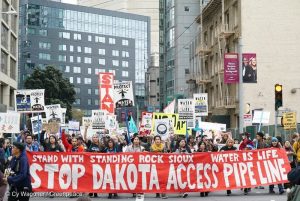
People march in support of the Standing Rock Nation at the Civic Center Plaza of San Francisco. The protest was one of many in a global day of action against the Dakota Access Pipeline (DAPL) calling on the U.S. Army Corps of Engineers to cancel the permit for the project.
6. They’re clutching at straws… [vid]
Just like in the , ETP is using the Racketeering Influenced and Corrupt Organizations Act (RICO) – a law which was originally created to prosecute the mafia – to claim treble damages and inflate the amount of money it is able to demand. In their lawsuit, ETP claims thatGreenpeace led a corrupt environmentalist enterprise that “cynically planted radical, violent eco-terrorists on the ground amongst the protesters, and directly funded their operations” – a baseless attempt to mislabel legal advocacy as criminal conduct through the use of these racketeering laws, and present constitutionally-protected free speech as defamatory. It’s as ridiculous as it sounds…
7. We can fight this
ETP and other corporate bullies are blatantly trying to stifle free speech and our right to peacefully protest. So let’s show them that that’s not going to happen: Refuse to be silent. Defend free speech. And let’s continue standing up for what is right.
You can take action against this SLAPP here and find more information about how you can fight back against SLAPPs generally.
===
921 intercept
The KIND OF WASTE coal mined from sites like Humphrey No. 7 and the Barrackville pile have become a cause célèbre for the fossil fuel industry. Industry lobbyists arguethat the burning of waste coal helps to reclaim mines by removing waste piles that can leach toxins into the groundwater. In 2010, while serving as governor, Manchin codified this view by overseeing legislation to designate waste coal as an alternative energy source in the Alternative and Renewable Energy Portfolio Act. This practice not only spews tens of thousands of tons of carbon dioxide and sulfur dioxide into the atmosphere, but the combustion chambers also produce a solid, nonaerosolized byproduct: coal ash. In the case of the Grant Town plant, the ash is trucked back to mines across Marion County, including Barrackville, for disposal.
Some studies suggest that the alkaline nature of some kinds of coal ash neutralizes acid mine drainage, a pollutant formed by the reaction of water and oxygen with both above-ground coal refuse and the exposed metals left exposed in abandoned mines. But coal ash can also contain toxic heavy metals that can poison groundwater, further destabilizing West Virginia’s ecosystem. Avner Vengosh, a professor of environmental quality at Duke University who studies the impact of coal ash on the environment, told Type and The Intercept that without precise monitoring and analysis, there is no guarantee that coal ash actually reduces contamination. It may in fact introduce new contaminants into the environment and groundwater.
“A company needs to demonstrate that this practice is successful and that over the long term, the practice is beneficial rather than harming the environment,” Vengosh said. “It all depends on the relationship, the volume, and mass of the acid mine drainage. It’s really important to examine that relationship long term, because in the beginning often it looks great, but then there can be very quickly a breakthrough where fly ash becomes the primary source of contaminants.”
Manchinhas been one of coal ash’s most vocal supporters in Congress. In 2016, hesponsored and secured legislation to ease states’ abilities to deregulate the toxic coal byproduct. In a 2016 press release heralding the bill’s passage, he wrote, “The overregulation of coal ash by the EPA would threaten vital industries and unnecessarily cost West Virginia and the nation more jobs.” The Grant Town plant could have been one such casualty: Subject to long-standing financial precarity, the plant would likely be unable to maintain its business without the option for cheap and unrestricted ash dumping.
According to West Virginia Public Service Commission documents, between 2001 and 2017 the Grant Town plant disposed of 9,422 tons of coal combustion residue, or CCR, per acre at the Barrackville mine site; 108,922 tons per acre in Idamay, an unincorporated town just south of Farmington; 63,919 tons per acre in Grant Town; 3,154 tons per acre at the Wilson site located between Grant Town and Barrackville; and 37,085 tons per acre at the Ralph Six site in Grant Town.
Public Service Commission of West Virginia documentsalso show that Enersystems operated and maintained refuse sites for American Bituminous Power Partners, or AmBit — the owner of the Grant Town power plant — at Barrackville and Farmington at least up until 2017. Marion County Clerk records further tie Manchin to the sites by showing that Manchin’s company Transcon — later merged into Farmington Resources — leased coal reserves in Barrackville and Farmington to AmBit on a 35-year lease beginning in 1993. (Ambit did not respond to multiple requests to comment for this story.)
In addition to placing what AmBit claims is beneficial coal ash into the Idamay mine site, the company has also been injecting acid mine drainage just outside Farmington. According to documents from a 2021 dispute between the energy company and a neighboring firm, Murray American Energy Inc, AmBit has been pumping coal waste into an underground mine pool complex. From there, it flows beneath the greater Fairmont area....
==
https://www.alternet.org/2020/08/epa-chiefs-former-lobbying-clients-are-getting-a-long-list-of-favors-from-agency
At least three former lobbying clients of Environmental Protection Agency chief Andrew Wheeler have received favorable decisions from the EPA under his leadership.
Wheeler spent years as an energy lobbyist at the law firm Faegre Baker Daniels, where he represented companies like the coal giant Murray Energy, whose owner Robert Murray is a major Trump donor. Wheeler signed a pledge in May 2018 to recuse himself from matters related to former clients after he replaced embattled former EPA administrator Scott Pruitt. But the two-year pledge expired earlier this year and he has been repeatedly accused of violating the agreement by approving rules that he lobbied for as a lobbyist for Murray Energy and others.
At least three of Wheeler’s former clients have pushed for rules that the EPA has proposed or implemented under his leadership.
“Andrew Wheeler is overseeing policies that damage the air we breathe and water we drink while his associates benefit,” Chris Saeger, a spokesperson for the progressive watchdog group Accountable.US, told Salon. “This is a clear abuse of his taxpayer-funded position and ethics agreement."
in April, the EPA weakened regulations on the release of mercury and toxic metals from oil and coal-fired power plants, which experts said was aimed at “potentially constraining or handcuffing future efforts by the EPA to regulate air pollution.”
The New York Times described the change as a “particular victory” for Murray, who pressed for the change in a “wish list” of environmental regulation rollbacks he handed to President Trump just weeks after his inauguration. Murray donated $300,000 to Trump’s inaugural committee.
The Trump administration and federal agencies “have completed or are on track to fulfill most of the 16 detailed requests” in Murray’s wish list, the Times reported in 2018. But Murray had “unsuccessfully pressed the administration in 2017” to roll back the mercury emissions rule, E&E News reported, before it was rescinded under Wheeler.
The government watchdog group Citizens for Ethics and Responsibility in Washington filed an ethics complaint against Wheeler last yearover his involvement in the rule change, noting that he “participated in the matter less than a year” after signing the pledge.
“It is becoming more and more clear why coal and energy companies are happy to have their former lobbyist Andrew Wheeler in charge of the EPA,” CREW Executive Director Noah Bookbinder said at the time. “Administrator Wheeler’s apparent failure to abide by ethics obligations and to avoid the reality or appearance of conflicts continues to undermine the EPA’s integrity and weakens public confidence in our government.”
Earlier this year, the EPA also finalized a rule that would extend deadlines to start closing :{unlined :(style="background-color:#ffffff;"):}::{coal ash ponds:(style="background-color:#ff9900;"):}:. Coal ash from coal plants is dumped into excavated holes in the ground, where it mixes with water to create “coal ash ponds,” which can leak if they are not properly lined. The proposed rule would allow some coal plants five more years before requiring them to close the unlined ash ponds.
One of the major backers of the rule is the Utility Solid Waste Activities Group (USWAG), a secretive trade group whose members include Xcel Energy, a longtime former Wheeler client. Xcel Energy called for the rule change and the USWAG petitioned Pruitt for the rule in 2017. The USWAG praised the EPA for proposing the change under Wheeler last year.
Accountable.US criticized the EPA for rolling back regulations on coal ash at the behest of Wheeler’s former client.
“Administrator Wheeler is part of a corrupt pattern in the Trump administration, putting the interests of his allies above the public he is supposed to serve,” Saeger said last month. “This administration is abusing its power to hand out favors to corporate lobbyists, selling out Americans’ health and the environment in the process.”
In May, the EPA proposed no additional measures to mitigate negative air quality impacts associated with renewable fuel standards as required under the Clean Air Act. The proposed rule has been open for public comment ever since but has only received 16 thus far, including one supporting the rule from Growth Energy. The company has been one of the biggest supporters of the rule.
Growth Energy was one of Wheeler’s clients before he joined the EPA, according to his financial disclosure, which said he provided the company “strategic advice and counseling.” Wheeler had pledged to recuse himself from matters related to Growth Energy until shortly before the proposed rule was published.
The trend has played out in other agencies whose heads were appointed by the president. The Interior Department has made at least 15 policy changes or proposals that benefited Secretary David Bernhardt’s former energy industry clients. Several of acting Homeland Security SecretaryChad Wolf’s former lobbying clients have also**received millions in government contracts** while he held senior positions in the department. More than 280 of Trump’s political appointments have been former lobbyists, according to an analysis by ProPublica.
CREW has repeatedly called for the EPA’s inspector general to investigate whether Wheeler violated his ethics pledge in connection to rules that benefited his former clients.
“Administrator Wheeler has repeatedly used his government position at EPA to benefit the former clients that made him rich, and to the detriment of the agency’s critical mission,” CREW Deputy Director Donald Sherman said in a statement to Salon. “Administrator Wheeler’s continued lobbying on behalf of industry from within EPA, is clear evidence that patronage is a feature, not a bug, of the Trump administration.”
==
Trump EPA Targets More Coal Ash Rules for Rollback. Water Pollution Rules, Too.
BY JAMES BRUGGERS
==
but of course 1119
==
America's mega-emitters are starting to close
:{
When the Navajo Generating Station in Arizona shuts down later this year, it will be one of the largest carbon emitters to ever close in American history. Other massive coal plants are also being retired.
}:
==
Trump EPA Proposes Weaker Coal Ash Rules, More Use at Construction Sites
:{BY: JAMES BRUGGERS
The latest proposed rule change would also relax safeguards intended to prevent water contamination from that type of dumping of toxic ash. Read More}:
619
==
llinois Is Poised to Crack Down on Hazardous Coal Ash Waste to Protect Health and Rivers
BY: NINA PULLANO
Lawmakers targeted coal ash after testing showed Illinois was the No. 1 state for the most coal-fired power plants leaching unsafe levels of contaminants like arsenic into the groundwater.
:{
}:
Illinois is poised to become the latest state to crack down on power plants' coal ash waste, a hazardous byproduct of coal burning and source of groundwater contamination.
The state has more coal ash ponds leaching unsafe levels of contaminants into groundwater than any other state in the nation, a recent analysis of federally mandated water testing showed. That pollution can pose health risks for humans: Coal ash can contain chemicals and heavy metals, including arsenic, mercury and lead, that have been linked to cancer, heart disease, reproductive issues and brain damage in children.
Lawmakers passed legislation this week that, once signed by new Democratic Gov.J.B.Pritzker, would amend the Illinois Environmental Protection Act to set stricter requirements for coal ash cleanup and to mandate public comment periods prior to closing coal ash sites. It also would give the Illinois Environmental Protection Agency funding to run cleanup programs through permit fees.
...
==
==
https://apnews.com/b88179b618d14cf7b25b7ceafabdb382
- Duke Energy to Contest North Carolina Coal Ash Excavation Order - Associated Press
RALEIGH, N.C. (AP) — The country’s largest electric company says it’s challenging an order by North Carolina’s environmental agency to excavate coal ash from all of its power plant sites in the state.
Duke Energy Corp. said Thursday it will file an administrative appeal by May 1. The order could cut the risk of toxic chemicals leaking into water supplies but add billions of dollars to electricity bills.
The company has said it wants to cover the storage pits at six power plants with a waterproof cap, calling it a cheaper option that would prevent rain from passing through and carrying chemicals through the unlined bottoms.
The Charlotte-based company says complete excavation would cost about $10 billion, nearly double current estimates. Consumer advocates are demanding the company’s shareholders pay that bill instead of customers.
==
Overturned
- Proposed rule directing mines to prove they can pay to clean up future pollution | :{Story:(style="box-sizing:inherit"):}:
- Federal rulesregulating coal ash waste from power plants. States were granted oversight of the waste | :{Story:(style="box-sizing:inherit"):}:
==
https://insideclimatenews.org/news/16012019/coal-ash-groundwater-contamination-map-arsenic-power-plant-utility-reports
The clearest picture yet of coal ash contamination in the United States is emerging, with utilities reporting serious groundwater contamination in at least 22 states.
At dozens of power plants across the country, including many in the Southeast, utilities have found coal-ash pollution severe enough to force them to propose cleanup plans. Those plans will likely become the next front in a decades-long battle over how to manage one of the nation's largest industrial waste streams—one tainted by toxic heavy metals.
But as widespread as the contamination appears to be, environmental advocates are finding a measure of hope, even as the Trump administration pushes to roll back federal rules for managing and cleaning up contamination from the billions of tons of coal-burning wastes that have piled up across the country.
All power plants in South Carolina, for example, are removing the ash from their unlined ponds to prevent them from leaking pollution into nearby waterways. The governor of Virginia this month called for the complete removal of coal ash ponds within the Chesapeake Bay watershed. And environmental advocates have won rulings in state and federal courts, keeping the pressure on utilities to take action to protect human health and the environment.
"It's a flicker of hope, but there is an ill wind," said Lisa Evans, a senior attorney at Earthjustice who has fought for better protections from coal ash for years, referring to concerns about the Environmental Protection Agency's concessions to utilities under the Trump administration.
"But even if the Trump administration moves in to sweep away cleanup requirements, we now know the extent of the groundwater contamination, and it will be hard for them to leave communities with contaminated groundwater," she said. (A move by the Trump administration to relax the rules is being challenged.)
'We Have a Long Way to Go'
Utilities for decades have annually produced more than 100 million tons of coal burning wastes, including ash and scrubber sludge. The ash contains contaminants like selenium, mercury, cadmium and arsenic associated with cancer and other serious health effects, according to the EPA.
The Obama administration in 2015 put in place the first national regulations for coal-burning wastes, favoring dry storage in landfills over wet storage in ponds. Those rules require utilities to conduct groundwater monitoring at ponds and landfills, close leaking ash ponds, clean up polluted groundwater and disclose their studies and actions on their websites.
...
==
https://www.ecowatch.com/cash-buys-elections-and-continued-fossil-fuel-dominance-2619922863.html
Cash Buys Elections—and Continued Fossil Fuel Dominance
By Wenonah Hauter
Last week, the fossil fuel industry successfully squashed several local measures it didn't like—thanks to the more than $100 million it shelled out to oppose them.
Initiatives to rein in fracking failed in Colorado, where the industry spent a whopping $40 million (outspending advocates 40-1) and in San Luis Obispo County, where a measure to ban fracking lost in the face of $8 million in industry cash (proponents of the measure spent only $240,000). An Arizona initiative to mandate 50 percent renewable energy by 2050 failed, thanks to $30 million in energy cash to fight it. And, despite increasingly touting its approval for carbon taxes with modest funding of greenwashing groups like the Climate Leadership Council, the industry spent $30 million to oppose a carbon tax initiative in Washington.
The fossil fuel industry is doing more of the same in many states across the country, including Virginia. A new Food & Water Watch report out now looks at Dominion Energy's outsized influence in the state—how it buys policy, buys elections and squashes renewable energy to further its profits.
One of the ways Dominion buys policy in Virginia is through its multi-million dollar political and lobbying operation. Since 1998, the company has built the infrastructure to buy off policy and is the biggest corporate contributor to political campaigns in Virginia—with its political action committee and employees plowing more than $10 million into Virginia campaign coffers. Whether it's meals, cocktails, sporting tickets or other associated spending, it's repeatedly bought access to policy through the state's elected officials.
Dominion's primary interests have been in pushing policies that ensure they won't be regulated. Between 2017 and 2018, the company increased its lobbying and advertising expenditures 10-fold while pushing to enact a law that would ensure Virginia ratepayers would pay more for polluting fossil energy. It also spent more than $4 million on ads this year promoting its legislative agenda to build out more fossil fuel infrastructure—like the Atlantic Coast Pipeline—and its acquisition of SCANA, a South Carolina utility that brought with it a portfolio of coal- and gas-fired power plants.
Poisonous coal ash and climate pollution aren't Dominion's only toxic legacy in the state: its lobbying machine worked to obstruct clean energy initiatives as well. The company has successfully thwarted popular and progressive energy measures, ensuring, for example, that utilities (like its subsidiary, Virginia Power) would be gatekeepers for community-based solar projects instead of allowing churches and other community organizations to develop their own. This is a move to keep them stuck in the polluting fossil fuel system from which the company extracts great profits that keep them powerful.
And this is just in Virginia. Nationally, Dominion dumped at least $59 million into state and federal political advocacy, including campaign contributions, gifts and lobbying since 1998. In the late 1990s, Dominion joined disgraced energy company Enron in a national fight to deregulate utilities so that they could instead implement a market-based scheme to separate electricity distribution from power generation, essentially taking energy out of the realm of "public good" and into the realm of commodity. We know how well that worked out: Enron went bankrupt from the scheme, a development that also saddled Dominion with nearly $100 million in losses. But the damage had been done for ratepayers nationwide, with the Federal Energy Policy Act of 2005 entrenching the deregulation these companies sought—the same legislation that enshrined the "Halliburton Loophole" into federal law exempting frackers from federal drinking water protections. Dominion is also investing in infrastructure to connect its facilities to fracked gas from Ohio, Pennsylvania and West Virginia.
Industry influence can mean the difference between a renewable future or more climate-throttling fossil fuel infrastructure. In Virginia, local advocates are taking the fight to Dominion's doorstep—and their cronies in the statehouse. We're joining with Virginia NAACP, Virginia Interfaith Power and Light, People Demanding Action, Virginia Interfaith Center for Public Policy, League of United Latin American Citizens—Richmond, and others to pass legislation just introduced by state delegates Sam Rasoul and Elizabeth Guzman to transition the state to 100 percent renewables by 2035.
We're ready for the fight ahead because we have no choice but to ensure that Dominion, and the industry as a whole, doesn't win. We must begin the transition off of fossil fuels immediately if we want to protect our communities and avert the worst of catastrophic climate change ahead.
Wenonah Hauter is executive director of Food & Water Watch and Food & Water Action.
==
==
EPA Rejects States' Health Concerns Over Upwind Coal Air Pollution
The U.S. Environmental Protection Agency (EPA) published a notice Friday denying petitions by the states of Delaware and Maryland for it to recognize that upwind state pollution sources are interfering with their ability to meet ozone standards.
The states had used a provision of the Clean Air Act to petition for reduced nitrogen oxide emissions from coalplants in Pennsylvania, West Virginia, Indiana, Kentucky and Ohio, but the EPA found that there wasn't enough evidence that the plants were contributing to elevated ozone levels in the downwind states, InsideClimateNewsreported.
Keep reading...
hurricane flo NC
also coal ash
Will Hurricane Florence Flood North Carolina Factory Farms and Manure Pits?
When Hurricane Matthew hit North Carolina in 2016, it flooded more than 140 feces-strewn industrial-scale swine and poultry barns, more than a dozen open pits brimming with liquid hog waste and thousands of acres of manure-saturated fields. As Hurricane Florence—far bigger than Matthew—bears down on the state, Environmental Working Group (EWG) and Waterkeeper Alliance are prepared to again assess the impact on North Carolina's concentrated animal feeding operations or CAFOs.
...
post pruitt:
https://www.ecowatch.com/new-coal-ash-rule-2589214229.html
Green Groups Worry New Coal Ash Rule Could Harm Human Health
Environmental groups expressed concerns over the health impacts of a recent U.S. Environmental Protection Agency (EPA) decision to relax regulations on coal ash, CNN reported Saturday.
Coal ash contains toxic metals like arsenic, lead and mercury and is often left in ponds where it has been known to contaminate groundwater.
The rule change gives states greater authority over regulating one of the nation's biggest sources of industrial waste and allows companies to forgo annual groundwater tests if they can prove their coal ash is not polluting nearby aquifers.
"These rules will allow yet more tons of coal ash, containing toxics like arsenic and mercury, to be dumped into unlined leaking pits sitting in groundwater and next to rivers, lakes and drinking water reservoirs," Southern Environmental Law Center senior attorney Frank Holleman told CNN.
The new rule was signed July 18 and was the first rule signed by new acting EPA head Andrew Wheeler, Reuters reported.
"Our actions mark a significant departure from the one-size-fits-all policies of the past and save tens of millions of dollars in regulatory costs," Wheeler said, according to Reuters.
Revisions to the Obama-era coal ash regulations put in place in 2015 were sought by coalCEO Bob Murray, who Wheeler used to lobby for.
In March 2017, Wheeler helped organize and was present at a meeting between Murray and Energy Sec. Rick Perry in which Murray presented a plan to "assist in the survival of our Country's coal industry" which included giving states more control over coal ash disposal, CNN reported.
"It is now apparently the goal of EPA to save industry money by allowing them to continue to dump toxic waste into leaking pits, which is exactly what the new rule accomplishes," Earthjustice attorney Lisa Evans told CNN.
The obama-era coal ash regulations were written following two coal ash spills.
In 2008, a dam at the Tennessee Valley Authority's Kingston plant broke and released a billion gallons of coal ash into the Clinch River, covering 300 acres with sludge and contaminating fish with arsenic and selenium for months afterword.
In 2014, a pipe at Duke Energy's Dan River steam station leaked 39,000 tons of coal ash into North Carolina waterways, extending 70 miles and leading to mercury levels in fish so high that authorities still recommend against eating them.
But even in the absence of a single disaster, coal ash can have devastating effects on human health.
Tracey Brown Edwards, who grew up next to Duke Energy's Belews Creek Steam Station in Walnut Cove, North Carolina which had a coal ash pond next to a neighborhood lake, told CNN that in the five homes on her block, four had experienced cancer in the family.
"There's been a lot of young people with cancer, certain kinds of cancers, brain cancer, stomach cancers, breast cancer," she said.
Doctors say they cannot confirm if the cancer is caused by coal ash, but they also cannot exclude it as a possibility, CNN reported.
RELATED ARTICLES AROUND THE WEB
- With EPA rule change, worries linger for those near coal ash ponds ... ›
- Coal Ash Contaminates Our Lives | Earthjustice ›
- Earthjustice: Environmental Law: Because the Earth Needs a Good ... ›
==
==
https://www.ecowatch.com/coal-ash-oklahoma-pruitt-2579396022.html
Pruitt Grants Oklahoma Leniency to Dispose of Toxic Coal Ash Without Federal Oversight
On Monday, Oklahoma became the first state to be granted a permit from the Environmental Protection Agency (EPA) to dispose of its own coal ash, The Associated Press reported.
The move displaces the federal government as the body responsible for coal ash disposal in EPA head Scott Pruitt's home state. Coal ash is the residue left over from burning coal for power that often contaminates groundwater. It is a change that industry has lobbied for and environmental groups have opposed.
States have demonstrated that "they don't care about the health and safety of communities near coal ash dumps," Earthjustice attorney Lisa Evans told The Associated Press.
About 100 million tons of coal ash is produced by U.S. plants every year, often left in disposal ponds that leak into groundwater, contaminating it with pollutants like arsenic and radium. Tests ordered by the EPA this spring of groundwater around plants in various states found elevated pollution levels, according to The Associated Press.
Despite this, "industry has asked for leniency, less stringency. That's the direction they're going," Evans said.
According to documents obtained under the Freedom of Information Act, switching coal ash oversight to states was part of an "action plan" proposed by coal industry executive Robert Murray this spring to Pruitt and other officials in the Trump administration.
Pruitt defended the decision, saying in a statement that the move empowered "those who are best positioned to oversee coal ash management—the officials who have intimate knowledge of the facilities and the environment in their state."
Pruitt also moved to weaken Obama-era coal ash disposal regulations in March, but the rule change allowing states to control coal ash disposal was actually passed by Congress and signed by former President Barack Obama in 2016, according to NPR. The law said that state rules had to be "as protective as" federal guidelines.
"I am pleased that Oklahoma is the first state in the nation to receive approval of its Coal Combustion Residuals permit program. We actually incorporated the federal rule into our state permitting rules program over a year ago," Oklahoma Department of Environmental Quality (DEQ) Executive Director Scott Thompson said in an EPA press release about the decision.
But at a hearing in February, Oklahoma environmental groups said the DEQ was not prepared to adequately regulate coal ash.
"The DEQ rules are weaker than the EPA rules," Oklahoma Grand Riverkeeper and activist Earl Hatley told NPR in February. "This is just a boon for industry to do what they want."
Waterkeeper Alliance senior attorney Kelly Foster further expressed concerns that the DEQ plan did not provide enough information on how companies would be made to comply with regulations and how the DEQ would take on new responsibilities with existing resources.
Georgia and Texas are following Oklahoma in taking steps to control coal ash disposal, The Associated Press reported.
...
==
==
https://www.alternet.org/environment/3-ways-epa-chief-scott-pruitt-protects-polluters-not-people
Pruitt certainly calls into question his fitness to serve our country. Far more dangerous, though, is his utter fealty to polluters, which drive policies that present devastating threats to the air we breathe and the water we drink. The consequences of his disastrous decisions jeopardize the health and welfare of current and future generations.
The three examples below represent just a few of Pruitt's gifts to industrial polluters for which he should be removed from office immediately.
1. Eliminating Regulations on Coal Ash: water pollution from coal-fired power plants—and particularly their coal ash dumps—is the single largest source of toxic water pollution in the United States; coal plants dump more toxics into our waters than the other top nine polluting industries combined.
There are more than 1,400 coal ash dumps, containing millions of tons of toxic waste, at power plants throughout the United States. Roughly half of them have no liners and 70 percent are situated in low-income communities. Waterkeeper Alliance has investigated dozens of coal ash dumps all over the country and found toxic pollutants like chromium, cadmium, arsenic, mercury and lead discharging out of more than 90 percent of them into waterways used by citizens for drinking, swimming and fishing.
These toxins increase risks of multiple types of cancer, heart disease and organ failure.
In 2015, the EPA—for the first time—set standards for how power plants store and dispose of their coal ash. Despite the clear threat that coal ash presents to public health, Pruitt's EPA now wants to eliminate even these bare minimum standards. Pruitt claims that regulations are killing the coal industry. To the contrary, renewables and market forces are putting coal out of business—despite his attempts to keep the industry on life support.
Under the guise of providing flexibility to states, Pruitt wants to roll back rules that help protect our drinking water from coal ash. His proposed rollbacks project to save the coal industry between $31 million and $100 million in compliance costs. But what about the financial and emotional costs imposed on communities suffering from leaking coal ash dumps in their communities? For every day that Pruitt props up the coal industry, Americans suffer loss to their health and property.
Upon taking office, one of Pruitt’s first actions was to take aim at the definition of "Waters of the United States," which identifies the waterways that are protected from pollution under the Clean Water Act (CWA). Pruitt is looking to significantly narrow the definition presumably in order to enrich his polluter pals.
==
ej org dynergy
https://www.ecowatch.com/coal-ash-river-illinois-2573918063.html
==
more than 100 people testified before the Environmental Protection Agency (EPA) on coal ash, and the overwhelming majority voiced opposition to rolling back the coal ash rules. navajo?
Trump Administration Seeks to Gut Water Pollution Safeguards, Putting Communities at Risk
By Mary Anne Hitt
A Hollywood scriptwriter couldn't make this up. One day after new data revealed widespread toxic water contamination near coal ash disposal sites, U.S. Environmental Protection Agency (EPA) head Scott Pruitt announced a proposal to repeal the very 2015 EPA safeguards that had required this data to be tracked and released in the first place. Clean water is a basic human right that should never be treated as collateral damage on a corporate balance sheet, but that is exactly what is happening.
This proposal clears the way for polluters, and polluter-funded politicians, to write weak standards for groundwater monitoring and coal ash cleanups, and attacks several core health and environmental protections included in the standard that was enacted in 2015. This comes as the first round of water testing, carried out under the new EPA standard, revealed some shocking results. As the New Republic reported:
"At more than 70 sites across the country, toxins like arsenic, mercury, and radium are leaching into groundwater from pond-like storage pits filled with the sludgy leftovers of coal burning. That's the most alarming takeaway from reports that the coal industry was required to submit to the Environmental Protection Agency this month, part of the first-ever federal regulations of the waste product known as coal ash ... So far, the reports have shown coal ash leaking into groundwater at storage sites in Iowa, Nebraska, Arkansas, Georgia, Montana, Washington, Michigan and Florida."
Coal ash is the toxic waste left over from coal-burning power plants and contains some of some of the deadliest known toxic chemicals, including heavy metals like arsenic, lead, mercury, and chromium. For decades, coal ash disposal was subject to no EPA oversight, and this waste was dumped into giant unlined pits, where toxic chemicals then seeped into water and soil and blew into the air in many communities nationwide. Exposure to these toxics raise the risk for cancer, heart disease, and stroke, and can inflict permanent brain damage on children.
Pruitt's latest proposal would replace science-based federal requirements that would fairly and consistently address water quality issues nationwide with a patchwork of state-by-state requirements that can easily be influenced by polluter interests. And yet federal requirements were put in place because state regulators had not implemented adequate water protections against coal ash! In reality, state oversight failed families for decades, resulting in catastrophic spills like those in Kingston, Tennessee, and the Dan River in North Carolina, as well as slow-motion disasters still unfolding in dozens of communities nationwide. My colleague Connie Wilbert in Wyoming is worried about exactly that, as she expressed in this article:
"We aren't seeing the state take a strong position on any number of issues related to fossil fuels in general," said Wilbert, director of Sierra Club Wyoming. "This proposed revision introduces a level of flexibility that we're pretty uncomfortable with."
I recently spent time with families in North Carolina that have been living on bottled water for over 1,000 days due to coal ash pollution, rallying outside the headquarters of Duke Energy and calling on the company to clean up their mess. The stories of these families were heartbreaking, and they aren't alone. Today, more than 1,400 coal ash waste dumps are spread across the nation, and in at least 200 cases, the toxic waste is known to have contaminated water sources. More than 1.5 million children live near coal ash storage sites. Seventy percent of all coal ash impoundments disproportionately impact low-income communities.
The EPA's 2015 coal ash protections were basic common sense—they required utilities to test the water near their coal ash dumps to make sure hazardous chemicals were not leaking into drinking water sources. Requirements to monitor the water around dump sites—and to clean it up, if poisoned—went into effect at all coal ash dumps in 2018, and as noted above, the first round of findings from these reports was horrifying.
Further proving the point of just how terrible this idea is, the first state to take back the reins of managing its own coal ash is Pruitt's home state of Oklahoma, which has an abysmal and notorious track record that ThinkProgress described this way:
"In the eastern part of Oklahoma, near the Arkansas border, sits a small town named Bokoshe. Along with a population of just 512, Bokoshe also happens to be home to several old coal mines, which have been turned into landfills for another sort of coal product: coal ash, the toxic byproduct that results from burning coal ... For more than 20 years, residents of the town, plagued by high rates of asthma and cancer, have appealed to state and federal regulators for help. And for years those pleas have gone largely unheard, thanks to the complex web of regulations that address—or more often, fail to properly address—coal ash."
This is the legacy Pruitt's proposal will leave for dozens more communities. We will fight it in the streets and in the courts, to prevent it from being finalized. He and the Trump administration are trying to pull the wool over the American people's eyes about the dangers of gutting our clean water protections against coal ash, so that rich coal magnates will not have to pay to properly dispose of their toxic byproduct.
Weakening protections against coal ash is a betrayal of all the families across this country who have been living on bottled water for years, or have lost their health and property, due to coal ash pollution. Families are looking to EPA to solve the coal ash problem—not abandon them.
The EPA will take comments on this proposal until April 30 and will hold a hearing on these rollbacks in the Washington, DC area on April 24. Please join us in letting Scott Pruitt know that the American people won't stand for this polluter power grab.
Mary Anne Hitt is the director of the Sierra Club Beyond Coal Campaign.
RELATED ARTICLES AROUND THE WEB
- Trump EPA Withdraws Clean Air Policy Opposed By Fossil Fuel ... ›
- EPA withdraws regulation on 'major sources' of pollution - CNNPolitics ›
- Trump administration to propose repealing rule giving EPA broad ... ›
==
https://insideclimatenews.org/news/15032018/epa-regulations-coal-power-plant-waste-ash-ponds-toxins-health-jeremy-orr-water-testing
no link
EPA Environmental Justice Adviser Slams Pruitt's Plan to Weaken Coal Ash Rules
With groundwater tests showing toxins, the newly appointed adviser calls for better protection of low-income and minority communities near coal ash ponds.
Phil McKenna
BY PHIL MCKENNA
MAR 15, 2018
Coal ash ponds in North Carolina. Credit: Waterkeeper Alliance
Coal ash waste from coal-fired power plants contains a number of known carcinogens. Recent water testing near coal ash ponds nationwide found toxins in the groundwater. Credit: Waterkeeper Alliance
A newly appointed environmental justice adviser to the Environmental Protection Agency is criticizing an agency proposal to roll back regulations governing coal ash ponds, saying doing so would hurt disadvantaged communities.
EPA Administrator Scott Pruitt announced his proposal to weaken federal coal ash rules earlier this month as a cost-cutting measure for businesses. At the same time, utility companies, responding to a federal deadline to report water monitoring results, were revealing high levels of toxins in groundwater near coal ash ponds at power plants across the country.
"It's framed as being able to save up to $100 million for the utility industry, but what's the trade-off?" said Jeremy Orr, a civil rights attorney and environmental and climate justice chair for the NAACP's Michigan State Conference, whose appointment to the EPA's National Environmental Justice Advisory Council was announced last week.
"Can you really quantify and trade off the disproportionate health impacts that these communities near these ponds are going to suffer?" Orr asked.
Pruitt's proposed regulatory changes, along with the dismissal of civil rights complaints at an Alabama coal ash landfill, are the latest signs of a persistent conflict between civil rights advocates and the EPA that has only intensified under the Trump Administration.
The legal state of the 2015 coal ash rule is in some disarray, with court challenges from environmental advocates and industry pending in federal court.
Pruitt's proposed changes wouldn't fully dismantle the rule, which established minimum national standards regulating the location, design and operation of existing and new coal ash ponds and landfills at more than 400 coal-fired power plants nationwide. But they would give states more influence over regulations, could push back current deadlines for future groundwater monitoring and analysis, and might revisit current restrictions on the construction or operation of coal ash ponds and landfills.
The U.S. Commission on Civil Rights, an independent federal agency, faulted the EPA in 2016 for lax regulations on coal ash ponds. In a blistering, 230-page report, it argued that the EPA's 2015 coal ash rule didn't go far enough.
'We Have a Significant Problem'
Coal ash is the waste left over from burning coal in coal-fired power plants and is one of the largest types of industrial waste generated in the United States, with more than 100 million tons created each year. It contains a number of known carcinogens and is often stored in unlined pits, creating the potential for environmental and health risks, including increased risks of skin, lung and bladder cancers.
Under the 2015 rule, utilities across the country were required to publish groundwater monitoring results by March 2. The test results showed contamination, including high levels of arsenic and radium, at more than 70 sites nationwide, according to an initial analysis by the Associated Press.
"The data clearly show that nationwide we have a significant problem," said Earthjustice Senior Counsel Lisa Evans, whose group is still analyzing the tens of thousands of pages of groundwater monitoring reports.
"Consistently, what I see at these coal ash dumps is an indication that they are leaking, which confirms what we had suspected before the data came out," Evans said. "Most of the sites are unlined, and there are effectively no barriers to stop the hazardous contaminants from leaking into underlying groundwater."
Residents in Uniontown, Alabama, a predominantly black community, had filed a filed civil rights complaint over a coal ash landfill near their community. The EPA rejected the complaint this month. Credit: Chris Jordan Bloch/Earthjustice
Residents in Uniontown, Alabama, a predominantly black community, filed civil rights complaints after a nearby landfill took in coal ash from a massive 2008 spill at the Kingston Fossil Plant in Tennessee. The EPA rejected their complaints this month. Credit: Chris Jordan Bloch/Earthjustice
The recent testing was required by the federal government after catastrophic spills in 2008 and 2014 released more than 1 billion gallons of coal ash slurry in Tennessee and North Carolina.
Civil Rights Commission: People Are at Risk
Martin Castro, former U.S. Commission on Civil Rights chair, said the water monitoring results confirm what he has heard for years from low-income communities and communities of color living near coal ash ponds.
"We heard the concerns and the warnings from individuals and community organizations about what the future might hold, and I think, unfortunately, they were right: coal ash, the way it was being stored in unlined ponds or ponds where lining was old and already failing, allowed these chemicals to leach into the groundwater," Castro said.
The toxins in coal ash can damage "all major organ systems," and the percentage of minorities and low-income families living near coal ash ponds are "disproportionately high when compared to the national average," the Civil Rights Commission concluded in its 2016 report.
The commission faulted the EPA's Office of Civil Rights for never making a formal finding of discrimination despite what the commission felt was clear evidence of disproportionate adverse impacts on low-income communities and communities of color.
Pruitt's new proposal, announced on March 1, raises the prospect of giving utilities greater flexibility in where they put coal ash ponds or landfills, something environmental justice advocates say would increase exposure to low-income communities and communities of color.
"They are located in communities of color, overwhelmingly, and low-income communities, overwhelmingly, and that is with current regulation," Orr said. "Imagine rolling that back. It's only going to be an increase in contamination and exposure for these communities."
Current Commission on Civil Rights Chair Catherine Lhamon declined a request to comment on the groundwater monitoring results and the EPA's proposed rule change. "The findings of the 2016 report remain the official position of the Commission," Brian Walch, director of communications for the commission, said.
Walnut Cove and the 300-Acre Ash Pond
The recent testing did not analyze groundwater at drinking water well sites, but the results may shed light on potential health hazards for a number of communities, said Evans, of Earthjustice.
One example is Walnut Cove in North Carolina where in 2016 African-American residents living near Duke Energy's Belews Creek Steam Station detailed their health concerns to the Commission on Civil Rights. They described cancer, respiratory illnesses, neurological problems, heart attacks and strokes that they attributed to the coal ash pond.
Residents near the Belews Creek generating station believe several health issues in their community are related to coal ash. Credit: Karen Fasimpaur/Wikimedia Commons
The Belews Creek coal ash pond sprawls across more than 300 acres behind a 13-story-tall embankment that company records show would inundate surrounding homes if the embankment were to fail. The results of water monitoring near the coal ash pond, published Feb. 6, found arsenic levels nine times higher than the Federal Drinking Water Standard.
Duke Energy downplayed the significance of the test results. "It's important to note that these CCR [Coal Combustion Residuals] monitoring wells are located immediately next to the CCR unit (basin, landfill, etc.) and do not reflect groundwater conditions farther away or off plant property where neighbors are located," Erin Culbert a spokesperson for Duke Energy, said. "At the Belews Creek site, groundwater near the ash basin is actually moving away from neighbors' wells."
Rev. Rodney Sadler, chair of the healthcare committee for the North Carolina NAACP, disagreed. He described "deleterious health impacts that are extraordinarily rare, occurring with an incredible frequency" in the area.
In preparing the 2016 Civil Rights Commission report, Castro said he heard anecdotal evidence of similar adverse health impacts near coal ash ponds across the country.
"It's consistent across states, it's consistent across generations, it's consistent across communities whether they are poor or African American or Latino," Castro said. "These sorts of toxins have an adverse impact on the health and vitality of individuals, families and communities and we need to regulate them more aggressively, more thoroughly, not less thoroughly."
Orr stressed that the EPA rule changes are still just proposals. The EPA anticipated publishing the proposed amendments in the Federal Register on Thursday and will accept public comments for 45 days once the proposal is published. A public hearing on the proposed amendments is planned for April 24 in Washington D.C.
==
==