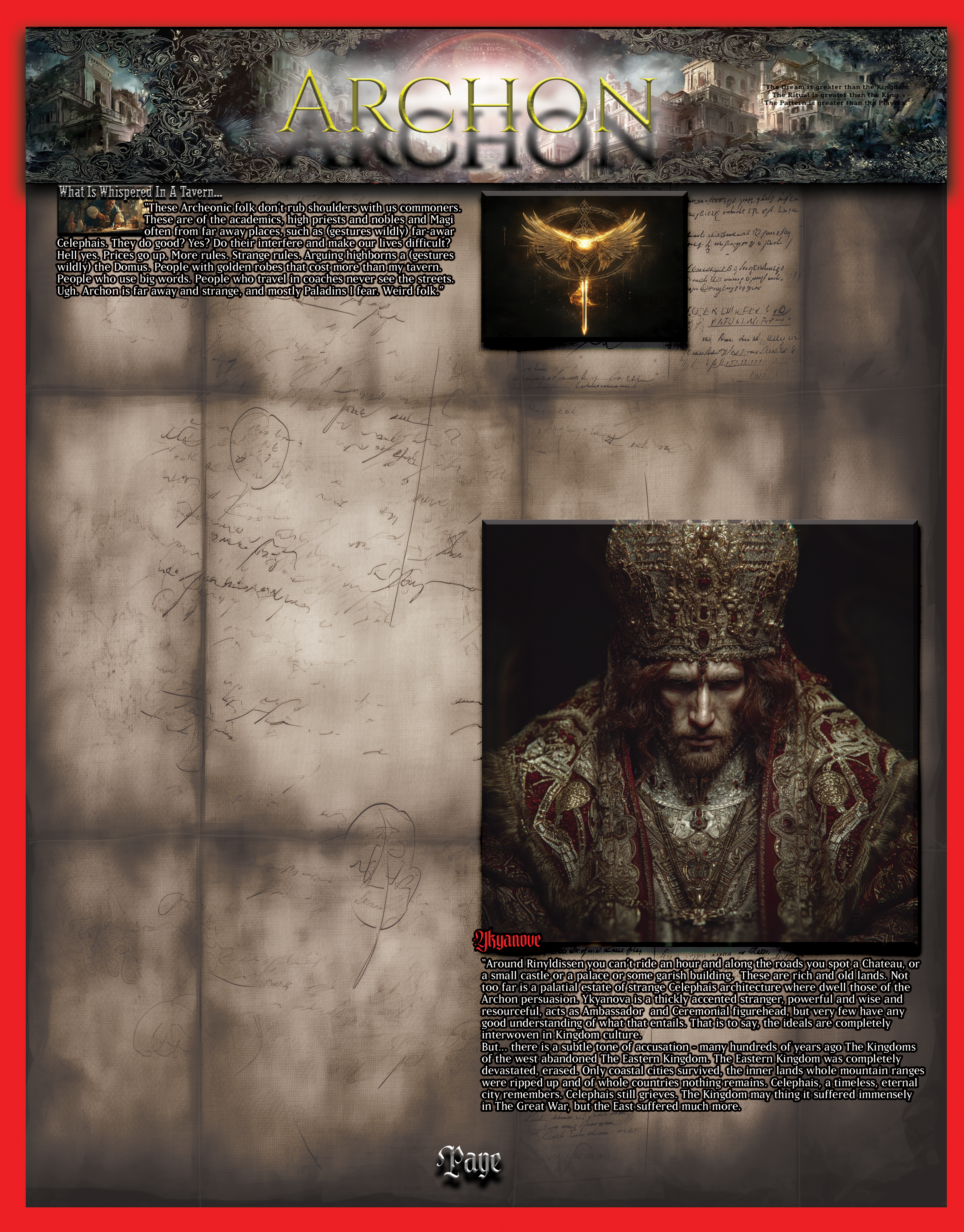
The Archon Alignment
In every age there are those who move through the world as if it were already footnoted. They do not hurry, yet they are rarely surprised. They do not announce authority, yet their presence subtly reorders a room. These are called Archonic, though the word itself is older than any kingdom that currently claims to understand it. To outsiders, Archonic figures appear as nobles, magistrates, theologians, scholars, ambassadors, or administrators of vast and careful institutions. They are seen presiding over councils, drafting charters, sealing correspondence, or receiving petitions with an attention that feels less like judgment and more like classification. They are rarely the loudest voice in any hall, but they are often the voice that remains when the shouting has exhausted itself.
The Archonic alignment does not concern itself primarily with conquest, piety, rebellion, or profit, though individuals within its orbit may display any of these traits in passing. Instead, Archonic thought orients toward continuity. It assumes that the world is not a sequence of isolated crises but a long unfolding arrangement in which events acquire meaning through placement rather than intensity. Where others see battles, Archonic minds see precedents. Where others see revolutions, they see reconfigurations. They are not immune to passion, yet they tend to distrust moments that demand immediate allegiance, preferring to observe how a development settles into pattern before declaring it significant. This tendency can be mistaken for indifference, but it is more accurately described as a commitment to proportion.
In lands such as Celephaïs, where terraces overlook tranquil waters and imported newspapers arrive weeks after their printing, the Archonic presence is especially difficult to detect. Nothing appears to be directed, and yet the city rarely drifts into chaos. Decisions seem to have been anticipated, disputes quietly resolved before they acquire the dignity of spectacle. Visitors who arrive expecting proclamations or dramatic revelations are often disappointed. Archonic influence seldom manifests as decree; it manifests as framing. A conversation is not halted but gently reframed. A proposal is not rejected but contextualized. An ambition is not mocked but situated within a longer chain of causes whose implications the petitioner had not considered. By the time one leaves such an exchange, it may be unclear whether anything was granted at all, yet one’s sense of the situation has undeniably shifted.
It would be an error to imagine the Archonic alignment as a secret cabal or hidden conspiracy, for secrecy implies a desire to conceal. Archonic structures are frequently visible, even ornate, and they do not shrink from public ritual. Their halls are open to those with standing, their records meticulously maintained, their emissaries properly credentialed. What distinguishes them is not hidden knowledge but layered knowledge. They operate with the assumption that any matter worth addressing has antecedents, and that those antecedents can be traced, compared, and evaluated against similar events elsewhere. In this way, Archonic actors serve as living archives of political memory. They remember treaties that others have forgotten, alliances that outlasted their founders, and crises that once seemed apocalyptic but now reside quietly in ledgers.
For players encountering Archonic figures, the experience is often characterized by an unsettling sense of temporal displacement. One may feel as though one has arrived late to a discussion already in progress. Archonic representatives seldom ask the obvious questions, not because they are omniscient, but because they have studied the patterns into which such questions fall. They may greet a delegation with acknowledgment of circumstances that have not yet been publicly discussed, or refer obliquely to developments in distant cities as though they were weather reports. This does not mean that Archonic agents control all events; rather, they track the interdependencies that bind them. In their view, an isolated action is a fiction, and any claim to absolute novelty is greeted with polite skepticism.
The larger Dreamlands provide the true scale against which Archonic alignment must be understood. The map stretches far beyond the comfortable borders of familiar realms, and across that expanse lie cities whose customs differ, ports whose merchants speak in layered idioms, and sanctuaries whose scholars maintain correspondences older than the current dynasties. Archonic thought recognizes this breadth as a constant presence. Even when events unfold in a single district or along a provincial road, they are interpreted against the backdrop of distant polities and long-standing arrangements. Thus, an Archonic figure may seem strangely unperturbed by matters that feel urgent to adventurers, not out of contempt, but because they measure urgency against horizons most have never seen.
This alignment is not synonymous with goodness, nor does it define itself through opposition to chaos. It does not promise safety, nor does it relish instability. Instead, it values intelligibility. An Archonic mind seeks to render the world legible through classification, precedent, and comparison. This can result in wise counsel, careful stewardship, and the preservation of fragile peace. It can also result in delay, frustration, and a sense that personal sacrifices have been absorbed into impersonal systems. Those aligned with Archonic principles may genuinely believe they are preventing greater harm, even as they decline to intervene in ways others consider obvious. The tension between immediate action and durable arrangement lies at the heart of their outlook.
To align oneself with the Archonic is to accept that the world is larger than any single quest and that consequences rarely conclude where they appear to. It means recognizing that power does not always reside in spectacle, and that influence can be exerted through positioning rather than force. Players who engage with Archonic institutions will find that access depends less on bravado and more on credibility, patience, and the ability to articulate how a proposed course of action fits within existing frameworks. Archonic agents are not immune to persuasion, but they are rarely swayed by urgency alone. They require coherence, evidence, and a demonstration that one understands the lattice into which one seeks entry.
Ultimately, the Archonic alignment serves as a reminder that the Dreamlands are not a stage constructed for the present moment. They are layered, inhabited by actors whose commitments extend beyond any single generation. To encounter Archonic power is to glimpse that layered depth, to sense that beneath every crisis lies a sediment of earlier choices. Whether one experiences this as reassurance or constraint depends largely on one’s temperament. The Archonic do not demand admiration, nor do they solicit fear. They endure, observe, and arrange, trusting that in time, even the most fervent upheaval will find its place within the broader design.