Adams. Sam 2
(see main node)
Samuel Adams (September 27 [O.S. September 16] 1722 – October 2, 1803) was an American statesman, political philosopher, and a Founding Father of the United States.[5] He was a politician in colonial Massachusetts, a leader of the movement that became the American Revolution, and one of the architects of the principles of American republicanism that shaped the political culture of the United States. He was a second cousin to his fellow Founding Father, President John Adams.
Adams was born in Boston, brought up in a religious and politically active family. A graduate of Harvard College, he was an unsuccessful businessman and tax collector before concentrating on politics. He was an influential official of the Massachusetts House of Representatives and the Boston Town Meeting in the 1760s, and he became a part of a movement opposed to the British Parliament's efforts to tax the British American colonies without their consent.
His 1768 Massachusetts Circular Letter calling for colonial non-cooperation prompted the occupation of Boston by British soldiers, eventually resulting in the Boston Massacre of 1770. Adams and his colleagues devised a committee of correspondence system in 1772 to help coordinate resistance to what he saw as the British government's attempts to violate the British Constitution at the expense of the colonies, which linked like-minded Patriots throughout the Thirteen Colonies. Continued resistance to British policy resulted in the 1773 Boston Tea Party and the coming of the American Revolution. Adams was actively involved with colonial newspapers publishing accounts of colonial sentiment over British colonial rule, which were fundamental in uniting the colonies.
Parliament passed the Coercive Acts in 1774, at which time Adams attended the Continental Congress in Philadelphia which was convened to coordinate a colonial response. He helped guide Congress towards issuing the Continental Association in 1774 and the Declaration of Independence in 1776, and he helped draft the Articles of Confederation and the Massachusetts Constitution. Adams returned to Massachusetts after the American Revolution, where he served in the state senate and was eventually elected governor.
Adams later became a controversial figure in American history. Accounts written in the 19th century praised him as someone who had been steering his fellow colonists towards independence long before the outbreak of the Revolutionary War. This view was challenged by negative assessments of Adams in the first half of the 20th century, mostly by British historians, in which he was portrayed as a master of propaganda who provoked mob violence to achieve his goals.
However, according to biographer Mark Puls, a different account emerges upon examination of Adams' many writings regarding the civil rights of the colonists, while the "mob" referred to were a highly reflective group of men inspired by Adams who made his case with reasoned arguments in pamphlets and newspapers, without the use of emotional rhetoric.[6]
Early life
[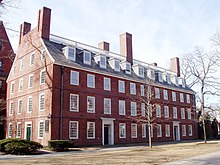
While at Harvard University, Adams boarded at Massachusetts Hall.[7]
Adams was born in Boston in the British colony of Massachusetts on September 16, 1722, an Old Style date that is sometimes converted to the New Style date of September 27.[8] Adams was one of twelve children born to Samuel Adams, Sr., and Mary (Fifield) Adams in an age of high infant mortality; only three of these children lived past their third birthday.[9][10][11] Adams's parents were devout Puritans and members of the Old South Congregational Church. The family lived on Purchase Street in Boston.[9][12] Adams was proud of his Puritan heritage, and emphasized Puritan values in his political career, especially virtue.[13]
Samuel Adams, Sr. (1689–1748) was a prosperous merchant and church deacon.[14][9] Deacon Adams became a leading figure in Boston politics through an organization that became known as the Boston Caucus, which promoted candidates who supported popular causes.[15][16][17][a]
Members of the Caucus helped shape the agenda of the Boston Town Meeting. A New England town meeting is a form of local government with elected officials, and not just a gathering of citizens; according to historian William Fowler, it was "the most democratic institution in the British empire".[18][15] Deacon Adams rose through the political ranks, becoming a justice of the peace, a selectman, and a member of the Massachusetts House of Representatives.[19][20][21] He worked closely with Elisha Cooke, Jr. (1678–1737), the leader of the "popular party", a faction that resisted any encroachment by royal officials on the colonial rights embodied in the Massachusetts Charter of 1691.[22][23][20] In the coming years, members of the "popular party" became known as Whigs or Patriots.[24]
The younger Samuel Adams attended Boston Latin School and then entered Harvard College in 1736. His parents hoped that his schooling would prepare him for the ministry, but Adams gradually shifted his interest to politics.[9][25] After graduating in 1740, Adams continued his studies, earning a master's degree in 1743. In his thesis, he argued that it was "lawful to resist the Supreme Magistrate, if the Commonwealth cannot otherwise be preserved", which indicated that his political views, like his father's, were oriented towards colonial rights.[26][27][28]
Adams's life was greatly affected by his father's involvement in a banking controversy. In 1739, Massachusetts was facing a serious currency shortage, and Deacon Adams and the Boston Caucus created a "land bank" which issued paper money to borrowers who mortgaged their land as security.[29][30] The land bank was generally supported by the citizenry and the popular party, which dominated the House of Representatives, the lower branch of the General Court. Opposition to the land bank came from the more aristocratic "court party", who were supporters of the royal governor Jonathan Belcher and controlled the Governor's Council, the upper chamber of the General Court.
The court party used its influence to have the British Parliament dissolve the land bank in 1741.[31][32] Directors of the land bank, including Deacon Adams, became personally liable for the currency still in circulation, payable in silver and gold. Lawsuits over the bank persisted for years, even after Deacon Adams's death, and the younger Samuel Adams often had to defend the family estate from seizure by the government. For Adams, these lawsuits "served as a constant personal reminder that Britain's power over the colonies could be exercised in arbitrary and destructive ways."[33]
Early career...
Conflict with Great Britain
Samuel Adams emerged as an important public figure in Boston soon after the British Empire's victory in the French and Indian War (1754–1763). The British Parliament found itself deep in debt and looking for new sources of revenue, and they sought to directly tax the colonies of British America for the first time.[56][57] This tax dispute was part of a larger divergence between British and American interpretations of the British Constitution and the extent of Parliament's authority in the colonies.[58]
In the years leading up to and into the revolution Adams made frequent use of colonial newspapers and began openly criticizing British colonial policy and by 1775 was advocating independence from Britain.[59][60] Adams was foremost in actively using newspapers like the Boston Gazette to promote the ideals of colonial rights by publishing his letters and other accounts which sharply criticized British colonial policy and especially the practice of colonial taxation without representation.[61][62][63]
The Boston Gazette had a circulation of two thousand, published weekly, which was considerable number for that time. Its publishers, Benjamin Edes and John Gill, both founding members of the Sons of Liberty,[64] were on friendly and cooperative terms with Adams, James Otis and the Boston Caucus. Historian Ralph Harlow maintains that there is no doubt of the influence these men had in arousing public feeling.[65] In his writings in the Boston Gazette, Adams often wrote under a variety of assumed names, including "Candidus", "Vindex",[66][67][68] and others.[c] In less common instances his letters were unsigned.[73]
Adams earnestly endeavored to awaken his fellow citizens over the perceived attacks on their Constitutional rights, with emphasis aimed at Massachusetts Governor Thomas Hutchinson. Hutchinson stressed that no one matched Adams' efforts in promoting the radical Whig position and the revolutionary cause, which Adams accordingly demonstrated with his numerous published and pointedly written essays and letters. In each of its issues from early September through mid-October of 1771, the Gazette published Adams' inciteful essays, one of which criticized the Parliament for using colonial taxes to pay Hutchinson's annual salary of £2,000.[74] In a letter of February 1770, published by the New York Journal[d] Adams maintained that it became increasingly difficult to view King George III as one who was not passively involved in Parliamentary decisions. In it he asked if anyone of common sense could deny that the King had assumed a “personal and decisive” role against the Americans.[75]
Sugar Act
The first step in the new program was the Sugar Act of 1764, which Adams saw as an infringement of longstanding colonial rights. Colonists were not represented in Parliament, he argued, and therefore they could not be taxed by that body; the colonists were represented by the colonial assemblies, and only they could levy taxes upon them.[76] Adams expressed these views in May 1764, when the Boston Town Meeting elected its representatives to the Massachusetts House. As was customary, the town meeting provided the representatives with a set of written instructions, which Adams was selected to write. Adams highlighted what he perceived to be the dangers of taxation without representation:
For if our Trade may be taxed, why not our Lands? Why not the Produce of our Lands & everything we possess or make use of? This we apprehend annihilates our Charter Right to govern & tax ourselves. It strikes at our British privileges, which as we have never forfeited them, we hold in common with our Fellow Subjects who are Natives of Britain. If Taxes are laid upon us in any shape without our having a legal Representation where they are laid, are we not reduced from the Character of free Subjects to the miserable State of tributary Slaves?[77][78]
"When the Boston Town Meeting approved the Adams instructions on May 24, 1764," writes historian John K. Alexander, "it became the first political body in America to go on record stating Parliament could not constitutionally tax the colonists. The directives also contained the first official recommendation that the colonies present a unified defense of their rights."[79] Adams's instructions were published in newspapers and pamphlets, and he soon became closely associated with James Otis, Jr., a member of the Massachusetts House famous for his defense of colonial rights.[79] Otis boldly challenged the constitutionality of certain acts of Parliament, but he would not go as far as Adams, who was moving towards the conclusion that Parliament did not have sovereignty over the colonies.[80][81]
Stamp Act
In 1765, Parliament passed the Stamp Act which required colonists to pay a new tax on most printed materials.[82] News of the passage of the Stamp Act produced an uproar in the colonies.[83] The colonial response echoed Adams's 1764 instructions. In June 1765, Otis called for a Stamp Act Congress to coordinate colonial resistance.[84][85] The Virginia House of Burgesses passed a widely reprinted set of resolves against the Stamp Act that resembled Adams's arguments against the Sugar Act.[85] Adams argued that the Stamp Act was unconstitutional; he also believed that it would hurt the economy of the British Empire. He supported calls for a boycott of British goods to put pressure on Parliament to repeal the tax.[86]
In Boston, a group called the Loyal Nine, a precursor to the Sons of Liberty, organized protests of the Stamp Act. Adams was friendly with the Loyal Nine but was not a member.[87][88] On August 14, stamp distributor Andrew Oliver was hanged in effigy from Boston's Liberty Tree; that night, his home was ransacked and his office demolished. On August 26, lieutenant governor Thomas Hutchinson's home was destroyed by an angry crowd.

Anne Whitney, Samuel Adams, bronze and granite statue, 1880, located in front of Faneuil Hall, which was the home of the Boston Town Meeting[89]
Officials such as Governor Francis Bernard believed that common people acted only under the direction of agitators and blamed the violence on Adams.[90] This interpretation was revived by scholars in the early 20th century, who viewed Adams as a master of propaganda who manipulated mobs into doing his bidding.[91][54] For example, historian John C. Miller wrote in 1936 in what became the standard biography of Adams[92] that Adams "controlled" Boston with his "trained mob".[88]
Some modern scholars have argued that this interpretation is a myth, and that there is no evidence that Adams had anything to do with the Stamp Act riots.[93][94][95][e] After the fact, Adams did approve of the August 14 action because he saw no other legal options to resist what he viewed as an unconstitutional act by Parliament, but he condemned attacks on officials' homes as "mobbish".[96][97][98]
According to the modern scholarly interpretation of Adams, he supported legal methods of resisting parliamentary taxation, such as petitions, boycotts, and nonviolent demonstrations, but he opposed mob violence which he saw as illegal, dangerous, and counter-productive.[98][99]
In September 1765, Adams was once again appointed by the Boston Town Meeting to write the instructions for Boston's delegation to the Massachusetts House of Representatives. As it turned out, he wrote his own instructions; on September 27, the town meeting selected him to replace the recently deceased Oxenbridge Thacher as one of Boston's four representatives in the assembly.[100] James Otis was attending the Stamp Act Congress in New York City, so Adams was the primary author of a series of House resolutions against the Stamp Act, which were more radical than those passed by the Stamp Act Congress. Adams was one of the first colonial leaders to argue that mankind possessed certain natural rights that governments could not violate.[101]
The Stamp Act was scheduled to go into effect on November 1, 1765, but it was not enforced because protestors throughout the colonies had compelled stamp distributors to resign.[102] Eventually, British merchants were able to convince Parliament to repeal the tax.[103] By May 16, 1766, news of the repeal had reached Boston. There was celebration throughout the city, and Adams made a public statement of thanks to British merchants for helping their cause.[104]
The Massachusetts popular party gained ground in the May 1766 elections. Adams was re-elected to the House and selected as its clerk, in which position he was responsible for official House papers. In the coming years, Adams used his position as clerk to great effect in promoting his political message.[105][106][107] Joining Adams in the House was John Hancock, a new representative from Boston. Hancock was a wealthy merchant—perhaps the richest man in Massachusetts—but a relative newcomer to politics. He was initially a protégé of Adams, and he used his wealth to promote the Whig cause.[108][109][110]
Townshend Acts
After the repeal of the Stamp Act, Parliament took a different approach to raising revenue, passing the Townshend Acts in 1767 which established new duties on various goods imported into the colonies. These duties were relatively low because the British ministry wanted to establish the precedent that Parliament had the right to impose tariffs on the colonies before raising them.[111] Revenues from these duties were to be used to pay for governors and judges who would be independent of colonial control. To enforce compliance with the new laws, the Townshend Acts created a customs agency known as the American Board of Custom Commissioners, which was headquartered in Boston.[112]
Resistance to the Townshend Acts grew slowly. The General Court was not in session when news of the acts reached Boston in October 1767. Adams therefore used the Boston Town Meeting to organize an economic boycott, and called for other towns to do the same. By February 1768, towns in Massachusetts, Rhode Island, and Connecticut had joined the boycott.[111] Opposition to the Townshend Acts was also encouraged by Letters from a Farmer in Pennsylvania, a series of popular essays by John Dickinson which started appearing in December 1767. Dickinson's argument that the new taxes were unconstitutional had been made before by Adams, but never to such a wide audience.[113]
In January 1768, the Massachusetts House sent a petition to King George asking for his help.[113][114][f] Adams and Otis requested that the House send the petition to the other colonies, along with what became known as the Massachusetts Circular Letter, which became "a significant milestone on the road to revolution".[113] The letter written by Adams called on the colonies to join with Massachusetts in resisting the Townshend Acts.[115][116] The House initially voted against sending the letter and petition to the other colonies but, after some politicking by Adams and Otis, it was approved on February 11.[115][117]
British colonial secretary Lord Hillsborough, hoping to prevent a repeat of the Stamp Act Congress, instructed the colonial governors in America to dissolve the assemblies if they responded to the Massachusetts Circular Letter. He also directed Massachusetts Governor Francis Bernard to have the Massachusetts House rescind the letter.[118][119] On June 30, the House refused to rescind the letter by a vote of 92 to 17, with Adams citing their right to petition as justification.[120][119] Far from complying with the governor's order, Adams instead presented a new petition to the king asking that Governor Bernard be removed from office. Bernard responded by dissolving the legislature.[120]
The commissioners of the Customs Board found that they were unable to enforce trade regulations in Boston, so they requested military assistance.[121][119] Help came in the form of HMS *Romney*, a fifty-gun warship which arrived in Boston Harbor in May 1768.[121] Tensions escalated after the captain of Romney began to impress local sailors. The situation exploded on June 10, when customs officials seized *Liberty*, a sloop owned by John Hancock—a leading critic of the Customs Board—for alleged customs violations. Sailors and marines came ashore from Romney to tow away Liberty, and a riot broke out. Things calmed down in the following days, but fearful customs officials packed up their families and fled for protection to Romney and eventually to Castle William, an island fort in the harbor.[122][123]
Governor Bernard wrote to London in response to the Liberty incident and the struggle over the Circular Letter, informing his superiors that troops were needed in Boston to restore order.[124] Lord Hillsborough ordered four regiments of the British Army to Boston.
Boston under occupation

Paul Revere's 1768 engraving of British troops arriving in Boston was reprinted throughout the colonies.
Learning that British troops were on the way, the Boston Town Meeting met on September 12, 1768, and requested that Governor Bernard convene the General Court.[125] Bernard refused, so the town meeting called on the other Massachusetts towns to send representatives to meet at Faneuil Hall beginning on September 22.[126] About 100 towns sent delegates to the convention, which was effectively an unofficial session of the Massachusetts House. The convention issued a letter which insisted that Boston was not a lawless town, using language more moderate than what Adams desired, and that the impending military occupation violated Bostonians' natural, constitutional, and charter rights.[127][128] By the time that the convention adjourned, British troop transports had arrived in Boston Harbor.[128] Two regiments disembarked in October 1768, followed by two more in November.[129]
According to some accounts, the occupation of Boston was a turning point for Adams, after which he gave up hope of reconciliation and secretly began to work towards American independence.[130][131][132] However, historian Carl Becker wrote in 1928 that "there is no clear evidence in his contemporary writings that such was the case.[133] Nevertheless, the traditional, standard view of Adams is that he desired independence before most of his contemporaries and steadily worked towards this goal for years.[134] There is much speculation among historians, with compelling arguments either way, over whether and when before the war Adams openly advocated independence from Britain.
Historian Pauline Maier challenged the idea that he had in 1980, arguing instead that Adams, like most of his peers, did not embrace independence until after the American Revolutionary War had begun in 1775.[135] According to Maier, Adams at this time was a reformer rather than a revolutionary; he sought to have the British ministry change its policies, and warned Britain that independence would be the inevitable result of a failure to do so.[136] Adams biographer Stewart Beach also questioned whether Adams sought independence before the mid-1770s, in that Hutchinson, who despised Adams, and had reason enough to, never once in his papers accused Adams of pushing the idea of independence from Britain, though he notes that Adams had publicly promised retaliation to any British troops sent over to quell the rebellion, moreover, that Adams was never accused of treason by the Parliament before the war.[137]
Adams wrote numerous letters and essays in opposition to the occupation, which he considered a violation of the 1689 Bill of Rights.[138] The occupation was publicized throughout the colonies in the Journal of Occurrences, an unsigned series of newspaper articles that may have been written by Adams in collaboration with others.[139] The Journal presented what it claimed to be a factual daily account of events in Boston during the military occupation, an innovative approach in an era without professional newspaper reporters. It depicted a Boston besieged by unruly British soldiers who assaulted men and raped women with regularity and impunity, drawing upon the traditional Anglo-American distrust of standing armies garrisoned among civilians.[140] The Journal ceased publication on August 1, 1769, which was a day of celebration in Boston: Governor Bernard had left Massachusetts, never to return.[141]
Adams continued to work on getting the troops withdrawn and keeping the boycott going until the Townshend duties were repealed. Two regiments were removed from Boston in 1769, but the other two remained.[141] Tensions between soldiers and civilians eventually resulted in the killing of five civilians in the Boston Massacre of March 1770. According to the "propagandist interpretation"[91][142] of Adams popularized by historian John Miller, Adams deliberately provoked the incident to promote his secret agenda of American independence.[143] According to Pauline Maier, however, "There is no evidence that he prompted the Boston Massacre riot".[96]
After the Boston Massacre, Adams and other town leaders met with Bernard's successor Governor Thomas Hutchinson and with Colonel William Dalrymple, the army commander, to demand the withdrawal of the troops.[144][145] The situation remained explosive, so Dalrymple agreed to remove both regiments to Castle William.[146] Adams wanted the soldiers to have a fair trial, because this would show that Boston was not controlled by a lawless mob, but was instead the victim of an unjust occupation.[147] He convinced his cousins John Adams and Josiah Quincy to defend the soldiers, knowing that those Whigs would not slander Boston to gain an acquittal.[148][149] However, Adams wrote essays condemning the outcome of the trials; he thought that the soldiers should have been convicted of murder.[150]
"Quiet period"
....
Boston Tea Party
Adams took a leading role in the events that led up to the famous Boston Tea Party of December 16, 1773, although the precise nature of his involvement has been disputed.
In May 1773, the British Parliament passed the Tea Act, a tax law to help the struggling East India Company, one of Great Britain's most important commercial institutions. Britons could buy smuggled Dutch tea more cheaply than the East India Company's tea because of the heavy taxes imposed on tea imported into Great Britain, and so the company amassed a huge surplus of tea that it could not sell.[173][174] The British government's solution to the problem was to sell the surplus in the colonies. The Tea Act permitted the East India Company to export tea directly to the colonies for the first time, bypassing most of the merchants who had previously acted as middlemen.[175]
This measure was a threat to the American colonial economy because it granted the Tea Company a significant cost advantage over local tea merchants and even local tea smugglers, driving them out of business. The act also reduced the taxes on tea paid by the company in Britain, but kept the controversial Townshend duty on tea imported in the colonies. A few merchants in New York, Philadelphia, Boston, and Charlestown were selected to receive the company's tea for resale.[176] In late 1773, seven ships were sent to the colonies carrying East India Company tea, including four bound for Boston.[177]
News of the Tea Act set off a firestorm of protest in the colonies.[178][179] This was not a dispute about high taxes; the price of legally imported tea was actually reduced by the Tea Act. Protesters were instead concerned with a variety of other issues. The familiar "no taxation without representation" argument remained prominent, along with the question of the extent of Parliament's authority in the colonies. [180] Some colonists worried that, by buying the cheaper tea, they would be conceding that Parliament had the right to tax them.[178]
The "power of the purse" conflict was still at issue. The tea tax revenues were to be used to pay the salaries of certain royal officials, making them independent of the people.[181] Colonial smugglers played a significant role in the protests, since the Tea Act made legally imported tea cheaper, which threatened to put smugglers of Dutch tea out of business.[182][i] Legitimate tea importers who had not been named as consignees by the East India Company were also threatened with financial ruin by the Tea Act[183] and other merchants worried about the precedent of a government-created monopoly.[178]

This iconic 1846 lithograph by Nathaniel Currier was entitled "The Destruction of Tea at Boston Harbor"; the phrase "Boston Tea Party" had not yet become standard.[184]
Adams and the correspondence committees promoted opposition to the Tea Act.[185] In every colony except Massachusetts, protesters were able to force the tea consignees to resign or to return the tea to England.[186] In Boston, however, Governor Hutchinson was determined to hold his ground. He convinced the tea consignees, two of whom were his sons, not to back down.[187] The Boston Caucus and then the Town Meeting attempted to compel the consignees to resign, but they refused.[188][189] With the tea ships about to arrive, Adams and the Boston Committee of Correspondence contacted nearby committees to rally support.[190]
The tea ship Dartmouth[clarification needed] arrived in the Boston Harbor in late November, and Adams wrote a circular letter calling for a mass meeting to be held at Faneuil Hall on November 29. Thousands of people arrived, so many that the meeting was moved to the larger Old South Meeting House.[191] British law required the Dartmouth to unload and pay the duties within twenty days or customs officials could confiscate the cargo. The mass meeting passed a resolution introduced by Adams urging the captain of the Dartmouth to send the ship back without paying the import duty.[192][193] Meanwhile, the meeting assigned twenty-five men to watch the ship and prevent the tea from being unloaded.[194]
Governor Hutchinson refused to grant permission for the Dartmouth to leave without paying the duty. Two more tea ships arrived in Boston Harbor, the Eleanor and the Beaver. The fourth ship, the William, was stranded near Cape Cod and never arrived in Boston. December 16 was the last day of the Dartmouth's deadline, and about 7,000 people gathered around the Old South Meeting House.[195] Adams received a report that Governor Hutchinson had again refused to let the ships leave, and he announced, "This meeting can do nothing further to save the country."[196][197]
According to a popular story, Adams's statement was a prearranged signal for the "tea party" to begin. However, this claim did not appear in print until nearly a century after the event, in a biography of Adams written by his great-grandson, who apparently misinterpreted the evidence.[198] According to eyewitness accounts, people did not leave the meeting until ten or fifteen minutes after Adams's alleged "signal", and Adams in fact tried to stop people from leaving because the meeting was not yet over.[199][198][j]
While Adams tried to reassert control of the meeting, people poured out of the Old South Meeting House and headed to Boston Harbor. That evening, a group of 30 to 130 men boarded the three vessels, some of them thinly disguised as Mohawk Indians, and dumped all 342 chests of tea into the water over the course of three hours.[200][201] Adams never revealed whether he went to the wharf to witness the destruction of the tea. Whether or not he helped plan the event is unknown, but Adams immediately worked to publicize and defend it.[202][203] He argued that the Tea Party was not the act of a lawless mob, but was instead a principled protest and the only remaining option that the people had to defend their constitutional rights.[204]
Revolution
Great Britain responded to the Boston Tea Party in 1774 with the Coercive Acts. The first of these acts was the Boston Port Act, which closed Boston's commerce until the East India Company had been repaid for the destroyed tea. The Massachusetts Government Act rewrote the Massachusetts Charter, making many officials royally appointed rather than elected, and severely restricting the activities of town meetings. The Administration of Justice Act allowed colonists charged with crimes to be transported to another colony or to Great Britain for trial. A new royal governor was appointed to enforce the acts: General Thomas Gage, who was also commander of British military forces in North America.[205]
Adams worked to coordinate resistance to the Coercive Acts. In May 1774, the Boston Town Meeting (with Adams serving as moderator) organized an economic boycott of British goods.[206] In June, Adams headed a committee in the Massachusetts House—with the doors locked to prevent Gage from dissolving the legislature—which proposed that an inter-colonial congress meet in Philadelphia in September. He was one of five delegates chosen to attend the First Continental Congress.[207][208] Adams was never fashionably dressed and had little money, so friends bought him new clothes and paid his expenses for the journey to Philadelphia, his first trip outside of Massachusetts.[209][210][211]
First Continental Congress

Adams as portrayed by Paul Revere, 1774. Yale University Art Gallery.
In Philadelphia, Adams promoted colonial unity while using his political skills to lobby other delegates.[212] On September 16, messenger Paul Revere brought Congress the Suffolk Resolves, one of many resolutions passed in Massachusetts that promised strident resistance to the Coercive Acts.[213][214][215] Congress endorsed the Suffolk Resolves, issued a Declaration of Rights that denied Parliament's right to legislate for the colonies, and organized a colonial boycott known as the Continental Association.[216]...
In 1781, Adams retired from the Continental Congress. His health was one reason; he was approaching his sixtieth birthday and suffered from tremors that made writing difficult.[248] But he also wanted to return to Massachusetts to influence politics in the Commonwealth.[249] He returned to Boston in 1781, and never left Massachusetts again.[250]
Return to Massachusetts
Adams remained active in politics upon his return to Massachusetts. He frequently served as moderator of the Boston Town Meeting, and was elected to the state senate, where he often served as that body's president.[251]
Adams focused his political agenda on promoting virtue, which he considered essential in a republican government. If republican leaders lacked virtue, he believed, liberty was endangered. His major opponent in this campaign was his former protégé John Hancock; the two men had a falling out in the Continental Congress. Adams disapproved of what he viewed as Hancock's vanity and extravagance, which Adams believed were inappropriate in a republican leader.
When Hancock left Congress in 1777, Adams and the other Massachusetts delegates voted against thanking him for his service as president of Congress.[252] The struggle continued in Massachusetts. Adams thought that Hancock was not acting the part of a virtuous republican leader by acting like an aristocrat and courting popularity.[252] Adams favored James Bowdoin for governor, and was distressed when Hancock won annual landslide victories.[253]
Adams's promotion of public virtue took several forms. He played a major role in getting Boston to provide a free public education for children, even for girls, which was controversial.[254][255][256] Adams was one of the charter members of the American Academy of Arts and Sciences in 1780.[257]
After the Revolutionary War, Adams joined others, including Thomas Jefferson, in denouncing the Society of the Cincinnati, an organization of former army officers. Adams worried that the Society was "a stride towards an hereditary military nobility", and thus a threat to republicanism.[258] Adams also believed that public theaters undermined civic virtue, and he joined an ultimately unsuccessful effort to keep theaters banned in Boston.[255][259] Decades after Adams's death, orator Edward Everett called him "the last of the Puritans".[260]
I firmly believe that the benevolent Creator designed the republican Form of Government for Man.
Samuel Adams, April 14, 1785[261][262]
Postwar economic troubles in western Massachusetts led to an uprising known as Shays' Rebellion, which began in 1786. Small farmers, angered by high taxes and debts, armed themselves and shut down debtor courts in Worcester and Hampshire Counties, prompting Governor James Bowdoin to consult Adams first. Adams at a Boston town meeting oversaw the drafting of a circular letter which denounced these actions as unconstitutional and as acts treason. [263][264] As Massachusetts' senator representing Boston, Adams played an important role in forming Governor Bowdoin's hard-line policy to suppress the rebellion.[264]
His old political ally James Warren thought that Adams had forsaken his principles, but Adams saw no contradiction. He approved of rebellion against an unrepresentative government, as had happened during the American Revolution, but he opposed taking up arms against a republican government, composed of fellow American citizens, where problems should be remedied through elections. He thought that the leaders of Shays's Rebellion should be hanged, reportedly saying that "the man who dares to rebel against the laws of a republic ought to suffer death", and urged Governor Bowdoin to use military force, who obliged and sent four thousand militiamen to put down the uprising.[265][266][264]
Shays's Rebellion contributed to the belief that the Articles of Confederation needed to be revised. In 1787, delegates to the Philadelphia Convention, instead of revising the Articles, created a new United States Constitution with a much stronger national government. The Constitution was sent to the states for ratification, when Adams expressed his displeasure. "I confess," he wrote to Richard Henry Lee on Boston December 3, 1787, "as I enter the Building I stumble at the Threshold. I meet with a National Government, instead of a Federal Union of States."[267][268] Adams was one of those derisively labeled "Anti-Federalists" by proponents of the new Constitution, who called themselves "Federalists".[269]
Adams was elected to the Massachusetts ratifying convention which met in January 1788. Despite his reservations, Adams rarely spoke at the convention, and listened carefully to the arguments rather than raising objections.[270] Adams and John Hancock had reconciled, and they finally agreed to give their support for the Constitution, with the proviso that some amendments be added later.[271] Even with the support of Hancock and Adams, the Massachusetts convention narrowly ratified the Constitution by a vote of 187 to 168.[272]
While Adams was attending the ratifying convention, his only son Samuel Adams, Jr. died at just 37 years of age. The younger Adams had served as surgeon in the Revolutionary War, but had fallen ill and never fully recovered. The death was a stunning blow to the elder Adams.[273] The younger Adams left his father the certificates that he had earned as a soldier, giving Adams and his wife unexpected financial security in their final years. Investments in land made them relatively wealthy by the mid-1790s, but this did not alter their frugal lifestyle.[274]
Adams was concerned about the new Constitution and made an attempt to re-enter national politics. He allowed his name to be put forth as a candidate for the House of Representatives in the December 1788 election, but lost to Fisher Ames, apparently because Ames was a stronger supporter of the Constitution, a more popular position.[275] Adams belonged to the school of revolutionary crusaders, whose purpose and influence became obscured by 1776 and all but disappeared by war's end. By the late 1780s Adams appeared to be an aging politician whose glory days were obscured by present day constitutional issues.[276]
Ames, however, belonged to the group of constructive statesmen who built up out of the wreck of revolution and strived to bring the young nation into a rapidly changing world by establishing a strong federal constitution. During this time the newspapers outlined the stark contrast in politics between Adams and Ames in their pages.[276][277] Despite his defeat, Adams continued to work for amendments to the Constitution, a movement that ultimately resulted in the addition of a Bill of Rights in 1791.[278] Adams subsequently became a firm supporter of the Constitution, with these amendments and the possibility of more.[275]
In 1789, Adams was elected Lieutenant Governor of Massachusetts and served in that office until Governor Hancock's death in 1793, when he became acting governor. The next year, Adams was elected as governor in his own right, the first of four annual terms. He was generally regarded as the leader of his state's Jeffersonian Republicans, who were opposed to the Federalist Party. Unlike some other Republicans, Adams supported the suppression of the Whiskey Rebellion in 1794 for the same reasons that he had opposed Shays's Rebellion.[279]
Like his fellow Republicans, he spoke out against the Jay Treaty in 1796, a position that drew criticism in a state that was increasingly Federalist.[280][281] In that year's U. S. presidential election, Republicans in Virginia cast 15 electoral votes for Adams in an effort to make him Jefferson's vice-president,[282] but Federalist John Adams won the election, with Jefferson becoming vice-president. The Adams cousins remained friends, but Samuel was pleased when Jefferson defeated John Adams in the 1800 presidential election.[283]
Samuel Adams took a cue from President Washington, who declined to run for reelection in 1796: he retired from politics at the end of his term as governor in 1797.[284] Adams suffered from what is now believed to have been essential tremor, a movement disorder that rendered him unable to write in the final decade of his life.[285] He died at the age of 81 on October 2, 1803, and was interred at the Granary Burying Ground in Boston.[286] Boston's Republican newspaper the Independent Chronicle eulogized him as the "Father of the American Revolution".[287]
Legacy
Samuel Adams grave marker in the Granary Burying Ground
Samuel Adams is a controversial figure in American history. Disagreement about his significance and reputation began before his death and continues to the present.[288][289]
Adams's contemporaries, both friends and foes, regarded him as one of the foremost leaders of the American Revolution. Thomas Jefferson, for example, characterized Adams as "truly the Man of the Revolution."[237] Leaders in other colonies were compared to him; Cornelius Harnett was called the "Samuel Adams of North Carolina", Charles Thomson the "Samuel Adams of Philadelphia",[290] and Christopher Gadsden the "Sam Adams of the South".[291] When John Adams traveled to France during the Revolution, he had to explain that he was not Samuel, "the famous Adams".[290]
Supporters of the Revolution praised Adams, but Loyalists viewed him as a sinister figure. Peter Oliver, the exiled chief justice of Massachusetts, characterized him as a devious Machiavellian with a "cloven Foot".[289] Thomas Hutchinson, Adams's political foe, took his revenge in his History of Massachusetts Bay, in which he denounced him as a dishonest character assassin, emphasizing his failures as a businessman and tax collector.
This hostile "Tory interpretation" of Adams was revived in the 20th century by historian Clifford K. Shipton in the Sibley's Harvard Graduates reference series.[292] Shipton wrote positive portraits of Hutchinson and Oliver and scathing sketches of Adams and Hancock; his entry on Adams was characterized by historian Pauline Maier as "forty-five pages of contempt".[293]
Whig historians challenged the "Tory interpretation" of Adams. William Gordon and Mercy Otis Warren, two historians who knew Adams, wrote of him as a man selflessly dedicated to the American Revolution.[294] But in the early 19th century, Adams was often viewed as an old-fashioned Puritan, and was consequently neglected by historians.[295]
Interest in Adams was revived in the mid-19th century. Historian George Bancroft portrayed him favorably in his monumental History of the United States from the Discovery of the American Continent (1852). The first full biography of Adams appeared in 1865, a three-volume work written by William Wells, his great-grandson.[295][296] The Wells biography is still valuable for its wealth of information,[37] although Whig portrayals of Adams were uncritically pro-American and had elements of hagiography, a view that influenced some later biographies written for general audiences.[297][298]
Adams' writings include letters and essays, many of which were published in colonial newspapers like the Boston Gazette. These works have been collected, edited and published in a four volume work (1906-1908), edited by Harry A. Cushing. In the preface of this work Cushing asserts that, "The writings of no one of the leaders of the American Revolution form a more complete expression of the causes and justification of that movement than do those of Samuel Adams.[299]
In the late 19th century, many American historians were uncomfortable with contemporary revolutions and found it problematic to write approvingly about Adams. Relations had improved between the United States and the United Kingdom, and Adams's role in dividing Americans from Britons was increasingly viewed with regret.[300][301] In 1885, James Hosmer wrote a biography that praised Adams, but also found some of his actions troubling, such as the 1773 publication of Hutchinson's private letters.[302]
Subsequent biographers became increasingly hostile towards Adams and the common people whom he represented. In 1923, Ralph V. Harlow used a "Freudian" approach to characterize Adams as a "neurotic crank" driven by an "inferiority complex".[303][92][k] Harlow argued that, because the masses were easily misled, Adams "manufactured public opinion" to produce the Revolution, a view that became the thesis of John C. Miller's 1936 biography Sam Adams: Pioneer in Propaganda.[293][92] Miller portrayed Adams more as an incendiary revolutionary than an adroit political operative, attributing to this one man all the acts of Boston's "body of the people", and consistently calling his subject "Sam", despite the fact that Adams was almost always known as "Samuel" in his lifetime.[37][305]
Miller's influential book became, in the words of historian Charles Akers, the "scholarly enshrinement" of "the myth of Sam Adams as the Boston dictator who almost single-handedly led his colony into rebellion". According to Akers, Miller and other historians used "Sam did it" to explain crowd actions and other developments, without citing any evidence that Adams directed those events.[306] In 1974, Akers called on historians to critically re-examine the sources rather than simply repeating the myth.[307]
By then, scholars were increasingly rejecting the notion that Adams and others used "propaganda" to incite "ignorant mobs", and were instead portraying a revolutionary Massachusetts too complex to have been controlled by one man.[308][309]
Historian Pauline Maier argued that Adams, far from being a radical mob leader, took a moderate position based on the English revolutionary tradition that imposed strict constraints on resistance to authority. That belief justified force only against threats to the constitutional rights so grave that the "body of the people" recognized the danger, and only after all peaceful means of redress had failed. Within that revolutionary tradition, resistance was essentially conservative. In 2004, Ray Raphael's Founding Myths continued Maier's line by deconstructing several of the "Sam" Adams myths that are still repeated in many textbooks and popular histories.[310]
Samuel Adams's name has been used by commercial and non-profit ventures since his death. The Boston Beer Company created Samuel Adams Boston Lager in 1985, drawing upon the tradition that Adams had been a brewer; it became a popular award-winning brand.[311] Adams's name is also used by a pair of non-profit organizations, the Sam Adams Alliance and the Sam Adams Foundation. These groups take their names from Adams in homage to his ability to organize citizens at the local level to achieve a national goal.[312]
In her 2022 biography of Adams, Pulitzer Prize winning biographer Stacy Schiff writes that Adams "operated by stealth, melting into committees and crowd actions, pseudonyms and smoky back rooms."[313]
Descendants...
Knowledge Web Content (see main node)
Name: Samuel Adams
Achievements: Chief propagandist of the American Revolution. Signed the Declaration of Independence.
Born: September 27, 1722; Boston, Massachusetts
Died: October 7, 1803; Boston, Massachusetts (Aged 81)
Field & Discipline: Politics; Government
Language: English
Father: Samuel Adams
Mother: Mary Fifield
Siblings: Joseph; Mary
Spouse: 1)Elizabeth Checkley; 2) Elizabeth Wells
Children: by Checkley: Samuel; Hannah
Education: Boston Grammar School; Harvard College
Major Work:
"Circular Letter" to the thirteen colonies, (1767)
Life & Times:
In 1743, after completing his thesis on the subject "Whether it be Lawful to Resist the Supreme Magistrate, if the Commonwealth cannot be otherwise Preserved", Adams graduated with a master’s degree.
A decade later, he was elected to a minor government post and, in 1756 became a relatively unsuccessful tax collector. By the time he was forty, Adams was a devout but unambitious man who wrote articles about ideal states of government and seemed to be uninterested in affairs outside his home town.
In 1764, Adams was outraged when the English parliament passed the Sugar Act. This lowered the import tax on molasses in order to make smuggling less profitable, and imposed taxes for the colonists on other imports such as silk, coffee, wine, salt and ironware.
The powerful members of the Caucus Club in Boston asked him to write a series of instructions to the Boston representatives in the Massachusetts Assembly.
The aim was to remove the conservative Chief Justice, Thomas Hutchinson, who was loyal to the British, and to challenge the idea that the authority of the British government extended to taxing colonists.
There was no law saying that the colonists couldn’t be taxed by London but, by custom, the colonists taxed themselves to raise the revenue for paying their own officials. Knowing that many in the Assembly wouldn’t be bothered by the Sugar Act, Adams pointed out that to be taxed without legal representation meant that their land, produce and possessions were equally vulnerable.
The Stamp Act of 1665, which imposed a tax on every legal and business transaction in the colonies, proved his point and Adam’s principle, of “no taxation without representation”, became the rallying cry for the supporters of independence.
In September, he was elected to the Massachusetts House of Representatives, where he became the chief voice of the radical opposition. Adams formed an alliance with the publishers of the Boston "Gazette" and wrote anonymous articles and editorials, which emphasised the point that the colonists were being taxed by a body in which they were not represented.
Under pressure from the colonists, the British Parliament was forced to repeal the Stamp Act in 1766 but then passed the so-called Tea Act the following year. The Chancellor of the Exchequer, [attacked policy of] Charles Townshend*, imposed duties on imports to the American colonies, including paint, paper, glass and tea, so Adams wrote a "Circular Letter" to the other colonial Assemblies, recommending that they stand united in opposition.
In 1768, the British sent troops to Boston to maintain peace, but violence was inevitable and in 1770, British soldiers killed four Bostonians. Adams led a delegation to the King’s representative, Governor Hutchinson, forcing him to order the troops out of town.
The taxes on the majority of products (with the exception of tea) were repealed, and, with the British army gone, things settled down. Adams wasn’t happy with this state of affairs, so he continued to keep the issue alive through published articles.
In 1772, the British declared that officials and judges would be paid from customs revenues, to be held by the British. At Adams' suggestion, the colonies set up Committees of Correspondence, whose aim was to work for inter-colonial unity and to write to influential contacts around the world, highlighting the injustice of British actions against the colonists.
The British upset the colonies even more when, in 1773, they allowed the [attacked the policy of] East India Company* to import goods to Britain independently, ignoring the established channels in Boston. In London, [was a Declaration of Independence co-signer with] Benjamin Franklin*, (who had warned the British about the dangers of the Stamp Act, now told them that the Americans would not stand for this, but the British refused to listen.
In December 1773, three British ships arrived in Boston harbour with their cargo of tea. Adams demanded that Hutchinson order them to turn away but, when he refused, a group of men stormed the ships during the night and dumped the tea into the harbour. This event is remembered as the Boston Tea Party.
The British made a decisive mistake when they reacted drastically by closing down the port of Boston and moving the provincial capital to Salem. [knew]Paul Revere* took the news to New York and Pennsylvania, returning with an offer to set up a Congress of Delegates from all thirteen colonies. In Virginia, [work related to] Jefferson* and others made the same suggestion.
When the Massachusetts Assembly met in Salem in June 1774, Adams locked the chamber door to prevent the conservative governor dissolving the assembly before representatives, including Adams, were elected to the First Continental Congress of all thirteen colonies.
At the Congress, Adams’ most significant contribution was the formation of the Continental Association, which agreed a blockade on British imports. Although in danger of arrest by British troops, he escaped to Philadelphia to attend the second Congress in 1775, where he became friendly with [a pal of] Thomas Paine*, the editor of the Pennsylvania "Gazette".
That same year, the first action in the war of independence was fought in Lexington. Adams threw his support behind [a supporter of] Washington*, upholding his right to conduct the war as he saw fit, and he voted for and signed the Declaration of Independence in 1776.
Adams sat in Congress until 1781, two years before the recognition of American independence, then returned to Boston, where he was a member of the State Senate but, as he grew older, his influence declined.
His second cousin (and co-signer of the Declaration of Independence) [was a Declaration of Independence co-signer with]John Adams*, became the second President after served in England as minister for the United States. John sent letters, via his son, [family member was] John Quincy Adams*, to keep Adams, now in his old age, well informed.
Extra Connections: He was a colleague in Congress of Silas [colleague of] Deane*
He signed the Declaration of Independence with [was a Declaration of Independence co-signer with]John Hancock*, [was a Declaration of Independence co-signer with]Josiah Bartlett*, [was a Declaration of Independence co-signer with]William Whipple*, [was a Declaration of Independence co-signer with]Robert Treat Paine*, [was a Declaration of Independence co-signer with]Stephen Hopkins*, [was a Declaration of Independence co-signer with]William Ellery*, [was a Declaration of Independence co-signer with]Roger Sherman*, [was a Declaration of Independence co-signer with]Samuel Huntington*, [was a Declaration of Independence co-signer with]William Williams*, [was a Declaration of Independence co-signer with]William Floyd*, [was a Declaration of Independence co-signer with]Philip Livingston*, [was a Declaration of Independence co-signer with]Francis Lewis*, [was a Declaration of Independence co-signer with]Lewis Morris*, [was a Declaration of Independence co-signer with]Richard Stockton*, [was a Declaration of Independence co-signer with]John Witherspoon*, [was a Declaration of Independence co-signer with]Francis Hopkinson*, [was a Declaration of Independence co-signer with]John Hart*, [was a Declaration of Independence co-signer with]Abraham Clark*, [was a Declaration of Independence co-signer with]Robert Morris*, [was a Declaration of Independence co-signer with]Benjamin Rush*, [was a Declaration of Independence co-signer with]John Morton*, [was a Declaration of Independence co-signer with]George Clymer*, [was a Declaration of Independence co-signer with]James Smith*, [was a Declaration of Independence co-signer with]George Taylor*, [was a Declaration of Independence co-signer with]James Wilson*, [was a Declaration of Independence co-signer with]George Ross*, [was a Declaration of Independence co-signer with]Caesar Rodney*, [was a Declaration of Independence co-signer with]George Read*, [was a Declaration of Independence co-signer with]Samuel Chase*, [was a Declaration of Independence co-signer with]William Paca*, [was a Declaration of Independence co-signer with]Thomas Stone*, [was a Declaration of Independence co-signer with]Charles Carroll*, [was a Declaration of Independence co-signer with]Thomas Jefferson*, [was a Declaration of Independence co-signer with]Benjamin Harrison*, [was a Declaration of Independence co-signer with]Thomas Nelson*, [was a Declaration of Independence co-signer with]Francis Lightfoot Lee*, [was a Declaration of Independence co-signer with]Carter Braxton*, [was a Declaration of Independence co-signer with]William Hooper*, [was a Declaration of Independence co-signer with]Joseph Hewes*, [was a Declaration of Independence co-signer with]John Penn*, [was a Declaration of Independence co-signer with]Edward Rutledge*, [was a Declaration of Independence co-signer with]Thomas Heyward*, [was a Declaration of Independence co-signer with]Thomas Lynch Jr.*, [was a Declaration of Independence co-signer with]Arthur Middleton*, [was a Declaration of Independence co-signer with]Button Gwinett*, [was a Declaration of Independence co-signer with]Lyman Hall*, [was a Declaration of Independence co-signer with]George Walton*, [was a Declaration of Independence co-signer with]George Wythe*, [was a Declaration of Independence co-signer with]Elbridge Gerry*, [was a Declaration of Independence co-signer with]Richard Henry Lee*, [was a Declaration of Independence co-signer with]Oliver Wolcott*, [was a Declaration of Independence co-signer with]Matthew Thornton*, [was a Declaration of Independence co-signer with]Thomas McKean*
Assessment: Adams was the leading publicist of the American Revolution and was largely responsible for firing the colonists’ desire for independence after 1764.
Oneliner: Samuel Adams, American revolutionary
Bibliography:
- Lewis, Paul, The Grand Incendiary, A Biography of Samuel Adams, 1973.