Ellery, William
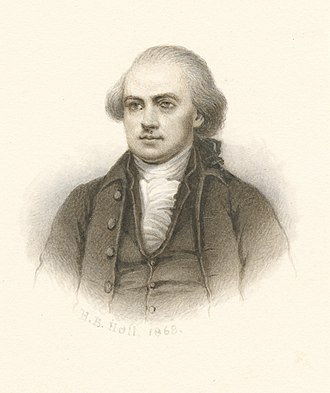
William Ellery (December 22, 1727 – February 15, 1820)[1] was a Founding Father of the United States, one of the 56 signers of the United States Declaration of Independence,[2][3] and a signer of the Articles of Confederation as a representative of Rhode Island.[4]
In 1764, the Baptists consulted with Ellery and Congregationalist Reverend Ezra Stiles on writing a charter for the college that became Brown University. Ellery and Stiles attempted to give control of the college to the Congregationalists, but the Baptists withdrew the petition until it was rewritten to assure Baptist control. Neither Ellery nor Stiles accepted appointment to the reserved Congregationalist seats on the board of trustees.[5]
Biography
Ellery was born in Newport, Rhode Island on December 22, 1727,[2] the second son of William Ellery, Sr. and Elizabeth Almy, a descendant of Thomas Cornell. He received his early education from his father, a merchant and Harvard College graduate. He graduated from Harvard College in 1747, where he excelled in Greek and Latin. He then returned to Newport where he worked first as a merchant, next as a customs collector, and then as clerk of the Rhode Island General Assembly. He started practicing law in 1770 at age 43 and became active in the Rhode Island Sons of Liberty.
Statesman Samuel Ward died in 1776, and Ellery replaced him in the Continental Congress. He was a signer of the Articles of Confederation and one of the 56 signers of the Declaration of Independence in 1776. The size of his signature on the Declaration is second only to John Hancock's famous signature.
Ellery also served as an associate justice of the Supreme Court of Rhode Island from May 1780 to May 1781, and chief justice from June 1785 to May 1786.[6] He had become an abolitionist by 1785. He was the first customs collector of the port of Newport under the Constitution, serving there until his death, and he worshipped at the Second Congregational Church of Newport.[7][8]
Ellery died on February 15, 1820, at age 92 and was buried in Common Burial Ground in Newport.[9] The Rhode Island Society of the Sons of the Revolution and the William Ellery Chapter of the Daughters of the American Revolution make an annual commemoration at his grave on Independence Day.
Family and legacy

Coat of Arms of William Ellery
Ellery married Ann Remington of Cambridge, Massachusetts, in 1750. She was the daughter of Judge Jonathan Remington. She died in 1764 in Cambridge and was buried there, and he married Abigail Cary in 1767. He had 19 children, and his descendants include Ellery Channing, Washington Allston, William Ellery Channing, Richard Henry Dana, Sr., Edie Sedgwick, Paulita Sedgwick, Kyra Sedgwick and Andra Akers.[10] Francis Dana married his daughter Elizabeth. His great-great-grandnephew, Major Elbert Ellery Anderson (1833-1903), took his middle name from him.[11]
Ellery left a humorous record of his travels (on a mount he refers to as "my Jenny") from Massachusetts to Philadelphia in 1778 and 1779 that was published in serial form in the Pennsylvania Magazine of History and Biography of the Historical Society of Pennsylvania (1887).[12]
William Ellery is the namesake of the town of Ellery, New York,[13] and Ellery Avenue in Middletown, Rhode Island, is named in his honor
S. Johnson in HWGTN states that the first mass-produced watch in America named for Ellery (popular with Civil War soldiers; Lincoln owned one as well. Page 176).
SANDBOX (7/26): TheBrain
AMERICAN CONNECTIONS
WILLIAM ELLERY (RI) was forty-eight. Well-heeled
son of Rhode Island's deputy governor, after Harvard and business he
went into politics, then law, then entered Congress just in time for the
Great Continental Loan Office shambles.
Congress had decided to pay for the war by raising $5 million from the
public. In return for which the public would get government bonds at a 4
percent annual interest rate over three years. Congress then borrowed
enough money from French investors to be able to pay back the public.
However, what bondholders finally received turned out to be not money
but French exchange notes. No problem, as these were cashable in Paris.
Except it took forever to get your cash. And because by 1781 the U.S.
currency had inflated out of sight, what you got was peanuts.
All of which made U.S. bondholders extremely unhappy and also
discouraged foreigners from investing in the U.S. economy. In
consequence of which things financial were getting decidedly
problematic. But for a while, before all this happened and things went
from bad to bankruptcy, the original government bonds were almost as
good as money and were spread around, where needed, by the Continental
Loan Office.
Rather a lot of the bonds went to John Brown of Rhode Island (via his
friend William Ellery, at the time state commissioner in charge of
issuing the bonds) for "services rendered." This included Brown's
building Navy ships in his shipyard and making armaments in his foundry.
The Providence, at one time under the command of Continental Navy officer John Paul Jones, went on to participate in 60 engagements and capture 40 British ships before it was dismantled in 1779 to prevent it from falling into British hands.
Brown was a leader in the Sons of Liberty and was one of the instigators of the burning of the *Gaspee* in 1772
Brown ended up wealthy enough to be president of the new Providence
Bank. The other major source of Brown's income was his distillery, which
did so well because he was also a slaver. He and close shipping
associates the four D'Wolf brothers made a ton of money by shipping rum
to Africa, where they exchanged it for slaves, then shipping the slaves
to the Caribbean, where they exchanged them for sugar and molasses, then
shipping this back to Rhode Island where they distilled it into rum.
Which they then shipped back to Africa, etc.
This little trick was known as the "triangle trade" and nice work if you
could get it. And soon it was also against the law. So the D'Wolfs
branched out. In 1806 one of them, John (later uncle-by-marriage of
Herman Melville) was sailing the Northwest Pacific coast picking up
pelts from the local Native Americans. His plan: take the skins to
Russia and trade them. In Sitka DeWolf bumped into the boss of the
Russian-American Company (the Russians owned Alaska at the time)
Nicholas Rezanov. To whom John sold his ship the Juno so
Rezanov could go off to San Francisco, set up Californian colonies, and
buy food for his starving Alaskan colonists.
Rezanov himself had just arrived in Sitka on board the first Russian
round-the-world expedition. Which then shoved off to continue round the
world, carrying teenage explorer Otto von Kotzebue. Nine years later
Kotzebue was in command of the brig Rurik and set off for
another round-the-world itinerary: June 1815 leave St. Petersburg and go round
Cape Horn, to Chile, Kamchatka, California, Hawaii, Guam, Philippines,
South Africa, London, arrive back St. Petersburg August 1818. During the
trip Kotzebue discovered nearly four hundred Pacific islands, atolls,
and assorted specks of land and wrote a best-selling account of the
voyage. Several plants, including the California poppy, Eschscholzia californica, were named after his friend Johann Friedrich von Eschscholtz, the Rurik's entomologist.
But not as best-selling as the piece written by his on-board naturalist
Adalbert von Chamisso (French aristo family, ran away from guillotine,
settled in Berlin, hence the "von"). Soldier-turned-botanist with an
interest in the creepy, in 1811 Chamisso spent time at the Swiss villa
of Romantic maven Madame De Stael. By the time of his voyage with
Kotzebue (during which he identified floating fruits as Pacific island
vegetation colonizers), Chamisso had written poetry set to music by
Schumann as well as his own internationally acclaimed Peter Schliemihl,
the Man Who Sold his Shadow (to the Devil, in return for a
bottomless purse, but finds happiness only wearing magic boots and
botanizing---weird or what?).
The story resonated with Robert MacNish, doctor in utmost northern
Scottish nowhere (Caithness) where, apart from nothing else, the
solitude got to him. Go there and you'll see what he meant. On his
return to big-city Glasgow in 1824 MacNish's hair fell out, he became
paranoid and wrote: The Metempsychosis (two drunks agree to
exchange bodies and can swap back again only by selling their souls),
The Anatomy of Drunkenness (a study of the shakes, slurred
speech, feeling no pain, etc.), and Philosophy of Sleep (a
study of nightmares, trances, and sleepwalking). The kind of stuff that
would today get MacNish's head examined.
Which is what MacNish himself did, depositing a plaster cast of his own
skull with the secretary of the Edinburgh Phrenological Society, Robert
Cox, who analyzed bumps on the head to see what was wrong with you. When
he wasn't feeling skulls Cox was a lawyer. In 1847 he was hired to
represent a bunch of botanizers who'd had a "heated exchange" with the
sixth Duke of Atholl and his gamekeeper goons, who had prevented the
botanizers from walking up Glen Tilt.
Tilt is in the middle of the Highlands, an as-advertised picture-perfect
Scottish Glen. And back then it was, like large bits of Scotland, the
exclusive property of the Duke of Atholl (an early and brutal example of the Clearances). Whose message to the plant-picking ramblers heading onto his land was: No Way. A red rag to the Right of Way Society to which these veggie enthusiasts belonged.
Amazingly they won their court case and today you, too, have the right
to walk up Glen Tilt (so long as you stay on the road).
Leader of the ROW group was Professor John Hutton Balfour of Glasgow and
Edinburgh universities. One of the first true ecologists, Balfour taught
botany in context (how the plant and its location related to the local
geology, meteorology, topography, etc). Balfour lived, ate, and slept
botany after starting as a doctor (as so many did, when there were so
few specialist subjects to study). He was big in the local Botanical
Society, the Botanical Club, professor of medicine and botany, keeper of
the Royal Botanical Gardens, and the Queen's botanist for Scotland. And
wrote a book about the links between botany and the Bible. And had a
blackberry plant named after him. His great-great-granddaughter is actress Tilda Swinton, who went to a boarding school, where she was a friend of Lady Diana Spencer, the future Princess of Wales.
Balfour learned a lot about the countryside from senior academic pal
Archibald Geikie, who was as nuts about geology as was Balfour about
botany. Geikie did the classic thing: picking up fossils as a kid and
becoming an obsessive rockhound thereafter. His life was one long climb
up the academic cliff face from assistant on Scottish geological surveys
to professor and sir. Geikie's real passion was reserved for volcanoes
(major opus in 1897: The Ancient Volcanoes of Great Britain,
and he traveled France and the United States peering into these
dangerous hot spots. His major geo-thought was that the landscape looked
the way it did because hard rocks weathered less than soft rocks. Made
sense.
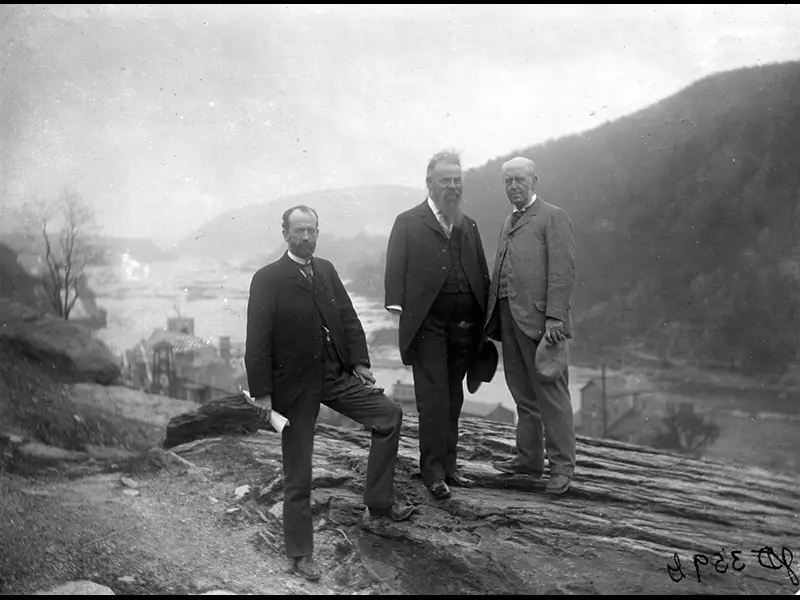
He was much influenced by meeting pioneers of U.S. western geology, one-armed Civil War veteran and explorer of the Grand Canyon Major John Wesley Powell and Clarence Dutton in 1879. They organized the scientific Cosmos Club, in Dolley Madison House.
Geikie also wrote the biography of his mentor, the arrogant,
self-opinionated, and aggressively irascible Sir Roderick Impey
In 1818 Murchison made the acquaintance of Sir Humphry Davy, who urged Murchison to turn his energy to science, after hearing that he wasted his time riding to hounds and shooting. With encouragement from his wife Charlotte, Murchison became fascinated by the young science of geology and joined the Geological Society of London, soon becoming one of its most active members. His colleagues there included Adam Sedgwick, William Conybeare, William Buckland, William Fitton, Charles Lyell and Charles Darwin.
Murchison was (rightly) convinced that strata didn't tell you
diddly about history because strata could go up and down and be
interrupted, folded, and other stuff that made it untrustworthy,
sequence-wise. Fossils were the only true guide. Once you found a
reliable and uninterrupted baseline stratum. Murchison's UBS was
Silurian, and he made enemies because he kept on expanding it and
snitching fossils from other people's strata. This was Victorian England
and the whole of knowledge was up for grabs.
One of Murchison's (very few) friends was Andrew Ramsay, who thought
glaciers were so exciting he took his honeymoon among them. Discovered
that glaciers scooped out holes that were now lakes. Spoke French at
breakfast once a week for life. Said field work beat lab work and that
he wouldn't "look at a mountain with a microscope." And fortunately for
this chapter (enough geology, already!) had a nephew who was a chemist.
William Ramsay was the chemistry noodler of all time. Most of his life
was spent boiling cold stuff.
He started by investigating vapor, liquids, and evaporation. Then, what else, moved on to gases. In 1894 he removed everything from liquid air and found something left behind, which he named argon. In 1895 he did the same thing with something else
and got helium. Then decided there must be something more to these new
gases. He boiled more cold stuff and in 1898 found krypton, neon, and
xenon. Got a Nobel for them in 1904. In 1907 (dedication to duty) he
boiled off, fractionated, separated, etc. one hundred tons of liquid
air. And found nothing he hadn't found before.
This jolly, witty, multilingual, single-minded geek had started out at
the Tubingen lab of one Rudolf Fittig, German chemist whose work
included all you might have hated about chemistry at school. Words like
mesitylene, alkybenzenes, piperine naphthalene, and pinacol coupling
reaction (the last not what it sounds like).
Alongside Ramsay in this test-tube heaven was a young American, Ira
Remsen, who stayed on for two years as lab assistant to Fittig after
getting a Ph.D. In 1872 Remsen went home to the United States, taught
for a while at Williams College, and then set up the first chemistry
department at the new Johns Hopkins University. Where in 1879 he made
the great discovery (or didn't).
One night at dinner after a hard day in the office toiling over coal tar
derivatives his bread rolls tasted sweet. Then bitter. But not to his
wife. So back in the lab next day he licked everything he'd touched (or
didn't) and bingo there was the same taste. In a chemical called
o-toluenesulfonamide. Which he renamed "saccharin" (or didn't). The
doubts expressed here (in parentheses) relate to the fact that exactly
the same story was told later by Remsen's assistant Constantine
Fahlberg, who patented saccharine and made a fortune. Remsen got upset
not about the money but about who'd done the discovering.
In 1891 Fahlberg started earning serious money when R. J. Reynolds used
saccharine to sweeten their chewing tobacco. Reynolds put his first
factory next to the railroad in Winston, North Carolina. Which was next
to the tobacco-growing belt. He also foresaw that cigarettes would soon
replace plug tobacco and in 1911 produced the Camel brand. The rest, as
they say, is respiratory-medicine history.
Starting in 1907, the United States Food and Drug Administration began investigating saccharin as a result of the Pure Food and Drug Act, passsed on the furire caused by Upton Sinclair's *The Jungle* ( he complained about the public's misunderstanding of the larger point of his book by saying, "I aimed at the public's heart, and by accident I hit it in the stomach.")
Harvey Wiley, then the director of the bureau of chemistry for the FDA, viewed it as an illegal substitution of a valuable ingredient, sugar, by a less valuable ingredient. In a clash that had career consequences, Wiley told President Theodore Roosevelt, "Everyone who ate that sweet corn was deceived. He thought he was eating sugar, when in point of fact he was eating a coal tar product totally devoid of food value and extremely injurious to health." But Roosevelt himself was a consumer of saccharin, and, in a heated exchange, Roosevelt angrily answered Wiley by stating, "Anybody who says saccharin is injurious to health is an idiot." The episode proved the undoing of Wiley's career.
R.J. Reynolds was born on an estate near Critz, Virginia, just outside the
town of Martinsville. Where in 2005 the American Standard Building
Systems company was producing homes. One of their models (two floors,
three bedrooms, 2,606 sq.ft.) was named the WILLIAM ELLERY.
Multimedia:
Wiley's achievements are the subject of Deborah Blum's 2018 nonfiction book The Poison Squad: One Chemist's Single-Minded Crusade for Food Safety at the Turn of the Twentieth Century, which was the basis for The Poison Squad, a documentary film that first aired on American Experience on January 28, 2020. The Liberty Ship S.S. Harvey W. Wiley was one of 2751 World War II Liberty Ships built between 1941 and 1945.